Monthly Archives: October 2020

News: eFounders unveils its next batch of enterprise SaaS startups

Since 2011, European startup studio eFounders has launched 27 companies with a focus on software-as-a-service companies trying to improve the way we work. Some of them have been quite successful, such as Front and Aircall. And the company is working on its next batch of startups. “We’re particularly inspired by the new wave of productivity

Since 2011, European startup studio eFounders has launched 27 companies with a focus on software-as-a-service companies trying to improve the way we work. Some of them have been quite successful, such as Front and Aircall.

And the company is working on its next batch of startups. “We’re particularly inspired by the new wave of productivity tools, that is ever more collaborative and flexible,” eFounders co-founder Thibaud Elziere said in a statement

In exchange for financial and human resources, eFounders keeps a significant stake in its startups. Ideally, startups raise a seed round and take off on their own after a year or two.

Here’s what’s coming up from eFounders.

Canyon

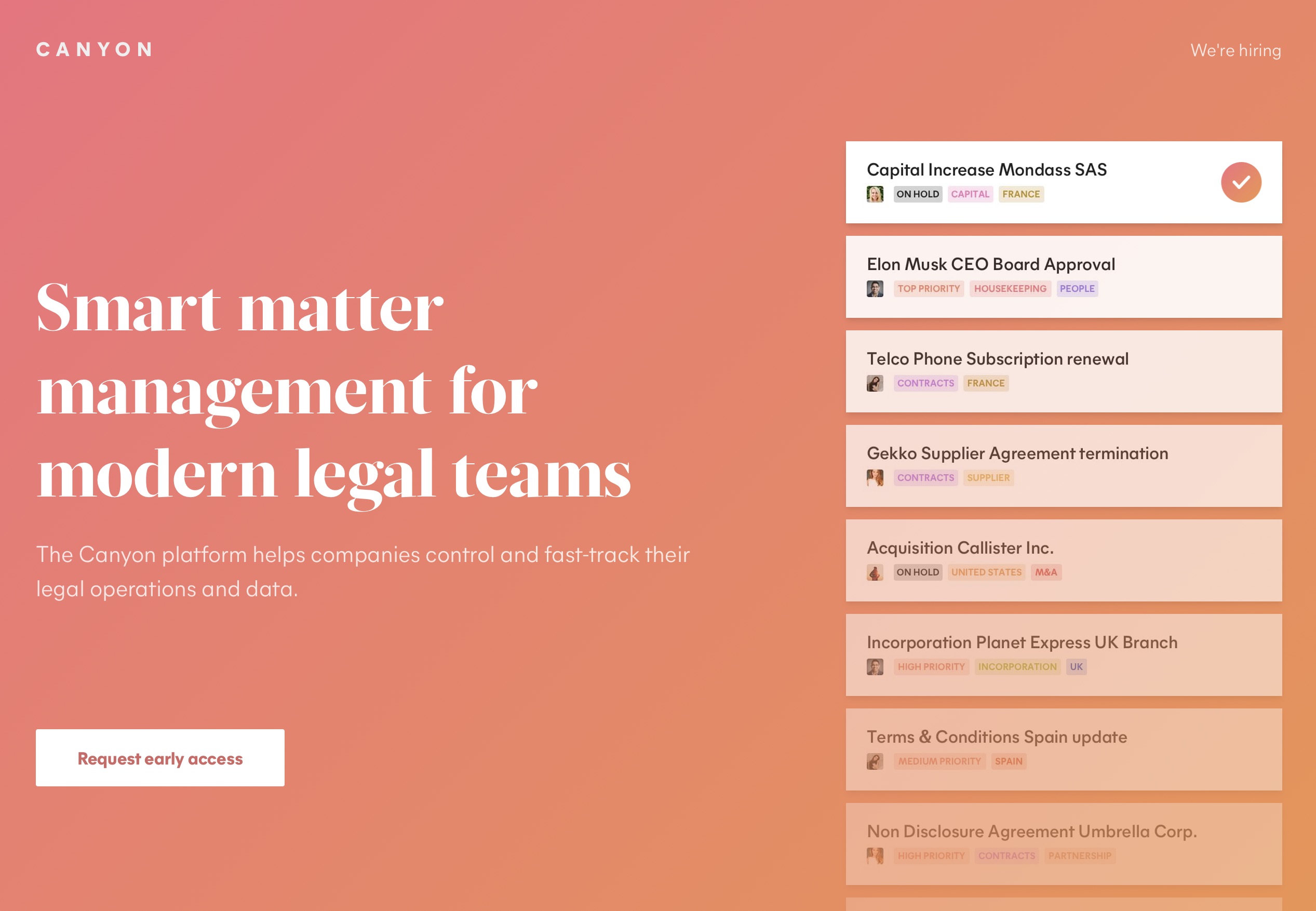
Canyon is a product for legal teams that want to ditch Word, PDF documents and emails. It starts with a central hub to hold all your drafts and documents. This way, you can track progress, get the latest document version and see the context around a document. Given that it is tailored for legal teams, it should work a bit better than a shared Dropbox folder.

You can create templates to reuse them later, see related emails directly in Canyon’s interface and invite other people so that they can have a look at what you’ve been working on.

Image Credits: Canyon

Kairn

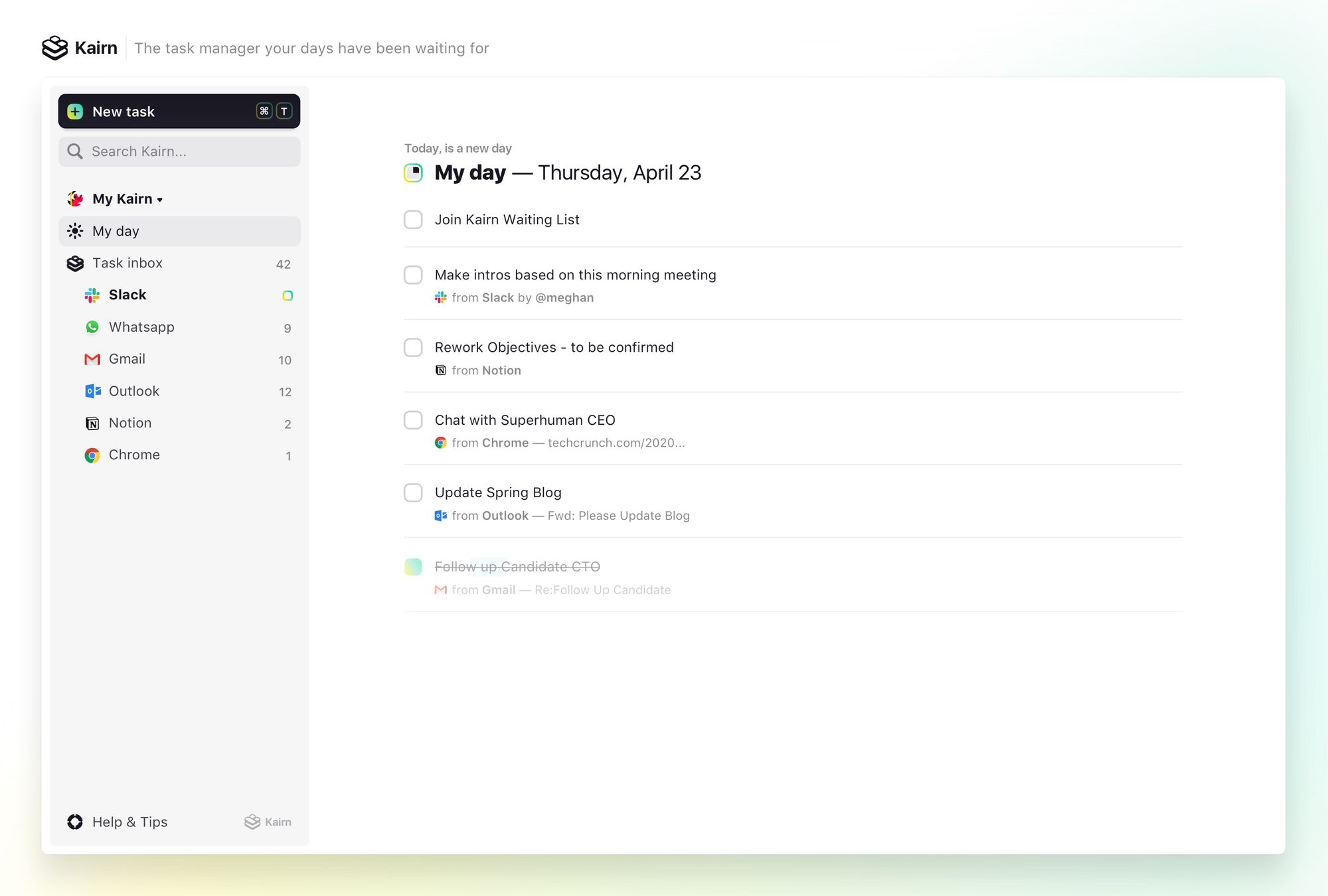
Kairn is a task manager that tries to get out of the way as much as possible. When you’re working on your computer, you can add tasks directly from the app that you’re already using.

For instance, you can imagine adding a task by starring an email conversation in Gmail, forwarding a message to a WhatsApp bot or starring a message in Slack. There’s also a quick add window that you can trigger with a keyboard shortcut.

Read my full article on Kairn:

Image Credits: Kairn

Crew

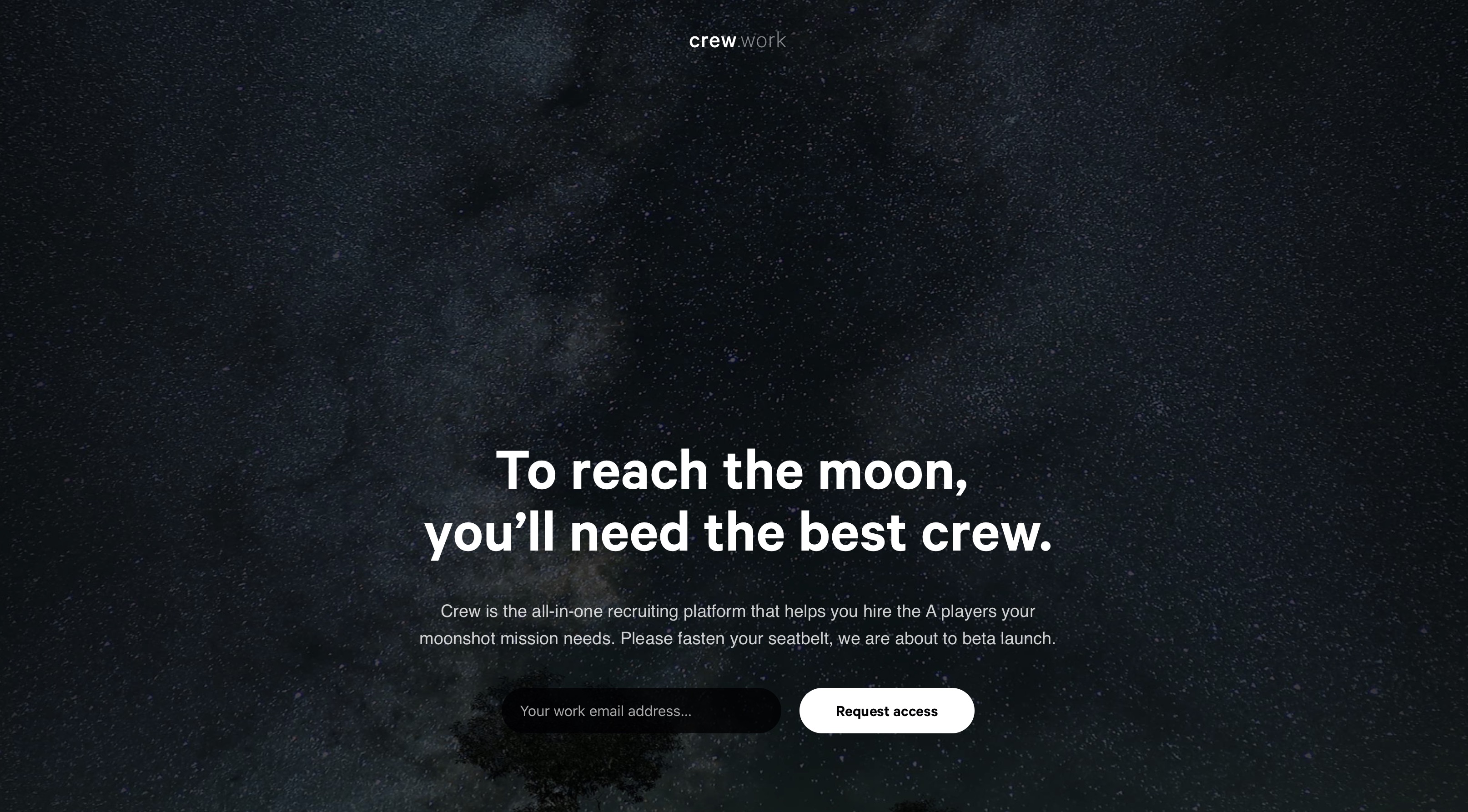
Crew is focused on new hires and job applications. Given that many companies are actively looking for interesting candidates, Crew isn’t just a way to passively collect applications.

It lets you create automated workflows and handle everything you’d expect from a recruitment platform.

Image Credits: Crew

Collective

Collective is a product for freelancers who want to work together and form groups. It should make it easier to send a contract to a client that involves multiple freelancers working on the contract. Collective will make it easier to remain legally compliant.

News: Allbirds CEO Joey Zwillinger on the startup’s $100 million round, profitability, and SPAC mania

As people spend less time out in the world and more time daydreaming about when a vaccine will arrive, lifestyle shoes are only gaining traction. One obvious beneficiary is Allbirds, the San Francisco-based maker of comfortable, sustainable kicks that launched in 2016 and quickly became a favorite in Silicon Valley circles before taking off elsewhere.

As people spend less time out in the world and more time daydreaming about when a vaccine will arrive, lifestyle shoes are only gaining traction.

One obvious beneficiary is Allbirds, the San Francisco-based maker of comfortable, sustainable kicks that launched in 2016 and quickly became a favorite in Silicon Valley circles before taking off elsewhere.

Though the company saw its business slow this year because of the pandemic, its products are now available to purchase in 35 countries and its 20 brick-and-mortar stores are sprinkled throughout the U.S. and Europe, with another outpost in Tokyo and several shops in China.

Investors clearly see room for more growth. Allbirds just closed on $100 million in Series E funding at roughly the same $1.6 billion valuation it was assigned after closing on $27 million in Series D funding earlier this year, and blank-check companies have been calling, says cofounder and CEO Joey Zwillinger. He talked with us earlier this week in a chat that has been edited for length and clarity.

TC: Your shoes are sold worldwide. What are your biggest markets?

JZ: The biggest market by far is the U.S., and the same day that we started here in 2016, we also launched in New Zealand, so that’s been very good to us over the last four years, too. But we’ve seen growth in Japan and Korea and China and Canada and Australia. We have a network of warehouses globally that lets us reach 2.5 billion people [who], if they were so inclined, could get their product in three days. We’re proud of the infrastructure we’ve set up.

TC: We’ve all worn shoes a lot less than we might have expected in 2020. How has that impacted your business?

JZ: We’re growing but definitely not at the same pace we would be had the pandemic not occurred. We’re predominantly digital in terms of how we reach people, but stores are important for us. And we had to switch [those] off completely and lost a portion of our sales for a long time.

TC: Did you have to lay off your retail employees?

JZ: A large portion of our retail force was unable to work, but we were luckily able to keep them fully paid for four months, plus [some received] government benefits if they got that. And now all of our 20 stores are up and running again in a way that’s totally safe and everyone feels really comfortable.

We also donated shoes to frontline workers — 10,000 pairs or around a million dollars’ worth.

TC: What does Allbirds have up its sleeve, in terms of new offerings?

JZ: We just launched our native mobile app, and through it we’re able to give our more loyal fans exclusives. It’s a really cool experience that blends technology with fashion. You can try on shoes in a virtual mirror; you’re given information [about different looks] that you wouldn’t have otherwise.

We also launched wool-based weather-proofed running shoes in April that have blown away our expectations but [were fast discovered by] people who haven’t really been running for 10 to 15 years and are running again [because of gym closures]. It’s a super high-stakes category and one that’s hard to break into because people buy on repeat. But we spent two years making it. It’s not like we launched it because of the pandemic. It’s a shoe for 5K to 10K distances — it’s not a marathon shoe or a trail shoe — and that we’ve been able to clearly articulate that speaks to its success, I think.

TC: What about clothing?

We launched underwear and socks last year in a small launch. We developed a textile that hasn’t been used before — it’s a blend of tree fiber and merino wool because our view is that nature can unlock magic. Underwear is typically synthetic — it’s made from plastics — or cotton, which isn’t a great material for a whole bunch of reasons. [Meanwhile] ours is phenomenal for temperature control; it also feels like cashmere.

TC: Patagonia really advertises its social and environmental values. Do you see Allbirds evolving in a similar way, with a growing spate of offerings?

JZ: I’m incredibly humbled by [the comparison]. Given their environmental stewardship of the retail sector, we hope we’re compared to them. But they are much more of an outdoor brand — not a competitor so to speak. And we’d love to share more of the retail world with them so we can do our environmental thing together.

TC: You just raised funding. Are you profitable and, if not, is profitability in sight?

JZ: We’ve been profitable for most of our existence. Having some discipline as we grow is good. We’re not close to the profitability that we’ll eventually have, but we’re still a small company in investment mode. After we emerge from the pandemic, we’ll enter a ramping-up phase.

TC: Everyone and their brother is raising money for a blank-check company, or SPAC, which can make it a lot faster for a private company to go public. Have you been approached, and might this option interest you?

JZ: Yes and no. Yes we’ve been approached, and no, we’re [not interested]. We want to build a great company and being public might be something that helps enable that for a whole bunch of reasons. But we want to do it at the right time, in a way that helps the business grow in the most durable and sustainable fashion. Just jumping at the opportunity of a SPAC without doing the rigorous prep the way we want to, we’re not super focused on that

News: Indian startups explore forming an alliance and alternative app store to fight Google’s ‘monopoly’

Google, which reaches more internet users than any other firm in India and commands 99% of the nation’s smartphone market, has stumbled upon an odd challenge in the world’s second largest internet market: Scores of top local entrepreneurs. Dozens of top startups and firms in India are working to form an alliance and toying with

Google, which reaches more internet users than any other firm in India and commands 99% of the nation’s smartphone market, has stumbled upon an odd challenge in the world’s second largest internet market: Scores of top local entrepreneurs.

Dozens of top startups and firms in India are working to form an alliance and toying with the idea of launching an app store to cut their reliance on Google, five people familiar with the matter told TechCrunch.

The list of entrepreneurs include high-profile names such as Vijay Shekhar Sharma, co-founder and chief executive of Paytm (India’s most valuable startup), Deep Kalra of travel ticketing firm MakeMyTrip, and executives from PolicyBazaar, Sharechat and many other firms.

The growing list of founders expressed deep concerns about Google’s “monopolistic” hold on India, and discussed what they alleged was unfair and inconsistent enforcement of Play Store’s guidelines in the country.

The conversations, which began in recent weeks, escalated on Tuesday after Google said that starting next year developers with an app on Google Play Store must give the company a cut of as much as 30% of several app-related payments.

Dozens of executives “from nearly every top startup and firm” in India attended a call on Tuesday to discuss the way forward, some of the people said, requesting anonymity. A 30% cut to Google is simply unfeasible, people on the call unanimously agreed.

Vishal Gondal, the founder of fitness startup GOQii, confirmed the talks to TechCrunch and said that an alternative app store would immensely help the Indian app ecosystem.

TechCrunch reached out to Paytm on Monday for comment and the startup declined the request.

In recent months, several major startups in India have also expressed disappointment over several of the existing industry bodies, which some say have failed to work on nurturing the local ecosystem.

The tension between some firms and Google became more public than ever late last month after the Android-maker reiterated Play Store’s gambling policy, sending a shockwave to scores of startups in the country that were hoping to cash in on the ongoing season of Indian Premier League cricket tournament.

Google temporarily pulled Paytm’s marquee app from the Play Store citing repeat violation of its Play Store policies. Disappointed by Google’s move, Paytm’s Sharma said in a TV interview, “This is the problem of India’s app ecosystem. So many founders have reached out to us… if we believe this country can build digital business, we must know that it is at somebody else’s hand to bless that business and not this country’s rules and regulations.”

Google has sent notices to several firms in India including Hotstar, TechCrunch reported last month. Indian newspaper Economic Times reported on Wednesday that the Mountain View giant had also sent warnings to food delivery startups Swiggy and Zomato.

Vivek Wadhwa, a Distinguished Fellow at Harvard Law School’s Labor and Worklife Program, lauded the banding of Indian entrepreneurs and likened Silicon Valley giants’ hold on India to the rising days of East India Company, which pillaged India. “Modern day tech companies pose a similar risk,” he told TechCrunch.

Some of the participating members are also hopeful that the government, which has urged the citizens in India to become self-reliant to revive the declining economy, would help their movement.

Other than its reach on Android, Google today also leads the mobile payments market in India, TechCrunch reported earlier this year.

The giant, which has backed a handful of startups in India and is a member of several Indian industry bodies, invested $4.5 billion in Mukesh Ambani’s telecom giant Jio Platforms earlier this year.

India’s richest man Ambani, who runs oil-to-retails giant Reliance Industries, is an ally of Indian Prime Minister Narendra Modi. Jio Platforms has attracted over $20 billion in investment from Google, Facebook, and 11 other high-profile investors this year.

The voluminous investment in Jio Platforms has puzzled many industry executives. “I see no business case for Facebook investing in Jio beyond saying we need regulatory help,” said Miten Sampat, a high-profile angel-investor on a podcast published Wednesday.

“This is a white-collar way of saying there is corruption involved, and if the government gets upset, I have invested somewhere with some friend of the government. All of us are losing at the benefit of one company,” he said. Sampat’s views are shared by many industry executives, though nobody has said it on record and in such clear terms.

Google said in July that it would work with Jio Platforms on low-cost Android smartphones. Jio Platforms is planning to launch as many as 200 million smartphones in the next three years, according to a pitch the telecom giant has made to several developers. Bloomberg first reported about Jio Platform’s smartphone production plans.

These smartphones, as is the case with nearly 40 million JioPhone feature phones in circulation today, will have an app store with only a few dozen apps, all vetted and approved by Jio, according to one developer who was pitched by Jio Platforms. An industry executive described Jio’s store as a walled-garden.

A possible viable option for startup founders is Indus OS, a Samsung-backed third-party store, which last month said it reaches over 100 million monthly active users. As of earlier this week, Paytm and other firms had not reached out to IndusOS, a person familiar with the matter said.


WordPress Image Lightbox Plugin