
Monthly Archives: October 2020

News: The Spectrum Equity-backed video education platform Kajabi has already hit $60 million in ARR

Kajabi may not be an American household name, but users of the web hosting and video tech platform are now being seen in a lot of American households. The company, initially bootstrapped and profitable since its launch, raised a minority investment from Spectrum Equity Partners last November, but that was merely icing on the cake

Kajabi may not be an American household name, but users of the web hosting and video tech platform are now being seen in a lot of American households.

The company, initially bootstrapped and profitable since its launch, raised a minority investment from Spectrum Equity Partners last November, but that was merely icing on the cake for a business that had seen its user adoption surge.

The COVID-19 pandemic has pushed that adoption even higher as work-from-home gigs yield to work-from-home side hustles and anyone and everyone decides to get in on on the online education and training action, the company said.

In the past year alone, the company has seen its run rate cross $60 million in August and the company hit over $1 billion in recorded transactions milestone in March, according to chief marketing officer Orlando Baeza, who previously served as a marketing executive at Buzzfeed and Paramount Pictures .

Last November, the company took a minority equity investment from Spectrum Equity Partners, the first outside capital the company raised since its inception a bit over a decade ago.

Founded by a former commodities trader, Kenny Rueter, Kajabi is like Thinkific or Patreon primarily for online learning and video-based entrepreneurs.

“It’s not just a way  to sell your content,” said Kajabi President, Jonathan Cronstedt. “It does do your webpage, blog, email marketing, marketing automation, digital delivery. It does the  webinar aspect and the marketing you’d need to build up a list of prospects… It’s a platform from start to finish for an online business.”

If the best way to make money during a gold rush is to sell picks and shovels, then think of Kajabi as the pick and shovel purveyor for the self-help, startup guide, guru advice set.

The company touts its enabling of self-help legends like Brendon Burchard, Danielle Leslie, and Amy Porterfield, and, most recently, Sophia Amoruso, who joined the platform in August.

“We want  to empower entrepreneurs, experts and influencers  who are serious about their business to have success  online,” said Cronstedt in a November interview when the company took its minority investment from Spectrum Equity. 

The company’s toolkit basically serves as an integration of the various bundle of software a business would need to get itself off the ground. Instead of integrating Shopify, Wix, and other platforms to create a full stack of tools, Kajabi does it for a business.

“There’s endless ways you can use duct tape and bailing wire to get all of these solutions together,” said Cronstedt. “[Businesses are] not going to have the chance to get it out there  because they’re too busy trying to be a platform integrator… they never get into creating anything.”

With over 100 employees, the company sees itself on a pandemic-driven trajectory that should set the company up for massive growth.

Indeed, online learning is now a $220 billion global market, and the self-help market alone is $11 billion (people need a lot of help). The company also cites statistics that put the number of Americans pursuing a “side hustle” at roughly 35% with an estimated 40 million “solopreneurs” in the U.S. workforce.

“Since inception, we have helped 41 million users access great educational content and our customers have generated over 1 billion in sales,” said Rueter, in a November statement. “We feel fortunate to partner with incredible entrepreneurs who are sharing their expertise with the world and are excited to help so many more.”
News: Google takes aim at ‘beauty filters’ with design changes coming to Pixel phones

Google is taking aim at photo face filters and other “beautifying” techniques that mental health experts believe can warp a person’s self-confidence, particularly when they’re introduced to younger users. The company says it will now rely on expert guidance when applying design principles for photos filters used by the Android Camera app on Pixel smartphones.

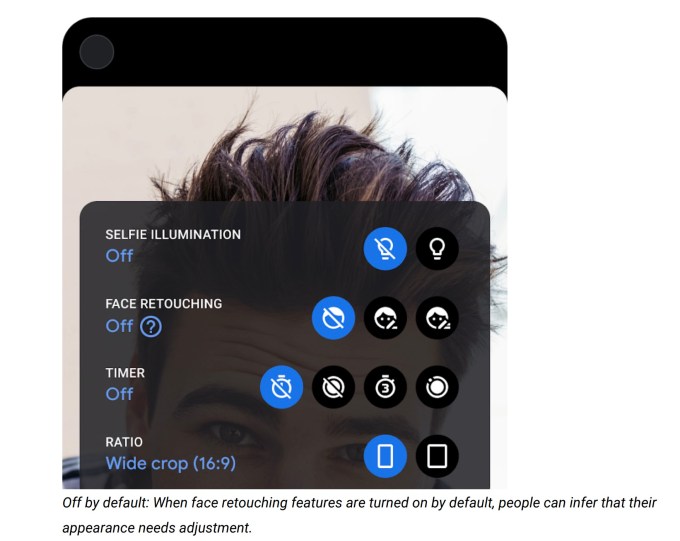
Google is taking aim at photo face filters and other “beautifying” techniques that mental health experts believe can warp a person’s self-confidence, particularly when they’re introduced to younger users. The company says it will now rely on expert guidance when applying design principles for photos filters used by the Android Camera app on Pixel smartphones. In the Pixel 4a, Google has already turned off face retouching by default, it says, and notes the interface will soon be updated to include what Google describes as “value-free” descriptive icons and labels for the app’s face retouching effects.

That means it won’t use language like “beauty filter” or imply, even in more subtle ways, that face retouching tools can make someone look better. These changes will also roll out to the Android Camera app in other Pixel smartphones through updates.

The changes, though perhaps unnoticed by the end user, can make a difference over time.

Google says that over 70% of photos on Android are shot with the front-facing camera and over 24 billion photos have been labeled as “selfies” in Google Photos.

Image Credits: Google

But the images our smartphones are showing us are driving more people to be dissatisfied with their own apparences. According to the American Academy of Facial Plastic and Reconstructive Surgery, 72% of their members last year said their patients had sought them out in order to improve their selfies, a 15% year-over-year increase. In addition, 80% of parents said they’re worried about filters’ impact and two-thirds of teens said they’ve been bullied over how they look in photos.

Google explains it sought the help of child and mental health experts to better understand the impact of filters on people’s well-being. It found that when people weren’t aware a photo filter had been applied, the resulting photos could negatively impact mental well-being as they quietly set a beauty standard that people would then compare themselves against over time.

Image Credits: Google

In addition, filters that use terminology like “beauty,” “beautification,” “enhancement,” and “touch up” imply there’s something wrong with someone’s physical appearance that needs to be corrected. It suggests that the way they actually look is bad, Google explains. The same is true for terms like “slimming” which imply a person’s body needs to be improved.

Google also found that even the icons used could contribute to the problem.

It’s often the case that face retouching filters will use “sparkling” design elements on the icon that switches the feature on. This suggests that using the filter is making your photo better.

To address this problem, Google will update to using value-neutral language for its filters along with new icons.

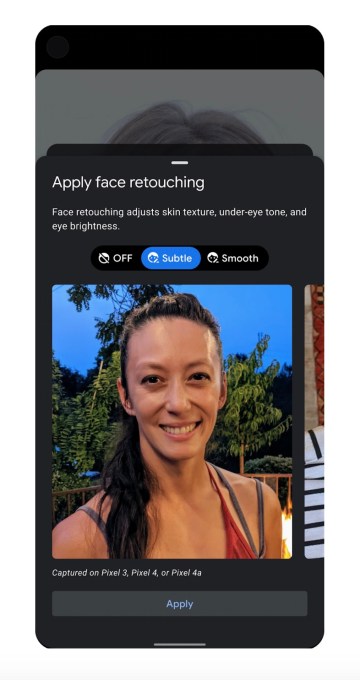
For example, instead of labeling a face retouching option as “natural,” it will relabel it to “subtle.” And instead of sparkling icons, it instead shows an icon of the face with an editing pen to indicate which button to push to enable the feature.

Adjustment levels will also follow new guidelines, and use either numbers and symbols or simple terms like “low” and “high,” rather than those that refer to beauty.

Image Credits: Google


Google says the Camera app, too, should also make it obvious when a filter has been enabled — both in the real-time capture and afterwards. For example, an indicator at the top of the screen could inform the user when a filter has been turned on, so users know their image is being edited.

In Pixel smartphones, starting with the Pixel 4a, when you use face retouching effects, you’ll be shown more information about how each setting is being applied and what specific changes it will make to the image. For instance, if you choose the “subtle” effect, it will explain that it adjusts your skin texture, under eye tone, and eye brightness. Being transparent about the effects applied can help to demystify the sometimes subtle tweaks that face retouching filters are making to our photos.

Face retouching will also be shut off in the new Pixel devices announced on Wednesday, including the Pixel 4a 5G and Pixel 5. And the changes to labels and descriptions are coming to Pixel phones through an upcoming update, Google says.

News: Hear how Porsche is preparing for the electric future at TC Sessions: Mobility

Detlev von Platen is a car guy, and in this age of new mobility, that’s important. Platen has been at Porsche for over 30 years and is currently on Porsche’s executive board as the sales and marketing executive. Before his current role, he lead Porsche North America, where he oversaw incredible growth. We’re thrilled Platen

Detlev von Platen is a car guy, and in this age of new mobility, that’s important. Platen has been at Porsche for over 30 years and is currently on Porsche’s executive board as the sales and marketing executive. Before his current role, he lead Porsche North America, where he oversaw incredible growth.

We’re thrilled Platen is speaking at TechCrunch Sessions: Mobility next week.

Porsche is in a curious position. As part of the Volkswagen family, Porsche has the manufacturing might of a giant, but a niche brand’s narrow focus. Right now, its lineup is largely unchanged over the last decade. The iconic 911 sits as Porsche’s halo car. The 718 Boxster sits under the 911 as an enthusiast option. The two SUVs are Porsche’s top-selling models, and the low-slung Panamera is a fantastic option for those looking for a sporty sedan. And then there’s the electric Taycan.

Last year, Porsche pulled the sheet off its first electric option, and so far, the electric Porsche Taycan is well-received. Like the rest of Porsche’s lineup, it’s a sports car first. We’re excited to speak to Platen about how Porsche can maintain and cultivate a strong brand identity even as consumer expectations change.

Porsche has been in this position in the past and excelled. In the late ’90s, the automobile world started turning its collective back on cars in favor of sport utility vehicles. And Porsche didn’t have an SUV. Porsche went on to build and sell the Cayenne starting in 2002 and, now in its third generation, is now the company’s top-selling model by an autobahn kilometer.

With the Cayenne, Porsche demonstrated it could infuse Porsche’s sports car identity into a four-door SUV. Can it do it again with electric vehicles?

The timing is critical. The State of California just announced an ambitious plan to ban the sales of cars powered internal combustion and it’s rumored the European Union will announce a similar deadline. Will Porsche be ready by California’s 2035 deadline? Will Porsche — gasp — sell an electric 911? We have a lot of questions, and we hope Platen has answers.

Please note, Detlev von Platen is replacing Klaus Zellmer at our event.

Three weeks ago, we announced Porsche Cars North America CEO Klaus Zellmer as a speaker at Mobility. Then, one week later, he became VW’s sales chief. Platen is a perfect replacement for our event. Before becoming Porsche’s top sales executive, he held Zellmer’s position as the CEO of Porsche Cars North America and has a great overview of Porsche’s electrification strategy.

TechCrunch Sessions: Mobility runs October 6-7, and tickets are still available. Thanks to COVID-19, the event is virtual, allowing anyone to participate in the interviews, demos, and breakout sessions where attendees can ask speakers questions.

We hope you can join our talk with Platen at TechCrunch Sessions: Mobility 2020. The event is virtual this year, therefore making it more accessible to attendees from around the world. Platen joins other mobility executives, including Bryan Salesky of Argo AI, Peter Rawlinson of Lucid Motors, and Tekedra Mawakana of Waymo.

News: Google now has three mid-range Pixel phones

The Pixel has always been a mixed bag. The first-generation product was announced roughly this time four years ago, with Google finally offering a full-throated entry into the smartphone space after years of device partnerships. Of course, by 2016, the market was already mature — particularly for Android phones. But while it was easy to

The Pixel has always been a mixed bag. The first-generation product was announced roughly this time four years ago, with Google finally offering a full-throated entry into the smartphone space after years of device partnerships.

Of course, by 2016, the market was already mature — particularly for Android phones. But while it was easy to write off those initial devices as Nexus-like references for future software updates, Google made it clear that it was taking the line seriously. It put any doubts to rest two years later, with its $1.1 billion acquisition of the design team from a struggling HTC.

But Google’s had struggles of its own. Slow Pixel 3 sales left the company in a tough spot, as the overall market took a hit. Google was able to correct the ship with the launch of the Pixel 3a, joining the likes of Apple and Samsung in offering budget versions of its smartphone flagship as consumers grew weary of premium prices.

It’s a strategy that makes sense. Two primary devices: a flagship and a budget model. Of course, the line has never been particularly clear for Google. For one thing, the company just doesn’t chase premium hardware in the same way that Apple, Samsung or Huawei does. Rather, it insists setting itself apart with its software — even for things like imaging. That often results in a less pronounced gap between devices. It also dulls the company’s edge with features that, more often than not, come to other Android devices.

But today’s hardware event blurred those lines more than ever. The dual-launch of the Pixel 5 and 4a 5G was arguably the most confusing element about a morning event with words “Launch Night” in its title.

Image Credits: Google

While pre-show rumors and leaks revealed a lot about the devices that ultimately proved true, they didn’t do much to distinguish the differences between the products. Turns out there’s an obvious reason: There really isn’t that much of a difference. If anything, the 4a 5G feels like a stepping stone toward the Pixel 5 — a device that would, perhaps, more fittingly have been named the Pixel 5a, if the company’s naming conventions worked that way.

We already knew that both devices were going to sport 5G. That seems to be Google taking advantage of Qualcomm’s aggressive push to bring the next-gen wireless technology to more budget devices. Really, the big driver here is that both devices utilize the same processors: Qualcomm’s Snapdragon 765G. It is, as I’m sure you’re aware, a mid-tier processor. It’s a step down from the 865 currently found in the majority of this year’s flagships.

Likely, the decision was a cost-cutting measure, but we’ve seen evidence from a number of manufacturers that it’s possible to produce an 865-sporting device priced in the middle six digits. Both devices also sport the same dual-camera set up on the rear and the same resolution screens — though the 4a 5G’s is actually bigger (albeit with a lower pixel density), at 6.2 inches to the 5’s 6.0.

There are some differences between the products to justify the $200 pricing gap. For starters, the 5 features a 100% recycled aluminum body, whereas the 4a 5G is polycarbonate. The cheaper phone lacks waterproofing and the reverse wireless charging found on the 5. It also sports a smaller battery, though both devices have been upgraded in that respect over the 4 and 4a. Battery life, after all, was the biggest complaint against the Pixel 4 — and either way you’re going to need more milliamp hours to handle the strains of 5G and, in the case of the 5, reverse charging.

So, are you clear on all of this? Me neither, to be honest. Google’s smartphone line now contains three devices. There’s a mid-tier handset, a slightly lower-mid-tier handset and an even lower-mid-tier handset. That’s three distinct devices with about a $300 price difference, all released within months of one another. It’s as if Google saw the 3a’s successes and decided “screw it, we’re making all of our products mid-range.” Affordability isn’t a bad thing, of course, but if you’re going to release three separate products over roughly a two-month span, you owe it to yourself and your fans to offer clearer value propositions.

Some of this is going to self-correct. For starters, it seems likely that the three devices will turn into two by this time next year. I don’t foresee the company keeping both an LTE and 5G model around in late-2021. There’s also the fact that the company has been undergoing a bit of an executive shakeup among the Pixel line — something that appears to point to a dramatic rethink of the line. It’s likely that the 4a, 4a 5G and 5 were already pretty far into development when Google started its executive shuffling.

Hopefully all of this will cause the company to rethink the Pixel line from the ground up and determine what Google can bring to the table that the competition can’t.

News: Microsoft enhances customer data platform as pandemic drives need for personalization

When Microsoft introduced its customer data platform last February the focus was on simply connecting silos of data to help customers get the data into the system, but as the pandemic has taken hold this year, customers need deeper insight into their customers and Microsoft has made some enhancements to the platform today. James Phillips,

When Microsoft introduced its customer data platform last February the focus was on simply connecting silos of data to help customers get the data into the system, but as the pandemic has taken hold this year, customers need deeper insight into their customers and Microsoft has made some enhancements to the platform today.

James Phillips, president of Microsoft business applications says the goal of the platform is about understanding customers at a deeper level. “From that depth of understanding our customers can engage their customers through the entirety of the customer lifecycle,” Phillips told TechCrunch.

That could involve a variety of activities such personalizing offers, speaking to them in a way that they know their customers want to be spoken to, offering them new products and services that better meet their needs or supporting them better, he said.

He adds that COVID-19 has changed customer priorities and forced them to make adjustments to the way they do business and how they interact with customers. “As everything’s gone digital, the need to deeply understand your customer and to increase the efficacy of those engagements has really been heightened through this pandemic,” he said.

The company is announcing several new components to the customer data platform product to help customers build that understanding. The first is called Customer Engagement, which as the name implies takes all that data they’ve pushed to the CDP to help understand that customer better and deliver more meaningful interactions. That goes into preview today.

“Engagement Insights is about directly funneling web, mobile and connected product data back into Customer Insights to help continue to enrich that understanding of the customer in order to better serve them,” he said.

The next piece is about putting AI to work on all that data to allow marketers to make more educated predictions about the customers based on what they know about them. This takes advantage of Azure Synapse Analytics and provides a set of pre-built AI templates to help customers with elements like predicting customer churn, automating product recommendations and estimating customer lifetime value.

In addition, the company is offering a data governance product to help protect that data and it’s integrating with Microsoft Customer Voice, the company’s survey tool to give customers the ability to fill in the blanks in the data by asking the customers when all of the data doesn’t provide an answer.

Phillips says all of these capabilities are about helping customers to be more agile, so that as the world shifts, as it has so dramatically this year, businesses can be in a better position to react to those changes more quickly and meet the changing customer requirements.

It’s worth noting that Microsoft clearly isn’t alone in this type of offering, as every big company that sells marketing tools from Adobe to Salesforce to SAP is offering similar products for similar reasons.

News: Twitter confirms some service flakiness today — now fixed

Twitter users around the world have reported some short partial outages today, with the platform not displaying certain tweets or not able to retrieve any at all. TC’s own geographically distributed staff reported issues with accessing tweets in Europe, India and the US, for example, while DownDetector‘s map indicated some service issues across the world

Twitter users around the world have reported some short partial outages today, with the platform not displaying certain tweets or not able to retrieve any at all.

TC’s own geographically distributed staff reported issues with accessing tweets in Europe, India and the US, for example, while DownDetector‘s map indicated some service issues across the world — with a more severe outage apparently concentrated in Japan.

In a support tweet, Twitter confirmed it’s had an issue — writing: “You may have had trouble sending and seeing Tweets” — but added the problem had been fixed. It didn’t offer further details about the issue.

Let’s see if this works…

You may have had trouble sending and seeing Tweets. (Yeah, us too.) We’ve now fixed this.

— Twitter Support (@TwitterSupport) October 1, 2020

Service outages aren’t unusual for Twitter, although the platform’s stability has improved greatly since the iconic ‘fail whale’ days. In recent years more major outages have been reported in 2017, 2018 and 2019.

Today’s flakiness appears to be pretty minor — resolving after a few minutes for users in Europe, for example.

News: News apps in the US and China use algorithms to drive engagement, discovery

Algorithms are reshaping many parts of our lives, including how news gets to us. Around the world, entrepreneurs make use of algorithms to program their ideal news apps, and while they normally agree on universal objectives like fighting fake news, their views diverge elsewhere, leading to different applications of machines and user experiences. No one

Algorithms are reshaping many parts of our lives, including how news gets to us. Around the world, entrepreneurs make use of algorithms to program their ideal news apps, and while they normally agree on universal objectives like fighting fake news, their views diverge elsewhere, leading to different applications of machines and user experiences.

No one has a monopoly over the “right” approach to build an algorithmic news app, but it’s perhaps timely and necessary to examine various players in the field and ask how their black boxes affect people’s content consumption. We need look no further than China and the U.S., where machine-driven news platforms are in full bloom.

Show me more of what I want

Before ByteDance became synonymous with TikTok globally, it was known in China for its algorithm-powered news app Jinri Toutiao, or Today’s Headlines. The Chinese app has not disclosed its user numbers for years, but third-party data suggests it had 360 million monthly active users by January 2020, eight years after launching.

Zhang Yiming, the founder of ByteDance, built Toutiao with the goal to give users more of what they want.

“We pictured Toutiao’s feed to be a smart antenna linked to an infinite ocean of information. When you swipe, you retrieve what you’re most interested in right now and in this place,” said Zhang at the company’s seventh anniversary. His remark echoes the app’s catchy tagline: Only what you care are headlines.

To achieve its mission, the app predicts user preferences based on a few parameters, Toutiao’s scientist Cao Huanhuan revealed in a speech in 2018: profiles per the app’s understanding of user demographics; content’s timeliness and popularity; users’ locations; and what similar users like to consume. The app then measures the success of its recommendations by tracking clicks, time spent, likes, comments and shares.

Having world-class algorithms is just part of the story; the other challenge is to create Zhang’s “ocean of information.” Early on, Toutiao relied on crawling the internet to fill its reservoir; these days, the app runs a publishing platform with creators ranging from news outlets, bloggers, celebrities, through to influencers. To sustain the torrent of information available, the app doles out subsidies and devises monetization methods for creators, sharing ad revenue and allowing them to sell products.

News: SAP continues to build out customer experience business with Emarsys acquisition

SAP seemed to be all in on customer experience when it acquired Qualtrics for $8 billion in 2018. It continued on that journey today when it announced it was acquiring Austrian cloud marketing company Emarsys for an undisclosed amount of money. Emarsys, which raised over $55 million, according to PitchBook data, gives SAP customer personalization

SAP seemed to be all in on customer experience when it acquired Qualtrics for $8 billion in 2018. It continued on that journey today when it announced it was acquiring Austrian cloud marketing company Emarsys for an undisclosed amount of money.

Emarsys, which raised over $55 million, according to PitchBook data, gives SAP customer personalization technology. If you talk to any marketing automation vendor over the last several years, the focus has been on using a variety of data and touch points to understand the customer better, and deliver more meaningful online experiences.

With the pandemic closing or limiting access to brick and mortar stores, personalization has taken a new urgency as customers are increasingly shopping online and companies need to meet them where they are.

With Emarsys, the company is getting an omnichannel marketing solution that they say is designed to deliver messages to customers wherever they are including e-mail, mobile, social, SMS, and the web, and deliver that at scale.

When SAP announced it was spinning out Qualtrics a couple of months ago, just 20 months after buying, it left some question about whether SAP was fully committed to customer experience business.

Brent Leary, founder and principal analyst at CRM Essentials says that the acquisition shows that SAP is still very much in the game. “This illustrates that SAP is serious about CX and competing in a highly competitive space. Emarsys adds industry-specific customer engagement capabilities that should help SAP CX customers accelerate their efforts to provide their customers with the experiences they expect as their needs change over time,” Leary told TechCrunch.

As an ERP company at its core, SAP has traditionally focused on back office kind of operations, but Bob Stutz, president, SAP Customer Experience sees this acquisition as a way to continue bringing back office and front office operations together.

“With Emarsys technology, SAP Customer Experience solutions can link commerce signals with the back office and activate the preferred channel of the customer with a relevant and consistently personalized message, allowing customers the freedom to choose their own engagement,” Stutz said in a statement.

The company, which is based in Austria, was founded back in 2000 when marketing was a very different world. It has built a customer base of 1500 companies with 800 employees in 13 offices across the globe. All of this will become part of SAP, of course and come under Stutz’s purview.

As with all transactions of this type it will be subject to regulatory approval, but the deal is expected to close this quarter.

News: Macrometa, an edge computing service for app developers, lands $7M seed round led by DNX

As people continue to work and study from home because of the COVID-19 pandemic, interest in edge computing has increased. Macrometa, a Palo Alto-based that provides edge computing infrastructure for app developers, announced today it has closed a $7 million seed round. The funding was led by DNX Ventures, an investment fund that focuses on

As people continue to work and study from home because of the COVID-19 pandemic, interest in edge computing has increased. Macrometa, a Palo Alto-based that provides edge computing infrastructure for app developers, announced today it has closed a $7 million seed round.

The funding was led by DNX Ventures, an investment fund that focuses on early-stage B2B startups. Other participants included returning investors Benhamou Global Ventures, Partech Partners, Fusion Fund, Sway Ventures, Velar Capital and Shasta Ventures.

While cloud computing relies on servers and data centers owned by providers like Amazon, IBM, Microsoft and Google, edge computing is geographically distributed, with computing done closer to data sources, allowing for faster performance.

Founded in 2018 by chief executive Chetan Venkatesh and chief architect Durga Gokina, Macrometa’s globally distributed data service, called Global Data Network, combines a distributed noSQL database and a low-latency stream data processing engine. It allows developers to run their cloud apps and APIs across 175 edge regions around the world. To reduce delays, app requests are sent to the region closest to the user. Macrometa claims that requests can be processed in less than 50 milliseconds globally, making it 50 to 100 times faster than cloud platforms like DyanmoDB, MongoDB or Firebase. One of the ways that Macrometa differentiates from competitors is that it enables developers to work with data stored across a global network of cloud providers, like Google Cloud and Amazon Web Services (for example), instead of a single provider.

As more telecoms roll out 5G networks, demand for globally distributed, serverless data computing services like Macrometa are expected to increase, especially to support enterprise software. Other edge computing-related startups that have recently raised funding including Latent AI, SiMa.ai and Pensando.

A spokesperson for Macrometa said the seed round was oversubscribed because the pandemic has increased investor interest in cloud and edge companies like Snowflake, which recently held its initial public offering.

Macrometa also announced today that it has added DNX managing partner Q Motiwala, former Auth0 and xnor.ai chief executive Jon Gelsey and Armorblox chief technology officer Rob Fry to its board of directors.

In a statement about the funding, Motiwala said, “As we look at the next five to ten years of cloud evolution, it’s clear to us that enterprise developers need a platform like Macrometa to go beyond the constraints, scaling limitations and high-cost economics that current cloud architecture impose. What Macrometa is doing for edge computing, is what Amazon Web Services did for the cloud a decade ago.”

News: Motif Foodworks preps commercial production for its first ingredient, improving the flavor of beef substitutes

Motif Foodworks, the Ginkgo Bioworks spinout focused on developing new plant-based flavorings and food ingredients, is readying commercial scale production of its first product an ingredient to improve the flavor of beef substitutes. The expansion of Motif’s manufacturing capacity presages the commercial availability of its new flavoring, which should be on folded into consumer products

Motif Foodworks, the Ginkgo Bioworks spinout focused on developing new plant-based flavorings and food ingredients, is readying commercial scale production of its first product an ingredient to improve the flavor of beef substitutes.

The expansion of Motif’s manufacturing capacity presages the commercial availability of its new flavoring, which should be on folded into consumer products by the fourth quarter of 2021, according to Motif chief executive Jonathan McIntyre.

“We’re making the product at pilot scale and we’re happy with the pilotization and now we’re scaling up to do large scales in formula development and characterization and talking to contract manufacturers about getting the product put in,” McIntyre said.

There’s a second product under development that’s focused on nutritional attributes for applications in sports nutrition and nutritional supplements, McIntyre said.

In all, Motif has nine ingredients under development with academic partners that will soon be coming to market.

“The first wave of those [ingredients] is targeted at plant-based meats,” McIntyre said. “Ground beef is the first one and the thing that you usually validate in.”

As the industry matures, there’s a growing sense among the lab grown meat and plant-based meat substitute manufacturers that the process isn’t as simple as just coming up with novel proteins to replicate the bloody taste of meats (like plant-based heme). Instead there’re going to be an array of ingredients and proteins that need to be identified and developed to replicate the fibrous textures and fats that make meat taste like meat.

It’s not just the muscle meat, what is critical is getting the flavor attributes and the other tissue attributes. When you get a steak and you see the marbleizing. That marbleizing creates a relationship between the protein fibers and the fat… has a lot to do with taste… that does not occur in a plant based product. Even when you cook a plant based burger next to a beef burger you see the fat behavior differently.”

So Motif is working on new ways to make that connective tissue using plant-based substitutes. It’s part of the company’s mission to be the plant-based ingredient company that can replace the chemicals and animal byproducts currently used to add texture and flavor to a whole range of food products.

“The technology is a plant-based set of ingredients that have been transformed to have properties that have connective tissue,” McIntyre said. “We don’t lock in to just one technology. We lock into what is the issue that is going to taste better. We have been building as strong as a food science, food application, culinology approach as we have protein science. Those ingredients are in the late analysis stage.. Where we’ll be making tens of kilos of material and getting those in front of consumers quickly.”

Looking ahead McIntyre said that Motif Foodworks is looking to create what he called new “food forms”. The idea, McIntyre said is to start making foods that have their own unique flavor profiles and ingredients that won’t necessarily need to be compared to an animal substitute.

“If you’re figuring out a way to make the plant-based option taste better, can you do other food forms that may not suffer by comparison to a burger?” McIntry said. “We want to show the plant-based food world it’s not about replacements.”

This is the next step in the evolution of a company that’s not yet two years old.

Motif spun out of Ginkgo Bioworks in February 2019 with a $90 million investment from Fonterra, the New Zealand-based multinational dairy company; the global food processing and trading firm Louis Dreyfus Co.; and Breakthrough Energy Ventures, the climate focused investment fund financed by a global gaggle of billionaires including Marc Benioff, Jeff Bezos, Michael Bloomberg, Richard Branson, Bill Gates, Reid Hoffman, John Doerr, Vinod Khosla, Jack Ma, Neil Shen, Masayoshi Son, and Meg Whitman.

Motif isn’t just focused on making new ingredients and alternatives to traditional meat-based products. The company is also looking at ways to make existing food healthier with novel ingredients.


“That fortification game has been played a lot. We need to figure out how to get more servings of fruits and vegetables to consumers,” said McIntyre. “It could be that our list of ingredients could be more expansive to include not just plant protein.. It might be having two servings of vegetables combined with all of that in a great new food.”

WordPress Image Lightbox Plugin