Monthly Archives: October 2020

News: Digital vote-by-mail applications in most states are inaccessible to people with disabilities

The 2020 election is without a doubt going to be the biggest one in history for voting by mail, but people with disabilities may find it rather difficult to apply for their ballot, since according to an audit by Deque, most states don’t actually have an accessible digital application. Deque, a company that helps develop

The 2020 election is without a doubt going to be the biggest one in history for voting by mail, but people with disabilities may find it rather difficult to apply for their ballot, since according to an audit by Deque, most states don’t actually have an accessible digital application.

Deque, a company that helps develop accessible web applications and processes, checked each state’s process for applying to receive a mail-in or absentee ballot (they’re basically the same thing). Disappointingly, 43 of the states’ applications “had some level of digital inaccessibility.”

This could be a variety of things, but take for example an application that’s a PDF. In order to be accessible the document should be real text that can be read by a screen reader app, and the user should be able to fill in the fields necessary without printing it and grabbing a pen.

Making a single form readable and writable can probably be done in an hour or two, which is why Deque did so and offered the updated forms to each state. Georgia, Rhode Island, Ohio, Montana, Missouri, Maryland, and Kentucky all quickly accepted the offered help. Michigan and Massachusetts have accessible online processes as alternatives to the PDFs, and several states don’t require applications.

The remainder have some sort of issue. That doesn’t mean that a blind person or someone who can’t write will be totally unable to request a mail-in ballot, but it won’t be as easy as it is for many others and they may need help from another person, which isn’t always easy to get on short notice. Deque has most of the states’ forms available with accessibility updates here.

“Voting is a right. It was an easy decision for us to offer these remediated PDFs as a free public service, hopefully making it easier for all to take advantage of mail-in voting options,” said Deque CEO Preety Kumar in a press release announcing the audit.

The effort to make and keep the web — and things like ordinary government functions — accessible is a full-time one. As those in the community have noted, it’s easier and better by far to design accessibility in at the start than patch it on later.

News: Daily Crunch: Google commits $1B to pay publishers

Google is paying a lot of money for its news licensing program, Microsoft announces an affordable laptop and Facebook says it won’t accept ads casting doubts on the election. This is your Daily Crunch for October 1, 2020. The big story: Google commits $1B to pay publishers Specifically, CEO Sundar Pichai said today that the

Google is paying a lot of money for its news licensing program, Microsoft announces an affordable laptop and Facebook says it won’t accept ads casting doubts on the election. This is your Daily Crunch for October 1, 2020.

The big story: Google commits $1B to pay publishers

Specifically, CEO Sundar Pichai said today that the company will be paying $1 billion to news publishers to license their content for a new format called the Google News Showcase — basically, panels highlighting stories from partner publishers in Google News.

Google outlined the broad strokes of this plan over the summer, but now it’s actually launching, and it has signed deals with 200 publications in Germany, Brazil, Argentina, Canada, the U.K. and Australia.

This announcement also comes as Google and Facebook are both facing battles in a number of countries as regulators and publishers pressure them for payments.

The tech giants

Microsoft adds the $549 Laptop Go to its growing Surface lineup — At $549, the Laptop Go is $50 more than the Surface Go tablet, but it’s still an extremely affordable take on the category.

Facebook won’t accept ads that ‘delegitimize’ US election results — Facebook said this includes ads “calling a method of voting inherently fraudulent or corrupt, or using isolated incidents of voter fraud to delegitimize the result of an election.”

Google now has three mid-range Pixel phones — Brian Heater unpacks the company’s smartphone strategy.

Startups, funding and venture capital

Working for social justice isn’t a ‘distraction’ for mission-focused companies — Passion Capital’s Eileen Burbidge weighs in on Coinbase’s controversial stance on politics.

Cazoo, the UK used car sales platform, raises another $311M, now valued at over $2.5B — The funding comes only six months after the company raised $116 million.

With $18M in new funding, Braintrust says it’s creating a fairer model for freelancers — The startup is using a cryptocurrency token that it calls Btrust to reward users who build the network.

Advice and analysis from Extra Crunch

Latin America’s digital transformation is making up for lost time — After more than a decade of gradual progress made through fits and starts, tech in Latin America finally hit its stride.

News apps in the US and China use algorithms to drive engagement, discovery — We examine various players in the field and ask how their black boxes affect people’s content consumption.

(Reminder: Extra Crunch is our subscription membership program, which aims to democratize information about startups. You can sign up here.)

Everything else

Section 230 will be on the chopping block at the next big tech hearing — It looks like we’re in for another big tech CEO hearing.

What if the kernel is corrupt? — The latest episode of Equity discusses moderation issues at Clubhouse.

The Daily Crunch is TechCrunch’s roundup of our biggest and most important stories. If you’d like to get this delivered to your inbox every day at around 3pm Pacific, you can subscribe here.

News: There’s a way to pick the absolute best images for your content: Apply AI

Is there a data-driven — or even better, an AI-driven — process for gaining deeper insight into which images are more likely to engage users?

Kristin Tynski
Contributor

Kristin Tynski is co-founder and SVP creative at Fractl, a growth marketing agency that’s helped Fortune 500 companies and boutique businesses earn quality media coverage, backlinks, awareness and authority.

Most marketers believe there’s a lot of value in having relevant, engaging images featured in content.

But selecting the “right” images for blog posts, social media posts or video thumbnails has historically been a subjective process. Social media and SEO gurus have a slew of advice on picking the right images, but this advice typically lacks real empirical data.

This got me thinking: Is there a data-driven — or even better, an AI-driven — process for gaining deeper insight into which images are more likely to perform well (aka more likely to garner human attention and sharing behavior)?

The technique for finding optimal photos

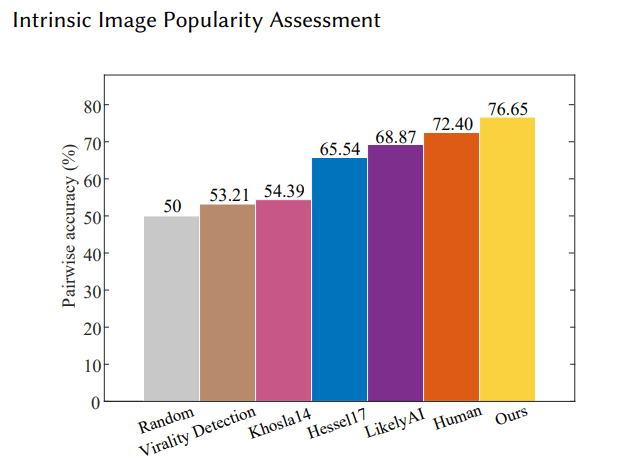
In July of 2019, a fascinating new machine learning paper called “Intrinsic Image Popularity Assessment” was published. This new model has found a reliable way to predict an image’s likely “popularity” (estimation of likelihood the image will get a like on Instagram).

It also showed an ability to outperform humans, with a 76.65% accuracy on predicting how many likes an Instagram photo would garner versus a human accuracy of 72.40%.

I used the model and source code from this paper to come up with how marketers can improve their chances of selecting images that will have the best impact on their content.

Finding the best screen caps to use for a video

One of the most important aspects of video optimization is the choice of the video’s thumbnail.

According to Google, 90% of the top performing videos on the platform use a custom selected image. Click-through rates, and ultimately view counts, can be greatly influenced by how eye-catching a video title and thumbnail are to a searcher,

In recent years, Google has applied AI to automate video thumbnail extraction, attempting to help users find thumbnails from their videos that are more likely to attract attention and click-throughs.

Unfortunately, with only three provided options to choose from, it’s unlikely the thumbnails Google currently recommends are the best thumbnails for any given video.

That’s where AI comes in.

With some simple code, it’s possible to run the “intrinsic popularity score” (as derived by a model similar to the one discussed in this article) against all of the individual frames of a video, providing a much wider range of options.

The code to do this is available here. This script downloads a YouTube video, splits it into frames as .jpg images, and runs the model on each image, providing a predicted popularity score for each frame image.
Caveat: It is important to remember that this model was trained and tested on Instagram images. Given the similarity in behavior for clicking on an Instagram photo or a YouTube thumbnail, we feel it’s likely (though never tested) that if a thumbnail is predicted to do well as an Instagram photo, it will similarly do well as a YouTube video thumbnail.

Let’s look at an example of how this works.


thumbnail from youtube video with housebuilding couple

Current thumbnail. Image Credits: YouTube (opens in a new window)


We had the intrinsic popularity model look at three frames per second of this 23-minute video. It took about 20 minutes. The following were my favorites from the 20 images that had the highest overall scores.

News: Facebook sues two companies engaged in data scraping operations

Facebook today says it has filed a lawsuit in the U.S. against two companies that had engaged in an international “data scraping” operation. The operation extended across Facebook properties, including both Facebook and Instagram, as well as other large websites and services, including Twitter, Amazon, LinkedIn and YouTube. The companies, who gathered the data of

Facebook today says it has filed a lawsuit in the U.S. against two companies that had engaged in an international “data scraping” operation. The operation extended across Facebook properties, including both Facebook and Instagram, as well as other large websites and services, including Twitter, Amazon, LinkedIn and YouTube. The companies, who gathered the data of Facebook users for “marketing intelligence” purposes, did so in violation of Facebook’s Terms of Service, says Facebook.

The businesses named in the lawsuits are Israeli-based BrandTotal Ltd. and Unimania Inc., a business incorporated in Delaware.

According to BrandTotal’s website, its company offers a real-time competitive intelligence platform that’s designed to give media, insights and analytics teams visibility into their competition’s social media strategy and paid campaigns. These insights would allow its customers to analyze and shift their budget allocation to target new opportunities, monitor trends and threats from emerging brands, optimize their ads and messaging, and more.

Meanwhile, Unimania operated apps claimed to offer users the ability to access social networks in different ways. For example, Unimania offered apps that let you view Facebook via a mobile-web interface or alongside other social networks like Twitter. Another app let you view Instagram Stories anonymously, it claimed.

However, Facebook’s lawsuit is largely focused on two browser extensions offered by the companies: Unimania’s “Ads Feed” and BrandTotal’s “UpVoice.”

The former allowed users to save the ads they saw on Facebook for later reference. But as the extension’s page discloses, doing so would opt users into a panel that informed the advertising decisions of Unimania’s corporate customers. UpVote, on the other hand, rewarded users with gift cards for using top social networking and shopping sites and sharing their opinions about the online campaigns run by big brands.

Facebook says these extensions operated in violation of its protections against scraping and its terms of service. When users installed the extensions and visited Facebook websites, the extensions installed automated programs to scrape their name, user ID, gender, date of birth, relationship status, location information, and other information related to their accounts. The data was then sent to a server shared by BrandTotal and Unimania.

Facebook lawsuit vs BrandTotal Ltd. and Unimania Inc. by TechCrunch on Scribd

Data scrapers exist in part to collect as much information as they can through any means possible using automated tools, like bots and scripts. Cambridge Analytica infamously scraped millions of Facebook profiles in the run-up to the 2016 presidential election in order to target undecided voters. Other data scraping operations use bots to monitor concert or event ticket prices in order to undercut competitors. Scraped data can also be used for marketing and advertising, or simply sold on to others.

In the wake of the Cambridge Analytica scandal, Facebook has begun to pursue legal action against various developers that break its terms of service.

Most cases involving data scraping are litigated under the Computer Fraud and Abuse Act, written in the 1980s to prosecute computer hacking cases. Anyone who accesses a computer “without authorization” can face hefty fines or even prison time.

But because the law doesn’t specifically define what “authorized” access is and what isn’t, tech giants have seen mixed results in their efforts to shut down data scrapers.

LinkedIn lost its high-profile case against HiQ Labs in 2019 after an appeals court ruled that the scraper was only collecting data that was publicly available from the internet. Internet rights groups like the Electronic Frontier Foundation lauded the decision, arguing that internet users should not face legal threats “simply for accessing publicly available information in a way that publishers object to.”

Facebook’s latest legal case is slightly different because the company is accusing BrandTotal of scraping Facebook profile data that wasn’t inherently public. Facebook says the accused data scraper used a browser extension installed on users’ computers to gain access to their Facebook profile data.

In March 2019, it took action against two Ukrainian developers who were harvesting data using quiz apps and browser extensions to scrape profile information and people’s friends lists, Facebook says. A court in California recently recommended a judgement in Facebook’s favor in the case. A separate case around scraping filed last year against a marketing partner Stackla  also came back in Facebook’s favor.

This year, Facebook filed lawsuits against companies and individuals engaged in both scraping and fake engagement services.

Facebook isn’t just cracking down on data scraping businesses to protect user privacy, however. It’s because failing to do so can lead to large fines. Facebook at the beginning of this year was ordered to pay out over half a billion dollars to settle a class action lawsuit that alleged systemic violation of an Illinois privacy law. Last year, it settled with the FTC over privacy lapses and had to pay a $5 billion penalty. As governments work to further regulation online privacy and data violations, fines like this could add up.

The company says legal action isn’t the only way it’s working to stop data scraping. It has also invested in technical teams and tools to monitor and detect suspicious activity and the use of of unauthorized automation for scraping, it says.


News: Section 230 will be on the chopping block at the next big tech hearing

It looks like we’re in for another big tech CEO hearing. The Senate Commerce Committee voted Thursday to move forward with subpoenas for Twitter’s Jack Dorsey, Facebook’s Mark Zuckerberg and Sundar Pichai, the CEO of Alphabet. The unusual decision to subpoena the social media chief executives adds yet another politically volatile event to the schedule

It looks like we’re in for another big tech CEO hearing.

The Senate Commerce Committee voted Thursday to move forward with subpoenas for Twitter’s Jack Dorsey, Facebook’s Mark Zuckerberg and Sundar Pichai, the CEO of Alphabet. The unusual decision to subpoena the social media chief executives adds yet another politically volatile event to the schedule in the run-up to the most contentious election in modern U.S. history.

The hearing will focus on Section 230 of the Communications Decency Act, the key law that shields online platforms from legal liability for the content their users create.

While the topic might sound dry for the unacquainted, the law is an explosive topic, both politically and in the eyes of the tech industry, which could be left reeling from even what might seem like minor changes to the legal shield.

Committee Chairman Roger Wicker called the decision to hold the hearing “imperative” in order for Americans to “receive a full accounting from the heads of these companies about their content moderation practices.”

Remarkably, the decision to subpoena the CEOs was unanimous, with ranking Democrat Maria Cantwell joining the vote to subpoena the companies after initially opposing the decision.

Cantwell previously called the idea of issuing subpoenas an “extraordinary” step intended to “chill the efforts” of companies to remove misinformation and harassment from their platforms.

Republican members of the Senate Commerce Committee include its Wicker, Ted Cruz, John Thune and Rick Scott. Democrats on the committee include Cantwell, Amy Klobuchar, Brian Schatz, and Kyrsten Sinema.

What’s going on with Section 230?

Section 230 is generally regarded as the legal infrastructure that made the social internet possible, from Facebook accounts and comments sections to Yelp and Amazon reviews. It’s a short law but in 2020 an increasingly controversial one as lawmakers scramble for levers to limit — or at least threaten to limit — the power of big tech companies.

Republicans see dismantling Section 230’s legal protections as a way to punish social media companies for perceived anti-conservative bias — a common refrain on the right that is regularly undermined by the ubiquity of right-leaning content on platforms like Facebook.

Importantly, President Trump and Attorney General William Barr have taken particular interest in attacking Section 230. Earlier this year, Trump lashed out at Twitter for moderating his false claims with an executive order threatening the law. While the order was largely toothless, Trump’s focus on Section 230 set the agenda for the Barr’s Department of Justice and for Republicans in Congress eager to follow his lead. The order also roped the FCC into getting involved.

In June, the Justice Department laid out a groundwork for “a set of concrete reform proposals” that would undermine the law, couching the proposal as an effort to rid platforms of “illicit content” like child abuse. Last month, Barr sent draft legislation to Congress incorporating those proposals.

Democrats have more recently warmed up to the idea of going after Section 230, but for different reasons. While the right mostly complains about political censorship, Democratic lawmakers see changing Section 230 as a way to hold platforms accountable for rampant misinformation and other forms of toxic content that continue to thrive on social platforms.

Legislation taking aim at Section 230

Lindsey Graham’s bill, the EARN IT Act, is probably the best known legislation targeting Section 230 so far. A toned-down version of that bill advanced out of its committee but hasn’t yet faced the full Senate.

In June, Senators John Thune and Brian Schatz, both members of the committee issuing subpoenas, introduced a bipartisan Section 230 bill known as the PACT Act that focused mostly on moderation transparency.

To make matters even more confusing, another Graham-sponsored bill focused on Section 230 emerged earlier this month hours after Trump called on his party to “repeal Section 230 immediately.” That proposal did not have bipartisan sponsorship.

Whatever happens with the next big tech hearing and with all of these Section 230 bills, it’s clear that there’s a bipartisan appetite for doing something to change tech’s critical legal shield, even if the what isn’t yet clear.

What is clear: Tinkering with such a foundational law could have a huge cascade of effects for the internet as we know it and isn’t something to be undertaken lightly — if at all.

News: What if the kernel is corrupt?

Hello and welcome back to Equity, TechCrunch’s VC-focused podcast (now on Twitter!), where we unpack the numbers behind the headlines. This week, Alex is on a much deserved vacation (but not from Twitter, it seems) so Danny Crichton and I chatted through the news and happenings of the week. Somehow we winded our way through the

Hello and welcome back to Equity, TechCrunch’s VC-focused podcast (now on Twitter!), where we unpack the numbers behind the headlines.

This week, Alex is on a much deserved vacation (but not from Twitter, it seems) so Danny Crichton and I chatted through the news and happenings of the week. Somehow we winded our way through the latest tech controversies, gave Chris Wallace a shout out, and ended with some funding rounds. I’ll be out next week so don’t miss me too much, but expect the entire Equity team to be back full-speed in mid-October. Thanks, as always, to our producer Chris Gates for his patience and diligence.

Now, onto a sneak peek of what we got into:

  •  Moderation continues to be the root of all problems. We got into the anti-semitic comments that were spewed on Clubhouse, and what that means for the future of the audio-only platform. As Danny so eloquently put it: if Clubhouse is having moderation problems even with an exclusive invite-only user base, the problem will grow.
  •  We also talked about Coinbase CEO Brian Armstrong’s blog post, which triggered a debate between us on whether tech companies can even choose to not be political. For the record, Black Lives Matter is not a political statement. It’s a human statement. Read this op-ed for more.
  •  I wrote a piece about how a new program wants to be the Y Combinator for emerging fund managers. The whole “YC for X” model usually makes me roll my eyes, but listen to hear why I’m actually optimistic and bullish on programs like these taking off within tech.
  • Silver Lake added a $2 billion ‘long-term’ hedge fund backed by Abu Dhabi to its tech finance toolkit. The strategy is a signal to privately-backed startups, and potentially a slap in the face to SoftBank.
  • For a quick edtech note, I caught up with Duolingo’s CEO this week in one of his rare press interviews. Luis Von Ahn explained the app’s surge in bookings, and there’s one key metric we pull out to noodle over.
  • Danny explained Gusto’s latest product launch with, wait for it, Gusto. In all seriousness, he brings up interesting points about the future of fin-tech feeling more full-suite, and free.
  • Funding round chatter continued when we unpacked Lee Fixel’s latest investment in India’s Inshorts
  • Finally, we ended with LiquidDeath,  which is not the name of a drinking game, but instead the name of a startup that has successfully attracted millions in venture capital for mountain water.

And with that, we will be back next week. Vote like your life depends on it, because it does.

Equity drops every Monday at 7:00 a.m. PDT and Thursday afternoon as fast as we can get it out, so subscribe to us on Apple PodcastsOvercastSpotify and all the casts.

News: Oracle’s TikTok and Zoom deals won’t move cloud market share needle significantly

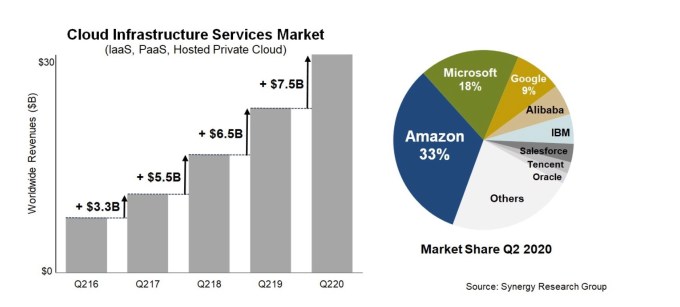
While the overall cloud infrastructure market is booming having reached $30 billion last quarter worldwide, Oracle is struggling with market share in the low single digits. It is hoping that the Zoom and TikTok deals can jump start those numbers, but trying to catch the market leaders Amazon, Microsoft and Google, never mind several other

While the overall cloud infrastructure market is booming having reached $30 billion last quarter worldwide, Oracle is struggling with market share in the low single digits. It is hoping that the Zoom and TikTok deals can jump start those numbers, but trying to catch the market leaders Amazon, Microsoft and Google, never mind several other companies ahead of it, is going to take a lot more than a couple of brand name customers.

By now, you know Oracle and TikTok were joined together in unholy acquisition matrimony last month in the acquisition equivalent of a shotgun wedding. In spite of that, Oracle founder and chief technology officer Larry Ellison gushed in a September 19 press release about how TikTok had “chosen” his company’s cloud infrastructure service. The statement also indicated that this “choice” was influenced by Zoom’s decision to move some percentage of its workloads to Oracle’s infrastructure cloud earlier this year.

The mechanics of the TikTok deal aside, the question is how big an effect will these two customers have on the company’s overall cloud infrastructure market share. We asked a couple of firms who closely watch all things cloud.

John Dinsdale, chief analyst at Synergy Research Group, wasn’t terribly optimistic that they would have much material impact on moving the market share needle for the database giant. “Oracle’s cloud infrastructure services growth has been consistently below overall IaaS and PaaS market growth rates so its market share has [actually] been nudging downward. Zoom may be a good win but it is unlikely to move the needle too much — and remember Zoom also buys cloud services from AWS,” Dinsdale told TechCrunch.

As for TikTok, Dinsdale, like the rest of us, wasn’t clear how that deal would ultimately play out, but he says even with both companies in the fold, it wasn’t going to shift market share as much as Oracle might hope. “Hypothetically, even if Zoom/TikTok helped Oracle increase its cloud infrastructure service revenues 50% over 12 months, which would be a real stretch, its market share would still be nearer to 2% than 3%. This compares with Google at 9%, Microsoft 18% and AWS 33%,” Dinsdale said.

He did point out that the company’s SaaS business is much stronger. “Broadening the scope a little to other cloud services, Oracle’s SaaS growth is running roughly in line with overall market SaaS market growth so market share is steady. Oracle’s share of the total enterprise SaaS market is running at around 6%, though if you drill down to the ERP segment it is obviously doing much better than that,” he said.

Canalys, another firm that follows the cloud infrastructure market says their numbers tell a similar story for Oracle. While it’s doing well in Saas with 7.8% market share, it’s struggling in IaaS/PaaS.

“For IaaS/PaaS, Oracle Cloud is at 1.9% for Q2 2020 and that isn’t moving much. The top three providers are AWS, Azure and Google Cloud, who have 30.8%, 20.2% and 6.2% respectively,” Blake Murray from Canalys told TechCrunch.

It’s worth keeping in mind that Google hired Diane Greene five years ago with the hope of accelerating its cloud infrastructure business. Former Oracle exec Thomas Kurian replaced her two years ago and the company’s market share still hasn’t reached double digits in spite of a period of big overall market growth, showing how much of a challenge it is to move the needle in a significant way.

Another big company, IBM bought Red Hat two years ago for $34 billion with an eye toward improving its cloud business, and while Red Hat has continued to do well, it does not seem to have much impact on the company’s overall cloud infrastructure market share, which has been superseded by Alibaba in fourth place, according to Synergy’s numbers. Both companies are in the single digits.

Synergy Research Q2 2020 cloud infrastructure market share graphs

Image Credits: Synergy Research

All that means, even with these two clients, the company still has a long way to go to be relevant in the cloud infrastructure arena in the near term. What’s unknown is if this new business will help act as lures for other new business over time, but for now it’s going to take a lot more than a couple of good deals to be relevant — and as Google and IBM have demonstrated, it’s extremely challenging to gain chunks of market share.

News: Latin America’s digital transformation is making up for lost time

If we look beyond the data at the bigger picture instead of searching for mythical creatures, the promise of digitalization in Latin America is clear.

Julio Vasconcellos
Contributor

Julio Vasconcellos is the managing partner of Atlantico, a venture capital fund focused on Latin America. He was previously the founder of Canary, Peixe Urbano and was Facebook’s first employee in Brazil.

“Gradually, then suddenly.” Hemingway’s words succinctly capture the recent history of tech in Latin America. After more than a decade of gradual progress made through fits and starts, tech in Latin America finally hit its stride and has been growing at an accelerating pace in recent years.

The region now boasts 17 unicorns up from zero just three years ago. For the first time, the most valuable company in the region isn’t a state-controlled oil or mining behemoth, but rather e-commerce platform MercadoLibre.

We are only in the first chapter of this long story, however. When we compare the penetration of tech companies in Latin America to both developed and developing markets, we estimate that the market could grow nearly tenfold over the next decade. The value to be unlocked will be measured in trillions of dollars and the lives improved in the hundreds of millions.

Our venture capital fund, Atlantico, conducts a thorough annual analysis of market data from Latin America in what we call the Latin America Digital Transformation Report. The report consists of hundreds of data-rich slides based off of original studies, surveys and models constructed from a combination of public and proprietary data shared by many of the region’s leading tech companies. This year, for the first time, we have decided to make the report public and here we highlight some of the findings from this year.

Global venture capitalists, the likes of Sequoia, Benchmark and a16z have planted their flags through key investments in companies like Nubank, Wildlife and Loft. Those are not isolated incidents – venture capital investments in the region have nearly doubled annually for the last three years according to the Latin American Venture Capital Association (LAVCA). In order to understand what investors are seeing in the region, we analyzed the market through a simple framework we apply throughout our report.

The starting point for this framework is the socioeconomic foundation in place. The context in which transformation occurs is important in shaping its possible outcome. The same ingredients applied in different contexts and time periods will produce very different results. Thus, we believe that Latin America is unique globally, and the types of companies that will flourish (and to what extent) will be different than in other parts of the world. Trying to shoehorn foreign business models and products is unlikely to yield good results.

In the case of Latin America, it’s key to remember the region boasts a population twice that of the United States and a GDP half that of China’s (but similar on a per capita basis). In short: Latin America is big, a central factor that has the power to attract capital and talent. However, also critical to note is that economic inequality is severe. While a quarter of the region’s population lives in poverty, the wealthy in Mexico City and São Paulo enjoy living standards in line with their peers in New York and London.

This unique mix of large opportunity and critical problems waiting to be solved has provided fertile ground for the gig economy to flourish. Case-in-point: Brazil is Uber’s largest market globally in volume of rides, with São Paulo its largest city. Rappi, a major food delivery player in the region, valued at over $3 billion, grew its sales by 113% over the first five months of the pandemic. When taken together, the largest ride-hailing and food-delivery services in Brazil are already the largest private employer in Brazil, a formidable contribution to reducing high unemployment.

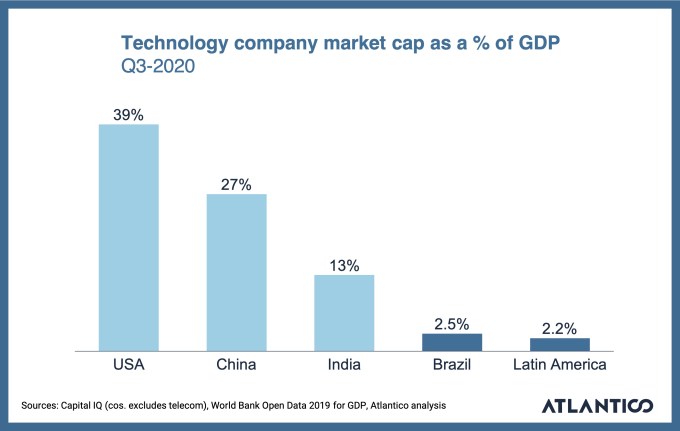
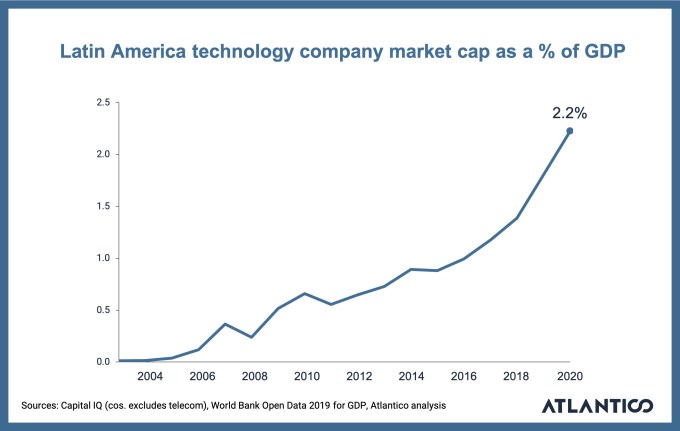
When we track technology company value as a percent of the economy (tech company market cap as a % of GDP) we clearly see that Latin America, at 2.2% penetration, has a ways to go. Our estimate is that it is 10 years behind China (at 27% penetration), which itself is five years behind current U.S. levels (39% penetration).

Image Credits: Atlantico

However, it is important to note that Latin America is making up for lost time. This metric for tech company penetration or share has been growing on average at 65% per year since 2003. In comparison, the growth in U.S. tech company penetration has grown at 11% annually in the same period, while China’s has expanded at 40%.

https://www.atlantico.vc/latin-america-digital-transformation-report

Image Credits: Atlantico

Drivers of digital transformation

Within the socioeconomic context of the region, we advance to looking at the three drivers of change in our framework: people, capital and regulation.

On the people front, the greater visibility of successful role models has catalyzed a desire to follow entrepreneurial footsteps. People like Mike Krieger (co-founder of Instagram), Marcos Galperin (founder/CEO of Mercado Libre) and Henrique Dubugras (founder/co-CEO of Brex) have shown that local talent can go on to build global companies.

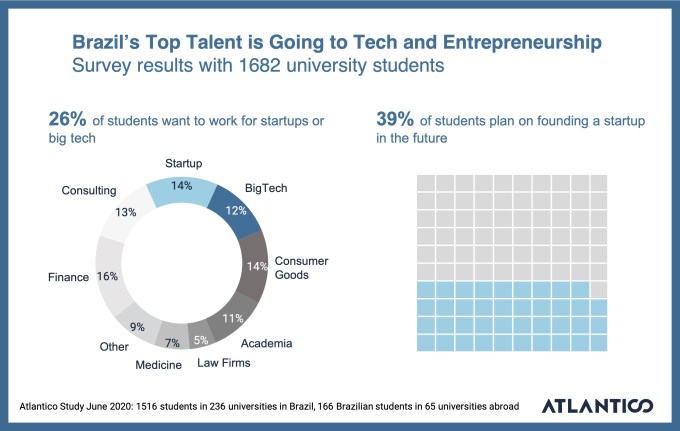
In a survey we conducted with nearly 1,700 college students from the top universities in Brazil, 26% of students voiced a desire to work at startups or big tech companies. A whopping 39% expressed plans to start a company in the future, that number rising to 60% when we consider only computer science students. As more and more of the region’s top graduates flock to tech, it gives us confidence in the accelerating growth of the sector over many years to come.

On the capital front, the growth of venture funding in the region has been frequently written about. Last year, it hit a peak of $4.6 billion after doubling from the year before. However, what perhaps is more surprising is that despite this rapid growth, we are still far from the ceiling. When we view venture capital investments as a proportion of GDP, we see Latin America as only one-seventh of the U.S. level and a quarter of the level in India.

News: Facebook won’t accept ads that ‘delegitimize’ U.S. election results

Following a particularly dark and vivid display of the threats to the 2020 U.S. election during Tuesday’s first presidential debate, Facebook has further clarified its new rules around election-related ads. Facebook is now expanding its political advertising rules to disallow any ads that “[seek] to delegitimize the outcome of an election” including “calling a method

Following a particularly dark and vivid display of the threats to the 2020 U.S. election during Tuesday’s first presidential debate, Facebook has further clarified its new rules around election-related ads.

Facebook is now expanding its political advertising rules to disallow any ads that “[seek] to delegitimize the outcome of an election” including “calling a method of voting inherently fraudulent or corrupt, or using isolated incidents of voter fraud to delegitimize the result of an election.”

Facebook Director of Product Management Rob Leathern, who leads the company’s business integrity team, announced the changes on Twitter.

For example, this would include calling a method of voting inherently fraudulent or corrupt, or using isolated incidents of voter fraud to delegitimize the result of an election. You can find more info and specifics in our Help Center here https://t.co/BPnm1z7LW6 (2/3)

— Rob Leathern (@robleathern) September 30, 2020

Facebook says it will also not allow ads that discourage users from voting, undermine vote-by-mail or other lawful voting methods, suggest voter fraud is widespread, threaten safe voting through false health claims and ads that suggest the vote is invalid because results might not be immediately known on election night.

Both Twitter and Facebook recently issued new guidelines on how they will handle claims of election victory prior to official results, though Facebook’s rules appear to only apply to those claims if they’re made in advertising. We’ve asked Facebook for clarification about how those claims will be handled outside of ads, on a candidate’s normal account.

While Twitter opted to no longer accept political advertising across the board, Facebook is instead tweaking its rules about what kinds of political ads it will allow and when. Facebook previously announced that it would no longer accept ads about elections, social issues or politics in the U.S. after October 27, though political ads that ran before that date will be allowed to continue.

Facebook is already grappling with a deluge of attacks on the integrity of November’s U.S. election originating with President Trump and his supporters. During Tuesday night’s debate, Trump again cast doubt about voting by mail (a system already trusted and in use nationwide in the form of absentee ballots) and declined to commit to accepting election results in the event that he loses.

While the unique circumstances of the pandemic are leading to logistical challenges, voting through the mail is not new. A handful of states including Colorado and Oregon already conducted elections through the mail and vote-by-mail is just a scaled-up version of the absentee voting systems already in place nationwide.

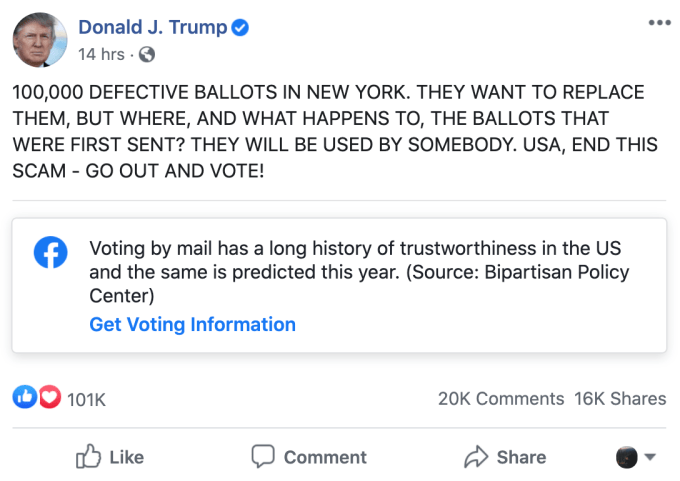
On Wednesday, President Trump sowed conspiratorial ideas about defective ballots that were sent out in New York state as a result of vendor error. The state will reissue the ballots, but Trump seized on the incident as evidence that vote by mail is a “scam” — a claim that evidence does not bear out.

Trump’s attacks on the U.S. election are an unprecedented challenge for social platforms but also one for the nation as a whole, which has never in modern times seen the peaceful transfer of executive power threatened by a sitting president.

News: Last chance to demo at TC Sessions: Mobility 2020: Sales end tomorrow

Opportunity alert! We’re just five short days away from TC Sessions: Mobility 2020, a two-day event focused on building the future of transportation. Thousands of attendees from around the world will be looking for the latest technologies and up-and-coming startups. Will they find your up-and-coming startup? The answer is a resounding yes — if you

Opportunity alert! We’re just five short days away from TC Sessions: Mobility 2020, a two-day event focused on building the future of transportation. Thousands of attendees from around the world will be looking for the latest technologies and up-and-coming startups. Will they find your up-and-coming startup?

The answer is a resounding yes — if you buy an Early Stage Startup Exhibitor Package. Join more than 40 other early-stage startups exhibiting in our expo area and plant your company in the path of the influencers who can help drive your business forward. Expand your network and build sustainable relationships that can provide long-lasting benefits.

Deadline Alert! Act now because exhibitor package sales end tomorrow, October 2, at 11:59 p.m. (PT).

Let’s look at just some of the benefits that come from exhibiting at TC Sessions: Mobility. It’s a “Field of Dreams” moment — if you exhibit, they will come. We’re talking media hunting for their next great story, investors who want to pack their portfolio pipeline, founders looking for partnerships, brilliant engineers eager for employment and, of course, potential customers.

Exhibiting lets you present your pitch decks, schedule demos, start conversations and see where they lead. Add it all together and you get invaluable exposure, increased brand recognition and infinite opportunity.

“TC Sessions Mobility offers several big benefits. First, networking opportunities that result in concrete partnerships. Second, the chance to learn the latest trends and how mobility will evolve. Third, the opportunity for unknown startups to connect with other mobility companies and build brand awareness.” — Karin Maake, senior director of communications at FlashParking.

Want even more exposure? We’ve got you covered. Every exhibiting startup will get five minutes to pitch live in a pitch session. Think of it: you — strutting your stuff in front of influential mobility movers, shakers and startup dream makers from around the world. Warm up your pitching arm, folks. It’s gonna be a wild ride.

TC Sessions: Mobility 2020 takes place October 6-7, but your opportunity to exhibit in the expo comes to a screeching halt tomorrow, October 2 at 11:59 p.m. (PT). Don’t waste another minute. Secure your Early Stage Startup Exhibitor Package now and get ready to fast-track opportunity.

WordPress Image Lightbox Plugin