Monthly Archives: October 2020

News: Air quality monitoring service Airly raises $2 million as fires, pollution force consumers to take note

As smoke from fires chokes the skies Western U.S. and pollution chokes much of the world, air quality has become yet another issue for civilization to address. Industrialization and natural disasters wrought by climate change are spewing more toxic matter into the air, and governments around the world are racing to monitor what the combination

As smoke from fires chokes the skies Western U.S. and pollution chokes much of the world, air quality has become yet another issue for civilization to address.

Industrialization and natural disasters wrought by climate change are spewing more toxic matter into the air, and governments around the world are racing to monitor what the combination of catastrophes and economic growth could mean for their citizens.

The ability to get an accurate measurement of the air quality in their home city of Krakow, Poland is what drove the team of engineers that launched Airly to start their business.

Founded by three engineering students, Michal Misiek, Wiktor Warchalowski,  and Aleksander Konior, the company combines sensing technologies and software to measure particulate matter and emissions like NOx, SOx, methane, and carbon monoxide in the air.

“We are using software and calibration algorithms to provide the best data,” said Warchalowski, who serves as the company’s chief executive officer. The company is more than just collecting air quality. The three engineers have also developed an algorithm that they say can accurately predict air quality for up to 24 hours based on the data they gather.

The current market for air quality assessment tools stands at roughly $4 billion today and will reach $6.5 billion by 2025. Already, Airly’s technology is being used by around 400 cities across Europe and Asia by several universities and corporations including Philips, PwC, Motorola, Aviva, Veolia and Skanska. The company has also released an API so media, technology, and finance companies can access live air quality data. There’s also an app for consumers who want to get a sense of the air out there.

Airparif, the French-based air quality assessment organization awarded the company an honor for being the most accurate air quality device it had seen.

The company initially started because Warchalowski and his friends were training for a marathon and wanted to see when would be the best time to run so they wouldn’t be exposed to pollution. “When I wanted to run at 5PM and the data was from 2PM it was not up to date,” he said.

Over 2 million people are now using the company’s app. “There are more people like me that need that data,” Warchalowski said.

Airly makes money by selling its device, which is roughly the size of an iPhone, to consumers and communities, and by charging for access to its API. The devices cost $300 and API access starts at $1,000, according to Warchalowski.

With revenue in hand and the imprimatur of leading air quality monitoring organizations its little wonder that Airly was able to attract venture backing from of Sir Richard Branson’s and Sir Ronald Cohen’s families; Pipedrive co-founder Martin Tajur; Cherry Ventures partner and former Spotify CMO Sophia Bendz; former Gojek CMO Piotr Jakubowski; and Henkel board member Konstantin von Unger, in a $2 million round led by the newly formed investment firm Giant Ventures.

“By building the leading source of air quality data globally, Airly is creating enormous social and economic value,” said Cameron McLain, a managing partner and co-founder of Giant Ventures.


News: Indianapolis-based Malomo raises $2.8 million to turn order tracking into a branded customer experience

Yaw Aning, named Malomo, the service he launched for small businesses to turn their order-tracking services into branded customer experiences, as a tribute to his mother, who was a small business owner herself. “Malomo” means flowers in Swahili and it was the name of Aning’s mother’s small soap making business which she built over the

Yaw Aning, named Malomo, the service he launched for small businesses to turn their order-tracking services into branded customer experiences, as a tribute to his mother, who was a small business owner herself.

“Malomo” means flowers in Swahili and it was the name of Aning’s mother’s small soap making business which she built over the years — even as she was battling the cancer to which she would eventually succumb.

The small Indianapolis startup has just raised $2.8 million to expand its services providing a new marketing channel for the Shopify retailers of the world who can always use more ways to reach new customers, Aning said.

The financing came from the San Francisco-based firm, Base 10, and New York’s Harlem Capital, along with commitments from previous investors Hyde Park and High Alpha.

Aning came to entrepreneurship as an Orr Fellow, an Indiana program that takes ten graduates and places them in high growth companies. While Aning worked in corporate finance, he was always interested in the startup world and started is first company, Pocket Tales, an online reading game for children.

That business was followed by a Sticks and Leaves, a web design agency that gave Aning his first view into the opportunity that order tracking presented as a space for a better customer experience.

Along with co-founder Anthony Smith, Aning built a service that connects with a single click to the Shopify platform and creates custom, branded tracking pages for each brand. “It’s a landing page for a brand. They use it like they would use any marketing asset,” Aning said. “The strategy is to build up integrations to the other tools merchants use to create rich experiences leveraging those tools.”


News: Zynga completes its acquisition of hyper-casual game maker Rollic

Zynga announced in August that it would be acquiring Istanbul-based Rollic, developer and publisher of hyper-casual gaming hits like Go Knots 3D and Tangle Master 3D. Today, it says the deal has closed. To be clear, Zynga doesn’t completely own Rollic yet. Instead, it’s purchased 80% of the company for approximately $180 million in cash,

Zynga announced in August that it would be acquiring Istanbul-based Rollic, developer and publisher of hyper-casual gaming hits like Go Knots 3D and Tangle Master 3D. Today, it says the deal has closed.

To be clear, Zynga doesn’t completely own Rollic yet. Instead, it’s purchased 80% of the company for approximately $180 million in cash, with additional payments to acquire the remaining 20% over the next three years.

In anticipation of the deal closing, CEO Frank Gibeau told me that this represents Zynga’s first move into the world of hyper-casual games — games where, as their titles suggest, players perform simple tasks like throwing knives and untying knots.

Rollic, he argued, has succeeded in a field where “for the first three years, everybody kept calling it a fad.” He was particularly impressed by the company’s development process, where it releases games at a rapid clip by managing a network of hundreds of developers.

“They already had some scale and some velocity and hit the ground running, but we thought they could grow faster with us,” Gibeau said.

He was also impressed by the size of their audience — apparently the combined companies will reach a total of 160 million monthly active users, with 65 million coming from Rollic. And as Gibeau noted, the ability to reach a large audience and monetize that audience without ad tracking will be even more important after Apple’s looming change, which will require app developers to allow their users to opt out of tracking.

This is Zynga’s fourth acquisition in Istanbul. In fact, it paid $1.8 billion for Peak Games just a couple months before the Rollic deal. Asked whether it’s harder to bring new teams on-board when travel and in-person work is limited, Gibeau replied, “It requires a lot of Zoom time instead of face-to-face time.”

He added, “The good news about this is, it’s obviously a very tragic situation and the work-from-home environment is a big negative in a lot of ways, but for gaming companies, we’re in pretty good shape, right? We can build games in this environment.”

Gibeau also said that the company is interested in making more acquisitions, but the strategy is “not just being a roll-up.” And while Zynga has had its ups and downs since it first rode the wave of Facebook gaming, Gibeau noted that the company has beaten expectations with impressive revenue growth in recent quarters.

“I think we still have a lot to prove,” he said.

News: American stocks drop in wake of President’s COVID-19 diagnosis

American stocks are selling in the wake of President Trump, and members of his family and a key staff member, testing positive for COVID-19. The news, which came overnight, is weighing heavily on all major American indices, but heaviest on tech shares. As of the time of writing, here’s where the mess stands: Dow Jones

American stocks are selling in the wake of President Trump, and members of his family and a key staff member, testing positive for COVID-19.

The news, which came overnight, is weighing heavily on all major American indices, but heaviest on tech shares. As of the time of writing, here’s where the mess stands:

  • Dow Jones Industrial Average: Futures off 1.5%
  • S& 500: Futures off 1.63%
  • Nasdaq Composite: Futures off 2.32%

Smaller, and more specific baskets of equities like the Bessemer cloud index do not release similar pre-market numbers, so we cannot see the precise impact that the news, and the potential political destabilization that it may bring, are having on the shares of the tech industry that have flown the highest.

But we can see around the edges: Datadog is off 2.9%. Salesforce is off 1.8%. Zoom is off 1.7%. Crowdstrike is off 3.2%, and so forth. In short, it doesn’t appear that SaaS and cloud stocks are faring better than tech stocks more broadly.

Recent direct listings Palantir and Aasana are off 3.8% and 3.4%, respectively, in pre-market trading. Other recent IPOs are down as well, including JFrog (off 5.8% before the bell), and Snowflake (off 4.6% in pre-market trading).

It’s not hard to guess why the stock market is suffering in the wake of the President’s diagnosis. This close to an already volatile election, complicating factors are deleterious to investor confidence. That’s bad for stocks. And it would be a good moment to have a fully healthy President to help get another round of stimulus done. That package could be undercut by today’s chaos. And on and on.

TechCrunch will keep an eye on the markets as the day continues, but don’t expect your personal accounts to look better at the day’s end than the beginning.

News: Twitter may let users choose how to crop image previews after bias scrutiny

In an interesting development in the wake of a bias controversy over its cropping algorithm Twitter has said it’s considering giving users decision making power over how tweet previews look, saying it wants to decrease its reliance on machine learning-based image cropping. Yes, you read that right. A tech company is affirming that automating certain decisions

In an interesting development in the wake of a bias controversy over its cropping algorithm Twitter has said it’s considering giving users decision making power over how tweet previews look, saying it wants to decrease its reliance on machine learning-based image cropping.

Yes, you read that right. A tech company is affirming that automating certain decisions may not, in fact, be the smart thing to do — tacitly acknowledging that removing human agency can generate harm.

As we reported last month, the microblogging platform found its image cropping algorithm garnering critical attention after Ph.D. student Colin Madland noticed the algorithm only showed his own (white male) image in preview — repeatedly cropping out the image of a black faculty member.

Ironically enough he’d been discussing a similar bias issue with Zoom’s virtual backgrounds.

Geez…any guesses why @Twitter defaulted to show only the right side of the picture on mobile? pic.twitter.com/UYL7N3XG9k

— Colin Madland (@colinmadland) September 19, 2020

Twitter responded to the criticism at the time by saying it had tested for bias before shipping the machine learning model and had “not found evidence of racial or gender bias”. But it added: “It’s clear from these examples that we’ve got more analysis to do. We’ll continue to share what we learn, what actions we take, and will open source our analysis so others can review and replicate.”

It’s now followed up with additional details about its testing processes in a blog post where it suggests it could move away from using an algorithm for preview crops in the future.

Twitter also concedes it should have published details of its bias testing process before launching the algorithmic cropping tool — in order that its processes could have been externally interrogated. “This was an oversight,” it admits.

We saw your Tweets about the harm caused by how images are cropped on Twitter.

Today we’re sharing how we test for bias in our systems, and how we plan to rely less on auto-cropping and give you more choice in how images appear in Tweets:
https://t.co/tiSreeoGOA

— Twitter Support (@TwitterSupport) October 1, 2020

Explaining how the model works, Twitter writes: “The image cropping system relies on saliency, which predicts where people might look first. For our initial bias analysis, we tested pairwise preference between two demographic groups (White-Black, White-Indian, White-Asian and male-female). In each trial, we combined two faces into the same image, with their order randomized, then computed the saliency map over the combined image. Then, we located the maximum of the saliency map, and recorded which demographic category it landed on. We repeated this 200 times for each pair of demographic categories and evaluated the frequency of preferring one over the other.”

“While our analyses to date haven’t shown racial or gender bias, we recognize that the way we automatically crop photos means there is a potential for harm. We should’ve done a better job of anticipating this possibility when we were first designing and building this product. We are currently conducting additional analysis to add further rigor to our testing, are committed to sharing our findings, and are exploring ways to open-source our analysis so that others can help keep us accountable,” it adds.

On the possibility of moving away from algorithmic image cropping in favor of letting humans have a say, Twitter says it’s “started exploring different options to see what will work best across the wide range of images people tweet every day”.

“We hope that giving people more choices for image cropping and previewing what they’ll look like in the tweet composer may help reduce the risk of harm,” it adds, suggesting tweet previews could in future include visual controls for users.

Such a move, rather than injecting ‘friction’ into the platform (which would presumably be the typical techie concern about adding another step to the tweeting process), could open up new creative/tonal possibilities for Twitter users by providing another layer of nuance that wraps around tweets. Say by enabling users to create ‘easter egg’ previews that deliberately conceal a key visual detail until someone clicks through; or which zero-in on a particular element to emphasize a point in the tweet.

Given the popularity of joke ‘half and half’ images that play with messaging app WhatsApp’s preview crop format — which requires a click to predictably expand the view — it’s easy to see similar visual jokes and memes being fired up on Twitter, should it provide users with the right tools.

The bottom line is that giving humans more agency means you’re inviting creativity — and letting diversity override bias. Which should be a win-win. So it’s great to see Twitter entertaining the idea of furloughing one of its algorithms. (Dare we suggest the platform also takes a close and critical look at the algorithmic workings around ‘top tweets’, ‘trending tweets’, and the ‘popular/relevant’ content its algos sometimes choose to inject, unasked, into users’ timelines, all of which can generate a smorgasbord of harms.)

Returning to image cropping, Twitter says that as a general rule it will be committed to “the ‘what you see is what you get’ principles of design” — aka, “the photo you see in the tweet composer is what it will look like in the tweet” — while warning there will likely still be some exceptions, such as for images that aren’t a standard size.

In those cases it says it will experiment with how such images are presented, aiming to do so in a way that “doesn’t lose the creator’s intended focal point or take away from the integrity of the photo”. Again, it will do well to show any algorithmic workings in public.

News: Paired picks up $1M funding and launches its relationship app for couples

Paired, a new app for couples, is launching today and disclosing $1 million in funding. Backing the startup, which wants to support “happier and healthier” relationships, is Taavet Hinrikus of TransferWise, the co-founders of Runtastic (which was sold to Adidas), Ed Cooke of Memrise and Bernhard Niesner of Busuu. Founded in September 2019 by Kevin

Paired, a new app for couples, is launching today and disclosing $1 million in funding. Backing the startup, which wants to support “happier and healthier” relationships, is Taavet Hinrikus of TransferWise, the co-founders of Runtastic (which was sold to Adidas), Ed Cooke of Memrise and Bernhard Niesner of Busuu.

Founded in September 2019 by Kevin Shanahan and Diego López, who previously worked together at language learning app Memrise, and joined shortly afterwards by Chief Relationships Officer Dr Jacqui Gabb, who is Professor of Sociology and Intimacy at The Open University, Paired combines audio tips from experts with “fun daily questions and quizzes” that partners answer together.

The app has been piloted (and iterated) in Australia for the last six months and is pitched as different to traditional couples therapy, which is often prescribed to couples in distress, in that it is targeting the “full spectrum” of couples who want help building intimacy and improving communication. The idea is that Paired can provide the steps needed by couples to improve their relationship each day.

Available in the Apple App Store and Google Play Store, Paired is free to download but requires a subscription to unlock the full library of content.

“Our relationship with our partner is one of the most important parts of our lives: it affects our physical health, our mental health, and the lives of our children,” says Kevin Shanahan, co-founder and CEO. “However, there aren’t many solutions to help couples keep their relationship healthy. Most are designed for couples in distress”.

Image Credits: Paired

Shanahan says that Paired prompts you and your partner to take “small, positive steps” to improve your relationship. To do this, the startup works with relationship academics and therapists to create quizzes, audio courses, and tips that “help you to learn more about each other, resolve conflict, and build intimacy”.

Experts collaborating with Paired include University of Washington Professor and Married at First Sight USA’s Dr. Pepper Schwartz, University of Exeter academics Mark Rivett and Hannah Sherbersky, and Oakland University Professor and Marriage and Family Therapist Dr. Terri Orbuch.

After downloading Paired, you’re asked if you’d like to pair with your partner to swap answers. To enable this, you’re given a unique code to share. Alternatively, you can choose to pair later or just use the app by yourself.

“Each day we then prompt you to answer either a question or quiz,” explains Shanahan. “These rotate between different areas of your relationship so you can learn which areas are strong and which have room for growth. If you’re paired with your partner, then when they answer the quiz or question you can unlock each other’s answer and discuss them together.

“In parallel, you begin listening to (and will soon be able to read) audio courses and tips that are presented by top relationship academics and therapists. These are on a range of topics — including sex and intimacy, managing conflict, and parenting — and include couple case studies to learn from and exercises to do outside of the app”.

Shanahan describes Paired’s user base as quite broad, made up of new couples, some who have been together for a long time, long-distance couples and people using the app individually. The majority are aged 30-50 and use the app with their partner.

“Each day they typically use the app for about 5 minutes and (based on anecdotal feedback) discuss their answers outside of the app for another 5 minutes or so,” says the Paired CEO.

News: Blossom Capital appoints Carmen Alfonso Rico as its newest partner

Blossom Capital, the early-stage venture capital firm founded by Ophelia Brown, has recruited its latest partner: Carmen Alfonso Rico has joined from Samaipata VC, where she led the U.K. office. Before that she was at Felix Capital and is also a co-founder of the London outpost of “community-driven” VC, The Fund. During her time at

Blossom Capital, the early-stage venture capital firm founded by Ophelia Brown, has recruited its latest partner: Carmen Alfonso Rico has joined from Samaipata VC, where she led the U.K. office. Before that she was at Felix Capital and is also a co-founder of the London outpost of “community-driven” VC, The Fund.

During her time at Felix Capital and Samaipata, Alfonso Rico is said to have sourced and invested in a number of promising European startups, such as virtual events platform Hopin and social networking app Peanut, along with scale-ups Goop, Deliveroo and Mirakl.

She’s also been an entrepreneur herself, having founded two companies, both with limited success but plenty of learnings. Vinpho was a Spanish crowdsourced journalism platform (you can read the early pitch deck here), and Reconnect was a U.K.-based direct-to-consumer lifestyle and fashion brand for pregnant women.

“It actually came about quite unexpectedly,” Alfonso Rico tells me on a call discussing her latest career move. “Ophelia and I like to joke now that it was almost like generating a deal and when founders are not looking to raise because I was not looking to move at all… We had breakfast and discussed Blossom and I very quickly realised that Blossom was a very, very interesting platform and that it had a lot of the kind of deal-making mindset that I was looking for”.

That’s a partial reference to the firm’s “high conviction” investing pitch, which sees the Series A and sometimes seed investor back fewer companies by writing larger cheques. Alfonso Rico says she was also attracted to the way Blossom is structured, being an all-partner firm where investments are worked on together and one that it isn’t particularly thesis-driven with regards to sectors or geography, unlike much of her previous VC experience. And, of course, there’s Brown’s own ambition.

“I think you know Ophelia [Brown], she is quite bold and very hungry and I think she projects that into Blossom,” says Alfonso Rico. “I immediately got very interested but we did take a lot of time to get to know each other, we spent weeks discussing deals, we spent some time together, actually properly together, to just make sure that there was that personal fit. And at the end, it was kind of an obvious decision”.

Although Blossom’s partner team isn’t “strictly segmented,” in terms of individual focus areas, Alfonso Rico says her investing and entrepreneurial background includes consumer, where she has an established network and some “muscle [memory]” analysing consumer companies, and digital platforms and marketplaces, both B2C and B2B. She’s also long-been obsessed with the “power of communities” and how they can be leveraged to support the success of products and brands regardless of sector.

“Following that customer love, that power of the community, has led me to my best investments, and I plan on continuing down that path,” she adds.

News: Nintendo’s new RC Mario Kart looks terrific

In a year, Nintendo would have demoed, in person, Mario Kart Live: Home Circuit. The company would have invited select members of the press into some rented event space and let us experience the game first-hand, like it had with Labo and Ring Fit Adventures. It’s 2020, however, and that’s just not how we do

In a year, Nintendo would have demoed, in person, Mario Kart Live: Home Circuit. The company would have invited select members of the press into some rented event space and let us experience the game first-hand, like it had with Labo and Ring Fit Adventures. It’s 2020, however, and that’s just not how we do things.

Watching someone else play an RC game over teleconference software is not ideal. But it’s nothing if not extremely of the moment. And more importantly, it’s probably a testament to what Nintendo has built here that it translates so well with a less than ideal setup. Granted, I won’t feel comfortable offering a proper review until I’ve played the game on my Switch, but I can confidently say that Mario Kart Live makes for one hell of an impressive demo.

Image Credits: Nintendo

Like the recently released Mario Lego sets, this is the kind of toy that makes me jealous of kids today. It also, frankly, bums me out that I don’t have more space at home to lay out a track. I’ve heard it was a buyer’s market, so maybe I’ll go buy a house. Whatever the case, bringing Mario to a real-world RC car is one of those no-brainer ideas, and the execution looks great.

The game also finds Nintendo embracing augmented reality in a really convincing and clever way. We’ve seen some AR from the company, most notably in the form of Pokémon GO — which, to be fair, was more of a Niantic joint and, as plenty will happily point out, not really proper AR. And like that title, Nintendo worked closely with a third party. In this case, it’s the New York-state based Velan Studios, which was started by brothers Guha and Karthik Bala who also founded Vicarious Visions, an Albany-based game developer now owned by Activision.

“It started as an experiment by a small team at Velan,” the startup said in a blog post today. “Like many prototypes, the main goal was to “find the fun”. We built an RC car by kitbashing together drone parts, cameras, and sensors to create a unique thirdperson view driving experience. It gave us the exhilaration of speed and allowed us to see the world from a totally different perspective.”

Image Credits: Nintendo

The execution of Mario Kart Live is a perfect bit of synergy in that it leverages the Switch to really bring the whole thing to life — in a manner similar to what the company has already done with Labo and Ring Fit. Of course, much or most of the real magic here comes courtesy of the racer. Currently limited to Mario and Luigi (no word yet on additional characters), the cars feature both a camera for FPV on the Switch and all of the requisite sensors.

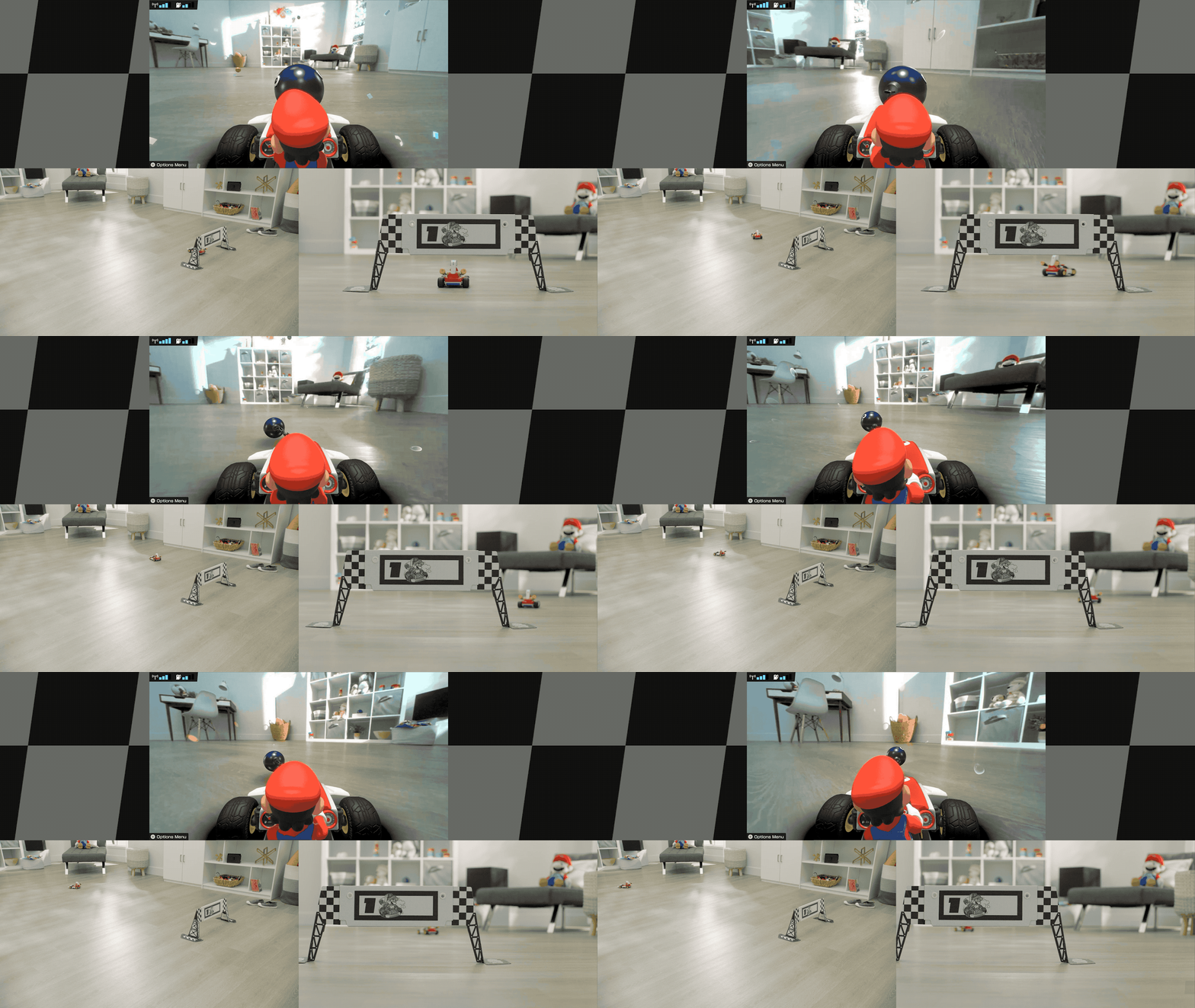
Nintendo declined to answer specific questions about the on-board sensors and other hardware, but one assumes depth-sensing plays a big role here. There’s no calibration out of the box. You can pretty much start it up and start driving around. Once you actually unfold and set up the three gates to create the circular course, however, that will require some driving to generate the lay of the land. Nintendo’s employed a clever graphic for that, with Lakitu dropping a bucket of paint the character drives over and tracks with his wheels.

Image Credits: Nintendo

The game also employs some clever physics, with game action impacting speed and steering. There’s a range of top speeds, from 50 to 200 cc. A demo stripped of AR shows how in-game elements impact the actual kart speed. Other elements, like the sudden occasional sand storm, cause the kart to drift to the sides. The game will also react, if, say, you crash it into a table leg — sending coins flying just as it would in a Mario Kart game.

On that note, the company tells me that the karts are quite robust, with a bumper that’s essentially designed to run into stuff. That shouldn’t cause any damage, given the top speeds here. Though the company notes that if, say, a heavy book falls on top of the kart after it jostled it loose from a shelf, that could ultimately be an issue. Nintendo says there will be a way to repair the karts, but offered no specifics on warranty.

Image Credits: Nintendo

Races can be played with up to four, though a kart is required to play. In fact, the actual game will be free to download from the Nintendo store, but is essentially worthless without a kart. Until that’s set up, the only thing you’ll be able to access is a game trailer. At the moment, the in-game opponents are just the Koopalings.

Image Credits: Nintendo

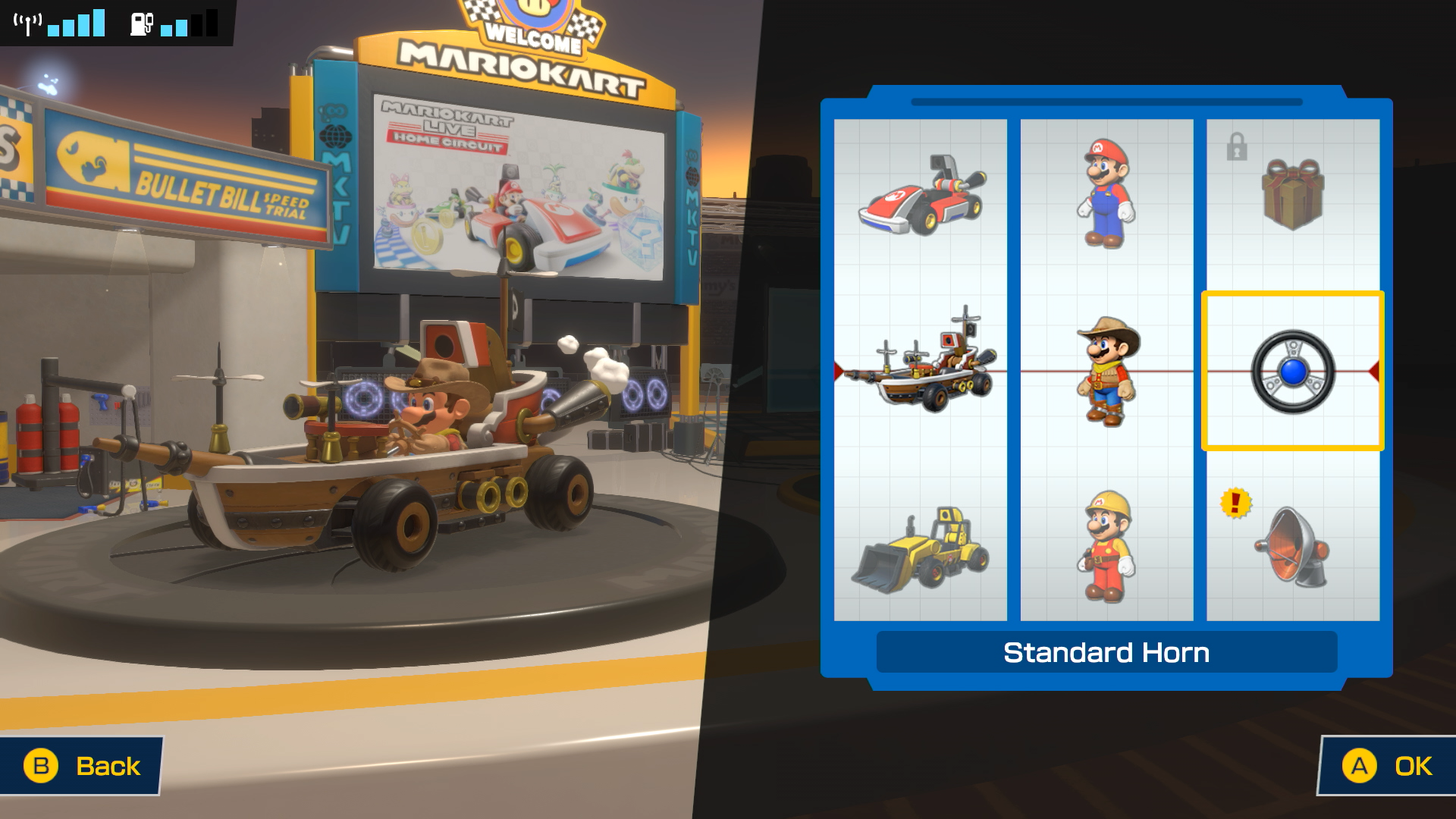
Like the karts themselves, however, it seems likely — or even certain — that the company will introduce additional characters down the road. Perhaps we can look for expansions along the lines of what the company has done with Smash Bros. Also, like Mario Maker, you can customize both your character and car for the in-game FPV AR overlays (though these won’t be visible to other players).

Mario Kart Live: Home Circuit arrives October 16, priced at $100 a kart. You’ll need either a Switch or Switch Lite to play.

News: A PC gaming site had to ban political troll mods for games, because nowhere is safe

NexusMods, a large platform and gathering place for modding PC games, has banned all content relating to the U.S. elections following a flood of troll content, saying “we’ve decided to wipe our hands clean of this mess.” Not exactly headline news, no, but a reminder that the toxic behavior frequently seen (and blamed) on social

NexusMods, a large platform and gathering place for modding PC games, has banned all content relating to the U.S. elections following a flood of troll content, saying “we’ve decided to wipe our hands clean of this mess.” Not exactly headline news, no, but a reminder that the toxic behavior frequently seen (and blamed) on social media is pervasive even in niches where politics would seem to be completely irrelevant.

“Modding” (as in modifying) is the practice of creating new content for games that players can then install on their own, for example adding new levels or characters, or adjusting the interface or difficulty. NexusMods is one of the larger collections of such mods and a lively community.

Unfortunately, even something as simple as a way to add decorative tapestries to Skyrim is a proxy political battleground, with numerous mods appearing to, for example, replace generic enemies in a game with Trump supporters or “rioters.” Here’s a screenshot from Reddit user Cipherx02, who noted that users were also filling the description fields with disinformation:

I blurred out one mod that used an image of a protester shot in Portland by Kyle Rittenhouse. Yes, they did!

In a post to the site’s news page, the admins of NexusMods walk a fine line in expressing their frustration without espousing any political ideology apart from, perhaps, “anti-idiot”:

Recently we have seen a spate of provocative and troll mods being uploaded based around current sociopolitical issues in the United States. As we get closer to the US election in November we expect this trend to increase as it did this time 4 years ago.

Considering the low quality of the mods being uploaded, the polarising views they express and the fact that a small but vocal contingent of our users are seemingly not intelligent or grown up enough to be able to debate the issues without resorting to name calling and baseless accusations without proof (indicative of the wider issues plaguing our world at this time) we’ve decided to wipe our hands clean of this mess and invoke an outright ban on mods relating to sociopolitical issues in the United States. We have neither the time, the care or the wish to moderate such things. This ban will apply to all mods uploaded from the 28th of September onwards. We will review this restriction sometime after the next President of the United States has been inaugurated.

No doubt all over the web there are situations of this sort as ordinarily politically-neutral spaces are infected by toxic discourse. Unlike Facebook and YouTube, however, smaller sites and communities don’t have thousands of paid moderators or sophisticated machine learning tools to nip the problems in the bud.

As such a total ban doesn’t seem so much an overreaction as the only reasonable reaction. As the election approaches (and likely well beyond that) it’s probable that many small communities will have to draw a line in the sand or risk serious incidents such as doxing, threats, and the unwelcome attentions of angry internet mobs.

News: Spain’s startup ecosystem: 9 investors on remote work, green shoots and 2020 trends

As reported in the first half of our Spain-focused VC survey, the nation’s startup ecosystem continues to grow and is keeping pace with ecosystems in more developed European countries such as U.K., France, Sweden and Germany. While main hubs Madrid and Barcelona bump heads politically, tech ecosystems in each city have been developing with local support.

As reported in the first half of our Spain-focused VC survey, the nation’s startup ecosystem continues to grow and is keeping pace with ecosystems in more developed European countries such as U.K., France, Sweden and Germany.

While main hubs Madrid and Barcelona bump heads politically, tech ecosystems in each city have been developing with local support. According to this regional investor database, Spain is home to 62 angels, 84 seed funds and 19 Series A and beyond institutional funds.

As the capital and financial center, Madrid enjoys proximity to political power and multinational companies, which is likely why it’s home to a larger proportion of fintech startups. According to Dealroom, between 2015 and 2019, Madrid’s emerging companies raised €1.5 billion. In recent years, its Arganzuela district has become known as a startup hub, but Barcelona’s Districte de la innovació is also home to a growing number of established and upcoming technology companies.

May of 2020 saw a resumption of VC activity with €70.89 million invested in startups. Wallabox, the Barcelona-based electric charger company, closed the second part of €12 million from a Series A investment. Also in May, Belvo raised €9.09 million, Accure Therapeutics €7.6 million and Cubiq Foods €4 million.

Notable companies and data points:

  • Voovio Technologies — raised €15 million from Moira Capital.
  • MOVO — €13 million from Delivery Hero, Seaya Ventures and others.
  • Lana — $12.5 million from Base10, Cathay Innovation and other investors.
  • ProntoPiso — €1.6 million from existing shareholders.
  • Colvin — raised €14 million.
  • U.S./Spanish insurtech startup CoverWallet was sold to AON for $330 million.
  • MediQuo — raised €4 million.
  • Factorial — raised a €15 million in a Series A round led by CRV.
  • Holded — €6 million Series A round in 2019 led by Lakestar.

Here are the investors who shared their thoughts with us for the conclusion of our Spain VC survey:

Lourdes Álvarez de Toledo, partner, JME Ventures

What trends are you most excited about investing in, generally?
SaaS. B2B.

What’s your latest, most exciting investment?
Kymatio.

Are there startups that you wish you would see in the industry but don’t? What are some overlooked opportunities right now?
Subscription B2C app for managing kids from 0 to 18 years.

What are you looking for in your next investment, in general?
Scalability,

Which areas are either oversaturated or would be too hard to compete in at this point for a new startup? What other types of products/services are you wary or concerned about?
Too much competition: travel. Interesting areas: quantum computing.

How much are you focused on investing in your local ecosystem versus other startup hubs (or everywhere) in general? More than 50%? Less?
More than 50% in Spain.

Which industries in your city and region seem well-positioned to thrive, or not, long term? What are companies you are excited about (your portfolio or not), which founders?
Industries: cybersecurity. Companies: Lingokids, Devo, Genially, Glovo.

How should investors in other cities think about the overall investment climate and opportunities in your city?
Spain has no Series B investors, so there are many opportunities for foreign Series B funds.

Do you expect to see a surge in more founders coming from geographies outside major cities in the years to come, with startup hubs losing people due to the pandemic and lingering concerns, plus the attraction of remote work?
At least in Spain, I think remote work will be only temporary. If you are freelance it is still important to work near the main cities.

Which industry segments that you invest in look weaker or more exposed to potential shifts in consumer and business behavior because of COVID-19?
Retail, fashion, travel.

What is your advice to startups in your portfolio right now?
Don’t take debt if it is not extremely necessary, try to be cash flow positive — although you have to sacrifice faster growth.

Are you seeing “green shoots” regarding revenue growth, retention or other momentum in your portfolio as they adapt to the pandemic?
Yes! In Genially: awesome growth.

What is a moment that has given you hope in the last month or so? This can be professional, personal or a mix of the two.
Schools opening again (four kids already).

Any other thoughts you want to share with TechCrunch readers?
Spain will be very harmed the next year, and so will the startup ecosystem.

Javier González-Soria y Moreno de la Santa, managing partner, Top Seeds Lab

What trends are you most excited about investing in, generally?

WordPress Image Lightbox Plugin