Tag Archives: Blog

News: EU’s top privacy regulator urges ban on surveillance-based ad targeting

The European Union’s lead data protection supervisor has recommended that a ban on targeted advertising based on tracking Internet users’ digital activity be included in a major reform of digital services rules which aims to increase operators’ accountability, among other key goals. The European Data Protection Supervisor (EDPS), Wojciech Wiewiorówski, made the call for a

The European Union’s lead data protection supervisor has recommended that a ban on targeted advertising based on tracking Internet users’ digital activity be included in a major reform of digital services rules which aims to increase operators’ accountability, among other key goals.

The European Data Protection Supervisor (EDPS), Wojciech Wiewiorówski, made the call for a ban on surveillance-based targeted ads in reference to the Commission’s Digital Services Act (DSA) — following a request for consultation from EU lawmakers.

The DSA legislative proposal was introduced in December, alongside the Digital Markets Act (DMA) — kicking off the EU’s (often lengthy) co-legislative process which involves debate and negotiations in the European Parliament and Council on amendments before any final text can be agreed for approval. This means battle lines are being drawn to try to influence the final shape of the biggest overhaul to pan-EU digital rules for decades — with everything to play for.

The intervention by Europe’s lead data protection supervisor calling for a ban on targeted ads is a powerful pre-emptive push against attempts to water down legislative protections for consumer interests.

The Commission had not gone so far in its proposal — but big tech lobbyists are certainly pushing in the opposite direction so the EDPS taking a strong line here looks important.

In his opinion on the DSA the EDPS writes that “additional safeguards” are needed to supplement risk mitigation measures proposed by the Commission — arguing that “certain activities in the context of online platforms present increasing risks not only for the rights of individuals, but for society as a whole”.

Online advertising, recommender systems and content moderation are the areas the EDPS is particularly concerned about.

“Given the multitude of risks associated with online targeted advertising, the EDPS urges the co-legislators to consider additional rules going beyond transparency,” he goes on. “Such measures should include a phase-out leading to a prohibition of targeted advertising on the basis of pervasive tracking, as well as restrictions in relation to the categories of data that can be processed for targeting purposes and the categories of data that may be disclosed to advertisers or third parties to enable or facilitate targeted advertising.”

It’s the latest regional salvo aimed at mass-surveillance-based targeted ads after the European Parliament called for tighter rules back in October — when it suggested EU lawmakers should consider a phased in ban.

Again, though, the EDPS is going a bit further here in actually calling for one. (Facebook’s Nick Clegg will be clutching his pearls.)

More recently, the CEO of European publishing giant Axel Springer, a long time co-conspirator of adtech interests, went public with a (rather protectionist-flavored) rant about US-based data-mining tech platforms turning citizens into “the marionettes of capitalist monopolies” — calling for EU lawmakers to extend regional privacy rules by prohibiting platforms from storing personal data and using it for commercial gain at all.

“Every attempt to water down data protection in the name of supposed voluntary consent must be ruled out,” wrote Mathias Döpfner in Business Insider last month. “Permission to use data should not even be possible in the first place. Sensitive and personal data does not belong in the hands of platforms that rule the market (so-called gatekeepers) or in the hands of states.”

Apple CEO, Tim Cook, also took to the virtual stage of a (usually) Brussels based conference last month to urge Europe to double down on enforcement of its flagship General Data Protection Regulation (GDPR).

In the speech Cook warned that the adtech ‘data complex’ is fuelling a social catastrophe by driving the spread of disinformation as it works to profit off of mass manipulation. He went on to urge lawmakers on both sides of the pond to “send a universal, humanistic response to those who claim a right to users’ private information about what should not and will not be tolerated”. So it’s not just European companies (and institutions) calling for pro-privacy reform of adtech.

The iPhone maker is preparing to introduce stricter limits on tracking on its smartphones by making apps ask users for permission to track, instead of just grabbing their data — a move that’s naturally raised the hackles of the adtech sector, which relies on mass surveillance to power ‘relevant’ ads.

Hence the adtech industry has resorted to crying ‘antitrust‘ as a tactic to push competition regulators to block platform-level moves against its consentless surveillance. And on that front it’s notable than the EDPS’ opinion on the DMA, which proposes extra rules for intermediating platforms with the most market power, reiterates the vital links between competition, consumer protection and data protection law — saying these three are “inextricably linked policy areas in the context of the online platform economy”; and that there “should be a relationship of complementarity, not a relationship where one area replaces or enters into friction with another”.

Wiewiorówski also takes aim at recommender systems in his DSA opinion — saying these should not be based on profiling by default to ensure compliance with regional data protection rules (where privacy by design and default is supposed to be the legal default).

Here too be calls for additional measures to beef up the Commission’s legislative proposal — with the aim of “further promot[ing] transparency and user control”.

This is necessary because such system have “significant impact”, the EDPS argues.

The role of content recommendation engines in driving Internet users towards hateful and extremist points of view has long been a subject of public scrutiny. Back in 2017, for example, UK parliamentarians grilled a number of tech companies on the topic — raising concerns that AI-driven tools, engineered to maximize platform profit by increasing user engagement, risked automating radicalization, causing damage not just to the individuals who become hooked on hateful views the algorithms feeds them but cascading knock-on harms for all of us as societal cohesion is eaten away in the name of keeping the eyeballs busy.

Yet years on little information is available on how such algorithmic recommender systems work because the private companies that operate and profit off these AIs shield the workings as proprietary business secrets.

The Commission’s DSA proposal takes aim at this sort of secrecy as a bar to accountability — with its push for transparency obligations. The proposed obligations (in the initial draft) include requirements for platforms to provide “meaningful” criteria used to target ads; and explain the “main parameters” of their recommender algorithms; as well as requirements to foreground user controls (including at least one “nonprofiling” option).

However the EDPS wants regional lawmakers to go further in the service of protecting individuals from exploitation (and society as a whole from the toxic byproducts that flow from an industry based on harvesting personal data to manipulate people).

On content moderation, Wiewiorówski’s opinion stresses that this should “take place in accordance with the rule of law”. Though the Commission draft has favored leaving it with platforms to interpret the law.

“Given the already endemic monitoring of individuals’ behaviour, particularly in the context of online platforms, the DSA should delineate when efforts to combat ‘illegal content’ legitimise the use of automated means to detect, identify and address illegal content,” he writes, in what looks like a tacit recognition of recent CJEU jurisprudence in this area.

“Profiling for purposes of content moderation should be prohibited unless the provider can demonstrate that such measures are strictly necessary to address the systemic risks explicitly identified by the DSA,” he adds.

The EDPS has also suggested minimum interoperability requirements for very large platforms, and for those designated as ‘gatekeepers’ (under the DMA), and urges lawmakers to work to promote the development of technical standards to help with this at the European level.

On the DMA, he also urges amendments to ensure the proposal “complements the GDPR effectively”, as he puts it, calling for “increasing protection for the fundamental rights and freedoms of the persons concerned, and avoiding frictions with current data protection rules”.

Among the EDPS’ specific recommendations are: That the DMA makes it clear that gatekeeper platforms must provide users with easier and more accessible consent management; clarification to the scope of data portability envisaged in the draft; and rewording of a provision that requires gatekeepers to provide other businesses with access to aggregated user data — again with an eye on ensuring “full consistency with the GDPR”.

The opinion also raises the issue of the need for “effective anonymisation” — with the EDPS calling for “re-identification tests when sharing query, click and view data in relation to free and paid search generated by end users on online search engines of the gatekeeper”.

ePrivacy reform emerges from stasis

Wiewiorówski’s contributions to shaping incoming platform regulations come on the same day that the European Council has finally reached agreement on its negotiating position for a long-delayed EU reform effort around existing ePrivacy rules.

In a press release announcing the development, the Commission writes that Member States agreed on a negotiating mandate for revised rules on the protection of privacy and confidentiality in the use of electronic communications services.

“These updated ‘ePrivacy’ rules will define cases in which service providers are allowed to process electronic communications data or have access to data stored on end-users’ devices,” it writes, adding: “Today’s agreement allows the Portuguese presidency to start talks with the European Parliament on the final text.”

Reform of the ePrivacy directive has been stalled for years as conflicting interests locked horns — putting paid to the (prior) Commission’s hopes that the whole effort could be done and dusted in 2018. (The original ePrivacy reform proposal came out in January 2017; four years later the Council has finally settled on its arguing mandate.)

The fact that the GDPR was passed first appears to have upped the stakes for data-hungry ePrivacy lobbyists — in both the adtech and telco space (the latter having a keen interest in removing existing regulatory barriers on comms data in order that it can exploit the vast troves of user data which Internet giants running rival messaging and VoIP services have long been able to).

There’s a concerted effort to try to use ePrivacy to undo consumer protections baked into GDPR — including attempts to water down protections provided for sensitive personal data. So the stage is set for an ugly rights battle as negotiations kick off with the European Parliament.

Metadata and cookie consent rules are also bound up with ePrivacy so there’s all sorts of messy and contested issues on the table here.

An update of the ePrivacy rules are very much necessary to protect confidentiality of our communications: in 2002, it still took 5 years until the first iPhone, and there was hardly any instant messaging, video calls, and no inescapable commercial tracking practices

— Sophie in ‘t Veld (@SophieintVeld) February 10, 2021

Digital rights advocacy group Access Now summed up the ePrivacy development by slamming the Council for “hugely” missing the mark.

“The reform is supposed to strengthen privacy rights in the EU [but] States poked so many holes into the proposal that it now looks like French Gruyère,” said Estelle Massé, senior policy analyst at Access Now, in a statement. “The text adopted today is below par when compared to the Parliament’s text and previous versions of government positions. We lost forward-looking provisions for the protection of privacy while several surveillance measures have been added.”

The group said it will be pushing to restore requirements for service providers to protect online users’ privacy by default and for the establishment of clear rules against online tracking beyond cookies, among other policy preferences.

The Council, meanwhile, appears to be advocating for a highly dilute (and so probably useless) flavor of ‘do not track’ — by suggesting users should be able to give consent to the use of “certain types of cookies by whitelisting one or several providers in their browser settings”, per the Commission.

“Software providers will be encouraged to make it easy for users to set up and amend whitelists on their browsers and withdraw consent at any moment,” it adds in its press release.

Clearly the devil will be in the detail of the Council’s position there. (The European Parliament has, by contrast, previously clearly endorsed a “legally binding and enforceable” Do Not Track mechanism for ePrivacy so, again, the stage is set for clashes.)

Encryption is another likely bone of ePrivacy contention.

As security and privacy researcher, Dr Lukasz Olejnik, noted back in mid 2017, the parliament strongly backed end-to-end encryption as a means of protecting the confidentiality of comms data — saying then that Member States should not impose any obligations on service providers to weaken strong encryption.

So it’s notable that the Council does not have much to say about e2e encryption — at least in the PR version of its public position. (A line in this that runs: “As a main rule, electronic communications data will be confidential. Any interference, including listening to, monitoring and processing of data by anyone other than the end-user will be prohibited, except when permitted by the ePrivacy regulation” is hardly reassuring, either.)

It certainly looks like a worrying omission given recent efforts at the Council level to advocate for ‘lawful’ access to encrypted data. Digital and humans rights groups will be buckling up for a fight.

News: How will investors value MetroMile and Oscar Health?

What we learn today will hopefully bear on other insurtech startups that want liquidity during the current cycle.

Last night, MetroMile and SPAC INSU Acquisition Corp. II completed their combination, putting the per-mile auto insurance startup up for regular trading today for the first time.

In the wake of last year’s debuts by neoinsurance companies Lemonade and Root, it’s not surprising to see others test the public markets. For example, Oscar Health recently announced its intention to go public via a traditional IPO.

How the new entrants will fare, however, is not clear.


The Exchange explores startups, markets and money. Read it every morning on Extra Crunch, or get The Exchange newsletter every Saturday.


There is something of a tale of two companies in Lemonade and Root, with the pair valued at divergent multiples and sporting very different post-IPO trajectories, at least concerning their value.

While Lemonade has appreciated greatly from its IPO price ($29) to its current value ($155.33), Root’s share price dropped from its debut ($27) to today ($21.75).
This morning, as MetroMile starts its life as a public company, Oscar Health preps its own run at an IPO and other neoinsurance players like Hippo wait in the wings, let’s quickly check the difference between how Root and Lemonade have fared, and then ask what we can learn their different valuation multiples and what they might mean for the next startup insurance players hoping to gov v public while the IPO window is wide open.

Root, Lemonade

Lemonade’s path to the public markets was one that started modestly with its first IPO pricing, improved, and then, after technically going public at a down-round valuation, took off like a rocket. Root’s IPO pricing run involved what we thought of as a strong IPO range and then an above-target pricing.

But since then, Lemonade shares have rallied to several times their original price, while Root has dropped around 20%. Lemonade, for reference, sells rental insurance with an eye on going up-market in time to other forms of home-focused insurance. Root is in the auto insurance market, where MetroMile also works.

Both Lemonade and Root have yet to announce Q4 2020 results, so we’ll look at their Q3 details instead. We want to get a handle for how divergently their insurance incomes are being treated. This should give us a better understanding of how Wall Street values each, then we’ll apply those learnings to our two new companies. What we learn today will hopefully bear on other insurtech startups that want liquidity during the current cycle.

Results via the company, comparisons are Q3 2019:

  • Root Q3 2020 revenue: $50.5 million (impaired from $75.8 million)
  • Root Q3 2020 gross profit: $0.7 million (improved from -$36 million)
  • Root Q3 2020 net loss: $85.2 million (improved from -$100.1 million)
  • Premiums in force: $600.1 million
  • Valuation: $5.45 billion (Google Finance)

This gives us Root revenue run rate multiple of around 27x, and a premium in force multiple of just over 9x. Now let’s observe Lemonade’s data.

Results via the company, comparisons are Q3 2019:

  • Lemonade Q3 2020 revenue: $10.5 million (impaired from $17.8 million)
  • Lemonade Q3 2020 gross profit: $7.3 million (improved from $4.0 million)
  • Lemonade Q3 2020 net loss: $30.9 million (improved from $31.1 million)
  • Premiums in force: $188.9 million
  • Valuation: $9.33 billion (Google Finance)

Looking at the same two metrics, Lemonade has a run rate multiple of 222x, and a premium in force multiple of more than 49x.

News: Alexa von Tobel brings 15 years of financial savvy to Early Stage 2021

Alexa von Tobel has a unique vantage point on the world of startups. She debuted in the tech space with the launch of LearnVest in 2009. The company raised nearly $70 million and sold to Northwestern Mutual in 2015 for an estimated $250 million, according to reports. Since, von Tobel has founded her own venture

Alexa von Tobel has a unique vantage point on the world of startups. She debuted in the tech space with the launch of LearnVest in 2009. The company raised nearly $70 million and sold to Northwestern Mutual in 2015 for an estimated $250 million, according to reports.

Since, von Tobel has founded her own venture firm called Inspired Capital. Portfolio companies include Finix, Chief, Orum, Habi and more.

But before she was an entrepreneur, or the Chief Digital Officer of a major financial services company (and then Chief Innovation Officer, overseeing the Northwestern Mutual’s venture arm), or the founding partner of a venture capital firm, she was a Certified Financial Planner.

At TechCrunch Early Stage in April, von Tobel will lead a breakout on financial planning targeted specifically at early stage startups.

Take a look:

Finance for Founders

As a founder, you not only have to master your company’s finances, you also have to tackle your own personal finances. Managing your money as a founder comes with a unique set of questions. Leveraging her expertise from LearnVest and as a Certified Financial Planner, Alexa will share financial planning best practices so founders can remove this layer of stress from the pressure of building a business.

Early Stage is back in 2021 and better than ever. The event is centered around all the startup core competencies that founders will need in their tool chest to build successful businesses, from marketing to operations to fundraising.

von Tobel joins an all-star lineup, which includes experts in the fields of sales, seed and A fundraising, recruiting, and much much more. These experts will give presentations across a variety of topics, and then answer questions live from the audience.

The event is split across two days: On April 1 we’ll be hearing from experts in fundraising and operations, and on July 8 we’ll learn more from experts in fundraising and marketing. At both events, the TechCrunch pitch-off will be center stage, giving early stage companies the chance to pitch to and get feedback from seasoned investors. Early Stage is entirely virtual, so folks from anywhere in the world can pick up and ticket and show up from the comfort of their couch.

We sincerely hope you’ll join us!

News: Ancestry says it fought two police requests to search its DNA database

DNA profiling company Ancestry has confirmed it fought two U.S. law enforcement requests to access its DNA database in the past six months, but that neither request resulted in turning over customer or DNA data. The Utah-based company disclosed the two requests in its latest transparency report covering the latter half of 2020. The report

DNA profiling company Ancestry has confirmed it fought two U.S. law enforcement requests to access its DNA database in the past six months, but that neither request resulted in turning over customer or DNA data.

The Utah-based company disclosed the two requests in its latest transparency report covering the latter half of 2020. The report said Ancestry “challenged both of these requests, which were withdrawn,” and that the company “provided no data” at the time of the report, published Tuesday.

Ancestry did not say which agencies or police departments requested the DNA data or for what reason the company challenged the request. Ancestry spokesperson Gina Spatafore confirmed the search warrants were to obtain DNA data but declined to comment beyond what was in the report.

The company also said in its most recent report that it “refused numerous inquiries” from U.S. law enforcement for failing to obtain the proper legal process. The report also said the company received four valid law enforcement requests, but that it did not provide any data in response.

Ancestry has more than 3.6 million subscribers and has more than 18 million customer DNA profiles in its database, making it the largest in the world.

DNA profiling companies like Ancestry are increasingly popular with customers wanting to learn more about their family heritage, their genetic markers, and to understand their cultural and ethnic backgrounds. But as these DNA databases become larger, they are also attracting attention from law enforcement who want access to help solve crimes.

On its website, Ancestry says: “We believe that the nature of our members’ DNA data is particularly sensitive, so we insist on a court order or search warrant as the minimum level of due process before we will review our ability to comply with the request. We also seek to put our members’ privacy first, so we also will try to minimize the scope or even invalidate the warrant before complying.”

It’s not the first time Ancestry has pushed back against a legal demand. Last year the company said it rejected an out-of-state search warrant, ordered by a court in Pennsylvania, to “seek access” to its DNA database on the grounds that the warrant was “improperly served.”

Ancestry has only complied with one search warrant for DNA data from a database it acquired and later made public, not realizing that police would use the database to search for leads.

It’s not uncommon for companies with large amounts of customer data to frequently receive law enforcement demands for user data — or for companies to publish periodic transparency reports that detail the number of legal demands they receive.

To its credit, Ancestry is one of only two DNA profiling sites that publishes a transparency report. 23andMe also publishes the number of data demands it receives each quarter, but to date has not released any customer data to law enforcement. FamilyDNA said over a year ago that it was “working on publishing” a transparency report.

The move by Ancestry and 23andMe came shortly after police used DNA profiling site GEDmatch to identify the DNA of a suspected serial killer, a breakthrough which later led to the arrest of the so-called Golden State Killer in 2018. GEDmatch said it was “not approached by law enforcement” prior to the search. GEDmatch soon after allowed its users to opt-in for their DNA to be included in police searches.

Last year, GEDmatch confirmed it was hit by two data breaches that made user profiles visible to other users, including law enforcement.

News: Apple Maps to gain Waze-like features for reporting accidents, hazards and speed traps

Apple Maps is inching into more Waze-like territory with an update that will give drivers the ability to report road hazards, accidents, or even speed traps. The new features are live now in the iOS 14.5 beta, which is now open to public beta testers as well as developers, but won’t roll out to the

Apple Maps is inching into more Waze-like territory with an update that will give drivers the ability to report road hazards, accidents, or even speed traps. The new features are live now in the iOS 14.5 beta, which is now open to public beta testers as well as developers, but won’t roll out to the general public until later this spring, Apple says.

To use the new features, drivers will be able to report road issues and incidents by using Siri on their iPhone or through Apple’s CarPlay. For example, during navigation, they’ll be able to tell Siri things like “there’s a crash up head,” “there’s something on the road,” or “there’s a speed trap here.” They’ll also be able to correct stale accident or hazard alert information by saying things like “the hazard is gone” or the “incident is no longer here.”

While using Siri makes the reporting experience safer, the updated app will also allow users to swipe up on the map to tap a report button to alert others to accidents, hazards or speed traps, as well.

The update could present a challenge to Google-owned navigation app Waze, which has long been a popular tool for staying alerted to road conditions, hazards, accidents and police presence. In Waze, users can interact by touching the screen or issuing commands through Google Assistant, but voice support for iOS users, naturally, is more limited. Today, Waze supports the use of Siri Shortcuts, which have to be manually configured and added to Siri, for example.

The new Apple Maps features could also make Apple’s app more appealing to users who feel their user data is safer within Apple’s ecosystem, thanks to the work Apple has done to position itself as the company that cares more about consumer privacy.

Notable, too, is the addition of speed traps, which represents a shift in direction for Apple Maps. Historically, Apple has been opposed to including police warnings in its product. But that lack of support has contributed to Google’s ability to dominate the navigation and mapping market on mobile devices.

Apple’s decision here also follows an expansion of Waze-like features to Google Maps, blurring the distinctions between Google’s two navigation products even further. And as Google continued to roll out the ability to report accidents, traffic, speed traps and more to Google Maps users on iOS, it made it even harder for anyone who would have otherwise considered switching to Apple Maps to make the jump.

Apple, belatedly, has seemed to realize this as well.

News: Accord launches B2B sales platform with $6M seed

The founders of Accord, an early stage startup focused on bringing order to B2B sales, are not your typical engineer founders. Instead, the two brothers, Ross and Ryan Rich, worked as sales reps seeing the problems unique to this kind of sale first-hand. In November 2019, they decided to leave the comfort of their high-paying

The founders of Accord, an early stage startup focused on bringing order to B2B sales, are not your typical engineer founders. Instead, the two brothers, Ross and Ryan Rich, worked as sales reps seeing the problems unique to this kind of sale first-hand.

In November 2019, they decided to leave the comfort of their high-paying jobs at Google and Stripe to launch Accord and build what they believe is a missing platform for B2B sales, one that takes into account the needs of both the sales person and the buyer.

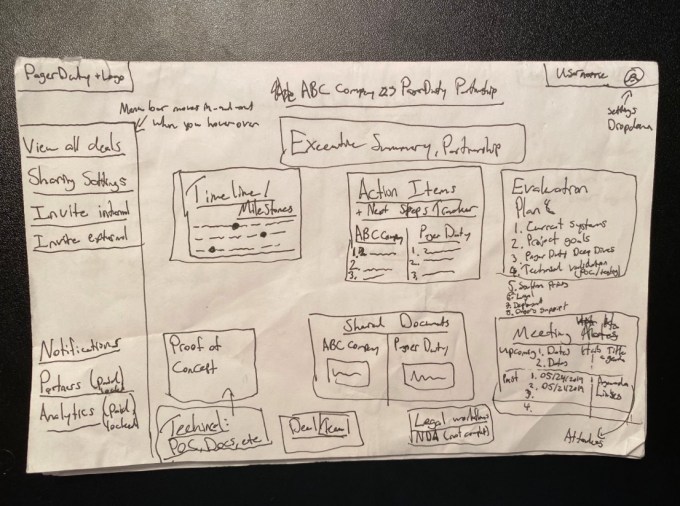
Today the company is launching with a $6 million seed round from former employer Stripe and Y Combinator. It should be noted that the founders applied to YC after leaving their jobs, and impressed the incubator with their insight and industry experience, even though they didn’t really have a product yet. In fact, they literally drew their original idea on a piece of paper.

Original prototype of Accord sketched on a piece of paper.

The original prototype was just a drawing of their idea. Image Credits: Accord

Recognizing they had the sales skills, but lacked programming chops, they quickly brought in a third partner, Wayne Pan to bring their idea to life. Today, they have an actual working program with paying customers. They’ve created a kind of online hub for B2B sales people and buyers to interact.

As co-founder Ross Rich points out these kinds of sales are very different from the consumer variety, often involving as many as 14 people on average on the buyer side. With so many people involved in the decision-making process, it can become unwieldy pretty quickly.

“We provide within the application shared next steps and milestones to align on and that the buyer can track asynchronously, a resource hub to avoid sorting through those hundreds of emails and threads for a single document or presentation and stakeholder management to make sure the right people are looped in at the right time,” Rich explained.

Accord also integrates with the company CRM like Salesforce to make sure all of that juicy data is being tracked properly in the sales database. At the same time, Rich says the startup wants this platform to be a place for human interaction. Instead of an automated email or text, this provides a place where humans can actually interact with one another, and he believes that human element is important to help reduce the complexity inherent in these kinds of deals.

With $6 million in runway and a stint at Y Combinator under their belts, the founders are ready to make more concerted go-to-market push. They are currently at 9 people, mostly engineers aside from the two sales-focused founders. He figures to be bringing in some new employees this year, but doesn’t really have a sense of how many they will bring on just yet, saying that is something that they will figure out in the coming months.

As they do that, they are already thinking about being inclusive with several women on the engineering team, recognizing if they don’t start diversity early, it will be more difficult later on. “[Hiring a diverse group early] only compounds when you get to nine or 10 people and then when you’re talking to someone and they are wondering ‘do I trust this team and is that a culture where I want to work?’ He says if you want to build a diverse and inclusive workplace, you have to start making that investment early.

It’s early days for this team, but they are building a product to help B2B sales teams work more closely and effectively with customers, and with their background and understanding of the space, they seem well positioned to succeed.

News: Lang.ai snags $2M to remove technical burden of implementing AI for businesses

Lang.ai, which has developed a no-code platform for businesses, closed on a $2 million seed funding round. The company’s SaaS platform aims to allow business users to structure any free-text data with custom categories built through a drag & drop interface, based on AI-extracted concepts. Village Global led the financing, which included participation from new

Lang.ai, which has developed a no-code platform for businesses, closed on a $2 million seed funding round.

The company’s SaaS platform aims to allow business users to structure any free-text data with custom categories built through a drag & drop interface, based on AI-extracted concepts.

Village Global led the financing, which included participation from new and existing backers including Acceleprise, Oceans Ventures, Alumni Ventures Group, 2.12 Angels, GTMFund, and Lorimer Ventures.

Spain-born Jorge Penalva founded Lang.ai in 2018 with the goal of giving any business user the ability “to build enterprise-ready natural language processing models in just minutes.” It was built to give non-engineers a way to automate repetitive tasks in use cases such as customer service and claims processing.

“It can be installed in our cloud or theirs,” Penalva said. 

Lang.ai saw its revenue double from the last quarter of 2020 to the first quarter of 2021 and the seed funding was motivated mainly to continue that momentum.

“We’re getting demand in the form of projects with our larger customers, so we needed the funding to be able to support that demand,” Penalva told TechCrunch.

In his previous role of CEO of Séntisis, Penalva realized that processes driven by free-text data remained a blind spot for many companies. 

“Today, millions of dollars and hours are invested by companies to manually read and process textual information captured from disparate areas of their business,” he said.

His mission with Lang.ai is to “empower businesses to put AI to work for them, without the technical complexities of building and training custom algorithms.” 

Specifically, Penalva said that Lang.ai’s product analyzes a customer’s historical data “in minutes” and suggests AI-extracted concepts to build custom categories through a drag & drop interface. The custom categories are applied in real-time to automate “tedious” tasks such as the manual tagging and routing of support tickets, the processing of insurance claims and the dispatching of field engineers to incoming work order requests.

Put simply, Lang.ai’s goal is to remove the technical burden of implementing AI for a business.

Lang.ai’s community of users (called “Citizen NLP Builders”) consists of mostly non-technical business roles, ranging from customer service operations to marketers, business analysts and UX designers.

Customers include Freshly, Userzoom, Playvox, Spain’s CaixaBank, Yalo Chat and Bancolombia, among others. 

Ben Segal, director of infrastructural efficiency at Freshly, described the platform as “so nimble.”

“Out of the box, it took us two days to make automated tagging 15% more reliable than a previous platform that we had had in production for 2 years, with the added benefit that now all of our teams can tap into and exploit our support data,” Segal said. “The marketing team has built workflows to understand key customer moments. Our data and analytics team is super excited about having all these new tags in Snowflake, and it’s crazy how easy it is to use.”

Penalva is proud of the fact that Lang.ai’s engineering team is primarily based in Spain and that he has been able to grow the 10-person company outside of his native country.

“With very few resources, it took us a little over two years to build an enterprise-grade product and find the right set of early customers and investors who are aligned with our vision,” he said. “I moved to the US from Spain to build a global company and this is just the beginning…Lang has always been powered by immigrant hustle, and it has been core to our values since day 1.”

News: Huawei files suit over security threat designation

Earlier this week, Huawei CEO Ren Zhengfei spoke rather diplomatically about the company’s hopes of holding talks with the new U.S. administration. The hardware giant is also taking a less conciliatory route, challenging its FCC designation as a national security threat. The company this week filed a suit with the U.S. Court of Appeals for

Earlier this week, Huawei CEO Ren Zhengfei spoke rather diplomatically about the company’s hopes of holding talks with the new U.S. administration. The hardware giant is also taking a less conciliatory route, challenging its FCC designation as a national security threat.

The company this week filed a suit with the U.S. Court of Appeals for the Fifth Circuit, calling the FCC ruling, “arbitrary, capricious, and an abuse of discretion and not supported by substantial evidence.”

Questions have swirled around the smartphone maker’s ties to the Chinese government for years, but the U.S. greatly ramped up actions against Huawei during the Trump years. The federal government has taken a number of routes to essentially kneecap the company, including, notably, its addition to the Department of Commerce’s “entity list,” which effectively barred it from working with U.S. companies.

Huawei likely sees a change in U.S. governance as an opportunity to be reevaluated by the powers that be. The company has long denied spying and other security charges. “I would welcome such phone calls and the message is around joint development and shared success,” Ren earlier this week told the media that he was eager to speak with Biden. “The U.S. wants to have economic growth and China wants to have economic growth as well.”

In a statement offered to The Wall Street Journal, however, an FCC spokesperson stayed firm to the 2020 decision, stating, “Last year the FCC issued a final designation identifying Huawei as a national security threat based on a substantial body of evidence developed by the FCC and numerous U.S. national security agencies. We will continue to defend that decision.”

Thus far, the Biden administration hasn’t indicated any plans to soften restrictions on Huawei. Facing opposition from Republican lawmakers, Commerce Secretary nominee Gina Raimondo noted, “I currently have no reason to believe that entities on those lists should not be there. If confirmed, I look forward to a briefing on these entities and others of concern.”

The Biden administration does appear to be reviewing other actions against Chinese companies taken during the Trump administration. Notably, a planned forced sale of TikTok’s U.S. wing has been put on hold while the White House reassesses security concerns.

News: Quilt, an audio social network focused on self care, raises $3.5 million in seed

The era of social audio 1.0 is in full swing, and while podcasts and Clubhouse have led the way, there are many other audio startups joining the fold. Quilt, an audio social network that focuses on wellness and community, has raised a $3.5 million seed round led by Mayfield Fund, with partner Rishi Garg joining

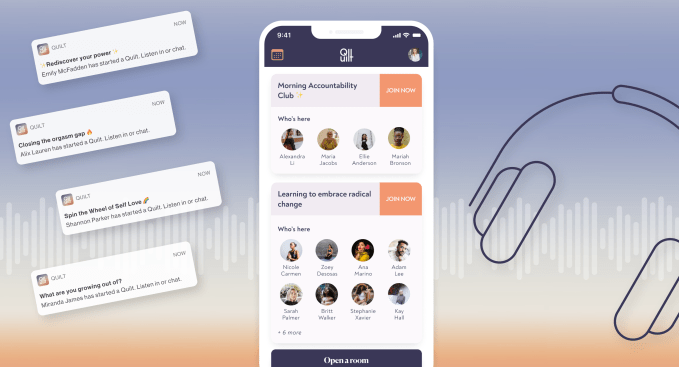
The era of social audio 1.0 is in full swing, and while podcasts and Clubhouse have led the way, there are many other audio startups joining the fold. Quilt, an audio social network that focuses on wellness and community, has raised a $3.5 million seed round led by Mayfield Fund, with partner Rishi Garg joining the board, to do just that.

Quilt started as a community platform founded by Ashley Sumner, which let local folks meet up with one another in their own homes. Sumner was on the founding team at NeueHouse and has spent her career building community through physical space. Thousands of Quilt conversations were happening out of peoples’ homes until the pandemic struck in March, resulting in an existential crisis for the startup.

Sumner quickly moved Quilt over to Zoom but soon realized that video chat didn’t quite capture the magic that was happening in person, nor did it prove the right medium to foster the type of conversations that had made Quilt so special.

She worked to develop an audio app that would become the new Quilt 2.0, which went live in the App Store at the end of January.

Quilt allows anyone to start a room for a conversation, dropping a line or two of text to describe what they want to talk about. The app is focused on wellness, breaking rooms into three different categories: spiritual and personal development (with conversations around meditation, astrology, human design, etc.), career and purpose (“it was very important to link purpose to it,” said Sumner, “these aren’t networking events”), and relationships, sex, and family.

Quilt

Image Credits: Quilt

The platform has put specific focus on balancing the engagement levels of content creators and consumers. According to Quilt, 98 percent of hosts attend other hosts’ conversations and more than 50 percent of Quilters talk during any given conversation.

Garg, who has spent nearly two decades in the emerging media space, talked about how the engagement ratio among creators, consumers and ‘bystanders’ is different for each social platform based on the medium and product choices.

“With YouTube, the famous number was 1 percent create, 9 percent engage, and 90 percent sit back,” said Garg. “At Twitter, interestingly, it was 10 percent, 30 percent, 60 percent. If you look at something like Clubhouse, you’re seeing that parallel already happen. It’s like celebrity central. Part of what got us excited about Quilt was that anyone could just start a room. We really focused in on the pathway between being a consumer to being a creator. Starting or hosting a room is shorter than on any other social media platform.”

He added that the norms within the Quilt community are a big part of what makes that possible, saying there is a hurdle associated with platforms that are more celebrity driven or top heavy. Consumers look at the bar that is set by the community and feel they’re not famous enough, or don’t have a big enough community to contribute, he said.

“Part of the magic of Quilt is that everyone can feel like they have something to offer,” Garg explained. “I think it’s a lot more scalable and a lot less fragile than an ecosystem built entirely on celebrity.”

Retention also seems to be strong in Quilt’s early days, with 80 percent of sign-ups coming back for conversations every week. The company also said that around 60 percent of conversations are started spontaneously, rather than being a planned and promoted ‘event.’

Sumner says that Quilt will never generate revenue through advertising, but rather employ a freemium model.

Existing investors such as Freestyle VC’s Jenny Lefcourt and Upside Partnership’s Kent Goldman and Christina Hunt also participated in this latest round alongside new investors, including Houseparty CEO Sima Sistani, The Mini Fund’s Eros Resmini, former Discord CMO Allison Stoloff, and others.

The Quilt team is currently made up of eight people, 50 percent of whom are female and 25 percent of whom are non-Black people of color. Twenty percent are LGBT and 10 percent are non-binary.

News: TikTok’s forced sale to Oracle is put on hold

The insane saga of a potential forced sale of TikTok’s US operations is reportedly ending — another victim of the transition to methodical and rational policymaking that appears to be the boring new normal under the Presidency of Joe Biden. Last fall, the U.S. government under President Donald Trump took a stab at “gangster capitalism”

The insane saga of a potential forced sale of TikTok’s US operations is reportedly ending — another victim of the transition to methodical and rational policymaking that appears to be the boring new normal under the Presidency of Joe Biden.

Last fall, the U.S. government under President Donald Trump took a stab at “gangster capitalism” by trying to force the sale of TikTok to a group of buyers including Oracle and Walmart.

While the effort was doomed from the start, with TikTok’s parent company ByteDance winning most of the legal challenges to the government effort, a Rubicon had effectively been crossed where the U.S. government appeared willing to spend political capital to stymie the growth of a successful foreign business on its shores for the flimsiest of security reasons.

Now, The Wall Street Journal is reporting that the efforts by the U.S. government to push the deal forward “have been shelved indefinitely”, citing sources familiar with the process.

However, discussions between TikTok and U.S. national security officials are continuing because there are valid concerns around TikTok’s data collection and the potential for manipulation and censorship of content on the app.

In the meantime, the U.S. is taking a look at all of the potential threats to data privacy and security from intrusions by foreign governments or using tech developed overseas, according to Emily Horne, the spokeswoman for the National Security Council.

“We plan to develop a comprehensive approach to securing U.S. data that addresses the full range of threats we face,” Horne told the WSJ. “This includes the risk posed by Chinese apps and other software that operate in the U.S. In the coming months, we expect to review specific cases in light of a comprehensive understanding of the risks we face.”

Last year, then-President Trump ordered a ban on TikTok intending to force the sale of the Chinese-owned, short form video distribution service to a U.S.-owned investment group.

As part of that process, the Committee on Foreign Investment in the U.S. ordered ByteDance to divest of its U.S. operations.

TikTok appealed that order in court in Washington last November as the U.S. was roiled by the presidential election and its aftermath.

That case is still pending, but separate federal court rulings have blocked the U.S. government from shutting TikTok down.

WordPress Image Lightbox Plugin