Tag Archives: Blog

News: Imagine a better future for social media at TechCrunch Sessions: Justice

Toxic culture, deadly conspiracies and organized hate have exploded online in recent years. We’ll discuss how much responsibility social networks have in the rise of these phenomena and how to build healthy online communities that make society better, not worse at TechCrunch Sessions: Justice on March 3. Join us for a wide-ranging discussion with Rashad Robinson,

Toxic culture, deadly conspiracies and organized hate have exploded online in recent years. We’ll discuss how much responsibility social networks have in the rise of these phenomena and how to build healthy online communities that make society better, not worse at TechCrunch Sessions: Justice on March 3.

Join us for a wide-ranging discussion with Rashad Robinson, Jesse Lehrich and Naj Austin that explores what needs to change to make social networks more just, healthy environments rather than dangerous echo chambers that amplify society’s ills.

Naj Austin is the founder and CEO of Somewhere Good and Ethel’s Club. She has spent her career building digital and physical products that make the world a more intersectional and equitable space. She was named one of Inc. magazine’s 100 Female Founders transforming America, a HuffPost Culture Shifter of 2020 and Time Out New York’s 2020 list of women making NYC better.

Jesse Lehrich is a co-founder of Accountable Tech. He has a decade of experience in political communications and issue advocacy, including serving as the foreign policy spokesman for Hillary Clinton’s 2016 presidential campaign, where he was part of the team managing the response to Russia’s information warfare operation.

Rashad Robinson is the president of Color Of Change, a leading racial justice organization driven by more than 7.2 million members who are building power for Black communities. Color Of Change uses innovative strategies to bring about systemic change in the industries that affect Black people’s lives: Silicon Valley, Wall Street, Hollywood, Washington, corporate board rooms, local prosecutor offices, state capitol buildings and city halls around the country.

Under Rashad’s leadership, Color Of Change designs and implements winning strategies for racial justice, among them: forcing corporations to stop supporting Trump initiatives and white nationalists; framing net neutrality as a civil rights issue; holding local prosecutors accountable to end mass incarceration, police violence and financial exploitation across the justice system; forcing over 100 corporations to abandon ALEC, the secretive right-wing policy shop; changing representations of race and racism in Hollywood; moving Airbnb, Google and Facebook to implement anti-racist initiatives; and forcing Bill O’Reilly off the air.

Be sure to join us for this conversation and much more at TechCrunch Sessions: Justice on March 3.

News: Reimagining the path forward for the formerly incarcerated at TechCrunch Sessions: Justice

Reentering society after having been incarcerated by the criminal justice system can be daunting. Advances in technology and the continued, unchecked march of capitalism place obstacles in paths that can generally be difficult to overcome. Fortunately for these returning citizens there are a variety of programs and resources designed to help get them up to

Reentering society after having been incarcerated by the criminal justice system can be daunting. Advances in technology and the continued, unchecked march of capitalism place obstacles in paths that can generally be difficult to overcome.

Fortunately for these returning citizens there are a variety of programs and resources designed to help get them up to speed. One such organization, The Last Mile, aims to help incarcerated folks learn skills so that they have a shot to get jobs after they reenter society. Some companies, like Slack, have committed to hiring returned citizens.

At TechCrunch Sessions: Justice on March 3, we’ll examine the importance of opportunities for returning citizens upon release from incarceration with a panel of people working in this important transition space. Joining us for the virtual discussion will be Aly Tamboura, strategic advisor at the newly formed Justice Accelerator Fund; Jason Jones, remote instruction manager for The Last Mile; and Deepti Rohatgi, head of Slack for Good and Public Affairs.

Aly Tamboura graduated from The Last Mile program while at San Quentin. Until recently, Tamboura was a manager in the Criminal Justice Reform Program at the Chan Zuckerberg Initiative, where he helped to guide the organization toward one of its stated goals, to reform the American criminal justice system. Just last week, the Justice Accelerator Fund announced that Tamboura joined the grant-making organization as its first strategic advisor. Tamboura will work alongside Founder and Executive Director Ana Zamora to “operationalize the fund and launch its first grant-making strategy later this year.”

Jason Jones also graduated from The Last Mile in 2018. Upon his release from San Quentin, he joined the organization as its remote instruction manager. He is a web developer and volunteers at West Oakland’s McClymonds High School teaching coding.

Slack decided to build its own take on programs like The Last Mile with Next Chapter, which helps train up formerly incarcerated individuals for jobs in tech and has hired a few itself. Deepti Rohatgi leads Slack for Good, which developed the program, though other companies have signed on to give it a try.

Join us on March 3 at TC Sessions: Justice to hear from Tamboura, Jones and Rohatgi about how the ability to start from a place of strength can help set folks up for success, as well as what the tech industry can do to help foster this environment. You can get your $5 ticket here.

News: Krisp nearly triples fundraise with $9M expansion after blockbuster 2020

Krisp, a startup that uses machine learning to remove background noise from audio in real time, has raised $9M as an extension of its $5M A round announced last summer. The extra money followed big traction in 2020 for the Armenian company, which grew its customers and revenue by more than an order of magnitude.

Krisp, a startup that uses machine learning to remove background noise from audio in real time, has raised $9M as an extension of its $5M A round announced last summer. The extra money followed big traction in 2020 for the Armenian company, which grew its customers and revenue by more than an order of magnitude.

TechCrunch first covered Krisp when it was just emerging from UC Berkeley’s Skydeck accelerator, and co-founder Davit Baghdasaryan was relatively freshly out of his previous role at Twilio. The company’s pitch when I chatted with them in the shared office back then was simple and remains the core of what they offer: isolation of the human voice from any background noise (including other voices) so that audio contains only the former.

It probably comes as no surprise, then, that the company appears to have benefited immensely from the shift to virtual meetings and other trends accelerated by the pandemic. To be specific, Baghdasaryan told me that 2020 brought the company a 20x increase in active users, a 23x increase in enterprise accounts and 13x improvement of annual recurring revenue.

The rise in virtual meetings — often in noisy places like, you know, homes — has led to significant uptake across multiple industries. Krisp now has more than 1,200 enterprise customers, Baghdasaryan said: banks, HR platforms, law firms, call centers — anyone who benefits from having a clear voice on the line (“I guess any company qualifies,” he added). Enterprise-oriented controls like provisioning and central administration have been added to make it easier to integrate.

Illustration of six people using a video chat app.

Image Credits: Krisp

B2B revenue recently eclipsed B2C; the latter was likely popularized by Krisp’s inclusion as an option in popular gaming (and increasingly beyond) chat app Discord, though of course users of a free app being given a bonus product for free aren’t always big converters to “pro” tiers of a product.

But the company hasn’t been standing still, either. While it began with a simple feature set (turning background noise on and off, basically) Krisp has made many upgrades to both its product and infrastructure.

Noise cancellation for high-fidelity voice channels makes the software useful for podcasters and streamers, and acoustic correction (removing room echos) simplifies those setups quite a bit as well. Considering the amount of people doing this and the fact that they’re often willing to pay, this could be a significant source of income.

The company plans to add cross-service call recording and analysis; since it sits between the system’s sound drivers and the application, Krisp can easily save the audio and other useful metadata (How often did person A talk versus person B? What office locations are noisiest?). And the addition of voice cancellation — other people’s voices, that is — could be a huge benefit for people who work, or anticipate returning to work, in crowded offices and call centers.

Part of Krisp’s allure is the ability to run locally and securely on many platforms with very low overhead. But companies with machine learning-based products can stagnate quickly if they don’t improve their infrastructure or build more efficient training flows — Lengoo, for instance, is taking on giants in the translation industry with better training as more or less its main advantage.

Krisp has been optimizing and reoptimizing its algorithms to run efficiently on both Intel and ARM architectures, and decided to roll out its own servers for training its models instead of renting from the usual suspects.

“AWS, Azure and Google Cloud turned out to be too expensive,” Baghdasaryan said. “We have invested in building a data center with Nvidia’s latest A100s in them. This will make our experimentation faster, which is crucial for ML companies.”

Baghdasaryan was also emphatic in his satisfaction with the team in Armenia, where he and his co-founder Arto Minasyan are from, and where the company has focused its hiring, including the 25-strong research team. “By the end of 2021 it will be a 45-member team, all in Armenia,” he said. “We are super happy with the math, physics and engineering talent pool there.”

The funding amounts to $14 million if you combine the two disparate parts of the A round, the latter of which was agreed to just three months after the first. That’s a lot of money, of course, but may seem relatively modest for a company with a thousand enterprise customers and revenue growing by more than 2,000% year over year.

Baghdasaryan said they just weren’t ready to take on a whole B round, with all that involves. They do plan a new fundraise later this year when they’ve reached $15 million ARR, a goal that seems perfectly reasonable given their current charts.

Of course startups with this kind of growth tend to get snapped up by larger concerns, but despite a few offers Baghdasaryan says he’s in it for the long haul — and a multibillion dollar market.

The rush to embrace the new virtual work economy may have spurred Krisp’s growth spurt, but it’s clear that neither the company nor the environment that let it thrive are going anywhere.

News: Notable Health seeks to improve COVID-19 vaccine administration through intelligent automation

Efficient and cost-effective vaccine distribution remains one of the biggest challenges of 2021, so it’s no surprise that startup Notable Health wants to use their automation platform to help. Initially started to address the nearly $250 billion annual administrative costs in healthcare, Notable Health launched in 2017 to use automation to replace time-consuming and repetitive

Efficient and cost-effective vaccine distribution remains one of the biggest challenges of 2021, so it’s no surprise that startup Notable Health wants to use their automation platform to help. Initially started to address the nearly $250 billion annual administrative costs in healthcare, Notable Health launched in 2017 to use automation to replace time-consuming and repetitive simple tasks in health industry admin. In early January of this year, they announced plans to use that technology as a way to help manage vaccine distribution.

“As a physician, I saw firsthand that with any patient encounter, there are 90 steps or touch points that need to occur,” said Notable Health Medical Director Muthu Alagappan in an interview. “It’s our hypothesis that the vast majority of those points can be automated.”

Notable Health’s core technology is a platform that uses robotic process automation (RPA), natural language processing (NLP) and machine learning to find eligible patients for the COVID-19 vaccine. Combined with data provided by hospital systems’ electronic health records, the platform helps those qualified to receive the vaccine set up appointments and guides them to other relevant educational resources.

“By leveraging intelligent automation to identify, outreach, educate and triage patients, health systems can develop efficient and equitable vaccine distribution workflows,” said Notable Health strategic advisor and Biden Transition COVID-19 Advisory Board Member Dr. Ezekiel Emanuel, in a press release.

Making vaccine appointments has been especially difficult for older Americans, many of whom have reportedly struggled with navigating scheduling websites. Alagappan sees that as a design problem. “Technology often gets a bad reputation, because it’s hampered by the many bad technology experiences that are out there,” he said.

Instead, he thinks Notable Health has kept the user in mind through a more simplified approach, asking users only for basic and easy-to-remember information through a text message link. “It’s that emphasis on user-centric design that I think has allowed us to still have really good engagement rates even with older populations,” he said.

While the startup’s platform will likely help hospitals and health systems develop a more efficient approach to vaccinations, its use of RPA and NLP holds promise for future optimization in healthcare. Leaders of similar technology in other industries have already gone on to have multibillion dollar valuations and continue to attract investors’ interest.

Artificial intelligence is expected to grow in healthcare over the next several years, but Alagappan argues that combining that with other, more readily available intelligent technologies is also an important step toward improved care. “When we say intelligent automation, we’re really referring to the marriage of two concepts: artificial intelligence — which is knowing what to do — and robotic process automation — which is knowing how to do it,” he said. That dual approach is what he says allows Notable Health to bypass administrative bottlenecks in healthcare, instructing bots to carry out those tasks in an efficient and adaptable way.

So far, Notable Health has worked with several hospital systems across multiple states in using their platform for vaccine distribution and scheduling, and are now using the platform to reach out to tens of thousands of patients per day.

News: We’re talking startup sales with Zoom CRO Ryan Azus at TechCrunch Early Stage

TechCrunch is excited to announce that Zoom chief revenue officer (CRO) Ryan Azus is joining us at TechCrunch Early Stage on April 1. Azus has worked at Cisco, RingCentral and most recently Zoom. In his previous roles he held a number of sales titles, including his final role at RingCentral where he was its executive

TechCrunch is excited to announce that Zoom chief revenue officer (CRO) Ryan Azus is joining us at TechCrunch Early Stage on April 1.

Azus has worked at Cisco, RingCentral and most recently Zoom. In his previous roles he held a number of sales titles, including his final role at RingCentral where he was its executive vice president of global sales and services.

Zoom needs little introduction, having crossed over from enterprise software success story to consumer phenomenon during the COVID-19 pandemic, during which time companies, groups, individuals and families leaned on the video chat provider to stay in touch.

Azus has been at the helm of Zoom’s money engine since mid-2019, which means that he has sat atop it during one of the most impressive periods of sales growth at any software company — ever.

So we’re glad that he’ll be at TC Early Stage this year, where we’ll pepper him with questions. Bring your own, of course, as we’ll be reserving around half our time for audience Q&A.

But the TechCrunch crew has a plethora of things we want to chat about too, including the importance of bottom-up sales during the pandemic, especially in contrast to the more traditional sales bullpen model that many startups have historically used; how to balance self-service sales and human-powered sales at a tech company that presents both options to customers, and their relative strength in 2021; changes to sales incentive metrics at Zoom over time from which startups might be able to learn; and how to maintain order and culture in a quickly scaling, remote sales organization.

We’re also curious how Zoom managed to adapt to the pandemic itself, like how long it took the company to reach full-strength from a sales perspective as it moved to remote work and customers that were also out of the office. The simple answer is that his company simply used more of its own product, but there’s more to the story that we want to hear.

Often at TechCrunch events we round up a cadre of executives from well-known technology companies and then hammer them for news. Early Stage is a bit different, focusing instead on extracting knowledge, tips and what-pitfalls-to-avoid from tech folks interested in helping startups do more, more quickly.

Azus won’t be coming alone. Bucky Moore from Kleiner will be in the house, along with Neal Sales-Griffin (a managing director at Techstars) and Eghosa Omoigui (a managing general partner at EchoVC Partners). The list goes on, as you can see here. (We’re also having a big pitch-off, so make sure to come to both days of the event.)

TC Early Stage continues TechCrunch’s recent spate of virtual events, so no matter where you are, you can tune in and learn. Register today to take advantage of early-bird pricing, don’t forget to bring your best questions, and we’ll see you in early April!

News: Inside Rover and MoneyLion’s SPAC-led public debuts

If we are not careful, every entry of this column could consist of SPAC news.

If we are not careful, every entry of this column could consist of SPAC news.

Special purpose acquisition companies, or blank-check companies, whatever you prefer to call them, are enormous business today. But they aren’t the only thing going on, and we’ll get to other things shortly. Consider this an apology for having written about SPACs twice in two days.

Yesterday, we considered the rise of the VC-led SPAC and whether venture capital groups that offer seed-through-SPAC money will wind up with advantage in the market over firms that specialize on any particular startup stage. Sticking to the blank-check theme, this morning we’re looking into two SPAC-led deals, namely those involving Rover and MoneyLion.


The Exchange explores startups, markets and money. Read it every morning on Extra Crunch, or get The Exchange newsletter every Saturday.


We’re doubling up to prevent more SPAC-related posts. And we’ve selected Rover because Chewy, another pet-themed entity, is an already-public company. As both were venture-backed, we may be able to contrast their trading performance post-debut. Sadly, Chewy is focused on pet e-commerce while Rover is more centered around pet services, but they may prove close enough for some loose comparisons.

And why chat about MoneyLion? Because it’s a heavily venture-backed fintech startup, one that TechCrunch has covered extensively. If its SPAC-assisted vault into the public markets goes well, it could smooth the same path forward for myriad other yet-private fintechs sitting atop a mountain of raised capital.

So this is a SPAC post, but as we’ll largely be looking at the financial health of two companies that we’ve heard about for ages and never got to see inside of, I hope you join me all the same.

We’re starting with the Rover investor presentation, before zipping over to MoneyLion’s own.

Rover

Rover is merging with Nebula Caravel Acquisition Corp., which is affiliated with True Wind Capital. The deal gives Rover an anticipated market cap of around $1.6 billion, with around $300 million in cash on its books.

So, how attractive is this new unicorn? You can find its investor deck here, if you want to read along as we peek.

First up, the company stresses rising use of digital services in the last year thanks to the pandemic and the fact that pet ownership is growing. Both of which are true. We’ve seen the accelerating digital transformation for both companies and consumers. And if you’ve tried to adopt a pet lately, you’ve seen how few are left waiting for forever homes.

With those things behind it, you might be wondering why Rover is pursuing a SPAC-led debut as well. If its market is hot and it has previously raised venture capital, why not just go public via an IPO? Because 2020 was tough on the company.

Image Credits: Rover

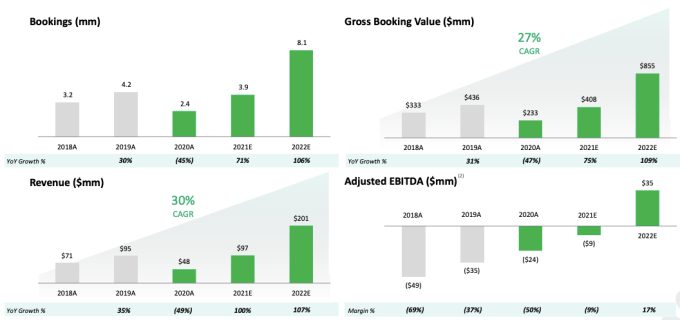
Revenue dipped from $95 million in 2019 to just $48 million last year. Bookings fell from 4.2 million to 2.4 million over the same time frame, leading to gross booking value falling from $436 million in 2019 to $233 million in 2020. Why? Because everyone was stuck at home. With their pets. A situation that limited demand for Rover-delivered pet services.

News: Bumble prices IPO at $43 per share

This afternoon Bumble priced its IPO at $43 per share, ahead its raised IPO range of $37 to $39 per share. After filing to go public in mid-January, and offered up its first price range on February 2nd. That range, $28 to $30 per share wound up coming up short. Bumble raised its price range

This afternoon Bumble priced its IPO at $43 per share, ahead its raised IPO range of $37 to $39 per share.

After filing to go public in mid-January, and offered up its first price range on February 2nd. That range, $28 to $30 per share wound up coming up short. Bumble raised its price range to $37 to $39 per share earlier this week.

Before counting a possible underwriters’ option, Bumble raised $2.15 by selling 50,000,000 million shares in its public offering. The company will begin to trade tomorrow morning.

Bumble’s debut comes amidst a number of other 2021 offerings, including MetroMile’s SPAC-led public combination earlier this week. Other well-known companies are anticipated to list this year, including Coinbase and, perhaps, Robinhood.

The public offering of Bumble shares comes after a sustained period when one company, Match, was presumed to be the only possible public dating company. However, the smaller Bumble has proven that there is room for at least one more.

TechCrunch explored Bumble’s financial results here, if you’d like more.

News: Daily Crunch: Facebook tests a News Feed with less politics

Facebook tries to get less political, Oracle’s TikTok acquisition may not be happening and Twitter says Donald Trump is banned forever. This is your Daily Crunch for February 10, 2021. The big story: Facebook tests a News Feed with less politics Facebook announced today that it’s testing changes to the News Feed that would downrank

Facebook tries to get less political, Oracle’s TikTok acquisition may not be happening and Twitter says Donald Trump is banned forever. This is your Daily Crunch for February 10, 2021.

The big story: Facebook tests a News Feed with less politics

Facebook announced today that it’s testing changes to the News Feed that would downrank political content. The company says the results will help determine how it treats such content in the future; content from health organizations and official government agencies will not be affected.

Two years ago, Facebook said it would be downranking publisher content in favor of content from family and friends, but this time it’s targeting politics specifically. For now, this test is only being conducted with a small group of users in select markets, including the United States, Canada, Brazil and Indonesia.

The tech giants

TikTok’s forced sale to Oracle is put on hold — The insane saga of a potential forced sale of TikTok’s U.S. operations is reportedly ending.

Twitter says Trump is banned forever, even if he runs for president again — “When you’re removed from the platform, you’re removed from the platform,” said Twitter CFO Ned Segal.

Apple Maps to gain Waze-like features for reporting accidents, hazards and speed traps — The new features are live in the iOS 14.5 beta.

Startups, funding and venture capital

Israeli startup CYE raises $100M to help companies shore up their cyber-defenses — CYE conducts offensive operations against their customers (with their permission) to find weaknesses before malicious hackers do.

SecuriThings snares $14M Series A to keep edge devices under control — This could include devices like security cameras, access control systems and building management systems.

Podz turns podcasts into a personalized audio newsfeed — A new company from an old Startup Battlefield winner, backed by Katie Couric and Paris Hilton.

Advice and analysis from Extra Crunch

Three adtech and martech VCs see major opportunities in privacy and compliance — We asked them to update us on whether deal flow has recovered, and to look ahead at the possibility of additional regulation.

Dear Sophie: How can I improve our startup’s international recruiting? — The latest edition of the advice column that answers immigration-related questions about working at technology companies.

How will investors value MetroMile and Oscar Health? — Last night, MetroMile and SPAC INSU Acquisition Corp. II completed their combination.

(Extra Crunch is our membership program, which helps founders and startup teams get ahead. You can sign up here.)

Everything else

Ancestry says it fought two police requests to search its DNA database — Neither request resulted in the company turning over customer or DNA data.

NASA will use Fitbits to help prevent spread of COVID-19 to astronauts and employees — NASA will provide 1,000 of its employees, including 150 astronauts, with Fitbit devices in a pilot program.

EU’s top privacy regulator urges ban on surveillance-based ad targeting — The regulator is proposing that this ban be included in a major reform of digital services rules.

The Daily Crunch is TechCrunch’s roundup of our biggest and most important stories. If you’d like to get this delivered to your inbox every day at around 3pm Pacific, you can subscribe here.

News: Scalarr raises $7.5M to fight mobile ad fraud

Scalarr, a startup that says it uses machine learning to combat ad fraud, is announcing that it has raised $7.5 million in Series A funding. The company was founded by CEO Inna Ushakova and CPO Yuriy Yashunin, who previously led the mobile marketing agency Zenna. Ushakova told me that while at Zenna, they realized that

Scalarr, a startup that says it uses machine learning to combat ad fraud, is announcing that it has raised $7.5 million in Series A funding.

The company was founded by CEO Inna Ushakova and CPO Yuriy Yashunin, who previously led the mobile marketing agency Zenna. Ushakova told me that while at Zenna, they realized that ad fraud had grown to the point that it posed a real threat to their business.

At the same time, the team wasn’t impressed by any of the existing anti-fraud solutions, so it built its own technology. Eventually, they shut down Zenna completely and moved the entire team over to Scalarr.

The startup’s products include AutoBlock, which is supposed to detect fraud before the advertiser bids on an ad, and DeepView, which is used by adtech platforms (including ad exchanges, demand-side platforms and supply-side platforms).

Scalarr says it can detect 60% more fraud than existing products on the market and that it saved its clients $22 million in ad fraud refunds in 2020. Ushakova attributed this in large part to the startup’s extensive use of machine learning technology.

She added that while large ad attribution companies are adding anti-fraud products, they aren’t the focus. And historically, companies have tried to detect fraud through a “rules-based approach,” where there’s a list of behaviors that suggest fraudulent activity — but no matter how quickly they create those rules, it’s hard to keep up with the fraudsters.

“Fraud is ever evolving,” Ushakova said. “It’s like a Tom and Jerry game, so they are ahead of you and we are trying to catch them.”

As for why machine learning works so much more effectively, she said, “Only ML could help you predict the next step, and with ML, you should be able to detect abnormalities that are not classified. Right after that, our analytics should be able to take a look at those abnormalities and decide whether something is statistically important.”

Scalarr’s Series A was led by the European Bank of Reconstruction and Development, with participation from TMT Investments, OTB Ventures and Speedinvest. Among other things, the company will use the money to expand its presence in Asia and continue developing the product.

News: Beacons debuts a ‘link in bio’ mobile website builder that helps creators make money, not just list links

Today, there are a number of website builders aimed at creators who want to point fans to a dedicated landing page from their social media profile. If you’ve spent any time on TikTok or Instagram, you’ve likely come across one of these simplified “link in bio”-style websites — like those hosted by Linktree, for example.

Today, there are a number of website builders aimed at creators who want to point fans to a dedicated landing page from their social media profile. If you’ve spent any time on TikTok or Instagram, you’ve likely come across one of these simplified “link in bio”-style websites — like those hosted by Linktree, for example. A new startup called Beacons is now entering this market with the goal of making “link in bio” websites even more powerful. Its website builder offers creators an expanded set of tools to monetize their community, including through donations, sales, paid requests, affiliate shopping and more.

After signing up for the service, Beacons walks the user through a series of questions, many which can be answered with just a “yes” or “no.” For example, Beacons may ask the user if they want to accept donations or collect followers’ emails, if they make TikTok or YouTube videos, and which category they’re in, in terms of the content they create.

This information is used to set up their Beacons landing page with the right content sections, which Beacons calls “blocks.” At launch, Beacons offers around a dozen of these configurable blocks, like email and SMS collection modules, video embed blocks for TikTok or YouTube creators, music blocks for embedding a track or album, a Twitter block to embed a tweet or Twitter profile, and link blocks, similar to Linktree, among others.

There’s even a “friends” block, which is like a modern-day Myspace Top 8. This lets you link out to your friends on either Beacons, Instagram, Twitter or TikTok.

An area where Beacons differentiates itself from other “link in bio” website builders, however, is with its set of “monetization” blocks. Today, it has four tools for creators who want to generate revenue from their online presence. One of these is similar to Cameo, as it allows the creator to set up a menu of options to take fan requests for personalized content. For instance, fans could ask a fitness influencer to critique their routine, or they could pay to have their burning questions answered by someone they admire. The creator can then send out a personalized response either publicly or privately.

Other monetization blocks allow creators to accept donations or sell digital downloads — like e-books or paid video content, for instance.

Image Credits: Beacons

The fourth, and perhaps most interesting, monetization block is a TikTok shopping feature. It allows creators to embed their TikTok videos where they recommend products directly on their Beacons website. From here, they can add affiliate links to the products in question, allowing them to directly generate revenue when fans purchase the items they’ve featured.

This particular feature comes at an opportune time. Today, TikTok is only beginning to formalize its plans around e-commerce. In a recent presentation to marketers, TikTok spoke of its plans to launch new online shopping tools that would allow brands to more directly reach TikTok’s younger audience. TikTok has also partnered with Shopify on social commerce, and has experimented with live video shopping, including with a holiday event hosted by Walmart.

But TikTok’s creators have already been driving shopping trends across categories like fashion, beauty, home décor, household items, toys and much more, to the point that “TikTok made me buy it,” has become a common excuse for the impulse purchases prompted by TikTok’s viral content. By allowing creators to now more directly and financially benefit from these trends is the next logical step.
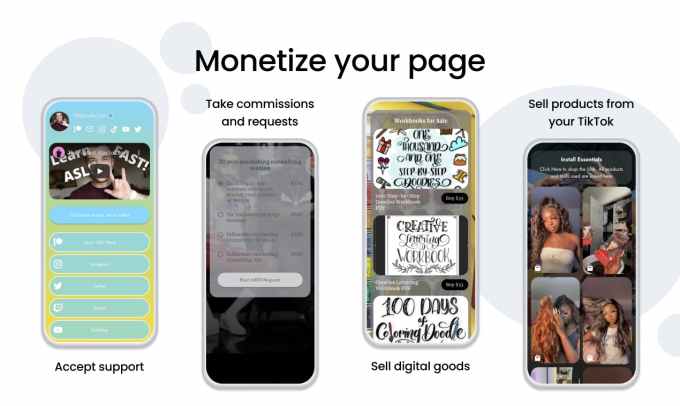
Image Credits: Beacons

The idea for Beacons comes from co-founders Neal Jean, Jesse Zhang, Greg Luppescu and David Zeng. Neal, Jesse and David met while in the PhD program at Stanford studying different areas of research, like machine learning and AI. Greg, meanwhile, did his Master’s at Stanford, then went on to work at Apple on the Apple Watch team.

Neal, Jesse and David had teamed up on Beacons and went through the Y Combinator Summer 2019 batch, iterating on ideas and pivoting the product several times. Some of those early concepts may eventually return — like a Shopify integration that would connect creators with brands selling on Shopify, for example.

The broader focus, however, had always been on helping creators make money, says Neal.

“Even before our current product, we were really focused on trying to help creators solve monetization,” he explains. “When we kind of made this mini-pivot into the more Linktree-like product, we thought about building features that can help creators actually generate revenue — which I don’t think Linktree or any of the existing incumbents in the space were doing. Even today, you can’t actually make any money through Linktree,” he notes.

Linktree, of course, is only one of many “link in bio” websites on the market today, which means Beacons still faces a lot of competition. Other rivals include Linkin.bio, Lnk.bio, Shorby, Tap.bio, Feedlink.io, Link in Profile, Milkshake, Campsite, bio.fm, url.bio and biolincs.me, for example.

Unlike some of its competitors, Beacons offers its tools for free and instead monetizes through a premium plan ($10/mo) that allows creators to use their own custom domain. It also makes money by taking a percentage of sales on the requests and sales blocks, which is either 9% on the free plan or 5% on the paid plan. This rev share doesn’t bring in much money today — only “hundreds” of dollars — but the team believes that will scale as the startup grows and gains a large user base.

“Our strategy is…to continue building out more of these different kinds of revenue streams for creators,” says Neal. “And as we do that, I think, the fraction of transactional revenue will become higher relative to the subscription revenue than it is today.”

Since launching in private beta last September, Beacons has seen 90,000 sign-ups and now has over 20,000 people who are considered active users of the product — most arrived in the last couple of months when the service began to roll out some of its newer features. So far, Beacons hasn’t done any paid marketing, with around 77% of new users coming to Beacons because they saw it on someone else’s profile.

The team raised a small, post-YC angel round of around $600,000 but is looking to fundraise in the future.


WordPress Image Lightbox Plugin