Tag Archives: Blog

News: Peak AI nabs $21M for a platform to help non-tech companies make AI-based decisions

One of the biggest challenges for organizations in modern times is deciding where, when, and how to use the advances of technology, when the organizations are not technology companies themselves. Today, a startup out of Manchester, England, is announcing some funding for a platform that it believes can help. Peak AI, which has built technology

One of the biggest challenges for organizations in modern times is deciding where, when, and how to use the advances of technology, when the organizations are not technology companies themselves. Today, a startup out of Manchester, England, is announcing some funding for a platform that it believes can help.

Peak AI, which has built technology that it says can help enterprises — specifically those that work with physical products such as retailers, consumer goods companies, and manufacturing organizations — make better, AI-based evaluations and decisions, has closed a round of $21 million.

The Series B is being led by Oxx, with participation from past investors MMC Ventures and Praetura Ventures, as well as new backer Arete. It has raised $43 million to date and is not disclosing its valuation.

Richard Potter, the CEO who co-founded the company with Atul Sharma and David Leitch, said that the funding will be used to continue expanding the the functionality of its platform, adding offices in the U.S. and India, and growing its customer base.

Its list of clients today is an impressive one, including the retailer PrettyLittleThing, KFC, PepsiCo, Marshalls and Speedy Hire.

As Potter describes it, Peak identified its opportunity early on. It was founded in 2014, a time non-tech enterprises were just starting to grasp how the concept of AI could apply to their businesses but felt it was out of their reach.

Indeed, the larger landscape for AI services at that time was largely one focused on technology companies, specifically companies like Google, Amazon and Apple that were building AI products to power their own services, and often snapping up the most interesting talent in the field as it manifested through smaller startups and universities.

Peak’s basic premise was to build AI not as a business goal for itself but as a business service. Its platform sits within an organization and ingests any data source that a company might wish to feed into it.

While initial integration needs technical know-how — either at the company itself or via a systems integrator — using Peak day-to-day can be done by both technical and non-technical workers.

Peak says it can help answer a variety of questions that those people might have, such as how much of an item to produce, and where to ship it, based on a complex mix of sales data; how to manage stock better; or when to ramp up or ramp down headcount in a warehouse. The platform can also be used to help companies with marketing and advertising, figuring out how to better target campaigns to the right audiences, and so on.

Peak is not the first company that has seized on the concept of using a “general” AI to give non-tech organizations the same kinds of superpowers that the likes of big tech now use in their own businesses everyday.

Sometimes the ambition has outstripped the returns, however.

Witness Element AI, a highly-touted startup backed by a long list of top-shelf strategic and financial investors to build, essentially, an AI services business for non-tech companies to use as they might these days use Accenture. It never quite got there, though, and was acquired by ServiceNow last year at a devalued price of $500 million, the customer deals it had were wound down, and the tech was integrated into the bigger company’s stack.

Other efforts within hugely successful tech companies have not fared that well either.

“Einsten’s features are essentially useless, and you can quote me on that,” said Potter of Salesforce’s in-house CRM AI business. “Because it is too generic, it doesn’t predict anything useful.”

And that is perhaps the crux of why Peak AI is working for now: it has remained focused for now on a limited number of segments of the market, in particular those with physical objects as the end product, giving the AI that it has built a more targeted end point. In other words, it’s “general” but only for specific industries.

And it claims that this is paying off. Peak’s customers have reported a 5% increase in total company revenues, a doubling of return on advertising spend, a 12% reduction in inventory holdings, and a 5% reduction in supply chain costs, according to the company (although it doesn’t specify which companies, which products, or anything that points to who or what is being described).

“Richard and the excellent Peak team have a compelling vision to optimize entire businesses through Decision Intelligence and they’re delivering real-world benefits to a raft of household name customers already,” said Richard Anton, a general partner at Oxx, in a statement. “The pandemic has meant digitization is no longer a choice; it’s a requirement. Peak has made it easier for businesses to get started and see rapid results from AI-enabled decision making. We are delighted to support Peak on their way to becoming the category-defining global leader in Decision Intelligence.” Anton is joining the board with this round.

News: Epic Games takes its Apple App Store fight to Europe

Epic Games has taken its fight against Apple’s App Store rules to the European Union where it’s lodged a complaint with the bloc’s antitrust regulators. In a blog post today the maker of the popular online game Fortnite said it’s extending its battle for what it dubbed “fairer digital platform practices for developers and consumers”

Epic Games has taken its fight against Apple’s App Store rules to the European Union where it’s lodged a complaint with the bloc’s antitrust regulators.

In a blog post today the maker of the popular online game Fortnite said it’s extending its battle for what it dubbed “fairer digital platform practices for developers and consumers” to Europe, noting the bloc is already looking into competition concerns attached to the Apple App Store (and its payment service, Apple Pay).

The EU opened a formal probe into certain Apple practices last year.

Regional lawmakers have also recently set out a plan to expand platform regulation to put specific strictures on ‘gatekeeper’ platforms with the aim of ensuring fairness and accountability vis-a-vis third parties. And the issue of platform power is certainly one that’s now under close scrutiny by regulators and lawmakers around the world.

We’re bringing our fight to end Apple’s App Store monopoly to Europe. Apple’s practices are harming consumers and app developers in Europe and around the world, and we’re joining the #EU’s ongoing investigation into Apple’s abuse of its dominant position https://t.co/LIb346QmEi

— Epic Games Newsroom (@EpicNewsroom) February 17, 2021

“The complaint, filed with the European Commission’s Directorate-General for Competition, alleges that through a series of carefully designed anti-competitive restrictions, Apple has not just harmed but completely eliminated competition in app distribution and payment processes,” Epic writes, adding: “Apple uses its control of the iOS ecosystem to benefit itself while blocking competitors and its conduct is an abuse of a dominant position and in breach of EU competition law.”

It’s not seeking damages against Apple but wants EU competition authorities to impose remedies against what it describes as the iPhone maker’s “monopoly channels”.

“What’s at stake here is the very future of mobile platforms,” said Epic Games founder and CEO, Tim Sweeney, in a statement. “Consumers have the right to install apps from sources of their choosing and developers have the right to compete in a fair marketplace. We will not stand idly by and allow Apple to use its platform dominance to control what should be a level digital playing field. It’s bad for consumers, who are paying inflated prices due to the complete lack of competition among stores and in-app payment processing. And it’s bad for developers, whose very livelihoods often hinge on Apple’s complete discretion as to who to allow on the iOS platform, and on which terms.”

Epic launched a US lawsuit against Apple last August after Apple banned Fortnite from the App Store.

The tech giant made the move after Epic tried to bypass its in-app purchase framework (and circumvent the cut Apple takes) by adding its own payment mechanism to Fortnite to let users purchase in-game currency directly — in direct contravention of Apple’s rules.

As well as banning Fortnight, Apple said it would go further and revoke Epic’s developer account and access to developer tools for its Unreal Engine — a move that would have affected third party app makers that rely on Epic’s engine. However it was barred from going that far.

A US judge quickly denied Epic’s motion to force Apple to unblock the game but Cupertino was ordered not to block Epic’s ability to provide and distribute its Unreal Engine on iOS — limiting Apple’s ability to take a scorched earth approach to try to shut Epic’s battle down.

Since then Epic has filed legal complaints against Apple in Australia and the UK. It’s now also petitioning EU regulators.

The EU’s antitrust division, meanwhile, opened a formal investigation of Apple last summer — more than a year after the Europe-based music streaming service Spotify had made a similar complaint over ‘restrictive’ App Store rules and the 30% cut Cupertino takes on iOS in-app payments.

The Commission said at the time that an unnamed e-book/audiobook distributor had also complained about the impact of App Store rules on competition.

It confirmed today that it has received a complaint by Epic Games against Apple. We will assess it based on our standard procedures,” a Commission spokesperson told us. 

Epic’s argument is that Apple is denying Fortnight users on iOS a choice between Apple payment and Epic direct payment — claiming savings would be passed to direct purchasers (although Epic of course stands to gain money if it can open up a channel that bypasses Apple’s cut on in-app payments).

Epic has also tried to push Apple to let it operate an Epic Games Store on iOS — a move Apple refused, citing the “exacting standards for security, privacy, and content” which it argues are predicated on the App Store rules (although Apple’s claims of curation equaling ‘quality’ don’t always live up to the reality of what it allows to operate on its App Store).

Back in 2019, Apple also launched its own gaming distribution service, Apple Arcade — a pure-play content play that offers access to new and exclusive games playable across Apple’s device ecosystem.

That move was perhaps the straw the broke the camel’s back vis-a-vis Epic Games deciding to go all in on an antitrust brawl with Apple. (Its blog post references Apple Arcade, and notes that Apple has barred competitors, including itself, from doing the same).

It’s worth noting that Epic has also squared up to Google, which similarly takes a cut of in-app payments of Android apps distributed via its Play Store — and which also removed Fortnight from the Play Store last year.

However Google’s Android platform allows sideloading of third party apps and alternative app stores, arguably making it harder to make an antitrust case stick vs the tighter restrictions applied by Apple.

At the same time, though, Android dominates smartphone marketshare — while Apple’s cut of the global market is less than a fifth.

News: vArmour the multi-cloud security startup, raises $58M en route to IPO

Enterprises have been loading more of their operations into cloud — and, more often than not, multi-cloud — environments over the last year, creating vast networks of services that can be complex to manage. Today, vArmour, a startup that provides ways to manage in real time and ultimately secure how applications (and people) work in

Enterprises have been loading more of their operations into cloud — and, more often than not, multi-cloud — environments over the last year, creating vast networks of services that can be complex to manage. Today, vArmour, a startup that provides ways to manage in real time and ultimately secure how applications (and people) work in those fragmented environments is announcing funding to capitalize on the demand for its services.

The Bay Area startup has picked up funding of $58 million in what it described as an oversubscribed round. Co-led by previous backers AllegisCyber Capital and NightDragon, existing investors Standard Chartered Ventures, Highland Capital Partners, Australian carrier Telstra, Redline Capital, and EDBI also participated.

CEO Tim Eades (who co-founded the company with Roger Lian) said this round is likely to be its final fundraising ahead of an IPO for the company.

“We had one hell of a year in 2020 with companies rushing to the cloud,” he said in an interview, with net new annual recurring revenue doubing year over year in the last year. It started out, he noted, with perhaps 10% of business processes in the cloud, and ended at more like 50%. “Now the focus for us is to get to the public markets, maybe in two or 2.5 years from now.”

The company appointed a CFO last October as part of its go-public plan, he noted — Chris Dentiste, who previously had been the CFO of RSA. “His job is to help me find the right window. My job is to make sure we have enough fuel in the tank, and we do,” said Eades.

He added that the company is likely also to look at making some acquisitions in the meantime. A recent launch of an AI lab in Calgary, Canada, points to one area where we might see some activity.

The company is not disclosing its valuation, although Eades confirmed it was a significant up-round. We’re also double checking what the total raised to date is now too (we’ll update when we get that information).

For some context, in the last round of funding that we covered — a $44 million round in 2019 led by the same two investors — we mentioned a PitchBook estimate of $420 million from the previous round — a figure that the company did not dispute with us at the time.

vArmour has been around for several years, with the first three spent in stealth mode, quietly building its technology, raising money and amassing early customers. Those customers, Eades said, fall into categories like telecommunications (strategic backer Telstra being one of them), and financial services.

Those industries speak largely to the challenges that vArmour is addressing in its business.

Legacy businesses in critical verticals often pre-date the modern era of business, and while many of them are going through what enterprise people like to refer to as “digital transformation”, the evolution is not a smooth one.

In many cases, adopting new technologies can be slow, and in almost every case, when you are talking about large enterprises, the changes are very piecemeal, affecting one particular service, or region, or department, or even a subsection of any of those.

All of this means that for malicious actors, there are a number of options to tackle when setting out to look for vulnerabilities in a business or its network, and for those on the inside, it makes for a very complicated and fragmented situation when it comes to monitoring those networks and the services running on them, finding vulnerabilities or suspicious activity, and doing something about that. VArmour’s term that it uses for this is “Application Relationship Management.”

Eades — whose background includes working for the likes of IBM but also leading number of startups acquired by bigger technology giants — has first-hand understanding of how that complexity looks from both sides, from the end user end and from the service provider end. That is in essence what his company has identified and is trying to fix.

Having started out in managing application policies and providing insights to protect on that front, the company is expanding the range of tools that it provides with the recent launch of identity access management on top of that.

But that is likely to be just one of the product steps that it takes to tackle what remains a difficult problem to fix, as its growth is related not just to the growth of activity on a network, but further digital migration of services, and the rise of new technology within an organization’s stack.

(And that is also an area that vArmour is not alone in considering, or even the only approach to tackling it: consider yesterday’s news of Palo Alto Networks acquiring Bridgecrew to extend its own ability to provide automated security monitoring services to DevOps teams.)

“Managing risk and resiliency in the hybrid cloud is one of the most significant security challenges for enterprises,” said Bob Ackerman, Founder and Managing Director at AllegisCyber Capital, in a statement. “vArmour’s platform provides the visibility, controls, and accountability necessary to actively manage these challenges and has done this for hundreds of customers. We are ecstatic to be part of their next stage of growth.”

“As applications become more complex, more distributed, and more targeted by attackers, the importance of full visibility into the relationships between applications becomes increasingly important.” added Dave DeWalt, founder of NightDragon. “vArmour’s approach to application relationship management ensures that enterprises of all sizes can continuously audit, respond, and control identity relationships to best protect their important IP, and mitigate risk to the business.”

News: Sinch acquires Inteliquent for $1.14B to take on Twilio in the US

After raising $690 million from SoftBank in December to make acquisitions, the Sweden-based cloud communications company Sinch has followed through on its strategy in that department. Today the company announced that it is acquiring Inteliquent, an interconnection provider for voice communications in the U.S. currently owned by private equity firm GTCR, for $1.14 billion in

After raising $690 million from SoftBank in December to make acquisitions, the Sweden-based cloud communications company Sinch has followed through on its strategy in that department. Today the company announced that it is acquiring Inteliquent, an interconnection provider for voice communications in the U.S. currently owned by private equity firm GTCR, for $1.14 billion in cash.

And to finance the deal, Sinch said it has raised financing totaling SEK8.2 billion — $986 million — from Handelsbanken and Danske Bank, along with other facilities it had in place.

The deal will give Sinch — a competitor to Twilio with a range of messaging, calling and marketing (engagement) APIs for those building communications into their services in mobile apps and other services — a significant foothold in the U.S. market.

Inteliquent — a profitable company with 500 employees and revenues of $533 million, gross profit of $256 million, and Ebitda of $135 million in 2020 — claims to be one of the biggest voice carriers North America, serving both other service providers and enterprises. Its network connects to all the major telcos, covering 94% of the U.S. population, with more than 300 billion minutes of voice calls and 100 million phone numbers handled annually for customers.

Sinch is publicly traded in Sweden — where its market cap is current at $13 billion (just over 108 billion Swedish krona) — and the acquisition begs the question of whether the company plans to establish more of a financial presence in the U.S., for example with a listing there. We have asked the company what its next steps might be and will update this post as and when we learn more.

“Becoming a leader in the U.S. voice market is key to establish Sinch as the leading global cloud communications platform,” said Oscar Werner, Sinch CEO, in a statement. “Inteliquent serves the largest and most demanding voice customers in America with superior quality backed by a fully-owned network across the entire U.S.. Our joint strengths in voice and messaging provide a unique position to grow our business and power a superior customer experience for our customers.”

Inteliquen provides two main areas of service, Communications-Platform-as-Service (CPaaS) for API-based services to provide voice calling and phone numbers; and more legacy Infrastructure-as-a-Service (IaaS) products for telcos such as off-net call termination (when a call is handed off from one carrier to another) and toll-free numbers. These each account for roughly half of the total business although — unsurprisingly — the CPaaS business is growing at twice the rate of IaaS.

Its business, like many others focusing on services for people who are relying more on communications services as they are seeing each other in person less — saw a surge of use this past year, it said. (Revenues adjusted without Covid lift, it noted, would have been $499 million, so still healthy.)

As for Sinch, since spinning out from Rebtel in 2014 to take on the business of providing comunications tools to developers, it has been on an acquisition roll to bulk up its geographical reach and the services that it provides to those customers.

Deals have included, most recently, buying ACL in India for $70 million and SAP’s digital interconnect business for $250 million. The deals — combined with Twilio’s own acquisitions of companies like Sendgrid for $2 billion and last year’s Segment for $3.2 billon, speak both to the bigger trend of consolidation in the digital (API-based) communications space, as well as the huge value that is contained within it.

Inteliquent itself had been in private equity hands before this, controlled by GTCR based in Chicago, like Inteliquent itself. According to PitchBook, its most recent financing was a mezzanine loan from Oaktree Capital in 2018 for just under $19 million.

Interestingly, Inteliquent itself has been an investor in innovative communications startups, participating in a Series B for Zipwhip, a startup that is building better ways to integrate mobile messaging tools into landline services.

“We’re excited about the tremendous opportunities this combination unlocks, expanding the services we can provide to our customers. Combining our leading voice offering with Sinch’s global messaging capabilities truly positions us for leadership in the rapidly developing market for cloud communications“, comments Ed O’Hara, Inteliquent CEO, in a statement.

News: Dixa acquires Elevio, the ‘knowledge management’ platform helping brands improve customer support

Dixa, the Danish customer support platform promising more personalised customer support, has acquired Melbourne-based “knowledge management” SaaS Elevio to bolster its product and technology offerings. The deal is said to be worth around $15 million, in a combination of cash and Dixa shares. This sees Elevio’s own VC investors exit, and Elevio’s founders and employees

Dixa, the Danish customer support platform promising more personalised customer support, has acquired Melbourne-based “knowledge management” SaaS Elevio to bolster its product and technology offerings.

The deal is said to be worth around $15 million, in a combination of cash and Dixa shares. This sees Elevio’s own VC investors exit, and Elevio’s founders and employees incentivised as part of the Dixa family, according to Dixa co-founder and CEO, Mads Fosselius.

“We have looked at many partners within this space over the years and ultimately decided to partner with Elevio as they have what we believe is the best solution in the market,” he tells me. “Dixa and Elevio have worked together since 2019 on several customers and great brands through a strong and tight integration between the two platforms. Dixa has also used Elevio’s products internally and to support our own customers for self service, knowledge base and help center”.

Fosselius says that this “close partnership, strong integration, unique tech” and a growing number of mutual customers eventually led to a discussion late last year, and the two companies decided to go on a journey together to “disrupt the world of customer service”.

“The acquisition comes with many interesting opportunities but it has been driven by a product/tech focus and is highly product and platform strategic for us,” he explains. “We long ago acknowledged that they have the best knowledge product in the market. We could have built our own knowledge management system but with such a strong product already out there, built with a similar tech stack as ours and with a very aligned vision and culture fit to Dixa, we felt this was a no brainer”.

Founded in 2015 by Jacob Vous Petersen and Mads Fosselius, Dixa wants to end bad customer service with the help of technology that claims to be able to facilitate more personalised customer support. Originally dubbed a “customer friendship” platform, the Dixa cloud-based software works across multiple channels — including phone, chat, e-mail, Facebook Messenger, WhatsApp and SMS — and employs a smart routing system so the right support requests reach the right people within an organisation.

Broadly speaking, the platform competes with Zendesk, Freshdesk and Salesforce. However, there’s also overlap with Intercom in relation to live chat and messaging, and perhaps MessageBird with its attempted expansion to become an “Omnichannel Platform-as-a-Service” (OPaaS) to easily enable companies to communicate with customers on any channel of their choosing.

Meanwhile, Elevio is described as bridging the gap between customer support and knowledge management. The platform helps support agents more easily access the right answers when communicating with customers, and simultaneously enables end-users to get information and guidance to resolve common issues for themselves.

Machine learning is employed so that the correct support content is provided based on a user’s query or on-going discussion, whilst also alerting customer support teams when documents need updating. The Australian company also claims that creating user guides using Elevio doesn’t require any technical skills and says its “embeddable assistant” enables support content to be delivered in-product or injected into any area of a website “without involving developers”.

Adds the Dixa CEO : “Customer support agents still spend a lot of time helping customers with the same type of questions over and over again. Together with Elevio we are able to ensure that agents are given the opportunity to quickly replicate best practice answers, ensuring fast, standardised and correct answers for customers. Elevio is the world leader in applying machine learning to solve this problem”.

News: Jet co-founder Nate Faust is building a more sustainable e-commerce experience with Olive

Nate Faust has spent years in the e-commerce business — he was a vice president at Quidsi (which ran Diapers.com and Soap.com), co-founder and COO at Jet (acquired by Walmart for $3.3 billion) and then a vice president at Walmart. Over time, he said it slowly dawned on him that it’s “crazy” that 25 years

Nate Faust has spent years in the e-commerce business — he was a vice president at Quidsi (which ran Diapers.com and Soap.com), co-founder and COO at Jet (acquired by Walmart for $3.3 billion) and then a vice president at Walmart.

Over time, he said it slowly dawned on him that it’s “crazy” that 25 years after the industry started, it’s still relying on “single-use, one-way packaging.” That’s annoying for consumers to deal with and has a real environmental impact, but Faust said, “If any single retailer were to try to tackle this problem right now on their own, they would run up into a huge cost increase to pay for this more expensive packaging and this two-way shipping.”

So he’s looking to change that with his new startup Olive, which consolidates a shopper’s purchases into a single weekly delivery in a reusable package.

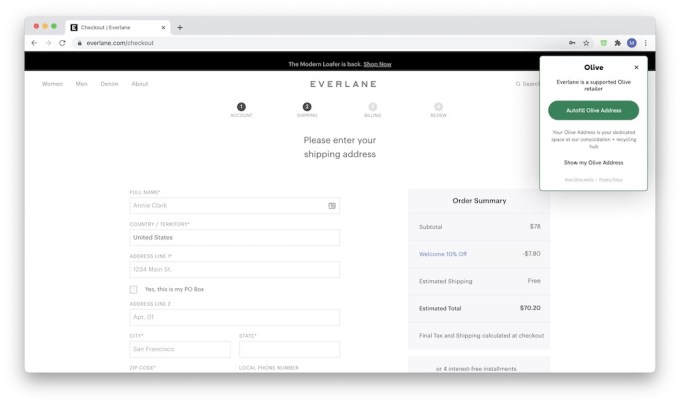
Olive works with hundreds of different apparel brands and retailers, including Adidas, Anthropologie, Everlane, Hugo Boss, Outdoor Voices and Saks Fifth Avenue. After consumers sign up, they can install the Olive iOS app and/or Chrome browser extension, then Faust said, “You shop on the directly on the retailer and brand sites you normally would, and Olive assists you in that checkout process and automatically enters your Olive details.”

Olive chrome extension

Image Credits: Olive

The products are sent to an Olive consolidation facility, where they’re held for you and combined into a weekly shipment. Because the retailers are still shipping products out like normal, all that packaging is still being used — but at least the consumer doesn’t have to dispose of it. And Faust said that eventually, Olive could work more closely with retailers to reduce or eliminate it.

Until then, he said the real environmental impact comes from “the consolidation of deliveries into fewer last mile stops” — the startup estimates that doubling the number of items in a delivery reduces the per-item carbon footprint by 30%.

The weekly shipments are delivered by regular mail carriers in most parts of the United States, and by local couriers in dense urban areas. They arrive in reusable shippers made from recyclable materials, and you can return any products by just selecting them in the Olive app, then putting them back in the shipper and flipping the label over.

In fact, Faust argued that the convenience of the return process (no labels to print out, no visits to the local FedEx or UPS store) should make Olive appealing to shoppers who aren’t drawn in by the environmental impact.

“In order to have the largest environmental impact, the selling point can’t be the environmental impact,” he said.

Olive delivery is available at no extra cost to the consumer, who just pays whatever they normally would for shipping.

Faust acknowledged that Olive runs counter to the “arm’s race” between Amazon and other e-commerce services working to deliver purchases as quickly as possible. But he said that the startup’s consumer surveys found that shoppers were willing to wait a little longer in order to get the other benefits.

Plus, Olive is starting with apparel because “there’s not that same expectation of speed” that you get in other categories, and because the items cost enough that the delivery economics still work out, even if you only order one product in a week.

News: Zolve raises $15 million for its cross-border neobank aimed at global citizens

Tens of thousands of students and professionals move out of India each year to pursue higher education and for work. Even after spending months in a new country, they struggle to get a credit card from local banks, and end up paying a premium to access a range of other financial services. Banks in the

Tens of thousands of students and professionals move out of India each year to pursue higher education and for work. Even after spending months in a new country, they struggle to get a credit card from local banks, and end up paying a premium to access a range of other financial services.

Banks in the U.S., or in most other countries for that matter, rely on local credit scores to determine the worthiness of potential applicants. Even if an individual had a great credit score in India, for instance, that wouldn’t hold any water for banks in a foreign land.

That was the takeaway Raghunandan G, the founder of ride-hailing firm TaxiForSure (sold to local giant Ola), returned to India with after a trip. After months of research and assembling a team, Raghunandan believes he has a solution.

On Wednesday, he announced Zolve, a neobanking platform for individuals moving from India to the U.S. (or the other way around).

The startup works with banks in the U.S. and India to provide consumers access to financial products seamlessly — without paying any premium or coughing up any security deposit.

In an interview with TechCrunch, Raghunandan said the startup underwrites the risks, which has enabled banks in foreign countries to extend their services to Zolve customers. “Consumers can open an account with us and access all banking services as if they are banking with their national bank,” he said.

As part of the announcement, Raghunandan said two-month-old Zolve has raised $15 million in a seed financing round led by Accel and Lightspeed. Blume Ventures and several high-profile angel investors, including Kunal Shah (founder of Cred), Ashish Gupta (formerly the MD of Helion), Greg Kidd (known for his investments in Twitter and Ripple), Rahul Mehta (managing partner at DST Global) and Rahul Kishore (senior managing director of Coatue Capital), also participated in the round. So did Founder Collective (which has backed Airtable and Uber), in what is its first investment in an Indian startup.

“Individuals with financial identities in multiple geographies need seamless global financial solutions and we believe the team’s strong identification with the problem will enable them to deliver compelling and innovative financial experiences,” said Bejul Somaia, Lightspeed India Partners, in a statement.

Before starting Zolve, Raghunandan founded TaxiForSure, a ride-hailing firm, that he later sold to Ola for $200 million. Image Credits: Zolve

Raghunandan acknowledged that a handful of other startups are also attempting to solve this challenge, but he said other firms are not making use of a consumer’s credit history from their origin nation. “We are the only one who is looking at this problem in a completely different light. We are not trying to solve the problem at the destination country where consumers face the challenges. We are finding the solution in the home country itself, where the consumers already have a reputation and credit history,” he said.

Once a customer has access to a credit card and other financial services in the new nation, they can quickly broaden their local credit history, something that otherwise takes years, he said.

“The global citizen community is largely underserved in terms of access to financial services and we believe that there is a huge market opportunity for Zolve. Raghu has a proven track record as a founder and we are delighted to partner with him again, on his latest venture. The team’s passion and commitment are commendable and we are positive that Zolve will create tremendous value for this community,” said Anand Daniel, partner at Accel, in a statement.

Headquartered in San Francisco and Bangalore, Zolve offers a range of compelling features even for those who don’t plan to visit a foreign land. If you’re in India, for instance, you can use Zolve to buy shares of companies listed at U.S. exchanges. You can also buy bitcoin and other cryptocurrency from exchanges based in the U.S. or Europe, said Raghunandan.

The startup, which has already amassed more than 5,000 customers, has formed revenue-sharing arrangements with its banking partners. Raghunandan said since Zolve currently onboards customers in India and generates much of its revenue from banking partners in the U.S., it’s already operating on a profitable model.

News: Daily Crunch: Axiom Space raises $130M

A space startup connected to the International Space Station raises $130 million, Atlassian releases a new version of Trello and bitcoin briefly passes $50,000. This is your Daily Crunch for February 16, 2021. The big story: Axiom Space raises $130M Founded in 2016, Axiom Space is working with NASA to add privately developed space station

A space startup connected to the International Space Station raises $130 million, Atlassian releases a new version of Trello and bitcoin briefly passes $50,000. This is your Daily Crunch for February 16, 2021.

The big story: Axiom Space raises $130M

Founded in 2016, Axiom Space is working with NASA to add privately developed space station modules to the International Space Station. It’s also the service provider for the first private astronaut launch to the ISS, scheduled for January 2022 using a SpaceX Dragon spacecraft and Falcon 9 rocket.

Eventually, the startup hopes to create its own orbital platforms. And in his story on the funding, Darrell Etherington says Axiom is emerging as “the leading linkage between private human spaceflight and the existing infrastructure and industry.”

The tech giants

Atlassian launches a whole new Trello — Trello is one of the most popular project management tools around, and in many ways it brought digital Kanban boards to the mainstream.

TikTok hit with consumer, child safety and privacy complaints in Europe — TikTok is facing a fresh round of regulatory complaints in Europe.

Reddit’s transparency report shows a big spam problem and relatively few government requests — Volume-wise, the largest problem by far is spam.

Startups, funding and venture capital

01 Advisors, the venture firm of Dick Costolo and Adam Bain, has closed fund two with $325M — Costolo and Bain previously served as Twitter’s CEO and its chief operating officer, respectively.

Shared scooter startup Revel adds electric bike subscriptions to its business — Revel will start offering monthly electric bike subscriptions in New York.

Tencent backs digital rights startup Pex in $57M round — The startup describes its Attribution Engine as the “licensing infrastructure for the Internet.”

Advice and analysis from Extra Crunch

Inside Rover and MoneyLion’s SPAC-led public debuts — Looking at the financial health of two companies that we’ve heard about for ages and never got to see inside of.

Four strategies for deep tech startups recruiting top growth marketers — How do deep tech companies connect and cultivate strong relationships with talented nontechnical growth people outside of their industry?

(Extra Crunch is our membership program, which helps founders and startup teams get ahead. You can sign up here.)

Everything else

Bitcoin briefly breaks the $50K barrier as Coinbase’s direct listing looms — The hodl-crew are having quite the moment.

Imagine a better future for social media at TechCrunch Sessions: Justice — We’ll discuss how much responsibility social networks have in the rise of toxic culture, deadly conspiracies and organized hate online.

The Daily Crunch is TechCrunch’s roundup of our biggest and most important stories. If you’d like to get this delivered to your inbox every day at around 3pm Pacific, you can subscribe here.

News: Justice Through Code is a free coding program for those impacted by the criminal justice system

People who have spent time in jail or prison often face barriers to accessing stable jobs, housing and financial services. These types of barriers are a key driver of recidivism for the more than 600,000 people who are released from prison each year. Between 2005 and 2014, an estimated 68% of people released in 2005

People who have spent time in jail or prison often face barriers to accessing stable jobs, housing and financial services. These types of barriers are a key driver of recidivism for the more than 600,000 people who are released from prison each year. Between 2005 and 2014, an estimated 68% of people released in 2005 were arrested again within three years. Within nine years, 83% of those released in 2005 were rearrested, according to the U.S. Department of Justice’s Bureau of Justice Statistics.

Justice Through Code, a semester-long coding and interpersonal skills intensive that takes place at Columbia University, aims to provide alternative paths for people once they reenter society.

Throughout the semester, students learn the fundamentals of Python and other computer science basics. They also receive career coaching, public speaking training, and learn negotiation skills and how to write a resume. Once students complete the program, Justice Through Code, which held its first cohort last year with just over 30 students, puts them in touch with its partners for paid internships and jobs.

Of the students in the first cohort who were interested in finding jobs or internships after the program, more than 80% of them were placed in relevant roles within six months, Justice Through Code founder Aedan Macdonald told TechCrunch. Antwan (pictured above) is one of the graduates who secured an internship after the program. Antwan has been interning full time at Columbia in the school’s IT department since December.

“It was just amazing that within one year of me coming across that flyer [for Justice Through Code] on Facebook, I’m actually working an internship at Columbia,” Antwan told TechCrunch. “And it’s just been tremendous. I mean, it’s been nonstop learning every single day.”

Before that, Antwan spent time at Emergent Works.

“It really gave me my first opportunity of using the theory that I learned in the program in a work setting,” Antwan said.

Justice Through Code works with a handful of tech partners to support its program and its students. Amazon Web Services, for example, provides laptops to students who need them while technologists from Google, Slack and Coursera speak to students on their experiences in tech.

AWS has yet to hire folks from the program but an AWS spokesperson says the company is excited to present opportunities to graduates.

“It’s definitely our intention to hire individuals from this program,” the spokesperson told TechCrunch.

Justice Through Code is now accepting applications for its third cohort, which Macdonald says he hopes will have a class size of up to 60 people. While Justice Through Code does not require applicants to have any prior coding experience, the program does want participants to be comfortable using computers. The application process also seeks to determine how well someone may be equipped to deal with the frustrations that come with learning how to code.

“So much of learning how to code is being in a kind of state where you don’t know everything,” Macdonald said. “And it can be highly frustrating. And so I think seeing how the process of how people work through problems [is beneficial]. We do a couple logic problems in the interview, and it’s really not a matter of does somebody have the answer to this, but we actually have questions in pairs. So if somebody struggles on one question, we’ll go through in detail how to solve that and then see what their process is of applying that same principle of logic to the subsequent question that utilizes the same principle. So … how people are responding in a learning environment, as well as kind of curiosity about the the industry and just a real drive to succeed if they’re selected to participate in the program.”

Justice Through Code is not the only program that serves folks impacted by the criminal justice system. The Last Mile teaches folks business and coding skills while incarcerated, and similarly has partnerships in place with tech companies to help returned citizens find jobs.

Macdonald, who himself spent time in prison, says he hopes Justice Through Code can help to shift “the negative stereotypes of the formerly incarcerated as not having any future beyond a minimum wage job.”

News: Reddit’s transparency report shows a big spam problem and relatively few government requests

Reddit has published its transparency report for 2020, showing various numbers relating to removed content, government requests and other administrative actions. The largest problem by far — in terms of volume, anyway — is spam, which made up nearly all content taken down. Legal requests for content takedown and user information were far fewer, but

Reddit has published its transparency report for 2020, showing various numbers relating to removed content, government requests and other administrative actions. The largest problem by far — in terms of volume, anyway — is spam, which made up nearly all content taken down. Legal requests for content takedown and user information were far fewer, but not trivial, in number.

The full report is quite readable, but a bit long; the main points to understand are summarized below.

Of nearly 3.4 billion pieces of content created on Reddit (which is to say posts, comments, hosted images, etc.), 233 million were removed. These numbers are both up by 20%-30% from 2019. Of those 233 million, 131 million were “proactive” removals by the AutoMod system and 13.6 million were removed after user reports by subreddit moderators.

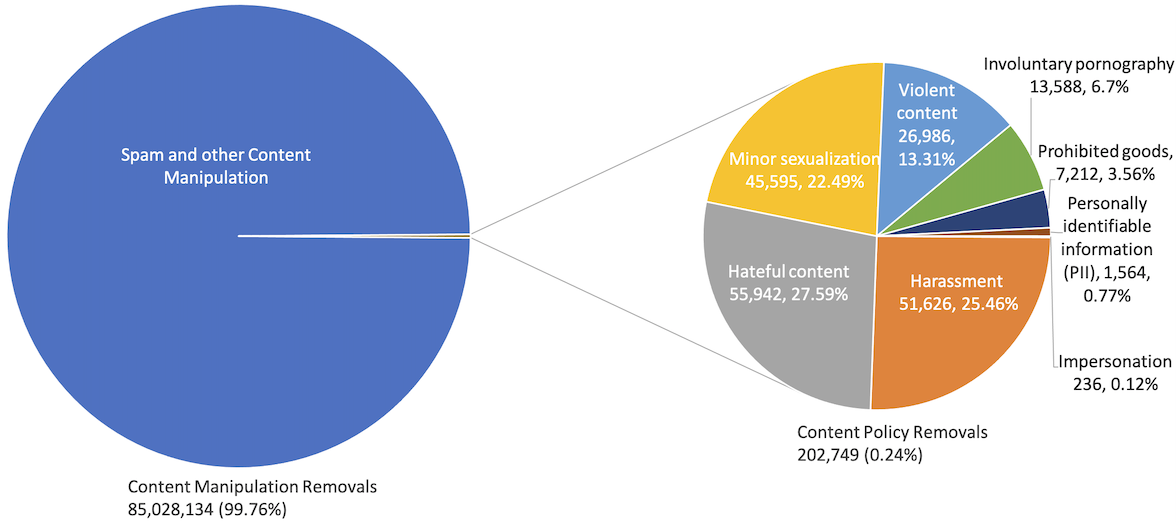
The remaining 85 million were taken down by Reddit admins; 99.76% of these were spam or “content manipulation” like brigading and astroturfing, with around 50,000 each of harassment, hate and sexualization of minors, smaller amounts of violent speech, doxing and so on.

Chart showing that content removal on reddit was largely spam.

Image Credits: Reddit

82,858 subreddits were removed, nearly four times more than 2019. The majority of these were for lack of moderation, followed by hate, harassment and ban evasion (e.g., r/bannedsub starts r/bannedsub2).

When it came to removing comments, hate, violence and harassment were much more prevalent. And 92% of private messages removed (of about 25,000 total) were for harassment.

Outside of spam and content manipulation, hate speech resulted in far more bans than any other infraction; more accounts were permanently banned for hate in 2020 than for all causes combined in 2019. (But far fewer for content violations than for spam and ban evasion.)

Government requests to remove content were relatively few. Overall Reddit received a couple hundred requests covering about 5,000 pieces of content or subreddits. For example, 753 subreddits had their access restricted to Pakistani users due to anti-obscenity laws there.

Requests from individuals or companies to remove things numbered in the hundreds, and copyright takedown notices asked for about half a million pieces of content to be removed (375,774 were), more than twice 2019’s. Only a handful of DMCA counter-notices were received.

Law enforcement came to Reddit 611 times for user information, up 50% from last year, and the company granted 424 of those requests. These are mostly subpoenas, court orders and search warrants. Since Reddit isn’t really a social network and accounts can be essentially anonymous or throwaway, it’s hard to say what level of disclosure this actually represents. Emergency disclosure requests numbered about 300 and were mostly complied with — these are supposedly life-or-death situations in which a Reddit account is concerned.

Lastly Reddit received somewhere between 0 and 249 secret requests for data, targeting somewhere between 0 and 249 users, same as last year. Sadly, federal law prohibits them from saying any more than this regarding FISA orders and National Security Letters.

Overall the picture painted of Reddit in 2020 is of a growing community plagued by spam and inauthentic activity, plus a significant and growing contingent of hate, harassment and other prohibited content (though last year was surely an exceptional one for this). Lacking much fundamental access to or use of personally identifiable data, Reddit isn’t much of a target for three-letter agencies and law enforcement. And with “free speech”-focused alternatives to Reddit and other platforms popping up, it’s likely that the hate and harassment that were deplatformed will roost elsewhere in 2021.

WordPress Image Lightbox Plugin