Tag Archives: Blog

News: Aeye becomes latest lidar company to go public via SPAC

Aeye, a lidar startup that developed its technology for use in autonomous vehicles as well as to support advanced driver assistance systems in passenger cars, is going public through a merger with CF Finance Acquisition Corp. III that will value the company at $2 billion. The agreement marks the latest lidar company to turn to

Aeye, a lidar startup that developed its technology for use in autonomous vehicles as well as to support advanced driver assistance systems in passenger cars, is going public through a merger with CF Finance Acquisition Corp. III that will value the company at $2 billion.

The agreement marks the latest lidar company to turn to so-called blank check companies or SPACs in lieu of a traditional IPO process. Velodyne Lidar kicked off the trend last summer when it announced that it planned to go public through a merger with special purpose acquisition company Graf Industrial Corp., with a market value of $1.8 billion. Others soon followed, including Luminar, Aeva, Ouster and Innoviz.

Under this deal, Aeye said it was able to raise $225 million in private investment in public equity, or PIPE, from institutional and strategic investors that includes, GM Ventures, Subaru-SBI, Intel Capital, Hella Ventures, Taiwania Capital. Other undisclosed investors also participated. Through the transaction, Aeye will have about $455 million in cash on its balance sheet, proceeds that include $230 million in trust from CF Finance Acquisition Corp. III, a SPAC sponsored by Cantor Fitzgerald.

Lidar, light detection and ranging radar, measures distance using laser light to generate a highly accurate 3D map of the world around the car. The sensor is considered by many in the emerging automated driving industry as a critical and necessary tool. Velodyne long dominated the lidar industry and supplied most AV developers with its products. Dozens of startups have popped up in the past several years aiming to carve away market share from Velodyne, each one pitching its own variation on the technology and business approach.

In the past three years, lidar companies have tweaked their business models as the timeline to commercialize autonomous vehicles dragged on. Startups began to emphasize their perception software or pitched to automakers that the sensors could — and should — be applied to passenger vehicles to provide redundancy and push the capabilities of driver assistance systems.

AEye is one of several lidar companies that have expanded its focus beyond autonomous vehicles. The company said the capital raised by going public will be used to scale the company in key markets. Aeye’s pitch is that the company’s lidar technology along with its partnerships with Tier 1 and Tier 2 suppliers like Continental makes it well positioned to scale and to be adopted by major automakers. Aeye’s lidar sensor scans the surroundings and then, with help from its perception software, identifies and focuses on relevant objects.

Automotive, specifically to support ADAS in passenger vehicles and in the long-term within autonomous vehicles, is Aeye’s foundational market. But the company sees wider industrial and mobility applications in mining, trucking, traffic systems, aviation and drones.

“At the right price and reliability, we believe lidar will eventually be in everything that has a camera today,” CEO Blair LaCorte said during an investor presentation. “With expectations for broad adoption of lidar for consumer and industrial applications, we forecast a total addressable market of $42 billion by 2030.”

Aeye is at the earliest stages of that total addressable market. The company said it expects to generate $4 million in revenue in 2021 and a net loss (EBITDA) of $59 million. Aeye said commercial production of its sensors are expected in the fourth quarter of 2021, which will help increase revenue to a forecast $13 million in 2022. By 2024, Aeye forecasts $175 million in revenue and says it will be positive EBITDA by the second half of the year.

The combined company will be called AEye Holdings Inc. and is expected to be publicly listed on Nasdaq. The transaction is expected to close in the second quarter of 2021. The management team, which includes Blair LaCorte as CEO, founder Luis Dussan as CTO and Bob Brown as CFO, will remain.

News: NY AG sues Amazon over treatment of warehouse workers

New York Attorney General Letitia James has filed a lawsuit alleging that Amazon failed to provide adequate safety health and safety measures in two New York facilities, and that it unlawfully disciplined and fired employees who complained. James opened an investigation into Amazon in March of last year, which her office says initially focused on conditions

New York Attorney General Letitia James has filed a lawsuit alleging that Amazon failed to provide adequate safety health and safety measures in two New York facilities, and that it unlawfully disciplined and fired employees who complained.

James opened an investigation into Amazon in March of last year, which her office says initially focused on conditions at a fulfillment center in Staten Island and a distribution center in Queens — collectively employing more than 5,000 people — before expanding to look at the firing and disciplining of employees as well.

In a statement, James said:

While Amazon and its CEO made billions during this crisis, hardworking employees were forced to endure unsafe conditions and were retaliated against for rightfully voicing these concerns. Since the pandemic began, it is clear that Amazon has valued profit over people and has failed to ensure the health and safety of its workers. The workers who have powered this country and kept it going during the pandemic are the very workers who continue to be treated the worst. As we seek to hold Amazon accountable for its actions, my office remains dedicated to protecting New York workers from exploitation and unfair treatment in all forms.

Last week, Amazon preemptively sued James, arguing that workplace safety is a federal matter and that she did not have authority to bring her suit.

“We care deeply about the health and safety of our employees, as demonstrated in our filing last week, and we don’t believe the Attorney General’s filing presents an accurate picture of Amazon’s industry-leading response to the pandemic,” said Amazon spokesperson Kelly Nantel in a statement.

Among other things, the suit alleges that Amazon violated state laws around cleaning and disinfection protocols, as well as contact tracing, and that it failed to alter its productivity policies to allow employees “to take the time necessary to engage in hygiene, sanitation, social-distancing, and necessary cleaning practices.”

The suit also points to the firing of Christian Smalls (who has filed his own lawsuit against the company) and its warnings to Derrick Palmer as “swift retaliatory action against workers’ complaints.”

James’ office says that it’s seeking changes in Amazon’s policies, backpay/damages and reinstatement for Smalls, damages for Palmer and “requiring Amazon to give up the profits it made as a result of its illegal acts.”

News: Mars rover Perseverance touches down tomorrow – how to watch and what to expect

There will be one more robot on Mars tomorrow afternoon. The Perseverance rover will touch down just before 1:00 Pacific, beginning a major new expedition to the planet and kicking off a number of experiments — from a search for traces of life to the long-awaited Martian helicopter. Here’s what you can expect from Perseverance

There will be one more robot on Mars tomorrow afternoon. The Perseverance rover will touch down just before 1:00 Pacific, beginning a major new expedition to the planet and kicking off a number of experiments — from a search for traces of life to the long-awaited Martian helicopter. Here’s what you can expect from Perseverance tomorrow and over the next few years.

It’s a big, complex mission — and like the Artemis program, is as much about preparing for the future, in which people will visit the Red Planet, as it is about learning more about it in the present. Perseverance is ambitious even among missions to Mars.

If you want to follow along live, NASA TV’s broadcast of the landing starts at 11:15 AM Pacific, providing context and interviews as the craft makes its final approach:

Until then, however, you might want to brush up on what Perseverance will be getting up to.

Seven months of anticipation and seven minutes of terror

Illustration of the Perseverance landing capsule entering the Martian atmosphere like a meteor.

Image Credits: NASA/JPL-Caltech

First, the car-sized rover has to get to the surface safely. It’s been traveling for seven months to arrive at the Red Planet, its arrival heralded by new orbiters from the UAE and China, which both arrived last week.

Perseverance isn’t looking to stick around in orbit, however, and will plunge directly into the thin atmosphere of Mars. The spacecraft carrying the rover has made small adjustments to its trajectory to be sure that it enters at the right time and angle to put Perseverance above its target, the Jezero crater.

The process of deceleration and landing will take about seven minutes once the craft enters the atmosphere. The landing process is the most complex and ambitious ever undertaken by an interplanetary mission, and goes as follows.

After slowing down in the atmosphere like a meteor to a leisurely 940 MPH or so, the parachute will deploy, slowing the descender over the next minute or two to a quarter of that speed. At the same time, the heat shield will separate, exposing the instruments on the underside of the craft.
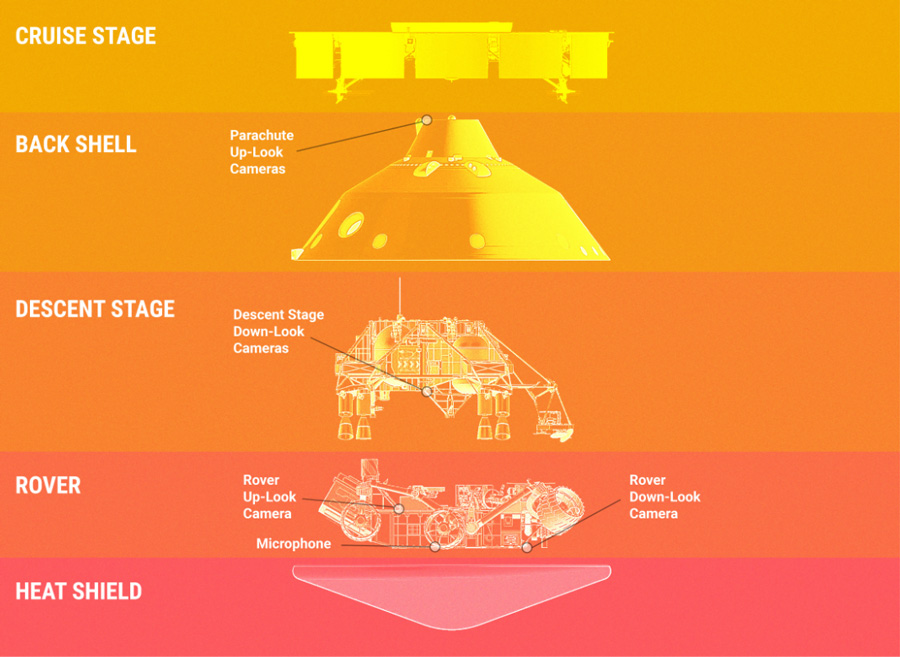
Perseverance rover and its spacecraft in an exploded view showing its several main components.

Image Credits: NASA/JPL-Caltech

This is a crucial moment, as the craft will then autonomously — there’s no time to send the data to Earth — scan the area below it with radar and other instruments and find what it believes to be an optimal landing location.

Once it does so, from more than a mile up, the parachute will detach and the rover will continue downwards in a “powered descent” using a sort of jetpack that will take it down to just 70 feet above the surface. At this point the rover detaches, suspended at the end of a 21-foot “Sky Crane,” and as the jetpack descends the cable extends; once it touches down, the jetpack boosts itself away, Sky Crane and all, to crash somewhere safely distant.

All that takes place in about 410 seconds, during which time the team will be sweating madly and chewing their pencils. It’s all right here in this diagram for quick reference:
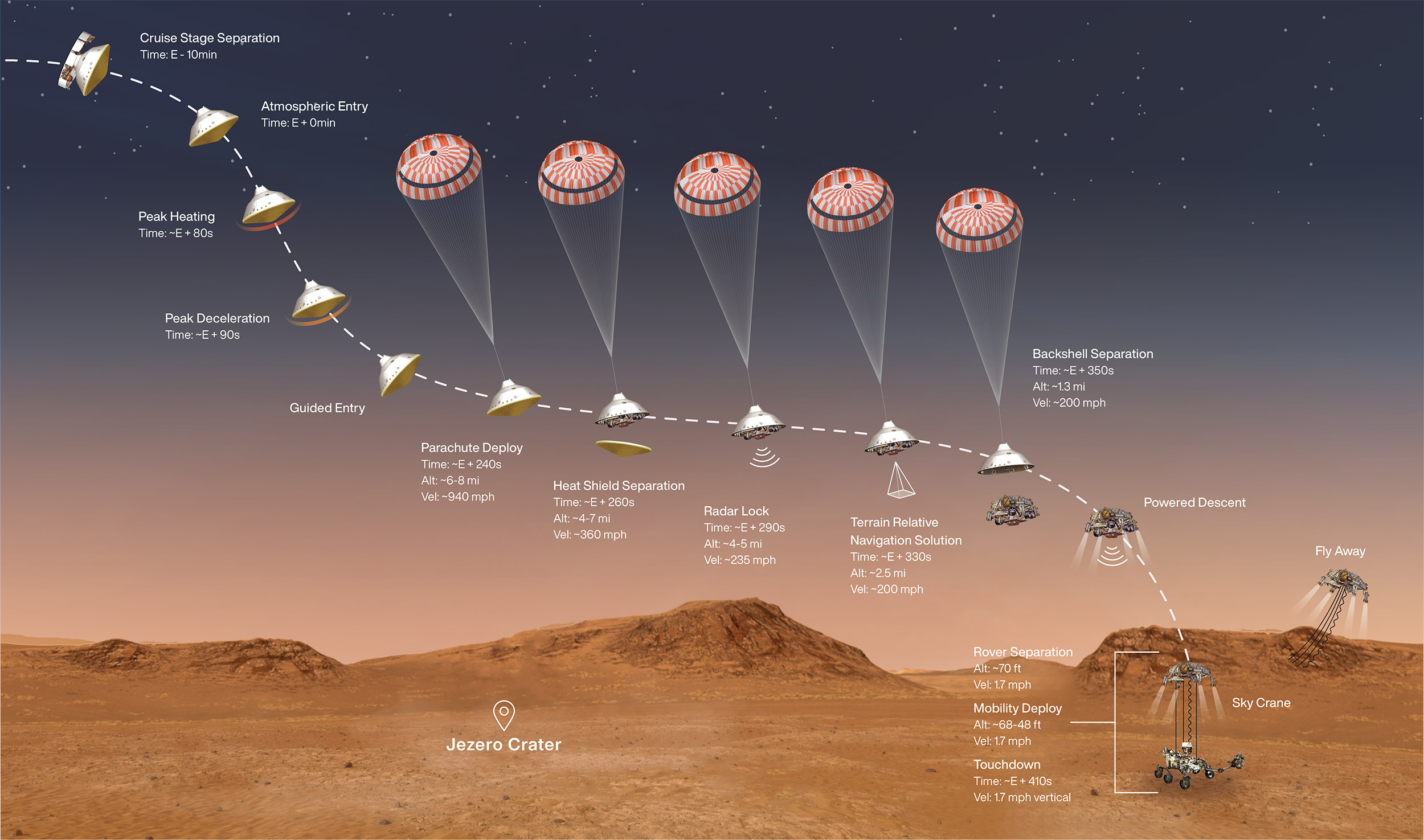
Diagram showing the various parts of the Perseverance landing process

Image Credits: NASA/JPL-Caltech

And for the space geeks who want a little more detail, check out this awesome real-time simulation of the whole process. You can speed up, slow down, check the theoretical nominal velocities and forces, and so on.

Rocking the crater
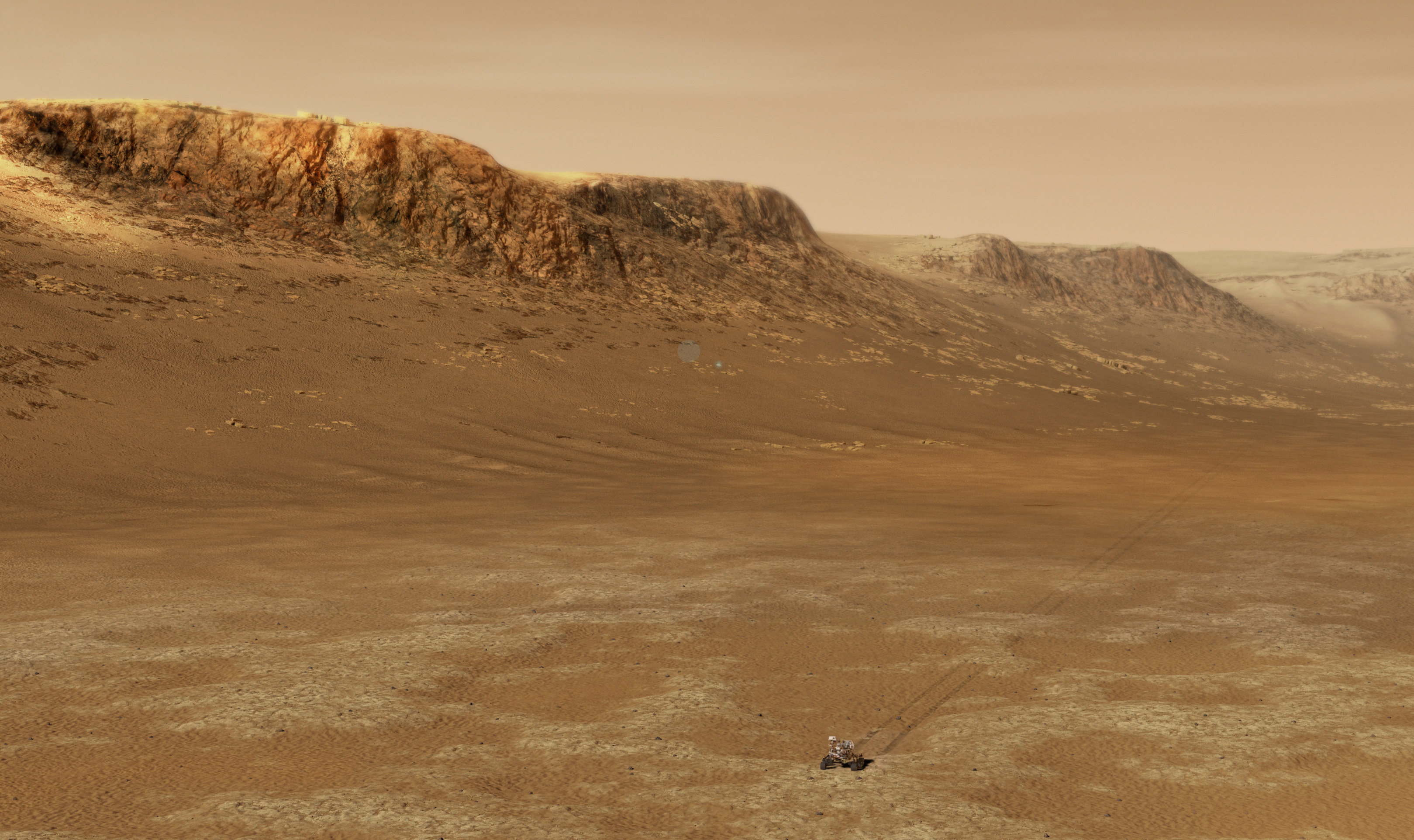
Illustration of Perseverance very small against a Martian landscape.

Image Credits: NASA/JPL-Caltech

Other rovers and orbiters have been turning up promising signs of life on Mars for years: the Mars Express Orbiter discovered liquid water under the surface in 2018; Curiosity found gaseous hints of life in 2019; Spirit and Opportunity found tons of signs that life could have been supported during their incredibly long missions.

Jezero Crater was chosen as a region rich in possibilities for finding evidence of life, but also a good venue for many other scientific endeavors.

The most similar to previous missions are the geology and astrobiology goals. Jezero was “home to an ancient delta, flooded with water.” Tons of materials coalesce in deltas that not only foster life, but record its presence. Perseverance will undertake a detailed survey of the area in which it lands to help characterize the former climate of Mars.

Part of that investigation will specifically test for evidence of life, such as deposits of certain minerals in patterns likely to have resulted from colonies of microbes rather than geological processes. It’s not expected that the rover will stumble across any living creatures, but you know the team all secretly hope this astronomically unlikely possibility will occur.

One of the more future-embracing science goals is to collect and sequester samples from the environment in a central storage facility, which can then be sent back to Earth — though they’re still figuring out how to handle that last detail. The samples themselves will be carefully cut from the rock rather than drilled or chipped out, leaving them in pristine condition for analysis later.
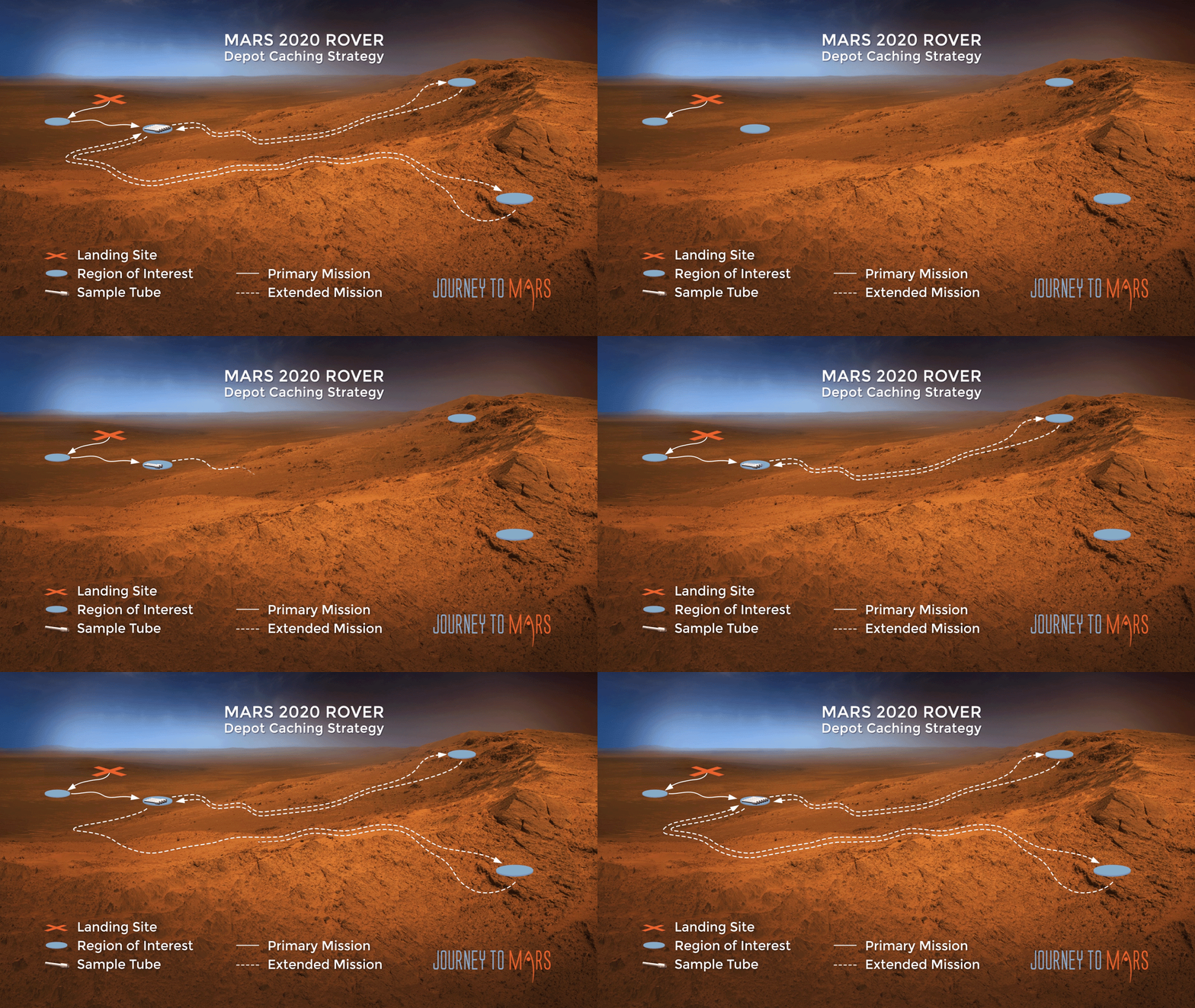
Animated image showing how Perseverance could travel and retravel certain routes to bring items to a central location.

Image Credits: NASA/JPL-Caltech

Perseverance will spend some time doubling back on its path to place as many as 30 capsules full of sampled material in a central depot, which will be kept sealed until such a time as they can be harvested and returned to Earth.

The whole time the rover will be acting as a mobile science laboratory, taking all kinds of readings as it goes. Some of the signs of life it’s looking for only result from detailed analysis of the soil, for instance, so sophisticating imaging and spectroscopy instruments are on board, PIXL and SHERLOC. It also carries a ground-penetrating radar (RIMFAX) to observe the fine structure of the landscape beneath it. And MEDA will continuously take measurements of temperature, wind, pressure, dust characteristics, and so on.

Of course the crowd-pleasing landscapes and “selfies” NASA’s rovers have become famous for will also be beamed back to Earth regularly. It has 19 cameras, though mostly they’ll be used for navigation and science purposes.

Exploring takes a little MOXIE and Ingenuity
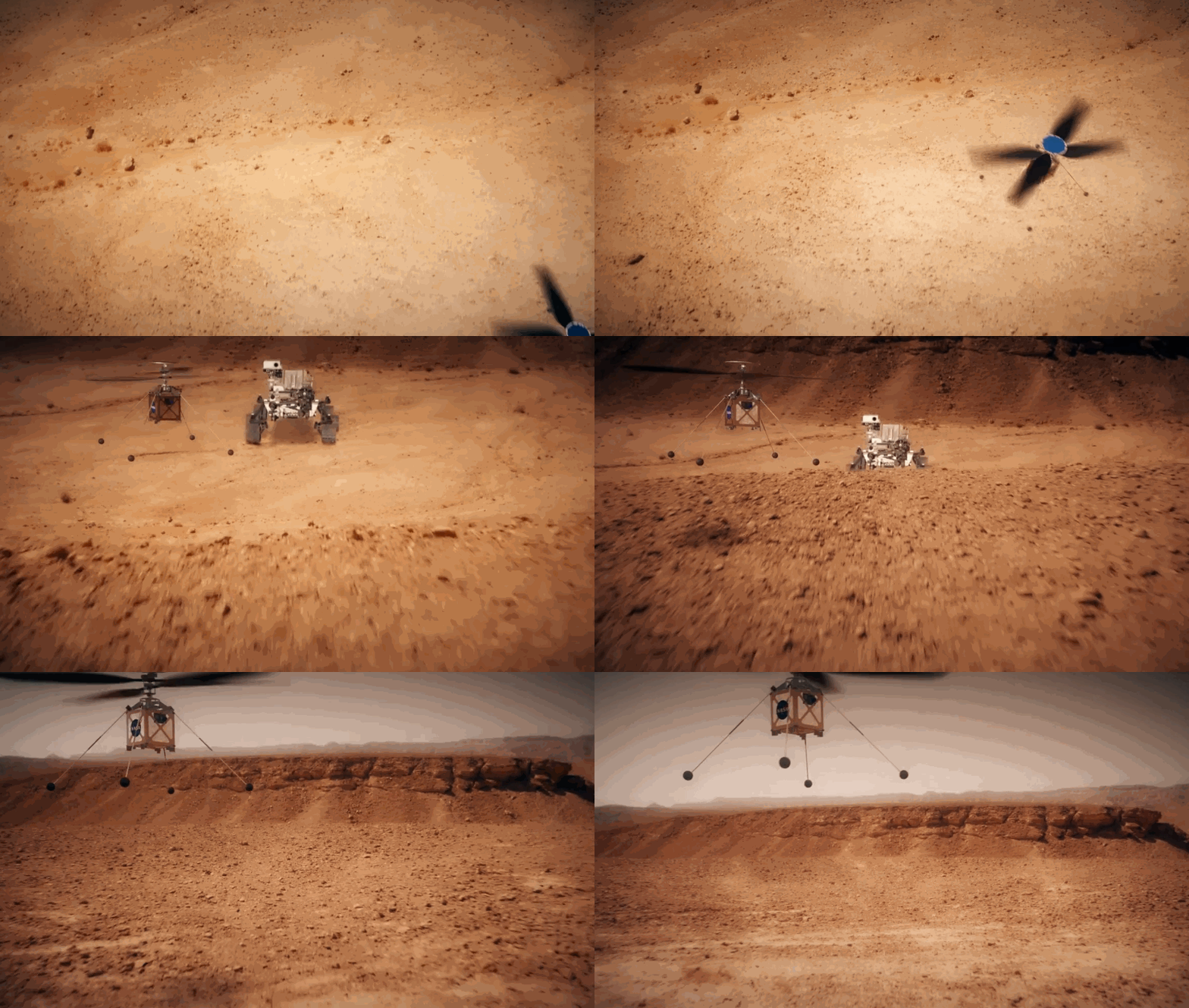
Animated image showing the Ingenuity Mars helicopter taking off and flying on Mars.

Image Credits: NASA/JPL-Caltech

Perseverance is part of NASA’s long-term plan to visit the Red Planet in person, and it carries a handful of tech experiments that could contribute to that mission.

The most popular one, and for good reason, is the Ingenuity Mars Helicopter. This little solar-powered two-rotor craft will be the first ever demonstration of powered flight on another planet (the jetpack Perseverance rode in on doesn’t count).

The goals are modest: the main one is simply to take off and hover in the thin air a few feet off the ground for 20 to 30 seconds, then land safely. This will provide crucial real-world data about how a craft like this will perform on Mars, how much dust it kicks up, and all kinds of other metrics that future aerial craft will take into account. If the first flight goes well, the team plans additional ones that may look like the GIF above.

Being able to fly around on another planet would be huge for science and exploration, and eventually for industry and safety when people are there. Drones are have already become crucial tools for all kinds of surveying, rescue operations, and other tasks here on Earth — why wouldn’t it be the same case on Mars? Plus it’ll get some great shots from its onboard cameras.
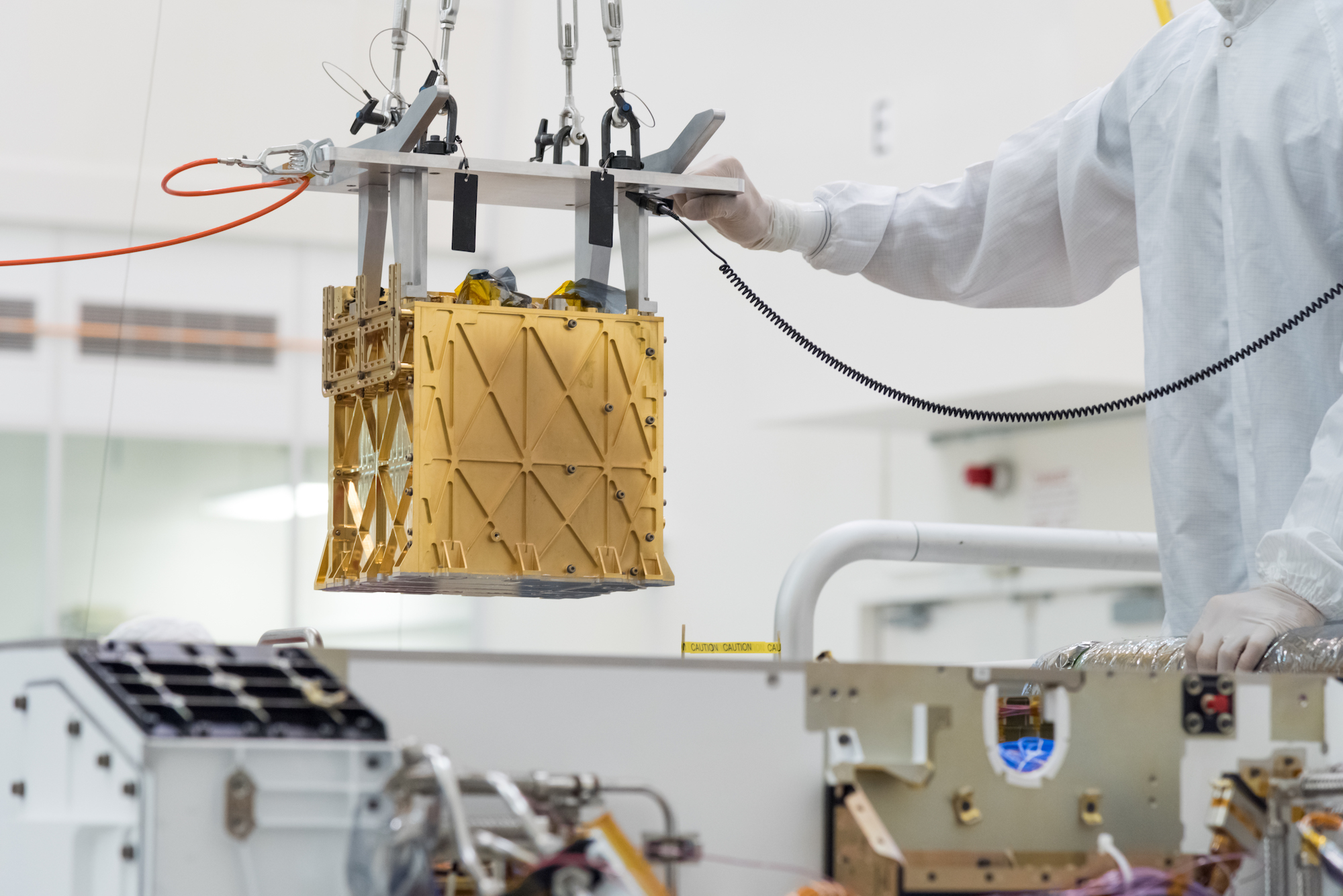
Image of the MOXIE device, which will isolate oxygen from Mars's atmosphere.

MOXIE is the other forward-looking experiment, and could be even more important (though less flashy) than the helicopter. It stands for Mars Oxygen In-Situ Resource Utilization Experiment, and it’s all about trying to make breathable oxygen from the planet’s thin, mostly carbon dioxide atmosphere.

This isn’t about making oxygen to breathe, though it could be used for that too. MOXIE is about making oxygen at scales large enough that it could be used to provide rocket fuel for future takeoffs. Though if habitats like these ever end up getting built, it will be good to have plenty of O2 on hand just in case.

For a round trip to Mars, sourcing fuel from the there rather than trucking all the way from Earth to burn on the way back is an immense improvement in many ways. The 30-50 tons of liquid oxygen that would normally be brought over in the tanks could instead be functional payloads, and that kind of tonnage goes a long way when you’re talking about freeze-dried food, electronics, and other supplies.

MOXIE will be attempting, at a small scale (it’s about the size of a car battery, and future oxygen generators would be a hundred times bigger), to isolate oxygen from the CO2 surrounding it. The team is expecting about 10 grams per hour, but it will only be on intermittently so as not to draw too much power. With luck it’ll be enough of a success that this method can be pursued more seriously in the near future.

Self-roving technology

An orbital image of the Jezero Crater region of Mars with a potential path for the rover on it.

Image Credits: NASA/JPL-Caltech

One of the big challenges for previous rovers is that they have essentially been remote controlled with a 30-mintue delay — scientists on Earth examine the surroundings, send instructions like go forward 40 centimeters, turn front wheels 5 degrees to the right, go 75 centimeters, etc. This not only means a lot of work for the team but a huge delay as the rover makes moves, waits half an hour for more instructions to arrive, then repeats the process over and over.

Perseverance breaks with its forbears with a totally new autonomous navigation system. It has high resolution, wide-angle color cameras and a dedicated processing unit for turning images into terrain maps and choosing paths through them, much like a self-driving car.

Being able to go farther on its own means the rover can cover far more ground. The longest drive ever recorded in a single Martian day was 702 feet by Opportunity (RIP). Perseverance will aim to cover about that distance on average, and with far less human input. Chances are it’ll set a new record pretty quickly once it’s done tiptoeing around for the first few days.

In fact the first 30 sols after the terrifying landing will be mostly checks, double checks, instrument deployments, more checks, and rather unimpressive-looking short rolls around the immediate area. But remember, if all goes well, this thing could still be rolling around Mars in 10 or 15 years when people start showing up. This is just the very beginning of a long, long mission.


News: Astra hires longtime Apple veteran Benjamin Lyon as Chief Engineer

New Space startup Astra, which is currently focused on commercial rockets, but which plans to eventually build satellites, too, has hired one of Apple’s key engineering leaders to head its own engineering efforts. Benjamin Lyon spent over two decades at Apple, where he worked on everything from the iPhone, to input devices and sensor hardware,

New Space startup Astra, which is currently focused on commercial rockets, but which plans to eventually build satellites, too, has hired one of Apple’s key engineering leaders to head its own engineering efforts. Benjamin Lyon spent over two decades at Apple, where he worked on everything from the iPhone, to input devices and sensor hardware, to special projects: the department at Apple working on autonomous vehicle technology.

“When I’ve looked at what to do next at Apple, it has always been this combination of ‘What is the most impactful thing that I can do for humanity?’ – the iPhone was very much one of these,” Lyon told me in an interview. “Phones were awful [at the time], and if we could fundamentally come up with a new interface, that would completely change how people interact with devices.”

Creating a mobile device with an interface that was “completely flexible and completely customizable to the application” was what seemed so transformative to Lyon about the iPhone, and he sees a direct parallel in the work that Astra is doing to lower the barrier of access to space through cheap, scalable and highly-efficient rocketry.

“Astra me feels very, very much like redefining what it means for a phone to be smart,” Lyon said. “I think the Astra vision is this magical combination of fundamentally taking the rocket science out of space. How do you do that? Well, you better have a great foundation of a team, and a great foundation of core technologies that you can bring together in order to make a compelling series of products.”

Foundations are the key ingredient according not only to Lyon, but also to Astra co-founder and CEO Chris Kemp, who explained why an experienced Apple engineer made the most sense to him to lead a rocket startup’s engineering efforts.

“We did not want anyone from aerospace – I’ll just I’ll say that out of the gate,” Kemp told me. “Aerospace has not figured out how to build rockets at scale, or do anything profitably – ever. So I found no inspiration from anyone I talked to who had anything to do with with any of the other space-related companies. We do feel that there are people that are at SpaceX and Blue Origin who are really good at what they do. But in terms of the culture that we’re trying to establish at Astra, if you look back at Apple, and the things that that Benjamin worked on there over many decades, he really took on not only designing the the thing, but also designing the thing that makes the thing, which was more important than the thing itself.”

Kemp’s alluding to Apple’s lauded ability to work very closely with suppliers and move fundamental component engineering in-house, crafting unique designs for things like the system-on-a-chip that now powers everything from the iPhone to Macs. Apple often designs the processes involved in making those fundamental components, and then helps its suppliers stand up the factories required to build those to its exacting specifications. Astra’s approach to the space industry centers around a similar approach, with a focus on optimizing the output of its Alameda-based rocket factory, and iterating its products quickly to match the needs of the market while keeping pricing accessible.

And Astra’s definition of ‘iteration’ matches up much more closely with the one used by Silicon Valley than that typically espoused by legacy aerospace companies – going further still in questioning the industry’s fundamentals than even watershed space tech innovators like SpaceX, which in many ways still adheres to accepted rocket industry methods.

“You don’t do the iPhone X at iPhone 1 – you start with the iPhone 1 and you work your way to the iPhone X,” Lyon told me. “You’re going to see that with Astro as well, there’s going to be this amazing evolution, but it’s going to be tech company-rate evolution, as opposed to an ‘every 20 years’ evolution.”

That sentiment lines up with Astra and Kemp’s approach to date: The company reached space for the first time late last year, with a rocket that was the second of three planned launches in a rapid iteration cycle designed to achieve that milestone. After the first of these launches (Rocket 3.1 if you’re keeping track) failed to make space last September, Astra quickly went back to the drawing board and tweaked the design to come back for its successful attempt in December (Rocket 3.2) – an extremely fast turnaround for an aerospace company by any measure. The company is now focused on its Rocket 3.3 launch, which should only require software changes to achieve a successful orbit, and put it on track to begin delivering commercial payloads for paying customers.

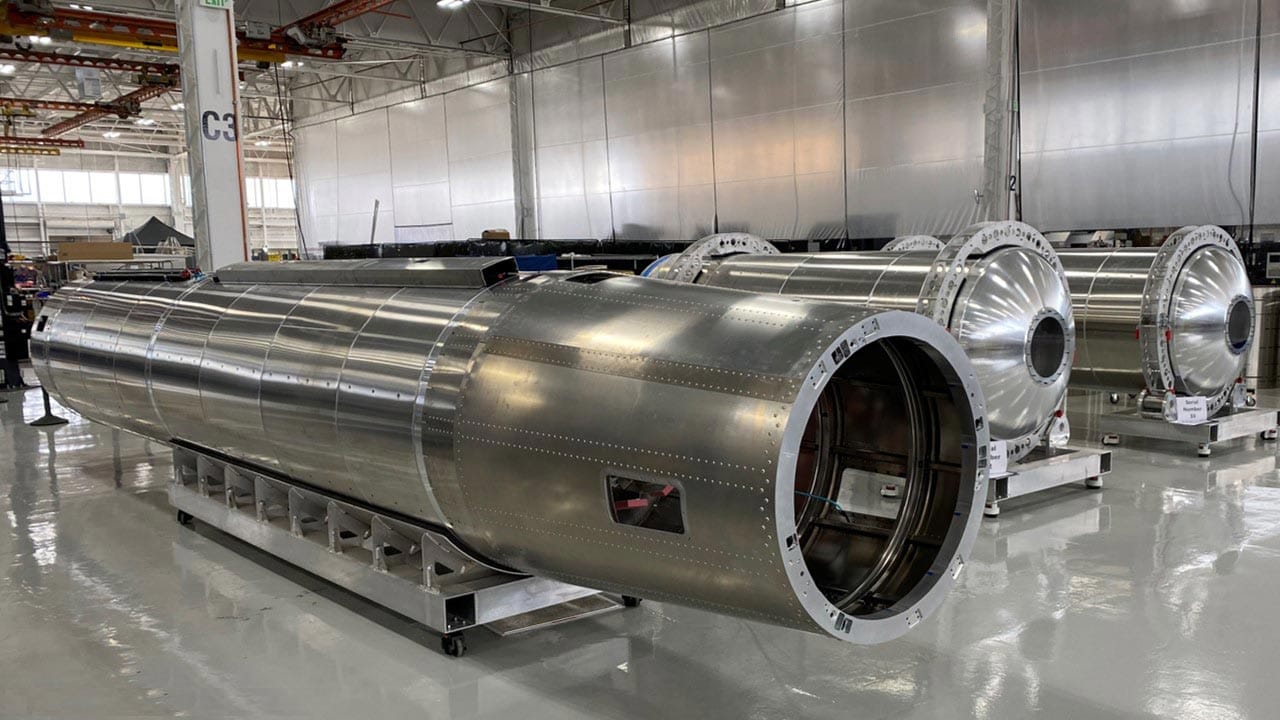
Astra’s rocket production facility in Alameda, California.

Astra’s rocket is tiny compared to the mammoth Starship that SpaceX is currently developing, but that’s part of the appeal that drew Lyon to the startup in the first place. He says the goal of “design[ing] a rocket to match the application,” rather than simply “design[ing] a rocket to end all rockets” makes vastly more sense to serve the bourgeoning market.

“And that’s just the beginning,” he added. “Then you’ll take the next step, which is if you look at the technology that’s in a satellite, and a bunch of the smart technology that’s in a rocket, there’s a tremendous amount of duplication there. So, get rid of the duplication – design the rocket and the satellite together as one system.”

Eventually, that means contemplating not only launch and satellite as a single challenge, but also managing “the entire experience of getting to space and managing a constellation” as “a single design problem,” according to Lyon, which is the level of ambition at Astra that he views as on par with that of Steve Jobs at Apple at the outset of the iPhone project.

Ultimately, Astra hopes to be able to provide aspiring space technology companies with everything they need so that the actual space component of their business is fully handled. The idea is that startups and innovators can then focus on bringing new models and sensing technologies to Astra, worrying only about payload – leaving launch, integration and eventually constellation management to the experts. It’s not unlike what the App Store unlocked for the software industry, Lyon said.

“We’re trying to do something that’s never been done before in aerospace, which is to really scale the production of rockets, and also focus on the overall economics of the business,” Kemp explained about additional advantages of having Lyon on board. “As we become a public company, in particular, we have very aggressive EBITDA targets, and very aggressive production targets, much the same way Apple does. We also want to have a new rocket every year, just like [the iPhone] and so to some degree, we found every aspect of Benjamin’s ethos aligned with our values, and the culture that we’re creating here at Astro of relentless, constant innovation and iteration.

News: ExOne gets $1.6M DoD contract to build a 3D printing ‘factory’ in shipping container

ExOne this week announced that the U.S. Department of Defense has granted it $1.6 million. It’s one of the Pennsylvania-based metal 3D printing company’s largest government contracts, in service of building a portable 3D printing factory for the front line – essentially a method for troops to fabricate broken and missing parts where the need

ExOne this week announced that the U.S. Department of Defense has granted it $1.6 million. It’s one of the Pennsylvania-based metal 3D printing company’s largest government contracts, in service of building a portable 3D printing factory for the front line – essentially a method for troops to fabricate broken and missing parts where the need them the most.

“Over the last two years, we’ve really focused on providing our technology into government-type applications: DoD, NASA, DoE,” CEO John Hartner tells TechCrunch. “Sometimes people talk about disrupting the supply chain and getting decentralized manufacturing. This is decentralized and forward deployed, if you will. Be it an emergency, humanitarian mission or frontlines for a war fighter.”

The money from the grant will specifically go toward R&D and building the first unit.

ExOne is proud to have been awarded a $1.6M U.S. Department of Defense contract to develop a portable self-contained 3D printing “factory” housed in a shipping container. The pod will help reduce inventory and simplify the supply chain. #metal3Dprintinghttps://t.co/jSCef5HuB6 pic.twitter.com/awXhMGrKFp

— ExOne (@ExOneCo) February 16, 2021

The system combines a series of machines with a software layer designed to lower the barrier of entry for use. While some training will be required, the hope is that people will be able to operate the system in the field.

“We’ve ruggedized the products that are going inside,” says Hartner. “There’s an element of software that makes the whole thing easier to use together. You start with scanning. So, there’s a possibility that you print from a cloud-based repository, but that may not be available for whatever reason, so you may have a broken part that you can scan and do some digital repair to the file and print.”

The devices rely on binder jet printing, the core tech behind ExOne’s machines. The system essentially composites powder, layer by layer to build up an object. ExOne expects to deliver the first system by Q3 2022. If all goes well, the parties will discuss further partnerships going forward.

News: As expected, stock trading service Public raises $220M at unicorn valuation

The day before Robinhood goes under the the Congressional hammer, domestic rival Public.com announced this morning that it has closed a $220 million funding round at a $1.2 billion valuation. News of the round was first broken by TechCrunch. Further reporting colored in the lines concerning the investment’s size and valuation range. Confirming the funding

The day before Robinhood goes under the the Congressional hammer, domestic rival Public.com announced this morning that it has closed a $220 million funding round at a $1.2 billion valuation. News of the round was first broken by TechCrunch. Further reporting colored in the lines concerning the investment’s size and valuation range.

Confirming the funding news today, Public added a fresh metric to the mix, namely that it has reached one million members – over the course of just 18 months post-launch, the company was quick to point out.

That means that Public’s backers – its latest round was put together by prior investors, including Greycroft, Accel, Tiger Global, Inspired Capital and others – values the company at around $1,200 per current “member.” Whether or not that feels rich, we leave to you to decide.

But with rising interest in the savings and investing space – some data here — and Robinhood’s revenues growing to a run rate of more than $800 million in Q4 2020 and looking even better at the start of 2021, it’s not hard to see why investors are backing Public. It’s even easier if you believe that Robinhood’s brand has undergone material harm from its woes during the GameStop saga.

The pair, along with a host of other fintech services that offer savings and investing products, have been buoyed by a secular shift in banking away from the physical world (in-person shopping, bank branches, plastic cards) to the digital (neo-banks, ecommerce, virtual cards). Robinhood shook up the trading world with zero-cost investing, fitting neatly into the mobile and virtual banking future that is being built. And Public has taken that model a step further by dropping payment for order flow (PFOF), a method revenue generation in which companies like Robinhood get a small fee for sending their users’ trades to one particular market maker or another.

TechCrunch recently joked that it seems like “there is infinite money for stock-trading startups,” in light of the anticipated Public round, which has now has arrived. Let’s see who is next to take home a big check.

News: Ally.io rasies $50M Series C as the OKR software market stays explosive

This morning Ally.io, a software startup with a focus on the OKR (objectives and key results, in case you’ve somehow avoided being exposed) goal-setting technique, announced that it has closed $50 million in new capital. The Series C round was led by Green Oaks Capital, Madrona Capital, and its Series B lead, Tiger Global. Ally

This morning Ally.io, a software startup with a focus on the OKR (objectives and key results, in case you’ve somehow avoided being exposed) goal-setting technique, announced that it has closed $50 million in new capital. The Series C round was led by Green Oaks Capital, Madrona Capital, and its Series B lead, Tiger Global.

Ally raised an $8 million Series A in August, 2019 and a $15 million Series B in October of the same year. The Series C is more than its A and B rounds put together – and doubled.

That Ally raised such a large round really wasn’t too big a surprise. OKR-software rival Gtmhub raised a $30 million Series B earlier this year, and companies in this particular software niche reported rapid-fire growth last year. TechCrunch collected growth metrics from a host of companies competing in the OKR and corporate goal-setting market, including Ally. In 2020, Gtmhub, Perdoo, WorkBoard, and Ally.io all grew in the triple digits.

In a blog post that TechCrunch saw before publication, Madrona investor and Ally backer S. Somasegar noted that “nearly $300 million” has been invested into OKR startups in the last two years. Such rapid growth from so many players in such a competitive space could signal a huge market.

Ally’s latest round makes it clear that investors expect similar growth from the cohort in 2021.

For flavor, we got new growth numbers from Ally.io. Previously the startup had shared growth of 3.3x in 2020. Its CEO Vetri Vellore told TechCrunch in an email that Ally.io’s “revenue has increased by 5x and [has] added over 600 customers” since its Series B, which came around 15 months prior. That’s quick.

It’s the sort of growth that venture investors want to own a piece of. So, even though Vellore told TechCrunch that his company has “most of [its] Series B money in the bank,” it decided to take on more capital “to accelerate further,” to which we’d add because it could.

Ally did not have to twist arms to raise more. Vellore described the round as “extremely competitive” in an email, noting that he had “started the [fundraising] process in early January.” It’s just over mid-February, so the round came together quickly: “Within two weeks of starting the process, we were able to wrap it up,” the CEO wrote, adding that the investment “was heavily oversubscribed due to strong interest from both existing investors and our new investors.”

The market for OKR software, and corporate goal-setting software in general, is proving to be large, and lucrative. Let’s see which rival player is the next to raise.

News: Google Maps users can now pay for parking or their transit fare right from the app

Drivers throughout the United States will now have the option to pay for street parking right from Google Maps as part of an expanded partnership with transportation software companies Passport and Parkmobile. Google also announced it was extending this contactless payment feature to public transit users. Google Maps’ pay for parking feature will expand first

Drivers throughout the United States will now have the option to pay for street parking right from Google Maps as part of an expanded partnership with transportation software companies Passport and Parkmobile. Google also announced it was extending this contactless payment feature to public transit users.

Google Maps’ pay for parking feature will expand first via Android to more than 400 U.S. cities, including Boston, Chicago, Houston, Los Angeles, New York and Washington D.C. The feature will be available through the iOS version of the Google Maps app soon, the company said. The transit feature will include more than 80 transit agencies globally.

The parking feature, which integrates with Passport’s operating system, launched in Austin last year. The two companies indicated, at the time, that the feature would eventually roll out in other U.S. cities. While the expansion was expected, it’s still a boon for the North Carolina-based startup, which is now integrated in one of the most widely used navigation apps. The same goes for Parkmobile, which is also embedded in Google Maps.

The aim, according to Google Maps product manager Vishal Dutta and Google Pay’s Fausto Araujo, is to help drivers users pay for parking without having to touch a meter — a compelling feature in this era of COVID-19.

When navigating with Google Maps on iOS and Android, drivers in certain cities in the U.S. will see an option to pay for parking with Google Pay as they approach their destination. This means a user has to set up a Google Pay account, which is linked to a credit or debit card. From there, drivers add their meter number, the amount of time they wish to pay for, and complete the payment via Google Pay. Parkers can also add time to their meter from their Google Pay app without returning to their vehicle.

Google said the payment feature has been extended to including transit fares for more than 80 transit agencies around the world. “Now you’ll be able to plan your trip, buy your fare, and start riding without needing to toggle between multiple apps,” Google wrote in a blog post.

The transit pay option pops up in Google Maps in the user’s directions. In places like San Francisco, users will also be able to buy a digital Clipper card directly from Google Maps. Once they’ve purchased their fare, the user just needs tap their phone on the reader or show their digital ticket.

News: Low-code focused OutSystems raises $150M at a $9.5B valuation

This morning OutSystems, a low-code app development service, announced that it has closed $150 million in new capital. The round was led by Abdiel Capital and Tiger Global. Notably this is not the largest funding event that the Portugal and U.S.-based software company has raised. TechCrunch covered a $360 million round that OutSystems raised in

This morning OutSystems, a low-code app development service, announced that it has closed $150 million in new capital. The round was led by Abdiel Capital and Tiger Global. Notably this is not the largest funding event that the Portugal and U.S.-based software company has raised. TechCrunch covered a $360 million round that OutSystems raised in 2018.

OutSystems was founded in 2001, making it older than most companies that we cover on TechCrunch, and yet it remains privately held. And like many startups, it appears to have caught a tailwind from the accelerating digital transformation of companies both large and small.

By selling $150 million worth of its own shares at a $9.5 billion valuation, OutSystems parted ways with around 1.6% of itself in the deal. Investors would not be willing to buy such a tiny slice of a company for such a price if they didn’t have confidence in its future performance.

The new funds put OutSystems on an IPO path, we reckon; the company declined to discuss public market plans with TechCrunch. It could go out sooner rather than later. This round smells a bit like pre-IPO capital, and OutSystems touted its model to TechCrunch as “efficient” in a conversation about its new funding, implying moderate cash-consumption at worst.

TechCrunch had asked the company to break down its stated plan to invest its new capital in both go-to-market (GTM) capabilities and product (R&D) work. OutSystems CEO Paulo Rosado told TechCrunch in an email that even before this announcement OutSystems was “steadily increasing both our R&D and GTM capacity,” meaning that it was “investing for growth.” The company remains “focused on building scale in an efficient way,” the CEO added.

OutSystems works on low-code app development, in contrast to the startups and more mature private concerns that are focused on the no-code project; no-code tools do not involve code, while low-code services bring together some coding along with visual programming interfaces.

In an interview with Rosado in late 2020, he explained to TechCrunch the differences between no-code and low-code as both complexity (the ability to tackle heavy-duty internal corporate workflows) and extensibility (the ability to adapt).

In OutSystems’ view low-code is simply better suited to creating material corporate apps. Here’s how the CEO explained it:

The problem is not low-code is worse than no-code. If no-code is very narrow, which most no-code tools are, when you get [a] change request that goes beyond what you can do visually, that’s it. The only answer that you have for the customer is “no, we cannot do it.”

With low-code, you can do it. But you have to do it with code. You go, you [add] code, and the code then gets blended into the no-code portion.So low-code means it’s a no-code capability, with the possibility of jumping into code.

No-code fans would argue that as their tools’ ability to avoid code improves, the code-required portion of development that Rosado details will decline. Regardless, the OutSystem’s method approach to the market appears to be working, if its recent capital raise is any indication.

Back to the round, to better understand of OutSystems’ market position in both competitive and completeness terms, TechCrunch asked the CEO about its relative strength in customer pricing calls. He responded by saying that the OutSystem’s “pricing model is based on platform utilization” over traditional SaaS pricing. We could quibble with the company here – it does have seat limits on lower-priced tiers – but the focus on consumption over traditional SaaS reminded us more of on-demand software over what Salesforce pioneered. Given the changes we’ve seen in the SaaS market lately, it’s a distinction worth keeping in mind.

Finally, how competitive is the low-code market that OutSystems’ is now taking on with fresh funding? According to its CEO, their chief competitor is not some other startup, but, instead “non-consumption.” A bit like how Netflix is competing with sleep, instead of HBO.

TechCrunch has covered the no-code and low-code for quite some time. We put words together concerning OutSystem’s 2016-vintage, $55 million round for example. But lately it seems that the demand for corporate apps – be they no-code or low-code – does appear to have accelerated. In the last four or six quarters, startups in the less-code market have consistently reported high-demand to TechCrunch.

Let’s see if the moment is enough to carry OutSystems all the way to the public markets.

News: YouTube to expand Shorts to the U.S., add 4K and DVR to YouTube TV, launch in-video shopping and more in 2021

YouTube has a host of big product updates coming this year, and it just detailed a lot of them in a blog post from Chief Product Officer Neal Mohan. Google’s streaming video site plans to expand its TikTok-esque Shorts mobile video creation and consumption tool to the U.S. (it’s currently in beta in India), make

YouTube has a host of big product updates coming this year, and it just detailed a lot of them in a blog post from Chief Product Officer Neal Mohan. Google’s streaming video site plans to expand its TikTok-esque Shorts mobile video creation and consumption tool to the U.S. (it’s currently in beta in India), make YouTube TV a more full-featured in-home cable alternative, add customization and control options to YouTube Kids and more.

Many of the product updates detailed by Mohan are expansions of existing tests and beta features, but there are also entirely new developments that could significantly change how YouTube works for both creators and audiences. YouTube’s focus on monetization and new formats also indicates a desire to keep creators happy, which makes a lot of sense in the context of the platform’s popular new mobile-first competitor TikTok.

Here’s a TL;DR of everything YouTube announced today for its 2021 roadmap:

  • Expansion of its in-video e-commerce shopping experience beyond the current limited beta
  • Expansion of Applause tipping feature
  • YouTube Shorts launching in the U.S.
  • Adding the ability for parents to specify individual channels and videos for their kids to be able to watch on YouTube Kids
  • New features for user playlists on YouTube Music, and making those playlists more discoverable to others
  • A new paid add-on coming to YouTube TV that offers 4K streaming, DVR for off-line playback, and unlimited simultaneous in-home streams
  • Automatic video chaptering for some videos that don’t have creator-defined ones
  • A redesigned YouTube VR experience focused on accessibility, search and better navigation

YouTube has a big year planned, and some of these changes could significantly alter the dynamics of the platform. Making it possible for every creator to turn their channel in a mini shopping channel has a lot of potential to alter what it looks like to build a business on the platform, while YouTube TV’s transformation narrows the gap even further between that service and traditional cable and satellite provider offerings.

WordPress Image Lightbox Plugin