Tag Archives: Blog

News: SpaceX reportedly raises $850M in new funding

SpaceX has raised a fresh round of funding, totalling $850 million, per a new report by CNBC, citing sources “familiar” with the matter. The new capital brings the total valuation of the company, which is still privately-held, to around $74 billion according to the report. This is a massive round, by most standards – but

SpaceX has raised a fresh round of funding, totalling $850 million, per a new report by CNBC, citing sources “familiar” with the matter. The new capital brings the total valuation of the company, which is still privately-held, to around $74 billion according to the report.

This is a massive round, by most standards – but not by SpaceX’s own. The space launch company, which was founded in 2002, has raised a total of over $6 billion to date including this latest injection, with a $2 billion venture round raised last August. That funding was invested at a valuation of $46 billion, meaning the company’s value, at least in the eyes of private investors, leapt considerably in the six months separating the two raises.

SpaceX has accomplished a lot between now and then, including building its Starlink broadband constellation to more than 1,000 active satellites; launching its first operational NASA crew to the International Space Station aboard a Dragon spacecraft; launching not one, but two high-altitude flight tests of its Starship spacecraft with relatively good results; and launched its first dedicated rideshare mission, demonstrating the viability of a big potential new group of launch customers.

While the company has achieved a lot on the back of its existing capital, its recent successes no doubt provided a good base to go out and get more. That’s likely going to go to good use, since it has plenty of work yet to do, like continued develop of Starship to prove out its space-worthiness, and the capital-intensive activity of building Starlink into a true, globe-spanning network.

News: Ford to go all electric in Europe by 2030

Ford today announced a new strategy for the European market that aims the automaker at primarily only selling electric vehicles by 2030. To do so, Ford intends to spend $1 billion to revamp a factory in Cologne, Germany, where it will produce EVs using a Volkswagen platform. The first production vehicle from the updated factory

Ford today announced a new strategy for the European market that aims the automaker at primarily only selling electric vehicles by 2030. To do so, Ford intends to spend $1 billion to revamp a factory in Cologne, Germany, where it will produce EVs using a Volkswagen platform. The first production vehicle from the updated factory is expected by 2023.

Stuart Rowley, president of Ford of Europe, made the announcement today during an online news conference.

This new strategy involves phasing out gasoline-powered vehicles in favor of electric power. The automaker expects to have all commercial vehicles made by Ford in Europe be electric by 2024. Two years later, it expects to have converted its entire lineup into electric or plug-in hybrids. Gasoline-powered commercial vehicles will still be offered for sale in Europe after 2030, Ford says. However, the automaker currently sees electric models accounting for two-thirds of its European sales.

Ford’s announcement comes after a similar pledge from General Motors where the automaker said it intended to mostly produce EVs by 2035. Both Ford and General Motors are small players in the European market where GM has all but pulled out, and Ford only has a 5% market share.

News: Indian trader group calls for ban on Amazon following explosive report

An influential India trader group that represents tens of millions of brick-and-mortar retailers called New Delhi to ban Amazon in the country after a report claimed that the American e-commerce group had given preferential treatment to a small group of sellers in India, publicly misrepresented its ties with those sellers, and used them to circumvent

An influential India trader group that represents tens of millions of brick-and-mortar retailers called New Delhi to ban Amazon in the country after a report claimed that the American e-commerce group had given preferential treatment to a small group of sellers in India, publicly misrepresented its ties with those sellers, and used them to circumvent foreign investment rules in the country.

The Confederation of All India Traders (CAIT) on Wednesday “demanded” serious action from the Indian government against Amazon following revelations made in a Reuters story. “For years, CAIT has been maintaining that Amazon has been circumventing FDI [Foreign Direct Investment] laws of India to conduct unfair and unethical trade,” it said.

Praveen Khandelwal, Secretary General of CAIT, which claims to represent 80 million retailers and 40,000 trade associations in India, said, “It’s an open and shut case that Amazon is wilfully playing with rules. What more we are waiting for. It should be banned in India with immediate effect.”

CAIT has for years expressed concerns over what they allege are unlawful business practices employed by Amazon and Walmart-owned Flipkart in the country. They say these actions are posing existential threats to small merchants.

India is a key overseas market for Amazon, which has committed to invest over $6.5 billion in its operations in the world’s second largest internet market.

In a statement, an Amazon spokesperson said the company cannot confirm the veracity or otherwise information and claims made in the Reuters story as it has not seen the documents. “The article appears to be based on unsubstantiated, incomplete, and/or factually incorrect information, likely supplied with the intention of creating sensation and discrediting Amazon,” the spokesperson said.

“Amazon remains compliant with all Indian laws. In the last several years, there have been number of changes in regulations governing the marketplaces and Amazon has, on each occasion taken rapid action to ensure compliance. The story therefore seems to have outdated information and does not show any non-compliance. We continue to focus on delivering first class service to India’s consumers, and helping India’s manufacturers and SMB’s reach customers across India and around the world,” it added.

Long-standing laws in India have constrained Amazon and other e-commerce firms to not hold inventory or sell items directly to consumers. To bypass this, the company has operated through a maze of joint ventures with local companies that operate as inventory-holding firms. India got around to fixing this loophole in late 2018.

Citing private company documents, Reuters said that Amazon had exercised significant control over the inventory of some of the biggest sellers. The report claimed that 33 Amazon sellers accounted for about a third of the value of all goods sold on Amazon, and two sellers in which Amazon had an indirect stake accounted for around 35% of the platform’s sales revenue in early 2019.

The new report — and its potential repercussions — is just the latest headache for Amazon in India.

News: Uber could give gig workers a better deal but it’s lobbying EU to lower standards, says Fairwork

Uber has been accused of downplaying its influence over working conditions in the gig economy after the ride-hailing giant published a white paper earlier this week in which it lobbied for a ‘Prop 22’ style deregulation of Europe’s labor laws. Fairwork, an academic research project that benchmarks gig platforms against a set of fairness principles

Uber has been accused of downplaying its influence over working conditions in the gig economy after the ride-hailing giant published a white paper earlier this week in which it lobbied for a ‘Prop 22’ style deregulation of Europe’s labor laws.

Fairwork, an academic research project that benchmarks gig platforms against a set of fairness principles to  encourage these intermediaries to improve conditions for workers, said today that Uber’s call for special rules for the gig economy is an attempt to “legitimize a lower level of protection for platform workers than most European workers benefit from.”

Uber’s white paper is an attempt to narrowly define the parameters within which the debate about platform working conditions can take place. It is corporate lobbying masquerading as progressivism. https://t.co/wYjVgaEcGY

— Mark Graham (@geoplace) February 17, 2021

“Uber asserts that it recognizes the need for improved conditions but is dependent on regulatory change to realize that goal. The company’s recognition of dissatisfaction among drivers is commendableHowever, it is already well within their locus of control to address this dissatisfaction and improve conditions for its drivers under existing legal frameworks,” the platform work research group wrote in a response to Uber’s ‘Better Deal‘ white paper. 

Uber’s focus on policy change, furthermore, downplays the company’s significant influence over conditions in the gig economy. By calling for new regulations, the company is shifting responsibility for workers’ conditions to other actors, when it could step up to the plate and provide an exemplar of how a platform can treat its workers.” 

“Whilst we applaud Uber’s awareness of the need for change, we urge them to live up to their call,” Fairwork added. “The company has long set the blueprint for the gig economy, and, perhaps more than any other actor, is positioned to enact immediate change to improve the lives of their workers under current legal frameworks.

Fairwork noted that Uber has repeatedly fallen short of its (independent) benchmarks of ‘fair’ platform work. (NB: We covered the start of its initiative here back in 2019).

As we reported earlier this week, Uber is pushing for a ‘Prop 22’-style outcome in Europe, following its win in California last year when it convinced voters to exempt delivery and transport platform workers from employment classification laws — and as regional lawmakers are actively looking at how to improve the lot of gig workers.

In the white paper Uber has fired at EU lawmakers it argues that conditions for gig workers can only improve if regulators grant platforms a carve out from labor laws — lobbying for what it dubbed a “new standard” for gig work. However Fairwork argues this a blatant attempt to water down European employment standards, as Uber seeks to apply the same playbook it successfully deployed to reconfigure Californian legislation in its business interests.

Yet Europe is not California. And as Fairwork points out courts across the region have begun to roll back self-serving classifications of gig workers as ‘self-employed’ — with a number of these challenges going against Uber in recent years.

A major verdict is also looming for Uber Friday when the UK Supreme Court is expected to give the last word on an employment tribunal which it has been losing since 2016.

“The white paper reproduces the strategy taken by Uber in California where, after the state introduced new regulation that would have extended employee benefits to platform workers, they and several other prominent platforms successfully pushed for a watered-down alternative,” said Fairwork, noting that platforms (Uber and Lyft) spent some $200M persuading voters in California to back their ballot measure (“which exempted delivery and transport platform workers from classification laws in exchange for stripped-back versions of workplace benefits that have already been shown to be inadequate”, as the group tells it). 

“It is no surprise to see the company extending this strategy to Europe shortly in advance of a February 19 ruling in a UK Supreme Court case challenging the classification of drivers and the European Commission’s consultation with workers and employer representatives to inform gig economy regulation on February 24,” Fairwork also said, calling for regional lawmakers to engage with a process to strengthen and expand existing labor protections rather than get on board with Uber’s drive to lower European standards. 

“All workers, regardless of how their work is arranged, deserve decent wages and safe working conditions. Laboulaw provides these basic rights; and work arranged via a platform does not require a radical new approach. The benefits proposed in Uber’s white paper, like those provided under Proposition 22, represent weakened versions of those afforded to employees,” it added.

“We need to strengthen and expand existing labour protections in order to improve conditions, not create additional exclusions and exemptions that leave millions behind.” 

We’ve reached out to Uber for any comment.

The European Commission has yet to decide what kind of regulatory intervention it might make as regards gig work. But it has signalled an intention to do something in this area — and that’s likely been accelerated by the COVID-19 pandemic spotlighting the individual and public health risks when gig workers lack employment protections like sick pay.

In a 2019 mission letter, the EU president told the incoming jobs commissioner to look at ways to improve the lot of platform workers, writing that: “Dignified, transparent and predictable working conditions are essential to our economic model.”

News: The Series A deal that launched a near unicorn: Meet Accel’s Steve Loughlin and Ironclad’s Jason Boehmig

The only people who truly understand a relationship are the ones who are in it. Luckily for us, we’re going to have a candid conversation with both parties in the relationship between Ironclad CEO and co-founder Jason Boehmig and his investor and board member Accel partner Steve Loughlin. Loughlin led Ironclad’s Series A deal back

The only people who truly understand a relationship are the ones who are in it. Luckily for us, we’re going to have a candid conversation with both parties in the relationship between Ironclad CEO and co-founder Jason Boehmig and his investor and board member Accel partner Steve Loughlin.

Loughlin led Ironclad’s Series A deal back in 2017, making it one of his first Series A deals after returning to Accel.

This episode of Extra Crunch Live goes down on Wednesday at 3 p.m. EST/12 p.m. PST, just like usual.

We’ll talk to the duo about how they met, what made them “choose” each other, and how they’ve operated as a duo since. How they built trust, maintain honesty and talk strategy are also on the table as part of the discussion.

Loughlin was an entrepreneur before he was an investor, founding RelateIQ (an Accel-backed company) in 2011. The company was acquired by Salesforce in 2014 for $390 million and later became Salesforce IQ. Loughlin then “came back home” to Accel in 2016 and has led investments in companies like Airkit, Ascend.io, Clockwise, Ironclad, Monte Carlo, Nines, Productiv, Split.io and Vivun.

Not entirely unsurprising for a man who has dominated the legal tech sphere, Jason Boehmig is a California barred attorney who practiced law at Fenwick & West and was also an adjunct professor of law at Notre Dame Law School. Ironclad launched in 2014 and today the company has raised more than $180 million and, according to reports, is valued just under $1 billion.

Not only will we peel back the curtain on how this investor/founder relationship works, but we’ll also hear from these two tech leaders on their thoughts around bigger enterprise trends in the ecosystem.

Then, it’s time for the pitch deck teardown. On each episode of Extra Crunch Live, we take a look at decks submitted by the audience and our experienced guests give their live feedback. If you want to throw your deck in the ring, submit your deck for a future episode.

As with just about everything we do here at TechCrunch, audience members can also ask their own questions.

Extra Crunch Live has left room for you to network (you gotta network to get work, amirite?). Networking is open starting at 2:30 p.m. EST/11:30 a.m. PST and stays open a half hour after the episode ends. Make a friend!

As a reminder, Extra Crunch Live is a members-only series that aims to give founders and tech operators actionable advice and insights from leaders across the tech industry. If you’re not an Extra Crunch member yet, what are you waiting for?

Loughlin and Boehmig join a stellar cast of speakers on Extra Crunch Live, including Lightspeed’s Gaurav Gupta and Grafana’s Raj Dutt, as well as Felicis’ Aydin Senkut and Guideline’s Kevin Busque. Extra Crunch members can catch every episode of Extra Crunch Live on demand right here.

You can find details for this episode (and upcoming episodes) after the jump below.

See you on Wednesday!

News: Microsoft’s Dapr open-source project to help developers build cloud-native apps hits 1.0

Dapr, the Microsoft-incubated open-source project that aims to make it easier for developers to build event-driven, distributed cloud-native applications, hit its 1.0 milestone today, signifying the project’s readiness for production use cases. Microsoft launched the Distributed Application Runtime (that’s what “Dapr” stand for) back in October 2019. Since then, the project released 14 updates and

Dapr, the Microsoft-incubated open-source project that aims to make it easier for developers to build event-driven, distributed cloud-native applications, hit its 1.0 milestone today, signifying the project’s readiness for production use cases. Microsoft launched the Distributed Application Runtime (that’s what “Dapr” stand for) back in October 2019. Since then, the project released 14 updates and the community launched integrations with virtually all major cloud providers, including Azure, AWS, Alibaba and Google Cloud.

The goal for Dapr, Microsoft Azure CTO Mark Russinovich told me, was to democratize cloud-native development for enterprise developers.

“When we go look at what enterprise developers are being asked to do — they’ve traditionally been doing client, server, web plus database-type applications,” he noted. “But now, we’re asking them to containerize and to create microservices that scale out and have no-downtime updates — and they’ve got to integrate with all these cloud services. And many enterprises are, on top of that, asking them to make apps that are portable across on-premises environments as well as cloud environments or even be able to move between clouds. So just tons of complexity has been thrown at them that’s not specific to or not relevant to the business problems they’re trying to solve.”

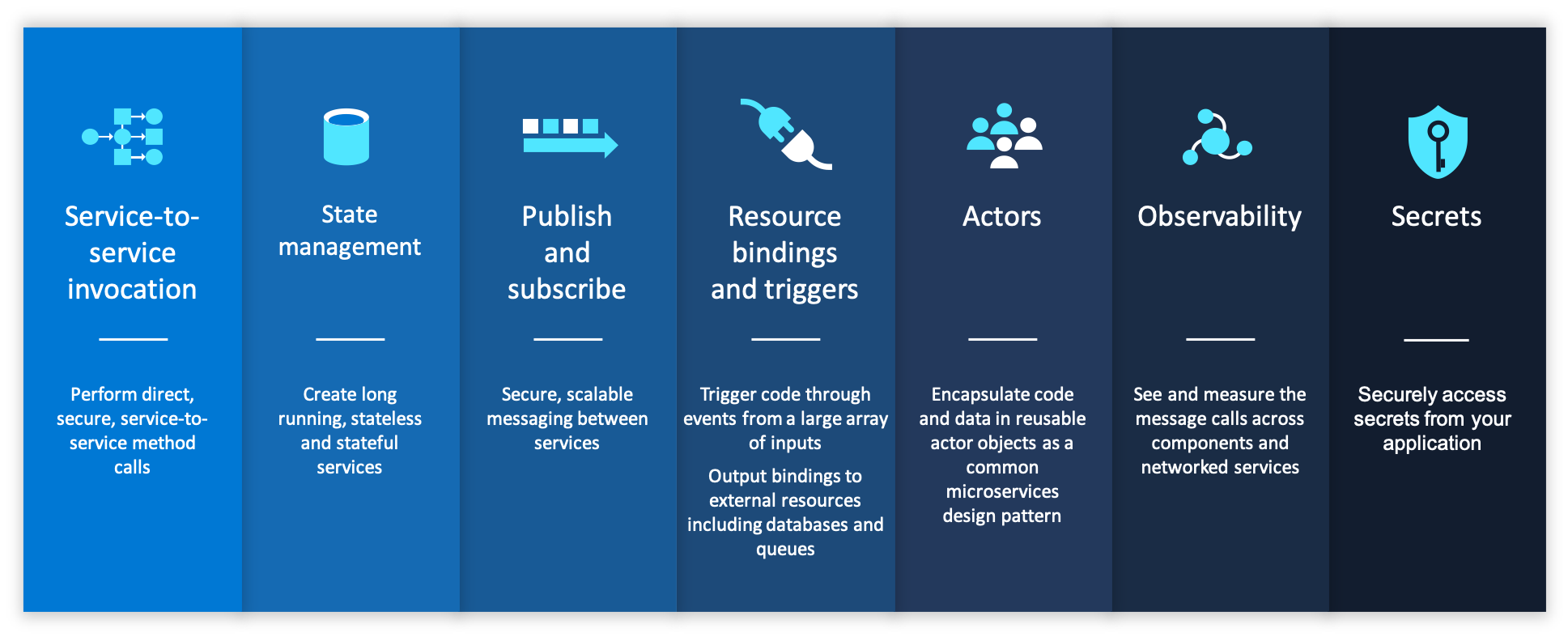
And a lot of the development involves re-inventing the wheel to make their applications reliably talk to various other services. The idea behind Dapr is to give developers a single runtime that, out of the box, provides the tools that developers need to build event-driven microservices. Among other things, Dapr provides various building blocks for things like service-to-service communications, state management, pub/sub and secrets management.

Image Credits: Dapr

“The goal with Dapr was: let’s take care of all of the mundane work of writing one of these cloud-native distributed, highly available, scalable, secure cloud services, away from the developers so they can focus on their code. And actually, we took lessons from serverless, from Functions-as-a-Service where with, for example Azure Functions, it’s event-driven, they focus on their business logic and then things like the bindings that come with Azure Functions take care of connecting with other services,” Russinovich said.

He also noted that another goal here was to do away with language-specific models and to create a programming model that can be leveraged from any language. Enterprises, after all, tend to use multiple languages in their existing code, and a lot of them are now looking at how to best modernize their existing applications — without throwing out all of their current code.

As Russinovich noted, the project now has more than 700 contributors outside of Microsoft (though the core commuters are largely from Microsoft) and a number of businesses started using it in production before the 1.0 release. One of the larger cloud providers that is already using it is Alibaba. “Alibaba Cloud has really fallen in love with Dapr and is leveraging it heavily,” he said. Other organizations that have contributed to Dapr include HashiCorp and early users like ZEISS, Ignition Group and New Relic.

And while it may seem a bit odd for a cloud provider to be happy that its competitors are using its innovations already, Russinovich noted that this was exactly the plan and that the team hopes to bring Dapr into a foundation soon.

“We’ve been on a path to open governance for several months and the goal is to get this into a foundation. […] The goal is opening this up. It’s not a Microsoft thing. It’s an industry thing,” he said — but he wasn’t quite ready to say to which foundation the team is talking.


News: Why two startups are betting on debt instead of equity

When there’s a need for capital, not every startup goes the venture route. Boast.ai, a company that plugs into business systems and automatically finds them R&D tax breaks, announced Wednesday it has raised a $100 million credit facility from Brevet Capital to advance those R&D incentives. And proptech startup States Title announced it has closed

When there’s a need for capital, not every startup goes the venture route.

Boast.ai, a company that plugs into business systems and automatically finds them R&D tax breaks, announced Wednesday it has raised a $100 million credit facility from Brevet Capital to advance those R&D incentives.

And proptech startup States Title announced it has closed on $150 million in debt financing from HSCM Bermuda, which had previously invested in the company. 

States Title has developed patented machine learning technology that it says reduces title processing time from five days to “as little as one minute” and cuts down the entire mortgage closing process “from a 40+ day ordeal to as little as six days.” 

I was curious as to why these companies chose to go after debt/credit as opposed to raising venture capital. 

For Boast.ai, which was bootstrapped until it raised a $23 million Series A last December and is profitable, it boiled down to simple economics.

“Equity is expensive,” Lloyed Lobo, co-founder and president at Boast.ai, told TechCrunch via email. “Plus you bring on a range of partners that you have to be answerable to. For example, if you raise capital, you’re paying a return on the capital you raise no matter what you do with it. Credit facility is more like you have $100 million to deploy as you go and we have the option to extend that to $500 million.”

The company’s vision, he said, is to automate access to billions in R&D tax credits and innovation incentives to help businesses fuel their growth without giving up equity and dealing with red tape.

Proving R&D costs to the U.S. and Canadian government to get tax breaks is a lengthy and time-consuming process. Boast.ai’s offering plugs into a company’s business tools to automatically calculate R&D expenses, and then advances money for the R&D incentives. Boast.ai makes money by charging a fee to the company depending on the credit they have to pay once they receive it.

For States Title, which raised a $123 million Series C last March, debt was a more appealing option than raising more equity.

The COVID-19 pandemic led to record low interest rates, which led to an increased number of people re-financing and/or buying homes. This led to more demand for States Title’s offering, according to CEO Max Simkoff.

“With such an increase in demand, we originally looked at raising equity, but there were ultimately significantly more attractive options for debt,” he told TechCrunch. 

The company, Simkoff said, is growing faster than it could have modeled, so it continues to invest “in an aggressive roadmap.”

“That gave us the confidence to take on the debt facility,” he added. 

Debt is finite, Simkoff said. And for States Title, that is a good thing.

“The reason many companies don’t pursue debt financing is because they feel they may not have a clear path to profitability in the time frame in which they would need to pay the debt back,” he added. “Equity extends the runway to find that path, but it also means giving away more of the eventual upside, if and when a company is able to convert valuation numbers into actual value.”

States Title is planning to use the money to accelerate traction of its product roadmap, power new market expansions, acquire and support customers, and help it restructure its cap table. 

The company wants to do more hiring and pay down what it owes to Lennar Corp., which helped fund State Title’s 2019 acquisition of North American Title Company (NATC) and North American Title Insurance Company (NATIC).  

These two startups are prime examples of the fact that while there is plenty of venture out there, not every company is eager to take it.

News: With software markets getting bigger, will more VCs bet on competing startups?

As startups get more broad and stay private longer, the space into which VCs can invest may narrow.

This morning I covered three funding rounds. One dealt with the no-code/low-code space, another focused on the OKR software market, and the last dealt with a company in the consumer investing space. Worth a combined $420 million, the investments made for a contentedly busy morning.

But they also got me thinking about startup niches and competition. Back in the days when inside rounds were bad, SPACs were jokes and crypto a fever dream, there was lots of noise about investors who declined to place competing bets in any particular startup market.


The Exchange explores startups, markets and money. Read it every morning on Extra Crunch, or get The Exchange newsletter every Saturday.


This rule of thumb still holds up today, but we need to update it. The general sentiment that investors shouldn’t back competing companies is still on display, as we saw Sequoia walk away from a check it put into Finix after it became clear that the smaller company was too competitive with Stripe, another portfolio company.

But as startups get more broad and stay private longer, the space into which VCs can invest may narrow — especially if they have a big winner that stays private while building both horizontally and vertically (like Stripe, for example).

Does that mean Sequoia can’t invest elsewhere in fintech? No, but it does limit their investing playing field.

Which is dumb as hell. Nothing that Sequoia could invest in today is really going to slow Stripe’s IPO, unless the company decides to not go public for a half-decade. Which would be lunacy, even for today’s live-at-home-with-the-parents startup culture that leans towards staying private over going public.

News: DuPont and VCs see lithium mining as a critical investment for the electric future

“Mining” has become synonymous with crypto the past few years in the tech industry, what with Bitcoin piercing the $50,000 barrier and GPUs and ASICs worldwide scrambling to hash functions in a bid for distributed crypto manna. That excitement belies an increasingly energetic push though to bring VC dollars and entrepreneurial acumen back to Mining

“Mining” has become synonymous with crypto the past few years in the tech industry, what with Bitcoin piercing the $50,000 barrier and GPUs and ASICs worldwide scrambling to hash functions in a bid for distributed crypto manna. That excitement belies an increasingly energetic push though to bring VC dollars and entrepreneurial acumen back to Mining 1.0 — actual meatspace resource extraction.

One of the key target resources is lithium, a critical component for smartphones, electric vehicle batteries and nearly every other electric tool of modern convenience and industrial import. China through its mining companies and battery manufacturers is currently in the lead, thanks to a years-long push to control both the supply of lithium and develop massive new manufacturing capacity to meet global demand. As tensions rise between China and the United States however, companies are racing to find alternative supplies as the world transitions to more electric-based infrastructure systems.

That’s one reason why DuPont is making a push to prove out its extraction technologies.

The water filtration and purification service provider DuPont Water Solutions has teamed up with Vulcan Energy Resources, a developer of lithium mining and renewable energy projects, to test a new process for direct lithium extraction.

Current processes for mining lithium are bad for the environment (to put it mildly), involving heavy use of toxic chemicals and increasingly scarce water resources. This new joint project, which is being developed in the Upper Rhine Valley of Germany, would tap DuPont’s direct lithium extraction products and filtration expertise to mine and refine lithium in a more environmentally-friendly way, the company said.

Dr. Francis Wedin, Managing Director of Vulcan, said in a statement that “DuPont’s diverse set of products, which can be manufactured at scale, are likely to be well-suited to sustainably extract the lithium from the brine.”

DuPont is hoping to push the technology out across the mining industry and make its portfolio of sorbents, nanofiltration technologies, reverse osmosis filters, ion exchange resins, ultrafiltration, and close-circuit reverse osmosis products available to a wider group of customers.

A push by DuPont to become more involved in the lithium-mining business will heighten competition for startups like Lilac Solutions, which has developed its own technology for lithium extraction. The company has partnered with an Australian company, Controlled Thermal Resources, to develop lithium brine deposits in the Salton Sea, which is among California’s most blighted environmental disasters.

Last year, the Oakland-based startup announced a $20 million investment led by Breakthrough Energy Ventures (those folks are everywhere), the MIT-affiliated investment firm The Engine and early Uber investor Chris Sacca’s relatively new climate-focused fund, Lowercarbon Capital.

Outside Lilac, there’s been a stream of VC dollars flowing into the (non-crypto) mining business as software helps extraction companies operate more efficiently. Notable investments include high-tech prospectors like KoBold Minerals (another Breakthrough Energy Ventures portfolio company), which uses big data and machine learning to help pick better targets for mines and Lunasonde, which prospects from space using satellites.

Other solutions to the lithium problem are attracting investor attention, too. For Jeff Chamberlain, the founder and chief executive of the battery technology investment firm Volta Energy Technologies, an alternative may be found in “urban mining,” or the recycling of used lithium-ion batteries. For decades, lead-acid batteries have been recycled for their component materials, and Chamberlain expects that the lithium-ion supply chain will evolve to support more efficient reuse of existing materials as well.

There’s a slew of companies trying to prove Chamberlain right. They include businesses like Li-Cycle, which yesterday announced that it would go public through a special purpose acquisition company (SPAC) in a deal that would value the company at $1.67 billion.

Meanwhile, privately-held and venture-backed startups are developing other recycling solutions. Battery Resourcers, a spinout from Massachusetts’ Worcester Polytechnic Institute, is focused on making cathode power converters from recycled scrap. Singapore-based Green Li-ion is another company that’s opening a recycling plant for lithium-ion battery cathodes, and Northvolt, a Swedish battery startup that was founded by former Tesla executives in 2016, already has an experimental recycling plant up and running.

Finally there’s J.B. Straubel’s Nevada-based startup Redwood Materials, which was one of the first companies to receive funding from Amazon through its Climate Pledge Fund.

“Ultimately we won’t have to extract lithium out of rock. We can extract lithium from pools and using urban mining,” said Chamberlain. Call it Mining 1.0, Version 2 — but it’s just the kind of investment our world needs if we are going to secure a better climate future.

News: Reducing the spread of misinformation on social media: What would a do-over look like?

If we could teleport back in time to relaunch social media platforms with the goal of minimizing the spread of misinformation and conspiracy theories from the outset … what would they look like?

Kristen Berman
Contributor

Kristen Berman is the co-founder and CEO of Irrational Labs, a behavioral research and design consultancy.
Evelyn Gosnell
Contributor

Evelyn Gosnell is a managing director at Irrational Labs, a behavioral research and design consultancy.

Richard Mathera
Contributor

Richard Mathera is a managing director at Irrational Labs, a behavioral research and design consultancy.

The news is awash with stories of platforms clamping down on misinformation and the angst involved in banning prominent members. But these are Band-Aids over a deeper issue — namely, that the problem of misinformation is one of our own design. Some of the core elements of how we’ve built social media platforms may inadvertently increase polarization and spread misinformation.

If we could teleport back in time to relaunch social media platforms like Facebook, Twitter and TikTok with the goal of minimizing the spread of misinformation and conspiracy theories from the outset … what would they look like?

This is not an academic exercise. Understanding these root causes can help us develop better prevention measures for current and future platforms.

Some of the core elements of how we’ve built social media platforms may inadvertently increase polarization and spread misinformation.

As one of the Valley’s leading behavioral science firms, we’ve helped brands like Google, Lyft and others understand human decision-making as it relates to product design. We recently collaborated with TikTok to design a new series of prompts (launched this week) to help stop the spread of potential misinformation on its platform.

The intervention successfully reduces shares of flagged content by 24%. While TikTok is unique amongst platforms, the lessons we learned there have helped shape ideas on what a social media redux could look like.

Create opt-outs

We can take much bigger swings at reducing the views of unsubstantiated content than labels or prompts.

In the experiment we launched together with TikTok, people saw an average of 1.5 flagged videos over a two-week period. Yet in our qualitative research, many users said they were on TikTok for fun; they didn’t want to see any flagged videos whatsoever. In a recent earnings call, Mark Zuckerberg also spoke of Facebook users’ tiring of hyperpartisan content.

We suggest giving people an “opt-out of flagged content” option — remove this content from their feeds entirely. To make this a true choice, this opt-out needs to be prominent, not buried somewhere users must seek it out. We suggest putting it directly in the sign-up flow for new users and adding an in-app prompt for existing users.

Shift the business model

There’s a reason false news spreads six times faster on social media than real news: Information that’s controversial, dramatic or polarizing is far more likely to grab our attention. And when algorithms are designed to maximize engagement and time spent on an app, this kind of content is heavily favored over more thoughtful, deliberative content.

The ad-based business model is at the core the problem; it’s why making progress on misinformation and polarization is so hard. One internal Facebook team tasked with looking into the issue found that, “our algorithms exploit the human brain’s attraction to divisiveness.” But the project and proposed work to address the issues was nixed by senior executives.

Essentially, this is a classic incentives problem. If business metrics that define “success” are no longer dependent on maximizing engagement/time on site, everything will change. Polarizing content will no longer need to be favored and more thoughtful discourse will be able to rise to the surface.

Design for connection

A primary part of the spread of misinformation is feeling marginalized and alone. Humans are fundamentally social creatures who look to be part of an in-group, and partisan groups frequently provide that sense of acceptance and validation.

We must therefore make it easier for people to find their authentic tribes and communities in other ways (versus those that bond over conspiracy theories).

Mark Zuckerberg says his ultimate goal with Facebook was to connect people. To be fair, in many ways Facebook has done that, at least on a surface level. But we should go deeper. Here are some ways:

We can design for more active one-on-one communication, which has been shown to increase well-being. We can also nudge offline connection. Imagine two friends are chatting on Facebook messenger or via comments on a post. How about a prompt to meet in person, when they live in the same city (post-COVID, of course)? Or if they’re not in the same city, a nudge to hop on a call or video.

In the scenario where they’re not friends and the interaction is more contentious, platforms can play a role in highlighting not only the humanity of the other person, but things one shares in common with the other. Imagine a prompt that showed, as you’re “shouting” online with someone, everything you have in common with that person.

Platforms should also disallow anonymous accounts, or at minimum encourage the use of real names. Clubhouse has good norm-setting on this: In the onboarding flow they say, “We use real names here.” Connection is based on the idea that we’re interacting with a real human. Anonymity obfuscates that.

Finally, help people reset

We should make it easy for people to get out of an algorithmic rabbit hole. YouTube has been under fire for its rabbit holes, but all social media platforms have this challenge. Once you click a video, you’re shown videos like it. This may help sometimes (getting to that perfect “how to” video sometimes requires a search), but for misinformation, this is a death march. One video on flat earth leads to another, as well as other conspiracy theories. We need to help people eject from their algorithmic destiny.

With great power comes great responsibility

More and more people now get their news from social media, and those who do are less likely to be correctly informed about important issues. It’s likely that this trend of relying on social media as an information source will continue.

Social media companies are thus in a unique position of power and have a responsibility to think deeply about the role they play in reducing the spread of misinformation. They should absolutely continue to experiment and run tests with research-informed solutions, as we did together with the TikTok team.

This work isn’t easy. We knew that going in, but we have an even deeper appreciation for this fact after working with the TikTok team. There are many smart, well-intentioned people who want to solve for the greater good. We’re deeply hopeful about our collective opportunity here to think bigger and more creatively about how to reduce misinformation, inspire connection and strengthen our collective humanity all at the same time.


WordPress Image Lightbox Plugin