Tag Archives: Blog

News: Math learning app Photomath raises $23 million as it reaches 220 million downloads

Photomath, the popular mobile app that helps you solve equations, has raised a $23 million Series B funding round led by Menlo Ventures. The app is a massive consumer success, and chances are you might already know about it if you have a teenager in your household. The app lets you point your phone’s camera

Photomath, the popular mobile app that helps you solve equations, has raised a $23 million Series B funding round led by Menlo Ventures. The app is a massive consumer success, and chances are you might already know about it if you have a teenager in your household.

The app lets you point your phone’s camera at a math problem. It recognizes what’s written and gives you a step-by-step explanation to solve the problem. You might think that it’s the perfect app for lazy students.

But there are many different use cases for Photomath. For instance, you can write an equation in your notebook and use Photomath to draw a graph.

Typing an equation on a keyboard is quite difficult. That’s why bridging the gap between the physical world and your smartphone is key to Photomath’s success. You can just grab a pen and write something down on a piece of paper. Essentially, it’s an AR calculator.

GSV Ventures, Learn Capital, Cherubic Ventures and Goodwater Capital are also participating in today’s funding round.

Behind the app’s success, there’s an interesting story. Photomath was originally designed as a demo app for another company called MicroBlink. At the time, the team was working on text recognition technology. It planned to sell its core technology to other companies that might find it useful.

In 2014, they pitched MicroBlink at TechCrunch Disrupt in London. And things changed drastically overnight as Photomath reached the first spot of the iOS App Store.

Photomath has now attracted over 220 million downloads. As of this writing, it is still #59 in the U.S. App Store, one rank above Tinder. Other companies tried to build competitors, but it seems like they didn’t manage to crush the tiny European startup.

The app seems even more relevant as many kids are spending more time studying at home. They can’t simply raise their hand to call the teacher for some help.

Photomath is free and users can optionally pay for Photomath Plus, a premium version with more features, such as dynamic illustrations and animated tutorials.

News: Uber extends work from home policy through mid-September

Uber today notified employees that it will extend its work from home policy through September 13. “In considering the extension, we took into account the latest scientific data and experts’ views; the fact that different countries are at different stages of recovery; and the start of the school year,” Uber Chief People Officer Nikki Krish

Uber today notified employees that it will extend its work from home policy through September 13.

“In considering the extension, we took into account the latest scientific data and experts’ views; the fact that different countries are at different stages of recovery; and the start of the school year,” Uber Chief People Officer Nikki Krish wrote in an email, viewed by TechCrunch, to employees. “[…] We know that some CommOps, IT, or other roles require physical presence in an office, so please continue to work within the policies your teams have developed—however, as always, we won’t force anyone to go into the office if they have medical concerns.”

Uber is also encouraging employees to get vaccinated when it’s possible to do so. In the email, Krish said Uber employees will be able to take time off in order to get vaccinated.

In August, Uber notified employees that they should expect to work from home through June 2021. As for other tech companies, Google in July extended its work from home policy through the end of June 2021, while Facebook in August extended its remote work policy until July 2021.

Post-COVID, Uber will likely have a hybrid work model, Krish said, but it’s still a work in progress.

“We’re taking a number of aspects into consideration, such as how being physically together benefits or reduces productivity, collaboration, and engagement,” she wrote. “We’ll update you on where things stand in a few weeks, and along the way as we make progress.”

News: Microsoft announces the next perpetual release of Office

If you use Office, Microsoft would really, really, really like you to buy a cloud-enabled subscription to Microsoft 365 (formerly Office 365). But as the company promised, it will continue to make a stand-alone, perpetual license for Office available for the foreseeable future. A while back, it launched Office 2019, which includes the standard suite

If you use Office, Microsoft would really, really, really like you to buy a cloud-enabled subscription to Microsoft 365 (formerly Office 365). But as the company promised, it will continue to make a stand-alone, perpetual license for Office available for the foreseeable future. A while back, it launched Office 2019, which includes the standard suite of Office tools, but is frozen in time and without the benefit of the regular feature updates and cloud-based tools that come with the subscription offering.

Today, Microsoft is announcing what is now called the Microsoft Office LTSC (Long Term Servicing Channel). It’ll be available as a commercial preview in April and will be available on both Mac and Windows, in both 32-bit and 64-bit versions.

And like with the previous version, it’s clear that Microsoft would really prefer if you just moved to the cloud already. But it also knows that not everybody can do that, so it now calls this version with its perpetual license that you pay for once and then use for as long as you want to (or have compatible hardware) a “specialty product for specific scenarios. Those scenarios, Microsoft agrees, include situations where you have a regulated device that can’t accept feature updates for years at a time, process control devices on a manufacturing floor and other devices that simply can’t be connected to the internet.

“We expect that most customers who use Office LTSC won’t do it across their entire organization, but only in specific scenarios,” Microsoft’s CVP for Microsoft 365, Jared Spataro, writes in today’s announcement.

Because it’s a specialty product, Microsoft will also raise the price for Office Professional Plus, Office Standard, and the individual Office apps by up to 10%.

“To fuel the work of the future, we need the power of the cloud,” writes Spataro. “The cloud is where we invest, where we innovate, where we discover the solutions that help our customers empower everyone in their organization – even as we all adjust to a new world of work. But we also acknowledge that some of our customers need to enable a limited set of locked-in-time scenarios, and these updates reflect our commitment to helping them meet this need.”

If you have one of these special use cases, the price increase will not likely deter you and you’ll likely be happy to hear that Microsoft is committing to another release in this long-term channel in the future, too.

As for the new features in this release, Spataro notes that will have dark mode support, new capabilities like Dynamic Arrays and XLOOKUP in Excel, and performance improvements across the board. One other change worth calling out is that it will not ship with Skype for Business but the Microsoft Teams app (though you can still download Skype for Business if you need it).

News: Anthony Lin named permanent managing director and head of Intel Capital

When Wendell Brooks stepped down as managing partner and head of Intel Capital last August, Anthony Lin was named to replace him on an interim basis. At the time, it wasn’t clear if he would be given the role permanently, but today, six months later, the answer is known. In a letter to the firm’s

When Wendell Brooks stepped down as managing partner and head of Intel Capital last August, Anthony Lin was named to replace him on an interim basis. At the time, it wasn’t clear if he would be given the role permanently, but today, six months later, the answer is known.

In a letter to the firm’s portfolio CEOs published on the company website, Lin mentioned, almost casually that he had taken on the two roles on a permanent basis. “Personally, I want to share that I have been appointed to managing partner and head of Intel Capital. I have been a member of the investment committee for the past several years and am humbly awed by the talent of our entrepreneurs and our team,” he wrote.

Lin takes over in a time of turmoil for Intel as the company struggles to regain its place in the semiconductor business that it dominated for decades. Meanwhile, Intel itself has a new CEO with Pat Gelsinger returning in January from VMware to lead the organization.

As the corporate investment arm of Intel, it looks for companies that can help the parent company understand where to invest resources in the future. If that is its goal, perhaps it hasn’t done a great job as Intel has lost some of its edge when it comes to innovation.

Lin, who was formerly head of mergers and acquisitions and international investing at the firm, can use the power of the firm’s investment dollars to try help point the parent company in the right direction and help find new ways to build innovative solutions on the Intel platform.

Lin acknowledged how challenging 2020 was for everyone, and his company was no exception, but the firm invested in 75 startups including 35 new deals and 40 deals involving companies it had previously invested in. It  has also made a commitment to invest in companies with more diverse founders. To that end, 30% of new venture stage dollars went to startups led by diverse leaders, according to Lin.

What’s more, the company made a five year commitment that 15% of all of its deals would go to companies with Black founders. It made some progress towards that goal, but there is still a ways to go. “At the end of 2020, 9% of our new venture deals and 15% of our venture dollars committed were in companies led by Black founders. We know there is more progress to be made and we will continue to encourage, foster and invest in diverse and inclusive teams,” he wrote.

Lin faces a big challenge ahead as he takes over a role that had the same leader for the first 28 years in Arvind Sodhani. His predecessor, Brooks, was there for five years. Now it passes to Lin and he needs to use the firm’s investment might to help Gelsinger advance the goals of the broader firm, while making sound investments.

News: Robinhood goes to Congress

Update: There’s an entire second session of this? My lord. Today the House Financial Services Committee dragged the CEO of Reddit, a Cato wonk, social media icon DeepFuckingValue, the CEO of Citadel Kenneth Griffin, a hedgefund bro who got whomped by DeepFuckingValue, and the CEO of Robinhood Vlad Tenev, who got womped when individual investors

Update: There’s an entire second session of this? My lord.

Today the House Financial Services Committee dragged the CEO of Reddit, a Cato wonk, social media icon DeepFuckingValue, the CEO of Citadel Kenneth Griffin, a hedgefund bro who got whomped by DeepFuckingValue, and the CEO of Robinhood Vlad Tenev, who got womped when individual investors joined DeepFuckingValue in his womping of the hedge fund and thus womped his capital requirements leading to general market chaos, before them virtually for questioning.

It was not very useful. Between a cascade of Zoom failures — mutings, incorrect unmutings, a green screen that was not actually in use, and an actual gavel — members of Congress largely took five minute slots to embarass themselves, and not make material points.

The format was not conducive to real questioning, and most questions were both too long and either too precise, and misguided in their direction, or too imprecise, even if they landed in the strike zone. Sitting here I am trying to recall a single thing that I learned. I suppose that Robinhood’s CEO was not sure on the details of his company’s arbitration agreement with users. And perhaps a little bit about how many of its users trade options. And that Reddit’s CEO has a nice suit.

Some members of Congress mocked the proceedings, calling them political theater. That earned a rebuke by Maxine Waters, Chair of the House Financial Services Committee.

Some members of Congress nearly got around to asking something useful. But largely the method of asking questions was bilge, the responses canned, and nothing much uncovered.

What would have worked? I suppose Congress could have brought in a few actual experts and a more limited number of guests, and then hammered them with questions about the ethical reality of payment for order flow, Robinhood’s app mechanics and how easily it offers access to exotic trading tools, and the like. That would have helped.

Instead, we got great stuff like this:

“I believe that investing is investing” – Steve Huffman

— alex (@alex) February 18, 2021

Which was not very helpful. That said, there were some good memes and jokes, so, let’s have some fun instead of being annoyed with our elected representatives:

“Did you buy GameStock because you were not aware of payment for order flow” is an incredible series of words to put one after the other

— Myles Udland (@MylesUdland) February 18, 2021

Really? An actual green screen? pic.twitter.com/goFNv3PtkP

— Lisa Fleisher (@lisafleisher) February 18, 2021

Just waiting for “why doesn’t Robinhood take responsibility for customers losses?” from these incompetent boomers

— litquidity (@litcapital) February 18, 2021

The rest of it was a waste of time. As I write this sentence to you, a member of Congress just asked how Robinhood go its name. Which is dumb, as the name is so obvious it nearly makes your head hurt with how earnest it is.

So there’s that. This was a waste. Real questions remain. They largely didn’t get asked, and certainly didn’t get answered.

News: Google has a new responsible AI lead

Google has appointed Dr. Marian Croak to lead its responsible artificial intelligence division within Google Research, Bloomberg reported earlier today. Croak was previously the vice president of engineering at the company. In her new role, Croak will oversee the teams working on accessibility, AI for social good, algorithmic fairness in health, brain fairness, ethical AI

Google has appointed Dr. Marian Croak to lead its responsible artificial intelligence division within Google Research, Bloomberg reported earlier today. Croak was previously the vice president of engineering at the company.

In her new role, Croak will oversee the teams working on accessibility, AI for social good, algorithmic fairness in health, brain fairness, ethical AI and others. She’ll report to Jeff Dean, SVP of Google AI Research and Health. In a Google blog post and video confirming the news, Croak said:

This field, the field of responsible AI and ethics, is new. Most institutions have only developed principles, and they’re very high-level, abstract principles, in the last five years. There’s a lot of dissension, a lot of conflict in terms of trying to standardize on normative definitions of these principles. Whose definition of fairness, or safety, are we going to use? There’s quite a lot of conflict right now within the field, and it can be polarizing at times. And what I’d like to do is have people have the conversation in a more diplomatic way, perhaps, than we’re having it now, so we can truly advance this field.

This all comes after the departure of Dr. Timnit Gebru, the former co-lead of Google’s ethical AI team, as well as the corporate lockout of researcher Margaret Mitchell, founder of Google’s ethical AI team. In January, Google revoked corporate access from AI ethicist Margaret Mitchell for reportedly using automated scripts to find examples of mistreatment of Gebru, according to Axios. Gebru says she was fired from Google while Google has maintained that she resigned. In a statement to Axios at the time, Google said:

Our security systems automatically lock an employee’s corporate account when they detect that the account is at risk of compromise due to credential problems or when an automated rule involving the handling of sensitive data has been triggered. In this instance, yesterday our systems detected that an account had exfiltrated thousands of files and shared them with multiple external accounts. We explained this to the employee earlier today.

Mitchell is still locked out of her account, and tweeted today about how she only found out about the reorganization through the Bloomberg story.

…And this is how I find out. I’m so glad for all the trust they’ve rebuilt. It seems I’ve been completely erased and my team taken.https://t.co/1BTGOo5Wry

— MMitchell (@mmitchell_ai) February 18, 2021

TechCrunch has reached out to Google to try to determine what this means for Mitchell, but the company declined to comment on her.

News: YC-backed Queenly launches a marketplace for formalwear

Queenly, a marketplace for formalwear, launched into a world where its core product of dresses and gowns had a massive competitor, bigger and more elusive than Poshmark: quarantine. The coronavirus pandemic has caused the fancy in-person events that one might attend, such as award shows, pageants, proms and weddings to be canceled to limit spread.

Queenly, a marketplace for formalwear, launched into a world where its core product of dresses and gowns had a massive competitor, bigger and more elusive than Poshmark: quarantine.

The coronavirus pandemic has caused the fancy in-person events that one might attend, such as award shows, pageants, proms and weddings to be canceled to limit spread. But despite the fact that you might be rocking sweats over slacks, Queenly co-founders Trisha Bantigue and Kathy Zhou say that they had half a million in sales last year, and over 100,000 people visit their website everyday.

“So many women bought dresses to just dress up and feel normal at home, when everything else around the world was not,” Bantigue said. “It helped them feel grounded and stabilize themselves in this crazy chaotic pandemic environment.” The canceled events have also found new homes, such as Zoom weddings, Twitch pageants, socially distant proms and graduation car parades. The co-founder added that content creators on TikTok and YouTube have also bought Queenly dresses.

Pandemic growth added a surprising dimension to Queenly’s business, and the Bay Area startup is currently partaking in the Y Combinator winter cohort to navigate it. So far, it has raised $800,000 to date from investors including Mike Smith, former COO of Stitch Fix, Thuan Pham, former CTO of Uber, and Kelly Thompson, former COO of Samsclub.com and Walmart.com. The goal, the co-founders tell me, is to become the StockX for formalwear.

Queenly is a marketplace for buying and selling formal dresses, from wedding dresses to pageant gowns. The 50,000 dresses on the platform are either new or resale, and sellers get paid 80% of the price that the gowns go for.

Part of the company’s biggest sell, according to the co-founders, is its algorithm that matches buyers to dresses. Before Queenly, Zhou was a former software engineer at Pinterest who helped build content creation flows and the back end of the platform. She took the same focus that her and her Pinterest co-workers had on data-driven search and development and applied it to Queenly.

The search engine can go deeper than a normal dress search on Macy’s can, which might create options based on size, color and cut. In contrast, Queenly can help offer more diverse insights with a larger range of sizes, silhouette options and different shades of the same color.

Last week, a seller sold her wedding dress with a tag that says the dark mesh on the dress is for a darker skin tone. Queenly is beta-testing a feature that lets you search medium skin tone sheer options or dark skin tone sheer options. The team says that skin-tone filters are one of the important long-term goals of their search engine.

“These are just some things that we know because we’re women, and we know how to build this product for women,” Zhou said. “As opposed to if this was a male founder, they would not know that that would even be something that women would search for.”

Currently, there are over 50,000 dresses for sale on the Queenly platform, ranging from $70 to $4,000 and going up to size 32.
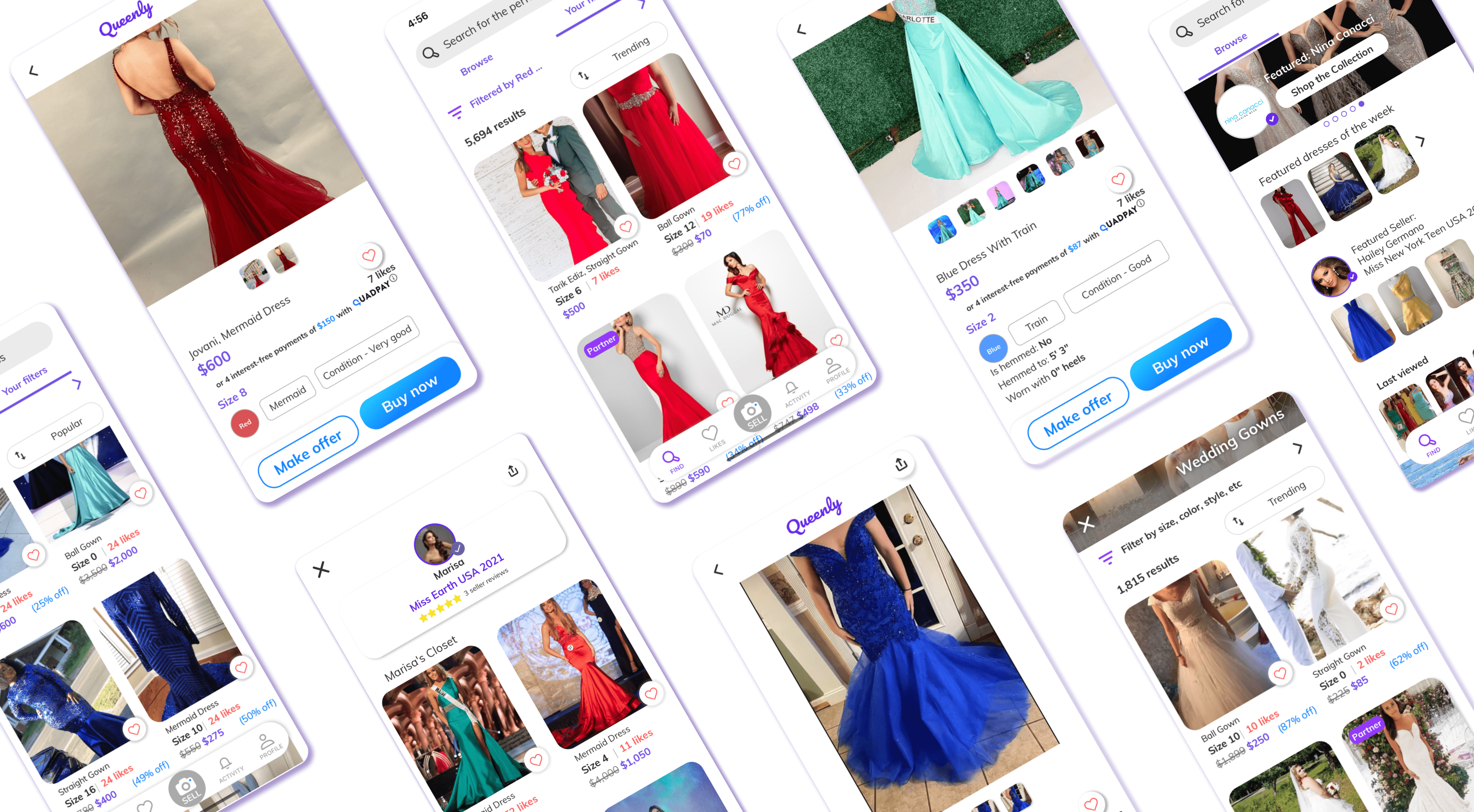
Image Credits: Queenly

With these search insights, Queenly says that it is able to sell dresses within two weeks, claiming that some users say that their same dresses spent five months on the Poshmark platform.

The diversity of dresses, from a price and range perspective, is one of the ways that Queenly stays competitive with large retail brands like Nordstrom.

“Buying and carrying inventory is very capital intensive for any startup,” Bantigue said. “As female minority founders it was hard for us to raise in the beginning.” As a result, the startup doesn’t keep a physical inventory of dresses, but instead relies on users to help get dresses from owner to buyer. If a dress is under $200, Queenly sends a prepaid shipping label to the seller to mail directly to the end buyer. If a dress is over $200, Queenly gets the dress sent directly to the company, does light dry cleaning and authentication, and then sends it right to the user.

Bringing the users into the transaction process adds a layer of risk because it depends on people to do things for the startup to be successful. The incentive here is that sellers make 80% of their sale price, and Queenly pockets the other 20%.

The startup’s biggest cost is shipping. To limit these costs, Queenly currently doesn’t accept or honor any returns, unless the dress upon arrival is not what was described in the sales post.

While this is a sensical business decision, it could be a hurdle for the startups’ clientele. Sizes are complicated and inconsistent, so the inability to return a dress might stifle a customer’s appetite to buy in the first place.

“We were actually worried about this before, but for two years now we [have not] had a complaint about sizing,” Bantigue said.

The co-founders say that many buyers are comfortable tailoring a dress post-purchase, and sellers are required to post pictures so expectations are set pre-purchase. There have been no cases of counterfeit brands to date, Bantigue said.

Queenly’s next plan is to bring on boutique stores and dress designers for Queenly partners, a program started to help small boutique businesses digitize their inventory through the Queenly platform.

“For years, the formalwear industry has been mostly offline, with only big name players being available online,” Bantigue said. “We want to change this.”


News: Check out the incredible speakers joining us on Extra Crunch Live in March

Extra Crunch Live is off to a kick-ass start this year. Lightspeed’s Gaurav Gupta and Grafana’s Raj Dutt taught us how to nail the narrative. Felicis Ventures’ Aydin Senkut and Guideline’s Kevin Busque showed us how valuable a simple pitch deck can be. And just yesterday, Accel’s Steve Loughlin and Ironclad’s Jason Boehmig discussed the

Extra Crunch Live is off to a kick-ass start this year. Lightspeed’s Gaurav Gupta and Grafana’s Raj Dutt taught us how to nail the narrative. Felicis Ventures’ Aydin Senkut and Guideline’s Kevin Busque showed us how valuable a simple pitch deck can be. And just yesterday, Accel’s Steve Loughlin and Ironclad’s Jason Boehmig discussed the challenges of pricing and packaging your product. Next week, we’ll sit down with Bain Capital Ventures’ Matt Harris and Justworks’ Isaac Oats.

For those of you who followed the series last year, Extra Crunch Live is a brand new beast in 2021: we take a look at early stage funding deals through the eyes of the founders and investors who made them happen, and those same tech leaders go through your pitch decks and give feedback and advice. Every single Wednesday at 12 p.m. PST/3 p.m. EST!

Extra Crunch Live is available for EC members only. It is but one of the many reasons to join Extra Crunch, including but not limited to Investor Surveys, Market Maps, and the EC Perks Program. Interested? Hit up this link to get started.

Today, I’m thrilled to announce the March slate for Extra Crunch Live. (Registration info for these events is at the bottom of the post.)


Sarah Kunst (Cleo Capital) + Julia Collins (Planet FWD)

March 10, 12pm PT/3pm ET

Julia Collins built a unicorn in the form of Zume, a robotics-focused pizza startup. Her latest venture, Planet FWD, has raised $2.7 million for climate-friendly food. Sarah Kunst, managing director of Cleo Capital invested in the round, adding Planet FWD to a portfolio that includes mmhmm, Lunch Club, StyleSeat and more. Hear why they chose one another, what matters most in the relationship between an investor and a founder, and get their live feedback on audience-submitted pitch decks.


Emmalyn Shaw (Flourish Ventures) + Adam Roseman (Steady)

March 17, 12pm PT/3pm ET

Emmalyn Shaw co-manages a $500 million fintech fund in Flourish Capital, with portfolio companies that include Brigit, Chime, Clerkie, Cushion, EarnUp, Kin, Propel, and SeedFi. She also led the Series A deal for Steady, founded by Adam Roseman, back in 2018. Hear from Emmalyn and Adam about how they came together, what it takes to get funding and be successful in the fintech space, and get their live feedback on audience-submitted pitch decks.


Navin Chaddha (Mayfield) + Manish Chandra (Poshmark)

March 24, 12pm PT/3pm ET

Poshmark raised upwards of $150 million before filing to go public in 2019. Today, it has a market cap north of $5 billion. Mayfield’s Navin Chaddha led the company’s Series A all the way back in 2011, back when Poshmark was called Gosh Posh. Hear Chaddha and Poshmark founder Manish Chandra discuss a decade of growth, and walk us through how they came together more than ten years ago. Then the duo will take a look at pitch decks submitted by audience members.


As a reminder, Extra Crunch Live is available for EC members only. It is but one of the many reasons to join Extra Crunch, including but not limited to Investor Surveys, Market Maps, and the EC Perks Program. Interested? Hit up this link to get started.

Register for the March episodes of Extra Crunch Live below.

See you there!

News: Apple TV+ arrives on Google TV devices, starting with Chromecast

Google announced today the Apple TV+ streaming service has now arrived on the Google TV platform, starting with Chromecast with Google TV. It will also become available on Google TVs from both Sony and TCL, with expansions to other Android TV-powered devices in the months to come, Google says. Google TV was first introduced last September

Google announced today the Apple TV+ streaming service has now arrived on the Google TV platform, starting with Chromecast with Google TV. It will also become available on Google TVs from both Sony and TCL, with expansions to other Android TV-powered devices in the months to come, Google says.

Google TV was first introduced last September as the new way Google will refer to its interface for Chromecast, where it combines streaming services, live TV via YouTube TV, and other Google offerings into one user interface — making it more competitive with similar offerings from Apple and Amazon. Today, the platform supports a wide range of top streaming services, like Disney+, Netflix, HBO Max, Peacock, Prime Video, CBS All Access, Hulu, Soing, and others, including, of course, YouTube.

With the added support for Apple TV+, users who already have subscriptions will be able to tune into its original programming, which includes movies, documentaries and series like “Ted Lasso,” “For All Mankind,” “Servant,” “The Morning Show,” “Dickinson,” and others. The app also provides access to the user’s library of movies and shows purchased from Apple, recommendations, and supports Family Sharing. The latter allows up to 6 family members to share a subscription to Apple TV+ and Apple TV channels.

Following the app’s launch on Google TV, users in the U.S. will be able to browse Apple’s Originals in Google TV’s personalized recommendations and surface its content in search results. Users can also ask Google Assistant to open the Apple TV app or they can request an Apple Original title by name. And they’ll be able to add Apple TV+ programming to the Google TV Watchlist. Google says these features will arrive in the “coming months,” however, instead of at launch.

The launch makes Google TV one of the last of the major streaming device platforms to support Apple’s streaming service, which is otherwise broadly available.

Apple TV+ had debuted in November 2019 for Apple customers, and later rolled out to non-Apple platforms including, that same year, Roku devices and Amazon’s Fire TV platform. Today, it’s also now available across a variety of smart TVs by Samsung, LG, Vizio, and Sony; gaming consoles including PlayStation (PS4 & PS5) and Xbox (One, Series X, Series S): and via the web.


News: Why do SaaS companies with usage-based pricing grow faster?

Public SaaS companies that have adopted usage-based pricing are better at landing new customers, growing with them and retaining them. 

Kyle Poyar
Contributor

Kyle Poyar is VP of Growth at OpenView.

Today we know of HubSpot — the maker of marketing, sales and service software products — as a preeminent public company with a market cap above $17 billion. But HubSpot wasn’t always on the IPO trajectory.

For its first five years in business, HubSpot offered three subscription packages ranging in price from $3,000 to $18,000 per year. The company struggled with poor churn and anemic expansion revenue. Net revenue retention was near 70%, a far cry from the 100%+ that most SaaS companies aim to achieve.

Something needed to change. So in 2011, they introduced usage-based pricing. As customers used the software to generate more leads, they would proportionally increase their spend with HubSpot.  This pricing change allowed HubSpot to share in the success of its customers.

In a usage-based model, expansion “just happens” as customers are successful.

By the time HubSpot went public in 2014, net revenue retention had jumped to nearly 100% — all without hurting the company’s ability to acquire new customers.

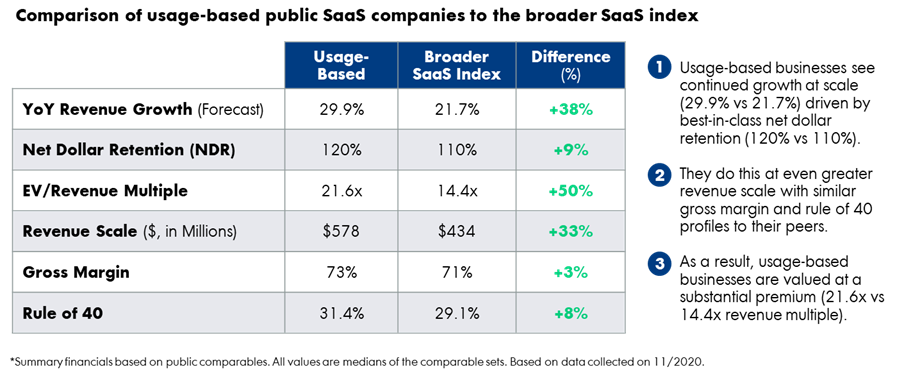
HubSpot isn’t an outlier. Public SaaS companies that have adopted usage-based pricing grow faster because they’re better at landing new customers, growing with them and keeping them as customers.

Image Credits: Kyle Povar

Widen the top of the funnel

In a usage-based model, a company doesn’t get paid until after the customer has adopted the product. From the customer’s perspective, this means that there’s no risk to try before they buy. Products like Snowflake and Google Cloud Platform take this a step further and even offer $300+ in free usage credits for new developers to test drive their products.

Many of these free users won’t become profitable — and that’s okay. Like a VC firm, usage-based companies are making a portfolio of bets. Some of those will pay off spectacularly — and the company will directly share in that success.

Top-performing companies open up the top of the funnel by making it free to sign up for their products. They invest in a frictionless customer onboarding experience and high-quality support so that new users get hooked on the platform. As more new users become active, there’s a stronger foundation for future customer growth.

WordPress Image Lightbox Plugin