Tag Archives: Blog

News: With $20M A round, Promise brings financial flexibility to outdated government and utility payment systems

The last year has been one of financial hardship for billions, and among the specific hardships is the elementary one of paying for utilities, taxes and other government fees — the systems for which are rarely set up for easy or flexible payment. Promise aims to change that by integrating with official payment systems and

The last year has been one of financial hardship for billions, and among the specific hardships is the elementary one of paying for utilities, taxes and other government fees — the systems for which are rarely set up for easy or flexible payment. Promise aims to change that by integrating with official payment systems and offering more forgiving terms for fees and debts people can’t handle all at once, and has raised $20 million to do so.

When every penny is going toward rent and food, it can be hard to muster the cash to pay an irregular bill like water or electricity. They’re less likely to be shut off on short notice than a mobile plan, so it’s safer to kick the can down the road… until a few bills add up and suddenly a family is looking at hundreds of dollars of unpaid bills and no way to split them up or pay over time. Same with tickets and other fees and fines.

The CEO and co-founder of Promise, Phaedra Ellis-Lamkins, explained that this (among other places) is where current systems fall down. Unlike buying a TV or piece of furniture, where payment plans may be offered in a single click during online checkout, there frequently is no such option for municipal ticket payment sites or utilities.

“We have found that people struggling to pay their bills want to pay and will pay at extremely high rates if you offer them reminders, accessible payment options and flexibility. The systems are the problem — they are not designed for people who don’t always have a surplus of money in their bank accounts,” she told TechCrunch.

“They assume for example that if someone makes their first payment at 10 PM on the 15th, they will have the same amount of money the next month on the 15th at 10 PM,” she continued. “These systems do not recognize that most people are struggling with their basic needs. Payments may need to be weekly or split up into multiple payment types.”

Even those that do offer plans still see many failures to pay, due at least partly to a lack of flexibility on their part, said Ellis-Lamkins — failure to make a payment can lead to the whole plan being cancelled. Furthermore, it may be difficult to get enrolled in the first place.

“Some cities offer payment plans but you have to go in person to sign up, complete a multiple-page form, show proof of income and meet restrictive criteria,” she said. “We have been able to work with our partners to use self-certification to ease the process as opposed to providing tax returns or other documentation. Currently, we have over a 90% repayment rate.”

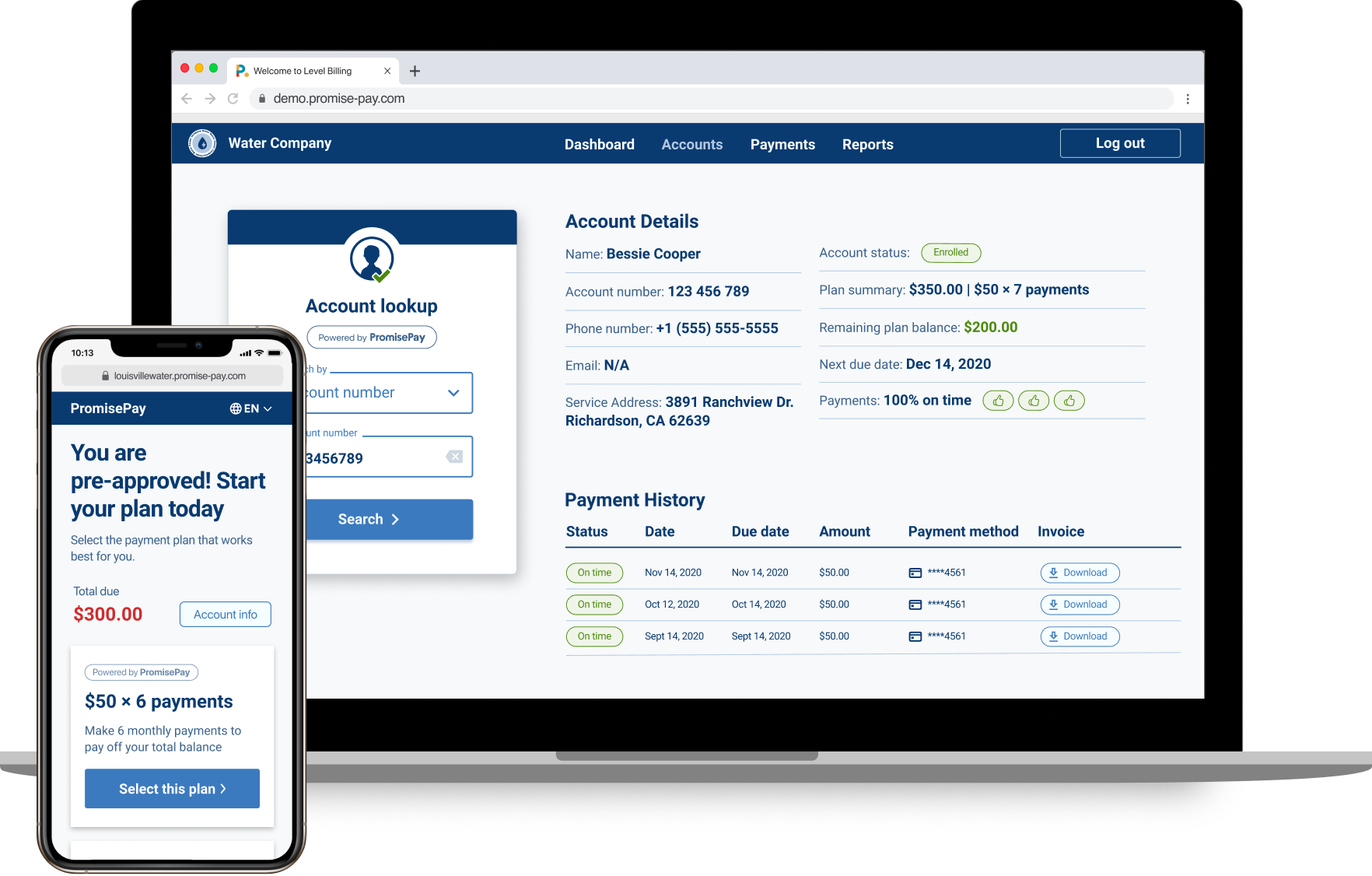
Promise acts as a sort of middleman, integrating lightly with the agency or utility, which in turn makes anyone owing money aware of the possibility of the different payment system. It’s similar to how you might see various payment options, including installments, when making a purchase at an online shop.

Mobile and computer screens showing payment interfaces with optiosn to pay over time.

Image Credits: Promise

The user enrolls in a payment plan (the service is mobile-friendly because that’s the only form of internet many people have) and Promise handles that end of it, with reminders, receipts and processing, passing on the money to the agency as it comes in — the company doesn’t cover the cost up front and collect on its own terms. Essentially it’s a bolt-on flexible payment mechanism that specializes in government agencies and other public-facing fee collectors.

Promise makes money by subscription fees (i.e. SaaS) and/or through transaction fees, whichever makes more sense for the given customer. As you might imagine, it makes more sense for a utility to pay a couple bucks to be more sure of collecting $500, than to take its chance on getting none of that $500, or having to resort to more heavy-handed and expensive debt collection methods.

Lest you think this is not a big problem (and consequently not a big market), Ellis-Lamkins noted a recent study from the California Water Boards showing there are 1.6 million people with a total of $1 billion in water debt in the state — one in eight households is in arrears to an average of $500.

Those numbers are likely worse than normal, given the immense financial pressure that the pandemic has placed on nearly all households — but like payment plans in other circumstances, households of many incomes and types find their own reason to take advantage of such systems. And pretty much anyone who’s had to deal with an obtusely designed utility payment site would welcome an alternative.

The new round brings the company’s total raised to over $30 million, counting $10 million it raised immediately after leaving Y Combinator in 2018. The funding comes from existing investors Kapor Capital, XYZ, Bronze, First Round, YC, Village, and others.

News: 3 strategies for elevating brand authority in 2021

Providing real value through content is an excellent way to build authority in the short and long term. The key is figuring out the best route for your investment.

Amanda Milligan
Contributor

Amanda Milligan is the marketing director at Fractl, a prominent growth marketing agency that’s helped Fortune 500 companies and boutique businesses alike earn quality media coverage, backlinks, awareness and authority.

A lot of clients come to us saying they want to be more respected in their space. They know their competitors are trusted and they want the same recognition, if not more.

This feels even more important now after the absolute disaster that was 2020. Consumers and clients alike just want to be able to count on brands and not stress over whether they’re making the right decision.

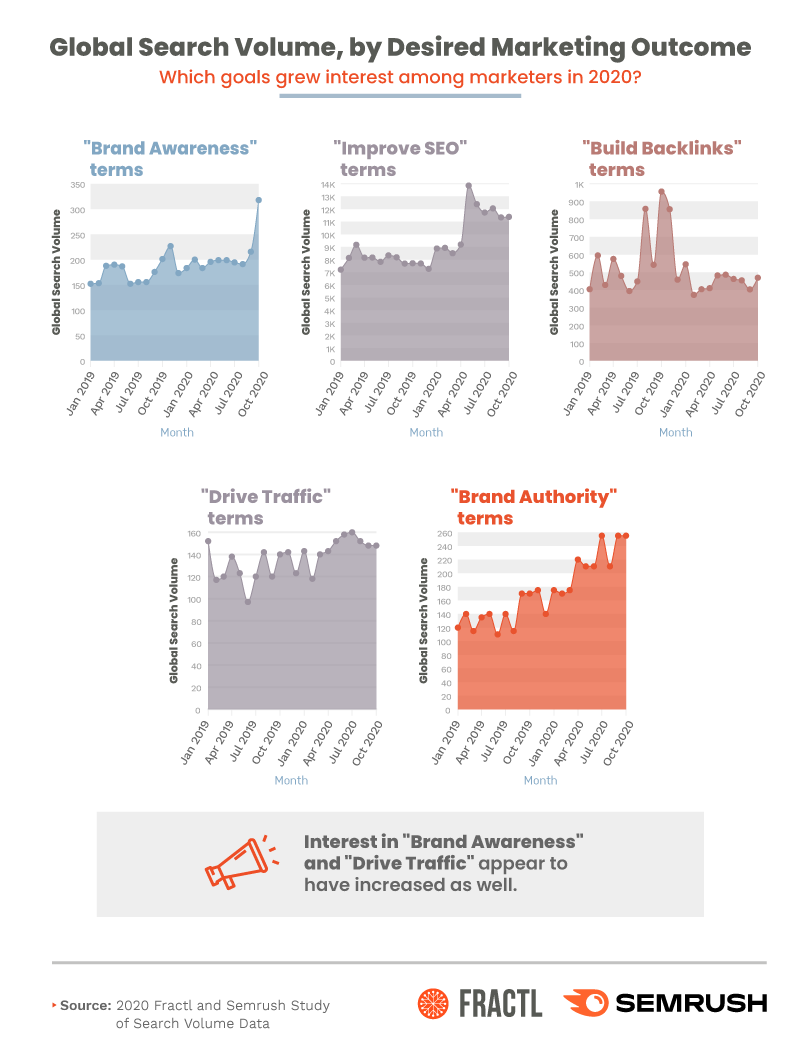
Marketers seem to know this. When we teamed up with Semrush to explore keyword search data in 2020 related to marketing goals, brand awareness and authority showed steady upward trends.

If you’re one of these marketers, I have some strategies you can use to improve your brand’s authority this year. It can’t happen overnight, but you can start implementing these strategies now to see results over time.

I have some strategies you can use to improve your brand’s authority this year.

Strategy #1: Get media coverage

Media coverage can build the authority of your brand in a few ways.

For one, it’s hard for people to trust you if they don’t know you exist. Of course, you can pay for ads or kill it on social to get your name out there, but media coverage has other benefits, as well.

When reputable publications and websites reference your brand and link to your site, they’re sending a signal that they trust what you have to say. It’s third-party confirmation that you know what you’re talking about and/or have something to offer.

For example, for our client Stoneside, we surveyed folks to see how many purchased and cared for houseplants in 2020.

The report got coverage on TreeHugger and Simplemost, but it also served as great context for other articles, like HelloGiggles and The Weather Network.

hello giggles article headere

Image Credits: Fractl

having a houseplant article screenshot

Image Credits: Fractl

weather network screen shoit

Image Credits: Fractl

Of course, getting media coverage isn’t easy. You need newsworthy content or an expert opinion to contribute, and you need to know how to pitch it to writers.

Small budget options

Are there industry blogs you can write a guest post for? Are there peers in your industry who are looking for quotes for their content? Start building connections with other industry experts. Cite their work in your content and build a rapport.

For example, I sometimes work with marketing tool brands like Semrush and BuzzSumo because those brands align well with Fractl, as we all work in the same industry.

You can also sign up for HARO, in which journalists post requests to speak to particular types of experts. However, it’s not often you’ll see relevant requests, and even then it’s a toss up whether they’ll reach out to you specifically.

Larger budget options

If you can afford it, a combination of content marketing and digital PR is the way to go. If you have resources internally — marketing folks who are savvy with data analysis and content creation — you can start by seeing if you have any internal data that would be interesting to a wider audience.

News: Meet the Female Founders Alliance startups from TC Include at TC Sessions: Justice 2021

We’re less than two weeks away from TC Sessions: Justice 2021, a day-long deep dive into the state of diversity, inclusion and equity in tech. March 3 is your opportunity to hear from and engage with the people who, through entrepreneurship, venture capital, labor organizing and advocacy, are both using and challenging tech to disrupt

We’re less than two weeks away from TC Sessions: Justice 2021, a day-long deep dive into the state of diversity, inclusion and equity in tech. March 3 is your opportunity to hear from and engage with the people who, through entrepreneurship, venture capital, labor organizing and advocacy, are both using and challenging tech to disrupt the status quo for the betterment of all.

This programming-packed day features presentations, breakout sessions and interactive Q&As with the leading movers, shakers and makers who are laser focused on, well, justice. Peruse the agenda and plan your day accordingly.

We’re stoked about showcasing the participating members of our TC Include Program. Do not miss meeting and connecting with these impressive early-stage founders, nominated by our partner founder organizations, Black Female Founders, Latinx Startup Alliance, Startout and the Female Founders Alliance.

TechCrunch, in collaboration with these organizations and VC firms like Kleiner Perkins, Salesforce Ventures and Initialized Capital, provide these young founders with educational resources and mentorship over the course of a year.

What’s more, the TC Include founders will take the virtual stage for a live pitch feedback session with a TechCrunch staffer during the conference. Tune in a get ready to take notes — the advice you hear could help you improve your pitch deck.

We already turned the spotlight on the startups nominated by Black Female Founders, and today we focus on these awesome, early-stage founders in the Female Founders Alliance cohort.

I-Ally: I-Ally is a community-driven app that saves millennial family caregivers time and enables informed decision-making by providing services that fulfill their unique needs. Founded by Lucinda Koza.

Proneer: Proneer is virtual try-on and size-recommendation software that helps reduce returns in apparel retail. Founded by Nicole Faraji.

Tribute: Tribute is the only mentorship platform that creates a continuous learning and development environment by connecting employees together for mentorship using the power of personal stories. Founded by Sarah Haggard.

Cirkled In: LinkedIn for Gen Z students, Cirkled is a 21st century online profile and portfolio platform connecting Gen Z with best-fit colleges, employers and endless win-win opportunities. Founded by Reetu Gupta.

Datacy: Datacy is a consumer to business insights data marketplace. We connect consumers and businesses to enable high-quality, ethical and transparent data exchange. Founded by Paroma Indilo.

We’ll be highlighting the cohorts from the Latinx Startup Alliance and Startout soon, so stay tuned!

TC Sessions: Justice 2021 takes place on March 3. Join this essential discussion, infuse justice into the DNA of your startup and make tech better for everyone. We can’t wait to get started.

News: Miami edtech startup Nearpod acquired by Renaissance

Nearpod, the Miami-based edtech company, is being acquired by Renaissance Holding Corp., a group that develops education technology. While Nearpod isn’t announcing the news until later this month, the information leaked to Yahoo! Finance yesterday, and a source inside the company confirmed the sale with TechCrunch this morning. The acquisition price, and further details, have

Nearpod, the Miami-based edtech company, is being acquired by Renaissance Holding Corp., a group that develops education technology. While Nearpod isn’t announcing the news until later this month, the information leaked to Yahoo! Finance yesterday, and a source inside the company confirmed the sale with TechCrunch this morning. The acquisition price, and further details, have yet to be disclosed.

Nearpod offers an edtech platform that K-12 teachers use in the classroom to create interactive slides filled with videos, quizzes, questions and other activities. Students can use any device to participate in the lessons in real-time; there is also a student-paced learning mode. In response to the pandemic, Nearpod now also offers remote learning, too.

It’s been a busy year for Nearpod. The company, which was founded in 2012 by three Argentinian entrepreneurs, is now led by Pep Carrera who was brought on in early 2020 just as the pandemic gained traction. The company has raised more than $30 million in venture capital according to Crunchbase, and we last profiled the startup in 2017 when it raised its Series B.

In a previous interview, Carrera told me “My first day on the job, I’m driving to the office [near Dania Beach] and talking to the management team on the phone, and we decided that we needed to close the office due to the pandemic. This was in March.” Nearpod currently employees about 250 employees, most of which are at their Dania Beach HQ.

While the pandemic has posed many questions around remote work, under the leadership of Carrera, Nearpod has seen explosive growth in 2020. While Nearpod was primarily designed to be used in the classroom, the team was able to turn it into a remote-learning platform, too, making it a forerunner in K-12 distance education.

Nearpod is used in all 50 states, and in more than 1,800 school districts. In 2020 alone, the company grew by about 50% with more than 1 million teachers using the product, and 2-3 million students online per day. In a December 2020 interview, Carrera told me that all the money being generated right now is being put back into the company to propel its growth, which has been organic. Nearpod spends very little ad dollars on marketing. The real marketing, he said, is by word of mouth.

A teacher uses Nearpod to deliver digital curriculum to students’ mobile devices, during class. Photo via Nearpod.

Prior to joining Nearpod, Carrera was president of ProQuest Books, where he led a team focused on providing innovative software that made the acquisition, management, and delivery of books to academic learners, researchers, and librarians efficient and impactful. And even prior to ProQuest, as president and COO, Carrera grew VitalSource Technologies, the digital learning division of Ingram Conte Group, serving more than 20 million learners per year globally, by 10x over his six years there.

M&A activity in edtech has accelerated as VCs have splurged funding into the space. As my colleague Natasha Mascarenhas wrote recently, edtech M&A is leading to mass consolidation in the space. Nearpod joins a number of other edtech companies like Symbolab and Woot Math that have exited in recent months.

News: Early bird pricing increases next week for TC Early Stage Operations & Fundraising

Just because there are no short cuts to startup success doesn’t mean you have to reinvent the wheel. At TechCrunch Early Stage 2021, a virtual bootcamp experience in two distinct parts, you’ll learn from leading experts across the startup spectrum — including prominent founders ready to share their personal experiences and hard-won advice to help

Just because there are no short cuts to startup success doesn’t mean you have to reinvent the wheel. At TechCrunch Early Stage 2021, a virtual bootcamp experience in two distinct parts, you’ll learn from leading experts across the startup spectrum — including prominent founders ready to share their personal experiences and hard-won advice to help you avoid costly missteps.

Early-bird pricing for passes to Early Stage part one (April 1-2) — or dual-event passes (Early Stage part 2 takes place July 8-9) — remains in effect for just one more week. Be a savvy shopper — save up to $250 — beat the deadline and buy your Early Stage passes by Feb 27 at 11:59 p.m. (PT).

While both Early Stage bootcamps focus on startups in the very early innings, each event will feature different topics, content and experts. You’ll learn or strengthen the core entrepreneurial skillsets every startup founder needs to master — legal issues, fundraising, marketing, growth, product-market fit, tech stack, recruiting, pitch deck teardowns and more.

What’s more, you’ll learn from the best of the best. Here are just two of the featured speakers ready to download serious knowledge in April. We’ll be adding even more (and posting the agenda) in the weeks to come.

Melissa L. Bradley: Co-founder of venture backed Ureeka (a community where small businesses gain unprecedented access to the expertise needed to grow their business), Melissa is also founder and Managing Partner of 1863 Ventures. A professor at Georgetown University, she teaches impact investing, social entrepreneurship, P2P economies and innovation.

Neal Sáles-Griffin: Managing Director of Techstars Chicago and a Venture Partner for MATH, Neal is an entrepreneur, investor and teacher. In 2011, he co-founded the first beginner-focused, in person coding bootcamp. He is active in non-profit and civic engagement across Chicago and in 2018 he ran for mayor. Neal has an undergraduate degree from Northwestern University, where he is an Adjunct Professor teaching entrepreneurship.

We love highlighting the best startups, and we’re devoting day two to that noble cause in the form of an Early Stage Pitch-Off! We’re looking for 10 founders who will pitch live on stage for five minutes followed by a five-minute Q&A with a panel of prominent VC judges. The top three founders pitch yet again to a new set of judges — and engage in a more intensive Q&A. Talk about awesome exposure!

Get the essential Pitch-off 411 here (like who qualifies and what the winner receives). Whatever you do, apply here before the deadline: February 21 at 11:59 p.m.

Don’t grind your gears reinventing the wheel. Join us at TechCrunch Early Stage 2021 on April 1-2. You have just one week left to score the best possible price. Buy your early bird pass before the deal ends on Feb 27 at 11:59 p.m. (PT).

Is your company interested in sponsoring or exhibiting at Early Stage 2021 — Operations & Fundraising? Contact our sponsorship sales team by filling out this form.

News: Fintech companies must balance the pursuit of profit against ethical data usage

Big Tech has written the playbook for what not to do with our data, while also laying a framework for how to build exceptional experiences.

Richard Steggall
Contributor

Australia native Richard Steggall is the CEO of Urban FT, a New York-based fintech company. He has more than two decades of experience in fintech, capital growth, mergers & acquisitions and strategic IPO advisory.

Financial institutions are falling behind the tech curve in delivering on the convenience consumers demand, leaving the door wide open for Big Tech companies like Apple, Amazon and Google to become our bankers. In November, Google redesigned its contactless payments service Google Pay, merging the services of traditional banks with the seamless, convenient experience users expect from the likes of Big Tech.

But there’s a catch.

Despite the elaborate smoke and mirrors that Google has put up, one fact remains: Google is an advertising company with ads representing 71% of its revenue sources in 2019.

What happens when an advertising company now wants to be our bank?

One must ask: What happens when an advertising company — armed with the terabytes of data points it has harvested from our personal emails, location data, song preferences and shopping lists — now wants to be our bank? The answer is potentially unsettling, especially considering the extraordinary neglect Big Tech has shown for user privacy, as seen here. And here. And here.

As the marketplace is poked by yet another technocrat tentacle, this time in the heart of financial services, traditional banks that consumers and businesses once relied on find themselves at a crossroads. To retain market share, these institutions will need to continue investing in fintech so they can level up with convenience and personalization provided by new competitors while preserving trust and transparency.

Traditional banks miss the digital mark

Fintech holds the potential to fundamentally transform the financial services industry, enabling financial institutions (FIs) to operate more efficiently and deliver superb user experiences (UX).

But there’s a digital gap holding FIs back, especially small community banks and credit unions. Many have long struggled to compete with the deep pockets of national banks and the tech savvy of neo and challenger banks, like Varo and Monzo. After investing more than $1 trillion in new technology from 2016 through 2019, the majority of banks globally have yet to see any financial boost from digital transformation programs, according to Accenture.

Never before has this gap been more prevalent than amid the pandemic as customers migrated online en masse. In April 2020 alone, there was a 200% uptick in new mobile banking registrations and total mobile banking traffic jumped 85%, according to Fidelity National Information Services (FIS).

Data is the grand prize for Big Tech, not revenue from financial services

Naturally, Big Tech players have recognized the opportunity to foray into financial services and flex their innovation muscles, giving banks and credit unions a strenuous run for their money. Consumers looking to digitize their finances must heed caution before they break up with traditional banks and run into the arms of Big Tech.

It’s important to bear in mind that the venture into payments and financial services is multipronged for Big Tech players. For example, in-house payments capabilities would not just provide companies focused on retail and commerce an additional revenue stream; it promises them more power and control over the shopping process.

Regulations in the U.S. might restrain this invasion to an extent, or at least limit a company’s ability to directly profit. Because let’s face it: the Big Tech players certainly aren’t asking for the regulatory “baggage” that comes with a bank charter.

But tech companies don’t need to profit directly from offerings like payments and wealth management, so long as they can hoard data. Gleaning insights on users’ spending patterns offers companies significant ROI in the long term, informing them how a user spends their money, if they have a mortgage, what credit cards they have, who they bank with, who they transact with, etc.

Financial behavior also potentially includes highly personal purchases, such as medications, insurance policies and even engagement rings.

With this laser sharp view into consumers’ wallets, imagine how much more valuable and domineering Google’s advertising platform will become.

Banks must lead the charge in ethical data

When it comes to the digitization of financial services, the old adage “with great power comes great responsibility” rings true.

Customer data is an incredible tool, allowing banks to cater to all consumers wherever they fall on the financial spectrum. For example, by analyzing a customers’ spending habits, a bank can offer tailored solutions that help them save, invest or spend money more wisely.

However, what if being a customer of these services means you’re then inundated with ads that respond directly to your searches and purchases? Or, even more insidiously, what if your bank now knows you so well that they can create a persona for you and proactively predict your needs and desires before even you can? That’s what the future looks like if you’re a customer of the Bank of Google.

It’s not enough to use customer data to refine product offerings. It must be done in a way that ensures security and privacy. By using data to personalize services, rather than bolster revenue behind the scenes, banks can distinguish a deeper understanding of consumer needs and gain trust.

Trust could become the weapon that banks use to defend their throne, especially as consumers become more aware of how their data is being used and they rebel against it. A Ponemon study on privacy and security found that 86% of adults said they are “very concerned” about how Facebook and Google use their personal information.

In an environment where data collection is necessary but contentious, the main competitive advantage for banks lies in trust and transparency. A report from nCipher Security found that consumers still overwhelmingly trust banks with their personal information more than they do other industries. At the same time, trust is waning for technology, with 36% of consumers reportedly less comfortable sharing information now than a year ago, according to PwC.

Banks are in a prime position to lead the charge on ethical data strategy and the deployment of artificial intelligence (AI) technologies, while still delivering what consumers need. Doing so will give them a leg up on collecting data over Big Tech in the long term.

Looking toward a customer-centric, win-win future

The financial services industry has reached a pivotal crossroads, with consumers being given the choice to leave traditional banks and hand over their personal data to Big Tech conglomerates so they can enjoy digital experiences, greater convenience and personalization.

But banks can still win back consumers if they take a customer-centric approach to digitization.

While Big Tech collects consumer data to support their advertising revenue, banks can win the hearts of consumers by collecting data to drive personalization and superior UXs. This is especially true for local community banks and credit unions, as their high-touch approach to services has always been their core differentiator. By delivering personalized interactions while ensuring the data collection is secure and transparent, banks can regain market share and win the hearts of customers again.

Big Tech has written the playbook for what not to do with our data, while also laying the framework for how to build exceptional experiences. Even if a bank lacks the technology expertise or the deep-pocket funding of Facebook, Google or Apple, it can partner with responsible fintechs that understand the delicate balance between ethical data usage and superior UXs.

When done right, everybody wins.

News: Marlon Nichols will discuss how to secure seed funding at TechCrunch Early Stage 2021

We’re excited to announce another terrific panel for our stacked TechCrunch Early Stage event on April 1 & 2. Marlon Nichols will be joining us to discuss securing seed funding. Nichols is intimately acquainted with the topic — as a founding managing partner of MaC Venture Capital (nee Cross Culture Ventures), he has been involved

We’re excited to announce another terrific panel for our stacked TechCrunch Early Stage event on April 1 & 2. Marlon Nichols will be joining us to discuss securing seed funding.

Nichols is intimately acquainted with the topic — as a founding managing partner of MaC Venture Capital (nee Cross Culture Ventures), he has been involved in helping more than 100 early-stage startups receive seed funding. Previously, Nichols served as a Kauffman Fellow and Investment Director at Intel Capital, focusing on media and entertainment.

He has had a hand in a number of high-profile investments, including Gimlet Media, MongoDB, Thrive Market, PlayVS, Fair, LISNR, Mayvenn, Blavity and Wonderschool. His accolades include the MVMT50 SXSW 2018 Innovator of the Year and Digital Diversity’s Innovation & Inclusion Change Agent awards.

He will be discussing ways to get on investors’ radar and how to raise that early round. Per the panel description:

Right now, there is more seed-stage fundraising than ever before, and Marlon will speak on how to get noticed by investors, how to grow your business and how to survive in the crowded, competitive space of tech startups. He will provide insights on how to network, craft a great pitch and target the best investors for your success.

The panel is part of the two days of events that explore seed and Series A fundraising, recruiting and more for early-stage startups at TC Early Stage – Operations and Fundraising on April 1 & 2. Grab your ticket now before prices increase next week!

News: Pfizer-BioNTech’s COVID-19 vaccine just got a lot easier to transport and distribute

The COVID-19 vaccine developed by Pfizer and BioNTech now has less stringent and extreme transportation requirements than it debuted with. Originally, the mRNA-based vaccine had to be maintained at ultra-low temperatures throughout the transportation chain in order to remain viable – between -76°F and -112°F. New stability data collected by Pfizer and BioNTech, which has

The COVID-19 vaccine developed by Pfizer and BioNTech now has less stringent and extreme transportation requirements than it debuted with. Originally, the mRNA-based vaccine had to be maintained at ultra-low temperatures throughout the transportation chain in order to remain viable – between -76°F and -112°F. New stability data collected by Pfizer and BioNTech, which has been submitted to the U.S. Food and Drug Administration (FDA) for review, allow it to be stored at temps between 5°F and -13°F – ranges available in standard medical freezers found in most clinics and care facilities.

The vaccine should remain stable for up to two weeks at that temperature, which vastly improves the flexibility of its options for transportation, and last-mile storage in preparation for administration to patients. To date, the vaccine has relied largely on existing “cold-chain” infrastructure to be in place in order for it to be able to reach the areas where it’s being used to inoculate patients. That limitation hasn’t been in place for Moderna’s vaccine, which is stable at even higher, standard refrigerator temperatures for up to a month.

This development is just one example of how work continues on the vaccines that are already being deployed under emergency approvals by health regulators across the U.S. and elsewhere in the world. Pfizer and BioNTech say they’re working on bringing those storage temp requirements down even further, so they could potentially approach the standard set by the Moderna jab.

Taken together with another fresh development, study results from Israeli researchers that found just one shot of the ordinarily two-shot Pfizer-BioNTech vaccine could be as high as 85 percent effective on its own, this is a major development for global inoculation programs. The new requirements open up participation to a whole host of potential new players in supporting delivery and distribution – including ride-hailing and on-demand delivery players with large networks like Amazon, which has offered the President Biden’s administration its support, and Uber, which is already teamed up with Moderna on vaccine education programs.

This also opens the door for participation from a range of startups and smaller companies in both the logistics and the care delivery space that don’t have the scale or the specialized equipment to be able to offer extreme ‘cold-chain’ storage. Technical barriers have been a blocker for some who have been looking for ways to assist, but lacked the necessary hardware and expertise to do so effectively.

News: 10 investors predict MaaS, on-demand delivery and EVs will dominate mobility’s post-pandemic future

“Transportation is important to basically all people and is a real mess, so it will likely continue to be a hot topic and a source of investor interest for years to come.”

The COVID-19 pandemic didn’t just upend the transportation industry. It laid bare its weaknesses, and conversely, uncovered potential opportunities.

Electric bikes sales spiked as public transit ridership evaporated. The public, and investors, began to recognize the utility of autonomous sidewalk delivery bots, which had once been viewed as mere novelties; the rising popularity of on-demand delivery prompted major retailers like Walmart to put more resources towards meeting consumers needs and was one of the driving forces behind Uber’s decision to dump nearly every business unit and acquire Postmates.

The upshot? The transformation isn’t over. Following up on our May of 2020 survey of the sector and about the impact of COVID-19 in particular, TechCrunch spoke with 10 investors about the state of mobility, which trends they’re most excited about and what they’re looking for in their next investments. They see opportunities within software, particularly around mobility-as-a-service ventures and fleet management, continued demand for delivery and the push for electrification and batteries as well as the financial instrument — SPACs — that so many startups turned to in 2020. But there’s a lot more; they even see tailwinds for eVTOLs.

Here’s who we interviewed:


Clara Brenner, co-founder and managing partner, Urban Innovation Fund

COVID-19 disrupted virtually every sector of the transportation industry. E-bike demand spiked, shared scooters initially struggled with some rebounding, ridership dwindled in ride-hailing and plummeted in public transit as consumers turned to cars and other alternatives. Meanwhile, demand for delivery skyrocketed and the autonomous vehicle industry went through a consolidation. What sectors will recover in 2021 and where are the new and unlikely opportunities to invest?

COVID has exposed how rickety, insolvent and inequitable transit is in the U.S. Tools that empower cities to get compensated for private enterprise monetizing public infrastructure, and that ensure more equitable mobility access are exciting to me. Companies like Ride Report that help cities wrap their arms around all of the various public and private transit happening on their streets are exciting to me.

What are the remaining opportunities for new startups, now that the autonomous vehicle industry is maturing with unprecedented consolidation, billion-dollar funding rounds and even a few low-volume commercial operations kicking off?

Autonomous vehicles still have a long way to go, and there is still lots of room for new startups to make their mark on this space. In particular, we’ve been interested to see new entrants working on software tools to facilitate regulation and parking.

What are the overlooked areas that you want to invest in, now that legacy automakers are shifting their portfolios to electric and new EV manufacturers are preparing to start production?

We are very interested in the emerging fleet management space — and this is reflected in a number of our recent investments, including Electriphi (software to help fleets transition to electric) and Kyte (activating underutilized fleets to deliver a magical car rental experience). There are so many efficiencies that come from the fleet model for transportation — we think this will be an increasingly important area in the coming years.

What is the fundraising model of success for transportation startups of the future? Do you expect early-stage funding in this sector to stay hot indefinitely? Do you see SPACs as the path to liquidity long term for a large number of startups in this sector?

Transportation is important to basically all people and is a real mess, so it will likely continue to be a hot topic and a source of investor interest for years to come. However, for capital intensive transportation companies, the rounds have gotten so huge and expensive that they often make little sense for early-stage funders to participate in (they get diluted down hugely). Not that this seems to be dissuading many investors at the moment.

At the Urban Innovation Fund, we are spending a lot of time looking at software tools that enable larger hardware systems to work more efficiently. In terms of longer-term liquidity, SPACs represent a good option for many companies. That said, consolidation/mergers seems the most logical outcome for most companies in the transportation space — where strategic partnerships and integrations represent critical competitive advantages.

What do you want to see from the Biden administration to accelerate innovation in the transportation sector?

I’d like to see the Biden administration invest in our urban public transit systems — we know those systems can work beautifully. This may not accelerate “innovation,” but it will accelerate progress. This is a fundamental confusion in the VC space — innovation does not always equal progress.

Shawn Carolan, partner, Menlo Ventures

COVID-19 disrupted virtually every sector of the transportation industry. E-bike demand spiked, shared scooters initially struggled with some rebounding, ridership dwindled in ride-hailing and plummeted in public transit as consumers turned to cars and other alternatives. Meanwhile, demand for delivery skyrocketed, and the autonomous vehicle industry went through consolidation. What sectors will recover in 2021, and where are the new and unlikely opportunities to invest?

Pretty much all aspects of transportation will show recovery in 2021 with the population’s strong desire to get closer to normal, daily infections dropping, better mask compliance and increased vaccinations. The slowest will be commute-to-work use cases where the “new normal” for many will be 50%-100% fewer trips to the office on a monthly basis.

Personal above shared movement: The psychological aftermath of the pandemic will persist for some time; people do and will continue to prefer more distance from others. This will lead to an acceleration of personal e-mobility solutions, both outright purchase and subscription models, including scooters and e-bikes (Unagi, where we are investors), asset-sharing models where riders aren’t in close proximity to strangers (GetAround, Turo, Lime, Bird), and single-ridership Ubers and Lyfts over UberPools and the like.

E-commerce supply chain: E-commerce has experienced a step-function in demand that will persist. Many shippers, trucking companies, manufacturers, distributors, etc., are still poorly connected, inefficient, and managed with paper and manual labor. The entire supply chain is ripe for Amazon-like efficiency and clarity; this will be driven by factory/warehouse level automation, robotics, best-of-breed fulfillment, and logistics software like our investments in Alloy, Fox Robotics and ShipBob.

Local delivery: Instacart, DoorDash, UberEats, etc. have brought local delivery mainstream. This trend will continue, and the larger incumbents will be working hard to get their act together for streamlining fulfillment rather than let the delivery fleets capture all of the upsides. Here companies like AnyCart that streamline ordering for grocery and recipes can partner versus compete with large grocery chains to deliver a compelling user experience and more reasonable prices.

What are the remaining opportunities for new startups, now that the autonomous vehicle industry is maturing with unprecedented consolidation, billion-dollar funding rounds and even a few low-volume commercial operations kicking off?

Until there is a teleporter, opportunities will always exist to make transportation better, faster and cheaper for a given distance. The big levers coming are:

Electric propulsion (on ground and air) yields a much lower cost per mile with lower opex motors and lower cost of recharge versus burning fuel. Opportunities exist here mostly for component companies making better batteries, motors and quiet propellers.

Better asset utilization: More efficient routing of vehicles (via routing software), higher capacity utilization (via more efficient marketplaces), and less downtime (through better scheduling and optimization algorithms) bring prices down.

Autonomy: Drivers are a big part of both the cost structure of transportation and also accidents. Human-level autonomy is still several years off, but we see lots of opportunity for autonomy in constrained environments (vehicles moving in repetitive patterns with few obstacles) and through the air.

What are the overlooked areas that you want to invest in? Now that legacy automakers are shifting their portfolios to electric, and new EV manufacturers are preparing to start production, what are the overlooked areas that you want to invest in?

We believe there are many transportation options beyond the car. Electric scooters, bikes, eVTOLs and others will keep growing in popularity for both utility and fun.

What is the fundraising model of success for transportation startups of the future? Do you expect early-stage funding in this sector to stay hot indefinitely? Do you see SPACs as the path to liquidity long term for a large number of startups in this sector?

Transportation will be a perennial sector of opportunity given how large a piece of consumer spend it occupies. Till the late 2000s, Silicon Valley barely touched transportation; this has, of course, changed dramatically since that period, particularly with the rise of Tesla.

It’s often quite capital intensive, though. Proving solid unit economics at a small scale before scaling will become more of a mandate given the machinations in the shared scooter market and how it showed that rapid growth doesn’t solve all woes.

We’d love to see better debt financing for electric vehicle companies. With their much lower operating costs and the low-interest macro environments, we find ourselves in, if there were large pools of clean transportation debt capital that could get more vehicles in consumers’ lives via modest monthly fees that would go a long way in accelerating adoption. For example, Unagi all-access subscription offers a beautiful personal scooter for $30-$40 per month with great ROI given the usage patterns and reliability. If the debt markets line up to finance these at scale, it could be a nice win-win.

SPACs prove to be a good option for companies with high R&D costs and a long horizon to reach traditional IPO milestones (i.e., >$100 million ARR). Some of these projects aren’t going to work out, though and retail investors will be left holding the bag when the stocks crater. This will be the kickstarter “failed launch” phenomenon at a much larger scale, and there will be some nasty fallout.

Corporate venture capital, mainly industrial and automative focused companies, are getting more aggressive as the industry recognizes their need to adapt.

What do you want to see from the Biden administration to accelerate innovation in the transportation sector?

We’d love to see aggressive policies to further the acceleration of clean technology. Aside from the obvious environmental imperative to reduce carbon emissions, it makes good economic sense. Some examples would be personal and corporate tax credits for investing in anything that offers lower environmental impact. Electric vehicles of all sorts (scooters, bikes, cars, boats, etc.), installing solar for home and utility plants, using EVs for materials handling, etc.

Make the U.S. the testing ground for AVs by making regulation more favorable relative to competitors like Europe and China both on the ground and in the air.

Own the future of lithium-ion extraction and manufacturing. This is the “white oil” of our generation.

Aggressive funding of R&D initiatives at universities and commercial research labs that have a shot at changing the cost equations for batteries, motors, propellers, the power grid, etc. that can improve the fundamental building blocks.


News: A fraction of Robinhood’s users are driving its runaway growth

Borrowing a term from the casino trade, these whales generate the bulk of the company’s revenue stream.

Yesterday’s House Financial Services Committee hearing about GameStop and Robinhood wasn’t great. Reuters has a good summary of one its few interesting bits, a scrap between the elected inquisitors and Robinhood CEO Vlad Tenev regarding whether or not his firm had to raise additional capital to continue operations during the GameStop saga; TechCrunch has reported on the matter since its inception, though learning a little bit more was useful.

Lawmakers also managed to extract an interesting, if expected data point: the company generates more than half of its revenues from payment for order flow (PFOF), a controversial practice in which Robinhood is paid by market makers for executing customer trades.


The Exchange explores startups, markets and money. Read it every morning on Extra Crunch, or get The Exchange newsletter every Saturday.


Those skeptical of PFOF contend that the setup effectively transforms users of neotrading services that monetize their order volume into the product being sold, leaving retail investors susceptible to poor trade execution pricing. Robinhood has gotten into trouble regarding trade pricing in the past. But those in who don’t find PFOF to be an inherent issue contend that it allows for low-cost consumer access to the equities markets. That’s fair enough.

Regardless of where you land between — or even on — those two poles is immaterial. PFOF doesn’t appear to be in material danger of being regulated out of existence, and Robinhood’s use of the business model allowed it to generate huge growth in 2020. For perspective, Robinhood’s PFOF revenues rose from a little over $90 million in Q1 2020 to around $220 million in Q4.

How many users did it take to generate those PFOF sums? Tenev also told Congress in his written testimony that Robinhood has more than 13 million “customers,” though we lack clarity on precisely who counts as customer. But those millions do not monetize equally. Some of those 13 million users are more lucrative than others.

To understand that, let’s start with working to learn what fraction of Robinhood users trade options. Here’s Tenev, via his testimony:

[A]s of the end of 2020, about 13 percent of Robinhood customers traded basic options contracts (e.g., puts and calls), and only about two percent traded multi-leg options. Less than three percent of funded accounts were margin-enabled.

This, combined with the fact that Tenev allowed that PFOF incomes comprise the majority of its revenue, comes to an interesting conclusion: A somewhat small fraction of Robinhood’s users are responsible for the vast bulk of its incomes. We can tell that that is the case by recalling that when we examine PFOF data, Robinhood’s revenues from trades in S&P 500 stocks are modest, its incomes from trades involving non-S&P 500 stocks a bit larger, and its incomes from options’ order flow comprised the majority of the revenue reported in recent periods.

For example, in the months of October, November, and December, TechCrunch calculates that Robinhood’s PFOF revenues were around 67%, 64%, and 63% options-derived, respectively.

For reference, 13% of 13 million is 1.69 million. That’s the number of Robinhood users we estimate have traded options. The multi-leg options number is a far smaller 260,000 users.

WordPress Image Lightbox Plugin