Tag Archives: Blog

News: ErudiFi raises $5 million Series A to give students in Southeast Asia more education financing options

Based in Singapore, ErudiFi wants to help more students in Southeast Asia stay in school by giving them affordable financing options. The startup announced today it has raised a $5 million Series A, co-led by Monk’s Hill Ventures and Qualgro. ErudiFi currently works with more than 50 universities and vocational schools in Indonesia and the

Based in Singapore, ErudiFi wants to help more students in Southeast Asia stay in school by giving them affordable financing options. The startup announced today it has raised a $5 million Series A, co-led by Monk’s Hill Ventures and Qualgro.

ErudiFi currently works with more than 50 universities and vocational schools in Indonesia and the Philippines. Co-founder and chief executive officer Naga Tan told TechCrunch that students in those countries have limited financing options, and often rely on friends or family, or informal payday lenders that charge high interest rates.

To provide more accessible financing options, ErudiFi partners with accredited universities and schools to offer subsidized installment plans, using tech to scale up while keeping costs down. Interest rates and repayment terms vary between institutions, but can be as low as 0%, with loans payable in 12 to 24 months.

By providing their students with affordable financing plans, ErudiFi can increase retention rates at schools, helping them keep students who would otherwise be forced to drop out because of financial issues.

Tan said ErudiFi’s value proposition for educational institutions is “being able to offer a data-driven financing solution that helps with student recruitment and retention. Students also greatly benefit because our product is one of the few, if not the only, affordable financing option they have access to.”

In a press statement, Peng T. Ong, co-founder and managing partner of Monk’s Hill Ventures, said, “Access to affordable tertiary education remains a huge pain point in Southeast Asia where the cost is nearly double then the average GDP per capita. ErudiFi is tackling an underserved market that is plagued with high-interest rates by traditional financial institutions and limited reach from peer-to-peer lending companies.”

ErudiFi’s Series A will be used on hiring for its product and engineering teams and to expand in Indonesia and the Philippines.

News: 2150 launches with $281M fund to reduce the carbon footprint of the world’s growing cities

A new VC fund, “2150“, is launching with the first close of a €200m ($281m) fund which will back technologies aimed largely at reducing the carbon footprint of cities. For example, startups that inject carbon into concrete, or monitor the energy of buildings. The final close is anticipated by mid-2021. The advisory board for 2150 comprises the former chief sustainability officer

A new VC fund, “2150“, is launching with the first close of a €200m ($281m) fund which will back technologies aimed largely at reducing the carbon footprint of cities. For example, startups that inject carbon into concrete, or monitor the energy of buildings. The final close is anticipated by mid-2021.

The advisory board for 2150 comprises the former chief sustainability officer in the Obama administration and renowned urbanist and academic, Richard Florida. 2150 is based around the idea that half of the world’s population lives in cities, and this will increase to two-thirds by 2050, creating a growing environmental impact that the world can ill-afford, given the climate crisis.

Based across London, Copenhagen and Berlin, the fund’s Limited Partners include a mix of institutional capital and family offices including Chr. Augustinus Fabrikker, Denmark’s Green Future Fund and Novo Holdings. 2150 says it has other LP partners who are building or managing “over 16 million square meters of real estate”, who will come in handy, kicking the tires on the efficacy of 2150 investments.  The anchor funding has come from NREP, a sustainable real estate fund manager with a large Northern European footprint and platform.

The founding partners include Mikkel Bülow-Lehnsby, Chairman and co-founder of large real estate logistics company NREP; Jacob Bro, former Chief Product Officer at Rocket Internet; Christian Jølck, the founder and former Chairman of industry climate advocacy group SYNERGI; Christian Hernandez, former Facebook executive and VC; Nicole LeBlanc, formerly with Alphabet’s urban product incubator Sidewalk Labs; Rahul Parekh, founder of VC-backed foodtech startup EatFirst and former executive director at Goldman Sachs; and Alexandra Perez, who incubated and launched urban tech startups at Tech City Ventures.

2150 will focus on startups that can make cities more resilient, efficient and sustainable, investing in tech associated with the urban environment, materials, automation, and sensor-based monitoring to improve the health, safety, and productivity of building occupants. It says it will only invest where sustainability impact can be measured, aiming for a first portfolio of around 20 companies. Ticket sizes will be €4-5m series A for startups, but it will also invest in existing companies that want to expand.

Its first investment is in CarbonCure Technologies – a Canadian company lowering the CO2 footprint of concrete – in which 2150 participated in a funding round for last year, investing alongside Amazon’s Climate Pledge Fund, Bill Gates-backed Breakthrough Energy Ventures, and Microsoft’s Climate Innovation Fund. At present, concrete accounts for 8% of all global CO2 emissions

Speaking to TechCrunch, Hernandez said 2150 was particularly interested in what’s coming to be known as “ESG Analytics” or “Carbon Accounting”. In other words, platforms that can analyze the impact of developments for an ESG and CO2 perspective.

The other background data which inspired the creation of the fund includes the fact that two billion new homes will need to be built over the next 80 years
; cities consume over two-thirds of the world’s energy and account for more than 70% of global CO2 emissions; 13% of global GDP is spent on construction, but the industry is slow to adopt new technology; and the UN has said ground-breaking innovation is needed in cities, where the battle for sustainable development will be “won or lost”.

Mikkel Bülow-Lehnsby, Partner at 2150 and Chairman and co-founder of NREP, said: “With NREP we have been on a 15-year mission of making real estate and cities more efficient, customer-centric and sustainable. With 2150 we are leveraging all of NREP’s learnings and ambitions and partnering with our industry peers to identify and accelerate technology that can help us support our purpose of making real estate better. I am convinced that 2150’s mission-aligned team will play an important role in designing a future in which the convergence of entrepreneurship, technology and sustainability will reverse the built environment’s negative impact on the planet.”

Christian Hernandez, Partner at 2150, said: “Cities are complex living systems that are constantly expanding, evolving and adapting, with half the world’s population now living in urban environments and rising. Cities, while vehicles for the betterment of humanity, currently emit 70% of the world’s greenhouse gases and generate the vast majority of the planet’s waste. We see a huge opportunity to make a serious impact on the way cities are developed and the way our citizens live, work and are cared for by completely reimagining and reshaping the urban environment for good.”

The advisory board for 2150 includes technologists, scientists and designers including well-known architect, Bjarke Ingels, the Director of Princeton’s Andlinger Center for Energy and the Environment; Dr. Lynn Loo, Unity’s head of AI; Danny Lange, the former Chief Sustainability Officer in the Obama Administration; Christine Harada, the founder of sustainable developer EDGE Technologies; and Coen van Oostrom.

News: Rows, formerly dashdash, raises $16M to build and populate web apps using only spreadsheet skills

Spreadsheet software — led by products like Microsoft’s Excel, Google’s Sheets and Apple’s Numbers — continues to be one of the most-used categories of business apps, with Excel alone clocking up more than a billion users just on its Android version. Now, a startup called Rows that’s built on that ubiquity, with a low-code platform

Spreadsheet software — led by products like Microsoft’s Excel, Google’s Sheets and Apple’s Numbers — continues to be one of the most-used categories of business apps, with Excel alone clocking up more than a billion users just on its Android version. Now, a startup called Rows that’s built on that ubiquity, with a low-code platform that lets people populate and analyze web apps using just spreadsheet interfaces, is announcing funding and launching a freemium open beta of its expanded service.

The Berlin-based startup — which rebranded from dashdash at the end of last year — closed a Series B round of $16 million, money that it is using to continue investing in its platform as well as in sales and marketing.

The round was led by Lakestar, with past investors Accel (which led its $8 million Series A in 2018) and Cherry Ventures also participating. Christian Reber has also invested in this round. Reber knows a thing or two about software disrupting legacy products — he is the co-founder and CEO of presentation software startup Pitch and the former CEO and founder of Microsoft-acquired Wunderlist — and notably he is joining Rows’ Advisory Board along with the investment.

A little detail about this Series B: CEO Humberto Ayres Pereira tells us that the round actually was quietly closed over a year ago, in January 2020 — just ahead of the world shutting down amid the Covid-19 pandemic. The startup chose to announce that round today to coincide with adding more features to its product and moving it into an open beta, he said.

That open beta is free in its most basic form — free is limited to 10 users or less and a minimal amount of integration usage. Paid tiers, which cover more team members and up to 100,000 integration tasks (which are measured by how many times a spreadsheet queries another service), start at $59 per month.

One strong sign of interest in this latest iteration of the software will be in the lasting popularity of spreadsheets. Another is Rows’ traction to date: in invite-only mode, it picked up 10,000 users, and hundreds of companies, as customers.

No-code and low-code software, which let people create and work with apps and other digital content without delving deep into the lines of code that underpin them, have continued to pick up traction in the market in the last several years.

The reason for this is straightforward: non-technical employees may not code, but they are getting increasingly adept at understanding how services function and what can be achieved within an app.

No-code and low-code platforms let them get more hands-on when it comes to customizing and creating the services that they need to use everyday to get their work done, without the time and effort it might take to get an engineer involved.

“People want to create their own tools,” said Ayres Pereira. “They want to understand and test and iterate.” He said that the majority of Rows’ users so far are based out of North America, and typical use cases include marketing and sales teams, as well as companies using Rows spreadsheets as a dynamic interface to manage logistics and other operations.

Stephen Nundy, the partner at Lakestar who led its investment, describes the army of users taking up no-code tools as “citizen developers.” 

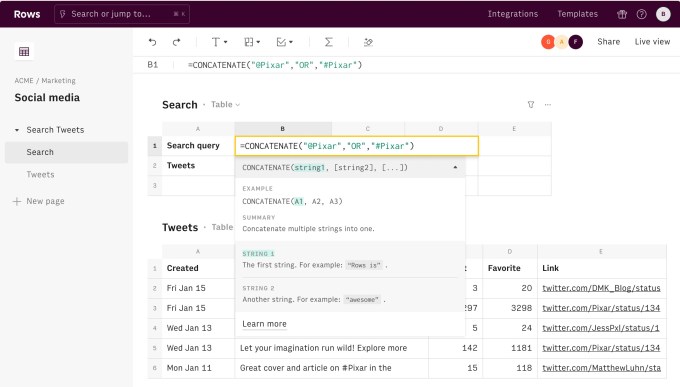
Rows is precisely the kind of platform that plays into the low-code trend. For people who are already au fait with the kinds of tools that you find in spreadsheets — and something like Excel has hundreds of functions in it — it presents a way of leaning on those familiar functions to trigger integrations with other apps, and to subsequently use a spreadsheet created in Rows to both analyse data from other apps, as well as update them.

You might ask, why is it more useful, for example, to look at content from Twitter in Rows rather than Twitter itself? A Rows document might let a person search for a set of Tweets using a certain chain of keywords, and then organise those results based on parameters such as how many “likes” those Tweets received.

Or users responding to a call to action for a promotion on Instagram might then be cross referenced with a company’s existing database of customers, to analyze how those respondents overlap or present new leads.

There have been a number of other startups building tools that are providing similar no- and low-code approaches. Gyana is focusing more on data science, Tray.io provides a graphical interface to integrate how apps work together, Zapier and Notion also provide simple interfaces to integrate apps and APIs together, and Airtable has its own take on reinventing the spreadsheet interface. For now, Ayres Pereira sees these more as compatriots than competitors.

“Yes, we overlap with services like Zapier and Notion,” he said. “But I’d say we are friends. We’re all raising awareness about people being able to do more and not having to be stuck using old tools. It’s not a zero sum game for us.”

When we covered Rows’s Series A two years ago, the startup had built a platform to let people who are comfortable working with data in spreadsheets to use that interface to create and populate content in web apps. It had a lot of extensibility, but mainly geared at people still willing to do the work to create those links.

Two years on, while the spreadsheet has remained the anchor, the platform has grown. Ayres Pereira, who co-founded the company with Torben Schulz (both pictured above), said that there are some 50 new integrations now, including ways to analyse and update content on social media platforms like Instagram, YouTube, CrunchBase, Salesforce, Slack, LinkedIn and Twitter, as well as some 200 new features in the platform itself.

It also has a number of templates available for people to guide them through simple tasks, such as looking up LinkedIn profiles or emails for a list of people; tracking social media counts and so on.

One of the most common details of spreadsheets, however, has yet to be built. The interface is still banked around rows and columns, with no graphical tools to visualize data in different ways such as pie charts or graphs as you might have in a typical spreadsheet program.

It’s for this reason that Rows has yet to exit beta. The feature is one requested a lot, Pereira said, describing it as “the final frontier.” When Rows is ready to ship with that functionality, likely by Q3 of this year, it will tick over to general “1.0” release, he added.

“Humberto and Torben have really impressed us with their ambition to disrupt the market with a new spreadsheet paradigm that tackles the significant shortcomings of today’s solutions,” said Nundy at Lakestar. “Data integrations are native, the collaboration experience is first class and the ability to share and publish your work as an application is unique and will create more ‘Citizen developers’ to emerge. This is essential to the growing needs of today’s technology literate workforce. The level of interest they’ve received in their private beta is proof of the desirability of platforms like Rows, and we’re excited to be supporting them through their public beta launch and beyond with this investment.” Nundy is also joining Rows’ board with this round.

News: Katana raises $11M Series A to be the SaaS powering ‘manufacturing entrepreneurs’

Katana, an Estonian startup that has built manufacturing-specific enterprise resource planning (ERP) software for SMBs, has raised $11 million in Series A funding. Leading the round is European venture capital firm Atomico, with participation from angel investors Ott Kaukver (Checkout.com CTO), Sten Tamkivi (CPO Topia, formerly Skype), Sergei Anikin (CTO, Pipedrive) and Kairi Pauskar (former

Katana, an Estonian startup that has built manufacturing-specific enterprise resource planning (ERP) software for SMBs, has raised $11 million in Series A funding.

Leading the round is European venture capital firm Atomico, with participation from angel investors Ott Kaukver (Checkout.com CTO), Sten Tamkivi (CPO Topia, formerly Skype), Sergei Anikin (CTO, Pipedrive) and Kairi Pauskar (former TransferWise HR Architect). Previous backer 42Cap also followed on, bringing the total investment raised by the company to date to $16 million.

Founded in 2017 by Kristjan Vilosius (CEO), Priit Kaasik (engineering lead) and Hannes Kert (CCO), Katana positions itself as the “entrepreneur manufacturer’s secret weapon” with a plug-and-play ERP for small to medium-sized manufacturers. The idea is to wean companies off existing antiquated tools such as spreadsheets and legacy software to manage inventory and production. The startup is also playing into macro trends, such as the advent of online marketplaces and D2C e-commerce, that are resulting in an explosion of independent makers, spanning cosmetics to home décor, electronics to apparel, and food and beverages.

“We are seeing a global renaissance of small manufacturing driven by the rise of e-commerce tools and consumer demand for bespoke products produced locally,” says Vilosius. “Just walk around any big city from London to San Francisco, and you’ll see workshops all around you. Someone’s making organic cosmetics here; over there, someone is making electric bikes. These companies are run by passionate entrepreneurs selling through traditional channels, but also selling through direct-to-consumer channels, e-commerce stores and marketplaces, etc. This is a massive boom of makers wanting to create products and sell them globally, and it is not a trend that will disappear tomorrow”.

The problem, however, is that small and medium-sized manufacturers don’t have the right software to support workflows necessary to sell through multiple channels — and this is where Katana comes in. The plug-and-play software claims a superior UX designed specifically to power boutique manufacturing, including functionality supporting the workflows of modern manufacturers, i.e. inventory control and optimization, and purchasing materials, managing bill-of-materials, tracking costs and more. It also offers an API and integrations with popular e-commerce sales channels and accounting tools such as Shopify, Amazon, WooCommerce, QuickBooks, Xero and others.

“We have built the world’s most self on-board-able manufacturing ERP, and that’s a very important differentiation between us and competitors,” explains Vilosius. “Implementation is so simple that more than half of Katana’s users self-onboard. It takes less than a week on average to get Katana up and running, compared to months for competitors”.

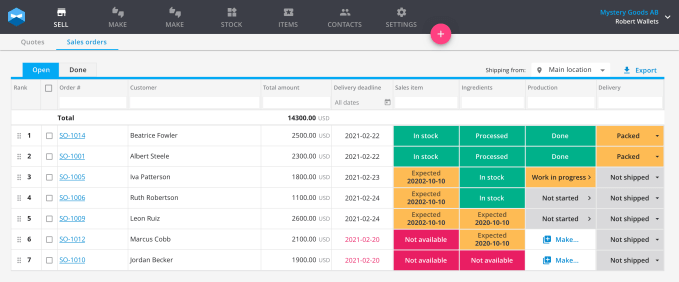
As an example of how a company might use Katana, imagine a boutique manufacturer using Shopify as their main sales channel. Once configured, Katana pulls in orders from Shopify and knows whether or not the product is available so it can be shipped immediately. If it’s unavailable, Katana displays if the necessary raw materials needed to manufacture are in stock and by when the product could be finished. “We handle the entire process from getting the raw materials in the warehouse to planning manufacturing activities, executing and shipping when the product is done,” says Vilosius.

Katana software screen shot

Image Credits: Katana

Cue statement from Atomico partner Ben Blume, who joins the Katana board: “Atomico has always believed in the strength of Estonian-built engineering and product, and as we got to know the team at Katana, we saw a familiar pattern: a relentlessly product-focussed team with the incredible ability to build and think from their customer’s point of view, and an unwavering belief that a new generation of manufacturers with big ideas shouldn’t have to settle for less than world-class technology to support them.”

News: Facebook to restore news sharing in Australia after government amends proposed law

Facebook said it will begin restoring news sharing to Australian users’ feeds in “the coming days” after reaching an agreement with the country’s government. The social media giant made the drastic move of restricting news content in Australia last Wednesday after a dispute over a proposed media bargaining code that is expected to be voted

Facebook said it will begin restoring news sharing to Australian users’ feeds in “the coming days” after reaching an agreement with the country’s government. The social media giant made the drastic move of restricting news content in Australia last Wednesday after a dispute over a proposed media bargaining code that is expected to be voted into law soon. The code would have forced Facebook, and other tech giants like Google, to make revenue-sharing agreements with publishers for content posted to their social media platforms.

Australian treasurer Josh Frydenberg said changes have been made to the code to “provide further clarity to digital platforms and news media businesses about the way the Code is intended to operate and strengthen the framework for ensuring news media businesses are fairly remunerated,” reported Seven News.

The amendments mean the code now includes a two-month mediation period to allow digital platforms like Facebook and publishers to agree on deals before they are forced to enter into arbitration. The Australian government will also consider commercial agreements tech platforms have already made with local publishers before deciding if the code applies to them, and give them one month’s notice before reaching a final decision.

William Easton, managing director of Facebook Australia and New Zealand, said in a statement that the company was “satisfied” with the changes, adding that they addressed Facebook’s “core concerns about allowing commercial deals that recognize the value our platform provides to publishers relative to the value we receive from them.”

Facebook’s restrictions last week meant Australian publishers were restricted from sharing or posting content from Facebook Pages, and users in Australia were unable to view or share Australian or international news content.

The Australian government announced in April 2020 it would adopt a mandatory code ordering Google, Facebook and other large tech companies to pay local media for reusing their content, after an earlier attempt to create a voluntary code with the companies stalled.

As it lobbied against the proposed law, Facebook first threatened to restrict the public sharing of news content in Australia last September. Google also claimed that user experience in Australia would suffer and suggested it may no longer be able to offer free services in the country.

News: Lucid Motors strikes SPAC deal to go public with $24 billion valuation

Lucid Motors reached an agreement to become a publicly traded company through a merger with special-purpose acquisition company Churchill Capital IV Corp, in the largest deal yet between a blank-check company and electric vehicle startup.  The combined company, in which Saudi Arabia’s sovereign fund will continue to be the largest shareholder, will have a transaction

Lucid Motors reached an agreement to become a publicly traded company through a merger with special-purpose acquisition company Churchill Capital IV Corp, in the largest deal yet between a blank-check company and electric vehicle startup. 

The combined company, in which Saudi Arabia’s sovereign fund will continue to be the largest shareholder, will have a transaction equity value of $11.75 billion. Private investment in the public equity deal is priced at $15 a share, putting the implied the pro-forma equity value at $24 billion. The announcement comes more than a week after Bloomberg, citing unnamed sources, reported a deal was close to being finalized.

Lucid follows a string of other, albeit smaller valued, SPAC mergers with electric vehicle startups that have been announced this year, including Arrival, Canoo, Fisker and Lordstown Motors. Several EV infrastructure companies including EVgo and ChargePoint have also become public companies via SPAC mergers.

Lucid might have been the most anticipated. The hype and speculation that has been rampant for weeks drove up the stock price of Churchill Capital IV Corp from its opening price of $10 a share more than 470% since January 2021. The skyrocketing share price, plummeted more than 30% after the details of the deal were announced.

The private investment and cash from Churchill will provide roughly $4.4 billion in total funding to Lucid. That capital will be put to work to speed up and expand Lucid’s plans. The company plans to begin production and deliveries of the Lucid Air in North America in the second half of this year. The Air will come to Europe in 2022, followed by China in 2023. The Gravity performance luxury SUV is expected to come to market in North America in 2023. The vehicles will be produced at its new factory in Casa Grande, Arizona. 

The funding will be used to bring those two vehicles to market as well as to expand its factory in Arizona, Lucid CEO and CTO Peter Rawlinson said Monday. The company plans to expand the factory over another three phases in the coming years to have the capacity to produce 365,000 units per year at scale. The initial phase of the $700 million factory was completed late last year and will have the capacity to produce 30,000 vehicles a year.

Lucid Motors air EV

Image Credits: Lucid Motors

The deal will also help Lucid realize its vision to supply electric vehicle technologies to third parties such as other automotive manufacturers as well as offer energy storage solutions in the residential, commercial and utility segments, Rawlinson said.

Scaling an electric vehicle company is not cheap or easy. Lucid narrowly missed imploding several years ago as it struggled to find an investor that would provide the capital it needed to bring its ultra-luxe electric Air sedan into production. That investor ended up being Saudi Arabia’s sovereign wealth fund, which agreed in September 2018 to invest $1 billion into Lucid Motors.

Lucid began in 2007 as Atieva, a company founded by former Tesla VP and board member Bernard Tse and entrepreneur Sam Weng that focused on developing electric car battery technology. The early research, development and eventual progress in the components and overall electric architecture would lay the critical ground work for the future Lucid, which emerged at the end of 2016 with new publicly stated purpose to make electric vehicles (although the company had already been working quietly at this for a couple of years). Rawlinson, who left Tesla to join Lucid in 2013 as CTO, was one of the driving forces behind this new mission. He later took on the CEO title and responsibility as well.

While Lucid is often couched as a competitor to Tesla, Rawlinson has told TechCrunch the Air is meant to be a rival of the Mercedes S Class, the internal combustion engine flagship of the German automaker. The investor presentation released Monday echoes Rawlinson’s earlier comments, noting that “Tesla is innovative but not luxury.” Lucid describes itself as “post luxury” and in competition with “established luxury” brands Audi, BMW and Mercedes-Benz.

Lucid is taking a page out of Tesla’s playbook and outlined plans to eventually offer more affordable EVs once it scales production.

Rawlinson will remain as CEO and CTO. The deal is expected to close in the second quarter.

News: Eat this, not that, exercise now; new personalized software predicts and helps prevents blood sugar spikes

Not everyone has Type 2 diabetes, the disease that causes chronically high blood sugar levels, but many do. Around 9% of Americans are afflicted, and another 30% are at risk of developing it. Enter software by January AI, a four-year-old, subscription-based startup that in November began providing personalized nutritional and activity-related suggestions to its customers

Not everyone has Type 2 diabetes, the disease that causes chronically high blood sugar levels, but many do. Around 9% of Americans are afflicted, and another 30% are at risk of developing it.

Enter software by January AI, a four-year-old, subscription-based startup that in November began providing personalized nutritional and activity-related suggestions to its customers based on a combination of food-related data the company has quietly amassed over three years, and each person’s unique profile, which is gleaned over that individuals’s first four days of using the software.

Why the need for personalization? Because believe it or not, people can react very differently to every single food, from rice to salad dressing.

The tech may sound mundane but it’s eye-opening and potentially live-saving, promises cofounder and CEO Nosheen Hashemi and her cofounder, Michael Snyder, a genetics professor at Stanford who has focused on diabetes and pre-diabetes for years.

Investors like the idea, too. Felicis Ventures just led a $21 million Series A investment in the company, joined by HAND Capital and Salesforce founder Marc Benioff. (Earlier investors include Ame Cloud Ventures, SignalFire, YouTube cofounder Steve Chen, and Sunshine cofounder Marissa Mayer, among others.) Says Felicis founder Aydin Senkut, “While other companies have made headway in understanding biometric sensor data—from heart rate and glucose monitors, for example—January AI has made progress in analyzing and predicting the effects of food consumption itself [which is] key to addressing chronic disease.”

We talked with Hashemi and Snyder this afternoon to learn more. Below is part of our chat, edited for length and clarity.

TC: What have you built?

NH: We’ve built a multiomic platform where we take data from different sources and predict people’s glycemic response, allowing them to consider their choices before they make them. We pull in data from heart rate monitors and continuous glucose monitors and a 1,000-person clinical study and an atlas of 16 million foods for which, using machine learning, we have derived nutritional values and created nutritional labeling [that didn’t exist previously].

[The idea is to] predict for [customers] what their glycemic response is going to be to any food in our database after just four days of training. They don’t actually have to eat the food to know whether they should eat it or not; our product tells them what their response is going to be.

TC: So glucose monitoring existed previously, but this is predictive. Why is this important?

NH: We want to bring the joy back to eating and remove the guilt. We can predict, for example, how long you’d have to walk after eating any food in our database in order to keep your blood sugar at the right level. Knowing what “is” isn’t enough; we want to tell you what to do about it. If you’re thinking about fried chicken and a shake, we can tell you: you’re going to have to walk 46 minutes afterward to maintain a healthy [blood sugar] range. Would you like to do the uptime for that? No? Then maybe [eat the chicken and shake] on a Saturday.

TC: This is subscription software that works with other wearables and that costs $488 for three months.

NH: That’s retail price, but we have an introductory offer of $288.

TC: Are you at all concerned that people will use the product, get a sense of what they could be doing differently, then end their subscription?

NH: No. Pregnancy changes [one’s profile], age changes it. People travel and they aren’t always eating the same things. . .

MS: I’ve been wearing [continuous glucose monitoring] wearables for seven years and I still learn stuff. You suddenly realize that every time you eat white rice, you spike through the roof, for example. That’s true for many people. But we are also offering a year-long subscription soon because we do know that people slip sometimes [only to be reminded] later that these boosters are very valuable.

TC: How does it work practically? Say I’m at a restaurant and I’m in the mood for pizza but I don’t know which one to order.

NH: You can compare curve over curve to see which is healthier. You can see how much you’ll have to walk [depending on the toppings].

TC: Do I need to speak all of these toppings into my smart phone?

NH: January scans barcodes, it also understands photos. It also has manual entry, and it takes voice [commands].

TC: Are you doing anything else with this massive food database that you’ve aggregated and that you’re enriching with your own data? 

NH: We will definitely not sell personal information.

TC: Not even aggregated data? Because it does sound like a useful database . . .

MS: We’re not 23andMe; that’s really not the goal.

TC: You mentioned that rice can cause someone’s blood sugar to soar, which is surprising. What are some of the things that might surprise people about what your software can show them? 

NH: The way people’s glycemic response is so different, not just between by Connie and Mike, but also for Connie and Connie. If you eat nine days in a row, your glycemic response could be different each of those nine days because of how much you slept or how much thinking you did the day before or how much fiber was in your body and whether you ate before bedtime.

Activity before eating and activity after eating is important. Fiber is important. It’s the most under overlooked intervention in the American diet. Our ancestral diets featured 150 grams of fiber a day; the average American diet today includes 15 grams of fiber. A lot of health issues can be traced to a lack of fiber.

TC: It seems like coaching would be helpful in concert with your app. Is there a coaching component?

NH: We don’t offer a coaching component today, but we’re in talks with several coaching solutions as we speak, to be the AI partner to them.

TC: Who else are you partnering with? Healthcare companies? Employers that can offer this as a benefit?

NH: We are selling to direct to consumers, but we’ve already had a pharma customer for two years. Pharma companies are very interested in working with us because we are able to use lifestyle as a biomarker. We essentially give them [anonymized] visibility into someone’s lifestyle for a period of two weeks or however long they want to run the program for so they can gain insights as to whether the therapeutic is working because of the person’s lifestyle or in spite of a person’s lifestyle. Pharma companies are very interested in working with us because they can potentially get answers in a trial phase faster and even reduce the number of subjects they need.

So we’re excited about pharma. We are also very interested in working with employers, with coaching solutions, and ultimately, with payers [like insurance companies].


News: No place is safe from failing US infrastructure

In the face of rising homelessness, increasing crime and inadequate public transit in San Francisco, many tech influencers are pulling up stakes to geographies that offer a seemingly more welcome climate to conduct business and make investments. But the ongoing disaster in Texas makes one cold truth very clear: No place is safe from America’s

In the face of rising homelessness, increasing crime and inadequate public transit in San Francisco, many tech influencers are pulling up stakes to geographies that offer a seemingly more welcome climate to conduct business and make investments. But the ongoing disaster in Texas makes one cold truth very clear: No place is safe from America’s failure to invest in infrastructure or take climate change seriously.

The shock of seeing the cradle of America’s energy industry crippled by its inability to prepare its own power grid for the “once in a century storms” that increasingly look to be coming every 10 years (a phenomenon that Texas Tech climate scientist Katherine Hayhoe calls “global weirding”) underscores a point that should have been plain years ago: By refusing to invest in adequate public infrastructure, the country’s leadership has failed to perform the basic duty of protecting the health and safety of its citizens.

And the shocks that result from these investment failures will affect anyone without the means or desire to leave the country entirely.

Decline

This failure reaches from the woefully inept response to the COVID-19 pandemic which is on track to kill half a million people in the U.S., to the millions across the country who faced a week without adequate heat, water and sometimes even food or shelter from the bitter cold bearing down on the nation.

The catastrophe also crystallizes the inanity of many of the issues currently consuming the technology community that holds itself in such high esteem as a pillar of rational discourse and as the architects of America’s future.

The investors, who decried California’s broken, over-regulated dystopia, are now trying to change their ZIP codes for broken, under-regulated dystopias.

The problem is that they’re moving without confronting the substantive issues that make these regions unlivable for large portions of the population. And that’s caused by a historic failure to engage in any politics that isn’t directly tied to the bottom line of the corporations these entrepreneurs have created or their investors have financed.

As Michael Solana, a vice president at Founders Fund, noted in a great piece on his Pirate Wires Substack:

The truth is, had tech workers actually assumed a significant measure of political influence, and led in local politics, San Francisco would today be one of the greatest cities in the world. But not only was such political influence not achieved, it was never attempted. Throughout the most recent technology boom of the last fifteen years, there has been almost no meaningful engagement in local politics from the industry.

Not that the deregulatory streak prized by many in the tech community would have solved Texas’s problem or Florida’s (California is a different kind of disaster).

In Texas, lack of regulations around construction and the state’s independent energy grid have made it more vulnerable to catastrophic climactic events — whether that’s 2017’s Hurricane Harvey or this year’s deadly winter storms, which killed Texans in their homes, vehicles and backyards.

California can claim that its grid failed by fewer megawatts than Texas’s — but the overall result from the natural disasters, blackouts, billions of dollars lost and scores of deaths are much the same.

Surveying this broken world, many in the tech community have decided that the best result is to try the same thing somewhere else. But they’re going to face many of the same problems in Florida or Texas.

Homeowners concerned about construction lowering the value of their properties? Check. Rampant income inequality? Check. Reluctance to put in effective oversight that could ensure failures don’t occur? Check.

The difference those states offer is lower taxes for the wealthy, which means more of an ability to pay privately for the services to ensure that the burdens of climate change don’t fall on these billionaires in their new waterfront homes.

The through-line in all of this is a cynicism and abdication of responsibility papered over by the thinnest lips paying the smallest amount of service to solving climate problems.

One step forward, eleventy-seven back

Don’t think that I’m merely being cynical about what some tech companies are doing when confronted with the rising catastrophe of climate change and decrepit American infrastructure.

Why else would Elon Musk commit $100 million to a carbon capture prize while his publicly traded energy company invests $1.5 billion in Bitcoin? Some analysts estimate that the deal and the resulting skyrocketing price of the cryptocurrency will erase all of the gains in emissions offsets from the use of every Tesla ever made.

“The immediate impact of Tesla’s buy is that the Bitcoin price went up by more than $5,000. We can estimate this will lead to the network consuming an additional 34 TWh of electrical energy per year. That’s about the size of a country like Denmark’s total annual electrical energy requirement. We can also estimate this will result in an additional 17 million metric tons of CO2 being put out by the network every year,” wrote Alex de Vries, the founder of the cryptocurrency analysis site, Digiconomist. “According to Tesla, the amount of CO2 saved by Tesla vehicles adds up to 3.7 million tons. The amount of additional CO2 produced by the Bitcoin network, as a result of Tesla’s buy, would thus amount to more than four times the amount of CO2 saved by all their vehicles to date.”

Some argue that Bitcoin mining uses a disproportional amount of renewable energy to produce the cryptocurrency, but that argument is complicated by the seasonal sources of some renewables that miners (especially Chinese miners who produce the bulk of Bitcoin) rely on for power.

Tesla could potentially make more money from that investment than it has from the sale of cars and  has definitely boosted the emissions spewing mining processes that make Bitcoin’s digital printers go brrrrr.  All of which makes the company’s commitment to combating climate change look a bit specious.

Some hope?

The most frustrating thing about all of this is that entrepreneurs and investors are working on solutions to the climate crisis. Technologies exist that can help address some of the issues that confront these cities. And there’s billions to be made solving something that is very much an existential problem.

Unfortunately unlocking those billions in a timeframe that’s viable for society’s survival is going to require policy movement and the type of engagement that many tech investors would rather hand off to someone else as they move to more temperate, and tax advantaged, climates.

With the waters rising and the temperatures dropping, maybe those tax savings can buy a nice microgrid for power or a bigger boat. Given the projections that put the cost of climate change at nearly half a trillion dollars annually by the end of the century, it’d have to be a pretty big boat.


News: Daily Crunch: Spotify announces a high-end subscription

Spotify makes a bunch of announcements, Netflix introduces an intriguing new feature and Clubhouse faces security concerns. This is your Daily Crunch for February 22, 2021. The big story: Spotify announces a high-end subscription Spotify listeners will get the chance to pay for higher-quality audio when the streaming service launches a new tier that it

Spotify makes a bunch of announcements, Netflix introduces an intriguing new feature and Clubhouse faces security concerns. This is your Daily Crunch for February 22, 2021.

The big story: Spotify announces a high-end subscription

Spotify listeners will get the chance to pay for higher-quality audio when the streaming service launches a new tier that it says will offer “CD-quality, lossless audio.” The pricing and launch date have yet to be announced, but Spotify HiFi will, unsurprisingly, cost more than Spotify Premium and be marketed as a Premium add-on.

That was probably the biggest news that Spotify made at today’s “Stream On” event, where it also announced an audience development tool for artists, an audio ad marketplace, continued international expansiona podcast co-hosted by Barack Obama and Bruce Springsteen and a test of paid podcast subscriptions.

The tech giants

Netflix launches ‘Downloads for You,’ a new feature that automatically downloads content you’ll like — After turning on the feature for the first time, you’ll be able to select the amount of storage space you want to dedicate for these recommended downloads.

Twitter explored buying India’s ShareChat and turning Moj into a global TikTok rival — According to sources, Twitter offered to buy the five-year-old Indian startup for $1.1 billion.

Startups, funding and venture capital

EquityBee raises $20M to help startup employees actually afford their stock options — EquityBee CEO Oren Barzilai says his company’s mission is to help educate startup employees on the meaning of their stock options, as well as provide them with funds to be able to purchase those options.

Splice gets $55M for its software bringing beats from bedrooms to bandstands — Splice gained a following for its ability to help electronic dance music creators save, share, collaborate and remix music.

A race to reverse-engineer Clubhouse raises security concerns — The fact that it takes programmers little effort to reverse-engineer and fork Clubhouse is sounding an alarm about the app’s security.

Advice and analysis from Extra Crunch

If Coinbase is worth $100B, what’s a fair valuation for Stripe? — We dig into Coinbase’s 2019 and 2020 financial performance.

Bain’s Matt Harris and Justworks’ Isaac Oates to talk through the Series B deal that brought them together — All the way back in 2016, Bain Capital Ventures caught a whiff of Justworks’ potential for success.

Winning enterprise sales teams know how to persuade the Chief Objection Officer — Many enterprise software startups have at some point faced the invisible wall.

(Extra Crunch is our membership program, which helps founders and startup teams get ahead. You can sign up here.)

Everything else

Watch Perseverance’s harrowing descent to the surface of Mars — NASA has released video taken by the Perseverance landing module and rover showing the famous “seven minutes of terror.”

Calling Oslo VCs: Be featured in The Great TechCrunch Survey of European VC — TechCrunch is embarking on a major project to survey the venture capital investors of Europe, and their cities.

Original Content podcast: Apple’s ‘Ted Lasso’ is all about relentless optimism — This will be our last episode on TechCrunch, as Original Content goes independent!

The Daily Crunch is TechCrunch’s roundup of our biggest and most important stories. If you’d like to get this delivered to your inbox every day at around 3pm Pacific, you can subscribe here.

News: Huawei launches its next foldable in China

Huawei’s first foldable feels like a distant memory. Announced in 2019, the company went back to the drawing board prior to release, as Samsung ran into its own much publicized issues with the innovative form factor. The Mate X was well-received among journalists — I had the opportunity to spend some time with it at

Huawei’s first foldable feels like a distant memory. Announced in 2019, the company went back to the drawing board prior to release, as Samsung ran into its own much publicized issues with the innovative form factor.

The Mate X was well-received among journalists — I had the opportunity to spend some time with it at the company’s HQ in China and was impressed with the build quality. But for various reasons, it never made its way outside of China. And there’s some reason to believe that the newly announced X2 will suffer a similar fate.

The new handset has already drawn its share of comparisons to Samsung’s early models — and rightfully so, to be honest. The X2’s form factor appears to share much more in common with the Galaxy Fold from a design standpoint than its own predecessor. And while Samsung’s model got off to a rocky start or two, the company was also the first to get things fairly right after a bit of public trial and error.

And like Samsung, Huawei is leading with improvements to the hinge mechanism as a big selling point here. It’s the sort of meat and potatoes thing that would be glossed over in most other devices, but the hinge has proven one of the major pain points for these devices — and as much as a company might test behind the scenes, there’s no replacing real-world usage.

The primary, foldable display is eight inches, with a 6.45-inch screen on the outside — a bit more than the Galaxy Fold 2, in both cases (at 7.6 and 6.2 inches, respectively). In the rendering, the front screen occupies most of the device, with a bit of a bezel and a camera cut out. There’s 5G on board, too, paired with Huawei’s proprietary Kirin 9000 chip and a 4,400mAh battery.

The system is, of course, missing a pretty significant feature, courtesy of all of those blacklists. The company is pushing the presence of the Android 10-based EMUI 11.0 (Based on Android 10). Likely the device will also feature Huawei’s own HarmonyOS, in lieu of Android. The company’s been building out its operating system in recent years with the understanding that it would likely become a flashpoint in U.S./China tensions.

We have yet to see a full version of the software, but it’s hard to imagine it being as complete or robust as Google’s 12-year-old mobile OS — not to mention Google’s various apps.

The Mate X2 arrives in China on February 25, starting at around $2,800.

WordPress Image Lightbox Plugin