
Tag Archives: Blog

News: Android’s latest update will let you schedule texts, secure your passwords, and more

Google today announced the next set of features coming to Android, including a new password checkup tool, a way to schedule your texts, along with other improvements to products like its screen reader TalkBack, Maps, Assistant, and Android Auto. This spring 2021 release is latest in a series of smaller update bundles, similar to iOS

Google today announced the next set of features coming to Android, including a new password checkup tool, a way to schedule your texts, along with other improvements to products like its screen reader TalkBack, Maps, Assistant, and Android Auto. This spring 2021 release is latest in a series of smaller update bundles, similar to iOS “point releases,” that add new functionality and features to Android outside of the larger update cycle.

One the security front, this update will integrate a feature called Password Checkup into devices running Android 9 and above to alert you to passwords you’re using that have been previously exposed.

The feature works with Autofill with Google, which lets you quickly sign in to apps and other services on Android. Now, when you use Autofill, Password Checkup will check your credentials against a list of known compromised passwords, then notify you if your credentials appear on that list and what to do about it.
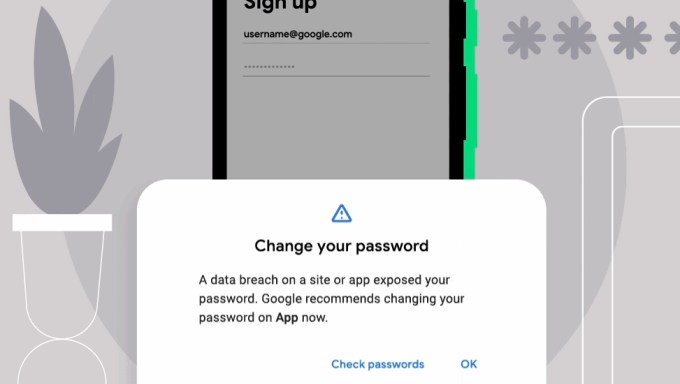
Image Credits: Google

The prompt can also direct you to your Password Manager page on Google, where you can review all your other saved Autofill passwords for similar issues.

To use this feature, you’ll need to have Autofill enabled. (Settings > System > Languages & Input > Advanced, the tap Autofill. Tap Google to ensure the setting is enabled.)

The new Messages feature rolling out this update could see profilifc texters considering a switch to Android, as it’s one of the most in-demand features since SMS was invented: the ability to schedule your texts.
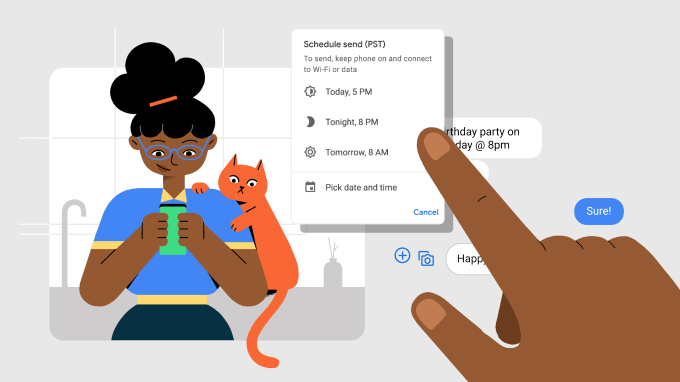
Image Credits: Google

Android’s new scheduled send feature will allow you to compose a message ahead of time, whenever it’s convenient for you, then schedule it to be sent later when it’s a more appropriate time. This can be particularly helpful if you have friends, family or coworkers and colleagues in other timezones, and are hesitant to bother them when they could be sleeping or enjoying family time after work. It can also help those who often remember something they meant to text when it’s late at night and too late to send the message.

To use this feature, you’ll just write the text as usual, then press and hold the send button to select a date and time to deliver the message. You’ll need the latest version of the Android Messages app for this feature to work.

Another flagship feature arriving in this Android release is aimed at making Android’s screen reader, known as TalkBack, easier to use for those users who are blind or have low vision. TalkBack today allows users to navigate their device with their voice and gestures in order to read, write, send emails, share social media, order delivery and more.

Image Credits: Google

The updated version (TalkBack 9.1) will now include a dozen new multi-finger gestures to interact with apps and perform common actions, like selecting and editing text, controlling media or getting help. This will work on Pixel and Samsung Galaxy devices from One UI 3 onwards, Google says.

Google is also responding to user feedback over TalkBack’s confusing multiple menu system, and has returned to the single menu system users wanted. This single menu will adapt to context while also providing consistent access to the most common functions.

Other TalkBack improvements includes new gestures — like an up and right swipe to access over 25 voice commands — and new reading controls that let users either skim a page, read only headlines, listen word-by-word or even character-by-character.


Users can also now add or remove options from the TalkBack menu or the reading controls to further customize the interface to their needs. Plus, TalkBack’s braille keyboard added support for Arabic and Spanish.

The spring update also adds more minor improvements to Maps, Assistant and Android Auto.

Maps is getting a dark mode that you can enable as the default under Settings > Theme and then selecting “Always in Dark Theme.”

 

Image Credits: Google


Google Assistant’s update will let you use the feature when the phone is locked or further away from you, by turning on Lock Screen Personal Results in Assistant’s Settings then saying “Hey Google,” as needed.

The new cards that appear when the phone is locked are meant to be easier to read with just a glance, Google says.

And finally, Android Auto will now include custom wallpapers and voice-activated games like trivia and “Jeopardy!” which you can ask for via the “Hey Google” command.

There are also now shortcuts on the launch screen for accessing your contacts, or using Assistant to complete tasks like checking the weather or adjusting the thermostat, for example. Cars with wider screens will gain access to a split screen view with Google Maps on one side and media controls on the other.

Android Auto’s features will roll out in the “coming days” on phones running Android 6.0 and higher and work with compatible cars, Google notes.


News: Project management service ZenHub raises $4.7M

ZenHub, the GitHub-centric project management service for development teams, today announced that it has raised a $4.7 million seed funding round from Canada’s BDC Capital and Ripple Ventures. This marks the first fundraise for the Vancouver, Canada-based startup after the team bootstrapped the service, which first launched back in 2014. Additional angel investors in this

ZenHub, the GitHub-centric project management service for development teams, today announced that it has raised a $4.7 million seed funding round from Canada’s BDC Capital and Ripple Ventures. This marks the first fundraise for the Vancouver, Canada-based startup after the team bootstrapped the service, which first launched back in 2014. Additional angel investors in this round include Adam Gross (former CEO of Heroku), Jiaona Zhang (VP Product at Webflow) and Oji Udezue (VP Product at Calendly).

In addition to announcing this funding round, the team also today launched its newest automation feature, which makes it easier for teams to plan the development sprints, something that is core to the Agile development process but often takes a lot of time and energy — something teams are better off spending on the actual development process.

“This is a really exciting kind of pivot point for us as a business and gives us a lot of ammunition, I think, to really go after our vision and mission a little bit more aggressively than we have even in the past,” ZenHub co-founder and CEO Aaron Upright told me. The team, he explained, used the beginning of the pandemic to spend a lot of time with customers to better understand how they were reacting to what was happening. In the process, customers repeatedly noted that development resources were getting increasingly expensive and that teams were being stretched even farther and under a lot of pressure.

ZenHub’s answer to this was to look into how it could automate more of the processes that constitute the most complex parts of Agile. Earlier this year, the company launched its first efforts in this area, with new tools for improving developer handoffs in GitHub and now, with the help of this new funding, it is putting the next pieces in place by helping teams automate their sprint planning.

Image Credits: ZenHub

“We thought about automation as an answer to [the problems development teams were facing] and that we could take an approach to automation and to help guide teams through some of the most complex and time-consuming parts of the Agile process,” Upright said. “We raised money so that we can really accelerate toward that vision. As a self-funded company, we could have gone down that path, albeit a little bit slower. But the opportunity that we saw in the market — really brought about by the pandemic, and teams working more remotely and this pressure to produce — we wanted to provide a solution much, much faster.”

The spring planning feature itself is actually pretty straightforward and allows project managers to allocate a certain number of story points (a core Agile metric to estimate the complexity of a given action item) to each sprint. ZenHub’s tool can then use that to automatically generate a list of the most highly prioritized items for the next sprint. Optionally, teams can also decide to roll over items that they didn’t finish during a given sprint into the next one.

Image Credits: ZenHub

With that, ZenHub Sprints can automate a lot of the standard sprint meetings and lets teams focus on thinking about the overall process. Of course, teams can always overrule the automated systems.

“There’s nothing more that developers hate than sitting around the table for eight hours, planning sprints, when really they all just want to be working on stuff,” Upright said.

With this new feature, sprints become a core feature of the ZenHub experience. Typically, project managers worked around this by assigning milestones in GitHub, but having a dedicated tool and these new automation features will make this quite a bit easier.

Coming soon, ZenHub will also build a new feature that will automate some parts of the software estimation process, too, by launching a new tool that will help teams more easily allocate story points to routing action items so that their discussions can focus on the more contentious ones.

News: Archer Aviation aims to launch network of urban air taxis in Los Angeles by 2024

Archer Aviation, the electric aircraft startup that recently announced a deal to go public via a merger with a blank-check company, plans to launch a network of its urban air taxis in Los Angeles by 2024. The announcement comes two months after the formation of the Urban Air Mobility Partnership, a one-year initiative between Los

Archer Aviation, the electric aircraft startup that recently announced a deal to go public via a merger with a blank-check company, plans to launch a network of its urban air taxis in Los Angeles by 2024.

The announcement comes two months after the formation of the Urban Air Mobility Partnership, a one-year initiative between Los Angeles Mayor Eric Garcetti’s office, the Los Angeles Department of Transportation and Urban Movement Labs to develop a plan for how to integrate urban aircraft into existing transportation networks and land use policies. Urban Movement Labs, launched in November 2019, is a public-private partnership involving local government and companies to develop, test and deploy transportation technologies. Urban Movement Labs and the city of Los Angeles are working on the design and access of “vertiports,” where people can go to fly on an “urban air mobility” aircraft. Urban air mobility, or UAM, is industry-speak for a highly automated aircraft that can operate and transport passengers or cargo at lower altitudes within urban and suburban areas.

Archer Aviation’s announcement comes two weeks since it landed United Airlines as a customer and an investor in its bid to become a publicly traded company via a merger with a special purpose acquisition company. Archer Aviation reached an agreement in early February to merge with special purpose acquisition company Atlas Crest Investment Corp., an increasingly common financial path that allows the startup to eschew the once traditional IPO process. The combined company, which will be listed on the New York Stock Exchange with ticker symbol “ACHR,” will have an equity valuation of $3.8 billion.

United Airlines, which has a major hub in Los Angeles, was one of the investors in the deal. Under the terms of its agreement, United placed an order for $1 billion of Archer’s aircraft. United has the option to buy an additional $500 million of aircraft.

“Archer’s commitment to launch their first eVTOL aircraft in one of United’s hubs means our customers are another step closer to reducing their carbon footprint at every stage of their journey, before they even take their seat,” Michael Leskinen, vice president of corporate development and investor relations at United Airlines, said in a statement. “We’re confident that Los Angeles is only the beginning for Archer and we look forward to helping them extend their reach across all of our Hubs.”

Archer has a ways to go before it’s ready to shuttle passengers. The company has yet to mass produce its electric vertical take-off and landing aircraft, which is designed to travel up to 60 miles on a single charge at speeds of 150 miles per hour. The company previously said it plans to unveil its full-scale eVTOL later this year and is aiming to begin volume manufacturing in 2023.

Designing and building a hub of vertiports is among the numerous tasks that must be completed in the next three years. Brett Adcock and Adam Goldstein, the company’s co-founders and co-CEOs, have said they’re open to using existing infrastructure such as helipads and parking garages in the short term. Their eVTOL, known as “Maker,” is built to fit within the size of the existing infrastructure, according to the company. That flexibility, assuming the Urban Air Mobility Partnership agrees with the strategy, could help Archer meet its 2024 deadline.

News: After 80% ARR growth in 2020, Saltmine snags $20M to help employees return to a ‘new normal’ office

What is working in the office going to look like in a post-COVID-19 world? That’s something one startup hopes to help companies figure out. Saltmine, which has developed a web-based workplace design platform, has raised $20 million in a Series A funding round. Existing backers Jungle Ventures and Xplorer Capital led the financing, which also

What is working in the office going to look like in a post-COVID-19 world?

That’s something one startup hopes to help companies figure out.

Saltmine, which has developed a web-based workplace design platform, has raised $20 million in a Series A funding round.

Existing backers Jungle Ventures and Xplorer Capital led the financing, which also included participation from JLL Spark, the strategic investment arm of commercial real estate brokerage JLL. 

Notably, JLL is not only investing in Saltmine, but is also partnering with the San Francisco-based startup to sell its service directly to its clients — opening up a whole new revenue stream for the four-year-old company.

Saltmine claims its cloud-based technology does for corporate real estate heads what Salesforce did for CROs in digitizing and streamlining the office design process. It saw an 80% spike in ARR (annual recurring revenue) last year while doubling the number of companies it works with, according to CEO and founder Shagufta Anurag. Its more than 35 customers include PG&E, Snowflake, Fidelity and Workday, among others. Its mission, put simply, is to help companies “create the best possible workplaces for their employees.”

Saltmine claims to have a 95% customer retention rate and in 2020 saw 350% year over year growth in monthly active users of its SaaS platform. So far, the square footage of all the office real estate properties designed and analyzed by customers on Saltmine totals 50 million square feet across 1,500 projects.

Saltmine says it offers companies tools to do things like establish social distancing measures in the office. Its platform, the company says, houses all workplace data — including strategy, design, pricing and portfolio analytics — in one place. It combines and analyzes floor plans with project requirements with real-time behavioral data (aggregated through a combination of utilization sensors and employee feedback) to identify companies’ design needs. Besides aiming to improve the workplace design process, Saltmine claims to be able to help companies “optimize their real estate portfolios.”

The pandemic has dramatically increased the need for a digital transformation of how workplaces are designed and reimagined, according to Anurag. 

“Given the need for social distancing capabilities and a greater emphasis on work-life balance in many office settings, few workers expect a complete ‘return to normal,’ ” she said. “There is now enormous pressure on corporate heads of real estate to adapt and modify their workplaces.”

Once companies identify their new needs, Saltmine uses “immersive” digital 3D renderings to help them visualize the necessary changes to their real estate properties.

Singapore-based Anurag has previous experience in the design world, having founded Space Matrix, a large interior design firm in Asia, as well as Livspace, a digital home interior design company.

“I saw the same pain points and unmet needs in office real estate that I did in the residential market,” she said. “Real estate is the second-largest cost for companies and has a direct impact on their largest cost — their people.”

Looking ahead, Saltmine plans to use its new capital to (naturally) do some hiring and continue to acquire customers — in particular, seeking to expand its portfolio of Global 2000 companies.

Saltmine has about 125 employees in five offices across Asia, Europe and North America. It expects to have 170 employees by year’s end and to be profitable by the end of fiscal year 2021.

The company’s initial focus has been in North America, but it is now beginning to expand into APAC and Australia. 

JLL Technologies’ co-CEO Yishai Lerner said JLL Spark was drawn to Saltmine’s approach of making data and analytics accessible in one place.

“Having a single source of truth for data also facilitates collaboration across teams, which is important, for example, in workspace planning,” he told TechCrunch. “This reduces inefficiencies and improves workflows in today’s fragmented design, build and fit-out market.”

JLL Spark invests in companies that it believes can benefit from its distribution and network — hence the firm’s agreement to sell Saltmine’s software directly to its customers.

“As JLL tenants and clients continue to embrace the future of work, they are seeking technology solutions that keep their buildings running efficiently and effectively,” Lerner said. “Saltmine’s platform checks all of the boxes by streamlining stakeholder collaboration, increasing transparency and simplifying data management.”

News: Contra wants to be the community that independent workers are missing

Whether you’re working on something new according to your Twitter bio, or self-employed, according to your LinkedIn bio, founder Ben Huffman thinks his platform, Contra, will be the best way for independent workers to explain and monetize what they are working on. Contra is a platform that wants professionals to create profiles that show project-based

Whether you’re working on something new according to your Twitter bio, or self-employed, according to your LinkedIn bio, founder Ben Huffman thinks his platform, Contra, will be the best way for independent workers to explain and monetize what they are working on.

Contra is a platform that wants professionals to create profiles that show project-based identities, versus a role-based identity that one would show on LinkedIn. It’s been built for what Huffman thinks is the future: digital knowledge workers, a term he uses to describe independent tech workers who freelance for different companies or gigs.

The early adopters are independent workers who want to work or advise for a product team.

“So you can think about any type of modern-day product team consisting of like a designer, an engineer, a PM, maybe a writer, or maybe someone else distributing content. There’s a high degree of referability amongst these user types,” he said.

Users would showcase the tools they use, projects they’ve led and initiatives they’ve pushed instead of simply writing “Former Stripe Engineer” and calling it a day.

“What you don’t know is what problems they solved at Stripe,” Huffman explained, and Contra wants to give users space to explain that.

A Contra profile looks like a storefront for an independent creators’ business. The first thing you will see is project experience, with the option to toggle between services currently available for sale, recommendations from the referral network and, finally, the About page.

A goal of Contra’s, per Huffman, is to help independent workers create high-signal referral networks so they can land new opportunities and gigs. Whenever a user posts a new project experience to their resume, they can add who they worked with as a collaborator.

It’s different from LinkedIn, where you can add anyone you meet and they become a “connection.” Contra requires you to have work experience with your network, making the referral network high-signal. Contra positions referrals high-up on profiles, reminiscent of the MySpace Top 10.

Referrals as a core mechanism to get jobs could disproportionately hurt Black and brown founders, who have been left out of networks. But Huffman says that Contra doesn’t only rely on referrals, it also helps position someone as more than their resume.

“Most resumes are filtered out by AI today and have historically disadvantaged BPOC candidates,” he said. “With a project focus instead of roles and education credential-focus on the identity, we help undiscovered talent get ahead.”

Huffman, who experienced resume bias first-hand as a college dropout with no-credentials from a rural area, thinks that his tool can combat bias in an effective way. The best-case scenario would be if Contra could help a talented designer based in Minneapolis get an opportunity in a city like San Francisco or New York by showcasing their work.

But Contra has ambition to be more than just the latest startup to aim at LinkedIn, Huffman tells TechCrunch. Beyond being a professional network, it wants to also be a place where independent workers can make money for their services and get inbound customers. He describes Contra as a LinkedIn meets Shopify for independent workers.

In other words, Contra is a profile that independent workers can build and then monetize off of, as well as track engagement on how certain services of theirs might be in more demand than others.

“We’re trying to enable people to monetize the value they create, versus the time they spend in places,” says Huffman. The goal here is to “enable people to build these identities, and give them infrastructure to be successful as an independent worker. Contra integrates with Stripe to bring on payments infrastructure, letting workers actually sell their services on the platform.

From an independent worker’s perspective, the internal view offers analytics to understand what the public is looking at on their profile, from what services are most in demand to what projects get the most attention. The analytics, which are private to everyone except the user, also helps workers understand what the conversion rate is once people come to their platform.

It is free to make money and a profile on Contra, which differentiates it from freelance marketplaces like UpWork and Fiverr, which take a percent cut of earnings. Since Contra doesn’t charge a commission on earnings, it monetizes through a SaaS subscription, $29 a month, that includes benefits such as same-day payouts and higher visibility in the platform to eventually get better opportunities.

A potentially large new competitor might be from LinkedIn itself, which is developing a new service called Marketplaces to help freelancers find and book work. Facebook is also working on a tool related to freelancers. Huffman sees Contra’s focus on professional identity as a competitive advantage, and the fact that the tool might be taking commissions.

“It makes what we are doing that much more relevant,” he said.

Luckily, the startup has raised a $14.5 million Series A round to meet its competition head on. The financing event was led by Unusual Ventures, with participation from Cowboy Ventures and Li Jin’s recently announced Atelier Ventures.

Contra wouldn’t disclose the number of users it currently has but did confirm that the total is “in the six-figure range.”

The cash will be used to increase the speed in which it can ship features, as well as build out an ambassador program, in which it will pay users $1,000 a month to test out the product and support the shift to independent work.

News: Oscar Health’s initial IPO price is so high, it makes me want to swear

Amidst all the hype that Lemonade (IPO), Root (IPO), Metromile (SPAC-led debut) and other insurtech players have generated in the last year, it’s been easy to forget about Oscar Health. But now that the company founded in 2012 is approaching the public markets, one of the early tech-themed insurance companies is catching up on the

Amidst all the hype that Lemonade (IPO), Root (IPO), Metromile (SPAC-led debut) and other insurtech players have generated in the last year, it’s been easy to forget about Oscar Health. But now that the company founded in 2012 is approaching the public markets, one of the early tech-themed insurance companies is catching up on the attention front.


The Exchange explores startups, markets and money. Read it every morning on Extra Crunch, or get The Exchange newsletter every Saturday.


There is some naughty language in The Exchange today. It is necessary. We’ll get back to PG-ifying this column tomorrow. — Alex

So this morning we’re digging into Oscar Health’s first IPO pricing interval, hoping to understand how the market is valuing its unprofitable health-insurance enterprise.

Recall that Oscar Health was valued at around $3.2 billion in March of 2018. That datapoint, via PitchBook, is dated. Oscar Health raised hundreds of millions since (per several venture-capital tracking databases, including Crunchbase) but we lack a final private valuation for the company.

Regardless, with Oscar Health now targeting a $32 to $34 per-share IPO range, we can get our hands dirty.

Let’s get some valuation numbers and then decide if Oscar Health feels cheap or expensive at that price.

Billion-dollar IPO

Oscar Health is looking to reap as much as $1.21 billion in its IPO, a huge sum. The company is selling 30,350,920 shares, with 4,650,000 additional shares reserved for its underwriters. Existing shareholders are selling another 649,080 shares.

This means that after the IPO, Oscar Health will have 197,037,445 Class A and B shares in circulation, or 201,687,445 after counting shares reserved for its underwriters.

Using the company’s $32 to $34 per-share range, we can calculate a valuation minimum of $6.31 billion for the company (lower share count, low-end of price range) and $6.86 billion (higher share count, high-end of price range). That’s the company’s simple IPO valuation.

Oscar Health may also sell up to $375 million of its shares at its IPO price to three different funds. The company advises that the “indication of interest is not a binding agreement or commitment to purchase,” so we can ignore it for now.

News: The current narrative explaining why tech stocks are getting hammered

This morning the tech-heavy Nasdaq Composite index is off 2.34% after falling yesterday. Shares of Tesla are off more than 6% today, now mired in a bear-market correction after reaching new all-time highs earlier this year. Apple stock is worth $122.02 per share, down from over its recent highs of more than $145. After a

This morning the tech-heavy Nasdaq Composite index is off 2.34% after falling yesterday. Shares of Tesla are off more than 6% today, now mired in a bear-market correction after reaching new all-time highs earlier this year. Apple stock is worth $122.02 per share, down from over its recent highs of more than $145.

After a long period of time when it felt like tech stocks only went up, the recent correction is starting to feel material.

There are other ways to measure the selloff. Bessemer’s cloud index is off 4.5% today, after falling over 5% yesterday. And the now-infamous $ARKK, or ARK Innovation ETF that many investors have used as a proxy for growthy-tech stocks, is off 6.6% today after falling 5.9% yesterday.

Hell, even bitcoin has taken a pounding in the last few days, after its recent, relentless rise.

What’s driving the rapid turn-around in the value of tech companies, tech-focused indices, and tech-adjacents, like cryptocurrencies? Not merely one thing, of course, in an environment as complex as the world’s capital markets. But there is a rising narrative that you should consider.

Namely that the money-is-cheap-and-bond-yield-is-garbage-so-everyone-is-putting-money-into-stocks trade is losing steam. As some yields rise, bonds are become more attractive bets. And as COVID-19 vaccines roll out, some investors are pushing their stock-market bets into categories other than tech.

The result is that the landscape of value is shifting; the winds that were at the back of every tech company are receding, at least for now. If the changed weather persists until the very investment climate that tech stocks exist in reaches a new equilibrium, we could see the appetite for tech IPOs lessen, late-stage private valuations for startup shares dip, and more.

Here’s CNBC from earlier today on what’s changing:

Stocks dropped again on Tuesday as tech shares continued to tumble in the face of higher interest rates and a rotation into stocks more linked to the economic comeback.

Here’s the Wall Street Journal on the same theme, from yesterday:

The lift in yields largely reflects investor expectations of a strong economic recovery. However, the collateral damage could include higher borrowing costs for businesses, more options for investors who had seen few alternatives to stocks and less favorable valuation models for some hot technology shares, investors and analysts said.

And here’s Barrons from this morning, noting that what we’re seeing at home is not merely a US-issue:

While members of the NYSE FANG+ index including Tesla, Facebook and Apple have dropped sharply as the yield on the 10-year Treasury has climbed, the sector also is on the retreat overseas.

The market could snap back. Or not. It’s worth watching stocks for the next few days.

News: Twitter relaunches test that asks users to revise harmful replies

Twitter is running a new test that will ask users to pause and think before they tweet. According to the company’s announcement, when Twitter detects what appears to be a potentially harmful or offensive reply to someone else’s tweet, it will prompt you to consider revising your text instead of tweeting. Users whose tweets are

Twitter is running a new test that will ask users to pause and think before they tweet. According to the company’s announcement, when Twitter detects what appears to be a potentially harmful or offensive reply to someone else’s tweet, it will prompt you to consider revising your text instead of tweeting.

Users whose tweets are flagged in this way will see a pop-up message appear on their screen, which asks, “Want to review this before Tweeting?” There are three buttons to then choose from: one to tweet the reply anyway, an Edit button (this is as close as we’ll get, apparently), and a delete button to discard the tweet entirely. There is also a small link to report if the system got things wrong.

This is not the first time Twitter has run a test like this.

In May 2020 and again in August 2020, Twitter ran variations on this same experiment. In those cases, the text on the pop-up screen was largely the same, but the layout of the three buttons looked different and were less colorful.

The earlier tests ran on Android, iOS and web, but this current iteration is only on iOS, for the time being.

At the time of the initial test, Twitter explained its systems were able to detect harmful language based on the kind of language that had been used in other tweets that had been reported in the past.

Say something in the moment you might regret? 😬 We’ve relaunched this experiment on iOS that asks you to review a reply that’s potentially harmful or offensive.

Think you’ve received a prompt by mistake? Share your feedback with us so we can improve. pic.twitter.com/t68az8vlYN

— Twitter Support (@TwitterSupport) February 22, 2021

It’s been shown that these sorts of built-in small nudges can have an impact.

For example, when Twitter began prompting users to read the article linked in a tweet before retweeting it, the company found that users would open the articles 40% more often than without the nudge. Twitter has also built similar experiments to try to slow down the pace of online conversation on its platform, by doing things like discouraging retweets without commentary or slow down “Likes” on tweets containing misinformation.

Other social networks use small nudges like this, too, to influence their users’ behavior. Instagram back in 2019 launched a feature that would flag potentially offensive comments before they were posted, and later expanded this to captions. TikTok more recently launched a banner that would ask users if they were sure they wanted to share a video that contains “unverified content.”

It’s unclear why Twitter hasn’t simply rolled out the pop-up to combat online abuse — still a serious issue on its platform — and then iterated on the design and style of the message box, as needed.

Compared with the much larger engineering and design efforts the company has had underway — including its newer Stories feature known as Fleets and a Clubhouse rival called Spaces — a box asking users to pause and think seems like something that could have graduated to a full product by now.

News: RIBS: The messaging framework for every company and product

Relevant. Inevitable. Believable. Simple. Behind most successful companies is a story that checks every one of those boxes.

Caryn Marooney
Contributor

Caryn Marooney is general partner at Coatue Management and sits on the boards of Zendesk and Elastic. In prior roles she oversaw communications for Facebook, Instagram, WhatsApp and Oculus and co-founded The OutCast Agency, which served clients like Salesforce.com and Amazon.

Over more than two decades of advising founders, I’ve heard all kinds of stories — good, bad and everything in between. While everyone is different, I’ve noticed that the very best stories have something in common: They pass the RIBS test. I’ve talked a lot about this over the years, and it’s stood the test of time and trends.

The test is designed to tell you if your story is memorable (will it “stick to your ribs?”) so you can turn it into a compelling message. It looks something like this:

  • Relevant
  • Inevitable
  • Believable
  • Simple

Relevant

Before you can come up with a good story, you need to think about the audience. Who are you trying to reach? Are you solving a problem they care about? What matters to them about that problem? Why does your solution deserve attention?

The test is designed to tell you if your story is memorable (will it “stick to your ribs?”) so you can turn it into a compelling message.

Marc Benioff could have launched Salesforce by describing it as an online way for companies to manage relationships with their customers. It’s true and it would have been interesting, at least to some people. But instead, Marc went bigger: He ran a campaign that described Salesforce as the “end of software.”

At the time, software was everywhere and it was creating all kinds of problems: It was massively expensive, time consuming and prone to failure. By taking on those issues, Marc made the company instantly more relevant to a bigger market and audience. The conversation went from a discussion of feature checklists, contacts and leads, to how an entire industry would change. Marc looked like a visionary — and Salesforce seemed revolutionary.

Inevitable

News: Shippo raises $45M more at $495M valuation as ecommerce booms

This morning Shippo, a software company that provides shipping-related services to ecommerce companies, announced a new $45 million investment. The new capital values the startup at $495 million. TechCrunch is calling the new funding a Series D as it is a priced round that followed its Series C; the company did not award the round

This morning Shippo, a software company that provides shipping-related services to ecommerce companies, announced a new $45 million investment. The new capital values the startup at $495 million. TechCrunch is calling the new funding a Series D as it is a priced round that followed its Series C; the company did not award the round a moniker.

Shippo’s 2020 Series C, a $30 million transaction that was announced last April, valued the company at around $220 million. D1 Capital led both Shippo’s Series C and D rounds, implying that it was content to pay around twice as much for the company’s equity in 2021 than it was in 2020. (Recall that investors doubling-down on previous bets as lead investor in successive rounds is no longer considered to be a negative signal concerning startup quality, but a positive indicator.)

Why raise more money so soon after its last round? According to Shippo CEO and founder Laura Behrens Wu, her company made material progress on customer acquisition and partnerships last year. That led to a decision around the time of Shippo’s Q4 board meeting with her investors that it was a good time to put more capital into the company.

In a sense the timing is reasonable. As Shippo scales its customer base, it can negotiate better shipping deals with various providers, which, in turn, help it continue to attract new customers. Behrens Wu noted in an interview with TechCrunch that when her company was helping its early customers ship just a few packages, shipping companies it supports on its platform didn’t want to meet with the startup. Now armed with more volume, Shippo can recycle customer demand into partner leverage, improving its total customer offering.

Behrens Wu said that Shippo had secured such a partnership with UPS before it raised its new round.

Turning to growth, Shippo doubled its platform spend, or “GPV” last year. GPV is the company’s acronym for gross postage volume. It roughly tracks with revenue, TechCrunch confirmed. So Shippo likely doubled its top-line last year. That’s good. Shippo wants to do that again this year, Behrens Wu told TechCrunch. The startup will also double its headcount this year, adding around 150 people.

Now flush with more capital, what’s next for Shippo? Per its CEO, the startup wants to invest more in platforms (where Shippo is baked into a marketplace, for example), international expansion (Shippo only does a “little bit” of international shipping, per Behrens Wu), and double-down on what it considers its core customer base.

TechCrunch was curious about how broad Shippo might take its product from its original home in shipping labels. The startup said that there’s lots of room in the journey of a packaged, from pre-purchase on, where her company might expand into. However, Behrens Wu cautioned that such a broadening of product work is not an immediate focus at her company.

Let’s see how long the current ecommerce boom lasts and how far this new capital can take Shippo. If it doubles in size again this year we’ll have to start its IPO countdown sometime in mid-2022.

WordPress Image Lightbox Plugin