Tag Archives: Blog

News: Airbnb plans for a new kind of travel post-COVID with flexible search

Since going public, most of the news out of Airbnb has been around policy. Today, the company has an announcement that’s all about the product. As the pandemic evolves the way we do everything, and we collectively realize that much of that new behavior will be permanent, tech companies are looking to evolve alongside us.

Since going public, most of the news out of Airbnb has been around policy. Today, the company has an announcement that’s all about the product.

As the pandemic evolves the way we do everything, and we collectively realize that much of that new behavior will be permanent, tech companies are looking to evolve alongside us.

Airbnb is today introducing Flexible Search, which will allow users to forgo putting in exact dates when they look to book lodging on the platform. Instead, users can search for a weekend getaway, week-long vacation, month-long vacation or months-long vacation without setting specific dates.

Not only does this give guests more options to browse through, but it should also increase exposure for hosts.

Image Credits: Airbnb

Airbnb says that its new travel trends report shows that one quarter of Americans would consider traveling during off-peak times of the year or the week, and in 2021 so far, more than 1/3 of the people searching on Airbnb have been flexible in terms of date and location.

Here’s what the company had to say about it in a blog post:

It’s no surprise COVID-19 continues to change the way we travel, and in addition to redesigning our platform last year to make nearby and longer-term stays easier to find and book, our new Flexible Dates feature aligns with a broader shift in how people will travel in the future. The traditional travel industry was built around fixed destinations with fixed dates in mind, but that model no longer meets the needs of today’s travelers.

Travel, and air travel in particular, have been devastated by the pandemic in 2020. Signs of a slow recovery are starting to sprout up, but the move to remote work (which has resulted in much, much less business travel) means that a good chunk of the depression in the travel industry is here to stay. That said, Airbnb’s travel trends report shows that the majority of folks (54 percent) miss traveling and are planning their next getaway.

Flexible Search will allow users to get back in the mindset of travel without having an exact plan around dates, which is particularly important as the positivity rates around the globe and country continue to shift.

News: YouTube to launch parental control features for families with tweens and teens

YouTube announced this morning it will soon introduce a new experience designed for teens and tweens who are now too old for the schoolager-focused YouTube Kids app, but who may not be ready to explore all of YouTube. The company says it’s preparing to launch a beta test of new features that will give parents

YouTube announced this morning it will soon introduce a new experience designed for teens and tweens who are now too old for the schoolager-focused YouTube Kids app, but who may not be ready to explore all of YouTube. The company says it’s preparing to launch a beta test of new features that will give parents the ability to grant kids more limited access to YouTube through a “supervised” Google Account. This setup will restrict what tweens and teens can watch on the platform, as well as what they can do — like create videos or leave comments, for example.

Many parents may have already set up a supervised Google Account for their child through Google’s Family Link parental control app. This app allows parents to restrict access across a range of products and services, control screen time, filter websites and more. Other parents may have created a supervised Google Account for their child when they first set up the child’s account on a new Android device or Chromebook.

If not, parents can take a few minutes to create the child’s supervised account when they’re ready to begin testing the new features. (Unfortunately, Google Edu accounts — like those kids now use for online school — aren’t supported at launch.)

The new features will allow parents to select between three different levels of YouTube access for their tween or teen. Initially, YouTube will test the features with parents with children under the age of consent for online services — age 13 in the U.S., but different in other countries — before expanding to older groups.

Image Credits: YouTube

For tweens who have more recently graduated out of the YouTube Kids app, an “Explore” mode will allow them to view a broad range of videos generally suited for viewers age 9 and up — including vlogs, tutorials, gaming videos, music clips, news, and educational content. This would allow the kids to watch things like their favorite gaming streamer with kid-friendly content, but would prevent them (in theory) from finding their way over to more sensitive content.

The next step up is an “Explore More” mode, where videos are generally suitable for kids 13 and up — like a PG-13 version of YouTube. This expands the set of videos kids can access and allows them access to live streams in the same categories as “Explore.”

For older teens, there is the “Most of YouTube” mode, which includes almost all YouTube videos except those that include age-restricted content that isn’t appropriate for viewers under 18.

Image Credits: YouTube

YouTube says it will use a combination of user input, machine learning, and human review to curate which videos are included in each of the three different content settings.

Of course, much like YouTube Kids, that means this will not be a perfect system — it’s a heavily machine-automated attempt at curation where users will still have to flag videos that were improperly filtered. In other words, helicopter parents who closely supervise their child’s access to internet content will probably still want to use some other system — like a third-party parental control solution, perhaps — to lock down YouTube further.

The supervised access to YouTube comes with other restrictions, as well, the company says.

Parents will be able to manage the child’s watch and search history from within the child’s account settings. And certain features on YouTube will be disabled, depending on the level of access the child has.

For example, YouTube will disable in-app purchases, video creation, and commenting features at launch. The company says that, over time, it wants to work with parents to add some of these features back through some sort of parent-controlled approach.

Also key is that personalized ads won’t be served on supervised experiences, even if that content isn’t designated as “made for kids” — which would normally allow for personalized ads to run. Instead, all ads will be contextual, as they are on YouTube Kids. In addition, all ads will have to comply with kids advertising policies, YouTube’s general ad policies, and will be subject to the same category and ad content restrictions as on Made for Kids content.

That said, when parents establish the supervised account for their child, they’ll be providing consent for COPPA compliance — the U.S. children’s privacy law that requires parents to be notified and agree to the collection and use personal data from the kids’ account. So there’s a trade-off here.

However, the new experience may still make sense for families where kids have outgrown apps designed for younger children — or even in some cases, for younger kids who covet their big brother or sister’s version of “real YouTube.” Plus, at some point, forcing an older child to use the “Kids” app makes them feel like they’re behind their peers, too. And since not all parents use the YouTube Kids app or parental controls, there’s always the complaint that “everyone else has it, so why can’t I?” (It never ends.)

Image Credits: YouTube Kids app

This slightly more locked down experience lets parents give the child access to “real YouTube” with restrictions on what that actually means, in terms of content and features.

YouTube, in an announcement, shared several endorsements for the new product from a few individual youth experts, including Leslie Boggs, president of National PTA; Dr. Yalda Uhls, Center for Scholars & Storytellers, UCLA – Author of Media Moms & Digital Dads; Thiago Tavares, Founder and President of SaferNet Brazil; and Professor Sun Sun Lim, Singapore University of Technology & Design – Author of Transcendent Parenting.

YouTube’s news, notably, follows several product updates from fast-growing social video app and YouTube rival TikTok, which has rolled out a number of features aimed at better protecting its younger users.

The company in April 2020 launched a “family pairing” mode that lets a parent link their child’s account to their own in order to also lock down what the child can do and what content they can see. (TikTok offers a curated experience for the under-13 crowd called Restricted Mode, which can be switched on here, too.) And in January of this year, TikTok changed the privacy setting defaults for users under 18 to more proactively restrict what they do on the app.

YouTube says its new product will launch in beta in the “coming months” in over 80 countries worldwide. It also notes that it will continue to invest in YouTube Kids for parents with younger children.

News: Fintech startup Finix closes on $3M in Black and Latinx investor-led SPV

Many founders talk about their desire for a more diverse investor base. Richie Serna took that desire and made it a reality. Serna, who founded payments infrastructure startup Finix in 2016, had raised more than $95 million in venture funding from the likes of Lightspeed Venture Partners, American Express Ventures, Homebrew, Precursor Ventures, Insight Partners,

Many founders talk about their desire for a more diverse investor base. Richie Serna took that desire and made it a reality.

Serna, who founded payments infrastructure startup Finix in 2016, had raised more than $95 million in venture funding from the likes of Lightspeed Venture Partners, American Express Ventures, Homebrew, Precursor Ventures, Insight Partners, Bain Capital Ventures, Visa and Activant Capital.

The San Francisco-based fintech last raised $30 million in an extension of its Series B round last August. At the time, Finix — which says its mission is to make every company a payments company — said it had seen its transaction volume more than quadruple from Q2 2019 to Q2 2020.

But Serna, a first-generation Mexican-American who was the first in his family to go to college (Harvard), wanted to broaden his company’s cap table even further. So he created a special purpose vehicle (SPV) that ultimately raised an additional $3 million and brought more than 80 “traditionally marginalized” investors onto Finix’s cap table. 

“This is very personal for me as a founder of color — making sure we have a diverse representation of people in our investor base,” Serna said.

Finix CEO and founder Richie Serna – Image courtesy of Finix

The effort, Serna added, was more than just diversifying his company’s cap table. It was also an initiative aimed at giving Black and Latinx investors access to an opportunity they may not have otherwise had. Indeed, the numbers are dismal. A recent NVCA-Deloitte Human Capital Survey found that 80% of investment partners at VC firms are white, and just 3% are Black and 3% are Hispanic/Latinx.

“This is about helping historically underrepresented groups build track records and get attribution for the work to help them start their careers and hopefully one day start their own fund,” Serna told TechCrunch. “So this is just one way that we at Finix can construct a rewrite of the story about the lack of diversity in Silicon Valley.”

It’s also not a one-time thing. Moving forward, in all subsequent rounds, Finix will be allocating 10% of each round to Black and Latinx investors.

Jewel Burks Solomon, managing partner of Collab Capital and head of Google for Startups, U.S. said the opportunity to invest in “a high growth company like Finix at a time that is typically reserved for a very select group of highly connected (usually white) investors is a big deal.”

“Access is the primary determinant of wealth creation,” Atlanta, Ga.-based Solomon added. “So creating an opportunity for access to folks who might not otherwise have it is game-changing.”

For Tiffani Ashley Bell, founder and executive director of The Human Utility (and now Finix investor), the SPV gives “talented, knowledgeable investors and operators from diverse backgrounds — especially Black and Latinx people — who have traditionally been excluded from investing early in rocket ship startups” a chance to be able to do so. 

While fundraising, Finix was also looking to fill senior executive positions. Through the process, the company was able to find a few who came with a breadth of experience to help the company advance on its long-term goals — including the possibility of going public one day.

Fiona Taylor, who helped steer Solar City’s IPO and acquisition by Tesla and most recently served as Marqeta’s SVP of operations, is COO. CTO Ramana Satyavarapu was a founding member of Microsoft Office 365, the head of engineering for Google Play Search, led software infrastructure engineering at Uber, and was most recently the head of data platforms & products at Two Sigma, a quantitative hedge fund. 

Today, Finix has about 100 employees, 50% of whom Serna says he’s never met in person due to the pandemic and remote work. The company plans to double its headcount over the next year.

On whether the new hires mean that an IPO is in Finix’s future, Serna replied: “We always like to think that we’re not just building for the next year, we’re building for the future. And I think if you look at the group that we’ve brought together, it’s pretty clear in terms of the direction that we’re trying to head as an organization.”

In looking ahead, Serna said he’s also excited about the potential of the SPV to add diversity to his company’s cap table.

“Black investors and other Latinx entrepreneurs were the first people to believe in me and back Finix,” he added. “I’m honored to pay it forward by creating the SPV, and I hope other founders are inspired to do the same.”

News: Chinese mobile games are gaining ground in the US

Over the past year, the coronavirus crisis has spurred app usage in the United States as people stay indoors to limit contact with others. Mobile games particularly have enjoyed a boom, and among them, games from Chinese studios are gaining popularity. Games released on the U.S. App Store and Google Play Store raked in a

Over the past year, the coronavirus crisis has spurred app usage in the United States as people stay indoors to limit contact with others. Mobile games particularly have enjoyed a boom, and among them, games from Chinese studios are gaining popularity.

Games released on the U.S. App Store and Google Play Store raked in a total of $5.8 billion in revenue during the fourth quarter, jumping 34.3% from a year before and accounting for over a quarter of the world’s mobile gaming revenues, according to a new report from market research firm Sensor Tower.

In the quarter, Chinese titles contributed as much as 20% of the mobile gaming revenues in the U.S. That effectively made China the largest importer of mobile games in the U.S., thanks to a few blockbuster titles. Chinese publishers claimed 21 spots among the 100 top-grossing games in the period and collectively generated $780 million in revenues in the U.S., the world’s largest mobile gaming market, more than triple the amount from two years before.

Occupying the top rank are familiar Chinese titles such as the first-person shooter game Call of Duty, a collaboration between Tencent and Activision, as well Tencent’s PlayerUnknown’s Battlegrounds. But smaller Chinese studios are also quickly infiltrating the U.S. market.

Mihoyo, a little-known studio outside China, has been turning heads in the domestic gaming industry with its hit game Genshin Impact, a role-playing action game featuring anime-style characters. It was the sixth-most highest-grossing mobile game in the U.S. during Q4, racking up over $100 million in revenues in the period.

Most notable is that Mihoyo has been an independent studio since its inception in 2011. Unlike many gaming startups that covet fundings from industry titans like Tencent, Mihoyo has so far raised only a modest amount from its early days. It also stirred up controversy for skipping major distributors like Tencent and phone vendors Huawei and Xiaomi, releasing Genshin Impact on Bilibili, a popular video site amongst Chinese youngsters, and games downloading platform Taptap.

Magic Tavern, the developer behind the puzzle game Project Makeover, one of the most installed mobile games in the U.S. since late last year, is another lesser-known studio. Founded by a team of Tsinghua graduates with offices around the world, Magic Tavern is celebrated as one of the first studios with roots in China to have gained ground in the American casual gaming market. KKR-backed gaming company AppLovin is a strategic investor in Magic Tavern.

Other popular games in the U.S. also have links to China, if not directly owned by a Chinese company. Shortcut Run and Roof Nails are works from the French casual game maker Voodoo, which received a minority investment from Tencent last year. Tencent is also a strategic investor in Roblox, the gaming platform oriented to young gamers and slated for an IPO in the coming weeks.

News: BigCommerce customers can now sell on Walmart’s online marketplace

BigCommerce has partnered with Walmart to allow its customers to sell on the Bentonville, Arkansas-based retailer’s ecommerce marketplace, it announced this morning. Shares of Austin-based BigCommerce rose sharply in pre-market trading after the news, gaining around 10% before the bell. Walmart, best-known for in-person shopping, has proven an ecommerce success story in recent years. For

BigCommerce has partnered with Walmart to allow its customers to sell on the Bentonville, Arkansas-based retailer’s ecommerce marketplace, it announced this morning. Shares of Austin-based BigCommerce rose sharply in pre-market trading after the news, gaining around 10% before the bell.

Walmart, best-known for in-person shopping, has proven an ecommerce success story in recent years. For example, in its most recent quarter while Walmart as a whole grew 7.3%, its ecommerce sales advanced 69%.

BigCommerce has also reported strong growth in recent quarters, supported in part by partnerships similar to the one that it announced today. The ecommerce SaaS provider rolled out an integration with Wish last year, for example.

In a call concerning its earnings, which were announced before the Walmart news was announced, BigCommerce CEO Brent Bellm told TechCrunch that his company had been impressed with customer uptake of the Wish integration. Regarding the Walmart partnership, in a second interview Bellm told TechCrunch that it was overdue on the BigCommerce side; given the historical success of the Wish deal, it will be curious to dig into how many of the ecommerce platform’s customers opt to sell on Walmart, and how quickly they do so.

TechCrunch also spoke with Walmart exec Jeff Clementz about the arrangement. He stressed Walmart’s online customer monthly-actives — 120 million, per his company — and the breadth of their demand; BigCommerce customers selling on Walmart could expand its product diversity, helping the traditionally physical retailer possible continue its rapid growth.

The two companies are incentivizing adoption of the deal amongst BigCommerce customers by waiving certain fees for a month for retailers that sign up to sell on Walmart; Clementz described it as the first time that his company had offered a “new-seller discount.”

TechCrunch has had its eye on BigCommerce for some quarters now, thanks in part to its 2020 IPO. But the company is also interesting as its regular earnings results provide a lens into the world of ecommerce growth amongst independent digital retailers. Shopify, a chief BigCommerce rival, provides a similar view into the ecommerce world.

Shopify previously integrated with Walmart in the middle of 2020.

Looking ahead, it will be interesting to see if the Walmart partnership helps BigCommerce continue its improving revenue growth. The company is in a marketshare race with Shopify. But while BigCommerce’s rival has posted impressive growth from its integrated solutions, like its payments service, the Austin-based company stresses what it calls a more open model. Shopify charges many customers a percentage of their transaction volume for using a third-party payment solution over its own, for example, which Bellm described as a “tax” during an interview.

“Merchant Solutions” revenue at Shopify, which it generates “principally” from “payment processing fees from Shopify Payments,” grew 116% in 2020 to a little over $2 billion.

So with BigCommerce collecting a partnership with Walmart to match Shopify’s own, we’re seeing not merely two ecommerce platforms go toe-to-toe on providing their customers with as much market access as they can, but two different business philosophies compete. Akin to Microsoft Teams and Slack, it’s a competition to spectate.

News: Blueshift raises $30M for its AI-based, integrated approach to marketing

The concept of the “marketing cloud” — sold by the likes of Salesforce, Oracle and Adobe — has become a standard way for large tech companies to package together and sell marketing tools to businesses that want to improve how they use digital channels to grow their business. Some argue, however, that “cloud”, singular, might

The concept of the “marketing cloud” — sold by the likes of Salesforce, Oracle and Adobe — has become a standard way for large tech companies to package together and sell marketing tools to businesses that want to improve how they use digital channels to grow their business.

Some argue, however, that “cloud”, singular, might be a misnomer: typically those tools are not integrated well with each other and effectively are run as separate pieces of software. Today a startup called Blueshift — which claims to offer an end-to-end marketing stack, by having built it from the ground up to include both traditional marketing data as well as customer experience — is announcing some funding, pointing to the opportunity to build more efficient alternatives.

The startup has closed a round of $30 million, a Series C that co-founder and CEO Vijay Chittoor said it will be using to expand to more markets (it’s most active in the U.S. and Europe currently) and also to expand its technology.

“The product already has a unified format, to ingest data from multiple sources and redistribute that out to apps. Now, we want to distribute that data to more last-mile applications,” he said in an interview. “Our biggest initiative is to scale out the notion of us being not just an app but a platform.”

The company’s customers include LendingTree, Discovery Inc., Udacity, BBC and Groupon, and it has seen revenue growth of 858% in the last three years, although it’s not disclosing actual revenues, nor valuation, today.

The round is being led by Fort Ross Ventures, with strong participation also from Avatar Growth Capital. Past investors Softbank Ventures Asia (which led its last round of $15 million), Storm Ventures, Conductive Ventures and Nexus Venture Partners also invested.

The concept for Blueshift came out of Chittoor’s direct experience at Groupon — which acquired his previous startup, social e-commerce company Mertado — and before that a long period at Walmart Labs — which Walmart rebranded after it acquired another startup where Chittoor was an early employee, semantic search company Kosmix.

“The challenges we are solving today we saw first hand as challenges our customers saw at Groupon and Walmart,” he said. “The connected customer journey is creating a thousand times more data than before, and people and brands are engaging across more touchpoints. Tracking that has become harder with legacy channel-centric applications.”

Blueshift’s approach for solving that has been, he said, “to unify the data and to make decisions at customer level.”

That is to say, although the customer experience today is very fragmented — you might potentially encounter something about a company or brand in multiple places, such as in a physical environment, on various social media platforms, in your email, through a web search, in a vertical search portal, in a marketplace on a site, in an app, and so on — the experience for marketers should not be.

The company addresses this by way of a customer data platform (CDP) it markets as “SmartHub.” Designed for non-technical users although customizable by engineers if you need it to be, users can integrate different data feeds from multiple sources, which then Blueshift crunches and organises to let you view in a more structured way.

That data can then be used to power actions in a number of places where you might be setting up marketing campaigns. And Chittoor pointed out — like other marketing people have — that these days, the focus on that is largely first-party data to fuel that machine, rather than buying in data from third-party sources (which is definitely part of a bigger trend).

“Our mission is to back category-leading companies that are poised to dominate a market. Blueshift clearly stood out to us as the leader in the enterprise CDP space,” said Ratan Singh of Fort Ross Ventures in a statement. “We are thrilled to partner with the Blueshift team as they accelerate the adoption of their SmartHub CDP platform.” Singh is joining Blueshift’s board with this round.

News: Mozilla beefs up anti-cross-site tracking in Firefox, as Chrome still lags on privacy

Mozilla has further beefed up anti-tracking measures in its Firefox browser. In a blog post yesterday it announced that Firefox 86 has an extra layer of anti-cookie tracking built into the enhanced tracking protection (ETP) strict mode — which it’s calling ‘Total Cookie Protection’. This “major privacy advance”, as it bills it, prevents cross-site tracking

Mozilla has further beefed up anti-tracking measures in its Firefox browser. In a blog post yesterday it announced that Firefox 86 has an extra layer of anti-cookie tracking built into the enhanced tracking protection (ETP) strict mode — which it’s calling ‘Total Cookie Protection’.

This “major privacy advance”, as it bills it, prevents cross-site tracking by siloing third party cookies per website.

Mozilla likens this to having a separate cookie jar for each site — so, for e.g., Facebook cookies aren’t stored in the same tub as cookies for that sneaker website where you bought your latest kicks and so on.

The new layer of privacy wrapping “provides comprehensive partitioning of cookies and other site data between websites in Firefox”, explains Mozilla.

Along with another anti-tracking feature it announced last month — targeting so called ‘supercookies’ — aka sneaky trackers that store user IDs in “increasingly obscure” parts of the browser (like Flash storageETags, and HSTS flags), i.e. where it’s difficult for users to delete or block them — the features combine to “prevent websites from being able to ‘tag’ your browser, thereby eliminating the most pervasive cross-site tracking technique”, per Mozilla.

There’s a “limited exception” for cross-site cookies when they are needed for non-tracking purposes — Mozilla gives the example of popular third-party login providers.

“Only when Total Cookie Protection detects that you intend to use a provider, will it give that provider permission to use a cross-site cookie specifically for the site you’re currently visiting. Such momentary exceptions allow for strong privacy protection without affecting your browsing experience,” it adds.

Tracker blocking has long been an arms race against the adtech industry’s determination to keep surveilling web users — and thumbing its nose at the notion of consent to spy on people’s online business — pouring resource into devising fiendish new techniques to try to keep watching what Internet users are doing. But this battle has stepped up in recent years as browser makers have been taking a tougher pro-privacy/anti-tracker stance.

Mozilla, for example, started making tracker blocking the default back in 2018 — going on make ETP the default in Firefox in 2019, blocking cookies from companies identified as trackers by its partner, Disconnect.

While Apple’s Safari browser added an ‘Intelligent Tracking Prevention’ (ITP) feature in 2017 — applying machine learning to identify trackers and segregate the cross-site scripting data to protect users’ browsing history from third party eyes.

Google has also put the cat among the adtech pigeons by announcing a planned phasing out of support for third party cookies in Chrome — which it said would be coming within two years back in January 2020 — although it’s still working on this ‘privacy sandbox’ project, as it calls it (now under the watchful eye of UK antitrust regulators).

Google has been making privacy strengthening noises since 2019, in response to the rest of the browser market responding to concern about online privacy.

In April last year it rolled back a change that had made it harder for sites to access third-party cookies, citing concerns that sites were able to perform essential functions during the pandemic — though this was resumed in July. But it’s fair to say that the adtech giant remains the laggard when it comes to executing on its claimed plan to beef up privacy.

Given Chrome’s marketshare, that leaves most of the world’s web users exposed to more tracking than they otherwise would be by using a different, more privacy-pro-active browser.

And as Mozilla’s latest anti-cookie tracking feature shows the race to outwit adtech’s allergy to privacy (and consent) also isn’t the sort that has a finish line. So being slow to do privacy protection arguably isn’t very different to not offering much privacy protection at all.

To wit: One worrying development — on the non-cookie based tracking front — is detailed in this new paper by a group of privacy researchers who conducted an analysis of CNAME tracking (aka a DNS-based anti-tracking evasion technique) and found that use of the sneaky anti-tracking evasion method had grown by around a fifth in just under two years.

The technique has been raising mainstream concerns about ‘unblockable’ web tracking since around 2019 — when developers spotted the technique being used in the wild by a French newspaper website. Since then use has been rising, per the research.

In a nutshell the CNAME tracking technique cloaks the tracker by injecting it into the first-party context of the visited website — via the content being embedded through a subdomain of the site which is actually an alias for the tracker domain.

“This scheme works thanks to a DNS delegation. Most often it is a DNS CNAME record,” writes one of the paper authors, privacy and security researcher Lukasz Olejnik, in a blog post about the research. “The tracker technically is hosted in a subdomain of the visited website.

“Employment of such a scheme has certain consequences. It kind of fools the fundamental web security and privacy protections — to think that the user is wilfully browsing the tracker website. When a web browser sees such a scheme, some security and privacy protections are relaxed.”

Don’t be fooled by the use of the word ‘relaxed’ — as Olejnik goes on to emphasize that the CNAME tracking technique has “substantial implications for web security and privacy”. Such as browsers being tricked into treating a tracker as legitimate first-party content of the visited website (which, in turn, unlocks “many benefits”, such as access to first-party cookies — which can then be sent on to remote, third-party servers controlled by the trackers so the surveilling entity can have its wicked way with the personal data).

So the risk is that a chunk of the clever engineering work being done to protect privacy by blocking trackers can be sidelined by getting under the anti-trackers’ radar.

The researchers found one (infamous) tracker provider, Criteo, reverting its tracking scripts to the custom CNAME cloak scheme when it detected the Safari web browser in use — as, presumably, a way to circumvent Apple’s ITP.

There are further concerns over CNAME tracking too: The paper details how, as a consequence of current web architecture, the scheme “unlocks a way for broad cookie leaks”, as Olejnik puts it — explaining how the upshot of the technique being deployed can be “many unrelated, legitimate cookies” being sent to the tracker subdomain.

Olejnik documented this concern in a study back in 2014 — but he writes that the problem has now exploded: “As the tip of the iceberg, we found broad data leaks on 7,377 websites. Some data leaks happen on almost every website using the CNAME scheme (analytics cookies commonly leak). This suggests that this scheme is actively dangerous. It is harmful to web security and privacy.”

The researchers found cookies leaking on 95% of the studies websites.

They also report finding leaks of cookies set by other third-party scripts, suggesting leaked cookies would in those instances allow the CNAME tracker to track users across websites.

In some instances they found that leaked information contained private or sensitive information — such as a user’s full name, location, email address and (in an additional security concern) authentication cookie.

The paper goes on to raise a number of web security concerns, such as when CNAME trackers are served over HTTP not HTTPS, which they found happened often, and could facilitate man-in-the-middle attacks.

Defending against the CNAME cloaking scheme will require some major browsers to adopt new tricks, per the researchers — who note that while Firefox (global marketshare circa 4%) does offer a defence against the technique Chrome does not.

Engineers on the WebKit engine that underpins Apple’s Safari browser have also been working on making enhancements to ITP aimed at counteracting CNAME tracking.

In a blog post last November, IPT engineer John Wilander wrote that as defence against the sneaky technique “ITP now detects third-party CNAME cloaking requests and caps the expiry of any cookies set in the HTTP response to 7 days. This cap is aligned with ITP’s expiry cap on all cookies created through JavaScript.”

The Brave browser also announced changes last fall aimed at combating CNAME cloaking.

“In version 1.25.0, uBlock Origin gained the ability to detect and block CNAME-cloaked requests using Mozilla’s terrific browser.dns API. However, this solution only works in Firefox, as Chromium does not provide the browser.dns API. To some extent, these requests can be blocked using custom DNS servers. However, no browsers have shipped with CNAME-based adblocking protection capabilities available and on by default,” it wrote.

“In Brave 1.17, Brave Shields will now recursively check the canonical name records for any network request that isn’t otherwise blocked using an embedded DNS resolver. If the request has a CNAME record, and the same request under the canonical domain would be blocked, then the request is blocked. This solution is on by default, bringing enhanced privacy protections to millions of users.”

But the browser with the largest marketshare, Chrome, has work to do, per the researchers, who write:

Because Chrome does not support a DNS resolution API for extensions, the [uBlock version 1.25 under Firefox] defense could not be applied to this browser. Consequently, we find that four of the CNAME-based trackers (Oracle Eloqua, Eulerian, Criteo, and Keyade) are blocked by uBlock Origin on Firefox but not on the Chrome version.


News: Amazon Echo Show 10 review: Unmoved

Every new smart home device invites new questions. Questions of privacy, security and what we’re willing to give up for the sake of convenience. It’s not an anti-technology stance to welcome these conversations and assess new products as we invite them into our homes. For my part, my apartment is fairly limited when it comes

Every new smart home device invites new questions. Questions of privacy, security and what we’re willing to give up for the sake of convenience. It’s not an anti-technology stance to welcome these conversations and assess new products as we invite them into our homes.

For my part, my apartment is fairly limited when it comes to smart home tech. I own two large smart speakers and a third smaller one, mostly for the convenience of networking streaming music across different rooms. My smoke detector is connected, for the peace of mind that comes with knowing that my home wasn’t on fire back when I used to leave it for extended stretches. Oh, and a couple of connected lightbulbs, mostly because why not?

Back when Google announced its first-party smart screen, the Home (now Nest) Hub, I thought it was a savvy decision to leave the camera off. Of course, the company included one on its larger Max device, so the option is there, if you want it. Of course, for most of these products, video cameras are a given — and understandably so, with smart screens like the new Echo Show 10 edging into the teleconferencing space as the line between work and home has become far more fuzzy for many.

Image Credits: Brian Heater

Amazon’s gotten the message here, with the addition of a large physical shutter button on the top of the device. When slid to the right, the camera on the top right is covered by a white lens cap, contrasted against the black bezel, so it’s easy to spot across the room. Doing so will pop up a notification: “Camera off. Disabling motion.”

The “motion” here refers to the rotating screen — the headline feature of Amazon’s latest take on the Echo Show format. The company is positioning the new tech as a game changer for the category, and while I will say it’s done a good job implementing the feature in a way that works well and quietly, it’s precisely this new addition that reignites the privacy question.

Image Credits: Brian Heater

The notion of creating a home device that fades into its surroundings is really out the window with that feature. The Echo uses figure tracking to make sure the display is facing you at all times when using it, drawing attention to itself in the process. One can inherently know and passively understand that a device is using imaging and AI for tracking, but largely effectively ignore it. After all, we’ve got cameras on pretty much everything now. These things are a part of the social media and services we regularly use. When the device physically follows you around the room, however, this stuff is top of mind.

Having used the product for several days, I would say the feature feels unnecessary in most cases — and downright unnerving in some. I’ve placed the Show on my desk next to the computer where I’m typing this, and I’ve mostly disabled the feature. It’s probably something I could get used to over time, but with the relatively limited amount I’m going to spend with it, I prefer to use the product in a stationary manner, manually swiveling the display and flipping the screen angle up and down as needed. I adjust screens all of the time. It’s fine.

Amazon will walk you through the feature during setup, including which direction you want the screen facing as a default and how much rotation it offers on either side. Keep in mind, the system really has no notion of what constitutes “straight ahead, until you adjust the setting sliders accordingly. You can adjust these later in settings, as well. There’s also a “Motion Preferences” option. Here you can limit the applications it will use to follow you, require voice to use the feature or disable it entirely.

Of course, I’m also someone who prefers to keep the camera shutter on while not in use, so that works out just fine. You can’t shutter the camera and have the device continue to move, since it needs to know what it’s seeing to move along with it. I will say that the moving screen has the unexpectedly nice side effect of reminding me when I’ve forgotten to disable the camera.

Amazon’s understandably — and thankfully — been talking up the privacy aspects since the Echo Show 10 was announced. There are eight mentions of “privacy” on the product page, but here’s the key graf:

Built with multiple layers of privacy controls, including a mic/camera off button and a built-in shutter to cover the camera. Easily turn on/off motion at any time by voice, on-device, or in the Alexa app. The processing that powers screen motion happens on device – no images or videos are sent to the cloud to provide the motion feature.

Image Credits: Brian Heater

Notably, the tracking feature uses a vague outline of a person, rather than any sort of facial tracking. The image it processes looks more like a blotchy heat map than anything recognizable as an individual or even, generally, a human (though it’s able to distinguish human figures from pets). That, in particular, has been a hot button topic for the company.

The rotating feature is primarily a way to reduce user friction. Amazon notes that existing Echo Show owners will swivel their devices around when they’re, say, using it in the kitchen to cook. The front-firing audio also moves as the screen does. That’s in keeping with the company’s move away from 360-degree audio in recent Echo models. This is either a plus or a minus, depending on how you use the device, and how many people are around. It can also be used to follow you as you move around while video calling (a feature the competition has offered through zooming and cropping).

Amazon’s taken pains in recent generations to improve the audio on these device, prioritizing the “speaker” part of smart speaker, and the new Show certainly benefits from that. I wouldn’t use it as my primary sound system, but sitting here on my desk, it delivers a nice, full sound for its size, even with the screen obscuring a big portion of the front.

The 10.1-inch screen is a nice size, as well. Again, I wouldn’t use it to replace a TV or even a good laptop, but it’s good size for quick videos. It’s a shame Amazon and Google haven’t been able to play nice here, because YouTube has the market cornered on short-form videos that are perfect for this form factor. (If you’re so inclined, you can still access YouTube via the built-in browser, though it’s not exactly an elegant solution.)

Image Credits: Brian Heater

Amazon Prime Video certainly has its share of good long-form content and series (it has a ton of trash, as well, but sometimes that’s fun, too), but Amazon’s best play is partnering with third-parties to bolster its offerings. And that’s another spot where Amazon has been improving the Echo experience. Netflix and Hulu are now available on the device for video, and Apple Music and Spotify have been added on the music side.

There are still a number of third-party apps that would be nice additions, but that’s a pretty solid starting point. Not to mention that services like Spotify can be set as the default for music playback. That’s one of those additions that genuinely reduces friction (and honestly, Amazon Music is a far less compelling service than Prime Video at the moment).

Zoom — arguably the most compelling addition from a software standpoint — is coming later. For now, calls are limited to other Alexa devices. Zoom and other third-party teleconference software has the opportunity to create an entire new dimension for these products, especially with the aforementioned blurring of home and work life.

Honestly, where the Show is currently sitting on my desk is really the perfect placement to use it for calls while working on my computer. I’m cautiously optimistic about the implementation. At the very least, it would give me a compelling reason to get more use out of that 13-megapixel camera on a regular basis.

Image Credits: Brian Heater

For the time being, I think the most compelling case to be made for both the camera and automatic screen swiveling is as a makeshift security camera. This is another “Coming Soon” feature that requires a Guard Plus subscription. With it, you can set a geofence, with the Show doubling as a smart security camera when you leave home. The system will send an alert if a person is detected in your home while you’re out.

This month has seen rumors that Amazon is working on a wall-mounted smart home hub. The form factor certainly makes sense, essentially serving as an Alexa-enabled touchscreen control for your various connected devices. For the time being, between Show and the Alexa mobile app, I think the bases are covered pretty well — though such a device could certainly lend a more premium experience to the space.

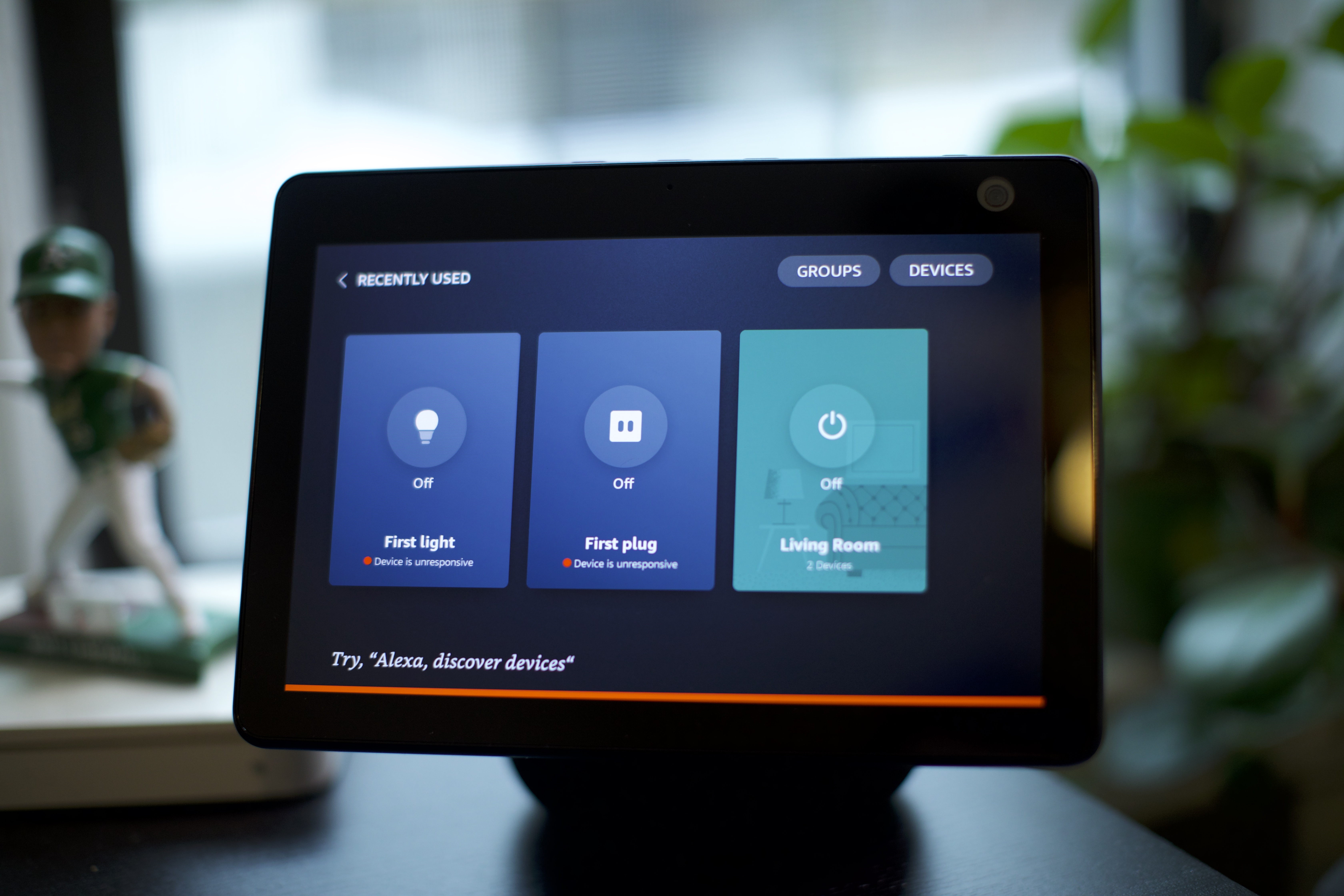
A well-placed Show will address that need for many. Certainly it does the job for my one-bedroom apartment. You can use voice or touch to control lighting, and the screen can monitor feeds from security cameras, including, naturally, Amazon-owned Ring. Additions like these have really made the smart screen category a much more compelling and capable one.

At $249, it’s $20 pricier than the 2018 Show. It’s hard to say how much of the increase is due to the new mechanical turning mechanism, but Amazon offered up a cheaper model without the functionality that’s almost certainly the one I would go for, for reasons outlined above. Again, not everyone will have the same misgivings.

And all told, it’s a well-constructed, nice addition to the Show family and one I don’t mind moving around the old-fashioned way.

News: Everdrop raises $21.8m Series A round led by Felix Capital for its dissolvable cleaning tablet

It’s almost too simple. You get a tablet made of household chemicals that can be dissolved in water which can become a cleaning spray for the kitchen, glass and bathroom, with no need to ship the water it is dissolved into because it literally comes out of your tap. That was the premise of Munich-based

It’s almost too simple. You get a tablet made of household chemicals that can be dissolved in water which can become a cleaning spray for the kitchen, glass and bathroom, with no need to ship the water it is dissolved into because it literally comes out of your tap. That was the premise of Munich-based startup everdrop and it’s been a hit not just with consumers, but also with investors. It’s now raised an €18m ($21.8m) Series A funding round led by Felix Capital, with participation from HV Capital and Vorwerk Ventures. Everdrop now plans to develop a wider range of sustainable household products and market them across Europe, and eventually the US.

Launched in Dec 2019, the cleaning tablet also removes the need for single-use plastic bottles, thus appealing to environmentally conscious consumers, (unusually for a consumer good company, the startup has 110,000 followers on Instagram).

Everdrop estimates it was able to eliminate over 2.5 million single-use plastic bottles with their tabs.

David Löwe, Co-Founder of everdrop told me in an interview that while it might be possible to clone the company’s formats, it would not be easy to replicate its water hardness calculator: “Plus, the individualizing of the laundry detergent is quite unique. I think there’s no one out there in other countries who are doing that at the moment… But obviously, other companies could potentially do that too.”

Everdrop competes with Grove Collaborative, Blueland and to some extent The Honest Company.

Löwe told me: “If I’m very honest, it would be cool if the other companies would do it because this is something that I’m really convinced about. If we inspire with our success, the big corporations could finally change into more sustainable products.”

As well as the tablet, everdrop now has a range of sustainable laundry detergents, also microplastic-free, which addresses water hardness by tailoring the detergent to the water in the customer’s home area. This means everdrop can save up to 50% of the unnecessary surfactants in the detergent. Laundry detergent is the biggest chemical emitter in private households. Everdrop estimates its approach saves 250 tons of unnecessary surfactants from going into the environment.

Its latest product is a “naked” dishwasher tablet which doesn’t have the plastic wrapper that usually envelops these products.

David Fischer, investor at HV Capital said: “It is incredible how a truly sustainable brand such as everdrop has a similar growth trajectory in its inception year as its D2C peers Hims and DollarShaveClub.”

News: Workiz locks in $13M for productivity tools aimed at home services professionals

Knowledge workers — those whose professions tend to be anchored to desks or computers — have long been the most obvious and primary focus for a lot of B2B apps and services. But as the wider world migrates to doing more and more on smartphones and other connected devices, the opportunity to build for the

Knowledge workers — those whose professions tend to be anchored to desks or computers — have long been the most obvious and primary focus for a lot of B2B apps and services. But as the wider world migrates to doing more and more on smartphones and other connected devices, the opportunity to build for the rest of the global workforce continues to grow. Today, one of the startups targeting smaller businesses in the area of field service is announcing a round of funding that underscores that trend.

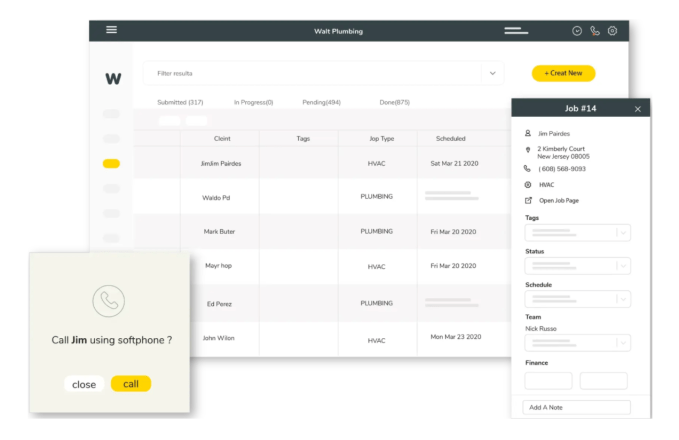
Workiz, which has developed a platform to help small business in the home services space — locksmiths, removals companies, large appliance repairs, and others — book jobs, manage teams, keep in communication with customers, bill them, and also — taking a page from the world of knowledge workers — run data analytics connected to their jobs to optimize business more in the future, has closed a funding round of $13 million.

The funding round was oversubscribed — it actually grew to $13 million in the week between getting pitched this story and writing it — and it comes on the back of a year that has seen double-digit growth exceeding what the startup had expected to achieve in 2020, said CEO Adi (Didi) Azaria in an interview.

Part of the reason has been an uplift from people spending more time working at home, putting their dwellings and the things contained in them through more wear and tear, and/or realizing that they could do some home improvement and vastly upgrade their daily environments.

“If you open the fridge too many times, things get broken and you need these guys to come in,” he said, adding that the demand from customers these days are for people to be using the same tools they are to get work done. “Many field services need software because our expectations as consumers are changing. They see it as a need.”

Workiz’s CEO himself was once a locksmith, similar to co-founders Idan Kadosh and Erez Marom (who co-founded the startup with Saar Kohanovitch), but he might be better known for co-founding his previous startup, Sisense, the business analytics company now valued at over $1 billion.

Workiz is based out of San Diego and Israel, with the latter home to its R&D efforts and a number of its investors. This Series B is being led by Tel Aviv’s New Era Capital Partners, with past backers Aleph, Magenta Venture Partners (which led its Series A), Maor Investments, and TMT Investments also participating in the round.

Valuation is not being disclosed but there are some signs that it’s on the up for the startup. Workiz’s services — the startup’s name incidentally is pronounced not like a cute version of work, “workies”, but like “work is” as the company’s official name is actually Workiz Easy — are live in the U.S. and Canada, and it currently has some 100,000 service professionals using the platform.

Since the startup was founded in 2015 (originally as Send a Job), more than 12 million jobs, 100 million text messages, and $5 billion in job revenue have been initiated through it. 

For a point of comparison, a direct competitor, Jobber, earlier this year closed a $60 million round also after hitting 100,000 service professionals on its platform.

Despite that competition — and it’s a crowded field, with others like ServiceTitan, GE’s ServiceMax, BigChange in the U.K., new approaches like Super, and many others in the market — field service remains a big market, with some 20 million businesses globally focused on home services, with 5 million in the U.S. alone.

The opportunity for a startup like Workiz within that is to figure out what needs are currently not being addressed as well by existing offerings, and building them into its own solution.

One example of that, Azaria points out, has been the company’s voice service. He notes that most field service professionals before the rise of mobile apps had organized and updated customers and head offices of their whereabouts and progress through phone calls.

In some cases that is not hugely efficient, since it only alerts the person you are calling, not a whole team, and sometimes the person you are speaking with is not the person who needs the update most. But, it also remains a key way to connect with customers especially when there are delays. The phone service that the company offers integrates with other details about a job, letting the call become part of the bigger work log for everyone else to see.

Another is scheduling, which has been a complicated issue to manage especially in cases when you have small teams of users who need to work in close conjunction with each other. Workiz’s scheduling tools essentially work like a shared Google Calendar to help match people with skills, locations and jobs to get work booked and done faster.

The company’s toolkit, interestingly, has features that highlight business analytics too: you can currently manage call tracking, lead tracking and a live dashboard to measure how long jobs are taking and whether scheduling is mapping accurately or not. These are next-level tools that do remind me a little of Sisense and point precisely to how software and goals envisioned for the average data/knowledge worker are now being recast for those on their feet and in the field.

This also leaves the door open for the option to build in more lead generation into the platform, essentially creating a marketplace for field service professionals to connect with customers seeking people to do specific jobs, although it’s not an area the company is exploring for now at least.

“At this point we focus on SaaS and making a best-of-breed solution. We’re not in the lead generation market. We try to focus because we understand how challenging it is to be a field service engineer, with phone calls, stress and disorganization,” he said. “Most of them still use pen and paper and need tools to organizse the day. Many of them can advertise or use third party companies for lead generation, although maybe in the future we might do more on that.” For now, he said, the focus will remain on tools to address their more immediate needs just to get through their workdays and helping them be more professional, to “make the service person look larger than what they are.”

“Field service management is a market ripe for disruption, with a technological approach that is both agile and competitive,” said Gideon Argov, managing at New Era Capital Partners, in a statement. “In Workiz, we found all the elements for success, coupled with passionate leadership that started from the field. We are delighted to join the Workiz team.” Argov is joining the board with this round.

WordPress Image Lightbox Plugin