Tag Archives: Blog

News: Can solid state batteries power up for the next generation of EVs?

As the market for EVs shifts to include commercial vehicles, aerospace, off-roaders and microtransit, the commercial future for SSBs is finally looking a little more solid.

Lithium-ion batteries power almost every new phone, laptop and electric vehicle. But unlike processors or solar panels, which have improved exponentially, lithium-ion batteries have inched along with only incremental gains.

For the last decade, developers of solid state battery systems have promised products that are vastly safer, lighter and more powerful. Those promises largely evaporated into the ether — leaving behind a vapor stream of disappointing products, failed startups and retreating release dates.

For the last decade, developers of solid state battery systems have promised products that are vastly safer, lighter and more powerful.

A new wave of companies and technologies are finally maturing and attracting the funding necessary to feed batteries’ biggest market: transportation. Electric vehicles account for about 60% of all lithium-ion batteries made today, and IDTechEx predicts that solid state batteries will represent a $6 billion industry by 2030.

Electric vehicles have never been cooler, faster or cleaner, yet they still account for only around one in 25 cars sold around the world (and fewer still in the United States). A global survey of 10,000 drivers in 2020 by Castrol delivered the same perennial complaints that EVs are too expensive, too slow to charge and have too short a range.

Castrol identified three tipping points that EVs would need to drive a decisive shift away from their internal combustion rivals: a range of at least 300 miles, charging in just half an hour and costing no more than $36,000.

Theoretically, solid state batteries (SSB) could deliver all three.

There are many different kinds of SSB but they all lack a liquid electrolyte for moving electrons (electricity) between the battery’s positive (cathode) and negative (anode) electrodes. The liquid electrolytes in lithium-ion batteries limit the materials the electrodes can be made from, and the shape and size of the battery. Because liquid electrolytes are usually flammable, lithium-ion batteries are also prone to runaway heating and even explosion. SSBs are much less flammable and can use metal electrodes or complex internal designs to store more energy and move it faster — giving higher power and faster charging.

The players

“If you run the calculations, you can get really amazing numbers and they’re very exciting,” Amy Prieto, founder and CTO of solid state Colorado-based startup Prieto Battery said in a recent interview. “It’s just that making it happen in practice is very difficult.”

Prieto, who founded her company in 2009 after a career as a chemistry professor, has seen SSB startups come and go. In 2015 alone, Dyson acquired Ann Arbor startup Sakti3 and Bosch bought Berkeley Lab spin-off SEEO in separate automotive development projects. Both efforts failed, and Dyson has since abandoned some of Sakti3’s patents.

Prieto Battery, whose strategic investors include Intel, Stout Street Capital and Stanley Ventures, venture arm of toolmaker Stanley Black & Decker, pioneered an SSB with a 3D internal architecture that should enable high power and good energy density. Prieto is now seeking funding to scale up production for automotive battery packs. The first customer for these is likely to be electric pickup maker Hercules, whose debut vehicle, called Alpha, is due in 2022. (Fisker also says that it is developing a 3D SSB for its debut Ocean SUV, which is expected to arrive next year.)

Another Colorado SSB company is Solid Power, which has had investments from auto OEMs including BMV, Hyundai, Samsung and Ford, following a $20 million Series A in 2018. Solid Power has no ambitions to make battery packs or even cells, according to CEO Doug Campbell, and is doing its best to use only standard lithium-ion tooling and processes.

Once the company has completed cell development in 2023 or 2024, it would hand over full-scale production to its commercialization partners.

“It simply lowers the barrier to entry if existing producers can adopt it with minimal pain,” Campbell said.

QuantumScape is perhaps the highest profile SSB maker on the scene today. Spun out from Stanford University a decade ago, the secretive QuantumScape attracted funding from Bill Gates and $300 million from Volkswagen. In November, QuantumScape went public via a special purpose acquisition company at a $3.3 billion valuation. It then soared in value over 10 times after CEO Jagdeep Singh claimed to have solved the short lifetime and slow charging problems that have plagued SSBs.

News: Canva acquires background removal specialists Kaleido

Kaleido, makers of a drag-and-drop background removal service for images and video, have been acquired by up and coming digital design platform Canva. While the price and terms are not disclosed, it is speculated that this young company may have fetched nearly nine figures. It’s the right product at the right time, seemingly. In 2019,

Kaleido, makers of a drag-and-drop background removal service for images and video, have been acquired by up and coming digital design platform Canva. While the price and terms are not disclosed, it is speculated that this young company may have fetched nearly nine figures.

It’s the right product at the right time, seemingly. In 2019, the Vienna-based Kaleido made remove.bg, a quick, simple, free, and good-enough background removal tool for images. It became a hit among the many people who need to quickly do that kind of work but don’t want to fiddle around in Photoshop.

Then late last year they took the wraps off Unscreen, which did the same thing for video — a similar task conceptually, but far more demanding to actually engineer and deploy. The simplicity and effectiveness of the tool practically begged to be acquired and integrated into a larger framework by the likes of Adobe, but Canva seems to have beaten the others to the punch.

Animated image showing a stack of books on a table in a room, but the table and room get deleted.

Image Credits: Unscreen

The acquisition was announced at the same time as another by Canva: product mockup generator Smartmockups, suggesting a major product expansion by the growing design company.

We completely bootstrapped Kaleido with no investors involved from day one,” said co-founder and CEO of Kaleido, Benjamin Groessing, in a press release. “It has just been two founders and an incredible team. We’ve been profitable from the start — so this acquisition wasn’t essential for our existence. It just made sense on so many levels.”

The company declined to provide any further details on the acquisition beyond that the brand and name are expected to survive — at least Unscreen, which makes perfect sense as a product name even under another company.

German outlets Die Presse and Der Brutkasten cited sources putting the purchase “reiht sich dahinter ein” or in the same rank as the largest Austrian exits (the largest of which was Runtastic at €220M), though still in the two-digit millions — which suggests a price approaching $100M.

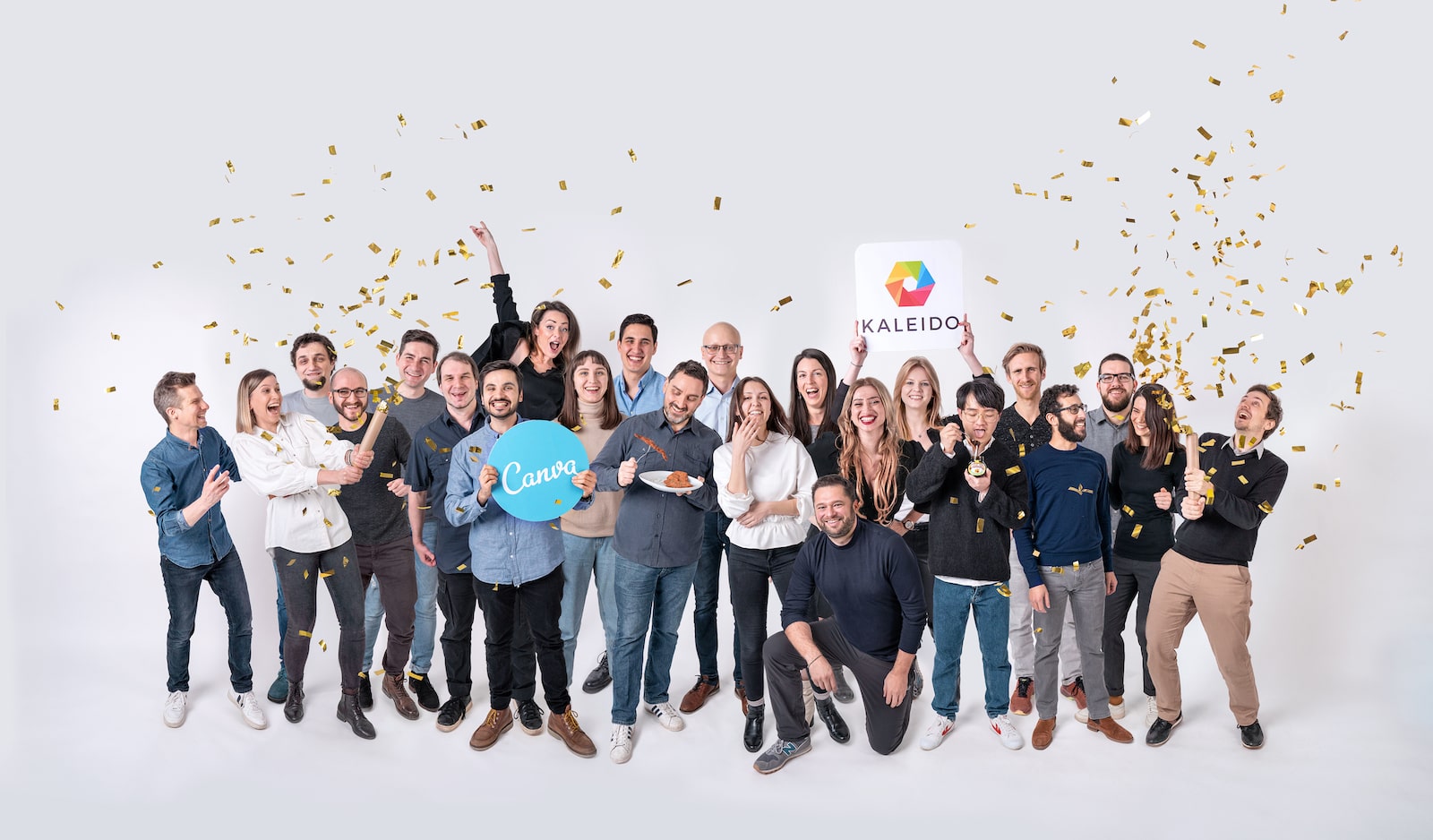
The team at kaleido celebrating their acquisition - each member has been digitally added.

Image Credits: Kaleido

Whatever the exact amount, it seems to have made the team very happy. And don’t worry – they put that image together using their own product for each person.

News: Techstars’ Neal Sáles-Griffin will join us at TechCrunch Early Stage 2021 to talk accelerators

Should you try to get your startup into an accelerator program? How do you make the right impression on the application? Where does your team need to be before you apply — and once you’re in, how do you make the most of your time in the program? Join us at the TechCrunch Early Stage

Should you try to get your startup into an accelerator program? How do you make the right impression on the application? Where does your team need to be before you apply — and once you’re in, how do you make the most of your time in the program?

Join us at the TechCrunch Early Stage event in April, where Neal Sáles-Griffin, managing director of Techstars Chicago, will help us figure it all out.

Neal has seen this industry from just about every angle — as a teacher, advisor, investor and repeat co-founder. In 2011 he co-founded what is often referred to as the “first coding bootcamp,” with The Starter League, acquired by New York’s Fullstack Academy in 2016. In addition to leading the way at Techstars Chicago, he is also a venture partner at MATH Venture Partners, an early/middle-stage VC fund.

TC Early Stage — happening on April 1st and 2nd — is an event that we’ve tailored to be absolutely packed with information for early-stage founders, with key insights from the investors, founders and executives who’ve been through it all before. Day one will cover everything from fundraising, to honing your pitch deck, to finding product market fit; day two transitions into what we’ve dubbed the TC Early Stage Pitch-Off, where 10 companies will get a shot to pitch an incredible line-up of VC judges.

Oh, and it’s all fully virtual, so you can tune in straight from the comfort of your couch. You can find more details here, or get your tickets directly below.

News: Francisco Partners is acquiring MyHeritage, sources say for $600M

Genealogy tracking online is a big business, and today comes some M&A news for one of the bigger names in the field. TechCrunch has learned and confirmed that Israel’s MyHeritage.com — a profitable site that lets people test DNA and track their family lineage and has some 62 million users — is getting acquired by

Genealogy tracking online is a big business, and today comes some M&A news for one of the bigger names in the field. TechCrunch has learned and confirmed that Israel’s MyHeritage.com — a profitable site that lets people test DNA and track their family lineage and has some 62 million users — is getting acquired by Francisco Partners, for a price that a source close to the deal tells us is $600 million.

A spokesperson for MyHeritage confirmed the deal to TechCrunch over the phone but not the price. Francisco Partners has not responded to our request for comment but we’ll update this post as we learn more.

From what we understand the deal will be announced officially very soon. Update: we now have received a press release, so I  guess that makes it “official.”

The market for DNA tests and genealogy research is generally a very fragmented one, but within that MyHeritage has been an early player — it has been around since 2003 — and a prolific one at that.

In addition to its 62 million active users of its site — which is available in 42 languages — it also has a database of some 13 billion historical records. Users have built and expanded on some 58 million family trees on its platform. It’s also run nearly 5 million DNA tests for its users.

Pricing for the service starts at free for limited use and goes up in several increments starting at $129/year through to $319/year depending on usage and features that you want to use. DNA kits cost $59.

The deal is a confirmation, if one is needed, that the hunting down of DNA lineage and family trees —  perennial hobbies for people looking for more links to their histories — can be be big business.

“When I founded the company from my home eighteen years ago, I had a clear vision that drove me, and continues to drive me today – to make family history discovery easier using technology and to unlock the fun in genealogy: the human pursuit that bonds people,” said Gilad Japhet, founder and CEO of MyHeritage, in a statement. “With the help of an excellent and dedicated team, years of hard work, and with constant technological innovation, we created new and exciting ways for people to learn about their origins.

“In Francisco Partners we see a true partner for our journey ahead, not only demonstrated by the trust they are placing in our company through this acquisition, but in their desire for us to remain true to our vision by continuing along our path and helping us do what we do best – putting our users first and giving them life-enriching, and sometimes life-changing, experiences. This move will enable us to reach new heights, invest more resources in creating greater value for our users and to reach a larger audience. We’re incredibly excited for this next chapter in our company’s evolution.”

Indeed, while MyHeritage is already profitable this deal represents a moment for the company (and its new owner) to double down on investing in what it does already and expanding its services to the next level. It has grown in part through some 11 acquisitions to date, so making more consolidating purchases might be part of that.

It will also hopefully include investment in its cybersecurity.

MyHeritage has had a colorful, not always positive, profile in the public eye. It emerged as a key player in solving one of the most elusive murder cases in decades, the hunt for the Golden State Killer.

But is has also been the subject of a major data breach, compromising some 92 million accounts in 2018. Account details of some MyHeritage users were part of a huge trove of personal details — collated from a number of breaches of several sites — that were posted for sale online in 2019.

To be completely clear on data, MyHeritage as a company is not in the business of selling or using data in any way. It said that it will soon be updating its privacy policy “to include the unequivocal prohibition for the company to license or sell genetic data to any third party. These updates will be highly unique amongst the larger genealogy and genetic DNA industry and are a testament to the commitment both MyHeritage and Francisco Partners share to privacy and consumers.”

It also runs pro bono work including DNA Quest, for adoptees to find their biological families; and Tribal Quest, to help document the family histories and cultural heritage of remote tribes around the world. It has been running a Covid-19 testing lab in Israel as well to better track the spread of the coronavirus.

The deal is coming at a time when another major DNA player, 23andme, is going public way of a SPAC at a valuation of $3.5 billion.

Although a significantly smaller sum, $600 million would be a really strong exit for MyHeritage, which says it has only raised $49 million in funding since being founded in 2003, with investors including Accel, Index and Bessemer.

Part of the deal will see some individual and institutional investors continuing to keep stakes in the company alongside Francisco Partners, MyHeritage said. They include HP Beteiligungs GmbH, Yuval Rakavy, Japhet, and Gigi Levy.

PE firm Francisco Partners has been a prolific acquirer and investor in the tech sector, and tapping a profitable company that has more obvious growth potential is a logical move for it.

“By leveraging our operational expertise, market resources and strong industry networks, we believe Francisco Partners is uniquely positioned to help MyHeritage accelerate its vision for growth. We are deeply impressed by the incredible achievements and relentless determination of Gilad, a visionary leader in genealogy who has grown the company from a start-up to a profitable global market leader,” said Eran Gorev, Francisco Partners‘ President of Israel & Senior Operating Partner, in a statement. “We are looking forward to partnering with Gilad and the entire MyHeritage team to help drive market expansion for the company.”

Gorev is joining the board along with Francisco’s Europe head Matt Spetzler with this deal.

“Francisco Partners shares MyHeritage’s vision for growth as well as its intense commitment to ensuring the privacy of its users. The users’ personal data is an extremely important priority and we will work together with MyHeritage to expand its already strong privacy framework going forward,” said Spetzler.

Updated with more detail about the deal and the company.

News: Europe kicks off bid to find a route to ‘better’ gig work

The European Union has kicked off the first stage of a consultation process involving gig platforms and workers. Regional lawmakers have said they want to improve working conditions for people who provide labor via platforms which EU digital policy chief, Margrethe Vestager, accepted in a speech today can be “poor” and “precarious”. Yet she also

The European Union has kicked off the first stage of a consultation process involving gig platforms and workers. Regional lawmakers have said they want to improve working conditions for people who provide labor via platforms which EU digital policy chief, Margrethe Vestager, accepted in a speech today can be “poor” and “precarious”.

Yet she also made it clear the Commission’s agenda vis-a-vis the issue of gig work is to find some kind of “balance” between (poor) platform work and, er, good and stable (rights protected) employment.

There’s no detail yet on how exactly regional lawmakers plan to square the circle of giving gig platforms a continued pass on not providing good/stable work — given that their sustainability as businesses (still with only theoretical profits, in many cases) is chain-linked to not shelling out for the full suite of employment rights for the thousands of people they rely upon to be engaged in the sweating toil of delivering their service off the corporate payroll.

But that, presumably, is what the Commission’s consultation process is aimed at figuring out. Baked into the first stage of the process is getting the two sides together to try to hash out what better looks like.

“The platform economy is here to stay — new technologies, new sources of knowledge, new forms of work will shape the world in the years ahead,” said Vestager, segueing into a red-line that there must be no reduction in the rights or the social safety net for platform workers (NB: The word ‘should’ is doing rather a lot of heavy lifting here): “And for all of our work on the digital economy, these new opportunities must not come with different rights. Online just as offline, all people should be protected and allowed to work safely and with dignity.”

“The key issue in our consultations is to find a balance between making the most of the opportunities of the platform economy and ensuring that the social rights of people working in it are the same as in the traditional economy,” she also said, adding: “It is also a matter of a fair competition and level playing field between platforms and traditional companies that have higher labour costs because they are subject to traditional labour laws.”

The Commission’s two-stage consultation process on gig work starts with a consultation of “social partners” on “the need and direction of possible EU action to improve the working conditions in platform work”, as it puts it.

This will be open for at least six weeks. It will involve platforms talking with workers (and/or their representatives) to try to come up with agreement on what ‘better’ looks like in the context of platform working conditions, either to steer the direction of any Commission initiative. Or — else — to kick the legislative can down the road on said initiative if they can come up with stuff they can agree to implement themselves.

The second phase — assuming the “social partners” don’t agree on and implement a way forward themselves — is planned to take place before the summer and will focus on “the content of the initiative”, per Vestager. (Aka: what exactly the EU ends up proposing to square the circle that must be squared.)

The competition component of the gig work conundrum — whereby there’s also the ’employer fairness’ dynamic to consider, given platforms aren’t playing by the same rules as traditional employers so are potentially undercutting rivals who are offering those good and stable jobs — explains why the Commission is launching a competition-focused parallel consultation alongside the social stakeholder chats.

“We will soon start a public consultation on this initiative that has another legal base since it is about competition law and not social policies. This is the reason why we consult differently on the two initiatives,” noted Vestager.

She said this will aim to ensure that EU competition rules “do not stand in the way of collective bargaining for those who need it” — suggesting the Commission is hoping that collective bargaining will form some part of the solution to achieving the sought for (precarious) balance of ‘better’ platform work.

Albeit, a cynical person might predict the end goal of all this solicitation of views will probably be some kind of fudge — that offers the perception of a plug for the platform rights gap without actually disrupting the platform economy which Vestager has sworn is here to say.

Uber for one has scented opportunity in the Commission’s talk of improving “legal clarity” for platforms.

The ride-hailing giant put out a white paper last week in which it lobbied lawmakers to deregulate platform work — pushing for a Prop-22 style outcome in Europe, having succeeded in getting a carve out from tightened employment laws in California.

Expect other platforms to follow with similarly self-serving suggestions aimed at encouraging Europe’s social contract to be retooled at the points where it intersects with their business models. (Last week Uber was accused of intentionally stalling on improving conditions for workers in favor of lobbying for deregulation, for example.)

The start of the Commission’s gig work consultation come hard on heels of a landmark ruling by the UK’s Supreme Court (also last week) — which dismissed Uber’s final appeal against a long running employment tribunal.

The judges cemented the view that the group of drivers who sued Uber had indeed been erroneously classified as ‘self employed’, making Uber liable to pay compensation for the rights it should have been funding all along.

So if the EU ends up offering a lower level of employment rights to platform workers vis-a-vis the (post-brexit) UK that would surely make for some uncomfortable faces in Brussels.

While it may be unrealistic to talk about striking a ‘balance’ in the context of business models that are inherently imbalanced, given they’re based on dodging existing employment regulations and disrupting the usual social playbook for profit, he Commission seems to think that a consultation process and a network of overlapping regulations is the way to rein in the worst excesses of the gig economy/big tech more generally.

In a press release about the consultation, it notes that platform work is “developing rapidly” across various business sectors in the region.

“It can offer increased flexibility, job opportunities and additional revenue, including for people who might find it more difficult to enter the traditional labour market,” it writes, starting with some of the positives that are, pesumably, feeding its desire for a ‘balanced’ outcome.

“However, certain types of platform work are also associated with precarious working conditions, reflected in the lack of transparency and predictability of contractual arrangements, health and safety challenges, and insufficient access to social protection. Additional challenges related to platform work include its cross-border dimension and the issue of algorithmic management.”

It also notes the role of the coronavirus pandemic in both accelerating uptake of platform work and increasing concern about the “vulnerable situation” of gig workers — who may have to choose between earning money and risking their health (and the health of other people) via working and thus potential viral exposure.

The Commission reports that around 11% of the EU workforce (some 24 million people) say they have already provided services through a platform.

Vestager said most of these people “only have platform work as a secondary or a marginal source of income” — but added that some three million people do it as a main job.

And just imagine the cost to gig platforms if those three million people had to be put on the payroll in Europe…

In the bit of her speech leading up to her conclusion that platform work is here to stay, Vestager quoted a recent study she said had indicated that 35% to 55% of consumers say they intend to continue to ask for home delivery more in the future.

“We… see that the platform economy is growing rapidly,” she added. “Worldwide, the online labour platform market has grown by 30% over a period of 2 years. This growth is expected to continue and the number of people working through platforms is expected to become more significant in the years ahead.”

“European values are at the heart of our work to shape Europe’s digital future,” she also went on, taking her cue to point to the smorgasbord of digital regulations in the EU’s pipeline — and perhaps illustrating the concept of an overlapping regulatory net that the Commission intends to straightjacket platform giants into more socially acceptable and fair behavior (though it hasn’t yet).

“Our proposals from December for a Digital Services Act and a Digital Markets Act are meant to protect us as consumers if technology poses a risk to fundamental rights. In April we will follow up on our white paper on Artificial Intelligence from last year and our upcoming proposal will also have the aim to protect us as citizens. The fairness aspect and the integration of European values will also be a driver for our upcoming proposal on a digital tax that we plan to present before summer.

“All these initiatives are part of our ambition to balance the great potential that the digital transformation holds for our societies and economies.”


 

News: SpaceX’s floating oil rig spaceship launch pad could be operating later this year according to Elon Musk

SpaceX’s grand vision for Starship, the next-generation spacecraft it’s currently in the process of developing, includes not only trips to Mars, but also regular point-to-point flights right here on Earth. These would skim the Earth’s outer atmosphere, reducing travel times for regular international flights from many hours to around 30 minutes. They’ll need to take

SpaceX’s grand vision for Starship, the next-generation spacecraft it’s currently in the process of developing, includes not only trips to Mars, but also regular point-to-point flights right here on Earth. These would skim the Earth’s outer atmosphere, reducing travel times for regular international flights from many hours to around 30 minutes. They’ll need to take off from somewhere, however, and rockets are a bit more disturbing to their local environs than traditional aircraft, so part of SpaceX founder Elon Musk’s plan for their regular use is covering oil rig platforms into floating spaceports.

Musk has talked about these plans before, and SpaceX recently went so far as to purchase two rigs – which it nicknamed Phoibos and Deimos after the moons of Mars. These are currently in the process of being retrofitted for use with Starship, and they’ll be stationed in the Gulf of Mexico near SpaceX’s Brownsville, Texas development site.

On Wednesday, Musk said on Twitter that one of the two platforms could be at least partially operational by the end of 2021. The SpaceX CEO is known for his optimistic timelines, but a lot of them have actually been relatively accurate lately – or at least not quite as unrealistic as in years past.

One of them may be in limited operation by end of year

— Elon Musk (@elonmusk) February 24, 2021

What he means by “in limited operation” isn’t necessarily clear. That could mean that they’re floating where they’re supposed to be, and technically capable of playing host to a Starship prototype, but not that SpaceX will be actively launching Starships from one by end of year. He did add that the plan is to put floating launchpads for Starship not only in the Gulf, but also at various points around the world – which is in keeping with the bold plan he shared via CG concept videos when Starship debuted, which depicted launch and landing facilities stationed in bodies of water near urban destinations.

News: Meet Smash Ventures, the low-flying outfit that has quietly funded Epic Games among others

When in 2018, Smash Ventures showed up as an investor in a $1.25 billion round for Epic Games — reportedly the largest ever investment in a video game company at the time — it was the first time many had heard of the investing outfit. When the brand showed up again last summer in an

When in 2018, Smash Ventures showed up as an investor in a $1.25 billion round for Epic Games — reportedly the largest ever investment in a video game company at the time — it was the first time many had heard of the investing outfit.

When the brand showed up again last summer in an even bigger round for Epic —  last August, the games giant announced $1.78 billion in fresh funding at a post-money equity valuation of $17.3 billion — a diner near Epic’s Cary, North Carolina headquarters that sells “smash waffles” started getting calls from reporters, says Eric Garland, who used to lead venture and growth deals for The Walt Disney Company after selling his company, BigChampagne, to Live Nation in 2011.

“Some reporters really turned over rocks,” he says.

Garland knows this, he says, because he cofounded Smash Ventures with Evan Richter, a former member of Disney’s corporate strategy and business development team (and who, before that, was an investor at Insight Partners).

They pair say they weren’t trying to duck the press after striking out on their own a few years ago; they were mostly just trying to get their firm off the ground, which they’ve seemingly done and then some. First, there’s the newly closed $75 million debut fund from strategic partners and notable investors like Kevin Mayer, the former CEO of TikTok and the former Disney executive; Pixar cofounder Ed Catmull; and journalist Willow Bay, who is now dean of the USC Annenberg School for Communication and Journalism. Yet it’s just small notable piece of what they have assembled.

Indeed, at a time when money is more of a commodity than ever and can be accessed easily by many founders, Smash has a few tricks up its sleeve, Richter and Garland suggest.

One thing to know, for example, is that the two apparently have little spinning up side vehicles when they wedge their way into an interesting deal. While they got to know Epic Games through Disney (it made an investment in the company in 2017 when Epic took part in its accelerator program), when they persuaded founder Tim Sweeney to take a bigger check from Smash Ventures in 2018, they were able to package together “several hundred million dollars” from their LPs for a stake in the business.

The also “flexed up” with the help of its limited partners to put a separate $200 million into others of its handful of portfolio companies. These include DraftKings, before it went public through a blank-check company last year; the footwear, apparel and accessory brand Nobull; the men’s grooming company Manscaped; and India’s biggest e-learning startup, Byju’s.

Disney — one of the world’s most powerful brands —  is a common thread throughout. In addition to inviting Epic into its accelerator program, Disney began work on an education app with Byju back in 2018 and it owned 6% of DraftKings when it went public last year.

Mayer, the former Disney exec who more recently began launching special purpose acquisition vehicles, credits Richter and Garland with finding “a lot of really cool companies like Epic” while inside Disney, saying he has “been supporting them ever since, because I think they’re great.”

Underscoring the strength of that former Disney network — another apparent advantage here — Mayer says that in addition to being a limited partner, he will sometimes “try and talk to their CEOs, give strategic advice, and talk about exits and M&A with some of their portfolio companies.” (Catmull, who was the president of Walt Disney Animation Studios after Disney acquired Pixar in 2006, was also pulled in to help seal the Epic deal, says Garland.)

As for whether Smash’s dealings have irritated current execs at Disney — it isn’t hard to imagine the entertainment giant would have liked a bigger stake in Epic — Garland says no, adding that “Disney is not generally in the venture business.”

In the meantime, Smash also says it’s getting into deals by helping companies tell stories to their respective, captive audiences. As Richter explains it, “The leading consumer software and internet businesses are building massive, and dedicated, user bases, and media, whether it’s a Travis Scott experience within Epic Games, or an IP collaboration between Marvel or Disney [and Byju’s], or whether it’s doing something with the UFC [which last year partnered with Manscaped], can be an incredible way to keep and grow a user base.”

The firm certainly appears to spend a lot of time with its portfolio companies on these efforts. While Smash wrote its first check in 2018, it has just five portfolio companies to date, and it plans only to invest in 10 to 12 companies altogether with that $75 million pool of capital, writing checks as small as $5 million to $10 million, with the ability to write far larger checks when the opportunity arises and its LP network says yes to it.

Asked why the firm is suddenly going public with those efforts, Richter suggests it’s time to cast a wider net. Even still, Garland says that “we like to stay focused. We make a lot of noise for our portfolio companies,” he adds,” but we are ourselves very heads down.”

News: Google Cloud puts its Kubernetes Engine on autopilot

Google Cloud today announced a new operating mode for its Kubernetes Engine (GKE) that turns over the management of much of the day-to-day operations of a container cluster to Google’s own engineers and automated tools. With Autopilot, as the new mode is called, Google manages all of the Day 2 operations of managing these clusters

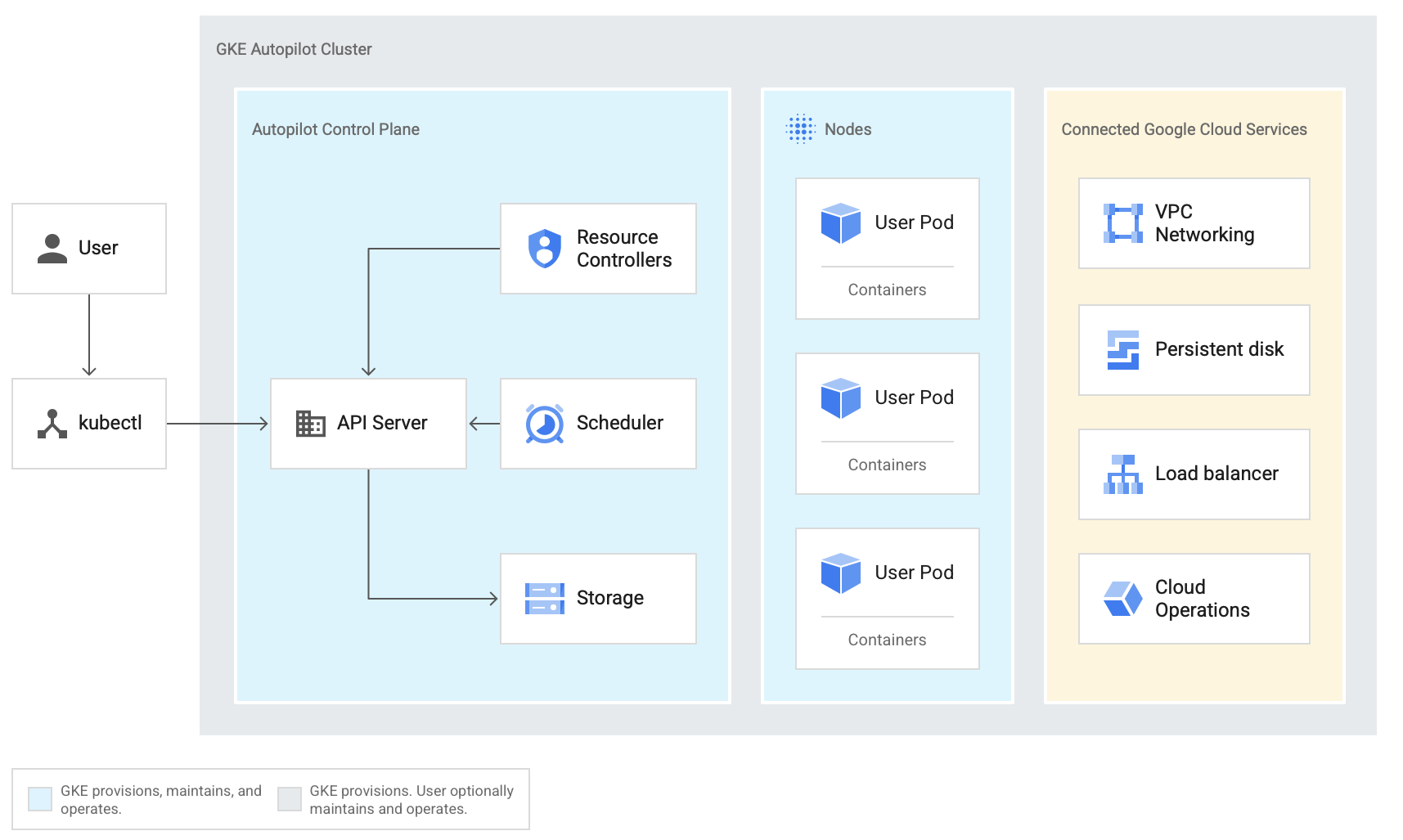
Google Cloud today announced a new operating mode for its Kubernetes Engine (GKE) that turns over the management of much of the day-to-day operations of a container cluster to Google’s own engineers and automated tools. With Autopilot, as the new mode is called, Google manages all of the Day 2 operations of managing these clusters and their nodes, all while implementing best practices for operating and securing them.

This new mode augments the existing GKE experience, which already managed most of the infrastructure of standing up a cluster. This ‘standard’ experience, as Google Cloud now calls it, is still available and allows users to customize their configurations to their heart’s content and manually provision and manage their node infrastructure.

Drew Bradstock, the Group Product Manager for GKE, told me that the idea behind Autopilot was to bring together all of the tools that Google already had for GKE and bring them together with its SRE teams who know how to run these clusters in production — and have long done so inside of the company.

“Autopilot stitches together auto-scaling, auto-upgrades, maintenance, Day 2 operations and — just as importantly — does it in a hardened fashion,” Bradstock noted. “[…] What this has allowed our initial customers to do is very quickly offer a better environment for developers or dev and test, as well as production, because they can go from Day Zero and the end of that five-minute cluster creation time, and actually have Day 2 done as well.”

Image Credits: Google

From a developer’s perspective, nothing really changes here, but this new mode does free up teams to focus on the actual workloads and less on managing Kubernetes clusters. With Autopilot, businesses still get the benefits of Kubernetes, but without all of the routine management and maintenance work that comes with that. And that’s definitely a trend we’ve been seeing as the Kubernetes ecosystem has evolved. Few companies, after all, see their ability to effectively manage Kubernetes as their real competitive differentiator.

All of that comes at a price, of course, at a flat fee of $0.10 per hour and cluster (there’s also a free GKE tier that provides $74.40 in billing credits), plus, of course, the usual fees for resources that your clusters consume. Google offers a 99.95% SLA for the control plane of its Autopilot clusters and a 99.9% SLA for Autopilot pods in multiple zones.

Autopilot for GKE joins a set of container-centric products in the Google Cloud portfolio that also include Anthos for running in multi-cloud environments and Cloud Run, Google’s serverless offering. “[Autopilot] is really [about] bringing the automation aspects in GKE we have for running on Google Cloud, and bringing it all together in an easy-to-use package, so that if you’re newer to Kubernetes, or you’ve got a very large fleet, it drastically reduces the amount of time, operations and even compute you need to use,” Bradstock explained.

And while GKE is a key part of Anthos, that service is more about brining Google’s config management, service mesh and other tools to an enterprise’s own data center. Autopilot of GKE is, at least for now, only available on Google Cloud.

“On the serverless side, Cloud Run is really, really great for an opinionated development experience,” Bradstock added. “So you can get going really fast if you want an app to be able to go from zero to 1000 and back to zero — and not worry about anything at all and have it managed entirely by Google. That’s highly valuable and ideal for a lot of development. Autopilot is more about simplifying the entire platform people work on when they want to leverage the Kubernetes ecosystem, be a lot more in control and have a whole bunch of apps running within one environment.”


News: Apple supplier Foxconn reaches tentative agreement to build Fisker’s next electric car

Apple supplier Foxconn Technology Group has reached a tentative agreement with electric vehicle startup-turned-SPAC Fisker to develop and eventually manufacture an EV that will be sold in North America, Europe, China and India. Fisker and Foxconn said Wednesday that a memorandum of understanding agreement has been signed. Discussions between the two companies will continue with

Apple supplier Foxconn Technology Group has reached a tentative agreement with electric vehicle startup-turned-SPAC Fisker to develop and eventually manufacture an EV that will be sold in North America, Europe, China and India.

Fisker and Foxconn said Wednesday that a memorandum of understanding agreement has been signed. Discussions between the two companies will continue with the expectation that a formal partnership agreement will be reached during the second quarter of this year. 

Under the agreement, Foxconn will begin production in the fourth quarter of 2023 with a projected annual volume of more than 250,000 vehicles. The electric vehicle will carry the Fisker brand.

Foxconn Technology Group Chairman Young-way Liu touted the company’s vertically integrated global supply chain and accumulated engineering capabilities, noting that it gives the company two major advantages in the development and manufacturing of the key elements of an EV, which includes the electric motor, electric control module and battery.

That supply chain and ability to scale engineering quickly will be critical for Foxconn if it hopes to meet its production target.

“The collaboration between our firms means that it will only take 24 months to produce the next Fisker vehicle — from research and development to production, reducing half of the traditional time required to bring a new vehicle to market,” Young-way Liu said in a statement.

Fisker said production of the Ocean SUV — its first EV and one that is supposed to be built by contract manufacturer Magna — will begin in the fourth quarter of 2022. The company said it plans to unveil a production-intent prototype of the Ocean later this year.

This is not Foxconn’s first foray into electric vehicle manufacturing.

Foxconn announced in January 2020 that it had formed a joint venture with Fiat Chrysler Automobiles to build electric vehicles in China. Under that agreement, each party will own 50% of the venture to develop and manufacture electric vehicles and engage in an IOV, what Foxconn parent company Hon Hai calls the “internet of vehicles” business.

Last month, Foxconn and Chinese automaker Zhejiang Geely Holding Group agreed to form a joint venture focused on contract manufacturing for automakers, with a specific focus on electrification, connectivity and autonomous driving technology as well as vehicles designed for sharing.

The joint venture between Foxconn and Geely will provide consulting services on whole vehicles, parts, intelligent drive systems and other automotive ecosystem platforms to automakers as well as ridesharing companies. Geely said it will bring its experience in the automotive fields of design, engineering, R&D, intelligent manufacturing, supply chain management and quality control while Foxconn will bring its manufacturing and Information and Communication Technology (ICT) know-how.


News: MealMe raises $900,000 for its food search engine

This morning MealMe.ai, a food search engine, announced that it has closed a $900,000 pre-seed round. Palm Drive Capital led the round, with participation from Slow Ventures and CP Ventures. TechCrunch first became familiar with MealMe when it presented as part of the Techstars Atlanta demo day last October, mentioning it in a roundup of

This morning MealMe.ai, a food search engine, announced that it has closed a $900,000 pre-seed round. Palm Drive Capital led the round, with participation from Slow Ventures and CP Ventures.

TechCrunch first became familiar with MealMe when it presented as part of the Techstars Atlanta demo day last October, mentioning it in a roundup of favorite startups from a group of the accelerator’s startup cohorts.

The company’s product allows users to search for food, or a restaurant. It then displays price points from various food-delivery apps for what the user wants to eat and have delivered. And, notably, MealMe allows for in-app checkout, regardless of the selected provider.

The service could boost pricing and delivery-speed transparency amongst the different apps that help folks eat, like DoorDash and Uber Eats. But Mealme didn’t start out looking to build a search engine. Instead it took a few changes in direction to get there.

From social network to search engine

MealMe is an example of a startup whose first idea proved only directionally correct. The company began life as a food-focused social network, co-founder Matthew Bouchner told TechCrunch. That iteration of the service allowed users to view posted food pictures, and then find ordering options for what they saw.

While still operating as a social network, MealMe applied to both Y Combinator and Techstars, but wasn’t accepted at either.

The startup discovered that some of its users were posting food pics simply to get the service to tell them which delivery services would be able to bring them what they wanted. From that learning the company focused on building a food search engine, allowing users to search for restaurants, and then vet various delivery options and prices. That iteration of the product got the company into Techstars Atlanta, eventually leading to the demo day that TechCrunch reviewed.

During its time in Techstars, the company adjusted its model to not merely link to DoorDash and others, but to handle checkout inside of its own application. This captures more gross merchandize value (GMV) inside of MealMe, Bouchner explained in an interview. The capability was rolled out in September of 2020.

Since then the company has seen rapid growth, which it measures at around 20% week-on-week. During TechCrunch’s interview with MealMe, the company said that it had reached a GMV run rate of more than $500,000, and was scaling toward the $1 million mark. In the intervening weeks the company passed the $1 million GMV run-rate threshold.

MealMe was slightly coy on its business model, but it appears to make margin between what it charges users for orders and the total revenue it passes along to food delivery apps.

TechCrunch was curious about platform risk at MealMe; could the company get away with offering price comparison and ordering across multiple third-party delivery services without raising the ire of the companies behind those apps? At the time of our interview, Bouchner said that his company had not seen pushback from the services it sends users to. His company’s goal is to grow quickly, become a useful revenue source for the DoorDashes of the world, and then reach out for some of formal agreement, he explained.

“We continue to be a powerful revenue generator and drive thousands of orders to food delivery services per week,” the co-founder said in a written statement. Certainly MealMe found investors more excited by its growth than concerned about Uber Eats or other apps cutting the startup off from their service.

What first caught my eye about MealMe was the realization of how much I would have used it in my early 20s. Perhaps the company can find enough users like my younger self to help it scale to sufficient size that it can go to the major food ordering companies and demand a cut, not merely avoid being cut off.

WordPress Image Lightbox Plugin