Tag Archives: Blog

News: As BNPL startups raise, a look at Klarna, Affirm and Afterpay earnings

To better understand what’s going on with the companies hoping to help you finance your next mistaken purchase, let’s check out earnings results from Klarna, Afterpay and Affirm.

As the e-commerce market grows, startups are racing to help online retailers sell larger items to consumers with so-called “buy-now-pay-later” options. Via BNPL, consumers turn a one-time purchase into a limited string of regular payments.

Terms vary, but the space is very active. TechCrunch covered Scalapay’s January $48 million round, what the Italian BNPL described as a seed round. Also this year, we’ve seen France’s Alma raise a $59.4 million Series B for its BNPL efforts. And I recently covered Wisetack’s aggregate $19 million fundraise as it looks to make more noise about its service that focuses on real-world transactions like home improvement.

But unlike some burgeoning startup niches where we lack visible results from leading players to use as a lens for vetting the market, we do have a number for the BNPL space. This morning, to better understand what’s going on with the younger companies hoping to help you finance your next mistaken purchase, let’s check out earnings results from Klarna, Afterpay and Affirm.


The Exchange explores startups, markets and money. Read it every morning on Extra Crunch, or get The Exchange newsletter every Saturday.


Klarna, based in Sweden, is said to be considering a direct listing. Its 2020 results are here. Afterpay, based in Australia, went public a few years ago. Its H1 fiscal 2021 results are here. And then there’s Affirm, the recently public U.S.-based BNPL company that had a recent direct listing. Its fiscal Q2 2021 (calendar Q4) results are here.

Let’s see how the three are doing, yank learnings for the mix and then check our gut about what their results might mean for BNPL startups the world ’round.

BNPL results

The BNPL cohort of startups is showing signs of pursuing verticalization to find veins of market demand that remain untapped by the largest players in their market. So, while Affirm wants to check you out everywhere online, providing you with repayment options wherever you travel digitally, Wisetack wants to integrate with a particular set of merchants. The latter model could provide startups pursuing similar, narrower market targets the ability to better understand their economics and perhaps generate more total margin on their loans.

That’s a long way to say that even with the information at our disposal, we’re thinking directionally. But doing so is both good fun and illustrative, so let’s get into it. First, Klarna.

Klarna

This morning we’ll look at Klarna’s Q3 2020 report and its Q4 report from the same year.

The gist is that Klarna had a super-solid 2020. In its Q3 update, Klarna wrote that it saw 43 percent growth in gross merchandise volume during the first nine months of the year. In its Q4 report, it noted a full-year number of 46 percent GMV growth. From that, we can intuit that Klarna had a great fourth quarter.

Turning to the U.S. market, Klarna first reported “10 million total consumers by [the Q3] period end, and 11 million by the end of October.” And for the full year, it wrote that it had seen “15 million consumers choosing to shop with Klarna by January 2021” in the United States. Again, those look pretty great.

News: Relativity Space unveils plans for a new, much larger and fully reusable rocket

3D-printed rocket company Relativity Space has just revealed what comes after Terran 1, the small launch vehicle it hopes to begin flying later this year. It’s next rocket will be Terran R, a much larger orbital rocket with around 20x the cargo capacity of Terran 1, that will also be distinguished from its smaller, disposable

3D-printed rocket company Relativity Space has just revealed what comes after Terran 1, the small launch vehicle it hopes to begin flying later this year. It’s next rocket will be Terran R, a much larger orbital rocket with around 20x the cargo capacity of Terran 1, that will also be distinguished from its smaller, disposable sibling by being fully reusable – across both first and second-stages, unlike SpaceX’s Falcon 9.

I spoke to Relativity Space CEO and founder Tim Ellis about Terran R, and how long it’s been in the works for the space startup. Ellis said that in fact, the vision every since Relativity’s time at Y Combinator has included larger lift rockets – and much more.

“When I founded Relativity five years ago, it always was inspired by seeing SpaceX launching and landing rockets, docking with the International Space Station, and this idea that going to Mars was critically important for humanity’s future, and really expanding the possibilities for human experience, on Earth and beyond,” Ellis told me. “But that all of the animations faded to black right when people walked out [of spaceship landing on Mars], and I believed that 3D printing had to be this inevitable technology that was going to build humanity’s industrial base on Mars, and that we needed to really inspire dozens, or even hundreds of companies to work on making this future happen.”

The long-term goal for Relativity Space, Ellis said, has always been to become an “end-product 3D printing company,” with its original Terran 1 light payload rocket simply representing the first of those products it’s bringing to market.

“3D printing is our new tech stack for aerospace, and really is rewriting something that we don’t feel has fundamentally changed over the last 60 years,” he said. “It’s really bringing automation that replaces the factory fixed tooling, supply chains, hundreds of thousands of parts, manual labor and slow iteration speed, with something that I believe is needed for the future on Earth, too.”

Terran R, which will have a payload capacity of over 20,000 kg (more than 44,000 lbs) to low-Earth orbit, is simply “the next logical step” for Relativity in that long-term vision of producing a wide range of products, including aerospace equipment for use right here on Earth. Ellis says that a larger launch vehicle makes sense given current strong customer demand for Terran 1, which has a max payload capacity of 1,250 kg (around 2,755 lbs) to low-Earth orbit, combined with the average size of satellites being launched today. Despite the boon in so-called ‘small’ satellites, many of the constellations being build today have individual satellites that weigh in excess of 500 kilograms (1,100 lbs), Ellis points out, which means that Terran R will be able to delivery many more at once for these growing on-orbit spacecraft networks.

A test fire of the new engine that Terran R will use for higher thrust capabilities.

“It’s really the same rocket architecture, it’s the same propellant, same factory, it’s the same printers, the same avionics and the same team that developed Terran 1,” Ellis said about the forthcoming rocket. That means that it’s actually relatively easy for the company to spin up its new production line, despite Terran R actually being quite functionally different than the current, smaller rocket – particularly when it comes to its full reusability.

As mentioned, Terran R will have both a reusable first and second stage. SpaceX’s Falcon 9’s first stage (a liquid fuel rocket booster) is reusable, and detaches from the second stage before quickly re-orienting itself and re-entering Earth’s atmosphere for a propulsive landing just after entering space. The Falcon 9 second stage is expendable, which is the space term for essentially just junk that’s discarded and eventually de-orbits and burns up on re-entry.

SpaceX had planned to try to make the Falcon 9 second stage reusable, but it would’ve required too much additional mass via heat shielding for it to make sense with the economics it was targeting. Ellis was light on details about Terran R’s specifics, but he did hint that some unique use of fairly unusual materials made possible though 3D printing, along with some sparing use of generative design, will be at work in helping the Relativity rocket’s second stage reusable in a sustainable way.

“Because it’s still entirely 3D-printed, we’re actually going to use more exotic materials, and design geometries that wouldn’t be possible at all, traditionally, to manufacture,” Ellis said. “It’s just too complicated looking; it would be way too difficult to manufacture traditionally in the ways that that Terran R is designed. And that will actually make it a much more reusable rocket, and really helped build the best reusable rocket possible.”

Terran R will also use a new upper stage engine that Relativity Space is designing, which is also unique compared to the existing engines used on Terran 1. It’s 3D printed as well, but uses a copper thrust chamber that will allow it to have higher overall power and thrust capabilities, according to Ellis. When I spoke to Ellis on Thursday evening, Relativity had just completed its first full success duration test of the new engine, a key step towards full production.

Ellis said that the company will share more about Terran R over the course of this year, but did note that the existing large 3D printers in its production facilities are already sized correctly to start building the new rocket – “the only change is software,” he said. He also added that some of the test sites Relativity has contracted to use at NASA’s Stennis Space Center are able to support testing of a rocket at Terran R’s scale, too, so it sounds like he’s planning for rapid progress on this new launch vehicle.

News: Newness raises $3.5 million for its ‘Twitch for beauty streamers’

Newness, a startup co-founded by former Twitch employees, has raised $3.5 million in a Sequoia-led seed round for its live-streaming platform aimed at beauty creators and their fan communities. Though today’s creators are not without options when it comes to livestreaming — Twitch, YouTube, TikTok, Instagram and Facebook are all popular choices — Newness is

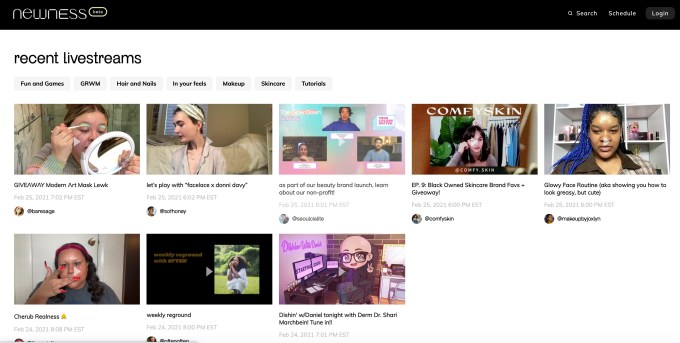
Newness, a startup co-founded by former Twitch employees, has raised $3.5 million in a Sequoia-led seed round for its live-streaming platform aimed at beauty creators and their fan communities. Though today’s creators are not without options when it comes to livestreaming — Twitch, YouTube, TikTok, Instagram and Facebook are all popular choices — Newness is focused on building differentiated tools and features that work well for the beauty streamer market in particular. This includes offering options for both public and private streams, engagement mechanisms that reward positive contributions, moderation features, and the ability for fans to earn access to free beauty products by community participation.

In the new round, Jess Lee invested on behalf of Sequoia Capital. Other investors in Newness include Cowboy Ventures (Aileen Lee), Upside Partnership (Kent Goldman), Dream Machine (former TechCrunch editor Alexia Bonatsos), Index Ventures (Nina Achadjian), Twitch co-founder Kevin Lin, former Twitch execs Jonathan Shipman and John Sutton, Eventbrite founders Kevin and Julia Hartz, Incredible Health co-founder and CEO Iman Abuzeid, and other angel investors from Twitch.

The idea for Newness comes from CEO Jenny Qian, an early Twitch employee who held a number of roles at the game-streaming site over the years, most recently as the Senior Director of Business Strategy for Twitch’s video platform. She’s joined by CTO Youri Park, who also previously worked at Twitch, as well as Blizzard and Facebook Gaming.

Though always an avid gamer herself, Qian says she began getting into skincare after she turned 30. She then soon realized the potential in the live-streaming beauty space.

“I was so used to the format from Twitch. And, in some ways, I feel like I was spoiled with live-streaming,” she explains. Being able to hang out with streamers, ask questions, and learn from them was something that made the live format so compelling, she believes.

Image Credits: Newness

“It made me scratch my head and think: why didn’t something like this exist for the beauty community? It’s a community that is just as passionate, if not more so…and it’s a content category that is so incredibly popular. How come there isn’t a live medium available?,” she wondered.

But at the same time, Qian admits she didn’t feel comfortable going live on Twitch.

“It’s one thing to be made fun of for my gameplay. But I think it’s another if I take my makeup off, and people are making fun of me for how I look. It just cuts to a whole new level,” she says.

With Newness, the goal is to create a sort of anti-Twitch, in a way. It aspires to be a wholesome, positive community for beauty creators and fans, where moderation is a key focus and fans get rewarded for quality participation, not trolling.

When creators go live, Newness will pair them with an in-house moderator to help them feel more comfortable and to keep the content flowing. Once they’re a more established streamer, Newness will work with the creator to locate and elevate a moderator from their own fan community to help out with future streams.

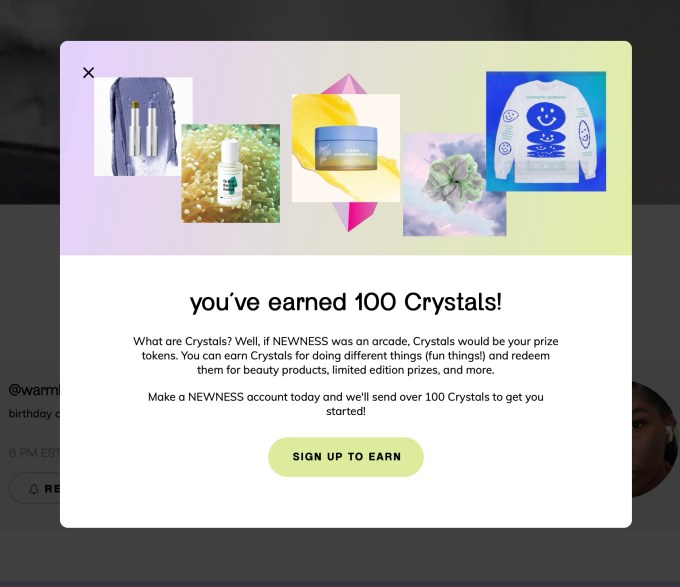
Meanwhile, fans are awarded virtual items called crystals for positive participation and good behavior — for example, for watching your favorite stream and engaging in chat. In Newness, every chat message also has a little heart next to it. And the more hearts you earn over time for higher-quality comments, the more crystals you also earn.

Image Credits: Newness

These crystals can be redeemed for full-size beauty products, which Newness will source through brand deals. Because moderators spend more time on the platform, they’ll also earn more crystals — and that means more opportunities for products.

The positive reward system has so far proven successful during beta tests, as around 66% of Newness viewers, on average, end up chatting during live streams, Qian says.

Another differentiating feature for Newness is the ability for creators to host both public and private streams. The latter is not meant to be some sort of OnlyFans equivalent, but is instead focused on allowing creators to host more professional and exclusive live events. With private streams, creators can sell both general admission and even pricier VIP tickets that could come with some sort of reward — like a goodie bag of beauty supplies.

In addition to events, Newness supports an in-app tipping mechanism called “gifting” on everyday streams.

Eventually, the startup plans to take a share of the revenue these transactions generate, but it hasn’t yet rolled that out as it’s still beta testing.

At present, the Newness community its small. And it still chooses which creators are allowed to live stream.

“We handpick the creators that we let on to our platform and keep it invite-only because we want to make sure that our earliest creators are helping to set the tone and building the culture of the community,” she says. The startup wants to ensure there are enough community members to sustain itself, while also not allowing the community to become toxic as it scales.

“We really care about cultivating an incredibly wholesome community. So for us, safety, moderation — all that is really important to us,” Qian notes.

The creators produce a range of content, including more expert advice and product reviews to more casual “get ready with me” videos and vlogs.

Newness, of course, will face steep competition from larger, existing platforms for streamers, like YouTube and Instagram, as well as from newcomers more focused on beauty videos, like Supergreat.

The startup has been in beta testing since last year, and is only available on the web for the time being. With the seed funding, Newness expects to build out its iOS consumer app in 2021, to complement its dedicated streaming app for creators. (Creators can also opt to stream from their DSLRs, if they prefer.)

It also aims to hire engineering talent and build out its 14-person team that’s now spread out across San Francisco, New York (thanks to some ex-Glossier hires), and L.A.


News: First Boulevard raises $5M for its digital bank aimed at Black America

The murder of George Floyd last May ignited many things in the United States last year — one of which that was perhaps unexpected: a rise in the number of digital banks targeting the Black community. Some members of the Black community took their belief that big banks are not meeting their needs and turned

The murder of George Floyd last May ignited many things in the United States last year — one of which that was perhaps unexpected: a rise in the number of digital banks targeting the Black community.

Some members of the Black community took their belief that big banks are not meeting their needs and turned them into startup concepts.

One of those startups, First Boulevard (formerly called Tenth), has just raised $5 million in seed funding from Barclays, Anthemis and a group of angel investors such as actress Gabrielle Union, Union Square Ventures John Buttrick and AutoZone CFO Jamere Jackson.

For co-founder and CEO Donald Hawkins, the genesis for the Overland, Kansas-bank came after Floyd’s murder, when he and friend Asya Bradley were talking about what they felt Black America “really needed to get out of a vicious cycle” of dealing with the same issues with no real solutions in sight.

CEO Donald Hawkins

COO Asya Bradley

“After viewing yet another tragedy engulf the Black community, and the all-too-familiar protests against persisting issues,” Hawkins said. “it was beyond clear to me that the solutions Black America needs must be financially-focused and developed within our community.”

The pair both had fintech experience. Hawkins had founded Griffin Technologies, a company focused on providing real-time, contextual intelligence to community banks and credit unions. And Bradley most recently was a founding team member and head of revenue at Synapse, a platform that built banking-as-a-service APIs to help bank the unbanked of America by connecting fintech platforms to banking institutions.

They discovered that there were only about 19 Black banks in the U.S., collectively holding about $5 billion in assets.

“And their technology was really behind the times,” Hawkins said. “We also took a hard look at some of the existing digital banks to really see who was really going about it  in the same way that we felt like America needed, and it was pretty clear at that point, that no one was really attacking the issue of helping Black America build some level of financial stability through the form of wealth-building play.”

The pair formed First Boulevard last August under the premise that Black Americans are “massively underserved consumers” of financial products and services despite having a collective spending power of $1.4 trillion annually. The startup’s mission is to empower Black Americans “ to take control of their finances, build wealth and reinvest in the Black economy” via a digitally-native platform. First Boulevard has 100,000 people on its waitlist currently.

Part of its goal with the new capital involves building out a Black business marketplace, which will give its members Cash Back for Buying Black™. It also plans to use the money to expand its team, increase its customer base and grow its platform to offer fee-free debit cards, financial education and on developing technology to help members automate their saving and wealth building goals.

History has proven that oppressed communities can succeed when their finances are centralized, and when it comes to financial services for the Black community, a centralizing force is long overdue,” Hawkins said.

The bank’s Cash Back for Buying Black™ program helps members earn up to 15% cashback when they spend money at black-owned businesses. 

“I believe the most recent stat but that also was that 41% of black owned businesses have closed since COVID-19 started,” Hawkins said. “We want to support them as much as we can.”

First Boulevard also is focused on passively building wealth for its communities.

“Black America as a whole has been blocked from learning how money works. We want to connect our members to wealth-building assets such as micro investments like money market accounts, high yield savings and cryptocurrency — things that Black America has largely been blocked from,” Hawkins said.

Bradley, who serves as First Boulevard’s COO, believes the current financial industry was not built to serve the needs of melanated people. Its goal is to take their understanding of the unique needs of the Black community to provide things such as early access to wages, round up savings features, targeted financial education and budgeting tools.

The pair aims to have a “fully inclusive” team that represents the community it’s trying to serve. Currently, its 20-person staff is 60% black, and 85% BIPOC. Two-thirds of its leadership team are women and 100% is BIPOC. The company plans to boost its headcount to 50 by year’s end.

“We are very proud of that considering that in the fintech space, those are not normal numbers from a leadership perspective,” Bradley said.

For Katie Palencsar, an investor at the Female Innovators Lab by Barclays and Anthemis, said that her firm has always recognized “that access to financial services has long remained a challenge despite the digital evolution.”

“This is especially true for Black Americans who often reside in financial deserts and struggle to find platforms that truly look to serve them,” she said. “First Boulevard deeply understands the challenge.”

Palencsar believes that First Boulevard’s mission of helping Black Americans not just bank, but actually build wealth, is unique in the market.

First Boulevard sees the wealth gap that continues to grow within the U.S. and wants to build a digital banking platform that addresses the systemic and structural challenges that face this population while enabling Black Americans and allies to invest in the community,” she said.

The company also recently announced a partnership with Visa, under which First Boulevard will be first to pilot Visa’s new suite of crypto APIs. First Boulevard will also launch a First Boulevard Visa Debit card.

First Boulevard is one of several digital banks geared toward Black Americans that have emerged in recent months. Paybby, a digital bank for the black and brown communities, recently acquired Wicket, a neobank that uses AI and biometric technology to create a personalized experience for users. Hassan Miah, the CEO and founder of Paybby, said the bank’s goal is to be “the leading smart, digital bank for the Black and Brown communities.”

Paybby, which started by offering a bank account and a way to expedite PPP loans, will soon be adding a cryptocurrency savings account for the Black and Brown communities.   

“Black buying power is projected to grow to $1.8 trillion by 2024,” Miah said. “Brown buying power is over $2 trillion. Paybby wants to take a good portion of this multi-trillion dollar market and give it back to these communities.”

Last October, Greenwood raised $3 million in seed funding from private investors to build what it describes as “the first digital banking platform for Black and Latinx people and business owners.”

At the time, co-founder Ryan Glover, founder of Bounce TV network, said it was “no secret that traditional banks have failed the Black and Latinx community.”

News: Why are we still dating LinkedIn in 2021?

Hello and welcome back to Equity, TechCrunch’s venture capital-focused podcast, where we unpack the numbers behind the headlines. Natasha and Danny and Alex and Grace were all here to chat through the week’s biggest tech happenings. Before we get into this week’s show, make sure to check out all the news here about how Equity is expanding, and becoming even more of

Hello and welcome back to Equity, TechCrunch’s venture capital-focused podcast, where we unpack the numbers behind the headlines.

Natasha and Danny and Alex and Grace were all here to chat through the week’s biggest tech happenings. Before we get into this week’s show, make sure to check out all the news here about how Equity is expanding, and becoming even more of a thing in 2021! We are beyond hyped about it.

Coming on the back of such a wild news week, we had to cut and cut from the notes doc to get the show to size. So, here’s what made the cut:

Equity drops every Monday at 7:00 a.m. PST, Wednesday, and Friday at 6:00 AM PST, so subscribe to us on Apple PodcastsOvercastSpotify and all the casts!

News: TechCrunch Early Stage is the startup bootcamp you’ve always needed

Wondering how to nail that virtual pitch meeting and raise VC funding? Or how to build a high-octane sales team? What about recruiting early team members that will fuel future growth? Managing the finances of a new company while also wondering about your own personal finances as a founder? Legal? Marketing? PR? Being a great

Wondering how to nail that virtual pitch meeting and raise VC funding? Or how to build a high-octane sales team? What about recruiting early team members that will fuel future growth? Managing the finances of a new company while also wondering about your own personal finances as a founder? Legal? Marketing? PR? Being a great leader?

The answer to every single one of these questions, and many more, will be at TechCrunch’s Early Stage events.

The event series takes place across two dates: April 1 – 2 and July 8 – 9.

Unlike other TechCrunch events, there is no ‘main stage.’ Each session is designed to tackle one of the many core competencies any startup needs to be successful. But this isn’t just about listening — every session includes plenty of time built in for audience Q&A. Essentially, it’s all breakout sessions, all day.

Our incredible speakers, who range from Zoom CRO Ryan Azus (‘How to build a sales team’) to Calendly founder Tope Awotona (‘How to bootstrap’) to Kleiner Perkins’ Bucky Moore (‘How to prep for Series A fundraising’), are making themselves available to answer your burning questions, on just about any topic.

What’s more — everyone who buys a ticket to TC Early Stage gets free access to Extra Crunch! Folks who buy a ticket to one of the two events get three months free, and folks who purchase a combination ticket (to both events) get six months free! An Extra Crunch membership includes:

Of course, TC Early Stage dual event ticket holders will get access to both events (April 1 – 2 and July 8 – 9) and have access to all the content that comes out of the event on demand.

Mercenary CEOs know all too well that this is about the most bang you can get for your buck. Period.

Still on the fence? Take a look at a preview of some of the sessions at TC Early Stage 2021:

Fundraising

  • Bootstrapping Best Practices (Tope Awotona and Blake Bartlett, Calendly)
  • Four Things to Think About Before Raising a Series A (Bucky Moore, Kleiner Perkins)
  • How to Get An Investor’s Attention (Marlon Nichols, MacVenture Partners)
  • How to Nail Your Virtual Pitch Meeting (Melissa Bradley, Ureeka)
  • How Founders Can Think Like a VC (Lisa Wu, Norwest Venture Partners)
  • The All-22 View, or Never Losing Perspective (Eghosa Omoigui, EchoVC Partners)

Operations:

  • Finance for Founders (Alexa von Tobel, Inspired Capital)
  • Building and Leading a Sales Team (Ryan Azus, Zoom CRO)
  • 10 Things NOT to Do When Starting a Company (Leah Solivan, Fuel Capital)
  • Leadership Culture and Good Governance (David Easton, Generation Investment Management)

Marketing:

  • Keys to Nailing Product Market Fit (Rahul Vohra, Superhuman)
  • How to Build Your Early Team for Future Growth (Sarah Smith, Bain Capital Ventures)
  • How to Get Into an Accelerator (Neal Sales-Griffin, TechStars)
  • Finding Your Product Market Fit (Sean Lane, OliveAI)
  • How To Use Coaches To Your Advantage (Ted Wang, Cowboy VC)

News: Has a startup finally found one of food science’s holy grails with its healthy sugar substitute?

A little less than three years ago at the Computer Science Museum in Mountain View, Calif. the founders of a young company hailing from Cambridge, England addressed a crowd of celebrities, investors and entrepreneurs at Y Combinator’s August Demo Day promising a revolution in food science. Over the years, the event has become a relatively

A little less than three years ago at the Computer Science Museum in Mountain View, Calif. the founders of a young company hailing from Cambridge, England addressed a crowd of celebrities, investors and entrepreneurs at Y Combinator’s August Demo Day promising a revolution in food science.

Over the years, the event has become a relatively low-tech, low-budget showcase for a group of tech investors and billionaire industry insiders to take a look at early stage businesses that could be their next billion-dollar opportunity.

Sharing the stage with other innovation-minded budding entrepreneurs the Cambridge scientists boasted of a technology could produce a sweetener that would mimic not just the taste of sugar, but the caramelization and stickiness that makes sugar the go-to additive for the bulk of roughly 74% of packaged foods that are made with some form of sweetener. Their company, Cambridge Glycoscience  could claim a huge slice of a market worth at least a $100 billion market, they said.

Now, the company has a new name, Supplant, and $24 million in venture capital financing to start commercializing its low-cost sugar substitute made from the waste materials of other plants.


The bitter history of the sweetest ingredient

Sugar came into the human diet roughly 10,000 years ago as sugarcane, which is native to New Guinea and parts of Taiwan and China. Over the next 2,000 years the crop spread from those regions to Madagascar and eventually took root in India, where it was first refined in about 500 BC.

From there, the sweetener spread across the known world. By the first century AD Greek and Roman scholars were referencing its medicinal properties and, after the Crusades, sugar consumption traveled across Europe through the Middle Ages.

It was a welcome replacement from Europe’s mainstay, honey, and the early artificial sweeteners used by the Romans, which contained near-lethal doses of lead.

The cold climates of Northern Europe proved mostly inhospitable to sugarcane cultivation so the root took root in the more temperate South and the islands off of Europe’s southern coast.

Those regions also became home to the first European experiments with agricultural slavery — a byproduct of the sugar trade, and one that would plant the seeds for the international exploitation of indigenous American and African labor for centuries as the industrial growth of sugar production spread to the New World.

First, European indentured servants and enslaved indigenous people’s powered the production of sugar in the Americas. But as native populations died off due to the introduction of European diseases, genocidal attacks, and back-breaking labor, African slaves were brought to the new colonies to work the fields and mills to make refined sugar.

Sugar hangover

The horrors of slavery may be the most damning legacy of industrial sugar, but it’s far from the only problem caused by the human craving for sweeteners.

As climate change becomes more of a threat, fears of increasing deforestation to meet the world’s demand — or to provide cover for other industrialization of virgin forests — have arisen thanks to new policies in Brazil.

“Conventional cane sugar is heavily heavily water intensive,” said Supplant co-founder Tom Simmons in an interview. That’s another problem for the environment as water becomes the next resource to be stressed by the currents of climate change. And species extinction presents another huge problem too.

“The WWF number one source for biodiversity lost globally is cane sugar plantations,” Simmons said. “Sugar is a massive consumer of water and in contrast, there’s big sustainability pitch for what we do.. the raw materials are products of the current agricultural industry.”

And the quest for sugar substitutes in the U.S. has come with related health costs as high fructose corn syrup has made its way into tons of American products. Invented in 1957, corn syrup is one of the most common sweeteners used to replace sugar — and one that’s thought to have incredibly disastrous effects on the health of consumers worldwide.

The use of corn syrup has been linked to an increasing prevalence of diabetes, obesity, and fatty liver disease, in the world’s population.

MELBOURNE, AUSTRALIA – APRIL 08: In this photo illustration, products containing high sugar levels are on display at a supermarket on April 8, 2016 in Melbourne , Australia. The World Health Organisation’s first global report on diabetes found that 422 million adults live with diabetes, mainly in developing countries. Australian diabetes experts are urging the Federal Government to consider imposing a sugar tax to tackle the growing problem. (Photo by Luis Ascui/Getty Images)

Looking For A Healthier Substitute

As Supplant and its investors look to take the crown as the reigning replacement for sugar, they join a long line of would-be occupants to sugar’s throne.

The first viable, non-toxic chemically derived sugar substitute was discovered in the late 18th century by a German chemist. Called saccharine it was popularized initially during sugar shortages caused by the first World War and gained traction during the health crazes of the sixties and seventies.

Saccharin, still available in pink Sweet n’ Low packets and a host of products, was succeeded by aspartame (known commercially as Equal and present as the sugar substitute in beverages like Diet Coke), which was supplanted by sucralose (known as Splenda).

These chemically derived sweeteners have been the standard on the market for decades now, but with a growing push for natural — rather than chemical — substitutes for sugar and their failures to act as a replacement for all of the things that sugar can do as a food ingredient, the demand for a better sugar has never been higher.

Supplanting the competition 

“Not everything that we back is going to change the world. This, at scale, does that.” said Aydin Senkut, the founder and managing partner of Felicis Ventures, the venture firm that’s one of Supplant’s biggest backers. 

Part of what convinced Senkut is the fact that Supplant’s sweetener has already received preliminary approvals in the European Union by the region’s regulatory equivalent of the Food and Drug Administration. That approval not only covers the sale of Supplant’s product as a sweetener, but also as a probiotic with tangible health benefits he said.

So not only is the Supplant product arguably a better and more direct sugar replacement, as the founders claim, it also has health benefits through providing increased fiber in consumers who use it regularly, Senkut said.

“The European FDA is even stricter than the U.S. FDA,” Senkut said. “[And] they got pre-approval for this.”

Senkut and Felicis invested in Cambridge Glycosciences almost immediately after seeing the company’s presentation at Y Combinator.

“We became the largest investors at seed,” Senkut said.

Its selling points were the products extremely low glycemic index and its ability to be manufactured from waste plant fibers, which means that it ultimately can be produced at a lower cost, according to Senkut.

What’s the difference? 

Supplant differs from its competition in a number of other key ways, according to company co-founder Tom Simmons.

While companies like the Israeli startup DouxMatok or Colorado’s MycoTechnology and Wisconsin’s Sensient work on developing additives from fungus or tree roots or bark that can enhance the sweetness of sugars, Supplant uses alternative sugars to create its sweetener, Simmons said. 

“The core difference is they’re working with cane sugar,” according to Simmons. “Our pitch is we make sugars from fiber so you don’t need to use cane sugar.”

Simmons said that these other startups have been approaching the problem from the wrong direction. “The problem that their technology addresses isn’t the problem the industry has,” Simmons said. “It’s about texture, bulking, caramelization and crystallization… We have a technology that’s going to give you the same sweetness gram for gram.”

There are six different types of calorific sugar, Simmons explained. There’s lactose, which is the sugar in milk; sucrose, which comes from sugarcane and sugar beets; maltose, found in grains like wheat and barley; fructose, the sugar in fruits and honey; glucose, which is in nearly everything, but especially carbohydrate-laden vegetables, fruits, and grains; and galactose, a simple sugar that derives from the breakdown of lactose.

Simmons said that his company’s sugar substitute isn’t based on one compound, but is derived from a range of things that come from fiber. The use of fibers means that the body recognizes the compounds as fibrous and treats them the same way in the digestive tract, but the products taste and act like sugar in food, he said. “Fiber derived sugars are in the category of sugars, but are not the calorific sugars,” said Simmons.
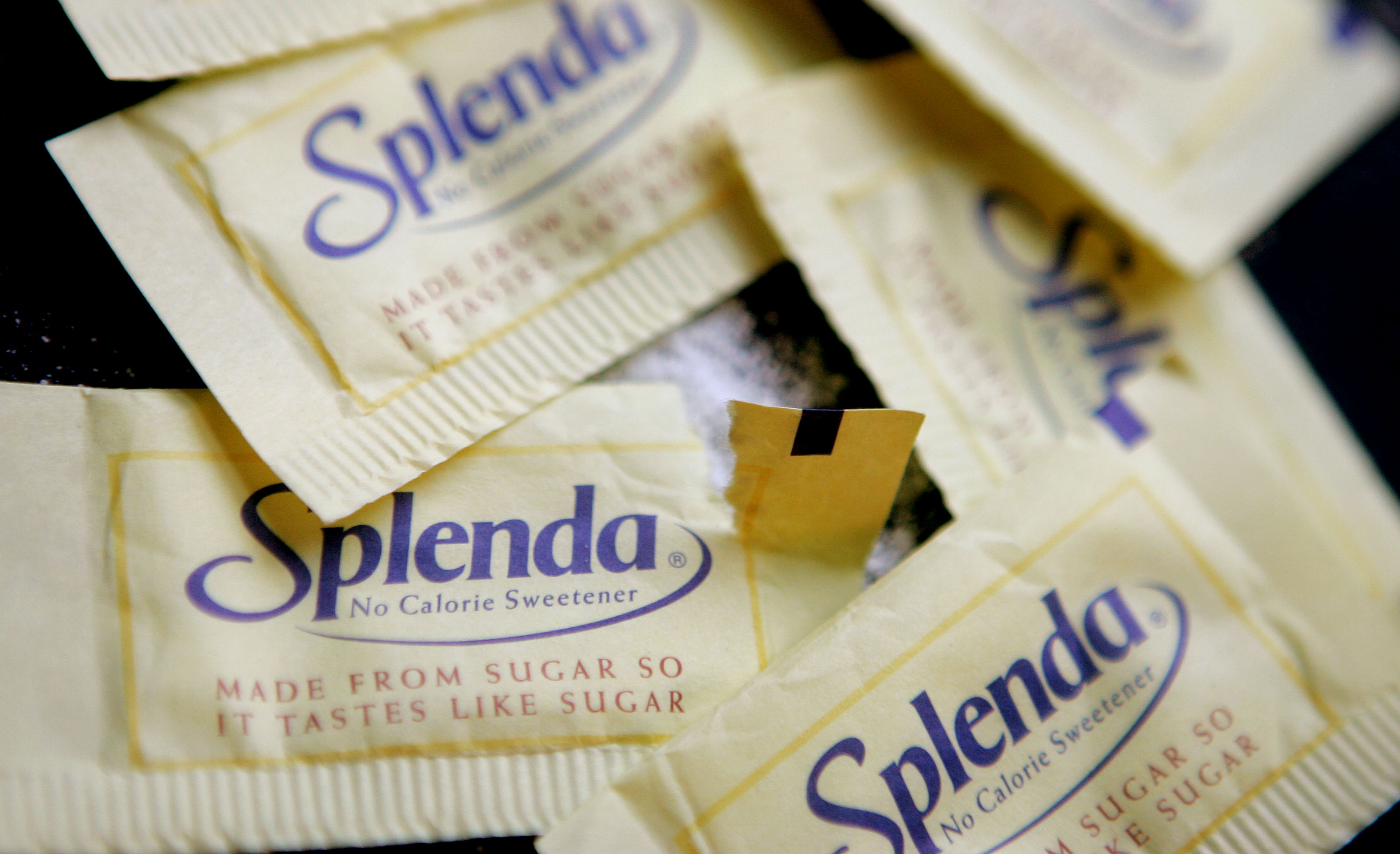
NEW YORK – DECEMBER 6: Packets of the popular sugar substitute Splenda are seen December 6, 2004 in New York City. The manufacturer of sucralose, the key ingredient in the no-calorie sweetener, says demand is so high for the product that it will not be able to take on new U.S. customers until it doubles production in 2006. Splenda has been boosted by the popularity of the low-sugar Atkins diet. (Photo Illustration by Mario Tama/Getty Images)

Trust the process? 

Supplant’s technology uses enzymes to break down and fragment various fibers. “As you start breaking it down, it starts looking molecularly like sucrose — like cane sugar — so it starts behaving in a similar way,” said Simmons.

This is all the result of years of research that Simmons began at Cambridge University, he said. “I arrived at Cambridge intending to be a professor. I did not arrive in Cambridge intending to start a business. I was interested in doing science, making inventions and stuff that would reach the wider world. I always imagined the right way for me to do that was to be a professor.”

In time, after receiving his doctorate and beginning his post-doctoral work into the research that would eventually turn into Supplant, Simmons realized that he had to start a company. “To try and do something impactful I was going to have leave the university,” he said. 

In some ways, Supplant operates at the intersection of all of Simmons’ interests in health, nutrition, and sustainability. And he said the company has plans to apply the processing technology across a range of consumer products eventually, but for now the company remains focused on the $100 billion sugar substitute market.

“There’s a handful of different core underlying scientific approaches in different spaces,” he said. The sort of things that go into personal care and homecare. Those chemicals. A big drive in the industry is for both less harsh and harsh chemicals in shampoos but also to do so in a way that’s sustainable. That’s made form a sustainable source but also biodegradable.”

Next steps 

With the money that the company has now raised from investors including Felicis, Soma Capital, and Y Combinator, Supplant is now going to prove its products in a few very targeted test runs. The first is a big launch with a celebrity chef, which Simmons teased, but did not elaborate on.

Senkut said that the company’s roll out would be similar to the ways in which Impossible Foods went to market. Beginning with a few trial runs in higher end restaurants and foodstuffs before trying to make a run at a mass consumer market.

The feedstocks for Supplant’s sugar substitute come from sugar cane bagasse, wheat and rice husks, and the processing equipment comes from the brewing industry. That’s going to be a benefit as the company looks to build out an office in the U.S. as it establishes a foothold for a larger manufacturing presence down the line.

“We’re taking known science and applying it in the food industry where we know that it has value,” Simmons said. “We’re not inventing any brand new enzymes and each part of the process — none of it on their own are new. The discovery that these sugars work well and can replace cane sugar. That’s someone that no one has done before. Most sugars don’t behave like cane sugar in food. They’re too dry, they’re too wet, they’re too hard, they’re too soft.”

Ultimately the consumer products mission resonates highly for Simmons and his twenty person team. “We’re going to use these hugely abundant renewable resources produced all around the world,” he said. 


News: Brandwatch is acquired by Cision for $450M, creating a PR, marketing and social listening giant

Online consumer intelligence and social media listening platform Brandwatch has been acquired by Cision, best known for its media monitoring and media contact database services, for $450 million, in a combined cash and shares deal. TechCrunch understands Brandwatch’s key executive team will be staying on. The move combines two large players to offer a broad

Online consumer intelligence and social media listening platform Brandwatch has been acquired by Cision, best known for its media monitoring and media contact database services, for $450 million, in a combined cash and shares deal. TechCrunch understands Brandwatch’s key executive team will be staying on. The move combines two large players to offer a broad range of services from PR to marketing and online customer engagement. The deal is expected to close in the second quarter of 2021.

Cision has a media contact database of approximately 1 million journalists and media outlets and claims to have over 75,000 customers. Brandwatch applies AI and machine learning the practice known as ‘social listening’.

Along the way, Brandwatch raised a total of around $65 million. It was Series A-funded by Nauta Capital, followed by Highland Europe and then Partech.

IN a statement, Giles Palmer, founder, and CEO of Brandwatch said: “We have always built Brandwatch with ambition… Now is the time to take the next step – joining a company of significant scale to create a business and a suite of products that can have an important global impact.”

Abel Clark, CEO of Cision said: “The continued digital shift and widespread adoption of social media is rapidly and fundamentally changing how brands and organizations engage with their customers. This is driving the imperative that PR, marketing, social, and customer care teams fully incorporate the unique insights now available into consumer-led strategies. Together, Cision and Brandwatch will help our clients to more deeply understand, connect and engage with their customers at scale across every channel.”

Brandwatch has been on an almost case-study of a journey from fundraising to acquisition to a merger, but less characteristically for a well-funded tech company, it did much of it from its home-town of Brighton, on the southern coast of England.

The financing journey began for Giles Palmer, with Angel funding in 2006. In 2010 Brandwatch raised $1.5m from Durrants, a marketing and PR firm, and Nauta Capital. In 2014 it raised $22 million in funding in a Series B round led by Highland Capital. That was followed by a $33M Series C financing led by Partech Ventures in 2015.

With the war chest, it went on to acquire BuzzSumo in 2017, a content marketing and influencer identification platform, for an undisclosed sum. And in 2019 Brandwatch merged with a similar business, Crimson Hexagon, creating a business with around $100 million in ARR. It also acquired the London-based SaaS research platform Qriously.

Brandwatch was recently named a leader in Forrester’s guide for buyers of social listening solutions.

News: MyHeritage now lets you animate old family photos using deepfakery

AI-enabled synthetic media is being used as a tool for manipulating real emotions and capturing user data by genealogy service, MyHeritage, which has just launched a new feature — called ‘deep nostalgia‘ — that lets users upload a photo of a person (or several people) to see individual faces animated by algorithm. The Black Mirror-style

AI-enabled synthetic media is being used as a tool for manipulating real emotions and capturing user data by genealogy service, MyHeritage, which has just launched a new feature — called ‘deep nostalgia‘ — that lets users upload a photo of a person (or several people) to see individual faces animated by algorithm.

The Black Mirror-style pull of seeing long lost relatives — or famous people from another era — brought to a synthetic approximation of life, eyes swivelling, faces tilting as if they’re wondering why they’re stuck inside this useless digital photo frame, has led to an inexorable stream of social shares since it was unveiled yesterday at a family history conference… 

Rosalind Franklin brought to life with #DeepNostalgia pic.twitter.com/DNQ3kzuf6h

— Dr Adam Rutherford (@AdamRutherford) February 26, 2021

My great great grandmother, Louisa Roakes (1871-1942), animated using the Deep Nostalgia tool on @MyHeritage #Genealogy #MyHeritage #DeepNostalgia pic.twitter.com/mb9b9uQdwi

— Nathan Dylan Goodwin (@NathanDGoodwin) February 25, 2021

This is my great-grandmother, Kathleen. I’ve always felt so close to her even though she died when I was 2 years old. This #DeepNostalgia video brought tears to my eyes to see her move, almost like seeing her as she was posing for this photo. Remarkable! #RootsTechConnect pic.twitter.com/ZRc41JOo3e

— Mike Quackenbush (@mikequack) February 26, 2021

MyHeritage’s AI-powered viral marketing playbook with this deepfakery isn’t a complicated one: They’re going straight for tugging on your heart strings to grab data which can be used to drive sign ups for their other (paid) services. (Selling DNA tests is their main business.)

It’s free to animate a photo using the ‘deep nostalgia’ tech on MyHeritage’s site but you don’t get to see the result until you hand over at least an email (along with the photos you want animating, ofc) — and agree to its T&Cs and privacy policy. Both of which have attracted a number of concerns, over the years.

Last year, for example, the Norwegian Consumer Council reported MyHeritage to the national consumer protection and data authorities after a legal assessment of the T&Cs found the contract it asks customers to sign to be “incomprehensible”.

In 2018 MyHeritage also suffered a major data breach — and data from that breach was later found for sale on the dark web, among a wider cache of hacked account info pertaining to several other services.

The company — which, as we reported earlier this week, is being acquired by a US private equity firm for ~$600M — is doubtless relying on the deep pull of nostalgia to smooth over any individual misgivings about handing over data and agreeing to its terms.

The face animation technology itself is impressive enough — if you set aside the ethics of encouraging people to drag their long lost relatives into the uncanny valley to help MyHeritage cross-sell DNA testing (with all the massive privacy considerations around putting that kind of data in the hands of a commercial entity).

Looking at the inquisitive face of my great grandmother I do have to wonder what she would have made of all this?

The facial animation feature is powered by Israeli company D-ID, a TechCrunch Disrupt battlefield alum — which started out building tech to digital de-identify faces with an eye on protecting image and video from being identifiable by facial recognition algorithms.

It released a demo video of the photo-animating technology last year. The tech uses a driver video to animate the photo — mapping the facial features of the photo onto that base driver to create a ‘live portrait’, as D-ID calls it.

“The Live Portrait solution brings still photos to life. The photo is mapped and then animated by a driver video, causing the subject to move its head and facial features, mimicking the motions of the driver video,” D-ID said in a press release. “This technology can be implemented by historical organizations, museums, and educational programs to animate well-known figures.”

It’s offering live portraits as part of a wider ‘AI Face’ platform which will offer third parties access to other deep learning, computer vision and image processing technologies. D-ID bills the platform as a ‘one-stop shop’ for syntheized video creation.

Other tools include a ‘face anonymization’ feature which replaces one person’s face on video with another’s (such as for documentary film makers to protect a whistleblower’s identity); and a ‘talking heads’ feature that can be used for lip syncing or to replace the need to pay actors to appear in content such as marketing videos as it can turn an audio track into a video of a person appearing to speak those words.

The age of synthesized media is going to be a weird one, that’s for sure.


News: How to land startup funding from Brookfield Asset Management, which manages $600 billion in assets

There are big investment firms, and then there are big investment firms. Brookfield Asset Management, the Toronto-based 122-year-old outfit whose current market cap is $63 billion and that oversees $600 billion in assets, clearly falls into the latter camp. Think real estate, infrastructure, renewable power, private equity, and credit. If it falls into a defined

There are big investment firms, and then there are big investment firms. Brookfield Asset Management, the Toronto-based 122-year-old outfit whose current market cap is $63 billion and that oversees $600 billion in assets, clearly falls into the latter camp. Think real estate, infrastructure, renewable power, private equity, and credit. If it falls into a defined asset class, Brookfield probably has it in its portfolio.

That’s also true of venture capital, though venture is new enough to Brookfield that founders who might like its capital are still getting the memo. Indeed, it was a little less than four years ago that Brookfield Technology Partners began investing off the company’s balance sheet and soon after recruited Josh Raffaelli — a Stanford MBA who cut his teeth as a principal with Draper Fisher Jurvetson, then spent another five years with Silver Lake — to lead the practice.

Its existence came as a surprise to him, actually. “I’ve been a tech investor in Silicon Valley,” says Raffaelli. “My entire professional career has been in a 15-minute drive from the house I grew up in. And I had never heard about Brookfield before they started this practice because it’s in businesses. It’s in real estate. It has done things that are not generally tech-enabled.”

Not until fairly recently, that is. Raffaelli and his 11-person team have not only made dozens of bets since then, but they’re currently investing out of a pool of capital that features third party capital in addition to that of Brookfield — which is a first. As for what they are looking for, the idea is help Brookfield reimagine how its many office towers, malls and other real estate might be used or developed or leased or insured. It’s to make Brookfield smarter, better prepared, and more profitable. In return, the startups get industry expertise and a major customer in Brookfield


To date, its bets have varied widely, as with Armis, an IoT startup focused on unmanaged device security; Loanpal, a point-of-sale payment platform for solar and other home efficiency products; and Carbon Health, a primary care company that blends real-world and virtual visits. “”We’re getting our themes effectively from the Brookfield ecosystem,” Raffaelli says.

Pulling back the curtain a bit more, Raffaelli says his team writes checks from $25 million to $50 million dollars and that they look for companies with $10 million in revenue that are seeing top-line year-over-year growth of more than 100%. In terms of pacing, they jump into roughly one new deal per quarter.

The fund is also independent and has its own custom committee, but that the committee is made up of the senior managing partners from each line of Brookfield’s businesses. (“These are the people that actually help us translate our investment themes that we’re generating here,” Raffaelli notes.)

To highlight how the operation works, Raffaelli points to Latch, a smart access software business that announced last month that it’s using a blank-check company backed by the real estate giant Tishman Speyer to become publicly traded. Brookfield owns roughly 70,000 multifamily units in North America, “so we have a lot of doors that need a lot of locks,” Raffaelli says. Latch, of course, is not the only smart access lock out there, so Brookfield ran “what was almost like a mini [proposal process], reaching out to all different companies in the market to understand how they compete,” he says.

It was a “six-month exercise,” but ultimately, his group led Latch’s Series B round in 2018 and since then, Brookfield was bought about 7,000 blocks from the business. It’s a meaningful difference, considering that when Brookfield first invested, the company had less than $20 million in bookings and those 7,000 locks have since brought in an additional $10 million to $15 million in revenue, Raffaelli says. “When we buy a lot of things at that stage of a company,” he adds, “we’re meaningfully enhancing their trajectory.”

It’s not a foolproof strategy, doubling down. If Latch’s locks turned out to be lemons (they haven’t), Brookfield would be out a big check along with that capital expenditure. It’s why Brookfield takes its time, says Raffaelli, adding that if he has done his job right, his team is involved with a company well before it is raising a round and shown already that it is a “strategic partner that has another lever.”

Either way, Raffaelli says that while the commercial real estate market has been hard hit by the pandemic, it has, counterintuitively, been a productive time for his group given the stronger incentive it has given the real estate world to adopt tech tools faster. Among the bets about which Raffaelli sounds most excited right now is VTS, for example, a leasing and asset management platform that can show properties remotely, and Deliverr, an e-commerce fulfillment startup that Raffaelli describes as “Amazon Prime for everybody else.”

In fact, Raffaelli convincingly argues that while the use case for a lot of real estate is changing,  the so-called built world remains Brookfield’s strongest competitive advantage given the size of its footprint.  The way he sees it, its options going forward are plentiful. “You’re looking at retail locations becoming ghost kitchens; you’re looking at retail locations turning into distribution and logistics facilities. We can turn physical locations into healthcare sites for [our portfolio company] Carbon Health, and our mall locations into locations for urgent care and primary care clinics for testing and vaccinations.”

It will never be a completely seamless transition. Brookfield has to be “thoughtful” given the pandemic and its devastating impacts, too. But Raffaelli comes across as excited in conversation nonetheless. The idea of turning physical real estate into a “mechanism for change within technology businesses,” adds Raffaelli, is a “very powerful place to be.”

WordPress Image Lightbox Plugin