Tag Archives: Blog

News: Polestar, ChargePoint introduce seamless charging in new partnership

A new alliance between Swedish electric performance automaker Polestar and EV infrastructure startup ChargePoint takes aim at the charging experience with the debut of an in-car app that will let customers seamlessly charge their Polestar 2 model vehicles. Seamless charging—being able to pull up to a charging station, plug in and let the vehicle handle

A new alliance between Swedish electric performance automaker Polestar and EV infrastructure startup ChargePoint takes aim at the charging experience with the debut of an in-car app that will let customers seamlessly charge their Polestar 2 model vehicles.

Seamless charging—being able to pull up to a charging station, plug in and let the vehicle handle billing and payment—has been dominated by Tesla through its branded Supercharger network. Most other EV drivers have to pay for charging using an RFID card or smartphone, and the convenience level is on-par with a traditional gas station. The partnership eliminates the need for these extra items at ChargePoint’s more than 130,000 stations. The app will embed directly into Polestar 2’s in-car “infotainment system,” which runs on Google’s Android Automotive OS.

There have been some inroads into seamless charging elsewhere, most notably by Electrify America, the entity established by Volkswagen as part of its settlement with U.S. regulators over its diesel-emissions scandal. It introduced an in-car payment technology dubbed Plug&Charge last November that will allow 2021 models of the Porsche Taycan, Ford Mustang Mach-E and Lucid Air to seamlessly charge at its stations.

The partnership also takes aim at the buying experience, another area that Tesla’s cornered with its branded Wall Connector home charger. Polestar 2 drivers will now be able to order the $699 ChargePoint Home Flex home charger alongside the purchase of a Polestar 2 and arrange for home installation prior to vehicle delivery.

It’s a blueprint for future collaboration between the two companies, ChargePoint senior VP Bill Loewenthal said in a statement. The partnerships may be the start of many more alliances between automakers and EV infrastructure companies who see user experience as a key part of their value proposition.

News: Backstage Capital’s Arlan Hamilton discusses how to find the next unicorn

Arlan Hamilton, the Backstage Capital founder and managing partner, joined us at TC: Sessions Justice to chat about how she vets founders beyond Stanford signal, the changing role of venture capital, how raising money from the community, versus institutional LPs, can impact Backstage strategy. On what makes a founder make sense for Backstage Capital In

Arlan Hamilton, the Backstage Capital founder and managing partner, joined us at TC: Sessions Justice to chat about how she vets founders beyond Stanford signal, the changing role of venture capital, how raising money from the community, versus institutional LPs, can impact Backstage strategy.


On what makes a founder make sense for Backstage Capital

In a world of $1 billion valuations for beta-stage startups and deals closed over the Twitter DMs within hours, it feels like the noisiest time in venture in the recent past. Hamilton talked a bit about how her firm, which has backed over 170 companies founded by underestimated founders, keeps focus. She got into if she follows trends, the dynamic of invite-only apps, and, of course, Twitter.

I just don’t engage and follow and I just don’t have the that same need to be on everything early in first and be everywhere. Really. So, I like to watch people kind of run around and ask for invites and things like that. It’s just not as important to me. It’s just a strategy of like keeping myself calm, because there’s always a VIP to the VIP section, there’s always a further, further, further, and I find some of it quite distracting. I think it helps just to know where I was just a few years ago, and to know, kind of what’s important…and not get caught up in any hype anytime. And I think that serves me well when I’m making investment decisions, too. Because people who interview me or are, you know, want insights from me, they are always asking me about “trends.”  And I just don’t know the trends. We’re kind of counter-intuitive and and dancing to the sound of a different beat anyways. So I think that’s all helpful when we’re looking at companies and finding things in different places. (Timestamp: 1:32)

Backstage Capital was in the fortuitous spot of being built on remote work before the pandemic made it necessary. Still, Hamilton said that vetting early-stage founders is a difficult thing to do, and Backstage Capital only backs about 2% of the founders it sees.

When you talk about founder product fit, we have that in spades. I am gay, and if I wanted to my wife and I wanted to have a child, there would be a lot that goes into that. There’s no accidental pregnancy with us. And so many people, you know, in the same boat, it’s almost like that with underrepresented, underestimated founders. They have so much to lose [and] I think they don’t have a second and a third and a fourth chances are that afforded to them. And so a lot of times, you’ll see companies that are built from such authenticity, and such genuine concern about a problem that they’re trying to solve, rather than so many companies I see elsewhere, that are how do we get rich the fastest way we possibly can. And that doesn’t always set you up with the right with the right recipe for success. (Timestamp 8:04)


On the future of venture capital as an asset class

One thing that came up during the conversation was that Hamilton doesn’t see Backstage Capital staying within the definition of a traditional venture capital firm. At first thought, this shouldn’t come as a total surprise, considering the rise in popularity of alternative financing among startups, from debt raises, to rolling funds, to revenue-based financing loans.

But in reality, Hamilton says that she has always known that Backstage Capital was a vector into the exclusive world of investment, which despite modest progress has still been reserved for wealthy, white men. Here’s what she said when I asked where she sees herself in five years:

I’ve always said this, I don’t know if people pay too much attention to it, but I’ve always said that venture capital was the tool. It was the mechanism for which I could get in. I couldn’t be an angel investor, couldn’t do all these things. But, I could earn and learn my way in to venture capital. I’ve never been beholden to it. I’ve always said to that, I don’t know what the future holds. But I think maybe there’s another asset class that gets born. And we would certainly be part of that. And if that’s the case, I just think it’s a broken system. It’s an old system. There is a lot that needs to be fixed.

And, again, it’s the people are kind of living in a fantasy world…So I think, just the way that I came in, I’ll probably pivot or or backstage, we’ll find ways we’ve already started. I mean, if you look at the rays that we did on Republic recently, that were that were, you know, still you could still be part of it, it’s just it’s an interesting thing. It didn’t exist, the way that we wanted it to exist this ability to to go to the crowd as a fund. And we trailblazing made a way we made a path. And I think that’s what founders are doing. We were just inspired by founders who are making a way for themselves left and right. (Timestamp: 15:50)

Her confidence in a potential pivot of Backstage Capital also stems from the fact that venture capital has stagnated, as an industry, to invest in underrepresented founders. The investor explained how the industry might lag behind from big deals if they continue to skip over diverse founders. Venture capital, as she sees it, might become less relevant in the future.

And eventually what’s going to happen is what I’ve seen so much of the same way people are leaving San Francisco in droves, they’re going to leave the arena of venture capital in droves. because so many people have just said I’m done trying to play that game. I’m going to bypass this altogether. I’m going to bootstrap I’m going to crowdfund I’m going to go with family offices. And venture capitalists don’t have that same sway and that same importance that they once did. And you may not feel that today, but you feel it soon. And you’re going to be the person who did not invest in Bumble, you’re going to be the person who did not invest in XYZ. So it’s at your own peril that you keep being blind to this in my opinion. (Timestamp: 14:38)


On raising from a community

Since founding Backstage Capital, Hamilton has been clear that she believes the biggest opportunity for investment is underrepresented founders. Toddy, she talked about her decision to bring let others into the process through Republic.

Now let’s be clear: equity crowdfunding isn’t a new concept, but this year will likely bring some healthy energy to the fundraising technique. It’s because new SEC rules allow companies to now raise $5 million a year through the fundraising channel. Republic is enabling startups and firms to take advantage of these new rules: the platform had more than $150 million in capital deployed across 150 deals in 2020.

In the chat, Hamilton explained why raising from supporters one by one instead of an institutional fund is important toher.

For so many years, we had been beholden to ‘you need to raise a large fund, and then you need the management fee to pay for your operations, to keep you in business.’ And every single year, we found a different way to do that, by necessity. It has been so difficult to raise. And this time, the crowd comes into play. That’s a grand and a great responsibility to have 1000s of people who are looking to you, looking for updates, and wanting you to win. I wouldn’t have it any other way. I’d much rather have 5000 people get a few extra bucks every year and be part of this, then to watch one or two institutional just get fatter. It’s just not as exciting. So the institutions are going to have to compete with the crowd now. And that is where things get really, really interesting. (Timestamp: 18:09)

You can read the entire transcript here.


News: Dropbox to acquire secure document sharing startup DocSend for $165M

Dropbox announced today that it plans to acquire DocSend for $165 million The company helps customers share and track documents by sending a secure link instead of an attachment. “We’re announcing that we’re acquiring DocSend to help us deliver an even broader set of tools for remote work, and DocSend helps customers securely manage and

Dropbox announced today that it plans to acquire DocSend for $165 million The company helps customers share and track documents by sending a secure link instead of an attachment.

“We’re announcing that we’re acquiring DocSend to help us deliver an even broader set of tools for remote work, and DocSend helps customers securely manage and share their business critical documents, backed by powerful engagement analytics,” Houston told me.

When combined with the electronic signature capability of HelloSign, which Dropbox acquired in 2019, the acquisition gives the company an end-to-end document sharing workflow it had been missing. “Dropbox, DocSend and HelloSign will be able to offer a full suite of self-serve products to help our millions of customers manage the entire critical document workflows and give more control over all aspects of that,” Houston explained.

Houston and DocSend co-founder and CEO Russ Heddleston have known each for other years, and have an established relationship. In fact, Heddleston worked for Dropbox as a summer in intern in 2010. He even ran the idea for the company by Houston prior to launching in 2013, who gave it his seal of approval, and the two companies have been partners for some time.

“We’ve just been following the thread of external sending, which has just kind of evolved and opened up into all these different workflows. And it’s just really interesting that by just being laser focused on that we’ve been able to create a really differentiated product that users love a ton,” Heddleston said.

Those workflows include creative, sales, client services or startups using DocSend to deliver proposals or pitch decks and track engagement. In fact, among the earliest use cases for the company was helping startups track engagement with their pitch decks at VC firms.

The company raised a modest amount of the money along the way, just $15.3 million, according to Crunchbase, but Heddleston says that he wanted to build a company that was self-sufficient and raising more VC dollars was never a priority or necessity. “We had [VCs] chase us to give us more money all the time, and what we would tell our employees is that we don’t keep count based on money raised or headcount. It’s just about building a great company,” he said.

That builder’s attitude was one of the things that attracted Houston to the company. “We’re big believers in the model of product growth and capital efficiency, and building really intuitive products that are viral, and that’s a lot of what what attracted us to DocSend,” Houston said. While DocSend has 17,000 customers, Houston says the acquisition gives the company the opportunity to get in front of a much larger customer base as part of Dropbox.

It’s worth noting that Box offers a similar secure document sharing capability enabling users to share a link instead of using an attachment. It recently bought e-signature startup SignRequest for $55 million with an eye toward building more complex document workflows similar to what Dropbox now has with HelloSign and DocSend. PandaDoc is another competitor in this space.

Both Dropbox and SendDoc participated in the TechCrunch Disrupt Battlefield with Houston debuting Dropbox in 2008 at the TechCrunch 50, the original name of the event. Meanwhile, DocSend participated in 2014 at TechCrunch Disrupt in New York City.

DocSend’s approximately 50 employees will be joining Dropbox when the deal closes, which should happen soon, subject to standard regulatory oversight.

News: Demostack announces $17.3M investment for demo building platform

Demostack, an early stage startup that wants to make it easy for companies to build software demos, announced $17.3 million in funding today. The company also announced it was coming out of stealth. That investment breaks down into a $13.3 million Series A led by Bessemer Venture Partners with help from GTM Fund and several

Demostack, an early stage startup that wants to make it easy for companies to build software demos, announced $17.3 million in funding today. The company also announced it was coming out of stealth.

That investment breaks down into a $13.3 million Series A led by Bessemer Venture Partners with help from GTM Fund and several individual investors. They also announced a $4 million seed from last December led by Amiti Ventures with participation from Operator Collective, Cerca Partners and a slew of individual investors. All the seed investors also participated in the A round, according to the company.

Software companies of all types face challenges in building a quality demo, one that doesn’t expose actual customer information, yet shows all of the functionality in a reasonably realistic way. It’s a problem that co-founder and CEO Jonathan Friedman experienced in his previous job and he wanted to do something about it.

“We’re building a perfect demo environment. And what that means is that it’s one that is controlled by sales or marketing. […] There is no need for [engineering] at all, and it’s customized for each prospect by default,” Friedman explained.

He said that it removes that anxiety that the demo won’t work, or that you will expose data you’re not supposed to. “Demo anxiety is real. Just having to worry about PII (personally identifiable information), and having people logging on and coming in and creating stuff within our production environment was unsustainable,” he told me.

Friedman founded Demostack to change that. They provide a full demo building tool that starts with a recording of the environment, so it looks and feels like the live product, and you can create auto customization with variables like customer name that link to the CRM tool and pull in information for you as you build the demo for a particular prospect.

It’s a solution that caught the attention of Adam Fisher, partner at lead investor Bessemer Venture Partners. “Demostack gives every software business a powerful competitive advantage, allowing them to better engage their prospective customers, doing away with old school temperamental demos,” he said in a statement.

Demostack already has 20 employees with plans to triple that number by the end of this year. He said the company is already embracing diversity among its early employees, and sees this as an important building block.

“One of the main reasons that we wanted to lean into this early is because being a diverse company is not a bonus. It’s not like, ‘Oh I’ll do this to make people happy about me’. You can’t understand how people from different walks of life see reality. Everyone sees a different slice of reality. If you can’t grasp that you will never build a company that is successful,” Friedman said.

The company launched last September and released an early version of the product in February. Today, Demostack is publicly unveiling the company, although it doesn’t expect to have the complete product ready for distribution until mid-year.

News: Apple releases results from its Women’s Health Study

Last week, Apple announced early results from its ongoing hearing health study. Conducted alongside the University of Michigan School of Public Health, the figures were released to mark World Hearing Day. Now, a day after International Women’s Day, it’s releasing results tied to its Women’s Health Study. As with the hearing study, the figures are

Last week, Apple announced early results from its ongoing hearing health study. Conducted alongside the University of Michigan School of Public Health, the figures were released to mark World Hearing Day. Now, a day after International Women’s Day, it’s releasing results tied to its Women’s Health Study.

As with the hearing study, the figures are collected from those who choose to participate via the Research app the company launched back in 2019. It’s all a part of Apple’s attempts to take a more serious approach to user health, built, in part, on data collected through the Apple Watch and iPhone.

Early results note that symptoms like nausea and sleep changes are common, along with more frequently discussed things like bloating and cramps. The study also notes that many of the tracked symptoms are common and consistent across age, race and location — even though they may not be widely discussed. The company says the efforts are, in part, to de-stigmatize discussions around these sorts of symptoms.

Data was collected from some 10,000 participants around the U.S. with a range of different ages and ethnic backgrounds. While much of the data collection is still in early stages, Apple and research partner Harvard are looking to study the connection between menstrual cycles and a variety of different health conditions, including infertility, polycystic ovary syndrome and perimenopause.

“What researchers and physicians in the scientific community want and need to know is more about the menstrual cycle, its relation to long-term health, as well as more about what environmental factors might affect cycle length and characteristics,” Harvard’s Dr. Shruthi Mahalingaiah said in a statement. “With this study, we are creating a larger foundational data set on this topic, which can eventually lead to further discovery and innovation in women’s health research and care.”

News: This Pipe-ing hot startup just raised $50M to be the ‘Nasdaq for revenue’

A little over one year ago, Pipe raised a $6 million seed round led by Craft Ventures to help it pursue its mission of giving SaaS companies a funding alternative outside of equity or venture debt. The buzzy startup’s goal with the money was to give SaaS companies a way to get their revenue upfront

A little over one year ago, Pipe raised a $6 million seed round led by Craft Ventures to help it pursue its mission of giving SaaS companies a funding alternative outside of equity or venture debt.

The buzzy startup’s goal with the money was to give SaaS companies a way to get their revenue upfront by pairing them with investors on a marketplace that pays a discounted rate for the annual value of those contracts. (Pipe describes its buy-side participants as “a vetted group of financial institutions and banks.”)

A few months after that initial seed raise, Pipe brought in another $10 million in funding as an extension of that round.

And now today, Miami-based Pipe is announcing a new raise — $50 million in “strategic equity funding” from a slew of high-profile investors. Siemens’ Next47 and Jim Pallotta’s Raptor Group co-led the round, which also included participation from Shopify, Slack, HubSpot, Okta, Social Capital’s Chamath Palihapitiya, Marc Benioff, Michael Dell’s MSD Capital, Republic, Alexis Ohanian and Joe Lonsdale.

While most of the round is dedicated to purchasing primary equity, a minority of the round is allocated toward buying secondary equity (meaning that a small portion of the dollars raised went toward buying shares from existing shareholders, such as employees and executives).

Pipe co-CEO and co-founder Harry Hurst is loath to label the latest raise with a stage.

“We don’t want to play the alphabet game,” he said. “This wasn’t about the money. We had five or six years of runway going into this round. It was about getting the right partners on our cap table.”

In conjunction with the new financing, Pipe said it is also broadening the scope of its platform beyond strictly SaaS companies to “any company with a recurring revenue stream.” This could include D2C subscription companies, ISP, streaming services or a telecommunications companies. Even VC fund admin and management are being piped on its platform, for example, according to Hurst.

“When we first went to market, we were very focused on SaaS, our first vertical,” he said. “Since then, over 3,000 companies have signed up to use our platform.” Those companies range from early-stage and bootstrapped with $200,000 in revenue to publicly traded companies.

Pipe’s platform assesses a customer’s key metrics by integrating with its accounting, payment processing and banking systems. It then instantly rates the performance of the business and qualifies them for a trading limit. Trading limits currently range from $50,000 for smaller early-stage and bootstrapped companies to over $100 million for late-stage and publicly traded companies, although there is no cap on how large a trading limit can be.

“The best way to summarize it is we can work with any company that has a high degree of predictability around their revenue,” Hurst said. Pipe, he added, aims to turn that monthly recurring revenue into annual recurring revenue.

In the first quarter of 2021, tens of millions of dollars were traded across the Pipe platform. Between its launch in late June 2020 through year’s end, the company also saw “tens of millions” in trades take place via its marketplace. Tradable ARR on the platform is currently in excess of $1 billion.

“We’re helping companies grow on their own terms,” Hurst said. “Or, you could say we’re building the Nasdaq for revenue. Virtually every company in the world has a recurring revenue model already, or if they don’t, they’re thinking about how they can shift to it.”
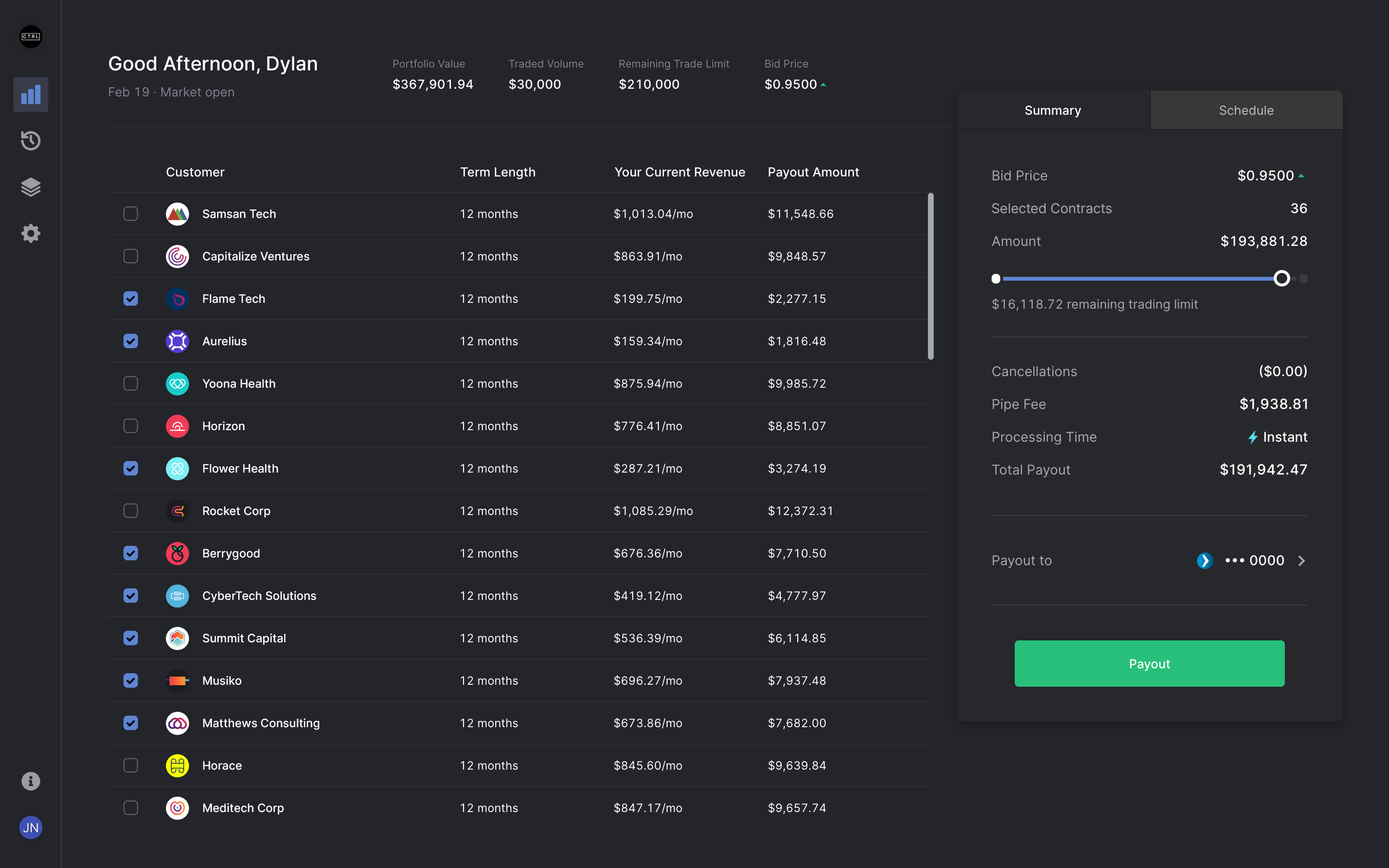
Image Credits: Pipe

Pipe is also using its new capital and partnerships to take its platform to a global stage.

The startup officially launched in the U.S. but is seeing traction in Europe, Asia-Pacific, Latin America and Canada. Long-term, Hurst expects India to be one of its largest markets.

“When we talk about global expansion, we’re talking about multi-currency support,” Hurst said. “And, teams on the ground in local markets. Technically we’ve served a global audience from day one.”

Some context

Hurst, Josh Mangel and Zain Allarakhia founded Pipe in September 2019.

The goal of the platform is to offer companies with recurring revenue streams access to capital so they don’t dilute their ownership by accepting external capital or forcing them to take out loans.

Pipe, essentially, is a trading platform for a new asset class: recurring revenue.

But Hurst is also quick to say the 25-person company doesn’t view its solution as an alternative to equity in every case.

“We feel like there’s a very important time and place for equity,” he said. “The fundamental problem with equity is that selling it becomes more valuable over time as you grow.”

Pipe, he said, has no cost of capital. Institutional investors compete against each other for deals on its platform. In return, Pipe charges both parties on each side of the transaction a fixed trading fee of up to 1%, depending on the volume.

Its goal with the latest round is to partner with its investors “to provide access to growth capital for the millions of customers they collectively service.”

“They’re building tools on the product side and we’re providing access to capital markets, and especially in the case of early-stage companies that would not otherwise have access to capital, we’re trying to level the playing field,” Hurst said.

Its investors all echo a similar sentiment: that they like how Pipe gives companies an alternative to traditional funding mechanisms.

For Monty Gray, SVP Corporate Development at Okta, Pipe’s platform “simplifies the time-consuming process of traditional fundraising, allowing founders to focus on their core product growth.”

“We are excited to see how Pipe can help not only Okta Ventures’ portfolio startups approach financing, but also Okta’s large customer base,” he said.


News: M1 Finance raises another rapid-fire round after scaling its AUM to more than $3.5B

Months after raising a Series C worth $45 million, Chicago-based M1 Finance announced a new round of capital today. A Series D, the new $75 million investment was led by Coatue, with two prior investors — Left Lane Capital and Clocktower Technology Ventures — also taking part. The new financing comes after M1 raised twice

Months after raising a Series C worth $45 million, Chicago-based M1 Finance announced a new round of capital today. A Series D, the new $75 million investment was led by Coatue, with two prior investors — Left Lane Capital and Clocktower Technology Ventures — also taking part.

The new financing comes after M1 raised twice in 2020, including the previously mentioned Series C and a smaller $33 million Series B.

While rapid-fire fundraising has become increasingly common in recent years, M1 Finance’s recent capital accretion remains notable for its pace and scale. And as the company has been comparatively free with both growth metrics and notes about its long-term business model, TechCrunch has been able to keep tabs on its expansion over the past few quarters.

M1 Finance’s growth

In February of 2020, M1 announced it had reached the $1 billion assets-under-management (AUM) mark after starting the year at $800 million. At the time, the company’s CEO Brian Barnes told TechCrunch that his company was targeting to generate revenues of around 1% of consumer AUM. That provided a good toe-hold into tracking how quickly the startup was scaling its revenues as it grew its asset base.

In June of 2020, the company announced its Series B and a new AUM milestone: $1.45 billion. That was something akin to 50% growth in les than half a year. Not bad.

When M1 Finance raised its Series C later that year, it had scaled to $2 billion in AUM. That was double its earlier-year tally, and was big enough to secure more of our attention. Then in January of 2021 the company announced $3 billion in AUM.

As you can quickly math out, 1% of $3 billion is $30 million in yearly income, provided that M1 is hitting its revenue goals. Today as part of its Series D, the company announced that it has reached $3.5 billion in AUM.

How did it manage such quick growth, adding $500 million in AUM in just a few months? According to Barnes, partially due to an expanding product mix. The startup added a cash-management product in early 2019. That service has reached hundreds of millions of dollars in assets, the CEO said. The company’s borrowing product has also seen rapid growth, quadrupling as a percentage of assets in the last year, he added.

AUM expansion has also been driven in part by the company’s user base. Barnes told TechCrunch that his company has around 500,00 funded accounts, a growing tally that has helped with word-of-mouth marketing in recent quarters. And, finally, AUM growth has come from existing user cohorts adding more capital to their M1 accounts over time, the CEO said.

Of course the company is not the only service in the savings, investing and spending spaces that has seen growth in the last year. Robinhood and Public have done well on the investing side of things, and Chime has scaled quickly in the spending and saving markets.

What’s ahead

M1 has more money than ever after this round, with its CEO telling TechCrunch that he had had no intention of raising new capital, and that his company had only barely touched its Series B while its entire Series C is untapped. But now with a fresh forklift of funds, perhaps M1 can boost its advertising spend to help keep its user growth strong; and the extra capital won’t hurt when it comes to competing with even better-funded rivals that also want to build consumer fintech super apps.

We’ll check back with M1 Finance when it reaches $10 billion AUM. Its CEO thinks that the company could reach double-digit billions of AUM by the end of the year, or early 2022. Let’s see how fast it reaches that next milestone.

News: Cube raises $10M more to help companies plan their financial future

This morning Cube, a startup that builds FP&A software for the mid-market, announced that it has raised a $10 million Series A. The company previously raised a $5 million seed round that TechCrunch covered last August. Mayfield led its Series A, which saw participation from Operator Collective and Bonfire Ventures. FP&A is probably not an

This morning Cube, a startup that builds FP&A software for the mid-market, announced that it has raised a $10 million Series A. The company previously raised a $5 million seed round that TechCrunch covered last August. Mayfield led its Series A, which saw participation from Operator Collective and Bonfire Ventures.

FP&A is probably not an acronym that you come across often. It spells out to financial planning and analysis, or the process by which companies outline their financial future. It’s pretty damn important. But like lots of the tech that CFOs and other financial types use, software in the FP&A space is often a mix of antiquated, expensive and slow.

Just ask the CFO you know best. Cube wants to build software for FP&A work that at once isn’t awful, and doesn’t require companies to stop using spreadsheets. The company’s software absorbs information from a company’s general ledger (accounting software), CRM (Zoho CRM, perhaps) and payroll service into one location. From there, CFOs and their team can view the past and sketch their financial future using a few different viewing methods, including the venerable spreadsheet.

When TechCrunch last checked in on Cube, we said that we’d report back when the company had growth numbers to share. Happily the startup’s CEO Christina Ross was willing to share. Per the founder, Cube customers have scaled 4x since its seed round, and revenue growth is tracking ahead of customer growth. Even better, Cube’s contract mix has shifted, with the company now securing more than half of its deals with multi-year terms.

When we spoke to Ross, her newest investor, Mayfield’s Rajeev Batra, was also on the call. He added that Cube has seen deal win rates in the 60% to 70% range, implying that it has found product-market fit. As Cube’s software starts at $850 per month for its service, any deal win is material annual recurring revenue (ARR) for the early-stage startup. Batra also stressed that Cube is seeing strong engagement inside of its product.

What is Cube going to do with its new capital? Ross said that she’s a trained CFO and knows the worries of raising too much money. She knows where the money is going, she added. One place the company intends to spend is headcount. The startup plans to triple its personnel base by the end of 2021, hiring for both product and go-to-market (GTM) roles. Ross also noted her company had built out its sales function after its seed round, and intends to grow its marketing efforts now that it has secured new capital.

Cube fits neatly into a trend that we’re seeing in recent months of companies not merely raising successive funding rounds more rapidly than the old-fashioned 18-month cadence. It’s somewhat common lately to see some startups raising new rounds just a few quarters after their last capital event. M1 Finance also announced a new round this morning, for example; it raised twice in 2020.

Let’s see what Cube can do with its Series A. If it can keep its recent pace of growth up, perhaps it will raise again this year.

News: Two European companies are mapping a future service for direct air capture to sequestration of CO2

The Swiss-based, venture capital-backed, direct air capture technology developer Climeworks is partnering with a joint venture between the government of Norway and massive European energy companies to map the pathway for a business that could provide not only the direct capture of carbon dioxide emissions from air, but the  underground sequestration and storage of those

The Swiss-based, venture capital-backed, direct air capture technology developer Climeworks is partnering with a joint venture between the government of Norway and massive European energy companies to map the pathway for a business that could provide not only the direct capture of carbon dioxide emissions from air, but the  underground sequestration and storage of those emissions.

The deal could pave the way for a new business that would offer carbon capture and sequestration services to commercial enterprises around the world, if the joint venture between the Climeworks and the newly formed Northern Lights company is successful. It would mean the realization of a full-chain carbon dioxide removal service that the two companies called a necessary component of the efforts to reverse global climate change.

Northern Lights was incorporated in March as a joint venture between Equinor, Shell and Total to provide processing, transportation and underground sequestration services for captured carbon dioxide emissions. The business is one of the lynchpins in the Norwegian government’s efforts to capture and store carbon emissions safely underground under a plan called The Longship Project.

“There is growing awareness of the need to build capacity to remove CO2 from the atmosphere to achieve net zero by 2050. We are enthusiastic about this collaboration with Climeworks. Combined with safe and permanent storage, direct air capture has the potential to get the carbon cycle back in balance,” said Børre Jacobsen, the  Managing Director of Northern Lights, in a statement.

The two companies are hoping to prove that Northern Lights facilities combined with Climeworks direct air capture technologies can prove to be a part of a push towards negative emissions technologies that allow companies in non-industrial sectors to become either carbon neutral or carbon negative.

There are a number of caveats to the project, which reveal both the potential promise and pitfalls of direct air capture initiatives and sequestration and monitoring projects.

The first issue is the need to set a global price for carbon dioxide emissions that would take to make the projects economically viable.

“There is one legislation worldwide that is paying for direct air capture of CO2 and that is the Low Carbon Fuel Standard in California,” said Christoph Gelbad, the co-chief executive and co-founder of Climeworks. “It’s paying up to $200 per ton… this price range is the price range that will be needed to make this full chain, really going from the atmosphere to direct air capture to underground storage and monitoring. That will be the price range needed to build up the infrastructure and finance it.”

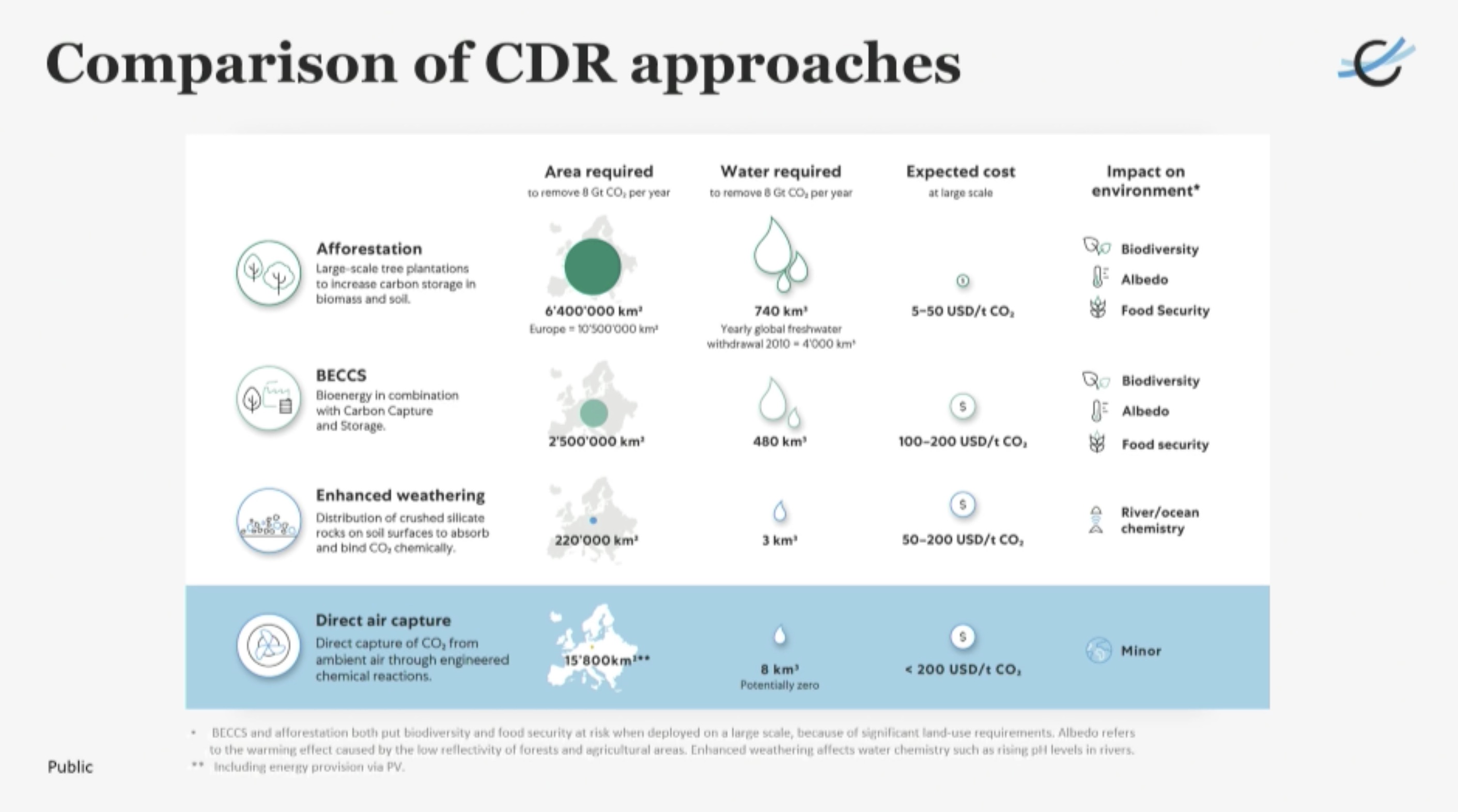
A breakdown of the costs associated with different carbon capture technologies.Image Credit: Climeworks

That price is on the highest end of any that world leaders have discusses as a potential cost for carbon emitting industries (and it’s well below the price that China has set for carbon emissions, which is important to note given the scale of China’s contribution to the production of greenhouse gases that cause global warming).

Beyond any pricing concerns associated with making these direct air carbon capture and storage solutions viable, there’s the scale at which these projects would need to be developed to make a real dent in global emissions.

Here again, Gelbad offers a clear-eyed assessment of his company’s capabilities and the size of the problem.

“The numbers given by science 10 to 20 billion tons of CO2 for removal,” Gelbad said. “Direct Air Capture will need to grow at a gigaton scale. This [potential] site will be in the megaton scale. [But] this is the range where our journey together with Northern Lights definitely could go. We see it going into the megaton ranges.”

Climeworks uses renewable energy and waste heat to power modular collectors that can be stacked into machines at any size. The only limit to the company’s ability to capture carbon dioxide is the availability of power, according to Gelbad.

The company already has a collaboration with an Icelandic company called Carbfix, where the Climeworks technology is used to capture carbon dioxide and store it in mineralized basalt. The company said in a statement that it’s looking globally for other opportunities for permanent carbon dioxide storage and that the Northern Lights solution of deep geological sequestration in an offshore saline aquifer under the North Sea represents an ideal alternative site.

To develop its technology, Climeworks has raised over $150 million from investors including the Swiss lender Zuercher Kantonalbank.

For its part, Northern Lights is already planning on capturing carbon dioxide from industrial point sources in the Oslo region, which will then be shipped to an onshore terminal on the Norwegian coast. A facility there will transport the liquefied carbon dioxide by pipeline to an offshore storage location 1.62 miles below the seabed in the North Sea.

“Northern Lights is offering carbon capture and sequestration as a service. From the idea of doing this project and from the early days of working with the ministry … my biggest surprise was the level of interest in [carbon capture and sequestration] among emitters in Europe,” said Jacobsen. “This awareness. This interest. And the need to find a solution is accelerating. We are talking about what are the possibilities and what are the solutions. Northern Lights offers a great part of the value chain.”

Some companies are already interested in becoming early customers for the project, Jacobsen said. “We have a number of MOUs and confidentiality agreements with customers and letters of support. Big interest in discussing with us. The key will be that we have to bring conversations into agreements so that we can bring this business forward.”

News: Wefarm adds $11M to expand its network for independent farmers, now at 2.5M users

The vast majority of startups remain focused on consumers, knowledge workers and the opportunities to provide services to those that are already operating completely, or at least partially, in digital environments. But today comes news of funding for a startup building a social network for what is probably one of the least digital business sectors

The vast majority of startups remain focused on consumers, knowledge workers and the opportunities to provide services to those that are already operating completely, or at least partially, in digital environments. But today comes news of funding for a startup building a social network for what is probably one of the least digital business sectors of all: independent, small-hold farmers in the developing world.

Wefarm, a social networking platform aimed at independent farmers to help them meet each other, exchange ideas and get advice, and sell or trade equipment and supplies, has raised $11 million funding to continue expanding its business, which now has 2.5 million users.

To put that number and the growth opportunity into some perspective, Wefarm estimates that there are some 400 million small-hold farmers globally, with a large proportion of them in developing markets.

The funding, an extension to the company’s 2019 Series A, is being led by Octopus Ventures. True Ventures (which led the 2019 round), Rabo Frontier Ventures, LocalGlobe, June Fund and AgFunder also participated. Wefarm has raised $32 million since being founded in 2015.

To date, London-based Wefarm has primarily found traction in countries in East Africa. Its service is available via a website, but most of its users are accessing without any internet use at all, via the company’s SMS interface. The SMS format has now hosted more than 37 million conversations from farmers engaging in around 400 different types of farming (from livestock or dairy to grains and fruits and vegetables) and $29 million in marketplace sales, the company said.

But rolling out SMS services can be slow, in part because it requires Wefarm to strike local deals with carriers over data usage. (That has also meant that the company has tightly controlled growth: if you go to the main site, you’ll see that you can either join a waitlist or join by way of an invitation from an existing member.)

Kenny Ewan, Wefarm’s founder and CEO, said this latest tranche of funding in part will be used to roll out an app (currently in beta) that will help it launch in more countries and pick up more farmers.

“The big step we’re taking is going from SMS a digital, app-based service, which will remove the digital barrier,” he said in an interview. “We compare it to the shift from sending DVDs in the mail to streaming video online. We feel like the time is right and believe it could take us to the 100 million mark of users.”

From pandemics to locust plagues

Wefarm’s role in helping link up independent farmers — traditionally and by its nature one of the most analogue of industries — has taken on an interesting profile particularly in the last year.

The Covid-19 pandemic has thrown a stark light on a number of digital divides in the world, and one of most distinctive has been in the wider world of business. Entrepreneurs, companies and organizations that had digital strategies in place could hit the ground running to adapt to a “new normal” with less physical interaction. Those that did not had to scramble to get there to avoid a nosedive in activity.

Wefarm was around for years before the Covid-19 pandemic, and in some regards it has always been championing and giving a digital voice to the underdogs.

The wider agricultural industry — globally a multi-trillion dollar enterprise, accounting for up to 25% of GDP in some markets — has undergone some significant digital transformation, but that has been focused on tools and other technology for the agribusiness sector, which includes the giant conglomerates and multinationals like Cargill, Archer-Daniels-Midland, Bayer (Monsanto’s parent), John Deere and others.

Wefarm’s importance (and often singular presence) as a tool for independent farmers to communicate, trade and generally network with others like them was already playing out before Covid-19. When we covered the company’s previous raise in 2019 (the first part of its Series A, a $13 million round) it had already grown to 1.9 million members. And, as it happens, for many of its users, Covid-19 was in some regards the least of their concerns:

“In reality a lot of people in rural Africa were concerned about the weather, or the effect of a locust plague,” Ewan said. “What we saw was traffic around not Covid, but these topics. They had different preoccupations.”

But the pandemic has had an impact, nevertheless. On the platform itself, as we saw in other e-commerce scenarios, Wefarm emerged as an essential service for trading at a time when in-person meetings were halted. As for Wefarm as a business, Ewan said that it essentially meant that the company’s country expansion plans had completely halted mainly because business development teams could no longer travel as they had before: another reason why launching an app could be a useful growth tool.

(That lack of travel was also potentially helpful to Wefarm: despite that the company still managed to grow by 600,000 more users, Ewan pointed out, underscoring a clear demand for the service among its target audience.)

Going forward, there are other ways in which Wefarm aims to leverage its user base, its network and the data that it potentially can amass from them.

“We see the possibility of providing more analytics and data. Our users want that very much,” Ewan said. “We now know more about small scale farmers than any one else, because they talk to us.” Areas that Wefarm is considering to develop over the next two years are whether it can help provide more insight into more workable business models, pricing models and more data on particular aspects like ripening periods.

“By building a highly engaged community of millions of small-holder farmers, Wefarm has created a powerful platform providing greater access to vital knowledge and information, which allows farmers to unlock greater economic potential from their land,” said Kamran Adle, early stage investor at Octopus Ventures. “In practice that might mean understanding which fertilisers work best, what the market price is for certain goods, or new farming techniques that result in better yields, all of which can make a significant difference to livelihoods. It’s also an enormous market with more than 400 million small-holder farmers globally who collectively spend around $400 billion on farming inputs. There is a huge opportunity for Kenny and the team at Wefarm to achieve incredible scale and we’re excited for the launch of its digital platform which will further accelerate growth.”

WordPress Image Lightbox Plugin