Tag Archives: Blog

News: Carbon Engineering inks Shopify as its first partner for carbon removal as a service

Carbon Engineering is moving ahead with its carbon removal service business, allowing customers to buy the removal of carbon dioxide from the atmosphere using its direct air capture technology. The launch of the service, and the announcement that Shopify will be the company’s first customer, comes as the company’s most direct competitor, Climeworks, made moves

Carbon Engineering is moving ahead with its carbon removal service business, allowing customers to buy the removal of carbon dioxide from the atmosphere using its direct air capture technology.

The launch of the service, and the announcement that Shopify will be the company’s first customer, comes as the company’s most direct competitor, Climeworks, made moves of its own — striking a deal with the Swedish sequestration services company Northern Lights to move forward with its own direct air capture as a service offering.

With the  Shopify agreement, Carbon Engineering has the first paying customer for 10,000 tonnes of permanent carbon removal capacity from a large-scale DAC project. The removal and sequestration will be done by CE’s plant development partner, 1PointFive – the US development company that’s currently engineering CE’s first industrial-scale facility, the company said. That facility is due to be completed in 2024. 

“Early customers for direct air capture (DAC) — especially companies with ambitious climate goals — can have outsized impact today: not only does procuring DAC services enable companies to hit ‘net-zero’ pledges faster, but it helps DAC technology come down the ‘learning curve,’ driving cost reductions and making DAC services more affordable and accessible for a wider customer base in the future,” said Noah Deich, president and founder of the climate focused advocacy group Carbon180. “I’m very excited to see Carbon Engineering announce a way for early corporate leaders — and hopefully a wave of fast followers — to devote more of their climate spend towards DAC.”

Their timeframe puts the Carbon Engineering timetable on roughly even footing with Climeworks for getting to market. Luckily for both firms, given the billions of tons of carbon dioxide emissions that need to be captured and sequestered it’s a market that’s definitely big enough for both of them. 

With its commitment, Shopify becomes the largest publicly-announced purchaser of direct air capture-based carbon removal.

“Carbon Engineering’s mission has always been to deliver a highly scalable and affordable solution for removing carbon dioxide from the atmosphere,” said CE CEO, Steve Oldham, in a statement. “We’re on the brink of large-scale deployment of our technology and the next critical step is accumulating market interest and securing customers. This new service allows us to do that. It also makes it easy for companies and governments to include permanent carbon removal in their net-zero plans. We’re thrilled to expand our relationship with Shopify and welcome them as our first carbon removal customer, and we look forward to supporting others so we can collectively make large-scale carbon removal a reality.”

Carbon removal unit purchases will be fulfilled by distributed air capture facilities deployed by 1PointFive, Carbon Engineering’s development partner, which is backed by deep-pocketed investors including Oxy Low Carbon Ventures, LLC, a subsidiary of Occidental, and Rusheen Capital Management.

Carbon Engineering is also working with Pale Blue Dot Energy out of the UK to bring its direct air capture technology across the Atlantic.

“We welcome this news and applaud Shopify on their climate leadership position,” said 1PointFive Chairman Richard Jackson. “Alongside climate experts like the Intergovernmental Panel on Climate Change, we recognize that permanent carbon removal is going to be necessary to achieve our vision of a sustainable low-carbon world. 1PointFive looks forward to bringing large-scale carbon removal capability based on CE’s technology to the market, helping customers worldwide to achieve their climate goals.” 

News: ActZero emerges from stealth with $40M for a suite of cybersecurity solutions aimed at SMBs

The world of cybersecurity has seen a huge proliferation of new technology and services over the years. But with the primary focus being on solutions for larger enterprises, it leaves a big gap in the market for small and medium businesses, not least because they are increasingly finding themselves to also be a focus of

The world of cybersecurity has seen a huge proliferation of new technology and services over the years. But with the primary focus being on solutions for larger enterprises, it leaves a big gap in the market for small and medium businesses, not least because they are increasingly finding themselves to also be a focus of malicious hackers. Today, a startup called ActZero is coming out of stealth with a set of solutions aimed specifically at SMBs. Along with its public launch, it’s also announcing that it has raised a seed round $40 million to get its business going.

“Our main focus is SMB security,” Sameer Bhalotra, the co-founder and CEO, said in an interview. The way he and the others at ActZero see it, many startups have emerged to target the security issues faced by big government and large enterprises. “But we want to help the small and medium businesses who we feel might need help the most. No one has stitched the products together the way SMBs need them to be.”

That solution is focused around monitoring, managed detection and response, he said, not just to discover but to contain cyber threats, which ActZero powers by way of a comprehensive, cloud-based AI platform. The AI in turn helps automate some of its services, bringing down the pricing and making it all something within the budgetary reach of a typical SMB. ActZero’s smallest customers have a few hundred employees, while the biggest have a headcount of around 3,500.

“We are bringing technology to bear to democratize access,” he said.

The funding is coming from a single investor, Point72 Hyperscale, a VC firm backed by Stephen Cohen, who may be most well known for his track record in private equity. That money was raised, Bhalotra said, “on day one” of ActZero being founded in 2019.

$40 million may sound like a lot for a seed round, especially for a company that had yet to launch a service or acquire a customer. But it’s money that has been put to work already.

Some of the funding was used to acquire IntelliGo, a security startup out of Canada, last year, to give the company a head start on training its AI models with IntelliGo’s data, and also to bring on the startup’s customers to be its first users.

Another reason for the large funding round and strong confidence in what was just a concept at the time is the track record of the startup’s executives.

A previous security company cofounded by Bhalotra, StackRox, was acquired by RedHat, and another, Impermium, where he was a key executive, was acquired by Google where he became a cybersecurity executive. He was also senior director for cybersecurity in the Obama White House, among many other critical roles.

Co-founder Ed Gardner was a longtime security architect and program manager first at Akamai, then Amazon and then Microsoft. ActZero’s COO Chris Finan also spent years at Impermium, Shape Security, and in a number of security roles over many years in Washington.

The work that they and others on the ActZero team put into managing cybersecurity in years past saw their primary focus train on formidable opponents that came in the form of state actors or those financed by large entities intent on stealing state intelligence, intellectual property from major companies, money laundering, and disrupting networks and normal activity for other motives. “Cyberdefense was mostly about big banks and government agencies,” Bhalotra said, speaking with just a little wistfulness in his voice, maybe because it was, relatively speaking, a lot simpler back then.

These are not exactly the same kinds of issues that SMBs have traditionally faced, but times are changing. In more recent years, the evolution of cybercrime has been swift and — ironically — democratized in the process, where not even the smallest companies are totally safe.

And in some ways, the threat is proportionately worse for less well-equipped smaller companies not set up to weather risky financial events. Recent research from the Ponemon Institute and IBM found that the average cost of a breach can reach into the millions of dollars, which can cripple smaller businesses.

You can liken the situation in enterprise security somewhat to the offline world of organized crime, where there are higher levels of groups that are dealing with huge sums of money and engaging in major industries, while there are also lower levels involved in more localized and smaller activities, and even low runs working in petty crime.

A lot of the primary threat for SMBs in recent years has been around ransomware, “and criminal organizations have innovated on their business models and they have now moved beyond ransomware to data extortion,” said Finan. “It’s actually been fascinating to see how vertically integrated these organizations have become. You might have accounts receivable arms, R&D arms.”

Sometimes malicious hackers will attack SMBs as part of their “testing” process, he added. And their arsenal of tools of course now also include artificial intelligence, giving them machine speed to fuel malicious human intent.

Meanwhile, the rise of Covid-19, which has led to so much more business and activity being carried out online, has led to a growing “opportunity” for them, Finan said. “I have been astounded by the level of sophistication, and Covid has accelerated that shift downmarket.”

The problem is that SMBs, even those with thousands of employees, may lack the knowledge, budget or human resources to hire the kinds of security teams they need to have to address all of this.

“I wish that these small businesses were still under the radar because they are not up to the challenge for dealing with these groups,” said Bhalotra. “It’s just not the case any longer that they’re being ignored. We want to democratize cyber defense because hackers target everyone. We see multiple attacks daily, and they vary tremendously.”

There have been tools built to address security for SMBs before, although traditionally the focus has been around antivirus, firewalls and other basics. The key with what ActZero is doing is that it’s conceiving of SMB solutions on par with what is being built for their larger counterparts. It’s a next-generation security approach being taken also by a few others, including BlueVoyant and Skout, both of which have also raised sizeable rounds of funding.

The bet is that ActZero’s team’s track record and knowledge sets them up to be leaders in this area.

“ActZero has developed an elegant solution for addressing the most pressing security concerns of SMBs today with its unified, AI-powered platform,” said Dan Gwak, head of Point72 Hyperscale, in a statement. “ActZero is unique in its appreciation for and realization of a combined people and automation model. We believe that ActZero has the potential to transform how security solutions are delivered to help businesses achieve better security posture more affordably. We’re excited to partner with them on this critical journey.”

News: SoFi acquires community bank Golden Pacific Bancorp to speed up its national bank charter process

SoFi, more formally known as Social Finance, announced today that it has agreed to acquire Golden Pacific Bancorp (GPB) for about $22.3 million. The dollar amount is not staggering. What is more notable about the acquisition is that it’s giving SoFi a quick route to getting a national bank charter. SoFi, a digital personal finance

SoFi, more formally known as Social Finance, announced today that it has agreed to acquire Golden Pacific Bancorp (GPB) for about $22.3 million.

The dollar amount is not staggering. What is more notable about the acquisition is that it’s giving SoFi a quick route to getting a national bank charter. SoFi, a digital personal finance company, got preliminary approval for a bank charter last October. By acquiring Golden Pacific, the company gets a fast track into that process. Once the transaction closes later this year, GPB will become a subsidiary of the company.

A national bank charter will give SoFi the ability to accept deposits and make loans that use SoFi’s member deposits as opposed to funding its loan offerings as a non-bank, by contracting external underwriters at a premium.

As a result of the proposed acquisition, SoFi said it would switch its current de novo (ie, net new) bank application to a change of control application. GPB currently has about $150 million in assets, but if the OCC and Federal Reserve grants SoFi a national bank charter, the company said it will then put $750 million toward its national, digital business plan. At the same time, it will maintain GPB’s community bank business and footprint, including its current three physical branches. 

SoFi expects the acquisition to close by year’s end. At that time, GPB’s community bank business will operate as a division of SoFi Bank, N.A., a renaming of GPB’s bank entity. 

GPB President and CEO Virginia Varela will continue to lead the GPB community bank business under the direction of Paul Mayer, who will serve as president of SoFi Bank, N.A.

“We believe that by pursuing a national bank charter, we will be able to help even more people get their money right with enhanced value and more products and services,” said SoFi CEO Anthony Noto in a written statement. “We are thrilled to have found a partner in Golden Pacific Bank to both accelerate our pursuit to establish a national bank subsidiary, as well as begin to expand our offerings in SoFi’s financial products and Galileo’s technology platform to serve local communities.”

Noto is referring to SoFi’s 2020 acquisition of Galileo — which provides APIs that allow fintech companies to easily create bank accounts and issue physical and virtual credit cards — for $1.2 billion. 

SoFi expects to file shortly with the Federal Reserve for Bank Holding Company status and, together with GPB, to file an updated business plan with the OCC.

San Francisco-based SoFi is the latest in a string of fintechs that are either becoming banks, or launching bank arms.

Last week, TechCrunch reported that Square’s industrial bank, Square Financial Services, had begun operations. Square Financial Services completed the charter approval process with the FDIC and Utah Department of Financial Institutions, meaning it was ready for business as of last week.

And in February, we reported that Brex — a fast-growing company that sells a credit card tailored for startups — had applied for a bank charter

News: Calixa raises $4.25M seed to manage ‘bottom up’ sales approach

Many companies have turned to self-serve sales, which may encourage people to try freemium or open source versions of a product. Some percentage of these users may turn into paying customers, and in the best case will act as leaders to bring a product into their organization. Calixa, an early stage startup believes that this

Many companies have turned to self-serve sales, which may encourage people to try freemium or open source versions of a product. Some percentage of these users may turn into paying customers, and in the best case will act as leaders to bring a product into their organization.

Calixa, an early stage startup believes that this type of sale, known as a bottom up sales motion, requires a new kind of tool to manage the process, and today it announced a $4.25 million seed round.

Kleiner Perkins led the round with help from Operator Collective, Liquid 2 Ventures and a bunch of individual investors. The round closed in February 2020, but is only being announced today.

Calixa co-founder and CEO Thomas Schiavone says the roots of the company began when he was working at Twilio in 2010, and saw how powerful it was for developers to purchase tooling themselves. And an idea began to form that CRM tools like Salesforce weren’t built to deal with this kind of sales motion.

“What I realized [at Twilio] was that developers were just signing up more and more every day, and that if you really wanted to stay on top of what was going on and try to effectively grow and retain those accounts, you weren’t looking in Salesforce,” Schiavone told me.

He said that he decided to start Calixa in 2019 to solve this problem once and for all. While this kind of user-driven, bottom up sale has been in place at software companies for years, he still saw a dearth of tools for dealing with its unique qualities in one place.

“We saw a great opportunity to build something that democratizes […] running a bottom up company by not only giving all customer facing teams the ability to see what’s going on with customers, but also take action,” he said.

This ability to manage the process and maybe extend a trial, issue a credit or even reset a password while letting these teams see and understand the underlying customer data was what set it apart from traditional CRMs.

“The central thesis here is that Salesforce and other CRMs, don’t have that data. They’re too divorced or too much in this rigid world of the typical sales model, and you need something different to be an effective company,” he said.

To use the product, you simply sign up and then link the various accounts the product needs to compile the data it needs. It uses various API connectors to make this happen, and all it requires is that you enter your user name and password to access the accounts and begins pulling together the data.

Bucky Moore, a partner at lead investor Kleiner Perkins says that the pandemic has accelerated the move to a bottom up approach as in person sales models have been impossible. “Core to the success of this strategy is a data-driven understanding of each customer and user. By democratizing this capability to companies of all sizes, Calixa’s opportunity is to become the de-facto customer operations platform for the modern software business,” Moore said.

Schiavone reports the company has 7 employees spread across the U.S., Canada and Columbia. He says that as he hires, he will have offices in cities close to his clusters of employees, but he sees a hybrid approach where employees can decide just how much they want to be in the office.

The company spent last year building the product and working with 21 beta customers. The product will be generally available starting today.

News: Learn how to build a strong board of directors at TC Early Stage this April

Building a strong board for your startup is key. It’s important to have folks on your board who have both the founder’s and the company’s best interests in mind, and are able to help the company navigate the many stages of a startup’s lifecycle. At TechCrunch’s Early Stage event on April 1 – 2, Generation

Building a strong board for your startup is key. It’s important to have folks on your board who have both the founder’s and the company’s best interests in mind, and are able to help the company navigate the many stages of a startup’s lifecycle.

At TechCrunch’s Early Stage event on April 1 – 2, Generation Investment Management Partner Dave Easton will talk about board composition, what it takes to make a great board and board governance as a startup scales.

At GIM, Easton has invested in startups like Asana, Andela, Gusto, DocuSign, Toast and others. Meanwhile, he serves on the boards of solar company M-KOPA and has previously served on the boards of Jumia Group and Narayana Health up until their respective initial public offerings.

Easton’s workshop is just one part of a two-day event exploring the many aspects of early-stage startups – check out the entire agenda line up here!  Be sure to grab your ticket to TC Early Stage — Operations and Fundraising on April 1-2 and save $100 or more when you get the dual-event ticket for both the April and July events.

News: TC Sessions: Mobility 2021 is coming, save the date!

Buckle up, startup and tech fans. Save the date and get ready to rub virtual elbows with mobility’s best and brightest minds — the movers, shakers and policy makers that are shaping the future of transportation. TC Sessions: Mobility returns for its third year on June 9, 2021. Can you say mobility three-peat? Yes, you

Buckle up, startup and tech fans. Save the date and get ready to rub virtual elbows with mobility’s best and brightest minds — the movers, shakers and policy makers that are shaping the future of transportation.

TC Sessions: Mobility returns for its third year on June 9, 2021. Can you say mobility three-peat? Yes, you can!

We’re excited to host another day dedicated to the people — and the technology they’re developing — that’s changing transportation. TC Sessions: Mobility 2021 goes beyond hunting for the next unicorn or showcasing the gee-whiz distraction of the moment. We’ll explore the latest trends, discuss regulatory, technical and ethical challenges and look at the costs and long-term effects on towns and cities.

Pro tip: Early bird pricing is now in play on all pass levels and June will be here before you know it. Keep your hard-earned money in your pocket. Buy your passes now and save 35% before the prices increase.

We’re building out the day’s agenda, and we’ll pack it with presentations, interviews and Q&As with founders, investors and inventors. Enjoy breakout sessions, dozens of exhibiting startups and plenty of time to network and recruit — with attendees from around the world.

Take a look at some of the mobility mavens and transportation titans who joined us on the virtual stage at last year’s event to get a sense of the quality programming you should expect on June 9.

  • JB Straubel, co-founder, CEO of Redwood Materials, co-founder and former Tesla CTO
  • Tekedra Mawakana, COO, Waymo
  • Matthew Johnson-Roberson, co-founder, Refraction AI
  • Nancy Sun, co-founder and chief engineer, Ike
  • Shin-pei Tsay, director of policy, cities and transportation, Uber
  • Peter Rawlinson, CTO and CEO, Lucid Motors
  • Margaret Stewart Nagle, head of policy and government affairs, Wing
  • Paul Ajegba, director, Michigan Department of Transportation
  • Celina Mikolajczak, vice president, battery technology, Panasonic Energy of North America, Panasonic
  • Reilly Brennan, founding general partner, Trucks Venture Capital

Will you benefit from attending TC Sessions: Mobility 2021? Take it from Rachael Wilcox, creative producer at Volvo Cars, who completed a TechCrunch hat trick in 2020 by attending Disrupt, TC Sessions: Robotics/AI and TC Sessions: Mobility.

Going to TechCrunch events, whether it’s Disrupt or TC Sessions, helps me stay ahead of emerging trends, technologies and startups that affect the future of mobility.”

TC Sessions: Mobility 2021 takes place on June 9, 2021. Learn from and engage with the industry’s mightiest minds, makers, innovators and investors. Buy your early bird pass, connect with your world-wide community and help build a new age of transportation.

Is your company interested in sponsoring or exhibiting at TC Sessions: Mobility 2021? Contact our sponsorship sales team by filling out this form.

News: A bug in a popular iPhone app exposed thousands of call recordings

A security vulnerability in a popular iPhone call recording app exposed thousands of users’ recorded conversations. The flaw was discovered by Anand Prakash, a security researcher and founder of PingSafe AI, who found that the aptly named Call Recorder app allowed anyone to access the call recordings from other users — by knowing their phone

A security vulnerability in a popular iPhone call recording app exposed thousands of users’ recorded conversations.

The flaw was discovered by Anand Prakash, a security researcher and founder of PingSafe AI, who found that the aptly named Call Recorder app allowed anyone to access the call recordings from other users — by knowing their phone number.

But using a readily available proxy tool like Burp Suite, Prakash could view and modify the network traffic going in and out of the app. That meant he could replace his phone number registered with the app with the phone number of another app user, and access their recordings on his phone.

TechCrunch verified Prakash’s findings using a spare phone with a dedicated account.

The app stores its user’s call recordings on a cloud storage bucket hosted on Amazon Web Services. Although the public was open and lists the files inside, the files could not be accessed or downloaded. The bucket was closed by press time.

At the time of writing, the cloud storage bucket had more than 130,000 audio recordings, amounting to some 300 gigabytes. The app says it has more than 1 million downloads to date.

TechCrunch contacted the app developer and held this story until the flaw was fixed. A new version of the app was submitted to Apple’s app store on Saturday. The release notes said the app update was to “patch a security report.”

Despite a brief response to our initial email acknowledging the security issue, the app developer Arun Nair has not returned several requests for comment.


Send tips securely over Signal and WhatsApp to +1 646-755-8849. You can also send files or documents using SecureDrop.

News: Could Valo Health become one of Flagship Pioneering’s biggest companies yet?

The investment firm Flagship Pioneering has incubated a lot of life sciences companies since it was founded in 2000. In fact, while a general partner with Flagship Pioneering over the last 15 years, David Berry has started more than 30 companies, five of which trade publicly right now: Seres Therapeutics, Sensen Bio, Evelo Biosciences, T2

The investment firm Flagship Pioneering has incubated a lot of life sciences companies since it was founded in 2000. In fact, while a general partner with Flagship Pioneering over the last 15 years, David Berry has started more than 30 companies, five of which trade publicly right now: Seres Therapeutics, Sensen Bio, Evelo Biosciences, T2 Biosystems, and Axcella Health.

Berry is often a company’s first CEO, then transitions out of the company within 18 months. But he has no plans to leave his post as CEO of Valo Health, a three-year-old, Boston-based, 110-person drug discovery company that Berry and Flagship seem to think could become one of the firm’s most important companies yet. That’s notable, considering that Flagship incubated 11-year-old Moderna, which currently boasts a $50 billion market cap thanks in large part its coronavirus vaccine.

Perhaps it’s no surprise, given Berry’s and Flagship’s track record that Valo has attracted believers. Notably, today it is announcing a fresh $110 million in extended Series B financing from Koch Disruptive Industries that brings the round total to $300 million and the overall amount the young company has raised to more than $450 million.

Still, given that there are hundreds of drug discovery companies in the world seizing on the latest advancements in AI, machine learning and computation, it’s easy to wonder what’s so special about this one. We got Berry’s take during a chat with him yesterday, parts of which we are featuring below edited for length and clarity.

TC: Valo is trying to accelerate the creation of drugs, and it has a computational platform called Opal to do it faster and more effectively than many rivals. Is there a way to make it clearer to outsiders why this platform is so unique? 

DB: First, from day one, we were operating on a different scale [than past Flagship Pioneering companies]. Typically, when you look at Flagship companies, there’s an [exclusive] initial commitment by Flagship of plus or minus $50 million. But because of the scale of the opportunity that we saw ahead of us with Valo, we actually started out by bringing in external financing partners as part of a Series A that was right around $100 million.

[Also unique is the] breadth of what we’re trying to achieve through our systematic approach to R&D, as opposed to a targeted approach to thinking about it. There’s been an historical challenge in life sciences in that companies are primarily viewed based on what their lead therapeutic asset looks like. But if you have the potential to change the scope, the scale, the potential, the speed, the probability of success, [and] the cost of developing drugs, you’re not going to look like a typical therapeutics company.

TC: So your focus on multiple therapeutic areas at once — oncology, neurodegenerative, and cardiovascular diseases — is a distinguishing element of the company. How are you tackling so much simultaneously?

DB: The legacy biopharma model is basically this point-to-point system [where up to 15 groups] do some work, and then they basically take the result of it and they throw it over a wall to another group that has its own framework. The model is intrinsically disintegrated. They use mice. They use cell lines. They use extracted organs. And those just don’t represent what a full, intact living human actually looks like, and they don’t reflect what the disease looks like in the context of that human.

What we’re doing is what I would call that next transformation . . . enabled by high-quality human-centric data [that we analyze] in an end-to-end, but componentized manner. What I mean by that is we’ve created a single underlying architecture so that we’re using the same species, we’re using the same decision-making criteria. we’re using the same KPIs throughout the entirety of the R&D cascade, [and] we’re using the same bases of the core computation. We’re using the same self-reinforcing model to learn as we go. We have a local expression, because we have to perform a certain set of tasks in order to comply with the regulatory environment. But by doing it in this way as we do those tasks, we’re learning a lot more and we’re keeping that human centricity, so when we uncover, for example, a new target in cardiovascular disease or neurodegenerative disease, it’s based on our human data. It’s not based on a dog model or mouse model or something along those lines. It’s not based on cells adapted to plastic in a lab.

TC: Where is that human data coming from? Is the data you’re feeing into Opal somehow better or different than what others are using?

DB: We haven’t we haven’t yet disclosed where our datasets are coming from, but we have reason to believe that the scale and quality of the data sets are substantially high. We have not seen data sets that compare in scope and size. We have announced one subset of our data lake, but I would call it a small subset through a data partnership we announced earlier. [Editor’s note: this is with a company called Global Genomics Group, which gives Valo access to a cardio-metabolic dataset.]

TC: You’ve been at this for a few years. Have you had any major breakthroughs?

DB: I believe what we’ve done over the last two years is build an incredibly strong technology basis and foundation [for] transformation. We’ve announced four therapeutic programs that we’ve launched thus far, and each represents not only something where we’ve been able to develop a therapeutic candidate in very short periods of time, but we’ve also been able to overcome historical barriers that made developing those sorts of candidates much more difficult, and we were able to overcome those barriers in weeks.

TC: Can you elaborate on one of those therapies to underscore your point?

DB: One of the programs we announced is called NAMPT. What was really interesting about it is it’s a very powerful cancer target. The downside of it is it’s known to cause a very particular toxicological effect — it causes retinal toxicity — and we wanted to figure out whether we could get the benefit of the molecule by targeting the target but avoid getting that molecule into the retina, which required a very specific design. Long story short, in a couple of weeks, we were able to achieve a molecule that had enough differentiation between the blood in the eye that it shouldn’t have any substantial effects.

TC: Are any of these four candidates heading into the market any time soon?

DB: I would love them to be in the market soon, but they’re not yet there. We are expecting that with the financing in hand, we should ultimately have molecules in clinical trials, and ultimately, we’re very excited to be able to transition some of the drugs that we are developing into [viable offerings in the market].

TC: Would you sell then sell these to a big pharma company, or would Valo be marketing these itself?

DB: Both are viable potential paths. Because we’re developing a number of different therapeutics, it gives us flexibility in the way we think about our ultimate business model.

News: French startup lobby targets Apple with ‘privacy hypocrisy’ complaint

Apple is facing another privacy complaint in Europe: A startup lobby group, France Digitale, has asked the country’s data protection watchdog to investigate alleged breaches of EU rules. The complaint, reported earlier by Politico, follows two similar complaints lodged in Germany and Spain by EU privacy campaign group noyb last year. All these complaints are

Apple is facing another privacy complaint in Europe: A startup lobby group, France Digitale, has asked the country’s data protection watchdog to investigate alleged breaches of EU rules.

The complaint, reported earlier by Politico, follows two similar complaints lodged in Germany and Spain by EU privacy campaign group noyb last year.

All these complaints are (directly and indirectly) targeting Apple’s IDFA — aka its mobile device Identifier for Advisers — with noyb arguing Apple should be gathering consent from users in the EU prior to assigning this unique device (whose purpose is, as the name suggests, to enable device tracking for ad targeting).

France Digitale’s complaint also raises competition concerns, pointing to a looming switch by Apple — to require opt in for third party apps to track users — and contrasting that with a ‘personalized advertising’ setting in iOS which it says lets Apple track users and is switched on by default.

It suggests that default is contrary to requirements under EU law (citing consent standards in the European Union’s General Data Protection Regulation; GDPR).

The France Digitale complaint also raises questions over the level of data access Apple provides iOS users related to the ad targeting it carries out — saying users are only provided with “generic data (year of birth, sex, location)”, rather than fuller targeting data.

In a statement responding to the complaint, an Apple spokesperson told us:

The allegations in the complaint are patently false and will be seen for what they are, a poor attempt by those who track users to distract from their own actions and mislead regulators and policymakers. Transparency and control for the user are fundamental pillars of our privacy philosophy, which is why we’ve made App Tracking Transparency equally applicable to all developers including Apple. Privacy is built into the ads we sell on our platform with no tracking. We hold ourselves to a higher standard by allowing users to opt out of Apple’s limited first-party data use for personalized advertising, a feature that makes us unique.

The CNIL has also been contacted for comment on the complaint.

The latest IDFA-related complaint against Apple is a little unusual as it’s not coming from a privacy group — but a startup lobby.

Evidently, though, Apple’s decision to switch to requiring opt-in from iOS users to third party tracking (rather than opt out) is ruffling feathers. (The move also led to a publisher lobby group in France to file a competition complaint last year). The not-so-subtle subtext, here, is Apple is being accused of privacy hypocrisy.

Asked why France Digitale is making a privacy complaint against Apple, a spokesman told TechCrunch: “Startups play by the rules. We expect the world’s largest tech company to do so. We believe no scale-up can thrive without a regulatory level-playing field.”

“We are merely asking the CNIL to enforce the law. Privacy watchdogs investigate our startup members all the time. Lets them use their expertise on the bigger cats,” he added.

While the group has attracted some quick publicity with the complaint to the CNIL, under GDPR’s one-stop-shop mechanism the matter would have to be referred to Ireland’s Data Protection Commission — which is Apple’s lead data supervisor in the EU — which would then take a decision on whether or not to investigate. So there’s unlikely to be any quick regulatory action on this issue.

News: Meet SeekOut, a profitable diverse hiring startup that just raised $65M

Most companies claim they want a diverse staff but at the same time, complain they don’t know how to go about recruiting more diverse candidates. Enter SeekOut — a startup that is out to give companies no excuses with its AI-powered platform. A group of former Microsoft executives and engineers —  Anoop Gupta, Aravind Bala,

Most companies claim they want a diverse staff but at the same time, complain they don’t know how to go about recruiting more diverse candidates.

Enter SeekOut — a startup that is out to give companies no excuses with its AI-powered platform.

A group of former Microsoft executives and engineers —  Anoop Gupta, Aravind Bala, John Tippett, Vikas Manocha — founded SeekOut in 2016. The team started out building a messaging platform that provided a deep level of information about people that others might be emailing. When they realized that what customers really were after was the information they were uncovering, and not so much the messaging capability, the company pivoted in 2017.

Today, SeekOut’s goal is to help talent acquisition teams to recruit “hard-to-find and diverse talent.” The startup wouldn’t name names but said it is working with 6 out of the 10 “most highly valued companies” by market cap in the U.S. Overall, it had about 500 customers as of January across a range of industries from technology to pharmaceutical to aerospace and defense to banking.

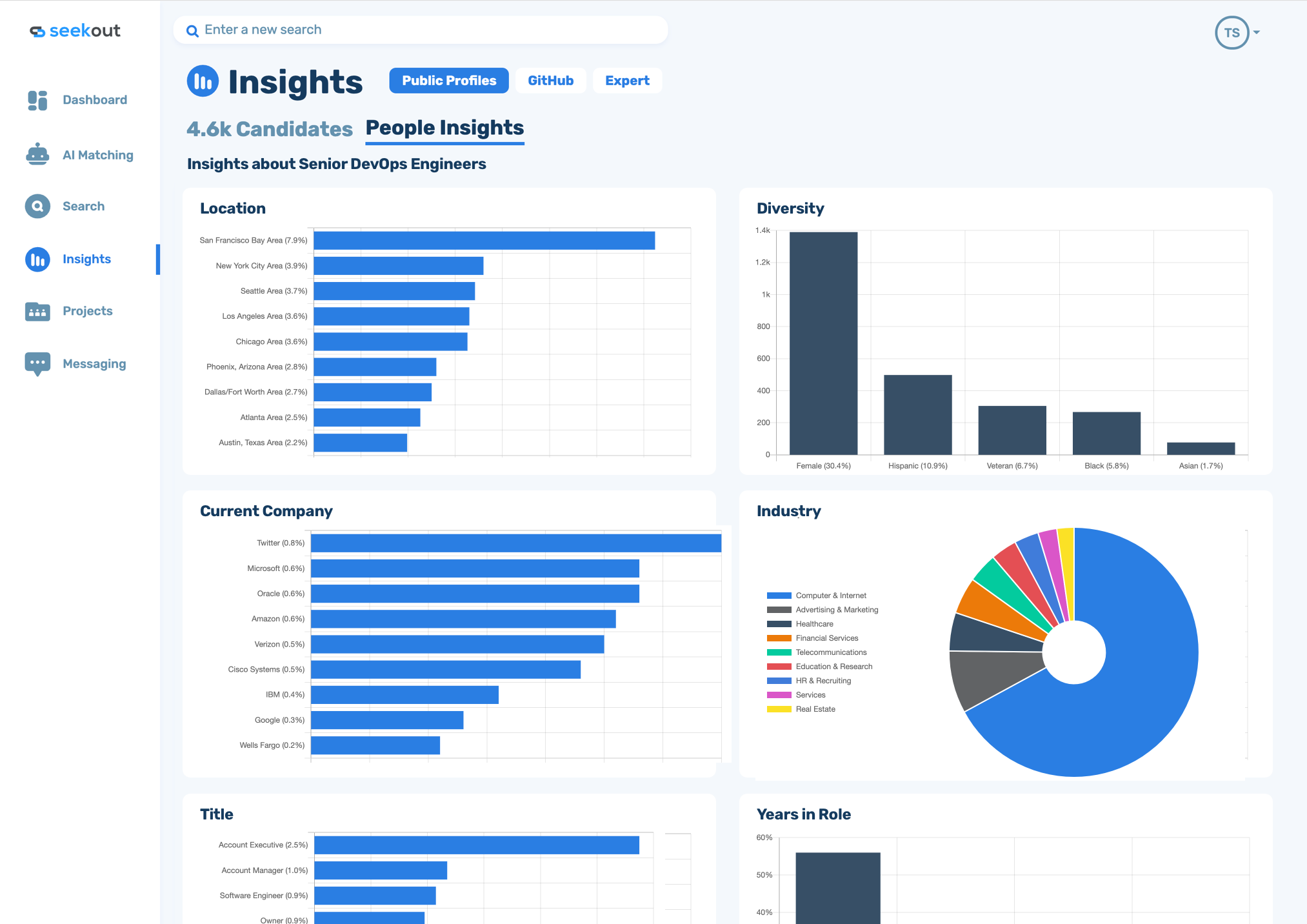
Over the years, SeekOut has built out a database with hundreds of millions of profiles using its AI-powered talent search engine and “deep interactive analytics.” It finds talent by scouring public data and using natural-language and machine-learning technologies to understand the expertise of each candidate and build a complete 360-degree view of each potential employee. Specifically, it blends info from public profiles, GitHub, papers and patents, employee referrals, company alumni, candidates in ATS systems.

While SeekOut initially focused strictly on technical talent, it has since broadened its base to helping recruiters and sources find more diverse candidates in general as well as people with simply “hard-to-find” skill sets. And it claims to do it with “unprecedented speed and precision” via a blind hiring method designed to reduce bias. SeekOut then gives recruiters a way to engage with candidates instantly by getting access to the right contact information in a “single click.”

SeekOut co-founders (left to right) Anoop Gupta, Aravind Bala, Vikas Manocha and John Tippett. Image courtesy of SeekOut

The startup is hitting such a sweet spot that it attracted the attention of Tiger Global Management, the global investment firm that just led a $65 million Series B that values SeekOut at around $500 million.

Existing backers Madrona Venture Group and Mayfield also participated in the financing, which brings SeekOut’s total funding since inception to $73 million.

In a world where so many startups have yet to turn a profit, SeekOut is a refreshing exception. Since its $6 million Series A raise in May 2019, the SaaS company says it has grown its subscription revenue (ARR) by “more than 10-fold” (although it declined to reveal hard revenue figures). And it’s been profitable, or cash-flow positive, each of the last two years.

Gupta, who serves as the company’s CEO, said its platform (dubbed Talent-360) helps companies not only find diverse talent, but helps them improve retention by finding the “right” candidate to begin with.

While there was a pause almost across the board in hiring when the COVID-19 pandemic began, the emergence of remote work as a new normal has forced companies to think more creatively about hiring — especially since they are not constricted by geography as in the past — according to Gupta.

“This freedom also means their need for tools like SeekOut increased and we have seen our business take off as a result,” he told TechCrunch. “The focus on diversity hiring and our unique approach to finding the talent and offering blind hiring features has super charged the adoption.”

SeekOut’s Insights dashboard. Image courtesy of SeekOut

Mario Linares, head of talent acquisition at Aviatrix, acknowledges that competition for talent among software companies is fiercer than ever

“SeekOut’s innovative AI-powered search, global power filters, diversity filters, and talent pool insight have been critical components of Aviatrix’s global growth plan,” he said in a written statement.

For Tiger Global Partner John Curtius, SeekOut’s platform has the potential “to transform the world of HR.”

“We are impressed by the customer love and traction SeekOut is experiencing,” he said in a written statement.

Looking ahead, SeekOut plans to use its new capital to speed up the development and expansion of its platform and build customer success, engineering, sales and marketing teams in Seattle. And it plans to use its own platform to do it.

The company also plans to double its headcount of 50 over the next year.

WordPress Image Lightbox Plugin