Tag Archives: Blog

News: Mercado Libre taps Pachama to monitor and manage its $8 million investment in Latin American rainforest restoration

Mercado Libre, one of the largest e-commerce and financial services company from Latin America by market cap, has selected the startup and Y Combinator alumni Pachama as its strategic partner in developing projects to restore ecosystems in Latin America. The selection of Pachama is part of a program initiated by Mercado Libre, Latin America’s answer

Mercado Libre, one of the largest e-commerce and financial services company from Latin America by market cap, has selected the startup and Y Combinator alumni Pachama as its strategic partner in developing projects to restore ecosystems in Latin America.

The selection of Pachama is part of a program initiated by Mercado Libre, Latin America’s answer to Amazon, which is called Regenera America. The $8 million that Mercado Libre is investing will be in two reforestation projects: the “Mantiqueira Conservation Project”, organized under the auspices of The Nature Conservancy and the “Corridors of Live Project”, designed and implemented by the Instituto de Pesquisas Ecologicas.

Both projects will focus on the reforestation of over three thosuand hectares, through natural regeneration and planting over 1 million trees, restoring biodiversity corridors and protecting hydrological basins in the Atlantic Forest region of Brazil, the two companies said in a statement.

Pachama will provide satellite and machine learning technologies to verify and monitor the carbon sequestration produced by the sweeping reforestation efforts in a deal which leapfrogs Mercado Libre ahead of Microsoft as the young startup’s largest customer.

Software tools provided by Pachama will also increase the efficiency and transparency of the actual reforestation efforts on the ground, the companies said in a joint statement.

The deal between the two companies, and Mercado Libre’s big buy was announced earlier today at a press conference in Argentina and the agreement marks the first time Mercado Libre has tapped money from a recently issued $400 million Sustainability Bond that was designed to finance projects of what the e-commerce giant called “triple impact” in the Latin American region. The bond was issued by JP Morgan and BNP Paribas.

“We’re taking our first steps. We have always tried to do things the hard way and go to the core of problems. We have had a very interesting debate internally about when is the right time to start buying carbon offsets and carbon credits but we also realize that the … getting up and running of projects that generate carbon credits in Latin America was potentially even more of a challenging situation and more of a longterm solution,” said Mercado Libre chief financial officer Pedro Arnt.

“This is a building block of a longer term strategy thinking through not just what we can do for the next two or three years,” Arnt said. 

The Regenera America project has four pieces, Arnt said: measuring and reporting emissions internally for the company; buying clean energy for the company’s operations; providing electric vehicles for its own fleet and assisting its last mile and logistics partners in electrifying their own transportation; and the development of reforestation efforts across Latin America.

“This is setting up an example for more traditional industries across Latin America,” said Diego Saez-Gil, the co-founder and chief executive of Pachama. MercadoLibre is the largest company by market cap in Latin America and serves as a standard bearer for the forward thinking businesses in the region, he said. “Latin America is one of the biggest holders of biodiversity and carbon stocks in the world, and should be playing a more active role in climate mitigation.”

It’s a big step for Pachama as well. The deal marks the first time the young company has involved itself in project origination and provide a new revenue stream to compliment its existing lines of business.

“We are incredibly excited to start helping new reforestation projects get off the ground that have the capabilities to plant millions of trees and remove millions tons of CO2 from the atmosphere. If we are to solve climate change we need more projects like these to start as soon as possible,” said Saez-Gil in a statement. “We are confident that technologies such as AI and satellite imagery are key to scaling these efforts with high integrity, efficiency and transparency. Partnering with world-class organizations such as Mercado Libre, The Nature Conservancy and IPE for our first projects represents an incredible opportunity for us.” 

News: Sonos goes full portable Bluetooth speaker with the $169 Roam

Introduced in late-2019, the Move was a very Sonos approach to the Bluetooth speaker. It was an attempt to bring the company’s long-standing premium approach to a more portable form factor. Accordingly, the press photos feature a lot of shots of the product on porches and around pools. Today’s arrival of the Roam, however, takes

Introduced in late-2019, the Move was a very Sonos approach to the Bluetooth speaker. It was an attempt to bring the company’s long-standing premium approach to a more portable form factor. Accordingly, the press photos feature a lot of shots of the product on porches and around pools.

Today’s arrival of the Roam, however, takes an even bigger step to full portability, with a smaller, lighter, more ruggedized and waterproof design that puts it more in line with popular offerings from companies like JBL. It’s also priced at a much more palatable $169, more than half the Move’s starting price.

Image Credits: Sonos

Of course, you can still get plenty of cheaper (and quite good) portable Bluetooth speakers. JBL’s Flip 5, for instance, retails for about $40 less. But what you’re paying for, in part, is the Sonos ecosystem. As such, I suspect the clearest play from the outset here is Sonos’ base. And thankfully, for the company, there are no doubt a lot of Sonos users who have been waiting for a long time for a compatible speaker they can toss in their suitcase — or, rather, will be able to toss into their suitcases when they use suitcases again.

In addition to the standard Bluetooth and Wi-Fi connections, the system utilizes Sonos’ new Sound Swap feature, which switches the music to the next closest speaker when the play/pause button is held down. The speaker works with more than 100 streaming services, per the company’s count, including, of course Sonos Radio. It also can be controlled with Alexa and Google Assistant or via AirPlay 2.

Image Credits: Sonos

I got all of this information by way of a virtual briefing, as is how business is done these days, so I can’t speak specifically to the sound. That said, I’d imagine it’s a step down from the very good and quite expensive Move. But again, this is a speaker you’re buying specifically with flexibility in mind. On that note, the speaker gets about 10 hours of playback on a charge and can go 10 days when not in use.

The speaker arrives on April 20th.

News: Blue Origin will upgrade New Shepard rocket with the ability to simulate lunar gravity

Jeff Bezos’ Blue Origin will be providing NASA with a valuable scientific tool ahead of the U.S. space agency’s goal of returning to the Moon: The ability to run experiments in simulated lunar gravity much closer to home, in suborbital space. NASA revealed that Blue Origin will be modifying its reusable New Shepard sub-orbital launch

Jeff Bezos’ Blue Origin will be providing NASA with a valuable scientific tool ahead of the U.S. space agency’s goal of returning to the Moon: The ability to run experiments in simulated lunar gravity much closer to home, in suborbital space.

NASA revealed that Blue Origin will be modifying its reusable New Shepard sub-orbital launch vehicle to add Moon gravity approximation via rotation of the spacecraft’s capsule. That’ll effectively turn it into one big centrifuge, which will mean that objects inside will experience a gravitational force very close to that found on the lunar surface.

It’s not like there aren’t already ways to simulate lunar gravity, but the way that New Shepard will implement its system will provide two benefits that none of these existing methods can match: Longer duration, offering over two minutes of continuous artificial Moon gravity exposure, and larger payload capacity, which will unlock experimental capabilities that are currently impossible just due to space restrictions.

Blue Origin anticipates that this new capability for New Shepard will be ready to roll by 2022 – important timing because the whole idea is to help support NASA’s Artemis program, which is its mission series that will see a return to human Moon exploration, including establishment of a more permanent crewed research presence both in lunar orbit and on the surface.

Gravity on the surface of the Moon is about one-sixth as powerful as that here on Earth. NASA also points out that it will require experimentation not only in preparation for lunar missions, but also to support eventually crewed launches to Mars, which has gravity that’s just over one-third as strong as it is here.

Blue Origin is also working with NASA on human landers for its lunar missions, through a space industry team-up that includes Lockheed Martin, Northrop Grumman and Draper.

News: Memes for sale

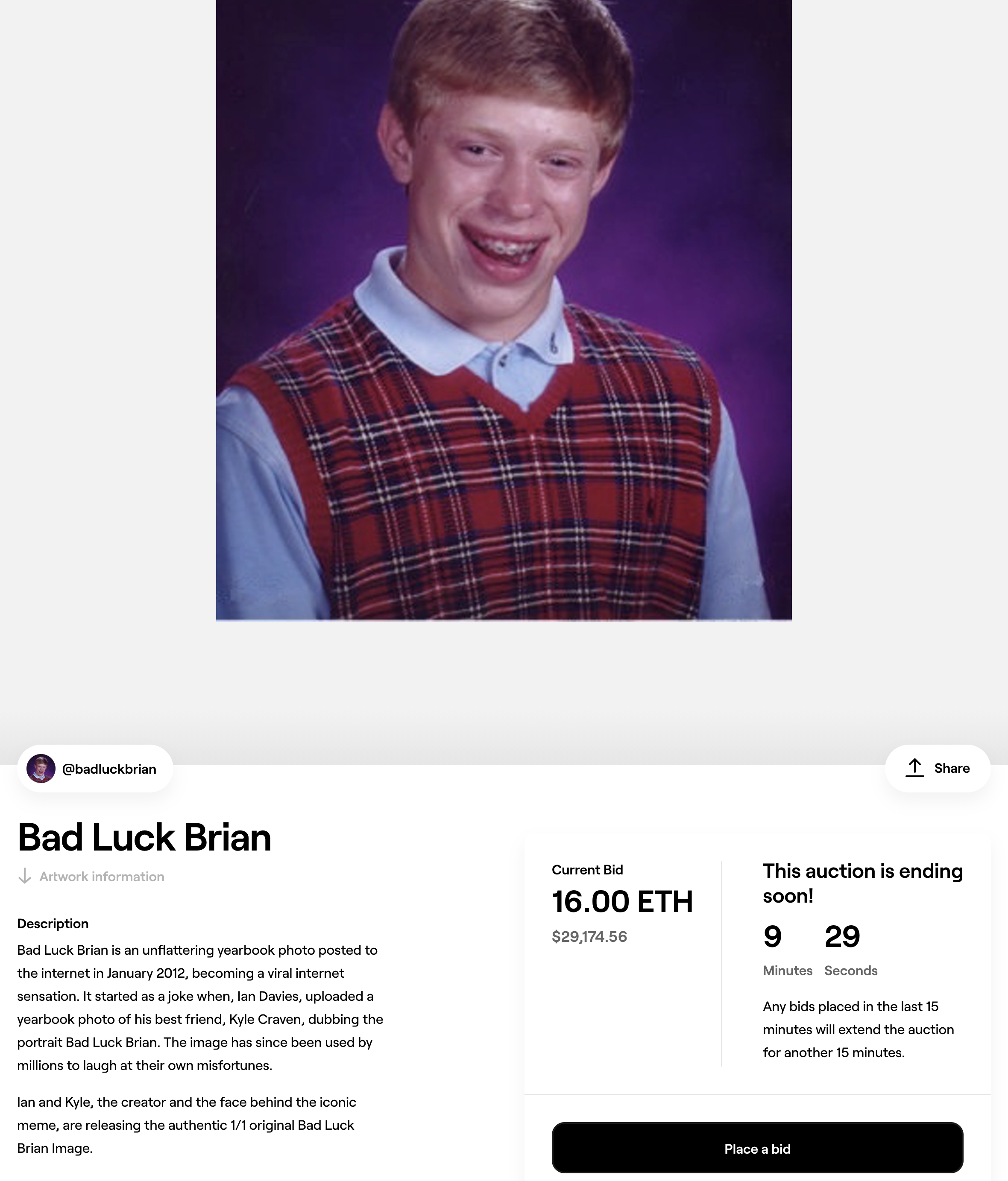
The creator of the Nyan Cat, Chris Torres, has organized an informal collection of meme originators – the creators or original popularizers of meme images — into a two-week-long auction of their works. Under the hashtag #memeconomy the creators of memes like Bad Luck Brian, Coughing Cat, Kitty Cat Dance, Scumbag Steve, Twerky Pepe and

The creator of the Nyan Cat, Chris Torres, has organized an informal collection of meme originators – the creators or original popularizers of meme images — into a two-week-long auction of their works. Under the hashtag #memeconomy the creators of memes like Bad Luck Brian, Coughing Cat, Kitty Cat Dance, Scumbag Steve, Twerky Pepe and some others are finally finding a way to monetize the creation of genuine cultural phenomenons that have been used freely for decades.

They’re mostly being hosted on booming new crypto art and collectibles platform Foundation, which launched in February and has already hosted $6M in sales of over 1,000 NFTs. I have a lot to say about NFTs and can’t say them all here, but I found this project fascinating and wanted to note it. The fact is that memes are Internet art (sorry). They are unique creations that took elements of participatory and performance art and injected them into the veins of the internet. In many ways, they have millions of creators, as the original editions may have planted the seed but every use and permutation gave them additional strands of DNA, crafting their cultural importance upload by upload. They have let us express ourselves — our desire, disgust, joy and lust — when words just wouldn’t suffice.

These “originals” are made original by the act of them being minted on the blockchain by the original artists. I know, it’s a distinction that may seem slim when the same images can be had anywhere at any time, but that’s the beauty of the re-organization that is happening within all of DeFi and crypto at the moment. We are stripping out layers of commerce and communication that benefited only platforms and participants that took part in the origination and sale of art from the perspective of frameworks like the DMCA and DRM. Those relationships are being rethought. The recapture of value for works that have already been broadly distributed has been historically relegated to ‘licensing them for t-shirts’. And extremely rarely elevated to the level of fine art sale.

Now that we’re all living on the Internet, Internet art is just art. And so are memes.

That’s why it’s fascinating to see some of the people who have created things that have let so m​any of us express ourselves get paid.

One famous case of this, of course, is the Pepe and its creator Matt Furie. Though Furie’s attempts to redeem Pepe have focused on attempting to reclaim him from a legacy of racist and hateful memes, Pepe and his friends are a cool cast of characters and it would be heartening to see Furie reclaim them by minting them himself.


I spoke a bit to Torres about the project and why he got interested in it.

TC: Why did you decide to organize this informal schedule of meme NFTs?

Torres: The idea has always kind of been in the back of my mind since discovering the NFT universe. The idea of NFTs were always so attractive to me, a place where you can create your own original art and gain proper attribution for your work. Memes have always had a rough time on the Internet, because their creators are usually taken advantage of, and I have personally seen artists have their works stolen and monetized to the tune of millions of dollars without even proper credit. So the idea has always been down deep in my subconscious but this week things have really amped up enough to finally give me the power I need to make it happen!

TC: How did you get in contact with the creators?

Actually, they all contacted me! It’s unbelievable knowing I’m in direct contact with some fantastic iconic internet legends from the past. Some of these have existed solely as enigmas on the Internet, it’s great connecting with them. Things started with casual conversations with Bad Luck Brian, but then Trollface messaged me, then Me Gusta, then Kitty Cat Dance, then things just kept amping up.

TC: How has it felt to have your creation formally rewarded after spending so long in the cultural meme-ory?

It’s still very surreal, to be honest. The NFT community is full of very talented people with so many thoughts and ideas on how to build a better future for the crypto space. I’ve actually used this power for good this week by starting up #Memeconomy with all these talented meme creators and will be trying my hardest to get these guys the recognition they deserve.

TC: What excites you about NFTs and art?

The number one thing that’s kept me excited for NFTs is just knowing that it’s a perfect way to empower artists to take ownership of their own works. I’ve been hanging out in the Clubhouse chats, reading everything I can on Twitter, and just have been losing sleep being so enthralled by it all. Every day I wake up and there’s a new meta of NFTs out there. It’s cool to see all this artistic knowledge evolving in real time. I absolutely live off that energy, and it’s inspired me to be more creative than ever.

The world of NFTs is complex and fascinating and deserves a deeper look that looks at the economic, ecological and technical aspects. We’ve already hosted and written about various projects in the space. Stay tuned for more.

🌐#MEMECONOMY WEEK 1 🌈 by @NyanCat

6 OG memes. 1 brand new NFT. We’re seeing the rise of the meme economy on Foundation. 📈@solidbadluck @idascreatures @steveibsen @realgrumpycat @keyboardcatreal @twerkypepe @blakeboston617

Only on → https://t.co/A7bTOLs99m pic.twitter.com/XVaUZrDoQI

— Foundation (@withFND) March 9, 2021


News: 4 ways startups will drive GPT-3 adoption in 2021

What OpenAI — and crucially, the beta testers with access to GPT-3 and other models — are able to accomplish continues to surprise and in many cases, unexpectedly delight us.

Oren Etzioni
Contributor

Professor Emeritus at the University of Washington, Oren Etzioni is an entrepreneur and CEO of the non-profit Allen Institute for AI.

Matt McIlwain
Contributor

Matt McIlwain is an early-stage venture investor at Madrona Venture Group who has been investing in AI technologies for nearly a decade.
More posts by this contributor

The introduction of GPT-3 in 2020 was a tipping point for artificial intelligence. In 2021, this technology will power the launch of a thousand new startups and applications. GPT-3 and similar models have brought the power of AI into the hands of those looking to experiment — and the results have been extraordinary.

Trained on trillions of words, GPT-3 is a 175-billion parameter transformer model — the third of such models released by OpenAI. GPT-3 is remarkable in its ability to generate human-like text and responses — in some respects, it’s eerie. When prompted by a user with text, GPT-3 can return coherent and topical emails, tweets, trivia and much more.

In 2021, this technology will power the launch of a thousand new startups and applications.

Suddenly, authoring emails, customer interactions, social media exchanges and even news stories can be automated — at least in part. While large companies are pondering the pitfalls and risks of generating text (remember Microsoft’s disastrous Tay bot?), startups have already begun sweeping in with novel applications — and they will continue to lead the charge in transformer-based innovation.

OpenAI researchers first released the paper introducing GPT-3 in May 2020, and what started out as some nifty use cases on Twitter has quickly become a hotbed of startup activity. Companies have been formed on top of GPT-3, using the model to generate emails and marketing copy, to create an interactive nutrition tracker or chatbot, and more. Let OthersideAI take a first pass at writing your emails, or try out Broca or Snazzy for your ad copy and campaign content, for instance.

Other young companies are harnessing the API to accelerate their existing efforts, augmenting their technical teams’ capabilities with the power of 175 billion parameters and quickly bringing otherwise difficult products to market with much greater speed and data than previously possible. With some clever prompt engineering (a combination of an instruction to the model with a sample output to help guide the model), these companies leverage the underlying GPT-3 system to improve or extend an existing application’s capabilities.

Sure, a text expander can be a useful tool for shorthand notation — but powered by GPT-3, that shorthand can be transformed into a product that generates contextually aware emails in your own style of writing.

As early-stage technology investors, we are inspired to see AI broadly, and natural language processing specifically, become more accessible via the next generation of large-scale transformer models like GPT-3. We expect they will unlock new use cases and capabilities we have yet to even contemplate.

News: Techstars Music announces its 2021 class and a partnership with media company Quality Control

This morning Techstars Music is announcing 11 new companies that have joined its ranks, along with a partnership with Atlanta media house Quality Control. While it’s easy to mentally bunch everything Techstars does together under the singular “Techstars” name, it’s actually made up of 40+ interconnected accelerator programs each with its own focus and portfolio.

This morning Techstars Music is announcing 11 new companies that have joined its ranks, along with a partnership with Atlanta media house Quality Control.

While it’s easy to mentally bunch everything Techstars does together under the singular “Techstars” name, it’s actually made up of 40+ interconnected accelerator programs each with its own focus and portfolio. The majority of these are focused on a specific region — programs like Techstars Boulder, Boston, or LA. Others focus on a specific vertical or industry — like Sports, Space, or, in this case, Music.

So what all does that “Music” focus cover? It’s not just music creation tools, or apps for artists. As Techstars Music Managing Director Bob Moczydlowsky put it in a Q&A last year, “we don’t invest in music companies — we invest in companies solving problems for music.”

Their past portfolio includes Endel, which generates “personalized soundscapes” meant to help you focus or fall asleep faster, and Blink Identity, a company looking to replace the paper/digital concert ticket with facial recognition machines at the venue’s entrance.

The companies in the 2021 class, in alphabetical order:

We’re moving closer towards the woods. I hate this part of town at night, since there’s almost no lights. pic.twitter.com/iCD3OlpU8O

— Luna Gardner (live-tweeted comic) (@CRC_Luna) August 10, 2018

555 Comic: Develops “virtual characters” and uses them to tell stories through social media (like the tweet above). Imagine one artist having multiple “personas”, with each genre they dabble in represented by a different character, each with an evolving backstory. (Fun trivia: the number five said aloud in Japanese sounds like “Go”; the Japanese company’s name is a play on “Go Go Go!”)

BlackOakTV: A subscription, on-demand video service focusing on content made by black creators. Currently costs $4.99 a month with apps available on most major platforms.

Creative Futures Collective: A networking/mentoring program aiming to “unearth the next generation of creative industry leaders from disenfranchised backgrounds” and connect them with jobs and paid internships.

Fave: A social platform meant to help connect an artist’s “superfans” with each other and allow them to compete to earn rewards from the artist.

HappsNow: a fully white-labeled ticketing platform meant to give artists/venues more control of the experience.

Holotch: Capture volumetric 3D video with off-the-shelf technology and stream it live. Imagine an artist capturing a performance live, and being able to watch them perform in your living room through augmented reality “holograms”.

Music Tech Works: A super simplified catalog and workflow for figuring out who owns the rights to a song and acquiring a license to use it.

Rares: A platform for investing in shares of particularly notable sneakers — think gameworn shoes, the hardest to find, or those that were never mass produced.

Remetrik: A software platform that aims to bring all of the (often labyrinthian) accounting involved with music royalties into one place in a simple and transparent way.

Volta Audio: A platform for artists to build immersive, evolving VR experiences in which they can perform live.

Westcott Multimedia: An automated advertising platform that looks for events related a music catalog (like, say, an artist’s birthday, or a song being played in the background of a viral video) and builds marketing campaigns around them.

Along with this latest class, Techstars Music is also announcing that it’s partnering with Quality Control, the media house behind Quality Control Music — best known as the label behind Migos, Lil Yachty, and Lil Baby. Quality Control joins Techstars Music as a “member” company (sort of like their equivalent to an LP, offering investment, helping to vet companies and mentoring them once they’re in); existing members include Amazon Music, AVEX, Bill Silva Entertainment, Concord, Peloton, Entertainment One, Right Hand Music Group, Royalty Exchange, Sony, and Warner Music Group.

Moczydlowsky tells me that Techstars Music alumni companies have raised over $105m since the first class in 2017, and that the group above has already raised over $3M ahead of its Demo Day in May.

News: Epic Games buys photogrammetry software maker Capturing Reality

Epic Games is quickly becoming a more dominant force in gaming infrastructure M&A after a string of recent purchases made to bulk up their Unreal Engine developer suite. Today, the company announced that they’ve brought on the team from photogrammetry studio Capturing Reality to help the company improve how it handles 3D scans of environments

Epic Games is quickly becoming a more dominant force in gaming infrastructure M&A after a string of recent purchases made to bulk up their Unreal Engine developer suite. Today, the company announced that they’ve brought on the team from photogrammetry studio Capturing Reality to help the company improve how it handles 3D scans of environments and objects.

Terms of the deal weren’t disclosed.

Photogrammetry involves stitching together multiple photos or laser scans to create 3D models of objects that can subsequently be exported as singular files. As the computer vision techniques have evolved to minimize manual fine-tuning and adjustments, designers have been beginning to lean more heavily on photogrammetry to import real world environments into their games. 

Using photogrammetry can help studio developers create photorealistic assets in a fraction of the time it would take to create a similar 3D asset from scratch. It can be used to quickly create 3D assets of everything from an item of clothing, to a car, to a mountain. Anything that exists in 3D space can be captured and as game consoles and GPUs grow more capable in terms of output, the level of detail that can be rendered increases as does the need to utilize more detailed 3D assets.

The Bratislava-based studio will continue operating independently even as its capabilities are integrated into Unreal. Epic announced some reductions to the pricing rates for Capturing Reality’s services, dropping the price of a perpetual license fee from €15,000 to $3,750 USD. In FAQs on the studio’s site, the company notes that they will continue to support non-gaming use clients moving forward.

In 2019, Epic Games acquired Quixel which hosted a library of photogrammetry “mega scans” that developers could access.


News: Detail wants to turn your phone into a software-optimized camera app for live video

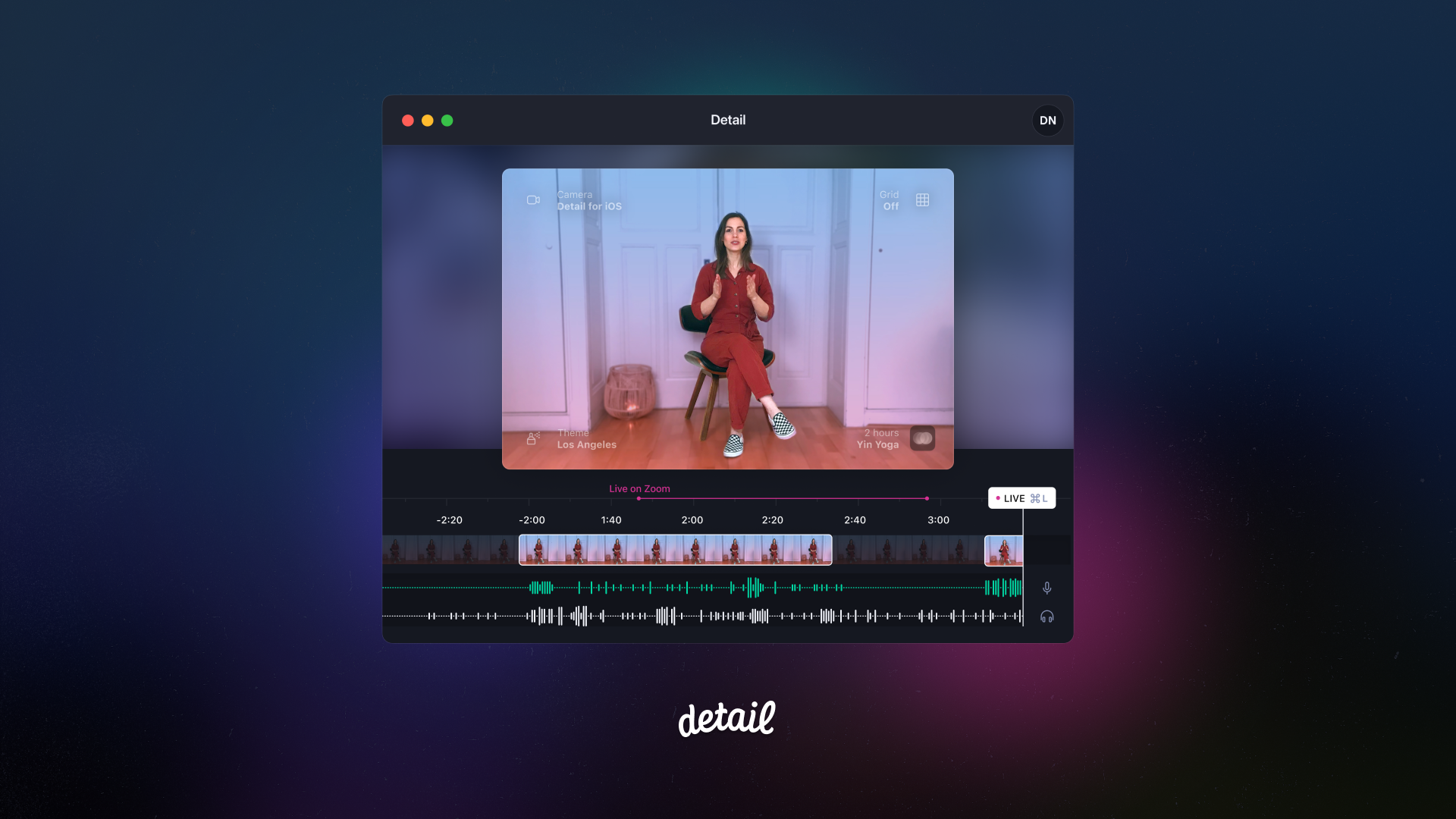
Meet Detail, a new startup working on an app for iOS and macOS so that you can turn your iPhone into a software-optimized camera for live video. The startup wants to make it easy to use the phone that you have in your pocket with the livestreaming platform that you already use, such as Zoom,

Meet Detail, a new startup working on an app for iOS and macOS so that you can turn your iPhone into a software-optimized camera for live video. The startup wants to make it easy to use the phone that you have in your pocket with the livestreaming platform that you already use, such as Zoom, Google Meet, Twitch, Hopin or YouTube Live.

Over the past year, if you have had to present something to a large audience over a livestream, chances are you’ve faced a few challenges. First, as Joanna Stern of the Wall Street Journal demonstrated, laptop webcams suck. There’s no way you’re going to look good with your computer.

Second, if you’re willing to invest some money, you can buy a ring light, a dedicated camera, a good microphone, etc. The issue is that it’s expensive. More importantly, it’s been really hard to buy some of this stuff as many remote workers have been looking for those devices.

Third, you might be good at teaching something, but not good at video production. Those are different skills and somehow people are telling you that you should know everything about white balance, anti-flickering and more.

As for Detail, the company wants to make it as easy as possible to go from zero to livestream. The best camera that you have is most likely the one in your pocket, right there on the back of your smartphone. For the past few years, computational photography has led to tremendous improvements when it comes to taking photos with your phone. But there’s still some work to do on the livestreaming front.

Detail founder Paul Veugen rightly points out that hosting a live video has become a commodity. But everything that happens before you send the video feed over the internet could be improved.

At first Detail is going to be an iPhone and Mac app that works hand in hand like Camo and EpocCam. There are going to be some easy-to-use settings to tweak color grades, add filters, etc. It’s going to be a more opinionated take on the smartphone-as-a-webcam movement.

Behind the scenes, the team is composed of some of the people that worked on Human, an app I started covering way back in 2013. Human was a passive fitness tracking app — you could set it up and get insights about how active you had been over the past few days. Essentially, it was like Apple’s activity rings before Apple introduced the Apple Watch. Human was acquired by Mapbox in 2016.

Detail raised a $2 million pre-seed round led by Connect Ventures. Hustle Fund, Alexander Ljung, Anke Huiskes, Arthur Kosten, Elodie and Tony Jamous, Hiten Shah, Janis Krums, Mart Kelder, Micha Hernandez van Leuffen, Othman Laraki, Omri Amir and Sten Tamkivi are also participating in the round.

As you can see, Detail is still in active development and the beta test is going to start soon. But it’s an intriguing app and I’m going to keep an eye on it to see how it pans out.

Image Credits: Detail

News: Capsule gets $1.5M to build ‘super simple’ decentralized social media

Capsule‘s plan to launch a super simple decentralized social media platform which is safe from censorship by Big Tech has advanced another stage: The nascent startup has closed a seed round of funding ($1.5M) led by Beacon Fund, a dedicated crypto fund by Polychain Capital — which is itself focused on startups building on Dfinity’s

Capsule‘s plan to launch a super simple decentralized social media platform which is safe from censorship by Big Tech has advanced another stage: The nascent startup has closed a seed round of funding ($1.5M) led by Beacon Fund, a dedicated crypto fund by Polychain Capital — which is itself focused on startups building on Dfinity’s decentralized network for next-gen ‘open’ apps (aka, the Internet Computer).

As we reported in January, the idea for Capsule started with a tweet that almost immediately pulled in a pre-seed raise of $100k. That’s now been topped up with seed financing to get a prototype to market later this month.

Mobile apps are also on the cards and the funding will be used to build out Capsule’s team as well (currently it’s around four people).

Capsule founder Nadim Kobeissi, a cryptography researcher who previously authored the open-source E2E-encrypted desktop chat app Cryptocat, says they’re on track to put out an MVP this month — once they’ve made a few tweaks to the infrastructure.

“The prototype is ready,” he tells TechCrunch. “We’re investigating switching some of the infrastructure from GUN to IPFS [InterPlanetary File System; aka a p2p hypermedia protocol], and improving the user interface. We could launch an MVP now but are choosing to hold off by a few weeks.”

Polychain Capital outted its Beacon Fund last September. The $14.5M investment vehicle is funded by Polychain, Andreessen Horowitz, and the Dfinity Foundation — and aims to support entrepreneurs and teams building on Dfinity’s the Internet Computer (TIC); aka a serverless architecture for natively hosting software and services (which it refers to as the “first blockchain computer that runs at web speed with infinite capacity”).

Kobeissi’s original concept for Capsule, meanwhile, was to create self-hosting microservices. He says that hasn’t changed — but sees potential for TIC to help solve some specific technical issues.

“The Internet Computer will hopefully be helping us build a ‘customized mini-blockchain’ to solve two issues with Capsule: Global authenticated timestamps for posts as well as a root of trust for user’s authentication keys for posts,” he says. “We were looking to solve these issues somehow before this investment and were already considering Dfinity as the potential solution given that it has a programming language that allows for building these ‘custom mini-blockchains’ as we see them.”

“The rest will still be a self-hosting, self-contained, precisely engineered micro-services concept, with IPFS (previously GUN) as a decentralized database/connectivity back-end,” he adds.

Given the intent with TIC is to hosts all sorts of decentralized apps it’s possible — indeed, likely — that a bunch of decentralized social media plays will emerge. Last year, for example, Dfinity launched a proof of concept for an ‘open’ version of the professional social network, LinkedIn — which it punningly called ‘LinkedUp’.

It went on to demo a TikTok clone — and to open TIC up to outside developers last summer. So there could soon be a bunch of apps built atop its network touting social networking services without the meddling hand of Big Tech. Where, then, does Kobeissi see Capsule’s USP — i.e. if/when there’s a sea of decentralized ‘mega-apps’ that can also claim resilience to censorship?

“We think Capsule’s value will lie in its exceptional user experience, quality, performance, ease of use and high quality engineering that draws on advanced technologies such as TIC and IPFS without saddling bloat,” he says. “Others may use the same technology but I think we can do a good job on building something simple that just works and that is a pleasure to use.”

“Ultimately, I think that Capsule will be to Facebook what healthy, vegetarian diets are to a McDonald’s diet,” he adds more generally of his intent for the service. “Capsule may be a social media service but its relationship with its users and developers will be fundamentally different than Big Tech platforms.”

Below are a few screenshots showing current mock-ups of the Capsule interface.

News: Walmart to host a new live stream shopping event on TikTok, following successful pilot

In December, Walmart partnered with TikTok on the first pilot test of a new livestreamed shopping experience in the U.S. on the video platform. That test seemingly performed well, as today Walmart announced it will return to TikTok to host another livestream shopping event, the “Spring Shop-Along: Beauty Edition,” which will feature TikTok creators and

In December, Walmart partnered with TikTok on the first pilot test of a new livestreamed shopping experience in the U.S. on the video platform. That test seemingly performed well, as today Walmart announced it will return to TikTok to host another livestream shopping event, the “Spring Shop-Along: Beauty Edition,” which will feature TikTok creators and influencers in an hour-long livestream.

The retailer didn’t disclose to what extent its first TikTok live shopping event drove sales, but noted that it netted 7x more views that it had anticipated, and was able to grow its TikTok follower base by 25%. These metrics were encouraging enough to send Walmart back to the platform for another go — this time, to promote beauty products instead of apparel, which had been the focus of the holiday livestream.

The new Spring Shop-Along will run this Thursday, March 11 at 9 PM EST on the Walmart TikTok channel. Like the prior holiday event, the new livestream shopping event will see various TikTok creators joining to talk about and demonstrate their favorite items. One participating creator has already been announced: Gabby Morrison (@GabbyMorr) who has over 3.5 million TikTok followers.

Image Credits: Walmart

Gabby and others will demo their skincare, makeup and hair routines and reveal the Walmart beauty products they’re using during the 60-minute live event. Featured beauty brands will include NYX, Maybelline, The Lip Bar, Bliss, Kim Kimble, and Marc Jacobs fragrances.

Viewers watching the event will be able to get beauty tips as well as shop the products featured directly in the TikTok app by tapping on product “pins.” This will allow them to add items to their cart that they can then check out either during or after the event.

“Brands have found a unique home on TikTok to create content that speaks to the community and inspires engagement, whether it’s participating in trends or discovering new products,” said Blake Chandlee, President of TikTok Global Business Solutions, in a statement about Walmart’s plans.

“With the shoppable livestream experience, it’s exciting to see how the TikTok community loves engaging with their favorite creators and discovering new products. We look forward to continue building innovative ways to power the path from discovery to purchase, and seeing brands like Walmart bring their creativity to users,” Chandlee added.

Walmart had already signaled its interest in leveraging TikTok for e-commerce ahead of the holiday livestream. Notably, it had planned to invest in TikTok when the video app was threatened with a ban under the Trump administration, unless it sold its U.S. operations to an American company. That forced sale, which would have spun out TikTok’s U.S. business to new owners Oracle and Walmart, is shelved for the time being as the Biden administration reviews the agency action under Trump.

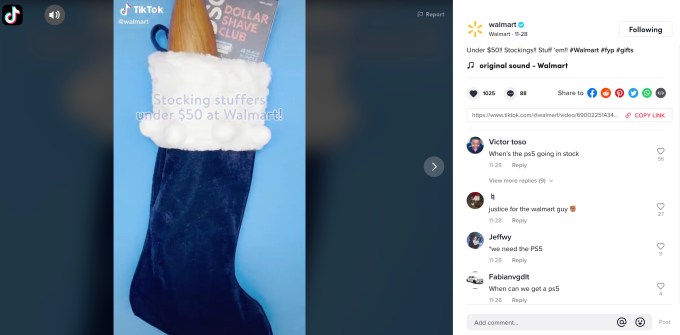
Image Credits: Screenshot of Walmart’s TikTok channel during the 2020 holidays

Livestreamed shopping is an area of increasing interest and investment in the U.S. The trend has seen a number of startups enter the market, including NTWRK and recently funded Bambuser and Popshop Live, among others. Larger tech companies are also taking part — including across mobile video and live video shopping.

Google’s R&D project for mobile video shopping Shoploop was integrated into search. Facebook acquired a video shopping startup Packagd to build out live shopping, and heavily invested in video shopping across Facebook and Instagram. Amazon runs live shopping through its QVC-like Amazon Live. Alibaba (AliExpress) JD.com, Pinduoduo, WeChat and TikTok’s Chinese sister app, Douyin, all support mobile video shopping, too.

Walmart had said its plan to partner with TikTok on livestream shopping wasn’t a result of its deal talks, however — it’s been an active brand on TikTok’s platform for well over a year. The retailer even tasked its employees to make TikTok videos, in addition to running its own TikTok channel.

Reached for comment, the retailer declined to provide further metrics about its first livestream on TikTok, but felt the pilot test delivered above expectations.

“We were happy with getting 7X more views than anticipated and the 25% increase in TikTok follower growth after the first event. We were also pleased with the smooth checkout experience,” a spokesperson told TechCrunch. “We aren’t able to share sales numbers, but can share that we hit the projections we set ahead of the event.”

Following this week’s live shopping event, Walmart says it plans to bring more shopping experiences to TikTok in the months to come, by continuing to partner with creators to highlight different products via different formats.

WordPress Image Lightbox Plugin