
Tag Archives: Blog

News: The great Gatsby raises millions to take on Robinhood

Millennials and GenZers seem interested in investing more than ever these days. As a result, a number of startups have emerged in recent years to give them more options. One such startup, Gatsby, announced Monday that it has raised $10 million in a Series A round of funding. Backers include Techstars Ventures, Beta Bridge Capital,

Millennials and GenZers seem interested in investing more than ever these days. As a result, a number of startups have emerged in recent years to give them more options.

One such startup, Gatsby, announced Monday that it has raised $10 million in a Series A round of funding.

Backers include Techstars Ventures, Beta Bridge Capital, a network of “super angels” placed by ClearList and an oversubscribed SeedInvest campaign. Previous investors include Barclays Bank, SWS Venture Capital, and Rosecliff Ventures, 

Jeff Myers and Ryan Belanger-Saleh co-founded Gatsby, a commission-free options and stock trading app aimed at younger traders, in 2018. The pair had already one successful exit in Dealtable.com, a social data room platform. 

Co-founders and co-CEOs Jeff Myers (left) and Ryan Balenger-Saleh (right)

Notably, Peter Quinn, a founder of stock trading service Public.com — which recently raised $220 million at a $1.2 billion valuation — serves as Gatsby’s chief operations officer and as the company’s first hire, is considered a member of its founding team.

Besides focusing on a younger demographic, Gatsby aims to give people “a safe and fair platform to trade on without users having to worry about getting in over their heads or being shut out of names when volatility spikes.” The app launched into iOS and Android in early 2020, with the number of signups doubling since the beginning of 2021.

It’s also seen a spike in trade volume with cannabis and meme stocks ranking among its most popular trades of the year so far. 

Gatsby aims to take on Robinhood by offering traders no commission trading, no per-contract fees and “with no excessive jargon.” Beyond that, it also offers users a way to earn revenues from trade activity through a rewards program or as Myers puts it, “get paid to trade.” It also hosts a social network that can be a source for trade ideas or a place for Gatsby traders to share on their wins (or commiserate their losses).

“We believe that PFOF (payment for order flow) is a fundamentally better pricing model than commissions for users trading on small accounts as long as customers feel like their broker is being fair and honest about execution quality and how they make money,” Myers said.

In the second quarter, Gatsby plans to launch a feature called ‘Gatsby Circles,’ through which traders can create groups of friends to follow and share trades, and get alerts when someone in their circle executes a trade. 

The startup plans to use its new capital “to grow aggressively” in 2021. Specifically, the company plans to expand in engineering and brokerage operations over the course of the year. It plans to boost its 12-person team by another “10 to 20 heads” over the next three quarters, according to Myers.

The company’s goal is to have over 100,000 accounts by year’s end.

Gatsby also plans to launch additional research tools for more sophisticated options traders, as well as more advanced strategies. Down the line, the startup is also planning to launch crypto-trading features.

It’s also working on building an adaptive interface. This means that Gatsby’s algorithm will assess the trader and adjust the feature set and interface to be tailored for that user depending on their experience level.

For Jordan French, an early stage investor in Gatsby and publisher at Grit Daily News, Myers and Belanger-Saleh “have the right combination of technology and marketing experience to grow Gatsby into a defensible position that will be very difficult for competitors to unseat.”

He also believes the company’s approach aligns closely with its core investor base.

Gatsby seeks to “shed the ‘fat-cat cronyism’ of legacy financial institutions,” French added.
News: Using cameras and AI to help exoskeletons adapt to their environment

Researchers at Canada’s University of Waterloo are showcasing work with prosthesis and exoskeletons that utilizes cameras and AI to deliver more natural human movement. The ExoNet project leverages video captured by wearable camera, run through deep learning AI, in order to mimic how humans adapt and adjust movements based on their environment. The project is

Researchers at Canada’s University of Waterloo are showcasing work with prosthesis and exoskeletons that utilizes cameras and AI to deliver more natural human movement. The ExoNet project leverages video captured by wearable camera, run through deep learning AI, in order to mimic how humans adapt and adjust movements based on their environment.

The project is an attempt to create more natural locomotion on the fly than is currently offered through systems with connected smartphone apps or other external controllers.

“That can be inconvenient and cognitively demanding,” Waterloo PhD candidate Brokoslaw Laschowski said in a release tied to the research. “Every time you want to perform a new locomotor activity, you have to stop, take out your smartphone and select the desired mode.”

The research highlighted primarily focuses on robotic exoskeletons, which are being developed by a number of different companies to help assist people with impaired mobility. The hope here is that the ExoNet system could eventually replace the need for external control by the wearer, in order to create more natural locomotion.

Of course, there’s still a lot of work to be done. Naturally, the system is easier to navigate on flat terrain. Next steps would involve adapting it to environments that can give those with limited mobility some difficult, including stairs and other obstacles. A final version of the system would be able to anticipate and adapt accordingly.

“Our control approach wouldn’t necessarily require human thought,” Laschowski adds. “Similar to autonomous cars that drive themselves, we’re designing autonomous exoskeletons that walk for themselves.”

There are other challenges here, as well. Batteries are an issue, for one. The team is looking to improve longevity by experimenting with a system that can recharge with the wearer’s movement.

News: Building code compliance startup UpCodes gets $3.36M in pre-Series A funding

UpCodes, a startup that develops building code compliance tools, announced today it has raised $3.36 million in pre-Series A funding. This brings its total raised so far to $4.15 million. The new funding was led by Berlin-based Point Nine Capital, which focuses on SaaS and online marketplaces. The company also recently won a legal victory

UpCodes, a startup that develops building code compliance tools, announced today it has raised $3.36 million in pre-Series A funding. This brings its total raised so far to $4.15 million. The new funding was led by Berlin-based Point Nine Capital, which focuses on SaaS and online marketplaces.

The company also recently won a legal victory when United States District Court Judge Victor Marrero granted UpCodes its motion to dismiss a false advertising and unfair competition lawsuit filed against it by the International Code Council (ICC). An earlier copyright lawsuit filed by the ICC against UpCodes is still ongoing, but UpCodes won a major decision in the case last year when Judge Marrero ruled that its posting of building codes is covered by public domain and fair use.

UpCodes’ other investors include PlanGrid co-founders Ryan Sutton-Fee, Ralph Gootee, Tracy Young and Kenny Stone; Bragiel Brothers; Capital X; Flex Capital; and Liquid 2 Ventures. It also took part in Y Combinator’s summer 2017 accelerator program.

Founded in 2016 by brothers Garrett and Scott Reynolds, UpCodes now has about 500,000 monthly active users. The company’s paid customers include construction firms like Stantec and ARCO National Construction, architecture firms SOM and Ennead, and Airbnb, Cornell University and the State University of New York. It is also used by rental tenants, landlords, homeowners, general contractors, plumbers, electricians—basically anyone with a question about building code compliance.

UpCodes’ first product was a searchable database of building codes with collaboration tools. Then in 2018 it launched UpCodes AI, a tool that scans 3D models created with building information modeling (BIM) data and alerts architects about potential issues.

The company’s newest feature, its code calculator, is designed for people who have compliance questions, but might not know how to navigate building codes, which differ between municipalities, contain multiple sections and often have amendments attached.

In response to questions like “how much square footage is allowed per floor,” “how many exits does this floor need” or “what is the maximum corridor length allowed,” the code calculator generates a list of requirements, with links to the relevant building code sections. The feature is currently available for more than 40 states as part of UpCodes’ paid plan.

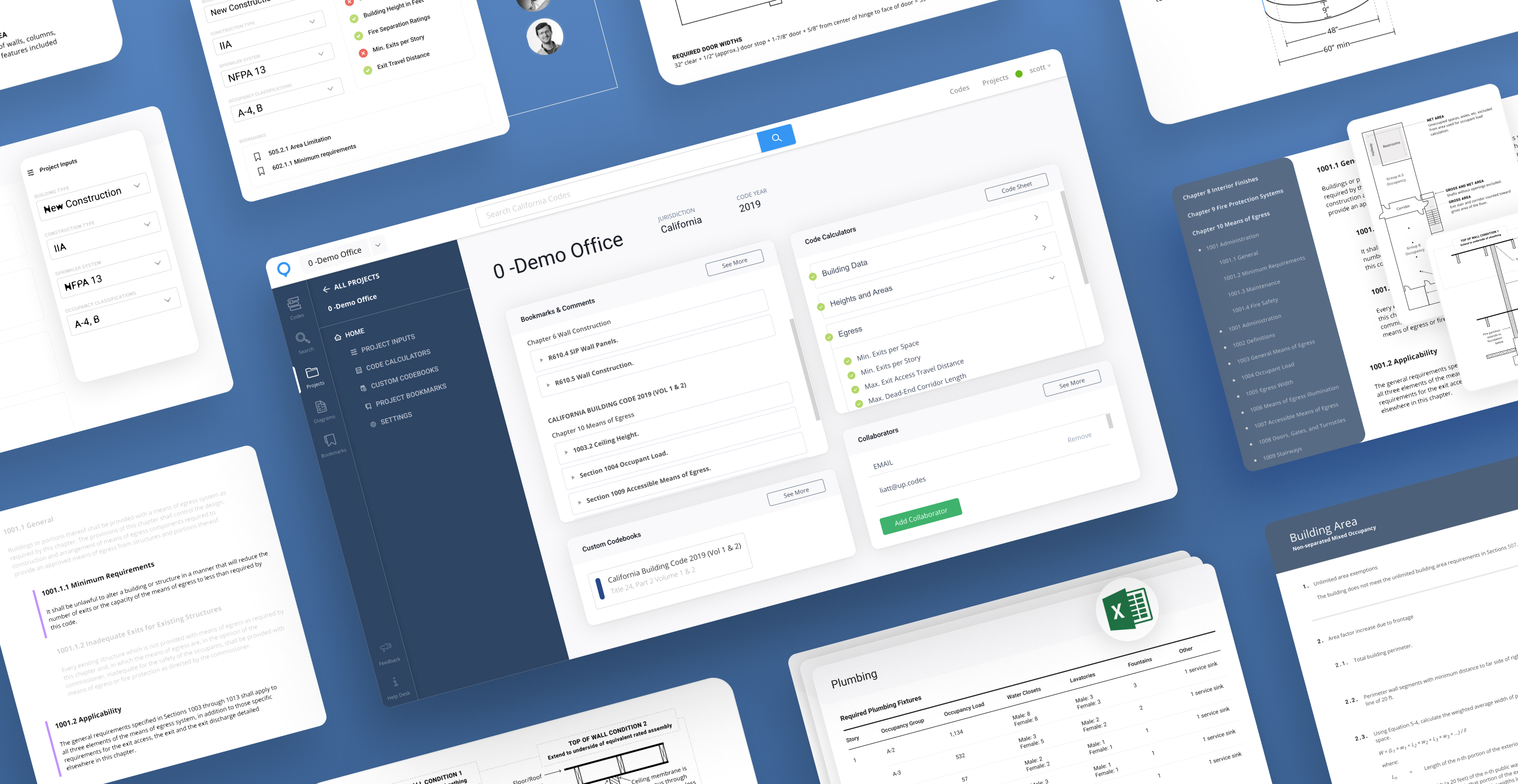
Screenshots of UpCodes' building code calculator

UpCodes’ building code calculator

“Our end goal is that no matter who you are or what level of sophistication you have with building codes, you can go into a friendly interface and answer your code question,” said Scott, who worked as an architect before launching UpCodes. He notes that even at architecture, engineering and construction firms, which often work with code consultants as part of their compliance process, employees have differing levels of familiarity with referencing building codes.

“We’ve heard from users that they’ll be looking at one particular section of the code, and they’ll make the building compliant to that, but not realize there’s a more stringent piece of code somewhere else, like say the fire code compared to the building code,” he added. “It causes huge downstream issues because they don’t have the full picture of it, so that’s what we’re trying to solve.”

The Reynolds brothers compared UpCodes code calculator to tax software like TurboTax, which help people comply with tax laws even if they haven’t parsed it closely. “When Americans file their taxes every year, they’re not cracking open the tax code. They have tax software,” said Garrett, who was previously a software engineer at PlanGrid. “We’re very much in the dark ages of compliance and so we want to modernize it and not have people read through the raw building codes, which are much more complicated than tax code.”

The new funding will be used for hiring, so UpCodes can add new features more quickly, including ones to automate calculations.

“We want to keep expanding so that ideally an homeowner on their iPhone, for example, can click and get any kind of compliance answer they want,” said Scott.


News: Customer experience startup Sprinklr files confidential S-1 with SEC

Sprinklr, a New York-based customer experience company, announced today it has filed a confidential S-1 ahead of a possible IPO. “Sprinklr today announced that it has confidentially submitted a draft registration statement on Form S-1 with the Securities and Exchange Commission (the “SEC”) relating to the proposed initial public offering of its common stock,” the

Sprinklr, a New York-based customer experience company, announced today it has filed a confidential S-1 ahead of a possible IPO.

“Sprinklr today announced that it has confidentially submitted a draft registration statement on Form S-1 with the Securities and Exchange Commission (the “SEC”) relating to the proposed initial public offering of its common stock,” the company said in a statement.

It also indicated that it will determine the exact number of shares and the price range at a later point after it receives approval from the SEC to go public.

The company most recently raised $200 million on a $2.7 billion valuation last year. It was its first fundraise in 4 years. At the time, founder and CEO Ragy Thomas said his company expected to end 2020 with $400 million in ARR, certainly a healthy number on which to embark as a public company.

He also said that Sprinklr’s next fundraise would be an IPO, making him true to his word. “I’ve been public about the pathway around this, and the path is that the next financial milestone will be an IPO,” he told me at the time of the $200 million round. He said that with COVID, it probably was a year or so away, but the timing appears to have sped up.

Sprinklr sees customer experience management as a natural extension of CRM, and as such a huge market potentially worth a $100 billion, according to Thomas. But he also admitted that he was up against some big competitors like Salesforce and Adobe, helping explain why he fundraised last year.

Sprinklr was founded in 2009 with a focus on social media listening, but it announced a hard push into customer experience in 2017 when it added marketing, advertising, research, customer and e-commerce to its social efforts.

The company has raised $585 million to-date, and has also been highly acquisitive buying 11 companies along the way as it added functionality to the base platform, according to Crunchbase data.

News: Match Group makes seven-figure investment in background check nonprofit Garbo

Match Group, the parent company to Tinder, Match, OkCupid, Hinge and other top dating apps, announced this morning it’s made a seven-figure investment into nonprofit background check platform Garbo, with the goal of helping Match Group’s users make more informed decisions about their safety when dating online. The deal will see Match working closing with

Match Group, the parent company to Tinder, Match, OkCupid, Hinge and other top dating apps, announced this morning it’s made a seven-figure investment into nonprofit background check platform Garbo, with the goal of helping Match Group’s users make more informed decisions about their safety when dating online. The deal will see Match working closing with Garbo to integrate the background check technology into Tinder later this year, followed by other Match Group U.S. dating apps.

Image Credits: Kathryn Kosmides, via Match Group

New York-based Garbo was originally founded in 2018 by Kathryn Kosmides, a survivor of gender-based violence who wanted to make it easier for everyone to be able to have the ability to look up critical information about someone’s background that could indicate a history of violence.

Typically, background check services are run by for-profit companies and surface a wide variety of personal information — like drug offenses or minor traffic violations — that aren’t always relevant to matters of safety and abuse. Plus, those types of charges are often levied against members of more vulnerable communities, Garbo has pointed out, and aren’t correlated to gender-based violence.

Garbo instead offers low-cost background checks by collecting public records and reports of violence and abuse only, including arrests, convictions, restraining orders, harassment, and other violent crimes. To use the service, a user would enter either a first and last name, or a first name and phone number — often the only information a dating app users will have on one of their matches.

The service will then perform what it calls an “equitable background” check, meaning it will exclude drug possession charges form its results, as well as traffic tickets besides DUIs and vehicle manslaughter.

Last year, the nonprofit launched a beta test of its technology with 500 people in the NYC area, and soon grew its waitlist to over 6,000 more entirely by word-of-mouth. Garbo later pulled the test as the team realized the technology had the potential for national scale — something the team wanted to deliver before launching to the public.

As a small nonprofit without much in terms of financial backing, Garbo also realized a larger partner may be needed in that effort. After Kosmides was connected with Match Group’s new head of safety, Tracey Breeden, the two companies agreed to work together on bringing the technology to a broader U.S. audience.

“For far too long women and marginalized groups in all corners of the world have faced many barriers to resources and safety,” said Breeden, Match Group’s Head of Safety and Social Advocacy, in a statement about today’s news. “We recognize corporations can play a key role in helping remove those barriers with technology and true collaboration rooted in action. In partnership with Match Group, Garbo’s thoughtful and groundbreaking consumer background check will enable and empower users with information, helping create equitable pathways to safer connections and online communities across tech,” she added.

This is Match Group’s second investment in an outside safety technology provider to enhance its dating apps’ feature sets. In early 2020, the company invested in Noonlight to help it power new safety features inside Tinder and other dating apps following a damning investigative report by ProPublica and Columbia Journalism Investigations, published December 2019. The report revealed how Match Group allowed known sexual predators to use its apps. It also noted that Match Group didn’t have a uniform policy of running background checks on its dating app users, putting the responsibility on users to keep themselves safe.

Meanwhile, Tinder’s top competitor Bumble has been marketing itself as a more women-friendly alternative to traditional dating apps like Tinder, and has rolled out a number of features designed to keep users safe from bad actors — including, most recently, a way to prevent to prevent them from using the app’s “unmatch” option to hide from their victims.

Given that gaining a reputation for being an “unsafe” app could be significantly damaging to a brand like Tinder and the larger online dating industry as a whole, it’s obvious why Match Group is now directly investing to address this problem. With the Noonlight investment, for example, Match Group promised features like a discreet way to trigger emergency services inside the Tinder app, similar to the feature found in Uber and Lyft, plus other anti-abuse measures.

Match Group says Garbo will use the new investment to hire across product, engineering and in leadership — including a head of engineering and an initial team of five engineers. This team will work to build out Garbo’s capabilities, using technologies like natural language processing and A.I.

Garbo will also benefit from sizable contributions of time and resources from Match Group, as its gets its product fully operational and then rolled out across Match Group products, starting with Tinder. And Match Group will help Garbo make the nonprofit’s technology accessible to other platforms, as well — like ridesharing companies.

Once live in Tinder, the background check feature may not be free, however.

Instead, Match Group says it will work to determine the pricing based on things like what user adoption looks like, how many people want to use it, how many searches they want to perform and other factors. It also hasn’t yet determined how deep the integration may be — whether, for example, it will link outside the app to Garbo or make it seem more like an in-app feature.

Match Group doesn’t have any exact time frame for the feature’s launch beyond “later this year” for Tinder, to be followed by other U.S. dating apps. The company may consider looking into similar investments for its services aimed at international users in the months to come.

News: His Majesty Elon the First, Technoking of Tesla

Last week, Elon Musk made $25 billion in one day. On Monday, he crowned himself “Technoking of Tesla.” In Musk-speak, this new title still translates into the Chief Executive Officer of the electric car company.  The eccentric billionaire is nothing if not creative with his dubs (see: Offspring named X Æ A-Xii.) Zach Kirkhorn, the

Last week, Elon Musk made $25 billion in one day. On Monday, he crowned himself “Technoking of Tesla.” In Musk-speak, this new title still translates into the Chief Executive Officer of the electric car company. 

The eccentric billionaire is nothing if not creative with his dubs (see: Offspring named X Æ A-Xii.) Zach Kirkhorn, the company’s Chief Financial Officer, has also been bestowed the title of Master of Coin. A nod to Game of Thrones? Honestly, who knows? 

The new appellations were announced via a U.S. Securities and Exchange Commission filing, which reads: 

“Effective as of March 15, 2021, the titles of Elon Musk and Zach Kirkhorn have changed to Technoking of Tesla and Master of Coin, respectively. Elon and Zach will also maintain their respective positions as Chief Executive Officer and Chief Financial Officer.”

This title change follows Musk’s announcement last month that Tesla might start accepting bitcoin as a form of payment in the near future. The cryptocurrency’s stock price hit a new high of $61,788 over the weekend. 

Perhaps this is Musk’s not-so-subtle way of trying to let the world know who reigns supreme, especially after being bumped by Jeff Bezos as the richest person on the planet and after being sued by a Tesla investor for his continuous “erratic tweets” that potentially expose the electric vehicle company to fines and penalties that could drive its share price down. 

Musk’s announcement had a negligible impact on the stock price. Tesla’s stock is up 1.5% in morning trading. Tesla shares had an impressive 600% soar in 2020. However, the stock is now down 20% for the year from a high of $880.82 reached January 8. 

Tesla also disclosed on Monday that Jerome Guillen, president of automotive, will now take on the role of president of Tesla Heavy Trucking. In a 2020 Q4 earnings call, Musk said he expects deliveries of the Tesla Semi to begin this year. The engineering work on the freight-hauling truck with an all-electric powertrain is complete, but lack of availability to battery cells might halt production, Musk said during the call. 

News: Genesis raises $45M to expand its fintech-focussed low-code platform to more verticals

Low-code and no-code tools have been a huge hit with enterprises keen to give their operations more of a tech boost, but often lack the resources to handle more complex integrations. Today, one of the startups that has been building low-code finance tools is announcing funding to tap into that trend and expand its business.

Low-code and no-code tools have been a huge hit with enterprises keen to give their operations more of a tech boost, but often lack the resources to handle more complex integrations. Today, one of the startups that has been building low-code finance tools is announcing funding to tap into that trend and expand its business.

Genesis — which has to date primarily worked with financial services companies, giving non-technical employees the tools to create ways to monitor and manage real-time risk, high-frequency trades and other activities — has picked up $45 million. It plans to use to bring the tools it has already built to a wider set of verticals that have some of the same needs to manage risk, compliance, and other factors as finance — healthcare and manufacturing are two examples — as well as to continue building more into the stack. 

This Series B includes a mix of financial investors along with strategic backers that speak to who already integrates with Genesis’ tools on their own platforms.

Led by Accel, it also includes participation from new backers GV (formerly Google Ventures) and Salesforce Ventures, in addition to existing investors Citi, Illuminate Financial and Tribeca Venture Partners, who also invested in this round. To give you an idea of who it works with, Citi, along with ING, London Clearing House, and XP Investments, are some of Genesis customers.

Originally conceived in 2012 in Brazil by a pair of British co-founders — Stephen Murphy (CEO) and James Harrison (CTO), who cut their teeth in the world of investment banking — Genesis had raised less than $5 million before this round, mostly bootstrapping its business and leaning on Murphy and Harrison’s existing relationships in the world of finance to grow its customer base.

Today, Murphy lives in and leads the business from Miami — where he moved from New York just as the Covid-19 pandemic was starting to gain steam last year — while James Harrison (CTO) leads part of the team based out of the UK.

As you might imagine with so little funding before now for a company going on nine years old, Genesis was doing fine financially before this Series B, so the plan is to use the funding specifically to grow faster than it could have on its own steam. The startup is not disclosing its valuation with this round.

“We were not really fixated on valuation,” said Murphy in an interview, who said the funding came about after a number of VCs had approached the startup. “The most important thing is the future opportunity and where we could take the company with additional funding… this will help us hyper scale up.” He did note that the term sheets contained “some amazing numbers and multiples,” given the current interest in no-code and low-code technology.

Indeed, the vogue for no-code and low-code tech — other well-funded names in the crowded space include startups like Zapier, Airtable, Rows, Gyana, Bryter, Ushur, Creatio, and EasySend, as well as significant launches from Google and Microsoft and other bigger players — is coming out of two trends colliding.

On one side, we’ve well and truly entered an era in enterprise technology — with the same trend playing out in consumer tech, too — where smart developers are taking sophisticated and complex services and putting “wrappers” around them by way of APIs and simpler (low- or no-code) interfaces, so that those sophisticated tools can in turn be integrated and implemented in more places. This saves needing to build or integrate that complexity from scratch and expands access to the processes within those wrappers.

On the other side, the thirst for tech knowledge has become well and truly mainstream and as a result getting far more democratized. Working in a variety of applications, using different digital tools and devices, and seeing the fruits of tech pay off are all second nature to today’s working world — whether or not you are a technologist. So it’s no surprise to see more proactive, non-technical people looking for more ways to get their hands on these tools themselves.

“You now have a whole citizen developer world, for example business analysts who understand the solution you want but might not know how to get there,” Murphy said. “We play to seasoned developers first but the investment will help us put more low code and no code tools into place to widen the tools out to them.”

Starting out in finance made sense not just because that was where the two founders had previously worked, but also because of the history of how different software tools were already being used. Specifically, he noted that the ubiquity of microservices — which themselves are collections of services as apps — laid the groundwork for more low-code. “We saw that if we could build a low-code entry point to microservices, that would be powerful.”

On top of that, investment banks, he said, have a history of wanting to build things themselves to tailor to their specific needs. “Buying off the shelf means you are at the mercy of the vendor,” he said. These factors made financial services companies very receptive to what Genesis was offering.

While a lot of the no/low-code players are coming at the concept with specific verticals in mind — no surprise, since different verticals have very specific use cases and needs — so what’s interesting with Genesis is how the company is leveraging what it already knows about finance, and then looking at other industries that have similar demands, structures and rules.

Murphy said that Genesis will stay “very focused on financial markets for 2021” but that it’s identified a number of other verticals similar to it, and is actually already seeing some inbound interest from them.

“A number of people have already approached us from the world of healthcare,” he said, pointing out that these organizations, like financial services, face challenges around how to audit data and regulations around performing transactions. Manufacturing, meanwhile, has some parallels around the area of complex event processing similar to equity algorithmic trading, he said. (In short, this relates to how external events might trigger more transactions, not unlike how external factors affect manufacturing operations.)

The trend is one that analysts forecast will only grow in the coming years: Gartner, for example, says that by 2024, low-code platforms will account for no less than 65% of all app development activity.

“Low-code promises business users the autonomy to make their own technology usage and purchase decisions while enabling them to actually build their own applications without having to rely on IT,” said Andrei Brasoveanu, a partner at Accel, said n a statement. “By bringing one of the most transformative innovations in software development to financial services, Steve and the Genesis team are taking on a huge market of legacy vendors – and winning too – while delivering on the promise of low-code. The confidence they’ve gained from serving such large institutions is proof that there’s a real and urgent need for a purpose-built low-code solution for financial markets. We’re excited to partner with Genesis and support them in delivering this across the world.” Brasoveanu is joining the startup’s board with this round.

News: Volkswagen will bring 240 gigawatt hours of battery production capacity to Europe by 2030

Volkswagen AG is gearing up to seize the top spot as the world’s largest electric vehicle manufacturer with plans announced Monday to have six 40 Gigawatt hour (GWh) battery cell production plants in operation in Europe by 2030. To get there, the automaker put in a 10-year, $14 billion order with Swedish battery manufacturer Northvolt

Volkswagen AG is gearing up to seize the top spot as the world’s largest electric vehicle manufacturer with plans announced Monday to have six 40 Gigawatt hour (GWh) battery cell production plants in operation in Europe by 2030.

To get there, the automaker put in a 10-year, $14 billion order with Swedish battery manufacturer Northvolt – and that’s only one of the six planned factories. A second plant in Germany will commence production in 2025.

The company also announced serious investments in charging infrastructure across China, Europe and the United States. It aims to grow its fast-charging network in Europe to 18,000 stations with its partner IONITY, 17,000 charging points in China through its joint venture CAMS New Energy Technology, and to increase the number of fast-charging stations in the United States by 3,500.

The company’s first dedicated battery event, a clear nod to Tesla’s Battery Day, also included a deep dive into novel battery chemistries that will reduce costs by up to 50%. The cell also paves the way for the transition to a solid-state battery cell, which the company anticipates for the middle of the decade. VW has made significant investments in solid-state battery manufacturer QuantumScape.

Volkswagen’s new Unified Premium Battery platform will be rolled out in 2023 and will be used across 80 percent of its EV models. The first to contain the new battery, the Audi Artemis, will be rolled out in 2024.

Scania AB, VW’s brand of heavy-duty trucks and busses, also has plans to increase its share of EVs. Departing from other major heavy-duty players that have opted for hydrogen fuel cells, company representatives on Monday said that it is unequivocally possible to electrify the heavy-duty transportation sector.

Looking to the battery’s end-of-life, VW said it will be able to recycle up to 95% of the battery through a process called hydrometallury.

News: Equity Monday: Stripe’s epic new valuation, Deliveroo’s IPO, and WeWork numbers

Hello and welcome back to Equity, TechCrunch’s venture capital-focused podcast where we unpack the numbers behind the headlines. This is Equity Monday, our weekly kickoff that tracks the latest private market news, talks about the coming week, digs into some recent funding rounds and mulls over a larger theme or narrative from the private markets. You

Hello and welcome back to Equity, TechCrunch’s venture capital-focused podcast where we unpack the numbers behind the headlines.

This is Equity Monday, our weekly kickoff that tracks the latest private market news, talks about the coming week, digs into some recent funding rounds and mulls over a larger theme or narrative from the private markets. You can follow the show on Twitter here and myself here — and make sure to check out Friday’s news-roundup with Danny and Natasha that included some neat notes on search startups. And their chances against Google.

So, what did we chat about this morning? Here’s the rough rundown:

Extra Crunch Live this week is Emmalyn Shaw from Flourish Ventures and Adam Roseman from Steady. That’s March 17th at 12 p.m. PDT and 3 p.m. EDT. See you there!

Equity drops every Monday at 7:00 a.m. PST, Wednesday, and Friday at 6:00 AM PST, so subscribe to us on Apple PodcastsOvercastSpotify and all the casts!

News: Julia Collins and Sarah Kunst outline how to build a fundraising process

“if you’re not a graphic designer, then any incremental minute that you’re spending on trying to make your deck pretty is a waste of time.”

Julia Collins is the first Black woman to co-found a venture-backed unicorn. So it should come as no surprise that investors lined up to bet on her latest venture, Planet FWD.

Investor Sarah Kunst says Collins’ branding skills are on par with Supreme, the ubiquitous lifestyle brand.

“The thing that Supreme has done incredibly well is the same thing I think some very exceptional founders like Julia can do very well, which is to build a brand that stands for something,” said Kunst. “Smart people know that the best time to get aligned with a great brand is at the drop. A Supreme shirt that costs $100 bucks in the store will cost $1,000 online. So, as an investor, I am just a kid on the street corner flipping sportswear.”

Kunst and Collins met well before Collins even had a clear idea for Planet FWD, but the duo knew they wanted to work together in the future. Kunst essentially told Collins that, whatever she was planning to do next, Kunst wanted to invest in it, sight unseen.

Kunst said Collins’ ability to “see around the corner” with Zume gave her the confidence to proceed. When Zume launched, there were a lot of naysayers, recalls Kunst.

“Now, you look at where the world is and there are multibillion dollar companies in the space,” she said. “Some of the most successful entrepreneurs in the world, like Travis Kalanick, are leaning into ghost kitchens, which are just less efficiently delivered versions of Zume Pizza robots. To quote Wayne Gretzky, because I’m from the Midwest and therefore care about hockey a tiny bit, you want to skate to where the puck is going.”

The two formed a friendship and eventually, Collins started building out Planet FWD and prepping to raise. By then, the foundation was there. Kunst got in on Planet FWD’s seed round.

Fundraising is a process

Collins says one of the biggest lessons she learned from her time at Zume was to limit distractions and focus on one thing at a time.

“I felt this disorientation at times, and it was hard to navigate,” she said, noting that she not only was starting a company but also settling into the Bay Area. “Now, it’s much easier for me to cut through a lot of noise and focus on a single conversation, a single product’s development, a single thing that I need to get done.”

In that same vein, Collins has learned to be incredibly deliberate when it comes to fundraising. It’s also worth noting that she’s raised some $400 million+ in the last five years.

WordPress Image Lightbox Plugin