Tag Archives: Blog

News: Oso announces $8.2M Series A to simplify authorization for developers

When we think about getting access to an application, we tend to focus on the authentication side — granting or denying people (or devices) entry. But there is another piece to this, and that’s authorization. This is related to what you can do once you are inside the application, and Oso, an early stage startup,

When we think about getting access to an application, we tend to focus on the authentication side — granting or denying people (or devices) entry. But there is another piece to this, and that’s authorization. This is related to what you can do once you are inside the application, and Oso, an early stage startup, has created an open source library for developers to make it easier to build authorization in their applications.

Today, the company announced an $8.2 million Series A led by Sequoia with participation from SV Angel, Company Ventures, Highland Capital and numerous angel investors. When combined with a $2.7 million seed round from 2019, it brings the total raised to $10.9 million.

Company co-founder and CEO Graham Neray says that developers have benefited from tools like Stripe and Twilio to normalize the use of third-party APIs to offload parts of the application that aren’t core to the value prop. Oso does the same thing, except for authorization.

“We help developers to speed up their authorization roadmaps by up to 4x, and the way that we do that is by providing this library, which comes with pre-built integrations, guides and an underlying policy language,” Neray explained.

He says that authorization is a misunderstood concept, and as though to confirm this, when I tried to explain Oso to a colleague, his first thought was that it is an Okta competitor. It’s not. As Neray explains authorization and authentication are related, but are in fact different and require a different set of tools.

While tools like Okta grant you access, authorization determines what buttons can you click, what pages, can you see, what data can you access. Most developers handle this manually by writing the authorization code themselves, linking it to Active Directory (or a similar tool) and fashioning a permissions matrix. Oso’s goal is to remove that burden and provide a set of tools to abstract away most of the complexity.

The tool is open source and the startup is concentrating on building a community of users for now to build developer interest. Over time, they fully intend to build a commercial company on top of that, but are still thinking about how that will look.

For now,  the company, which launched in 2018, has 9 employees with plans to triple over the next 18 months. Naray and co-founder and CTO Sam Scott are thinking carefully about how to build a diverse, inclusive and equitable company as they grow. That means hiring from underrepresented groups, treating them fairly and making them feel like they belong. Naray says at this point, he is doing all of the hiring.

“I make a concerted effort to ensure that our pipeline is as diverse as I want the team to be — full stop — and that’s the only way to do it,” he said.

He adds that while building a diverse workforce is the morally right thing to do for him and his co-founder, there is also a practical business side to this too. “We don’t want to build an echo chamber with people from the same background, the same thought process and all the same upbringing,” he said.

When the company can return to the office, the plan is to have a home base, but let folks work where they want and how they want. “The plan is we will have an office in New York, and we will have remote team members. So in one form or another it will be hybrid,” Naray said.

News: Pixxel closes $7.3M seed round and unveils commercial hyperspectral imaging product

LA and Bangalore-based space startup Pixxel has closed a $7.3 million seed round, including newly committed capital from Techstars, Omnivore VC and more. The company has also announced a new product focus: Hyperspectral imaging. It aims to provide that imaging at the highest resolution commercially available, via a small satellite constellation that will provide 24-hour,

LA and Bangalore-based space startup Pixxel has closed a $7.3 million seed round, including newly committed capital from Techstars, Omnivore VC and more. The company has also announced a new product focus: Hyperspectral imaging. It aims to provide that imaging at the highest resolution commercially available, via a small satellite constellation that will provide 24-hour, global coverage once it’s fully operational.

Pixxel’s funding today is an extension of the $5 million it announced it had raised back in August of last year. At the time, the startup had only revealed that it was focusing on Earth imaging,, and it’s unveiling its specific pursuit of hyperspectral imaging for the first time today. Hyperspectral imaging uses far more light frequencies than the much more commonly-used multispectral imaging used in satellite observation today, allowing for unprecedented insight and detection of previously invisible issues, including migration of pest insect populations in agriculture, or observing gas leaks and other ecological threats.

Standard multispectral imaging (left) vs. hyperspectral imaging (right) Credit: EPFL

“We started with analyzing existing satellite images, and what we could do with this immediately,” explained Pixxel co-founder and CEO Awais Ahmed in an interview. “We realized that in most cases, it was not able to even see certain problems or issues that we wanted to solve – for example, we wanted to be able to look at air pollution and water pollution levels. But to be able to do that there were no commercial satellites that would enable us to do that, or even open source satellite data at the resolution that would enable us to do that.”

The potential of hyperspectral imaging on Earth, across a range of sectors, is huge, according to Ahmed, but Pixxel’s long-term vision is all about empowering a future commercial space sector to make the most of in-space resources.

“We started looking at space as a sector for us to be able to work in, and we realized that what we wanted to do was to be able to enable people to take resources from space to use in space,” Ahmed said. That included asteroid mining, for example, and when we investigated that, we found hyperspectral imaging was the imaging tech that would enable us to map these asteroids as to whether they contain these metal or these minerals. So that knowledge sort of transferred to this more short-term problem that we were looking at solving.”

Part of the reason that Pixxel’s founders couldn’t find existing available hyperspectral imaging at the resolutions they needed was that as a technology, it has previously been restricted to internal governmental use through regulation. The U.S. recently opened up the ability for commercial entities to pursue very high-resolution hyperspectral imaging for use on the private market, effectively because they realized that these technical capabilities were becoming available in other international markets anyway. Ahmed told me that the main blocker was still technical, however.

Pixxel's Hyperspectral imaging satellite at its production facility in Bangalore

Image Credits: Pixxel

“If we were to build a camera like this even two or three years ago, it would not have been possible because of the miniaturized sensors, the optics, etc.,” he said. “The advances that have happened only happened very recently, so it’s also the fact that this the right time to take it from the scientific domain to the commercial domain.”

Pixxel now aims to have its first hyperspectral imaging satellite launched and operating on orbit within the next few months, and it will then continue to launch additional satellites after that once it’s able to test and evaluate the performance of its first spacecraft in an actual operating environment.


Early Stage is the premier “how-to” event for startup entrepreneurs and investors. You’ll hear firsthand how some of the most successful founders and VCs build their businesses, raise money and manage their portfolios. We’ll cover every aspect of company building: Fundraising, recruiting, sales, product-market fit, PR, marketing and brand building. Each session also has audience participation built-in — there’s ample time included for audience questions and discussion. Use code “TCARTICLE at checkout to get 20% off tickets right here.

News: Pregame Y Combinator with Equity

 Hello and welcome back to Equity, TechCrunch’s venture capital-focused podcast, where we unpack the numbers behind the headlines. This is our Wednesday show, where we niche down and focus on a single topic, or theme. This is our sweet spot: going beyond definitions and into the dirty and deep impact of how a phenomenon could


Hello and welcome back to Equity, TechCrunch’s venture capital-focused podcast, where we unpack the numbers behind the headlines.

This is our Wednesday show, where we niche down and focus on a single topic, or theme. This is our sweet spot: going beyond definitions and into the dirty and deep impact of how a phenomenon could impact startups and tech. We are hoping to explore more than answer, and debate more than agree.

This week we’re riffing on the impending Y Combinator demo day class, all hailing from the Winter 2021 cohort. As we stated on the show, we’re not saying that these are the only startups worth looking at. They’re simply the startups from the batch that TechCrunch has already covered, as well as some crowdsourced favorites.

Here’s a brief rundown of the show, bucketed by market choice, loosely:

  • Startups serving startups: The largest group of startups in our rundown, we chatted about BrioHR, which is building HR software for Southeast Asia (TechCrunch coverage here), Firstbase, which is building a remote-work onboarding service (TechCrunch coverage here), ContentFly, which wants to use a hybrid of computer and human intelligence to provide writing services, Runway, which wants to help companies better manage app rollouts (TechCrunch coverage here), and Mono, which is building a Plaid for Africa (TechCrunch coverage here).
  • Marketplaces: Here we found two companies to discuss, the first being Providence’s own Pangea, and Queenly. Pangea (TechCrunch coverage here), is building a freelance marketplace for digitally-savvy college kids and small businesses, while Queenly is a marketplace for formalwear (TechCrunch coverage here).
  • Space: Alex demanded that we include Albedo, which is aiming to launch a satellite constellation to improve imaging of the planet using low-orbit flight paths.
  • Biotech: And then there were two biotech companies. The first, Pipe|Bio does big data management for drug development, and Nuntius Therapeutics, which is working on delivering “large genetic payloads into the correct cells.” Which sounds cool.

The actual Demo Day is happening next Tuesday, so TechCrunch and Extra Crunch will be all over day-of coverage as per usual. Talk then!

Equity drops every Monday at 7:00 a.m. PST, Wednesday, and Friday morning at 7:00 a.m. PST, so subscribe to us on Apple PodcastsOvercastSpotify and all the casts.

News: In expanded crackdown, Facebook increases penalties for rule-breaking groups and their members

Facebook this morning announced it will increase the penalties against its rule-breaking Facebook Groups and their members, alongside other changes designed to reduce the visibility of groups’ potentially harmful content. The company says it will now remove civic and political groups from its recommendations in markets outside the U.S., and will further restrict the reach

Facebook this morning announced it will increase the penalties against its rule-breaking Facebook Groups and their members, alongside other changes designed to reduce the visibility of groups’ potentially harmful content. The company says it will now remove civic and political groups from its recommendations in markets outside the U.S., and will further restrict the reach of groups and members who continue to violate its rules.

The changes follow what has been a steady, but slow and sometimes ineffective crackdown on Facebook Groups that produce and share harmful, polarizing or even dangerous content.

Ahead of the U.S. elections, Facebook implemented a series of new rules designed to penalize those who violated its Community Standards or spread misinformation via Facebook Groups. These rules largely assigned more responsibility to Groups themselves, and penalized individuals who broke rules. Facebook also stopped recommending health groups, to push users to official sources for health information, including for information about Covid-19.

This January, Facebook made a more significant move against potentially dangerous groups. It announced it would remove civic and political groups, as well as newly created groups, from its recommendations in the U.S. following the insurrection at the U.S. Capitol on Jan. 6, 2021. (Previously, it had temporarily limited these groups ahead of the U.S. elections.)

As The WSJ reported when this policy became permanent, Facebook’s internal research had found that Facebook groups in the U.S. were polarizing users and inflaming the calls for violence that spread after the elections. The researchers said roughly 70% of the top 100 most active civic Facebook Groups in the U.S. had issues with hate, misinformation, bullying and harassment that should make them non-recommendable, leading to the January 2021 crackdown.

Today, that same policy is being rolled out to Facebook’s global user base, not just Facebook U.S. users.

That means in addition to health groups, users worldwide won’t be “recommended” civic or political groups when browsing Facebook. It’s important, however, to note that recommendations are only one of many ways users find Facebook Groups. Users can also find them in search, through links people post, through invites and friends’ private messages.

In addition, Facebook says groups that have gotten in trouble for violating Facebook’s rules will now be shown lower in recommendations — a sort of downranking penalty Facebook often uses to reduce the visibility of News Feed content.

The company will also increase the penalties against rule-violating groups and their individual members through a variety of other enforcement actions.
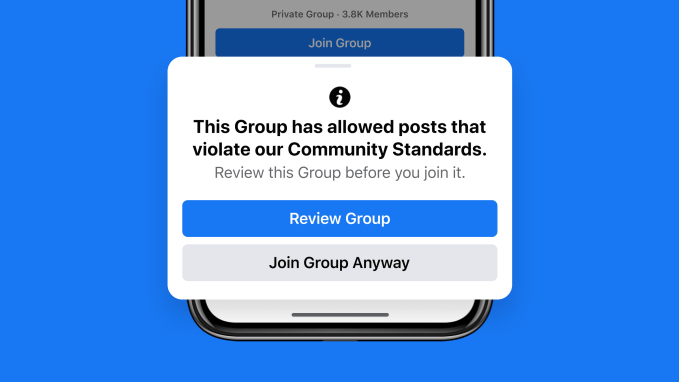
Image Credits: Facebook

For example, users who attempt to join groups that have a history of breaking Facebook’s Community Standards will be alerted to the the group’s violations through a warning message (shown above), which may cause the user to reconsider joining.

The rule-violating groups will have their invite notifications limited, and current members will begin to see less of the groups’ content in their News Feed, as the content will be shown further down. These groups will also be demoted in Facebook’s recommendations.

When a group hosts a substantial number of members who have violated Facebook policies or participated in other groups that were shut down for Facebook Community Standards violations, the group itself will have to temporarily approve all members’ new posts. And if the admin or moderator repeatedly approves rule-breaking content, Facebook will then take the entire group down.

This rule aims to address problems around groups that re-form after being banned, only to restart their bad behavior unchecked.

The final change being announced today applies to group members.

When someone has repeated violations in Facebook Groups, they’ll be temporarily stopped from posting or commenting in any group, won’t be allowed to invite others to join groups, and won’t be able to create new groups. This measure aims to slow down the reach of bad actors, Facebook says.

The new policies give Facebook a way to more transparently document a group’s bad behavior that led to its final shutdown. This “paper trail,” of sorts, also helps Facebook duck accusations of bias when it comes to its enforcement actions —  a charge often raised by Facebook critics on the right, who believe social networks are biased against conservatives.

But the problem with these policies is that they’re still ultimately hand slaps for those who break Facebook’s rules — not all that different from what users today jokingly refer to as “Facebook jail“. When individuals or Facebook Pages violate Facebook’s Community Standards, they’re temporarily prevented from interacting on the site or using specific features. Facebook is now trying to replicate that formula, with modifications, for Facebook Groups and their members.

There are other issues, as well. For one, these rules rely on Facebook to actually enforce them, and it’s unclear how well it will be able to do so. For another, they ignore one of the key means of group discovery: search. Facebook claims it downranks low-quality results here, but results of its efforts are decidedly mixed.

For example, though Facebook made sweeping statements about banning QAnon content across its platform in a misinformation crackdown last fall, it’s still possible to search for and find QAnon-adjacent content — like groups that aren’t titled QAnon but cater to QAnon-styled “patriots” and conspiracies).

Similarly, searches for terms like “antivax” or “covid hoax,” can also direct users to problematic groups — like the one for people who “aren’t anti-vax in general,” but are “just anti-RNA,” the group’s title explains; or the “parents against vaccines” group; or the “vaccine haters” group that proposes it’s spreading the “REAL vaccine information.” (We surfaced these on Tuesday, ahead of Facebook’s announcement.)


Cleary, these are not official health resources, and would not otherwise be recommended per Facebook policies — but are easy to surface through Facebook search. The company, however, takes stronger measures against Covid-19 and Covid vaccine misinformation — it says it will remove Pages, groups, and accounts that repeatedly shared debunked claims, and otherwise downranks them.

Facebook, to be clear, is fully capable of using stronger technical means of blocking access to content.

It banned “stop the steal” and other conspiracies following the U.S. elections, for example. And even today, a search for “stop the steal” groups simply returns a blank page saying no results were found.
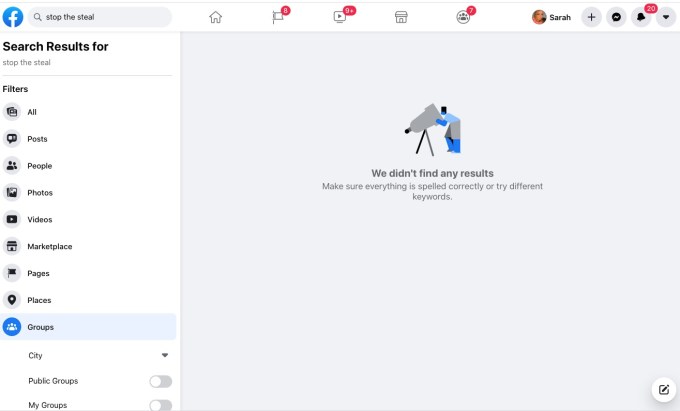
Image Credits: Facebook fully blocks “stop the steal”

So why should a search for a banned topic like “QAnon” return anything at all?

Why should “covid hoax?” (see below)
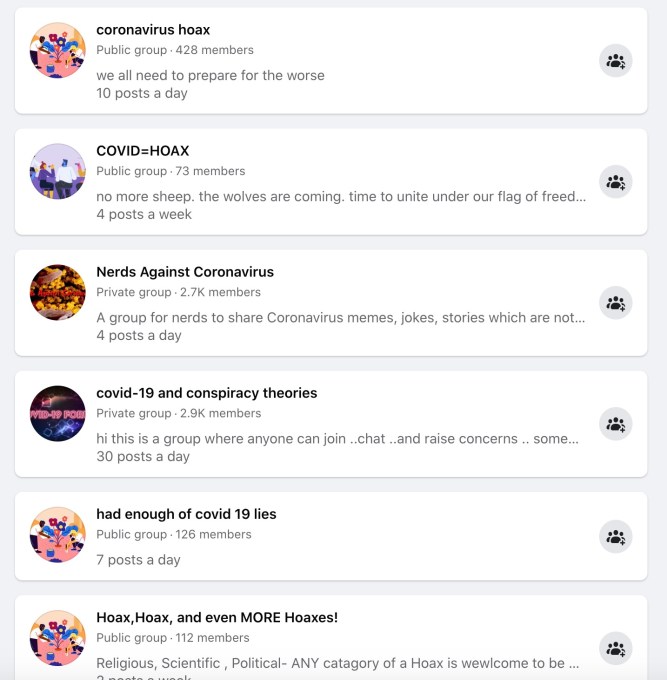
Image Credits: Facebook group search results for “covid hoax”


If Facebook wanted to broaden its list of problematic search terms, and return blank pages for other types of harmful content, it could. In fact, if it wanted to maintain a block list of URLs that are known to spread false information, it could do that, too. It could prevent users from re-sharing any post that included those links. It could make those posts default to non-public. It could flag users who violate its rules repeatedly, or some subset of those rules, as users who no longer get to set their posts to public…ever.

In other words, Facebook could do many, many things if it truly wanted to have a significant impact on the spread misinformation, toxicity, polarizing and otherwise harmful content on its platform. Instead, it continues inching forward with temporary punishments and those that are often only aimed at “repeated” violations, such as the ones announced today. These are, arguably, more penalties than it had before — but also maybe not enough.


News: France’s privacy watchdog probes Clubhouse after complaint and petition

Clubhouse, the buzzy but still invite only social audio app that’s popular with the Silicon Valley technorati, is being investigated by France’s privacy watchdog. The CNIL announced today it’s opened an investigation into Clubhouse following a complaint and after it got some initial responses back from Alpha Exploration Co., the U.S.-based company behind the app.

Clubhouse, the buzzy but still invite only social audio app that’s popular with the Silicon Valley technorati, is being investigated by France’s privacy watchdog.

The CNIL announced today it’s opened an investigation into Clubhouse following a complaint and after it got some initial responses back from Alpha Exploration Co., the U.S.-based company behind the app.

It also points to a petition that’s circulating in France with over 10,000 signatures — calling for regulatory intervention.

The regulator says it’s confirmed that Clubhouse’s owner is not established anywhere in the European Union — which means the app can be investigated by any EU DPA that receives a complaint or has its own concerns about EU citizens’ data.

Last month the Hamburg privacy regulator also raised concerns over Clubhouse, saying they’d asked the app for more information on how it protects the privacy of European users and their contacts.

In the EU, cross border data protection cases involving tech giants typically avoid this scenario as the General Data Protection Regulation (GDPR) includes a mechanism that funnels complaints via a lead data supervisor — aka the national agency where the business is established in the EU.

This ‘one-stop-shop’ already has had the effect of slowing down GDPR enforcement against giants like Facebook, which have established their regional HQ in Ireland. But there is a further risk of a regulatory moat effect for ‘big tech’ if the OSS gets combined with swifter unilateral privacy enforcement against newcomers like Clubhouse.

France’s watchdog has certainly demonstrated a willingness to move fast and enforce the rules against tech giants like Google and Amazon when unencumbered by the OSS — recently issuing fines over cookie consent issues in excess of $160M, for example. It also hit Google with a GDPR fine of $57M in 2019 before the tech giant moved the jurisdiction of regional users to Ireland.

So there’s no reason why the CNIL won’t show similar alacrity in its probe of Clubhouse. (Although in its press note today it does write that European DPAs are “communicating with each other on this matter, in order to exchange information and ensure consistent application of the GDPR”.)

Privacy concerns that have been attached to Clubhouse include that it uploads users’ phone book contacts — using the harvested phone numbers to build a usage graph so it can display how many ‘friends’ a non-user has on the service at the point when the user is being asked to select which of their contacts to invite to the service.

The petition to CNIL also claims Clubhouse’s “secret database” of users’ contacts may be sold to third parties.

“For years, lawmakers have not dared to attack Facebook for sucking up our data. Our democracies are paying a heavy price today,” the authors of the petition also write. “Clubhouse hopes we haven’t learned anything from Facebook’s methods and that its questionable practices will go unnoticed. But the German privacy agency has already accused the company of violating EU law. Now we need regulators in other countries to follow suit and put pressure on Clubhouse.

If thousands of you ask the CNIL to enforce the law, we can put an end to this blatant violation of our private lives. It is also an opportunity to send a strong message to the tech giants: our data is ours and no one else’s.”

In its privacy policy, Clubhouse‘s owner writes that the “Company does not sell your Personal Data” — but does list a wide ranging number of reasons why it may “share” user data with third parties, including for “advertising and marketing services”, among many other listed reasons.

Clubhouse has been contacted for comment.

News: Writing helper Copy.ai raises $2.9M in a round led by Craft Ventures

Copy.ai, a startup building AI-powered copywriting tools for business customers, announced a $2.9 million round this morning. The investment was led by Craft Ventures. Other investors took part in the deal, including smaller checks from Li Jin’s newly-formed Atelier Ventures, and Sequoia. The startup is notable for a few reasons. First for its model of

Copy.ai, a startup building AI-powered copywriting tools for business customers, announced a $2.9 million round this morning. The investment was led by Craft Ventures. Other investors took part in the deal, including smaller checks from Li Jin’s newly-formed Atelier Ventures, and Sequoia.

The startup is notable for a few reasons. First for its model of building in public. I initially heard of the company through its monthly updates that it posts on Twitter. Thanks to that, I can tell you that Copy.ai generated monthly recurring revenue (MRR) of $53,600. That figure, up 46% from January, works out to annual recurring revenue (ARR) of $643,200.

Copy.ai also shares usage numbers, and, humorously, the number of Twitter followers that its founder Paul Yacoubian picked up in the last month.

The startup is also worth watching because it is part of a growing cohort of companies building atop GPT-3, what its progenitor the OpenAI project describes as an “autoregressive language model with 175 billion parameters.” More generally, it’s a piece of AI that can generate words.

Some investors are rather bullish on startups using the technology. Recently on TechCrunch, for example, Madrona’s Matt McIlwain wrote that “the introduction of GPT-3 in 2020 was a tipping point for artificial intelligence” that will lead to “the launch of a thousand new startups and applications.”

So far that’s holding up. Not only has Copy.ai managed to find early in-market traction, TechCrunch has covered a number of other startups busy leveraging GPT-3, including OthersideAi which raised $2.6 million back in November of 2020, and an “AI Dungeon-maker” called Latitude that also employs GPT-3 and raised $3.3 million this February.

But enough about its cohort. Let’s get into how Copy.ai got built.

Origins

Before founding Copy.ai, Yacoubian was an investor and, it seems, a tinkerer. He played with GPT-3 predecessor GPT-2 when it came out, telling TechCrunch in an interview that he discovered that the tool generated lots of “nonsense,” with the occasional “flash of brilliance.” GPT-3 proved even better in his view, providing something akin to a “50x” improvement on the generation that came before it.

Leaning on Twitter as a distribution method — Copy.ai uses Twitter as distribution channel, hence its reporting on social media metrics — Yacoubian and his co-founder Chris Lu launched a few different draft-projects using GPT-3. Simplify.so did text condensing, a slackbot was built but never made it to the outside world, and taglines.ai was put together to help companies come up with slogans.

That last one found early traction, generating around 700 sign-ups in two days. That was enough of a user base, the co-founders decided, to begin monetizing their tool. Then they decided that the initial could be extended to other writing use cases, helping people with myriad distinct writing projects. Copy.ai was formed out of that concept.

The product can now generate text for blogs and products and headlines and the like, based on user-provided word inputs.

What’s odd and nearly antithetical to your humble servant as a writer is that Copy.ai doesn’t want to save you word count, per se. Instead, it generates a number of possible text results that the customer then chooses from. Recall the flashes of brilliance that Yacoubian said GPT-2 could generate? GPT-3 is even better, giving users of Copy.ai even better possible text formulations for their needs. And then the human-in-the-loop plays the editor role, choosing which they want the most and, I presume, tweaking from there.

When it was released back in October of 2020, Copy.ai snagged 2,000 sign-ups in its first two days. Then investors started reaching out.

Quitting their day jobs, Copy.ai became a full-time affair. The unorthodox startup also put together an unorthodox round, raising from what Yacoubian described as “as many people as [they] could.” That wound up being 80 people, give or take.

The round was raised as a capped SAFE, the Y Combinator-favored investing instrument that allows startups to accrete capital from external sources without a formal pricing; instead, SAFEs are often “capped” at a maximum valuation. Copy.ai raised its cap as its fundraising process trundled along.

David Sacks, founder of Craft Ventures, told TechCrunch that he thinks that “natural language generation powered by AI is going to change the way that marketing teams write copy,” adding that amongst startups it is “rare to see such strong bottom-up adoption in so short a time.”

I am honestly a bit excited to see what Copy.ai can do, not because I will use its product — it’s not precisely in my wheelhouse — but because I am rather excited about GPT-3 as a technology. And the startup is an in-market experiment regarding AI and writing. Two things I care quite a lot about.

News: The Voter Formation Project puts an experimental spin on reaching Black and brown first-time voters

Victories notwithstanding, the 2020 election blew up many of the assumptions Democrats have long held about the American electorate.In Florida, Arizona and elsewhere, Latino voters broke for Trump in unexpected numbers, upending conventional wisdom that the growing Spanish-speaking population will reliably vote the same way — and vote blue. Polling again failed to capture contours

Victories notwithstanding, the 2020 election blew up many of the assumptions Democrats have long held about the American electorate.In Florida, Arizona and elsewhere, Latino voters broke for Trump in unexpected numbers, upending conventional wisdom that the growing Spanish-speaking population will reliably vote the same way — and vote blue. Polling again failed to capture contours of races around the country, proving that pollsters’ inability to predict Trump’s 2016 win wasn’t a fluke. And with all eyes on Texas, Georgia flipped blue for the first time in two decades.

Tatenda Musapatike, a former political ad specialist at Facebook who left the company in 2019 to lead civic engagement campaigns, believes that the relative tabula rasa in American politics right now is an opportunity to double down on expanding the electorate.

This month, Musapatike is leaving her role directing campaigns at the Democratic nonprofit Acronym to launch the Voter Formation Project, a 501(c)3 laser-focused on reaching Black and brown first-time voters using every trick in the digital toolbox.

One answer to Trump’s surprise win in 2016, Acronym emerged as a nonprofit strategy group aiming to lay a Democratic digital groundwork that could match or surpass Republican digital campaigns.

The group stumbled in 2020 when an untested and probably ill-advised vote tabulation app delayed results in the Iowa caucuses, creating chaos and casting doubt on the Democratic party’s technical prowess. The app was created by Shadow, a tech company Acronym acquired the year prior but then scrambled to distance itself from.

But Acronym had a lot of irons in the fire. One of those was a 2019 voter drive called the “People’s Power Grab” led by Musapatike that mobilized unregistered voters of color in eight states including Arizona, Florida and Georgia.

With the Voter Formation Project, Musapatike can both extend and hone the same work. And with Georgia as a proof-of-concept and major legislative voting rights reform on the table, the political stakes of that mission are clearer than ever.

Musapatike is well-positioned for the task at hand. Prior to her work on voter outreach at Acronym, she spent three and a half years at Facebook working with progressive super PACs and nonprofits on their digital ad campaigns. (Mired in myriad political controversies following the 2016 U.S. election, including accusations that the company gave the Trump campaign special treatment, Facebook dissolved those teams.)

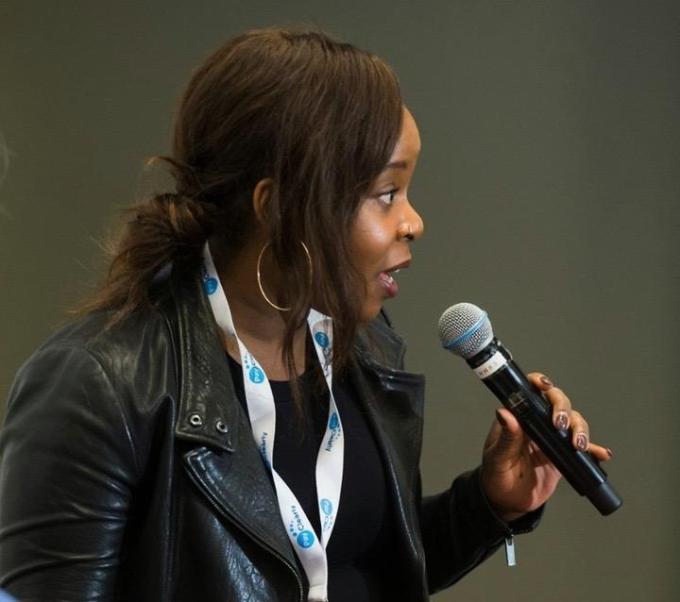
Tatenda Musapatike

Tatenda Musapatike of the Voter Formation Project

Musapatike told TechCrunch that the Voter Formation Project will fill an existing gap for digital-only voter outreach in at least a few ways. For one, it will be the first digital-only operation helmed by a Black woman in the space. Its mission is also uniquely targeted and the organization will be looking to raise at least $4 million this year to make it happen.

“I’m really excited about the sea change that we’re seeing in terms of valuing the work, and trusting Black women to do the work,” Musapatike said.

Practically, the Voter Formation Project will look like a lot of digital advertising. Musapatike believes that by embracing the chaos of so many upended assumptions, she can reach more first time voters from communities of color.

“Oftentimes, I think a lot of groups that do digital work predominantly focus on either young people or individual communities of color,” she said. “We’re really focused on the digital piece, and then targeting people of color to figure out what works for our different communities.”

But it won’t all be ads. Musapatike expects digital advertising to be half of the fledgling group’s budget in its first year, but also emphasizes the need for digital training and education for other voter outreach programs, particularly smaller ones at the state level and other organizations with more traditional in-person operations that lack the resources for deep digital expertise.

The final piece is advertising tech that the organization developed to guide new voters through getting registered and creating a plan to vote, keeping track of them along the way so they can be re-targeted if they don’t complete the process.

Around the time she was leaving Facebook, Musapatike started thinking about how ad operations targeting first-time voters were stuck repeating the same patterns.

“We saw the same type of assumptions about what moved people, what inspired people, what got people to register being repeated,” Musapatike said. “I rarely had the opportunity to see really different and experimental thought coming to campaigns. And I wanted to be able to run the campaigns that I dreamed about in my head.”

One example is the belief that ads seeking to register new voters should look kind of dry and official, like they might have come from the government itself.

Her teams ran tests of “official-looking” ads against what she calls “culturally relevant” ads that looked like organic content anyone might run into on social media, with a careful eye to be sure the people featured in the more modern ads looked and spoke like the communities being targeted. They found that the official-looking ads indeed resonated more with older voters, but younger people of color were much more likely to register to vote when targeted with the culturally relevant ads.

“And so that said to us we need to do a lot more digging into what works for who, and not necessarily say that same tactic works for everyone, because we just don’t know if that’s true or not,” Musapatike said.

Democrats could wait patiently for for shifting demographics to move the country left — or they could get experimental in order to tap into a powerful well of potential votes sitting out in the open. Pockets of unregistered voters are particularly concentrated in the South, and the Voter Formation Project names Texas and Virginia as two states of particular interest.

“These are places where we have failed in elections that are occurring either at the municipal or the state level,” Musapatike said, pointing out that while the South appears to skew heavily conservative, it’s also the region most afflicted by efforts to disenfranchise voters.

“For that we are running programs in states where there are disproportionately fewer people of color voting compared to their older, whiter counterparts,” Musapatike said. “Because once those people have access to voting, it could change the outcomes.”

Asked if she has any qualms about pumping advertising dollars into a social media platforms that are known to amplify voter suppression efforts and other strains of political misinformation, Musapatike was crystal clear. “I just don’t believe in bringing a knife to a gunfight,” she said.

In the 2020 presidential race, Democrats prevailed by around 12,000 votes in Georgia. For state and local elections, even small bumps in the voting population can have a huge impact. To that end, from day one, the Voter Formation Project is setting out with a measurable goal: to register and mobilize half a million voters before the 2022 midterm elections.

“When there are a significant amount of people who don’t have access to the ballot box, [elections] are no longer a fair contest of ideas,” Musapatike said. “It becomes a game of suppression, which is not what the United States is about.”

News: Stack Overflow adds a free tier to its fast-growing Teams service

Stack Overflow is the default Q&A site for programmers (though the overall Stack Exchange network goes well beyond helping you answer your basic PHP questions). But over the course of the last year and a half, with its new CEO Prashanth Chandrasekar coming on board, the company has also kickstarted its SaaS business with a

Stack Overflow is the default Q&A site for programmers (though the overall Stack Exchange network goes well beyond helping you answer your basic PHP questions). But over the course of the last year and a half, with its new CEO Prashanth Chandrasekar coming on board, the company has also kickstarted its SaaS business with a new focus on its StackOverflow for Teams product. Teams offers businesses something akin to a private Stack Overflow for managing and sharing knowledge across a company. Until now, Teams was only available through a paid subscription (or a time-gated trial), but starting today, Stack Overflow will move to a freemium model with a perpetually free plan.

As Chandrasekar told me ahead of today’s announcement, Stack Overflow’s $85 million Series E funding round this summer was all about Teams and accelerating its SaaS growth. “We wanted to double down on Teams,” he said. “And that is very much — as we transform into a product-led SaaS company from our foundation of the community and the public platform — that’s a huge, huge focus.”

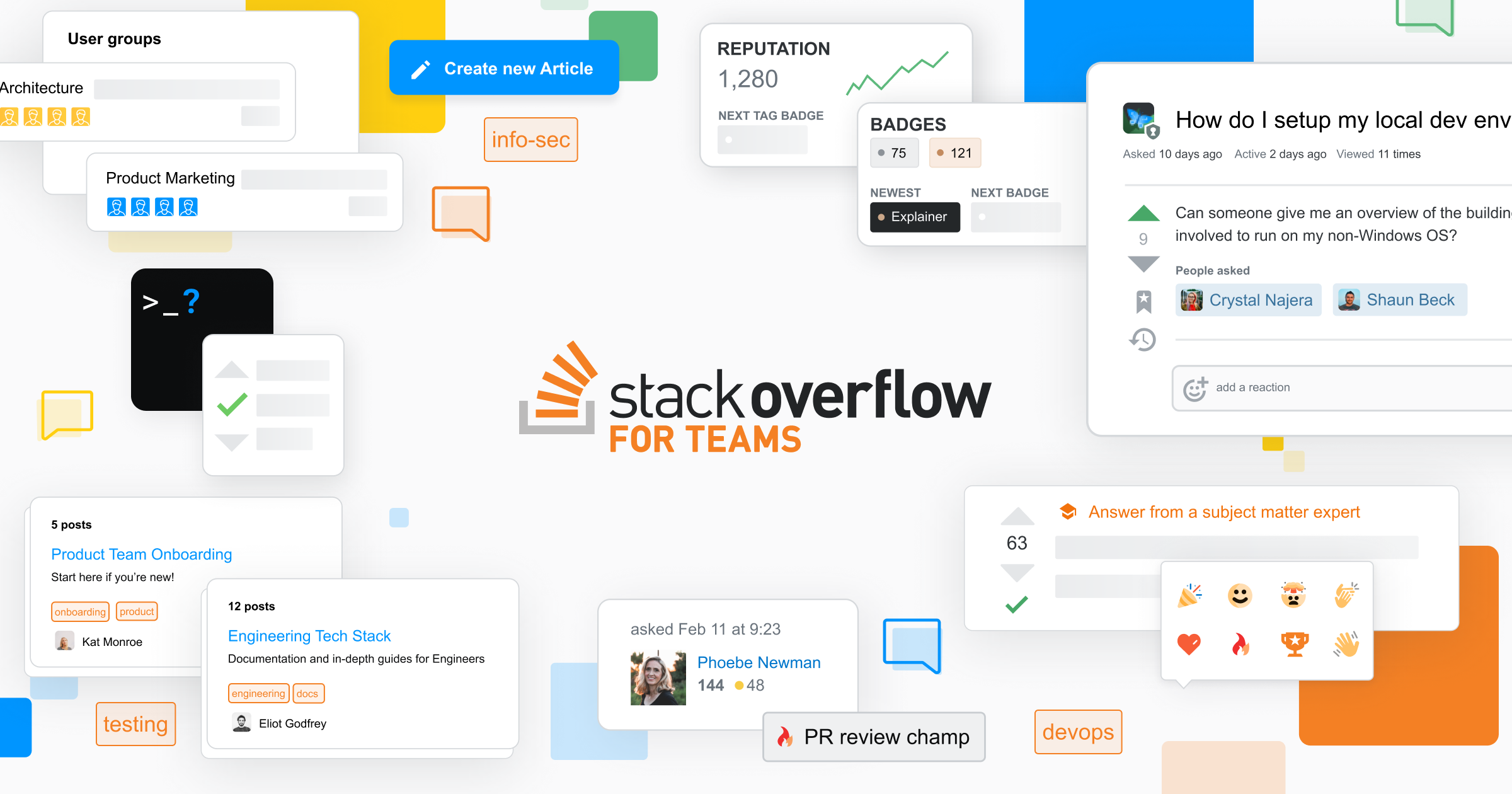
Image Credits: Stack Overflow

Like so many products in this space, Stack Overflow for Teams experienced rapid growth in 2020. Its annual recurring revenue grew 72% last year, the company tells me, and it added over 1,500 Teams customers, including 70 that opted for its high-end Enterprise tier. Teams customers now include the likes of Box, Microsoft, Bloomberg, Instacart and Zapier.

The new freemium offering will be limited to 50 seats, but for the most part, it’s quite a fully-featured solution, with support for all of the core Teams features. It also includes support for the service’s ChatOps integrations with Slack and Microsoft Teams (side note: maybe there are too many products with the name ‘Teams’ right now?). The free service does not include support for single sign-on solutions, though. You’ll need the basic paid plan for that. And while the enterprise tier is SOC II certified and runs on single-tenant instances, that’s not the case for the free, basic and business tiers.

“At Unqork, we use Stack Overflow for Teams and its Slack integration to empower our creators to learn from each other in a productive way and to support our clients building solutions on top of our platform,” said Olga Gomonova, head of enablement at Unqork. “Since implementing Stack Overflow for Teams for internal and external use cases, we’ve been able to reduce the time to respond to client and internal questions from 60 to 30 minutes, and have been able to onboard new hires faster as our company grows.”

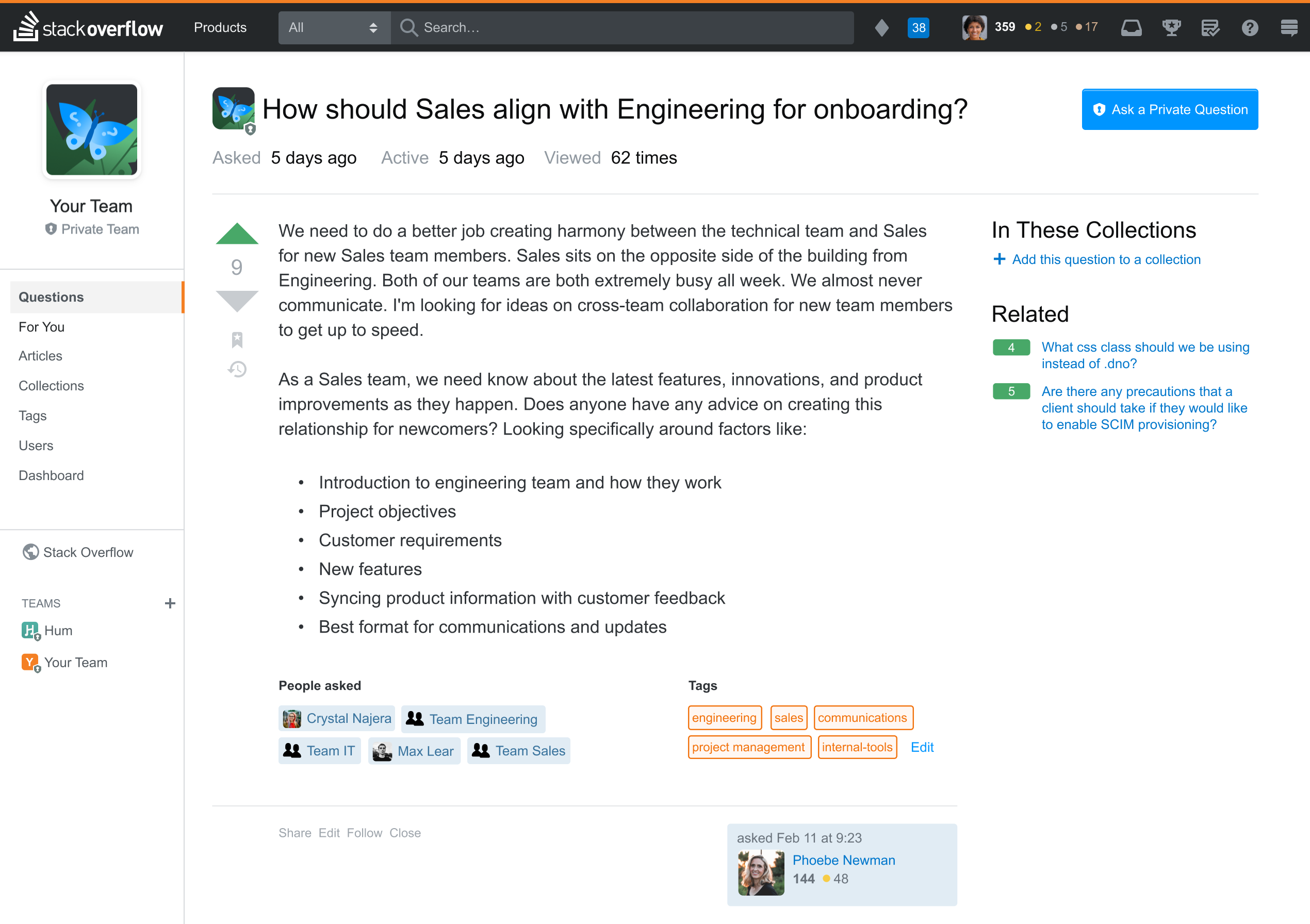
Image Credits: Stack Overflow

Some of the missing features, however, are access to Stack Overflow for Teams’ Articles format for longer-form content and Collections, a feature that allows users to group together sets of similar questions that can be used for an onboarding workflow or in place of a traditional FAQ document, for example. Stack Overflow CPO Teresa Dietrich tells me that the company has seen over 50% adoption of Articles since its launch in  August 2020. The company also recently introduced a private feedback option for Teams.

“We found that, unlike on the public Q&A sites, people weren’t comfortable giving downvotes to content on the Teams product until we introduced private feedback,” she said. “So now they give feedback to the content writer in a private way that says it’s incomplete, it’s out of date, or it’s wrong. And then they can put text around that feedback and only the owner of that content sees it.”

The freemium offering has been in the works for a while. As Chandrasekar and Dietrich both noted, the company removed the credit card requirement to get started with the 30-day Teams trial that had been in place before. “We realized through that experience, that it was actually not enough time to allow companies to create a community internally and that’s basically what we’re trying to do,” Chandrasekar said. “So that was a huge learning for us to say it didn’t make a lot of sense for us to keep a free trial that was timeboxed. And that really expanded to just make it free for life.”

Dietrich added that before launching this free offering, the company also wanted to make sure that it had optimized its onboarding flow for these free users as well.

News: SoftBank-backed Indian insurance platform Policybazaar raises $75 million

Policybazaar has raised $75 million as the Indian online insurance platform looks to expand its presence in UAE and Middle East. Sarbvir Singh, chief executive of PolicyBazaar, told TechCrunch that the startup had raised $75 million, but didn’t elaborate. Falcon Edge Capital led the new tranche of investment in the Indian startup, which has raised

Policybazaar has raised $75 million as the Indian online insurance platform looks to expand its presence in UAE and Middle East.

Sarbvir Singh, chief executive of PolicyBazaar, told TechCrunch that the startup had raised $75 million, but didn’t elaborate. Falcon Edge Capital led the new tranche of investment in the Indian startup, which has raised about $630 million to date, according to research firm Tracxn.

The 12-year-old startup, which counts SoftBank Group’s Vision Fund and Tiger Global among its investors, is among a handful of startups that is attempting to upend India’s insurance market, which is largely commanded by state and bank-backed insurers.

Policybazaar serves as an aggregator that allows users to compare and buy policies — across categories including life, health, travel, auto, and property — from dozens of insurers on its website without having to go through conventional agents.

In India only a fraction of the nation’s 1.3 billion people currently have access to insurance and some analysts say that digital firms could prove crucial in bringing these services to the masses. According to rating agency ICRA, insurance products had reached less than 3% of the population as of 2017.

An average Indian makes about $2,100 in a year, according to World Bank. ICRA estimated that of those Indians who had purchased an insurance product, they were spending less than $50 on it in 2017.

In a recent report, analysts at Bernstein estimated that Policybazaar commands 90% of share in the online insurance distribution market. The platform also sells loans, credit cards, and mutual funds. The startup says it sells over a million policies a month.

“India has an under-penetrated insurance market. Within the under-penetrated landscape, digital distribution through web-aggregators like Policybazaar forms <1% of the industry. This offers a large headroom for growth,” they wrote.

The startup, which is working on an initial public offering slated for next year, said it will use the fresh investment to expand its presence across the UAE and Middle East regions.

“PolicyBazaar has shown stellar innovation, execution, and relentlessness in establishing itself as the market leader in online insurance aggregation in India. We believe the playbook it has established over the last 10 years in being the most efficient sales channel for insurance manufacturers, can act as a catalyst to gain market leadership in the GCC,” said Navroz Udwadia, co-founder of Falcon Edge Capital, in a statement.

News: Pinduoduo steals Alibaba’s crown with 788M annual active users

For the first time, Pinduoduo has surpassed Alibaba in annual active users, marking the Chinese e-commerce upstart’s meteoric rise over the course of five years. The milestone also indicates Pinduoduo has overcome the early stereotype that it was an app for users in China’s less developed, low-tier cities. Pinduoduo made its name by removing intermediary

For the first time, Pinduoduo has surpassed Alibaba in annual active users, marking the Chinese e-commerce upstart’s meteoric rise over the course of five years.

The milestone also indicates Pinduoduo has overcome the early stereotype that it was an app for users in China’s less developed, low-tier cities. Pinduoduo made its name by removing intermediary distributors and selling cheap fruits and daily items, but it has gradually diversified its offerings to be all-encompassing, like heavily discounted iPhones.

The company went public on NASDAQ in 2018 and counts Tencent as a major shareholder and partner. It recorded 788 million annual active users in 2020, according to its Q4 earnings report that just came out. Alibaba lagged slightly behind at 779 million active users through the year.

In terms of monthly active users, though, Alibaba enjoyed a great lead at 902 million in December. Pinduoduo’s MAU of the month was 720 million.

Both companies still have room to grow as China had 989 million internet users as of 2020, according to a report from the country’s top cyberspace authority.

Alibaba, founded 21 years ago, was ahead of Pinduoduo in revenue by a wide margin, partly because of a larger transaction volume and a thriving cloud computing business. Alibaba ended the December quarter with 221 billion yuan or $33.88 billion in revenue, compared to Pinduoduo’s 26.55 billion yuan.

Farm produce remains at the core of Pinduoduo, which was founded by ex-Googler Colin Huang. Huang today stepped down as chairman of the company and will devote his time to research in the food and life sciences, which Pinduoduo believes could drive future growth of its “agriculture platform.”

Pinduoduo doesn’t just want to bring produce from farmers to urban consumers. In recent years, it has also thrown itself into agri-tech by piloting AI-powered farms and training farmers to be savvy online vendors. These strategies are in line with Beijing’s push to boost China’s rural economy, which affects the lives of hundreds of millions.

The e-commerce upstart has a big goal: selling $145 billion worth of agricultural products annually by 2025. It seems to be on track. The firm’s gross merchant volume, an e-commerce metric for transactions, from agricultural products doubled to more than 270 billion yuan or $41.5 billion in 2020. Its marketplace boasted 12 million farmers selling directly to consumers.

“Pinduoduo started with agricultural products,” says Chen Lei, current chairman and CEO at Pinduoduo, in a statement. “[W]e hope that Pinduoduo can one day become the largest grocer in the world.”

While selling grocery isn’t as lucrative as, say, electronics, it could be an effective way for user acquisition as the cost of trying out fruits sold on Pinduoduo is relatively low.

As the firm pursues its agricultural dream, it has yet to turn profitable. Pinduoduo’s net loss shrank to 1.38 billion yuan or $210.9 million in the quarter, compared with 1.75 billion yuan in the same quarter of 2019.

WordPress Image Lightbox Plugin