Tag Archives: Blog

News: Europe’s rush for a COVID-19 ‘digital pass’ stirs concerns

More details have emerged today about the European Commission’s legislative proposal for a pan-EU ‘digital green pass’ to show verified COVID-19 status. The plan is controversial from a human rights and civil liberties perspective, given the clear risk of discrimination. But privacy and security experts are also raising concerns about the technology architecture that will

More details have emerged today about the European Commission’s legislative proposal for a pan-EU ‘digital green pass’ to show verified COVID-19 status. The plan is controversial from a human rights and civil liberties perspective, given the clear risk of discrimination. But privacy and security experts are also raising concerns about the technology architecture that will underpin the system — which has yet to detailed in full.

“The proposal does not yet meet the requirements of data protection and protection against discrimination,” said German Pirate MEP Patrick Breyer in a statement today. “It does not ensure that the digital variant of the certificate is stored decentrally on devices of the person concerned and not in a central vaccination register.”

The European Union’s intention for COVID-19 vaccine passports — or rather what it’s branded a “digital green pass” or a “digital COVID-19 certificate” — will show whether the holder has been vaccinated against COVID-19 or had a recent negative test or if they have recovered from the disease and have antibodies, Commission president, Ursula von der Leyen, said today during a press briefing to give more details of its legislative proposal for the “common instrument”.

“The certificate will make sure that the results of what it shows — the minimum set of data — are mutually recognized in every Member State,” she also said, adding that the aim for the system is to help Member States reinstate freedom of movement “in a safe, responsible and trusted manner”.

Justice commissioner Didier Reynders said the intention is for every EU citizen to be able to receive the certificate free of charge and ask other Member States to accept it. He said the Commission will largely not be regulating use of the pass. Rather it will be up to Member States to set specific requirements related to the common instrument.

He gave the example of a European country being able to specify that they would accept a vaccination status of a person who has had a vaccine that’s not yet been approved for use in the EU, for example. But Reynders said the Commission will be obliging Member States to accept pass holders who have been vaccinated with an EMA approved vaccine.

The Commission wants the system to be ready to use “before the summer”, he also said. However that timeline looks incredibly ambitious for what is a complex technical project that involves sensitive personal data being used for a purpose which is inherently controversial, given the clear risk of COVID-19 status being used to discriminate or unfairly infringe on individuals’ civil liberties.

The digital certificates being ready means not only the Commission implementing/procuring any central components and ensuring Member States implement the necessary technical pieces at a national level for the system to work as intended but also getting the required legislation approved by the EU Council and Parliament — and doing all that “maybe” as early as June, per Reynders.

Asked during the press briefing if there was a ‘plan b’, given how ambitious the questioner suggested the Commission’s plan is, he said there is no other plan — as the only plan is to avoid fragmentation by implementing a common instrument to prevent Member States making unilateral choices over COVID-19 at their borders.

Still, the proposal currently leaves room for European countries to apply different rules, according to Breyer — who has also warned it could lead to discrimination by allowing freedom of travel to be linked purely to vaccination if Member States choose not allow negative tests to be accepted as an alternative, for example. “This needs to be improved,” the MEP suggested today.

“On the other hand, I welcome the fact that the retention of medical information after showing the certificate is excluded,” he added.

EU lawmakers avoided too much discussion of what Member States might do with the common tool but they confirmed the digital pass would be available in both a paper and digital form (although, again, Breyer expressed concern counties may choose not to implement the paper form, thereby discriminating against those who do not have access to a smartphone).

Reynders also confirmed the digital pass would incorporate a QR code to verify what’s on the certificate and check if it’s validated.

The Commission scheme shares at least one component with a system that was recently reported by Spiegel as under procurement in Germany — which it said involves QR codes but also blockchain technology (with IBM and a local company called Ubirch winning the tender) — and which is intended to be compatible with the EU’s digital pass requirements.

There was no mention of blockchain during today’s Commission press briefing. Internal market commissioner Thierry Breton said only that the technical solution “is also part of trust”.

“That’s why we have worked with Member States so that we are now all together on the same page. We share exactly the same technology,” he went on, adding: “We keep of course the GDPR at very high level. We will not exchange data and the good news is that all Member States have shared this view now. And this is extremely important because of course trust is also when you will move from one country to the other one that everybody will know just with a QR code you will know what is on your certificate and if it is validated.”

Asked after the briefing whether or not the pan-EU system will incorporate blockchain components a Commission spokesman sidestepped the question, saying only: “The gateway will link the national public key directories for the signature keys.”

“We cannot yet tell you who will implement this technically,” he added.

The spokesman went on to say that the “trust framework” (provided for by article 4 of the draft regulation) will be developed by the Commission “based on the outline on which Member States agreed in the eHealth Network on Friday” — referring to the voluntary network of Member State representatives which was established by EU directive in 2011 to facilitate cross-border data sharing for an e-health purpose.

On a related webpage the Commission also writes: “The eHealth Network has published an outline of the trust framework needed for [e]stablishing the Digital Green Certificate infrastructure, and continues to develop mechanisms for the mutual recognition and interoperability of vaccination, test and recovery certificates.”

“Further work is being conducted by the eHealth Network in collaboration with EU agencies, the Health Security Committee, the World Health Organization and other institutions,” it adds there.

The eHealth Network’s current outline for the “trust framework for the interoperability of health certificates” is available here — as a 16-page PDF (v.1.0, dating from March 12, 2021).

The document discusses some design choices and intended outcomes but does not provide details of the chosen technical solutions as decisions appear to have not yet been taken — despite the Commission’s goal of the whole thing being wrapped up and ready to run in a little over two months’ time.

Pressure from southern European nations worried about the impact of the coronavirus on heavily tourism-dependent economies is one driving force for the Commission to scramble to roll out a common approach for mutual recognition of vaccination documentation. Although fear of fragmentation of the bloc’s Single Market is likely the bigger accelerant for the Commission. (It’s notable, for instance, that other Member States, including France and Germany, have previously expressed concerns over linking the right to travel to a pass. So how ‘on the same page’ European countries are on this issue looks debatable.)

Also questionable is how trusted the technical underpinnings of the digital pass will be — as plenty of detail is still to be confirmed.

In the eHealth Network’s outline, a section on “data security by design and default”, for example, asserts that the trust framework “should by design and default ensure the security and the privacy of data in the compliant implementations of digital vaccination certificate systems, ensuring both security and privacy” — but it does not explain how this will be achieved.

“The design should prevent the collection of identifiers or other similar data which might be cross-referenced with other data and re-used for tracking (‘Unlinkability’),” it goes on before adding: “Further discussions are needed as to the technological aspects and timeline for the incorporation of these features in the trust framework.”

Another section offering an “overall description” notes that the EU trust framework is designed to be “largely decentralised”. However it confirms there will be “some centralised elements”: Namely “roots of trust” stored in a common directory/gateway (aka “EU Public Key Directory/Gateway”), and the “Governance model” — raising core questions of trust over those key elements. 

On the EU Public Key Directory the document envisages the gateway “shall be provided by a public sector body, such as the European Commission”. But evidently there’s still room for alternative bodies to take on that role.

Elsewhere, the outline confirms that offline verification will involve the use of 2D barcodes containing a digital signature used in conjunction with dedicated verification software that will periodically fetch verified public keys. While it states that online verification “will rely on the UVCI [Unique Vaccination Certificate/assertion Identifier] and it will be incorporated in the next version of the specifications (V2)”.

A section on presentation formats confirms that 2D barcodes will be used — but also raises the possibility of “W3C Verifiable Credentials” being utilized, stating only that a decision “will be made later”.

Harry Halpin, a CEO and research scientist (and formerly a staff member at the W3C) — who has been critical of the lack of openness around the technical design of the Commission’s digital green pass, and who presented a paper last year critiquing immunity passport schemes that involved what he describes as “a stack of little-known standards, such as Decentralized Identifiers (DIDs) and Verifiable Credentials (VCs) from the World Wide Web Consortium (W3C)” — is concerned the Commission is considering incorporating what his paper describes as “questionable use of blockchain technology” into the digital green pass.

He argues that use of W3C Verifiable Credentials in immunity passports would be dangerous to privacy and security.

“Technologically there’s ways to prove test results digitally without involving any global identity at all,” he told us. “If you really just want to prove with medical authenticity that I have ‘A attribute’ — where this attribute is I have negative COVID-19 test in the last 72 hours or I’ve been immunized with a vaccine in the last year, whatever it is that you want to prove, there’s another form of identity… called attribute-based credentials. Which is a perfectly fine way to do it. Attribute-based credentials just prove attributes without revealing identity. You don’t need a global identity for any of these use-cases.”

“Maybe the metaphysical angle is that because of corona all my previously private health data should now be public but then just come out and say that — don’t hide it behind some blockchain nonsense,” he added.

Why is there a “Digital Green Pass” immunity passport being pushed by the European Union without any open technical design or code? What’s to prevent ‘immunity passports’ from being a privacy catastrophe?@ManfredWeber @Peterliese @DirkGotink @mosojn https://t.co/fyK1VZBHOZ

— harryhalpin (@harryhalpin) March 16, 2021

Discussing the eHealth Network’s outline, security and privacy researcher Dr Lukasz Olejnik — who has also written about the privacy risks and wider ramifications of vaccine passports — said the document raises some questions such as who will be the source of trust and whether there’s a risk of function creep related to the proposed design.

“This technical document confirms that the user’s ID will be bound to the certificate. This may mean that the passport would mediate a proof of ID,” he told TechCrunch. “Considering today’s proposal of a regulation it is pertinent to wonder whether a function-creep-like expansion couldn’t lead to these passports becoming actual proofs of identity in the future.

“Other than that, the eHealth document is descriptive but contains no details as to the future solution. The source of trust in this system will be the key problem of interest,” Olejnik added. “It seems that we will need to wait longer for the details.”

Who will be the (technical meaning!) source of trust? Systems of European Commission. How? We don’t know. Blockchain? It will also be digital ID system. #greenpass #DigitalGreenCertificate pic.twitter.com/qXUUMARltZ

— Lukasz Olejnik (@lukOlejnik) March 17, 2021

During today’s briefing Reynders raised the spectre of future expansion from another angle — saying that while the digital pass would be a “temporary” instrument, and the legislation would provide for the system to be “suspended” at the end of the pandemic, it would also bake in the possibility of re-activation at a later point if necessary, such as in the event of another pandemic.

“We have the possibility to suspend the certificate when the WHO declares the pandemic over. So this is dedicated to COVID-19,” he said. “I’m saying ‘suspend’ but through a delegated act and with the European Parliament we could use this instrument if there were another pandemic. But basically we’re talking about a temporary solution with the Member States and with the European Parliament.”

“We don’t want to prolong that,” he added. “When it will be possible for the World Health Organization to say that we are at the end of the pandemic we’ll stop with such an instrument. And of course we are just thinking about the possibility to reactivate the instrument later — but I’m not hoping that — if we have a new pandemic in the future. But that will be with a dedicated act — always with the Parliament involved in the process.”

On the issue of function creep, Reynders conceded that European countries might seek to use the digital pass for other purposes, i.e. outside the Commission’s target of facilitating the free movement of EU people.

But he suggested it’s no different to Member States requiring masks be worn or a rapid test taken as they may already do in certain situations — while emphasizing any such uses would need to comply with wider EU laws and fundamental rights.  

“If there are other uses well it’s already the case you can perhaps use other things like masks that are also imposed. There are also test, self tests which are used by people. But if we go into using the certificate in other ways we have to see if that use is necessary proportional and non discriminatory and also compatible with EU legislation,” he said.

“Of course we will examine the situation on a case by case basis but I don’t think we necessarily need to draw a distinction between the certificate and other measures for example rapid antigen tests, masks and so forth. These are other tools that have been used… We need to make sure that any further use is proportional and non-discriminatory and obviously in line with the rules on free movement.” 

The EU’s digital COVID-19 pass has been in the active mix since January when the Commission said it was pushing for “an appropriate trust framework” to be agreed upon by the end of the month “to allow member states’ certificates to be rapidly useable in health systems across the EU and beyond.”

It followed up earlier this month when it announced it was coming with a legislative plan for the pass, emphasizing its hopes of facilitating safe cross-border travel this summer. Albeit, those hopes look more fragile now — given the slow pace of the EU’s vaccine rollout in the first quarter.

The Commission president also warned today that some Member States are on the cusp of a third wave of COVID-19.

The EU executive’s plan to speed full-steam ahead with a digital pass to verify COVID-19 status remains controversial — not least in light of the still highly limited access to vaccinations across the bloc which only underlines the risks of the tool being unfairly applied.

Civil liberties concerns can’t be disconnected from ‘vaccine passports’. Nor will they be swept away by an anodyne rebranding to a ‘digital pass’. But there are now additional questions stacking up around the Commission’s technology choices for the common instrument — and whether the architecture of the system will live up to Von der Leyen’s tweeted promise that the EU digital green pass “will respect data protection, security and privacy”.

For EU citizens to trust in that claim full transparency is essential. 

 

News: Daily Crunch: Uber to classify UK drivers as workers

Uber changes driver classification following a legal defeat in the U.K., Facebook says it will crack down on rule-breaking Groups and Snap makes an e-commerce acquisition. This is your Daily Crunch for March 17, 2021. The big story: Uber to classify UK drivers as workers Following a Supreme Court ruling, Uber said it will classify

Uber changes driver classification following a legal defeat in the U.K., Facebook says it will crack down on rule-breaking Groups and Snap makes an e-commerce acquisition. This is your Daily Crunch for March 17, 2021.

The big story: Uber to classify UK drivers as workers

Following a Supreme Court ruling, Uber said it will classify all drivers in the United Kingdom as workers — a category between self-employed and employed that entitles those designated to a minimum wage and holiday pay.

That doesn’t mean the dispute is fully resolved, however. Uber said that it will calculate working time starting when drivers accept a trip, excluding the time after they’ve signed into the app and are waiting for a ride. A statement by the App Drivers and Couriers Union described the company’s new approach as “a day late and a dollar short, literally.”

The tech giants

In expanded crackdown, Facebook increases penalties for rule-breaking groups and their members — The changes follow what has been a steady, but slow and sometimes ineffective crackdown on Facebook Groups that produce and share harmful, polarizing or even dangerous content.

Snap acquires Fit Analytics, a fitting technology startup, to double down on fashion and e-commerce — Fit Analytics has built technology to help shoppers find the right-sized apparel and footwear from online retailers.

Apple Maps updated with COVID-19 vaccination locations in the US — To access this information through a voice command, users can ask Siri something like “where can I get a COVID vaccination?” which will direct them to Maps.

Startups, funding and venture capital

Incredibuild gets $140M to speed up games and other software development with distributed processing tech — Incredibuild is a private tech company, but it has been around since 2000, and it counts Epic, Microsoft and Nintendo as clients.

SoftBank-backed Indian insurance platform Policybazaar raises $75M — Policybazaar is among a handful of startups that is attempting to upend India’s insurance market, which is largely commanded by state and bank-backed insurers.

The Robinhood competitor landscape intensifies as Invstr raises $20M — Via social gamification, Invstr has set out to make the financial educational process fun.

Advice and analysis from Extra Crunch

Dear Sophie: What type of visa should we get to fundraise in Silicon Valley? — The latest edition of “Dear Sophie,” the advice column that answers immigration-related questions about working at technology companies.

How to recruit data scientists without paying top dollar — When it comes to building a data science team, many companies fail at the first step: creating a job posting.

Olo prices IPO sharply above its target, valuing company as high as $4.6B — We’re checking in on the price investors paid for a block of Olo shares before it began trading.

(Extra Crunch is our membership program, which helps founders and startup teams get ahead. You can sign up here.)

Everything else

The Voter Formation Project puts an experimental spin on reaching Black and brown first-time voters — This new group is a 501(c)3 laser-focused on reaching Black and brown first-time voters using every trick in the digital toolbox.

On Friday the EU will put startup-friendly legislation to member states — will they sign up? — The EU Startup Nations Standard aims to make the European Union the most attractive place to create a startup.

The Daily Crunch is TechCrunch’s roundup of our biggest and most important stories. If you’d like to get this delivered to your inbox every day at around 3pm Pacific, you can subscribe here.

News: Cymbio raises $7M to help brands expand to more e-commerce markets

Cymbio, a Tel Aviv-based startup focused on what it calls “brand-to-retailer connectivity,” announced today that it has raised $7 million in Series A funding. CEO Roy Avidor, who founded the company with Mor Lavi and Gilad Zirkel, told me that the platform is designed to help brands sell their products on any e-commerce marketplace that

Cymbio, a Tel Aviv-based startup focused on what it calls “brand-to-retailer connectivity,” announced today that it has raised $7 million in Series A funding.

CEO Roy Avidor, who founded the company with Mor Lavi and Gilad Zirkel, told me that the platform is designed to help brands sell their products on any e-commerce marketplace that they want. Whereas adding a new market might normally require a cost-benefit analysis (“How much money will it cost me to set up this retailer? How much sales will this retailer drive? Will the margins justify this?”), Avidor said Cymbio turns the process into a “no brainer” with immediate integration.

That’s because the platform automatically handles all the differences between marketplaces, whether that involves the taxonomy of the product pages or the background color of the product images, as well as inventory syncing, tracking and returns. It allows the brand to fulfill orders using drop shipping — so the brand stores and ships the products, rather than the marketplace, getting access to customer names and addresses in the process.

Avidor said that increasingly, brands realize “they need to be where the customers are.” That doesn’t mean they’ll sell on every single marketplace, but with Cymbio, “brand perception and visibility” are the main limitations, rather than time and money.

Cymbio Founders

Cymbio founders. Image Credits: Cymbio

In 2020, the company says that its customer count increased 12x and now includes Steve Madden, Marchesa, Camper and Micro Kickboard. The company also says that it reduces the time to launch on a new marketplace by 91%, while increasing digital revenue for the average customer by 65%.

The company says the Series A will allow it to expand its sales and marketing team while continuing to develop the product — on the product front, Avidor said the team is working on “a no-code integration where anyone can connect to anything quickly, no developers needed.”

The new funding was led by Vertex Ventures, with participation from Udian Investments, Payoneer founder Yuval Tal and Sapiens co-founder Ron Zuckerman.

“We believe deeply that Cymbio’s technology will fundamentally change the game for brands that sell online, making long, cumbersome integrations a thing of the past,” said Emanuel Timor, general partner at Vertex Ventures Israel, in a statement.

News: How to recruit data scientists without paying top dollar

HR professionals need to collaborate with data science managers to craft job descriptions that speak to a data science audience. The increasingly pivotal role of job postings will not abate with the virus.

Michael Li
Contributor

Tianhui Michael Li is founder of The Data Incubator, an eight-week fellowship to help Ph.D.s and postdocs transition from academia into industry. Previously, he headed monetization data science at Foursquare and has worked at Google, Andreessen Horowitz, J.P. Morgan and D.E. Shaw.

When it comes to building a data science team, many companies fail at the first step — creating a job posting. These mistakes have been amplified in the age of COVID-19.

The increasing demand for AI and data science experts, driven in part by the pandemic’s economic impact, is showing no sign of abating. Many employers are failing to identify viable job candidates, much less interviewing or hiring them.

What’s the biggest obstacle holding them back? In our experience, it is often a poorly drafted job posting. And with the pandemic completely stopping all in-person recruiting events, hiring success hinges on an effective job rec. Previously tolerable mistakes are now fatal.

At The Data Incubator, a data science training and placement firm, we’ve helped hundreds of companies successfully hire data science teams. Honestly, it pains me to see amazing companies undersell themselves in this area.

When it comes to building a data science team, many companies fail at the first step — creating a job posting.

Companies inevitably gravitate toward the same generic buzzwords, promoting themselves as “cutting edge,” “creative,” “collaborative,” “data driven,” “passionate” or “insightful” (just peruse Indeed for examples of these lackluster postings). Or they delve into industry jargon, which may be lost on candidates who are not familiar with the industry.

To streamline the writing process, we recommend that clients break down their competitive advantage into three buckets: compensation, mission and tech. Only by understanding where their strength lies can they successfully market their job openings.

Compensation

Compensation is an important component of making a position competitive. Managers certainly need to fight to ensure their remuneration range is appropriate for their data science roles. However, budget constraints are difficult to overcome, especially given the ability of tech and finance to pay top dollar for these sought-after skills. How to combat this when you don’t have the same budget? Consider listing compensation in job ads.

If you’re one of (the majority of) employers who cannot afford to compete on salary, this will help job seekers understand what to expect. Neither you, nor a potential candidate, wants to spend hours interviewing just to discover that it would have never worked out because of compensation. Save yourself the time and frustration by listing remuneration upfront.

What if you are one of the few employers able to pay major-league salaries? Congratulations, but don’t throw away your hard-won budget! Companies develop reputations for compensation. Unless you are one of the select firms with a reputation for paying top dollar, you will need to signal that to top talent. Otherwise, strong candidates may assume the remuneration is low and not apply, defeating the purpose of paying a high salary in the first place.

Obviously, listing salaries is controversial and there are plenty of reasons why employers are weary of listing salary ranges. However, a recent survey by SHRM found that 70% of professionals want to hear about salary upfront and Glassdoor.com reports that salary is the No. 1 consideration for 67% of job seekers. With all these benefits, employers should seriously consider being more upfront and transparent about what they are able to pay, if only to save themselves time and frustration.

Mission

In the COVID-19 workplace, employees are finding themselves increasingly isolated. With work from home poised to stay even after the virus has dissipated, the risk of isolation will continue. Companies need to double down on articulating their mission and galvanizing employees around that. This doesn’t just start with employment but the very first step of the hiring process: the job posting. Emphasizing mission in the job posting will attract employees.

News: BMW takes the wraps off the i4, its first all-electric sedan

BMW plans to have 25 electrified cars in its lineup by 2025 and it’s taking a few more steps in this direction this year with the launch of the all-electric iX SUV and the i4 sedan. Today, for the first time, the German automaker shared a few more details of what we can expect from

BMW plans to have 25 electrified cars in its lineup by 2025 and it’s taking a few more steps in this direction this year with the launch of the all-electric iX SUV and the i4 sedan. Today, for the first time, the German automaker shared a few more details of what we can expect from the i4, its first fully-electric sedan, in addition to sharing the first exterior shots of the new model.

At the top end, the i4 will have a power output of 390kW / 530HP. Going from zero to 100km/h will take four seconds.

BMW promises up to a 300 miles range, according to its own preliminary tests based on the EPA’s test procedures. Enough to go from L.A. to Las Vegas. That’s the same range as the iX will be able to cover on a single charge and a slight increase in horsepower compared to BMW’s new SUV. And while that range is less than what Tesla and some other competitors can offer, it’s still more than what’s possible with comparable all-electric Porsche and Audi models like the eTaycan and e-tron GT, which are in the lower 200s.

Image Credits: BMW

“With its sporty looks, best in class driving dynamics and zero local emissions, the BMW i4 is a true BMW. It makes the heart of the BMW brand now beat fully electric,” said Pieter Nota, member of the Board of Management of BMW AG responsible for Customer, Brands, Sales.

For now, we don’t have any pricing details or additional specs for the i4. It will become available later this year, so we’ll likely see more details in the summer.

“The iX is purpose-built, it’s spectacular and it’s a completely new BMW X product,” Frank Weber, BMW’s head of development, said at a press event earlier this week. “But what people are longing for is to see that we have a sport sedan that is fully electric. […] And the i4 has everything it takes to have a real sporty sedan from BMW that is fully electric.”

And indeed, unlike the somewhat quirky i3, BMW’s first all-electric car, the i4 is a standard, four-door sedan (with real passenger doors, unlike the i3) — something that buyers in the market for a sporty yet roomy electric car from BMW in the spirit of the existing 4-series will likely appreciate.

Earlier this week, BMW also announced version 8 of its iDrive operating system, which will feature a new dashboard layout and visual design, with two curved screens. It will make its debut in the i4 and iX.

News: Okay, the GPT-3 hype seems pretty reasonable

This morning TechCrunch covered an interesting round for Copy.ai, a startup that employs GPT-3 to help other companies with their writing projects. GPT-3, or Generative Pre-trained Transformer 3, is a piece of AI from the OpenAI group that takes text from the user, and writes a lot more for them. As part of the process of

This morning TechCrunch covered an interesting round for Copy.ai, a startup that employs GPT-3 to help other companies with their writing projects. GPT-3, or Generative Pre-trained Transformer 3, is a piece of AI from the OpenAI group that takes text from the user, and writes a lot more for them.

As part of the process of covering the Copy.ai round, I got caught up in the idea of AI-powered writing. I’ve long been more curious than afraid of automated writing. So when the Copy team described their very positive impressions of the GPT-3 AI writing tool to TechCrunch during an interview, I was intrigued.

To scratch this newly-formed itch, I doodled around this morning with a competitor of sorts to the Copy team , Headlime. And, freaking heck am I am impressed at what folks have managed to build around the GPT-3 technology.

Sure, GPT-3 can add words to a prompt. But the technology can do a lot more than that. The GPT-3-powered Headlime managed to not only write some medium-good stuff for me, but also managed bring in concepts concerning my reporting beat that were in my head but not in the prompts I provided.

I can’t do better than just show you what I mean. So, here’s what happened when I used Headlime for the first time, sans help.

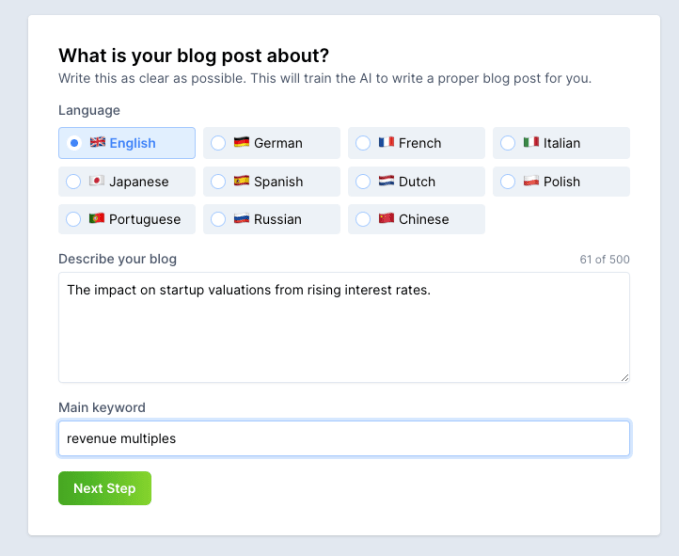
Here’s the first thing that Headlime showed me, a language selector and a request for a description of the post that I wanted to write. I decided to push the system a bit by just telling it about a piece I need to write in light of today’s market action:

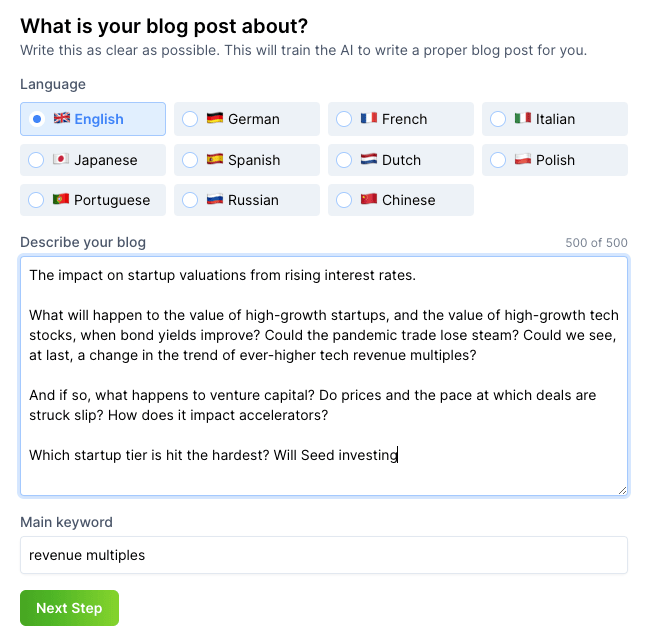
Ha ha, I thought, that will kick it in the teeth and I, a biped of intelligent meat wrapped around some calcium sticks, will feel grossly superior to the computer player. I hit go and then realized that I actually had to provide 500 characters of stuff, so I rambled for a bit to fill in required length:

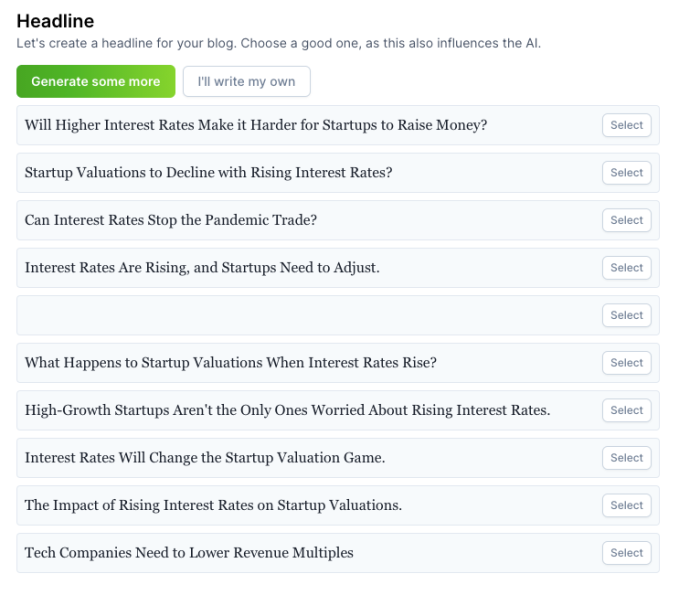
Time for the next step! Hitting the button brought up a list of possible headlines for the post I was helping create, which were honestly not terrible:

Fair enough, yeah? At this point I was starting to become impressed.

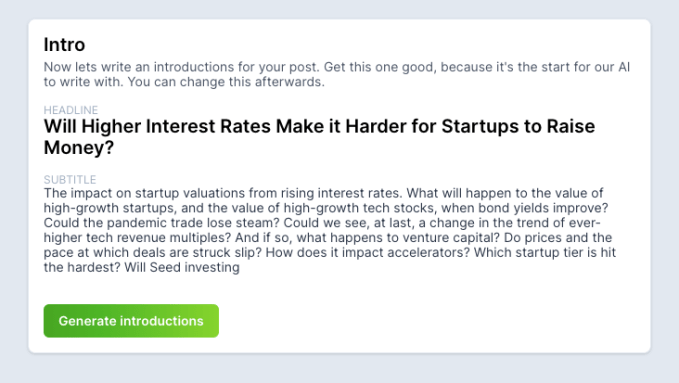
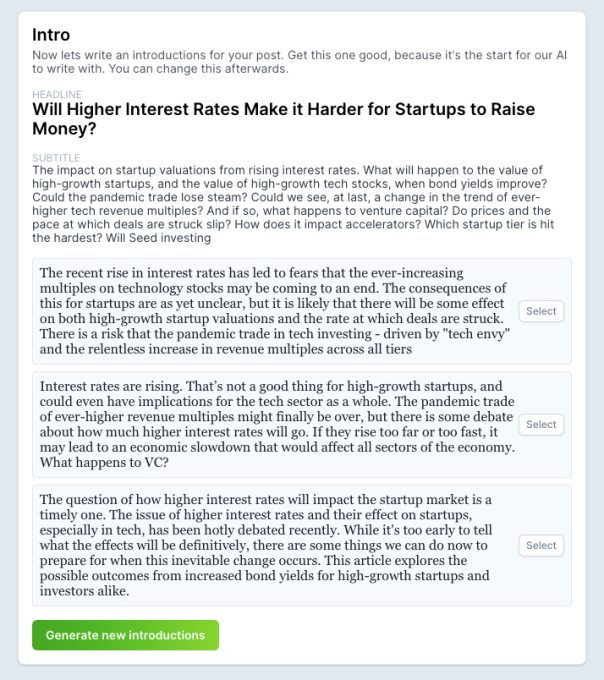
I selected the first headline as it was my favorite and moved along. Next came the work to get an intro put together for the post, a process that involved the strenuous work of clicking a button:

Here are the options proffered:

Again, not bad.

What struck me about these are not merely minor variations on each other. They are structured differently, taking various angles on what I was halfway talking about in the 500 characters of bilge I had fed into the system. I was starting to wish that I had given GPT-3 a bit more to work with up top, as it was trying its best after I had clearly not.

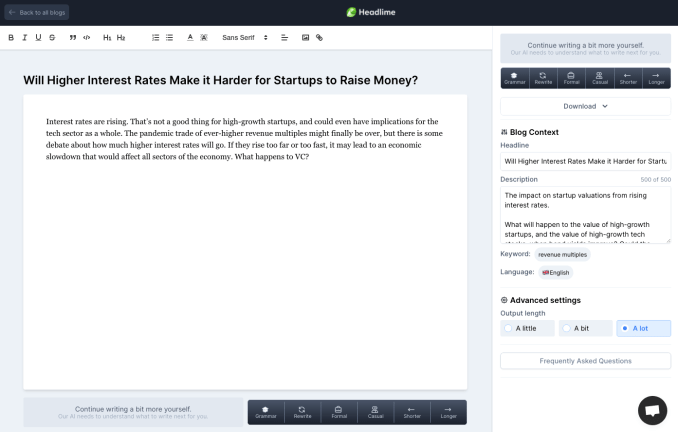
Intro selected, I was brought into a CMS of sorts, where our selected bits were included, and your humble servant was asked to do a bit more writing.

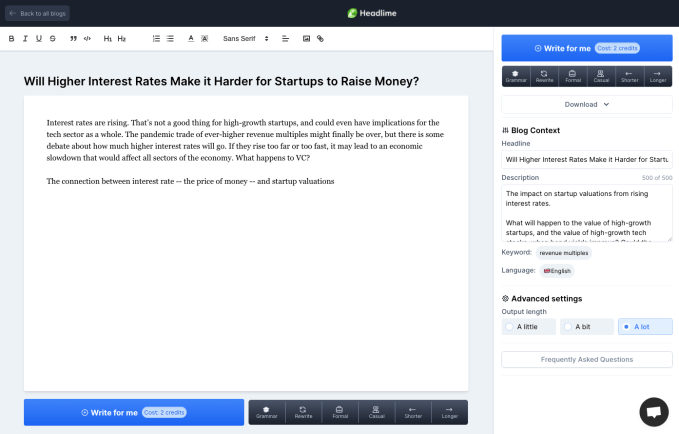
I was happy to oblige, only for the system to stop me and offer to take over:

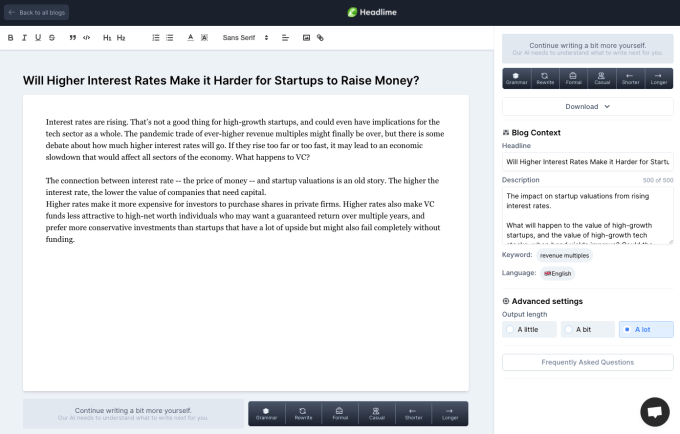
Having precisely no idea what a credit is, or what two of them cost as I was on a free trial of sorts, I hit the “Write for me” button. This is what came out:

Look at how it finished that sentence I started, even after I used em-dashes! The software gets the next sentence backwards, but is right back on the horse afterwards talking about how higher interest rates make exotic investment classes like venture capital less attractive! I was gobsmacked.

I will keep playing with the tech and the various software wrappers that are being built to productize GPT-3. More notes to come. But I wanted to pause and share my initial delight. This is cool. I can’t recall the last time that technology actually shocked me. But, well played GPT-3, you’re amazing.


News: Fraud prevention platform Seon raises a $12M Series A round led by Creandum

Seon, which lets online businesses fight online fraud like fake accounts has raised a $12 million Series A round led by Creandum, with participation from PortfoLion, part of OTP Bank. The funding appears to be one of Hungary’s larger series A rounds to date.   Seon is a fraud-detection startup that establishes a customers’ ‘digital

Seon, which lets online businesses fight online fraud like fake accounts has raised a $12 million Series A round led by Creandum, with participation from PortfoLion, part of OTP Bank. The funding appears to be one of Hungary’s larger series A rounds to date.
 
Seon is a fraud-detection startup that establishes a customers’ ‘digital footprint’ in order to weed out false accounts and thus prevent fraudulent transactions. Clients include Patreon, AirFrance, Rivalry and Ladbrokes Launched in 2017, the company claims to bave been profitable since the end of 2019, after experiencing growth through working with neobanks, esports, gaming, Forex, and crypto trading throughout the rapid digitization brought on by the pandemic.

SEON’s CEO and Founder, Tamas Kadar, said in a statement: “We’re extremely pleased to have completed our latest funding round, led by Creandum, joining its exciting tech portfolio. We feel we have found a like-minded investor to work closely with to pursue the significant global opportunity for our business as we continue to democratize fraud fighting.”
 
Simon Schmincke, general partner at Creandum, said: “At Creandum, we believe cybercrime will be one of the most serious threats of the 21st century. With SEON, we’ve found an anti-fraud solution that’s effective, affordable, flexible, intuitive, and clearly proves its ROI.”
 
Gábor Pozsonyi, partner at PortfoLion Capital Partners, added: “Seon is a fundamentally useful brand: it offers a solution to one of the greatest challenges of digitalization, not only saving hundreds of millions of euros for its partners but making the internet a safer place.”

SEON are seen as competing with Emailage, Iovation, Threatmetrix. However, SEON’s thesis is that social media is a great proxy of a legitimate user vs bot/fake fraudster, so it looks heavily at social accounts to weed out fraudsters.

As part of the funding round, Seon has brought on board the following investors as shareholders: N26 founders, Maximilian Tayenthal and Valentin Stalf; SumUp founders Stefan Jeschonnek and Jan Deepen; Tide CEO Laurence Krieger; Revolut ex-CFO Peter O’Higgins; iZettle ex-chief Product Officer Leo Nilsson; Onfido cofounder Eamon Jubawy, and ComplyAdvantage founder Charlie Delingpole.

News: To solve all the small things, look to everyday Little AI

We should be deploying simple AI tools to solve and improve upon everyday tactics so we can spend more time on strategic growth goals and long-term execution.

Maya Mikhailov
Contributor

Maya Mikhailov is a founder of SAVVI AI and previously co-founded GPShopper, acquired by Synchrony in 2017 where she was SVP and general manager for the direct-to-consumer fintech.

In a recent LinkedIn survey, I asked product and software developers if and how they were making their software smarter. A surprising 57% cited A/B testing, while another 50% reported they were still swinging from decision trees.

Why are developers still solving everyday pain points with these manual, archaic processes, as opposed to employing “Little AI”? There are millions of everyday use cases for AI, where technology is empowered to learn and decide on a course of action that offers the best outcome for consumers and companies alike. The problem is that the Big AI we’re used to has a lot of challenges that make it inaccessible for developers to employ for tasks that’d benefit from everyday AI.

What we’re missing

Take this article you’re reading right now. If TechCrunch let loose a Little AI  – essentially empowered machine learning – it could learn you prefer to read short, newsworthy articles in the morning and longer thought pieces at night. That learning informs a personalized home page, presenting you with bullet points upon awakening and feature stories at night – all without you having to laboriously enter your preferences or respond to pop-up surveys.

Little AI also learns that what your VC friend wants to see on their screen first thing is recent series funding announcements. A truly personalized experience is not only our expectation, it is the core component of the relationship between us and our content providers. And yet, it’s missing.

Let’s raise the stakes. There are multiple players in the split-pay space. A sprinkle of Little AI can teach a fintech provider that one consumer likes to finish paying off an item in less than six months and never wants any outstanding payment to exceed $250. It can also learn that they are open to revolving credit/product offers for an experience-related purchase above $1,500. This type of truly personalized financing enables both the consumer and merchant to benefit from a completed sale while lowering the risk of default to the credit provider.

Travel will be coming back in a big way, with more deals than ever. Little AI can jump in and learn how to make that experience far easier for consumers and far more successful for travel providers. Rather than showing consumers every single deal for every single location, it can take personal preferences into account.

News: Lucid Motors sees a second life for its EV batteries in energy storage

Lucid Motors has designed the battery packs in its luxury electric vehicle for two lives. The company, which is already experimenting with energy storage systems for commercial and residential customers, is also eyeing ways to repurpose batteries from its electric vehicles. While Lucid is still years from having to contend with a large number of

Lucid Motors has designed the battery packs in its luxury electric vehicle for two lives. The company, which is already experimenting with energy storage systems for commercial and residential customers, is also eyeing ways to repurpose batteries from its electric vehicles.

While Lucid is still years from having to contend with a large number of used batteries —  its first EV, the luxury Lucid Air sedan, isn’t coming to market until the second half of 2021 — the company is already planning how to give them a second life them in a yet-to-be-launched energy storage business.

The battery-cell modules that power Lucid’s vehicles are identical to the ones that will be used for energy storage, making them well-suited for “second-life” purposes, according to the company. The company has already constructed a prototype of a 300-kilowatt hour stationary battery storage system at its engineering lab, Lucid’s Chief Engineer and Senior VP of Product Eric Bach told TechCrunch. The batteries in that system are new, but there is “no technical limitation” that would prevent Lucid from swapping them out with used batteries, Bach said. While Lucid CEO and CTO Peter Rawlinson has previously discussed plans to eventually build energy storage systems like Tesla that uses new batteries, this is the first time the company has talked about second-life applications for the product. 

Batteries typically retain a charging capacity of around 70% once they’re removed from EVs, which means they potentially have another decade of useful life. Automakers like General Motors, Ford Motor, and Audi AG have already initiated second-life pilot projects aimed at extracting that remaining value. 

Bach explained the company will likely retrieve batteries used in Lucid EVs after they reach the end of their useful life through its dedicated service centers or when customers trade in their vehicles. Once batteries are returned to Lucid, the company would need to harvest the modules from the packs and run a quality check on them. Lucid’s vehicles have built-in sensors that provide data on each of its cars from the battery packs down to the module level, Bach said, which will come in handy when determining the health of each module. After physical testing, the modules could be ready to be placed in an outgoing product. 

Storage systems do contain some additional components. In a home system, that may include a DC-to-AC inverter, a cooling system and safety switches. The actual battery will remain consistent across Lucid’s products.   

Lucid hasn’t determined how it will distribute the second-life batteries between home and industrial applications.

“Personally, I feel in an industrial application, using these [second-life] modules would be more appropriate and easier because there, the key metric is really just dollars per kilowatt hour,” Bach said.

In instances where a Lucid vehicle ends up at a car dismantler, Bach suggested there may be an opportunity to incentivize the dismantler to feed the battery packs back to the company. Even if that doesn’t happen, as the price of EV battery raw materials continues to rise, dismantlers will likely make their own business of selling battery packs to companies or recyclers. 

At this point – with no product yet on the market and with an expectation that it will be low- to mid-volume – Lucid has not started branching out into recycling materials itself, he said. For the moment, Lucid is leaving recycling operations to its battery cell suppliers, like South Korea-based LG Chem.

“But in the long run, I mean, we’re just at the start of our journey [. . .] and I can envision that in multiple years we will look into cell manufacturing ourselves as well as the full value chain for everything that’s needed to make the applicable energy storage devices,” Bach said. “So in the future, absolutely it makes a lot of sense as the volume goes up, you need to try to contain more of the supply chain and that goes back into a sustainable method of harvesting the raw materials.”

Bach said the company is laser-focused on the Lucid Air and the public may be a few years out from seeing a Lucid home battery system. Until then, the Lucid Air will come equipped with bidirectional charging capabilities, meaning the customer will be able to feed the power from her car into her house. 

“Essentially, that is the first home battery system that we will have already,” Bach said.

It’s unclear what resources — in terms of people and capital — Lucid is putting towards an energy storage business. Such details are likely to remain scant until after the company officially becomes a publicly traded company. In March, Lucid Motors announced it had reached an agreement to become a publicly traded company through a merger with special-purpose acquisition company Churchill Capital IV Corp., in what was considered the largest deal yet between a blank-check company and an electric vehicle startup.

The combined company, in which Saudi Arabia’s sovereign fund will continue to be the largest shareholder, will have a transaction equity value of $11.75 billion. Private investment in the public equity deal is priced at $15 a share, putting the implied pro-forma equity value at $24 billion.

The funding will be used to bring the Lucid Air and an SUV to market as well as to expand its factory in Arizona, Lucid CEO and CTO Peter Rawlinson previously told TechCrunch. The company plans to expand the factory over another three phases in the coming years to have the capacity to produce 365,000 units per year at scale. The initial phase of the $700 million factory was completed late last year and will have the capacity to produce 30,000 vehicles a year.

News: Amazon will expand its Amazon Care on-demand healthcare offering U.S.-wide this summer

Amazon is apparently pleased with how its Amazon Care pilot in Seattle has gone, since it announced this morning that it will be expanding the offering across the U.S. this summer, and opening it up to companies of all sizes, in addition to its own employees. The Amazon Care model combines on-demand and in-person care,

Amazon is apparently pleased with how its Amazon Care pilot in Seattle has gone, since it announced this morning that it will be expanding the offering across the U.S. this summer, and opening it up to companies of all sizes, in addition to its own employees. The Amazon Care model combines on-demand and in-person care, and is meant as a solution from the search giant to address shortfalls in current offering for employer-sponsored healthcare offerings.

In a blog post announcing the expansion, Amazon touted the speed of access to care made possible for its employees and their families via the remote, chat and video-based features of Amazon Care. These are facilitated via a dedicated Amazon Care app, which provides direct, live chats via a nurse or doctor. Issues that then require in-person care is then handled via a house call, so a medical professional is actually sent to your home to take care of things like administering blood tests or doing a chest exam, and prescriptions are delivered to your door as well.

The expansion is being handled differently across both in-person and remote variants of care; remote services will be available starting this summer to both Amazon’s own employees, as well as other companies who sign on as customers, starting this summer. The in-person side will be rolling out more slowly, starting with availability in Washington, D.C., Baltimore, and “other cities in the coming months” according to the company.

As of today, Amazon Care is expanding in its home state of Washington to begin serving other companies. The idea is that others will sing on to make Amazon Care part of its overall benefits package for employees. Amazon is touting the speed advantages of testing services, including results delivery, for things including COVID-19 as a major strength of the service.

The Amazon Care model has a surprisingly Amazon twist, too – when using the in-person care option, the app will provide an updating ETA for when to expect your physician or medical technician, which is eerily similar to how its primary app treats package delivery.

While the Amazon Care pilot in Washington only launched a year-and-a-half ago, the company has had its collective mind set on upending the corporate healthcare industry for some time now. It announced a partnership with Berkshire Hathaway and JPMorgan back at the very beginning of 2018 to form a joint venture specifically to address the gaps they saw in the private corporate healthcare provider market.

That deep pocketed all-star team ended up officially disbanding at the outset of this year, after having done a whole lot of not very much in the three years in between. One of the stated reasons that Amazon and its partners gave for unpartnering was that each had made a lot of progress on its own in addressing the problems it had faced anyway. While Berkshire Hathaway and JPMorgan’s work in that regard might be less obvious, Amazon was clearly referring to Amazon Care.

It’s not unusual for large tech companies with lots of cash on the balance sheet and a need to attract and retain top-flight talent to spin up their own healthcare benefits for their workforces. Apple and Google both have their own on-campus wellness centers staffed by medical professionals, for instance. But Amazon’s ambitious have clearly exceeded those of its peers, and it looks intent on making a business line out of the work it did to improve its own employee care services — a strategy that isn’t too dissimilar from what happened with AWS, by the way.

WordPress Image Lightbox Plugin