Tag Archives: Blog

News: This new startup is weeding out the weed-out classes, instead of students

Five years ago, entrepreneur Dan Sommer bet big on the adult learning space when he was building out Trilogy Education, an online and in-person bootcamp in collaboration with universities to train workforces on the latest tech skills. In 2019, Sommer sold that company for $750 million to 2U in one of the largest edtech exits

Five years ago, entrepreneur Dan Sommer bet big on the adult learning space when he was building out Trilogy Education, an online and in-person bootcamp in collaboration with universities to train workforces on the latest tech skills.

In 2019, Sommer sold that company for $750 million to 2U in one of the largest edtech exits to date. And today, Sommer is launching a new venture-backed startup in education that goes a few steps earlier in the learning journey: high school.

Edge Pathways is a for-credit, first-year program built in collaboration with universities to help aspiring engineers navigate entrance into the confusing, and often intimidating, field of science, technology and education. Along with launching to the public today, Edge Pathways announced it has raised $6 million in a seed round led by First Round Capital, Emerge Education and Rethink Education. First Round Capital’s Bill Trenchard will take a seat on Edge Pathway’s board of directors.

Instead of helping employed techies stay sharp, Sommer’s new startup is helping aspiring techies get a degree in the first place. When asked what changed between his two startups, he says it boils down to one single insight: the point in which a founder has to start helping support students to be ultimately successful.

“A lot of companies over the last two years are looking to group talent and looking at the old class of engineers,” Sommer said. “Starting earlier in this stage of the process is a way to help resolve the skills gap and help capture more students at a time when they’re impressionable, willing to learn and willing to support new kinds of pathways.”

Edge Pathways helps schools offer a program for credit that replaces the first year of college. Inspired by co-op programs at Drexel and Northeastern, Edge connects students to project-based learning and internship opportunities to replace a traditional lecture-style education. The startup is ultimately a services provider to colleges that want to open their doors to incoming engineering students.

Edge Pathways is more than a trial-run at college since it is for credit. To help colleges, the key stakeholder for Edge, stay happy, that means that the startup lets institutions make decisions on which students get admitted to the program, which faculty are involved and how the curriculum is created. Edge’s involvement is simply in the execution and daily support.

After the first year is completed, Edge stays with students to provide coaching and job opportunities throughout the college experience.

For the program, the startup charges students around $15,000, slightly lower than the price of in-state tuition. As numerous studies have shown, attrition rates in STEM fields are high due to changing majors or leaving the degree as a whole, which doesn’t help the some 3.5 million job openings out there for engineers, Sommer tells TechCrunch.

Edge’s largest challenge will likely be finding product-market fit with consumers. While it has created a curriculum in tandem with colleges, the startup needs to make sure the program fits a student’s wants and needs too — and those key decisions shouldn’t be without its end-customer in the room. Sommers, naturally, is optimistic that he’s on to something.

“So many students, particularly today, don’t see the relevance of what they’re learning in the classroom and don’t see how it ties into the world,” he said. “It’s hard to make that connection, so we designed a model to help universities support this gap.”

The other large challenge ahead for Edge is finding universities to work with. Sommer declined to share information about its inaugural partner, but said he will announce it “very soon.” Notably, the founder thinks early adopters will be transfer institutions because about 40% of students that get STEM degrees are transfer students.

“So many institutions today are really focused on the transient population of students,” he said. Edge hopes to “support more students through these hard disciplines, through hard subjects, and give them a reason to have inspiration.”

It’s an ambitious play, but by weeding out the weed-out classes themselves, Edge could make a big difference in the opportunity some students see for themselves in the world of STEM.


News: SecurityScorecard snags $180M Series E to measure a company’s security risk

SecurityScorecard has been helping companies understand the security risk of its vendors since 2014 by providing each one with a letter grade based on a number of dimensions. Today, the company announced a $180 million Series E. The round includes new investors Silver Lake Waterman, T. Rowe Price, Kayne Anderson Rudnick, and Fitch Venture along

SecurityScorecard has been helping companies understand the security risk of its vendors since 2014 by providing each one with a letter grade based on a number of dimensions. Today, the company announced a $180 million Series E.

The round includes new investors Silver Lake Waterman, T. Rowe Price, Kayne Anderson Rudnick, and Fitch Venture along with existing investors Evolution Equity Partners, Accomplice, Riverwood Capital, Intel Capital, NGP Capital, AXA Venture Partners, GV (Google Ventures) and Boldstart Ventures. The company reports it has now raised $290 million.

Co-founder and CEO Aleksandr Yampolskiy says the company’s mission has not changed since it launched. “The idea that we started the company was a realization that when I was CISO and CTO I had no metrics at my disposal. I invested in all kinds of solutions where I was completely in the dark about how I’m doing compared to the industry and how my vendors and suppliers were doing compared to me,” Yampolskiy told me.

He and his co-founder COO Sam Kassoumeh likened this to a banker looking at a mortgage application and having no credit score to check. The company changed that by starting a system of scoring the security posture of different companies and giving them a letter grade of A-F just like at school.

Today, it has ratings on more than 2 million companies worldwide, giving companies a way to understand how secure their vendors are. Yampolskiy says that his company’s solution can rate a new company not in the data set in just five minutes. Every company can see its own scorecard for free along with advice on how to improve that score.

He notes that in fact, the disastrous SolarWinds hack was entirely predictable based on SecurityScorecard’s rating system. “SolarWinds’ score has been lagging below the industry average for quite a long time, so we weren’t really particularly surprised about them,” he said.

The industry average is around 85 or a solid B in the letter grade system, whereas SolarWinds was sitting at 70 or a C for quite some time, indicating its security posture was suspect, he reports.

While Yampolskiy didn’t want to discuss valuation or revenue or even growth numbers, he did say the company has 17,000 customers worldwide including 7 of the 10 top pharmaceutical companies in the world.

The company has reached a point where this could be the last private fundraise it does before going public, but Yampolskiy kept his cards close on timing, saying it could happen some time in the next couple of years.

News: E-commerce marketing startup Yotpo raises $230M at a $1.4B valuation

Barely more than seven months after its most recent funding announcement, Yotpo is revealing that it has raised another $230 million in a Series F round that values the company at $1.4 billion (post-money). “Our round, in my eyes, it’s all about celebrating the future of e-commerce,” co-founder and CEO Tomer Tagrin told me. “Brands

Barely more than seven months after its most recent funding announcement, Yotpo is revealing that it has raised another $230 million in a Series F round that values the company at $1.4 billion (post-money).

“Our round, in my eyes, it’s all about celebrating the future of e-commerce,” co-founder and CEO Tomer Tagrin told me. “Brands don’t need to worry about connecting the marketing stack anymore.”

Where success in traditional retail has been determined by “location, location, location,” Tagrin said e-commerce is “all about consumer attention.” To capture that attention, he estimated the average brand is using 10 to 14 different marketing applications, creating a “pretty horrible experience.” So Yotpo — founded in 2011 and headquartered in New York City — aims to provide all of a brand’s e-commerce marketing needs in a single, integrated platform.

To illustrate this, Tagrin described a marketer wanting to create a customized offer just for users who had both purchased a product in the past 90 days and left a five-star review. Yotpo allows them to do that with “just the click of a button,” whereas “that experience was just not feasible before Yotpo,” he said.

The platform currently consists of four main products — Yotpo SMS Marketing, Yotpo Loyalty & Referrals, Yotpo Reviews and Yotpo Visual UGC — which integrate with each other, as well as with e-commerce platforms such as Shopify, Salesforce Commerce Cloud, Adobe-owned Magento and BigCommerce.

Yotpo CEO Tomer Tagrin

Yotpo CEO Tomer Tagrin

Tagrin said Yotpo still had money leftover from the last round but it decided to raise additional money to continue investing in product and marketing, as well for strategic acquisitions. (The company acquired SMSBump at the beginning of 2020 and Tagrin said it’s “70% of the way there” towards full integration.) Among other things, the company is planning to launch new products around customer communication and measuring a customer’s lifetime value.

Yotpo also says that it has now exceeded $100 million in annual recurring revenue, with the SMS marketing product growing revenue by 170% last year, while the loyalty product saw its revenue nearly double. Big brands like Patagonia and Steve Madden use the platform, but Tagrin pointed out that it’s also used by newer direct-to-consumer businesses like Princess Polly and has 30,000 paying customers over all.

“I like to say that Victoria’s Secret will die by a thousand cuts,” he said. “These are the mini-brands … the up-and-comer brands that are going to replace the incumbents.”

Yotpo has now raised more than $400 million in total funding, according to Crunchbase. The round was led by by Bessemer Venture Partners and Tiger Global, with participation from Claltech Investment, Coin Ventures, Hanaco, Vertex Ventures, Vintage Investment Partners, Capital Group and others.

“Tiger Global has long been bullish on eCommerce as the future of retail, having invested in disruptor brands like Warby Parker and Peloton, giants like JD.com, and best-in-class SaaS companies like Stripe and Twilio,” said Tiger’s John Curtius in a statement. “We are excited by Yotpo’s approach to provide a unified marketing tech stack and the value it provides to brands and online shoppers in the process.”

News: Airtel Africa sells $200M mobile money business stake to TPG’s Rise Fund

In February, London-listed telecom, Airtel Africa, said it was looking to sell a minority stake in its mobile money business in a bid to raise cash and sell off some assets. The firm seems to have found an investor as it announced that The Rise Fund, the global impact investing platform of investment firm TPG,

In February, London-listed telecom, Airtel Africa, said it was looking to sell a minority stake in its mobile money business in a bid to raise cash and sell off some assets.

The firm seems to have found an investor as it announced that The Rise Fund, the global impact investing platform of investment firm TPG, will invest $200 million in its mobile money arm

The investment will see the mobile money business —  Airtel Mobile Commerce BV (AMC BV) — valued at $2.65 billion. AMC BV is an Airtel Africa subsidiary and the holding company for several of Airtel Africa’s mobile money operations across 14 African countries, including Kenya, Uganda, and Nigeria.

AMC BV says the holding company will use the investment to reduce its debt and invest in network and sales infrastructure in the respective operating countries. The deal will close in two tranches — $150 million invested at first close, with $50 million to be invested at second close.

Following the deal’s completion, Airtel Africa will still hold a majority stake in the business and is also exploring the opportunity to take the business public within the next four years

“Our markets afford the substantial market potential for mobile money services to meet the needs of the tens of millions of customers in Africa who have little or no access to banking and financial services, and this demand is driving growth,” Airtel Africa CEO Raghunath Mandava said. “With today’s announcement, we are pleased to welcome The Rise Fund as an investor in our mobile  money business and as a partner to help us realise the full potential from the substantial opportunity  to bank the unbanked across Africa.”

Airtel mobile money business, one of the many players driving financial inclusion across the continent, offers a range of services. They include mobile wallet deposit and withdrawals, merchant and commercial payments, benefits transfers, loans and savings, virtual credit card and international money transfers

Typically, these services are present across countries of operation except Nigeria. In the West African country, Airtel has gone through the route of partnering with local banks but has now applied for its own mobile banking licence

In its most recent reported results for Q3 2020, Airtel Africa witnessed a year on year revenue growth of 41.1% to $110 million, largely driven by 29% growth in the customer base to 21.5 million and 9.7% ARPU growth. Transaction value went 53% up to $12.8 billion ($52 billion annualised), and underlying EBITDA stood at $54 million ($216 million annualised) at a margin of 48.7%.

AMC BV benefits from a strong offline presence of kiosks, mini shops and agents which tie with its core telecom business. And in a bid to drive growth this year, the business has struck partnerships with Mastercard, Samsung, Standard Chartered Bank, WorldRemit, among others, to expand both the range and depth of its mobile money offerings.

Yemi Lalude, a partner at TPG who leads Africa investing for The Rise Fund, said that with financial inclusion being a global issue that is most acute in Africa, the telecom is closing the gap between traditional financial institutions and the millions of unbanked Africans.

“We look forward to working with Airtel Africa to enhance their mobile money services, broaden its use cases, and grow into new markets. With this investment in Airtel Africa’s mobile money operations, we are excited to expand The Rise Fund’s global fintech portfolio and continue to deepen our focus on improving financial inclusion in Africa and around the world,” she said.

Last year, TPG which has more than $5 billion in assets under management invested $600 million in Reliance Jio. The telecoms operator is a competitor to Airtel Africa’s parent company, Bharti Airtel. That’s one interesting detail although both investments target different markets.

News: Miami startup Asteya launches to provide ‘income insurance’

Asteya, a Miami-based disability insurance startup that is geared toward small business owners and gig workers, launched today with a seed round of $10 million. Co-founder and CEO Alex Williamson, who was Bumble’s chief brand officer, describes Asteya as an “income insurance” startup.  The announcement comes on the heels of Bumble’s IPO last month, signaling

Asteya, a Miami-based disability insurance startup that is geared toward small business owners and gig workers, launched today with a seed round of $10 million. Co-founder and CEO Alex Williamson, who was Bumble’s chief brand officer, describes Asteya as an “income insurance” startup. 

The announcement comes on the heels of Bumble’s IPO last month, signaling that former executives are already taking their cash and betting that they themselves can build the next unicorn.

While she was at Bumble, Williamson took medical leave. “Had Bumble not been so generous with me with medical leave, I would have needed disability insurance,” she said.

Alex Williamson Image Credits: Asteya

According to Williamson, 51% of U.S. employers offer disability insurance to their employees. The other 49% are left unprotected should something happen to them. In today’s changing workforce, many of these people are small business owners and gig or freelance workers. It’s this class of worker that Asteya is targeting with its first product. It offers up to $500,000 in protection through a one-time payout for a monthly fee that starts at $6/month. 

When people get sick and need to take time off work to get back on their feet, worrying about how they are going to pay rent or cover any other regular financial responsibilities can be a hardship in itself.

“If your finances aren’t in order, you can’t focus on getting help,” Williamson told TechCrunch.

People not covered by disability insurance — once they fall ill — have the option of applying for federal disability. The main distinction here is that disability insurance starts paying immediately, while federal disability only pays after you get approved by the government, but the process can be cumbersome and is known to take several months. Many people who attempt to file for federal disability on their own are often denied and then subsequently need to use a lawyer to get approved. And after all that, payments — which range from only several hundred to a couple thousand dollars a month — kick in six months after you’re approved.

Signing up — and getting approved — for disability insurance with Asteya takes minutes, the company said. Like many other startups, Asteya, through its hassle-free approach in a sector that’s known to be tangled in bureaucracy, sees an opportunity to bring humanity into insurance, Williamson said.

Women are often charged a significant premium for disability insurance compared to men — which makes them a more expensive hire for companies — adding another unnecessary difficulty for female candidates. New York and Massachusetts are a few of the states that outlawed the policy in 2019, and following their lead, Asteya’s first product is gender-neutral, Williamson said. 

The company has a managing general agent (MGA) and broker’s license, and through its MGA license, all policies are offered through insurance heavyweights Munich Re and Lloyd’s of London. In short, if the startup doesn’t succeed, your coverage won’t be affected.

Considering Williamson’s contacts and those of the founding team members, they were able to line up funding pre-launch, and Bumble’s founder and CEO, Whitney Wolfe Herd, is an angel investor. 

Other investors include 2BF Ventures, Capital Factory, Cap Meridian Ventures, Northstar Ventures, Atrum, and angel investor Geeta Sankappanavar.

The company is planning to offer a product for longer-term disability, as well as one that covers people with pre-existing conditions. “It’s an area we’re on a mission to cover,” said Williamson.

News: Crypto infrastructure provider Fireblocks raises $133 million

Fireblocks has raised a $133 million Series C funding round led by Coatue, Ribbit, and Stripes. The company provides several products that let you store, transfer and issue digital assets. In particular, Fireblocks provides custody to institutional investors — it currently stores $400 billion in cryptocurrencies. BNY and Silicon Valley Bank are also participating in today’s

Fireblocks has raised a $133 million Series C funding round led by Coatue, Ribbit, and Stripes. The company provides several products that let you store, transfer and issue digital assets. In particular, Fireblocks provides custody to institutional investors — it currently stores $400 billion in cryptocurrencies.

BNY and Silicon Valley Bank are also participating in today’s funding round. Existing investors Paradigm, Galaxy Digital, Swisscom Ventures, Tenaya Capital and Cyberstarts Ventures are investing once again.

Overall, Fireblocks has raised $179 million since day one. The company says it has yet to reach a valuation of $1 billion — it isn’t a unicorn yet, but not far from it.

The startup doesn’t have a consumer-facing product. Instead, it sells its products to banks, fintech startups and other financial institutions. As interest rates have been close to 0% for a while, financial institutions are looking for a solution to store cryptocurrencies and diversify their balance sheet.

Fireblocks lets them do that securely. The company uses multi-party computation to handle private keys. When you create a wallet, cryptographic secrets are generated on your device and on the servers. Whenever you’re trying to initiate a transaction, multiple secrets are used to generate a full public and private key. This way, there’s no single point of failure.

The company has also put together a network of liquidity partners. You can connect directly with 30 different exchanges and initiate transfers from there. That’s why over-the-counter trading desks and market makers also use Fireblocks to settle trades across several exchanges.

Fireblocks also lets you issue and manage tokens. It can be particularly useful if you want to issue stablecoins, tokens that are backed by fiat currencies and don’t fluctuate over time against their fiat value. It works across multiple blockchains as well.

You can earn staking rewards on Ethereum 2.0, Polkadot and Tezos through integrations with Staked or Blockdaemon. There’s a DeFi API so that you can take advantage of the most interesting DeFi protocols.

The company also integrates with compliance providers Elliptic and Chainalysis for anti-money laundering reasons. The company can flag and reject transactions depending on a set of rules.

As you can see, Fireblocks provides plenty of integrations with the crypto ecosystem at large. Starting from scratch and building those integrations in house would require a ton of resources, especially if cryptocurrencies aren’t the core element of your business.

In many ways, Fireblocks reminds me of banking-as-a-service companies, except that Fireblocks focuses on crypto assets. And today’s funding round proves once again that there are a lot of investments happening in the crypto industry right now. PayPal acquired Curv just a couple of weeks ago. And this acquisition is certainly helping other crypto infrastructure companies proving that they’re valuable.

News: Saleor scores $2.5M seed round for its ‘headless’ e-commerce platform

Saleor, a Poland and U.S.-based startup that offers a “headless” e-commerce platform to make it easier for developers to build better online shopping experiences, has raised $2.5 million in seed funding. The round is led by Berlin’s Cherry Ventures, with participation from various angels. They include Guillermo Rauch (Vercel CEO and inventor of Next.js), Chris

Saleor, a Poland and U.S.-based startup that offers a “headless” e-commerce platform to make it easier for developers to build better online shopping experiences, has raised $2.5 million in seed funding.

The round is led by Berlin’s Cherry Ventures, with participation from various angels. They include Guillermo Rauch (Vercel CEO and inventor of Next.js), Chris Schagen (former CMO of Contentful) and Kevin Mahaffey (co-founder of Lookout).

Saleor says the injection of capital will be invested in further developing Saleor‘s headless e-commerce platform, including a soon-to-launch cloud product and GraphQL API for front-end engineers.

Founded in 2020 but with a history going back to 2013, years before founders Mirek Mencel and Patryk Zawadzki spun out the product separate from their agency, Saleor is described as an “API-first” e-commerce platform that takes a “headless” approach. The idea is that the platform does the back-end heavy lifting so that developers can focus on the front end where most of the value is created for users.

“Saleor was born of necessity when our agency work at Mirumee Software required more modular, flexible and scalable e-commerce software,” Saleor co-founder Mirek Mencel recalls. “Most solutions for bigger brands came with proprietary baggage like vendor lock-in, slow adoption of new technologies and commercial certification programs. On the open-source side, we didn’t enjoy Magento’s developer experience and felt alternatives weren’t viable at scale”.

And so Saleor was conceived as an open-source platform focused on “technical excellence and quality” that could deliver greater scalability and extensibility than existing proprietary software. By 2016, the product had grown from something Mencel and Zawadzki’s agency used internally into a platform used by developers around the world.

“We could have stopped there, but saw brands pressing for more revolutionary front-end experiences,” Mencel says. “Decoupling Saleor’s core from its presentation layer was the obvious path to revolutionary front-ends. As difficult as it was, we tore down what was a rather good open-source e-commerce platform and rebuilt it API-first”.

Beyond their early headless conviction, the pair also came to the realisation that GraphQL delivered “more power, precision and developer happiness” than REST. Reasoning that most developers prefer “a few things done superbly to many things done well,” they committed exclusively to Saleor’s GraphQL API. “We have never looked back,” says Mencel.

In 2018, the original six-person team shipped Saleor 2.0. Now with a headcount of 20, Mencel says Saleor has a simple vision of developer-first commerce: open-source, GraphQL and “fair-priced” cloud — a vision that Cherry Ventures has clearly bought into.

“We are currently witnessing a paradigm shift with developers switching to headless commerce solutions, allowing more flexible, differentiated shopping experiences,” says Filip Dames, founding partner of Cherry. “Mirek, Patryk, and their team are at the forefront of this development and will enable innovative merchants to build state-of-the-art shopping experiences that scale across all consumer touch points and devices”.

“We decided to pursue venture backing as a way to increase the Saleor core team size and accelerate buildout of Saleor Cloud, which we’ll launch this year,” adds Mencel.

News: Fulfilment startup Cubyn raises €35M to expand across Europe

Cubyn, the Paris-based logistics startup that lets e-merchants outsource fulfilment and delivery logistics, has raised another €35 million in funding. The round is led by Eurazeo and Bpifrance Large Venture, with participation from First Bridge Ventures and Fuse Venture Partners. Existing backers DN Capital, 360 Capital, Bpifrance Smart Cities fund and BNP Paribas Développement followed

Cubyn, the Paris-based logistics startup that lets e-merchants outsource fulfilment and delivery logistics, has raised another €35 million in funding.

The round is led by Eurazeo and Bpifrance Large Venture, with participation from First Bridge Ventures and Fuse Venture Partners. Existing backers DN Capital, 360 Capital, Bpifrance Smart Cities fund and BNP Paribas Développement followed on.

Cubyn says it will use the new funding to double its team of 85 to more than 170 employees by the end of 2021, and deploy its service more internationally. First up is Spain and Portugal (launching next month), followed by Italy, the U.K. and Germany.

Impressively, the company will open a 25,000 square meter “automated” facility in the Paris area in the coming months as it looks to drive down costs and delivery times.

Originally offering pickup and delivery only, 18 months ago, shortly after Cubyn raised €12 million in Series B funding, the company launched “Cubyn Fulfilment,” seeing it enter fulfilment too.

Described at the time as a fully integrated solution that covers the entire fulfilment process, including keeping stock in Cubyn’s warehouses, it set the company up to grow off the back of an e-commerce boom, prompted not only by the pandemic most recently but also the continuing D2C and marketplace trend. For example, marketplaces Back Market, Rakuten, Mirakl and Fnac are currently using Cubyn.

Its proprietary technology aims to streamline merchant logistics, “ranging from web apps to advanced optimization through algorithm and warehouse robotics,” says Cubyn. The result is that it claims to be able to operate a fully integrated fulfilment solution at a fraction of the industry standard cost. This has seen the company grow its gross merchandise value (GMV) from €30 million to €250 million in 2020.

“Cubyn is disrupting the traditional e-commerce third party logistics market from the ground up, offering a better, faster and cross-border service at a 30% lower price,” says Cubyn co-founder and CEO Adrien Fernandez-Baca in a statement. “We are also providing merchants with not just additional revenue streams, but with our international roll out, we are now opening up new markets for them, outperforming other options available in terms of cost and delivery speed by far”.

“COVID has accelerated the need for merchants to have a reliable, scalable and tech fulfilment solution,” notes Antoine Izsak at Bpifrance Large Venture fund. “We’re excited to work with Cubyn to scale their business across Europe in the next few months”.

Adds Fernandez-Baca: “Today 85% of our shipments are in France, 15% international. With the funding, the ratio is predicted to change to 50-50”.

News: Financial API provider Brick is building the infrastructure for open banking in Southeast Asia

The adoption of financial apps is surging in Southeast Asian markets like Indonesia, the region’s most populous country. Founded by fintech veterans last year, Brick develops APIs that make it easier for tech companies to add identity verification and access financial data from their users. It is currently partnered with Indonesia’s seven largest banks, covering

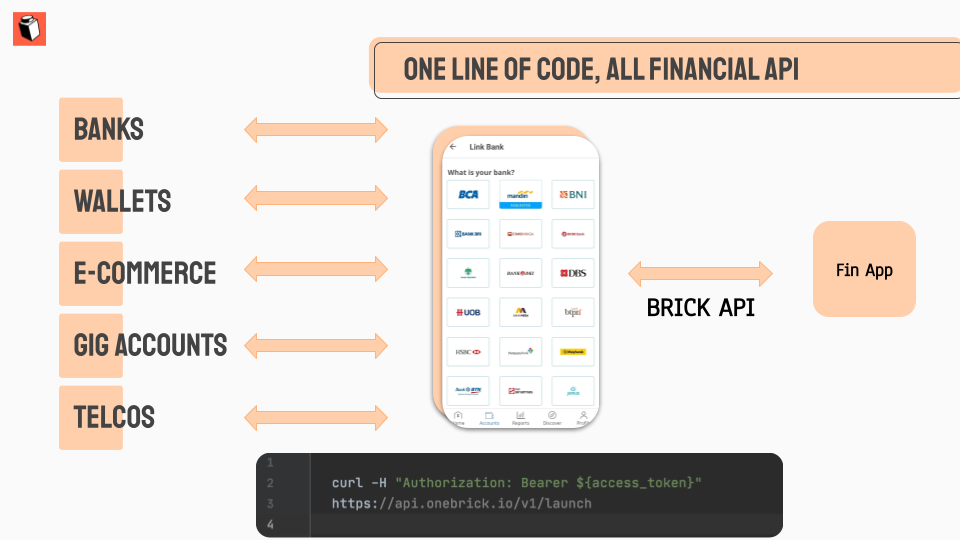
The adoption of financial apps is surging in Southeast Asian markets like Indonesia, the region’s most populous country. Founded by fintech veterans last year, Brick develops APIs that make it easier for tech companies to add identity verification and access financial data from their users. It is currently partnered with Indonesia’s seven largest banks, covering more than 90% of the country’s bank accounts, and plans to expand into all Southeast Asia countries.

More than three-fourths of Southeast Asia’s population is unbanked or underbanked, meaning that don’t have a bank account or access to traditional lending services. Brick will serve them as well, with products like mobile wallet and telcos APIs that are currently in beta and slated for launch next quarter.

The startup, which is now used by 250 developers and 35 tech companies, announced today it has raised new seed round. The amount of funding was undisclosed. Investors include investment firms Better Tomorrow Ventures, PT Prasetia Dwidharma, 1982 Ventures, Antler and Rally Cap Ventures, and angel backers like TrueLayer chief operating officer Shefali Roy, Cred chief executive officer Kunal Shah, Modalku CEO Reynold Wijaya, Carousell CEO Quek Siu Rui, and the founders of Nium, Xfers, Aspire, BukuWarung, ZenRooms and CareemPay.

Brick was founded in 2020 by chief executive officer Gavin Tan, an early employee at Aspire, a neobank for small- to mid-sized businesses, and chief technology Deepak Malhotra, previously co-founder of Indian neobank Slice and a former PayPal engineer.

Brick’s APIs have been deployed by personal financial management, cloud accounting, lending, wealth management and neobank apps, and Tan told TechCrunch it also sees use cases in verticals like savings, stock trading and financial planning.

Tan said he began thinking of launching Brick while working at high-growth fintech startups in Southeast Asia, including Aspire, and encountering a lack of infrastructure that slowed product development.

“Without unified APIs like those provided by Brick, fintech developers have to spend months figuring out commercials, navigating differing tech standards and navigating differing data standards, before they are able to launch their app,” Tan said.

A diagram showing Brick's financial API offerings

A diagram showing Brick’s financial API offerings


Brick and other fintechs have benefited from strong support from Indonesian regulators. For example, Bank Indonesia published open banking API standards in 2020.

Tan said the standards “represents concrete government recognition of open banking principles, including consumer ownership of data and the necessity of their consent to transfer and use that data (which Tan describes as “a core principle that all our products adhere to”) and establishing a common language for banks and fintechs that enables the adoption of embedded finance. It also laid out implementation timelines for open APIs, beginning with payment initiation APIs in 2021, which Brick will launch later this year.

Brick works closely with Bank Indonesia and Indonesia’s Financial Services Authority and is participating in Bank Rakyat Indonesia’s Sembrani Wira accelerator program.

The most obvious comparison for Brick is to Plaid, the financial API provider that helped enable the adoption of open banking and open finance in the United States, Canada and European countries. A key difference, however, is that Plaid serves markets where the majority of people have a bank account.

On the other hand, “in Southeast Asia, only 25% of adults regularly use a bank account,” Tan said. “For the 75% unbanked and underbanked adults, their data resides in alternative financial data sources.” To tap into that market, Brick is building APIs for alternative financial data sources, like mobile wallets, telcos, utility providers, e-commerce platforms, social security and tax offices.

The company is currently focused on product launches in Indonesia, and plans to start expanding into other high-growth fintech markets, including Singapore, the Philippines and Vietnam, later this year.

News: Visualping, which scans the web for changes (including new vaccination slots), raises $2 million

Years ago, Serge Salager, a Vancouver-based entrepreneur who’d taken a small company public on the Toronto Stock Exchange, was approached by deep-pocketed buyer who was interested in buying the business. Flattered but also nervous about who else the potential acquirer was talking with, Salager found himself scouring the web obsessively for news about other possible

Years ago, Serge Salager, a Vancouver-based entrepreneur who’d taken a small company public on the Toronto Stock Exchange, was approached by deep-pocketed buyer who was interested in buying the business. Flattered but also nervous about who else the potential acquirer was talking with, Salager found himself scouring the web obsessively for news about other possible takeover targets, from changes to their pricing and features to job offers.

Salager was right to be paranoid. The buyer acquired a rival company. On the bright side, Salager had a new business idea — to create a much better service than existed at the time to track altered information across the web.

Enter Visualping, a now six-year-old, 16-person freemium service that monitors the entire internet for changes and has amassed 1.5 million users, an undisclosed percentage of which pay the company a monthly subscription fee based on how many web pages and keywords they are following. (Two searches per day are free; 660 per day will set users back $100 per month.)

Journalists like the service as it helps them keep tabs on the people and companies they cover. Law firms use it to stay on top of changing regulations, along with other information. Employees of Apple use it to keep track of what is being said about the company and where.

The use cases are almost endless, which works in Visualping’s favor, as does its apparent ease of use. Users simply provide the company with a screenshot of a page or the part of the page they want to keep tabs on, along with any keywords, and Visualping then informs them via email as soon as a site has been altered or a keyword has appeared somewhere.

Visualping — which has a browser extension and says a mobile app is coming this summer — has also benefited from the pandemic. Indeed, in lieu of endlessly refreshing the sites of companies like Rite Aid and CVS, more people are learning to use Visualping to keep tabs on the availability of  COVID-19 vaccinations, thanks to mentions of the startup in recent months in the WSJ, CNBC, and Fox News.

In the meantime, like other data companies, Visualping is getting smarter all the time by applying machine learning to the information it’s generating on behalf of its users, insists Salager. It won’t, for example, alert someone when the banner ads on a page have changed, or if a customer is tracking a major price change, Visualping can hold off on sending that person an alert until that price change meets a certain threshold.

Of course, with data comes privacy concerns, and on this front, Salager insists that Visualping is fully compliant with GDPR, the EU law on data protection and privacy.

He adds that the company may some day serve up targeted ads to its customers based on their search preferences, as does Google, but he says that for now, Visualping is instead focused wholly on building up new enterprise products, given that more companies have begun discovering it. That’s the vision that investors are funding, too, Salager says, sharing publicly for the first time that Visualping closed on $2 million in seed funding in December from Mistral Ventures, a Canadian fund, and N49P, and AngelList syndicate.

It’s not a ton of capital, he notes, but with the revenue that Visualping is generating, it’s enough to get the startup through the next two years, he says. And after that? We ask Salager if he sees a tie-up down the road and whether he’d be open to acquisition talks, given what happened with his last company.

He does and he is, he answered candidly. While one scenario sees Visualping becoming “publicly traded like Dropbox,” he says (Dropbox also catered to consumers before later growing its business offerings), another “good fit is Google,” he adds. “We believe we fit very well with Google Alerts, so maybe an exit to Google is something we try to do, too.

WordPress Image Lightbox Plugin