Tag Archives: Blog

News: NASA and SpaceX sign a special info sharing agreement to help avoid Starlink collisions

NASA doesn’t just let anyone launch whatever they want to space without checking in with the agency about potential impacts to its own assets on orbit, including the International Space Station (ISS). The agency has a standard set of guidelines around so-called “Conjunction Assessment,” which is basically determine the risk that a close approach between

NASA doesn’t just let anyone launch whatever they want to space without checking in with the agency about potential impacts to its own assets on orbit, including the International Space Station (ISS). The agency has a standard set of guidelines around so-called “Conjunction Assessment,” which is basically determine the risk that a close approach between in-space objects might occur, which in turn could potentially result in a collision. This assessment determines when and where something flies, as you might expect.

Today, NASA published a new agreement between itself and SpaceX that goes above and beyond its standard Conjunction Assessment practices. The special agreement, which exists under the mandate of the Space Act that allows NASA to work with any company in order to fulfill its mandate, is defined as a ‘nonreimbursable’ one, or just one in which no money changes hands, which is designed to benefit both parties involved.

It effectively lays out that because SpaceX operates Starlink, which is the largest existing on-orbit constellation of spacecraft, and which is growing at a rapid pace, and because each of these is equipped with the ability to maneuver itself autonomously in response to mission parameters, there needs to exist a deeper ongoing partnership between NASA and SpaceX for conjunction avoidance.

Accordingly, the agreement outlines the ways in which communication and information sharing between NASA and SpaceX will exceed what has been typically been expected. For NASA’s part, it’ll be providing detailed and accurate info about its planned missions in advance to SpaceX so that they can use that to properly program Starlink’s automated avoidance measures whenever a mission is happening where NASA assets might cross paths with the constellation. It’ll also be working directly with SpaceX on improving its its ability to assess and avoid any incidents, and will be providing technical support on how SpaceX might better mitigate “photometric brightness,” or the reflectivity of its Starlink spacecraft.

Meanwhile, SpaceX will be responsible for ensuring its Starlink satellites take ‘evasive action’ to ‘mitigate close approaches and avoid collisions with all NASA assets.” It’ll also be required to provide time frame ‘cut-outs’ for periods when Starlink satellites aren’t able to employ their collision avoidance, which mostly occurs during the phase right after they’re launch when they’re still being activated and put into their target orbits.

Another key point in the agreement is that SpaceX plan Starlink launches so the they’re at minimum either 5km above or below the highest and lowest points of the International Space Station’s orbit as it makes its way around the Earth. Finally, SpaceX is also expected to share its own analysis of the effectiveness of its satellite dimming techniques, so the agency can adjust its own guidance on the subject accordingly.

The full agreement is embedded below, but the main takeaway is that NASA clearly wants SpaceX to be a better low-Earth partner and citizen as the size of its constellation pushes past the 1,200 mark, on track to grow to around 1,500 or more by year’s end. Also, NASA’s putting a lot of trust and responsibility in SpaceX’s hands – basically it’s laying out that Starlink’s built-in autonomous capabilities can avoid any really danger that might arise. The way NASA has structured this document also leaves open the possibility that it could repurpose it for other constellation operators – a growing need given the number of companies working on networks of low-Earth orbit spacecraft.

News: NFT marketplace OpenSea raises $23 million from a16z

OpenSea has been one of a handful of NFT marketplaces to explode in popularity in recent weeks as collectors wade into the trading of non-fungible tokens on the blockchain. While new startups have been popping up everyday, platforms that launched in crypto’s earlier times are receiving rampant attention from investors who see this wave of

OpenSea has been one of a handful of NFT marketplaces to explode in popularity in recent weeks as collectors wade into the trading of non-fungible tokens on the blockchain. While new startups have been popping up everyday, platforms that launched in crypto’s earlier times are receiving rampant attention from investors who see this wave of excitement for cryptocurrencies and tokens as much different than the ones that preceded it.

Today, the startup announced that it’s closed a $23 million round of funding led by Andreessen Horowitz with participation from a laundry list of angels and firms including Naval Ravikant, Mark Cuban, Alexis Ohanian, Dylan Field and Linda Xie.

OpenSea launched back in 2017, announcing a $2 million round a few months later from Founders Fund and a few crypto-centric firms. At the time CryptoKitties mania was most of what Ethereum had to offer and early NFT projects were being slowly embraced by a community that was enthusiastic but more curious than anything.

Fast forward to 2021 and NFTs are certainly having a moment, and while the specific shades of that moment may be heavily focused on high-dollar artwork sales from traditional auction houses or NFT memes being tweeted out by Elon Musk, proponents see a future for the tokens that upends the economics of content creation and influence on the internet. The enthusiasm accompanies a months-long rally in the value of cryptocurrencies themselves which have taken Ethereum and Bitcoin to multiples of previous-all-time-highs.

The market for digital goods expanding widely may depend heavily on further adoption among gaming giants and larger media organizations, but early-on there’s hope that digital-first creators can use these marketplace to connect more directly with fans and begin to bypass the massive platforms they depend on now.

There are still some early hiccups as the tech develops. While Ethereum has committed to moving from its energy-intensive proof-of-work standard to a more efficient proof-of-stake one eventually, the existing structure has been far from efficient, which has opened many of the early NFT artists to criticism surrounding climate change concerns and whether the stakeholders in crypto tokens should be prioritizing environmental worries over the specific challenges of certain proofs. In February, OpenSea announced support for more efficient Tezos-based NFTs.

A more nebulous challenge for marketplaces like OpenSea may be cutting through the noise of speculation and providing a marketplace for more users that are actually buying to own, an especially difficult proposition given the breakneck pace of growth for the digital currencies being used to purchase the digital goods themselves.

News: Rivian to install more than 10,000 EV chargers by end of 2023

Rivian, the EV startup backed by Amazon, Cox Automotive and T. Rowe Price, plans to building out a network of more than 10,000 chargers by the end of 2023 in a network aimed at quickly powering its electric vehicle models on highways and at further afield locations next to hiking and mountain biking trailheads and

Rivian, the EV startup backed by Amazon, Cox Automotive and T. Rowe Price, plans to building out a network of more than 10,000 chargers by the end of 2023 in a network aimed at quickly powering its electric vehicle models on highways and at further afield locations next to hiking and mountain biking trailheads and other adventurous destinations.

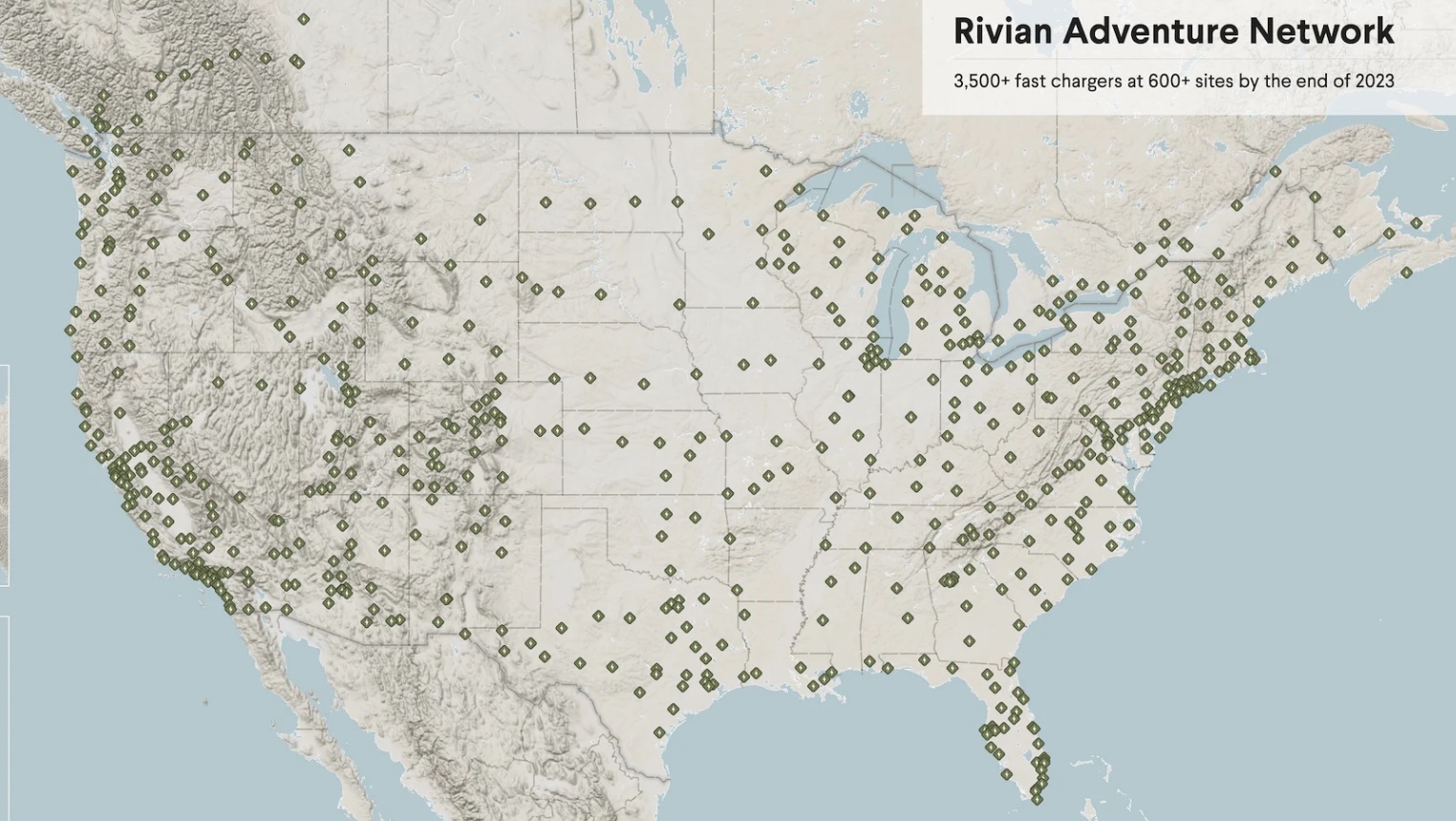
The company said Thursday that its so-called Rivian Adventure Network will include more than 3,500 DC fast chargers at over 600 sites, which will only be accessible to owners of its electric vehicles. Each site will have multiple chargers and located on highways and main roads, often by cafes and shops, the company said in a blog post Thursday.

Rivian is also installing thousands of “waypoint” Level 2 AC chargers throughout the United States and Canada. These waypoint chargers will have a 11.5 kW charging speed, which should be able add up to 25 miles of range every hour for its R1T pickup truck and R1S SUV. The waypoint chargers will be strategically located along and near routes that Rivian customers are likely to take. They will be found at shopping centers restaurants, hotels, campsites and parks. The first of these waypoints, which will be open to the public and accessible to all electric vehicle brands with a J1772 plug, are being installed at all 42 Colorado State Parks. Each park will have two Rivian Waypoints each, with installation starting in July, the company said.

The decision to add this second layer of electric vehicle chargers is a direct appeal to Rivian’s customer base and one required to build confidence in the brand and electric vehicles, in general, Rivian founder and CEO RJ Scaringe told TechCrunch late last year during a wide-ranging interview about charging, batteries and automated driving.

As part of its announcement, Rivian shared an image of a map indicating where these chargers are located. The map is not yet interactive, making it difficult to provide exact locations, but it appears that there are waypoint, or Level 2, chargers located at the South Rim and North Rim of the Grand Canyon National Park, as well as Zion National Park in Utah.

Rivian charging

Image Credits: Screenshot/Rivian

Rivian owners will be able to locate the waypoints as well as its branded fast chargers through the vehicle’s navigation and the accompanying app. Drivers will also be able to use the app or in-car system to and monitor charge status.

Rivian’s vehicles are equipped with a direct current connector used for rapid charging called Combined Charging System (CCS). CCS is an open international standard that in recent years has gained popularity in Europe and North America. This means that Rivian trucks and SUVs can also use any third-party CCS charging station without having to use an adapter.

The company indicated that the entire charging network will be powered by 100% renewable energy. That doesn’t mean that there will be a solar panel and energy storage system at every site, however. The 100% renewable energy goal will be achieved through partnerships with electricity providers. Rivian said it will use wind and solar wherever possible along with Renewable Energy Certificates to offset other power sources.

Building out such a large network will require capital, which Rivian hasn’t had trouble accessing. Rivian announced in January that it had raised $2.65 billion in a round led by funds and accounts advised by T. Rowe Price Associates Inc. Fidelity Management and Research Company, Amazon’s Climate Pledge Fund, Coatue and D1 Capital Partners as well as several other existing and new investors also participated, which pushed Rivian’s valuation to $27.6 billion, according to a person familiar with the investment round.

News: Introducing Startup Alley+ at TechCrunch Disrupt 2021

Determined early-stage startup founders (are there really any other kind?) always keep a sharp eye out for advantages that help them build better and faster. Well, heads up folks because this is a brand-new opportunity like no other, and it takes place at TechCrunch Disrupt 2021 on September 21-23. We’re talking about Startup Alley+, a

Determined early-stage startup founders (are there really any other kind?) always keep a sharp eye out for advantages that help them build better and faster. Well, heads up folks because this is a brand-new opportunity like no other, and it takes place at TechCrunch Disrupt 2021 on September 21-23.

We’re talking about Startup Alley+, a curated experience available to only 50 early-stage startups who exhibit in Startup Alley at Disrupt 2021. All exhibiting startups are eligible, and the TechCrunch team will ultimately select which companies earn a spot. What’s in store for the Startup Alley+ cohort? So glad you asked.

Let’s get the money issue out of the way. You won’t pay anything beyond what you paid for your Startup Alley Pass. Sweet! Now get ready because Startup Alley+ provides plenty of opportunities for exposure and business growth — before Disrupt 2021 even begins.

Get set up for success with access to founder masterclasses. Warm up your pitching arm because you’ll take part in a pitch-off at Extra Crunch Live and receive invaluable feedback. What’s more, TechCrunch will introduce you to top investors within the startup community through our inaugural VC match-making program . A warm introduction beats a cold pitch any day, amirite?

And the perks just keep coming. Startup Alley+ gives participants a healthy headstart on their Disrupt experience. How healthy? It begins in July at TechCrunch Early Stage: Marketing and Fundraising, a virtual event the Startup Alley+ cohort attends for free.

With all those experiences under your belt, you’ll be ready to hit the virtual ground running — and reap the rewards — when you set up shop in the Alley at Disrupt.

Don’t forget about the many benefits available to all Startup Alley exhibitors. The virtual nature of Disrupt means thousands of people from around the globe will attend — influencers of every stripe including tech icons, leading founders, top investors, engineers, job seeking talent, and entrepreneurs.

We’ve created more ways to add value and to draw attention to Startup Alley. For instance, every exhibiting startup gets to deliver a 60-second elevator pitch during a breakout feedback session. Your audience? TechCrunch staff and thousands of those Disrupt attendees we mentioned earlier.

We’re also rolling out the Startup Alley Crawl experience again. Every tech category will have an hour-long crawl posted in the agenda. Team TechCrunch will go live from the Disrupt Stage and interview a select number of founders in Startup Alley from each category. This could be you.

As a Startup Alley participant, you might just be selected to be a Startup Battlefield Wild Card. The Startup Battlefield is the stuff of legend. Past winners include the likes of Vurb, Dropbox, Mint and Yammer. Two Startup Alley exhibitors — chosen by the TechCrunch Editorial team — will compete in this year’s Battlefield and have a shot at the $100,000 (equity-free) cash.

Grab every advantage. Don’t miss your chance to participate in Startup Alley+, which kicks off in July. Apply for your Startup Alley Pass now and get ready to make the most of your time at in September at Disrupt 2021.

Is your company interested in sponsoring or exhibiting at Disrupt 2021? Contact our sponsorship sales team by filling out this form.

News: Quest for prosthetic retinas progresses towards human trials, with a VR assist

An artificial retina would be an enormous boon to the many people with visual impairments, and the possibility is creeping closer to reality year by year. One of the latest advancements takes a different and very promising approach, using tiny dots that convert light to electricity, and virtual reality has helped show that it could

An artificial retina would be an enormous boon to the many people with visual impairments, and the possibility is creeping closer to reality year by year. One of the latest advancements takes a different and very promising approach, using tiny dots that convert light to electricity, and virtual reality has helped show that it could be a viable path forward.

These photovoltaic retinal prostheses come from the École polytechnique fédérale de Lausanne, where Diego Ghezzi has been working on the idea for several years now.

Early retinal prosthetics were created decades ago, and the basic idea is as follows. A camera outside the body (on a pair of glasses, for instance) sends a signal over a wire to a tiny microelectrode array, which consists of many tiny electrodes that pierce the non-functioning retinal surface and stimulate the working cells directly.

The problems with this are mainly that powering and sending data to the array requires a wire running from outside the eye in — generally speaking a “don’t” when it comes to prosthetics, and the body in general. The array itself is also limited in the number of electrodes it can have by the size of each, meaning for many years the effective resolution in the best case scenario was on the order of a few dozen or hundred “pixels.” (The concept doesn’t translate directly because of the way the visual system works.)

Ghezzi’s approach obviates both these problems with the use of photovoltaic materials, which turn light into an electric current. It’s not so different from what happens in a digital camera, except instead of recording the charge as in image, it sends the current into the retina like the powered electrodes did. There’s no need for a wire to relay power or data to the implant, because both are provided by the light shining on it.

Researcher Diego Ghezzi holds a contact lens with photovoltaic dots on it.

Image Credits: Alain Herzog / EPFL

In the case of the EPFL prosthesis, there are thousands of tiny photovoltaic dots, which would in theory be illuminated by a device outside the eye sending light in according to what it detects from a camera. Of course, it’s still an incredibly difficult thing to engineer. The other part of the setup would be a pair of glasses or goggles that both capture an image and project it through the eye onto the implant.

We first heard of this approach back in 2018, and things have changed somewhat since then, as a new paper documents.

“We increased the number of pixels from about 2,300 to 10,500,” explained Ghezzi in an email to TechCrunch. “So now it is difficult to see them individually and they look like a continuous film.”

Of course when those dots are pressed right up against the retina it’s a different story. After all, that’s only 100×100 pixels or so if it were a square — not exactly high definition. But the idea isn’t to replicate human vision, which may be an impossible task to begin with, let alone realistic for anyone’s first shot.

“Technically it is possible to make pixel smaller and denser,” Ghezzi explained. “The problem is that the current generated decreases with the pixel area.”

Image showing a close-up of the photovoltaic dots on the retinal implant, labeled as being about 80 microns across each.

Current decreases with pixel size, and pixel size isn’t exactly large to begin with.Image Credits: Ghezzi et al

So the more you add, the tougher it is to make it work, and there’s also the risk (which they tested) that two adjacent dots will stimulate the same network in the retina. But too few and the image created may not be intelligible to the user. 10,500 sounds like a lot, and it may be enough — but the simple fact is that there’s no data to support that. To start on that the team turned to what may seem like an unlikely medium: VR.

Because the team can’t exactly do a “test” installation of an experimental retinal implant on people to see if it works, they needed another way to tell whether the dimensions and resolution of the device would be sufficient for certain everyday tasks like recognizing objects and letters.

A digitally rendered street scene and distorted monochrome versions below showing various ways of representing it via virtual phosphors.

Image Credits: Jacob Thomas Thorn et al

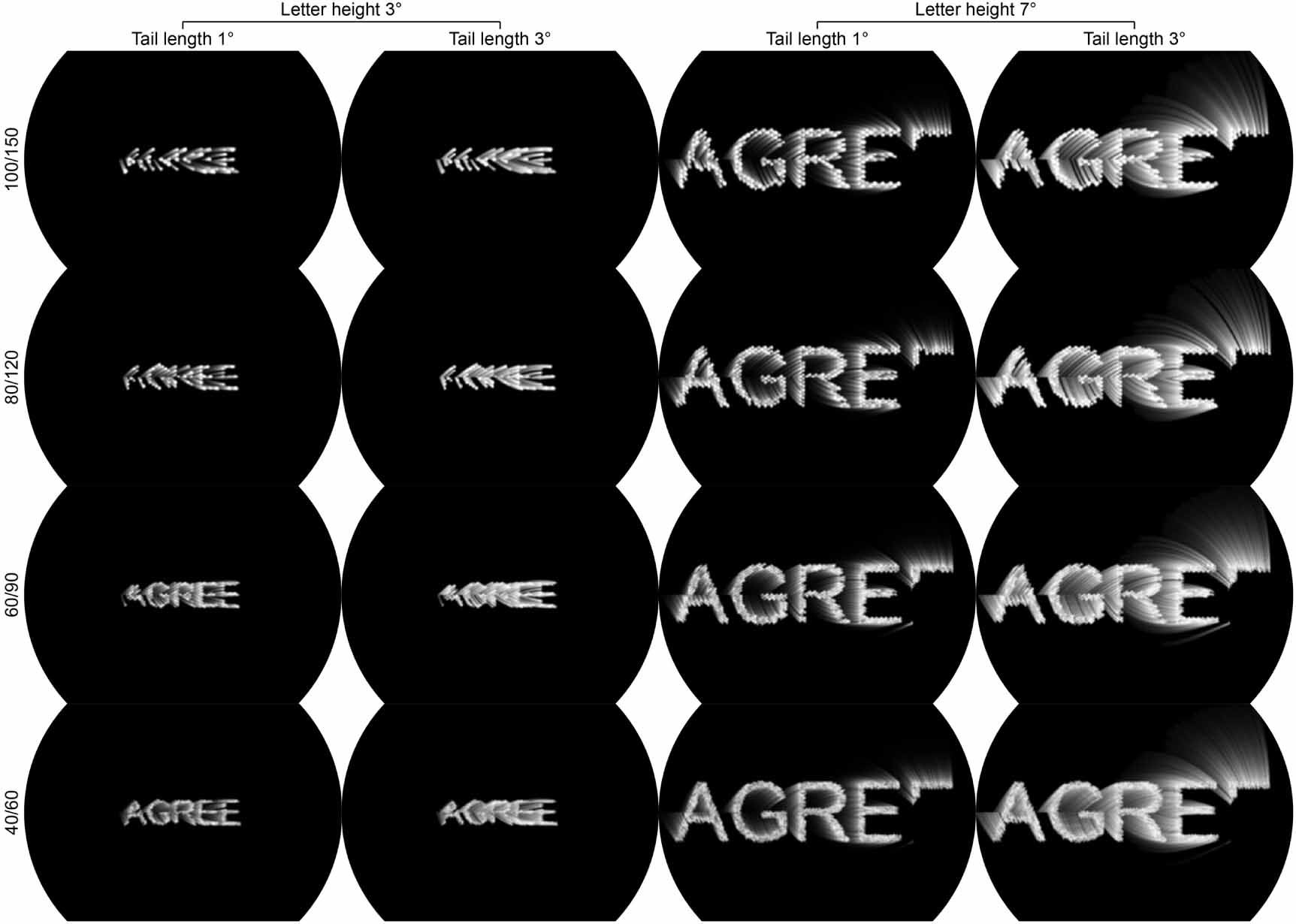
To do this, they put people in VR environments that were dark except for little simulated “phosphors,” the pinpricks of light they expect to create by stimulating the retina via the implant; Ghezzi likened what people would see to a constellation of bright, shifting stars. They varied the number of phosphors, the area they appear over, and the length of their illumination or “tail” when the image shifted, asking participants how well they could perceive things like a word or scene.

The word "AGREE" rendered in various ways with virtual phosphors.

Image Credits: Jacob Thomas Thorn et al

Their primary finding was that the most important factor was visual angle — the overall size of the area where the image appears. Even a clear image is difficult to understand if it only takes up the very center of your vision, so even if overall clarity suffers it’s better to have a wide field of vision. The robust analysis of the visual system in the brain intuits things like edges and motion even from sparse inputs.

This demonstration showed that the implant’s parameters are theoretically sound and the team can start working towards human trials. That’s not something that can happen in a hurry, and while this approach is very promising compared with earlier, wired ones, it will still be several years even in the best case scenario before it’s possible it could be made widely available. Still, the very prospect of a working retinal implant of this type is an exciting one and we’ll be following it closely.

News: Data shows how few Google Play developers will pay the higher 30% commission after policy change

Google this week announced its was cutting the commissions it charges Android app developers who publish on its Google Play marketplace, following a similar move by Apple last year aimed at fending off antitrust claims. According to Google’s own estimates, 99% of its developers who sell goods and services would see their fees cut in

Google this week announced its was cutting the commissions it charges Android app developers who publish on its Google Play marketplace, following a similar move by Apple last year aimed at fending off antitrust claims. According to Google’s own estimates, 99% of its developers who sell goods and services would see their fees cut in half, as a result of the move which reduces the 30% commission to 15% on the first million dollars a developer earns. Now, data shared by App Annie helps to further illustrate the distribution of earnings on the Google Play Store, as well as how that compares with Apple’s counterpart.

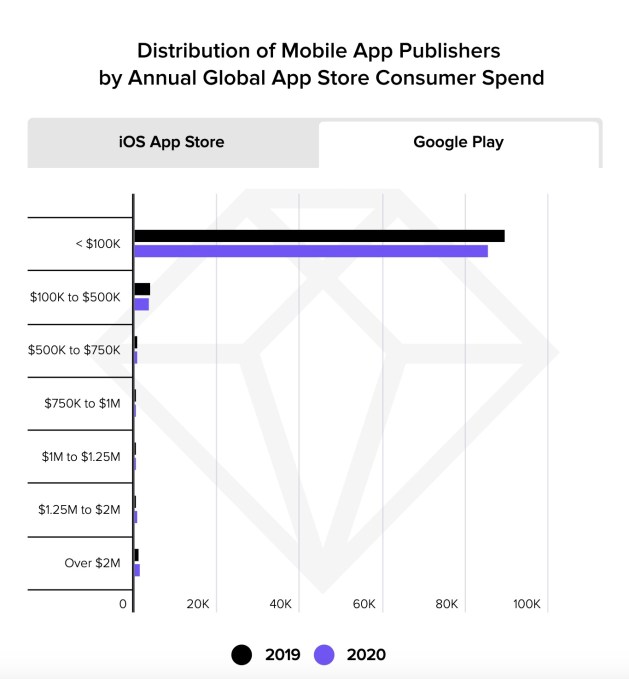
According to App Annie, the vast majority (97.9%) of Google Play publishers made less than $1 million in annual consumer spend in 2020, which allows them to qualify for this reduced commission. But it’s worth noting that the way Google has implemented its new policy is different from Apple, as it will reduce the commission on the “first” $1 million in revenue made during the year — not make $1 million the threshold that triggers a commission increase, like Apple is doing. That means more developers could benefit from Google’s policy change.

It’s interesting to see how few developers across Google Play will ever have to worry about the higher commission bracket. The majority are seeing very small returns from their paid downloads, in-app purchases or subscription offering, the data indicates. This has been an ongoing trend for Android apps, in fact, reflecting Android’s traction in emerging markets where consumers don’t often spend on apps, which has forced many developers to lean on ads in addition to in-app purchases to generate revenues.

Image Credits: App Annie

According to App Annie, 85,381 Google Play developers in 2020 generated less than $100,000 in consumer spend. 3,404 generated $100,000 to $500,000.

Only 568 developers began to even near the $1 million figure, with consumer spend of $500,000 to $750,000 in 2020. Then there were just 359 developers making $750,000 up to that first million.

The groups that would actually see the 30% commission apply to some of their sales were very small.

Just 215 developers saw consumer spend of $1 million to $1.25 million. Only 512 developers made between $1.25 million and $2 million. And then there’s the most profitable group, where 1,308 developers made over $2 million in revenue in 2020.

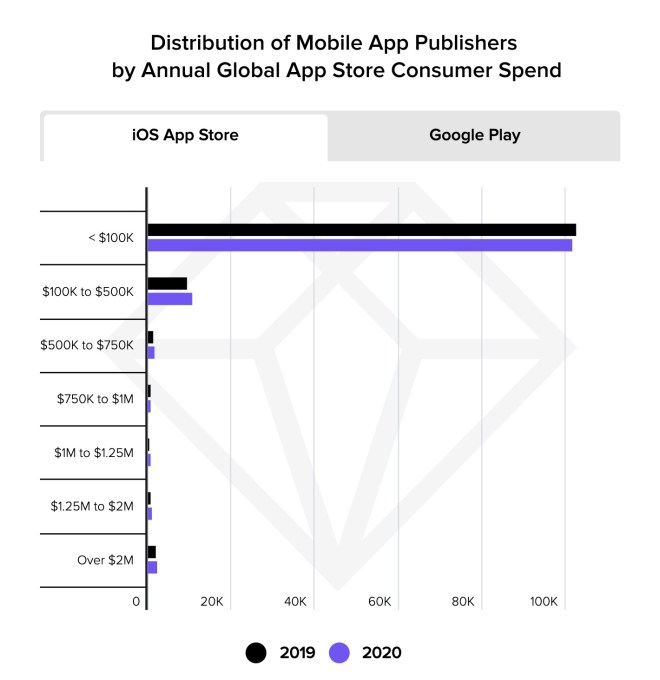
This distribution pattern where the largest group of developers is making under $100,000 and a sliver of the market was pulling in larger figures, including the over $2 million bracket, was similar to Apple’s App Store in 2020. But in Apple’s case, it sees more developers earning a decent income in the other sub-$1 million brackets than Google Play does.

The reason why Apple may have decided to charge a higher commission for developers making over $1 million is also reflected in these charts. Apple simply has more developers who qualify by making over $1 million per year. (On iOS, 3,611 developers make $1 million or more on the App Store vs. 2,035 developers on Google Play).

Image Credits: App Annie


In other words, these policy changes help a large majority of mobile app developers by allowing them to take home more money, and they give Apple and Google a good way to demonstrate to regulators that they’re not wielding their market power against the “little guy.”

For example, App Annie says that publishers making up to $1 million in consumer spend only comprised 5% of total Google Play consumer spend in 2020, even though 94% of Google Play apps offer some sort of in-app purchase mechanism.

But ultimately, the new policies have far less impact on the revenue the platforms themselves are pulling in via commissions. However, Google’s rule makes it simpler and more fair for developers who are still trying to grow their businesses despite crossing the $1 million threshold.

News: MaaS transit: The business of mobility as a service

Whether it’s bundling bookings, payments or just trip planning, startups are offering new mobility-as-a-service (MaaS) products intended to make transit agencies the backbone of urban mobility.

In 2019, St. Louis Metro Transit was struggling to keep customers. Uber and Lyft, along with dockless shared bikes and scooters, had flooded streets, causing ridership to fall more than 7% in a single year.

The agency didn’t try to fight for attention. Instead, it embraced its competitors.

Metro Transit dropped its internal trip-planning app, which had been developed with the Trapeze Group and directed riders to Transit, a private third-party app that offers mapping and real-time transit data in more than 200 cities. That app also included micromobility and ride-hailing information, allowing customers to not just look up bus schedules, but see how they might get to and from stops — or ignore the bus altogether.

The following year, Metro Transit partnered with mobile ticketing company Masabi and added a payment option on some bus routes. Now, the agency is planning an all-in-one app — via third-party providers Transit and Masabi — where customers could plan and book end-to-end trips across trains, buses, bikes, scooters and taxis.

“What we do best is transporting large volumes of people on vehicles and managing mass transit,” said Metro Transit executive director Jessica Mefford-Miller. “On the software side, there are a lot of players out there doing great stuff that can help us meet our customers where they are and make trip planning as easy as possible.”

St. Louis Metro Transit isn’t an outlier. As transit agencies seek to win back riders, a flurry of platforms — some backed by giants like Uber, Intel and BMW — are offering new technology partnerships. Whether it’s bundling bookings, payments or just trip planning, startups are selling these mobility-as-a-service (MaaS) offerings as a lifeline to make transit agencies the backbone of urban mobility.

Whether it’s bundling bookings, payments or just trip planning, startups are selling mobility-as-a-service (MaaS) offerings as a lifeline to make transit agencies the backbone of urban mobility.

Third-party platforms have become more appealing to transit agencies as they scramble to keep buses, trains and rail full of customers. According to the American Public Transportation Association (APTA), ridership and total miles traveled has declined since 2014, including a 2.5% drop from 2017 to 2018. The COVID-19 pandemic could accelerate this trend as more people continue working from home or shy away from crowding into buses and trains.

“This is like Expedia, the idea of seeing multiple airlines in one place to comparison shop,” said Regina Clewlow, CEO of transportation management firm Populus. “A lot of operators are looking at the question of whether that would give them more rides.”

But that the private growth could come at a cost, potentially injecting private concerns into what should be a public good, Metro Transit’s Mefford-Miller cautioned.

“If we let the market handle this planning on its own, a company might only do it for someone with a digital device or a bank account or only help people who don’t need special accommodation,” Mefford-Miller said. “That’s why we have as an underpinning an equitable and accessible system. It’s the underpinning before we choose any tools we use.”

The players

Amid the swarm of new startups there are a few giants. One of the biggest established players is Cubic Corp., a San Diego-based defense and public transportation company. The firm already controls payments and back-end software for hundreds of transit agencies, including in Chicago, New York and San Francisco, and in January launched a suite of new products under the brand name Umo to expand their offerings.

The package includes a customer-facing multimodal app, a fare collection platform, a contactless payment system, a rewards program, a behind-the-scenes management platform and a MaaS marketplace for public and private offerings. Mick Spiers, general manager of Umo, said the goal is to offer a “connected, integrated journey.”

“We’re uniquely placed as an independent, trusted third party that can be the data broker for a journey focused around the needs of the user,” Spiers added. “The journey we create has no commercial interest for us.”

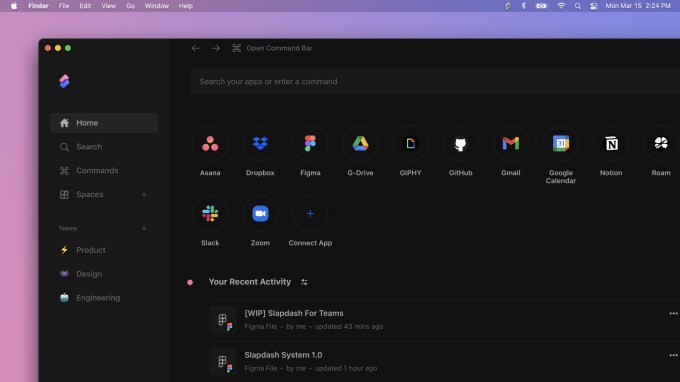
News: Slapdash raises $3.7M seed to ship a workplace apps command bar

The explosion in productivity software amid a broader remote work boom has been one of the pandemic’s clearest tech impacts. But learning to use a dozen new programs while having to decipher which data is hosted where can sometimes seem to have an adverse effect on worker productivity. It’s all time that users can take

The explosion in productivity software amid a broader remote work boom has been one of the pandemic’s clearest tech impacts. But learning to use a dozen new programs while having to decipher which data is hosted where can sometimes seem to have an adverse effect on worker productivity. It’s all time that users can take for granted, even when carrying out common tasks like navigating to the calendar to view more info to click a link to open the browser to redirect to the native app to open a Zoom call.

Slapdash is aiming to carve a new niche out for itself among workplace software tools, pushing a desire for peak performance to the forefront with a product that shaves seconds off each instance where a user needs to find data hosted in a cloud app or carry out an action. While most of the integration-heavy software suites to emerge during the remote work boom have focused on promoting visibility or re-skinning workflows across the tangled weave of SaaS apps, Slapdash founder Ivan Kanevski hopes that the company’s efforts to engineer a quicker path to information will push tech workers to integrate another tool into their workflow.

The team tells TechCrunch that they’ve has raised $3.7 million in seed funding from investors that include S28 Capital, Quiet Capital. Quarry Ventures and Twenty Two Ventures. Angels participating in the round include co-founders at companies like Patreon, Docker and Zynga.

Kanevski says the team sought to emulate the success of popular apps like Superhuman which have pushed low-latency command line interface navigation while emulating some of the sleek internal tools used at companies like Facebook where he spent nearly six years as a software engineer.

Slapdash’s command line widget can be pulled up anywhere, once installed, with a quick keyboard shortcut. From there, users can search through a laundry list of indexable apps including Slack, Zoom, Jira and about twenty others. Beyond command line access, users can create folders of files and actions inside the full desktop app or create their own keyboard shortcuts to quickly hammer out a task. The app is available on Mac, Windows, Linux and the web.

“We’re not trying to displace the applications that you connect to Slapdash,” he says. “You won’t see us, for example, building document editing, you won’t see us building project management, just because our sort of philosophy is that we’re a neutral platform.”

The company offers a free tier for users indexing up to five apps and creating ten commands and spaces, any more than that and you level up into a $12 per month paid plan. Things look more customized for enterprise-wide pricing. As the team hopes to make the tool essential to startups, Kanevski see the app’s hefty utility for individual users as a clear asset in scaling up.

“If you anticipate rolling this out to larger organizations, you would want the people that are using the software to have a blast with it,” he says. “We have quite a lot of confidence that even at this sort of individual atomic level, we built something pretty joyful and helpful.”

News: Twitter begins testing a way to watch YouTube videos from the home timeline on iOS

Shortly after Twitter announced it would begin testing a better way to display images on its app, it’s now doing the same for YouTube videos. According to a new post on Twitter’s Support account, the company will today start testing a way to watch YouTube videos directly from your home timeline within the Twitter iOS

Shortly after Twitter announced it would begin testing a better way to display images on its app, it’s now doing the same for YouTube videos. According to a new post on Twitter’s Support account, the company will today start testing a way to watch YouTube videos directly from your home timeline within the Twitter iOS app. That means you’ll be able to click and play a video without having to leave the conversation you’re currently viewing.

Before this change, YouTube videos wouldn’t show a preview on iOS, so you’d have to click the link to start watching. This would take you out of the conversation to another screen where you could play the video or tap again to open the YouTube iOS app, if you preferred.

Now, you’ll be able to scroll and watch videos without losing your place on the Twitter timeline.

Starting today on iOS, we’re testing a way to watch YouTube videos directly in your Home timeline, without leaving the conversation on Twitter. pic.twitter.com/V4qzMJMEBs

— Twitter Support (@TwitterSupport) March 18, 2021

Twitter says it’s initially testing the feature on iOS in the U.S., Japan, Canada and Saudi Arabia before rolling it out globally. It didn’t offer a time frame for when this would be available to all Twitter users.

The company had announced earlier this month it would be working toward a better media-viewing experience on its app, including for both sharing and viewing media, like photos and videos. With the photo preview test launched to iOS and Android last week, Twitter is now giving users a more accurate preview of what images look like, for example. Before, it would crop images automatically — often hiding key portions of a photo.

Twitter also recently announced the ability for users to upload 4K images on both Android and iOS, accessible through a new feature in your “Data Usage” settings in the Twitter app.

These changes are not only welcome from a user annoyance perspective, they’re also tied into Twitter’s newly announced ambitions to become a platform that serves creators. The company said it’s soon introducing a new subscription-based service called “Super Follow” that will allow creators to publish subscriber-only content on Twitter, like newsletters, deals and other exclusive content, which likely includes exclusive media. But in order to support creators, who often have their content spread across social platforms around the web, Twitter has to make the process of sharing that content — whether photos, videos or anything else — feel seamless and native to the app.

Twitter will likely have a few more updates on this front in the days and weeks to come.


News: Kuda raises $25M more led by Valar to become the neobank for ‘every African on the planet’

Challenger banks continue to make significant advances in attracting customers away from the big incumbents by providing more modern, user-friendly tools to manage their money. Today, one of the trailblazers in this area, Kuda Technologies, is announcing funding to continue building out its specific ambition: to provide a modern banking service for Africans and the

Challenger banks continue to make significant advances in attracting customers away from the big incumbents by providing more modern, user-friendly tools to manage their money. Today, one of the trailblazers in this area, Kuda Technologies, is announcing funding to continue building out its specific ambition: to provide a modern banking service for Africans and the African diaspora, or as co-founder and CEO Babs Ogundeyi describes them, “every African on the planet, wherever you are in the world.”

The company, which currently offers mobile-first banking services in Nigeria, has picked up $25 million in a Series A being led by Valar Ventures, the firm co-founded and backed by Peter Thiel, with Target Global and other unnamed investors participating. This is the first time that Valar — which has invested in a number of fintech startups, including N26, TransferWise, Stash, and just in the last week BlockFi and BitPanda — has backed an African startup.

Kuda currently provides services for consumers to save and spend money, and it has recently introduced overdrafts (essentially revolving credit for individuals). Ogundeyi said in an interview that the plan is to use these new funds to continue expanding its credit offerings, to build out services for businesses, to add in more integrations, and to move into more markets.

The funding is coming on the heels of very strong growth for Kuda, which is co-headquartered in London and Lagos.

When we last wrote about the startup, four months ago, it had just closed a seed round of $10 million led by Target Global. That was, at the time — and I think still is — the largest-ever seed round raised by a startup out of Africa, and thus as much of a milestone for the tech industry there as it was for Kuda itself.

At the time of the seed round, Kuda had registered 300,000 customers: now, that figure has more than doubled to 650,000, and tellingly, that base is spending more money through the Kuda app.

“In November we were doing about $500 million in transactions per month,” Ogundeyi said, for services like bill payments, card transactions, and phone top-ups. “We closed February at $2.2 billion.”

Kuda Transaction Screen CardKuda, as we described in our profile of the company when covering its seed round, is following in the footsteps of a number of other so-called “neobanks”, building a suite of banking services with a more accessible user interface and a more modern approach: you interact with the bank using a mobile app, and in addition to basic banking services, it provides tools to help people manage their money more intelligently.

But Kuda is also different from many of these, specifically because it taps into some financial practices that are unique to its market.

As Ogundeyi describes it, most people who are employed by companies will have “salary accounts” at banks, where companies pay in a person’s wages on a regular basis. These will typically be at incumbent banks, but they do not offer the same ranges of services to customers. No mobile apps, no facilities to buy mobile top-ups or make other kinds of bill payments, no AI-based calculators to figure out your monthly spend and provide suggestions on how to manage your budget, and so on.

That has opened a gap in the market for others to provide those services in their place. Kuda’s deposits, Ogundeyi said, typically start as basic transfers that people make from those “salary accounts” elsewhere. These start out small, maybe 20% of a person’s wages, but as those users find themselves using Kuda’s payment and other tools more, they are increasing how much they transfer in each payment period.

“As the trust increases you’re naturally more comfortable having money with Kuda,” he said. The next stage from that will be people depositing money directly with Kuda. A small minority already do this, he added, although the startup “has a bit more work to do” to get more companies integrated into its platform. (This is one of the areas that will be developed with this latest round of funding.)

In turn, having more money in Kuda accounts is likely to spur another wave of services being turned on at the startup, such as loans with more competitive interest rates, because they will not just be based on how much money people have but also their spending histories on the platform. “We can offer loans to salaried customers instantly as long as their salary is with Kuda,” he said.

Much of this is being enabled because of how Kuda is built. A lot of challenger banks have tapped into a world of finance and banking APIs built by another wave of fintech startups, partnering with other banks to provide backend deposit and other services: their value-add is in building efficient customer service and tools to help people manage and borrow money in smarter ways.

Kuda, on the other hand, has its own microfinance banking license from the central bank of Nigeria. This means that on top of building those same money management services, Kuda can also issue debit cards (in partnership with Visa and Mastercard), manage payments and transfers, and build all of the services in the stack itself, including those salary account services and loans. (Kuda does have partnerships with incumbent banks, specifically Zenith Bank, Guaranteed Trust and Access Bank, for people to come in for physical deposits and withdrawals when needed.)

While the service is still only live in Nigeria, the “vision is still to serve all Africans in Africa as well as outside of it,” Ogundeyi said.

The first step of that will likely be Nigerians outside of Nigeria — most likely in the UK, where Kuda already has a headquarters, and where it has a ready market: London alone has been estimated to be home to upwards of 1 million Nigerian immigrants and people of Nigerian descent (the number of UK residents actually born in Nigeria is considerably smaller, more like 200,000: that is the diaspora at work).

He added that the startup is also at work on preparing for the next countries on the continent to expand its service, another area where this funding will go: “It will let us fast track teams, on-the-ground operational teams,” he said.

The bigger picture is that the market for financial services targeting Africans has been on a significant upswing and so we will be seeing a lot more activity coming out of the region, not just from home-grown startups, but also out of other tech companies increasingly doing more business in that part of the world.

Cases in point: in addition to Stripe acquiring Nigerian payments company Paystack last year, just earlier this week, PayPal announced a deal with Flutterwave to bring PayPal services to more merchants in the region — specifically so that PayPal customers can pay merchants in the region using PayPal rails. Square’s CEO, Jack Dorsey, meanwhile never did make his intended move to the continent — Covid-19 has derailed many plans, as we all know — but it shows that the company trying not to overlook opportunities there, either.

PayPal, to be clear, has been active in Nigeria since 2014 but partnering with a significant player in the region represents an important step for it: Flutterwave itself earlier this month raised $170 million and became Africa’s latest unicorn, in what is still a pretty small list.

The fact that there is so much more to be done with payments and more financial services leaves the door open wide for Kuda to move in a number of different directions if it chooses. Having customers in two countries, especially with one foot in the developed market and another in an emerging market, for example, gives the company an interesting window into the world of remittances.

Money transfer has been one of the very biggest, and most important financial services for African diasporas — alongside those from many other emerging markets.

Even in cases where people are “unbanked” and have no other financial footprints, they have been turning to remittance services to send money home to their families from abroad. Kuda, with its integrations into people’s salaries, could easily become an efficient, one-stop-shop conduit for that activity too. (That’s one reason, likely, that remittance startup, Remitly, has also moved into starting to offer accounts to its users in originating countries.)

All of this to say that Valar’s making a new kind of bet here, but one laden with possibilities and a differentiated approach compared to the rest of its investment activities.

“Nigeria is at a tipping point in the adoption of digital banking,” noted Andrew McCormack, a general partner and co-founder at Valar, who led its investment here. “With the rapidly growing, youthful population who are open to new financial alternatives, Kuda is well-positioned to benefit and will transform the landscape of African banking. We are excited to lead their Series A and continue on the journey alongside Kuda.”


WordPress Image Lightbox Plugin