Tag Archives: Blog

News: AI fintech products are operating at scale and investor interest is maturing

Per a new dataset I spent this morning chewing on, VCs are firing cannons of capital into the AI startup world while exits reach new records.

Recently public unicorn Upstart announced earnings that blew the socks off of Wall Street this week. After closing on Wednesday at around $61 per share, Upstart wrapped Thursday worth $115 per share. It turns out that all the blather we’ve had to endure about artificial intelligence (AI) in the past decade is coming true, at least in certain applications for select companies.

But Upstart’s blockbuster guidance for 2021 is just a sliver of the story. The AI-powered fintech is projecting a year so good that its valuation nearly doubled yesterday, but there are other shoots of life in the AI world worth discussing, and investors are taking note.

Per a new data set I spent this morning chewing on, VCs are firing cannons of capital into the AI startup world while exits reach new records.


The Exchange explores startups, markets and money. Read it every morning on Extra Crunch, or get The Exchange newsletter every Saturday.


Real-world financial output coupled to historically strong venture capital activity — and new technologies dripping into the tech upstart world at a record clip — are creating whole-cloth new use cases for AI tied to lots of capital access. It’s all very exciting.

This morning, I want to discuss Upstart and its quarterly results. I spoke with CEO Dave Girouard yesterday, which yielded some notes on AI-powered tech adoption rates among more conservative companies. Then, we’ll peek into PitchBook data on global AI-focused startup fundraising and their exit market.

After that, we’ll start to come up with a list of GPT-3 powered startups, my new favorite thing aside from pastries. Sure, we’re not as laser-focused today as we are most mornings, but the AI world has me jazzed, so I can’t help but talk about it. Let’s go!

Upstart expects 114% YOY growth in 2021

In its first earnings report as a public company — you can read The Exchange’s coverage of its IPO here and here — Upstart reported Q4 2020 revenues $86.7 million (up 39% on a year-over-year basis), while its 2020 revenues totaled $233.4 million (up 42% on a year-over-year basis).

The quarter was a strong revenue beat, and a beat on adjusted profits. But it’s what the company has coming next that really stuck out. Here’s its CFO:

News: New markets emerge for carbon accounting businesses as cities like LA push proposals

Earlier this month, Los Angeles became the latest city to task its various departments with prepping a feasibility study for deploying new software and monitoring technologies to better account for its carbon footprint. LA’s city council initiative, led by Council member Paul Koretz, follows a push from the state legislature to mandate that all businesses

Earlier this month, Los Angeles became the latest city to task its various departments with prepping a feasibility study for deploying new software and monitoring technologies to better account for its carbon footprint.

LA’s city council initiative, led by Council member Paul Koretz, follows a push from the state legislature to mandate that all businesses operating in California that gross over $1billion annually disclose their greenhouse gas emissions and set science-based targets to reduce those emissions.

California is far from the only state in the U.S. that’s feeling the disastrous effects of global climate change, but it’s among the most aggressive in trying to address the causes. Whether that’s a dramatic effort to remove fossil fuels from its power supply or the proposal to make businesses accountable for their contributions to climate change, California has been a leader in trying to encourage the adoption of new technology and services that can mitigate the impact of climate change and reverse course on the production of greenhouse gas emissions.

With this move, Los Angeles wants to hitch its wagon to this momentum and is actively looking for tech busineses that can help with carbon accounting.

That means good things for companies like CarbonChain, Persefoni, ClimateView, and SINAI Technologies, which all have offerings meant to help with carbon accounting and management.

It shows that some of the largest cities, with billion dollar budgets, will open their wallets to pay for the tools they need to get a better handle on how they’re contributing to the climate change that threatens their own citizens.

In Los Angeles, the city council tasked the Los Angeles Bureau of Sanitation and Chief Legislative Analyst to report back on the feasibility of developing or buying technology to provide a more accurate accounting of the city’s carbon footprint.

“The City provides a number of services – from lighting and maintaining municipal buildings, facilities and streetlights, to paving roads and operating a transit fleet, and delivering water and operating reclamation facilities – all of which come with environmental impacts,” said Council member Koretz in a statement earlier this month. “If we’re going to take our carbon reduction goals seriously, and make a real difference in the lives of frontline communities near LAX and the Port of Los Angeles, we need a better, more consistent, and more transparent accounting of our emissions.”

Los Angeles has steadily worked to give climate change and climate friendly policies a more central role in political discussions. Roughly two years ago, in July 2019, Los Angeles set up an office of climate emergency and earlier this year Mayor Eric Garcetti launched the climate emergency mobilization office to coordinate activity between civic leaders, the mayor’s office, and the city council. 

Budget hasn’t been allocated for the accountability plan, but people familiar with the City Council’s plan expect that implementation could begin in the 2021-2022 budget cycle.

Los Angeles has tried to address its carbon footprint in the past, but the efforts weren’t very successful. The study was conducted using historical emissions data and did not include the “scope three” emissions, which refer to the greenhouse gas emissions created by service providers for the city’s operations.

As the City of Angels looks to improve its ability to provide accountability and metrics on its contribution to climate change, it could do worse than look at the standard that’s been set by New York City. Under the Bloomberg Administration, carbon accounting and resiliency measures became a priority — even before Hurricane Sandy made clear that the city was highly exposed to climate and weather-related disasters.

That 2012 storm inflicted nearly $70 billion in damage and killed 233 people across eight countries from the Caribbean to Canada.

The disaster only furthered New York’s resolve to be more aggressive with its climate action. The city has a robust accounting program for emissions from its operations, and is moving forward with policies across the city to reduce greenhouse gas emissions from the built environment, transportation, and industry.

“Data drives decision making and without data, we cannot chart a path towards a zero-emission future,” said Councilmember Joe Buscaino. “Today’s generation of leaders must continue to address climate change with urgency and be held accountable to the goals we set for Los Angeles, and this motion sets us on the path to do just that.”


News: SpaceX nears final assembly of its first massive testing rocket booster for Starship

SpaceX has completed what’s known as the ‘stacking’ of its first Super Heavy prototype, the extremely large next-generation first-stage rocket booster that it will eventually use to propel its Starship spacecraft to orbit and beyond. The Super Heavy Booster is about 220 feet tall – which is roughly the wingspan of a Boeing 747, or

SpaceX has completed what’s known as the ‘stacking’ of its first Super Heavy prototype, the extremely large next-generation first-stage rocket booster that it will eventually use to propel its Starship spacecraft to orbit and beyond. The Super Heavy Booster is about 220 feet tall – which is roughly the wingspan of a Boeing 747, or a bit taller than the Cinderella Castle at Walt Disney World in Florida.

That’s without Starship on top, which will add around another 160 feet. Super Heavy will undergo its own testing prior to flying with Starship, however, and a lot of that will be focused on assuring its fuel tanks can handle the pressurization and extreme temperatures required for keeping all that ignitable material stable prior to when the engines actually fire.

Super Heavy uses the same engines as Starship — Raptor engines, to be specific, which SpaceX created new for this generation of launch vehicle. The final version will have a total of 28 Raptor engines, but this first prototype will likely be outfitted with far fewer, and SpaceX CEO Elon Musk has confirmed that it’ll also remain grounded, as it’s intended to be use only for testing things like build and transportation mechanics.

Yes, Booster 1 is a production pathfinder, figuring out how to build & transport 70 meter tall stage. Booster 2 will fly.

— Elon Musk (@elonmusk) March 18, 2021

He did say the next prototype will fly, and while he isn’t always accurate about timelines, the Starship upper stage (i.e., the one that looks like a big grain silo with fins) is progressing quickly in its development, including with a recent test flight that ended with a near-perfect landing — minus the subsequent explosion that took out the prototype rocket entirely a few minutes after it had touched down successfully.

Musk clearly wants to move fast with Starship and Super Heavy, in part because of ambitious goals it has of serving as a provider to NASA for future human lunar landing missions as part of the Artemis program, and also because it’s still planning to fly the first commercial tourist flight of a Starship in just two short years in 2023.

News: India asks court to block WhatsApp’s policy update, says new change violates laws

As WhatsApp spends months to address users’ concerns and confusion about its planned policy update, there is evidently one entity it hasn’t had much luck making inroads with: The Government of India. The Indian government alleged on Friday that WhatsApp’s planned privacy update, which goes into effect in two months, violates local laws on several

As WhatsApp spends months to address users’ concerns and confusion about its planned policy update, there is evidently one entity it hasn’t had much luck making inroads with: The Government of India.

The Indian government alleged on Friday that WhatsApp’s planned privacy update, which goes into effect in two months, violates local laws on several counts.

In a filing to the Delhi High Court, the federal government also asked the court to prevent Facebook-owned messaging app from rolling out the update in India, WhatsApp’s biggest market by users.

“Social media in recent years has been used by billions of people around the world and millions of Indians today are dependent on WhatsApp. Therefore, information that is generally personal is shared at an enormous level. This information is susceptible to being misused if the social media giant decides to either sell or exploit the information, sensitive to the users, to any third party,” the government wrote in the filing.

The filing suggests that WhatsApp hasn’t been able to assuage concerns of New Delhi, which first raised issue about the planned policy update in January.

Earlier this year, India’s IT ministry had written to Will Cathcart, the head of WhatsApp, to express its “grave concerns” about the update and its implications and had “called upon to withdraw the proposed changes.”

A WhatsApp spokesperson declined to comment.

The Indian government’s unchanging stand — and ongoing legal case — on WhatsApp’s forthcoming terms and conditions change is the latest headache for the popular instant messaging firm, which is also grappling with a forthcoming guideline from New Delhi that could require WhatsApp to compromise end-to-end encryption it offers on its service.

Used by over 2 billion users, WhatsApp has been sharing some information with parent firm Facebook since 2016. The company, which hasn’t substantially updated its terms of service since, said last year that it will be making some changes to share a set of personal data about users such as their phone number and location with Facebook.

Through an in-app alert earlier this year, WhatsApp asked users to share their consent for the new terms in January, which prompted an immediate backlash from some users. Following the backlash — which saw tens of millions of users explore competing services such as Signal and Telegram — WhatsApp said it will give users three additional months to review its new policy. (On a side note, Signal mobile apps had crossed 100 million monthly active users in February, according to a popular mobile insight firm.)

News: Forget medicine, in the future you might get prescribed apps

Hello and welcome back to Equity, TechCrunch’s venture capital-focused podcast, where we unpack the numbers behind the headlines. Natasha and Danny and Alex and Grace were all here to chat through the week’s biggest tech happenings. This time around we had whatever passes for a quiet week as far as news volume. But that still meant we had to cut stuff and

Hello and welcome back to Equity, TechCrunch’s venture capital-focused podcast, where we unpack the numbers behind the headlines.

Natasha and Danny and Alex and Grace were all here to chat through the week’s biggest tech happenings. This time around we had whatever passes for a quiet week as far as news volume. But that still meant we had to cut stuff and move the rest around. But, once we got done editing the notes doc down, here’s what was leftover:

The show wraps with a teaser for next week that we won’t spoil here.

Equity drops every Monday at 7:00 a.m. PST, Wednesday, and Friday at 6:00 AM PST, so subscribe to us on Apple PodcastsOvercastSpotify and all the casts!

News: Survey: Share feedback on Extra Crunch

Over the last few months, we’ve added a number of new Extra Crunch features at the request of the community. This includes Group Membership, expanding support to new countries like Israel and Norway, adding “sign in with Google” to improve checkout speed, and increasing login timeout so users aren’t regularly logged out of the product.

Over the last few months, we’ve added a number of new Extra Crunch features at the request of the community. This includes Group Membership, expanding support to new countries like Israel and Norway, adding “sign in with Google” to improve checkout speed, and increasing login timeout so users aren’t regularly logged out of the product. Improvements will continue to come in 2021, including a new Extra Crunch Live homepage and easier ways to find the most relevant content for you.

Feedback from our community is critical as we continue to build and develop the product. We’re always looking to improve, and we’d love to get feedback on the product in its current state. If you have a few minutes, please fill out the survey below.

News: Brazilian startup Tractian gets the Y Combinator seal of approval for its equipment monitoring tech

Igor Marinelli and Gabriel Lameirinhas were raised around manufacturing plants. Marinelli’s father worked for International Paper in a plant outside of Sao Paulo while Lameirinhas’ father worked in a cement plant.  Throughout their lives, the two friends had heard their parents complain about the sorry state of maintenance and monitoring of the heavy equipment that

Igor Marinelli and Gabriel Lameirinhas were raised around manufacturing plants. Marinelli’s father worked for International Paper in a plant outside of Sao Paulo while Lameirinhas’ father worked in a cement plant. 

Throughout their lives, the two friends had heard their parents complain about the sorry state of maintenance and monitoring of the heavy equipment that their factories depended on to stay up and running.

So the two men decided to do something about it, and set about to develop the technology which would become Tractian.

Friends from their days at University of Sao Paulo, Lameirinhas and Marinelli kept in touch as Marinelli pursued a career in the U.S. as an entrepreneur, they reconnected in Brazil after the collapse of Marinelli’s attempt to launch a predictive chronic health condition service called BlueAI.

Marinelli spent some time working in a paper plant himself and became a software engineer for the facility. It was there that he saw the shoddy state of affairs that industrial monitoring tools were in.

Together with Lameirinhas he determined that there could be a better way. Factories in Brazil aren’t equipped with wifi or gateways or other networking technologies that the newest solutions from companies like Siemens or Schneider Electric require. Integrations with existing enterprise resource planning software from companies like SAP present another headache, said Marinelli.

“Only industries with huge capital can go through that mess,” Marinelli said.

Tractian’s sensors measure four things: vibration, temperature, energy consumption and a horometer to measure how long a machine has been up and running. The company has also developed software that can analyze the data coming off of the sensors to predict when a machine might need maintenance.

Y Combinator found the software and hardware package compelling and so did investors like Soma Capital, Norte Ventures, and angel investors including Alan Rutledge and Immad Akhund.

Tractian’s tech costs $90 for the sensors and the analysis and software is another $60 per month, per sensor. Marinelli claims that the service can pay for itself in less than two months. Already, the company has signed up AB InBev as an initial customer and has roughly 30 buyers in total using its sensors.


News: Nordetect’s system to monitor soil and water for indoor agriculture raises seed funding

As indoor farming expands, a number of new companies are cropping up to provide better data and monitoring tools for the businesses aimed at improving efficiencies and quality of indoor crops.  One of these companies, the Copenhagen-based Nordetect, is entering the U.S. market with around $1.5 million in funding from government investment firms and traditional

As indoor farming expands, a number of new companies are cropping up to provide better data and monitoring tools for the businesses aimed at improving efficiencies and quality of indoor crops. 

One of these companies, the Copenhagen-based Nordetect, is entering the U.S. market with around $1.5 million in funding from government investment firms and traditional accelerators like SOS V, with a tech that the company claims can give vertical farms a better way to monitor and manage nutrients and water quality.

Controlled agriculture, whether in greenhouses or warehouses, benefits from its ability to administer every aspect of the inputs to ensure that plants have the optimal growing conditions. It is, however, far more expensive than just seeding the ground.

Proponents say that these farms can overcome the additional expense by improving efficiency around water use, reducing the application of pesticides and fertilizer, and cultivating for better, tastier produce.

That’s where Keenan Pinto and Palak Sehgal’s Nordetect comes in. The two co-founders have known each other since they were undergraduates in India eight years ago. They went on to do their masters work together and after working in bioengineering plants — Sehgal focused on flowering systems in plants and Pinto focused on roots — they both went into more digital fields — but maintained their fascination with plants and kept in touch with each other.

Professional work in medical diagnostics for Sehgal and lab instrumentation for Pinto kept both busy, but they continued their discussions around plant science and soil health.

Roughly three years ago, the two hit on the idea for a combined toolkit for water quality monitoring and soil health. Sehgal left the India Institutes of Technology, where she had been working, and joined Pinto in Copenhagen to begin developing the tech that would form the core of Nordetect’s business proposition full time.

The company’s technology consists of an analyzer and a cartridge, a microfluidic chip that users can insert into their water tank to take a sample. From the data that the device collects, farmers can control the nutrients they put into the water to optimize for traits like color and flavor, Pinto said.

Image Credit: Shutterstock/Francesco83

The company was accepted into SOSV’s Hax accelerator in 2017 and the two first time founders moved from Denmark to Shenzhen to begin developing the business. In late 2018 the company moved back to Denmark and raised a small amount of additional capital from SOSV and Rockstart.

By 2020, watching the expansion of vertical farming, the company took what had initially been a soil monitoring tool and added water quality monitoring features to support indoor farming. That’s when the business started taking off, according to Pinto.

“One of the interesting things is when i consider the outdoor vs. the indoor markets. The outdoor felt a bit conservative… the indoor seems much more forthcoming… and that traction allowed us to pull together this funding round $1.5 million,” Pinto said. 

The new round came from Rockstart, Preseed Ventures, SOSV, the government of Denmark’s growth fund, and Luminate, a Rochester, NY-based accelerator that focuses on optical electronics technology.

Luminate’s participation is one reason why Nordetect is coming to the U.S., but it’s hardly the only reason. There’s also the capital that has come in to finance indoor ag companies. The two largest vertical farming companies in the U.S., Plenty and Bowery Farming have raised $541 million and $167 million between them.

“The vertical movement has put people into the position where they are what I call data farmers,” said Pinto. “Each batch of produce is being used to learn and the data is more important than the output. We used this market as a beachhead.”

News: Blackstone just closed its inaugural growth equity fund, and it’s a doozy

The private equity giant Blackstone is today announcing the final close of its first growth equity fund — Blackstone Growth — with $4.5 billion in  capital commitments from a wide range of family offices, entrepreneurs, endowments, strategic institutional investors, pension funds, and other big wheels. The outfit says it’s the “largest first-time growth equity private

The private equity giant Blackstone is today announcing the final close of its first growth equity fund — Blackstone Growth — with $4.5 billion in  capital commitments from a wide range of family offices, entrepreneurs, endowments, strategic institutional investors, pension funds, and other big wheels.

The outfit says it’s the “largest first-time growth equity private fund raised in history.”

We knew this was coming back in the fall of 2019, when we first talked with Jon Korngold, the head of the new fund. At the time, he was a recent hire, having joined that same year from General Atlantic, where he spent the previous 18 years of his career, including as a managing director and a member of its management committee.

Korngold was also in building mode, trying to assemble a team, and writing some early checks off of Blackstone’s sizable balance sheet. (The company had assets under management at the time of roughly $500 billion; it now manages just north of $600 billion.)

Because a lot has transpired since that conversation — including a $2 billion bet on the dating app Bumble that’s currently worth a stunning $7 billion — we asked Korngold to catch us up on the team, what size investments they are making, and whether Blackstone views blank-check companies as growing competition.

TC: Brass tacks, how many people are now investing this $4.5 billion alongside you?

JK: We’ve got about 30 people full-time dedicated to Blackstone Growth, in addition to the obviously hundreds, if not thousand, of people more generally available to us within the Blackstone family. We’ve got people now in San Francisco, New York, and in London. It’s has a global mandate.

TC: What size checks does your team tend to write?

JK: Our average investment might be $200 million to $400 million.

TC: And how much of this debut fund has been invested already?

JK: In beginning, we were using other pools of capital before this pool of capital was available to us. Now that we’ve got this, we’ve got a handful of investments and invested a pretty significant portion of our capital already. It’s probably north of 25% at this stage.

TC: Do you reserve upwards of half for follow-on funding? How does a fund of this size even work?

JK: Anytime we invest, we always expect and hope that we will continue to support our companies throughout. Fortunately, we never have a problem of running out of money. But we do reserve a significant portion of it to fund the ongoing growth of the companies.

The good news is many of our companies are already profitable. If you recall from the last we spoke last time, one of the things that we’ve tried to do is look for companies that are at the upper end of the growth equity spectrum, both in terms of some of the maturity of the business, and even their growth ambitions where they may have outgrown a lot of traditional growth equity, but they haven’t yet outgrow Blackstone. As result, fortunately, we have the luxury of not needing to reserve as much because we think our companies are going to run out of capital. That’s never really the problem.

TC: One of your most notable deals was in Bumble, into whose parent company you reportedly invested $2 billion at a $3 billion valuation for a controlling stake in late 2019. Given your other options, why did you decide to do this deal?

JK: First, we knew that dating is not a fad. People will date in bull markets and recessions and, we’ve learned in hindsight, in quarantine. Even before the pandemic, 40% of all new relationships that started began online. It’s become much, much more mainstream on the back of mobile phone penetration, and it’s a global phenomenon.

The second thing we really liked was the opportunity to back [founder and CEO] Whitney Wolfe Herd. She is an exceptional entrepreneur and partner and really embraced the full set of resources that Blackstone was in a position to help give. It’s been a just a phenomenal partnership.

TC: You’ve talked with me in the past about all the might that Blackstone brings to a deal. What did you do for Bumble?

JK: First was cementing Whitney’s leadership of the overall company. Historically, there were two parts of the business: it was Badoo and Bumble, and they were largely run separately [and now] Whitney is the single CEO of both companies together.

The second thing we did was really augment the management team. We brought in 10 C-level executives alongside Whitney, the majority of the Bumble team are female, we brought in six independent directors [and now] eight of the 11 board members are women.

We also consolidated the product development teams between Badoo and Bumble, and the marketing teams. We meaningfully upgraded the technology infrastructure — we put in a lot more around reporting and repeatability to make sure the company was going to be a great public entity. We consolidated their real estate footprint [as] they had multiple disparate units in London and Texas and elsewhere, and we centralized that to ensure the culture remained much more consistent. And we got the company ready to be public in terms of [Sarbanes-Oxley] compliance and prepping the company as to what to expect as a public business.

We also massively invested in product, one of which is video chat. Before the quarantine, we introduced video dating before any other platform, and that turned out to be a phenomenal boon for our growth across quarantine, where video usage was up 80% on the platform.

TC: Did you current investors in the fund benefit from Bumble’s success?

JK: Yes they did.

TC: Special purpose acquisition companies (SPACs) weren’t being in used much in 2019 when you struck your deal with Bumble. Do you think if they had, Bumble might have skipped the Blackstone round and just gone public sooner? Do see SPACs as a threat to your work? 

JK: I don’t really view SPACs as competitors. It’s easy to crap on SPACs but there is a role for them, it’s no longer the dirty four-letter word it was years ago now that you many more credible sponsors behind these SPACs.

I do think there will be many more SPACs than good deals to actually invest in, especially when the perverse incentive is: you’ve got 24 months to invest the money [so] it’s better to do a bad deal that no deal at all. There is a fundamental misalignment in the current model of SPAC that has led to an arbitrage that we haven’t seen in many, many, many years.

There’s a place for them, but like direct listings that [prompted people to believe the] IPO market is going to go away, the practical reality is that there have been four or five total direct listings in history. So I don’t see SPACs displacing IPOs, and I certainly don’t see them displacing growth equity.


News: Nigeria’s Termii raises $1.4M seed led by Future Africa and Kepple Africa Ventures

Ideally, it is expected of every business to reach its customers effectively. However, that’s not the case as limiting factors that hinder proper digital communication come into play at different growth stages. Termii, a Nigerian communications platform-as-a-service startup that solves this problem for African businesses, announced today that it has closed a $1.4 million seed round.

Ideally, it is expected of every business to reach its customers effectively. However, that’s not the case as limiting factors that hinder proper digital communication come into play at different growth stages. Termii, a Nigerian communications platform-as-a-service startup that solves this problem for African businesses, announced today that it has closed a $1.4 million seed round.

The round was co-led by African early-stage VC firm Future Africa and Japanese but Africa-focused VC Kepple Africa Ventures. Other investors include Acuity Ventures, Aidi Ventures, Assembly Capital, Kairos Angels, Nama Ventures, RallyCap Ventures, and Remapped Ventures.

Angel investors like Ham Serunjogi, co-founder and CEO of Chipper Cash; Josh Jones, former co-founder and CTO, Dreamhost; and Tayo Oviosu, co-founder and CEO of Paga also participated.

Gbolade Emmanuel and Ayomide Awe launched Termii after Emmanuel’s experience as a digital marketer helped him recognize the need for businesses to have exceptional communication channels. The CEO consulted for these companies and leveraged emails to retain customers, but as he found out that this process was lethargic, he sought other channels as a replacement.

“That got me to start thinking about multichannel messaging. What it meant was that we needed to find how to allow companies to use WhatsApp, voice, SMS effectively,” he said to TechCrunch. “And we had to make the process simple because in the African market, you can’t do complex stuff. You have to be as simple as possible.”

In 2017, the company officially launched and subsequently secured investment from Lagos-based VC Microtraction. Emmanuel says the company found product-market fit two years later after collating enough data from companies in different industries to understand what they really wanted.

Termii found out that in addition to assisting businesses to retain customers, there was a clear need to verify, authenticate and engage them.

“Many of these businesses we started engaging said they required tools to effectively communicate and verify customers because they were losing money at those points. For us, we saw it was a bigger problem,” Emmanuel added.

After making some tweaks, the team began to see an increase in customers numbers, especially amongst fintech startups. Positioning itself in the fast-moving space, Termii created an API-based communication infrastructure that caters to over 500 fintech startups across the continent. That’s not all. More than 1,000 businesses and developers are also using Termii’s API.

Some of these businesses include uLesson, Yassir, Helium Health, Piggyvest, Bankly, Paga, and TeamApt.

Playing in a $3.6 billion B2C communications market estimated to grow 6% annually, Termii runs a B2B2C model. But how does it make money? While a subscription-based model would’ve made sense, the two years spent by the company trying to find PMF made them think otherwise.

So the company leverages a virtual wallet system tied to a bank account and customers can make payments to the platform using mobile money, bank transfer, and credit cards. The startup charges these wallets on a per-message basis. It also does the same on every successful customer verification made towards customers’ contacts.

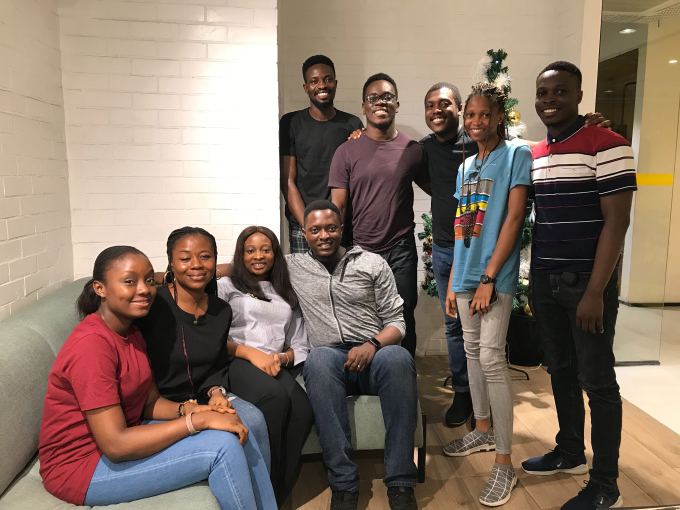
The Termii team

In early 2020, Termii started seeing immense progress and this coincided with their acceptance into Y Combinator. The growth continued throughout the year, growing its messaging transactions by 1000% and experiencing a 400% increase in its ARR.

Spilling into this year, Emmanuel says the company’s revenue is growing 60% month-on-month as a result of the surge in online financial transactions which to date makes up for 68% of the company’s total messaging transactions.

The seed investment that is coming a year after Termii graduated from the YC will be used for expansion and launch more messaging offerings across Africa.

Emmanuel says the company has its sights on North Africa with a physical presence in Algeria for the expansion. The reason lies behind the fact that in this quarter, Nigeria has accounted for 76% of the company’s messaging transactions, while Algeria currently accounts for 15%.

With this new fundraising, the company plans to tap into the wealth of experience from some of its new investors like Oviosu and Serunjogi who have also taken local companies into expansion phases.

Termii’s round is also noteworthy because it strays away from the usual fintech, mobility, agritech and cleantech sectors that investors typically notice. In fact, there are only a handful of venture-backed communications platform-as-a-service companies on the continent. A notable example is Kenya’s Africa Talking. It might be a stretch to say we might see more funding activity from this segment but one thing is apparent — investors are willing to place bets on less popular sectors.

Another highlight of Termii’s investment is that while foreign investors continue to dominate rounds in African tech startups, local and Africa-focused firms are beginning to step up by leading some which is a good sign for the bubbling ecosystem.

This round is also a big step for Future Africa. According to publicly available information, the firm is leading a million-dollar round for the first time since officially launching last year. This achievement is a continuation of its work over the past three quarters having invested in more than 10 African startups in the last three quarters and 30 startups in general. 

Kepple Africa Ventures, the co-lead, is also an active investor and can be argued to be the most early-stage VC firm on the continent — in terms of the number of deals made. So far, the firm has invested in 79 companies across 11 countries. 

Speaking on the investment for Kepple Africa, Satoshi Shinada, a partner at the firm, said, “Fragmented and unstable communication channels are one of the biggest challenges for the digitization of businesses in Africa. Emmanuel has proven that with his visionary goals and solid implementation of iterations on the ground, his team is unparalleled to build an innovative solution in this space.”

WordPress Image Lightbox Plugin