Tag Archives: Blog

News: 5 trends in the boardrooms of high-growth private companies

Just as countless aspects of corporate life have been reshaped over the course of the last year, boards of directors are undergoing significant and lasting transformation.

Ann Shepherd
Contributor

Ann Shepherd is co-founder of social impact venture Him For Her. She serves on the board of fintech startup HoneyBook.
More posts by this contributor

Jocelyn Mangan
Contributor

Jocelyn Mangan is the founder and CEO of social impact venture Him For Her. She serves on the boards of ChowNow and Papa John’s.

“Your board will never be the same.”

With that prediction, Nigel Travis, board director and former CEO of Dunkin’ and Papa John’s, kicked off a recent discussion about the future of corporate governance with chief executives and current and aspiring board members.

Just as countless aspects of corporate life have been reshaped over the course of the last year, boards of directors are undergoing significant and lasting transformation. Through our conversations with more than 500 business leaders and work on nearly 300 board searches over the last year, as well as findings from our recent board benchmarking study, we’ve identified five trends in the boardrooms of the United States’ high-growth private companies.

1. Board diversity is imperative

Historically, board members have been tapped from the personal networks of those already in the boardroom. This approach optimizes for trust and convenience at the expense of diversity.

We expect to see continued improvement when it comes to racial and ethnic diversity in the years ahead.

As pressure to diversity the boardroom mounts and societal challenges underscore the risks of the all-male board, companies are starting to take a more inclusive approach to board design. They are reaching outside their networks to appoint women and people of color, discovering that it’s not a pipeline problem — it’s a network problem. In one year’s time, the percentage of late-stage private companies with all-male boards declined from 60% to 49%.

While that’s progress, the fact that nearly half of the most heavily funded venture-backed companies lack a single woman on the board underscores the enormous work still to be done. Today, only 11% of high-growth private company board seats are held by women and only 3% by women of color.

However, we expect to see continued improvement when it comes to racial and ethnic diversity in the years ahead. Demand for Him For Her referrals to female board candidates nearly quadrupled in that last quarter of 2020 compared with a year prior, and among the new directors appointed, a quarter identify as Black or African American.

2. Source candidates from across the entire C-suite

When seeking independent directors, boards have traditionally favored CEO experience. Given the gender imbalance among CEOs, preference for that title instantly tips the scales in favor of male candidates.

As boards look to add women, many have discovered the value of taking a more strategic approach to defining criteria for the next director. Instead of relying on the CEO title as a proxy for the desired qualities, boards now conduct a gap analysis, identifying the mix of key competencies that would be most valuable.

The result: a rich pipeline of executive operators who contribute strategic perspective combined with cutting-edge best practices. In addition to CFOs ready to chair an audit committee, we’ve had requests for operators with go-to-market expertise, product leaders known for driving innovation, and people officers who know how to build corporate culture. We’ve even helped companies seeking, for example, business-savvy doctors, nurses and law-enforcement officers to bring the voice of their customers into the boardroom.

3. Independents come earlier

As CEOs look to add diversity and operating expertise to their boards, many are adding independent directors at an earlier stage. How early? “It’s never too early to have an independent director on the board,” according to Brad Garlinghouse, CEO of Ripple, where the first independent was appointed only a year after the company’s founding.

Over the last year, the percentage of the heavily funded private companies with at least one independent director grew from 71% to 84%, and the percentage of board seats held by independents grew from 20% to 25%, according to the 2020 Study of Gender Diversity on Private Company Boards. Among the board searches we’ve conducted for privately held companies, more than 40% were Series B or earlier.

4. The board Zoom is here to stay

The pandemic drove boards onto screens, but even when health risks are mitigated, many will continue to convene virtually at least some of the time. The last year has caused companies to rethink the role of the physical office, and the importance of the physical boardroom is getting new scrutiny. Though most CEOs and directors will still favor in-person attendance for formal board meetings, we expect a new tolerance for remote participation and an increase in ad-hoc virtual meetings.

Beyond reduced travel and ease of scheduling, there’s a hidden benefit to virtual meetings that leaders would be wise to exploit: the reduced opportunity cost of more attendees. The impact of “another body in the boardroom” has long been an argument against allowing company executives to attend board meetings. We expect that, with a virtual format, CEOs will take advantage of the development opportunity to expose more of their leaders to board discussions.

On the flip side, virtual meetings require a more conscious effort to build relationships. Boards will need to balance the convenience of virtual meetings with the value of in-person interactions in building rapport and fostering collaborative decision-making.

5. Stakeholder capitalism takes root

Propelled by increasing pressure in the public markets and by the growing number of consumers who make value-based purchasing decisions, private company boards will give sustainability more overt consideration in their decision-making. In his annual letter, BlackRock CEO Larry Fink pointed to evidence of a “sustainability premium” for companies that outperform their industry peers on ESG measures. As public companies standardize on metrics and disclosure around ESG performance, that discipline will extend into the boardrooms of companies that aim to compete in the global marketplace.

Private companies drive innovation in nearly every corner of the economy, yet their boardrooms have remained remarkably unchanged over the last several decades. We expect that 2020 will prove to be an inflection point in corporate boardrooms; this period of board transformation will be defined by increased diversity and inclusion and a growing emphasis on sustainable value creation. As these initiatives take root, beneficiaries will include not just the companies and their investors, but employees, customers, suppliers and society at large.

News: Instagram and WhatsApp hit by outage

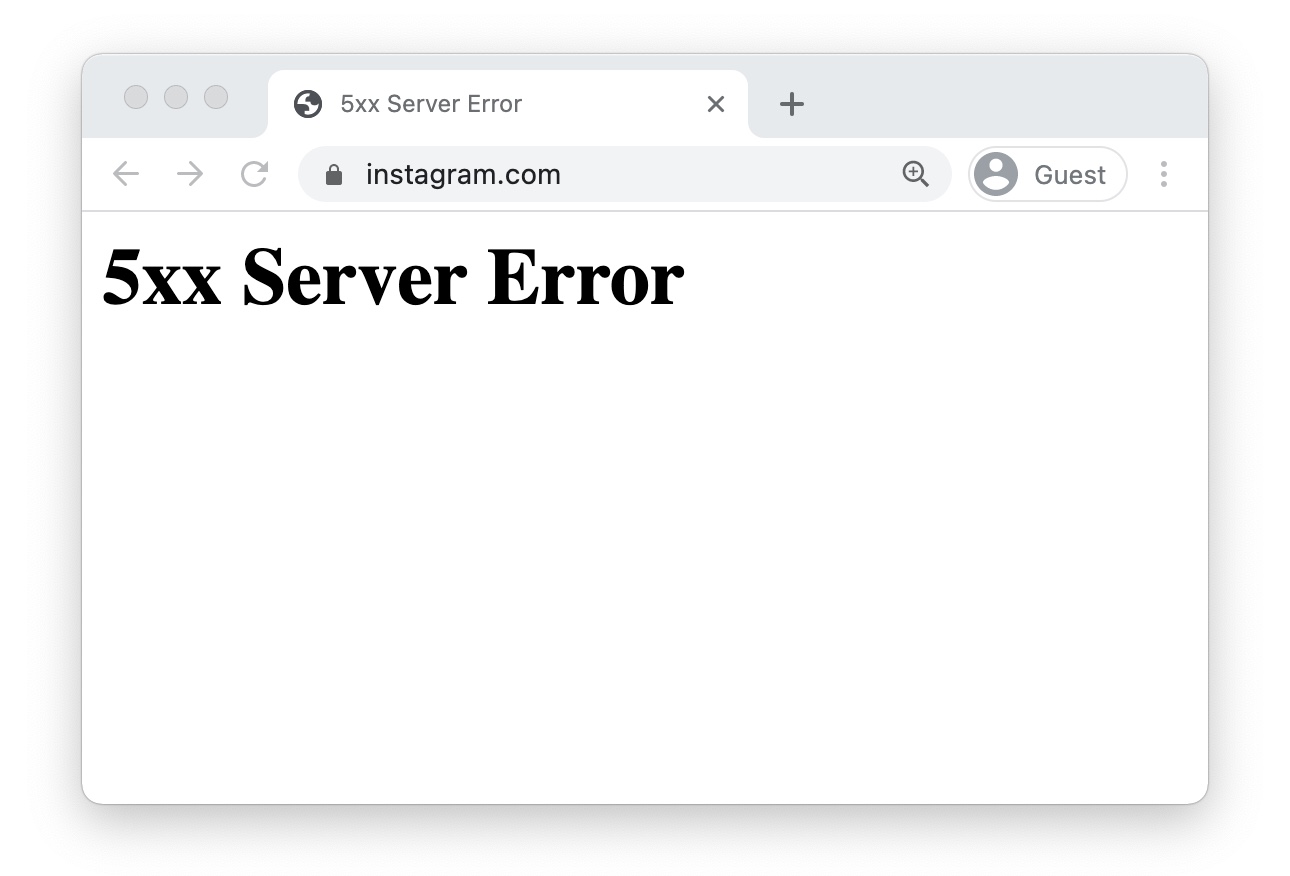
Instagram and WhatsApp are currently experiencing an apparent outage. It began around 1:40 pm ET. At the time of writing, Instagram was showing a 500 message, suggesting a back-end server error. WhatsApp meanwhile was unable to connect to the server, and messages are not being delivered. It’s not clear if the issue also affects Facebook

Instagram and WhatsApp are currently experiencing an apparent outage. It began around 1:40 pm ET.

At the time of writing, Instagram was showing a 500 message, suggesting a back-end server error. WhatsApp meanwhile was unable to connect to the server, and messages are not being delivered. It’s not clear if the issue also affects Facebook Messenger, which last year rolled out new functionality to allow cross-platform messaging between Facebook, WhatsApp and Instagram.

Instagram currently looks like this.

Instagram's error page

Instagram’s error page. (Image: TechCrunch)

WhatsApp has more than two billion users, and Instagram has about one billion users. Facebook’s developer status page did not show any immediate outages.

We’ve reached out to Facebook, which owns the two units, but did not immediately hear back. We’ll update when we know more.

More on TechCrunch:

News: Social+ payments: Why fintechs need social features

The shift toward social+ is not going anywhere, and the fintech vertical is no exception. The good news is the social+finance trend is still in its infancy, which means there are opportunities to gain a first-mover advantage by acting now.

John S. Kim
Contributor

John S. Kim is CEO of Sendbird, makers of a customizable chat and messaging API service for mobile and web applications.

Social+ companies are upping the stakes for everyone by giving consumers multiple benefits at once: products that serve a purpose but also meet our need for belonging to a community.

But what exactly is a social+ company? One for which social engagement is an inextricable component of the product. That is to say: If you removed the social element, the product would cease to make sense. You can find plenty of examples in gaming (Fortnite), fitness (Strava, Peloton), commerce (Pinduoduo), audio (Clubhouse) and more. As noted in Andreessen Horowitz’s recent series Social Strikes Back, “The best version of every consumer product is the one that’s intrinsically social.”

Social+ products are seeing mass adoption because they marry community with functionality.

The benefits of a social+ company

Social+ products are seeing mass adoption because they marry community with functionality. Users form meaningful connections — and engage in value-adding conversations — within the context of the goal they’re trying to achieve. Whether it’s shopping for a deal or growing their assets, social+ products help users gain new knowledge, find motivation, garner status, form friendships and generally feel like they’re part of something.

Companies that base their business model on social+ products enjoy a variety of benefits:

Growth

When the social aspect of a product is integral to its function, users will often drive growth on their own steam, inviting their friends and family to join the community.

Members of highly engaged communities are inspired and fired up by their interactions with other members, and when they’re fired up about something, they talk about it. Participating in these communities makes users feel like they’re part of something, which can have a powerful effect on your growth.

Retention

Relationships matter. The relationship your users have with your brand is ultimately what will determine whether they stick with you or leave you for a competitor offering the same service — particularly at a more attractive price. If you provide your customers with access to a community they relate to and resources that make their lives easier, they’re more likely to be loyal.

The beauty of social+ is that embedding social interaction within your product or app allows you to own that conversation and build a community around your brand. In the absence of built-in communities, these users are forced to turn to places like Reddit or WhatsApp to discuss, among other things, the relative advantages of competitors’ apps.

Harnessing the creativity of your users

User-generated content (UGC) is the lifeblood of any social+ product, driving user engagement and fostering connections among users. UGC means the company can harness the creativity and popularity of its users and doesn’t have to expend as many resources creating content users find valuable. Plus there’s the added bonus that authentic UGC — whether it’s a screenshot or a meme — lends the product far greater credibility than any marketing initiatives you could launch.

News: Uber under pressure over facial recognition checks for drivers

Uber’s use of facial recognition technology for a driver identity system is being challenged in the U.K., where the App Drivers & Couriers Union (ADCU) and Worker Info Exchange (WIE) have called for Microsoft to suspend the ride-hailing giant’s use of B2B facial recognition after finding multiple cases where drivers were mis-identified and went on

Uber’s use of facial recognition technology for a driver identity system is being challenged in the U.K., where the App Drivers & Couriers Union (ADCU) and Worker Info Exchange (WIE) have called for Microsoft to suspend the ride-hailing giant’s use of B2B facial recognition after finding multiple cases where drivers were mis-identified and went on to have their licence to operate revoked by Transport for London (TfL).

The union said it has identified seven cases of “failed facial recognition and other identity checks” leading to drivers losing their jobs and licence revocation action by TfL.

When Uber launched the “Real Time ID Check” system in the U.K. in April 2020, it said it would “verify that driver accounts aren’t being used by anyone other than the licensed individuals who have undergone an Enhanced DBS check”. It said then that drivers could “choose whether their selfie is verified by photo-comparison software or by our human reviewers”.

In one misidentification case the ADCU said the driver was dismissed from employment by Uber and his licence was revoked by TfL. The union adds that it was able to assist the member to establish his identity correctly, forcing Uber and TfL to reverse their decisions. But it highlights concerns over the accuracy of the Microsoft facial recognition technology — pointing out that the company suspended the sale of the system to U.S. police forces in the wake of the Black Lives Matter protests of last summer.

Research has shown that facial recognition systems can have an especially high error rate when used to identify people of color — and the ADCU cites a 2018 MIT study that found Microsoft’s system can have an error rate as high as 20% (accuracy was lowest for dark-skinned women).

The union said it’s written to the mayor of London to demand that all TfL private-hire driver licence revocations based on Uber reports using evidence from its Hybrid Real Time Identification systems are immediately reviewed.

Microsoft has been contacted for comment on the call for it to suspend Uber’s licence for its facial recognition tech.

The ADCU said Uber rushed to implement a workforce electronic surveillance and identification system as part of a package of measures implemented to regain its license to operate in the U.K. capital.

Back in 2017, TfL made the shocking decision not to grant Uber a licence renewal — ratcheting up regulatory pressure on its processes and maintaining this hold in 2019 when it again deemed Uber “not fit and proper” to hold a private hire vehicle licence.

Safety and security failures were a key reason cited by TfL for withholding Uber’s licence renewal.

Uber has challenged TfL’s decision in court and it won another appeal against the licence suspension last year — but the renewal granted was for only 18 months (not the full five years). It also came with a laundry list of conditions — so Uber remains under acute pressure to meet TfL’s quality bar.

Now, though, Labor activists are piling pressure on Uber from the other direction too — pointing out that no regulatory standard has been set around the workplace surveillance technology that the ADCU says TfL encouraged Uber to implement. No equalities impact assessment has even been carried out by TfL, it adds.

WIE confirmed to TechCrunch that it’s filing a discrimination claim in the case of one driver, called Imran Raja, who was dismissed after Uber’s Real ID check — and had his licence revoked by TfL.

His licence was subsequently restored — but only after the union challenged the action.

A number of other Uber drivers who were also misidentified by Uber’s facial recognition checks will be appealing TfL’s revocation of their licences via the U.K. courts, per WIE.

A spokeswoman for TfL told us it is not a condition of Uber’s licence renewal that it must implement facial recognition technology — only that Uber must have adequate safety systems in place.

The relevant condition of its provisional licence on “driver identity” states:

ULL shall maintain appropriate systems, processes and procedures to confirm that a driver using the app is an individual licensed by TfL and permitted by ULL to use the app.

We’ve also asked TfL and the U.K.’s Information Commissioner’s Office for a copy of the data protection impact assessment Uber says was carried before the Real-Time ID Check was launched — and will update this report if we get it.

Uber, meanwhile, disputes the union’s assertion that its use of facial recognition technology for driver identity checks risks automating discrimination because it says it has a system of manual (human) review in place that’s intended to prevent failures.

Albeit it accepts that that system clearly failed in the case of Raja — who only got his Uber account back (and an apology) after the union’s intervention.

Uber said its Real-Time ID system involves an automated “picture matching” check on a selfie that the driver must provide at the point of log in, with the system comparing that selfie with a (single) photo of them held on file. 

If there’s no machine match, the system sends the query to a three-person human review panel to conduct a manual check. Uber said checks will be sent to a second human panel if the first can’t agree. 

In a statement the tech giant told us:

Our Real-Time ID Check is designed to protect the safety and security of everyone who uses the app by ensuring the correct driver or courier is using their account. The two situations raised do not reflect flawed technology — in fact one of the situations was a confirmed violation of our anti-fraud policies and the other was a human error.

“While no tech or process is perfect and there is always room for improvement, we believe the technology, combined with the thorough process in place to ensure a minimum of two manual human reviews prior to any decision to remove a driver, is fair and important for the safety of our platform.

In two of the cases referred to by the ADCU, Uber said that in one instance a driver had shown a photo during the Real-Time ID Check instead of taking a selfie as required to carry out the live ID check — hence it argues it was not wrong for the ID check to have failed as the driver was not following the correct protocol.

In the other instance Uber blamed human error on the part of its manual review team(s) who (twice) made an erroneous decision. It said the driver’s appearance had changed and its staff were unable to recognize the face of the (now bearded) man who sent the selfie as the same person in the clean-shaven photo Uber held on file.

Uber was unable to provide details of what happened in the other five identity check failures referred to by the union.

It also declined to specify the ethnicities of the seven drivers the union says were misidentified by its checks.

Asked what measures it’s taking to prevent human errors leading to more misidentifications in the future, Uber declined to provide a response.

Uber said it has a duty to notify TfL when a driver fails an ID check — a step that can lead to the regulator suspending the license, as happened in Raja’s case. So any biases in its identity check process clearly risk having disproportionate impacts on affected individuals’ ability to work.

WIE told us it knows of three TfL licence revocations that relate solely to facial recognition checks.

“We know of more [UberEats] couriers who have been deactivated but no further action since they are not licensed by TfL,” it noted.

TechCrunch also asked Uber how many driver deactivations have been carried out and reported to TfL in which it cited facial recognition in its testimony to the regulator — but again the tech giant declined to answer our questions.

WIE told us it has evidence that facial recognition checks are incorporated into geo-location-based deactivations Uber carries out.

It said that in one case a driver who had their account revoked was given an explanation by Uber relating solely to location but TfL accidentally sent WIE Uber’s witness statement — which it said “included facial recognition evidence”.

That suggests a wider role for facial recognition technology in Uber’s identity checks versus the one the ride-hailing giant gave us when explaining how its Real-Time ID system works. (Again, Uber declined to answer follow-up questions about this or provide any other information beyond its on-the-record statement and related background points.)

But even just focusing on Uber’s Real-Time ID system there’s the question of how much say Uber’s human review staff actually have in the face of machine suggestions combined with the weight of wider business imperatives (like an acute need to demonstrate regulatory compliance on the issue of safety).

James Farrer, the founder of WIE, queries the quality of the human checks Uber has put in place as a backstop for facial recognition technology, which has a known discrimination problem.

“Is Uber just confecting legal plausible deniability of automated decision making or is there meaningful human intervention,” he told TechCrunch. “In all of these cases, the drivers were suspended and told the specialist team would be in touch with them. A week or so typically would go by and they would be permanently deactivated without ever speaking to anyone.”

“There is research out there to show when facial recognition systems flag a mismatch humans have bias to confirm the machine. It takes a brave human being to override the machine. To do so would mean they would need to understand the machine, how it works, its limitations and have the confidence and management support to over rule the machine,” Farrer added. “Uber employees have the risk of Uber’s license to operate in London to consider on one hand and what… on the other? Drivers have no rights and there are in excess so expendable.”

He also pointed out that Uber has previously said in court that it errs on the side of customer complaints rather than give the driver benefit of the doubt. “With that in mind can we really trust Uber to make a balanced decision with facial recognition?” he asked.

Farrer further questioned why Uber and TfL don’t show drivers the evidence that’s being relied upon to deactivate their accounts — to given them a chance to challenge it via an appeal on the actual substance of the decision.

“IMHO this all comes down to tech governance,” he added. “I don’t doubt that Microsoft facial recognition is a powerful and mostly accurate tool. But the governance of this tech must be intelligent and responsible. Microsoft are smart enough themselves to acknowledge this as a limitation.

“The prospect of Uber pressured into surveillance tech as a price of keeping their licence… and a 94% BAME workforce with no worker rights protection from unfair dismissal is a recipe for disaster!”

The latest pressure on Uber’s business processes follows hard on the heels of a major win for Farrer and other former Uber drivers and labor rights activists after years of litigation over the company’s bogus claim that drivers are “self employed”, rather than workers under U.K. law.

On Tuesday Uber responded to last month’s Supreme Court quashing of its appeal saying it would now treat drivers as workers in the market — expanding the benefits it provides.

However, the litigants immediately pointed out that Uber’s “deal” ignored the Supreme Court’s assertion that working time should be calculated when a driver logs onto the Uber app. Instead Uber said it would calculate working time entitlements when a driver accepts a job — meaning it’s still trying to avoid paying drivers for time spent waiting for a fare.

The ADCU therefore estimates that Uber’s “offer” underpays drivers by between 40%-50% of what they are legally entitled to — and has said it will continue its legal fight to get a fair deal for Uber drivers.

At an EU level, where regional lawmakers are looking at how to improve conditions for gig workers, the tech giant is now pushing for an employment law carve out for platform work — and has been accused of trying to lower legal standards for workers.

In additional Uber-related news this month, a court in the Netherlands ordered the company to hand over more of the data it holds on drivers, following another ADCU+WIE challenge. Although the court rejected the majority of the drivers’ requests for more data. But notably it did not object to drivers seeking to use data rights established under EU law to obtain information collectively to further their ability to collectively bargain against a platform — paving the way for more (and more carefully worded) challenges as Farrer spins up his data trust for workers.

The applicants also sought to probe Uber’s use of algorithms for fraud-based driver terminations under an article of EU data protection law that provides for a right not to be subject to solely automated decisions in instances where there is a legal or significant effect. In that case the court accepted Uber’s explanation at face value that fraud-related terminations had been investigated by a human team — and that the decisions to terminate involved meaningful human decisions.

But the issue of meaningful human invention/oversight of platforms’ algorithmic suggestions/decisions is shaping up to be a key battleground in the fight to regulate the human impacts of and societal imbalances flowing from powerful platforms which have both god-like view of users’ data and an allergy to complete transparency.

The latest challenge to Uber’s use of facial recognition-linked terminations shows that interrogation of the limits and legality of its automated decisions is far from over — really, this work is just getting started.

Uber’s use of geolocation for driver suspensions is also facing legal challenge.

While pan-EU legislation now being negotiated by the bloc’s institutions also aims to increase platform transparency requirements — with the prospect of added layers of regulatory oversight and even algorithmic audits coming down the pipe for platforms in the near future.

Last week the same Amsterdam court that ruled on the Uber cases also ordered India-based ride-hailing company Ola to disclose data about its facial-recognition-based “Guardian” system — aka its equivalent to Uber’s Real-Time ID system. The court said Ola must provide applicants with a wider range of data than it currently does — including disclosing a “fraud probability profile” it maintains on drivers and data within a “Guardian” surveillance system it operates.

Farrer says he’s thus confident that workers will get transparency — “one way or another”. And after years fighting Uber through U.K. courts over its treatment of workers his tenacity in pursuit of rebalancing platform power cannot be in doubt.


 

News: Cloud infrastructure spending passed on-prem data centers in 2020

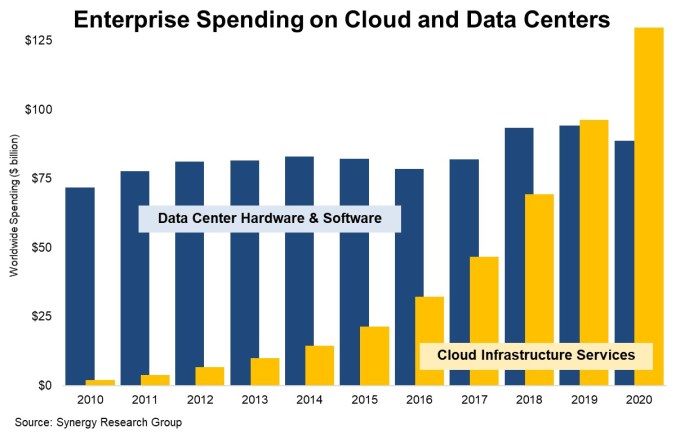
There is a prevailing notion that while the cloud infrastructure market is growing fast, the vast majority of workloads remain on premises. While that could be true, new research from Synergy Research Group found that cloud infrastructure spending surpassed on-prem spending for the first time in 2020 — and did so by a wide margin.

There is a prevailing notion that while the cloud infrastructure market is growing fast, the vast majority of workloads remain on premises. While that could be true, new research from Synergy Research Group found that cloud infrastructure spending surpassed on-prem spending for the first time in 2020 — and did so by a wide margin.

“New data from Synergy Research Group shows that enterprise spending on cloud infrastructure services continued to ramp up aggressively in 2020, growing by 35% to reach almost $130 billion. Meanwhile enterprise spending on data center hardware and software dropped by 6% to under $90 billion,” the firm said in a statement.

While the numbers have been trending toward the cloud for a decade, the spending favored on-prem software until last year when the two numbers pulled even, according to Synergy data. John Dinsdale, chief analyst and research director at Synergy says that this new data shows that CIOs have shifted their spending to the cloud in 2020.

“Where the rubber meets the road is what are companies spending their money on, and that is what we are covering here. Quite clearly CIOs are choosing to spend a lot more money on cloud services and are severely crimping their spend on on-prem (or collocated) data center assets,” Dinsdale told me.

Chart comparing on prem spending to cloud infrastructure spending from Synergy Research.

Image Credits: Synergy Research Group

The total for on-prem spending includes servers, storage, networking, security and related software required to run the hardware. “The software pieces included in this data is mainly server OS and virtualization software. Comparing SaaS with on-prem business apps software is a whole other story,” Dinsdale said.

As we see on-prem/cloud numbers diverging in this way, it’s worth asking how these numbers compare to research from Gartner and others that the cloud remains a relatively small percentage of global IT spend. As workloads move back and forth in today’s hybrid world, Dinsdale says that makes it difficult to quantify where it lives at any given moment.

“I’ve seen plenty of comments about only a small percentage of workloads running on public clouds. That may or may not be true (and I tend more toward the latter), but the problem I have with this is that the concept of ‘workloads’ is such a fungible issue, especially when you try to quantify it,” he said.

It’s worth noting that the pandemic has led to companies moving to the cloud much faster than they might have without a forcing event, but Dinsdale says that the trend has been moving this way over years, even if COVID might have accelerated it.

Whatever numbers you choose to look at, it’s clear that the cloud infrastructure market is growing much faster now than its on-premises counterpart, and this new data from Synergy shows that CIOs are beginning to place their bets on the cloud.

News: Attend Disrupt 2021 for less than $100

If three jam-packed days of TechCrunch Disrupt 2021, the mother of all tech conferences that takes place on September 21-23, wasn’t enough to get your startup motor running, listen up. You can attend the all-virtual TC Disrupt 2021 for less than a $100. Your eyes do not deceive. Read on! Right now, super early-bird pricing

If three jam-packed days of TechCrunch Disrupt 2021, the mother of all tech conferences that takes place on September 21-23, wasn’t enough to get your startup motor running, listen up. You can attend the all-virtual TC Disrupt 2021 for less than a $100. Your eyes do not deceive. Read on!

Right now, super early-bird pricing is in play for Founder, Innovator and Investor passes — and every single one sells for less than $100. But this largess won’t last. Buy your pass to Disrupt 2021 before the super early-bird deadline expires on May 13, 11:59 pm (PST).

Let’s talk about what Disrupt offers this year. In a word, plenty. In more words, opportunity, connection, networking, competition and a whole lot of experts downloading their knowledge to help you achieve your startup dreams.

Networking is a huge part of Disrupt, and you’ll find multiple ways to make valuable connections. Whether they happen spontaneously in our virtual event platform (the chat is where it’s at!) or curated meetups through CrunchMatch, our AI-powered platform, you’ll meet smart, exciting people eager to share, collaborate and inspire.

You’ll hear from and engage with marquee speakers from the Disrupt Stage — stay ahead of the trends, learn how others overcame struggles you’re facing and gain insight from expert analysis.

Get your how-to on over at the Extra Crunch Stage where you engage in interactive sessions and get you’re your burning questions answered on the spot. Take advantage of pitch deck teardowns or explore other expert-led sessions for actionable tips to help you better define your business and build a stronger startup.

Join the Extra Crunch bunch. Disrupt passes include a free 3-month membership to Extra Crunch. We’re talking exclusive content like IPO analysis, expert how-tos on monetization, strategy and growth and investor surveys. Boom, value added.

Startup Alley is back this year with new exposure opportunities for exhibitors — including a chance to participate in the elite StartupAlley+. Buy a Startup Alley Pass and shine the influential Disrupt spotlight on your amazing company.

This year, we’re opening Startup Battlefield to even more early-stage founders. With five semi-final rounds, it’ll be our biggest, most exciting Startup Battlefield ever! Think you’ve got what it takes to claim the title and the $100,000 prize? Applications for Startup Battlefield will open Q2 2021.

Okay, we listed lots of reasons to attend Disrupt. Now hear why one of your own thinks Disrupt is an essential part of startup life.

“Disrupt is laser focused on startups. I’m just starting my own company and attending Disrupt was an incredible opportunity to connect with companies and learn from the best people in the industry.” — Anirudh Murali, co-founder and CEO, Economize.

Don’t miss your chance to attend Disrupt 2021 for less than $100. Buy your pass before that super early bird price expires on May 13 at 11:59 pm (PST). Batman wouldn’t spend more than a Benjamin.

Is your company interested in sponsoring or exhibiting at Disrupt 2021? Contact our sponsorship sales team by filling out this form.

News: Fetcher raises $6.5M to automate parts of the recruiting process

Fetcher, a startup that promises to make the recruiting process easier while also diversifying the candidate pool, is announcing that it has raised $6.5 million in Series A funding. Originally known as Scout, the New York startup was founded by CEO Andres Blank, CPO Chris Calmeyn and engineering directors Javier Castiarena and Santi Aimetta. Blank

Fetcher, a startup that promises to make the recruiting process easier while also diversifying the candidate pool, is announcing that it has raised $6.5 million in Series A funding.

Originally known as Scout, the New York startup was founded by CEO Andres Blank, CPO Chris Calmeyn and engineering directors Javier Castiarena and Santi Aimetta.

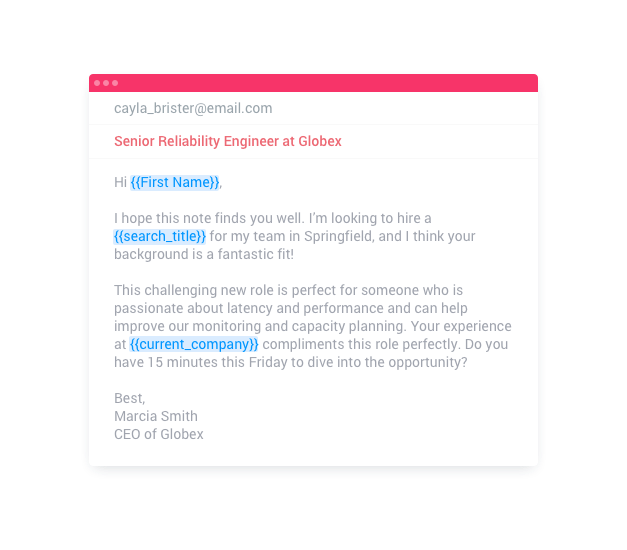
Blank told me that Fetcher automates parts of recruiters’ jobs, namely finding job candidates and sending the initial outreach emails. When I wondered whether that just leads to more spammy recruiting messages, he said that Fetcher emails actually result in “a very good response rate” because they’re targeted at the right candidates.

“The reality is that if you’re looking for a job, you don’t need an email to be so amazing,
and if you’re a recruiter, you don’t want to spend 10 minutes thinking about what to write to each candidate,” he said.

He also described Fetcher’s approach as a “human in the loop” approach. Yes, the initial outreach is automated, but then the recruiter handles the conversations with candidates who respond.

Fetcher screenshot

Image Credits: Fetcher

“By automating both the sourcing [and] outreach sides of recruiting, Fetcher reduces the amount of time a recruiter spends in front of a computer searching for candidates, making a recruiter’s job more balanced, strategic and impactful, all while continuing to build a robust, diverse pipeline for the company,” Blank wrote in a follow-up email.

He also suggested that automated sourcing allows recruiters to reach a much more diverse candidate pool than they would through traditional methods. For example, he sent me a case study in which Fetcher helped video collaboration startup Frame.io hire 11 new employees in less than 12 months, nine of whom were women and/or underrepresented minorities.

“Fetcher has freed up time and given us the capacity to diversify our pipeline more organically,” said Anna Chalon, Frame.io’s senior director of talent and diversity, equity and inclusion, in a statement. “This has allowed us to make some incredible hires, mostly from underrepresented groups, over the last year.”

Blank added that after Fetcher has seen its revenue increase every month since July of last year, owing to shrinking recruiting teams needing to be able to do more with fewer resources, as well as a greater corporate focus on the aforementioned diversity, equity and inclusion.

Fetcher has now raised a total of $12 million. The Series A was led by G20 Ventures, with participation from KFund, Slow Ventures and Accomplice. Blank said he’s planning to double the employee count (currently 80) by the end of the year and to build out additional analytics (including diversity analytics) and CRM tools.

News: Brian Brackeen returns as an advisor to facial recognition startup Kairos following his ouster as CEO

Brian Brackeen, the founder and former CEO of facial recognition startup Kairos, has made his way back to the company following his ouster in 2018. Brackeen is now chairing the company’s scientific advisory board, where he’ll help to address and eliminate issues of racial bias from the technology. While that’s not the company’s explicit mission

Brian Brackeen, the founder and former CEO of facial recognition startup Kairos, has made his way back to the company following his ouster in 2018. Brackeen is now chairing the company’s scientific advisory board, where he’ll help to address and eliminate issues of racial bias from the technology.

While that’s not the company’s explicit mission — it’s to provide authentication tools to businesses — algorithmic bias has long been a topic the company, especially Brackeen, has addressed.

But what happened in the time leading up to his ouster and the events that followed was quite the whirlwind.

In 2018, Kairos’ board of directors forced Brackeen out of his role as CEO, citing willful misconduct as the cause for his termination. In addition to forcing him out of the company he founded, Kairos sued Brackeen, alleging the misappropriation of corporate funds and misleading shareholders.

At the time, Brackeen referred to the events as “a poorly structured coup,” and denied the allegations. Then, Brackeen countersued Kairos, alleging the company and its CEO Melissa Doval intentionally destroyed his reputation through fraudulent conduct. In 2019, Brackeen and Kairos settled the lawsuits. Brackeen then went on to start Lightship Capital with his wife, Candice Brackeen.

Since returning to Kairos, Brackeen has already directed Kairos to focus on what it’s calling the Bias API. The API is designed to make it easier for companies and firms to detect and address any algorithmic biases, according to Brackeen.

Brackeen is not back on a full-time basis, as he has his hands pretty full with Lightship Capital, but he said he’s generally tasked with steering the ship during quarterly meetings.

As for who’s at the helm, that role falls to Dr. Stephen Moore, who joined Kairos as its chief scientific officer in July 2018 following the company’s acquisition of Emotion Reader.

“He is a brilliant mind, and I’m excited to see a scientist in the CEO role,” Brackeen said. “We will work closely together to bring the bias work to the fore, and to make sure it’s a world-class solution. He is as deeply committed to solving the problem of bias as I am.”

Despite the drama of the past, Brackeen told TechCrunch he still considers Kairos to be his baby. It’s also worth noting that folks like Doval, who was appointed to CEO following Brackeen’s ouster, and Mary Wolff, the former COO who spearheaded the lawsuit, are gone.

“First, I will always feel a responsibility to the team, investors and fans of Kairos,” Brackeen said as to why he’s returned. “Many of whom I was singularly responsible for. Secondly, as a society, bias can be found in everything from Twitter image cropping to air dryers not turning on for Black hands. It’s a painful reminder of a society that’s not fair for all. The challenge is that as AI gets to be imbedded in more and more products, we will see bias in all kinds of products. Kairos with its large data set and years of IP, must be the firm that saves us from that dystopian future. I am uniquely situated to lead that strategy.”

News: Hear how Poshmark went from Series A to the public markets with Manish Chandra and Mayfield’s Navin Chaddha

Poshmark has come a long way over the last decade. Launched in 2011, the social fashion marketplace has raised upwards of $150 million, and has now listed on the public markets. It’s valued at $3.5 billion. But well before all the success, Mayfield’s Navin Chaddha saw the potential, leading the Series A for the company.

Poshmark has come a long way over the last decade. Launched in 2011, the social fashion marketplace has raised upwards of $150 million, and has now listed on the public markets. It’s valued at $3.5 billion.

But well before all the success, Mayfield’s Navin Chaddha saw the potential, leading the Series A for the company.

On our next episode of Extra Crunch Live, we’ll sit down with Chaddha and Poshmark founder and CEO Manish Chandra to discuss going from Series A to public company. (Registration info is at the bottom of this post.)

Chandra is a triple-threat executive. He has degrees in marketing, business and computer science, and is a serial entrepreneur who sold his previous company, Kaboodle, to Hearst in 2007. The introduction of the iPhone inspired him to think about the coming shift in consumer behavior, paving the way for an idea like Poshmark to thrive. As is so often the case, what seems obvious in hindsight was incredibly insightful at the time.

The brilliance wasn’t at all lost on Chaddha, an entrepreneur in his own right. Now, Chaddha leads Mayfield, a firm with $2.5 billion in assets under management. Of the 50 companies he’s invested in during his venture capital career, 17 have gone public and 24 have been acquired. In other words, it makes sense that he has made an appearance on the Forbes Midas list 12 times.

We’ll talk to Chandra and Chaddha about the process of fundraising from the early stage to the growth stage and beyond. But more importantly, we’ll talk about how a company has to adapt in order to be successful over time.

Plus, Chandra and Chaddha will take a look at pitch decks submitted by the audience and give their live feedback. If you’re wondering how to perfect your deck, there may be no more valuable resource than the advice of this founder/investor duo. (Also, if you want to submit your deck to be featured on this show, smash this link.)

An important note about this next episode: We’re making Extra Crunch Live free. Folks who tune in live simply have to register and show up. On-demand access to the content is still reserved to Extra Crunch members only. In fact, EC members can check out the entire library of ECL content here.

It features tactical insights from folks including Roelof Botha, Mark Cuban, Aileen Lee, Aydin Senkut, Kirsten Green and more.

You can register to attend this episode, which will include audience Q&A and networking, right here.

News: Timing your bootstrap with Calendly’s Tope Awotona and OpenView’s Blake Bartlett at TC Early Stage

Once the path less traveled, bootstrapping today has become a much more viable and common approach to building a startup. By not taking venture capital dollars early, bootstrapping can force founders to remain disciplined in serving their paying customers well. It’s also a pretty compelling way to minimize dilution for founders and early employees. No

Once the path less traveled, bootstrapping today has become a much more viable and common approach to building a startup. By not taking venture capital dollars early, bootstrapping can force founders to remain disciplined in serving their paying customers well. It’s also a pretty compelling way to minimize dilution for founders and early employees. No wonder then that a crop of unicorn enterprise startups has taken this road these past years.

Few companies in that emerging crop though have reached quite the stature of Atlanta-based Calendly. The company is not just on everyone’s calendars (literally), but has also become a $3 billion unicorn behemoth with $70 million in subscription revenue in 2020.

To get Calendly started, CEO and founder Tope Awotona raised $550,000 (which included his life savings) to get the company off the ground, and remained bootstrapped for about seven years before inking a $350 million venture round with OpenView’s Blake Bartlett earlier this year along with Iconiq. OpenView happened to be one of the few investors in the company’s single seed round as well.

Bootstrapping is a continuous commitment to not take venture capital for an extended period of time. Why make that commitment? How does a founder build the fortitude to resist the lucre of VC when it can make so many things easier? What are the advantages to bootstrapping, and when does the calculus switch from avoiding VC to embracing it?

I’m excited to talk about those questions and more with Awotona and Bartlett at our upcoming Early Stage — Operations & Fundraising event, where we explore how to answer the strategic and tactical questions that founders must make in the course of leading their startups.

Not only will we be getting Awotona’s deep perspective as a founder, but we’re also going to dig into Bartlett’s long-time relationship with Calendly and how he assiduously built a partnership there over many years to “win” what was one of the marquee deals of the year. Bartlett has backed a variety of major enterprise startups, such as Expensify (which has also demurred from the high stakes world of big-dollar VC), Highspot, Postscript and others, and I’m curious to see how he thinks about companies that go big with venture versus those who want to go big without it.

While many decisions when building a startup can be delayed, how you fund your startup (and therefore, how you fund your employees and growth) is one that must be made early and consistently. Join us and learn more about the different paths to financing startups, and how one calendar company timed its approach to greatness.

The TC Early Stage curriculum is being spread across two events, with fundraising and operations represented on April 1 and 2 and fundraising and marketing deep dives on July 8 and 9. Folks who buy a ticket to just one event will get three months of Extra Crunch for free, and folks who buy a dual-event ticket will get six months of Extra Crunch membership for free.


WordPress Image Lightbox Plugin