Tag Archives: Blog

News: Tile brings its lost item-tracking service to wearables with Google Fitbit deal for Inspire 2 owners

Lost item finder Tile, the maker of the popular Bluetooth-powered tracker that can help you find your misplaced keys, bag, wallet or more, is bringing its tracking service to a wearable device for the first time with the launch of its Fitbit partnership. Starting today, all new and current Fitbit Inspire 2 users will gain

Lost item finder Tile, the maker of the popular Bluetooth-powered tracker that can help you find your misplaced keys, bag, wallet or more, is bringing its tracking service to a wearable device for the first time with the launch of its Fitbit partnership. Starting today, all new and current Fitbit Inspire 2 users will gain access to Tile’s Bluetooth-finding technology at no extra cost, the company says.

As a result of the deal, existing Inspire 2 users will soon be prompted to update their device’s software via the Fitbit app, which will make the new Tile feature available. Once updated, users will be directed to download Tile’s mobile app for access to the lost item finding features. From the Tile app, Inspire 2 users will then be able to locate their misplaced Fitbit when they’re within Bluetooth range — for example, if the device has been lost somewhere inside their home. If the device is further away, users will be able to tap into Tile’s broader finding network which leverages the Tile app installed on all Tile users’ smartphones. When anyone with the app is near the lost item, its location is shared back through the network to the original owner.

At present, Tile says it’s locating up to 6 million unique items per day across 195 countries.

Tile’s service is made available for free to Fitbit users and other customers, but it monetizes through a combination of device sales, in-app subscriptions, and other partnerships. The Tile Premium subscription will also be available to Inspire 2 users as an optional upgrade from within the Tile app at $2.99 per month or $29.99 per year. This service, originally targeted towards Tile tracker owners, includes free battery replacements for Tile devices, access to 30-day location history, item reimbursements, and smart alerts that remind you when you’ve left home without important things.

“Now with Tile technology, we’re adding even more convenience and helpful tools to Inspire 2, our accessible, easy-to-use activity and sleep tracker,” said Larry Yang, Director of Product Management of Fitbit Devices at Google, which finalized its Fitbit acquisition in early 2021. “We’re excited to partner with Tile so our users can focus on building healthy habits without worrying about not being able to find their misplaced device, with the potential to bring Tile’s finding technology to more Fitbit devices in the future,” he added.
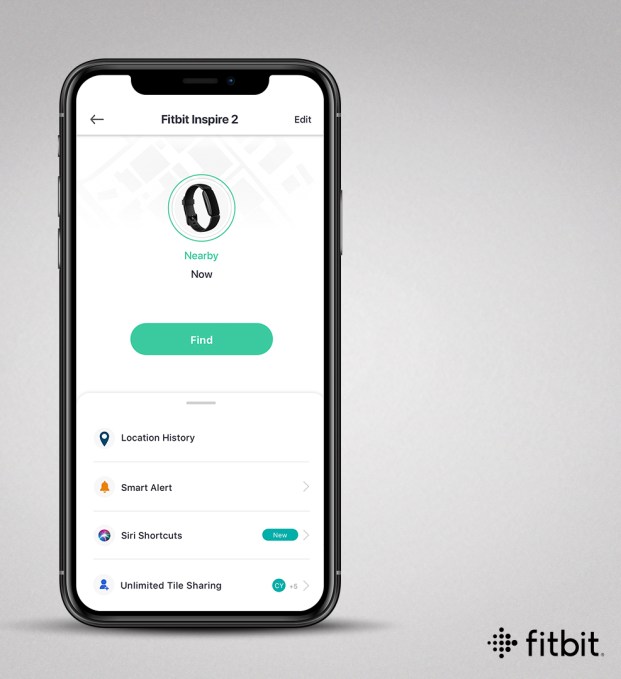
Image Credits: Tile

Tile’s partnership with Fitbit is now one of over 20 partners who are leveraging Tile’s technology in some way across audio, travel, smart home and PC categories. And while technically Fitbit is the first “wearable” partner, Tile has worked with others in the consumer electronics space, including headphone makers like Skullcandy, Bose and Sennheiser.

The company’s ability to expand its reach through industry partners may become even more critical to its future in the face of new competition from Apple, and to some extent, Samsung. Apple has been developing its own Tile competitor, AirTags, which the company accidentally disclosed in a YouTube video last year. These will leverage both Bluetooth and newer ultra-wideband technology to more precisely locate lost items. Meanwhile, Samsung’s newest Tile competitor, the Galaxy SmartTag, will also come in an UWB-powered version later this year.

This competition, specifically from Apple, could spell trouble for Tile, which has become a vocal participant in the U.S. antitrust investigations against Apple. The company has testified against Apple in congressional hearings about how its business has been negatively impacted by Apple in the past, and it pushed for third-party access to Apple’s “Find My” app as a means of evening the playing field between Apple’s upcoming trackers and its own. Tile also joined the Coalition for App Fairness, an advocacy group that’s now pushing for legislation to regulate the app stores in various U.S. states.

Partnering with Apple’s competitor, Google (by way of Fitbit), could be seen as another way for Tile to shore up a position for itself within a key section of the wearables market before AirTags arrive.


News: Revolut applies for bank charter in the US

London-based fintech startup Revolut has announced that it is applying for a bank charter in the U.S. The company has submitted a draft application with the FDIC and the California Department of Financial Protection and Innovation. If the company manages to get a charter in California, it would let the company operate throughout the U.S.

London-based fintech startup Revolut has announced that it is applying for a bank charter in the U.S. The company has submitted a draft application with the FDIC and the California Department of Financial Protection and Innovation.

If the company manages to get a charter in California, it would let the company operate throughout the U.S. as an independent bank. The discussions are still ongoing, which means it could take a while before the authorities grant a charter to the company.

After obtaining a charter in the U.S., Revolut could start offering more financial services. In particular, it would open up more opportunities when it comes to lending and savings products.

Right now, Revolut partners with Metropolitan Commercial Bank in the U.S. — they handle your deposits and they are insured by the FDIC. They also issue cards for Revolut.

In the U.S., Revolut is also launching Revolut Business. These accounts let a company send and receive international payments more easily. Companies can also use the service for payments with virtual and physical debit cards. Revolut Business is available across all 50 states. There are 500,000 companies using Revolut Business in Europe.

Revolut currently has 15 million customers for its financial super app — most of them are in the U.K. and the European Union. The company recently announced that it was applying for a banking license in the U.K., its home country and its biggest market. In Europe, Revolut has a specialized license from the Bank of Lithuania — some customers are already moving their account to Revolut Bank.

Revolut isn’t the only fintech startup applying for a bank charter in the U.S. Last month, Brex announced that it would apply for a bank charter in Utah. Varo Bank also obtained its own bank charter last year.

It proves that leveraging another bank’s charter is great for growth. But at some point, if you want to launch new products and generate more revenue from those products, you have to get your own charter.

News: Zoom introduces new SDK to help developers tap into video services

One clear sign of a maturing platform is when the company exposes the services it uses for its own tools to other developers. Zoom has been doing that for some time introducing Zoom Apps last year and the Marketplace to distribute and sell these apps. Today, the company introduced a new SDK (software development kit)

One clear sign of a maturing platform is when the company exposes the services it uses for its own tools to other developers. Zoom has been doing that for some time introducing Zoom Apps last year and the Marketplace to distribute and sell these apps. Today, the company introduced a new SDK (software development kit) to help developers embed Zoom video services inside another application.

“Our Video SDK enables developers to leverage Zoom’s industry-leading HD video, audio, and interactive features to build video-based applications and desktop experiences with native user interfaces,” Zoom’s Natalie Mullin wrote in a blog post announcing the new SDK.

If you want to include video in your app, you could try and code it yourself, or you could simply take advantage of Zoom’s expertise in this area and use the SDK to add video to the application and save a lot of time and effort.

The company envisions applications developers embedding video in social, gaming or retail applications where including video could enhance the user experience. For example, a shop owner could show different outfits to an online shopper in a live video feed, and discuss their tastes in real time.

Zoom CTO Brendan Ittelson said the SDK is actually part of a broader set of services designed to help developers take advantage of all the developer tooling that the company has been developing in recent years. As part of that push, the company is also announcing a central developer portal.

“We want to be able to have a single point where developers can go to to learn about all of the tools and resources that are available for them in the Zoom platform for their work in development, so we’re launching developer.zoom.us as that central hub for all developer resources,” Ittelson told me.

In addition, the company said that it wanted to give developers more data about how people are using the Zoom features in their applications, so they will be providing a new analytics dashboard with usage statistics.

“We are adding additional tools and actually providing developers with analytic dashboards. So folks that have developed apps for the Zoom ecosystem are able to see information about the usage of those apps across the platform,” Ittelson said.

He believes these tools combined with the new video SDK and existing set of tools will provide developers with a variety of options for building Zoom functionality into their applications, or embedding their application into Zoom as they see fit.

News: No-code business intelligence service y42 raises $2.9M seed round

Berlin-based y42 (formerly known as Datos Intelligence), a data warehouse-centric business intelligence service that promises to give businesses access to an enterprise-level data stack that’s as simple to use as a spreadsheet, today announced that it has raised a $2.9 million seed funding round led by La Famiglia VC. Additional investors include the co-founders of

Berlin-based y42 (formerly known as Datos Intelligence), a data warehouse-centric business intelligence service that promises to give businesses access to an enterprise-level data stack that’s as simple to use as a spreadsheet, today announced that it has raised a $2.9 million seed funding round led by La Famiglia VC. Additional investors include the co-founders of Foodspring, Personio and Petlab.

The service, which was founded in 2020, integrates with over 100 data sources, covering all the standard B2B SaaS tools from Airtable to Shopify and Zendesk, as well as database services like Google’s BigQuery. Users can then transform and visualize this data, orchestrate their data pipelines and trigger automated workflows based on this data (think sending Slack notifications when revenue drops or emailing customers based on your own custom criteria).

Like similar startups, y42 extends the idea data warehouse, which was traditionally used for analytics, and helps businesses operationalize this data. At the core of the service is a lot of open source and the company, for example, contributes to GitLabs’ Meltano platform for building data pipelines.

y42 founder and CEO Hung Dang

y42 founder and CEO Hung Dang.

“We’re taking the best of breed open-source software. What we really want to accomplish is to create a tool that is so easy to understand and that enables everyone to work with their data effectively,” Y42 founder and CEO Hung Dang told me. “We’re extremely UX obsessed and I would describe us as no-code/low-code BI tool — but with the power of an enterprise-level data stack and the simplicity of Google Sheets.”

Before y42, Vietnam-born Dang co-founded a major events company that operated in over 10 countries and made millions in revenue (but with very thin margins), all while finishing up his studies with a focus on business analytics. And that in turn led him to also found a second company that focused on B2B data analytics.

Image Credits: y42

Even while building his events company, he noted, he was always very product- and data-driven. “I was implementing data pipelines to collect customer feedback and merge it with operational data — and it was really a big pain at that time,” he said. “I was using tools like Tableau and Alteryx, and it was really hard to glue them together — and they were quite expensive. So out of that frustration, I decided to develop an internal tool that was actually quite usable and in 2016, I decided to turn it into an actual company. ”

He then sold this company to a major publicly listed German company. An NDA prevents him from talking about the details of this transaction, but maybe you can draw some conclusions from the fact that he spent time at Eventim before founding y42.

Given his background, it’s maybe no surprise that y42’s focus is on making life easier for data engineers and, at the same time, putting the power of these platforms in the hands of business analysts. Dang noted that y42 typically provides some consulting work when it onboards new clients, but that’s mostly to give them a head start. Given the no-code/low-code nature of the product, most analysts are able to get started pretty quickly  — and for more complex queries, customers can opt to drop down from the graphical interface to y42’s low-code level and write queries in the service’s SQL dialect.

The service itself runs on Google Cloud and the 25-people team manages about 50,000 jobs per day for its clients. the company’s customers include the likes of LifeMD, Petlab and Everdrop.

Until raising this round, Dang self-funded the company and had also raised some money from angel investors. But La Famiglia felt like the right fit for y42, especially due to its focus on connecting startups with more traditional enterprise companies.

“When we first saw the product demo, it struck us how on top of analytical excellence, a lot of product development has gone into the y42 platform,” said Judith Dada, General Partner at LaFamiglia VC. “More and more work with data today means that data silos within organizations multiply, resulting in chaos or incorrect data. y42 is a powerful single source of truth for data experts and non-data experts alike. As former data scientists and analysts, we wish that we had y42 capabilities back then.”

Dang tells me he could have raised more but decided that he didn’t want to dilute the team’s stake too much at this point. “It’s a small round, but this round forces us to set up the right structure. For the series, A, which we plan to be towards the end of this year, we’re talking about a dimension which is 10x,” he told me.

News: Camunda snares $98M Series B as process automation continues to flourish

It’s clear that automated workflow tooling has become increasingly important for companies. Perhaps that explains why Camunda, a Berlin startup that makes open source process automation software, announced an €82 million Series B today. That translates into approximately $98 million U.S. Insight Partners led the round with help from A round investor Highland Europe. When

It’s clear that automated workflow tooling has become increasingly important for companies. Perhaps that explains why Camunda, a Berlin startup that makes open source process automation software, announced an €82 million Series B today. That translates into approximately $98 million U.S.

Insight Partners led the round with help from A round investor Highland Europe. When combined with the $28 million A investment from December 2018, it brings the total raised to approximately $126 million.

What’s attracting this level of investment says Jakob Freund, co-founder and CEO at Camunda is the company is solving a problem that goes beyond pure automation. “There’s a bigger thing going on which you could call end-to-end automation or end-to-end orchestration of endpoints, which can be RPA bots, for example, but also micro services and manual work [by humans],” he said.

He added, “Camunda has become this endpoint agnostic orchestration layer that sits on top of everything else.” That means that it provides the ability to orchestrate how the automation pieces work in conjunction with one another to create this full workflow across a company.

The company has 270 employees and approximately 400 customers at this point including Goldman Sachs, Lufthansa, Universal Music Group, and Orange. Matt Gatto, managing director at Insight Partners sees a tremendous market opportunity for the company and that’s why his firm came in with such a big investment.

“Camunda’s success demonstrates how an open, standards-based, developer-friendly platform for end-to-end process automation can increase business agility and improve customer experiences, helping organizations truly transform to a digital enterprise,” Gatto said in a statement.

Camunda is not your typical startup. Its history actually dates back to 2008 as a business process management (BPM) consulting firm. It began the Camunda open source project in 2013, and that was the start of pivoting to become an open source software company with a commercial component built on top of that.

It took the funding at the end of 2018 because the market was beginning to catch up with the idea, and they wanted to build on that. It’s going so well that company reports it’s cash-flow positive, and will use the additional funding to continue accelerating the business.

News: Waterfund commits $50M to OurCrowd’s water and agtech portfolio

Waterfund, an investment and trading firm that specializes in acquiring and managing water-related infrastructure assets, today announced a deal with Israel-based crowdfunding platform OurCrowd that will see the Waterfund team commit $50 million to build a water- and agtech-focused portfolio of 15 companies. The first of these investments is in Plenty, a well-funded vertical farming

Waterfund, an investment and trading firm that specializes in acquiring and managing water-related infrastructure assets, today announced a deal with Israel-based crowdfunding platform OurCrowd that will see the Waterfund team commit $50 million to build a water- and agtech-focused portfolio of 15 companies. The first of these investments is in Plenty, a well-funded vertical farming startup.

In addition to these direct investments, the two companies are also working together on a new water-focused platform called Aquantos, which aims to issue so-called Blue Bonds and other financial products related to the water industry. Comparable to Green Bonds that focus on projects with environmental benefits — and which have been around for more than a decade now — Blue Bonds are still a new idea and focus on projects that could benefit the oceans.

“We are working to issue Blue Bonds that can be both climate bonds-certified and backed by sovereign or sub-sovereign borrowers,” said Waterfund CEO Scott Rickards. “This new financial tool and others are being designed to enable water projects in the Middle East to acquire leading technologies to address water scarcity in a fundamentally new way.”

Rickards argues that a lack of private capital has held back innovation in the water sector and that this new partnership — and the equity and debt financing opportunities it brings with it — will help change this.

OurCrowd, meanwhile, currently has about $1.5 billion in committed funding and has made investments in about 250 companies across its 25 funds. Among the companies the platform has invested in are the likes of Lemonade, Jump Bikes and Beyond Meat. Its portfolio also includes a number of existing agtech startups and last November, OurCrowd partnered with Sprout Agritech (a company in its portfolio) to run a new agtech accelerator in New Zealand.

“The Abraham Accords present a huge opportunity to bring new water and agricultural technology to the water scarcity challenges of the entire Middle East,” said OurCrowd founder and CEO Jon Medved. “Alongside Waterfund, it is our mission to invest in and help build game-changing technology companies. We are excited to be working together with Waterfund to drive more private capital to address the critical challenges of water.”

News: Mithril dives into chips again with a $55M infusion to Flex Logix

The once untouchable semiconductor sector continues to attract fervent attention from VCs. The latest news this morning is that Ajay Royan of Mithril Capital has led a $55 million Series D round of financing into Flex Logix, which builds chips designed to bring AI workflows to the compute edge. That follows on earlier rounds in

The once untouchable semiconductor sector continues to attract fervent attention from VCs.

The latest news this morning is that Ajay Royan of Mithril Capital has led a $55 million Series D round of financing into Flex Logix, which builds chips designed to bring AI workflows to the compute edge. That follows on earlier rounds in the company totaling $27 million from the likes of Lux, Eclipse Ventures and Tate Family Trust, the investment vehicle of the company’s founder and CEO Geoff Tate.

This isn’t Mithril’s first foray into the chip investing world. The firm previously backed Nuvia, a promising entrant in the server chip market which was founded by several of the top chip designers of Apple’s A-line of processors. Mithril invested $240 million in Nuvia last September, just a few months before the company flipped over to Qualcomm in a $1.4 billion transaction announced in January.

Back to Flex Logix though: we last covered the company in October, when it announced the availability of its X1 AI chip. As I wrote at the time:

Flex Logix wants to bring AI processing workflows to the compute edge, which means it wants to offer technology that adds artificial intelligence to products like medical imaging equipment and robotics. At the edge, processing power obviously matters, but so does size and price. More efficient chips are easier to include in products, where pricing may put constraints on the cost of individual components.

Mithril in its statement noted the company’s strength in designing a competitive processor which meets tight power and cost requirements in a white-hot segment of semiconductors. It also was excited that Flex Logix has developed a strong well of intellectual property in the eFPGA space, where there has been energetic activity given increasing interest from customers for flexible processors that can adapt to application needs over time.

For more information on Flex Logix and its founding story, read our earlier profile.

News: Nuvemshop, LatAm’s answer to Shopify, raises $90M in Accel-led Series D

The COVID-19 pandemic has led to people everywhere shopping more online and Latin America is no exception. São Paulo-based Nuvemshop has developed an e-commerce platform that aims to allow SMBs and merchants to connect more directly with their consumers. With more people in Latin America getting used to making purchases digitally, the company has experienced

The COVID-19 pandemic has led to people everywhere shopping more online and Latin America is no exception.

São Paulo-based Nuvemshop has developed an e-commerce platform that aims to allow SMBs and merchants to connect more directly with their consumers. With more people in Latin America getting used to making purchases digitally, the company has experienced a major surge in business over the past year.

Demand for Nuvemshop’s offering was already heating up prior to the pandemic. But over the past 12 months, that demand has skyrocketed as more merchants have been seeking greater control over their brands.

Rather than selling their goods on existing marketplaces (such as Mercado Libre, the Brazilian equivalent of Amazon), many merchants and entrepreneurs are opting to start and grow their own online businesses, according to Nuvemshop co-founder and CEO Santiago Sosa.

“Most merchants have entered the internet by selling on marketplaces but we are hearing from newer generations of merchants and SMBs that they don’t want to be intermediated anymore,” he said. “They want to connect more directly with consumers and convey their own brand, image and voice.”

The proof is in the numbers.

Nuvemshop has seen the number of merchants on its platform surge to nearly 80,000 across Brazil, Argentina and Mexico compared to 20,000 at the start of 2020. These businesses range from direct-to-consumer (DTC) upstarts to larger brands such as PlayMobil, Billabong and Luigi Bosca. Virtually every KPI tripled in the company in 2020 as the world saw a massive transition to online, and Nuvemshop’s platform was home to 14 million transactions last year, according to Sosa.

“With us, businesses can find a more comprehensive ecosystem around payments, logistics, shipping and catalogue/inventory management,” he said.

Nuvemshop’s rapid growth caught the attention of Silicon Valley-based Accel. Having just raised $30 million in a Series C round in October and achieving profitability in 2020, the Nuvemshop team was not looking for more capital.

But Ethan Choi, a partner at Accel, said his firm saw in Nuvemshop the potential to be the market leader, or the “de facto” e-commerce platform, in Latin America.

“Accel has been investing in e-commerce for a very long time. It’s a very important area for us,” Choi said. “We saw what they were building and all their potential. So we pre-emptively asked them to let us invest.”

Today, Nuvemshop is announcing that it has closed on a $90 million Series D funding led by Accel. ThornTree Capital and returning backers Kaszek, Qualcomm Ventures and others also put money in the round, which brings Nuvemshop’s total funding raised since its 2011 inception to nearly $130 million. The company declined to reveal at what valuation this latest round was raised but it is notable that its Series D is triple the size of its Series C, raised just over six months prior. Sosa said only that there was a “substantial increase” in valuation since its Series C.

Nuvemshop is banking on the fact that the density of SMBs in Latin America is higher in most Latin American countries compared to the U.S. On top of that, the $85 billion e-commerce market in Latin America is growing rapidly with projections of it reaching $116.2 billion in 2023.

“In Brazil, it grew 40% last year but is still underpenetrated, representing less than 10% of retail sales. In Latin America as a whole, penetration is somewhere between 5 and 10%,” Sosa said.

Nuvemshop co-founder and CEO Santiago Sosa;
Image courtesy of Nuvemshop

Last year, the company transitioned from a closed product to a platform that is open to everyone from third parties, developers, agencies and other SaaS vendors. Through Nuvemshop’s APIs, all those third parties can connect their apps into Nuvemshop’s platform.

“Our platform becomes much more powerful, vendors are generating more revenue and merchants have more options,” Sosa told TechCrunch. “So everyone wins.” Currently, Nuvemshop has about 150 applications publishing on its ecosystem, which he projects will more than triple over the next 12 to 18 months.

As for comparisons to Shopify, Sosa said the company doesn’t necessarily make them but believes they are “fair.”

To Choi, there are many similarities.

“We saw Amazon get to really big scale in the U.S.. Merchants also found tools to build their own presence. This birthed Shopify, which today is worth $160 billion. Both companies saw their market caps quadruple during the pandemic,” he said. “Now we’re seeing the same dynamics in LatAm…Our bet here is that this company and business has all the same dynamics and the same really powerful tailwinds.”

For Accel partner Andrew Braccia, Nuvemshop has a clear first mover advantage.

Over the past decade, direct-to-consumer has become one of the most important drivers of entrepreneurship globally,” he said. “Latin America is no exception to this trend, and we believe that Nuvemshop has the level of sophistication and ability to understand all that change and fuel the continued transformation of commerce from offline to online.”

Looking ahead, Sosa expects Nuvemshop will use its new capital to significantly invest in: continuing to open its APIs; payments processing and financial services; “everything related to logistics and logistics management” and attracting smaller merchants. It also plans to expand into other markets such as Colombia, Chile and Peru over the next 18-24 months. Nuvemshop currently operates in Mexico, Brazil and Argentina.

“While the countries share the same secular trends and product experience, they have very different market dynamics,” Sosa said. “This requires an on the ground local knowledge to make it all work. Separate markets require distinct knowledge. That makes this a more complicated opportunity, but one that enables a long-term competitive advantage.”

News: Swedish fintech Zaver raises $5M to bring cardless payments and BNPL to ‘durables’ sector

Zaver, a Swedish fintech that enable merchants to accept cardless payments and offer buy-now-pay-later (BNPL) as an option, has raised $5 million in new funding. The company, which began life focused on P2P payments for marketplace transactions, is now doubling down on the durables sector (think: automotive, health & beauty, craftmanship etc.) for both online

Zaver, a Swedish fintech that enable merchants to accept cardless payments and offer buy-now-pay-later (BNPL) as an option, has raised $5 million in new funding.

The company, which began life focused on P2P payments for marketplace transactions, is now doubling down on the durables sector (think: automotive, health & beauty, craftmanship etc.) for both online and offline commerce, after claiming to have found product-market-fit.

Backing Zaver’s new round are VCs Inbox Capital (the firm that has invested in the likes of Revolut and Klarna), and Inventure. Other investors include Fredrik Österberg (founder of Evolution Gaming), Magnus Rausing (angel investor), Joen Bonnier (partner at Atomico), and Fabian Hielte, Max Hobohm and Johannes Hobohm, (owners of Ernstrom).

Founded by Amir Marandi and Linus Malmén in mid 2016, while both were students at the KTH Royal Institute of Technology in Stockholm, Zaver wants to accelerate the move away from plastic cards, to mobile payments. Its target market is “durables,” starting in Sweden. Payments functionality and features include online and offline cardless payments powered by open banking, instant payouts for merchants, BNPL and credit scoring.

“By durables, we mean goods (and services) that do not need to be purchased often, and typically last for a longer period of time e.g. automotive, a visit to the dentist clinic, or kitchen renovation,” Marandi tells me. “[These] are often higher transaction value than ‘common’ retail products or services”.

Since the launch of “Zaver for Business” two years ago, Marandi says the company has gone from zero to “hundreds of millions of dollars” in processing volume. “Today, we have a product market fit proving that the users are willing to leave old habits, and instead use their phone in order to pay for even larger items or services,” he says.

Through bypassing the card rails, Marandi argues that Zaver is able to customize pricing, user experience and product development in-house, in a way that isn’t possible until now. “The focus in on replacing legacy-solutions with a comprehensive banking and payments platform for SMEs in this sector, where BNPL plays a key role in the transition in customer behaviour,” he adds.

Meanwhile, Zaver’s main competitors are cited as legacy products, such as credit cards, and factoring companies. “What makes us different is that we focus on the shift to mobile payments in a sector with low margin sales, and high average transaction values,” says Marandi. “By focusing on new customer behaviours (e.g. BNPL, direct debit, instalments at point-of-sale) and real time settlements, we can offer the same frictionless payment experience online and offline, no matter the size of the tickets”.

News: These undergraduates left university to build Flux, a payments startup now in YC

Traditional remittance companies, while necessary, currently have two flaws in speed and exorbitant fees. It can take a long while (days to weeks) for money sent from an immigrant in the U.S. to reach a relative in Nigeria. The fees charged depend on the amount sent — and let’s not forget the extra charges for

Traditional remittance companies, while necessary, currently have two flaws in speed and exorbitant fees. It can take a long while (days to weeks) for money sent from an immigrant in the U.S. to reach a relative in Nigeria. The fees charged depend on the amount sent — and let’s not forget the extra charges for withdrawals and deposits.

Ben Eluan and Osezele Orukpe, two software engineers based in Nigeria, faced this problem in 2019. They had executed a project for a client in the U.K. and when the time came for them to get paid, they settled with Skrill. However, it took a week for the friends to get their money, and they lost a considerable chunk of it to charges.

“The experience made us think of the payments and, more importantly, cross border payments,” Eluan said to TechCrunch.The gig economy and the service economy for small businesses economy is very massive, and we care about it enough to dedicate all our time into building payments for Africa.”

Over the last three years, crypto remittance companies have emerged to fill in this need, as well. Via an application and from a wallet, people can convert fiat into crypto and send it to the wallets of people in other countries who convert back to fiat if they choose.

Image Credits: Flux

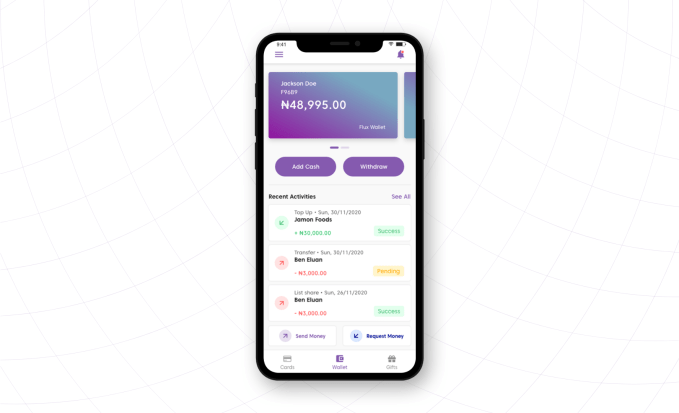
That’s the same proposition Eluan (CEO), Orukpe (CTO) and the team have with their product, Flux. The crypto remittance company was built to enable merchants to send and receive money from anywhere in the world, Eluan tells me.

He adds that what differentiates Flux from other crypto remittance startups lies in the ease and speed of the platform’s transactions. He claims that facilitating payments on Flux is 100x faster than fiat, and is cheaper too. The platform charges $0.50 for every transaction, regardless of the amount.

In May 2020, Flux got accepted into Pioneer, an accelerator launched by ex-YC partner Daniel Gross. Pioneer gives founders access to funding streams and talent hardly found outside Silicon Valley. It has already backed more than 100 founders who give up 1% equity to join the accelerator. Depending on their progress, Pioneer can decide to give either $20,000 for 5%, $100,000 for 5%, or $1 million for 10%.

After the program, Flux subsequently raised $77,000 pre-seed investment from different investors — Hustle Fund and Mozilla, among others.

Eluan says the six-month-old company has 5,000 customers who have transacted over $750,000 in payments volume. According to the CEO, the startup is growing 40% month-on-month and has made $25,000 in revenue.

The company witnessed this growth despite the Central Bank of Nigeria’s clampdown on crypto exchange activities. The country’s apex bank ordered local banks to stop aiding crypto transactions. This meant that crypto users on Flux and other crypto platforms could no longer convert fiat to crypto using their bank accounts or cards.

“We had to be compliant because of the CBN policy and our customers can’t really convert their crypto to fiat but can still transact their crypto. This is why we want to make Flux available in the US and UK, where people can use Flux and send money to Nigeria. It’s currently not available but that’s what we’re building and is the next phase of our application,” he said.

The team is also working on a peer-to-peer feature that will see users seamlessly transact crypto and fiat with one another. The company has launched Flux Merchants, a product that allows merchants to accept payments by creating payment links for their products and services.

Eluan, Orukpe, Israel Akintunde (VP, Engineering) and Ayomide Lasaki (head of Marketing) — met in their freshman year at Obafemi Awolowo University (OAU) in Ile-Ife, Osun. Studying various engineering disciplines, the four friends formed a “programming club” with other software developers on campus where they would basically meet to write code and make applications. Eluan even tells me they regularly skipped class for these sessions.

Before Flux, the friends built an e-commerce platform called Joppa that helped people find merchants around them within the city. Although they had 20,000 users, Eluan says the team didn’t understand the dynamics of what it entailed to run a startup, so the business had to shut down

A factor that eventually led to founding Flux was the university’s budding tech talent ecosystem, which is teeming with stories of prominent startups launched by alumni. Some include Jobberman, Africa’s largest recruitment site; Kudi and Cowrywise, two YC-backed companies; and Techstars company Farmcrowdy among others

“These founders came from our school and it was a huge motivation for us. We always knew that we wanted to build something but we weren’t sure what this would be. We eventually landed on Joppa, then Flux,” Eluan added.

In fact, according to Techpoint Africa, OAU alumni have founded startups that have cumulatively raised $1 million more than other alumni from other universities in West Africa. Think of OAU as the region’s Stanford University.

Image Credits: Flux

However, unlike others, the founders dropped out of the university to start Flux. 

“We dropped out to focus on our startup and scaling it into a $1 billion company. We believe the opportunity here is huge. So for us, the right thing to do is to get the job done well. Startups need time so dropping out was inevitable,” he said.

Not only are they the first set of African founders that are all dropouts to get into Y Combinator, but they’re arguably the youngest. It is a feat Flux is thrilled about, and Eluan believes it will open the doors for more young founders on the continent.

“Well, we are excited about that, and it simply means brilliant young people in Nigeria and Africa can definitely go ahead to build stuff and get funded too just like founders from the U.S.,” he said.

But while their acceptance into Y Combinator is a much-needed validation for their work and sacrifice, there’s still a lot of work to be done. The startup, now based in Lagos, is playing in a competitive payments space. Different companies like Chipper Cash, Flutterwave, MFS Africa and other crypto startups are trying to fix cross-border payments, and there’s a race against time to capture market share. Hopefully, YC, Pioneer, other backers, and the team’s understanding of the market will propel Flux to dominance

WordPress Image Lightbox Plugin