Tag Archives: Blog

News: 10 proptech investors see better era for residential and retail after pandemic

The pandemic made the internet a lifeline for shopping, earning a living and maintaining personal relationships. Now, as lockdowns start to lift, the real estate industry has to figure out what that means.

The pandemic made the internet a lifeline for shopping, earning a living and maintaining personal relationships. Now, as lockdowns start to lift, the real estate industry has to figure out what that means.

Seeking answers, I surveyed the people who are betting on the biggest and most surprising changes in the sector — proptech investors. While landlords and their lenders may hope for a return to the past, proptech investors are focused on where the notion of place is going in the future. I have an in-depth writeup with many excerpts and my thoughts over on TechCrunch, including a look at the revival of neighborhood retail, the rebirth of cities and much more.

I couldn’t get into all of the great topics, though, including the rapid recent evolution of the residential sales and rental market, construction tech, related climate-tech topics and other issues.

So here are the thousands of words of answers in full, below. Extra Crunch subscription required. If you’re a startup founder, employee, investor, etc., you may also enjoy the previous editions of this survey, from the fall of 2020, spring of 2020 and fall of 2019.

The investors we talked to:


Clelia Warburg Peters, venture partner, Bain Capital Ventures

As the pandemic hopefully enters its final stages, how are the changes from this period affecting your real estate and proptech investment strategy? Are big trends of the present, like high nationwide housing demand and mass commercial vacancies, refocusing your investing strategy?

Above all, I think COVID will prove to be an accelerant to existing trends in both the residential and commercial space. I like to think of it as a decade of innovation acceleration in 24 months.

The pandemic has certainly refocused attention on life at home, and that combined with low interest rates has undeniably made this an incredible period for companies that touch the housing market. Given that I got into proptech through work at a family residential brokerage, this market has always been a big area of interest for me, and I would observe that we were in the midst of some major shifts in this market pre-COVID. The residential transaction disruption is now settling in three core categories: iBuyers (who buy homes directly from sellers and ultimately hope to own the sell-side marketplace), neobrokers (who generally employ their agents and use secondary services such as title mortgage and insurance to increase their revenue) and elite agent tools (platforms or tools focused on the top agents). Additionally, consumers are increasingly open to alternative financing tools, including home-equity-based financing models (where you sell a stake in your home, or you buy into full ownership in a home over time. The growth and proliferation of these new models are consolidating the whole residential market so that brokerage sales commissions and commission from the sale of mortgage, title and home insurance are now functionally one large and intertwined disruptable market. In this context, while some of the valuations we are seeing may be a little euphoric, I think there is no doubt that we are in a period of massive and sustainable innovation in how we buy and hold our homes and I think these trends are going to be enduring.

In the commercial arena, we were also in the midst of a meaningful shift in how companies were conceiving of office space, in many ways thanks to the innovations that WeWork brought to the market. But the pandemic has pushed this much further, fundamentally shifting the relationship between the landlord/manager (who has largely been in a position of power since the 1950s) and the tenant (who is now in a position of much greater power, more akin to a consumer of a luxury product). As a result of this, I think the best landlords will recognize that they are going to be under pressure to shift from simply providing a physical space, to helping provide tenants with a multichannel work experience. This might mean a physical/digital hybrid of systems that include access control, physical space management (both in the hub location and potentially in spoke locations), and a digital space for meetings and collaboration. These assets will need to be provided in the context of a much more human relationship, focusing on serving the needs of tenants. As lease terms inevitably shorten, tenants will need to be courted and supported in a much more active way than they have been in the past.

How do you see the big cities adapting to life after the pandemic — or will they? What solutions are you focusing on in particular for the future of urban living (co-living, ADUs, commercial conversion to residential, etc.)?

I think the experience of cities after the pandemic is going to be highly variable — for instance, the trajectories for Austin and New York will likely look radically different. I am personally uncertain about how co-living, or even commercial to residential conversion will be at play, but I do believe that there will be a few consistent areas of interest.

First, smaller-scale urban life will continue to be a significant trend. I think we will continue to see a proliferation of bike lanes, a focus on living in walkable neighborhoods, and a reliance on tools (such as the app Nextdoor) that reinforce our feeling of connection to our neighbors.

Second, I think we will continue to see a reliance on certain types of outsourced services — ghost kitchens for takeout or rapid provision of groceries and other essentials — and technologies and spaces that facilitate these will be a growth area.

Finally, I do believe that in some more sprawling urban environments ADUs will be an area of growth, particularly with seniors who are looking for an additional income stream so they can age at home. One caveat is that I think this will be something of a winner-takes-all space with a limited number of geographically dominant winners.

The demand for suburban-style living is back — for now. What are you focusing on across this category for the next year or two (new residential services and amenities, build-to-rent housing developments, etc.)?

The current transition out of urban environments and into suburban environments is playing out alongside some broader changes in the way the American public seems to be approaching homeownership. Over the past decade, there has been a net decline in homeownership and a net growth in renting. Some of this is by necessity, and some is by choice. I think one component of the tech-related opportunity in the migrations we see now will be around rental platforms and multifamily amenitization. There is still no data aggregator like the MLS on the rental side, and a number of portals (including Zillow Rentals, Apartment List, Zumper, RentalBeast and others) are competing to provide listing information to consumers. On the multifamily side, many multifamily operators are understanding that the integration of work/life/play is creating a new need for amenitization and greater services in their offerings. I think we will continue to see more and more emphasis on hospitality-style brand creation in the multifamily space, and much of this will be facilitated by different kinds of tech-facilitated amenities.

It’s also important to note the flood of both institutional and private investor money that is coming into the single-family rental space. (It may be that in the future a certain percent of the population is renting their primary home, but exposed to the property market through ownership of these kinds of real estate assets.) This growth is being facilitated by property management services like Mynd, marketplaces like Roofstock, and innovative products like Zibo or Knox Financial.


News: Y Combinator’s biotech startups incubate a new generation of therapies and tools

Medical and biotech had a strong showing at Y Combinator’s latest demo day, with nearly a dozen companies in the space catching my eye. The things a startup can accomplish in this space are astonishing these days, so don’t be surprised if a few of these companies are headline news in the next year. Startups

Medical and biotech had a strong showing at Y Combinator’s latest demo day, with nearly a dozen companies in the space catching my eye. The things a startup can accomplish in this space are astonishing these days, so don’t be surprised if a few of these companies are headline news in the next year.

Startups take on big pharma

Atom Bioworks has one of the shortest timelines and highest potential impacts; as I wrote in our second set of favorites from demo day, the company seems to be fairly close to one of the holy grails of biochemistry, a programmable DNA machine. These tools can essentially “code” a molecule so that it reliably sticks to a specific substance or cell type, which allows a variety of follow-up actions to be taken.

For instance, a DNA machine could lock onto COVID-19 viruses and then release a chemical signal indicating infection before killing the virus. The same principle applies to a cancer cell. Or a bacterium. You get the picture.

Atom’s founders have published the details of their techniques in Nature Chemistry, and says it’s working on a COVID-19 test as well as therapies for the virus and other conditions. It expects sales in the 9-figure range.

Another company along these lines is LiliumX. This company is going after “biospecific antibodies,” which are kind of like prefab DNA machines. Our own antibodies learn to target various pathogens, waste, and other items the body doesn’t want, and customized, injected antibodies can do the same for cancer cells.

LiliumX is taking the algorithmic approach to generating potential antibody stuctures that could be effective, as many AI-informed biotech companies have before it. But the company is also using a robotic testing setup to thin the herd and get in vitro results for its more promising candidates. Going beyond lead generation is a difficult step but one that makes the company that much more valuable.

Entelexo is one step further down the line, having committed to developing a promising class of therapeutics called exosomes that could help treat autoimmune diseases. These tiny vesicles (think packages for inter-cell commerce) can carry all kinds of materials, including customized mRNA that can modify another cell’s behavior.

Modifying cell behavior systematically could help mitigate conditions like multiple sclerosis, though the company did not elaborate on the exact mechanism — probably not something that can be explained in under a minute. They’re already into animal testing, which is surprising for a startup.

One step further, at least mechanically, is Nuntius Therapeutics, which is working on ways to deliver cell-specific (i.e. to skeletal muscle, kidney cells, etc) DNA, RNA, and CRISPR-based therapies. This is an issue for cutting-edge treatments: while they can be sure of taking the correct action once in contact with the target cell type, they can’t be sure that the therapeutic agent will ever reach those cells. Like ambulance drivers without an address, they can’t do their jobs if they can’t get there.

Nuntius claims to have created a reliable way to deliver genetic therapy payloads to a variety of target cells, beyond what major pharma companies like Moderna have accomplished. The company also develops and licenses its own drugs, so it’s practically a one-stop shop for genetic therapies if its techniques pan out for human use.

Beyond providing therapeutics, there is the evolving field of artificial organs. These are still highly experimental, partly due to the risk of rejection even when using biocompatible materials. Trestle Biotherapeutics is taking on a specific problem — kidney failure — with implantable lab-grown kidney tissue that can help get these patients off dialysis.

While the plan is to eventually create full kidney replacements, the truth is that for people with this condition, every week and month counts. Not only does it improve their chances of finding a donor or moving up the list, but regular dialysis is a horrible process by all accounts. Anything that reduces the need to rely on it would be welcomed by millions.

This Yale-Harvard tie-up comes from a team with quite a bit of experience in stem cell science and tissue engineering, including 3D printing human tissues — which no doubt is part of the approach.

Beyond therapy

Moving beyond actual techniques for fighting various conditions, the YC batch had quite a few dedicated to improving the process of researching and understanding those conditions and techniques.

Many industries rely on cloud-based document platforms like Google Docs for sharing and collaboration, but while copywriters and sales folks probably find the standard office suite sufficient, that’s not necessarily the case for scientists whose disciplines demand special documentation and formatting.

Curvenote is a shared document platform built with these folks in mind; it integrates with Jupyter, SaturnCloud, and Sagemaker, supports lots of import and export options, integrates visualization plug-ins like Plotly, and versions through Git. Now you just have to convince the head of your department it’s worth paying for.

Lab notes in Jupyter on a laptop screen.

Image Credits: Curvenote

A more specialized cloud tool can be found in Pipe|bio, which does hosted bioinformatics for developing antibody drugs like LiliumX. It’s hard to get into details here beyond that the computational and database needs of companies in biotech can be very specific and not everyone has a bioinformatics specialist on staff.

Having a tool you can just pay for instead getting a data science grad student to moonlight for your lab is almost always preferable. (Also preferable is not using special characters in your company name — just saying, it’s going to come up.)

Special tools can be found on the benchtop as well as the laptop, though, and the remaining companies are firmly in meatspace.

Animated diagram of a cell shrinking and fluorescing in a cross shape.Forcyte is another company I highlighted in our favorite demo day companies roundups: It’s less about chemistry and molecular biology than the actual physical phenomena experienced by cells. This is a difficult thing to observe systematically, but important for many reasons.

The company uses a micropatterned surface to observe individual cells and watch specifically for contraction and other shape changes. Physical constriction or relaxation of cells is at the heart of several major diseases and their treatments, so being able to see and track it will be extremely helpful for researchers.

The company has positioned itself as a way to test drugs at scale that affect these properties and claims to have already found promising compounds for lung fibrosis. Forcyte’s team is published in Nature, and received a $2.5 million SBIR award from the NIH, a pretty rare endorsement.

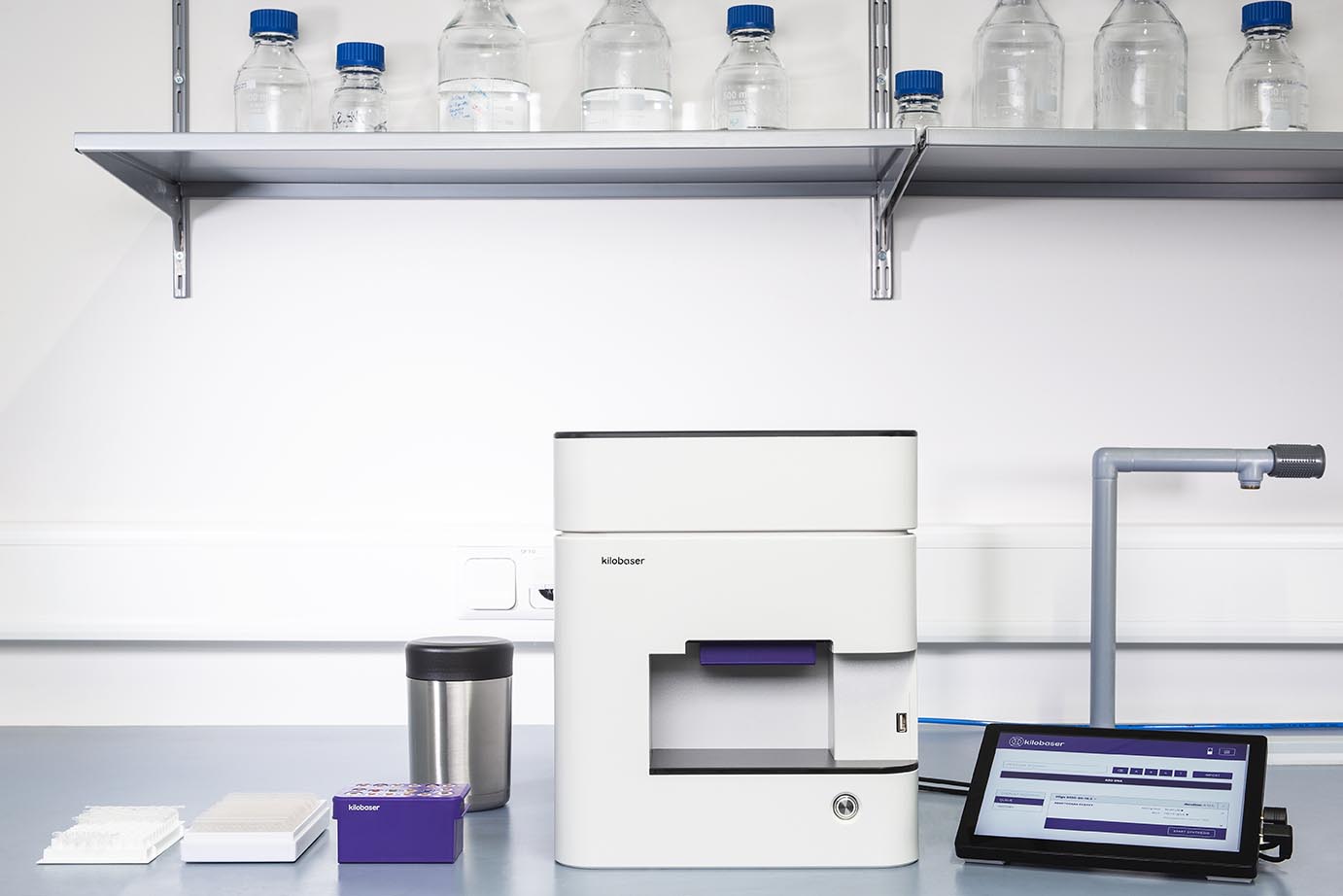
Kilobaser's DNA sequencing device on a lab bench.

Image Credits: Kilobaser

Kilobaser is taking aim at the growing DNA synthesizing space; companies often contract with dedicated synthesizing labs to create batches of custom DNA molecules, but at a small scale this might be better done in-house.

Kilobaser’s benchtop machine makes the process as simple as using a copier, letting people with no technical know-how. As long as it has some argon, a reagent supply and microfluidic chip (sold by the company, naturally), it can replicate DNA you submit digitally in under two hours. This could accelerate testing in many a small lab that’s held back by its reliance on a separate facility. The company has already sold 15 machines at €15,000 each — but like razor blades, the real money is in the refills.

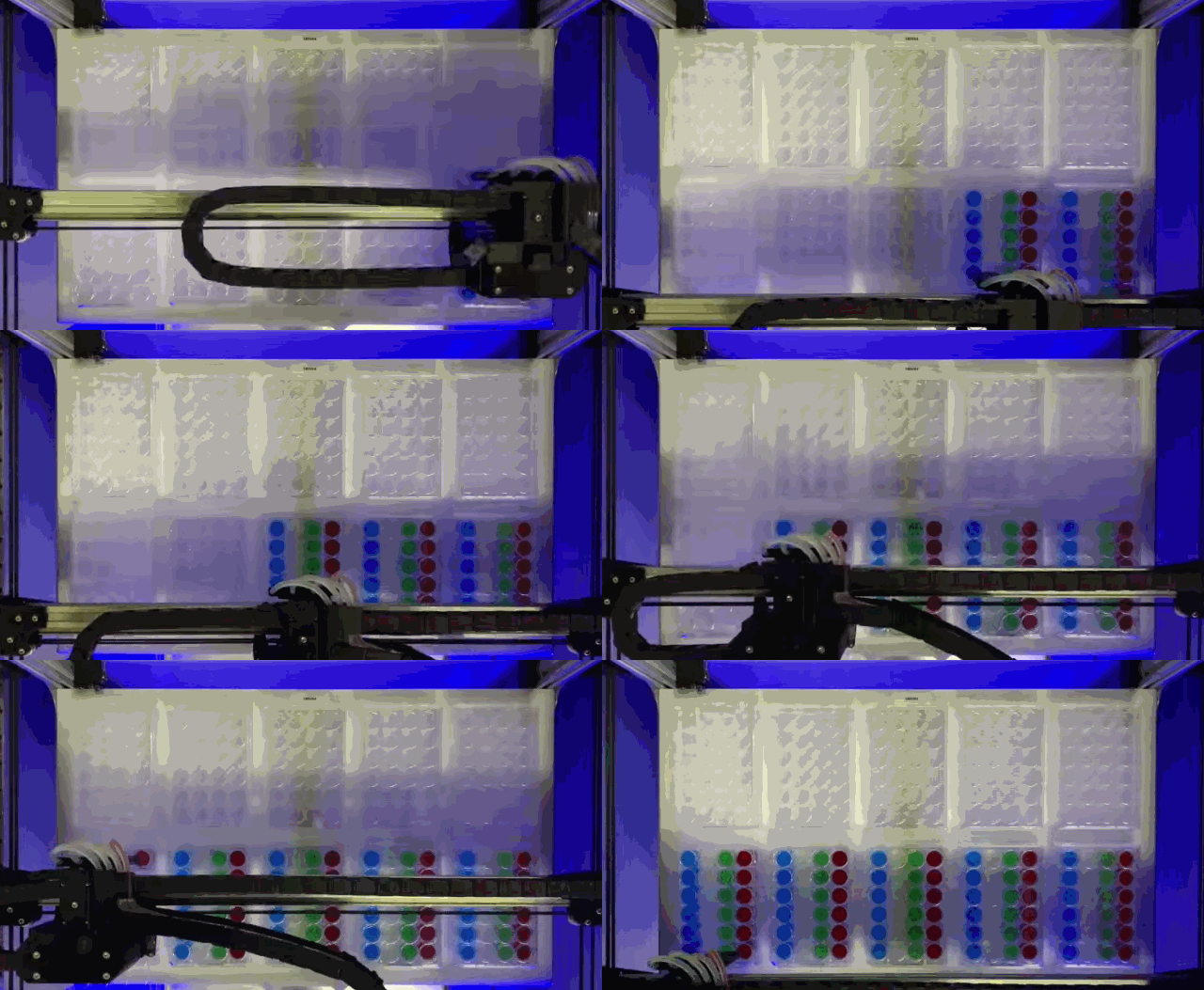
Video of a robotic arm filling vials.

Image Credits: Reshape Biotech

Reshape Biotech is perhaps the most straightforward of the bunch. Its approach to automating common lab tasks is to create custom robots for each one. That’s it! Of course, that’s easier said than done, but given the similarity of many lab layouts and equipment, a custom robotic sampler or autoclave could be adopted by thousands as (again) an alternative to hiring another part time grad student.

There were several other companies in the biotech and medical space worth looking at in the batch, but not enough space here to highlight them individually. Suffice it to say that the space is increasingly welcoming to startups as advances in tech and software are brought to bear where insuperable barriers to entry once left such possibilities remote.

News: To rebuild manufacturing, the US needs to beef up the Small Business Innovation Research program

We have only a small window of time to restore manufacturing as a foundation of American prosperity, and a remarkable but underappreciated federal program has a big role to play.

Sean O’Sullivan
Contributor

Sean O’Sullivan was a co-founder of MapInfo and is the managing general partner and founder of SOSV, a venture firm that operates the startup accelerators HAX, IndieBio, Chinaccelerator, MOX, and dlab.
More posts by this contributor

I grew up in poverty in upstate New York, but I was lucky enough to study engineering at Rensselaer Polytechnic Institute. I founded a company that went public when I was 28, and I used that wealth to invest in startups.

It’s been exhilarating to watch many founders flourish, but when I return to upstate New York, the desolate remains of long-closed factories remind me of the sectors that the tech revolution never reached.

The numbers behind those empty facades could not be more dire. In late 2019, even before COVID struck, U.S. manufacturing fell to 11% of GDP, the lowest level in 72 years. We ceded much of that ground to low-cost competitors in China, which became the world’s top manufacturer back in 2011. We now have only a small window of time to restore manufacturing as a foundation of American prosperity, and a remarkable but underappreciated federal program has a big role to play.

My firm, SOSV, specializes in running programs that help founders take technically difficult ideas from research to product. Many of these companies represent the future of American industry, especially when it comes to such national priorities as industrial automation and decarbonization.

You might think those startups would be ripe for venture investment, but in reality, only a fraction of venture capital flows to them. They are simply too risky compared with categories like SaaS and consumer.

SBIR’s brilliant design has helped thousands of technology-minded entrepreneurs cross the chasm from research to real products, new markets and venture backing.

That is exactly why in 1982 the U.S. Congress established the Small Business Innovation Research (SBIR) program, which, in the words of its founder, Roland Tibbetts, aimed to “provide funding for some of the best early-stage innovation ideas — ideas that, however promising, are still too high risk for private investors, including venture capital firms.”

For a little more than $3 billion per year in contracts and grants disbursed by federal agencies, the SBIR has produced 70,000 patents, $41 billion in follow-on venture capital investments and 700 public companies.

SBIR’s brilliant design has helped thousands of technology-minded entrepreneurs cross the chasm from research to real products, new markets and venture backing. We’ll need thousands more brilliant scientists, technologists and entrepreneurs to step up in the decade ahead. They can do this from their garage, but they can’t do it out of thin air. Congress should act quickly to create an “SBIR 2.0” with three critical improvements over how SBIR works today.

First, we need at least 10 times more SBIR funding. Even at $30 billion, SBIR’s funding would be a rounding error compared to many budgets in Washington, like $693 billion for defense in 2020, and just a fraction of total U.S. venture investing, which in 2020 reached $156 billion. Yet, arguably, nothing in the federal budget could do more to help American industry.

Second, we need to focus new SBIR funding on critical strategic areas, especially decarbonization and advanced manufacturing. The first will save humanity’s future on this planet. The second will help us leap over our missed generation of manufacturing investment to establish leads in critical areas, including robotics, battery technology, artificially intelligent devices and additive manufacturing. Who could ask for better markets?

Finally, the review and reward process needs to be fast. One great example is the innovative U.S. Air Force “pitch day” programs in 2019 and 2020, which granted funds to the best founder pitches (carefully pre-qualified) in a matter of minutes. In our almost frictionless market for talent, long waits to deliberate and disburse funds is not a winning approach.

The Biden administration’s late-February issuance of an executive order on America’s supply chains suggests that the White House is already working hard on policy measures. No doubt the administration’s effort will draw on many approaches, but the key must be a relentless focus on America’s primary unspent fuel: the ingenuity and drive of our people.

We will only pull the depressed regions of this country out of poverty by giving them the tools to, with their own hands, rebuild American manufacturing through entrepreneurship.

Editor’s note: Former TechCrunch COO Ned Desmond is now senior operating partner at SOSV.

News: Veera Health wants to help women in India navigate polycystic ovary syndrome

Polycystic ovary syndrome, or PCOS, is a common disorder that can cause irregular periods, infertility or gestational diabetes in women. And the condition is far from rare: PCOS impacts one in 10 women, meaning there’s a big market of people out there that want better support and risk-screening to navigate the symptoms. That’s where Veera

Polycystic ovary syndrome, or PCOS, is a common disorder that can cause irregular periods, infertility or gestational diabetes in women. And the condition is far from rare: PCOS impacts one in 10 women, meaning there’s a big market of people out there that want better support and risk-screening to navigate the symptoms.

That’s where Veera Health comes in. The startup is an online clinic aimed at helping women in India navigate PCOS through risk-screening, mental health support and answers about effects such as acne and weight gain. If the startup does its job right, it can help bring earlier diagnosis to women around the world.

“The big issue around polycystic ovary syndrome is that there [are] a lot of different symptoms, and very often women take a long time to actually get diagnosed in the right manner,” CEO and co-founder Shashwata Narain said. “We want to provide a higher level and quality of guidance so she can have open eyes experience as she goes through her treatment process.”

Veera Health’s subscription-based program takes the medical history of a patient to better understand symptoms and any existing reports. About 60% to 70% of the patients that Veera Health has worked with so far are pre-diagnosed and are looking for a solution, so the startup then starts to pick apart potential risk factors and suggests a holistic treatment plan. The startup has a team of specialists, from clinical nutritionists to dermatologists and gynecologists, that it works with on a contractual basis to approve any plan given to a patient. The startup has employed a number of care managers, which is basically an employee in charge of handling weekly and daily communication with the patient about these plans.

The company uses published research on assessment and management of PCOS as a framework for its suggestions.

Veera Health officially launched three months ago and already has made $10,000 in revenue, growing at 300% month over month in paid customers.

Veera Health isn’t covered by insurance, so patients pay out of pocket for the services. In India, Narain says, outpatient care is “almost entirely an out-of-pocket market” and insurance is largely focused on hospitalization expenses. By using Veera Health, the co-founder estimates that by aggregating all these services into one spot, Veera Health can stop customers from spending “thousands and thousands of rupees” and playing specialist hopscotch.

In fact, one study shows that PCOS clinics have had a high retention in patients compared to other single-care providers.

The co-founder says the biggest challenge for Veera Health is educating women about how to prioritize their own health and get past the stigma of PCOS.

“It’s a challenge because you want to get as much information out there and make sure women are paying attention to their health, yet at the same time there’s a lot of stigma on [PCOS] and around women’s health to begin with.”

We know of at least one investor that thinks the conversation is ready to be had, anyway. Veera Health recently graduated from Y Combinator’s Winter 2021 cohort as one of the 39 companies based in India, the highest concentration from the accelerator yet.

Narain says that Veera Health is uniquely positioned to help women during the pandemic. Her sister and co-founder, Shobhita, was diagnosed with PCOS so experienced firsthand the confusing path to diagnosis.

“Because of the pandemic, there’s a lot more openness to online solutions,” she said. “People are at home, not able to exercise and are much more stressed out. This had a ramp up in the level of awareness on [PCOS] and the search for solutions.”

News: Twitter is exploring the use of Facebook-style emoji reactions

If you’re old enough to remember the outrage that followed Twitter’s decision to replace stars with hearts (aka likes instead of favorites), then you know that Twitter’s user base has strong feelings about how it wants to engage with tweets. Now, Twitter is considering another radical change on this front that could shake things up

If you’re old enough to remember the outrage that followed Twitter’s decision to replace stars with hearts (aka likes instead of favorites), then you know that Twitter’s user base has strong feelings about how it wants to engage with tweets. Now, Twitter is considering another radical change on this front that could shake things up yet again. The company has been surveying users throughout the month to get input on how they feel about a broader set of emoji-style reactions, similar to what you’d see on Facebook.

“We’re exploring additional ways for people to express themselves in conversations happening on Twitter,” a Twitter spokesperson said of the survey.

Specifically, Twitter’s survey proposed a few different sets of reaction emojis, all of which include the heart (like), laughing face with tears (funny), thinking face (interesting) and crying face (sad).

It then proposed some variations on this basic set, where the “awesome” sentiment could be expressed with either the shocked face or fire emoji, or where a “support” sentiment could be indicated with either the hug emoji or the raised hands.

More controversially, Twitter is considering a way for users to signal a general like or dislike for the tweet with either a thumbs up or thumbs down, a “100” in either green or red to indicate “agree” or “disagree,” or a green up arrow icon or red down arrow icon, reminiscent of Reddit’s upvote and downvote mechanisms.

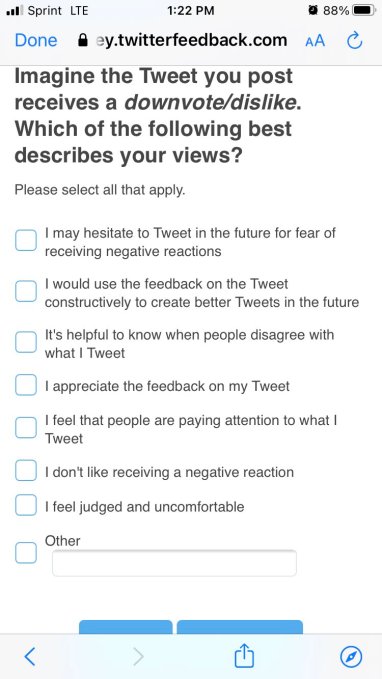
The survey questions demonstrated that Twitter is aware of the challenges that come with introducing emoji reactions that could imply negative sentiments. It asked the respondents how they would want to take advantage of a downvote or dislike, for example — whether they would use the reaction instead of replying to a tweet, or whether they would downvote irrelevant or offensive tweets, as well.

Twitter also asked how users would feel if their own tweets were downvoted and whether that would discourage them from tweeting in the future, or if they would take it more as “constructive” feedback about their content. (Ha!)

The company clearly understands that the introduction of reaction sets could have a significant impact on how people engage with Twitter content and, potentially, could even lead to a chilling effect on Twitter usage if people became overly concerned about having their tweets downvoted.

That said, the upvote and downvote mechanism — whether as thumbs or arrows or anything else — remains a common way to engage with content elsewhere on the web. This includes not only forum sites like Reddit and others, but also YouTube, Imgur and Pandora, to name a few. A “thumbs up” signal by itself, meanwhile, is even more popular thanks to Facebook’s lead. But today, this like button can also take the shape of an arrow, heart or just a box to click — like when you mark an Amazon.com user review as “Helpful,” for example.

Meanwhile, the use of expanded emoji reactions has become more common since Facebook’s emoji reaction set debuted in 2015. Since then, other social media sites adopted their use, like LinkedIn. Twitter even added emoji reactions to its DMs (direct messages) last year.

Twitter’s survey additionally asked users about how the thought the emoji reactions should be displayed — like whether negative reaction counts should be visible, for instance.

Twitter told TechCrunch the work it’s doing in the space of reactions is exploratory — it’s only running this survey now because the company is thinking about ways people could add more nuance to the conversations they’re having, and how, by doing so, readers would be able to better understand the additional context around those conversations. Plus, Twitter notes that the new emoji reactions would not replace the “heart;” they’re additive.

But although Twitter hasn’t yet built out its emoji reaction set or put it into testing, it appears it’s on the path to do so.

In response to a user’s recent request to test emoji reactions instead of just hearts, Twitter Chief Design Officer Dantley Davis replied, “we’ll have something for you soon.”

We’ll have something for you soon.

— Dantley Davis (@dantley) March 19, 2021

News: Facebook caught Chinese hackers using fake personas to target Uyghurs abroad

Facebook on Wednesday announced new actions to disrupt a network of China-based hackers leveraging the platform to compromise targets in the Uyghur community. The group, known to security researchers as “Earth Empusa,” “Evil Eye” or “Poison Carp” targeted around 500 people on Facebook, including individuals living abroad in the United States, Turkey, Syria, Australia and

Facebook on Wednesday announced new actions to disrupt a network of China-based hackers leveraging the platform to compromise targets in the Uyghur community.

The group, known to security researchers as “Earth Empusa,” “Evil Eye” or “Poison Carp” targeted around 500 people on Facebook, including individuals living abroad in the United States, Turkey, Syria, Australia and Canada. Through fake accounts on Facebook, the hackers posed as activists, journalists and other sympathetic figures in order to send their targets to compromised websites beyond Facebook.

Facebook’s security and cyberespionage teams began seeing the activity in 2020 and opted to disclose the threat publicly to maximize the impact on the hacking group, which has proven sensitive to public disclosures in the past.

Though Facebook says social engineering efforts on the platform are “a piece of the puzzle,” most of the hacking group’s efforts take place elsewhere online. They focus on attempts to gain access to targets’ devices with watering hole attacks and lookalike domains, including a fake Android app store offering prayer apps and Uyghur-themed keyboard downloads.

When downloaded, those fake apps infected devices using two strains of Android trojan malware, ActionSpy and PluginPhantom. On iOS devices, the hackers leveraged malware known as Insomnia.

While the hackers targeted a small number of users relative to what the company sees in disinformation operations, Facebook stressed that a small, well-chosen group of targets can result in huge impacts. “You can imagine surveillance, you can imagine a range of secondary consequences” Facebook Head of Security Policy Nathaniel Gleicher said.

The Uyghurs are a predominantly Muslim ethnic minority in China that continues to face brutal repression from the Chinese government, including being forced into labor camps in the country’s Xinjiang province.

Facebook declined to link what it observed to the Chinese government, saying that it defers to the broader security community to make those determinations when it lacks the technical indicators to do so itself. Researchers believe that adjacent hacking campaigns are Beijing’s efforts to extend its surveillance of communities it already subjugates within China’s bounds.

News: Staying ahead of the curve on Google’s Core Web Vitals

While many view Google’s Core Web Vitals as a big hoop to jump through to please the search powers that be, others are seeing — and seizing — the opportunities that come along with this change.

Amir Glatt
Contributor

Amir Glatt is the CTO and co-founder of Duda, a leading white-label web design platform for agencies, SaaS platforms and other web professionals that serve small businesses. Prior to co-founding Duda, Amir worked in SAP, the world’s largest maker of business applications.

One year.

That’s how long Google gave developers to start implementing required changes to improve user experience. In early May 2020, Google published a modest post on one of its developer blogs introducing Core Web Vitals — a set of metrics that will result in major changes to the way websites are ranked by the search engine. In May 2021, Google will officially add those Core Web Vitals to the various other “page experience” signals it analyzes when deciding how to rank websites.

The quest to improve a website’s position in search results has spawned hundreds (if not thousands) of how-to articles over the years. Businesses that are scared about taking a hit to SEO from Google’s new metrics have been pushing developers to optimize company websites. At the same time, developers have been frustrated because there’s a lot that goes into user experience that isn’t reflected in the Core Web Vitals. A lot of details have to be juggled.

Aside from improved SEO, small business websites optimizing for the new metrics will reap the rewards of an improved user experience for their site visitors.

But what about the startups, tech companies and small business owners who handle their own websites in-house? What about the agencies and enterprise platforms that manage or host hundreds or even thousands of websites for clients? While many are looking at the Core Web Vitals as a big hoop to jump through to please the search powers that be, others are seeing — and seizing — the opportunities that come along with this change.

Improving user experience will be rewarded

Small businesses wondering “What’s in it for me?” should recognize that if all other things are equal, optimizing for the Core Web Vitals is going to be a significant tiebreaker between websites. If a company’s site is ranking really well with these rigorous metrics, it will have an edge against competitors in searches when content and ranking are otherwise comparable.

Aside from improved SEO, small business websites optimizing for the new metrics will reap the rewards of an improved user experience for their site visitors. Internet users frequently complain about long wait times as pages are loading, or problems with an entire page shifting just as the user goes to click a specific button — which results in them clicking the wrong button and causing further delays. For online retail websites, a poor user experience leads to lost revenue as users abandon shopping carts and never return to a site. Once the Core Web Vitals go into effect, companies that have made the efforts to provide smooth and speedy performance for visitors will win out against competitors that retain sluggish designs.

Sparking overdue conversations

News: Rec Room raises at $1.25B valuation from Sequoia and Index as VCs push to find another Roblox

Investor FOMO following Roblox’s blockbuster public debut is pushing venture capitalists who missed out on that gaming giant to invest in competing platforms. Today, Rec Room announced it has raised $100 million from Sequoia and Index, with participation from Madrona Venture Group. The deal is a huge influx of capital for Rec Room, which had

Investor FOMO following Roblox’s blockbuster public debut is pushing venture capitalists who missed out on that gaming giant to invest in competing platforms.

Today, Rec Room announced it has raised $100 million from Sequoia and Index, with participation from Madrona Venture Group. The deal is a huge influx of capital for Rec Room, which had raised less than $50 million before this round, including a $20 million Series C that closed in December. In 2019, we reported that the company had raised its Series B at a $126 million valuation, this latest deal values the company at $1.25 billion, showcasing how investor sentiment for the gaming space has shifted in the wake of Roblox’s monster growth.

Rec Room launched as a virtual reality-only platform, but as headset sales creeped along slowly, the company embraced traditional game consoles, PC and mobile to expand its reach.

In a press release accompanying today’s funding announcement, Rec Room detailed it has surpassed 15 million “lifetime users” and had shown 566% year-over-year revenue growth. In December, CEO Nick Fajt told TechCrunch that the company has tripled its player base in the past 12 months.

The company has been following in Roblox’s footsteps in many ways as it build out its creator tools and seeks to build out an on-platform economy for game creators. The company says that two million players have created content on the platform and that Rec Room is on track to pay out more than $1 million to them this year.

News: Competition challenge to Facebook’s ‘superprofiling’ of users sparks referral to Europe’s top court

A German court that’s considering Facebook’s appeal against a pioneering pro-privacy order by the country’s competition authority to stop combining user data without consent has said it will refer questions to Europe’s top court. In a press release today the Düsseldorf court writes [translated by Google]: “…the Senate has come to the conclusion that a

A German court that’s considering Facebook’s appeal against a pioneering pro-privacy order by the country’s competition authority to stop combining user data without consent has said it will refer questions to Europe’s top court.

In a press release today the Düsseldorf court writes [translated by Google]: “…the Senate has come to the conclusion that a decision on the Facebook complaints can only be made after referring to the Court of Justice of the European Union (ECJ).

“The question of whether Facebook is abusing its dominant position as a provider on the German market for social networks because it collects and uses the data of its users in violation of the GDPR can not be decided without referring to the ECJ. Because the ECJ is responsible for the interpretation of European law.”

The Bundeskartellamt (Federal Cartel Office, FCO)’s ‘exploitative abuse’ case links Facebook’s ability to gather data on users of its products from across the web, via third party sites (where it deploys plug-ins and tracking pixels), and across its own suite of products (Facebook, Instagram, WhatsApp, Oculus), to its market power — asserting this data-gathering is not legal under EU privacy law as users are not offered a choice.

The associated competition contention, therefore, is that inappropriate contractual terms allow Facebook to build a unique database for each individual user and unfairly gain market power over rivals who don’t have such broad and deep reach into user’s personal data.

The FOC’s case against Facebook is seen as highly innovative as it combines the (usually) separate (and even conflicting) tracks of competition and privacy law — offering the tantalizing prospect, were the order to actually get enforced, of a structural separation of Facebook’s business empire without having to order a break up of its various business units up.

However enforcement at this point — some five years after the FCO started investigating Facebook’s data practices in March 2016 — is still a big if.

Soon after the FCO’s February 2019 order to stop combining user data, Facebook succeeded in blocking the order via a court appeal in August 2019.

But then last summer Germany’s federal court unblocked the ‘superprofiling’ case — reviving the FCO’s challenge to the tech giant’s data-harvesting-by-default.

The latest development means another long wait to see whether competition law innovation can achieve what the EU’s privacy regulators have so far failed to do — with multiple GDPR challenges against Facebook still sitting undecided on the desk of the Irish Data Protection Commission.

Albeit, it’s fair to say that neither route looks capable of ‘moving fast and breaking’ platform power at this point.

In its opinion the Düsseldorf court does appear to raise questions over the level of Facebook’s data collection, suggesting the company could avoid antitrust concerns by offering users a choice to base profiling on only the data they upload themselves rather than on a wider range of data sources, and querying its use of Instagram and Oculus data.

But it also found fault with the FCO’s approach — saying Facebook’s US and Irish business entities were not granted a fair hearing before the order against its German sister company was issued, among other procedural quibbles.

Referrals to the EU’s Court of Justice can take years to return a final interpretation.

In this case the ECJ will likely be asked to consider whether the FCO has exceeded its remit, although the exact questions being referred by the court have not been confirmed — with a written reference set to be issued in the next few weeks, per its press release.

In a statement responding to the court’s announcement today, a Facebook spokesperson said:

“Today, the Düsseldorf Court has expressed doubts as to the legality of the Bundeskartellamt’s order and decided to refer questions to the Court of Justice of the European Union. We believe that the Bundeskartellamt’s order also violates European law.”

News: Announcing the TC Early Stage Pitch-Off startups

Next week, TechCrunch is hosting Early Stage — a virtual bootcamp for founders to gain the critical insight needed to launch and scale their companies. Day one is all about how-to’s. What about day two? April 2 is the inaugural TC Early Stage Pitch-Off featuring 10 exceptional early-stage startups. The Pitch-Off is split into two

Next week, TechCrunch is hosting Early Stage — a virtual bootcamp for founders to gain the critical insight needed to launch and scale their companies. Day one is all about how-to’s. What about day two? April 2 is the inaugural TC Early Stage Pitch-Off featuring 10 exceptional early-stage startups.

The Pitch-Off is split into two segments. For the semifinals, each company will pitch for five minutes followed by a Q&A with our expert panel of judges. Check them out here, you might see some names you recognize. Three startups will make it into the final round — same pitch but a new batch of judges with a deeper Q&A.

We know you are excited to see who has made it. Tune in on April 2 to watch TC’s first Early Stage Pitch-Off event. Without further ado:

Session 1: 9:00 a.m. – 9:50 a.m. PDT

Clocr (Austin, Texas) — Clocr provides an all-in-one digital legacy planning and disbursement platform backed by patent-pending security.

Crispify (Tel Aviv, Israel) — Crispify provides air-quality monitoring and management solutions for mobility-as-a-service fleets like Uber, Avis and Zipcar.

Fitted (Philadelphia, Pennsylvania) — Fitted is the ultimate closet management service. [Fitted] combines a subscription laundry service with integrated technology that assists urban dwellers discover, clean and donate their clothes.

hi.health (Vienna, Austria) — hi.health provides zero friction financing for out-of-pocket health expenses, currently in Germany. The offering enables direct reimbursement solutions for pharmacies, medical product and service providers — where previously the insured person had to spend their own money and then file for reimbursement.

Pivot Market (Miami, Florida) — Pivot Market is a B2B marketplace where consumer brands gain immediate distribution in physical stores. Brand rent spaces inside B&M stores and stores earn money by managing those spaces on behalf of the brands.

Session 2: 10:00 a.m. – 10:45 a.m. PDT

Soon (Salt Lake City, Utah) — Soon’s patent-pending cash flow algorithm automates investing from start to finish, with the best combination of simplicity and wealth generation in a personal finance solution. Soon functions across all assets from your checking account to your savings and more.

Nalagenetics (Singapore City, Singapore) — Nalagenetics designs and develops preemptive genetic tests for developing markets. By combining genetic, clinical and behavioral data from patients, Nalagenetics builds localized risk-prediction models for minorities, starting with Asian populations

The Last Gameboard (Boulder, Colorado) — Gameboard is a gaming device and platform that unleashes the power of digital media with tactile movements of physical game pieces, creating a new genre of phygital gaming for tabletop fans.

Attention Quotient  by Mindwell Labs (New York, New York) — Mindwell Labs is a precision healthcare technology startup. Its first consumer product is AQ™ — the first personalized mental fitness tracking and training app that uses our unique biomarkers to measure and improve attention.


FLX Solutions (Bethlehem, Pennsylvania) — FLX Solutions is pioneering functional applications for robotics with highly intelligent robots that are miniaturized to operate in spaces that humans and traditional robots cannot easily access. Our first product, The FLX BOT, is a patented 1″ diameter snake-like robot that is able to fit into these spaces to inspect, map, and then autonomously perform any required maintenance.

Finals11:00 a.m. – 11:30 a.m. PDT


WordPress Image Lightbox Plugin