Tag Archives: Blog

News: Brazil’s iFood outlines sustainability initiatives aiming to reduce its carbon footprint

The Brazilian-based pan-Latin American food delivery startup iFood has announced a series of initiatives designed to reduce the company’s environmental impact as consumers push companies to focus more on sustainability. The program has two main components — one focused on plastic pollution and waste and another aiming to become carbon neutral in its operations by

The Brazilian-based pan-Latin American food delivery startup iFood has announced a series of initiatives designed to reduce the company’s environmental impact as consumers push companies to focus more on sustainability.

The program has two main components — one focused on plastic pollution and waste and another aiming to become carbon neutral in its operations by 2025.

Perhaps the most ambitious, and surely the most capital intensive of the company’s waste reduction initiatives is the development of a semi-automated recycling facility in Sao Paulo.

“We want to transform the entire supply chain for plastic-free packaging in Brazil. By controlling the national supply chain, from production to marketing and logistics, we can offer more competitive pricing for packaging to industries that already exist but do not have a scale of production and demand today,” said  Gustavo Vitti, the chief people and sustainability officer at iFood. 

 The company has also created an in-app option that allows customers to decline plastic cutlery when they’re getting their food delivered. 

“These initiatives will contribute to reducing the consumption of plastic items, which are often sent without being requested and end up going unused into the garbage bin,” said Vitti. “In the first tests that we did, 90 percent of consumers used the resource, which resulted in the reduction of tens of thousands of plastic cutlery and shows our consumers’ desire to receive less waste in their homes.”

On the emissions front, the company will work with Moss.Earth, a technology company in the carbon market, which developed the GHG inventory to offset its emissions by buying credits tied to environmental preservation and reforestation projects. 

But the company is also working Tembici, a provider of electric bikes in Brazil to move its delivery fleet off of internal combustion powered mopeds or scooters.

“We know that compensation alone is not enough. It is necessary to think of innovative ways to reduce CO2 emissions. In October last year, we launched the iFood Pedal program, in partnership with Tembici, a project developed exclusively for couriers that offers affordable plans for renting electric bikes,” said Vitti. “Currently, more than 2,000 couriers are registered and are sharing 1,000 electric bikes in São Paulo and Rio de Janeiro in addition to the educational aspect of program that we have contemplated. With good adherence indicators, our plan is to gradually expand the project, taking it to other cities and, thus, increase our percentage of clean deliveries.”

The Brazilian electric motorcycle company, Voltz Motors is also working with iFood, which ordered 30 electric motorcycles for use by some of its delivery partners. The company hopes to roll out more than 10,000 motorcycles over the next 12 months. 

Coupled with internal facing initiatives to improve water reuse, deploy renewable energy and develop a green roof at its Osasco headquarters, iFood is hoping to hit sustainability goals that can improve the environment across Brazil and beyond. 

“We know that we have a long way to go, but we trust that together with important partners and this set of initiatives, in addition to others that are under development, it will be possible to reduce plastic generation and CO2 emissions impact on the environment. Our relevance and presence in the lives of Brazilian families further reinforces the importance of these environmental commitments for the planet,” said Vitti.

News: FatFace tells customers to keep its data breach ‘strictly private’

Clothing giant FatFace had a data breach, but doesn’t want you to tell anyone about it. The company sent an email to customers this week disclosing that it first detected a breach on January 17. A hacker made off with the customer’s name, email and postal address, and the last four-digits of their credit card.

Clothing giant FatFace had a data breach, but doesn’t want you to tell anyone about it.

The company sent an email to customers this week disclosing that it first detected a breach on January 17. A hacker made off with the customer’s name, email and postal address, and the last four-digits of their credit card. “Full payment card information was not compromised,” the notice reiterated.

“We immediately launched an investigation with the assistance of experienced security specialists who, following thorough investigation, determined that an unauthorized third party had gained access to certain systems operated by us during a limited period of time earlier the same month,” the email said.

But despite going out to thousands of customers, the email said to “keep this email and the information included within it strictly private and confidential,” an entirely unenforceable request.

Under the U.K. data protection laws, a company must disclose a data breach within 72 hours of becoming aware of an incident, but there are no legal requirements on the customer to keep the information confidential. It didn’t take long for the company to face flack from the public. The company didn’t have much to say in response, asking instead to “DM us with any questions.”

In a statement sent via crisis communications firm Kekst CNC, FatFace said: “The notification email was marked private and confidential due to the nature of the communication, which was intended for the individual concerned. Given its contents, we wanted to make this clear, which is why we marked it private and confidential.” (FatFace declined to attribute the statement to a named spokesperson.)

TechCrunch obtained a near-identical email sent to its staff from a former employee who asked not to be named. The email to employees was largely the same as the customer email, but warned that staff may have had their bank account information and their National Insurance numbers — the U.K. equivalent of Social Security — compromised.

FatFace confirmed “a select number of employees, former employees and customers and providing appropriate guidance and support,” but would not say specifically how many customers and employees were affected by the breach.

News: Better Health raises $3.5M seed round to reinvent medical supply shopping through e-commerce

The home medical supply market in the U.S. is significant and growing, but the way that Americans go about getting much-needed medical supplies, particularly for those with chronic conditions, relies on outdated and clumsy sales mechanisms that often have very poor customer experiences. New startup Better Health aims to change that, with an e-commerce approach

The home medical supply market in the U.S. is significant and growing, but the way that Americans go about getting much-needed medical supplies, particularly for those with chronic conditions, relies on outdated and clumsy sales mechanisms that often have very poor customer experiences. New startup Better Health aims to change that, with an e-commerce approach to serving customers in need of medical supplies for chronic conditions, and it has raised $3.5 million in a new seed round to pursue its goals.

Better Health estimates the total value of the home medical supplies market in the U.S., which covers all reimbursable devices and supplies needed for chronic conditions, including things like colostomy bags, catheters, mobility aids, insulin pumps and more, is around $60 billion annually. But the market is obviously a specialized one relative to other specialized goods businesses, in part because it requires working not only with customers who make the final decisions about what supplies to use, but also payers, who typically foot the bill through insurance reimbursements.

The other challenge is that individuals with chronic care needs often require a lot of guidance and support when making the decision about what equipment and supplies to select — and the choices they make can have a significant impact on quality of life. Better Health co-founder and CEO Naama Stauber Breckler explained how she came to identify the problems in the industry, and why she set out to address them.

“The first company I started was right out of school, it’s called CompactCath,” she explained in an interview. “We created a novel intermittent catheter, because we identified that there’s a gap in the existing options for people with chronic bladder issues that need to use a catheter on a day-to-day basis […] In the process of bringing it to market, I was exposed to the medical devices and supplies industry. I was just shocked when I realized how hard it is for people today to get life-saving medical supplies, and basically realized that it’s not just about inventing a better product, there’s kind of a bigger systematic problem that locks consumer choice, and also prevents innovation in the space.”

Stauber Breckler’s founding story isn’t too dissimilar from the founding story of another e-commerce pioneer: Shopify. The now-public heavyweight originally got started when founder Tobi Lütke, himself a software engineer like Stauber Breckler, found that the available options for running his online snowboard store were poorly designed and built. With Better Health, she’s created a marketplace, rather than a platform like Shopify, but the pain points and desire to address the problem at a more fundamental level are the same.

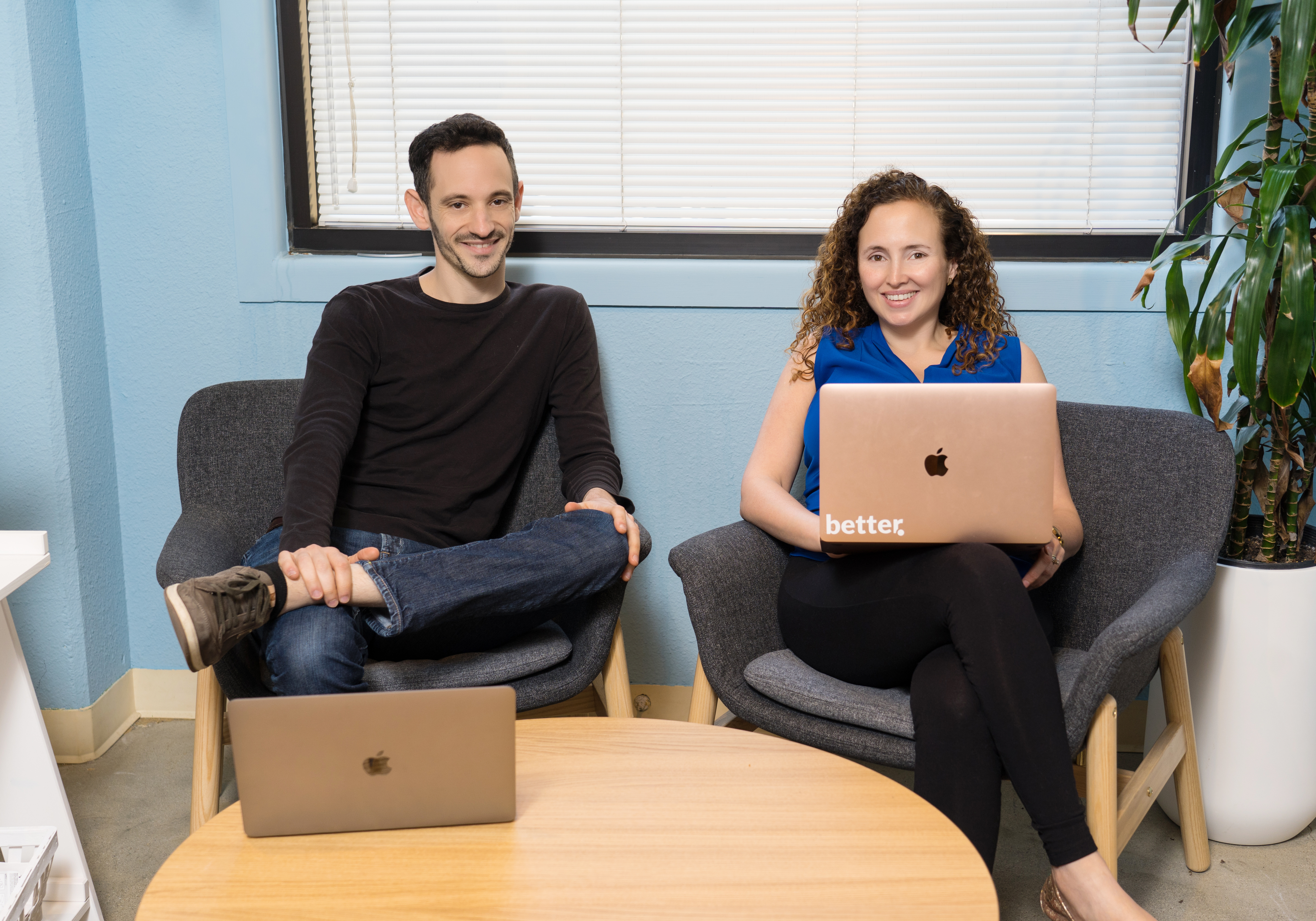
Better Health Head of Product Adam Breckler, left, and CEO Naama Stauber Breckler, right

With CompactCath, she said they ended up having to build their own direct-to-consumer marketing and sales product, and through that process, they ended up talking to thousands of customers with chronic conditions about their experiences, and what they found exposed the extend of the problems in the existing market.

“We kept hearing the same stories again, and again — it’s hard to find the right supplier, often it’s a local store, the process is extremely manual and lengthy and prone to errors, they get the surprise bills they weren’t expecting,” Stauber Breckler said. “But mostly, it’s just that there is this really sharp drop in care, from the time that you have a surgery or you were diagnosed, to when you need to now start using this device, when you’re essentially left at home and are given a general prescription.”

Unlike in the prescription drug market, where your choices essentially amount to whether you pick the brand name or the generic, and the outcome is pretty much the same regardless, in medical supplies which solution you choose can have a dramatically different effect on your experience. Customers might not be aware, for example, that something like CompactCath exists, and would instead chose a different catheter option that limits their mobility because of how frequently it needs changing and how intensive the process is. Physicians and medical professionals also might not be the best to advise them on their choice, because while they’ve obviously seen patients with these conditions, they generally haven’t lived with them themselves.

“We have talked to people who tell us, ‘I’ve had an ostomy for 19 years, and this is the first time I don’t have constant leakages’ or someone who had been using a catheter for three years and hasn’t left her house for more than two hours, because they didn’t feel comfortable with the product that they had to use it in a public restroom,” Stauber Breckler said. “So they told us things like ‘I finally went to visit my parents, they live in a town three hours away.’”

Better Health can provide this kind fo clarity to customers because it employs advisors who can talk patients through the equipment selection process with one-to-one coaching and product use education. The startup also helps with navigating the insurance side, managing paperwork, estimating costs and even arguing the case for a specific piece of equipment in case of difficulty getting the claim approved. The company leverages peers who have first-hand experience with the chronic conditions it serves to help better serve its customers.

Already, Better Health is a Medicare-licensed provider in 48 states, and it has partnerships in place with commercial providers like Humana and Oscar Health. This funding round was led by 8VC, a firm with plenty of expertise in the healthcare industry and an investor in Stauber Breckler’s prior ventures, and includes participation from Caffeinated Capital, Anorak Ventures, and angels Robert Hurley and Scott Flanders of remote health pioneer eHealth.

News: Argentina’s Digital House raises over $50M to help solve LatAm’s tech talent shortage

Digital House, a Buenos Aires-based edtech focused on developing tech talent through immersive remote courses, announced today it has raised more than $50 million in new funding. Notably, two of the main investors are not venture capital firms but instead are two large tech companies: Latin American e-commerce giant Mercado Libre and San Francisco-based software

Digital House, a Buenos Aires-based edtech focused on developing tech talent through immersive remote courses, announced today it has raised more than $50 million in new funding.

Notably, two of the main investors are not venture capital firms but instead are two large tech companies: Latin American e-commerce giant Mercado Libre and San Francisco-based software developer Globant. Riverwood Capital, a Menlo Park-based private equity firm, and existing backer early-stage Argentina-based venture firm Kaszek also participated in the financing.

The raise brings Digital House’s total funding raised to more than $80 million since its 2016 inception. The Rise Fund led a $20 million Series B for Digital House in December 2017, marking the San Francisco-based firm’s investment in Latin America.

Nelson Duboscq, CEO and co-founder of Digital House, said that accelerating demand for tech talent in Latin America has fueled demand for the startup’s online courses. Since it first launched its classes in March 2016, the company has seen a 118% CAGR in revenues and a 145% CAGR in students. The 350-person company expects “and is on track” to be profitable this year, according to Duboscq.

Digital House CEO and co-founder Nelson Duboscq. Image Credits: Digital House

In 2020, 28,000 students across Latin America used its platform. The company projects that more than 43,000 will take courses via its platform in 2021. Fifty percent of its business comes out of Brazil, 30% from Argentina and the remaining 20% in the rest of Latin America.

Specifically, Digital House offers courses aimed at teaching “the most in-demand digital skills” to people who either want to work in the digital industry or for companies that need to train their employees on digital skills. Emphasizing practice, Digital House offers courses — that range from six months to two years — teaching skills such as web and mobile development, data analytics, user experience design, digital marketing and product development.

The courses are fully accessible online and combine live online classes led by in-house professors, with content delivered through Digital House’s platform via videos, quizzes and exercises “that can be consumed at any time.” 

Digital House also links its graduates to company jobs, claiming an employability rate of over 95%.

Looking ahead, Digital House says it will use its new capital toward continuing to evolve its digital training platforms, as well as launching a two-year tech training program — dubbed the the “Certified Tech Developer” initiative — jointly designed with Mercado Libre and Globant. The program aims to train thousands of students through full-time two-year courses and connect them with tech companies globally. 

Specifically, the company says it will also continue to expand its portfolio of careers beyond software development and include specialization in e-commerce, digital marketing, data science and cybersecurity. Digital House also plans to expand its partnerships with technology employers and companies in Brazil and the rest of Latin America. It also is planning some “strategic M&A,” according to Duboscq.

Francisco Alvarez-Demalde, co-founder & co-managing partner of Riverwood Capital, noted that his firm has observed an accelerating digitization of the economy across all sectors in Latin America, which naturally creates demand for tech-savvy talent. (Riverwood has an office in São Paulo).

For example, in addition to web developers, there’s been increased demand for data scientists, digital marketing and cybersecurity specialists.

“In Brazil alone, over 70,000 new IT professionals are needed each year and only about 45,000 are trained annually,” Alvarez-Demalde said. “As a result of such a talent crunch, salaries for IT professionals in the region increased 20% to 30% last year. In this context, Digital House has a large opportunity ahead of them and is positioned strategically as the gatekeeper of new digital talent in Latin America, preparing workers for the jobs of the future.”

André Chaves, senior VP of Strategy at Mercado Libre, said the company saw in Digital House a track record of “understanding closely” what Mercado Libre and other tech companies need.

“They move as fast as we do and adapt quickly to what the job market needs,” he said. “A very important asset for us is their presence and understanding of Latin America, its risks and entrepreneurial environment. Global players have succeeded for many years in our region. But things are shifting gradually, and local knowledge of risks and opportunities can make a great difference.”

News: Acquisition-happy space infrastructure company Redwire set to go public via SPAC

The latest in a string of space tech SPACs announced this year is Redwire, an entity created by a PE firm in 2020, which has acquired a number of smaller companies including Adcole Space, Roccor, Made in Space, LoadPath, Oakman Aerospace, Deployable Space Systems and more — all within the last year or so. Redwire

The latest in a string of space tech SPACs announced this year is Redwire, an entity created by a PE firm in 2020, which has acquired a number of smaller companies including Adcole Space, Roccor, Made in Space, LoadPath, Oakman Aerospace, Deployable Space Systems and more — all within the last year or so. Redwire announced that it will go public through a merger with special purpose acquisition company Genesis Park Acquisition Crop., and the combined company will list on the NYSE.

The deal puts Redwire’s pro forma enterprise value at %615 million, and is expected to provide an additional $170 million to Redwire’s coffers post-merger, including a PIPE valued at over $100 million. Unsurprisingly, one of the uses of the proceeds that Redwire intends to pursue is continued M&A activity to build out its list of service offering in the space domain.

Redwire’s mandate isn’t specifically to go after new space companies, and instead its targets share in common expertise in a particular, rather narrow slice of the severally space market. It’s capabilities include on-orbit manufacturing and servicing; satellite design, manufacture and assembly; payload integration; sensor design and development, and more. The idea appears to be to build a full-stack infrastructure company that can offer tip-to-tail space technology services, exclusive really only of launch and ground station components (for now).

It’s a smart approach for a bourgeoning new space economy where increasingly, technology companies who want to operate in space would rather focus on their unique value proposition, and outsource the complex, but mostly settled business of actually getting to, and operating in, space. Other companies are addressing the market in similar ways, with launchers bringing more of that part of the process in-house so their payload customers basically only have to show up with the sensor or communication device they want to send to space, and the launcher providing everything else — including even the satellite, in the relatively near future.

Redwire has proven revenue-generating power, with projected 2021 revenue of $163 million, and many of the companies now operating under its umbrella are fairly mature and have been operating cash flow positive for many years. Accordingly, a SPAC as a path to public markets likely does make sense in this particular instance, but the increasing frequency and volume of space companies choosing this route, is, on the whole, a trend to watch with healthy skepticism.

News: Indian edtech giant Byju’s in talks to raise over $600 million at $15 billion valuation

Indian edtech giant Byju’s, which raised about a billion dollars last year as the pandemic accelerated the adoption of online learning services in India, is about to kickoff a new fundraising spree. Byju’s is in talks to raise over $600 million in a new financing round that values the Indian startup at $15 billion, up

Indian edtech giant Byju’s, which raised about a billion dollars last year as the pandemic accelerated the adoption of online learning services in India, is about to kickoff a new fundraising spree.

Byju’s is in talks to raise over $600 million in a new financing round that values the Indian startup at $15 billion, up from about $11 billion late last year, and $5.75 billion in July 2019, two people familiar with the matter told TechCrunch.

Byju Raveendran, the co-founder and chief executive of the eponymous startup, informed some existing investors last month that he would be raising a sizeable round this month, a person familiar with the matter said. The new round is in advanced stages of talks, and some new investors are expected to lead and participate, the people said.

A Byju’s spokesperson declined to comment last month and earlier this week.

The startup plans to use the fresh capital to acquire more startups. It is currently in talks with a U.S.-based firm — the name of which TechCrunch could not ascertain — for an acquisition, and is conducting due diligence to buy Indian physical coaching institute Aakash, the people said, requesting anonymity as talks are private. Byju’s acquired WhiteHat Jr, which offers online coding classes to school-going students in India and the U.S., for $300 million a year ago.

Byju’s prepares students pursuing undergraduate and graduate-level courses, and in recent years it has also expanded its catalog to serve all school-going students. Tutors on Byju’s app tackle complex subjects using real-life objects such as pizza and cake.

The pandemic, which prompted New Delhi to enforce a months-long nationwide lockdown and close schools, accelerated its growth, and those of several other online learning startups including Unacademy and Vedantu.

It has amassed over 80 million users, 5.5 million of whom are paying subscribers. Byju’s, which is profitable, generated revenues of over $100 million in the U.S. last year, Deborah Quazzo, Managing Partner of GSV Ventures, said at a session held by Indian venture fund Blume Ventures earlier this week.

The startup executives said at a recent UBS event that the company’s current revenue runrate is $800 million, a figure they expect will reach $1 billion in the next 12-15 months.

This is a developing story. More to follow…

News: Closing on $103M, MaC VC is changing the face of venture capital

The partners at MaC Venture Capital, the Los Angeles-based investment firm that has just closed on $103 million for its inaugural fund, have spent the bulk of their careers breaking barriers. Formed when M Ventures (a firm founded by former Washington DC mayor Adrian Fenty); the first Black talent agency partner in the history of

The partners at MaC Venture Capital, the Los Angeles-based investment firm that has just closed on $103 million for its inaugural fund, have spent the bulk of their careers breaking barriers.

Formed when M Ventures (a firm founded by former Washington DC mayor Adrian Fenty); the first Black talent agency partner in the history of Hollywood, Charles D. King; and longtime operating executive (and former agent) Michael Palank joined forces with Marlon Nichols, a co-founder of the LA-based investment firm Cross Culture Capital, MaC Venture Capital wanted to be a different kind of fund.

The firm combines the focus on investing in software that Fenty had honed from his years spent as a special advisor to Andreessen Horowitz, where he spent five years before setting out to launch M Ventures; and Nichols’ thesis-driven approach to focusing on particular sectors that are being transformed by global cultural shifts wrought by changing consumer behavior and demographics.

“There’s a long history and a lot of relationships here,” said King, one of Hollywood’s premier power players and the founder of the global media company, Macro. “Adrian and I go back to 93 [when] we were in law school. We went on to conquer the world, where he went out to Washington DC and I became a senior partner at WME.”

Palank was connected to the team through King as well, since the two men worked together at William Morris before running business development for Will Smith and others.

“There was this idea of having connectivity between tech and innovation… that’s when we formed M Ventures [but] that understanding of media and culture… that focus… was complimentary with what Marlon was doing at Cross Culture,” King said.

Few firms could merge the cultural revolutions wrought by DJ Herc spinning records in the rec room of a Bronx apartment building and Sir Tim Berners Lee’s invention of the internet, but that’s exactly what MaC VC aims to do.

And while the firm’s founding partnership would prefer to focus on the financial achievements of their respective firms and the investments that now comprise the new portfolio of their combined efforts — it includes StokeGoodfairFinessePureStream, and Sote — it’s hard to overstate the significance that a general partnership that includes three Black men have raised $103 million in an industry that’s been repeatedly called out for problems with diversity and inclusion.

MaC Venture Capital co-founders Marlon Nichols, Michael Palank, Charles King, and Adrian Fenty. Image Credit: MaC Venture Capital

“Our LPs invested in us… for lots of different reasons but at the top of the list was that we are a diverse team in so many ways. We’re going to show them a set of companies that they would not have seen from any [other] VC fund,” said Fenty. “We also, in turn, have the same investing thesis when we look at companies. We want to have women founders, African American founders, Latino founders… In our fund now we have some companies that are all women, all African American or all Latino.”

The diversity of the firm’s ethos is also reflected in the broad group of limited partners that have come on to bankroll its operations: it includes Goldman Sachs, the University of Michigan, Howard University, Mitch and Freada Kapor, Foot Locker, and Greenspring Associates.

“We are thrilled to join MaC Venture Capital in this key milestone toward building a new kind of venture capital firm that is anchored around a cultural investment thesis and supports transformative companies and dynamic founders,” said Daniel Feder, Managing Director with the University of Michigan Investment Office, in a statement. “Their unified understanding of technology, media, entertainment, and government, along with a successful track record of investing, give them deep insights into burgeoning shifts in culture and behavior.”

And it extends to the firm’s portfolio, a clutch of startup companies headquartered around the globe — from Seattle to Houston and Los Angeles to Nairobi.

“We look at all verticals. We’re very happy to be generalists,” said Fenty.

A laser focus on software-enabled businesses is complemented by the thesis-driven approach laid out in position papers staking out predictions for how the ubiquity of gaming; conscious consumerism; new parenting paradigms; and cultural and demographic shifts will transform the global economy.

Increasingly, that thesis also means moving into areas of frontier technologies that include the space industry, mixed reality and everything at the intersection of computing and the transformation of the physical world — drawn in part by the firm’s close connection to the diverse tech ecosystem that’s emerging in Los Angeles. “We’re seeing these SpaceX and Tesla mafias spin out, entrepreneurs who have had best-in-class training at an Elon Musk company,” said Palank. “It’s a great talent pool, and LA has more computer science students graduating every year than Northern California.”

With its current portfolio, though early, the venture firm is operating in the top 5% of funds — at least on paper — and its early investments are up 3 times what the firm invested, Nichols said. 

“The way to think about it is MaC is essentially an extension of what we were building before,” the Cross Culture Ventures co-founder said. “We’re sticking with the concept that talent is ubiquitous but access to capital and opportunity is not. We want to be the source and access to capital for those founders.”

News: Ribbon wants to make it easier for product teams to interview users

Everybody says they want to build user-centric companies and products, but how exactly is that achieved? Talking and listening to users, of course — a task that is both unnecessarily time-consuming and cumbersome to organise, according to Axel Thomson, a former product manager at U.K. recipe-box subscription unicorn Gousto. His burgeoning startup, dubbed Ribbon, wants

Everybody says they want to build user-centric companies and products, but how exactly is that achieved? Talking and listening to users, of course — a task that is both unnecessarily time-consuming and cumbersome to organise, according to Axel Thomson, a former product manager at U.K. recipe-box subscription unicorn Gousto.

His burgeoning startup, dubbed Ribbon, wants to make it easy for product teams to recruit and interview users, and to “continuously test and validate their hypotheses”. This, it’s hoped, will then lead to better products for users. The idea was born out of a need Thomson says he experienced himself while leading a user experience-focused product team at Gousto.

“I initially joined Gousto in the growth team, running product and marketing experiments focused on improving the user experience and increasing retention before moving over to the product team to work on improving the user experience more holistically,” he tells me.

“In both of these teams we had to constantly make decisions on what features and experiments we wanted to take bets on, quickly realising that as much as we thought we knew what the users wanted, the best way to find out was by having real conversations with users, and letting them test out different concepts. This was a big eye-opener to how difficult it could be to consistently make good and informed decisions on which products and features were worth testing and which ones were doomed to fail”.

Thomson says it’s become a trope within management circles that product teams should be user-centric and that products should be designed to help users solve “real problems”. But in reality, it’s often hard to know what users really think or actually want, while continuously doing user research and conducting interviews is very time-consuming.

“Teams will often spend days setting up interviews, resulting in a slow feedback loop that slows down product development and experimentation,” he says. “Alternatively, product teams seek solace in quantitative data from analytics platforms such as Amplitude and Mixpanel, which only give insight into how users have used their products once they’ve been shipped”.

Enter Ribbon, which its founder says lets companies start user interviews in roughly “the same time it takes to order a ride through Uber”. Product teams simply install the Ribbon widget on their website and can then recruit and conduct video interviews with users any point in the user journey.

“We want to help product teams rapidly and continuously do user interviews, and ultimately any type of qualitative user research, without having to make compromises on how quickly they can ship, how reliable results they can get and how frequently they can do research,” explains Thomson.

Ribbon is designed to appeal to product managers, designers and user researchers, all of whom benefit from validating their ideas by having conversations with users. However, Thomson argues that the benefits of user research isn’t limited to these roles only, and that while companies often have dedicated teams or people that “own” user interviews, there is an increasing interest in “socialising research findings and participation in user research across companies”.

“Our goal as a user research platform is to make it easy for our users to become evangelists of their research within their own teams and organisations, by making it really easy to do great research and share it with your team,” he adds.

It’s still early days, of course — Ribbon launched its MVP to the Product Hunt community at the end of October last year. Until now, the London-based startup has been bootstrapped, too, but today is disclosing that it has raised £200,000 in pre-seed funding from MMC Ventures, RLC Ventures and a group of London-based angels.

News: Digital banking solutions provider Meniga closes additional €10M investment

Meniga, the London fintech that provides digital banking technology to leading banks, has closed €10 million in additional funding. The round is led by Velocity Capital and Frumtak Ventures. Also participating are Industrifonden, the U.K. Government’s Future Fund and existing customers UniCredit, Swedbank, Groupe BPCE and Íslandsbanki. Meniga says the funding will be used for

Meniga, the London fintech that provides digital banking technology to leading banks, has closed €10 million in additional funding.

The round is led by Velocity Capital and Frumtak Ventures. Also participating are Industrifonden, the U.K. Government’s Future Fund and existing customers UniCredit, Swedbank, Groupe BPCE and Íslandsbanki.

Meniga says the funding will be used for continued investment in R&D, and in particular further development of green banking products — building on its carbon spending insights product. In addition, the fintech will bolster its sales and service teams.

Headquartered in London but with additional offices in Reykjavik, Stockholm, Warsaw, Singapore and Barcelona, Meniga’s digital banking solutions help banks (and other fintechs) use personal finance data to innovate in their online and mobile offerings.

Its various products include a software layer that bridges the gap between a bank’s legacy tech infrastructure and a modern API, making it easier to build consumer-friendly digital banking experiences. The product suite spans data aggregation technologies, personal and business finance management solutions, cash-back rewards and transaction-based carbon insights.

Meniga tells TechCrunch it has experienced a significant increase in the demand for its digital banking products and services over the past year. This has seen the fintech launch a total of 18 digital banking solutions across 17 countries.

Image Credits: Meniga

Helping fuel that demand is the need for banks to attract and retain a generation of customers that increasingly care about sustainability and the need to tackle climate change. Enter Meniga’s green banking solution: Dubbed “Carbon Insight,” it leverages personal finance data so that mobile banking customers can track and, in theory, reduce their carbon footprint.

Specifically, it lets users track their estimated carbon footprint for a given time period (which can be broken down into specific spending categories); track the estimated carbon footprint of individual transactions; and compare their overall carbon footprint and the carbon footprint of spending categories with that of other users.

Last month, Íslandsbanki became the first Nordic bank to implement Meniga’s Carbon Insight solution into its own digital banking offering.

News: As more artists and musicians turn their attention to NFTs, so do bad actors

Outlets that follow the crypto industry have been observing a trend, which is that according to Google search data, the rise in interest in non-fungible tokens, or NFTs, now almost matches the level of interest in 2017 in initial coin offerings, or ICOs. Of course, ICOs largely disappeared from the scene after the SEC started

Outlets that follow the crypto industry have been observing a trend, which is that according to Google search data, the rise in interest in non-fungible tokens, or NFTs, now almost matches the level of interest in 2017 in initial coin offerings, or ICOs.

Of course, ICOs largely disappeared from the scene after the SEC started poking around and determining, in some cases, that they were being used to launder money. Now experts in blockchain transactions see the potential for abuse again with NFTs, despite the traceable nature of the tokens — and perhaps even because of it.

As most readers may know at this point (because they’re increasingly hard to avoid), an NFT is a kind of digital collectible that can come in almost any form, a PDF, a tweet — even a digitized New York Times column.

Each of these items — and there can be many copies of the same item — is stamped with a long string of alphanumerics that makes it immutable. As early crypto investor David Pakman of Venrock explains it, that code is also recorded on the blockchain, so that there’s a permanent record of who own what. Someone else can screenshot that PDF or tweet or Times column, but they won’t be able to do anything with that screenshot, whereas the NFT owner can, theoretically at least, sell that collectible at some point to a higher bidder.

The biggest NFT sale to date, about 15 days ago, was the sale of digital artist Mike Winkelmann’s “Everydays: The First 5000 Days,” which sold for a stunning $69 million — the third-highest auction price achieved for a living artist, after Jeff Koons and David Hockney. Winkelmann, who uses the name Beeple, broke his own record with the sale, having sold another crypto art piece for $6.6 million in February. (Earlier this week, he sold yet another for $6 million.) There is such a frenzy that Beeple has told numerous outlets that he believes there’s a crypto art “bubble” and that many NFTs will “absolutely go to zero.”

There is so much money involved that experts believe that NFTs have become a rife opportunity for bad actors, even if action hasn’t been brought against one yet.

One of the most practical dangers centers on trade-based money laundering, or the process of disguising illegal proceeds by moving them through trade transactions in an effort to legitimize them. It’s already a huge issue in the art world, and NFTs are comparable to art, with even more erratic pricing right now.

Jesse Spiro, the chief of government affairs at the blockchain analysis firm Chainalysis explains it this way: “One of the ways to identify trade-based money laundering with [traditional] art is that [an appraiser] comes up with a fair market value for something, and you’re able to measure that fair market value against the pricing that’s involved [and flag] over invoicing or under invoicing, which is either selling that asset for less than it’s worth, or for more than it’s worth.”

The good news is that in some instances where hundreds or even thousands of NFTs are being sold, even at very different prices, as has been happening with NBA highlight clips, there’s an average value that can be measured, Spiro notes, and that makes unusual activity easier to spot.

In cases where it’s impossible to establish a sales history, however, its ultimate price “could be whatever the buyer is willing to pay for something, so you can’t really make that determination” that something nefarious is afoot. According to Spiro, “All that’s needed is two parties that are involved to effectively execute that [transaction] successfully.”

There are many other flavors of crime when it comes to digital assets and, potentially, with regard to NFTs. Asaf Meir, the cofounder and CEO of the crypto market surveillance company Solidus Labs, points as examples to wash trades, where an individual or outfit simultaneously sells and buys the same financial instruments; as well as cross trades, which involve a trade between two accounts within the same organization, all to create a false record around the price of an asset that doesn’t reflect the true market price.

Both are illegal under money laundering laws and also very hard to spot, especially for legacy systems. The “tricky thing about the crypto markets is they are retail-oriented first, so there could be multiple different accounts with multiple addresses doing multiple things in collusion — sometimes mixed or not mixed with institutional accounts for different beneficial owners,” says Meir, who met his cofounders at Goldman Sachs, where they worked on the electronic trading desk for equities and quickly observed that surveillance for digital assets was very much an unsolved issue.

It’s worth noting that not everyone thinks it likely that NFTs are being used to transfer money illegally. Says Pakman, an investor in the NFT marketplace Dapper Labs, “Crytpo purists are upset this happened, but national governments can go to marketplaces and exchanges and they can say, ‘In order for you to do business, you need to follow [know-your-customer] and [anti-money-laundering] laws that force [these entities] to get a verified identify of everyone of their customers. Then any suspicious transactions over a certain amount, they have to file paperwork.”

The two tools make it easier for authorities to subpoena the marketplaces and exchanges when a suspicious transaction is flagged and force the outfits to verify their user’s identity.

Still, one question is how effective such a process is if enough time elapses between the suspicious transaction and it being flagged. Pakman answers that “everything is retroactively researchable. If you get away with it today, there’s nothing to stop the FBI from tracking it a year later.”

Another question is why money launderers would bother with NFTs when there are easier ways to transfer large sums of money in the crypto world. Max Galka, cofounder and CEO of the blockchain analytics platform Elementus, says that “one piece that kind of makes me think NFTs might not be the best vehicle for money laundering is just that secondary markets are not as liquid,” meaning it isn’t so easy for bad actors to create distance between themselves and a transaction.

Galka also wonders whether a criminal wouldn’t instead simply go to a decentralized exchange and buy up liquid tokens that are truly fungible (meaning no unique information can be written into the token) so that the location of those funds is harder to trace than with a nonfungible token.

“I certainly see the potential for money laundering here, but given that there are lots of assets out there on the blockchain that people can use for that, [NFTs] may not be best-suited” compared with their other options, says Galka.

Theoretically, Spiro of Chainalysis agrees on all fronts, but he suggests that the minting and sale of NFTs have ballooned so fast that a lot of processes that should be in place are not.

“Most NFTs operate on the Ethereum blockchain, so it’s technically true that these are traceable,” he says. It’s also true that “the entities running these NFTs should have compliance and work with blockchain forensics and analytics to ensure that someone is able to follow the flow of funds.”

Indeed, he says, in an “ideal world, you’d be able to follow transactions, and then at the choke points where individuals were trying to convert whatever token they’re using into maybe fiat currency, they’d have to provide their [personal identifiable information]” and law enforcement or regulators could then see if the transaction was connected to illicit activity.

We’re not there yet, though, which means bad things could very definitely be happening.

“Right now,” says Spiro, “compliance in relation to these NFTs is a gray area.”

WordPress Image Lightbox Plugin