Tag Archives: Blog

News: E-commerce roll-ups are the next wave of disruption in consumer packaged goods

The interest in creating value through e-commerce brands is striking. So what’s the roll-up hype about?

Alanna Gregory
Contributor

Alanna is a marketing executive who is currently serving as vice president of growth and digital at Hairstory. She previously founded VIVE Lifestyle (YC S15) and was an AVP at Barclays Capital.

This year is all about the roll-ups. No, not those fruity snacks you used to find in your lunchbox; roll-ups are the aggregation of smaller companies into larger firms, creating a potentially compelling path for equity value.

Right now, all eyes are on Thrasio, the fastest company to reach unicorn status, and its cadre of competitors, such as Heyday, Branded and Perch, all vying to become the modern model of consumer packaged goods (CPG) companies.

Making things even more interesting, famed investor and operator Keith Rabois recently announced that he too is working on a roll-up concept called OpenStore with Atomic co-founder Jack Abraham.

Like any investment firm, to be successful, a roll-up should have a thesis or two providing it with a cohesive strategy across its portfolio.

Thrasio has been reaping the benefits of the e-commerce market’s Cambrian explosion in 2020, in which over $1 billion of capital was invested in firms on a mission to acquire independent Amazon sellers and brands.

This catalyst can be attributed to a few key factors, the first and most notable being the pandemic accelerating spending on Amazon and e-commerce more broadly. Next is the low cost of capital, a reflection of interest rates making markets flush with cash; this has made it easier to raise both equity and debt capital.

The third is the emerging and quantifiable proofs of concept: Thrasio is one of several raising hundreds of millions of dollars, and Anker, a primarily Amazon-native brand, went public. Both stories have provided further validation that a meaningful brand can be built on top of Amazon’s marketplace.

Still, the interest in creating value through e-commerce brands is particularly striking. Just a year ago, digitally native brands had fallen out of favor with venture capitalists after so many failed to create venture-scale returns. So what’s the roll-up hype about?

Roll-ups are another flavor of investing

Roll-ups aren’t a new concept; they’ve existed for a while. In the offline world, roll-ups often achieve much greater exit multiples, known as “multiple arbitrage,” so it’s no surprise that the trend is making its way online.

Historically, though, roll-ups haven’t been all that successful; HBR notes that more than two-thirds of roll-ups fail to create value for investors. While roll-ups are often effective at building larger companies, they don’t always increase profits or operating cash flows.

Acquirers, i.e., those rolling up smaller companies, need to uncover new operating approaches for their acquired companies to increase equity value, and the only way to increase equity value is to increase operating cash flow. There are four ways to do this: reducing overhead costs, reducing operating costs without sacrificing price or volume, increasing pricing without sacrificing volume or increasing volume without increasing unit costs.

E-commerce could present a new and different opportunity, or at least that’s what investors and smart money are betting on. Let’s explore how this new wave of roll-ups is approaching both growth and value creation.

Channel your enthusiasm: Why every roll-up needs a thesis

Like any investment firm, to be successful, a roll-up should have a thesis or two providing it with a cohesive strategy across its portfolio. There are a few that are trending in this particular wave.

The first is the primary distribution channel upon which a company grows. Evaluating companies with a common distribution channel can be helpful for creating economies of scale, focusing marketing and growth resources in a specific channel versus diluting resources across several.

On the downside, these companies become reliant on this distribution strategy and any changes could create vulnerabilities for their portfolio companies. As a study, let’s take a look at how two companies take different approaches:

News: Amazon goes on the offensive ahead of next week’s union vote counting

This week’s Amazon public relations push will no doubt go down as one of the odder public-facing strategies in tech. As some of the company’s biggest rivals were getting ready to virtually testify on Capitol Hill, the retail giant’s CEO of worldwide consumer business appeared to suggest that Amazon is not only as progressive as

This week’s Amazon public relations push will no doubt go down as one of the odder public-facing strategies in tech. As some of the company’s biggest rivals were getting ready to virtually testify on Capitol Hill, the retail giant’s CEO of worldwide consumer business appeared to suggest that Amazon is not only as progressive as self-declared democratic socialist Bernie Sanders, but also more effective in achieving those leftist policies.

Ahead of the Vermont senator’s visit to Amazon’s Bessemer, Alabama fulfillment center, Dave Clark tweeted, “I welcome [Sanders] to Birmingham and appreciate his push for a progressive workplace. I often say we are the Bernie Sanders of employers, but that’s not quite right because we actually deliver a progressive workplace.”

1/3 I welcome @SenSanders to Birmingham and appreciate his push for a progressive workplace. I often say we are the Bernie Sanders of employers, but that’s not quite right because we actually deliver a progressive workplace https://t.co/Fq8D6vyuh9

— Dave Clark (@davehclark) March 24, 2021

The statement was unsurprisingly greeted with pushback from labor groups. The Retail, Wholesale and Department Store Union (RWDSU) sent TechCrunch a lengthy response from president Stuart Appelbaum to the odd statement:

How arrogant and tone deaf can Amazon be? Do they really believe that the wage they pay – which is below what workers in nearby unionized warehouses receive and below Alabama’s median wage – gives them the right to mistreat and dehumanize their employees, put their workers’ health and safety in jeopardy, require them to maintain an unbearable pace, which even Amazon itself admits that a quarter of their workforce won’t be able to meet, and to deny working men and women the dignity and respect they deserve.

The organization, which is helping facilitate the Bessemer warehouse’s union voting, goes on to cite high turnover rates and pay cuts amid the pandemic and founder Jeff Bezos’s ballooning wealth. The founder — who is set to step down as CEO some time in Q3 — reportedly added more than $72 billion to his net worth in 2020, as Amazon employees became essential workers amid COVID-19-fueled shutdowns.

For many in the U.S., Amazon’s online delivery service provided a lifeline, as many stores were forced to close over pandemic precautions. The Bessemer facility opened on March 29, just as the first wave was cresting in the U.S. The company was anticipating a potential strain on its resources as record numbers of Americans were suddenly forced to stay home and were otherwise avoiding in-person shopping at all costs.

“Our team at Amazon is thankful for the support we have received from state and community leaders, and we are excited to be a part of the Bessemer community,” Director of Operations Travis Maynard said at the time. “We’re proud to create great jobs in Bessemer with industry-leading pay and benefits that start on day one, in a safe, innovative workplace.”

After several years of negative coverage over its warehouse working conditions, it’s not surprising that the company has become proactively reflexive when it comes to working conditions.

“When New York City became the epicenter [of COVID-19], that’s when the Bessemer facility opened up,” Christian Smalls, a former Amazon worker-turned-critic said at TechCrunch’s Justice event earlier this month. “So the union got a head start on talking to workers. So that’s a gem for anybody or any union that plans on trying to unionize the building — that you have a facility in your community that’s about to open up, when opening, that’s the best time to connect with workers. That’s what happened last year. And as a result, the workers had seen what happened to the workers that were unprotected and they don’t want that. They want better for themselves.”

Next week, the RWDSU will begin tallying votes for what has shaped up to be the largest union push since Amazon’s 1995 founding, much to the company’s chagrin. In recent months, the company has been hoping to throw a wrench in the works. In January, it unsuccessfully appealed a ruling by the National Labor Relations Board (NLRB) that allowed workers to vote by mail, as more than 350,000 COVID-19 cases had been reported in the state since the beginning of the pandemic.

Amazon expressed concerns that mail-in voting would monopolize too much time and resources. “Union avoidance” firm Jackson Lewis suggested that such rules put employers at a disadvantage, “because eligible voters are given several days after receiving their ballots to return them to the NLRB, the impact and momentum of the employer’s voter education campaign is decreased. This does not exist in connection with a manual ballot election, where the employer may educate employees one-on-one until the last moment before they vote.”

NEW: Amazon is running glossy anti-union ads to combat the organizing drive by workers at their Bessemer, AL, warehouse. An Alabama resident said this spot is one of several that Amazon is now running on Twitch. pic.twitter.com/6WlojetvzY

— More Perfect Union (@MorePerfectUS) February 23, 2021

The following month, Amazon ran anti-union ads on its streaming subsidiary, Twitch. The spots featured employees discussing why they were planning to vote no, and compelled people to visit Do it Without Dues, which blasted potential union membership fees.

“Amazon feels that it has to go to extremes like this in order to gaslight its workers about the dreadful working conditions at its Bessemer warehouse,” Appelbaum told the press in response to the ads. Twitch pulled the spots, adding that they, “should never have been allowed to run on [the] service.”
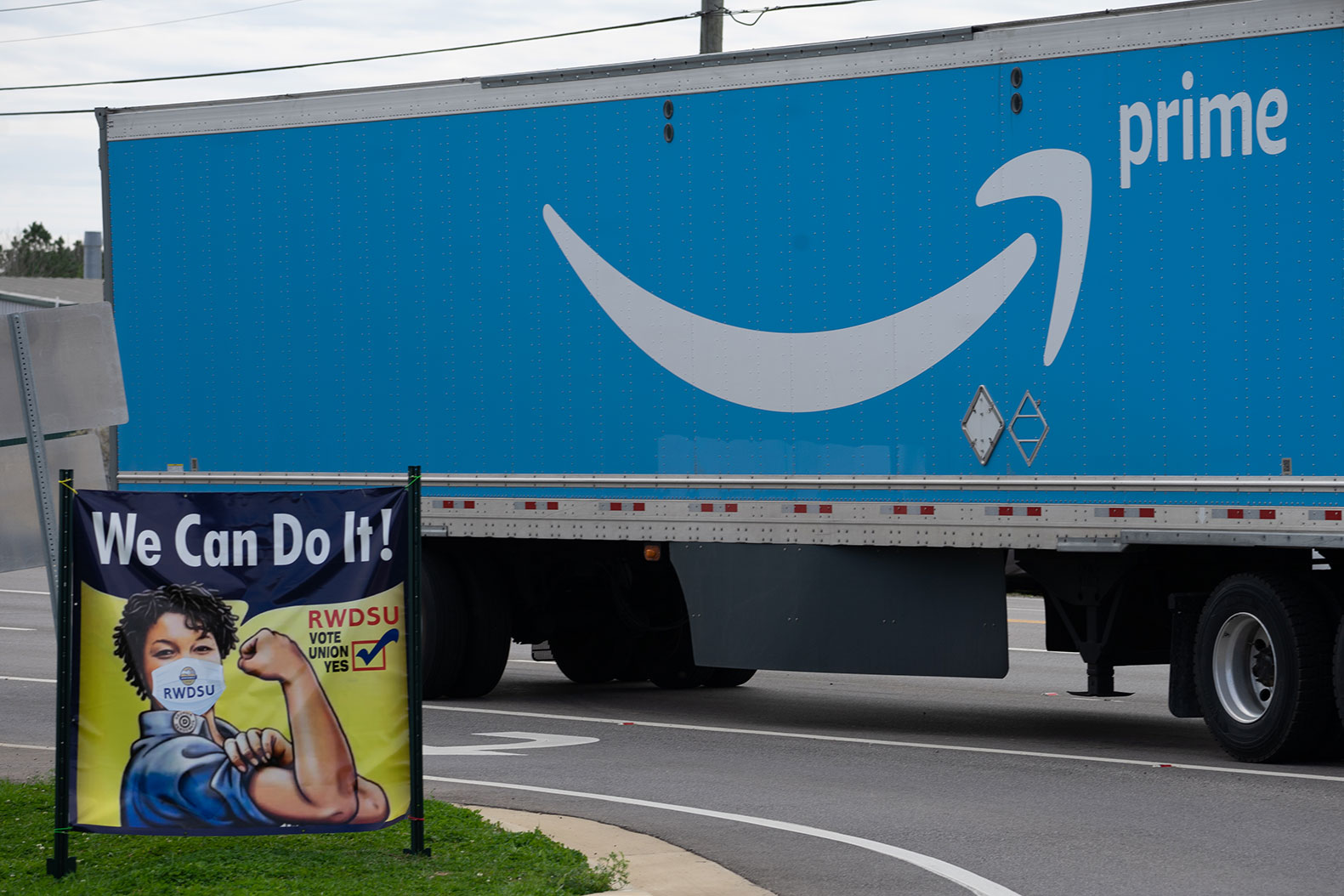
A truck passes as Congressional delegates visit the Amazon Fulfillment Center after meeting with workers and organizers involved in the Amazon BHM1 facility unionization effort

BIRMINGHAM, AL – MARCH 05: A truck passes as Congressional delegates visit the Amazon Fulfillment Center after meeting with workers and organizers involved in the Amazon BHM1 facility unionization effort, represented by the Retail, Wholesale, and Department Store Union on March 5, 2021 in Birmingham, Alabama. Workers at Amazon facility currently make $15 an hour, however they feel that their requests for less strict work mandates are not being heard by management. (Photo by Megan Varner/Getty Images)

Workers have continued to be critical of conditions in Amazon’s warehouses, frequently comparing the work to that of robots that have increasingly become their colleagues. Last week, New York Magazine published a piece from a Bessemer picker who describes long and tiring days on the floor.

“It really is not fair for employees to get fired for going to the bathroom,” the worker, Darryl Richardson, tells the magazine. “Sometimes the water in the bathrooms isn’t working on the floor, and you have to go down another flight of stairs to go to the bathroom.”

A number of similar stories have been recounted to the media over the years. Images of workers peeing in water bottles so as to not be docked pay — or worse — for taking a bathroom break have almost certainly become the most visceral.

1/2 You don’t really believe the peeing in bottles thing, do you? If that were true, nobody would work for us. The truth is that we have over a million incredible employees around the world who are proud of what they do, and have great wages and health care from day one.

— Amazon News (@amazonnews) March 25, 2021

When Wisconsin Rep. Mark Pocan called out Clark’s Sanders comparisons on Twitter earlier this week, an official account shot back, “We hope you can enact policies that get other employers to offer what we already do.”

Sanders has been a long-time critic of the company. The Vermont senator was one of a handful of progressive politicians who compelled Amazon to raise its minimum wage to $15 an hour, while criticizing massive tax breaks. In 2018, he introduced the Stop Bad Employers by Zeroing Out Subsidies (BEZOS) bill.

“The taxpayers in this country should not be subsidizing a guy who’s worth $150 billion, whose wealth is increasing by $260 million every single day,” Sanders told TechCrunch at the time. “That is insane. He has enough money to pay his workers a living wage. He does not need corporate welfare. And our goal is to see that Bezos pays his workers a living wage.” That November, the company relented, increasing minimum wage to $15 an hour — something that has since become a major talking point for Amazon.

Responding to Pocan’s comments about “union-bust[ing] & mak[ing] workers urinate in water bottles,” the Amazon News Twitter account wrote, “You don’t really believe the peeing in bottles thing, do you? If that were true, nobody would work for us. The truth is that we have over a million incredible employees around the world who are proud of what they do, and have great wages and health care from day one.”

And yes, I do believe your workers.

You don’t?

— Rep. Mark Pocan (@repmarkpocan) March 25, 2021

Pocan’s reply was simple: “[Y]es, I do believe your workers. You don’t?”

In addition to past reports of warehouse workers and delivery drivers peeing in bottles, a new report from The Intercept notes that the act is “widespread,” due to workplace pressures. It cites an email from last May that also adds defecation into the mix.

“We’ve noticed an uptick recently of all kinds of unsanitary garbage being left inside bags: used masks, gloves, bottles of urine,” the email titled Amazon Confidential reads. “By scanning the QR code on the bag, we can easily identify the DA who was in possession of the bag last. These behaviors are unacceptable, and will result in Tier 1 Infractions going forward. Please communicate this message to your drivers. I know it may seem obvious, or like something you shouldn’t need to coach, but please be explicit when communicating the message that they CANNOT poop, or leave bottles of urine inside bags.”

Pro-union demonstration signs during a Retail, Wholesale and Department Store Union (RWDSU) held protest outside the Amazon.com Inc. BHM1 Fulfillment Center in Bessemer, Alabama

Pro-union demonstration signs during a Retail, Wholesale and Department Store Union (RWDSU) held protest outside the Amazon.com Inc. BHM1 Fulfillment Center in Bessemer, Alabama, U.S., on Sunday, Feb. 7, 2021. The campaign in Bessemer to unionize Amazon workers has drawn national attention and is widely considered a once-in-a-generation opportunity to breach the defenses of the worlds largest online retailer, which has managed to keep unions out of its U.S. operations for a quarter-century. Photographer: Elijah Nouvelage/Bloomberg via Getty Images

As misguided or glib as the Amazon Twitter response may seem, it’s clear why the company has gone on the offensive here. “We’re not alone in our support for a higher federal minimum wage,” the accounted noted in the wake of the dustup with Pocan. The company adds that it has been pushing for a federal minimum wage increase following its own.

The push to unionize, meanwhile, has made strange political bedfellows, ranging from Stacey Abrams to Marco Rubio. Breaking with the customary party position, the Republican senator wrote in an op-ed, “Here’s my standard: When the conflict is between working Americans and a company whose leadership has decided to wage culture war against working-class values, the choice is easy — I support the workers. And that’s why I stand with those at Amazon’s Bessemer warehouse today.”

Rubio’s support of unionizing was tied, in part, to concerns over a “‘woke’ human resources fad,” but it’s still fairly uncommon for an event like this to find him on the side of the likes of Joe Biden, who had previously promised to be “the most pro-union president you’ve ever seen.”

Amazon will no doubt be keeping a close eye on Tuesday’s vote count, aware that the results will have a far wider ranging impact than the 6,000 workers currently employed at Bessemer. If unionization fails, the company will tout the results as vindication that its work force is perfectly happily without labor interference. A vote to unionize, on the other hand, could well embolden further unionization efforts across the company.


News: 5 mistakes creators make building new games on Roblox

Gamefam learned to develop on Roblox the hard way — by trial and error and by getting better at listening to the community’s unique gamer culture. Here are some common mistakes.

Joe Ferencz
Contributor

Joe Ferencz is the founder and CEO of Gamefam, a game publisher operating exclusively on Roblox.

With Roblox’s massive IPO this month, game developers, brands and investors alike are wondering what factors cause the most successful games on this $47 billion platform to break out from the millions of user-generated passion projects.

According to Roblox’s S-1 filing, nearly 250 developers and creators earned $100,000 or more in Robux in the year through September 2020 out of nearly 1 million creators on the platform.

From Gamefam’s first game two years ago that topped out at only 25 concurrent players to our current portfolio with 2 million to 3 million daily visits, our team learned to develop on Roblox the hard way — by trial and error and by getting better at listening to the Roblox community’s unique gamer culture and vernacular.

Even the most experienced and talented game designers from the mobile F2P business usually fail to understand what features matter to Robloxians.

For those entrepreneurs just starting their journey in Roblox game development, these are the most common mistakes I have seen gaming professionals (myself included) make on Roblox:

1. Using the established free-to-play (F2P) mobile game mechanics

In the F2P mobile games market, it’s all about layered game loops: play a match with the hero, level the hero up using resources from the match, buy more heroes to merge with the first hero, open up new matches with new rules to win more resources, and on and on. These require ongoing player tutorials across hours of play sessions. These mechanics tend to backfire on Roblox because players have no tolerance for anything but immediate, visceral fun.

Accordingly, in mobile F2P, a robust tutorial for new users is oftentimes one of the biggest investments during development. But in our Roblox game Speed Run Simulator (more than 400,000 daily visits), we saw a significant increase in D1 retention when we removed the tutorial entirely and just allowed existing players to guide new players’ understanding of the game. The differences between Roblox and mobile F2P are not only numerous but also sometimes profoundly counterintuitive.

2. Optimizing to make money off of “whales”

Roblox players spend because they’re getting something they want. They won’t be cajoled or coerced into spending like in a mobile game where progress is restricted or slowed without making an in-app purchase (think Candy Crush).

News: Woven Capital kicks off portfolio with investment in autonomous delivery company Nuro

Woven Capital, the investment arm of Toyota’s innovation-focused subsidiary Woven Planet, has announced an investment into Silicon Valley-based autonomous delivery vehicle company Nuro. This kicks off the new $800 million strategic fund, which will invest in growth-stage technology companies that could one day develop into partners or acquisitions to further a mission of building the

Woven Capital, the investment arm of Toyota’s innovation-focused subsidiary Woven Planet, has announced an investment into Silicon Valley-based autonomous delivery vehicle company Nuro. This kicks off the new $800 million strategic fund, which will invest in growth-stage technology companies that could one day develop into partners or acquisitions to further a mission of building the future of safe mobility, according to George Kellerman, Woven Capital’s head of investments and acquisitions.  

Woven Capital’s contribution was part of Nuro’s $500 million Series C funding round, which was announced last November. Chipotle also invested in the round, which also included funds managed by T. Rowe Price Associates, Inc., with participation from new investors Fidelity Management & Research Company, LLC. and Baillie Gifford. The specific amounts invested by each stakeholder were not disclosed. 

Toyota announced the $800 million investment pool in September 2020, and Woven Capital was officially formed in January 2021, with the aim of investing in technologies including as autonomous mobility, machine learning, artificial intelligence, automation, connectivity and data and analytics. 

“Nuro was a good jumping off point, because a lot of the work that we’re doing is really focused on developing autonomous passenger vehicles, so this is a way for us to learn and advance through a partner that is laser-focused on local goods delivery,” Kellerman told TechCrunch. “There’s a lot of opportunity to learn from them, and potentially over time, to collaborate and help them expand globally.”

Nuro’s fleet of cargo-only self-driving vehicles has already been approved by California’s Department of Motor Vehicles to test on public roads, delivering goods from partners like Krogers, Domino’s, Walmart and CVS. The coronavirus pandemic accelerated the need for goods delivery, giving Nuro an opportunity to become a leader in this space. Woven Capital saw an opportunity to help accelerate and strengthen that leadership position, while also setting up a strategic knowledge sharing arrangement between the two. 

“[Woven Capital] has assembled a great team with ambitious goals for the future, and we share a common objective of transforming the way people live and move to make life better,” said Nuro co-founder and president Dave Ferguson in a statement. “We’ll use this new capital, and the support of one of the largest automotive companies in the world, to continue growing our team and building a great autonomous delivery product.”

Toyota Woven City concept render.

Toyota Woven City concept render.

Automation will be a big part of Woven Capital’s portfolio, which exists to support all of parent Woven Planet’s activities, including Woven City, a testing ground for new technologies set in an interconnected smart city prototype. In February, Toyota broke ground at the Higashi-Fuji site in Susono City, Japan, at the base of Mount Fuji. 

“When we think about Woven City, we think about autonomous mobility and automation more broadly,” said Kellerman. “To facilitate that, you’re going to need artificial intelligence, machine learning, data and analytics, connectivity. So we’re going to be building a portfolio that has investments in all those areas.”

A growing trend in the mobility industry is to view mobility not just as the movement of people and goods, but as the movement of information and data. Woven Planet recognizes this and is taking a software-first approach, particularly when it comes to automobiles. This means that instead of the historical auto industry approach of designing the hardware first, and then fitting in the software to operate that vehicle, you start with the software and build hardware around it. 

Building off a software-first architecture provides a lot flexibility for future innovation. If the hardware changes, you don’t have to rewrite the code, you could just add in another application. Kellerman said all the software Woven Planet is developing as a company should be usable in as many applications as possible. 

Having really strong, integrated software is also the logical next step for connected mobility, and it opens up doors for rethinking what a vehicle has the potential to transport. A Nuro vehicle isn’t just a vehicle for whatever groceries it’s delivering, but it’s also a vehicle for all the information it picks up along the way and transmits back to the cloud, such as traffic flows and weather patterns. The value, therefore, is less in the A to B utility, and more in the interchange of information. 

Some of the information collected by Nuro that could be immediately useful to Woven City is that related to street safety. Nuro’s vehicles don’t carry passengers, so the design features focus more on the safety of people outside of the vehicle, the aggregate data of which could be useful in human-centered city planning. 

In the end, Woven Capital’s long-term view is always a potential funnel to future mergers and acquisitions, said Kellerman. 

“Toyota is not historically a very acquisitive company, but within Woven Planet we’re building a corporate development team with an eye to how we can accelerate the vision and mission of Woven Planet through strategic acquisitions, as well,” said Kellerman.

News: Hub, a productivity platform for technical sales professionals, launches with $1M in funding

Hub, a productivity platform for technical pre-sales, has formally launched with $1 million in seed funding. CEO Freddy Mangum and CTO Karl Gainey founded Hub in 2020. The pair both had experience in technical sales and recognized the challenges of using spreadsheets to manage their business. They researched and surveyed sales engineers at big and

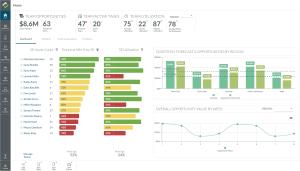
Hub, a productivity platform for technical pre-sales, has formally launched with $1 million in seed funding.

CEO Freddy Mangum and CTO Karl Gainey founded Hub in 2020. The pair both had experience in technical sales and recognized the challenges of using spreadsheets to manage their business.

They researched and surveyed sales engineers at big and small companies alike, discovering that many of these professionals were spending a lot of time doing things like “wrangling data to report to management, forcing individual contributors to enter data into a CRM (customer relationship management) system.

“Performing these kinds of mundane tasks was taking time away from them actually selling,” said Mangum. “We also came to the conclusion that technical sales professionals have been the unsung heroes of sales, behind the scenes driving enterprise.”

So they set about creating a better way for presales, solution architects and sales engineers to manage their day-to-day technical sales activities.

Then COVID hit, and obviously, as Mangum puts it, digital selling became much more real.

“That really accentuated the need for specific commercial tooling,” he said.

San Francisco-based Hub was born. The company describes its offering as a SaaS application that “securely interconnects and complements popular CRM systems and productivity applications.”

As a personalized productivity platform, Hub is designed to help individual contributors manage the sales process. By gaining greater visibility into every step, the goal is to better analyze and do more accurate forecasting so an organization can better “identify investment areas while taking corrective actions in real time,” Mangum said.

“Our tool can help them automate the mundane tasks and put the focus on high-value tasks to actually win more business,” he added.

Image Credits: Courtesy of Hub

Targeting technical sales professionals is an underserved market, according to Mangum, which presents tremendous opportunity.

Investors in the company include Tom Noonan, general partner of Atlanta-based TechOperators (and former chairman and CEO of Internet Security Systems, which was acquired in 2007 by IBM for $1.3 billion) and SalesLoft CEO and co-founder Kyle Porter.

To Noonan, the pandemic presented the challenge of keeping an enterprise sales force effective while working remotely.

“The biggest concern was not that sales people couldn’t engage with customers. It was how the technical part of the sales cycle was going to be conducted remotely, such as the concepts demonstrations integrations, the modifications, all the things that have to be articulately communicated, and also aligned with the customer’s needs,” he told TechCrunch. “And to me that just made the need for this model of selling that we’re in today.”

Looking ahead, Noonan believes these teams are going to question why they spent so much time on travel and on-site activities. 

“More and more customers have actually gotten accustomed to remote interactions and even more importantly, many of the customers are not working in a place of business now either,” he said. “And that leaves a huge challenge for the solution architects, because they are the glue that bridge between a buyer saying that’s interesting, and an organization concluding that the capabilities of whatever system is being sold to them truly meets their needs both from a technical perspective and integration perspective and a functional perspective.”

Hub, he believes, can help address that challenge.

With a diverse founding team (Mangum is a Bolivian immigrant and Gainey is Black), Hub aims to reflect that diversity in its team. Its developers are based in Argentina, for example. 

“As someone who graduated from ESL when I came to this country it is important that opportunities not be closed off to people just because of language barriers,” Mangum said.

News: UIPath’s meteoric rise from unknown startup to $35B RPA juggernaut

When TechCrunch covered UIPath’s Series A in 2017, it was a small startup out of Romania working in a little known area of enterprise software called robotic process automation (RPA). Then the company took off with increasingly large multi-billion dollar valuations. It progressed through its investment rounds, culminating with a $750 million round on an

When TechCrunch covered UIPath’s Series A in 2017, it was a small startup out of Romania working in a little known area of enterprise software called robotic process automation (RPA).

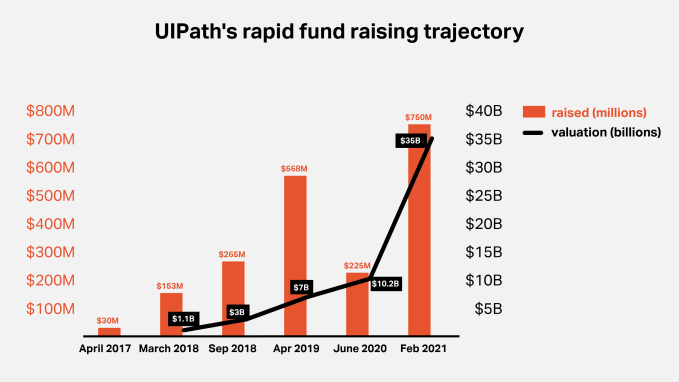
Then the company took off with increasingly large multi-billion dollar valuations. It progressed through its investment rounds, culminating with a $750 million round on an eye-popping $35 billion valuation last month.

This morning, the company took the next step on its rapid-fire evolutionary path when it filed its S-1 to go public. To illustrate just how fast the company’s rise has been, take a look at its funding history:

Chart illustrating rapid rise of UIPath through its funding rounds from 2017-2021

Image Credits: Bryce Durbin/TechCrunch

RPA is much better understood these days with larger enterprise software companies like SAP, Microsoft, IBM and ServiceNow getting involved. With RPA, companies can automate a mundane process like processing an insurance claim, moving work automatically, while bringing in humans only when absolutely necessary. For example, instead of having a person enter a number in a spreadsheet from an email, that can happen automatically.

In June 2019, Gartner reported that RPA was the fastest growing area in enterprise software, growing at over 60% per year, and attracting investors and larger enterprise software vendors to the space. While RPA’s growth has slowed as it matures, a September 2020 Gartner report found it expanding at a more modest 19.5% with total revenue expected to reach $2 billion in 2021. Gartner found that stand-alone RPA vendors UIPath, Blue Prism and Automation Anywhere are the market leaders.

Although the market feels rather small given the size of the company’s valuation, it’s still a nascent space. In its S-1 filing this morning, the company painted a rosy picture, projecting a $60 billion addressable market. While TAM estimates tend to trend large, UIPath points out that the number encompasses far more than pure RPA into what they call ‘Intelligent Process Automation.’ That could include not only RPA, but also process discovery, workflow, no code development and other forms of automation.

Indeed, as we wrote earlier today on the soaring process automation market, the company is probably going to need to expand into these other areas to really grow, especially now that it’s competing with much bigger companies for enterprise automation dollars.

While UIPath is in the midst of its quiet period, it came up for air this week to announce that it had bought Cloud Elements, a company that gives it access to API integration, an important component of automation in the enterprise. Daniel Dines, the company co-founder and CEO said the acquisition was about building a larger platform of automation tools.

“The acquisition of Cloud Elements is just one example of how we are building a flexible and scalable enterprise-ready platform that helps customers become fully automated enterprises,” he said in a statement.

While there is a lot of CEO speak in that statement, there is also an element of truth in that the company is looking at the larger automation story. It can use some of the cash from its prodigious fundraising to begin expanding on its original vision with smaller acquisitions that can fill in missing pieces in the product road map.

The company will need to do that and more to compete in a rapidly moving market, where many vendors are fighting for different parts of the business. As it continues its journey to becoming a public company, it will need to continue finding new ways to increase revenue by tapping into different parts of the wider automation stack.

News: Headless commerce startup Swell raises $3.4M

While new headless commerce platforms are emerging all the time, Swell CEO Eric Ingram told me that it remains “really hard to do something new in e-commerce.” Specifically, he told me that most headless platforms (which offer back-end infrastructure separate from the front-end shopping experience) allow businesses to build a faster shopping experience, but they’re

While new headless commerce platforms are emerging all the time, Swell CEO Eric Ingram told me that it remains “really hard to do something new in e-commerce.”

Specifically, he told me that most headless platforms (which offer back-end infrastructure separate from the front-end shopping experience) allow businesses to build a faster shopping experience, but they’re largely designed for marketplaces where you search, browse and purchase from a traditional product catalog.

“The most interesting ideas in e-commerce aren’t just another catalog,” Ingram said.

Swell, which is announcing that it has raised $3.4 million in seed funding, was designed to offer more flexibility when it comes to the underlying business models. Ingram (who founded the company with Stefan Kende, Dave Loneragan, Joshua Voydik and Mark Regal) described it as the “future-proof backend” for e-commerce companies, which can grow and adapt with them as their business models evolve.

“Typical catalogs” have been built on the platform, he said, but it also supports Spinn‘s marketplace of independent coffee roasters, B2B vacuum pump marketplace Nowvac and ethical direct-to-consumer diamond retailer Great Heights.


In fact, Voydik described Swell as “infinitely flexible.” Among other things, the company says it achieves this flexibility by offering API access to every component, as well as native subscription support and an unlimited number of product attributes.

“Every store on Swell effectively has their own database SaaS platform,” Ingram added.

Overall, he said the platform offers the flexibility that you’d normally get from an open source approach without the technical headaches: “No one wants to maintain their own code base and their own database.”

He continued, “You don’t need to be technical, you don’t need to have developers to leverage this. A lot of our customers are developers, but a lot of them are just regular marketers and ops people who know a bit of development concepts and want to have control over the systems.”

The startup’s new funding was led Jim Andelman of Bonfire Ventures, with participation from Willow Growth Partners, Andreas Klinger of Remote First Capital, Vercel CEO Guillermo Rauch, GitHub CTO Jason Warner and former Salesforce Commerce Cloud CTO Mike Micucci.

News: UiPath’s IPO filing suggests robotic process automation is booming

UiPath added its name to the list of companies pursuing public-market offerings with the release of its S-1, which details a quickly growing software company with sharply improving profitability.

Robotic process automation platform UiPath added its name to the list of companies pursuing public-market offerings this morning with the release of its S-1 filing. The document details a quickly growing software company with sharply improving profitability performance. The company also flipped from cash burn to cash generation on both an operating and free-cash-flow basis in its most recent fiscal year.

Companies that produce robotic process automation (RPA) software help enterprises reduce labor costs and errors. Instead of having a human perform repetitive tasks like data entry, processing credit card applications and scheduling cable installation appointments, RPA tools employ software bots instead.

The phrase that matters most when digesting this IPO filing is operating leverage, what Investopedia defines as “the degree to which a firm or project can increase operating income by increasing revenue.” In simpler terms, we can think of operating leverage as how quickly a company can boost profitability by growing its revenue.

The greater a company’s operating leverage, the more profitable it becomes as it grows its top line; in contrast, companies that see their profitability profile erode as their revenue scales have poor operating leverage.

Among early-stage companies in growth mode, losing money is not a sin — after all, startups raise capital to deploy it, often making their near-term financial results a bit wonky from a traditionalist perspective. But for later-stage companies, the ability to demonstrate operating leverage is a great way to indicate future profitability, or at least future cash-flow generation.

So, the UiPath S-1 filing is at once an interesting picture of a company growing quickly while reducing its deficits rapidly, and a look at what a high-growth company can do to show investors that it will, at some point, generate unadjusted net income.

There are caveats, however: UiPath had some particular cost declines in its most recent fiscal year that make its profitability picture a bit rosier than it otherwise might have proven, thanks to the COVID-19 pandemic. This morning, now that we’ve looked at the big numbers, let’s dig in a bit deeper and learn whether UiPath is as strong in operating leverage terms as a casual observer of its filing might guess.

And then we’ll dig into four other things that stuck out from its IPO filing. Into the data!

Operating leverage, cost control and COVID-19

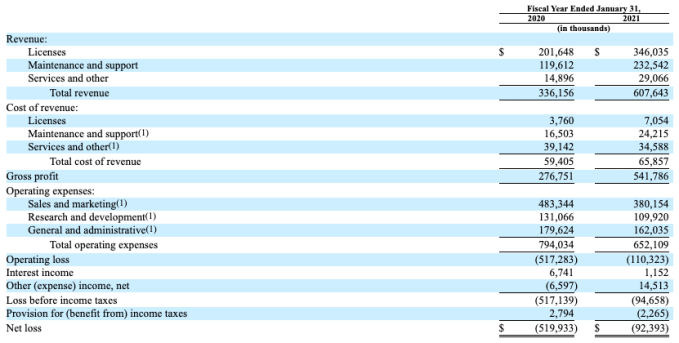
To avoid forcing you to flip between the filing and this piece, here’s UiPath’s income statement for its fiscal years that roughly correlate to calendar 2019 and calendar 2020:

From top-down, it’s clear UiPath is growing rapidly. And we can see that its gross profit grew more quickly than its overall revenue in its most recent 12-month period. As you can imagine, that combination led to rising gross margins at the company, from 82% in its fiscal year ending January 31, 2020, to 89% in its next fiscal year.

That’s super good, frankly; given that UiPath has a number of business lines, including a services effort that doubled in size during its most recent 12 months of operations, you might expect its blended gross margins to fade. They did not.

But it’s the following section, the company’s cost profile, that leads us to our first real takeaway from the UiPath S-1:

UiPath’s operating leverage looks good, even if COVID helped

Every operating expense category at the company fell from the preceding fiscal year to its most recent. That’s an impressive result, and one that is key when it comes to understanding where UiPath’s recent operating leverage came from. But how the declines came to be is just as important to understand.

News: Last chance to save on dual-event passes to Early Stage 2021

Procrastinators, last-minute decision makers and overwhelmed entrepreneurs heed this call! Your last chance to save $100 or more and attend both TechCrunch Early Stage 2021 bootcamps expires tonight! You’re dedicated to learning the essentials of building a solid early-stage startup, yes? That’s exactly what you’ll get at TC Early Stage 2021 (Operations & Fundraising: April

Procrastinators, last-minute decision makers and overwhelmed entrepreneurs heed this call! Your last chance to save $100 or more and attend both TechCrunch Early Stage 2021 bootcamps expires tonight! You’re dedicated to learning the essentials of building a solid early-stage startup, yes?

That’s exactly what you’ll get at TC Early Stage 2021 (Operations & Fundraising: April 1-2 and Marketing & Fundraising: July 8-9). Buy a dual-event pass before the early-bird deadline: Tonight, March 26 at 11:59 pm (PST). Save up to $100 and keep more feathers in your nest.

The two TC Early Stage conferences present distinct experiences — different topics, speakers, subject-matter experts and presentations. They’re highly interactive discussions, so come ready to ask questions. Don’t let qualms about virtual event quality hold you back. Here’s what Chloe Leaaetoa, the founder of Socicraft, had to say about her virtual experience.

“I wondered whether TC Early Stage 2020 was going to be just another virtual online class — long on PowerPoints and short on useful information. But it was engaging and interactive with lots of information I could implement right away.”

Here’s a quick look at what’s on tap in April. Check out the full agenda — with more than 20 presentations. Thanks to video on demand, you can catch sessions you missed after the conference ends with your complementary Extra Crunch membership with ticket purchase. We’ll have more news about the experts and topics for the July TC Early Stage soon.

How to Get an Investor’s Attention

Marlon Nichols is an expert in early-stage investments, having invested in countless successful ventures such as Gimlet Media, MongoDB, Thrive Market, PlayVS, Fair, Wonderschool and Finesse. He’ll speak on how to get noticed by investors, how to grow your business and how to survive in the crowded, competitive space of tech startups. He will provide insights on how to network, craft a great pitch and target the best investors for your success.

10 Things NOT To Do When You Are Starting a Company

With voices across the internet giving their two cents on how to run a great business, Fuel Capital’s Leah Solivan, who was CEO at TaskRabbit for 8 years, will share a list of things that a founder should NOT do. Avoid the pitfalls that could break your momentum or, worst case, your company and ask Solivan your own questions.

Don’t miss the special breakout sessions or, on day two, the TC Early Stage Pitch-Off. TechCrunch selected 10 early-stage startups to present their best pitch to a panel of VCs on April 2. We’ll open applications to compete in July soon, so keep checking back if you want a chance to practice your pitch and gain extra exposure for your startup.

Stop procrastinating and jump on this opportunity to double your knowledge and build a stronger startup. Buy your dual event pass to TC Early Stage 2021 and save $100 or more — but only if you beat the deadline: Tonight, March 26 at 11:59 pm (PST).

News: WeWork lines up for a second run at the public markets

At this point, if you aren’t going public via a direct listing, traditional IPO or SPAC, are you even a growthy business?

At this point, if you aren’t going public via a direct listing, traditional IPO or SPAC, are you even a growthy business?

Every CEO I talk to at a startup that’s doing more than Series B-level revenue tells me that SPACs are circling, hungry for a deal so they won’t have to return collected capital to their original backers. There’s an old joke: If all you have is a hammer, everything looks like a nail. Except this time, if all you have is a blank-check company, every erstwhile startup looks like a public company in waiting.


The Exchange explores startups, markets and money. Read it every morning on Extra Crunch, or get The Exchange newsletter every Saturday.


Enter WeWork. Yes, the company famous for torching a mountain of cash that would rival the Ever Given in sheer bulk is going public via a SPAC. This morning we’re going through its investor presentation, asking ourselves questions like, “Is this as nasty a business as it was a few years ago?” and “Why, oh God, why do we have to talk about WeWork again?”

But that’s not all. Axios, the rare media startup that appeared positioned for a good run, could merge with The Athletic and go public via a SPAC. At least per WSJ reporting.

It’s possible to summon arguments in favor of the deal. The Athletic has what Axios lacks and vice versa, so perhaps combining the former’s subscription base with the newsletter-and-ads prowess of the latter would make for an attractive company. Maybe.

But the main gist of this morning is that private investors in companies of all stripes are trying to get their money out while it’s still possible. That’s why we’ve seen eleventy-seven LIDAR and electric-vehicle SPACs. These aren’t usually companies that are ready to go public; they’re companies with investors that are ready to cash out.

The same momentum applies to the WeWork deal and the possible Axios combo-and-SPAC, I reckon.

Today, greed isn’t really good, to quote an old movie. It’s been good for so long among the tech-and-money class that quoting a film about a corrupt financier is too boring to warrant even warmed-over ennui. Instead, greed is god, and we’re all watching its ascension.

Now let’s digest the latest sacrifices.

WeWork

First, is WeWork a recovered company that has shown an ability to grow while losing less money? Not really.

WordPress Image Lightbox Plugin