
Tag Archives: Blog

News: Google Nest Hub 2 review: The solid smart screen adds sleep tracking

Two-and-a-half years later, the Nest Home Hub remains one of my favorite smart screens on the market. Maybe that’s a commentary on the rate of improvement in the category, or maybe Google just got things pretty right the first time out. It remains one of the best-looking products on the market, built from solid but

Two-and-a-half years later, the Nest Home Hub remains one of my favorite smart screens on the market. Maybe that’s a commentary on the rate of improvement in the category, or maybe Google just got things pretty right the first time out. It remains one of the best-looking products on the market, built from solid but understated material. The size is right and Google clearly put a lot of thought into the functionality.

Of course, these consumer electronics have spent a few decades training us to expect big, annual updates to product categories (gotta keep that demand up). By that measure, the second-gen device is something of a disappointment. There’s not really a lot new here. The product now does sleep tracking and the speaker’s bass is a bit more full. And that’s honestly pretty much it.

Perhaps the most fascinating thing about the new version is how Google’s engineers worked within their own self-imposed limitations. I recall very distinctly seeing original Google Home Hub at a pre-release event and asking the company about the decision not to include a camera. Surely companies like Google and Amazon were committed to collecting as much information as possible on devices like these.

Image Credits: Brian Heater

I gave the company kudos at the time for keeping the camera off the device — and I’m happy to say it continued to do so with gen 2 (of course, that was made easier with the subsequent release of the camera-sporting Nest Hub Max). And I have to say, having tested the new Echo Hub, which actually physically moves to follow you around the room, only cemented my appreciation of the intentional omission.

That decision was, no doubt, an integral part of why the Nest Hub has become a popular bedside device. Most of us don’t want a camera trained on us while we sleep and do…all of the other things people do in bed (eat crackers, watch scary movies, etc.).

Designing a second-generation version of what has become a popular bedside product made sleep tracking a no brainer. But there’s a problem: A camera seems like a pretty obvious way to do sleep tracking. But adding a camera would almost certainly make people less inclined to invite the product into their bedrooms. So, what do you do? If you’re lucky, you find a technology lying around that some company spent a bunch of money on, but ultimately had no idea what to do with.

So, what are the odds of something like that happening? If you’re Google, surprisingly high, it turns out.

Project Soli is one of those weird Google anomalies. It was a cool technology in search of a problem. The initial problem the team designated was, I suppose, that we touch our touchscreens too much. So it built the tech into the Pixel 4, allowing users to interact with a bespoke Pokémon game and a few other things. By the time the Pixel 5 rolled around, the technology was basically forgotten.
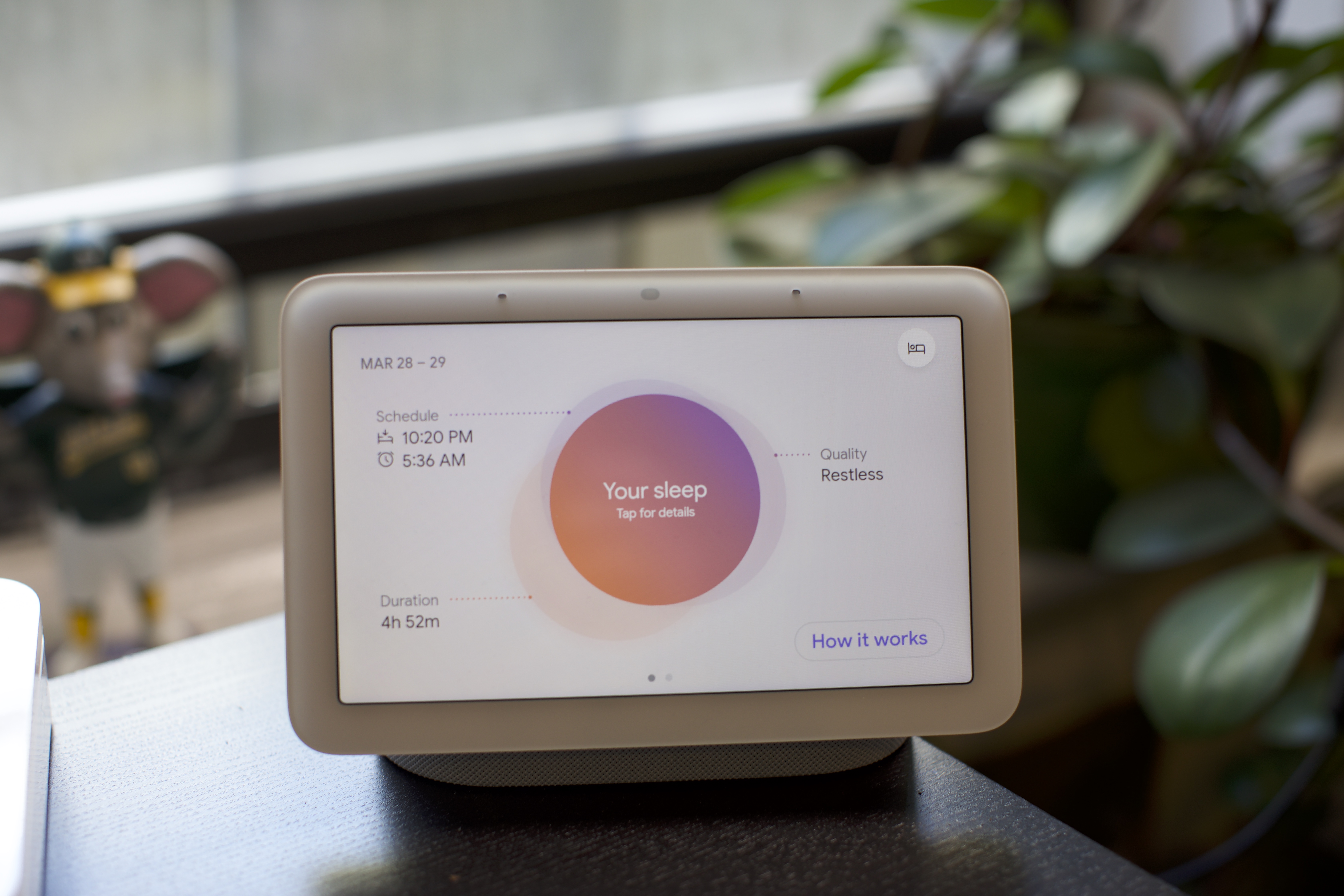
Image Credits: Brian Heater

On the face of it, camera-free sleep tracking is a much more logical implementation of the Soli tech (assuming you can get around the initial strangeness of having essentially miniature radar in the electronic device sitting next to your bed). Here’s the breakdown from Google’s product page:

Sleep Sensing uses Motion Sense to track the sleep of the person closest to the display. With a low-energy radar, Motion Sense detects movement and breathing. Other sensors in Nest Hub detect sounds like snoring and coughing, and environmental factors like light and temperature in the room. That’s how Sleep Sensing determines not just when you went to bed and how long you slept, but also the quality of your sleep.

Certainly the inclusion of sleep tracking doesn’t make the product unique among consumer electronics. It seems like every company is racing to get into sleep — understandably so. Most of us aren’t getting anywhere near enough — a trend that dates back well before COVID-19 made insomniacs out of many of us. What makes the product relatively unique, however, is that it promises to do so without making contact with either you or the bed.

As someone who has tested dozens of fitness trackers and smartwatches over the years, I can attest that sleeping with a wearable around your wrist kind of sucks. I mean, I have enough trouble getting to sleep without one on (if I didn’t, I probably wouldn’t be that interested in sleep tracking in the first place).

For my money, if you’re looking for a pure sleep tracker, I would however, take a look at something like Withings Sleep Tracking Mat, which sits under your mattress. It’s minimally invasive and doesn’t require having a screen near your bed. I can’t recommend the new Nest Hub based purely on sleep tracking, but if you were already considering sticking a smart display next to your bed, this makes one of the best models on the market that much more compelling.

Image Credits: Brian Heater

One of the downsides of the Soli tracking is that there isn’t a ton of flexibility in where you can put the device. I don’t presently have a nightstand, for instance, so I had to improvise with a chair for testing. The device needs to be on the side of the bed (not the head or foot) and level with you on the mattress. The screen should be about one or two feet from you while you sleep.

There’s a calibration process, too, though it’s quite quick and you only really need to do it the once, assuming you’re not going to be moving the product around. This was the one time I found myself missing one of the Echo Show’s new features: specifically, a screen that you can manually tilt up and down. It would be a great feature to see in all of the products, going forward.

I’ve been using the sleep tracking for several nights now and have found it pretty accurate — particularly for a product that sits a couple of feet away from the edge of my bed. (Spoiler: I sleep like crap). The on-board wellness feature drills down on the information, as well. In addition to standard info like duration and overall quality, it will tell you how many times you coughed in the night, how many minutes you spent snoring and what your average respiratory rate was throughout the night.

Other info is available, including room temperature (which utilizes a still relatively underused built-in thermometer) and sleep quality, broken down by wake/sleep/restlessness. It’s fairly basic, and it will be interesting to see how much detail the company is ultimately able to drill down on with the given hardware. Given the focus on respiratory health, sleep apnea seems like a no-brainer, but that will likely require some updates, coupled with regulatory scrutiny.
Image Credits: Brian Heater

It seems that, as far as sleep is concerned, there’s likely a good deal of room for improvement using the existing hardware. That’s doubly the case, now that Google’s Fitbit acquisition has officially closed. Expect some tighter integration on that front. For now, there’s still some thoughtful sleep integration with things like wake alarms and bedroom smart light functionality.

At $99, Google’s dropped the asking price by a full $50, which certainly softens the blow of what is ultimately a fairly minor update. Two and half years after its introduction, the Nest Hub is still one of the best smart screens you can buy, bolstered by Google’s solid Assistant and software offerings. The new version wouldn’t be the first on my list of sleep trackers, but if you’re looking for a beside smart display/alarm clock, it’s a nice bonus.
News: Hyundai IONIQ 5 will be Motional and Lyft’s first robotaxi

Motional will integrate its driverless technology into Hyundai’s new all-electric SUV to create the company’s first robotaxi. At the start of 2023, customers in certain markets will be able to book the fully electric, fully autonomous taxi through the Lyft app. The Hyundai IONIQ 5, which was revealed in February with a consumer release date

Motional will integrate its driverless technology into Hyundai’s new all-electric SUV to create the company’s first robotaxi. At the start of 2023, customers in certain markets will be able to book the fully electric, fully autonomous taxi through the Lyft app.

The Hyundai IONIQ 5, which was revealed in February with a consumer release date expected later this year, will be fully integrated with Motional’s driverless system. The vehicles will be equipped with the hardware and software needed for Level 4 autonomous driving capabilities, including LiDAR, radar and cameras to provide the vehicle’s sensing system with 360 degrees of vision, and the ability to see up to 300 meters away. This level of driverless technology means a human will not be required to take over driving.

The interior living space will be similar to the consumer model, but additionally equipped with features needed for robotaxi operation, according to a Motional spokesperson. Motional did not reveal whether or not the vehicle would still have a steering wheel, and images of the robotaxi aren’t yet available.

Motional’s IONIQ 5 robotaxis have already begun testing on public roads and closed courses, and they’ll be put through more months of testing and real-world experience before being deployed on Lyft’s platform. The company says it’ll complete testing only once it’s confident that the taxis are safer than a human driver.

Motional, the Aptiv-Hyundai $4 billion joint venture aimed at commercializing driverless cars, announced its partnership with Lyft in December, signaling the ride-hailing company’s primary involvement in Motional’s plans. The company recently announced that it began testing its driverless tech on public roads in Las Vegas. Hyundai’s IONIQ 5 is Motional’s second platform to go driverless on public roads.

News: Last two crewmembers named for SpaceX’s first all-civilian human spaceflight mission

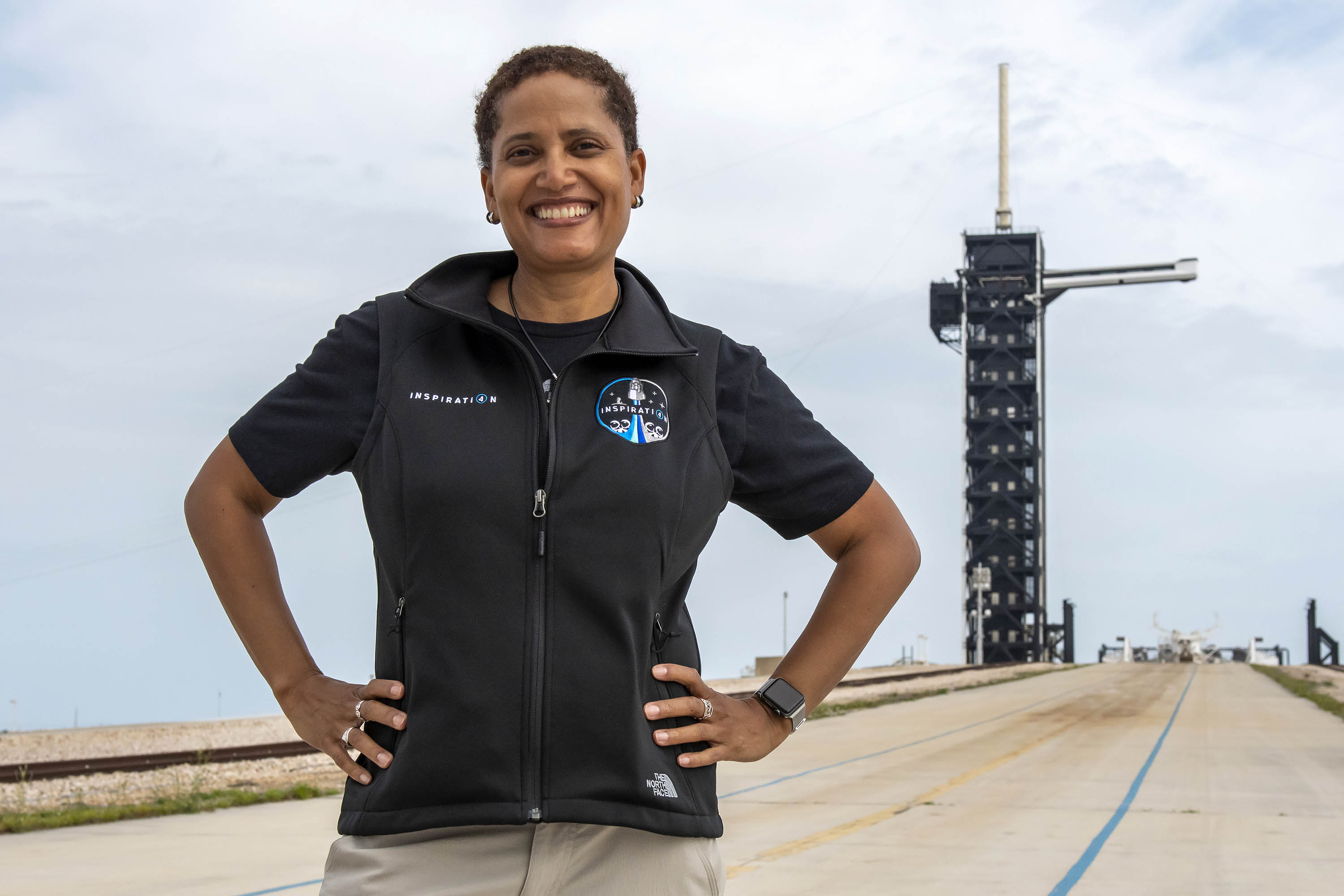
We now know the names of all four individuals who will fly on the historic Inspiration4 mission, the first all-civilian spaceflight in history. In addition to previously revealed crew members Jared Isaacman (who’s footing the entire bill) and St. Jude Children’s Hospital employee Haley Arceneaux, Inspiration4 will include Dr. Sian Proctor and Christopher Sembroski as

We now know the names of all four individuals who will fly on the historic Inspiration4 mission, the first all-civilian spaceflight in history. In addition to previously revealed crew members Jared Isaacman (who’s footing the entire bill) and St. Jude Children’s Hospital employee Haley Arceneaux, Inspiration4 will include Dr. Sian Proctor and Christopher Sembroski as the final two civilian astronauts. The mission will use a SpaceX Dragon capsule and is set to fly no earlier than September 15, with a total duration of three days.

Dr. Proctor takes the state reserved for the online business competition portion of the crew selection process, which saw entrants taken from submissions based on people who had created businesses on Isaacman’s Shift4Shop e-commerce platform. Sembroski won his seat by contributing to the ongoing St. Jude fundraising drive Isaacman is hosting as part of the mission’s promotional campaign.

Inspiration4 crew member Dr. Sian Proctor

Both Proctor and Sembroski have specific sets of skills relative to spaceflight that seem likely to have factored Ito their selection for the crew. Proctor is a trained pilot, for instance, and Sembroski is a veteran aerospace employee, most recently at Lockheed Martin, and also a literal veteran, having served in the U.S. Air Force.

Inspiration4 crew member Christopher Sembroski

As part of this final crew reveal, Inspiration4 also shared how many entries it received in each category. Somewhat surprisingly, the Shift4Shop e-commerce platform competition only drew a total of “approximately” 200 entries — and use of ‘approximately’ suggests fewer — while the charity drive drew 72,000 entries, and has raised around $113 million to date. That’s still short of the campaign’s $200 million goal, and includes Isaacman’s personal commitment of $100 million, but the drive continues and there are additional awards to be one, even if the top prize of the trip to space is gone.

This whole mission campaign has honestly been one of the most bizarre stories in spaceflight in recent memory, beginning with the big announcement, which included a press conference with SpaceX CEO Elon Musk joining Isaacman to discuss the flight, and seemingly not being aware of any relevant details about mission specifics. Isaacman also dedicated $100 million of his own money to the charity drive for St. Jude, as mentioned, but clearly donations from the community aren’t living up to expectations with around 13% of the total target raised from those to date.

That “approximately 200” entries in the Shift4Payments build-a-business competition might be the most perplexing, since the award was a free trip to space. In retrospect, this seems like it was the path to space with the most likelihood of working out, even if you had to convince an oddly stunt cast panel of judges to select yours as the winner.

News: LinkedIn adds Creator mode, video profiles, and in partnership with Microsoft, new career training tools

LinkedIn, the social network now with 740 million users around the world, has carved out an identity for itself as the place online where professionals go to list their places of work, get headhunted for other work, and look for work. But for years it’s been looking for ways to better leverage that position to

LinkedIn, the social network now with 740 million users around the world, has carved out an identity for itself as the place online where professionals go to list their places of work, get headhunted for other work, and look for work. But for years it’s been looking for ways to better leverage that position to move into a plethora of adjacent areas, such as training and education, professional development, networking with others, and news. Today, the company unveiled a series of new features that it will be rolling out over the coming months to play into that strategy, and also, it hopes, increase engagement on the platform:

— The company is bringing more video into people’s profiles, with the launch of a “video Cover Story”, short videos that people can make talking about themselves to live on their home pages. And for people to feel more connected with how they are depicted on LinkedIn, it is also adding a pronoun feature.

— Alongside these, the company is officially launching a new “Creator” mode, a more refined but also more democratic version of the company’s Influencer network (anyone can be a Creator if they so choose, for a start). It’s also carving out more of a solid place for freelancers on the platform, by way of a new Service page attached to your profile.

— LinkedIn’s educational and training efforts are also getting some boost. The program was originally launched in June 2020 in the wake of the economic shift that Covid-19 brought on the world with Microsoft, which owns LinkedIn, to offer free online training in 10 different professional areas. Now that program is getting extended to the end of this year. The move comes as the companies passed 30 million people in 249 countries using the training service. LinkedIn and Microsoft now hope that the number of companies hiring via the program will reach 250,000.

In another team-up with Microsoft, LinkedIn is also announcing a new Teams-based app called Career Coach aimed at students that use Teams. Using AI tools from LinkedIn, the Career Coach helps its users identify what they are interested in and might like to pursue as a profession, and it uses links through to LinkedIn and Microsoft’s learning content that could help with that journey.

Taken together, this seemingly disparate set of announcements all lean into an interesting development for LinkedIn. Social media — whether you are a person posting content, or simply looking at posts from others that you feel speak to your situation in life — has a strong undercurrent of individual empowerment throughout it. Through these different features and products, LinkedIn is trying in its own way to bring some of that individual identity, voice, and self-advancement, through to its own platform.

Below are some more detailed thoughts about the various new areas.

The video-based Cover Story plays on the idea of how people create short videos about themselves that they might post as a status on a more consumer-focused social media platform. If the list of places where you work and have worked or studied tell one kind of story about who you are, the idea is that the video selfie can tell another to fill in more gaps.

As LinkedIn’s chief product officer Tomer Cohen describes it, you can use the space to give yourself a more human angle, describing something about your interests or aspirations that might not come across in your resume. These also auto play when people come to visit your profile, which Cohen aptly refers to as a “Harry Potter” effect, in reference to the animated Daily Prophet newspaper in the wizarding world. For now these will only appear in your profile, but in time the animals may also expand to search results.

It all sounds interesting enough, except that it relies quite a lot on people using the format successfully rather than creating something that might actually deter recruiters. Ironically, if the trend is to remove some of what might profile and pigeonhole people too much when job-hunting, adding in these videos could serve to bring some of that kind of judgement back into play. It will depend on how they are adopted and used and viewed, at the end of the day.

LinkedIn’s focus on video comes as part of the company’s bigger engagement with the medium over the last several years, adding services like Live broadcasts into the timeline for example. It’s no surprise, considering how sticky video has been in the bigger realm of social media across services like TikTok, Snapchat, Facebook and Twitter.

That seems to also be playing out at LinkedIn and areas that align more closely with the company’s business: it said in a survey it conducted, some 61% of job seekers said that recorded video could be the next iteration of the traditional cover letter, and that among hiring managers, nearly 80% say video figures strongly in their candidate vetting. So it’s not a matter of testing the waters, but perhaps just making sure you have the tools to stay afloat.

Video is playing a bigger role beyond just that of helping everyone with profiles. For the most proactive, LinkedIn is launching a Creator mode, where people who already make LinkedIn Live videos and other content can shift over their profiles to becoming Creators instead of ordinary LinkedIn citizens. This is something you choose yourself, unlike the Influencer tag that LinkedIn confers on a smaller subset of thought leaders, and it means you can be “followed” on LinkedIn for people to watch and stay up to date with what you post.

While it’s hard to think of who might come to LinkedIn for entertainment in the same way that they might come to Instagram to follow a creator, the idea is that creating content for LinkedIn becomes the end in itself for both the person watching and the person being watched.

It looks like the natural progression of the original content that LinkedIn has been building up through its editorial operation led by Dan Roth — indeed the company announced the first steps for its Creator product last month, led by Roth. But unlike creators on platforms like Instagram or YouTube or TikTok, for now it doesn’t look like there are direct routes to monetization when you are a LinkedIn Creator. That might change, however.

“Indirectly we’ve been connecting people to opportunities since we first enabled people to share content on LinkedIn.  Our members get leads and grow their business and following on LinkedIn,” said Keren Baruch, group product manager for LinkedIn’s creator strategy. She cited Quentin Allums, “jobless, broke, and desperate when he started posting LinkedIn videos. Then they started to go viral and he created his own business on LinkedIn from this success.

“As we continue to listen to feedback from our members as we consider future opportunities, we’ll also continue to evolve how we create more value for our creators,” she added.

The Service Pages also appear to be something that is the start of a product and project that LinkedIn started to seed in February, which will comprise a larger freelancer marketplace, reportedly by September.

As you can see, this seems to be a baby step: no links through to setting up payments or handling anything like that, and LinkedIn itself is not making a cut, as Fiverr or Freelancer.com might make from giving people a platform to generate business for themselves. For now, it could be just a way of testing the waters and getting some people to populate the site with credentials but further down the line could represent an interesting inroad into a new kind of advertising unit or payment services alongside the revenue-generating features that LinkedIn already has in the form of premium subscriptions, tools for recruiters and other kinds of advertising.

Lastly, given that LinkedIn has made such a big push into trying to democratize opportunity on the platform, providing a link for freelancers to post on its platform might also interestingly might open the door to more than just the knowledge workers and their skills. These currently form the majority of users of LinkedIn but are clearly not the entirety of the working world that the company hopes to address and serve in the longer term.

News: Weather platform ClimaCell is now Tomorrow.io and raises $77M

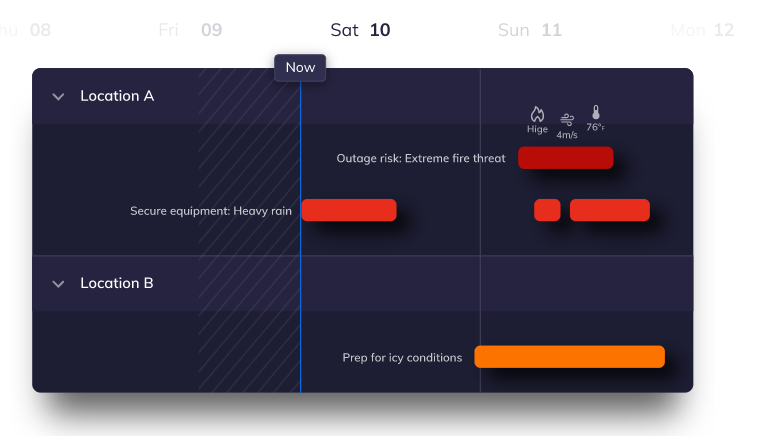
Weather intelligence platform ClimaCell today announced that it has raised a $77 million Series D funding round led by private equity firm Stonecourt Capital, with participation by Highline Capital. This brings the company’s total funding to about $185 million. In addition to the new funding, ClimaCell announced that it has changed its name to Tomorrow.io,

Weather intelligence platform ClimaCell today announced that it has raised a $77 million Series D funding round led by private equity firm Stonecourt Capital, with participation by Highline Capital. This brings the company’s total funding to about $185 million. In addition to the new funding, ClimaCell announced that it has changed its name to Tomorrow.io, with “The Tomorrow Companies Inc.” as its new legal name.

Today’s announcement comes only a month after the company announced that it would launch a fleet of small radar-equipped weather satellites to improve its weather monitoring and forecasting capabilities. That’s also, at least in part, where the name change comes from.

Image Credits: ClimaCell/Tomorrow.ai

Originally, ClimaCell/Tomorrow.io built out a novel technology to collect weather data using wireless network infrastructure and IoT devices. That’s where the “cell” in ClimaCell came from. But as the company’s CEO and co-founder Shimon Elkabetz told me, while the company isn’t abandoning this approach, its focus today is much broader.

“The mission is really to help countries, businesses, organizations, to better manage their weather-related challenges,” he said. “And the ambition was always to be that largest weather enterprise in the world, the most disruptive, the most industry-defining. And I think this is the perfect timing for us to come up with a new name, not only because of the funding but because we were able to explain to ourselves that really, we’re helping others take control of tomorrow, today.”

That’s something Stonecourt partner Rock Davis agrees with. “While the company’s growth has been tremendous since launch, there is a larger opportunity at play here,” he said. “What Tomorrow.io is building, corroborated by their recent announcement of launching radar-equipped satellites into space, is only further proof that this company represents the future of weather forecasting for the entire planet. The privatization of the weather industry is now, and that type of vision is what compels the team here at Stonecourt Capital.”

As Elkabetz noted, Tomorrow.io isn’t a typical investment for a private investment firm like Stonecourt. Last year, the firm acquired 365 Data Centers, but it is also backing the Denver-based freight rail company Alpenglow Rail, for example.

And while many of Tomorrow.io’s customers saw their business decline during the pandemic (the company counts Uber and Delta among its users, for example), Elkabetz tells me that its team focused on diversifying its customer base and managed to sign up a number of large logistics companies, including major railways in the U.S. and Mexico, but also smaller companies in the drone, autonomous driving and electric vehicle space. In total, the company says, it saw a 200% net revenue retention rate and its annual contract value grew 850% during the past two years.

The company plans to use the new funding to launch more satellites, but also to improve its overall product and accelerate its go-to-market activities.

“We’re an interesting company because we’re a SaaS company that is now going to space,” Elkabetz said. “A lot of the Earth observations companies are now scratching their heads and saying, ‘Oh, we can’t just sell observations, it’s not monetizable or becoming a commodity. We now need to become a software company and build the platform and do the analytics.’ Good luck.”

News: Virgin Galactic debuts its first third-generation spaceship, ‘VSS Imagine’

Commercial human spaceflight company Virgin Galactic has unveiled the first ever Spaceship III, the third major iteration of its spacecraft design. The first in this new series is called ‘VSS (Virgin SpaceShip) Imagine,’ and will start ground testing now with the aim of beginning its first glide flights starting this summer. VSS Imagine has a

Commercial human spaceflight company Virgin Galactic has unveiled the first ever Spaceship III, the third major iteration of its spacecraft design. The first in this new series is called ‘VSS (Virgin SpaceShip) Imagine,’ and will start ground testing now with the aim of beginning its first glide flights starting this summer. VSS Imagine has a snazzy new external look, including a mirrored wraparound finish that’s designed to reflect the spacecraft’s changing environment as it makes its way from the ground to space — but more importantly, it moves Virgin Galactic closer to achieving the engineering goals it requires to produce a fleet of spacecraft at scale.

I spoke to Virgin Galactic CEO Michael Colglazier about VSS Imagine, and what it represents for the company.

“We can build these at a faster pace,” he explained. “These are still relatively slow, versus what we want in our next class of spaceships. But what we do expect to have here is, we’ve taken all the learnings from [VSS] Unity, and built-in what we need to do so that we can turn these ships at a faster pace, because obviously, the number of flights we can do is the product of how many ships you have, and how quickly you can turn them.”

Unlike Unity, which is the spacecraft that Virgin Galactic first flew in September 2016, and that it ‘s still using in New Mexico now for its testing and commercial launch preparation program, Imagine has a “modular design” that makes it much easier to maintain, and increases the rate at which it can fly subsequent missions. As Colglazier mentioned, there’s still more work to be done in that regard to get the Spaceship design to the point where it’s able to support the company’s target of around 400 flights per year, per individual spaceport, but it’s a big upgrade, and the company is already beginning manufacturing work on a second Spaceship III-class vehicle, ‘VSS Inspire.’

Image Credits: Virgin Galactic

Imagine and Inspire are technical achievements, to be sure, but Colglazier, who came to Virgin Galactic from Disney Parks International in July 2020, also emphasized the importance of this spacecraft debut in terms of the company’s consumer brand.

“What you’re seeing in the images, the choice of the livery, the film that we’ve put out, is a very clear step, as a consumer brand launch, and as we’re stepping in and building that, that will build over the course of the summer as we build up towards Richard [Branson]’s flight,” he said. “Very purposefully, we’ve used these lofty words of ‘democratizing space’ — but space is meant for everyone. It may take a while, just for everyone to get there, but it’s coming. And so this was leading with a very consumer facing, ‘Why are we doing this?’”

In fact, that focus on the consumer side of the business has been a lot of Colglazier’s work over the past eight months since joining the company. He said that the Virgin Galactic he joined had a “world-class team” that had the aerospace pieces completely locked in, but that his particular contribution has been in building up the commercial side of the business to match.

“We’re now bringing some talent in that is used to scaling this kind of a business, so Swami Iyer actually started Monday of last week,” he said. “And when you see a guy like Joe Rohde, who came in on the experience side, there’s no replacement — that’s additive to building out now the shoulders around this experience.”

Iyer joined as President of Aerospace Systems, and brings years of experience in the commercial space and defense industry, across GKN Advanced Defernce Systems, Honeywell Aerospace and more. Rohde, on the other hand, boasts a very different background, as a longtime Disney Imagineer, who joins the company as its first ‘Experience Architect,’ focused squarely on defining what the Virgin Galactic experience is for its astronaut customers, their friends and family, and the broader public, too.

Colglazier said that their vision for what the experience will look like will also be different depending on what part of the world you’re flying from, noting that weather you fly from a spaceport in Europe, Asia, India or Australia should result in something “dramatically different,” even if the spacecraft themselves are all used in the same way as they are in New Mexico. That definitely seems like a logical approach from an executive whose prior experience includes leading Disney’s parks in Burbank, Paris, Hong Kong, Shanghai and Tokyo.

Image Credits: Virgin Galactic

In the end, Colglazier said that the core philosophy Virgin Galactic will pursue in terms of consumer brand will be one focused on inclusion, even if the actual ‘going to space’ part of its offering remains out of reach for most in the short term.

“This is for everyone, it has to be for everyone,” he said. That aspiration may take some number of years to actually be realized, but in the meantime, we have to find a way that our brand and our company can be accessed, that what we do can be accessed by all sorts of people at all different layers of engagement, so we’re going to be very purposeful about that. You’re going to hear us talking mostly about, effectively the apex experience — actually taking the new ships to space. But the ability to tier down out of that is really, really important, and the ability for us to be a brand that’s reaching out to everyone is incredibly important.”

That begins with the approach to this spacecraft debut today, Colglazier says, and is apparent in the tone of the video the company debuted (embedded above) to mark the reveal. And Virgin Galactic also still has 600 passengers booked and waiting for their own flights, so that’s obviously a key focus after Branson’s flight targeted for later this year.

Finally, I asked Colglazier when he himself intends to go up, since he said he definitely plans to when joining the company. Mostly, he said, he doesn’t want to cut in front of any paying customers.

“Okay, there are 600 or so people that are going to be a little ticked at me, if I jumped the line, so I’m going to keep focused at the consumer level,” he said. “But nobody else is in line yet, so I’m gonna get in before anybody else comes in line.”

News: HYCU raises $87.5M to take on Rubrik and the rest in multi-cloud data backup and recovery

As more companies become ever more reliant on digital infrastructure for everyday work, the more they become major targets for malicious hackers — both trends accelerated by the pandemic — and that is leading to an ever-greater need for IT and security departments to find ways of protecting data should it become compromised. Today, one

As more companies become ever more reliant on digital infrastructure for everyday work, the more they become major targets for malicious hackers — both trends accelerated by the pandemic — and that is leading to an ever-greater need for IT and security departments to find ways of protecting data should it become compromised. Today, one of the companies that has emerged as a strong player in data backup and recovery is announcing its first major round of funding.

HYCU, which provides multi-cloud backup and recovery services for mid-market and enterprise customers, has raised $87.5 million, a Series A that it the Boston-based startup will be using to invest in building out its platform further, to bring its services into more markets, and to hire 100 more people.

HYCU’s premise and ambition, CEO and founder Simon Taylor said in an interview, is to provide backup and storage services that are as simple to use “as backing up in iCloud for consumers.”

“If you look at primary storage, it’s become very SaaS-ifed, with no professional services required,” he continued. “But backup has stayed very legacy. It’s still mostly focused on one specific environment and can’t perform well when multi-cloud is being used.”

And HYCU’s name fits with that ethos. It is pronounced “haiku”, which Taylor told me refers not just to that Japanese poetic form that looks simple but hides a lot of meaning, but also “hybrid cloud uptime.”

The company is probably known best for its integration with Nutanix, but has over time expanded to serve enterprises building and operating IT and apps over VMware, Google Cloud, Azure and AWS. The company also has built a tool to help migrate data for enterprises, HYCU Protégé, which will also be expanded.

The funding is being led by Bain Capital Ventures, with participation also from Acrew Capital (which was also in the news last week as an investor in the $118 million round for Pie Insurance). The valuation is not being disclosed.

This is the first major outside funding that the company has announced since being founded in 2018, but in that time it has grown into a sizeable competitor against others like Rubrik, Veeam, Veritas and CommVault. The Rubrik comparison is interesting, given that it is also backed by Bain (which led a $261 million round in Rubrik in 2019). HYCU now has more than 2,000 customers in 75 countries. Taylor says that not taking funding while growing into what it has become meant that it was “listening and closer to the needs of our customers,” rather than spending more time paying attention to what investors says.

Now that it’s reached a certain scale, though, things appear to be shifting and there will probably be more money down the line. “This is just round one for us,” Taylor said.

He added that this funding came in the wake of a lot of inbound interest that included not just the usual range of VCs and private equity firms that are getting more involved in VC, but also, it turns out, SPACs, which as they grow in number, seem to be exploring what kinds and stages of companies they tap with their quick finance-and-go-public model.

And although HYCU hadn’t been proactively pitching investors for funding, it would have been on their radars. In fact, Bain is a major backer of Nutanix, putting some $750 million into the company last August. There is some strategic sense in supporting businesses that figure strongly in the infrastructure of your other portfolio companies.

There is another important reason for HYCU raising capital to expand beyond what its balance sheet could provide to fuel growth: HYCU’s would-be competition is itself going through a moment of investment and expansion. For example, Veeam, which was acquired by Insight last January for $5 billion, then proceeded to acquire Kasten to move into serving enterprises that used Kubernetes-native workloads across on-premises and cloud environments. And Rubrik last year acquired Igneous to bring management of unstructured data into its purview. And it’s not a given that just because this is a sector seeing a lot of demand, that it’s all smooth sailing. Igneous was on the rocks at the time of its deal, and Rubrik itself had a data leak in 2019, highlighting that even those who are expert in protecting data can run up against problems.

Taylor notes that ransomware indeed remains a very persistent problem for its customers — reflecting what others in the security world have observed — and its approach for now is to remain focused on how it delivers services in an agent-less environment. “We integrate into the platform,” he said. “That is incredibly important. It means that you can be up and running immediately, with no need for professional services to do the integrating, and we also make it a lot harder for criminals because of this.”

Longer term, it will keep its focus on backup and recovery with no immediate plans to move into adjacent areas though such as more security services or other tools. “We’re not trying to be a Veritas and own the entire business end-to-end,” Taylor said. “The goal is to make sure the IT department has visibility and the cloud journey is protected.”

Enrique Salem, a partner at Bain Capital Ventures and the former CEO of Symantec, is joining HYCU’s board with this round and sees the opportunity in the market for a product like HYCU’s.

“We are in the early days of a multi-decade shift to the public cloud, but existing on-premises backup vendors are poorly equipped to enable this transition, creating tremendous opportunity for a new category of cloud-native backup providers,” he said in a statement. “As one of the early players in multi-cloud backup as a service bringing true SaaS to both on-premises and cloud-native environments, HYCU is a clear leader in a space that will continue to create large multi-billion dollar companies.”

Stefan Cohen, a principal at Bain Capital Ventures, will also be joining the board.

News: Ecovative sees a fungal future for fashion, food, and foam packaging and has a fresh $60M to make it

Eben Bayer has spent the better part of fourteen years proving out the power of the humble mushroom as the world’s truly functional food.  As the chief executive and founder of Ecovative Design, Bayer has made replacements for foam packaging, lamps and furniture, leather materials, and even meats like bacon from mighty mushroom mycelia (they

Eben Bayer has spent the better part of fourteen years proving out the power of the humble mushroom as the world’s truly functional food. 

As the chief executive and founder of Ecovative Design, Bayer has made replacements for foam packaging, lamps and furniture, leather materials, and even meats like bacon from mighty mushroom mycelia (they even grew a tiny. home).

Now the company has $60 million in financing to create new applications for its mycelial products and scale up existing business units.

The core of Ecovative Design’s business is in packaging. That’s where the company has been developing its tech the longest and where its replacements for styrofoam packaging have had the most commercial traction.

But there’s far more to Ecovative’s mushrooms than that and the company’s new investors including Viking Global Investors, with support from Senator Investment Group, AiiM Partners, Trousdale Ventures and other undisclosed backers want to see just how far the company can go. 

Part of the money will be used to build out a discovery platform for new materials and new strains in an effort to make Ecovative, the Gingko Bioworks of the mushroom business. While another chunk of change will be used to build out a larger production facility for its mushroom production.

The Gingko analogy may not be that much of a stretch. Using its platform for manufacturing and deep knowledge of fungi, Ecovative has already spun up a food company called Atlast, which raised $7 million to begin building a fake meat empire on the back of a mushroom-made bacon substitute.

A person in a lab coat stands with their back to several trays of Ecovative’s mushroom material growing in trays. Image Credit: Ecovative Design

And the company also has fashion on the brain. A licensing agreement between Ecovative and Bolt Threads helped power that massively funded startup’s push into manufacturing a leather replacement from mushrooms back in 2018.

The deal between the two ended in acrimony and litigation — and now Ecovative is going it alone, looking to be a provider of bulk leather replacements for anything from shoes to belts, to buckskin jackets.

“It seems like there’s a need for somebody who could not be a branded supplier, but to be someone who can provide scalable mushroom leather,” said Bayer. 

Other companies are working on trying to convince consumers to make the switch to mushrooms or other plant-based leather substitutes. Those are businesses like Mycoworks, which raised $45 million from a slew of celebrities last year to build out its own commercial scale mycelial manufacturing business. Or Natural Fiber Welding, which is backed by none other than the omnipresent eco-conscious fashion accessory adorning the feet of almost every venture investor — Allbirds (or are Atoms the new thing? I can’t keep up.)

“The demand for new biomaterials in the fashion industry, such as mycelium, far outstrips the current supply.  Ecovative is tackling this challenge head-on, committing to building a next generation platform capable of producing mycelium at scale,” said Katrin Ley, Managing Director of Fashion For Good, in a statement. 

While Ecovative makes small batches of products under brands like Atlast, Bayer wants his company to be more of a white-label material provider than a branded business making shoes, packaging, and plant-based meat replacements.

The new financing comes on the heels of Ecovative’s partnership with UK packaging licensee Magical Mushroom Company, which recently announced the opening of four more facilities to supply the UK and EU markets with green packaging solutions, the company said. 

“Mycelium is a unique material that outperforms other sustainable alternatives in industries as diverse as fashion and food,” said Evan Lodes, Partner at Senator Investment Group, which first backed Ecovative back in 2019. “Ecovative pioneered the field of mycelium materials, and has invested in the research and development necessary to deliver it at the scale and cost necessary to make a significant impact.” 

News: Byju’s in talks to acquire US-based reading platform Epic

Byju’s is eying acquisition of a startup that could help the biggest e-learning Indian firm deepen its footprint in the U.S. The Indian startup is in talks to acquire online reading platform Epic, a startup that offers unlimited access to over 40,000 books, videos, and quizzes from more than 250 publishers to kids aged 12

Byju’s is eying acquisition of a startup that could help the biggest e-learning Indian firm deepen its footprint in the U.S.

The Indian startup is in talks to acquire online reading platform Epic, a startup that offers unlimited access to over 40,000 books, videos, and quizzes from more than 250 publishers to kids aged 12 or younger, two people familiar with the matter told TechCrunch.

The deal values Epic at “significantly” over $300 million dollars, according to one person, who like the other requested anonymity as the matter is private. The terms of the deal may change and/or the acquisition may not materialize, people warned.

An Epic spokesperson declined to comment Monday evening, and Byju’s did not respond to a request for comment on Tuesday.

Epic, backed by Evolution Media, reaches over 50 million kids in the U.S., a figure that has ballooned from 20 million last year.

The California-based startup, which has raised over $51 million to date, claimed in a press release last year that over 1 million teachers across more than 90% of U.S. elementary schools use Epic.

On Epic, founded by Suren Markosian and Kevin Donahue, children read over a billion books last year.

Epic collects and analyzes real-time anonymized and aggregated data on how many children read a book, how deeply they engage with it, and where their interests start to fall off. In a Netflix-like move, the firm now plans to release several print versions of its own original titles at Walmart, Target, and Sam’s Club later this year.

Some original titles released by Epic

If the deal goes through, the startup’s offerings would align with Byju’s current playbook in the U.S. In 2019, the Indian startup acquired U.S.-based Osmo, which offers “blended learning” apps to integrate offline activities for kids aged between five to 12.

Byju’s is separately in the middle of concluding a new funding round whose size is expected to balloon over $600 million, TechCrunch reported last week. The new round is expected to value Byju’s at $15 billion.

The new financing round, a major tranche of which has already concluded (about $460 million at a $13 billion valuation, per a filing), will be used to finance the new acquisition, the source said.

The Indian giant, which prepares students pursuing undergraduate and graduate-level courses, has witnessed skyrocketing growth amid the pandemic after New Delhi issued a months-long lockdown and closed schools.

India’s second most valuable startup, which serves over 80 million users, has additionally been aggressively exploring ways to grow inorganically.

Byju’s, which acquired coding platform aimed at kids WhiteHat Jr for $300 million last year, is conducting due diligence to acquire decades-old Indian brick-and-mortar institute Aakash and Toppr, another online learning startup in the world’s second largest internet market. These two deals are being financed with the over $1 billion funds Byju’s raised last year, one person familiar with the matter said.

WhiteHat Jr, which sparked controversy last year when it sued two critics, currently generates nearly half of its revenue from the U.S.

News: MessageBird acquires 24sessions to bring video to its ‘omnichannel’ platform

MessageBird, the omnichannel cloud communications platform recently valued at $3 billion, is continuing to ramp up its M&A activity. Following last year’s acquisition of Pusher, a company that provides real-time web technologies, it is announcing that it has acquired “video-first” customer engagement platform 24sessions, and customer data platform Hull. Terms of the two new deals

MessageBird, the omnichannel cloud communications platform recently valued at $3 billion, is continuing to ramp up its M&A activity. Following last year’s acquisition of Pusher, a company that provides real-time web technologies, it is announcing that it has acquired “video-first” customer engagement platform 24sessions, and customer data platform Hull.

Terms of the two new deals aren’t being disclosed, although MessageBird founder and CEO Robert Vis tells me the three acquisitions add up to about $100 million in total, and we alreadly know that Pusher’s acquisition price was $35 million. I also understand that the 24sessions and Hull acquisitions saw both companies’ investors exit entirely.

Originally seen as a European or “rest of the world” competitor to U.S.-based Twilio — offering a cloud communications platform that supports voice, video and text capabilities all wrapped up in an API — MessageBird has since repositioned itself as an “Omnichannel Platform-as-a-Service” (OPaaS). The idea is to easily enable enterprises and medium and smaller-sized companies to communicate with customers on any channel of their choosing.

Out of the box, this includes support for WhatsApp, Messenger, WeChat, Twitter, Line, Telegram, SMS, email and voice. Customers can start online and then move their support request or query over to a more convenient channel, such as their favourite mobile messaging app, which, of course, can go with them. It’s all part of MessageBird Vis’ big bet that the future of customer interactions is omni-channel.

To that end, the acquisition of 24sessions adds another channel: video. This, Vis tells me, is a particularly important channel where in-person interactions are being replicated digitally. However, he says it’s not just enough to have a video option — you need one that is compliant and secure. This is especially true for regulated industries such as financial services and healthcare. In addition, 24sessions is web-based, meaning that end-users aren’t required to install an app.

“Bringing a safe, secure and customizable video platform into the MessageBird family is the next step in our strategic journey,” said Vis in a statement. “Our portfolio of owned services already includes SMS, voice, email, OTT, social, live chat and push. The addition of 24sessions’ video platform gives us one of the world’s most comprehensive and powerful omnichannel offerings, and is consistent with our having end-to-end control of the stack in order to create magical experiences for our customers”.

“By joining forces with MessageBird, we’re making a leap forward in our mission to improve personal customer contact and turn it into a smooth digital experience, without losing the human touch,” adds Rutger Teunissen, CEO of 24sessions. “Video has become a more embedded, instant, intelligent, and integrated part of the omnichannel customer experience”.

However, communicating with customers more efficiently doesn’t just mean interacting with them on the channels of their choosing and building backend workflows to support this, it also requires a better understanding of the customer and the context of their query. That’s where the acquisition of Hull, based in France and the U.S., comes into play.

Described as a customer data platform (CDP), Hull’s team and technology will be deployed to create an “in-depth analytics layer” between MessageBird’s omnichannel offering and the workflow solutions it provides to customers.

“We want to empower clients to have easy, frictionless conversations with customers, so it’s crucial that we understand where those customers are and how they like to communicate,” said Vis. “To do that, it’s crucial that our platform is able to collect, unify and enrich product, marketing, and sales data and synchronize it across the workflow.”

In total, 45 staff will join from 24sessions, and 14 will join from Hull. The combined M&A brings MessageBird’s total headcount to almost 500 people across its nine hubs globally.

WordPress Image Lightbox Plugin