Tag Archives: Blog

News: Millions of dollars and 3.5 years, and it all came down to this

Company building, brand building, launch strategy and marketing tactics are key to the success of most startups — and that’s what this second part of the Tonal EC-1 is all about.

Launching a product is a nonevent for many startups. In software, it’s not uncommon to put together a flimsy working prototype over a couple of hours and publish it immediately to start generating feedback from early users and get that iterative flywheel spinning.

Launching has a very different meaning, though, for hardware. Once that physical product leaves the warehouse, the design team can’t patch the hardware itself. It’s got to work reliably, be easy to use and most importantly, be safe for users straight out of the box. Even more important than readying the product itself is the sales and marketing engine that accompanies a launch. For hardware startups, a mislaunch may well lead straight to bankruptcy as hardware inventory piles up and cash flow becomes constrained. You just can’t get a launch wrong.

Getting to a point where the prototype was usable and somewhat reflected the final product in its feature set was a lengthy process.

In part one of this EC-1, we looked at the three-and-a-half years of Tonal’s origins and how a scrappy entrepreneur in the form of founder and CEO Aly Orady continued to iterate upon prototypes of an all-in-one strength-training device powered by electromagnetics — a technology he had never worked on before. We also saw how he eventually won over several investors including Bolt, Mayfield, Shasta and Sapphire Ventures, who saw the potential in his device once they experienced it for themselves.

Tonal’s individual components were all ready, but how should it bring them together and create a successful launch?

Company building, brand building, launch strategy and marketing tactics are key to the success of most startups — and that’s what this second part of the Tonal EC-1 is all about. We will look at how Tonal’s designers changed the product based on feedback during its beta period. We’ll look at how Tonal’s product focus on strength training forced it to adapt a typical hardware launch strategy to optimize for the consumers it was hoping to target. Finally, we will explore the company’s marketing and launch strategy — and one key and seemingly smart decision at the time that proved to be an early blunder and humbling lesson in hindsight.

Iterating when a build isn’t one click

Unlike, say, productivity software where a user might be logged in for much of a work day spewing out usage data, Tonal is a strength training device, which means that users only use it for a limited period of time a couple of days per week. That made receiving sufficient authentic feedback on early units challenging.

Getting to a point where the prototype was usable and somewhat reflected the final product in its feature set was therefore a lengthy process. Following the small alpha trial in 2016 that Ripped Labs (later renamed Tonal) performed in a San Francisco apartment, the startup began an extensive year-long beta trial in early 2017 that placed prototype devices into 25 homes with at least two people in each home, and the company tracked those users for a year.

News: Building online communities for fun, profit and product

Once a fitness tech company like Tonal launches its product, it immediately faces another challenge: how to keep those users engaged.

Once a fitness tech company like Tonal launches its product, it immediately faces another challenge: how to keep those users engaged. It’s not enough that a customer purchased the device; it’s equally as important to keep them using it over the long term so they continue to pay the monthly subscription fees required for access to classes. In Tonal’s case, recurring revenues generated from those monthly subscription fees are significant, as the startup charges each user $49 per month with a minimum 12-month commitment to start.

To keep their users engaged, at-home fitness companies energize online communities by building Facebook Groups and significant Instagram and Twitter accounts. Since it launched its first bike in 2014, Peloton has catered to its large audience with a robust Facebook group that numbers nearly the population of San Francisco. Likewise, newer entrants such as Mirror and Tempo also developed their Facebook presence with nearly 86,900 and 11,200 followers, respectively.

While it has pursued a tried-and-true community engagement strategy, Tonal has also had to evolve its tactics as it learns the unique tastes of its strength-training demographic and how they differ from other fitness users.

Tonal is no different. Across social media channels, Tonal currently has over 155,000 followers, with its own private Facebook Group, “Official Tonal Community,” having roughly 12,900 members. At this point in Tonal’s lifespan, the community experience is decent, but more along the lines of Peloton’s engagement three to four years ago.

Yet, while it has pursued a tried-and-true community engagement strategy, Tonal has also had to evolve its tactics as it learns the unique tastes of its strength-training demographic and how they differ from other fitness users. In this third part of the Tonal EC-1, we will look at how the company grew its nascent community, how it shifted its strategy of engaging users, how the team uses community to hone its product, and how the future of Tonal’s community will look like as the company continues its rapid ascent.

A planned community, but what to build?

With its online community, Tonal’s strategy was deliberate and staggered, mirroring the approach it took with its August 2018 launch, in which the startup first launched in the San Francisco Bay Area and expanded to all of California before going nationwide in March 2019.

The startup hired its first community manager, Sarah Johnson, in October 2017 — nearly a year before that public launch. Her initial focus was monitoring users during Tonal’s alpha and beta trials, and she regularly called users to solicit feedback about their experiences working out with the device. Among Johnson’s early observations: Unlike the gym, which inherently has a more physical social element, Tonal users, who may have partners or families, wanted their at-home classes to be the most efficient workout possible in the shortest amount of time.

News: Can Tonal become the luxury fitness market champion?

Why should any customer spend upward of $3,000 on a Tonal device? The answer will determine Tonal’s eventual success, and that’s the theme we will explore in this fourth and final part of the EC-1.

Over the last three sections of this EC-1, we’ve seen the genesis of Tonal, transforming from a series of prototypes in the mind of CEO and founder Aly Orady into a unique strength-training entrant in the luxury at-home fitness market. We’ve also seen how the company extensively alpha and beta tested its device, designed a launch and marketing strategy, and also cultivated a nascent community to hone the company’s products while engaging customers.

While the market is huge and the competitors are hungry, Tonal’s success pivots exclusively on whether the device itself is worth its quite prohibitive price.

Yet, with Peloton such a dominant force in this market and multiple other fitness upstarts targeting the same affluent customer, there’s a natural question to be asked: Why should any customer ultimately spend upward of $3,000 on a base Tonal device? The answer to that question will determine Tonal’s eventual success, and that’s the theme we will explore in this fourth and final part of the EC-1 as we consider the competitive landscape of this white-hot market.

So what’s the product really like?

While the market is huge and the competitors are hungry, Tonal’s success pivots exclusively on whether the device itself is worth its quite prohibitive price. For me, using Tonal has been largely a positive experience, although it’s worth noting I received my Tonal loaner device within 14 days, far faster than the 10-12 week timeline that many customers have experienced in the pandemic-induced surge. The startup works with a third-party delivery service, which reminds the user the day before via email and also calls 30 minutes ahead of arrival.

Tonal’s device. Photo via Tonal.

Compact as the Tonal device is compared to gym weight stations, it was still a squeeze finding a spot in my crowded 900-square-foot apartment, and using it still requires me to move some dining chairs around to make space for my workout. While this probably won’t be an issue for many Tonal owners who live in larger homes (particularly in the suburbs), I suspect city dwellers may encounter similar challenges as I did.

News: Celebrity video request site Cameo reaches unicorn status with $100M raise

Cameo, the celebrity video site you’re probably familiar with if you’ve celebrated a birthday in the last three years, announced this morning that it’s raised a $100M Series C. The round, which was led by Jonathan Turner with e.ventures, puts the site’s value at just north of $1 billion. Cameo has been building a good

Cameo, the celebrity video site you’re probably familiar with if you’ve celebrated a birthday in the last three years, announced this morning that it’s raised a $100M Series C. The round, which was led by Jonathan Turner with e.ventures, puts the site’s value at just north of $1 billion.

Cameo has been building a good deal of steam in recent years, but the service is among those that managed to get a major boost amid the pandemic, as celebrities and normals alike suddenly found themselves with a lot more time on their hands.

“The pandemic put extra stress on the already unstable business models supporting talent across sports and entertainment ecosystems,” CEO Steven Galanis said in a Medium post tied to the news. “It catalyzed a massive shift in awareness and widespread adoption of direct-to-fan models, which has, in turn, created a new foundation for fan engagement. We exist in an entirely different world today — one in which talent actually want to connect more deeply with their fans, and fans expect unprecedented access to the talent they admire most. This funding will help us create the access and connections that will define the future of the ‘connection economy’ on a global scale.”

This latest round more than doubles the service’s total funding, bringing it up to $165 million. Google Ventures, Amazon Alexa Fund, UTA, SoftBank Vision Fund 2, Valor Equity Partners and Counterpoint Global (Morgan Stanley) join existing investors, Lightspeed Venture Partners, Kleiner Perkins, The Chernin Group, Origin Venture and Spark Capital. There are also some “talent investors” on board, as well, including skateboarding legend, Tony Hawk. Because, you know, Cameo.

Cameo says some 80% of its standard video requests are booked as gifts, to celebrate things like birthdays. In total, around two million videos have been created through the offering. But the site is looking to grow into additional categories. Last year it added the ability to book celebrities as guests for Zoom video chats (a very pandemic-focused offering).

Some of the funding will go toward ramping up Cameo for Business (C4B), which brings celebrity videos to events and conferences, as well as ads and sales. Effectively, the service works as a pipeline between businesses and famous people. The company will also be expending its international offering, growing beyond the approximately 20% of videos currently purchased outside the U.S.

News: SpaceX is outfitting it Dragon spacecraft with an observation down for space tourists

SpaceX is set to make a change to its Crew Dragon spacecraft for its forthcoming history-making all-civilian launch, currently set for September 15. That Dragon will replace its International Space Station docking mechanism with a transparent dome, through which passengers will be able to take in an awe-inspiring surround panorama of space and the Earth

SpaceX is set to make a change to its Crew Dragon spacecraft for its forthcoming history-making all-civilian launch, currently set for September 15. That Dragon will replace its International Space Station docking mechanism with a transparent dome, through which passengers will be able to take in an awe-inspiring surround panorama of space and the Earth from an orbital perspective.

The glass dome will be at the ‘nose’ of the Dragon capsule, or its topmost point when it’s loaded upright on top of a Falcon 9 rocket readying for launch. There should be space for one passenger to use it at a time, and it’ll be opened up once the spacecraft is safely out of Earth’s atmosphere, exposed by a protective cover that can be flipped back down to protect the observation deck when the spacecraft re-enters on its return trip.

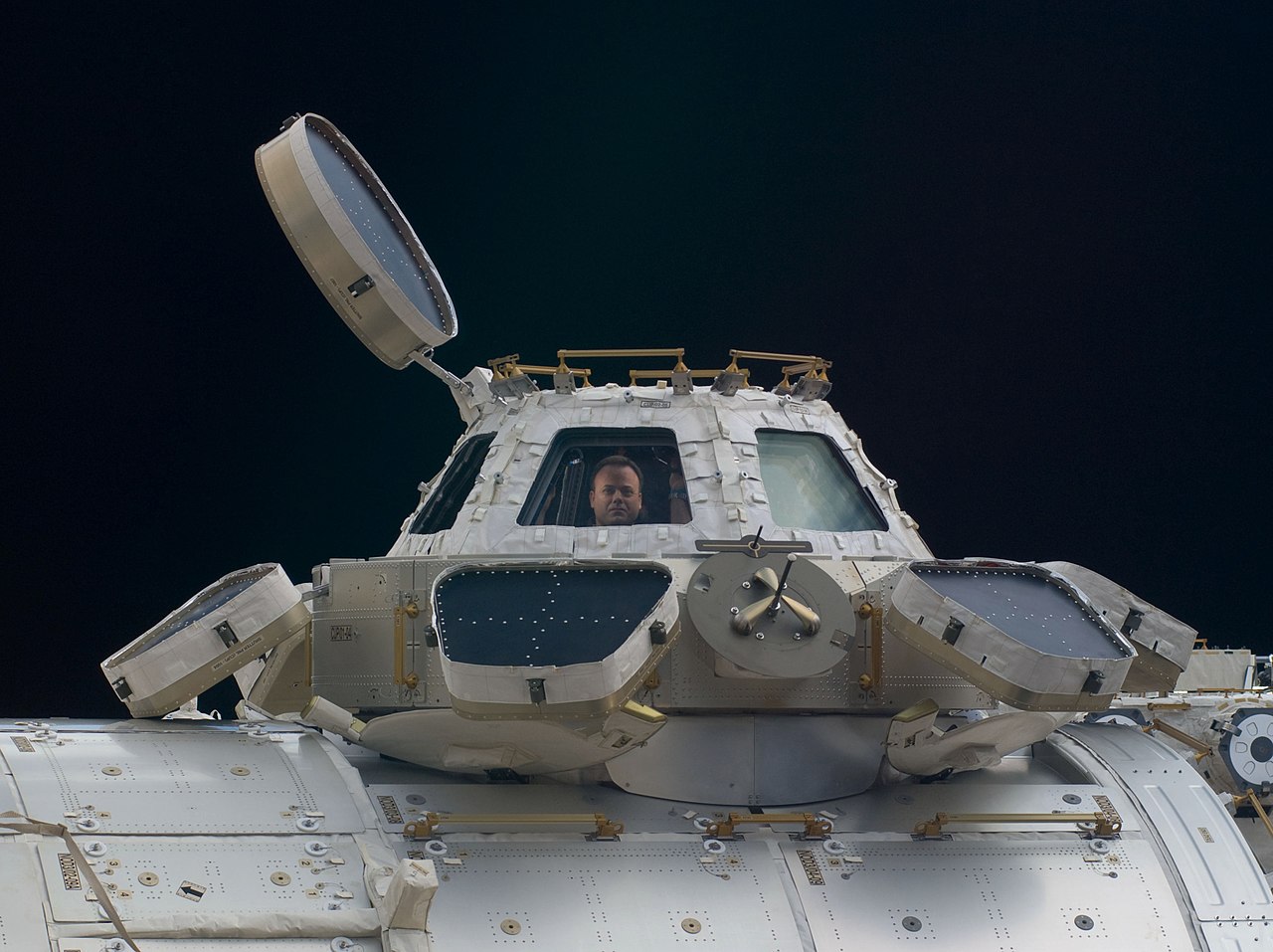
SpaceX CEO Elon Musk called it “the most ‘in space’ you could possibly feel” in a tweet sharing a concept render of the new modification in use. During a press briefing for the upcoming tourist flight, which is called ‘Inspiration4’ and led by billionaire Jared Isaacman, it was described as being similar to the exiting cupola on the International Space Station in terms of the views it affords.

Probably most “in space” you could possibly feel by being in a glass dome https://t.co/SOAIzxVGgX

— Elon Musk (@elonmusk) March 30, 2021

The ISS cupola is an observatory module built by the European Space Agency (ESA) and installed in 2010. Based on these renders from SpaceX, the Dragon version will be a continuous unbroken transparent surface, whereas the ISS cupola is made up of segmented panes separated by support structure, so that could mean Dragon provides a better view.

International Space Station cupola exterior.

International Space Station cupola exterior.

This modification could pave the way for a more permanent alternate configuration of Dragon, one best-suited for SpaceX’s planned commercial passenger missions, most of which will likely aim to do orbital tours without any actual docking at the ISS. It’s possible the company will make further cabin modifications when the vehicle isn’t configured for crew delivery to the orbital science station.

SpaceX also revealed new details about the Inspiration4 mission today, including its planned launch date of September 15, and a three-day mission flight duration. The remaining two passengers on board the four-person crew were also revealed this morning.

News: Stockly lets e-commerce websites sell out-of-stock items from a shared inventory

Meet Stockly, a French startup that keeps the inventory of various e-commerce websites in sync. When you see an out-of-stock item on an e-commerce website, chances are you leave that website and try to find the same item on another site. If you operate an e-commerce website, Stockly lets you sell items even when they’re

Meet Stockly, a French startup that keeps the inventory of various e-commerce websites in sync. When you see an out-of-stock item on an e-commerce website, chances are you leave that website and try to find the same item on another site.

If you operate an e-commerce website, Stockly lets you sell items even when they’re currently out of stock. The startup automatically finds a third-party Stockly supplier with that specific item.

The order will go through and be sent by that supplier directly. Stockly tells its partners to use neutral packaging so that the end consumer isn’t confused.

This could be particularly useful for small scale e-commerce companies that don’t have a healthy marketplace of third-party retailers. For instance, Amazon can already sell you an out-of-stock item if a supplier has listed that specific item on Amazon’s own marketplace. But that’s not the case for most e-commerce websites.

The main challenge for Stockly is that it has to sort through various catalog formats and match the different inventories of different retailers. It is focusing on clothing items at first. When an order is routed through Stockly, it selects a specific supplier based on different criteria, such as logistics, delivery time and historical data.

So far, Stockly has been working with Galeries Lafayette, Go Sport, Foot Shop and others. The startup has recently raised a $6 million (€5.1 million) funding round from Idinvest Partners, Daphni, Techstars, Checkout.com CEO Guillaume Pousaz and various business angels.

With this funding round, the company plans to expand its team to 20 people, add new clients and iterate on its product.

News: Aurora and Volvo partner to bring autonomous long-haul trucks to North America

The autonomous vehicle startup Aurora Innovation said Tuesday it has reached an agreement with Volvo to jointly develop autonomous semi trucks for North America. The partnership, which the two companies say will span several years and is through Volvo’s Autonomous Solutions unit, will focus on trucks built to operate autonomously on highways between hubs for

The autonomous vehicle startup Aurora Innovation said Tuesday it has reached an agreement with Volvo to jointly develop autonomous semi trucks for North America.

The partnership, which the two companies say will span several years and is through Volvo’s Autonomous Solutions unit, will focus on trucks built to operate autonomously on highways between hubs for Volvo customers. The Aurora Driver technology stack – Aurora’s self-driving software, computer and sensor suite – will be integrated into Volvo trucks.

The announcement comes fresh on the heels of the startup’s recent acquisition of Uber’s self-driving subsidiary and a separate deal with Toyota to develop self-driving minivans. Aurora now has partnerships with two of the three largest trucking manufacturers – Paccar and Volvo – that produce and sell nearly 50% of all Class 8 trucks in the country.

“Our previously announced collaborations with partners such as PACCAR will continue in parallel to the collaboration with Volvo,” an Aurora spokesperson told TechCrunch. “As Paccar’s first self-driving technology partner, the unique nature of our partnership enables us to build Paccar’s first redundant truck that will be able to operate without a safety driver, bring it to market first, and deploy it broadly.”

Aurora said its Frequency Modulated Continuous Wave lidar  — through its acquisitions of companies Blackmore and OURS Technology — will be key to solving autonomous long-range trucking. Lidar, or light detection and ranging radar, is considered to be a necessary component of self-driving systems. Aurora’s pitch’s is that unlike traditional time-of-flight lidar, its technology provides the long-range visibility needed to be able to spot hazards with enough time to stop or slow down.

The announcement also marks a major acceleration for Volvo’s autonomous vehicle arm, Volvo Autonomous Solutions. It’s the business unit’s first deal to bring autonomous trucking to the road.

Since its founding in 2017, Aurora has rapidly become one of the leaders in self-driving tech, attracting backing from Amazon, Sequoia Capital and Greylock Partners. The company was founded by former executives of Uber, Tesla and Google.

News: MobiKwik investigating data breach after 100M user records found online

MobiKwik said on Tuesday it was investigating claims of data breach after a website claimed to have exposed private information of nearly 100 million users of the Indian mobile payments startup. Over the weekend, a site on the dark web claimed it had 8.2 terabytes of MobiKwik user data. The data included phone numbers, email

MobiKwik said on Tuesday it was investigating claims of data breach after a website claimed to have exposed private information of nearly 100 million users of the Indian mobile payments startup.

Over the weekend, a site on the dark web claimed it had 8.2 terabytes of MobiKwik user data. The data included phone numbers, email addresses, scrambled passwords, transactions logs, and partial payment card numbers.

The website also claimed that it had “know your customer” (KYA) documents of 3.5 million users, and each visit to the website displayed four random images from the data dump. KYC documents are required in India for users who want to access certain services without any limitations. Local law requires a mobile wallet firm in India, for instance, to support monthly transactions exceeding a certain limit.

The dark web site features a searchable database that allows users to look up their phone number or email to verify the authenticity of the data breach claim. TechCrunch was able to verify the accuracy of the data in several cases.

A seller on a well-known cybercrime forum claims to be selling access to the database for 1.2 bitcoin — about $70,000.

The Sequoia Capital India-backed startup says it can’t yet prove if the data actually belongs to MobiKwik users. “It is incorrect to suggest that the data available on the darkweb has been accessed from MobiKwik or any identified source,” the startup wrote in a blog post.

Rajshekhar Rajaharia, a security researcher, told TechCrunch that he alerted MobiKwik about this alleged security breach last month. In a statement, MobiKwik said the company had conducted a thorough investigation and did not find any evidence of a breach.

However, a screenshot leaked to TechCrunch shows a MobiKwik official asking an Amazon representative last month for logs relating to its cloud service after the startup “came to know that our S3 [cloud storage] data is downloaded by some other person outside the organization.”

The startup said its legal team will take “strict action against the so-called security researcher.” Rajaharia told TechCrunch that it’s his right as a user to know if his financial data is safe and that he doesn’t have the resources to fight legal battles.

MobiKwik said it was closely working with authorities and was confident that security protocols to store sensitive data are “robust and have not been breached.” It added that it was getting a third-party to conduct a forensic data security audit. “We are committed to a safe and secure Digital India.”

News: Capitolis lands a16z-led $90M Series C for fintech SaaS platform

Capitolis, which makes technology for capital markets players such as investment and merchant banks, has closed on a $90 million Series C funding round led by Andreessen Horowitz (a16z). The financing included participation from existing backers Index Ventures, Sequoia Capital, S Capital, Spark Capital, SVB Capital, Citi, J.P. Morgan and State Street and brings Capitolis’

Capitolis, which makes technology for capital markets players such as investment and merchant banks, has closed on a $90 million Series C funding round led by Andreessen Horowitz (a16z).

The financing included participation from existing backers Index Ventures, Sequoia Capital, S Capital, Spark Capital, SVB Capital, Citi, J.P. Morgan and State Street and brings Capitolis’ total funding to date to $170 million. SVB Capital and Spark Capital co-led a $40 million Series B for the company in November 2019.

Capitolis CEO and founder Gil Mandelzis said the company’s mission since its 2017 inception has been to “fundamentally re-imagine how the capital markets operate” after the last financial crisis and the “bold steps taken by regulators” in its aftermath.

The startup says that its advanced workflow technology and proprietary algorithms allows banks, hedge funds and asset managers to eliminate, move or create trading positions by collaborating with other financial institutions. That results in freed up capital, open credit lines and access to capital from a bigger pool of sources, the company claims.

Ultimately, Capitolis’ network software is designed to help financial institutions optimize their balance sheets and reduce risk.

Seventy-five financial institutions currently use the Capitolis platform, according to the company’s website. The company says it grew its revenue run rate by “sixfold” in 2020. Since 2019, Capitolis has experienced a 230% increase in the number of users of its platform. To date, Capitolis says it has optimized $9 trillion in terms of gross notional balances.

Alex Rampell, partner at a16z, said that his firm believes that what sets Capitolis apart from other financial services players “is the sheer scale of management’s ambition and the substantial talent, technology and capital milestones they have achieved.”

The New York-based company says it plans to use its new capital toward product development and to boost its customer support and sales staff. It plans to increase its headcount from 90 today to over 150 by year’s end.

Capitolis currently covers foreign exchange products and equity swaps. It says it could expand into others if there is client demand.

This article was updated post-publication with additional information from the company

News: Google spinoff Cartken and REEF Technology launch Miami’s first delivery robots

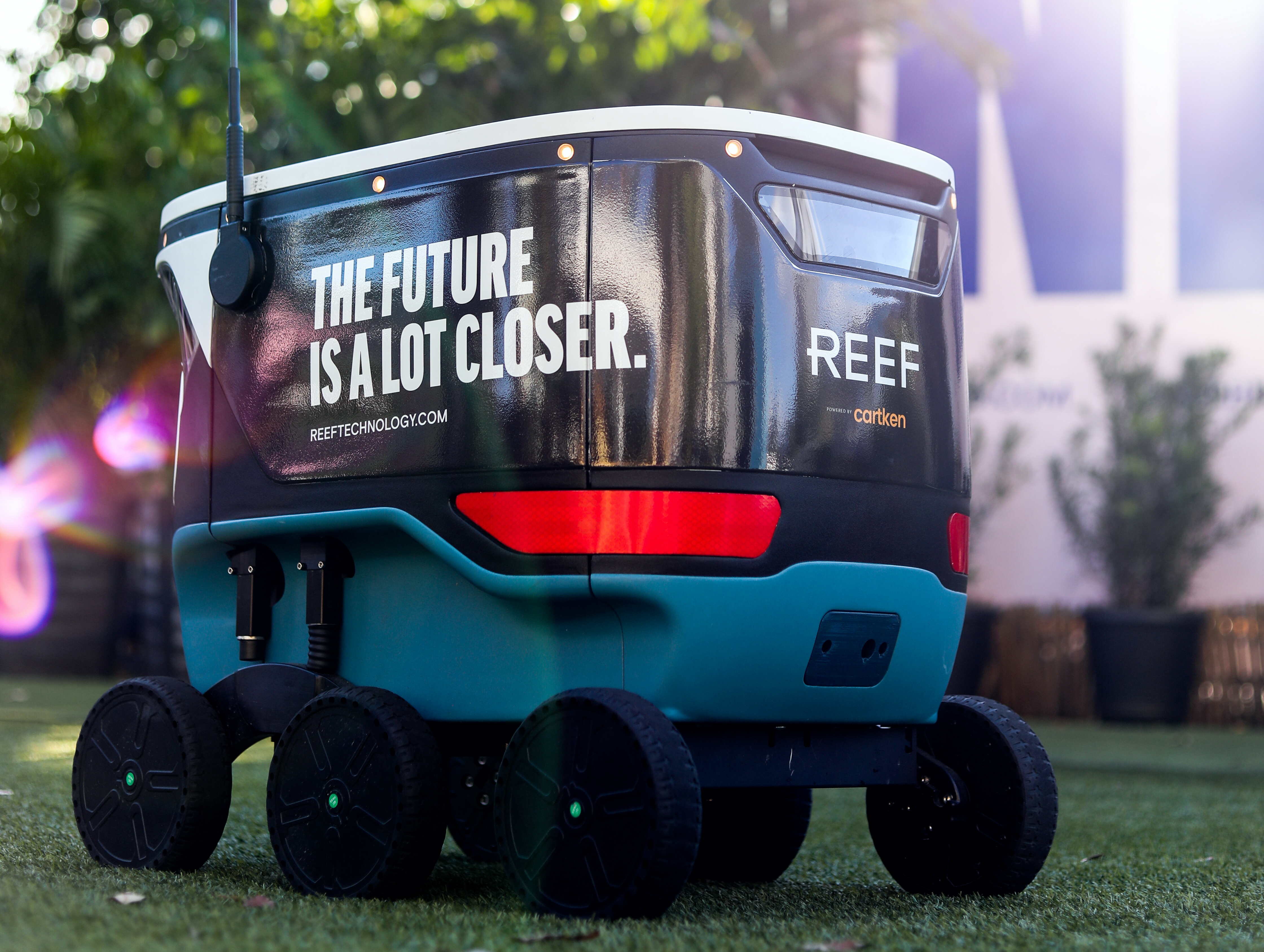
Self-driving and robotics startup Cartken has partnered with REEF Technology, a startup that operates parking lots and neighborhood hubs, to bring self-driving delivery robots to the streets of downtown Miami. With this announcement, Cartken officially comes out of stealth mode. The company, founded by ex-Google engineers and colleagues behind the unrequited Bookbot, was formed to

Self-driving and robotics startup Cartken has partnered with REEF Technology, a startup that operates parking lots and neighborhood hubs, to bring self-driving delivery robots to the streets of downtown Miami.

With this announcement, Cartken officially comes out of stealth mode. The company, founded by ex-Google engineers and colleagues behind the unrequited Bookbot, was formed to develop market-ready tech in self-driving, AI-powered robotics and delivery operations in 2019, but the team has kept operations under wraps until now. This is Cartken’s first large deployment of self-driving robots on sidewalks.

After a few test months, the REEF-branded electric-powered robots are now delivering dinner orders from REEF’s network of delivery-only kitchens to people located within a 3/4-mile radius in downtown Miami. The robots, which are insulated and thus can preserve the heat of a plate of spaghetti or other hot food, are pre-stationed at designated logistics hubs and dispatched with orders for delivery as the food is prepared.

“We want to show how future-forward Miami can be,” Matt Lindenberger, REEF’s chief technology officer, told TechCrunch. “This is a great chance to show off the capabilities of the tech. The combination of us having a big presence in Miami, the fact that there are a lot of challenges around congestion as Covid subsides, still shows a really good environment where we can show how this tech can work.”

Lindenberg said Miami is a great place to start, but it’s just the beginning, with potential for the Cartken robots to be used for REEF’s other last-mile delivery businesses. Currently, only two restaurant delivery robots are operating in Miami, but Lindenberger said the company is planning to expand further into the city and outward into Fort Lauderdale, as well as other large metros the company operates in, such as Dallas, Atlanta, Los Angeles and eventually New York.

Lindenberger is hoping the presence of robots in the streets can act as a “force multiplier” allowing them to scale while maintaining quality of service in a cost-effective way.

“We’re seeing an explosion in deliveries right now in a post-pandemic world and we foresee that to continue, so these types of no-contact, zero-emission automation techniques are really critical,” he said.

Cartken’s robots are powered by a combination of machine learning and rules-based programming to react to every situation that could occur, even if that just means safely stopping and asking for help, Christian Bersch, CEO of Cartken, told TechCrunch. REEF would have supervisors on site to remotely control the robot if needed, a caveat that was included in the 2017 legislation that allowed for the operation of self-driving delivery robots in Florida.

“The technology at the end of the day is very similar to that of a self-driving car,” said Bersch. “The robot is seeing the environment, planning around obstacles like pedestrians or lampposts. If there’s an unknown situation, someone can help the robot out safely because it can stop on a dime. But it’s important to also have that level of autonomy on the robot because it can react in a split second, faster than anybody remotely could, if something happens like someone jumps in front of it.”

REEF marks specific operating areas on the map for the robots and Cartken tweaks the configuration for the city, accounting for specific situations a robot might need to deal with, so that when the robots are given a delivery address, they can make moves and operate like any other delivery driver. Only this driver has an LTE connection and is constantly updating its location so REEF can integrate it into its fleet management capabilities.

Image Credits: REEF/Cartken

Eventually, Lindenberger said, they’re hoping to be able to offer the option for customers to choose robot delivery on the major food delivery platforms REEF works with like Postmates, UberEats, DoorDash or GrubHub. Customers would receive a text when the robot arrives so they could go outside and meet it. However, the tech is not quite there yet.

Currently the robots only make it street-level, and then the food is passed off to a human who delivers it directly to the door, which is a service that most customers prefer. Navigating into an apartment complex and to a customer’s unit is difficult for a robot to manage just yet, and many customers aren’t quite ready to interact directly with a robot. 

“It’s an interim step, but this was a path for us to move forward quickly with the technology without having any other boundaries,” said Lindenberger. “Like with any new tech, you want to take it in steps. So a super important step which we’ve now taken and works very well is the ability to dispatch robots within a certain radius and know that they’re going to arrive there. That in and of itself is a huge step and it allows us to learn what kind of challenges you have in terms of that very last step. Then we can begin to work with Cartken to solve that last piece. It’s a big step just being able to do this automation.”

WordPress Image Lightbox Plugin