Tag Archives: Blog

News: Leeway is a contract workflow service for your legal team

Meet Leeway, a French startup that is building an end-to-end software-as-a-service solution for your contracts. Leeway lets you centralize all your contracts in a single repository, go through multiple negotiation steps and trigger a DocuSign event for the signature. The company raised a $4.2 million seed round from HenQ, Kima Ventures as well as several

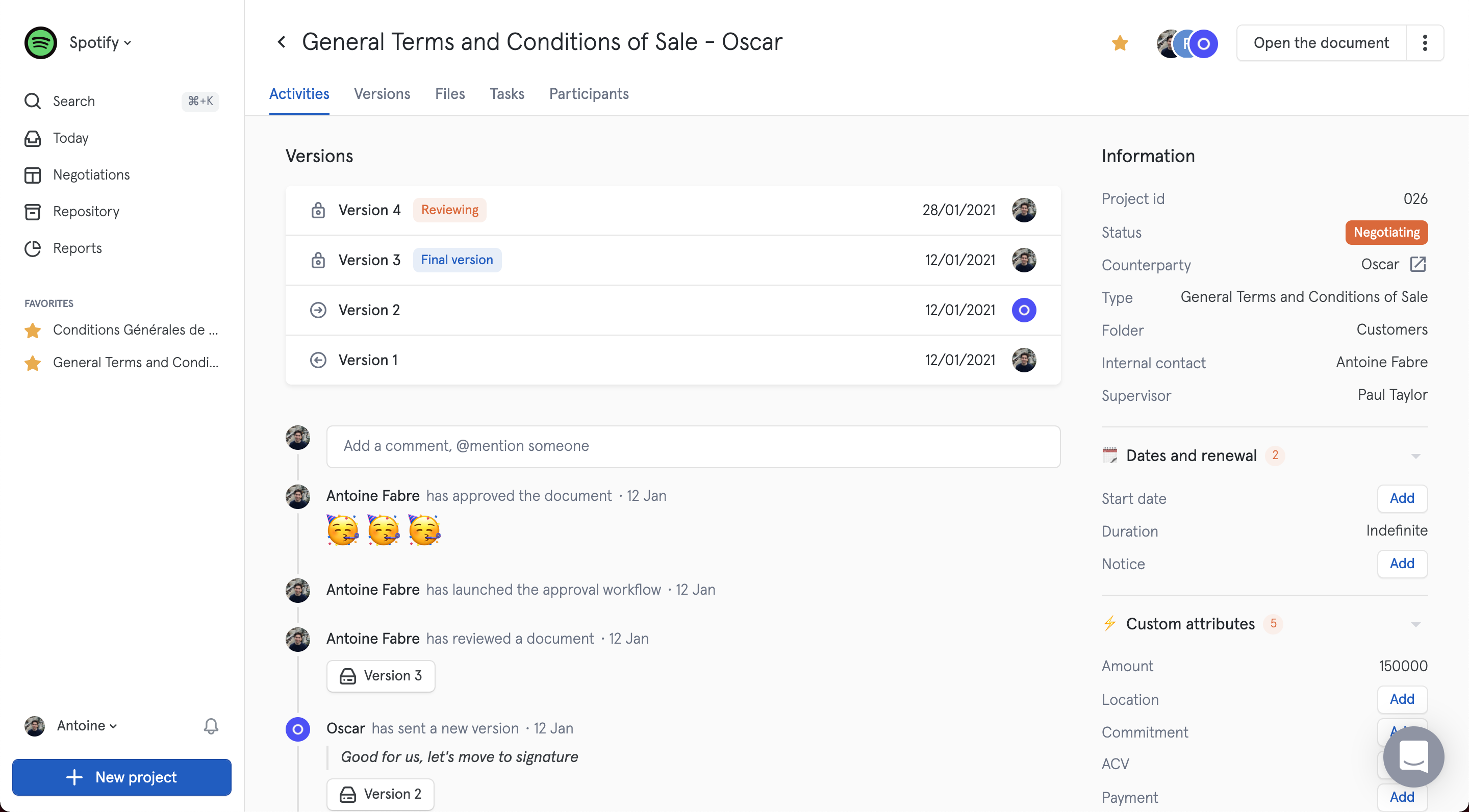
Meet Leeway, a French startup that is building an end-to-end software-as-a-service solution for your contracts. Leeway lets you centralize all your contracts in a single repository, go through multiple negotiation steps and trigger a DocuSign event for the signature.

The company raised a $4.2 million seed round from HenQ, Kima Ventures as well as several business angels, such as the founders of Algolia, Eventbrite, Spendesk, MeilleursAgents, Livestorm and Luko.

If you’re working for the legal department of your company, you’re probably working with multiple tools. Chances are you’re using Microsoft Word to write a contract, a cloud service to store and share the contract with your teammates and business partners, an e-signature and archival service.

Leeway is optimizing this worklfow at every step. First, you can store all your contracts on Leeway. In addition to making it easier to find a contract later down the road, you can get reminders when a contract is about to expire so that you can renew a contract.

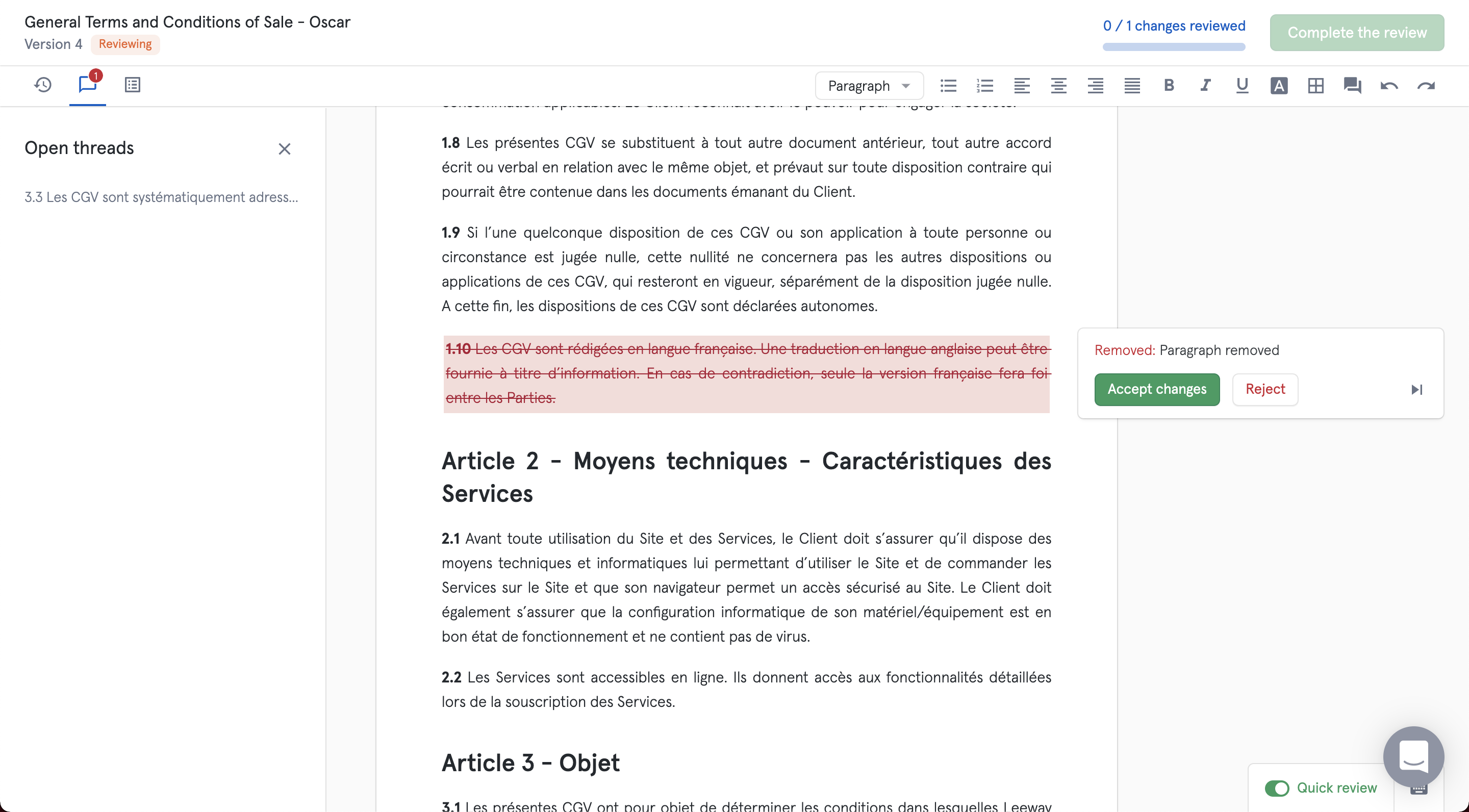
Second, you can edit your contract from Leeway directly. For instance, a manager can review a contract and write changes in Leeway’s interface. The employee can then start a revision and save a new version of the contract.

After that, you can send the contract from the same interface. Administrators can set up approval workflows so that several people need to approve a contract before it is signed. As everything is centralized, you can get an overview of all your contracts that are currently in the pipeline.

Image Credits: Leeway

Up next, Leeway is thinking about integrating conditional clauses within the product. Usually, big companies have several versions of the same clause — very favorable, favorable, not so favorable, etc. When a client is negotiating, Leeway customers could switch the clause from very favorable to favorable for instance.

Right now, around 30 companies are using Leeway to manage their contracts. Clients include Voodoo, Evaneos, Ifop and Fitness Park. “We have a very specific customer base — the legal department of companies with 100 to 500 employees,” co-founder and CEO Antoine Fabre told me.

It doesn’t mean that smaller and bigger companies shouldn’t be using Leeway. But companies with less than 100 employees don’t necessarily have a full-fledged legal department. The sales team or the finance department could act as the legal-ish team. But Leeway still has a lot of room to grow.

Image Credits: Leeway

News: Breaking up big tech would be a mistake

Instead of breaking up big tech, we should focus on ensuring that it grows better as it grows bigger by establishing a level playing field for startups’ and competitors’ proprietary digital markets.

T. Alexander Puutio
Contributor

T. Alexander Puutio is an adjunct professor at NYU Stern and he dedicates his research at University of Turku to the interplay between AI, tech, international trade and development. All views expressed are his own.

It seems safe to say that our honeymoon with big tech is officially over.

After years of questionable data-handling procedures, arbitrary content management policies and outright anti-competitive practices, it is only fair that we take a moment to rethink our relationship with the industry.

Sadly, most of the ideas that have gathered mainstream attention — such as the calls to break up big tech — have been knee-jerk responses that smack more of retributionist fantasies than sound economic thinking.

Instead of chasing sensationalist non-starters and zero-sum solutions, we should be focused on ensuring that big tech grows better as it grows bigger by establishing a level playing field for startups’ and competitors’ proprietary digital markets.

We can find inspiration on how to do just that by taking a look at how 20th-century lawmakers reined in the railroad monopolies, which similarly turned from darlings of industry to destructive forces of stagnation.

We’ve been here before

More than a century ago, a familiar story of a nation coming to terms with the unanticipated effects of technological disruption was unfolding across a rapidly industrializing United States.

While the first full-scale steam locomotive debuted in 1804, it took until 1868 for more powerful and cargo-friendly American-style locomotives to be introduced.

The more efficient and cargo-friendly locomotives caught on like wildfire, and soon steel and iron pierced through mountains and leaped over gushing rivers to connect Americans from coast to coast.

Soon, railroad mileage tripled and a whopping 77% of all intercity traffic and 98% of passenger business would be running on rails, ushering in an era of cost-efficient transcontinental travel that would recast the economic fortunes of the entire country.

As is often the case with disruptive technologies, early success would come with a heavy human cost.

From the very beginning, abuse and exploitation ran rampant in the railroad industry, with up to 3% of the labor force suffering injuries or dying during the course of an average year.

Railroad trust owners soon became key constituents of the widely maligned group of businessmen colloquially known as robber barons, whose corporations devoured everything in their path and made life difficult for competitors and new entrants in particular.

The railroad proprietors achieved this by maintaining carefully constructed walled gardens, allowing them to run competitors into the ground by means of extortion, exclusion and everything in between.

While these methods proved wildly successful for railroad owners, the rest of society languished under stifled competition and an utter lack of concern for consumers’ interests.

Everything old is new again

Learning from past experiences certainly doesn’t seem to be humankind’s strong suit.

In fact, most of our concerns with the tech industry are mirror images of the objections 20th-century Americans had against the railroad trusts.

Similar to the robber barons, Alphabet, Amazon, Apple, Facebook, Twitter, et al., have come to dominate the major thoroughfares of trade in a fashion that leaves little space for competitors and startups.

By instating double-digit platform fees, establishing strict limitations on payment processing protocols, and jealously hoarding proprietary data and APIs, big tech has erected artificial barriers to entry that make replicating their success all but impossible.

Over the past years, tech giants have also taken to cannibalizing third-party solutions by providing private-label versions — à la AmazonBasics — to the point where big tech’s clients are finding themselves undercut and outplayed by the platform-holders themselves.

Given the above, it is not surprising that the pace at which tech startups are created in the US has been declining for years.

In fact, VC veterans such as Albert Wenger have called attention to the “kill zone” around big tech for years, and if we are to reinvigorate the competitive fringe around our large tech conglomerates, something has to be done fast.

Why we need to stop talking about breaking up big tech

The 20th-century playbook for taming monopolistic railroad trusts offers several helpful lessons for dealing with big tech.

For first steps, Congress created the Interstate Commerce Commission (ICC) in 1887 and tasked it with administering reasonable and just rates for access to proprietary railroad networks.

Due to partisan politicking, the ICC proved relatively toothless, however. It wasn’t until Congress passed the 1906 Hepburn Act, which separated the function of transportation from the ownership of the goods being shipped, that we started seeing true progress.

By disallowing self-dealing and double-dipping in proprietary platforms, Congress succeeded in opening up access on equal terms both to existing competitors and startups alike, making a once-unnavigable thicket of exploitative practices into the metallic backbone of American prosperity that we know today.

This could never have been achieved by simply breaking the railroad trusts into smaller pieces.

In fact, when it comes to platforms and networks, bigger often is better for everyone involved thanks to network effects and several other factors that conspire against smaller platforms.

Most importantly, when access and interoperability rules are done right, bigger platforms can sustain wider and wider constellations of startups and third parties, helping us grow our economic pie instead of shrinking it.

Making digital markets work for startups

In our post-pandemic economy, our attention should be in helping tech platforms grow better as they grow bigger instead of cutting them down to size.

Ensuring that startups and competitors can access these platforms on equitable terms and at fair prices is a necessary first step.

There are numerous other tangible actions policymakers can take today. For example, rewriting the rules on data portability, pushing for wider standardization and interoperability across platforms, and reintroducing net neutrality would go a long way in addressing what ails the industry today.

With President Joe Biden’s recent nod toward “Amazon’s Antitrust Antagonist” Lina Khan as the next commissioner of the Federal Trade Commission, these changes suddenly seem more likely than ever.

In the end, all of us would stand to benefit from a robust fringe of startups and competitors that thrive on the shoulders of giants and the platforms they have made.


News: What to make of Deliveroo’s rough IPO debut

Deliveroops. After a lackluster IPO pricing run, shares of Deliveroo are lower today, marking a disappointing debut for the hot delivery company. A good question to ask at this juncture is why Deliveroo struggled with its IPO during a historically strong moment for tech flotations. The European unicorn listed on the London Stock Exchange, however,

Deliveroops.

After a lackluster IPO pricing run, shares of Deliveroo are lower today, marking a disappointing debut for the hot delivery company.

A good question to ask at this juncture is why Deliveroo struggled with its IPO during a historically strong moment for tech flotations. The European unicorn listed on the London Stock Exchange, however, possibly placing its public offering in a different climate than recent IPO successes listed in the United States.


The Exchange explores startups, markets and money. Read it every morning on Extra Crunch, or get The Exchange newsletter every Saturday.


TechCrunch noted on Monday that there were local concerns regarding Deliveroo’s governance and treatment of workers. At the time, however, those worries merely led to a decrease in the company’s IPO valuation.

Why did Deliveroo struggle when it began to trade? Is it suffering from cultural dissonance between its high-growth model and more conservative European investors? Let’s peek at the numbers and find out.

Deliveroo versus DoorDash

To ground us, let’s explore how differently the public markets value Deliveroo and DoorDash. If they are valued somewhat closely, we’ll be able to dismiss the question of whether the British delivery giant is really being treated with more skepticism than its American comp.

Not that we care, really, one way or the other about any single company’s value. But we do care if listing on a European exchange — I refuse to acknowledge Brexit this morning — means that companies valuing growth over profits are going to generate more stick than praise when they list.

So, briefly, here’s the data we need to make our comparison. We’ll start with DoorDash:

  • DoorDash 2020 revenue: $2.886 billion
  • DoorDash 2020 revenue growth (YoY): 226%
  • DoorDash market cap: $41.98 billion
  • Implied 2020 revenue multiple: 14.54x

And now, Deliveroo:

  • Deliveroo 2020 revenue: £1.191 billion
  • Deliveroo 2020 revenue growth (YoY): 54.3%
  • Deliveroo market cap: £5.55 billion
  • Implied 2020 revenue multiple: 4.66x

News: Hex lands $5.5M seed to help data scientists share data across the company

As companies embrace the use of data, hiring more data scientists, a roadblock persists around sharing that data. It requires too much copying and pasting and manual work. Hex, a new startup, wants to change that by providing a way to dispense data across the company in a streamlined and elegant way. Today, the company

As companies embrace the use of data, hiring more data scientists, a roadblock persists around sharing that data. It requires too much copying and pasting and manual work. Hex, a new startup, wants to change that by providing a way to dispense data across the company in a streamlined and elegant way.

Today, the company announced a $5.5 million seed investment, and also announced that it’s opening up the product from a limited beta to be more widely available. The round was led by Amplify Partners with help from Box Group, XYZ, Data Community Fund, Operator Collective and a variety of individual investors. The company closed the round last July, but is announcing it for the first time today.

Co-founder and CEO Barry McCardel says that it’s clear that companies are becoming more data-driven and hiring data scientists and analysts at a rapid pace, but there is an issue around data sharing, one that he and his co-founders experienced first-hand when they were working at Palantir.

They decided to develop a purpose-built tool for sharing data with other parts of the organization that are less analytically technical than the data science team working with these data sets. “What we do is we make it very easy for data scientists to connect to their data, analyze and explore it in notebooks. […] And then they can share their work as interactive data apps that anyone else can use,” McCardel explained.

Most data scientists work with their data in online notebooks like Jupyter where they can build SQL queries and enter Python code to organize it, chart it, and so forth. What Hex is doing is creating this super-charged notebook that lets you pull a data set from Snowflake or Amazon Redshift, work with and format the data in an easy way, then drag and drop components from the notebook page — maybe a chart or a data set — and very quickly build a kind of app that you can share with others.

Hex app example with data elements at the top and live graph below it.

Image Credits: Hex

The startup has 9 employees including co-founders McCardel, CTO Caitlin Colgrove and VP of architecture Glen Takahashi. “We’ve really focused on the team front from an early stage, making sure that we’re building a diverse team. And actually today our engineering team is majority female, which is definitely the first time that that’s ever happened to me,” Colgrove said.

She is also part of a small percentage of female founders. A report last year from Silicon Valley Bank, found that while the number was heading in the right direction, only 28% of US startups have at least one female founder. That was up from 22% in 2017.

The company was founded in late 2019 and the founders spent a good part of last year building the product and working with design partners. They have a small set of paying customers, and are looking to expand that starting today. While customers still need to work with the Hex team for now to get going, the plan is to make the product self-serve some time later this year.

Hex’s early customers include Glossier, imgur and Pave.

News: Coursera prices IPO at top end of its range in boon to edtech valuations

Coursera, an edtech unicorn, will begin its life today as a public company after pricing its IPO at $33 per share yesterday evening. Using a simple share count, the company’s valuation comes to $4.30 billion, or $4.38 billion if its underwriters exercise their option to purchase shares at its offering price. A more diluted share

Coursera, an edtech unicorn, will begin its life today as a public company after pricing its IPO at $33 per share yesterday evening. Using a simple share count, the company’s valuation comes to $4.30 billion, or $4.38 billion if its underwriters exercise their option to purchase shares at its offering price.

A more diluted share count pushes the valuation of Coursera over the $5 billion mark.

Coursera was last valued at $2.57 billion after raising $130 million in mid-2020, per PitchBook data. The company’s simple valuation is around a 67% gain on that final private figure; that gain rises to just over 70% if its underwriters purchase their available shares.

Using a diluted valuation, Coursera has roughly doubled its final private price. In under a year. For edtech investors looking to Coursera to help determine public market sentiment regarding the exit-value of their investments, TechCrunch reckons it’s a pretty good day.

The amount of private capital at play in edtech startups is staggering; billions and billions of potential returns could get a further shot in the arm if Coursera trades well this morning. And the very same billions of invested capital could lose the smile that Coursera’s seemingly-strong IPO pricing brought them.

There are other edtech debuts in the wings. TechCrunch has covered Nerdy’s plans to go public, via a SPAC, for example.

Private investors, who put well north of $10 billion into edtech companies globally in 2020, are modestly bullish on edtech exit volume this year. In a prior TechCrunch venture capitalist survey, GSV managing partner Deborah Quazzo said the following:

Exit volume is rising already with a wide range of strategic and financial buyers of edtech companies — something that didn’t exist before. You will see numerous high-value exits in the first half of 2021. It’s the public market “exits” that have really lagged and that I hope turns around in 2021 and 2022. There are numerous global companies that could go public and the addition of SPAC IPOs creates another positive dynamic.

The Coursera IPO pricing at least, meets the mark for a high-value exit. Which could lead where? Extending Quazzo’s thinking a single step, perhaps a strong Coursera first-day trading session will bolster SPAC interest in taking more edtech startups and unicorns public.

Such a move could lock-in valuations for a number of currently illiquid edtech startups, and perhaps begin to return chunks of invested capital in the historically out-of-fashion technology sector.

Adding to that sentiment is Owl Ventures’ managing director Ian Chiu, who told TechCrunch in the same survey that “the pipeline for potential IPO candidates coming from the edtech sector continues to grow larger.” Let’s hope — parsing the Coursera S-1 filing was good fun and we’d like another at-bat with an edtech IPO document.

More when Coursera trades.

News: Spotify adds three new types of personalized playlists with launch of ‘Spotify Mixes’

Spotify this morning announced it’s significantly expanding its selection of personalized playlists with the addition of three new categories of playlists under the heading of “Spotify Mixes.” This collection will include artist mixes, genre mixes, and decade mixes — meaning you’ll gain access to a sizable number of new mixes with easy-to-understand titles, like 2010s

Spotify this morning announced it’s significantly expanding its selection of personalized playlists with the addition of three new categories of playlists under the heading of “Spotify Mixes.” This collection will include artist mixes, genre mixes, and decade mixes — meaning you’ll gain access to a sizable number of new mixes with easy-to-understand titles, like 2010s Mix, R&B Mix, Pop Mix, Drake Mix, Selena Gomez Mix, and so on — or whatever reflects your own tastes and interests.

The company says the idea for the Spotify Mixes was inspired by its Daily Mixes, launched in fall 2016.

The Daily Mixes had been one of the company’s first big expansions in personalization beyond its flagship playlist, Discover Weekly, as they introduced a large set of playlists that reflected users’ listening history. Today, Daily Mixes bring together your recent listens with other tracks to keep you engaged — and the new Spotify Mixes essentially do the same, as they’re populated with music you like plus “fresh tracks.” The difference is that the new mixes have clearer names and a more specific focus, in some cases.

The Spotify Mixes will be available to all users globally, including both Free users and Premium subscribers. At launch, you can find them within Search in the “Made for You” hub.

You’ll easily spot them, too, as Spotify has already populated its app with a selection of mixes in the top three rows of the “Made for You” hub. Here, you’ll find “Your Genre Mixes,” “Your Artist Mixes,” and “Your Decade Mixes” —  each with a horizontally scrollable selection of mixes to get you started. Spotify says each mix category will be updated frequently and will always have several playlists available.

The new feature somewhat competes with a similar offering on Pandora, launched three years ago. The SiriusXM-owned music app had used its Music Genome technology to create personalized playlists across a number of attributes, including also genre and mood. While not an apples-to-apples comparison, necessarily, Pandora’s launch had instantly expanded its users’ access to personalized playlists by the dozens. It’s actually a bit surprising that it took Spotify as long as it did to offer a competitive response.

The launch comes shortly after the addition of new celebrity-inspired playlists to Spotify’s “Workout Hub” earlier this week.

Spotify says the new playlists are rolling out today to global users.


News: Oklahoma-based Cortado Ventures raises $20M

The team behind Cortado Ventures thinks there’s plenty of untapped investment opportunity in the Midwest. To change that, it’s raised $20 million in what appears to be Okalhoma’s largest venture fund to date. The firm is led by partners Nathaniel Harding, David Woods and Mike Moradi. In a Medium post, Harding (an angel investor and

The team behind Cortado Ventures thinks there’s plenty of untapped investment opportunity in the Midwest. To change that, it’s raised $20 million in what appears to be Okalhoma’s largest venture fund to date.

The firm is led by partners Nathaniel Harding, David Woods and Mike Moradi. In a Medium post, Harding (an angel investor and former oil and gas entrepreneur) recalled how he an Moradi had been discussing the need for an Oklahoma-based venture capital fund back in 2017.

They’d planned to launch the firm — which makes seed and Series A investments — just about a year ago, and the pandemic only gave them a greater sense of urgency.

“With the pandemic threatening Oklahoma’s economy, more attention than ever was placed on the need to diversify our economy and create future-ready tech jobs,” Harding said. “There was also a sense that innovation and startups would multiply, and that technology disruption and adoption would accelerate. In fact, we contend that there has never been a better time to start a new company. Our investors sensed this too.”

Although the firm’s first fund only recent hit its cap of $20 million, it has already invested in nine startups including text marketing company RespondFlow in Tulsa, Dallas-based Socialwyze (which helps underemployed people find flexible work) and hybrid materials startup Mito Material Solutions in Stillwater.

Cortado was created with the thesis that the region was “underfunded,” but Harding told me it doesn’t have any geographic restrictions on investments.

“We look at companies from anywhere,” he said. “We care more about what the companies does and less about where they’re located.”

Harding suggested that Oklahoma is particularly rich in entrepreneurs with a background in traditional industries like energy, aerospace, agriculture and manufacturing. And being based in Oklahoma City hasn’t stopped Cortado from backing founders from diverse backgrounds — he said the majority of the portfolio is led by women, people of color and first-generation immigrants.

Asked whether the regional ecosystem will also need more later-stage firms to fund the growth of  successful startups, Harding said, “Funding at the early stage is often very local, but funding at later stages, once you get to nine figure valuations — you’re a known commodity. Once you’re getting to a Series C and D […] you have a global market for investments.”

News: Tips for founders thinking about doing a remote accelerator

Hello and welcome back to Equity, TechCrunch’s venture capital-focused podcast, where we unpack the numbers behind the headlines. For this week’s deep dive, the Equity team got ahold of three founders from the recent Y Combinator batch (more here, and here) to chat through their experiences with a remote accelerator. TechCrunch was curious if the

Hello and welcome back to Equity, TechCrunch’s venture capital-focused podcast, where we unpack the numbers behind the headlines.

For this week’s deep dive, the Equity team got ahold of three founders from the recent Y Combinator batch (more here, and here) to chat through their experiences with a remote accelerator. TechCrunch was curious if the program lived up to founder expectations, how extreme timezone differentials were handled, and how easy it was to build camaraderie during a digital program. Oh, and how their demo day went.

Here’s who is on the show:

The short version is that the founders were generally happy with Y Combinator being remote, and that the setup allowing them to stay in their normal location was plus. We also asked the founders for learnings regarding how to best handle remote accelerators in the future.

More from Equity on Friday, at which point we’ll put Y Combinator aside for a good while.

Equity drops every Monday at 7:00 a.m. PST, Wednesday, and Friday morning at 7:00 a.m. PST, so subscribe to us on Apple PodcastsOvercastSpotify and all the casts.

News: Facebook denies its algorithms are a problem, but launches a tool to more easily view a non-algorithmic News Feed

Following years of backlash over its algorithms and their ability to push people to more extreme content, which Facebook continues to deny, the company today announced it would give its users new tools to more easily switch over to non-algorithmic views of their News Feed. This includes the recently launched “Favorites,” which shows you posts

Following years of backlash over its algorithms and their ability to push people to more extreme content, which Facebook continues to deny, the company today announced it would give its users new tools to more easily switch over to non-algorithmic views of their News Feed. This includes the recently launched “Favorites,” which shows you posts from up to 30 of your favorite friends and Pages, as well as the “Most Recent” view, which shows posts in chronological order. It also introduced new controls for adjusting who can comment on your posts, and other changes.

The features themselves aren’t entirely new, in some cases, but they’ve been made easier to get to with the addition of a Feed Filter Bar on mobile for changing the view of the News Feed, and an option menu on your posts to control who can comment.

The “Most Recent” view of the News Feed has long existed but has been buried in the extended “more” menu (the three-bar hamburger icon) on the Facebook mobile app. It’s not as useful as it sounds because it shows you all the posts from both friends and Pages in a single chronological view. If you’ve been on Facebook for many years, then you’ve probably “Liked” a number of Facebook Pages for brands, businesses and public figures. These Pages tend to post with more frequency than your friends, so the feed has become largely a long scroll through Page updates.

However, if you still prefer the “Most Recent” view, the Feed Filter Bar will give you a tool to easier switch back and forth between this and other views. The feature will launch on Android first, then roll out to iOS.

Meanwhile, Facebook has offered a way to prioritize who you see in your News Feed through a “See First” setting, but the newer “Favorites” feature rebrands this effort and gives you a single destination under Settings to select and deselect your Favorites, including favorite Pages.

The updated commenting controls are a new take on a habit many Facebook users have already adopted — when they share a post only to a given audience, like family or friends, while excluding other groups like work colleagues or even specific people. Now, users will have the option to instead share their posts but control who can engage in conversations. Public figures, for example, may choose to adopt the feature to restrict their audience to only those brands and profiles they’ve tagged.

Facebook says it will also show more context around suggestions it displays in the News Feed with its “Why am I seeing this?” feature that will explain how its algorithmic suggestions work. It says several factors may be at work here, in terms of what’s shown and why — including your location, whether you or people like you have engaged with related topics, groups or Pages, and more.

The changes arrive at a time when Facebook, along with other tech giants, has come under fire for its role in spreading misinformation leading to deadly events, like the storming of the U.S. Capitol, and serious public health crises, like vaccine hesitancy during a pandemic. Facebook CEO Mark Zuckerberg last week testified before the House’s Subcommittee on Communications and Technology about its failures to remove dangerous misinformation and its allowing of extremists to become more radicalized and to organize online.

Facebook’s official position, however, is that it doesn’t play a role in directing people towards problematic content — they seek it out. And people’s News Feeds are only a reflection of their own choices, in that way.

These thoughts and more were detailed today by Nick Clegg, VP of Global Affairs for Facebook, where he insists personalization algorithms are common across tech companies — Amazon and Netflix use them, too, for instance. And ranking simply makes what’s most relevant to the user appear first — effectively blaming users for the problems here. He also throws back the decisions to be made around Facebook’s role in misinformation peddling to the lawmakers, adding: “It would clearly be better if these [content] decisions were made according to frameworks agreed by democratically accountable lawmakers.”

News: Ensemble raises $3M to help divorced parents avoid arguing about money

At the age of 14, Jacklyn Rome saw firsthand how divorce can impact families, and how arguing about finances both during and after the process can impact children. The experience stuck with her. As an adult, after leading new product launches at Uber and Blue Apron,  Rome came up with the concept behind her startup,

At the age of 14, Jacklyn Rome saw firsthand how divorce can impact families, and how arguing about finances both during and after the process can impact children.

The experience stuck with her. As an adult, after leading new product launches at Uber and Blue Apron,  Rome came up with the concept behind her startup, Ensemble. The expense tracking app quietly launched in the App Store in 2020 with the mission of reducing tension among co-parents and making sure kids’ needs aren’t negatively impacted by a divorce.

Today, Ensemble is coming out of stealth with $3 million in seed funding from TTV Capital, Lerer Hippeau and Citi Ventures.

Put simply, Ensemble’s mission is to improve the lives of co-parents and their children by giving parents a streamlined way to track shared expenses.

“Most co-parents either figure out finances on their own ad hoc or rely on child support payments — however, child support only covers food, shelter and clothing, which is only half of the cost of raising a child,” Rome points out. The other half of expenses, including medical bills, extracurricular activities, transportation, etc., often end up being discussed by co-parents via text messages and spreadsheets.

Ensemble founder and CEO Jacklyn Rome. Image courtesy of Ensemble

Ensemble kicked off a six-month pilot in January 2020, when the credit-first version of the app went live. In April 2020, the dual functionality version — where two parents could connect their accounts — went live.

Since its App store launch last spring, Ensemble has seen “strong organic growth and referrals” from its users, according to Rome. Ensemble’s users, on average, are tracking over $1,000 per month in shared expenses for their children.

Roughly 30% of Ensemble’s downloads were organic in people discovering the app in the App Store, she said.

“Even in the most amicable divorces, money is the number one thing that divorced parents end up arguing about. In more contentious divorces, it often gets used as a power lever among two emotionally charged individuals with no other tools at their disposal,” Rome said. “We set out to build a product that eases tense communication about shared finances and serves the nuanced needs of separated parents.”

For now, the app is free. Ensemble plans to begin monetizing with the use of funds from its seed round.

Eventually, the company is planning to build out a paid subscription model. Over the long term, it’s also planning to expand beyond being an expense tracking app to offering a suite of financial products and primarily banking products, for things like shared credit cards with tight spending controls, Rome told TechCrunch.

“Ultimately, we want to help make sure that the children of divorced parents are not at a financial disadvantage when it comes to building for their financial future,” she said.

Rome founded Ensemble while she was an Entrepreneur in Residence (EIR) at Co-Created, a venture studio based in New York, with support and funding from Citi Ventures’ D10X program.

“A key insight that Citi had given us was that for them as a bank, it’s incredibly hard to acquire new customers because people don’t often change banks,” Rome said. “One of the few times in life that people regularly change banks is when they get divorced. And that sparked the thought process around the pain points that people feel through their divorce, specifically as it relates to finances.”

Luis Valdich, managing director of venture investing at Citi Ventures, says the bank has been “tracking for some time” how the financial needs of individuals have been evolving given societal trends, while at the same time identifying potential investment opportunities in startups that address underserved needs.

“One growing gap is for divorced or separate parents to track and manage shared expenses,” Valdich said. “Ensemble solves this problem by striking the optimal balance of delivering ease of use, visibility and empathy for modern co-parents, minimizing the need for back-and-forth communications. While it is early, we found its user experience to be substantially superior to the alternatives in the market, and Jacklyn brings a unique perspective on the challenge Ensemble is trying to solve.”

And while he could not speak to specific plans between Citi and Ensemble, Valdich said that Citi Ventures’ approach has always been to invest in companies with an eye toward future collaborations.

“We are proud that the majority of our portfolio has been commercialized within Citi and/or with Citi clients and we will certainly explore opportunities for collaboration when mutually convenient for both parties, as we always do,” Valdich added.

Meanwhile, TTV Capital Partner Mark Johnson said his firm has been investing in fintech for over 20 years and that it’s clear “people are craving digital tools to simplify communication and finances.”

He called Ensemble’s app “a sleek and simple platform” that addresses those needs for co-parents.

WordPress Image Lightbox Plugin