Tag Archives: Blog

News: Manticore Games raises $100 million to build a ‘creator multiverse’

The gaming sector has never been hotter or had higher expectations from investors who are dumping billions into upstarts that can adjust to shifting tides faster that the existing giants will. Bay Area-based Manticore Games is one of the second-layer gaming platforms looking to build on the market’s momentum. The startup tells TechCrunch they’ve closed

The gaming sector has never been hotter or had higher expectations from investors who are dumping billions into upstarts that can adjust to shifting tides faster that the existing giants will.

Bay Area-based Manticore Games is one of the second-layer gaming platforms looking to build on the market’s momentum. The startup tells TechCrunch they’ve closed a $100 million Series C funding round, bringing their total funding to $160 million. The round was led by XN, with participation from Softbank and LVP alongside existing investors Benchmark, Bitkraft, Correlation Ventures and Epic Games.

When Manticore closed its Series B back in September 2019, VCs were starting to take Roblox and the gaming sector more seriously, but it took the pandemic hitting to really expand their expectations for the market. “Gaming is now a bonafide super category,” CEO Frederic Descamps tells TechCrunch.

Manticore’s Core gaming platform is quite similar to Roblox conceptually, the big difference is that the gaming company is aiming to quickly scale up a games and creator platform geared towards the 13+ crowd that may have already left Roblox behind. The challenge will be coaxing that demographic faster than Roblox can expand its own ambitions, and doing so while other venture-backed gaming startups like Rec Room, which recently raised at a $1.2 billion valuation, race for the same prize.

Like other players, Manticore is attempting to build a game discovery platform directly into a game engine. They haven’t built the engine tech from scratch, they’ve been working closely with Epic Games which makes the Unreal Engine and made a $15 million investment in the company last year.

A big focus of the Core platform is giving creators a true drag-and-drop platform for game creation with a specific focus on “remixing” allowing users to pick pre-made environments, drop pre-rendered 3D assets into them, choose a game mode and publish it to the web. For creators looking to inject new mechanics or assets into a title, there will be some technical know-how necessary but Manticore’s team hopes that making the barriers of entry low for new creators means that they can grow alongside the platform. Manticore’s big bet is on the flexibility of their engine, hoping that creators will come on board for the chance to engineer their own mechanics or create their own path towards monetization, something established app store wouldn’t allow them to.

“Creators can implement their own styles of [in-app purchases] and what we’re really hoping for here is that maybe the next battle pass equivalent innovation will come out of this,” co-founder Jordan Maynard tells us.

This all comes at an added cost, developers earn 50% of revenues from their games, leaving more potential revenue locked up in fees routed to the platforms that Manticore depends on than if they built for the App Store directly, but this revenue split is still much friendlier to creators that what they can earn on platforms like Roblox.

Building cross-platform secondary gaming platforms is host to plenty of its own challenges. The platforms involved not only have to deal with stacking revenue share fees on non-PC platforms, but some hardware platforms that are reticent to allow them all, an area where Sony has been a particular stickler with PlayStation. The long-term success of these platforms may ultimately rely on greater independence, something that seems hard to imagine happening on consoles and mobile ecosystems.

News: Consumers spent $32B on apps in Q1 2021, the biggest quarter on record

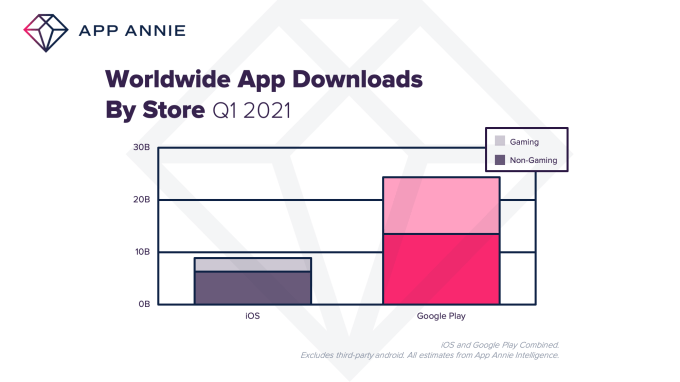
The pandemic’s remarkable impact on the app industry has not slowed down in 2021. In fact, consumer spending in apps has hit a new record in the first quarter of this year, a new report from App Annie indicates. The firm says consumers in Q1 2021 spent $32 billion on apps across both iOS and

The pandemic’s remarkable impact on the app industry has not slowed down in 2021. In fact, consumer spending in apps has hit a new record in the first quarter of this year, a new report from App Annie indicates. The firm says consumers in Q1 2021 spent $32 billion on apps across both iOS and Google Play, up 40% year-over-year from Q1 2020. It’s the largest-ever quarter on record, App Annie also notes.

Last year saw both app downloads and consumer spend increase, as people rapidly adopted apps under coronavirus lockdowns — including apps for work, school, shopping, fitness, entertainment, gaming and more. App Annie previously reported a record 218 billion in global downloads and record consumer spend of $143 billion for the year.

Image Credits: App Annie

These trends have continued into 2021, it seems, with mobile consumers spending roughly $9 billion more in Q1 2021 compared with Q1 2020. Although iOS saw larger consumer spend than Android in the quarter — $21 billion vs. $11 billion, respectively — both stores grew by the same percentage, 40%.

But the types of apps driving spending were slightly different from store to store.

On Google Play, Games, Social and Entertainment apps saw the strongest quarter-over-quarter growth in terms of consumer spending, while Games, Photo & Video, and Entertainment apps accounted for the strongest growth on iOS.

By downloads, the categories were different between the stores, as well.

On Google Play, Social, Tools, and Fiance saw the biggest download growth in Q1, while Games, Finance and Social Networking drove download growth for iOS. Also on Google Play, other top categories included Weather (40%) and Dating (35%), while iOS saw Health and Fitness app downloads grow by a notable 25% — likely a perfect storm as New Year’s Resolutions combined with continued stay-at-measures that encouraged users to find new ways to stay fit without going to a gym.

Image Credits: App Annie

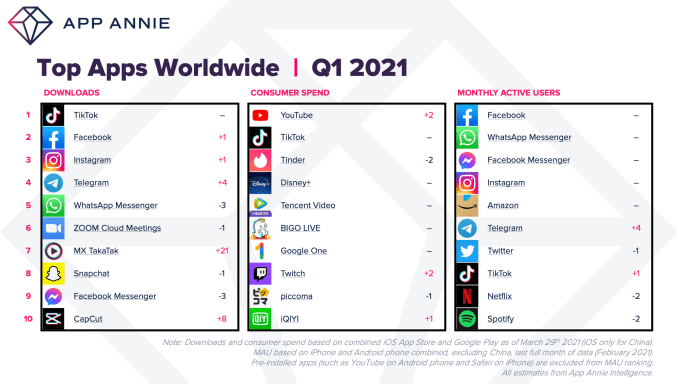
The top apps in the quarter remained fairly consistent, however. TikTok beat Facebook, in terms of downloads, and was followed by Instagram, Telegram, WhatsApp and Zoom. But the short-form video app only made it to No. 2 in terms of consumer spend, with YouTube snagging the top spot. Tinder, Disney+, Tencent Video, and others followed. (Netflix has dropped off this chart as it now directs new users to sign up directly, rather than through in-app purchases).

Image Credits: App Annie

Though Facebook’s apps have fallen behind TikTok by downloads, its apps — including Facebook, WhatsApp, Messenger and Instagram — still led the market in terms monthly active users (MAUs) in the quarter. TikTok, meanwhile, ranked No. 8 by this metric.

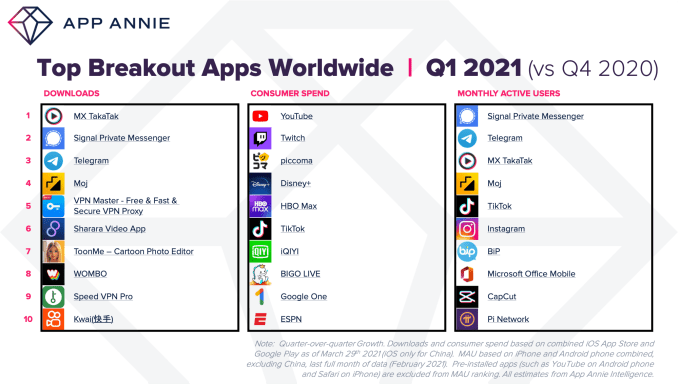
Up-and-comers in the quarter included privacy-focused messaging app Signal, which saw the strongest growth in the quarter by both downloads and MAUs — a calculation that App Annie calls “breakout apps.”  Telegram closely followed, as users bailed from mainstream social after the Capitol riot. Another “breakout” app was MX TakaTak, which is filling the hole in the market for short-form video that resulted from India’s ban  of TikTok.

Image Credits: App Annie

Gaming, meanwhile, drove a majority of the quarter’s spending, as usual, accounting for $22 billion of the spend — $13 billion on iOS (up 30% year-over-year) and $9 billion on Android (up 35%). Gamers downloaded about a billion titles per week, up 15% year-over-year from 2020.

Among Us! dropped to No. 2 in the quarter by downloads, replaced by Join Clash 3D, while DOP 2: Delete One Part jumped 308 places to reach No. 3.

Image Credits: App Annie

Roblox led by consumer spend, followed by Genshin Impact, Coin Master, Pokemon Go and others. And although Among Us! dropped on the charts by downloads, it remained No. 1 by monthly active users in the quarter, followed by PUBG Mobile, Candy Crush Saga, Roblox and others.

App Annie notes that the pandemic also accelerated the mobile gaming market, with game downloads outpacing overall downloads by 2.5x in 2020. It predicts that mobile gaming will reach  $120 billion in consumer spending this year, or 1.5x all other gaming formats combined.

News: Apple adds two brand new Siri voices and will no longer default to a female or male voice in iOS

Apple is adding two new voices to Siri’s English offerings, and eliminating the default ‘female voice’ selection in the latest beta version of iOS. This means that every person setting up Siri will choose a voice for themselves and it will no longer default to the voice assistant being female, a topic that has come

Apple is adding two new voices to Siri’s English offerings, and eliminating the default ‘female voice’ selection in the latest beta version of iOS. This means that every person setting up Siri will choose a voice for themselves and it will no longer default to the voice assistant being female, a topic that has come up quite a bit with regards to bias in voice interfaces over the past few years.

The beta version should be live now and available to program participants.

I believe that this is the first of these assistants to make the choice completely agnostic with no default selection made. This is a positive step forward as it allows people to choose the voice that they prefer without the defaults bias coming into play. The two new voices also bring some much needed variety to the voices of Siri, offering more diversity in speech sound and pattern to a user picking a voice that speaks to them.

in some countries and languages Siri already defaults to a male voice. But this change makes the choice the users’ for the first time.

“We’re excited to introduce two new Siri voices for English speakers and the option for Siri users to select the voice they want when they set up their device,” a statement from Apple reads. “This is a continuation of Apple’s long-standing commitment to diversity and inclusion, and products and services that are designed to better reflect the diversity of the world we live in.”

The two new voices use source talent recordings that are then run through Apple’s Neural text to speech engine, making the voices flow more organically through phrases that are actually being generated on the fly.

I’ve heard the new voices and they sound pretty fantastic, with natural inflection and smooth transitions. They’ll be a welcome addition of choice to iOS users. I’ll embed some samples here after the beta drops.

This latest beta also upgrades the Siri voices in Ireland, Russia and Italy to Neural TTS, bringing the total voices using the new tech to 38. Siri now handles 25 billion requests per month on over 500M devices and supports 21 languages in 36 countries.

The new voices are available to English speaking users around the world and Siri users can select a personal preference of voice in 16 languages.

It seems very likely that these two new voices are just the first expansion in Siri’s voice selections. More diversity in voice, tone and regional dialect can only be a positive development for how inclusive smart devices feel. Over the past few years we have finally begun to see some movement from Amazon, Google and Apple to aggressively correct situations where the assistants have revealed bias in their responses to queries that use negative or abusive language. Improvements there, as well as in queries on social justice topics and overall accessibility improvements are incredibly key as we continue to see an explosion of voice-first or voice-native interfaces. These kinds of choices matter, especially at a scale of hundreds of millions of people.


Article updated to note that in some countries and languages Siri currently defaults to a male voice. 

News: Pipe, which aims to be the ‘Nasdaq for revenue,’ raises more money at a $2B valuation

Fast-growing fintech Pipe has raised another round of funding at a $2 billion valuation, just weeks after raising $50M in growth funding, according to sources familiar with the deal. Although the round is still ongoing, Pipe has reportedly raised $150 million in a “massively oversubscribed” round led by Baltimore, Md.-based Greenspring Associates. While the company

Fast-growing fintech Pipe has raised another round of funding at a $2 billion valuation, just weeks after raising $50M in growth funding, according to sources familiar with the deal.

Although the round is still ongoing, Pipe has reportedly raised $150 million in a “massively oversubscribed” round led by Baltimore, Md.-based Greenspring Associates. While the company has signed a term sheet, more money could still come in, according to the source. Both new and existing investors have participated in the fundraise.

The increase in valuation is “a significant step up” from the company’s last raise. Pipe has declined to comment on the deal.

A little over one year ago, Pipe raised a $6 million seed round led by Craft Ventures to help it pursue its mission of giving SaaS companies a funding alternative outside of equity or venture debt.

The buzzy startup’s goal with the money was to give SaaS companies a way to get their revenue upfront, by pairing them with investors on a marketplace that pays a discounted rate for the annual value of those contracts. (Pipe describes its buy-side participants as “a vetted group of financial institutions and banks.”)

Just a few weeks ago, Miami-based Pipe announced a new raise — $50 million in “strategic equity funding” from a slew of high-profile investors. Siemens’ Next47 and Jim Pallotta’s Raptor Group co-led the round, which also included participation from Shopify, Slack, HubSpot, Okta, Social Capital’s Chamath Palihapitiya, Marc Benioff, Michael Dell’s MSD Capital, Republic, Alexis Ohanian’s Seven Seven Six and Joe Lonsdale.

At that time, Pipe co-CEO and co-founder Harry Hurst said the company was also broadening the scope of its platform beyond strictly SaaS companies to “any company with a recurring revenue stream.” This could include D2C subscription companies, ISP, streaming services or a telecommunications companies. Even VC fund admin and management are being piped on its platform, for example, according to Hurst.

“When we first went to market, we were very focused on SaaS, our first vertical,” he told TC at the time. “Since then, over 3,000 companies have signed up to use our platform.” Those companies range from early-stage and bootstrapped with $200,000 in revenue, to publicly-traded companies.

Pipe’s platform assesses a customer’s key metrics by integrating with its accounting, payment processing and banking systems. It then instantly rates the performance of the business and qualifies them for a trading limit. Trading limits currently range from $50,000 for smaller early-stage and bootstrapped companies, to over $100 million for late-stage and publicly traded companies, although there is no cap on how large a trading limit can be.

In the first quarter of 2021, tens of millions of dollars were traded across the Pipe platform. Between its launch in late June 2020 through year’s end, the company also saw “tens of millions” in trades take place via its marketplace. Tradable ARR on the platform is currently in excess of $1 billion.

News: Fifth Wall’s Brendan Wallace and Hippo’s Assaf Wand are joining us on Extra Crunch Live

As the world changes rapidly, so too do the most traditional of industries. That includes property tech and insurtech. Luckily for us, two of the top minds in those spaces are joining us on an upcoming episode of Extra Crunch Live. On April 21 at noon PT/3pm ET, Fifth Wall’s Brendan Wallace and Hippo’s Assaf

As the world changes rapidly, so too do the most traditional of industries. That includes property tech and insurtech. Luckily for us, two of the top minds in those spaces are joining us on an upcoming episode of Extra Crunch Live.

On April 21 at noon PT/3pm ET, Fifth Wall’s Brendan Wallace and Hippo’s Assaf Wand will hang out with us to discuss fundraising across these evolving verticals and explain specifically how fundraising went down for Hippo. The duo will also take a look at pitch decks sent in by the audience and give their live feedback. (If you’d like your deck to be featured on a future episode of Extra Crunch Live, hit up this link.)

But first, a little more information on our guests.

Brendan Wallace is cofounder and managing partner at Fifth Wall, one of the top VC firms dealing in property tech, future of work, new retail and more. Fifth Wall portfolio companies include OpenDoor, Classpass, AllBirds, Clutter, Eden, Lime, and Lyric, among others.

Before Fifth Wall, Wallace was an entrepreneur himself, cofounding Identified (acquired by Workday) and Cabify, a huge ridesharing service in Latin America. He was also an angel investor, with investments in Bonobos, Dollar Shave Club, Lyft, and SpaceX, to name a few.

The TL;dr version on Wallace is that he’s been around the block in the tech world plenty of times, and has experience across a variety of sectors. There’s lots to learn here.

Assaf Wand is cofounder and CEO of Hippo, a home insurance provider for the digital age. Wand is also a serial entrepreneur, founding a company that designed and developed consumer products called Sabi. It was acquired in 2015.

Interestingly, Wand has also worn the hat of an investor, serving as strategic investor for Intel Capital and also spending time at McKinsey as a consultant.

Hippo has raised more than $700 million from investors that include Bond, Felicis, Comcast and Horizons.

Wallace invested in Hippo’s Series B round, and we’re anxious to hear why Wand and Wallace chose each other, how they work together today, and what advice they have for founders looking to raise capital and scale their businesses.

The episode goes down at noon PT/3pm ET on April 21 and is free to all who want to check it out live. On-demand access to the content is reserved for Extra Crunch members only. Register to come hang out with us here.

News: Dear Sophie: What should I know about prenups and getting a green card through marriage?

My soon-to-be spouse will sponsor me for a green card. Are there any minimum salary requirements for her to sponsor me? Is there anything I should keep in mind before starting the green card process?

Sophie Alcorn
Contributor

Sophie Alcorn is the founder of Alcorn Immigration Law in Silicon Valley and 2019 Global Law Experts Awards’ “Law Firm of the Year in California for Entrepreneur Immigration Services.” She connects people with the businesses and opportunities that expand their lives.

Here’s another edition of “Dear Sophie,” the advice column that answers immigration-related questions about working at technology companies.

“Your questions are vital to the spread of knowledge that allows people all over the world to rise above borders and pursue their dreams,” says Sophie Alcorn, a Silicon Valley immigration attorney. “Whether you’re in people ops, a founder or seeking a job in Silicon Valley, I would love to answer your questions in my next column.”

Extra Crunch members receive access to weekly “Dear Sophie” columns; use promo code ALCORN to purchase a one- or two-year subscription for 50% off.


Dear Sophie:

I’m a founder of a startup on an E-2 investor visa and just got engaged! My soon-to-be spouse will sponsor me for a green card.

Are there any minimum salary requirements for her to sponsor me? Is there anything I should keep in mind before starting the green card process?

— Betrothed in Belmont

Dear Betrothed,

Congratulations on your engagement and thanks for reaching out!

There are several things to keep in mind before you tie the knot. These important considerations are particularly relevant since you’re a startup founder, currently on an E-2 visa, and if you’ll continue to live in California.

My law partner, Anita Koumriqian, who is an expert in family immigration law, recently interviewed Lydia Hsu and Kara Foster, the co-founders of Foster Hsu, LLP, a California family law firm, on our podcast. They cover the ins and outs of family law and prenups, and what to know before you tie the knot and pursue the green card process.

California is a community property state, which means if your marriage doesn’t work out, all of the assets acquired by you and your spouse during the marriage will be divided up equally unless you have a prenuptial agreement (prenup) in place before you get married. Since you are an E-2 investor and I imagine you have significant assets, it’s beneficial to consider entering into a prenup before you become legally married.

This is especially important for you in pursuing a marriage-based green card because U.S. Citizenship and Immigration Services (USCIS) often looks to see whether couples are commingling funds in a joint bank account when assessing if your marriage is good-faith to approve your green card.

A composite image of immigration law attorney Sophie Alcorn in front of a background with a TechCrunch logo.

Image Credits: Joanna Buniak / Sophie Alcorn (opens in a new window)

“A prenup may not be right for you,” says Kara, “but at least you should be educated going into a marriage and know what you’re going to be responsible for, what your obligations are going to be, and how California is going to treat your property, assets and income during the marriage. We have a lot of people coming in later for a divorce saying, ‘If I had known this, I would have done everything differently.’”

In addition to California, there are several other community property states in the U.S., including Arizona, Idaho, Louisiana, Nevada, New Mexico, Texas, Washington and Wisconsin.

From the immigration side of things, keep in mind that the Affidavit of Support (Form I-864), which is required for a marriage-based green card, will remain in effect even in the event of a divorce—and takes precedence over any spousal support designated in a prenup.

News: The Weeknd will sell an unreleased song and visual art via NFT auction

Abel Tesfaye, the Super Bowl-headlining musician known as The Weeknd, is the latest artist to embrace the excitement around NFTs (non-fungible tokens). Specifically, he’s teaming up with Nifty Gateway, the same marketplace that worked with Beeple to auction off a piece of digital art for $6.6 million earlier this year (a very impressive number, though quickly

Abel Tesfaye, the Super Bowl-headlining musician known as The Weeknd, is the latest artist to embrace the excitement around NFTs (non-fungible tokens).

Specifically, he’s teaming up with Nifty Gateway, the same marketplace that worked with Beeple to auction off a piece of digital art for $6.6 million earlier this year (a very impressive number, though quickly overshadowed by the $69 million that another Beeple piece sold for through Christie’s).

The Weeknd and Nifty Gateway will be holding a sale on Saturday with two main components, both of them involving a previously unreleased song — which will not be available on any other platforms in the future — plus visual art developed by Strange Loop Studios in consultation with The Weeknd.

There will be a flash sale of three different pieces of art, each with different filtered clip of the song. These pieces will be available in unlimited quantities, albeit for a limited amount of time. And there will be a 24-hour exclusive auction of a one-of-a-kind piece — accompanied by the song, full and unfiltered.

“Blockchain is democratizing an industry that has historically been kept shut by the gatekeepers,” The Weeknd said in a statement. “I’ve always been looking for ways to innovate for fans and shift this archaic music biz and seeing NFT’s allowing creators to be seen and heard more than ever before on their terms is profoundly exciting. I intend to contribute to this movement and can see that very soon it will be weaved into the music industry’s mechanics.”

NFTs are basically assets on the blockchain tied to digital art, whether that’s images, audio, video or another format. The art itself is usually reproducible, but the NFTs indicate the true ownership. Interest has exploded in recent months, thanks to auctions at eye-popping prices, as well as hopes that the technology will bring more financial benefits to artists in the digital world. At the same time, they’ve also faced criticism for factors including their energy usage and resulting impact on climate change.

The auction will begin at 11am Pacific on Saturday, April 3.

News: TC Early Stage will cover everything you need to know about operations for your startup

TechCrunch Early Stage goes down tomorrow (not a joke!) and the agenda is jam-packed with breakout sessions covering everything a startup needs to know about fundraising and operations. We’ve already told you plenty about the fundraising sessions, which are high in both quality and quantity. Today, however, I’d like to tell you a little bit

TechCrunch Early Stage goes down tomorrow (not a joke!) and the agenda is jam-packed with breakout sessions covering everything a startup needs to know about fundraising and operations. We’ve already told you plenty about the fundraising sessions, which are high in both quality and quantity. Today, however, I’d like to tell you a little bit about what’s in store on the operations front.

From finding product market fit to recruiting your early team to building and leading a successful sales team, there’s something for everyone.

Take a look at some of our sessions:

Finding Your Product Market Fit – Sean Lane, Olive

Olive AI founder and CEO is no stranger to the pivot. Hear how he practiced patience in the search for product market fit, how he knew it when he finally found it, and tactics he used to build on it. 

How to Get Into an Accelerator – Neal Sales-Griffin, TechStars

Accelerators provide an incredible launch pad for early stage startups, offering a built-in network, accessible advisors, and of course, capital. But first, you’ve got to be accepted. Hear Techstars Neal Sales-Griffin outline how to get into an accelerator and make the most of the experience.

How to Build Your Early Team for Future Growth – Sarah Smith, Bain Capital Ventures

More than your investors, or even you as a founder, your early employees will have a tremendous influence on the trajectory of your company. You hire them, and often times, they hire everyone else. Hear Bain Capital Ventures partner Sarah Smith talk through how to recruit a top-notch early team that sets up your startup for future growth.

What Startups Need To Know About Bug Bounties – Katie Moussouris

Should all startups launch a bug bounty program to improve their security? Learn about the good, the bad, and the ugly that startups will encounter when managing vulnerability disclosures and considering bug bounty programs.

Fundraising Terms That Affect Your Business – Dawn Belt, Fenwick

With each funding round, there is an exciting opportunity for growth, but it’s important to fully understand the implications of those terms. Fenwick partner, Dawn Belt, will discuss the key legal terms to focus on in your Seed and Series A rounds and how they affect the control and operational freedom of your company.

Finance for Founders – Alexa von Tobel, Inspired Capital

As a founder, you not only have to master your company’s finances, you also have to tackle your own personal finances. Managing your money as a founder comes with a unique set of questions (see: QSBS). Leveraging her expertise from LearnVest and as a Certified Financial Planner™, Alexa will share financial planning best practices so founders can remove this layer of stress from the pressure of building a business.

Building and Leading a Sales Team – Ryan Azus, Zoom

Contrary to popular opinion, even the very best products don’t sell themselves. Salespeople do. Hear from Zoom’s Chief Revenue Officer, at the helm of the company’s sales team during the biggest period of growth of any software company ever, lay out how to build a stellar sales team.

Leadership Culture and Good Governance – David Easton, Generation Investment Management

David Easton is a growth-stage partner at Generation Investment Management with portfolio companies that include Asana, Andela, Gusto, and Docusign, among others. Easton will talk through how to choose your board and foster a leadership culture that keeps sustainable, good governance top of mind.

The best part of TC Early Stage is that it’s specifically designed to prioritize audience Q&A. Bring your questions!

Oh, and ticket holders will be given free access to Extra Crunch. It’s not too late to pick up your ticket today.


News: Biden infrastructure plan proposes spending $174B to boost America’s EV market

President Joe Biden has earmarked $174 billion from his ambitious infrastructure plan to build out domestic supply chains for electric vehicles, noting the imperative for United States automakers to “compete globally” to win a larger share of the EV market. The funds are just one part of Biden’s plan, which calls for an ambitious $2

President Joe Biden has earmarked $174 billion from his ambitious infrastructure plan to build out domestic supply chains for electric vehicles, noting the imperative for United States automakers to “compete globally” to win a larger share of the EV market.

The funds are just one part of Biden’s plan, which calls for an ambitious $2 trillion infrastructure investment across multiple sectors. The Fact Sheet for the plan includes six references to China – one of these in reference to the size of the Chinese EV market, which is two-thirds larger than the domestic U.S. market. Chinese manufacturer Foxconn, Apple’s main supplier, said in February it was considering producing EVs at its Wisconsin plants – just weeks after tentatively agreeing to manufacture an EV for startup-turned-SPAC Fisker.

To ensure Americans actually purchase these domestically manufactured EVs, Biden also plans to establish sales rebates and tax incentives for the purchase of American-made EVs, though the size of the credit has not been released. Customers can already cash in a $7,500 federal tax credit for EVs, but it is not available to automakers that have sold more than 200,000 electric cars – people looking to purchase a Tesla, for instance, would not qualify for the credit. It’s unclear whether the new tax credit would raise or abolish the sales limit for automakers.

The plan also proposes using some of the funds to build a national EV charging network of 500,000 stations by 2030. A recent survey from Consumer Reports found that the availability of public charging stations was a major concern deterring people from looking into an EV for their next vehicle purchase.

On the transit side, Biden’s administration said the funds will also go towards replacing 50,000 diesel transit vehicles and electrifying at least 20 percent of school busses, through a new program administered by the Environmental Protection Agency.

The plan places a huge emphasis on providing good-paying jobs to American workers, but it still has a long way to go. It must be approved by Congress before becoming law.

News: Startups have about $1 trillion worth of reasons to love the Biden infrastructure plan

The sweeping infrastructure package put forward today by President Joe Biden comes with a price tag of roughly $2 trillion (and hefty tax hikes) but gives startups and the broader tech industry about $1 trillion worth of reasons to support it. Tech companies have spent the past decade or more developing innovations that can be

The sweeping infrastructure package put forward today by President Joe Biden comes with a price tag of roughly $2 trillion (and hefty tax hikes) but gives startups and the broader tech industry about $1 trillion worth of reasons to support it.

Tech companies have spent the past decade or more developing innovations that can be applied to old-world industries like agriculture, construction, energy, education, manufacturing and transportation and logistics. These are industries where structural impediments to technology adoption have only recently been broken down by the advent of incredibly powerful mobile devices.

Now, these industries are at the heart of the President’s plan to build back better, and the hundreds of billions of dollars that are earmarked to make America great again will, either directly or indirectly, be a huge boost to a number of startups and large tech companies whose hardware and software services will enable much of the work the Biden administration wants done.

“The climate-oriented investment in Biden’s new plan would be roughly ten times what came through ARRA,” wrote Shayle Kann, a partner with the investment firm, Energy Impact Partners. “It would present a huge opportunity for a variety of climate tech sectors, ranging from clean electricity to carbon management to vehicle electrification.”

Much of this will look and feel like a Green New Deal, but sold under a package of infrastructure modernization and service upgrades that the country desperately needs.  Indeed, it’s hard to invest in infrastructure without supporting the kind of energy efficiency and renewable development plans that are at the core of the Green New Deal, since efficiency upgrades are just a part of the new way of building and making things.

Over $700 billion of the proposed budget will go to improving resiliency against natural disasters; upgrading critical water, power, and internet infrastructure; and rehabilitating and improving public housing, federal buildings, and aging commercial and residential real estate.

Additionally there’s another roughly $400 billion in spending earmarked for boosting domestic manufacturing of critical components like semiconductors; protecting against future pandemics; and creating regional innovation hubs to promote venture capital investment and startup development intended to “support the growth of entrepreneurship in communities of color and underserved communities.”

Climate resiliency 

Given the steady drumbeat of climate disasters that hit the U.S. over the course of 2020 (and their combined estimated price tag of nearly $100 billion), it’s not surprising that the Biden plan begins with a focus on resiliency.

The first big outlay of cash outlined in the Biden plan would call for $50 billion in financing to improve, protect and invest in underserved communities most at risk from climate disasters through programs from the Federal Emergency Management Agency, Department of Housing and Urban Development, and new initiatives from the Department of Transportation. Most relevant to startups is the push to fund initiatives and technologies that can help prevent or protect against extreme wildfires; rising sea levels and hurricanes; new agriculture resource management; and “climate-smart” technologies.

As with most of Biden’s big infrastructure initiatives, there are startups tackling these issues. Companies like Cornea, Emergency Reporting, Zonehaven are trying to solve different facets of the fire problem; while flood prediction and weather monitoring startups are floating up their services too. Big data analytics, monitoring and sensing tools, and robotics are also becoming fixtures on the farm. For the President’s water efficiency and recycling programs, companies like Epic CleanTec, which has developed wastewater recycling technologies for residential and commercial buildings.

Fables of the reconstruction

Energy efficiency and building upgrades represent by far the biggest chunk of the Biden infrastructure package — totaling a whopping $400 billion of the spending package and all devoted to upgrading homes, offices, schools, veteran’s hospitals and federal buildings.

It gives extra credence to the thesis behind new climate-focused funds from Greensoil Proptech Ventures and Fifth Wall Ventures, which is raising a $200 million investment vehicle to focus on energy efficiency and climate tech solutions.

As Fifth Wall’s newest partner Greg Smithies noted last year, there’s a massive opportunity in building retrofits and startup technologies to improve efficiency.

“What excites me about this space is that there’s so much low-hanging fruit. And there’s $260 trillion worth of buildings,” Smithies said last year. “The vast majority of those are nowhere up to modern codes. We’re going to have a much bigger opportunity by focusing on some not-so-sexy stuff.”

Decarbonizing real estate can also make a huge difference in the fight against global climate change in addition to the its ability to improve quality of life and happiness for residents. “Real estate consumes 40% of all energy. The global economy happens indoors,” said Fifth Wall co-founder Brendan Wallace, in a statement. “Real estate will be the biggest spender on climate tech for no other reason than its contribution to the carbon problem.”

The Biden plan calls on Congress to enact new grant programs that award flexible funding to jurisdictions that take concrete steps to eliminate barriers to produce affordable housing. Part of that will include $40 billion to improve the infrastructure of the public housing in America.

It’s a project that startups like BlocPower are already deeply involved in supporting.

“Get the superhero masks and capes out. The Biden Harris Climate announcement is literally a plan to save the American economy and save the planet. This is Avengers Endgame in real life. We can’t undo the last five years… but we can make smart, massive investments in the climate infrastructure of the future,” wrote Donnel Baird, the chief executive and founder of BlocPower. “Committing to electrify 2 million American buildings, moving them entirely off of fossil fuels is exactly that — an investment in America leading theway towards creating a new industry creating American jobs that cannot be outsourced, and beginning to reduce the 30% of greenhouse gas emissiosn that come from buildings.”

As part of the package that directly impacts startups, there’s a proposal for a $27 billion Clean Energy and Sustainability Accelerator to mobilize private investment, according to the White House. The focus will be on distributed energy resources, retrofits of residential, commercial and municipal buildings; and clean transportation. A focus there will be on disadvantaged communities that haven’t had access to clean energy investments.

Financing the future startup nation

“From the invention of the semiconductor to the creation of the Internet, new engines of economic growth have emerged due to public investments that support research, commercialization, and strong supply chains,” the White House wrote. “President Biden is calling on Congress to make smart investments in research and development, manufacturing and regional economic development, and in workforce development to give our workers and companies the tools and training they need to compete on the global stage.”

To enable that, Biden is proposing another $480 billion in spending to boost research and development — including $50 billion for the National Science Foundation to focus on semiconductors and advanced communications technologies, energ technologies and biotechnology. Another $30 billion is designed to be targeted toward rural development; and finally the $40 billion in upgrading research infrastructure.

There’s also an initiative to create ARPA-C, a climate focused Advanced Research Projects Agency modeled on the DARPA program that gave birth to the Internet. There’s $20 billion heading toward funding climate-focused research and demonstration projects for energy storage, carbon capture and storage, hydrogen, advanced nuclear and rare earth  element separations, floating off shore wind, biofuel/bioproducts, quantum computing and electric vehicles.

The bulk of Biden’s efforts to pour money into manufacturing represents another $300 billion in potential government funding. That’s $30 billion tickets for biopreparedness and pandemic preparedness; another $50 billion in semiconductor manufacturing and research; $46 billion for federal buying power for new advanced nuclear reactors and fuel, cars, ports, pumps and clean materials.

Included in all of this is an emphasis on developing economies fairly and equally across the country — that means $20 billion in regional innovation hubs and a Community Revitalization Fund, which is designed to support innovative, community-led redevelopment efforts and $52 billion in investing in domestic manufacturers — promoting rural manufacturing and clean energy.

Finally for startups there’s a $31 billion available for programs that give small businesses access to credit, venture capital, and R&D dollars. Specifically, the proposal calls for funding for community-based small business incubators and innovation hubs to support growth in communities of color and underserved communites.

Water and power infrastructure 

America’s C- grade infrastructure has problems extending across the length and breadth of the country. It encompasses everything from crumbling roads and bridges to a lack of clean drinking water, failing sewage systems, inadequate recycling facilities, and increasing demands on power generation, transmission and distribution assets that the nation’s electricity grid is unable to meet.

“Across the country, pipes and treatment plants are aging and polluted drinking water is endangering public health. An estimated six to ten million homes still receive drinking water through lead pipes and service lines,” the White House wrote in a statement.

To address this issue, Biden’s calling for an infusion of $45 billion into the Environmental Protection Agency’s Drinking Water State Revolving Fund and Water Infrastructure Improvements for the Nation Act grants. While that kind of rip and replace project may not directly impact startups, another $66 billion earmarked for upgrades to drinking water, wastewater and stormwater systems and monitoring and managing the presence of contaminants in water will be a huge boon for the vast array of water sensing and filtration startups that have flooded the market in the past decade or more (there’s even an entire incubator dedicated to just water technologies).

The sad fact is that water infrastructure in America has largely failed to keep up in large swaths of the country, necessitating this kind of massive capital infusion.

And what’s true for water is also true increasingly true for power. Outages cost the U.S. economy upwards of $70 billion per year, according to the White House. So when analysts compare those economic losses to a potential $100 billion outlay, the math should be clear. For startups that math equals dollar signs.

Calls to build a more resilient transmission system should be music to the ears of companies like Veir, which is developing a novel technology for improving capacity on transmission lines (a project that the Biden administration explicitly calls out in its plan).

The Biden plan also includes more than money, calling for the creation of a new Grid Deployment Authority within the Department of Energy to better leverage rights-of-way along roads and railways and will support financing tools to develop new high-voltage transmission lines, the White House said.

The administration doesn’t stop there. Energy storage and renewable technologies are going to get a boost through a clutch of tax credits designed to accelerate their deployment. That includes a ten-year extension and phase down of direct-pay investment tax credits and production tax credits. The plan aslo calls for clean energy block grants and calls for the government to purchase nothing but renewable energy all day for federal buildings.

Complimenting this push for clean power and storage will be a surge in funding for waste remediation and cleanup, which is getting a $21 billion boost under Biden.

Companies like Renewell Energy, or various non-profits that are trying to plug abandoned oil wells, can play a role here. There’s also the potential to recover other mineral deposits or reuse the wastewater that comes from these wells. And here, too, investors can find early stage businesses looking for an angle. Part of the money frm the Biden plan will aim to redevelop brownfields and turn them into more sustainable businesses.

That’s where some of the indoor agriculture companies, like Plenty, Bowery Farms, AppHarvest could find additional pots of money to turn unused factory and warehouse space into working farms. Idled factories could also be transformed into hubs for energy storage and community based power generation and distribution facilities, given their position on the grid.

“President Biden’s plan also will spur targeted sustainable, economic development efforts through the Appalachian Regional Commission’s POWER grant program, Department of Energy retooling grants for idled factories (through the Section 132 program), and dedicated funding to support community-driven environmental justice efforts – such as capacity and project grants to address legacy pollution and the cumulative impacts experienced by frontline and fenceline communities,” the White House wrote.

Key to these redevelopment efforts will be the establishment of pioneer facilities that demonstrate carbon capture retrofits for large steel, cement, and chemical production facilities. But if the Biden Administration wanted to, its departments could go a step further to support lower emission manufacturing technologies like the kind companies including Heliogen, which is using solar power to generate energy for a massive mining operation, or Boston Metal, which is partnering with BMW on developing a lower emission manufacturing process for steel production.

Critical to ensuring that this money gets spent is a $25 billion commitment to finance pre-development activities, that could help smaller project developers, as Rob Day writes in Forbes.

“As I’ve written about elsewhere, local project developers are key to getting sustainability projects built where they will actually do the most good — in the communities hit hardest by both local pollution and climate change impacts. These smaller project developers have lots of expenses they must pay just to get to the point where private-sector infrastructure construction investments can come in,” Day wrote. “Everyone in sustainability policy talks about supporting entrepreneurs, but in reality much of the support is aimed at technology innovators and not these smaller project developers who would be the ones to actually roll out those technology innovations. Infrastructure investors are typically much more reticent to provide capital before projects are construction-ready.”

Building a better Internet

“Broadband internet is the new electricity. It is necessary for Americans to do their jobs, to participate equally in school learning, health care, and to stay connected,” the White House wrote. “Yet, by one definition, more than 30 million Americans live in areas where there is no broadband infrastructure that provides minimally acceptable speeds. Americans in rural areas and on tribal lands particularly lack adequate access. And, in part because the United States has some of the highest broadband prices among OECD countries, millions of Americans can’t use broadband internet even if the infrastructure exists where they live.”

The $100 billion that the Biden Administration is earmarking for broadband infrastructure includes goals to meet 100 percent high-speed broadband coverage and prioritizes support for networks owned, operated, or faffiliated with local governments, non-profits and cooperatives.

Attendant with the new cash is a shift in regulatory policy that would open up opportunities for municipally-owned or affiliated providers and rural electric co-ops from competing with prive providers and requiring internet providers to be more transparent about their pricing. This increased competition is good for hardware vendors and ultimately could create new businesses for entrepreneurs who want to become ISPs of their own.

Wander is one-such service providing high speed wireless internet in Los Angeles.

“Americans pay too much for the internet – much more than people in many other countries – and the President is committed to working with Congress to find a solution to reduce internet prices for all Americans, increase adoption in both rural and urban areas, hold providers accountable, and save taxpayer money,” the White House wrote.


 

WordPress Image Lightbox Plugin