Tag Archives: Blog

News: Coinbase to direct list on April 14th, provide financial update on April 6th

Today Coinbase, an American cryptocurrency trading platform and software company, said that it will begin to trade via a direct listing on April 14th. In a separate release the company also said that it will provide a financial update on April 6th, after the close of trading. Coinbase’s impending public debut comes at an interesting

Today Coinbase, an American cryptocurrency trading platform and software company, said that it will begin to trade via a direct listing on April 14th. In a separate release the company also said that it will provide a financial update on April 6th, after the close of trading.

Coinbase’s impending public debut comes at an interesting market moment. As some tech companies delay their offerings over demand concerns, Coinbase is pushing ahead with its flotation perhaps in part because it will not price its debut in the traditional sense; direct listings forgo raising capital at a specific price point, and instead merely begin to trade, albeit with a reference price attached.

That Coinbase will release new numbers before beginning to trade is at once interesting and pedestrian. It’s interesting as TechCrunch cannot recall a private company looking to go public holding a similar event. And, Coinbase deciding to share “first quarter 2021 estimated results” and “provide a financial outlook for 2021” is also in part a common move, as many companies provide updated financials in their S-1 documents if time passes from when they first file to when they actually trade.

We’ll be tuned into that call, as the numbers shared will impact not only how Coinbase trades when it does float, but will also provide insight into how active consumer trading is writ large, and particularly in the cryptocurrency space; more than one startup in the market today depends on trading incomes to generate top-line, so seeing new numbers from Coinbase will be welcome.

The company will trade under the ticker symbol “COIN.”

News: Compass CEO hails IPO as a fundraising event amid ‘challenging’ market

While several tech companies are opting to delay their IPOs in the face of less-than-enthusiastic market demand for their shares, real estate tech company Compass forged ahead and went public today. After pricing its shares at $18 apiece last night, the low end of a lowered IPO price range, Compass shares closed the day up just

While several tech companies are opting to delay their IPOs in the face of less-than-enthusiastic market demand for their shares, real estate tech company Compass forged ahead and went public today. After pricing its shares at $18 apiece last night, the low end of a lowered IPO price range, Compass shares closed the day up just under 12% at $20.15 apiece.

TechCrunch caught up with Compass CEO and founder Robert Reffkin to chat about his company’s debut in the market’s suddenly choppy waters for tech and tech-enabled debuts.

Regarding whether Compass is a tech company or a real estate brokerage, Reffkin — who raised the comparison himself — used the opportunity to note that companies like Amazon or Tesla aren’t only one thing. Amazon is a logistics company, an e-commerce company, a cloud-computing business and a media concern all at the same time. Price that.

The argument was good enough for Compass to sell 25 million shares — a lowered amount — at its IPO price for a gross worth $450 million. That, the CEO said, was his company’s goal for its public offering.

Sparing TechCrunch the usual CEO line about an IPO not being a destination but merely one stop on a longer journey at that juncture, Reffkin instead argued that putting nine figures of capital into his company was his objective, not a particular price or resulting valuation.

That might sound simple, but as Kaltura and Intermedia Cloud Communications have pushed their IPOs back, it’s a bit gutsy. Still, if financing was the key objective, Compass did succeed in its debut. And it was even rewarded with a neat little bump in value during its first day’s trading.

Reffkin did confirm to TechCrunch what we’ve been reporting lately, namely that the IPO market has changed for the worse in recent weeks. He described it as “challenging.”

So why go public now when there is so much capital available for private companies?

Reffkin cited a few numbers, but centered his view around having what he construes as the “right team” and the “right results.” We’ll get a bit more on the latter when Compass reports its first set of public earnings.

For now, it’s a company that braved stormier seas than we might have expected to see so soon after a blistering first few months of the year for IPOs.

And because I would also bring her along if I ever took a company public, here’s the company’s founder and CEO with his mother:

Via the company.


News: Startups must curb bureaucracy to ensure agile data governance

Being excessively cautious can prevent organizations from realizing the benefits of data-driven collaboration. Play offense, not defense.

Jon Loyens
Contributor

Jon Loyens is chief product officer and co-founder of Data.World.

By now, all companies are fundamentally data driven. This is true regardless of whether they operate in the tech space. Therefore, it makes sense to examine the role data management plays in bolstering — and, for that matter, hampering — productivity and collaboration within organizations.

While the term “data management” inevitably conjures up mental images of vast server farms, the basic tenets predate the computer age. From censuses and elections to the dawn of banking, individuals and organizations have long grappled with the acquisition and analysis of data.

By understanding the needs of all stakeholders, organizations can start to figure out how to remove blockages.

One oft-quoted example is Florence Nightingale, a British nurse who, during the Crimean war, recorded and visualized patient records to highlight the dismal conditions in frontline hospitals. Over a century later, Nightingale is regarded not just as a humanitarian, but also as one of the world’s first data scientists.

As technology began to play a greater role, and the size of data sets began to swell, data management ultimately became codified in a number of formal roles, with names like “database analyst” and “chief data officer.” New challenges followed that formalization, particularly from the regulatory side of things, as legislators introduced tough new data protection rules — most notably the EU’s GDPR legislation.

This inevitably led many organizations to perceive data management as being akin to data governance, where responsibilities are centered around establishing controls and audit procedures, and things are viewed from a defensive lens.

That defensiveness is admittedly justified, particularly given the potential financial and reputational damages caused by data mismanagement and leakage. Nonetheless, there’s an element of myopia here, and being excessively cautious can prevent organizations from realizing the benefits of data-driven collaboration, particularly when it comes to software and product development.

Taking the offense

Data defensiveness manifests itself in bureaucracy. You start creating roles like “data steward” and “data custodian” to handle internal requests. A “governance council” sits above them, whose members issue diktats and establish operating procedures — while not actually working in the trenches. Before long, blockages emerge.

Blockages are never good for business. The first sign of trouble comes in the form of “data breadlines.” Employees seeking crucial data find themselves having to make their case to whoever is responsible. Time gets wasted.

By itself, this is catastrophic. But the cultural impact is much worse. People are natural problem-solvers. That’s doubly true for software engineers. So, they start figuring out how to circumvent established procedures, hoarding data in their own “silos.” Collaboration falters. Inconsistencies creep in as teams inevitably find themselves working from different versions of the same data set.

News: Gillmor Gang: ZoomHouse

I use Feedly to work my way through each day’s stream of politics, tech, and media stories. Today, I am greeted with a picture of something called Feedly Cloud and the following message: Scheduled Maintenance Feedly will be back in less than 30 minutes. 60 minutes later, it still says that. Feedly is built on

I use Feedly to work my way through each day’s stream of politics, tech, and media stories. Today, I am greeted with a picture of something called Feedly Cloud and the following message:

Scheduled Maintenance Feedly will be back in less than 30 minutes.

60 minutes later, it still says that. Feedly is built on RSS aggregation of my favorite news sources, things like the New York Times, Washington Post, Techcrunch, Protocol, Deadline, Techmeme, and writers like Om Malik and Benedict Evans. Notice that very few newsletter authors make this list, mostly because they push via email. I wonder if that is because vendors like Substack and Revue want to promote their subscription model, but if so that is shortsighted. It’s not about the subscription, it’s about the relationship.

I pay a monthly fee to Feedly, and I get a piece of the Web I can call my own. If I see something I want to find later, I put it in the read later “folder.” If I think I might want to refer to it in the newsletter, I push it to a Feedly board that I can import into Revue along the right side of the screen. If I want to push a story live to the Telegram stream, I drop it on a board where a series of bots posts it to a chain of locations ending with the @gillmorgang Twitter identity. If I click the Feedly icon, it’s now less than 90 minutes ’til Feedly won’t be back.

Luckily, Revue has a section in the right screen list called My Items, where I’ve added a link to a Rolling Stone story with the following title:

Hear How Beck Turned Paul McCartney’s ‘Find My Way’ Into a Funky Dance Number

Rolling Stone has gone to a partial firewall model with a subscribe button, but kindly leaves access to the Vevo promo video embedded on the Gillmor Gang newsletter link below. Someone on the YouTube page has posted part of the Rolling Stonewalled text Wikipedia-style in the comments section, copied below (Beck speaking:)

I remember hanging out with Paul and his wife Nancy several years ago and Nancy mentioned that she wanted to go out dancing before calling it a night. We ended up at some club in West Hollywood and I remember noticing that Paul and Nancy were TEARING IT UP – really enjoying themselves more than anyone else on the dance floor. Last year when he asked me to remix this track, I remembered that night and wanted to try to recapture that amazing spirit I felt while watching him on the dance floor…sort of my little tribute to Paul “in his groove.” When I then heard the falsetto vocal in Paul’s original track I wanted to lean further into something really loose and funky – I pulled out my Hofner (because of course) and put down a few bass lines…and everything came to life from there. The best part of the entire experience, though, came a week after I’d turned in the remix, when Paul called to tell me he’d been dancing in his kitchen to the track all week.

The track runs 4:56, so a few clicks later I’m probably down to 80 minutes to go.

Maybe this is a more serious problem, I begin to suspect. Is there a business model problem here? McCartney is getting paid. Beck is getting paid. Steely Dan is not getting paid for that wonderful chord, the one where the keyboard stretches out to the horizon and meets the rhythm track. I’m getting paid, too. Click it again, go ahead.

I went back to the original version of this song, a record called McCartney III which the artist has written, played all the instruments, and recorded track by track during the pandemic. It’s fun, reminiscent of the original McCartney I he released to break up the Beatles in 1970. But this reimagining with Beck I like a whole lot better. Paul may have been the cute one, but he always glowed in resonance with John Lennon. “It’s getting better all the time… Can’t get much worse.” Beck doesn’t have the Lennon mordant wit, but he brings a sardonic edge that works in this vaccinated time.

As Joe Biden joked in his press conference the other day about his predecessor, “Oh God, I miss him.” Not really. We’re reimagining how to get back to work from everywhere, and I bet the answer is a lot more like life + than hybrid. On this episode of the Gillmor Gang, Denis Pombriant uses Zoom’s Stop Video button to great effect to opt out of more Fungible talk, non or otherwise. Now you see him, now you don’t. But he can hear you. It’s Zoom’s new Instant Clubhouse effect. Clap on, clap off. Somehow I doubt we’re eager to give that up as a collaboration tool going forward. Clap back on.

Just then, Feedly came back to life.

from the Gillmor Gang Newsletter

__________________

The Gillmor Gang — Frank Radice, Michael Markman, Keith Teare, Denis Pombriant, Brent Leary and Steve Gillmor. Recorded live Friday, March 26, 2021.

Produced and directed by Tina Chase Gillmor @tinagillmor

@fradice, @mickeleh, @denispombriant, @kteare, @brentleary, @stevegillmor, @gillmorgang

Subscribe to the new Gillmor Gang Newsletter and join the backchannel here on Telegram.

The Gillmor Gang on Facebook … and here’s our sister show G3 on Facebook.

News: Tiger Global just closed one of the biggest venture funds ever, with $6.7 billion

If you watch funding announcements as we do, you may have noticed something this year. There are a lot of mega-rounds coming together, and Tiger Global is involved in a notable number of them, often as the round’s co-lead. Just this week alone, half a dozen companies have announced rounds that the New York-based investing

If you watch funding announcements as we do, you may have noticed something this year. There are a lot of mega-rounds coming together, and Tiger Global is involved in a notable number of them, often as the round’s co-lead.

Just this week alone, half a dozen companies have announced rounds that the New York-based investing giant has led, co-led, or written follow-on checks into, including HighRadius, a company whose $300 million Series C round it co-led with D1 Capital; Cityblock Health, whose $192 million in extended Series C funding Tiger Global led; and 6sense, which received a follow-on check from Tiger Global as part of a $125 million Series D round.

The firm is also reportedly reportedly in talks to co-lead a $300 million round in a five-year-old, AI chipmaker called Groq.

If you’re wondering where all that money is coming from, wonder no longer. Though Tiger Global sent a letter to its investors back in January, saying was raising $3.75 billion for its thirteenth venture fund (titled XIV, apparently for superstitious reasons), a new SEC filing shows that new fund just closed with almost twice that amount: $6.65 billion.

That’s a lot of billions, even in this market, and especially for Tiger Global, which closed its 12th fund with $3.75 billion in capital commitments only last year.

We’ve reached out to the firm to learn more, but as we noted back in January, when we caught wind of its fundraising plans, Tiger Global seemingly had a strong case to present potential limited partners.

Among its most recent reasons to celebrate, portfolio company Stripe is now valued at $95 billion, following closing a $600 million round earlier this month. Tiger Global also owned 10% of the gaming company Roblox ahead of direct listing that it staged earlier this month to become a publicly traded outfit. The company’s market cap is currently $38 billion.

In 2020, numerous of its portfolio companies also either went public or were acquired, including Yatsen Holding, the nearly five-year-old parent company of China-based cosmetics giant Perfect Diary; the cloud-based data warehousing outfit Snowflake; and Root insurance, a nearly six-year-old, Columbus, Ohio-based insurance company.

As for M&A, Tiger Global saw at least three of its companies swallowed by bigger tech companies last year, including Postmates’s all-stock sale to Uber for $2.65 billion; Credit Karma’s $7 billion sale in cash and stock to Intuit; and the sale of Kustomer, which focused on customer service platforms and chatbots, for $1 billion to Facebook.

Tiger Global, whose roots are in hedge fund management, launched its private equity business in 2003, spearheaded by Chase Coleman, who’d previously worked for hedge-fund pioneer Julian Robertson at Tiger Management; and Scott Shleifer, who joined the firm in 2002 after spending three years with the Blackstone Group. Lee Fixel, who would become a key contributor in the business, joined in 2006.

Shleifer focused on China, Fixel focused on India and the rest of the firm’s support team (it now has 22 investing professionals on staff) helped find deals in Brazil and Russia before beginning to focus more aggressively on opportunities in the U.S.

Every investing decision was eventually made by each of the three. Fixel left in 2019 to launch his own investment firm, Addition. Now Shleifer and Coleman are the firm’s sole decision-makers.

Tiger Global’s investors include a mix of sovereign wealth funds, foundations, endowments, pensions and its own employees, who are collectively believed to be the firm’s biggest investors at this point.

Some of Tiger Global’s biggest wins to date have included a $200 million bet on the e-commerce giant JD.com that produced a $5 billion for the firm. According to the WSJ, it also cleared more than $1 billion on the Chinese online-services platform Meituan, which went public in 2018.

The firm also reaped a massive windfall through its investment in the connected fitness company Peloton, 20% of which the firm owned at the time of Peloton’s 2019 IPO.

News: ILM shows off the new Stagecraft LED wall used for season 2 of ‘The Mandalorian’

The first season of “The Mandalorian” last year wasn’t just a great show, it was the result of an entirely new paradigm in film and TV production. Stagecraft, the enormous LED-wall volume ILM used to shoot that season has since been expanded and updated to be better, faster and easier to use. In a behind-the-scenes

The first season of “The Mandalorian” last year wasn’t just a great show, it was the result of an entirely new paradigm in film and TV production. Stagecraft, the enormous LED-wall volume ILM used to shoot that season has since been expanded and updated to be better, faster and easier to use.

In a behind-the-scenes video, directors and others from the production weigh in on how the system makes everything easier, and enumerate the improvements for the 2.0 version.

The most recognizable piece of Stagecraft is “the volume,” an enormous space inside a two stories and a roof of high-resolution LED-based displays. With physical sets placed in the center, the feeling of being in a larger space is real — and if you shoot it right, you can’t tell a virtual background from a real one.

Fundamentally this is huge, allowing “on location” shoots to combine with intricate sets (and regardless of weather or travel schedules), but far more gracefully than the soundstages or portable green screens that actors have stood in front of for decades. Not only that but it pulls together many disparate parts of the production process into one shared process.

“What’s wonderful about this system is now everyone is on the same page,” said Robert Rodriguez, who directed several episodes of the show (as well as numerous films), in the ILM video. “It inspires the actors, it inspires the filmmaker to now see what they’re shooting. You know, it’s like you’re painting with the lights on finally.”

But while it would be difficult to call Stagecraft anything but a rousing success, it’s still very much a work in progress. As an end-to-end system it must integrate with dozens of renderers, color suites, cameras, pre- and post-production software, and of course the LED walls themselves, which are always improving.

Producers look at a bank of screens with images from the set of The Mandalorian on them.

Image Credits: ILM

“By the second season, ILM developed some software that was specific to this technology and to what the hardware was capable of,” said Jon Favreau, executive producer of the show and indefatigable patron of new technology in cinema.

There were lots of specific requests from various members of the team, plus the usual bug squashing and performance improvements, leading to an improved workflow. Plus the volume itself has gotten bigger and better.

“It also has forced us into having a more efficient workflow that draws pre-production, post-production, production, all into one continuous pipeline,” Favreau said. Not only is it more natural and better looking than ordinary location or green screen techniques, it’s faster — they’re working through 30%-50% more script pages per day, which any producer will tell you is unbelievable.

I plan to dig deeper into the technical improvements and pipelines that ILM, Disney, Unreal and other companies have put together to make this all possible. In the meantime you can watch the behind the scenes video below:

News: Bring CISOs into the C-suite to bake cybersecurity into company culture

Cyber strategy and company strategy are inextricably linked. Consequently, chief information security officers (CISOs) in the C-Suite will be just as common and influential as CFOs in maximizing shareholder value.

Spencer Calvert
Contributor

Spencer Calvert is an associate at Upfront Ventures.

When you think of the core members of the C-suite, you probably think of the usual characters: CEO, CFO, COO and maybe a CMO. Each of these roles is fairly well defined: The CEO controls strategy and ultimately answers to the board; the CFO manages budgets; the CMO gets people to buy more, more often; the COO keeps everything running smoothly. Regardless of the role, all share the same objective: maximize shareholder value.

But the information age is shaking up the C-suite’s composition. The cyber market is exploding in an attempt to secure the modern enterprise: multicloud environments, data generated and stored faster than anyone can keep up with and SaaS applications powering virtually every function across the org, in addition to new types of security postures that coincide with that trend. Whatever the driver, though, this all adds up to the fact that cyber strategy and company strategy are inextricably linked. Consequently, chief information security officers (CISOs) in the C-Suite will be just as common and influential as CFOs in maximizing shareholder value.

As investors seek outsized returns, they need to be more engaged with the CISO beyond the traditional security topics.

It’s the early ’90s. A bank heist. A hacker. St. Petersburg and New York City. Offshore bank accounts. Though it sounds like the synopsis of the latest psychological thriller, this is the context for the appointment of the first CISO in 1994.

A hacker in Russia stole $10 million from Citi clients’ accounts by typing away at a keyboard in a dimly lit apartment across the Atlantic. Steve Katz, a security executive, was poached from JP Morgan to join Citi as part of the C-suite to respond to the crisis. His title? CISO.

After he joined, he was told two critical things: First, he would have a blank check to set up a security program to prevent this from happening again, and second, Citi would publicize the hack one month after he started. Katz flew over 200,000 miles during the next few months, visiting corporate treasurers and heads of finance to reassure them their funds were secure. While the impetus for the first CISO was a literal bank heist, the $10 million stolen pales in comparison to what CISOs are responsible for protecting today.

News: QuikNode is building a blockchain developer cloud platform to compete with AWS

As hot as the blockchain space appears to be these days, it’s still far from simple to get a decentralized application reliably up-and-running. The NFT boom and rising cryptocurrency prices have brought more attention to applications running on the blockchain, but the dominant cloud service platforms aren’t quite ready to make a full-commit to the

As hot as the blockchain space appears to be these days, it’s still far from simple to get a decentralized application reliably up-and-running. The NFT boom and rising cryptocurrency prices have brought more attention to applications running on the blockchain, but the dominant cloud service platforms aren’t quite ready to make a full-commit to the needs of these budding developers.

QuikNode, which recently raised funding from Y Combinator and is in the process of wrapping its seed funding, has been building out a Web3 cloud platform for blockchain developers that can help them create and scale applications. The startup seems to be further along than most of its fellow YC batch mates, founded back in 2017.

At the moment, running a decentralized app can involve a lot of base infrastructure headaches that take developer attention away from their actual products. The initial setup can require days worth of downloads to sync to these networks for the first time while maintenance costs can also be high, the startup says. QuikNode allows app developers to rent access to nodes that let them operate on the blockchain network of their choice, enabling them to sidestep maintaining and monitoring their own node.

Alongside node management and maintenance, QuikNode’s product integrates developer tools and analytics to simplify running a decentralized app. The challenge for QuikNode will likely be maintaining an edge here in the shadow of cloud giants if the decentralized app market grows to a sizable (and consistent) presence on the web. QuikNode is itself a customer of these large cloud companies, opting to focus on software rather than building up physical data centers, nevertheless they’re still directly competing with these big players.

“I think we have about two years on Amazon, we’re on their radar,” CEO Dmitry Shklovsky tells TechCrunch.

For the time being, QuikNode’s small size gives it a distinct pricing advantage compared to nascent programs from other cloud providers. Plans start at just $9 for users launching the most basic applications, with structured plans increasing depending on the amount of “method calls” being performed. Renting a dedicated node is $300 per month. From there, the startup offers several chain-specific add-ons with options like Archive mode that give applications access all historical value states inside smart contracts on the network or Trace mode, which lets developers request nodes to re-execute transactions.

The team currently operates over 1,000 nodes and has around 400 customers. As QuikNode aims to scale their customer base, Shklovsky says that one of the best paths to customer acquisition have been guides educating decentralized app developers on how to connect to the most popular networks. 

Currently, the largely Miami-based team supports networks on six chains including Ethereum, Bitcoin, xDai, Binance Smart Chain, Polygon and Optimism.

News: US iPhone users spent an average of $138 on apps in 2020, will grow to $180 in 2021

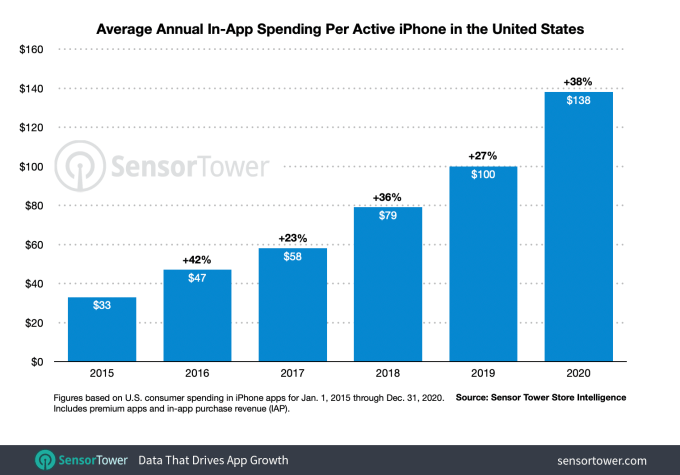
U.S. consumers spent an average of $138 on iPhone apps last year, an increase of 38% year over year, largely driven by the pandemic impacts, according to new data from app store intelligence firm Sensor Tower. Throughout 2020, consumers turned to iPhone apps for work, school, entertainment, shopping and more, driving per-user spending to a

U.S. consumers spent an average of $138 on iPhone apps last year, an increase of 38% year over year, largely driven by the pandemic impacts, according to new data from app store intelligence firm Sensor Tower. Throughout 2020, consumers turned to iPhone apps for work, school, entertainment, shopping and more, driving per-user spending to a new record and the greatest annual growth since 2016, when it had then popped by 42% year over year.

Sensor Tower tells TechCrunch it expects the trend of increased consumer spend to continue in 2021, when it projects consumer spend per active iPhone in the U.S. to reach an average of $180. This will again be tied, at least in part, to the lift caused by the pandemic — and, particularly, the lift in pandemic-fueled spending on mobile games.

Image Credits: Sensor Tower

Last year’s increased spending on iPhone apps in the U.S. mirrored global trends, which saw consumers spend a record $111 billion on both iOS and Android apps, per Sensor Tower, and $143 billion, per App Annie, whose analysis had also included some third-party Android app stores in China.

In terms of where U.S. iPhone consumer spending was focused in 2020, the largest category was, of course, gaming.

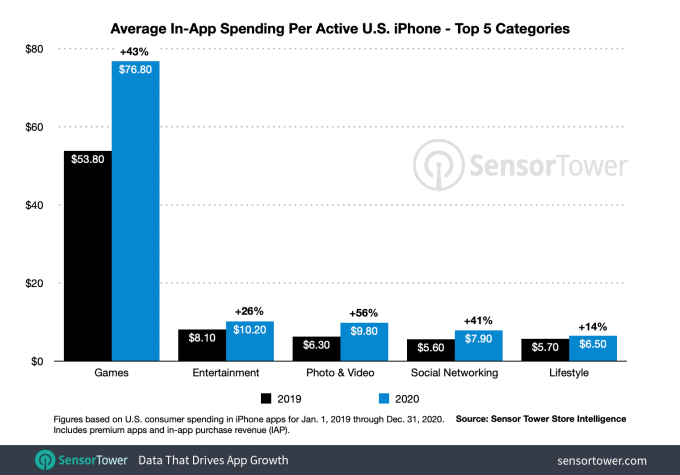
In the U.S., per-device spending on mobile games grew 43% year over year from $53.80 in 2019 to $76.80 in 2020. That’s more than 20 points higher than the 22% growth seen between 2018 and 2019, when in-game spending grew from $44 to $53.80.

U.S. users spent the most money on puzzle games, like Candy Crush Saga and Gardenscapes, which may have helped to take people’s minds off the pandemic and its related stresses. That category averaged $15.50 per active iPhone, followed by casino games, which averaged $13.10, and was driven by physical casinos closures. Strategy games also saw a surge in spending in 2020, growing to an average of $12.30 per iPhone user spending.

Image Credits: Sensor Tower

Another big category for in-app spending was Entertainment. With theaters and concerts shut down, consumers turned to streaming apps in larger numbers. Disney+ launched in late 2019, just months ahead of the pandemic lockdowns and HBO Max soon followed in May 2020.

Average per-device spending in this category was second-highest, at $10.20, up 26% from the $8.10 spent in 2019. For comparison, per-device spending had only grown by 1% between 2018 and 2019.

Other categories in the top five by per-device spending included Photo & Video (up 56% to $9.80), Social Networking (up 41% to $7.90) and Lifestyle (up 14% to $6.50).

These increases were tied to apps like TikTok, YouTube, and Twitch. Twitch saw 680% year-over-year revenue growth in 2020 on U.S. iPhones, specifically. TikTok, meanwhile, saw 140% growth. In the Lifestyle category, dating apps were driving growth as consumers looked to connect with others virtually during lockdowns, while bars and clubs were closed.

Overall, what made 2020 unique was not necessarily what apps people where using, but how often they were being used and how much was being spent.

App Annie had earlier pointed out that the pandemic accelerated mobile adoption by two to three years’ time. And Sensor Tower today tells us that the industry didn’t see the same sort of “seasonality” around spending in certain types of apps, and particularly games, last year — even though, pre-pandemic, there are typically slower parts of the year for spending. That was not the case in 2020, when any time was a good time to spend on apps.


News: Knowing when your startup should go all-in on business development

There’s a persistent fallacy swirling around that any startup growing pain or scaling problem can be solved with business development. That’s frankly not true.

Mike Ghaffary
Contributor

Mike Ghaffary joined Canvas Ventures as a general partner in 2019, where he invests in innovation for consumers and software.

There’s a persistent fallacy swirling around that any startup growing pain or scaling problem can be solved with business development. That’s frankly not true.

Business development is rarely, if ever, the solution to succeeding in a crowded industry, differentiating an offering or delivering a truly exceptional customer experience. But standing up an effective BD operation that brings in sustainable revenue and helps validate product-market fit can be the difference between survival and failure for a startup.

Business development is rarely, if ever, the solution to succeeding in a crowded industry, differentiating an offering or delivering a truly exceptional customer experience.

I’ve had the opportunity to lead business development functions at three companies experiencing three very different stages of growth: Yelp, Stitcher and TrialPay.

At Yelp, I served as vice president of business development and corporate development for seven years. The business development team I was brought in to lead was a core business unit with accountability to the COO, CEO and board. During my tenure, I was involved in securing around 200 partnerships with companies like Apple, Amazon, Microsoft and Samsung, as well as with scores of organizations ranging from early-stage startups to corporate giants.

Yelp was on its way to becoming a go-to source of information and customer value before I arrived. But partnerships like the one I secured with Apple made Yelp into a global market leader.

At Stitcher, I took on business development as central to my role as a company founder. While it may seem like an early phase to go all-in on BD, the partnerships with music and media companies that I orchestrated in the earliest days were essential to the company’s very survival. Stitcher is an example of a company where early BD investment made sense because of the dual importance of brand name involvement in concept validation and rising above podcast market congestion.

At TrialPay, an e-commerce platform acquired by Visa in 2015, there was already an established founding team and business model to involve customers in the marketing and payment of offerings by the time I showed up. In fact, I was brought in to run business development because the company was approaching an inflection point: There was pressure internally from investors and externally from customers to expand TrialPay’s network of merchants in order to diversify commercial offerings more rapidly.

The need for business development was directly tied to consumer demand and the company’s own position between growth funding rounds.

When to go all-in on BD — and when to avoid it

There are certain market conditions that make it smart for companies to invest in BD as a growth engine and others that signal it’s best to place money, talent and time elsewhere.

You should invest in business development early when your startup’s early success depends on it. For example, at Stitcher, we wanted — and perhaps needed — early buy-in from large media companies who created the podcast content we were going to feature. We didn’t want to get in the same murky legal territory early music startups had gotten into, like Napster.

WordPress Image Lightbox Plugin