Tag Archives: Blog

News: Egypt’s Paymob closes $18.5M Series A to expand payments services across MENA

While Nigeria and Kenya have been at the forefront of African fintech innovation, activities in Egypt are beginning to shape up nicely. Right now, Egypt is home to a burgeoning fintech startup ecosystem, and today, one of its biggest players, Paymob announced that it has completed an $18.5 million Series A round. In July 2020,

While Nigeria and Kenya have been at the forefront of African fintech innovation, activities in Egypt are beginning to shape up nicely. Right now, Egypt is home to a burgeoning fintech startup ecosystem, and today, one of its biggest players, Paymob announced that it has completed an $18.5 million Series A round.

In July 2020, Paymob raised $3.5 million as its first tranche of Series A investment. An additional $15 million was raised from the same investors in the first tranche led by Dubai-based VC firm Global Ventures. Other investors include Egyptian investment fund A15 and Dutch development bank FMO.

The total raise of $18.5 million is the largest Series A round in Egypt yet and one of the largest equity rounds in North Africa.

“We are delighted to lead this momentous fintech fundraise in the region. Paymob has a perfect combination of high-quality technology, product customers increasingly cannot do without, and an outstanding management team, “Basil Moftah, general partner at Global Ventures, said of the investment.Their market opportunity is also huge; Egypt’s transformation to a cashless society is being enabled by the unique products Paymob has built.” 

Paymob was founded in 2015 by Alain El Hajj, Islam Shawky, and Mostafa El Menessy. The platform helps online and offline merchants to accept payments from their customers via several products and solutions. It offers a payment gateway that merchants can plugin into their sites or mobile application using its APIs. For offline merchants, Paymob has a POS solution where they can receive in-store card payments.

The company also has a payment links feature where merchants share links with their customers to receive payments that are received using mobile wallets. And according to the company, 85% of mobile wallets transactions carried out in Egypt is processed by its infrastructure. It also claims to be the largest payment facilitator in the country.

Asides from Egypt, Paymob is also present in Kenya, Pakistan, and Palestine. CEO Shawky says the company has plans to expand into more Sub-Saharan African countries. However, that will come after focusing on the Gulf Cooperation Council (GCC) to gain a large market share.

Regional expansion (with an imminent entry into Saudi Arabia this year) is one of Paymob’s objectives following this raise. Per a statement released by the company, it will also use the investments to expand its merchant network, meet increasing demand, and improve product offerings.

The pandemic presented one of the best opportunities for fintechs all over the world to achieve massive growth. For Paymob, it claims to have grown its monthly revenue over 5x last year. The company also recorded a total payment volume of more than $5 billion from over 35,000 local and international merchants like Swvl, LG, Breadfast, and Tradeline

This growth allowed the fintech company to raise the second tranche of investment after closing just $3.5 million initially. Shawky told TechCrunch that the deal materialized after the company’s investors and management witnessed an “unprecedented growth” driven by the pandemic “in addition to the new initiatives launched by regulators, which encouraged them to increase their investment to meet our increasing demand

As earlier iterated, fintech is on the rise in Egypt with startups like Moneyfellows, NowPay, Raseedi, Flick providing lending, payments, wealth and personal finance management services, etc.

The Egyptian fintech ecosystem also got a major boost when incumbent fintech Fawry became a publicly-traded unicorn for the first time. Since launching in 2007, Fawry has been the largest online payment platform in the country and offers a variety of services ranging from mobile wallet to banking services. Will Fawry’s longstanding presence pose a challenge to Paymob’s quest to become a dominant fintech as well? Shawky doesn’t think so.

“Paymob’s major competitor is cash. With only a small percentage of the economy operating in digital forms, we believe the opportunity of truly transforming cash into digital is yet to be unlocked,” he said.

That said, the raise follows the launch of two funds — Algebra Ventures and Sawari Ventures in what can be described as an exciting week for startups and VCs in the country.

News: Messaging platform Gupshup raises $100 million at $1.4 billion valuation

A startup that began its journey in India 15 years ago, helping businesses reach and engage with users through texts said on Thursday it has attained the unicorn status and is also profitable. San Francisco-headquartered Gupshup has raised $100 million in its Series F financing round from Tiger Global Management, which valued the 15-year-old startup

A startup that began its journey in India 15 years ago, helping businesses reach and engage with users through texts said on Thursday it has attained the unicorn status and is also profitable.

San Francisco-headquartered Gupshup has raised $100 million in its Series F financing round from Tiger Global Management, which valued the 15-year-old startup at $1.4 billion.

The startup operates a conversational messaging platform, which is used by over 100,000 businesses and developers today to build their own messaging and conversational experiences to serve their users and customers.

Gupshup, which has raised $150 million to date and concluded its Series E round in 2011, says each month its clients send over 6 billion messages.

“The growth in business use of messaging and conversational experiences, transforming virtually every customer touchpoint, is an exciting secular trend,” said John Curtius, a partner at Tiger Global Management, in a statement. “Gupshup is uniquely positioned to win in this market with a differentiated product, a clear and sustainable moat, and an experienced team with a proven track record. In addition to its market leadership, Gupshup’s unique combination of scale, growth and profitability attracted us.”

Tens of millions of users in India, including yours truly, remember Gupshup for a different reason, however. For the first six years of its existence, Gupshup was best known for enabling users in India to send group messages to friends. (These cheap texts and other clever techniques enabled tens of millions of Indians to stay in touch with one another on phone a decade ago.)

That model eventually became unfeasible to continue, Beerud Sheth, co-founder and chief executive of Gupshup, told TechCrunch in an interview.

“For that service to work, Gupshup was subsidizing the messages. We were paying the cost to the mobile operators. The idea was that once we scale up, we will put advertisements in those messages. Long story short, we thought as the volume of messages increases, operators will lower their prices, but they didn’t. And also the regulator said we can’t put ads in the messages,” he recalled.

That’s when Gupshup decided to pivot. “We were neither able to subsidize the messages, nor monetize our user base. But we had all of this advanced technology for high-performance messaging. So we switched from consumer model to enterprise model. So we started to serve banks, e-commerce firms, and airlines that need to send high-level messages and can afford to pay for it,” he said.

Over the years, Gupshup has expanded to newer messaging channels, including conversational bots and it also helps businesses set up and run their WhatsApp channels to engage with customers.

Sheth said scores of major firms worldwide in banking, e-commerce, travel and hospitality and other sectors are among the clients of Gupshup. These firms are using Gupshup to send their customers with transaction information, and authentication codes among other use cases. “These are not advertising messages or promotional messages. These are core service information,” he said.

The startup, which had an annual run rate of $150 million, will use the fresh capital to broaden its product offering and court clients in more markets.

This is a developing story. More to follow…

News: YC-backed Abacum nets $7M to empower finance teams with real-time data and collaboration tools

SaaS to support mid-sized companies’ financial planning with real-time data and native collaboration isn’t the sexiest startup pitch under the sun but it’s one that’s swiftly netted Abacum a bunch of notable backers — including Creandum, which is leading a $7M seed round that’s being announced today. The rosters of existing investors also participating in

SaaS to support mid-sized companies’ financial planning with real-time data and native collaboration isn’t the sexiest startup pitch under the sun but it’s one that’s swiftly netted Abacum a bunch of notable backers — including Creandum, which is leading a $7M seed round that’s being announced today.

The rosters of existing investors also participating in the round are Y Combinator (Abacum was part of its latest batch), PROFounders, and K-Fund, along with angel investors such as Justin Kan (Atrium and Twitch co-founder and CEO); Maximilian Tayenthal (N26 co-founder and co-CEO & CFO); Thomas Lehrman (GLG co-founder and ex-CEO), Avi Meir (TravelPerk co-founder and CEO); plus Jenny Bloom (Zapier CFO and Mailchimp ex-CFO) and Mike Asher (CFO at Neo4j).

Abacum was founded last year in the middle of the COVID-19 global lockdown, after what it says was around a year of “deep research” to feed its product development. They launched their SaaS in June 2020. And while they’re not disclosing customer numbers at this early stage their first clients include a range of scale-up companies in the US and in Europe, including the likes of Typeform, Cabify, Ebury, Garten, Jeff and Talkable.

The startup’s Spanish co-founders — Julio Martinez, a fintech entrepreneur with an investment banking background, and Jorge Lluch, a European Space Agency engineer turned CFO/COO — spotted an opportunity to build dedicated software for mid-market finance teams to provide real-time access to data via native collaborative that plugs into key software platforms used by other business units, having felt the pain of a lack of access to real-time data and barriers to collaboration in their own professional experience with the finance function.

The idea with Abacum is to replace the need for finance teams to manually update their models. The SaaS automatically does the updates, fed with real-time data through direct integrations with software used by teams dealing with functions like HR, CRM, ERP (and so on) — empowering the finance function to collaborate more easily across the business and bolster its strategic decision-making capabilities.

The startup’s sales pitch to the target mid-sized companies is multi-layered. Abacum says its SaaS both saves finance teams time and enables faster-decision making.

“Prior to using Abacum, finance analysts in our clients were easily spending 50% to 70% of their time in manual tasks like downloading files from different systems, copy&pasting them in massive spreadsheets (that crash frequently), formatting the data by manually adding and removing rows, columns and formats, connecting the data in a model prone to manual error (e.g. vlookups & sumifs),” Martinez tells TechCrunch. “With Abacum, this entire manual part is automatically done and the finance professionals can spend their time analyzing and adding real value to the business.”

“We enable faster decisions that were not possible prior to Abacum. For instance, some of our clients were updating their cohort analysis on a quarterly basis only because the associated manual tasks were too painful. With us, they’re able to update the analysis weekly and take better decisions as a result.”

The SaaS also supports decisions in another way — by applying machine learning to business data to generate estimates on future performance, providing an AI-based reference point based on historical data that finance teams can use to inform their assumptions.

And it aids cross-business collaboration — allowing users to share and gather information “easily through workflows and permissions”. “We see that this results in faster and richer decisions as more stakeholders are brought into the process,” he adds.

Martinez says Abacum chose to focus on mid-market finance teams because they face “more challenges and inefficiencies” vs the smaller (and larger) ends of the market. “In that segment, the finance function is underinvested — they face the acute complexities of scaling companies that become very pressing but at the same time they are still considered a support function, a back-office,” he argues.

“Abacum makes finance a strategic function — we deliver native collaboration to finance teams so that they become the trusted business partner they want to be. We also see that the pandemic has accelerated the need for finance teams to collaborate effectively and work remotely,” he adds.

He also describes the mid market segment as “fairly unpenetrated” — claiming many companies do not yet having a solution in place.

While competitors he points to when asked about other players in the space are long in the tooth in digital terms: Adaptive Insights (2003); Host Analytics (2001); and Anaplan (2008).

Commenting on the seed round in a statement, Peter Specht, principal at Creandum, added: “The financial planning processes in many companies are ripe for disruption and demand more automation. Abacum’s slick solution empowers finance teams to be more collaborative, efficient and better informed with access to real-time data. We were impressed by their user-friendly product, the initial hiring of top talent, and crucially the strong founders and their extensive operational experience — including as CFOs and entrepreneurs who have experienced the problem first-hand. We are delighted to be part of Abacum’s journey to empower global SMEs to bring their financial operations to new levels.”

Abacum’s seed financing will be ploughed into product development and growth, per Martinez, who says it’s focused on wooing finance teams in the US and Europe for now.

News: Butter is building an ‘all-in-one’ platform to run virtual workshops

Butter, a startup registered in Denmark but operating fully remote, is building an “all-in-one” platform for planning and running virtual workshops. Offering video software and other features dedicated to workshopping, the idea is to pull people away from using more generic tools, such as Zoom and Microsoft Teams, which, arguably, aren’t well suited to workshops.

Butter, a startup registered in Denmark but operating fully remote, is building an “all-in-one” platform for planning and running virtual workshops.

Offering video software and other features dedicated to workshopping, the idea is to pull people away from using more generic tools, such as Zoom and Microsoft Teams, which, arguably, aren’t well suited to workshops. It’s also an idea that will be welcomed by many remote workers trapped in a groundhog day full of back-to-back Zooms — and one that has already attracted venture capital.

Backing Butter’s seed round of $2.75 million, which is being disclosed today, is Project A. Others investing in the burgeoning startup are Des Traynor, co-founder and chief strategy officer of Intercom (amongst other angels). It adds to $440,000 previously raised through a mix of equity funding from Morph Capital, venture debt from The Danish Growth Fund and grants from Innovation Fund Denmark.

Butter co-founder and CEO Jakob Knutzen tells me that workshop facilitators, such as strategy consultants, HR trainers and design sprinters, typically have two problems: technical overload and a lack of energy in the workshops.

The former includes having to juggle too many tools needed to plan, run and disseminate a workshop, coupled with unintuitive interfaces and an inability to set up elements of a workshop in advance. The lack of “energy” when delivering workshops virtually is likely a harder nut to define and then crack, but anyone who has taken part in an online workshop has likely experienced it.

“We solve these in two ways,” says Knutzen, “[with an] all-in-one tool that helps facilitators prepare, run and debrief the workshop in one place, [and] a delightful design that supports facilitators in delivering a more human experience… 90% of our users comment on this; Zoom fatigue is real”.

Image Credits: Butter

You get started in Butter by creating and setting up a “room,” including optionally creating an agenda, polls and timers, as well as various customisation, such as a welcome page, image and (yes) music. Next, you invite workshop participants via an automatically generated link that can easily be shared.

On the day, participants join directly in their browser and the workshop leader runs the workshop using the agenda they created as the main guiding point. Butter also supports various third-party integrations, such as for white boarding, note taking, etc. After the session, facilitators can access a “recap” in the room overview with a chat transcript, recording and poll results, etc.

Adds the Butter CEO: “Down the line, we’ll make this even more ‘full workshop flow’ — [including] more of the planning part, having a full pre-workshop space for participants, building out the post-workshop experience, etc. But for now, we’ve doubled down on making the ‘during’ part flow smoothly”.

To that end, Butter is yet to monetise, but will adopt a SaaS model. Meanwhile, Knutzen cites competitors as established but generalist platforms, such as Zoom and Teams; legacy specialist platforms, such as Adobe Connect and Webex for Training; and other startups trying to solve the same problem (e.g. Toasty.ai, circl.es and VideoFacilitator).

“We differentiate ourselves by being laser focused on workshops,” he says.

News: Shilling Founders Fund is Portugal’s newest VC, with $35.6M to spend on early-stage startups

Shilling, an early-stage VC in Portugal, has now launched a new €30M ($35.6M) early-stage fund called Shilling Founders Fund, which is backed just over 35 successful tech founders, as well as large European VC Atomico. The fund will run on a profit-sharing model, sharing fund returns with all of its portfolio founders. While the fund

Shilling, an early-stage VC in Portugal, has now launched a new €30M ($35.6M) early-stage fund called Shilling Founders Fund, which is backed just over 35 successful tech founders, as well as large European VC Atomico. The fund will run on a profit-sharing model, sharing fund returns with all of its portfolio founders. While the fund tends to back Portuguese startups it also hold back 40% of its capital for international deals.

The fund says it has already invested in seven companies: Rows (spreadsheet for app creators), Vawlt (secure and resilient multi-cloud platform), Promptly (SaaS platform for health outcomes analytics), Modatta (decentralized marketplace for consented personal data), Biocol Labs (DTC post-chemical pharmacy), Decipad (low-code notebook) and Detech.ai (AI-powered application and infrastructure monitoring platform).

The fund is also launching what it dubs the “Shilling Platform” – a pool of learnings and resources for startups.

In a statement, Pedro Santos Vieira, managing partner at Shilling said: “We call it experience-based acceleration. Additionally, we run on a profit-sharing model. Each portfolio founder will receive a share of our returns. This twofold approach fully aligns incentives between Shilling, LPs, and portfolio founders.”

Founded by Hugo Gonçalves Pereira, António Casanova, Diogo da Silveira, João Coelho Borges, Juan Alvarez and Pedro Rutkowski in 2011, Shilling was later joined by tech founders Ricardo Jacinto (Elecctro), Miguel Santo Amaro (Uniplaces), Pedro Ramalho Carlos (IP) and Pedro Santos Vieira (GoodGuide) in the last five years. Since 2011, it has invested in a number of breakout hits from the country, including Unbabel; Bizay; Uniplaces; and Best Tables, acquired by TripADvisor.

Hugo Gonçalves Pereira, founder of Shilling, added: “We are a Portugal-based, globally ambitious, VC fund, with a founder-friendly approach to early-stage investing… and when we say founder-friendly we truly mean it: in our pre-seed program, ventures go from first call, to money in the bank, in less than 30 days.”

As we noted earlier this year in our ExtraCrunch survey of Lisbon, Portugal, the city is gearing up to join other significant tech hubs.

Other leading VCs in the country include Indico Capital Partners,  Faber, Armilar Venture Partners, Tocha, and Portugal Ventures.

News: TrueLayer raises $70M for its open banking platform

TrueLayer, the London startup that offers a developer-friendly platform for companies, including other fintechs, to utilise open banking, is disclosing $70 million in new funding. The Series D round is led by new investor Addition. Existing investors, including Anthemis Group, Connect Ventures, Mouro Capital, Northzone and Temasek, also participated. New investors include Visionaries Club, Zack

TrueLayer, the London startup that offers a developer-friendly platform for companies, including other fintechs, to utilise open banking, is disclosing $70 million in new funding.

The Series D round is led by new investor Addition. Existing investors, including Anthemis Group, Connect Ventures, Mouro Capital, Northzone and Temasek, also participated. New investors include Visionaries Club, Zack Kanter (CEO Stedi), Daniel Graf (ex-Uber, Google, Twitter) and David Avgi (ex-CEO SafeCharge, CEO UniPaaS).

TrueLayer says the Series D brings the total investment to date to $142 million. The injection of capital will be used to continue scaling its open banking network, which brings together payments, financial data and identity to enable companies to build new products that improve “how we spend, save, and transact online”.

This will include further development of premium open banking-based services that go beyond simply accessing open banking APIs and will enable more innovation across financial services, including embedded finance and payments more generally.

To do this, and to support what it says is growing demand, TrueLayer is expanding its engineering, product and commercial teams. In the past 12 months, the fintech has expanded its services across 12 European markets.

Over the years, TrueLayer CEO and co-founder Francesco Simoneschi and I have often pontificated on what open banking’s killer use case or use cases may turn out to be. We may finally have our answer: payments.

That’s because one aspect of open banking is payment initiation, which lets an authorised third party initiate the transfer of money out of your bank account on your behalf as an alternative to card payments, which were never built with online payments in mind.

“We believe open banking payments will become the default way to pay online, replacing other payment methods in the next five years,” says Simoneschi. “Open banking is digitally native and mobile-first, moving money at a fraction of the cost, securely and conveniently, while also delivering a vastly better consumer experience”.

The past year has also exposed some of the problems with existing payments methods, as people have turned to digital channels to manage every aspect of their lives. “The problem is cards,” says the TrueLayer CEO, “which weren’t designed for online and have been retrofitted into current online payment flows. Newer digital approaches such as Google Pay or Apple Pay paper over those cracks but don’t change the fundamentals”.

Simoneschi says the company has seen the use of its payments API grow rapidly as more consumers embrace instant bank payments. Volumes grew by 600x over the last year, driven by more and more companies adopting open banking payments, including the likes of Revolut, Trading 212, Freetrade and Nutmeg.

“We typically see that 1 in 3 customers choose the open banking payment option after trying it once,” he notes, revealing that for some clients, closer to 70% of their customers are using open banking as the primary payment method.

“There are a number of reasons why it makes sense for customers. For one, they don’t need to remember card details. Instead, they authenticate with their face or fingerprint on their mobile device, instantly and securely. Plus, they’ll never need to update stored details if their card is lost, stolen or expires”.

Open banking payments as a checkout option benefits merchants too, argues Simoneschi. “These payments typically convert 20% better than cards (and up to 40% with our flows) and have success rates higher than 95%, equating to millions or hundreds of millions in recovered revenue at the end of the year,” adds the TrueLayer co-founder.

News: Indian edtech giant Byju’s to expand to international markets

Byju’s said on Thursday it will expand to international markets in the second half of next month as the Indian edtech giant, valued at over $13 billion, looks to accelerate its growth. The Indian edtech giant, which acquired 33-year-old Indian tutor Aakash for nearly $1 billion earlier this week, plans to launch in the U.S., UK,

Byju’s said on Thursday it will expand to international markets in the second half of next month as the Indian edtech giant, valued at over $13 billion, looks to accelerate its growth.

The Indian edtech giant, which acquired 33-year-old Indian tutor Aakash for nearly $1 billion earlier this week, plans to launch in the U.S., UK, Brazil, Indonesia and Mexico next month and explore other geographies later this year, it told employees in an email on Thursday.

The startup’s international business will be headed by Karan Bajaj, the founder of coding platform WhiteHat Jr, which Byju’s acquired for $300 million last year.

WhiteHat Jr’s platform is playing a crucial role in Byju’s international play. The coding platform, which offers one-to-one session between teachers and students, is enabling Byju’s to offer its courses in both synchronous and asynchronous formats.

In international markets, the Indian online learning giant will be branded as Byju’s Future School. It will offer a range of subjects including coding, Math, Music, English, Fine Arts and Science, the startup told employees. At the launch, coding and Math will be available.

This is a developing story. More to follow…

News: Nabla is building a healthcare super app for women

Meet Nabla, a French startup launching a new app today focused on women’s health. On Nabla, you’ll find several services that should all contribute to helping you stay on top of your health. In short, Nabla lets you chat with practitioners, offers community content, helps you centralize all your medical data and will soon offer

Meet Nabla, a French startup launching a new app today focused on women’s health. On Nabla, you’ll find several services that should all contribute to helping you stay on top of your health. In short, Nabla lets you chat with practitioners, offers community content, helps you centralize all your medical data and will soon offer telemedicine appointments.

Nabla’s key feature right now is the ability to start a conversation with health professionals. You can send a message to a general practitioner, a gynecologist, a midwife, a nurse, a nutritionist, or a physiotherapist.

While text discussions are not going to replace in-person appointments altogether, they can definitely be helpful. By increasing the number of interactions with health professionals, chances are you’ll be healthier and you may even end up booking more in-person appointments.

Other French startups have been providing text conversations with practitioners. For instance, health insurance company Alan lets you message a general practitioner — but you have to be insured by Alan. Biloba also lets you chat with a doctor — but the company has been focusing on pediatrics.

Nabla has a different positioning and offers this feature for free — there’s a limit as you can only send a handful of questions per month though. If it’s a common question, you may find the answer from the community. Nabla’s doctors will curate community content as well.

Using a free product to talk about your health feels suspicious. But that’s because the startup is well-funded and plans to launch premium features.

Image Credits: Nabla

The startup has raised $20.2 million (€17 million) and is already working with a team of doctors who are ready to answer questions from the company’s first users — or patients. Investors in the company include Xavier Niel, Artemis, Rachel Delacour, Julie Pellet, Marc Simoncini and Firstminute Capital.

One of the reasons why Nabla could raise so much money before releasing its app is that the three co-founders have a track record in the tech ecosystem.

Co-founder and CEO Alexandre Lebrun previously founded VirtuOz, which was acquired by Nuance, and Wit.ai, which was acquired by Facebook. More recently, he’s worked for Facebook’s AI research team (FAIR).

Co-founder and COO Delphine Groll has been heading business development and communications for two major media groups Aufeminin and My Little Paris. And Nabla’s co-founder and CTO Martin Raison has worked with Alexandre Lebrun at both Wit.ai and Facebook.

In addition to text conversations, Nabla shows all your past interactions in a personal log. You can connect that log with other apps and services, such as Apple’s Health app, Clue and Withings. This way, you can see all your data from the same app.

As you may have guessed, the startup truly believes that machine learning can help when it comes to preventive and holistic care. By default, nothing is shared with Nabla for machine learning purposes. But users can opt in and share data to improve processes, personalization and more.

Eventually, Nabla wants to optimize the interactions with doctors as much as possible. The startup says it doesn’t want to replace doctors altogether — it wants to enhance medical interactions so that doctors can focus on the human and empathetic part.

Nabla plans to launch a telemedicine service so that you can interact with doctors in real time as well as a premium offering with more features. That’s an ambitious roadmap, and it’s going to be interesting to track Nabla over the long run to see if they stick to their original vision and find a loyal user base.

News: India’s Spinny raises $65 million to expand its online platform for selling used cars

Hundreds of thousands of used cars are sold in India each month. But buying one through the offline and traditional channel could prove to be a painstakingly long and high-risk process. A Gurgaon-based startup that is attempting to improve this experience said on Thursday it has raised a new financing round. Spinny has raised $65

Hundreds of thousands of used cars are sold in India each month. But buying one through the offline and traditional channel could prove to be a painstakingly long and high-risk process.

A Gurgaon-based startup that is attempting to improve this experience said on Thursday it has raised a new financing round.

Spinny has raised $65 million in its Series C financing round, the five-year-old Indian startup said. The new round was led by Silicon Valley-headquartered venture firm General Catalyst, while Feroz Dewan’s Arena Holdings, Think Investments, and existing investors Fundamentum Partnership — backed by tech veterans Nandan Nilekani and Sanjeev Aggarwal — and Elevation Partners participated in it.

The round, which brings Spinny’s to-date raise to over $120 million, valued the startup at about $350 million, up from about $150 million a year ago, a person familiar with the matter told TechCrunch. The startup declined to comment on the valuation.

Spinny operates a platform to facilitate sale and purchase of used cars. One of the biggest challenges people face in buying a used car is the trust factor, and Niraj Singh, co-founder and chief executive of Spinny, says the startup’s thorough and transparent inspection of the car, buying it from the owner, and then selling it to customers is addressing those concerns.

The startup says it is removing the traditional middlemen from the equation, thereby making it more affordable and reliable for customers to buy a used car. If a customer is not satisfied with the car that they have purchased from Spinny, they get their full-refund, he said.

Spinny began its journey as a marketplace for used cars, but Singh said the startup has expanded its offerings to become a full-stack platform.

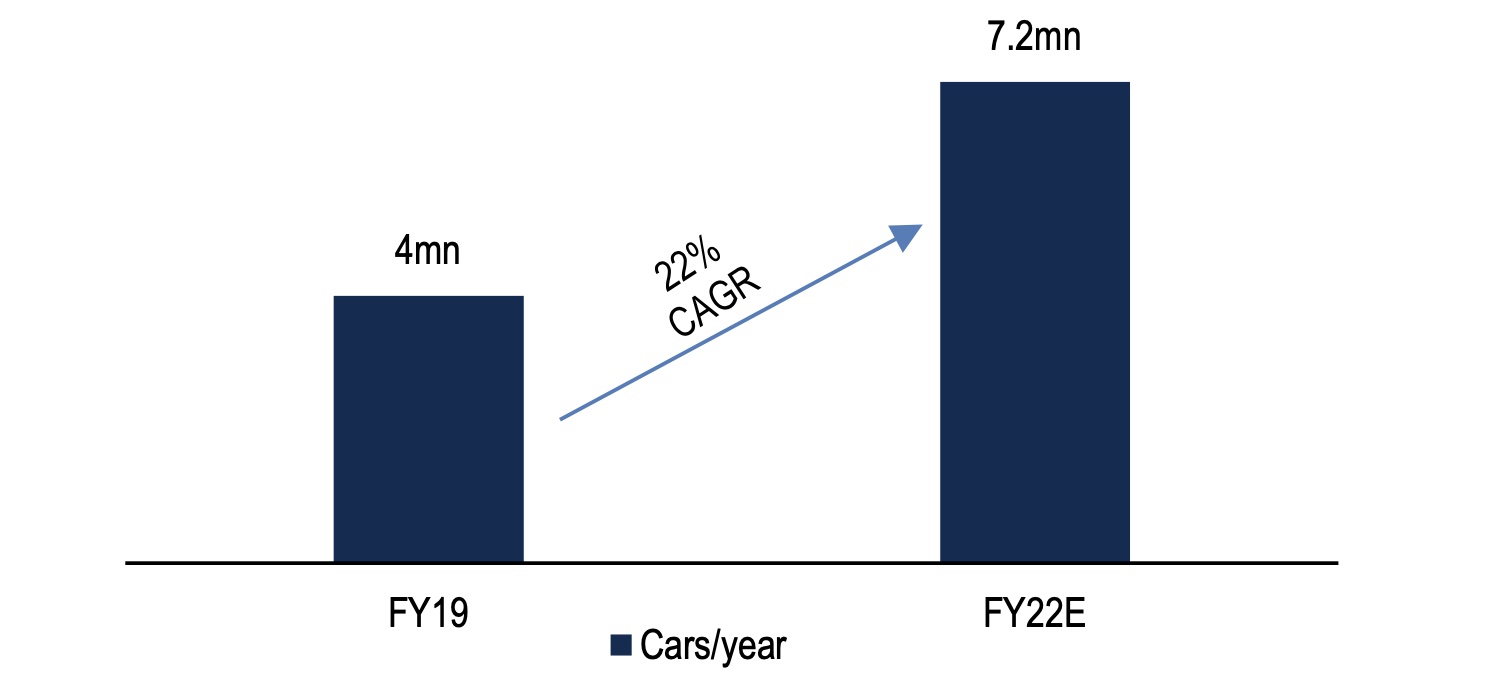
Used car marketed is estimated to grow at 22% CAGR to 7.2mn cars sold per year. (BoFA research)

Days after one of my previous conversations with Singh, New Delhi announced a months-long lockdown in the nation as it moved to contain the spread of the pandemic. Singh said the pandemic did hurt Spinny’s business for a few months, but the startup has long recovered its pre-pandemic growth figures.

The pandemic made many cautious about taking an Uber or Ola ride, and explore buying their own cars, which accelerated the growth, said Singh. It also significantly reduced the CAC (customer acquisition cost) for Spinny, he added.

“We believe Spinny is uniquely positioned to tap this opportunity–given their compelling leadership and their real market momentum. As long time investors, we’ve been impressed by how Spinny is reinventing every part of the buying process – injecting trust and safety into every aspect of the customer experience,” said Adam Valkin, General Partner at General Catalyst, in a statement.

Spinny, which was operational in five Indian cities last year, plans to expand to 15 cities by the end of 2021, and also deploy part of the fresh fund to broaden its full-stack platform, said Singh.

“Spinny has become India’s most trusted used car brand and is on its way to becoming India’s largest as well. It’s heartening to hear customers describe the experience of buying a used car from Spinny being better than that of buying a new car. This has been made possible because of Niraj and the entire Spinny team’s customer obsession and relentless execution. We are privileged to be their early partners and super excited to double down in this round,” said Mukul Arora, Partner at Elevation Capital, in a statement.

This is a developing story. More to follow later…

News: Norway’s Kolonial rebrands as Oda, bags $265M on a $900M valuation to grow its online grocery delivery business in Europe

Food delivery startups, and specifically those focused on grocery delivery, continue to reap super-sized rounds of funding in Europe, buoyed by a year of pandemic living that has led many consumers to shift to shopping online. Today, the latest of these is coming out of Norway. Kolonial, a startup based out of Oslo that offers

Food delivery startups, and specifically those focused on grocery delivery, continue to reap super-sized rounds of funding in Europe, buoyed by a year of pandemic living that has led many consumers to shift to shopping online. Today, the latest of these is coming out of Norway.

Kolonial, a startup based out of Oslo that offers same-day or next-day delivery of food, meal kits and home essentials — its aim is to provide “a weekly shop” for prices that compete against those of traditional supermarkets — has raised €223 million ($265 million) in an equity round of funding. Along with that, the company — profitable as of last year — is rebranding to Oda and plans to use the money (and new name) to expand to more markets, starting first with Finland and then Germany in 2022.

The market for online grocery ordering and delivery is gearing up to be a very crowded one, with hundreds of millions of dollars being poured by investors into the fuel tanks of a range of startups — each originating out of different geographies, each with a slightly different approach. Oda believes it has the right mix to end up at the front of the pack.

“We have found ourselves in a unique position,” CEO and co-founder Karl Munthe-Kaas said in an interview with TechCrunch. “We have built a service targeting the mass market with instant deliveries and low prices, because if you want to capture the full basket for the family, you can’t be a premium service. We’ve done that, and we’re profitable.”

And now, it will have the backing of two e-commerce heavyweights for its next steps. SoftBank’s Vision Fund 2 and Prosus (the tech holdings of South Africa’s Naspers), are co-leading the round, with past backers Kinnevik and a strategic investor, Norwegian “soft discount” chain REMA, also participating.

Munthe-Kaas confirmed to TechCrunch in an interview that Oda is valued at €750 million ($900 million) post-money.

The funding is a big leap for Oda (the name is not officially going to come into effect until the end of this month, although the company is already describing itself with the new brand, so we’ll follow that lead). PitchBook data notes that before this round, Oda had only raised about $96 million, and its last valuation was estimated to be just $178 million in 2017.

The company has certainly come a long way. Founded in 2013 by ten friends, Kolonial originally seemed to have a more modest vision when it first started out: Kolonial in Norwegian doesn’t mean “colonial” (a connotation Munthe-Kaas nevertheless said the startup wanted to avoid, one big reason for the change), but “cornershop.” These days, Oda is focused more on competing against large supermarkets — its average order size is $120 — yet with a significantly more efficient cost base behind the scenes.

It’s also been helped by the current climate. Online grocery shopping has been growing and maturing for a while now, but the last year been a veritable hothouse in that process: Covid-19, shelter in place orders and a general desire for people to keep their distance all compelled many more consumers to try out online grocery shopping for the first time, and many have stuck with it.

“We have seen a significant inflection point with grocery over the last year with the market transitioning online, accelerated by Covid,” said Larry Illg, CEO of Prosus Food, in a statement. “Oda’s leadership and impressive growth in Norway paired with its ground-breaking technology and ambition to scale across Europe and beyond makes them an ideal partner to tackle the grocery opportunity over the coming years.”

Oda has over the years grown to become the sector leader in a category it arguably helped define in its home country. It was profitable last year on revenues of €200 million, and it currently controls some 70% of Norway’s online grocery ordering and delivery market based on its own particular approach to the model.

That model involves Oda building and controlling its own supply chains from producers to consumers (no partnerships with third y partphysical retailers), producing several of the products itself (such as baked goods) to order, and using centralized fulfillment centers to manage orders for large geographies.

“Centralized warehouses means 50 supermarkets in one location,” Munthe-Kaas said, adding that this also makes the business significantly greener, too.

Those fulfillment centers, meanwhile, are operated at “extreme efficiency”, in his words. Oda’s grocery item picking averages out at 212 units per hour — that is, the amount of items “picked” for orders in a week divided by the number of hours in a week. The next closest UPH number in the industry, Munthe-Kaas said, was Ocado in the UK at 170 UPH, and the norm, he added, was more like 100 UPH, with physical store picking (where customers select items from shelves themselves) averaging out at 70 UPH.

All of this translates to much more cost-effective operations, including more efficient ordering and stock rotation, which helps Oda make better margins on its sales overall. Munthe-Kaas declined to go into the details of how Oda manages to get such high UPH numbers — that’s competitive knowledge, he said — noting only that a lot of automation and data analytics goes into the process.

That will be music to the ears of SoftBank, which has had a complicated run in e-commerce in the last several years, backing a number of interesting juggernauts that have nonetheless found themselves unable to improve on challenging unit economics.

“Oda’s leading position in Norway is testament to the merits of its bespoke and data-driven approach in offering a personalised, holistic and reliable online grocery experience,” said Munish Varma, managing partner for SoftBank Investment Advisers, in a statement. “We believe that Oda’s customer-centric focus, market-leading automation technology and fulfillment efficiency are a winning combination, and position Oda for success in scaling internationally for the benefit of customers and suppliers alike.”   

The big challenge for Oda going forward will be whether it can transplant its business model as it has been developed for Norway into further markets.

Oda will not only be looking for customer traction for its own business, but it will be doing so potentially against heavy competition from others also looking to expand outside their borders.

There are other online supermarket plays like Rohlik out of the Czech Republic (which in March bagged $230 million in funding); Everli out of Italy (formerly called Supermercato24, it also raised $100 million); Picnic out of the Netherlands (which has yet to announce any recent funding but it feels like it’s only a matter of time given it too has publicly laid out international ambitions); and Ocado in the UK (which also has raised huge amounts of money to pursue its own international ambitions).

And there is also the wave of companies that are building more fleet-of-foot approaches around smaller inventories and much faster turnaround times, the idea being that this can cater both to individuals and a different way of shopping — smaller and more often — even if you are a family.

Among these so-called “q-commerce” (quick commerce) players, covering just some of the most recent funding rounds, Glovo just last week raised $528 million; Gorillas in Berlin raised $290 million; Turkey’s Getir — also rapidly expanding across Europe — picked up $300 million on a $2.6 billion valuation as Sequoia took its first bite into the European food market; and reportedly Zapp in London has also closed $100 million in funding.

Deliveroo, which went public last week, is also now delivering groceries (in partnership with Sainsbury’s) alongside its restaurant delivery service.

These, ironically, are more cornershop replacements than Oda itself (formerly called Kolonia, or “cornershop” in Norwegian), and Munthe-Kaas said he sees them as “complementary” to what Oda does.

Indeed, Munthe-Kaas remains very committed to the basic rulebook that Oda has lived by for years.

“You need to beat the physical stores on quality, selection and price and get it home delivered,” he said. “This is a margin business and the only way to optimize is to be completely relentless.”

But he also understands that this might ultimately need to be modified depending on the market. For example, while the company has not worked with other retailers in Norway — even the investment by REMA is not for distribution but for better economies of scale in procuring products that REMA and Oda will sell independently from each other — this might be a route that Oda chooses to take in other markets.

“We’re in discussions with several other retailers, wholesalers and producers,” he said. “It’s important to get sourcing terms and have upstream logistics, but there are many ways of achieving that. We are super open to making partnerships on that front, but we still think the way to win is to run the value chain.”

WordPress Image Lightbox Plugin