Tag Archives: Blog

News: Epic cries monopoly as Apple details secret ‘Project Liberty’ effort to provoke ‘Fortnite’ ban

The Epic v. Apple lawsuit alleging monopolistic practices by the latter will begin next month, and today the main arguments of each company were published, having been trimmed down somewhat at the court’s discretion. With the basic facts agreed upon, the two companies will go to battle over what they mean, and their CEOs will

The Epic v. Apple lawsuit alleging monopolistic practices by the latter will begin next month, and today the main arguments of each company were published, having been trimmed down somewhat at the court’s discretion. With the basic facts agreed upon, the two companies will go to battle over what they mean, and their CEOs will likely take the (virtual) stand to do so.

As we’ve covered in previous months, the thrust of Epic’s argument is that Apple’s hold over the app market and 30 percent standard fee amount to anti-competitive behavior that must be regulated by antitrust law. It rebelled against what it describes as an unlawful practice by slipping its own in-game currency store into the popular game Fortnite, circumventing Apple payment methods. (CEO Tim Sweeney would later, and unadvisedly, compare this to resisting unjust laws in the civil rights movement.)

Apple denies the charge of monopoly, pointing out it faces enormous competition all over the market, just not within its own App Store. And as for the size of the fees — well, perhaps it’s a matter that could stand some adjustment (the company dropped its take to 15% for any developer’s first million following criticism throughout 2020), but it hardly amounts to unlawfulness.

For its part, Apple contends that the whole antitrust allegation and associated dust-kicking is little more than a PR stunt, and it has something in the way of receipts.

Epic did, after all, have a whole PR strategy ready to go when it filed the lawsuit, and the filings describe “Project Liberty,” a long-term program within the company to, in Apple’s opinion, shore up sagging revenues from Fortnite. Epic does seem to have paid a PR firm some $300K to advise on the “two-phase communications plan,” involving a multi-company complaint campaign against Apple and google via the “Coalition for App Fairness.”

Project Liberty makes up a whole section in Apple’s filing, detailing how the company and Sweeney planned to “draw Google into a legal battle over anti-trust,” (and presumably Apple) according to internal emails, by getting banned by the companies’ app stores for circumventing their payment systems. Epic only mentions Project Liberty in one paragraph, explaining that it kept the program secret because “Epic could not have disclosed it without causing Apple to reject Version 13.40 of Fortnite,” viz. the one with the offending payment system built in. It’s not much of a defense.

Whether Apple’s fees are too high, and whether Epic is doing this to extend Fortnite’s profitable days, the case itself will be determined on the basis of antitrust law and doctrine, and on this front things do not look particularly dire for Apple.

Although the legal arguments and summaries of fact run to hundreds of pages from both sides, the whole thing is summed up pretty well in the very first sentence of Epic’s filing: “This case is about Apple’s conduct to monopolize two markets within its iOS ecosystem.”

To be specific, it is about whether Apple can be said to be a monopolist over an ecosystem it created and administrated from the very beginning, and one that is provably assailed on all sides by competitors in the digital distribution and gaming space. This is a novel application of antitrust law and one that would carry a heavy burden of proof for Epic — and that an (admittedly amateur) review of the arguments doesn’t suggest there’s much chance of success.

But the opinion of a random reporter is not much in the accounting of things; there will have to be a trial, and one is scheduled to occur next month. There’s a lot of ground to cover, as Epic’s presentation of its arguments will need to be as meticulous as Apple’s dismantling of them. To that end we can expect live testimony from Apple CEO Tim Cook, Epic CEO Tim Sweeney, Apple’s former head of marketing and familiar face Phil Schiller, among others.

The timing and nature of that testimony or questioning will not be known until later, but it’s likely there will be some interesting interactions worth hearing about. The trial is scheduled to begin May 3 and last for about 3 weeks.

Notably there are a handful of other lawsuits hovering about relating to this, such as Apple’s countersuit against Epic alleging breach of contract. Many of these will depend entirely on the outcome of the main case — e.g. if Apple’s terms were found to be unlawful, there was no contract to break, or if not, Epic pretty much admitted to breaking the rules so the case is practically over already.

You can read the full “proposed findings of fact” documents from each party on the invaluable RECAP; the case number is 4:20-cv-05640.

News: Bootstrapping, managing product-led growth and knowing when to fundraise

Calendly CEO Tope Awotona and Blake Bartlett, partner at OpenView, talk about expanding internationally, when to bootstrap and when to fundraise, and how VCs approach a profitable company.

Product-led growth is all the rage in the Valley these days, and we had two leading thinkers discuss how to incorporate it into a startup at TechCrunch Early Stage 2021. Tope Awotona is the CEO and founder of Calendly, which bootstrapped for much of its existence before raising $350 million at a $3 billion valuation from OpenView and Iconiq. And on the other side of that table and this interview sat Blake Bartlett, a partner at OpenView who has been leading enterprise deals based around the principles of efficient growth.

In this interview, the two talk about bootstrapping and product-led growth, expanding internationally, when to bootstrap and when to fundraise, and how VCs approach a profitable company (carefully, and with a big stick). Oh, and how to spend $350 million.

Quotes have been edited and condensed for quality.


Bootstrapping is directly tied to product-led growth

Product-led growth is all about efficiency — spending all of a startup’s capital and time on perfecting its product to capture new users and help the most fervent customers advocate for the product with others or perhaps the managers approving their expenses. That’s directly related to bootstrapping, since by evading VC investment, a startup has to be much more tied to customers in the first place.

Tope Awotona:

With no marketing at all, Calendly began to take off. So the initial users were in higher education, and very quickly we moved to the commercial sector. And all of that was because of the virality of the product. Seeing that, we just began to invest more into virality. So the combination of self-serve, which is incredibly capital efficient, because you don’t need all of these sales people, and also the virality, instead of spending a bunch of dollars on advertising, you can really rely on the virality of the product and rely on the network of the users to really propagate and to enable distribution, just those are the two things that really allowed us to be successful. (Timestamp: 7:49)

We later discussed how the extreme focus on users can drive efficiency through product-led growth.

Blake Bartlett:

It’s the product and the distribution model, and they need to be tightly aligned. Tope spoke to some of this, but I think first and foremost, even outside of metrics, it’s just how is the business built? And on the product front, the product is built, the jobs to be done, so to speak, are oriented towards the actual user of the product, not their boss. SaaS historically was built for the boss because the boss owns the the budget for that department. So if you’re building a sales tool, build for the VP of Sales, and then hopefully the AEs will, you know, go along with it. But now with product-led growth, you’re actually building for that user. … Eventually, you can build the things on top that the boss cares about like the admin panel, and the KPIs and all that kind of stuff. (Timestamp: 29:35)


Product-led growth and international expansion

News: Consumers now average 4.2 hours per day in apps, up 30% from 2019

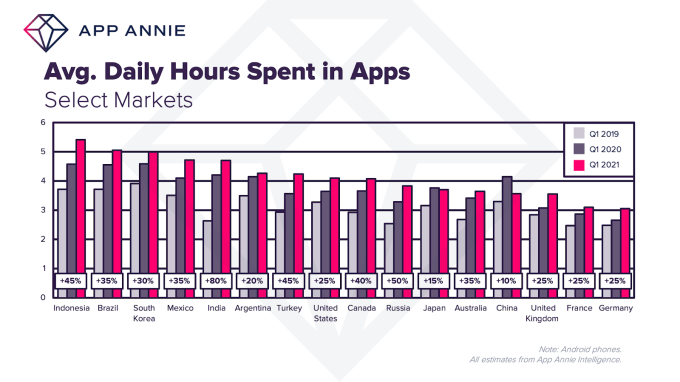
The coronavirus pandemic has increased our collective screen time, and that’s particularly true on mobile devices. According to a new report from mobile data and analytics firm App Annie, global consumers are now spending an average of 4.2 hours per day using apps on our smartphones, an increase of 30% from just two years prior.

The coronavirus pandemic has increased our collective screen time, and that’s particularly true on mobile devices. According to a new report from mobile data and analytics firm App Annie, global consumers are now spending an average of 4.2 hours per day using apps on our smartphones, an increase of 30% from just two years prior. In some markets, the average is even higher — more than five hours.

In the first quarter of 2021, the daily time spent in apps surpassed four hours in the U.S., Turkey, Mexico and India for the first time, the report notes. Of those, India saw the biggest jump as consumers there spent 80% more time in smartphone apps in the Q1 2021 versus the first quarter of 2019.

To put this in perspective in the American market, Nielsen had last year reported consumers were spending around 4 and half hours watching live or time-shifted TV, but only 3 hours, 46 minutes using smartphone apps.

Image Credits: App Annie

However, we should point out that Nielsen and App Annie’s analysis can’t necessarily be compared directly, because App Annie only measured time spent on Android devices — and many Americans use iPhones. Nielsen, meanwhile, relies on panels to achieve a representative sampling. Nevertheless, the broad strokes here are that mobile apps seem to be a more popular means of entertainment than the good ol’ American pastime of watching TV.

The new report also notes that three markets — Brazil, South Korea, and Indonesia — saw the average daily time spent in apps jump to over five hours this past quarter.

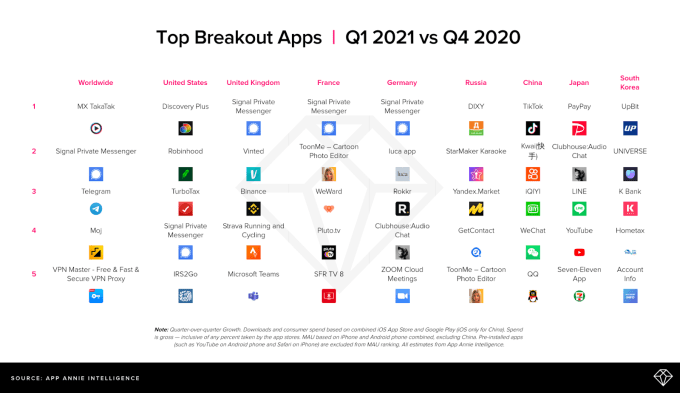
It can be difficult to determine which apps are driving these changes as the most downloaded apps tend to remain the same quarter after quarter. The top charts are dominated by the usual names like TikTok, YouTube and Facebook, for example. That’s why App Annie now tracks what it calls “breakout apps,” which are those that saw spikes in quarter-over-quarter downloads across both iOS and Android.

Image Credits: App Annie

In Q1 2021, Western markets saw a sharp rise in secure messaging apps, Signal and Telegram. Signal, for instance, placed first in the U.K., Germany, and France, and fourth in the U.S. as a “breakout app” for the quarter. Telegram was No. 9 in the U.K. No. 5 in France, and No. 7 in the U.S.

Investment and trading apps were also popular in the quarter, with Coinbase’s crypto app at No. 6 in the U.S. and U.K. on this list, while Binance was No. 7 in France. Crypto trading app Upbit, meanwhile, was No. 1 in South Korea. The payment app, PayPay was the No. 1 breakout app in Japan. And Robinhood was No. 2 in the U.S.

Clubhouse also made a showing on the “breakout” charts, as it gained ground in non-U.S. markets like Germany and Japan, where it ranked No. 4 and No. 3, respectively.

China’s breakout chart was different, with a focus on video apps like TikTok, Kwai, CapCut and iQIYI.

Image Credits: App Annie

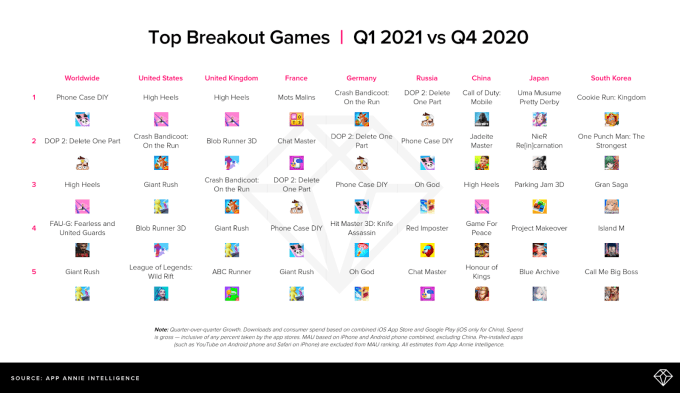
TikTok’s influence on games was also apparent in the quarter. The game High Heels from Istanbul-based Rollic (now owned by Zynga), was heavily advertised on TikTok, sending the title to No. 1 in the U.S. and U.K.’s “breakout” games charts, as well as No. 3 in China, No. 7 in Germany, and No. 6 in Russia.

Other hyper-casual games did well, too, including Project Makeover, DOP 2: Delete One Part, and Phone Case DIY.

Crash Bandicoot: On the Run also broke out in the quarter. Despite launching on March 25, the game saw 21 million downloads in four days, becoming the top breakout app in Germany, No. 2 in the U.S., No. 3 in the U.K, and No. 9 in France.

News: Immersion cooling to offset data centers’ massive power demands gains a big booster in Microsoft

LiquidStack does it. So does Submer. They’re both dropping servers carrying sensitive data into goop in an effort to save the planet. Now they’re joined by one of the biggest tech companies in the world in their efforts to improve the energy efficiency of data centers, because Microsoft is getting into the liquid-immersion cooling market.

LiquidStack does it. So does Submer. They’re both dropping servers carrying sensitive data into goop in an effort to save the planet. Now they’re joined by one of the biggest tech companies in the world in their efforts to improve the energy efficiency of data centers, because Microsoft is getting into the liquid-immersion cooling market.

Microsoft is using a liquid it developed in-house that’s engineered to boil at 122 degrees Fahrenheit (lower than the boiling point of water) to act as a heat sink, reducing the temperature inside the servers so they can operate at full power without any risks from overheating.

The vapor from the boiling fluid is converted back into a liquid through contact with a cooled condenser in the lid of the tank that stores the servers.

“We are the first cloud provider that is running two-phase immersion cooling in a production environment,” said Husam Alissa, a principal hardware engineer on Microsoft’s team for datacenter advanced development in Redmond, Washington, in a statement on the company’s internal blog. 

While that claim may be true, liquid cooling is a well-known approach to dealing with moving heat around to keep systems working. Cars use liquid cooling to keep their motors humming as they head out on the highway.

As technology companies confront the physical limits of Moore’s Law, the demand for faster, higher performance processors mean designing new architectures that can handle more power, the company wrote in a blog post. Power flowing through central processing units has increased from 150 watts to more than 300 watts per chip and the GPUs responsible for much of Bitcoin mining, artificial intelligence applications and high end graphics each consume more than 700 watts per chip.

It’s worth noting that Microsoft isn’t the first tech company to apply liquid cooling to data centers and the distinction that the company uses of being the first “cloud provider” is doing a lot of work. That’s because bitcoin mining operations have been using the tech for years. Indeed, LiquidStack was spun out from a bitcoin miner to commercialize its liquid immersion cooling tech and bring it to the masses.

“Air cooling is not enough”

More power flowing through the processors means hotter chips, which means the need for better cooling or the chips will malfunction.

“Air cooling is not enough,” said Christian Belady, vice president of Microsoft’s datacenter advanced development group in Redmond, in an interview for the company’s internal blog. “That’s what’s driving us to immersion cooling, where we can directly boil off the surfaces of the chip.”

For Belady, the use of liquid cooling technology brings the density and compression of Moore’s Law up to the datacenter level

The results, from an energy consumption perspective, are impressive. The company found that using two-phase immersion cooling reduced power consumption for a server by anywhere from 5 percent to 15 percent (every little bit helps).

Microsoft investigated liquid immersion as a cooling solution for high performance computing applications such as AI. Among other things, the investigation revealed that two-phase immersion cooling reduced power consumption for any given server by 5% to 15%. 

Meanwhile, companies like Submer claim they reduce energy consumption by 50%, water use by 99%, and take up 85% less space.

For cloud computing companies, the ability to keep these servers up and running even during spikes in demand, when they’d consume even more power, adds flexibility and ensures uptime even when servers are overtaxed, according to Microsoft.

“[We] know that with Teams when you get to 1 o’clock or 2 o’clock, there is a huge spike because people are joining meetings at the same time,” Marcus Fontoura, a vice president on Microsoft’s Azure team, said on the company’s internal blog. “Immersion cooling gives us more flexibility to deal with these burst-y workloads.”

At this point, data centers are a critical component of the internet infrastructure that much of the world relies on for… well… pretty much every tech-enabled service. That reliance however has come at a significant environmental cost.

“Data centers power human advancement. Their role as a core infrastructure has become more apparent than ever and emerging technologies such as AI and IoT will continue to drive computing needs. However, the environmental footprint of the industry is growing at an alarming rate,” Alexander Danielsson, an investment manager at Norrsken VC noted last year when discussing that firm’s investment in Submer.

Solutions under the sea

If submerging servers in experimental liquids offers one potential solution to the problem — then sinking them in the ocean is another way that companies are trying to cool data centers without expending too much power.

Microsoft has already been operating an undersea data center for the past two years. The company actually trotted out the tech as part of a push from the tech company to aid in the search for a COVID-19 vaccine last year.

These pre-packed, shipping container-sized data centers can be spun up on demand and run deep under the ocean’s surface for sustainable, high-efficiency and powerful compute operations, the company said.

The liquid cooling project shares most similarity with Microsoft’s Project Natick, which is exploring the potential of underwater datacenters that are quick to deploy and can operate for years on the seabed sealed inside submarine-like tubes without any onsite maintenance by people. 

In those data centers nitrogen air replaces an engineered fluid and the servers are cooled with fans and a heat exchanger that pumps seawater through a sealed tube.

Startups are also staking claims to cool data centers out on the ocean (the seaweed is always greener in somebody else’s lake).

Nautilus Data Technologies, for instance, has raised over $100 million (according to Crunchbase) to develop data centers dotting the surface of Davey Jones’ Locker. The company is currently developing a data center project co-located with a sustainable energy project off the coast of Stockton, Calif.

With the double-immersion cooling tech Microsoft is hoping to bring the benefits of ocean-cooling tech onto the shore. “We brought the sea to the servers rather than put the datacenter under the sea,” Microsoft’s Alissa said in a company statement.

Ioannis Manousakis, a principal software engineer with Azure (left), and Husam Alissa, a principal hardware engineer on Microsoft’s team for datacenter advanced development (right), walk past a container at a Microsoft datacenter where computer servers in a two-phase immersion cooling tank are processing workloads. Photo by Gene Twedt for Microsoft.

News: Introducing Found, a new podcast from TechCrunch

Here at TechCrunch, we spend most of our time talking to founders. Investors probably come a close second, but it’s definitely founders at the top of the list. That comes through in our articles and our events, but even with all we do there, it only begins to scratch the surface on the many, many

Here at TechCrunch, we spend most of our time talking to founders. Investors probably come a close second, but it’s definitely founders at the top of the list. That comes through in our articles and our events, but even with all we do there, it only begins to scratch the surface on the many, many interesting stories that are out there to tell.

That’s why we’re excited to bring you Found, a new weekly podcast from TechCrunch that’s all about founders, and the stories behind the startups. Each episode features an interview with a different early stage founder, with myself and TechCrunch Managing Editor Jordan Crook as hosts.

These aren’t your typical startup founder conversations or pitches — they’re open, honest talks about what it’s really like to found a company, and why you’d want to do that to begin with. We hear from founders about what motivated them to try to tackle big problems and put their financial success at risk, and about what they’ve had to overcome along the way to make their startup dreams a reality.

In our first batch of episodes, you’ll hear about an epiphany at the top of a literal mountain; going from teenage homelessness to running an artificial intelligence company; capping a medical degree with a world-class business education to assemble a unique toolkit for entrepreneurship; and finding inspiration for a world-changing business essentially gathering dust in NASA’s laboratories.

Found is about all of the above, but it’s also about hearing real stories from real founders all around the world about how they managed to pull off things like raising venture capital, pivoting their businesses, and building a team from nothing.

Our first episode debuts tomorrow — Friday, April 9 — but you can subscribe in Apple Podcasts or Spotify (or wherever you find your podcasts) right now to listen to the trailer, and get the premiere when it’s available. New episodes will be released weekly after that on Friday afternoons.

We’re love the conversations we’ve had so far on Found, and we think you will, too.

Apple Podcasts: https:/apple.co/found

Spotify: https://open.spotify.com/show/0Dqmcq2aDrZkS9v1fITOKV?si=qmQcT5ysR9eDnNl4yd97Ww

On Twitter: https://twitter.com/found

News: Realworld raises $3.4M to help Gen Z navigate adulthood

Realworld has a big vision — founder and CEO Genevieve Ryan Bellaire told me her goal is “simplifying adulthood.” And the New York startup has raised $3.4 million in seed funding to make it happen. Apparently that’s something Ballaire struggled with herself in her early twenties. Despite being a lawyer with an MBA, she said

Realworld has a big vision — founder and CEO Genevieve Ryan Bellaire told me her goal is “simplifying adulthood.” And the New York startup has raised $3.4 million in seed funding to make it happen.

Apparently that’s something Ballaire struggled with herself in her early twenties. Despite being a lawyer with an MBA, she said she found herself “just totally unprepared for all these real world things,” whether that was figuring out housing or heath insurance — something I (a non-lawyer, non-MBA) can definitely relate to.

“There’s tons of content out there out there that can tell you to fill out this form to sign up for a credit card, but you don’t know what you don’t know,” she said. “There’s not one place that defines adulthood.”

At the same time, there are online services that can make aspects of adulthood easier — whether that’s Lemonade for insurance, Betterment for investing or Zocdoc for doctor’s appointments. But again, finding these services and just knowing that you should use them can be a challenge, so Bellaire said Realworld is meant to serve as the “single point of entry.”

To do that, the startup has created more than 90 step-by-step playbooks, covering everything from budgeting to moving to salary negotiation. Bellaire said these are designed for members of Gen Z who are just leaving college and entering the workforce.

Realworld CEO Genevieve Ryan Bellaire

Realworld CEO Genevieve Ryan Bellaire

Of course, even if you focus on a specific age group, different twentysomethings will have different backgrounds, income levels and challenges. Bellaire said the playbooks will customize their instructions based on a user’s specific goals and circumstances, but she also argued that Realworld’s “starter pack” of 15 playbooks covers things that every adult will need to deal with in some form, such as creating budgets, finding an apartment and understanding income taxes.

The startup plans to release its first mobile app next month, and its goal is to become what Bellaire described as a “platform, marketplace and community.” The playbooks are a big piece of the platform, and eventually, Realworld could also include a marketplace for services that will help you accomplish those adulthood goals, as well as a community where users share their knowledge and advice.

Realworld initially charged for access to its playbooks, but they’re now available for free. Instead, Bellaire said the company could charge a subscription fee for additional features and for “concierge-oriented support.”

“This is one of those problems where if get it right, you can make a huge impact, but you can also have huge financial success,” she added.

It sounds like investors agree. Realworld had previously raised $1.1 million, and this new seed round was led by Fitz Gate Ventures, with participation from Bezos Expeditions (Jeff Bezos’ personal investment firm), Knightsgate Ventures, The Helm, Great Oaks VC, Copper Wire Ventures, AmplifyHer Ventures, Underdog Labs, Human Ventures and Techstars.

Amplifyher Partner Meghan Cross Breeden noted that Realworld could “corner the market on life milestones,” not just for Gen Z right now, but for “every future milestone … in the long-haul of adulthood, from buying a home to caring for a parent.”

News: Claiming a landmark in fusion energy, TAE Technologies sees commercialization by 2030

In a small industrial park located nearly halfway between Los Angeles and San Diego, one company is claiming to have hit a milestone in the development of a new technology for generating power from nuclear fusion. The twenty year old fusion energy technology developer TAE Technologies said its reactors could be operating at commercial scale

In a small industrial park located nearly halfway between Los Angeles and San Diego, one company is claiming to have hit a milestone in the development of a new technology for generating power from nuclear fusion.

The twenty year old fusion energy technology developer TAE Technologies said its reactors could be operating at commercial scale by the end of the decade, thanks to its newfound ability to produce stable plasma at temperatures over 50 million degrees (nearly twice as hot as the sun), .

The promise of fusion energy, a near limitless energy source with few emissions and no carbon footprint, has been ten years out for the nearly seventy years since humanity first harnessed the power of nuclear energy.  But a slew of companies including TAE, General Fusion, Commonwealth Fusion Systems and a host of others across North America and around the world are making rapid advancements that look to bring the technology from the realm of science fiction into the real world.

For TAE Technologies, the achievement serves as a validation of the life’s work of Norman Rostoker, one of the company’s co-founders who had devoted his life to fusion energy research and died before he could see the company he helped create reach its latest milestone.

“This is an incredibly rewarding milestone and an apt tribute to the vision of my late mentor, Norman Rostoker,” said TAE’s current chief executive officer, Michl Binderbauer, in a statement announcing the company’s achievement. “Norman and I wrote a paper in the 1990s theorizing that a certain plasma dominated by highly energetic particles should become increasingly better confined and stable as temperatures increase. We have now been able to demonstrate this plasma behavior with overwhelming evidence. It is a powerful validation of our work over the last three decades, and a very critical milestone for TAE that proves the laws of physics are on our side.”

Rostoker’s legacy lives on inside TAE through the company’s technology platform, called, appropriately, “Norman”. In the last 18 months that technology has demonstrated consistent performance, reaching over 50 million degrees in several hundred test cycles.

Six years ago, the company had proved that its reactor design could sustain plasma indefinitely — meaning that once the switch is flipped on a reaction, that fusion reaction can continue indefinitely. Now, the company said, it has achieved the necessary temperatures to make its reactors commercially viable.

It’s with these milestones behind it that TAE was able to raise an additional $280 million in financing, bringing its total up to $880 million and making it one of the best financed private nuclear fusion endeavors in the world.

“The Norman milestone gives us a high degree of confidence that our unique approach brings fusion within grasp technologically and, more important, economically,” Binderbauer said. “As we shift out of the scientific validation phase into engineering commercial-scale solutions for both our fusion and power management technologies, TAE will become a significant contributor in modernizing the entire energy grid.”

The company isn’t generating energy yet, and won’t for the foreseeable future. The next goal for the company, according to Binderbauer, is to develop the technology to the point where it can create the conditions necessary for making energy from a fusion reaction.

“The energy is super tiny. It’s immaterial. It’s a needle in the haystack,” Binderbauer said. “In terms of its energy discernability, we can use it for diagnostics.”
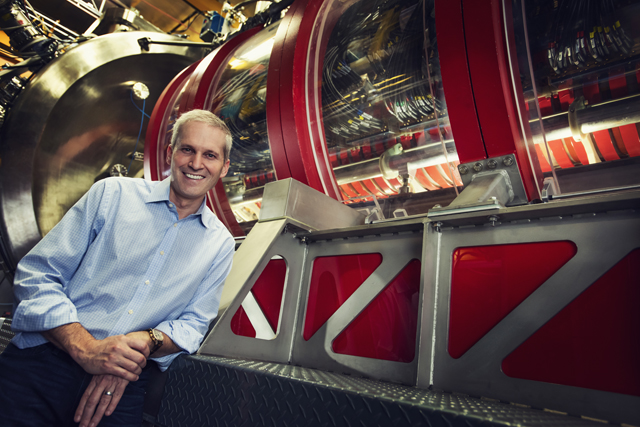
TAE Technologies Michl Binderbauer standing next to the company’s novel fusion reactor. Image Credit: TAE Technologies

Follow the sun

It took $150 million and five iterations for TAE Technologies to get to Norman, its national laboratory scale fusion device. The company said it conducted over 25,000 fully-integrated fusion reactor core experiments, optimized using machine learning programs developed in collaboration with Google and processing power from the Department of Energy’s INCITE program, which leverages exascale-level computing, TAE Technologies said.

The new machine was first fired up in the summer of 2017. Before it could even be constructed TAE Technologies went through a decade of experimentation to even begin approaching the construction of a physical prototype. By 2008, the first construction began on integrated experiments to make a plasma core and infuse it with some energetic particles. The feeder technology and beams alone cost $100 million, Binderbauer said. Then the company needed to develop other technologies like vacuum conditioning. Power control mechanisms also needed to be put in place to ensure that the company’s 3 megawatt power supply could be stored in enough containment systems to power a 750 megawatt energy reaction.

Finally, machine learning capabilities needed to be tapped from companies like Google and compute power from the Department of Energy had to be harnessed to manage computations that could take what had been the theorems that defined Rostoker’s life’s work, and prove that they could be made real.

“By the time Norman became an operating machine we had four generations of devices preceding it. Out of those there were two fully integrated ones and two generations of incremental machines that could do some of it but not all of it.”

Fusion energy’s burning problems

While fusion has a lot of promise as a zero-carbon source of energy, it’s not without some serious limitations, as Andy Jassby, the former principal physicist at the Princeton Plasma Physics Lab noted in a 2017 Bulletin of the Atomic Scientists article.

Jassby wrote:

Earth-bound fusion reactors that burn neutron-rich isotopes have byproducts that are anything but harmless: Energetic neutron streams comprise 80 percent of the fusion energy output of deuterium-tritium reactions and 35 percent of deuterium-deuterium reactions.

Now, an energy source consisting of 80 percent energetic neutron streams may be the perfect neutron source, but it’s truly bizarre that it would ever be hailed as the ideal electrical energy source. In fact, these neutron streams lead directly to four regrettable problems with nuclear energy: radiation damage to structures; radioactive waste; the need for biological shielding; and the potential for the production of weapons-grade plutonium 239—thus adding to the threat of nuclear weapons proliferation, not lessening it, as fusion proponents would have it.

In addition, if fusion reactors are indeed feasible—as assumed here—they would share some of the other serious problems that plague fission reactors, including tritium release, daunting coolant demands, and high operating costs. There will also be additional drawbacks that are unique to fusion devices: the use of a fuel (tritium) that is not found in nature and must be replenished by the reactor itself; and unavoidable on-site power drains that drastically reduce the electric power available for sale.

TAE Technologies is aware of the problems, according to a spokesperson for the firm, and the company has noted the issues Jassby raised in its product development, the spokesperson said.

“All the callouts to tritium is exactly why TAE has been focused on pB-11 as its feedstock from the very beginning (early 90’s).  TAE will reach D-T conditions as a natural stepping stone to pB-11, cause it cooks at ‘only’ 100M c, whereas pB-11 is upwards of 1M c,” the spokesperson wrote in a response. “It would seem like a much harder accomplishment to then scale to 1M, but what this milestone proves is the ‘Scaling law’ for the kind of fusion TAE is generating – in an FRC (the linear design of “Norman”, unlike the donut Tokamaks) the hotter the plasma, the more stable it becomes. It’s the opposite of a [Tokamak].  The milestone gives them scientific confidence they can increase temps beyond DT to pB11 and realize fusion with boron — cheap, aneutronic, abundant — the ideal terrestrial feedstock (let’s not get into mining the moon for helium-3!).”

As for power concerns, the TAE fusion reactor can convert a 2MW grid feed into 750MW shots on the machine without taking down Orange County’s grid (and needing to prove it to SCE), and scale power demand in microseconds to mold and course-correct plasmas in real-time, the spokesperson wrote.

In fact, TAE is going to spin off its power management technology into a separate business focused on peak shaving, energy storage and battery management on the grid and in electric vehicles.

A “safer” fusion technology?

The Hydrogen-Boron, or p-B11, fuel cycle is, according to the company, the most abundant fuel source on earth, and will be the ultimate feedstock for TAE Technologies’ reactor, according to the company. But initially, TAE, like most of the other companies currently developing fusion technologies will be working with Deuterium-Tritium as its fuel source.

The demonstration facility “Copernicus” which will be built using some of the new capital the company has announced raising, will start off on the D-T fuel cycle and eventually make the switch. Over time, TAE hopes to license the D-T technology while building up to its ultimate goal.

Funding the company’s “money by milestone” approach are some fo the world’s wealthiest families, firms, and companies. Vulcan, Venrock, NEA, Wellcome Trust, Google, and the Kuwait Investment Authority are all backers. So too, are the family offices of Addison Fischer, Art Samberg, and Charls Schwab.

“TAE is providing the miracles the 21st century needs,” said Addison Fischer, TAE Board Director and longtime investor who has been involved with conservation and environmental issues for decades. Fischer also founded VeriSign and is a pioneer in defining and implementing security technology underlying modern electronic commerce. “TAE’s most recent funding positions the company to undertake their penultimate step in implementing sustainable aneutronic nuclear fusion and power management solutions that will benefit the planet.”


News: Four strategies for getting attention from investors

MaC Venture Capital founder Marlon Nichols lays out his strategies for early-stage investing, and how these lessons can translate into a successful launch for entrepreneurs.

Being a successful early-stage investor is about a lot more than simply identifying trends. A successful VC needs to think several steps ahead. For MaC Venture Capital founder Marlon Nichols, it’s an ability that’s helped him spot big names like Gimlet Media, MongoDB, Thrive Market, PlayVS, Fair, LISNR, Mayvenn, Blavity and Wonderschool early on.

Nichols joined us on TechCrunch Early Stage to discuss his strategies for early-stage investing, and how those lessons can translate into a successful launch for budding entrepreneurs. Success involves not only a solid team and great ideas, it also requires the willingness and ability to change and adapt to an ever-changing world.


Getting ahead of the trends

Anyone can identify trends once they’ve broken, but a successful investor needs to see several steps ahead of the pack. This ability helps VCs know where to focus their attention and, eventually, how to weed out the snake oil from the true value pitches.

For us, that means taking a look at emerging behavioral trends and shifts in culture. What we’re looking to understand is where people and companies are going to spend their time and money – not only today, but in the future. So we do research to see if there are supporting factors for this thing sticking around and being successful. If that answer is yes, then we can dig a bit deeper. (Timestamp: 4:33)


Diverse from day one

News: AppHarvest buys ag-robotics firm, Root AI

Indoor farming company AppHarvest this week announced that it has acquired Root AI. The deal is valued at around $60 million, with $10 million in cash and the reminder coming from AppHarvest stock. Root AI is a Boston-based robotics startup, with a mission fairly in line with that of its future parent company. We’ve covered

Indoor farming company AppHarvest this week announced that it has acquired Root AI. The deal is valued at around $60 million, with $10 million in cash and the reminder coming from AppHarvest stock.

Root AI is a Boston-based robotics startup, with a mission fairly in line with that of its future parent company. We’ve covered the startup a handful of times, including last August, when it announced a $7.2 million seed round. Robotics, generally, have gotten a boost during the pandemic, but agriculture and food production have gotten special looks, as organizations are looking for ways to automate their processes.

Including the aforementioned seed, Root has raised a total of $9.5 million to date, fueled by interest in its Virgo harvesting system. Founder and CEO Josh Lessing will step into a CTO role at AppHarvest if the acquisition clears. The startup is still fairly lean, with 19 full-time employees.

According to quotes from both parties, robot-gathered data for crop yields is a key part of the acquisition.

“Farming as we’ve known it is broken because of the increasing number of variables such as extreme weather, droughts, fire and contamination by animals that make our food system unreliable,” AppHarvest founder and CEO Jonathan Webb said in a release tied to the news. Indoor farming solves for many of those challenges, and the data gathered can exponentially deliver more insights that help us predict and control crop quality and yield.”

News: Biden proposes gun control reforms to go after ‘ghost guns’ and close loopholes

President Biden has announced a new set of initiatives by which he hopes to curb the gun violence he described as “an epidemic” and “an international embarrassment.” Among other things, the ATF will be closing loopholes in unregulated online sales and so-called “ghost guns,” which can be built or printed with no serial numbers or

President Biden has announced a new set of initiatives by which he hopes to curb the gun violence he described as “an epidemic” and “an international embarrassment.” Among other things, the ATF will be closing loopholes in unregulated online sales and so-called “ghost guns,” which can be built or printed with no serial numbers or background checks.

Speaking in the White House Rose Garden Thursday afternoon, Biden recounted the many recent mass shootings as horrific tragedies, but pointed out that over a hundred people are shot every day in this country. “This is an epidemic, for God’s sake,” he repeated, “and it has to stop.”

Before outlining his plans for combating the problem, he made sure to address the inevitable Second Amendment objections from people who believe it is a Constitutional right for anyone to own things like assault rifles.

“Nothing I’m about to recommend in any way impinges on the Second Amendment,” Biden said. “From the very beginning, you couldn’t own any weapon you wanted to own. From the very beginning of the Second Amendment existing, certain people weren’t allowed to have weapons.”

Of course federal laws often conflict with state laws on this point, giving rise to surprising sights like heavily armed protestors taking over the Michigan capitol building — quite legally. But the feds do have a few tricks up their sleeves.

Background checks and registration tracking involve federal authorities, and there are loopholes that have appeared or worsened over recent years as online traffic in guns has increased (social networks are notorious for thinly veiled gun trade) and the process of building weapons at home has become easier.

“I have directed ATF to begin work on an updated study of gun trafficking, one that takes into account the fact that modern guns are not simply cast or forged any more, but can be made of plastic, printed on a 3D printer, or sold in self assembly kits,” said U.S. Attorney General Merrick Garland, who took the podium after Biden. “We will ensure that we understand and measure the problem of criminal gun trafficking in a data driven way.”

“Ghost guns” were a hot topic a few years back when several people and organizations, among them Defense Distributed, attempted to popularize 3D-printed pistols and assault rifle components. The high-tech angle made the media bite, though of course traditional gun trafficking in the form of smuggling and in-person sales dwarf the scale of anything these sites and services delivered.

But gun building kits do represent a significant loophole in the ATF’s regulations, which do not require registration or background checks for them. So a person can get 80% of a gun that way, get the other 20% (usually the “receiver,” which component qualifies the assembly as a firearm) by printing or another method, and have a gun with no serial number or registration whatsoever.

Garland has proposed a rule for the ATF to adopt that would change this and a few other things, such as easily purchased modifications for pistols that effectively make them into short-barreled rifles; the new rule would require those conversion kits to be registered. This presumably will follow the confirmation of the ATF’s first director in five years — the position was vacant for the whole last administration — David Chipmen, whom Biden plans to nominate.

Other efforts by the administration include a $5 billion, 8-year investment in community violence intervention programs, a push for “red flag” laws that temporarily bar people in crisis from obtaining guns, and a nudge for Congress to start working on legislation that addresses things the Executive can’t.

WordPress Image Lightbox Plugin