
Tag Archives: Blog

News: Pale Blue Dot aims to be Europe’s premier early-stage climate investor and has $100 million to prove it

When Hampus Jakobsson, Heidi Lindvall, and Joel Larsson, all well-known players in the European venture ecosystem, began talking about their new firm Pale Blue Dot, they began by looking at the problems with venture capital. For the three entrepreneurs and investors, whose resumes included co-founding companies and accelerators like The Astonishing Tribe (Jakobsson) and Fast

When Hampus Jakobsson, Heidi Lindvall, and Joel Larsson, all well-known players in the European venture ecosystem, began talking about their new firm Pale Blue Dot, they began by looking at the problems with venture capital.

For the three entrepreneurs and investors, whose resumes included co-founding companies and accelerators like The Astonishing Tribe (Jakobsson) and Fast Track Malmö (Lindvall and Larsson) and working as a venture partner at BlueYard Capital (Jakobsson again), the problems were clear.

Their first thesis was that all investment funds should be impact funds, and be taking into account ways to effect positive change; their second thesis was that since all funds should be impact funds, what would be their point of differentiation — that is, where could they provide the most impact.

The three young investors hit on climate change as the core mission and ran with it.

As it was closing on €53 million ($63.3 million) last year, the firm also made its first investments in Phytoform, a London headquartered company creating new crops using computational biology and synbio; Patch, a San Francisco-based carbon-offsetting platform that finances both traditional and frontier “carbon sequestration” methods; and 20tree.ai, an Amsterdam-based startup, using machine learning and satellite data to understand trees to lower the risk of forest fires and power outages.

Now they’ve raised another €34 million and seven more investments on their path to doing between 30 and 35 deals.

These investments primarily focus on Europe and include Veat, a European vegetarian prepared meal company; Madefrom, a still-in-stealth company angling to make everyday products more sustainable; HackYourCloset, a clothing rental company leveraging fast fashion to avoid landfilling clothes; Hier, a fresh food delivery service; Cirplus, a marketplace for recycled plastics trading; and Overstory, which aims to prevent wildfires by giving utilities a view into vegetation around their assets. 

The team expects to be primarily focused on Europe, with a few opportunistic investments in the U.S., and intends to invest in companies that are looking to change systems rather than directly affect consumer behavior. For instance, a Pale Blue Dot investment likely wouldn’t include e-commerce filters for more sustainable shopping, but potentially could include investments in sustainable consumer products companies.

The size of the firm’s commitments will range up to €1 million and will look to commit to a lot of investments. That’s by design, said Jakobsson. “Climate is so many different fields that we didn’t want to do 50% of the fund in food or 50% of the fund in materials,” he said. Also, the founders know their skillsets, which are primarily helping early stage entrepreneurs scale and making the right connections to other investors that can add value.

“In every deal we’ve gotten in co-investors that add particular, amazing, value while we still try to be the shepherds and managers and sherpas,” Jakobsson said. “We’re the ones that are going to protect the founder from the hell-rain of investor opinions.”

Another point of differentiation for the firm are its limited partners. Jakobsson said they rejected capital from oil companies in favor of founders and investors from the tech community that could add value. These include Prima Materia, the investment vehicle for Spotify founder Daniel Ek; the founders of Supercell, Zendesk, TransferWise and DeliveryHero are also backing the firm. So too, is Albert Wenger, a managing partner at Union Square Ventures.

The goal, simply, is to be the best early stage climate fund in Europe.

“We want to be the European climate fund,” Lindvall said. “This is where we can make most of the difference.” 
News: Connected Cannabis Co. raises $30 million to bring its designer weed strains to more states

Connected Cannabis Co. was founded in 2009 and has since grown to become a leading cultivator of designer cannabis strains. Today, the company announced $30 million in debt and equity financing. This comes after the company raised a $25 million Series A in 2019. The new round was led by existing investors including Navy Capital

Connected Cannabis Co. was founded in 2009 and has since grown to become a leading cultivator of designer cannabis strains. Today, the company announced $30 million in debt and equity financing. This comes after the company raised a $25 million Series A in 2019. The new round was led by existing investors including Navy Capital and One Tower Group. Emerald Park Capital, an affiliate of Bryant Park Capital, and Presidio View Capital also participated.

Currently, Connected Cannabis Co. operates cultivation and retail facilities in California and Arizona. With the additional financing, it intends to expand elsewhere. The company says it plans on focusing on states with robust cannabis cultures and promising outlook for growth such as Nevada and Michigan.

“We’re thrilled to bring Emerald Park Capital and Presidio into the Connected family and welcome back our long-term partners that have supported our company’s mission from the very beginning,” said Sam Ghods, CEO of Connected. “We are steadfast in our development of new, best-in-class genetics and our production of top-quality flower that has resulted in impressive growth and unwavering customer loyalty. That same commitment and quality that we’ve prided ourselves on from day one will stay with us as we enter additional states. We look forward to bringing our true product and brand to consumers in new markets – that is our highest priority every time we look at expansion.”

Connected Cannabis is among a growing number of cannabis-focused companies amassing a war chest ahead of expanding outside of select regions. As more states in the United States legalize cannabis, more companies are exploring expansion options. Strict federal regulations often slow the process and make it cumbersome for cultivators like Connected to operate in different states, which often have different regulations and federal law prohibits interstate commerce.

Growing cannabis is easy. The plant is hardy is hearty and forgiving. Growing cannabis at scale is anything but hearty and forgiving, which is why Connected turned to additional funding to fuel its national growth.

News: This startup wants to use technology to help Austin’s housing shortage problem

The sheer volume of people migrating to Austin from all over the country, but particularly from the San Francisco Bay Area, has been making headlines for a while now. One result of this continued migration is a steady surge in housing prices due to increased demand and low inventory that dropped to nearly zero earlier

The sheer volume of people migrating to Austin from all over the country, but particularly from the San Francisco Bay Area, has been making headlines for a while now.

One result of this continued migration is a steady surge in housing prices due to increased demand and low inventory that dropped to nearly zero earlier this year. Now, Homebound, a Santa Rosa, California-based tech-enabled homebuilding startup, is entering the Austin market with the goal of helping ease some of the pain felt in the city by offering an alternative to buying existing homes.

Homebound has raised about $73 million over the years from the likes of Google Ventures, Fifth Wall, Khosla, Sound Ventures, Atomic and Thrive Capital. It raised a $35 million Series B last April and then closed on a $20 million convertible note late last year. CEO Nikki Pechet and Atomic managing partner Jack Abraham founded the company in 2017 after Abraham lost his home to wildfires.

Essentially serving as a virtual general contractor, Homebound combines technology and a network for “vetted” and licensed building “experts” to manage the new home construction from the design phase to completion. The startup has developed tools to track and manage hundreds of unique tasks associated with building a home.

Up until this point, Homebound has been focused on helping homeowners navigate the challenges and complexities of rebuilding after wildfires in California. But this month, Homebound will be expanding to Austin, its first non-disaster market, with the goal of taking learnings from those rebuilds and applying the same “streamlined, tech-enabled building process” to make custom homebuilding an option for local homeowners.

I talked with Homebound’s CEO and co-founder, Nikki Pechet, to learn more.

With Homebound, she said, the company is out to serve as a “next gen” homebuilder to make it possible “for anyone, anywhere to build a home.”

Austin’s housing market is definitely overheated, with homes going 10-30% above asking in some cases (I should know, I live here).

“Homeowners have been reaching out to us from across the country asking us to come to their market,” Pechet said. “We’re already seeing Austin grow faster than any of our other markets did in their early days. It’s going to be a huge market for us.”

It’s a model Pechet envisions replicating in other cities with similar housing supply issues such as Miami, Tampa, Raleigh and Charlotte.

“This is just the start,” Pechet said. “We’re taking the platform to markets across the country to help exactly with this issue.”

The company starts by helping a potential homeowner identify land they want to build on, or help them find a lot among the inventory Homebound has already built up. From there, it can help with everything from architectural plans to design to actual construction via its platform. Homebound offers a set of plans for people to choose from, with varying levels of customization.

Building costs for a typical single-family home in the Austin area will start around $300,000 depending on the size, complexity of house, lot size and location. That does not include land cost. Some people are opting to build second units on existing properties.

“In most cases, people can build a new home for less than they can pay for an existing home just because of the dynamics,” Pechet said.

News: The TechCrunch Survey of Tech Startup Hubs in England and Wales

TechCrunch is embarking on a major new project to survey European founders and investors in cities outside the major European capitals. Over the next few weeks, we will ask entrepreneurs in these cities to talk about their ecosystems, in their own words. For this survey we are interested in startup hubs in England and Wales.

TechCrunch is embarking on a major new project to survey European founders and investors in cities outside the major European capitals.

Over the next few weeks, we will ask entrepreneurs in these cities to talk about their ecosystems, in their own words. For this survey we are interested in startup hubs in England and Wales. (Scotland will follow, and Northern Ireland is here).

So this is your chance to put your cities on the Techcrunch Map!

We’re like to hear from founders and investors. We are particularly interested in hearing from diverse founders and investors. These are our humble suggestions for the cities we’d most like to hear from:

Birmingham
Brighton
Bristol & Bath
Cambridge
Cardiff
Liverpool
Manchester
Newcastle
Oxford
Reading and Thames valley
York

If you are a tech startup founder or investor in one of the above cities please fill out the survey form here.

The more founders/investors we hear from in a particular city, the more likely it is that city will be featured in TechCrunch.

This is the follow-up to the huge survey of investors (see also below) we’ve done over the last six or more months, largely in capital cities.

These formed part of a broader series of surveys we’re doing regularly for ExtraCrunch, our subscription service that unpacks key issues for startups and investors.

In the first wave of surveys, the cities we wrote about were largely capitals. You can see them listed here.

This time, we will be surveying founders and investors in Europe’s other cities to capture how European hubs are growing, from the perspective of the people on the ground.

We’d like to know how your city’s startup scene is evolving, how the tech sector is being impacted by COVID-19, and generally how your city will evolve.

We leave submissions mostly unedited and are generally looking for at least one or two paragraphs in answers to the questions.

So if you are a tech startup founder or investor in one of these cities please fill out our survey form here.

Thank you for participating. If you have questions you can email mike@techcrunch.com and/or reply on Twitter to @mikebutcher.

News: Boasting menus from chefs at French Laundry, vegetarian mealkit startup Simple Feast hits the U.S.

Offering a respite from processed foods for the richest 20% of Americans, Simple Feast has landed on U.S. shores with a mission to expand its presence on the back of $45 million in financing from investors. The European startup is looking to take a page from the shouty LIVEKINDLY Collective playbook and take on the

Offering a respite from processed foods for the richest 20% of Americans, Simple Feast has landed on U.S. shores with a mission to expand its presence on the back of $45 million in financing from investors.

The European startup is looking to take a page from the shouty LIVEKINDLY Collective playbook and take on the U.S. market with gourmet prepared meals that come with a gourmet price tag and a mission to make Americans eat less meat by proffering more tasty and delicious vegetarian options.

It’s a strategy that netted LIVEKINDLY Collective’s business $335 million in a recent round of funding, making it one of the most well capitalized new entrants in the vegetarian food brand category.

“There’s a general health problem that’s coming mostly from what we put in our mouth,” said Jakob Jønck, the company’s co-founder and chief executive.

For folks in the U.S. who can afford it, Simple Feast is offering packaged meal kits with menus developed by chefs from some of the world’s highest end restaurants — place like French Laundry in California or Noma in Norway, where meals can run roughly $350 per-person.

A selection of three prepared meals for two-to-three people will run customers around $98 per-week and for a family of four or five that number jumps to $159 per-week.

Simple Feast’s foray into the US market represents just a small portion of the company’s total offerings. In the Nordic region the company offers about 30 different products all targeting people who want to reduce the amount of meat they eat.

Investors certainly love the company’s offering, because, as Jønck says, the products probably represent the highest margin in the meal kit category.

Those financiers include firms like the European venture capitalists Balderton Capital and Kinnevik, and New York-based 14W.

As for the company’s customers, they’re mostly moms with kids whose income puts them in the top 20% of the population. While they may be far more wealthy than the hoi polloi, Jønck said they still suffer from exposure to the worst aspects of America’s industrial food machine — highly processed foods that are causing an explosion in chronic health conditions like diabetes and obesity.

Data from places like the Rand Institute indicate that in America, the burden of insufficient nutrition and the chronic conditions that stem from that are disproportionately affecting low income and middle income families.

Health is a problem in the U.S. with $794 billion per year estimated to be lost in productivity between 2016 and 2030. An article from HealthAffairs cited research from the Joint Center for Political and Economic Studies estimates stating that health inequities and premature death cost the US economy $309.3 billion a year.

However, these costs are primarily born by the poorest Americans, particularly minorities. “People of color face higher rates of diabetes, obesity, stroke, heart disease, and cancer than whites,” the HealthAffairs article says.

Simple Feast is working to correct that, says Jønck. The company’s European packaged prepared meals available in retail stores cost around $15, he said, and the company will offer salaries far above the minimum wage in the U.S. to do its part in ameliorating some of the wealth disparity in the country.

“This is a general play on an industry that needs to change for the ground up. This system needs to change,” Jønck said. 


News: Slice raises $40M to power ordering and marketing for independent pizzerias

Slice, a startup that helps independent pizzerias build an online business, has raised another $40 million in Series D funding. The round was led by Cross Creek, with participation from KKR, GGV Capital and Primary Ventures, as well as Twitter’s former CEO Dick Costolo and former COO Adam Bain (through their firm 01 Advisors). Last

Slice, a startup that helps independent pizzerias build an online business, has raised another $40 million in Series D funding.

The round was led by Cross Creek, with participation from KKR, GGV Capital and Primary Ventures, as well as Twitter’s former CEO Dick Costolo and former COO Adam Bain (through their firm 01 Advisors).

Last spring, the startup announced a $43 million Series C. Why not raise more money this time? Founder and CEO Ilir Sela described this as “a quick round” to get Costolo and Bain  on-board as investors. He also suggested there may be additional fundraising conversations in the not-too-distant future.

“Slice has emerged as the leader in powering these types of small businesses that have been serving our communities for decades,” Bain said in a statement. “We look forward to working with Ilir and the incredible team at Slice to marry our significant operating and business-scaling experience with Slice’s focus on enabling economic growth in this category.”

Slice has built a mobile app and website for ordering from local pizzerias, but it also provides tools so they can build their own websites, run marketing campaigns, improve their search engine optimization and more. Slice only charges those pizzerias a fixed $2.25 per order, and last fall it even removed the fee for orders under $10.

The company continues to expand its products and services with the recent launch of a point-of-sale system for pizzerias called Slice Register, as well as a cross-pizzeria loyalty program called Slice Rewards.

Some of this might sound a bit niche — a POS system, just for pizzerias? — but when I brought this up with Sela, he replied, “I love it when people say that, because then they continue to stay out of the way.”

Slice already has 15,000 pizzerias on the platform, with plans to increase that number to 20,000 at the end of the year. He added that although the current addressable market consists of 57,000 independent and small chain U.S. shops, with the Slice Accelerate program (where the startup provides select pizzerias with $15,000 worth of technology and services) “there could be 100,000 in the U.S.”

“With Accelerate, we’re taking inefficient pizza shops who are predominantly offline and helping them realize their vision for their brand,” he continued. That might mean improving an existing location, or it might mean launching new ones. In fact, he said the new program has already helped to revamp Pizza Mia in Staten Island and will work with Crown Heights-based Billy’s Pizza & Pasta to open a second location.

“I definitely think that long term, there’s a big question whether our very unique model could be applied to other verticals,” he said. “I think it can, but it would be a mistake to move into those verticals today, because of the opportunity that it exists in pizza.

News: Messaging app Wire raises $21 million

Wire, the end-to-end encrypted messaging app and service, has raised a $21 million Series B funding round led by UVC Partners. As the company said a couple of years ago, the company is focusing on the enterprise market more than ever. While Wire started as a consumer app, it never managed to attract hundreds of

Wire, the end-to-end encrypted messaging app and service, has raised a $21 million Series B funding round led by UVC Partners. As the company said a couple of years ago, the company is focusing on the enterprise market more than ever.

While Wire started as a consumer app, it never managed to attract hundreds of millions of customers like other messaging apps. That doesn’t mean that Wire is a bad product.

The app lets you securely talk with other people using text messages, photos, videos and voice messages. You can also start a video call and send files with other users. Wire supports both one-to-one conversations as well as rooms.

Everything is end-to-end encrypted by default, which means that the company can’t decrypt your conversations, can’t hand them over to a court or can’t expose your conversations to a potential hacker. You can also view the source code on GitHub.

In 2019, the company told TechCrunch that it would open a holding company in the U.S. to raise some funding. The idea was to double down on enterprise customers to find a clear path toward profitability. And this focus hasn’t changed since then.

“If I think back on the evolution of the business – three years ago we had zero revenue and zero customers – whereas today we’re announcing a B round and we have clearly established a well-recognised enterprise brand amongst the likes of Gartner, which is one of the things I am extremely proud of,” Wire’s CEO Morten Brogger told me.

“I also think that with the focus on a revenue-generating, enterprise business, we avoid situations like WhatsApp, where the only model you can ultimately turn to is monetising data,” he added.

And it seems to be working well when it comes to revenue growth. Right now, Wire has 1,800 customers. The number of customers has increased by almost 50% over the past year.

The company focuses on large customers, such as big corporations and government customers with a ton of potential users. Five G7 governments are currently using Wire. Overall, revenue has tripled in 2020.

In addition to working on Messaging Layer Security (MLS), Wire has been focused on improving conference calls and real-time interactions. The company believes messaging apps and real-time collaboration apps are slowly converging. And the startup wants to offer a service that works well across various scenarios.

You can also expect more end-to-end encrypted services in the collaboration space. Wire is still relatively small with 90 employees, which means it has room to grow and iterate.

News: Vanadium ion battery startup Standard Energy raises $8.9M Series C from SoftBank Ventures Asia

Standard Energy, a vanadium ion battery developer, announced today it has raised a $8.9 million Series C from SoftBank Ventures Asia. The South Korea-based company says its batteries’ advantages over lithium ion include less risk of ignition and the ease of sourcing vanadium. The latter is an important selling point, as electric vehicle makers face

Standard Energy, a vanadium ion battery developer, announced today it has raised a $8.9 million Series C from SoftBank Ventures Asia. The South Korea-based company says its batteries’ advantages over lithium ion include less risk of ignition and the ease of sourcing vanadium. The latter is an important selling point, as electric vehicle makers face a potential shortage of lithium ion batteries.

Instead of serving as a replacement for lithium ion batteries, however, Standard Energy chief executive officer Bu Gi Kim said they complement each other. Vanadium ion batteries have high energy, performance and safety, but they are not as compact as lithium ion batteries.

Lithium ion batteries will continue to be used in hardware that needs to be mobile, such as electric vehicles or consumer devices like smartphones, but vanadium ion batteries are suited to “stationary” customers, like wind and solar power plants or ultra-fast charging stations for electric vehicles (Kim said Standard Energy is scheduled to ship its batteries to an ultra-fast charging station in Seoul soon).

Founded in 2013 by researchers from the Korea Advanced Institute of Science and Technology (KAIST) and the Massachusetts Institute of Technology (MIT), Standard Energy expects one of its main customers to be the energy storage systems (ESS) sector, which the company says is expected to grow from $8 billion to $35 billion in the next five years.

“A large number of renewable energy projects have slowed or even stopped in many places due to the unstable battery performance of lithium ion. VIB cannot be as compact as lithium ion. However, ESS projects or solutions including renewable energy plants provide enough space for our products to be integrated into their systems,” said Kim.

Standard Energy has already performed a total of over one million battery testing hours, including in a lab, at a certified battery performance test site and in actual operations. Kim said the company is confident its performance data will convince customers to adopt vanadium ion batteries.

In a press statement, SoftBank Ventures Asia senior partner Daniel Kang said, “The existing ESS market was in a state of imbalance due to the rapidly growing demand, and safety and efficiency issues of products. Standard Energy is expected to create new standards for the global ESS market through its innovative material and design technology with massive manufacturing capabilities.”

News: South Africa’s Quro Medical comes out of stealth with $1.1M to expand its hospital-at-home service

For a continent with such stark inequality, Africa has seen limited innovation to increase access to healthcare and reduce healthcare delivery costs. Over the years, there has been continued investment in traditional care models despite the overwhelming evidence of inefficiency and escalating costs. The pandemic also laid these problems bare, exposing the vulnerabilities of the

For a continent with such stark inequality, Africa has seen limited innovation to increase access to healthcare and reduce healthcare delivery costs. Over the years, there has been continued investment in traditional care models despite the overwhelming evidence of inefficiency and escalating costs. The pandemic also laid these problems bare, exposing the vulnerabilities of the continent’s healthcare system.

Health tech startup Quro Medical is trying to scale alternative models for African healthcare starting from its home country, South Africa. The company, which provides services to manage ill patients in the comfort of their homes, is emerging from stealth to announce the close of its $1.1 million round. The round was led by Kenya-based Enza Capital and South African VC firm Mohau Equity Partners. 

Quro Medical was founded by Dr Vuyane Mhlomi, Zikho Pali and Rob Cornish in 2018. CEO Mhlomi understood the pressing need for South African healthcare innovation from his own experience as a doctor

It is known that hospitals in Africa experience excessive demands, which places strain on bed capacity. At the same time, it hinders effective patient treatment and recovery. Raised in Cape Town by his parents, Mhlomi experienced this firsthand. His parents suffered from chronic health conditions and he had to spend hours in clinics and hospitals waiting to see doctors.

Later, an opportunity to study medicine took him to the University of Oxford. Upon completion, he returned to South Africa where he knew the problem he faced previously was one to solve, hence Quro Medical

“We were connected by our belief that the private healthcare sector can and should be doing more to shoulder the burden of healthcare provision in this country and on the continent generally,” Mhlomi told TechCrunch. These escalating costs are the primary barrier to accessing healthcare in the private sector, leaving an overwhelming burden on our public health system.” 

The CEO argues that acute patient care at home leads to better clinical outcomes and improved patient experience. This is the principle on which Quro Medical is established. In the long run, it wants to build the largest virtual hospital ward in Africa, with superior clinical outcomes to conventional care at a lower cost.

Quro Medical

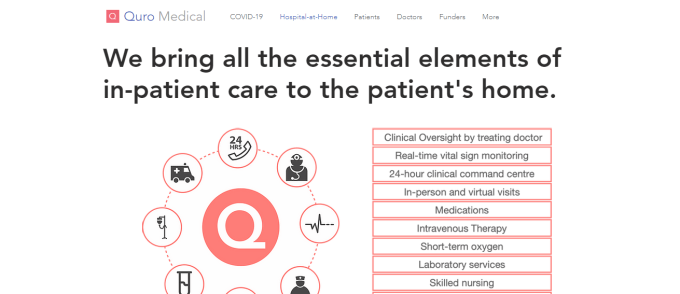
Unlike hospitals, getting healthcare at home can feel safer, which is an extra proposition for Quro Medical. According to COO Pali, apart from hospitals’ high costs, patients are at risk of getting hospital-acquired infections. But while it might appear that Quro Medical is offering the same old traditional home care with a mix of telemedicine service, that’s not precisely the case. Pali says the company incorporates clinical data and remote healthcare monitoring to provide real-time, data-driven clinical interventions. “We are focused on saving lives and enhancing patient care. The technology is the enabler, making all of this possible,” adds Mhlomi.

Patients are admitted into the company’s care in lieu of a general ward hospital admission. Then Quro Medical makes revenue from filing a claim with medical aid and insurance companies paid via reimbursement. The healthtech startup also collects out-of-pocket payments from patients.

The pandemic reinforced the company’s importance in offering remote patient monitoring services, a significant aspect of its business that garnered a check from Enza Capital.

“As our collective healthcare systems struggle to care for patients beyond the walls of a hospital, which we’ve seen exacerbated with the onset of the COVID-19 pandemic, remote patient monitoring and healthcare delivery will undoubtedly form a core part of the lasting solution,” said Mike Mompi, partner and CEO at the firm.

Nevertheless, this period has seen health tech startups offering out-of-hospital services struggle to have their services reimbursed. So how has Quro fared? Pretty well, apparently. The company claims to successfully convert most of its major medical schemes (health insurance) in South Africa as clients. They account for more than 90% of the total medical scheme market in the country.

Quro Medical has grown to work with about 150 doctors. Mhlomi believes his company is a first mover in Africa, meaning that he expects other players’ arrival in line with the trends in other markets. The company that has grown to work with 150 doctors now has plans to accelerate its hospital-at-home services and scale its operations across the country to meet its growing client base’s demands. It also wants to attract and retain talent and extend into other African markets. 

Speaking on the investment for Mohau Equity Partners, CEO Dr Penny Moumakwa said, “We are very excited to be invested in Quro, they are a dynamic management team, building out a global medical solution, that will showcase the ability of entrepreneurs on the African continent in advanced digital healthcare.” 

News: China’s Xpeng in the race to automate EVs with lidar

Elon Musk famously said any company relying on lidar is “doomed.” Tesla instead believes automated driving functions are built on visual recognition and is even working to remove the radar. China’s Xpeng begs to differ. Founded in 2014, Xpeng is one of China’s most celebrated electric vehicle startups and went public when it was just

Elon Musk famously said any company relying on lidar is “doomed.” Tesla instead believes automated driving functions are built on visual recognition and is even working to remove the radar. China’s Xpeng begs to differ.

Founded in 2014, Xpeng is one of China’s most celebrated electric vehicle startups and went public when it was just six years old. Like Tesla, Xpeng sees automation as an integral part of its strategy; unlike the American giant, Xpeng uses a combination of radar, cameras, high-precision maps powered by Alibaba, localization systems developed in-house, and most recently, lidar to detect and predict road conditions.

“Lidar will provide the 3D drivable space and precise depth estimation to small moving obstacles even like kids and pets, and obviously, other pedestrians and the motorbikes which are a nightmare for anybody who’s working on driving,” Xinzhou Wu, who oversees Xpeng’s autonomous driving R&D center, said in an interview with TechCrunch.

“On top of that, we have the usual radar which gives you location and speed. Then you have the camera which has very rich, basic semantic information.”

Xpeng is adding lidar to its mass-produced EV model P5, which will begin delivering in the second half of this year. The car, a family sedan, will later be able to drive from point A to B based on a navigation route set by the driver on highways and certain urban roads in China that are covered by Alibaba’s maps. An older model without lidar already enables assisted driving on highways.

The system, called Navigation Guided Pilot, is benchmarked against Tesla’s Navigate On Autopilot, said Wu. It can, for example, automatically change lanes, enter or exit ramps, overtake other vehicles, and maneuver another car’s sudden cut-in, a common sight in China’s complex road conditions.

“The city is super hard compared to the highway but with lidar and precise perception capability, we will have essentially three layers of redundancy for sensing,” said Wu.

By definition, NGP is an advanced driver-assistance system (ADAS) as drivers still need to keep their hands on the wheel and take control at any time (Chinese laws don’t allow drivers to be hands-off on the road). The carmaker’s ambition is to remove the driver, that is, reach Level 4 autonomy two to four years from now, but real-life implementation will hinge on regulations, said Wu.

“But I’m not worried about that too much. I understand the Chinese government is actually the most flexible in terms of technology regulation.”

The lidar camp

Musk’s disdain for lidar stems from the high costs of the remote sensing method that uses lasers. In the early days, a lidar unit spinning on top of a robotaxi could cost as much as $100,000, said Wu.

“Right now, [the cost] is at least two orders low,” said Wu. After 13 years with Qualcomm in the U.S., Wu joined Xpeng in late 2018 to work on automating the company’s electric cars. He currently leads a core autonomous driving R&D team of 500 staff and said the force will double in headcount by the end of this year.

“Our next vehicle is targeting the economy class. I would say it’s mid-range in terms of price,” he said, referring to the firm’s new lidar-powered sedan.

The lidar sensors powering Xpeng come from Livox, a firm touting more affordable lidar and an affiliate of DJI, the Shenzhen-based drone giant. Xpeng’s headquarters is in the adjacent city of Guangzhou about 1.5 hours’ drive away.

Xpeng isn’t the only one embracing lidar. Nio, a Chinese rival to Xpeng targeting a more premium market, unveiled a lidar-powered car in January but the model won’t start production until 2022. Arcfox, a new EV brand of Chinese state-owned carmaker BAIC, recently said it would be launching an electric car equipped with Huawei’s lidar.

Musk recently hinted that Tesla may remove radar from production outright as it inches closer to pure vision based on camera and machine learning. The billionaire founder isn’t particularly a fan of Xpeng, which he alleged owned a copy of Tesla’s old source code.

In 2019, Tesla filed a lawsuit against Cao Guangzhi alleging that the former Tesla engineer stole trade secrets and brought them to Xpeng. XPeng has repeatedly denied any wrongdoing. Cao no longer works at Xpeng.

Supply challenges

While Livox claims to be an independent entity “incubated” by DJI, a source told TechCrunch previously that it is just a “team within DJI” positioned as a separate company. The intention to distance from DJI comes as no one’s surprise as the drone maker is on the U.S. government’s Entity List, which has cut key suppliers off from a multitude of Chinese tech firms including Huawei.

Other critical parts that Xpeng uses include NVIDIA’s Xavier system-on-the-chip computing platform and Bosch’s iBooster brake system. Globally, the ongoing semiconductor shortage is pushing auto executives to ponder over future scenarios where self-driving cars become even more dependent on chips.

Xpeng is well aware of supply chain risks. “Basically, safety is very important,” said Wu. “It’s more than the tension between countries around the world right now. Covid-19 is also creating a lot of issues for some of the suppliers, so having redundancy in the suppliers is some strategy we are looking very closely at.”

Taking on robotaxis

Xpeng could have easily tapped the flurry of autonomous driving solution providers in China, including Pony.ai and WeRide in its backyard Guangzhou. Instead, Xpeng becomes their competitor, working on automation in-house and pledges to outrival the artificial intelligence startups.

“The availability of massive computing for cars at affordable costs and the fast dropping price of lidar is making the two camps really the same,” Wu said of the dynamics between EV makers and robotaxi startups.

“[The robotaxi companies] have to work very hard to find a path to a mass-production vehicle. If they don’t do that, two years from now, they will find the technology is already available in mass production and their value become will become much less than today’s,” he added.

“We know how to mass-produce a technology up to the safety requirement and the quarantine required of the auto industry. This is a super high bar for anybody wanting to survive.”

Xpeng has no plans of going visual-only. Options of automotive technologies like lidar are becoming cheaper and more abundant, so “why do we have to bind our hands right now and say camera only?” Wu asked.

“We have a lot of respect for Elon and his company. We wish them all the best. But we will, as Xiaopeng [founder of Xpeng] said in one of his famous speeches, compete in China and hopefully in the rest of the world as well with different technologies.”

5G, coupled with cloud computing and cabin intelligence, will accelerate Xpeng’s path to achieve full automation, though Wu couldn’t share much detail on how 5G is used. When unmanned driving is viable, Xpeng will explore “a lot of exciting features” that go into a car when the driver’s hands are freed. Xpeng’s electric SUV is already available in Norway, and the company is looking to further expand globally.

WordPress Image Lightbox Plugin