Tag Archives: Blog

News: Grocery startup Mercato spilled years of data, but didn’t tell its customers

A security lapse at online grocery delivery startup Mercato exposed tens of thousands of customer orders, TechCrunch has learned. A person with knowledge of the incident told TechCrunch that the incident happened in January after one of the company’s cloud storage buckets, hosted on Amazon’s cloud, was left open and unprotected. The company fixed the

A security lapse at online grocery delivery startup Mercato exposed tens of thousands of customer orders, TechCrunch has learned.

A person with knowledge of the incident told TechCrunch that the incident happened in January after one of the company’s cloud storage buckets, hosted on Amazon’s cloud, was left open and unprotected.

The company fixed the data spill, but has not yet alerted its customers.

Mercato was founded in 2015 and helps over a thousand smaller grocers and specialty food stores get online for pickup or delivery, without having to sign up for delivery services like Instacart or Amazon Fresh. Mercato operates in Boston, Chicago, Los Angeles, and New York, where the company is headquartered.

TechCrunch obtained a copy of the exposed data and verified a portion of the records by matching names and addresses against known existing accounts and public records. The data set contained more than 70,000 orders dating between September 2015 and November 2019, and included customer names and email addresses, home addresses, and order details. Each record also had the user’s IP address of the device they used to place the order.

The data set also included the personal data and order details of company executives.

It’s not clear how the security lapse happened since storage buckets on Amazon’s cloud are private by default, or when the company learned of the exposure.

Companies are required to disclose data breaches or security lapses to state attorneys-general, but no notices have been published where they are required by law, such as California. The data set had more than 1,800 residents in California, more than three times the number needed to trigger mandatory disclosure under the state’s data breach notification laws.

It’s also not known if Mercato disclosed the incident to investors ahead of its $26 million Series A raise earlier this month. Velvet Sea Ventures, which led the round, did not respond to emails requesting comment.

In a statement, Mercato chief executive Bobby Brannigan confirmed the incident but declined to answer our questions, citing an ongoing investigation.

“We are conducting a complete audit using a third party and will be contacting the individuals who have been affected. We are confident that no credit card data was accessed because we do not store those details on our servers. We will continually inform all authoritative bodies and stakeholders, including investors, regarding the findings of our audit and any steps needed to remedy this situation,” said Brannigan.


Know something, say something. Send tips securely over Signal and WhatsApp to +1 646-755-8849. You can also send files or documents using our SecureDrop. Learn more

News: How to pivot your startup, save cash and maintain trust with investors and customers

“We would go all in on a product and we’d build it and put blood, sweat and tears into it, and then I would kill it, and we’d move on to the next thing.”

A few years ago, founder Sean Lane thought he’d achieved product-market fit.

Speaking to attendees at TechCrunch’s Early Stage virtual event, Lane said Queue, a secure digital check-in tablet for hospital waiting rooms that reduced wait times by uniting and correcting electronic medical records, was “selling like hotcakes.” But once Lane realized it would only ever address one piece of a much bigger market opportunity, he sold off the product, laid off two-thirds of the people affiliated with it and redirected the employees who were left.

Lane explained that what he really wanted to build is what his company — since renamed Olive — has now become, a robotic process automation (RPA) company that takes on hospital workers’ most tedious tasks so nurses and physicians can spend more time with patients.

Customers seem to like it. According to Lane, more than 600 hospitals use the service to assist employees with tasks like prior authorizations and patient verifications.

Investors clearly approve of what Olive is selling, too: Last year, the company raised three rounds of funding totaling roughly $380 million and valuing the company at $1.5 billion. According to Crunchbase, it’s raised a total of $456 million altogether.

In fact, VCs think so much of Lane that in February, they invested $50 million in another company that Lane runs simultaneously called Circulo, a startup that describes itself as building the “Medicaid insurance company of the future.”

Still, the path from point A to B was painful, and it might not have happened if Lane didn’t have a few things going for him, including a deeply personal reason to build something that could have greater impact on the U.S. healthcare system.

News: Ford takes aim at Tesla, GM with its new hands-free driving system

Ford will debut its new hands-free driving feature on the 2021 F-150 pickup truck and certain 2021 Mustang Mach-E models through a software update later this year, technology that the automaker developed to rival similar systems from Tesla and GM. That hands-free capability — which uses camera, radar sensors and software to provide a combination

Ford will debut its new hands-free driving feature on the 2021 F-150 pickup truck and certain 2021 Mustang Mach-E models through a software update later this year, technology that the automaker developed to rival similar systems from Tesla and GM.

That hands-free capability — which uses camera, radar sensors and software to provide a combination of adaptive cruise control, lane centering and speed sign recognition — has undergone some 500,000 miles of development testing, Ford emphasized in its announcement and tweet from its CEO Jim Farley in a not-so-subtle dig at Tesla’s approach of rolling out beta software to customers. The system also has an in-cabin camera that monitors eye gaze and head position to help ensure the driver’s eyes remain on the road.

The hands-free system will be available on vehicles equipped with Ford’s Co-Pilot360 Technology and will only work on certain sections of divided highways that Ford. The system, which will be rolled out via software updates later this year, will initially be available on more than 100,000 miles of highways in North America.

BlueCruise! We tested it in the real world, so our customers don’t have to. pic.twitter.com/dgqVkWH31r

— Jim Farley (@jimfarley98) April 14, 2021

The system does comes with a price. BlueCruise software, which includes a three-year service period, will cost $600. The price of upgrading the hardware will depend on the vehicle. For instance, on F-150 owners will have to plunk down another $995 for the hardware, while owners of the “select” Mustang Mach-E model variant will have to pay an additional $2,600. BlueCruise comes standard on CA Route 1, Premium and First Edition variants of the Mustang Mach-E.

While nearly every automaker offers some driver assistance features, Ford is clearly aiming to compete with or capture market share away from GM and Tesla — the two companies with the best-known and capable ADAS. Convincing customers that its system is worth the expense will be critical to meeting its internal target of selling more than 100,000 vehicles equipped with BlueCruise in the first year, based on company sales and take-rate projections.

GM Super Cruise uses a combination of lidar map data, high-precision GPS, cameras and radar sensors, as well as a driver attention system, which monitors the person behind the wheel to ensure they’re paying attention. Unlike Tesla’s Autopilot driver assistance system, users of Super Cruise do not need to have their hands on the wheel. However, their eyes must remain directed straight ahead.

Tesla’s Autopilot feature also combines sensors like cameras and radar, computing power and software. Autopilot, which comes standard in all new Tesla vehicles, will steer, accelerate and brake automatically within its lane. Tesla uses a torque sensor in the steering wheel to determine if drivers are paying attention, although many owners have found and publicly documented hacks so they can keep their hands off the wheels and eyes off the road ahead. Tesla charges $10,000 for its upgrade to FSD (its own internal branding meant to stand for full self-driving). FSD is not an autonomous system. It does provide a number of more capable driver assist functions including automatic lane changes, the ability to recognize and act upon traffic lights and stop signs and a navigation feature that will suggest lane changes on route and automatically steer the vehicle toward highway interchanges and exits.

Ford said that its system communicates with drivers in different ways, including displaying text and blue lighting cues in the instrument cluster, which it says is effective even for those with color blindness.

The so-called BlueCruise hands-free technology will be offered in other Ford vehicle models in the future, the company said. Drivers who opt for the technology will continue to receive software updates as it is improved. Ford said future improvements will include a feature that will let the vehicle change lanes by tapping the turn signal indicator as well as one that will predict and then adjust vehicle speed for roundabouts and curves. The company also said it plans to offer regular mapping updates.

News: TikTok funds first episodic public health series ‘VIRAL’ from NowThis

TikTok is taking another step towards directly funding publishers’ content with today’s announcement that it’s financially backing the production of media publisher NowThis’ new series, “VIRAL,” which will feature interviews with public health experts and a live Q&A session focused on answering questions about the pandemic. The partnership represents TikTok’s first-ever funding of an episodic

TikTok is taking another step towards directly funding publishers’ content with today’s announcement that it’s financially backing the production of media publisher NowThis’ new series, “VIRAL,” which will feature interviews with public health experts and a live Q&A session focused on answering questions about the pandemic. The partnership represents TikTok’s first-ever funding of an episodic series from a publisher, though TikTok has previously funded creator content.

Through TikTok’s Instructive Accelerator Program, which was formerly known as the Creative Learning Fund, other TikTok publishers have received grants and hands-on support from TikTok so they could produce quality instructive content for TikTok’s #LearnOnTikTok initiative. The program today is structured as four, eight-week cycles during which time publishers post videos four times per week.

NowThis had also participated in the Creative Learning Fund last year and was selected for the latest cycle of the Instructive Accelerator Program. But its “VIRAL” series is separate from these efforts.

NowThis says it brought the concept for the show to TikTok earlier this year outside of the accelerator program, and TikTok greenlit it. TikTok then co-produced the series and provided some funding. Neither NowThis nor TikTok would comment on the extent of the financial backing involved, however.

The “VIRAL” series itself is hosted by infectious disease clinical researcher Laurel Bristow, who spent the last year working on COVID treatments and research. Every Thursday, Bristow will break down COVID facts in easy-to-understand language, NowThis says, including things like vaccine efficacy, transmission timelines, and treatment. The show will also bust COVID myths, provide information about ongoing public health risks, and feature interviews with a cross-section of experts.

Each episode of the will be 45 minutes in length and will also include an interactive segment where the TikTok viewing audience will be able to engage in a real-time Q&A session about the show’s content. In total, five episodes are being produced, and will air starting on Thursday April 15 at 6 PM ET and will run through Thursday May 13 on the @NowThis main TikTok page.

@nowthisTune in to our new TikTok live show VIRAL on Thursdays at 6pm ET with host @kinggutterbaby

♬ original sound – nowthis

NowThis has become one of the most-followed news media accounts on TikTok, with 4.6 million followers across its news and politics channels, since launching a little over a year ago. Because of its focus on video, it’s been a good fit for the TikTok’s platform.

The approach TikTok is taking with “VIRAL’s” production, it’s worth noting, stands in contrast to how other social media platforms are handling the pandemic and COVID-19 information. While most, including TikTok, have pledged to fact check COVID-19 information, remove misinformation and conspiracies, point users to official sources for health information, and provide other resources, TikTok is directly funding public health content featuring scientists and researchers, and then promoting it on its network.

The company explained to TechCrunch its thinking on the matter.

“As the pandemic continues to evolve, we think it’s important to provide our community an outlet to dispel misinformation and communicate with public health experts in real-time,” said Robbie Levin, Manager of Media Partnerships at TikTok. “NowThis has consistently been a great partner that produces engaging and informative content, so we felt this series would be an impactful and important avenue for our users to receive credible information on our platform,” Levin noted.

While the pandemic has driven the topic of choice here, paying creators for content is not new. And TikTok isn’t the only one to do so. Instagram and Snapchat are both funding creator content for their TikTok clones, Reels and Spotlight, respectively. And new social platforms like Clubhouse are funding creators’ shows, as well.

TikTok says it’s not currently talking to other publishers to produce more series like “VIRAL,” but it isn’t ruling out the idea of expanding its creator funding and producing efforts. In addition to its accelerator program, which is continuing, TikTok says if “VIRAL” proves successful and the community responds positively, it will pursue similar opportunities in the future.

News: Beat the deadline: Apply to compete in Startup Battlefield at TC Disrupt 2021

Startup Battlefield — the matriarch of all pitch competitions — is the stuff of tech legend. Heck, it even played a role in the HBO show, “Silicon Valley,” and its influence touches early-stage startups around the globe. Under no circumstance will you find a bigger, better platform for launching your startup to the world. Battlefield

Startup Battlefield — the matriarch of all pitch competitions — is the stuff of tech legend. Heck, it even played a role in the HBO show, “Silicon Valley,” and its influence touches early-stage startups around the globe. Under no circumstance will you find a bigger, better platform for launching your startup to the world.

Battlefield has a long history of producing notable names. Need an example? A little startup by the name of Dropbox competed in the Battlefield at TC50 (the precursor to Disrupt) way back in 2008.

TechCrunch is on the hunt for innovative, game-changing startups to take the Startup Battlefield challenge and wrangle with the best-of-the-best at TC Disrupt 2021 in September. Are you game?

Apply to compete in Startup Battlefield before the deadline closes on May 13 11:59 pm (PT).

The stakes: A shot at $100,000 in equity-free prize money. Major exposure for all competing startups — think investors eager to find and fund the next big thing, journalists in search of exciting, game-changing startups to cover and potential customers and partners who can help take your business to new levels of success.

The investment: Your time. Yup, that’s it. Appyling to and participating in Startup Battlefield is 100 percent free. No fees, no equity cut. You simply invest your time — all participating founders receive several weeks of training with the Startup Battlefield team. Your demo and presentation will be, well, pitch perfect when you deliver it to panels of top VC judges. And you’ll be thoroughly prepped to handle the Q&A that follows.

The perks: In addition to the massive interest from just about all Disrupt attendees, competing startups get exhibition space in the Startup Alley expo area, free passes to future TechCrunch events, a free membership to Extra Crunch and invitations to private events like the Startup Battlefield reception.

You’ll meet members of the Startup Battlefield alumni community — we’re talking about 922 companies (like Vurb, Mint, Yammer and, yes, Dropbox) that have collectively raised $9.5 billion and produced 117 exits. Once Disrupt ends, you’re part of this phenomenal community — just imagine the networking possibilities.

The details: Read more about how Startup Battlefield works.

TC Disrupt 2021 takes place September 21-23. If you’ve got an innovative, game-changing startup, apply to compete in Startup Battlefield. Make sure you submit your completed application before the deadline expires on May 13 11:59 pm (PT).

Is your company interested in sponsoring or exhibiting at Disrupt 2021? Contact our sponsorship sales team by filling out this form.

News: Kroger launches its first Ocado-powered ‘shed’, a massive, robot-filled fulfillment center in Ohio

After inking a deal to work together almost three years ago, U.S. supermarket chain Kroger and U.K. online grocer Ocado today took the wraps off the first major product of that deal. Kroger has launched a new Ocado-powered customer fulfillment center in Monroe, Ohio, outside of Cincinnati, a gigantic warehouse covering 375,000 square feet and

After inking a deal to work together almost three years ago, U.S. supermarket chain Kroger and U.K. online grocer Ocado today took the wraps off the first major product of that deal. Kroger has launched a new Ocado-powered customer fulfillment center in Monroe, Ohio, outside of Cincinnati, a gigantic warehouse covering 375,000 square feet and thousands of products for packing and delivering Kroger orders from online shoppers.

Built with a giant grid along the floor, “the shed”, as Ocado calls its warehouses, will feature some 1,000 robots alongside 400 human employees to pick, sort and move around items. It is expected to process as much as $700 million in sales annually, the sales of 20 brick-and-mortar stores.

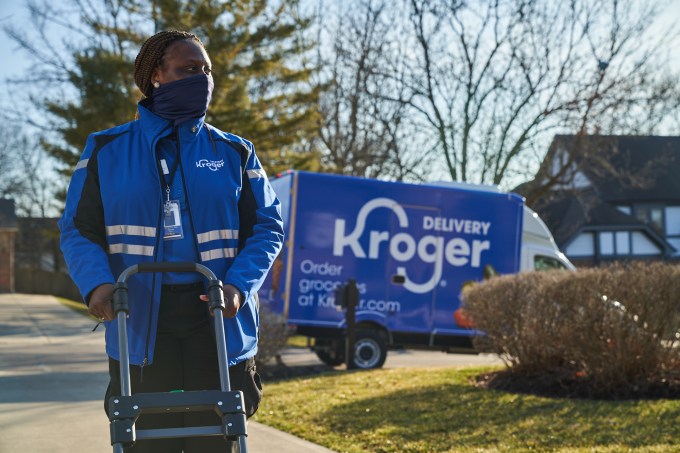
Those orders, in turn, will be delivered in temperature-controlled Kroger Delivery vans, built on the model of Ocado’s vans in the US and able to store up to 20 orders. These will also be run using Ocado software, mapping algorithms to optimize deliveries along the fastest and most fuel-efficient routes.

The partnership was a long time in the making but the focus on what has come out of it is probably at its keenest right now, given the huge boost online shopping has had in the past year. The Covid-19 pandemic, and the resulting push for more social distancing, has driven a lot of people to the internet to shop, opting for deliveries over physical store visits for some or all of their food and other weekly essentials.

In call today with journalists, Rodney McMullen, Kroger’s chairman and CEO, said that delivery had grown 150% for Kroger last year. While some of that may well melt back into physical shopping as and when Covid-19 cases wane (fingers crossed), many in the industry believe that the genie has been let out of the bottle, so to speak: many consumers introduced to shopping online will stay, at least in part, and so this is about building infrastructure to meet that new demand.

(And there is some data that backs that up: Ocado CEO and co-founder Tim Steiner noted that at Ocado, pre-pandemic the average order value for the company was £105 ($144). That grew to £180 last year, and are at £120.)

Kroger, like many brick-and-mortar players, has been building out multiple fronts in its digital strategy. Alongside Ocado, the company has also been investing in technology to boost the efficiency of its in-store operations (for example by working with companies like Shelf Engine), and it has a grocery delivery partnership with Instacart.

That partnership with Instacart will remain in place, not least because it covers a much wider geography than the Ocado approach, which is live now in Cincinnati, and sounds like it will also expand to Florida. While Kroger today said that CFCs will vary in size and be built on the concept of “modules” (the Monroe facility is built on seven modules), this is still a capital intensive approach compared to the Instacart model, so might overall face a slower rollout and perhaps only make sense in Kroger’s denser markets.

“The two partnerships are critical to Kroger and our customers,” said Yael Cosset, Kroger’s CIO, in the call today. “We expect to work very closely in strategic partnership with Instacart and with Ocado.”

Ocado, an early player that started out in the UK back in 2000, is seen by many as the industry standard for how to build and run an online-only grocery business.

The company has been expanding its reach by way of taking the technology that it has built for itself and turning it into a product — a process that is still very much in development, with the company working now on robotic pickers and other autonomous systems, along with other technology to power and make its delivery service more efficient.

Ocado’s “AWS” strategy of turning tech that it has built for itself into a product to sell to others has born fruit: it now has partnerships to power online grocery services, and specifically fulfillment centers, in Japan (with Aeon), France (with Casino) and Canada (with Sobeys). That means the Kroger rollout is now a tested model, but it’s still a very notable move for the company to break into the U.S. while at the same time giving Kroger a much-needed bit of infrastructure to better compete with bigger players in the country like Walmart and Amazon.

In that regard, it will be interesting to see how and if Kroger leverages its much bigger Ocado-powered infrastructure for its other projects. The company is working with Mirakl to develop its own marketplace for third-party retailers, going head to head with similar offerings from — yes — Amazon and Walmart.

News: Deep fake video app Avatarify, which process on-phone, plans digital watermark for videos

Making deep fake videos used to be hard. Now all you need is a smartphone. Avatarify, a startup that allows people to make deep-fake videos directly on their phone rather than in the Cloud, is soaring up the app charts after being used by celebrities such as Victoria Beckham. However, the problem with many deep

Making deep fake videos used to be hard. Now all you need is a smartphone. Avatarify, a startup that allows people to make deep-fake videos directly on their phone rather than in the Cloud, is soaring up the app charts after being used by celebrities such as Victoria Beckham.

However, the problem with many deep fake videos is that there is no digital watermark to determine that the video has been tampered with. So Avatarify says it will soon launch a digital watermark to prevent this from happening.

Run out of Moscow but with a US HQ, Avatarify launched in July 2020 and since then has been downloaded millions of times. The founders say that 140 million deepfake videos were created with Avatarify this year alone. There are now 125 million views of videos with the hashtag #avatarify on TikTok. While its competitors include the well-funded Reface, Snapchat, Wombo.ai, Mug Life, Xpression, Avatarify has yet to raise any money beyond an Angel round.

Despite taking only $120,000 in angel funding, the company has yet to accept any venture capital and says it has bootstrapped its way from zero to almost 10 million downloads and claims to have a $10 million annual run-rate with a team of less than 10 people.

It’s not hard to see why. Avatarify has a freemium subscription model. They offer a 7-day free trial and a 12-month subscription for $34.99 or a weekly plan for $2.49. Without a subscription, they offer the core features of the App for free, but videos then carry a visible watermark.

The founders also say the app protects privacy, because the videos are processed directly on the phone, rather than in the cloud where they could be hacked.

Avatarify processes user’s photos and turns them into short videos by animating faces, using machine learning algorithms, and adding sounds. The user chooses a picture she wants to animate, chooses the effects and music, and then taps to animate the picture. This short video can then be posted on Instagram or TikTok.

The Avatarify videos are taking off on TikTok because teens no longer need to learn a dance or be much more creative than finding a photo of a celebrity to animate to.

Avartify says you can’t use their app to impersonate someone, but there is of course no way to police this.

Founders Ali Aliev and Karim Iskakov wrote the app during the COVID-19 lockdown in April 2020. Ali spent 2 hours writing a program in Python to transfer his facial expressions to the other person’s face and use a filter in Zoom. The result was a real-time video, which could be streamed to Zoom. He joined a call with Elon Mask’s face and everyone on the call was shocked. The team posted the video, which then went viral.

The code on Github and immediately saw the number of downloads grow. The repository was published on 6 April 2020, and as of 19 March 2021 had been downloaded 50,000 times.

Ali left his job at Samsung AI Centre and devoted himself to the app. After Avatarify’s iOS app was released on 28 June 2020, viral videos on TikTok, created with the app, led it to App Store’s top charts without paid acquisition. In February 2021, Avatarify was ranked first among Top Free Apps worldwide. Between February and March, the app 2021 generated more than $1M in revenue (Source: AppMagic).

However, despite Avartify’s success, the ongoing problems with deep-fake videos remain, such as using these apps to make non-consensual porn, using the faces of innocent people.

News: MIT startup Pickle raises $5.75M for its package-picking robot

There’s no doubt this past year has been a major watershed moment for the robotics industry. Warehouse and logistics have been a particular target for an automation push, as companies have worked to keep the lights on amidst stay at home orders and other labor shortages. MIT spinoff Pickle is one of the latest startups

There’s no doubt this past year has been a major watershed moment for the robotics industry. Warehouse and logistics have been a particular target for an automation push, as companies have worked to keep the lights on amidst stay at home orders and other labor shortages.

MIT spinoff Pickle is one of the latest startups to enter the fray. The company launched with limited funding and a small team, though it’s recently changed one of these, telling TechCrunch this week that it has raised $5.57 million in funding during this hot investment streak. The seed round was led by Hyperplane and featured Third Kind Venture Capital, Box Group and Version One Ventures, among others.

The company’s making some pretty big claims around the efficacy of its first robot named, get this, “Dill” (the company clearly can’t avoid a clever name). It says the robot is capable of 1,600 picks per hour from the back of a trailer, a figure it claims is “double the speed of any competitors.”

CEO Andrew Meyer says collaboration is a key to the company’s play. “We designed people into the system from the get-go and focused on a specific problem: package handling in the loading dock. We got out of the lab and put robots to work in real warehouses. We resisted the fool’s errand of trying to create a system that could work entirely unsupervised or solve every robotics problem out there.”

Orders for the first product targeted at trailer unloading will open in June, with an expected ship date of early 2022.

News: Alexa von Tobel outlines how founders should manage personal finances

Von Tobel outlines steps to stay out of debt, build credit and accumulate wealth to ensure financial peace of mind as you take on the most stressful venture of your life: Starting a company.

Few people are more knowledgable on the topic of how founders should manage their finances than Alexa von Tobel. She is a certified financial planner, started her own company in the midst of the recession (which happened to be a wildly successful personal finance startup that sold for hundreds of millions of dollars) and is now a VC who invests and advises founders.

At Early Stage 2021, she gave a presentation on how founders should think about managing their own wealth. Startup founders can often put all their money into their venture and end up paying more attention to the finances of their company than their own bank account.

Von Tobel outlined the various steps you can take to stay out of debt, build credit and accumulate wealth through investments to ensure you have financial peace of mind as you take on the most stressful venture of your life: Starting a company.


Know your numbers

The first step in getting organized and being proactive is often taking inventory. Von Tobel believes that knowing your numbers and getting organized digitally is the first step to having financial peace of mind.

Know all your numbers. Know your net worth. What are your assets? What’s your debt? What does your total financial picture look like? Get everything online. You should have all the mobile apps downloaded so that, in minutes, you can actually see your full financial life. And keep it simple. Fewer accounts are better. I always tell people, if you have seven credit cards, plus three savings accounts, that’s a lot. You’re never going to be as good at managing your finances. Simplify your accounts. (Time stamp — 2:50)


Manage your credit and debt

News: Google’s FeedBurner moves to a new infrastructure but loses its email subscription service

Google today announced that it is moving FeedBurner to a new infrastructure but also deprecating its email subscription service. If you’re an internet user of a certain age, chances are you used Google’s FeedBurner to manage the RSS feeds of your personal blogs and early podcasts at some point. During the Web 2.0 era, it

Google today announced that it is moving FeedBurner to a new infrastructure but also deprecating its email subscription service.

If you’re an internet user of a certain age, chances are you used Google’s FeedBurner to manage the RSS feeds of your personal blogs and early podcasts at some point. During the Web 2.0 era, it was the de facto standard for feed management and analytics, after all. Founded in 2004, with Dick Costolo as one of its co-founders (before he became Twitter’s CEO in 2010), it was acquired by Google in 2007.

Ever since, FeedBurner lingered in an odd kind of limbo. While Google had no qualms shutting down popular services like Google Reader in favor of its ill-fated social experiments like Google+, FeedBurner just kept burning feeds day in and day out, even as Google slowly deprecated some parts of the service, most notably its advertising integrations.

I don’t know that anybody spent a lot of time thinking about the service and RSS has slowly (and sadly) fallen into obscurity, yet the service was probably easy enough to maintain that Google kept it going. And despite everything, shutting it down would probably break enough tools for publishers to create quite an uproar. The TechCrunch RSS feed, to which you are surely subscribed in your desktop RSS reader, is http://feeds.feedburner.com/TechCrunch/, after all.

So here we are, 14 years later, and Google today announced that it is “making several upcoming changes to support the product’s next chapter.” It’s moving the service to a new, more stable infrastructure.

But in July, it is also shutting down some non-core features that don’t directly involve feed management, most importantly the FeedBurner email subscription service that allowed you to get emailed alerts when a feed updates. Feed owners will be able to download their email subscriber lists (and will be able to do so after July, too). With that, Blogger’s FollowByEmail widget will also be deprecated (and hey, did you start this day thinking you’d read about FeedBurner AND Blogger on TechCrunch without having to travel back to 2007?).

Google stresses that other core FeedBurner features will remain in place, but given the popularity of email newsletters, that’s a bit of an odd move.

WordPress Image Lightbox Plugin