Tag Archives: Blog

News: Walmart helps push Cruise’s latest investment round to $2.75B

Cruise, the autonomous vehicle company aiming to deploy robotaxis in San Francisco and Dubai, has added Walmart as an investor in an extended fundraising round that has grown to $2.75 billion. The company said it has a post-money valuation of more than $30 billion. Walmart and several unnamed institutional investors added capital to a $2

Cruise, the autonomous vehicle company aiming to deploy robotaxis in San Francisco and Dubai, has added Walmart as an investor in an extended fundraising round that has grown to $2.75 billion.

The company said it has a post-money valuation of more than $30 billion. Walmart and several unnamed institutional investors added capital to a $2 billion equity round announced back in January that was led by Microsoft. The companies didn’t disclose Walmart’s exact investment. Cruise, the autonomous vehicle subsidiary of GM, is also backed by Honda, Softbank Vision Fund and funds managed by T. Rowe Price.

Cruise has long been viewed — and described itself — as a company solely focused on launching a commercial scale robotaxi service. However, comments from Walmart CEO John Furner in a blog post published Thursday suggest that laser focus continues to widened beyond robotaxis and San Francisco.

“The investment will aid our work towards developing a last-mile delivery ecosystem that’s fast, low-cost and scalable,” Furner wrote in a blog post published Thursday morning. He later wrote “this investment is a marker for us.”

Cruise has experimented with delivery over the past several years even as its efforts around robotaxis took most of its attention and resources. For instance, Cruise and DoorDash completed in 2019 a delivery pilot in San Francisco. And when the COVID-19 pandemic swept into North America, prompting government lockdowns, Cruise paused its testing in San Francisco and started delivering prepared meals for two food banks.

Walmart and Cruise also already have a relationship. The companies announced in November 2020 plans to test grocery delivery in Scottsdale, Arizona. Under the pilot program, the companies said that customers will be able to place an order from their local Walmart store and have it delivered via one of Cruise’s autonomous, electric Chevy Bolt cars. While the vehicles will operate autonomously, a human safety operator will always be behind the wheel.

Cruise is not Walmart’s only autonomous dancing partner. The retail giant has partnered with a handful of autonomous vehicle developers, including Waymo, to test out how the technology might eventually be used at a commercial scale. The retailer signed a deal in 2019 with startup Udelv to test the use of autonomous vans to deliver online grocery orders to customers in Surprise, Arizona. Autonomous delivery startup Nuro launched a pilot program with Walmart in Houston in 2020.

The retail giant participated in a pilot with Postmates and Ford in the Miami-Dade area and last year the retailer tapped AV startup Gatik to deliver customer online grocery orders from Walmart’s main warehouse to its neighborhood stores in Bentonville, Arkansas.
News: Persefoni’s carbon accounting platform raises $9.7 million

The carbon accounting and management platform Persefoni now has $9.7 million more in funding to support its international expansion, product development, and recruitment efforts. The round, led by Rice Investment Group with participation from NGP ETP, the electricity, renewable and sustainability-focused investment arm of the oil and gas and power focused investment fund NGP, comes

The carbon accounting and management platform Persefoni now has $9.7 million more in funding to support its international expansion, product development, and recruitment efforts.

The round, led by Rice Investment Group with participation from NGP ETP, the electricity, renewable and sustainability-focused investment arm of the oil and gas and power focused investment fund NGP, comes only about six months after the startup’s initial launch in August.

Founded only last January, Persefoni touts its tools to assemble, calculate, manage, and report organizational carbon footprints.

The company’s software promises real time reports on scope 1 through 3 emissions (these are emissions generated by a company’s direct operations, its purchases of power and the emissions of its suppliers).

“On the back of a banner year of net-zero commitments from governments, asset managers, and organizations the world over, we saw the venture and software investor communities wake up to what is the formation of the largest regulatory compliance software market since the introduction of Sarbanes Oxley”, said Kentaro Kawamori, CEO and co-founder of Persefoni, in a statement. “We applaud the efforts of financial regulators around the world who are implementing carbon and climate disclosure requirements. Such regulation is one of the most impactful ways to get companies accounting for, and reducing, their carbon footprint.”

Private equity firms like TPG are signing on to Persefoni’s service and Greg Lyons, a principal at NGP will be taking a seat on the company’s board of directors.

Additional investors in the company include the Carnrite Group and Sallyport Investments.

“Sallyport looks to partner with high-growth companies with an aim of making a meaningful industry impact,” said Doug Foshee, founder and owner of Sallyport Investments, in a statement.

Boosting the company’s environmental, social, and corporate governance bona fides is the addition of Robert G. Eccles, the founding chairman of the Sustainability Accounting Standards Board, to Persefoni’s board of advisors.

News: Autodesk acquires Upchain

Autodesk, the publicly-traded software company best known for its CAD and 3D modeling tools, today announced that it has acquired Upchain, a Toronto-based startup that offers a cloud-based product lifecycle management (PLM) service. The two companies, which didn’t disclose the acquisition price, expect the transaction to close by July 31, 2021. Since its launch in

Autodesk, the publicly-traded software company best known for its CAD and 3D modeling tools, today announced that it has acquired Upchain, a Toronto-based startup that offers a cloud-based product lifecycle management (PLM) service. The two companies, which didn’t disclose the acquisition price, expect the transaction to close by July 31, 2021.

Since its launch in 2015, Upchain raised about $7.4 million in funding, according to Crunchbase. The central idea behind the service was that existing lifecycle management solutions, which are meant to help businesses take new products from inception production and collaborate with their supply chain in the process, were cumbersome and geared toward large multi-national enterprises. Upchain’s focus is on small and mid-sized companies and promises to be more affordable and usable than other solutions. It’s customer base spans a wide range of industries, ranging from textiles and apparel to automotive, aerospace, industrial machines, transportation and entertainment.

“We’ve had a singular focus at Upchain to up-level cloud collaboration across the entire product lifecycle, changing the way that people work together so that everyone has access to the data they need, when they need it,” Upchain CEO and founder John Laslavic said in today’s announcement. “Autodesk shares our vision for radically simplifying how engineers and manufacturers across the entire value chain collaborate and bring a top-quality product to market faster. I look forward to seeing how Upchain and Autodesk, together, take that vision to the next level in the months and years to come.”

For Autodesk, this is the company’s 15th acquisition since 2017. Earlier this year, the company made its first $1 billion acquisition when it bought Portland, OR-based Innovyze, a 35-year-old company that focuses on modeling and lifecycle management for the water management industry. 

“Resilience and collaboration have never been more critical for manufacturers as they confront the increasing complexity of developing new products. We’re committed to addressing those needs by offering the most robust end-to-end design and manufacturing platform in the cloud,” said Andrew Anagnost, President and CEO of Autodesk. “The convergence of data and processes is transforming the industry. By integrating Upchain with our existing offerings, Autodesk customers will be able to easily move data without barriers and will be empowered to unlock and harness valuable insights that can translate to fresh ideas and business success.”

News: Yak Tack is a super simple app to boost vocabulary

Word nerds with a love for linguistic curiosities and novel nomenclature that’s more fulsome than their ability to make interesting new terms stick will be thrilled by Yak Tack: A neat little aide–mémoire (in Android and iOS app form) designed for expanding (English) vocabulary, either as a native speaker or language learner. Yak Tack uses

Word nerds with a love for linguistic curiosities and novel nomenclature that’s more fulsome than their ability to make interesting new terms stick will be thrilled by Yak Tack: A neat little aidemémoire (in Android and iOS app form) designed for expanding (English) vocabulary, either as a native speaker or language learner.

Yak Tack uses adaptive spaced repetition to help users remember new words — drawing on a system devised in the 1970s by German scientist Sebastian Leitner.

The app’s core mechanic is a process it calls ‘tacking’. Here’s how it works: A user comes across a new word and inputs it into Yak Tack to look up what it means (definition content for words and concepts is sourced from Oxford, Merriam-Webster, and Wikpedia via their API, per the developer).

Now they can choose to ‘tack’ the word to help them remember it.

This means the app will instigate its system of space repetition to combat the routine problem of memory decay/forgetting, as new information tends to be jettisoned by our brains unless we make a dedicated effort to remember it (and/or events conspire to make it memorable for other, not necessarily very pleasant reasons).

Tacked words are shown to Yak Tack users via push notification at spaced intervals (after 1 day, 2,3,5,8, and 13; following the fibonacci sequence).

Tapping on the notification takes the user to their in-app Tack Board where they get to re-read the definition. It also displays all the words they’ve tacked and their progress in the learning sequence for each one.

After the second repeat of a word there’s a gamified twist as the user must select the correct definition or synonym — depending on how far along in the learning sequence they are — from a multiple-choice list.

Picking the right answer means the learning proceeds to the next fibonacci interval. An incorrect answer moves the user back to the previous interval — meaning they must repeat that step, retightening (instead of expanding) the information-exposure period; hence adaptive space repetition.

It’s a simple and neat use of digital prompts to help make new words stick.

The app also has a simple and neat user interface. It actually started as an email-only reminder system, says developer Jeremy Thomas, who made the tool for himself, wanting to expand his own vocabulary — and was (intentionally) the sole user for the first six months after it launched in 2019. (He was also behind an earlier (now discontinued) vocabulary app called Ink Paste.)

For now Yak Tack is a side/passion project so he can keep coding (and indulge his “entrepreneurial proclivities”, as he wordily puts it), his day job being head of product engineering at Gusto. But he sees business potential in bootstrapping the learning tool — and has incorporated it as an LLC.

“We have just over 500 users spread across the world (17 different timezones). We’re biggest in Japan, Germany, and the U.S.,” he tells TechCrunch.

“I’m funding it myself and have no plans to take on investment. I’ve learned to appreciate technology companies that have an actual business model underneath them,” he adds. “There’s an elegance to balancing growth and business fundamentals, and given the low cost of starting a SaaS business, I’m surprised more companies don’t bootstrap, frankly.”

The email-only version of Yak Tack still works (you send an email to word@yaktack.com with the word you’d like to learn as the subject and the spaced repeats happen in the same sequence — but over email). But the mobile app is much more popular, per Thomas.

It is also (inevitably) more social, showing users words tacked by other users who tacked the same word as them — so there’s a bit of word discovery serendipity thrown in. However the user who will get the most out of Yak Tack is definitely the voracious and active reader who’s ingesting a lot of text elsewhere and taking the time to look up (and tack) new and unfamiliar words as they find them.

The app itself doesn’t do major lifting on the word discovery front — but it will serve up random encounters by showing you lists of latest tacks, most-tacked this month and words from any other users you follow. (There’s also a ‘last week’s most tacked words’ notification sent weekly.)

Taking a step back, one of the cruel paradoxes of the COVID-19 pandemic is that while it’s made education for kids harder, as schooling has often been forced to go remote, it’s given many stuck-at-home adults more time on their hands than usual to put their mind to learning new stuff — which explains why online language learning has seen an uplift over the past 12 months+.

And with the pandemic remaining the new dystopian ‘normal’ in most parts of the world, market conditions seem pretty conducive for a self-improvement tool like Yak Tack.

“We’ve seen a lot of good user growth during the pandemic, in large part because I think people are investing in themselves. I think that makes the timing right for an app like Yak Tack,” says Thomas.

Yak Tack is freemium, with free usage for five active tacks (and a queue system for any other words you add); or $5 a year for unlimited tacks and no queue.

“I figure the worldwide TAM [total addressable market] of English-learners is really big, and at that low price point Yak Tack is both accessible and is a huge business opportunity,” he adds.

News: Amazon announces $250 million venture fund for Indian startups

Amazon on Thursday announced a $250 million venture fund to invest in Indian startups and entrepreneurs focusing on digitization of small and medium-sized businesses (SMBs) in the key overseas market. The announcement comes at a time when the American e-commerce group, which has previously invested over $6.5 billion in its India business, faces heat from

Amazon on Thursday announced a $250 million venture fund to invest in Indian startups and entrepreneurs focusing on digitization of small and medium-sized businesses (SMBs) in the key overseas market.

The announcement comes at a time when the American e-commerce group, which has previously invested over $6.5 billion in its India business, faces heat from government bodies, and the small and medium-sized businesses that it purports to serve.

Through the new venture fund, called Amazon Smbhav Venture Fund, Amazon said it wants to invest in startups that focus on helping small businesses come online, sell online, automate and digitize their operations, and expand to customers worldwide.

Agriculture and healthcare are two additional areas Amazon is focusing on with its new venture fund, but it said it is open to looking at tech startups from other sectors if their work intersects with SMBs.

In the agri-tech sector, Amazon is looking to invest in Indian startups that are using technology to make agri-inputs more accessible to farmers, provide credit and insurance to farmers, reduce food wastage, and improve the quality of produce to consumers. In the healthcare sector, Amazon said it will invest in startups that are enabling healthcare providers to leverage telemedicine, e-diagnosis, AI powered treatment recommendations.

The announcement was made at Amazon’s annual event, called Sambhav, that focuses on India-based SMBs. At the virtual event, Amazon also unveiled ‘Spotlight North East’, an initiative to bring 50,000 artisans, weavers and small businesses online from the eight states in the North East region of India by 2025 and to boost exports of key commodities like tea, spices and honey from the region.

In the first edition of Sambhav last year, Amazon announced it would be investing $1 billion to help digitize 10 million small and medium sized businesses. Amazon said earlier this month that it had created 300,000 jobs in India since January 2020, and enabled exports for Indian-made goods worth $3 billion.

The company said more than 50,000 offline retailers and neighborhood stores — called kirana locally — are using Amazon marketplace and about 250,000 new sellers have also joined the platform. The company said today it aims to onboard 1 million offline retailers and neighbourhood stores by 2025 through the Local Shops on Amazon program.

Not far from Sambhav’s first event last year, which was attended by Amazon chief executive and founder Jeff Bezos, tens of thousands of protesters marched on the street and expressed their concerns about what they alleged was unfair practices employed by Amazon to crush them.

A similar protest was seen today. You can hear some of their stories here. It’s an ongoing challenge for Amazon, which has long struggled to stay out of controversy in India.

An influential India trader group that represents tens of millions of brick-and-mortar retailers called New Delhi to ban Amazon in the country in February this year after a report claimed that the American e-commerce group had given preferential treatment to a small group of sellers in India, publicly misrepresented its ties with those sellers and used them to circumvent foreign investment rules in the country.

The Confederation of All India Traders (CAIT) “demanded” serious action from the Indian government against Amazon following revelations made in a Reuters story. “For years, CAIT has been maintaining that Amazon has been circumventing FDI [Foreign Direct Investment] laws of India to conduct unfair and unethical trade,” it said.

Several international technology giants including Google, Facebook, and Microsoft have invested in Indian startups in recent years. Amazon, too, has backed a number of firms including ride-hailing startup Shuttl, and consumer brand MyGlamm. Last month, it acquired retail startup Perpule for about $20 million.

News: IBM acquires Italy’s MyInvenio to integrate process mining directly into its suite of automation tools

Automation has become a big theme in enterprise IT, with organizations using RPA, no-code and low-code tools, and other  technology to speed up work and bring more insights and analytics into how they do things every day, and today IBM is announcing an acquisition as it hopes to take on a bigger role in providing

Automation has become a big theme in enterprise IT, with organizations using RPA, no-code and low-code tools, and other  technology to speed up work and bring more insights and analytics into how they do things every day, and today IBM is announcing an acquisition as it hopes to take on a bigger role in providing those automation services. The IT giant has acquired MyInvenio, an Italian startup that builds and operates process mining software.

Process mining is the part of the automation stack that tracks data produced by a company’s software, as well as how the software works, in order to provide guidance on what a company could and should do to improve it. In the case of myInvenio, the company’s approach involves making a “digital twin” of an organization to help track and optimize processes. IBM is interested in how myInvenio’s tools are able to monitor data in areas like sales, procurement, production and accounting to help organizations identify what might be better served with more automation, which it can in turn run using RPA or other tools as needed.

Terms of the deal are not being disclosed. It is not clear if myInvenio had any outside investors (we’ve asked and are awaiting a response). This is the second acquisition IBM has made out of Italy. (The first was in 2014, a company called CrossIdeas that now forms part of the company’s security business.)

IBM and myInvenio are not exactly strangers: the two inked a deal as recently as November 2020 to integrate the Italian startup’s technology into IBM’s bigger automation services business globally.

Dinesh Nirmal, GM of IBM Automation, said in an interview that the reason IBM acquired the company was two-fold. First, it lets IBM integrate the technology more closely into the company’s Cloud Pak for Business Automation, which sits on and is powered by Red Hat OpenShift and has other automation capabilities already embedded within it, specifically robotic process automation (RPA), document processing, workflows and decisions.

Second and perhaps more importantly, it will mean that IBM will not have to tussle for priority for its customers in competition with other solution partners that myInvenio already had. IBM will be the sole provider.

“Partnerships are great but in a partnership you also have the option to partner with others, and when it comes to priority who decides?” he said. “From the customer perspective, will they will work just on our deal, or others first? Now, our customers will get the end result of this… We can bring a single solution to an end user or an enterprise, saying, ‘look you have document processing, RPA, workflow, mining. That is the beauty of this and what customers will see.”

He said that IBM currently serves customers across a range of verticals including financial, insurance, healthcare and manufacturing with its automation products.

Notably, this is not the first acquisition that IBM has made to build out this stack. Last year, it acquired WDG to expand into robotic process automation.

And interestingly, it’s not even the only partnership that IBM has had in process mining. Just earlier this month, it announced a deal with one of the bigger names in the field, Celonis, a German startup valued at $2.5 billion in 2019.

Ironically, at the time, my colleague Ron wondered aloud why IBM wasn’t just buying Celonis outright in that deal. It’s hard to speculate if price was one reason. Remember: we don’t know the terms of this acquisition, but given myInvenio was off the fundraising radar, chances are it’s possibly a little less than Celonis’s pricetag.

We’ve asked and IBM has confirmed that it will continue to work with Celonis alongside now offering its own native process mining tools.

“In keeping with IBM’s open approach and $1 billion investment in ecosystem, [Global Business Services, IBM’s enterprise services division] works with a broad range of technologies based on client and market demand, including IBM AI and Automation software,” a spokesperson said in a statement. “Celonis focuses on execution management which supports GBS’ transformation of clients’ business processes through intelligent workflows across industries and domains. Specifically, Celonis has deep connectivity into enterprise systems such as Salesforce, SAP, Workday or ServiceNow, so the Celonis EMS platform helps GBS accelerate clients’ transformations and BPO engagements with these ERP platforms.”

Indeed, at the end of the day, companies that offer services, especially suites of services, are working in environments where they have to be open to customers using their own technology, or bringing in something else.

There may have been another force pushing IBM to bring more of this technology in-house, and that’s wider competitive climate. Earlier this year, SAP acquired another European startup in the process mining space, Signavio, in a deal reportedly worth about $1.2 billion. As more of these companies get snapped up by would-be IBM rivals, and those left standing are working with a plethora of other parties, maybe it was high time for IBM to make sure it had its own horse in the race.

“Through IBM’s planned acquisition of myInvenio, we are revolutionizing the way companies manage their process operations,” said Massimiliano Delsante, CEO, myInvenio, who will be staying on with the deal. “myInvenio’s unique capability to automatically analyze processes and create simulations — what we call a ‘Digital Twin of an Organization’ —  is joining with IBM’s AI-powered automation capabilities to better manage process execution. Together we will offer a comprehensive solution for digital process transformation and automation to help enterprises continuously transform insights into action.”

News: Altman brothers lead B2B payment startup Routable’s $30M Series B

We all know the COVID-19 pandemic has accelerated digital adoption in a number of areas, particularly in the financial services space. Within financial services, there are few spaces hotter than B2B payments. With a $120 trillion market size, it’s no surprise that an increasing number of fintechs focused on digitizing payments have been attracting investor

We all know the COVID-19 pandemic has accelerated digital adoption in a number of areas, particularly in the financial services space. Within financial services, there are few spaces hotter than B2B payments.

With a $120 trillion market size, it’s no surprise that an increasing number of fintechs focused on digitizing payments have been attracting investor interest. The latest is Routable, which has nabbed $30 million in a Series B raise that included participation from a slew of high-profile angel investors.

Unlike most raises, Routable didn’t raise the capital from a bunch of VC firms. Sam Altman, CEO of OpenAI and former president of Y Combinator, and Jack Altman, CEO of Lattice, led the round. (The pair are brothers, in case you didn’t know.)

SoftBank-backed unicorn Flexport also participated, along with a number of angel investors, including Instacart co-founder Max Mullen, Airbnb co-founder Joe Gebbia, Box co-founder and CEO Aaron Levie, Salesforce founder and CEO Marc Benioff (who also started TIME Ventures),  DoorDash’s Gokul Rajaram, early Stripe employee turned angel Lachy Groom and Behance founder Scott Belsky.

The Series B comes just over eight months after Routable came out of stealth with a $12 million Series A.

CEO Omri Mor and CTO Tom Harel founded Routable in 2017 after previously working at marketplaces and recognizing the need for better internal tools for scaling business payments. They went through a Y Combinator batch and embarked on a process of interviewing hundreds of CFOs and finance leaders.

The pair found that the majority of the business payment tools that were out there were built for large companies with a low volume of business payments. 

After running enough customer development we identified a huge scramble to solve high-volume business payments, and that’s what we double down on,” Mor told TechCrunch. 

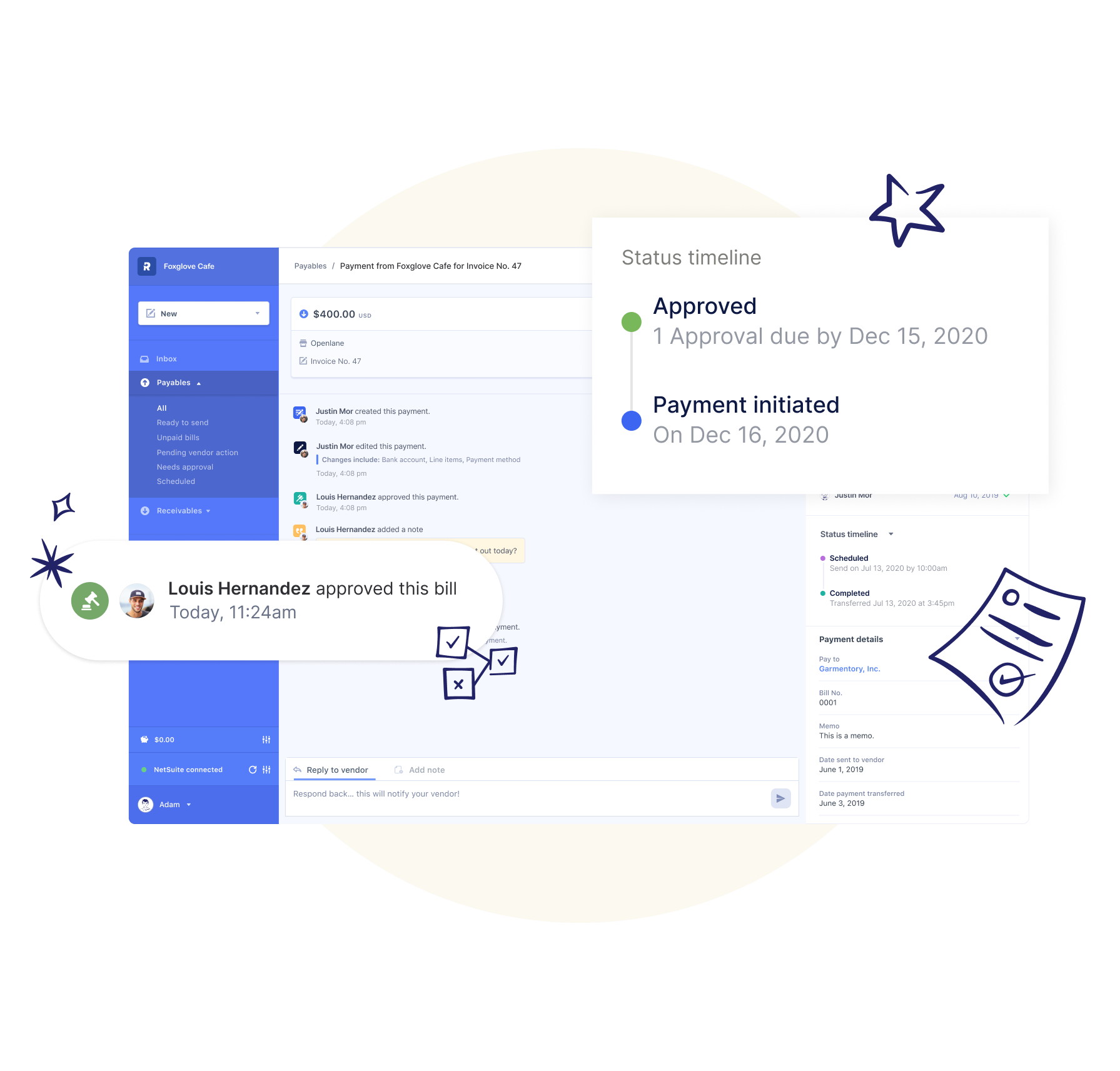
Routable’s mission is simple: to automate bill payment and invoicing processes (also known as accounts payables and accounts receivables), so that businesses can focus on scaling their core product offerings without worrying about payments.

“A business payment is more like moving a bill through Congress, where a consumer payment is more like a tweet,” Mor said. “We automate every step from purchase order to reconciliation and by extending an API, companies don’t have to build their own inner integration. We handle it, while helping them move their money faster.”

Since its August 2020 raise, Routable has seen its revenue grow by 380%, according to Mor. And last month alone, the company tripled its amount of new customers compared to the month prior. Customers include Snackpass, Ticketmaster and Re-Max, among others.

“We’ve been beating every quarter expectation for the past 18 months,” he told TechCrunch.

The company started out focused on the startup and SMB customer, but based on demand and feedback, is expanding into the enterprise space as well.

It has established integrations with QuickBooks, NetSuite and Xero and is looking to invest moving forward in integrating with Oracle, Microsoft Dynamics Workday and SAP. 

“A lot of our investment moving forward is to be able to bring that same level of automation and ease of use that we do for SMB and mid-market customers to the enterprise world,” Mor told TechCrunch.

Lead investor Sam Altman is in favor of that approach, noting that the recent booms in the gig and creator economies are leading to a big spike in the volume of both payments and payees.

“With the addition of enterprise capabilities, we think this can lead to an enormous business,” he said. 

The round brings Routable’s total raised to $46 million. The company has headquarters in San Francisco and Seattle with primarily a remote team. 

Sam Altman also told me that he was drawn to Routable after having experienced the pain of high-volume business payments himself and working with many startup founders who had experienced the same problem.

He was also impressed with the company’s engineering-forward approach.

“They can offer the best service by being embedded in a company’s flow of funds instead of the usual approach of just being an interface for moving money,” Altman said. 

With regard to the other investors, Mor said the decision to partner with founders of a number of prominent tech companies was intentional so that Routable could benefit from their “deep enterprise and high-growth experience.”

As mentioned above, the B2B payments space is white-hot. Earlier this year, Melio, which provides a platform for SMBs to pay other companies electronically using bank transfers, debit cards or credit — along with the option of cutting paper checks for recipients if that is what the recipients request — closed on $110 million in funding at a $1.3 billion valuation.

News: SoftBank in talks to invest up to $500 million in Swiggy

SoftBank Vision Fund 2 is in advanced stages of talks to invest up to half a billion dollars into food delivery startup Swiggy, two sources familiar with the matter told TechCrunch. The new investment values the Indian startup at about $5.5 billion, the sources said. The new investment would add to the $800 million fundraise Swiggy

SoftBank Vision Fund 2 is in advanced stages of talks to invest up to half a billion dollars into food delivery startup Swiggy, two sources familiar with the matter told TechCrunch. The new investment values the Indian startup at about $5.5 billion, the sources said.

The new investment would add to the $800 million fundraise Swiggy unveiled earlier this month. SoftBank began exploring investment in India’s food delivery space earlier this year, and also looked at Swiggy’s rival Zomato. But the investment firm picked Swiggy earlier this week, a person familiar with the matter said.

Swiggy and SoftBank declined to comment.

The new investment talks come amid Zomato raising $910 million in recent months as the Gurgaon-headquartered firm prepares for an IPO this year. The last tranche of investment valued Zomato at $5.4 billion. During its fundraise, Zomato said it was raising money partially to fight off “any mischief or price wars from our competition in various areas of our business.”

A third player, Amazon, also entered the food delivery market in India last year, though its operations are still limited to parts of Bangalore.

At stake is India’s food delivery market, which analysts at Bernstein expect to balloon to be worth $12 billion by 2022, they wrote in a report to clients earlier this year.

After raising $800 million, Swiggy co-founder and chief executive Sriharsha Majety told employees in a memo that the new fundraise “gives us a lot more firepower than the planned investments for our current business lines. Given our unfettered ambition though, we will continue to seed/experiment new offerings for the future that may be ready for investment later. We will just need to now relentlessly invent and execute over the next few years to build an enduring iconic company out of India.”

He added in that memo that the long-term goal for the startup is to serve 500 million users in the next 10-15 years, pointing to Chinese food giant Meituan, which had 500 million transacting users last year and is valued at over $100 billion.

“We’re coming out of a very hard phase during the last year given Covid and have weathered the storm, but everything we do from here on needs to maximise the chances of our succeeding in the long-term,” he wrote.

Swiggy last year eliminated some jobs — so did Zomato — and scaled down its cloud kitchen efforts as it attempted to stay afloat during the pandemic, which had prompted New Delhi to enforce a months-long lockdown.

TechCrunch reported on Wednesday that SoftBank Vision Fund 2 is also in talks to invest in Zeta. The investment firm also recently backed social commerce Meesho.

News: Cado Security locks in $10M for its cloud-native digital forensics platform

As computing systems become increasingly bigger and more complex, forensics have become an increasingly important part of how organizations can better secure them. As the recent Solar Winds breach has shown, it’s not always just a matter of being able to identify data loss, or prevent hackers from coming in in the first place. In

As computing systems become increasingly bigger and more complex, forensics have become an increasingly important part of how organizations can better secure them. As the recent Solar Winds breach has shown, it’s not always just a matter of being able to identify data loss, or prevent hackers from coming in in the first place. In cases where a network has already been breached, running a thorough investigation is often the only way to identify what happened, if a breach is still active, and whether a malicious hacker can strike again.

As a sign of this growing priority, a startup called Cado Security, which has built forensics technology native to the cloud to run those investigations, is announcing $10 million in funding to expand its business.

Cado’s tools today are used directly by organizations, but also security companies like Redacted — a somewhat under-the-radar security startup in San Francisco co-founded by Facebook’s former chief security officer Max Kelly and John Hering, the co-founder of Lookout. It uses Cado to carry out the forensics part of its work.

The funding for London-based Cado is being led by Blossom Capital, with existing investors Ten Eleven Ventures also participating, among others. As another signal of demand, this Series A is coming only six months after Cado raised its seed round.

The task of securing data on digital networks has grown increasingly complex over the years: not only are there more devices, more data and a wider range of configurations and uses around it, but malicious hackers have become increasingly sophisticated in their approaches to needling inside networks and doing their dirty work.

The move to the cloud has also been a major factor. While it has helped a wave of organizations expand and run much bigger computing processes are part of their business operations, it has also increased the so-called attack surface and made investigations much more complicated, not least because a lot of organizations run elastic processes, scaling their capacity up and down: this means when something is scaled down, logs of previous activity essentially disappear.

Cado’s Response product — which works proactively on a network and all of its activity after it’s installed — is built to work across cloud, on-premise and hybrid environments. Currently it’s available for AWS EC2 deployments and Docker, Kubernetes, OpenShift and AWS Fargate container systems, and the plan is to expand to Azure very soon. (Google Cloud Platform is less of a priority at the moment, CEO James Campbell said, since it rarely comes up with current and potential customers.)

Campbell co-founded Cado with Christopher Doman (the CTO) last April, with the concept for the company coming out of their respective experiences working on security services together at PwC, and respectively for government organizations (Campbell in Australia) and AlienVault (the security firm acquired by AT&T). In all of those, one persistent issue the two continued to encounter was the issue with adequate forensics data, essential for tracking the most complex breaches.

A lot of legacy forensics tools, in particular those tackling the trove of data in the cloud, was based on “processing data with open source and pulling together analysis in spreadsheets,” Campbell said. “There is a need to modernize this space for the cloud era.”

In a typical breach, it can take up to a month to run a thorough investigation to figure out what is going on, since, as Doman describes it, forensics looks at “every part of the disk, the files in a binary system. You just can’t find what you need without going to that level, those logs. We would look at the whole thing.”

However, that posed a major problem. “Having a month with a hacker running around before you can do something about it is just not acceptable,” Campbell added. The result, typically, is that other forensics tools investigate only about 5% of an organization’s data.

The solution — for which Cado has filed patents, the pair said — has essentially involved building big data tools that can automate and speed up the very labor intensive process of looking through activity logs to figure out what looks unusual and to find patterns within all the ones and zeros.

“That gives security teams more room to focus on what the hacker is getting up to, the remediation aspect,” Campbell explained.

Arguably, if there were better, faster tracking and investigation technology in place, something like Solar Winds could have been better mitigated.

The plan for the company is to bring in more integrations to cover more kinds of systems, and go beyond deployments that you’d generally classify as “infrastructure as a service.”

“Over the past year, enterprises have compressed their cloud adoption timelines while protecting the applications that enable their remote workforces,” said Imran Ghory, partner at Blossom Capital, in a statement. “Yet as high-profile breaches like SolarWinds illustrate, the complexity of cloud environments makes rapid investigation and response extremely difficult since security analysts typically are not trained as cloud experts. Cado Security solves for this with an elegant solution that automates time-consuming tasks like capturing forensically sound cloud data so security teams can move faster and more efficiently. The opportunity to help Cado Security scale rapidly is a terrific one for Blossom Capital.”

News: Flipkart to acquire online travel firm Cleartrip

Flipkart said on Thursday it has agreed to acquire online travel and hotel ticketing firm Cleartrip as the Walmart-owned e-commerce firm looks to expand its offerings in the world’s second largest internet market. The deal values 14-year-old Cleartrip, which raised about $74 million prior to the acquisition, at about $40 million, a person familiar with

Flipkart said on Thursday it has agreed to acquire online travel and hotel ticketing firm Cleartrip as the Walmart-owned e-commerce firm looks to expand its offerings in the world’s second largest internet market.

The deal values 14-year-old Cleartrip, which raised about $74 million prior to the acquisition, at about $40 million, a person familiar with the matter told TechCrunch. The distress sale comes as Cleartrip, like most other travel firms, faces unprecedented stress amid the global pandemic that has severely slowed down people’s appetite to move around.

Indian news outlet MoneyControl reported about the two companies exploring the deal last month.

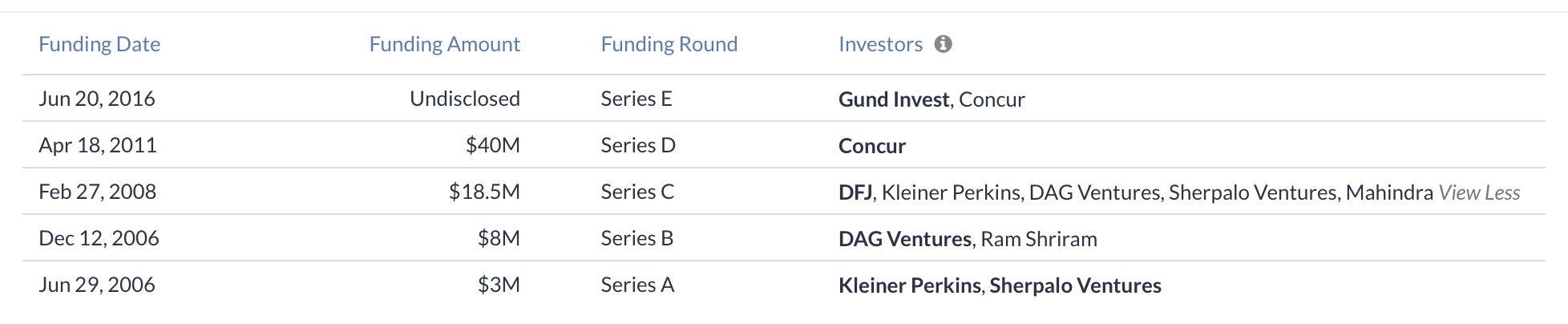
Cleartrip raised about $74 million prior to selling to Flipkart for $40 million. (Data: Tracxn)

Cleartrip is also a partner of Amazon in India, powering the ticketing engine for the American e-commerce group. The two firms inked a deal in 2019. TechCrunch asked Amazon earlier this week if it was aware and fine with its vendor partner exploring a buyout deal with Flipkart. The American e-commerce firm, which is currently fighting a court battle to block its estranged Indian partner Future Group from selling business to Reliance Retail, did not respond.

Cleartrip will continue to operate as a separate brand, retaining all employees while working closely with Flipkart to “further develop technology solutions to make travel simple for customers,” the two companies said today.

Flipkart has been rumored to be working on introducing flight tickets purchase feature on its marketplace for over a year.

“The Flipkart Group is committed to transforming customer experiences through digital commerce. Cleartrip is synonymous with travel for many customers, and as we diversify and look at new areas of growth, this investment will help strengthen our wide range of offerings for customers. We welcome the Cleartrip team with their deep industry knowledge and technology capabilities to the Flipkart Group and look forward to providing deeper value and travel experiences for customers together,” said Kalyan Krishnamurthy, CEO of Flipkart Group, in a statement.

This is a developing story. More to follow…

WordPress Image Lightbox Plugin