Tag Archives: Blog

News: Mastercard is acquiring identity verification company Ekata for $850M

As online identity management grows in importance, Mastercard swooped in this morning and bought identity verification company Ekata for $850 million. Mastercard certainly sees the rapid digital transformation that is happening in online commerce, a move that was accelerated by COVID. It’s a transformation that once started isn’t likely to change back to the old

As online identity management grows in importance, Mastercard swooped in this morning and bought identity verification company Ekata for $850 million.

Mastercard certainly sees the rapid digital transformation that is happening in online commerce, a move that was accelerated by COVID. It’s a transformation that once started isn’t likely to change back to the old ways of doing business, even when we get past the pandemic.

With Ekata, the company gets a solution that can verify the online identity of a person making the transaction in real time using various signals that can indicate if this is fraudulent or true as they open an account or transact business. The company provides a score and other data that predicts the likelihood this person is who they say they are. It’s not unlike a credit risk score, except for identity.

That was one of the primary reasons Mastercard decided to acquire Ekata, according to Ajay Bhalla, president of cyber and intelligence solutions at the company. “With the addition of Ekata, we will advance our identity capabilities and create a safer, seamless way for consumers to prove who they say they are in the new digital economy,” Bhalla said in a statement.

The two companies believe that by combining Mastercard’s fraud detection solutions with Ekata’s scoring approach, they will help prevent bad actors from using online platforms to conduct business. “The acceleration of online transactions has thrust global digital identity verification to the forefront as one of the biggest opportunities to build digital trust and combat global fraud,” Rob Eleveld, CEO at Ekata said in a statement.

The company, which was previously known as White Page Pro, was spun out as Ekata in June 2019. It has not raised any additional money, according to both Pitchbook and Crunchbase data. It would seem that $850 million represents a nice exit for a company that hasn’t raised a dollar, but it’s clearly more mature than your average startup with 2000 customers including Lyft, Stripe, Equifax, Checkout.com and Intuit.

It appears that Mastercard was willing to pay to get the company it wanted at a time when a solution like this is becoming more essential than ever. The acquisition is subject to standard regulatory approval, but remember regulators quashed the Visa-Plaid deal last year. If it passes muster, it should close some time in the next six months, according to the company.

News: Cannabis lender Bespoke Financial raises $8m from Casa Verde Capital and Sweat Equity Ventures

Cannabis financing company Bespoke Financial today announced it raised $8 million in a Series A financing round. Through this round, the company brought new, key investors into its corner as it fights to bring financing solutions to companies in the cannabis space. Bespoke is a direct lender and provides several financing solutions to companies operating

Cannabis financing company Bespoke Financial today announced it raised $8 million in a Series A financing round. Through this round, the company brought new, key investors into its corner as it fights to bring financing solutions to companies in the cannabis space.

Bespoke is a direct lender and provides several financing solutions to companies operating in cannabis. These short-term loans allow the companies to build credit with Bespoke, which then offers better terms on subsequent loans and products. The company says its loan origination volume has grown exponentially, outgrowing forecasts by 25% over the proceeding year. The company has deployed $120 million in gross merchandise volume over 2,000 cannabis license holders with zero defaults to date.

With this new round of capital, Bespoke intends to launch new financing structures and expand its financing options across various distribution channels.

CEO and Co-founder George Mancheil calls this round a pivotal moment for his company and stamp of validation on the direction and products offered by Bespoke Financial. As he tells TechCrunch, this round provides several key partners to the growing startup.

The financing round was co-led by Snoop Dogg’s Casa Verde Capital and Sweat Equity Ventures, along with Ceres Group Holdings, Greenhouse Capital Partners, DoubleLine Capital’s co-founder and former president Philip Barach, and Robery Stavis, a VC based in New York.

This is Sweat Equity Ventures’ (SEV) first investment into a cannabis company. SEV, backed and in part funded by LinkedIn founder Reid Hoffman, is led by Dan Portillo and works differently from traditional venture funds. SEV works with founders to provide top engineering and business talent to its portfolio companies. In exchange for these services, SEV takes equity from the companies instead of just writing checks.

“This is our firm’s first investment in the cannabis industry, and we are excited to partner with Bespoke as more and more states legalize cannabis use, and the Federal government contemplates nationwide legalization. This partnership combines Bespoke’s finance and cannabis acumen with our team’s expertise scaling innovative tech companies, and will provide cannabis companies greater access to streamlined financing while benefiting investors with increased transparency and enhanced risk surveillance,” says Dan Portillo, Managing Partner of Sweat Equity Ventures, in a released statement.

Karan Wadhera, managing partner at Casa Verde Capital, says Bespoke Financial addresses real needs in a growing industry. Casa Verde Capital previously invested in Bespoke Capital including in a $7 million round in 2019.

Bespoke CEO Mancheil tells TechCrunch his company is focused on being more than just a lender; it wants to be a modern financing company that allows it to act as a true partner with the cannabis industry.

With this $8 million in financing, Bespoke Financial has raised $28 million to date. The company was founded in 2019 and, as of this announcement, has 12 employees.

News: Popl tops $2.7M in sales for its technology that replaces business cards

If you’re spent any time on TikTok lately, then you’ve probably seen a number of Popl’s ads. The startup has been successfully leveraging social media to get its modern-day business card alternative in front a wider audience. Packaged as either a phone sticker, keychain or wristband, Popl uses NFC technology to make sharing contact information

If you’re spent any time on TikTok lately, then you’ve probably seen a number of Popl’s ads. The startup has been successfully leveraging social media to get its modern-day business card alternative in front a wider audience. Packaged as either a phone sticker, keychain or wristband, Popl uses NFC technology to make sharing contact information as easy as using Apple Pay. To date, Popl has sold somewhere over 700,000 units and has generated $2.7 million in sales for its digital business card technology.

Popl co-founder and CEO Jason Alvarez-Cohen, a UCLA grad with a background in computer science, first realized the potential for NFC business cards through a different use case — a device he encountered in someone’s home while attending a party. But it sparked the idea to use NFC technology for sharing information person-to-person, which would be faster than alternatives, like AirDrop or manual entry. And so, Popl was born.

Image Credits: Popl

Though startup history is littered with would-be “business card killers” that eventually died, what makes Popl different from early contenders is that it combines both an app with a physical product — the Popl accessory. This accessory can be purchased in a variety of form factors, including the popular Popl phone sticker that you can apply right to the back of your phone case (or even the top of your Popsocket), and customized with a photo of your choosing.

“I knew that, in the past, people would tap phones and share information like that. But I learned quickly that you can’t do this just phone-to-phone with pure software,” says Alvarez-Cohen. “So I was like, what’s the closest way we can get the phone tapping? And that’s how I came up with this back-of-the-phone product.”

Each Popl accessory is actually an NFC tag which enables the handoff of the user’s contact information. When the phones are close, the recipient will get a notification that alerts them to your shared Popl data.

There are, of course, other ways to quickly exchange contact information. You can easily enter in someone’s digits into your phone’s contacts app directly, for example, which may work better for more casual encounters — like meeting someone at a bar. But Popl lets you share a full business cards’ worth of contact data with just a tap, which makes it better for professional encounters, or any other time you want to share more than just your phone number.

While the Popl tags make for a nice gimmick, the Popl mobile app is what makes the overall service useful. And to be clear, the app is only necessary for the Popl’s owner — the recipient doesn’t need the app installed for Popl to work. They will, however, need to have a phone that can read NFC tags, which can leave out some older devices. Or, as a backup, they’ll need ability to scan the QR code the app provides as a workaround.

Image Credits: Popl

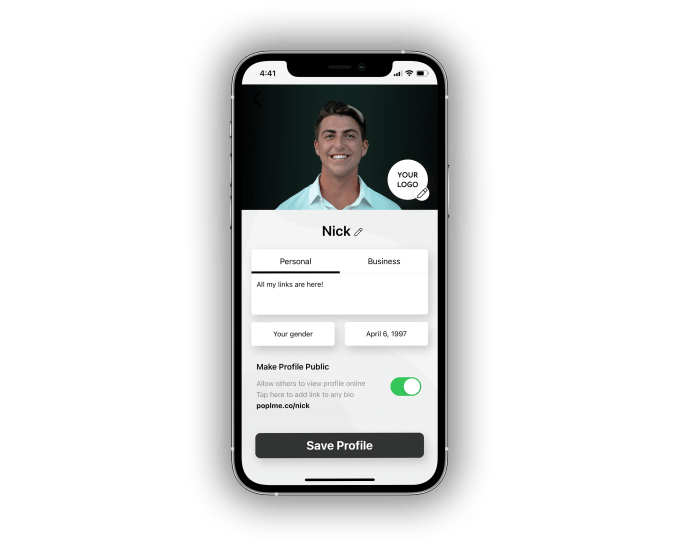
In the Popl app, you can customize which data you want to share with others — including your contact info, social profiles, website links, etc. — all via an easy-to-use interface. Like some business card apps in the past, you can flip in between a personal profile and a business profile in Popl in order to share the appropriate information when out networking. To actually make the exchange of contact information with another person, you simply hold up your phone to theirs and they’ll get a notification directing them to your Popl profile webpage. (The phones don’t have to physically touch or bump together, however. It’s more like Apple Pay, where they have to be near each other.)

From the Popl website that’s shared via the notification that pops up, the recipient can tap on the various options to connect with the sender — for example, adding them on a social network like LinkedIn or Instagram, grabbing their phone number to send a quick text, or even downloading a full contact card to their phone’s address book, among other things.

Image Credits: Popl

The app’s more clever feature, however, is something Popl calls “Direct.”

This patented feature won’t send over the Popl website where the recipient then has to choose how they want to connect. Instead, it opens up the destination app directly. For example, if you have LinkedIn Direct on, the recipient will be taken directly to your profile on LinkedIn when they tap the notification. Or if you put your Contact Card on Direct, it will just pop your address book entry onto the screen so the user can choose to save it to their phone.

For paid users, the app also lets you track your history of Popl connections on a map, so you can recall who you met, where and when, along with other analytics.

Image Credits: Popl

Work on Popl, which is co-founded by Alvarez-Cohen’s UCLA roommate, Nick Eischens, now Popl COO, began in late 2019. The startup then launched in February 2020 — just before the coronavirus lockdowns in the U.S. That could have been a disastrous time for a business designed to help people exchange information during in-person meetings when the world was now shifting to Zoom and remote work. But Alvarez-Cohen says they marketed Popl as a “contactless solution.”

“If I have this, and I have to meet someone for my business, I don’t even have to tap it —  you can just hover, and it will still send that information,” Alvarez-Cohen says. “So I’m able to share my business card with you without handing you a business card, which is kind of safe.”

But what really helped to sell Popl were its video demos. One TikTok ad, which I’m sure you’ve seen if you use TikTok at all, features the co-founders’ friend Arev sharing her TikTok profile with a new friend just as she’s leaving the gym.

In the video, the recipient — clearly dumbfounded by the technology after she taps his phone — responds “what? what? Whoa! What? How’d you do that?!”

It’s now been viewed over 80 million times.

@popl

HOW DID SHE DO THAT!! @endiccii with her new Popl. #poplchallengue #newtech #technology #foryou #fyp #instant

♬ original sound – popl

Today, Popl’s TikTok videos get high tens of thousands, hundreds of thousands, and sometimes still millions of views per video. The company also has an active presence on other social media. For instance, Popl posts regularly to Instagram where it has over 100K followers. Today, the startup’s growth now is about 60% driven by Facebook and Instagram marketing and 40% organic, Alvarez-Cohen says.

Now, the company is preparing new products for the post-pandemic era when in-person events return. Though it had before sold Popl’s in bulk for this purpose, it’s now readying an “event bracelet” that just slips on your wrist (and is reusable). The bracelet could be used at any big event — like music festivals or business conferences, where you’re meeting a lot of new people. And because Popl uses NFC, phones have to be close to make the contact info exchange — it won’t just randomly share your info with everyone you pass by them.

Popl is also fleshing out the business networking side of its app with integrations for Salesforce, Oracle and Hubspot, and CSV export, that come with its Popl Pro subscription ($4.99 per month). The in-app subscription is already at $320,000 in annual recurring revenue and growing 10% every week, as of early April.

A Y Combinator Winter 2021 participant, Popl is backed by Twitch co-founder Justin Kan (via Goat Capital), YC, Urban Innovation Fund, Cathexis Ventures, and others angels including Wish.com CEO Peter Szulczewski and Plangrid co-founder Ralph Gootee.

The app is available on iOS and Android, and the Popl accessories are sold on its website and on Target.com.

News: UK gov’t triggers national security scrutiny of Nvidia-Arm deal

The UK government has intervened to trigger public interest scrutiny of chipmaker’s Nvidia’s planned to buy Arm Holdings. The secretary of state for digital issues, Oliver Dowden, said today that the government wants to ensure that any national security implications of the semiconductor deal are explored. Nvidia’s $40BN acquisition of UK-based Arm was announced last

The UK government has intervened to trigger public interest scrutiny of chipmaker’s Nvidia’s planned to buy Arm Holdings.

The secretary of state for digital issues, Oliver Dowden, said today that the government wants to ensure that any national security implications of the semiconductor deal are explored.

Nvidia’s $40BN acquisition of UK-based Arm was announced last September but remains to be cleared by regulators.

The UK’s Competition and Markets Authority (CMA) began to solicit views on the proposed deal in January.

Domestic opposition to Nvidia’s plan has been swift, with one of the original Arm co-founders kicking off a campaign to ‘save Arm’ last year. Hermann Hauser warned that Arm’s acquisition by a U.S. entity would end its position as a company independent of U.S. interests — risking the U.K.’s economic sovereignty by surrendering its most powerful trade weapon.

The intervention by Department of Digital, Media, Culture and Sport (DCMS) — using statutory powers set out in the Enterprise Act 2002 — means the competition regulator has been instructed to begin a phase 1 investigation.

The CMA has a deadline of July 30 to submit its report to the secretary of state.

Commenting in a statement, Dowden said: “Following careful consideration of the proposed takeover of ARM, I have today issued an intervention notice on national security grounds. As a next step and to help me gather the relevant information, the UK’s independent competition authority will now prepare a report on the implications of the transaction, which will help inform any further decisions.”

“We want to support our thriving UK tech industry and welcome foreign investment but it is appropriate that we properly consider the national security implications of a transaction like this,” he added.

At the completion of the CMA’s phase 1 investigation Dowden will have an option to clear the deal, i.e. if no national security or competition concerns have been identified; or to clear it with remedies to address any identified concerns.

He could also refer the transaction for further scrutiny by instructing the CMA to carry out an in-depth phase 2 investigation.

After the phase 1 report has been submitted there is no set period when the secretary of state must make a decision on next steps — but DCMS notes that a decision should be made as soon as “reasonably practicable” to reduce uncertainty.

While Dowden’s intervention has been made on national security grounds, additional concerns have been raised about impact of an Nvidia take-over of Arm — specifically on U.K. jobs and on Arm’s open licensing model.

Nvidia sought to address those concerns last year, claiming it’s committed to Arm’s licensing model and pledging to expand the Cambridge, UK offices of Arm — saying it would create “a new global center of excellence in AI research” at the UK campus.

However it’s hard to see what commercial concessions could be offered to assuage concern over the ramifications of an Nvidia-owed Arm on the UK’s economic sovereignty. That’s because it’s a political risk, which would require a political solution to allay, such as at a treaty level — something which isn’t in Nvidia’s gift (alone) to give.

National security concerns are a rising operational risk for tech companies involved in the supply of cutting edge infrastructure, such as semiconductor design and next-gen networks — where a relative paucity of competitors not only limits market choice but amps up the political calculations.

Proposed mergers are one key flash point as market consolidation takes on an acute politico-economic dimension.

However tech companies’ operations are being more widely squeezed in the name of national security — such as, in recent years, the U.S. government’s attacks on China-based 5G infrastructure suppliers like Huawei, with former president Trump seeking to have the company barred from supplying next-gen networks not only within the U.S. but to national networks of Western allies.

Nor has (geo)political pressure been applied purely over key infrastructure companies in recent years; with Trump claiming a national security justification to try and shake down the Chinese-owned social networking company, TikTok — in another example that speaks to how tech tools are being coopted into wider geopolitical power-plays, fuelled by countries’ economic and political self-interest.

News: The Station: A chat with Scale AI’s Alexandr Wang, the NYC scooter winners and TuSimple goes public

The Station is a weekly newsletter dedicated to all things transportation. Sign up here — just click The Station — to receive it every weekend in your inbox. Hi there, new and returning readers. This is The Station, a weekly newsletter dedicated to all the ways people and packages move (today and in the future) from

The Station is a weekly newsletter dedicated to all things transportation. Sign up here — just click The Station — to receive it every weekend in your inbox.

Hi there, new and returning readers. This is The Station, a weekly newsletter dedicated to all the ways people and packages move (today and in the future) from Point A to Point B.

Just as I was getting ready to ship this newsletter, I spotted that there was a fatal crash involving a Tesla, in which no one was in the driver’s seat. There was an individual in the passenger seat and one in the rear. Both men died. Follow @KPRC2Deven, the Houston reporter who broke this story over the weekend, to keep up with the latest. Once again, Tesla vehicles are not self driving. 

One more thing: I will not have a newsletter next week. Don’t be sad! We’ll be back the following week.

My email inbox is always open. Email me at kirsten.korosec@techcrunch.com to share thoughts, criticisms, offer up opinions or tips. You can also send a direct message to me at Twitter — @kirstenkorosec.

Micromobbin’

Welp. I was only partially right about the e-scooter pilot in New York City. On Wednesday, Lime (as I predicted), Bird and Veo were officially chosen to kick off the city’s first foray into the world of shared electric scooters. Equity, accessibility and proven capabilities of keeping those pesky vehicles off of sidewalks were top priorities for the NYC Department of Transportation. Each company will be releasing 1,000 e-scooters into parts of the east Bronx, with more to come in the second phase expanding further into the borough.

The process of gaining this small sliver of the Big Apple has been very competitive. City concessions are a hot commodity, and winning New York is perceived to be, in technical terms, a big deal. The operators that hit the mean streets of New York have the potential to survive as the rideshare industry continues to consolidate under two-wheeled micromobility giants. But there is something a little bit anticlimactic about the news. Not to knock the Bronx, but dockless e-scooters are needed and could be of use citywide. One has to wonder how much influence Lyft-owned Citi Bike has over where e-scooter companies get to operate.

The 2018 legislation that allowed for the e-scooter pilot in the first place very clearly stipulates that pilot zones would be prioritized based, in large part, on areas of the city that don’t have access to docked bike shares, which basically means areas that don’t have access to Citi Bike. And the pilot zone in the Bronx doesn’t extend into areas in the South Bronx where Citi Bike plans to expand. I guess we’ll see how it goes after the first year.

Let’s talk about Europe

Electric bikes and scooters are barely legal in Ireland, but Tier is already preparing for more regulation. The Berlin-based e-scooter company has partnered with the Irish micromobility tech platform Luna, the Insight SFO Centre for Data Analytics, and Smart DCU to create a new AI-powered e-scooter trial that’ll launch on Dublin City University campuses as soon as the ink on the bill legalizing e-scooters dries.

The fleet of 30 computer vision-enabled scooters will allow Insight researchers to analyze a new, ever-growing dataset. Luna’s tech will allow the scooters to roll out with pedestrian and lane identification, making them as safe as the Irish government could possibly hope for.

Meanwhile in France, the government is moving closer to being the first country in the world to offer people the chance to trade in clunkers for an electric or folding bicycle. Owners that scrap their yucky old ICE cars can get a €2,500 rebate to buy a bike with the money. The National Assembly just approved the measure in a preliminary vote.

— Rebecca Bellan

Deal of the week

money the station

Ok, I know we had Grab as deal of the week in the last edition of The Station, but now we have a finalized deal and it’s a lot bigger than expected.

Ride-hailing, delivery and super app” company Grab finally and officially announced plans to go public. Grab, which operates in Singapore, Malaysia, Cambodia, Indonesia, Myanmar, Philippines, Thailand and Vietnam, merged with special purpose acquisition company Altimeter Growth Corp. The merger would value Grab at $39.6 billion and the company would keep $4.5 billion in cash. Importantly, Altimeter agreed to a three-year lockup period for its sponsor shares.

Grab has aspirations for the capital that the public markets provide. The company thinks there’s still a lot of room to grow when it comes to food delivery and on-demand mobility in Southeast Asia. It expects to see the total addressable market jump from $52 billion to $180 billion by 2025.

As part of the announcement, Grab shared some metrics and some big numbers. In 2020, the company managed to generate around $12.5 billion in gross merchandise value, TechCrunch’s Romain Dillet reported.

Other deals that got my attention … 

Battery Resourcers, a startup that has a “closed loop” process to turn recycled battery material into nickel-manganese-cobalt cathodes to sell back to battery manufacturers, raised in a $20 million Series B equity round led by Orbia Ventures, with injections from At One Ventures, TDK Ventures, TRUMPF Venture, Doral Energy-Tech Ventures and InMotion Ventures. Battery Resourcers CEO Mike O’Kronley declined to disclose the company’s new valuation.

Cruise, the autonomous vehicle company aiming to deploy robotaxis in San Francisco and Dubai, added Walmart as an investor in an extended fundraising round that has grown to $2.75 billion. The company said it has a post-money valuation of more than $30 billion. Walmart and several unnamed institutional investors added capital to a $2 billion equity round announced back in January that was led by Microsoft.

Clearcover, the digital car insurance startup, raised $200 million as part of a late-stage financing round led by Eldridge, the investment firm helmed by Los Angeles Dodgers owner Todd Boehly, Reuters reported.

Dat Bike, a Vietnamese startup with ambitions to become the top electric motorbike company in Southeast Asia, raised $2.6 million in pre-Series A funding led by Jungle Ventures. Dat Bike’s selling point is its ability to compete with gas motorbikes in terms of pricing and performance. Its new funding is the first time Jungle Ventures has invested in the mobility sector, and included participation from Wavemaker Partners, Hustle Fund and iSeed Ventures.

Oxbotica, a U.K. startup that develops autonomous driving systems took on online grocer Ocado as a new investor. Ocado, which took a $13.8 million stake in the AV startup, is treating this as a strategic investment to develop AI-powered, self-driving systems that will work across its operations, from vehicles within and around its packing warehouses through to the last-mile vehicles that deliver grocery orders to people’s homes, TechCrunch’s Ingrid Lunden reported.

Polestar, Volvo Car Group’s standalone electric performance brand, has raised $550 million in its first external round led by Chongqing Chengxing Equity Investment Fund Partnership, Zibo Financial Holding and Zibo Hightech Industrial Investment. SK Inc., the South Korean global conglomerate, and a range of other investors also participated.

TuSimple debuted on the public market this week. The company raised a bit more than $1 billion in its IPO, selling shares at $40. I interviewed the CEO Cheng Lu, so keep an eye out for that article in the next few days.

Xwing scored another win two months after it completed its first gate-to-gate autonomous demonstration flight of a commercial cargo aircraft. The company announced it raised $40 million at a post-money valuation of $400 million.

Scale AI’s Alexandr Wang

Alexandr Wang, co-founder and chief executive officer of Scale AI Inc., stands for a photograph after a Bloomberg Technology television interview in San Francisco, California, U.S., on Thursday, Aug. 8, 2019. Wang spoke about how Scale AI is using artificial intelligence to improve the safety of self-driving cars. Photographer: David Paul Morris/Bloomberg via Getty Images

Alexandr Wang, co-founder and chief executive officer of Scale AI. Photographer: David Paul Morris/Bloomberg via Getty Images

Scale AI, the data labeling startup that essentially sells the picks and shovels needed to develop and apply artificial intelligence, closed a $155 million round  back in December. Just after that round closed, more investors came calling co-founder and CEO Alexandr Wang told me in a recent interview. 

The upshot? A $325 million Series E funding round co-led by Dragoneer, Greenoaks Capital and Tiger Global at a valuation of more than $7 billion — double what it was four months ago. Additional new investors Wellington Management and Durable Capital joined existing investors Coatue, Index, Founders Fund and YC. Jeff Wilke, former CEO of Amazon’s Worldwide Consumer business, will be joining as advisor to Wang.

“Investors, I think are really ready to go all in on AI and you’re seeing that just across the board in terms of investments,” Wang said. “A lot of that is because, I think AI as an industry is really going from something that’s been more research based and theoretical to one that’s really rooted in impact and real business results.”

Wang said the company, which got its start serving the autonomous vehicle industry, is seeing an increase in demand for its product from a broad swath of industries, including the government. Its customers now include fintech companies like Brex, PayPal and Square, e-commerce businesses Etsy, Instacart and Pinterest, transportation and logistics companies Flexport, GM, Luminar, Oshkosh as well government agencies such as the Department of Defense and U.S. Air Force.

Wang said they’ve also noticed this “incredible pickup” from its customers to view Scale AI as a full stack infrastructure provider and a full stack AI partner, rather than just a data lake provider. “That’s been another big evolution that is that a lot of our investors are really excited about.

And finally, I asked Wang if we should expect an IPO or another fundraising round soon. He didn’t quite answer my question. But here’s what he did say:

“I think our goal is to build a super sustainable business where we don’t need to keep raising outside capital and so our intent is certainly not to not to have to keep raising money to operate the business, and in fact I think historically we’ve always operated really efficiently,” Wang said. “I think the idea is that we as a business, we don’t really need to keep raising outside capital, beyond this.”

Policy corner

the station electric vehicles1

Hey there! TechCrunch reporter Aria Alamalhodaei loves some good wonky policy. And so periodically — like today! — she will bring us transportation-related policy updates.

EV manufacturers have been waging legislative battles in multiple states over the ability to sell directly to customers, rather than at established franchise dealerships. It’s a privilege that’s been held to this point only by Tesla, and even then only in select states. (TechCrunch covered the issue a few weeks ago.) But there are signs that the fight may be turning into something larger.

A senior representative from one of the country’s largest automaker lobbying groups, Alliance for Automaker Innovation — which has until this point been fighting EV makers’ push to direct sell, in step with dealership groups — made a major pivot from this stance. Alliance’s Wayne Weikel told Vermont lawmakers during a hearing of one of the state’s legislative committees that it is Alliance’s position in Vermont that the state should consider allowing automakers to sell directly to customers — all automakers.

This is a major break from the group’s established position, which is defending dealers’ monopoly on selling cars in every other state where direct sales legislation is being considered. It’s unclear why the group has broken ranks in Vermont only, or if they’ll be doing so in any other state.

This doesn’t necessarily mean that things will be changing anytime soon, and certainly not in all fifty states. The direct sales bills in Washington and Georgia were both killed this legislative session, for example. A source close to the issue noted to TechCrunch that Washington’s Rep. Amy Walen (D), the Vice Chair of the House Consumer Protection and Business Committee (which heard the bill), is herself an auto dealer — the owner of Hyundai of Kirkland. The same is true of a legislator in Idaho, Rep. Jim Addis, who is part of a committee hearing the direct sales bill in that state.

— Aria Alamalhodaei

Oh and one more thing, from TechCrunch’s Rebecca Bellan …

Remember the bill that California state Senator Dave Min introduced last month that would require all AVs in the state to be zero-emission by 2025? Well, the bill has cleared the California Senate Transportation Committee. The language has been reworked a bit.

Now the bill would require all light-duty autonomous vehicles to be zero emission by 2027. The previous language hadn’t stipulated a type of self-driving vehicle, which could have had massive consequences on industries planning on heavy-duty AVs like autonomous trucking. While the bill still has a ways to go before it’s on Governor Newsom’s desk, it’s in line with the state’s goals to reduce emissions.

Notable reads and other tidbits

the-station-delivery

Let’s get to it.

Autonomous vehicles

Argo AI will be releasing its Voluntary Safety Self-Assessment — the official jargon in government speak for what can be described as its safety report — on Monday. But here at The Station, you can see it first. I haven’t done a super close read yet, but check out page 30 for the description on perception and a few pages later, how their self-driving system handles ambiguous situations.

Cruise announced it struck a deal to launch a robotaxi service in Dubai in 2023. This announcement felt like a distraction and has me wondering when Cruise is going to make — and show — technical progress with its autonomous vehicle deployment efforts in San Francisco, the market it has been aiming for all these years. Cruise said the robotaxi service in Dubai will use the Cruise Origin, the all-electric shuttle-like vehicle that has no steering wheel or pedals and is designed to travel at highway speeds.

Intel subsidiary Mobileye struck a deal with Udelv to supply its self-driving system to thousands of purpose-built autonomous delivery vehicles. The companies said they plan to put more than 35,000 autonomous vehicles, dubbed Transporters, on city streets by 2028. Commercial operations are slated to begin in 2023. It’s worth noting that Udelv was once developing its own self-driving system, but has now ditched that in favor of Mobileye’s SDS.

Nuro, the autonomous delivery vehicle company, will soon be delivering Domino’s pizza in parts of Houston. (Please welcome your new pizza overlords.) On certain days and times, customers who prepay online can choose to have the bot R2 drop their pizzas off. They’ll receive a text when the robot is outside and will be given an access code to open the bot’s chamber and release hot cheesy goodness into their hands.

WeRide, the Chinese autonomous vehicle startup that recently raised $310 million, received a permit to test driverless vehicles (meaning without a human safety driver behind the wheel) on public roads in San Jose, California. WeRide is the seventh company, following AutoX, Baidu, Cruise, Nuro Waymo and Zoox, to receive a driverless testing permit. The permit only allows for two driverless vehicles.

Electric vehicles

GM and LG Chem announced plans to build a second U.S. battery cell factory — a $2.3 billion facility in Spring Hill, Tennessee that will supply the automaker with the cells needed for the 30 electric vehicle models it plans to launch by mid decade.

QuantumScape, the solid state battery company, filed a document with the SEC that caught my attention. Celina Mikolajczak has joined its board. Why does that matter? Mikolajczak is the Vice President of Engineering and Battery Technology at Panasonic Energy of North America and prior to that was senior manager, cell quality and materials engineering at Tesla.

Rivian, the Amazon-backed EV manufacturer aiming to bring an electric pickup to market later this year, has partnered with Samsung SDI as its battery cell supplier. The two companies did not disclose the value of the deal or its term length, but in a statement Rivian said it had been working with Samsung SDI “throughout the vehicle development process.”

Tesla’s lawsuit against Dr. Guangzhi Cao is over. For the unfamiliar, Tesla had accused Cao, a former employee, of stealing source code from its Autopilot advanced driver assistance system and sharing it with XMotors, the U.S. unit of Chinese EV maker Xpeng, where he had taken a new job. A U.S. district court filing dated April 15 said the matter had been settled. Cao no longer works at XMotors.

Here’s the statement from XMotors, which was never made a party to the lawsuit.

After over two years of extensive discovery, including against XMotors, Tesla has failed to find any substantive evidence that supports its allegations and innuendos against XMotors. Tesla has failed to show any credible evidence that XMotors ever possessed, let alone used, any Tesla information from Dr. Cao.

Tesla has finally dismissed its claims and stopped its search for evidence that does not exist.

Technology innovation is at core of our foundation and strategy. In our pursuit of popularizing smart EVs, we respect any competition; however, we will not tolerate any bullying behavior or attempt to disrupt competitors. XMotors fully respects intellectual property rights, and bases its own competitive edge on its in-house-developed proprietary R&D and intellectual property.

TezLab, a free app that’s like a Fitbit for a Tesla vehicle, pushed out a new feature this week that shows the energy mix — breaking down the exact types and percentages of fossil fuels and renewable energy — coming from charging locations, including Superchargers and third-party networks throughout the United States.

Evtols

NFT Inc., a relatively unknown drive-and-fly vehicle startup, is betting it will succeed where its rivals have failed, with preorders opening for ASKA, its first electric flying car. The SUV-sized ASKA ( which means “flying bird” in Japanese) may be better described as a plane that drives, rather than a car that flies. Even when its six rotors are folded closed, the vehicle has the unmistakable look of a flying craft, with a helicopter-esque bubble front window and a distinct tail that would be familiar to anyone who has flown on an airplane. Important note: ASKA isn’t anticipated to be delivered until 2026.

In-car tech

Apex.AI, a startup founded by Bosch veterans and automated systems engineers Jan Becker and Dejan Pangercic, has spent four years rewriting the robot operating system that will give automakers the tools to integrate software within the vehicle and make sure all the applications run reliably. Now, freshly armed with a safety certification that validates its software development kit (SDK) is sophisticated enough to be used in production vehicles, Apex.AI has landed Toyota and Japanese tech startup Tier IV as partners.

Taiwan Semiconductor Manufacturing Company executives warned that the global semiconductor shortage, which has produced production slowdowns at Ford and General Motors, may drag on into 2022. TSMC CEO C.C. Wei pointed to the aftershocks of the COVID-19 pandemic as well as “geopolitical tensions” as reasons for the prolonged shortage in an investor call. TSMC, one of the world’s largest chip manufacturers, supplies chips for a wide range of products including smartphones, high-performing computers, and Internet of Things. Automotive sales accounted for 4% of their first-quarter revenue, which may not seem like much — but that’s a 31% increase quarter-over-quarter. (Aria Alamaldohaei)

Ford will debut its new hands-free driving feature (nope this doesn’t belong in the AV section) on the 2021 F-150 pickup truck and certain 2021 Mustang Mach-E models through a software update later this year. The automaker is aiming to compete with similar systems from Tesla and GM.

That hands-free capability uses cameras, radar sensors and software to provide a combination of adaptive cruise control, lane centering and speed-sign recognition. The system also has an in-cabin camera that monitors eye gaze and head position to help ensure the driver’s eyes remain on the road.

Mercedes-Benz lifted the final veil on its flagship EQS sedan after weeks of teasers, announcements and even a pre-production drive in which TechCrunch participated. (The company also released a 62-page press release alongside the reveal). There is a ton of the tech crammed into this vehicle from the microsleep warning system and 56-inch hyperscreen to the monster HEPA air filter and the software that intuitively learns the driver’s wants and needs. Oh, and 350 sensors used to record distances, speeds and accelerations, lighting conditions, precipitation and temperatures, the occupancy of seats as well as the driver’s blink of an eye or the passengers’ speech.

Ride-hailing

Uber appears to have lost another legal battle in Europe. Labor activists challenging Uber over what they allege are ‘robo-firings’ of drivers in Europe have trumpeted winning a default judgement in the Netherlands — where the Court of Amsterdam ordered the ride-hailing giant to reinstate six drivers who the litigants claim were unfairly terminated “by algorithmic means.” The court also ordered Uber to pay the fired drivers compensation.

In other Uber-related news … Uber’s transit SaaS program is expanding in partnership with three new agencies in Denver, Cecil County, Maryland and Porterville, California. Uber Transit already has deals with Marin Transit in California and Cape May County in New Jersey.

TC Sessions: Mobility 2021

The TC Sessions: Mobility 2021 event, which is scheduled for June 9,  will be virtual again — as I mentioned last week. I’ll provide updates each week as we announce speakers.

This week, I want to point your attention to a panel I put together that will focus on mobility, profitability and equity. Here are the questions we hope to address: can mobility be accessible, equitable and profitable? And how?

We are bringing together three guests who are at the center of cities, equity and shared mobility to help us answer those questions — community organizer, transportation consultant and lawyer Tamika L. Butler, Remix co-founder and CEO Tiffany Chu and Revel co-founder and CEO Frank Reig.

Early Bird tickets to the show are now available — book today and save $100 before prices go up.

Other guests to TC Sessions: Mobility 2021, includes Joby Aviation founder and CEO JoeBen Bevirt, investor and LinkedIn founder Reid Hoffman, whose SPAC merged with Joby, investors Clara Brenner of Urban Innovation Fund, Quin Garcia of Autotech Ventures and Rachel Holt of Construct Capital, as well as Starship Technologies co-founder and CEO/CTO Ahti Heinla.


News: Equity Monday: Clubhouse, UiPath, and the crypto flash crash

Hello and welcome back to Equity, TechCrunch’s venture capital-focused podcast where we unpack the numbers behind the headlines. This is Equity Monday, our weekly kickoff that tracks the latest private market news, talks about the coming week, digs into some recent funding rounds and mulls over a larger theme or narrative from the private markets. You

Hello and welcome back to Equity, TechCrunch’s venture capital-focused podcast where we unpack the numbers behind the headlines.

This is Equity Monday, our weekly kickoff that tracks the latest private market news, talks about the coming week, digs into some recent funding rounds and mulls over a larger theme or narrative from the private markets. You can follow the show on Twitter here and myself here.

First, our news roundup from last week was probably the most fun I’ve had in a few months, so make sure to catch up on that if you haven’t. That said, here’s a rundown of what we got into on the show this morning:

  • The new Clubhouse round has us thinking about what is a good venture-style bet, and what isn’t. At least you can’t fault the Clubhouse crew for not having conviction.
  • UiPath raised its IPO range, as expected.
  • There’s an Apple event this week, which caused us to wonder why more startups aren’t competing with the giant.
  • Cryptos have recovered from the flash crash, which had us thinking.
  • Druva raised $147 million as TechCrunch will report later today, and Razorpay raised even more capital at a newly refreshed valuation.
  • Finally, DoNotPay had some news, but it’s corporate ethos proved even more interesting.

The week is here, everyone! It’s Monday! We can do this!

Equity drops every Monday at 7:00 a.m. PST, Wednesday, and Friday at 6:00 AM PST, so subscribe to us on Apple PodcastsOvercastSpotify and all the casts!

News: Facebook now lets users export posts and notes to Google Docs, Blogger and WordPress.com

Facebook today announced a new feature that will allow users to export their Facebook posts and notes to a number of third-party services. Although the company has long since offered tools that let you download the information you’ve posted to Facebook, the tool launching today offers a more practical way of saving that data —

Facebook today announced a new feature that will allow users to export their Facebook posts and notes to a number of third-party services. Although the company has long since offered tools that let you download the information you’ve posted to Facebook, the tool launching today offers a more practical way of saving that data — by allowing you to export your notes and posts to popular services like Google Docs, Blogger, or WordPress.com.

Facebook users will find this latest feature under the “Your Facebook Information” menu in Settings, where you’ll then click “Transfer Your Information.” A series of prompts will walk you through the process to transfer you data to the one of the available destinations.

To protect the data, Facebook says it will ask users to re-enter their password before the transfer begins, which it also does with other exports. The process will encrypt the data as it moves between Facebook and the other service, the company notes.

The move to support the export of text-based content is interesting, as it’s been reported Facebook is developing a competitor to newsletter platform Substack. The social network aims to capitalize on the growing momentum in the newsletter industry, which has recently seen a number of top writers leave larger publications in order to connect with their audience directly, via paid newsletters. Twitter also acquired a newsletter business, Revue, to pursue the same goals. While Facebook didn’t say if it’s upcoming product would be included in the export procedure announced today, it makes for a good hedge against any sort of anti-competitive claims if and when Facebook rolls out the new service.

Today’s addition is part of Facebook’s larger Data Transfer Project, a collaboration between tech giants designed to give users more ways to move their content between services. Last year, for example, Facebook added a feature that gave users a way to export their Facebook photos and videos to Google Photos, as a result of the team-up. Users can now also export photos and videos to Backblaze, Dropbox, and Koofr, as well.

Alongside news of its announcement, Facebook argued for regulation in the area of data portability. It said there should be laws that determine which data should be made portable, and who is responsible for protecting the data once it has been transferred. The company also pointed to comments it filed with the FTC last year as well as a white paper that explored the privacy questions that surround the development of data portability tools.


News: Detroit VCs weigh in on fundraising and building startups in Michigan and the Midwest

TechCrunch just hosted a small virtual meetup with Detroit startups and venture capitals. Like the one we held last month in Miami, the event was a blast and featured a talk with two local VCs on what startups work in Detroit and how to raise money from local investors. In case you missed it, the

TechCrunch just hosted a small virtual meetup with Detroit startups and venture capitals. Like the one we held last month in Miami, the event was a blast and featured a talk with two local VCs on what startups work in Detroit and how to raise money from local investors.

In case you missed it, the video of this talk is below. Jonathon Triest from Ludlow Ventures and Patti Glaza from Invest Detroit Ventures spoke extensively on the wide-ranging types of startups that call Detroit home. They point to Bloomscape (houseplants) to StockX (sneakers) to the numerous medical and security startups in Detroit, nearby Ann Arbor, and the surrounding metro area. Both firms invest in early stage startups, but do so in radically different ways.

The 20-minute conversation covers the types of founders who can find success in Detroit and other Midwestern areas.

This event was part of TechCrunch’s growing series of City Spotlights, where we focus on a growing startup ecosystem and highlight what makes the area attractive for startups. We’re going to Pittsburgh next and hope you can join us.

News: Atlassian acquires ThinkTilt

Atlassian today announced that it has acquired Brisbane, Australia-based ThinkTilt, the company behind the popular Jira-centric no-code/low-code form builder ProForma. The two companies did not disclose the price of the acquisition. The acquisition is meant to help strengthen Jira Service Management, Atlassian’s version of Jira that focuses on IT service management (ITSM). Launched in November

Atlassian today announced that it has acquired Brisbane, Australia-based ThinkTilt, the company behind the popular Jira-centric no-code/low-code form builder ProForma. The two companies did not disclose the price of the acquisition.

The acquisition is meant to help strengthen Jira Service Management, Atlassian’s version of Jira that focuses on IT service management (ITSM). Launched in November 2020, Jira Service Management is meant to remove the barriers between development and IT operations and provide them with a unified platform, but it also enables other teams (think HR, legal or finance) to set up their own service operations.

Edwin Wong, Atlassian’s head of product, IT, tells me that the company already has over 30,000 customers who use Jira Service Management (though to be fair, Jira Service Management is in part a rebrand of Jira Service Desk with additional ITSM functionality, so a lot of these users were previous Jira Service Desk customers).

“One thing that I keep hearing from our customers when we speak to them, is that what makes us different is that Jira Service Management really helps them deliver value quickly, without the cost and complexity of some of the other ITSM solutions that they’ve used in the past. It’s just easier to set up, get going and maintain,” Wong said.

Image Credits: Atlassian

And while at launch, the company’s focus was very much on bringing developers and IT together, Wong stressed that today’s announcement is very much about how IT can help other business teams develop services as well — and cope with the reality of remote and hybrid work.

“Employees now expect digital experiences from the employers and their colleagues as much as they expect them in every aspect of their consumer lives, as these two things blend together,” Wong noted. “Fact is, you can’t really walk up to the HR team anymore when you’re working remote and say, ‘hey, I’ve got someone coming in.’ You can’t go tap on their shoulder and say, ‘hey, upgrade that campaign for me.’ That’s not really going to work anymore.” But ThinkTilt, Wong argues, helps businesses “create amazing customer and employee experiences, and allows anyone to do that really quickly and easily.”

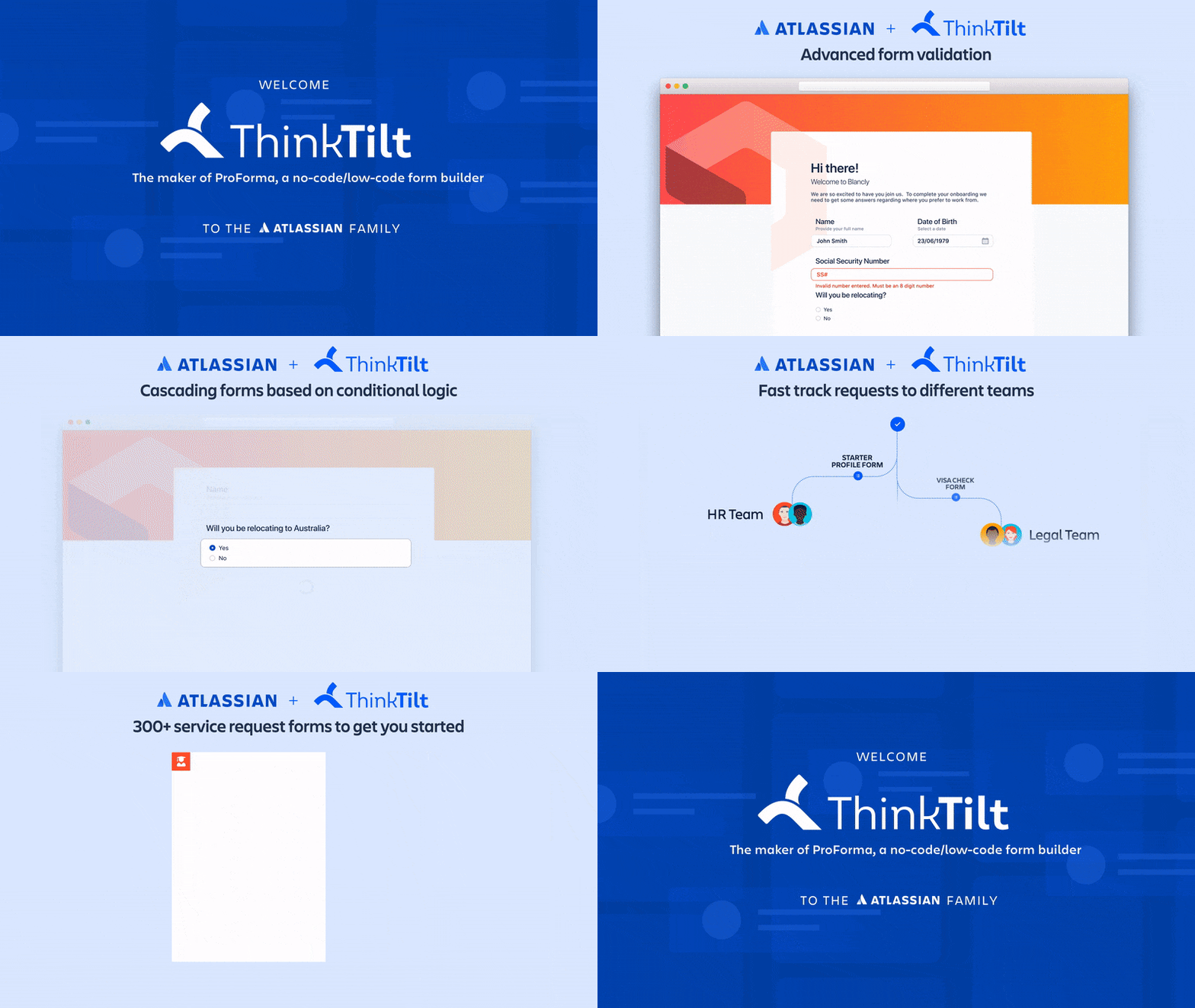
Unsurprisingly, ProForma comes with all the tools you would need to create forms (and there are a lot of them) and it is already deeply integrated with Jira and Jira Service Management. It also features over 300 templates for often used business flows like candidate approval tracking in an HR system, for example. “What we’re really providing for our customers is not just the features and saying, ‘hey, figure it out yourselves,’ but really that practice and the [ThinkTilt] team really brings with them an amazing amount of knowledge with that,” Wong said about ProForma’s set of templates.

One neat tool more companies should offer: ProForma features a fully functional demo mode that lets you try out the product before even signing up for its free trial.

Jira Service Management, of course, can already build all these workflows, too. That is, after all, what the product is all about. But with ProForma, an HR team could capture all the information they need to capture for a given workflow, with Jira Service Management becoming the backend for those operations. Or they can easily create forms based on existing workflows, too, and enhance the user experience that way.

Over the course of the last five years, Atlassian regularly acquired a company or two per year. Currently, though, it feels like this pace is picking up a bit. Indeed, the acquisition of ThinkTilt marks the company’s fourth acquisition in the last twelve months. In February, it acquired visualization and analytics company Chartio, while in 2020, it acquired helpdesk tool Halp and the asset management company Mindville. If anything, I would expect this pace to increase in the next year as Atlassian aims to capitalize on current trends.

News: Zoom launches $100M Zoom Apps investment fund

When Zoom launched Zoom Apps and the Marketplace as a place to sell them last year, it was a big signal that the company wanted to be more than just a popular video conferencing application. It wanted to be a platform, which developers could use to build applications on top of Zoom. Today the company

When Zoom launched Zoom Apps and the Marketplace as a place to sell them last year, it was a big signal that the company wanted to be more than just a popular video conferencing application. It wanted to be a platform, which developers could use to build applications on top of Zoom.

Today the company announced a $100 million investment fund to encourage the most promising startups using the Zoom toolset to launch a business by giving them funding, while using that as a springboard to encourage other developers to take advantage of the tooling on the platform.

“We’re looking for companies with a viable product and early market traction, and a commitment to developing on and investing in the Zoom ecosystem,” Zoom’s Colin Born wrote in a blog post announcing the new program.

The company’s corporate development team with heavy involvement from the Zoom executive team will be in charge of selecting and managing the portfolio companies. The company plans to invest between $250,000 and $2.5 million in each startup in the portfolio.

“A big part of this is helping facilitate those early companies and giving them the access to resources and connections within Zoom, so that they can grow and succeed,” Zoom CTO Brendan Ittelson told me.

While the company wants to invest successfully, a big part of this is using the fund to encourage developers to take advantage of the platform offerings from Zoom. “We feel we’ll help [these startups] build these valuable and engaging experiences and by having that and by investing, we’re helping bring solutions and further expand the ecosystem and our customers should benefit from that,” he said.

Zoom has a number of developer tools that budding entrepreneurs can use to build applications that take advantage of Zoom functionality. In March the company introduced an SDK (software development kit) designed to help programmers embed Zoom functionality inside other applications.

The company also provides tools for embedding an application inside of Zoom, such as one designed for a specific purpose like education or healthcare, and it has created a centralized place to learn about all of them at developer.zoom.us.

Zoom is not alone in investing in companies building applications on its platform. Firms like Sequoia, Maven Ventures and Emergence Capital have already started investing in startups building companies on top of Zoom including Mmhmm, Docket and ClassEdu.

The fund gives startup founders one more option to get some funding to get their idea off the ground. Ittelson says all of the investments will be seed level investments for starters and they will be providing developer and business resources to help the young startups build and distribute their products.

While he says that the company will be on the lookout for promising startups to bring into the portfolio, interested entrepreneurs can apply directly at zoom.com/fund.

WordPress Image Lightbox Plugin