
Tag Archives: Blog

News: ‘Bowl food’ startup Poke House closes $24M Series B led by Eulero Capital to expand in Europe

The FoodTech industry is effectively now going into fast food. Sweetgreen in the US is a ‘fast-casual’ restaurant chain that serves healthy “bowl food”. It’s raised $478.6M. A similar firm is Sweetfin. Both employ a lot of tech in their back-end to improve efficiencies. Into this area has come European startup Poke House, which is

The FoodTech industry is effectively now going into fast food. Sweetgreen in the US is a ‘fast-casual’ restaurant chain that serves healthy “bowl food”. It’s raised $478.6M. A similar firm is Sweetfin. Both employ a lot of tech in their back-end to improve efficiencies.

Into this area has come European startup Poke House, which is effectively industrializing the production of “poke bowls” for food delivery platforms. Poke House specializes in bowl food that often includes marinated fish that’s cubed and layered up with sticky rice, pickles, noodles, etc.

The company has now raised €20 million ($24m) in a Series B funding round led by Eulero Capital, with the backing of FG2 Capital and reinvestment from Milan Investment Partners SGR. It using tech and data to optimize the production and delivery of its product via all the major food delivery platforms such as Uber East etc. The Italy-born food tech startup claims to have built a “€100M+ company” inside two years.

Founded by Matteo Pichi and Vittoria Zanetti, Poke House has opened 30+ stores in Italy, Portugal and Spain, and now has 400 employees. It’s claiming an expected turnover of €40M+ in 2021.

With the funding, the startup will start opening new stores in existing markets, enter France and start in expansion in the UK.

Poke House says it uses a lot of tech on its back-end, tracking every element of the supply chain to optimize the business. It also analyzes data from third-party delivery platforms (ie. Deliveroo, Glovo, UberEats) to deliver a sub-10 mins food preparation time, and a delivery time under 25 mins.

Matteo Pichi, Co-Founder of Poke House said: “The pandemic has challenged our food sector, and we see technology as the way forward to innovate and digitalize the traditional restaurant experience. We are seeing a shift in people’s desires in fast but healthy food. Poke bowls fit this new need and it promotes a more balanced, active and sustainable lifestyle with quick and healthy food options available nearby.”

Speaking to TechCrunch, Pichi added: “Our competitors are the fast-growing healthy concepts such as Sweetgreen or Sweetfin in the US. But in the same time, we think we are lucky because we really are one of the first brands built 100% from food delivery experts or former employees. Our next competitors are gonna be full native virtual brands extremely strong in data analysis and digital brand building. We use food delivery platforms as media platforms and we invest heavier than competitors in the channel.”

Gianfranco Burei, Founding Partner of Eulero Capital said: “Poke House business model rides some of the main trends in the food sector (food-tech, healthy food, delivery, customization) and has all the characteristics and talents to position the company among the top players at European level. We are thrilled to be a partner of Poke House in an innovative and forward-looking project, in line with our investment strategy which is based on the search for companies included in the macro-trends that will characterize the economic, technological and social evolution of the coming years.”

News: UK drone startup sees.ai gets go ahead to trial beyond-visual-line-of-sight (BVLOS) flights

The UK’s Civil Aviation Authority (CAA) has given the go ahead to local startup sees.ai, which is developing a beyond-visual-line-of-sight (BVLOS) command & control solution to aid data capture for industrial use-cases, to trial a concept for routine BVLOS operations — the first such authorization for a U.K. company, the regulator said today. The test

The UK’s Civil Aviation Authority (CAA) has given the go ahead to local startup sees.ai, which is developing a beyond-visual-line-of-sight (BVLOS) command & control solution to aid data capture for industrial use-cases, to trial a concept for routine BVLOS operations — the first such authorization for a U.K. company, the regulator said today.

The test is taking place under a sandbox program announced back in May 2019 — directing government funding and regulatory support to R&D in the drone space — initially through virtual testing, such as of avoid and detect systems.

Sees.ai, an early participant in the sandbox, has now secured authorization to trial a concept for routine BVLOS operations at three (physical) sites without needing to pre-authorise each flight.

The Techstars-backed startup is focused on drone operations in industrial settings — building tech to scale the use of drones for inspection and maintenance purposes in industries, such as the oil & gas sector, by enabling pilots to remote-control craft from a central location, rather than needing to be on site for each flight.

But it’s clear BVLOS capabilities will be essential for other uses of drone tech — such as delivery — hence the CAA calling the trial “a significant step forward for the drone industry”.

“By testing the concept in industrial environments for inspection, monitoring and maintenance purposes, sees.ai aims to prove the safety of its system within this context initially, before extending it to address increasingly challenging missions over time,” it added.

Under current U.K. rules, drone operators must keep their aircraft within line of sight and follow the country’s drone code — unless they have specific permissions to do otherwise.

One company that previously gained such permission was U.S. tech giant Amazon — which started testing BVLOS delivery drones in the UK back in 2016 — and continues to work on bringing a commercial drone delivery service to market, under its Prime Air brand.

Amazon’s effort has already been years in the making (it’s been running experiments since 2013) — and last year the FT, citing a Prime Air source, reported that it still remains “years” out from realizing the goal of drone deliveries at scale. So while (another) U.K. trial of BVLOS drone tech is being lauded as a significant development for the industry by the regulator, any Brits expecting drone deliveries in the wild anytime soon are likely to be disappointed.

The CAA authorization for the sees.ai trial will enable the BVLOS test flights to operate under 150ft — initially requiring an observer to remain in visual line of sight with the aircraft and be able to communicate with the remote pilot if necessary, per the regulator.

So, technically then, the trials will begin as extended-line-of-sight (EVLOS), which still entail limits vs true BVLOS — enabling drone flights to operate further than 500m from the remote pilot (by deploying flight observers) but not removing on-site observers entirely, as is the ultimate industry goal. Update: The CAA confirmed the intention is to remove the observer once/if the trials prove the concept works. It also said the trial differs from traditional EVLOS flying because the spotter does not need to be in constant contact with the pilot — they only need the ability to contact the pilot if required.

In a regulatory roadmap published last fall the CAA wrote that many steps are required to arrive at the sought-for situation of BVLOS being ‘business as usual’ in non-segregated airspace — so there still looks to be a long road ahead before commercial drones will be able to legally whiz around gathering data (or delivering stuff) far from any humans in the loop.

“The long-term aspiration of operators is for BVLOS operations to be a routine part of business across the UK. This vision requires a significant volume of evidence, experience and learning by everyone involved. There will inevitably be a need for innovators and the CAA to build, test, learn and repeat in small steps to work towards the vision,” the CAA roadmap notes.

Commenting on sees.ai’s trial authorization in a statement, CEO John McKenna dubbed it a “significant milestone”, adding: “We are accelerating towards a future where drones fly autonomously at scale — high up alongside manned aviation and low down inside our industrial sites, suburbs and cities. Securing this UK-first permission is a major step on this journey which will deliver big benefits to society across public health & safety, efficiency and environmental impact.”


News: Venmo adds support for buying, holding and selling cryptocurrencies

Venmo is adding support for cryptocurrency, starting today. The company says it will begin to roll out the ability for Venmo’s more than 70 million users to buy, hold and sell cryptocurrencies directly in the app, similar to the support Venmo parent company PayPal added late last year. Initially, Venmo will support four types of

Venmo is adding support for cryptocurrency, starting today. The company says it will begin to roll out the ability for Venmo’s more than 70 million users to buy, hold and sell cryptocurrencies directly in the app, similar to the support Venmo parent company PayPal added late last year. Initially, Venmo will support four types of cryptocurrency: Bitcoin, Ethereum, Litecoin and Bitcoin Cash — the same that PayPal offers its U.S. users.

The company had already announced its plans to introduce cryptocurrency on Venmo in 2021. Both Venmo and PayPal support for crypto come by way of a partnership with Paxos Trust Company, a regulated provider of cryptocurrency products and services. 

Though there isn’t much differentiation between what both PayPal and Venmo offers users today, the company explains that the move is more about getting cryptocurrencies in front of a separate, and arguably younger, audience.

Image Credits: Venmo

“While there is some overlap between the bases, there are also a lot of customers who are discretely either PayPal or Venmo users,” explains Darrell Esch, Venmo general manager and SVP. “So this ultimately gives us a new group of customers who aren’t using PayPal day in and day out the ability to access [crypto] through Venmo.”

He says that Venmo skews younger, with more of its users in their 20s and 30s, compared with the overall U.S. population. They also have other traits that might make them receptive to investing in cryptocurrencies. For example, they’re more likely than the overall U.S. population to have a college degree, they’re solidly middle-income earners and they skew toward digital natives.

The user base has also already begun purchasing crypto, Venmo notes. More than 30% had purchased crypto or equities, according to a 2020 Venmo customer study. This picked up during the pandemic, as well.

At launch, Venmo will leverage its in-app social feed to spread the word about cryptocurrencies. Users can share their crypto transactions to the feed, if they choose. This will raise awareness and engagement with the idea of crypto, as will Venmo’s new educational features. The company says it plans to publish access guides and videos inside the app that will help to answer some of the common questions about cryptocurrencies for those who are just getting started. (See below video, for example.)

Meanwhile, although PayPal announced its U.S. customers could shop with cryptocurrencies via its supported merchant base, Venmo doesn’t immediately have a similar option. However, the company as of February rolled out to its user base a feature called Business Profiles, which enables Venmo users to transact with small sellers and merchants on its app. It’s not difficult to imagine the role that crypto could play here, as well, in the future. Venmo also offers other products, including a debit and credit card, which could also be leveraged in the future to take advantage of a crypto integration, perhaps.

But in the meantime, the only way to use crypto on Venmo is by buying, selling and holding. The company says users can start with as little as a dollar and pay via their linked bank account or debit card. Of note, the Venmo wallet doesn’t connect with that of parent company PayPal, though we understand the exchange rates will be the same.

Support for crypto on Venmo is starting to roll out today and will reach all customers within the next few weeks, Venmo says.

News: Tesla mulls cars tailored to China amid mounting criticisms

Tesla is working on vehicles tailored to Chinese consumers as complaints about the quality of its electric vehicles send shock waves through the internet in the country. The American EV giant is mulling new products that will be designed from the ground up for China, Grace Tao, a vice president at Tesla, told 21st Century

Tesla is working on vehicles tailored to Chinese consumers as complaints about the quality of its electric vehicles send shock waves through the internet in the country.

The American EV giant is mulling new products that will be designed from the ground up for China, Grace Tao, a vice president at Tesla, told 21st Century Business Herald, a Chinese business news outlet, during the Shanghai auto show this week. The vehicles developed in China will also be sold globally, she added.

At the same auto event on Monday, a woman showed up at Tesla’s booth, climbing atop a Tesla car and shouting allegations of faulty brakes made by the company. The person was later detained for damaging the vehicle, and Tesla said on microblogging platform Weibo that her car had crashed due to exceeding the speed limit, not quality issues.

Nonetheless, the protestor won widespread sympathy when videos of her spread online. Many users joined in to vent about their Tesla problems. Posts with the hashtag “Tesla stand turned into a stage for defending rights” garnered over 220 million views on Weibo within two days.

“We have since the start been willing to work with national and authoritative third-party organizations to thoroughly inspect the issues raised by the public. By doing this, we wish to win assurance and understanding from consumers,” Tesla China said in a statement posted on Weibo in response to the incident.

“But we still haven’t fulfilled this wish, mainly because our ways of communicating with customers may be problematic. Secondly, we indeed can’t decide for our customers how they want to resolve these issues.”

Like in the West, Tesla has fostered a cult-like following in China. And along with Apple, it’s one of the few American tech giants that have gained a firm foothold in China. Last year, Tesla shipped nearly 500,000 vehicles globally and China contributed 20% to its revenues.

But the company also faces mounting competition from Chinese homegrown challengers. Xpeng, Nio, and Li Auto, the well-funded startups, as well as old-school carmakers, with help from high-tech firms like Huawei, are ready to take a slice of Tesla’s market. The designed-in-China vehicles are already finding a spot among the more patriotic crowds.

It doesn’t help that the Chinese government is placing more scrutiny over Tesla. In January, the firm was summoned by local regulators over quality concerns, shortly after it recalled several tens of thousands of vehicles in the country. The government restricted the use of Tesla by military facilities over national security concerns, The Wall Street Journal reported in March. Elon Musk later said his company would be shut down if its cars were used to spy.

News: FintechOS nabs $61.5M for a low-code approach to modernizing legacy banking and insurance services

“Challenger” startups in banking and insurance have upended their industries, and picked up significant business, by building more customer-friendly tools and services — more personalized, easier to access, and usually competitively priced — than those typically provided their bigger, incumbent rivals. Now, a startup out of Romania that is building tools to help the incumbents

“Challenger” startups in banking and insurance have upended their industries, and picked up significant business, by building more customer-friendly tools and services — more personalized, easier to access, and usually competitively priced — than those typically provided their bigger, incumbent rivals. Now, a startup out of Romania that is building tools to help the incumbents respond with better services of their own is announcing a significant round of funding as its business grows.

FintechOS, which has built a low-code platform aimed at larger (older) banking and insurance companies to help them build new services and analytics on top of and around their existing infrastructure, has raised €51 million ($61.5 million at today’s rates) in a Series B round of funding.

FintechOS’s opportunity has been to target wave of incumbents in the insurance and banking industries that have been slowly watching as newer players like Lemonade (in insurance) and a huge plethora of challenger banks (Revolut, N26, Monzo and many others) are swooping in and picking up customers, especially among younger demographics, while they have been unable to respond mostly because their infrastructure is too old and big. Turning a huge ship around, as we have seen, is no small task — a situation that has become only more apparent in the last year of pandemic living and the big shift to digital interactions that resulted from it.

“When we launched FintechOS in 2017, we could already see existing solutions to digital transformation would struggle to deliver tangible results. By contrast, our unique approach has quickly inspired a sea-change in how financial institutions address digitization and engage with their customers,” said Teodor Blidarus, co-founder and CEO at FintechOS, in a statement. “Events over the last year have only increased pressure on our industry to evolve and as a result we’re seeing growing demand for our powerful platforms. Our latest round of funding will help us grow at the pace needed to improve outcomes for financial institutions and their customers globally.”

The Series B round of funding is being led by Draper-Esprit, with Early Bird, Gapminder Ventures, Launchub, and OTB Ventures (which all participated in its Series A in December 2019) also participating. There are other backers in the round that are not being disclosed at this time, the startup added. FintechOS is also not disclosing its valuation. The company, based out of Bucharest, has raised just under $80 million to date.

FintechOS is active today in the UK and Europe — where it has been growing at a CAGR of 200% and says its services touch “millions” of people, with some of its key customers including the likes of banking giants Societe Generale and IdeaBank and international insurance brokers Howden. The plan will be to continue investing in those markets, as well as expanding internationally.

And it will be adding in more services. Today, the banking platform is designed to help banks launch more retail services for consumers and small and medium business customers, and for insurance companies to build new health, life and general insurance products (there are a lot of synergies in how insurance and financial services companies have been built over the years, and so it’s a natural couplet when it comes to building tools for those industries).

In the financial sector, FintechOS lets banks build in new digital onboarding flows, credit cards and loan products, savings and mortgage products. Insurance products include new approaches to generating and handling quotes, customer onboarding and management and claims automation — which may well bring FintechOS into closer contact and collaboration with the most successful startup to come out of its home country to date, the RPA juggernaut UiPath. In all cases, it helps stitch together data from a bank’s own systems with more modern tooling, and to link that up with yet more modern tools to help process that data more easily.

This is “low code” but it typically means that the company needs to work with third parties to enable all of this. Partners include the likes of integrators and other global services technicians, such as Microsoft, Deloitte, CapGemini, KPMG, and so on. (And the founders of the startup themselves come from consulting backgrounds so they well understand the role these companies play in the process of bringing technology into big businesses.)

FintechOS is tapping into a couple of very big trends that have arguably been the biggest in the financial and related insurance industries.

The first of these is the fact that core services around things like credit/loans, current deposits and savings are not just very complex to build but actually have largely become commoditized — similar to digital payments — and so packaging them up and turning them into services that can be integrated by way of an API makes them more easily accessed without the heavy lifting needed to build them from scratch. This lets companies focus instead on customer service or building more interesting tools around those basic services to customise them (for example AI based personalization). Disintermediating basic functions from the services built around them is arguably a bigger trend but it has been especially prevalent in enterprise, which has long been a slow-moving space when it comes to innovation in the back-end, and the front-end.

The second of these is the big swing towards using no-code and low-code tools to empower more people within organizations to get stuck in when they can see something not working as efficiently as it could, and building the workflows themselves to improve that. This also applies to trying out and testing new products — again something that typically has not been done in financial and insurance services but can now be possible with low-code and no-code tools.

“Not only is our technology helping financial institutions become customer centric, but it’s also helping them provide products and services to more people and businesses,” said Sergiu Negut, the other co-founder who is FintechOS’s CFO and COO, said in a separate statement. “With so many markets still underserved, the ability to tailor offerings to a segment of one offers the opportunity to increase financial inclusion and adheres to our ideal that easy access to financial services is essential. We’re delighted to be working with investors who share our views on how fintech should be transforming the financial services industry.”

Notably, Draper Esprit also has backed Thought Machine, another big player in the world of fintech that is taking some of the learnings and models that have helped new entrants disrupt incumbents, and is packaging them up as services for incumbents, too. It takes a different approach to doing this, not using low-code but smart contracts, which could be one reason why the VC doesn’t see the investments as conflict of interest. They are also tackling an enormous market, and so at least for now there is room for them, and many others in the space, such as Temenos, Mambu, Rapyd and many others.

“When we met Teo and Sergiu, we were immediately convinced of their vision: a data led, end-to-end platform, facilitated with a low-code/no-code infrastructure,” Vinoth Jayakumar, partner at Draper Esprit, said in a statement. “Incumbent financial services firms have cost-to-income ratios up to 90%, so we see a huge and increasing need for infrastructure software that allows digitisation at speed, ease and lower cost. Draper Esprit builds enduring partnerships; with the team at FintechOS we hope to build an enduring fintech company that will dramatically change financial services experiences for people all over the world.”


News: ‘Pure’ nutritional supplements startup Feel closes $6.2M investment, led by Fuel Ventures

Earlier this year we covered the launch of Heights, a new supplements startup in an increasingly hot category. Feel, is a year-old UK startup with another twist on this world: pure nutritional supplements. It’s now closed a $6.2 million investment, led by Fuel Ventures, with participation from TMT Investments, Sova VC, Richard Longhurst (founder of

Earlier this year we covered the launch of Heights, a new supplements startup in an increasingly hot category. Feel, is a year-old UK startup with another twist on this world: pure nutritional supplements. It’s now closed a $6.2 million investment, led by Fuel Ventures, with participation from TMT Investments, Sova VC, Richard Longhurst (founder of LoveHoney.com) and Igor Ryabenkiy (founder and GP of Altair Capital).

Feel founder Boris Hodakel says he spun his startup up after looking at the UK’s big health and retail brands including Graze, Tesco, Bulk Powders and Simba Sleep.

In many ways Feel is very akin to Graze. The supplements arrive in a post-box-friendly box and is available in a range of subscription packages. This is basically ‘Graze nuts, but for supplements.’

Feel has a direct-to-consumer subscription model, and is claiming a 60x growth in its first year and 21,000 active subscriptions.

Hodakel’s contention is that while Feel provides higher grade supplements to consumers which cost more to produce, it manages to keep costs down for consumers via direct-to-consumer model.

Hodakel, founder and CEO of Feel said: “Not all vitamins are created equal and the majority you find on retail shelves have a dirty formula that is difficult to absorb by the body, missing natural elements. We’re the cleanest alternative in the market – backed up by science –  and continually invest in making our formulas as effective as possible while still affordable.”

He says he started Feel because, having a skin problem, supplements were part of his health routine, but “the aha moment” happened he realized how many fillers were in normal supplements. “All our formulas are researched and formulated in-house, and we keep updating them, like our flagship multivitamin in just two years is already in its 3rd version,” he said.

Mark Pearson, managing partner at Fuel Ventures added: “The growth and the expansion of Feel’s product line present a really exciting time for Feel and we are supporting them in becoming a significant disruptor to the health supplement market.” 

Alexander Chikunov, Partner at Sova VC added, “Feel is in the process of disrupting consumer habits around vitamin intake, and changing a marketplace worth $144bn by providing its customers with top-quality products, combined with flawless and friendly service.”

News: Cusp Capital launches with a $361M fund for early stage startups in Germany and Europe

In the past ten years, an investment team led by Christian Winter, Jan Sessenhausen, Helmut Klawitter and Wilken Engelbracht worked principally with German family offices, investing in startups such as Klarna, Zalando and Delivery Hero that went on to be worth around €80 billion in total. Today they are launching a VC firm of their own, Cusp Capital, with €300 million ($361m)

In the past ten years, an investment team led by Christian Winter, Jan Sessenhausen, Helmut Klawitter and Wilken Engelbracht worked principally with German family offices, investing in startups such as Klarna, Zalando and Delivery Hero that went on to be worth around €80 billion in total. Today they are launching a VC firm of their own, Cusp Capital, with €300 million ($361m) under their belt. 

Cusp Capital will back early-stage young tech companies across Europe. Its LPs include institutional investors such as the European Investment Fund, KfW Capital, RAG Stiftung, and NRW.BANK, alongside family offices and entrepreneurs.

In a statement Christian Winter, general partner, said: “Cusp Capital is built on and incorporates our experience as investors over the past decade. We have worked in various operational roles and accompanied more than 50 early-stage companies to successful exits and IPOs.”

Prior to forming Cusp, the team of partners had worked largely with the Haub Family office and the Tengelmann Group.

Over a call, he told me the firm is planning lead deals in Seed and Series A rounds, and co-lead in growth rounds. They plan to do 25-30 investments with this fund or a 6-7 a year period.

Cusp’s Initial investments will range from mid-to-high single-digit million Euros and it says it has already signed the first term sheets for investments.

Jan Sessenhausen, General Partner of Cusp Capital says: “We dedicate a lot of time to developing investment hypotheses with global relevance. We use these hypotheses to identify promising companies, and actively approach entrepreneurs with our expertise. Having our own perspective early on allows us to see eye-to-eye with founders and have the deep discussions needed to help them realize their full potential.”

One of those hypotheses is around focused sustainability. The firm says this will be a core theme for its investing, going forward. In addition, widening access to financing for lower-income consumers will also be a feature of its investing thesis.

Cusp Capital is headquartered in Essen, with a second office in Berlin.

News: Qapita, a developer of equity management software for startups, raises $5M led by MassMutual

Qapita, a Singapore-based fintech that provides capitalization table and employee stock ownership plans (ESOP) management software, has raised $5 million in pre-Series A funding. The round was led by MassMutual Ventures, with participation from Endiya Partners and angel investors including Avaana Capital founder Anjali Bansal and Udaan co-founder Sujeet Kumar. Vulcan Capital and East Ventures,

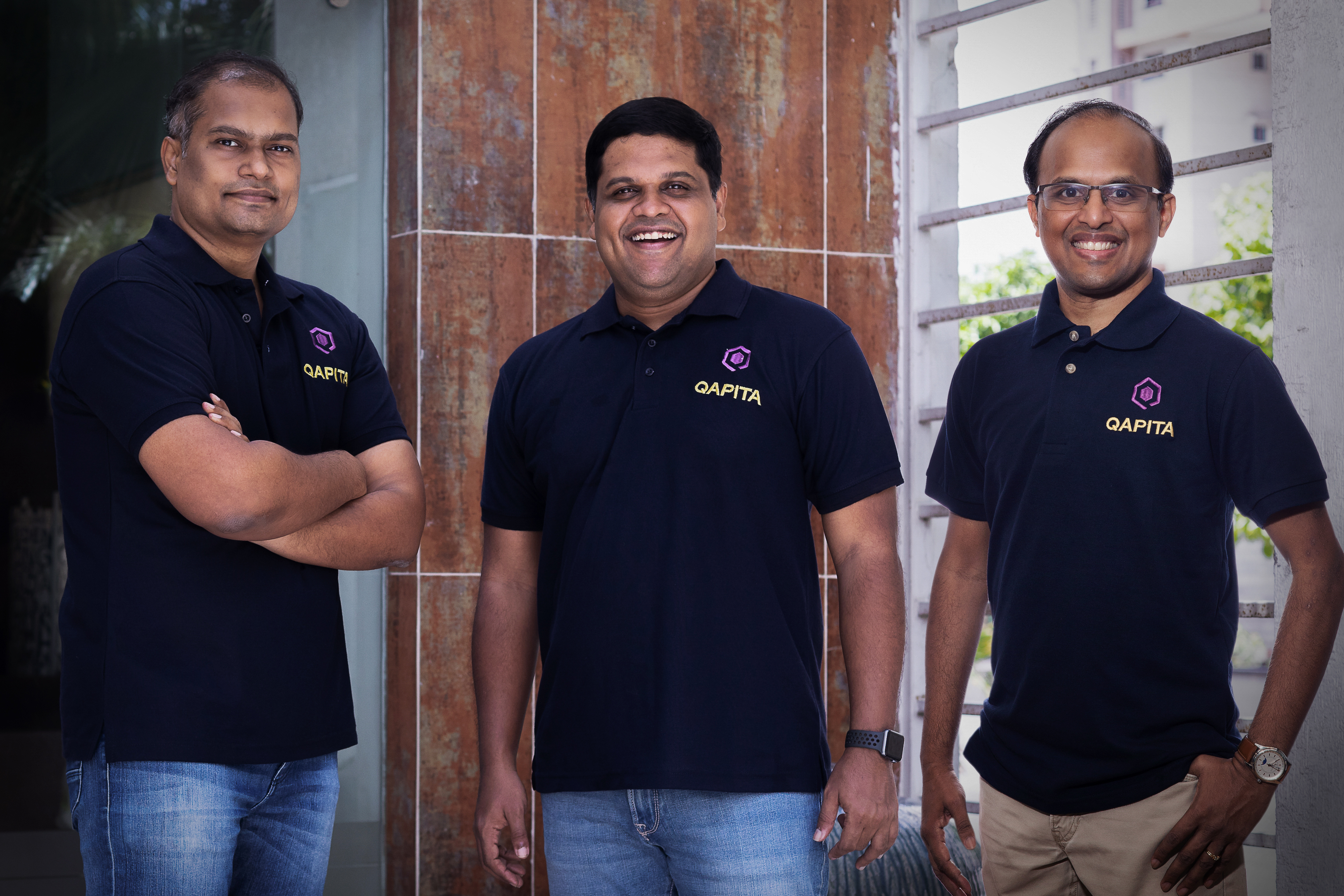
A group photo of Qapita's co-founders. From left to right: Vamsee Mohan, Ravi Ravulaparthi and Lakshman Gupta


Qapita’s co-founders. Fom left to right: Vamsee Mohan, Ravi Ravulaparthi and Lakshman Gupta

Qapita, a Singapore-based fintech that provides capitalization table and employee stock ownership plans (ESOP) management software, has raised $5 million in pre-Series A funding. The round was led by MassMutual Ventures, with participation from Endiya Partners and angel investors including Avaana Capital founder Anjali Bansal and Udaan co-founder Sujeet Kumar.

Vulcan Capital and East Ventures, who led Qapita’s seed round in September 2020, also returned for this funding, along with most of its angel investors, including Koh Boon Hwee, Atin Kukreja, Alto Partners, Mission Holdings, Northstar Group Partners and K3 Ventures. East Ventures co-founder and managing partner Willson Cuaca will join Qapita’s board.

Qapita currently serves clients in Indonesia, Singapore and India, focusing on startups. Its software platform helps private companies digitize and manage cap tables, perform due diligence and issue equity to employees. Qapita was founded in 2019 by Ravi Ravulaparthi, Lakshman Gupta and Vamsee Mohan, and has since grown its team to 30 people.

Its goal is to create more liquidity and re-investment in the Indian and Southeast Asian startup ecosystems by making it easier to issue equity. Qapita currently serves more than 100 companies, and its new funding will be used to add more features and strike partnerships with service providers like legal, accounting and company secretarial firms.

In a press statement, MassMutual Ventures Anvesh Ramineni, said, “Globally, we are witnessing trends that indicate a convergence between public and private markets. Qapita is enabling this in the region through their solution – from cap table and stakeholder management to digital share issuances and liquidity solutions. We believe the team has the right combination of experience, understanding of regional markets and product expertise to deliver on their vision.”

News: Huawei is not a carmaker. It wants to be the Bosch of China

One after another, Chinese tech giants have announced their plans for the auto space over the last few months. Some internet companies, like search engine provider Baidu, decided to recruit help from a traditional carmaker to produce cars. Xiaomi, which makes its own smartphones but has stressed for years it’s a light-asset firm making money

One after another, Chinese tech giants have announced their plans for the auto space over the last few months. Some internet companies, like search engine provider Baidu, decided to recruit help from a traditional carmaker to produce cars. Xiaomi, which makes its own smartphones but has stressed for years it’s a light-asset firm making money from software services, also jumped on the automaking bandwagon. Industry observers are now speculating who will be the next. Huawei naturally comes to their minds.

Huawei seems well-suited for building cars — at least more qualified than some of the pure internet firms — thanks to its history in manufacturing and supply chain management, brand recognition, and vast retail network. But the telecom equipment and smartphone maker repeatedly denied reports claiming it was launching a car brand. Instead, it says its role is to be a Tier 1 supplier for automakers or OEMs (original equipment manufacturers).

Huawei is not a carmaker, the company’s rotating chairman Eric Xu reiterated recently at the firm’s annual analyst conference in Shenzhen.

“Since 2012, I have personally engaged with the chairmen and CEOs of all major car OEMs in China as well as executives of German and Japanese automakers. During this process, I found that the automotive industry needs Huawei. It doesn’t need the Huawei brand, but instead, it needs our ICT [information and communication technology] expertise to help build future-oriented vehicles,” said Xu, who said the strategy has not changed since it was incepted in 2018.

There are three major roles in auto production: branded vehicle manufacturers like Audi, Honda, Tesla, and soon Apple; Tier 1 companies that supply car parts and systems directly to carmakers, including established ones like Bosch and Continental, and now Huawei; and lastly, chip suppliers including Nvidia, Intel and NXP, whose role is increasingly crucial as industry players make strides toward highly automated vehicles. Huawei also makes in-house car chips.

“Huawei wants to be the next-generation Bosch,” an executive from a Chinese robotaxi startup told TechCrunch, asking not to be named.

Huawei makes its position as a Tier 1 supplier unequivocal. So far it has secured three major customers: BAIC, Chang’an Automobile, and Guangzhou Automobile Group.

“We won’t have too many of these types of in-depth collaboration,” Xu assured.

L4 autonomy?

Arcfox, a new electric passenger car brand under state-owned carmaker BAIC, debuted its Alpha S model quipped with Huawei’s “HI” systems, short for Huawei Inside (not unlike “Powered by Intel”), during the annual Shanghai auto show on Saturday. The electric sedan, priced between 388,900 yuan and 429,900 yuan (about $60,000 and $66,000), comes with Huawei functions including an operating system driven by Huawei’s Kirin chip, a range of apps that run on HarmonyOS, automated driving, fast charging, and cloud computing.

Perhaps most eye-catching is that Alpha S has achieved Level 4 capabilities, which Huawei confirmed with TechCrunch.

That’s a bold statement, for it means that the car will not require human intervention in most scenarios, that is, drivers can take their hands off the wheels and nap.

There are some nuances to this claim, though. In a recent interview, Su Qing, general manager for autonomous driving at Huawei, said Alpha S is L4 in terms of “experience” but L2 according to “legal” responsibilities. China has only permitted a small number of companies to test autonomous vehicles without safety drivers in restricted areas and is far from letting consumer-grade driverless cars roam urban roads.

As it turned out, Huawei’s “L4” functions were shown during a demo, during which the Arcfox car traveled for 1,000 kilometers in a busy Chinese city without human intervention, though a safety driver was present in the driving seat. Automating the car is a stack of sensors, including three lidars, six millimeter-wave radars, 13 ultrasonic radars and 12 cameras, as well as Huawei’s own chipset for automated driving.

“This would be much better than Tesla,” Xu said of the car’s capabilities.

But some argue the Huawei-powered vehicle isn’t L4 by strict definition. The debate seems to be a matter of semantics.

“Our cars you see today are already L4, but I can assure you, I dare not let the driver leave the car,” Su said. “Before you achieve really big MPI [miles per intervention] numbers, don’t even mention L4. It’s all just demos.”

“It’s not L4 if you can’t remove the safety driver,” the executive from the robotaxi company argued. “A demo can be done easily, but removing the driver is very difficult.”

“This technology that Huawei claims is different from L4 autonomous driving,” said a director working for another Chinese autonomous vehicle startup. “The current challenge for L4 is not whether it can be driverless but how to be driverless at all times.”

L4 or not, Huawei is certainly willing to splurge on the future of driving. This year, the firm is on track to spend $1 billion on smart vehicle components and tech, Xu said at the analyst event.

A 5G future

Many believe 5G will play a key role in accelerating the development of driverless vehicles. Huawei, the world’s biggest telecom equipment maker, would have a lot to reap from 5G rollouts across the globe, but Xu argued the next-gen wireless technology isn’t a necessity for self-driving vehicles.

“To make autonomous driving a reality, the vehicles themselves have to be autonomous. That means a vehicle can drive autonomously without external support,” said the executive.

“Completely relying on 5G or 5.5G for autonomous driving will inevitably cause problems. What if a 5G site goes wrong? That would raise a very high bar for mobile network operators. They would have to ensure their networks cover every corner, don’t go wrong in any circumstances and have high levels of resilience. I think that’s simply an unrealistic expectation.”

Huawei may be happy enough as a Tier 1 supplier if it ends up taking over Bosch’s market. Many Chinese companies are shifting away from Western tech suppliers towards homegrown options in anticipation of future sanctions or simply to seek cheaper alternatives that are just as robust. Arcfox is just the beginning of Huawei’s car ambitions.

News: European e-scooter and micromobility startup Dott raises $85 million

Dott has raised a new $85 million Series B funding round — this round is a mix of equity and asset-backed debt financing. Belgium-based investment company Sofina is leading the investment. Dott is a micromobility startup that is better known for its colorful electric scooters that you can find across several European cities. The company

Dott has raised a new $85 million Series B funding round — this round is a mix of equity and asset-backed debt financing. Belgium-based investment company Sofina is leading the investment. Dott is a micromobility startup that is better known for its colorful electric scooters that you can find across several European cities.

The company operates a fleet of 30,000 electric scooters in five cities. Users can download a mobile app and unlock a scooter through the app. The company charges an unlocking fee as well as a per-minute price.

During its early days, Dott positioned itself as a capital-efficient, sustainable e-scooter company. It has raised a lot less money than Bird or Lime and it has taken a different approach when it comes to operations.

For instance, Dott has always had its own warehouses to charge and repair vehicles. The startup doesn’t work with third-party logistics providers. Dott has hired its own in-house team of logistics employees.

Similarly, Dott tries to repair, reuse and recycle scooters as much as possible. Thanks to swappable batteries and electric trucks, the company tries to keep its CO2 emissions as low as possible in the cities where it operates.

As a result, the company has won permits to operate in Paris and Lyon following tender processes. Overall, the company operates in a dozen cities in France, Italy, Belgium, Germany and Poland. Tier, a European competitor, has been expanding more aggressively and has raised $250 million in November 2020.

In addition to Sofina, new and existing investors include EQT Ventures, Prosus Ventures, Aberdeen Standard Investments, Estari, Expon Capital, Felix Capital, FJ Labs, Invest-NL, McRock Capital and Quadia.

With today’s funding round, the company plans to expand beyond e-scooters with a new bike-sharing service. Dott already shared images of its e-bike. It should be launching this summer.

Dott also plans to expand to other cities and countries, starting with Spain and the U.K. As you can see, Dott doesn’t want to launch a hundred cities at once. It is slowly rolling out its service in new cities. It is currently EBIT positive across all cities and Dott probably wants to keep it this way.

WordPress Image Lightbox Plugin