Tag Archives: Blog

News: All the electric vehicles that stood out at the Shanghai Auto Show

The 19th annual Shanghai Auto Show delivered a bevy of electric and tech-centric vehicles this year. Chinese, European and U.S. automakers showed off their latest offerings in every price segment, from the budget-minded ​​Wuling Hong Guang Mini via a joint venture between SAIC Motor Corp., General Motors Co. and Liuzhou Wuling Motors Co. to the

The 19th annual Shanghai Auto Show delivered a bevy of electric and tech-centric vehicles this year. Chinese, European and U.S. automakers showed off their latest offerings in every price segment, from the budget-minded ​​Wuling Hong Guang Mini via a joint venture between SAIC Motor Corp., General Motors Co. and Liuzhou Wuling Motors Co. to the luxury Mercedes EQS  — and everything in between.

Several automakers touted the capabilities of their driver assistance systems, using terminology that suggested they could be autonomous if only regulators allowed it. Let’s be clear, these systems are not autonomous. Other automakers stopped short of those claims, but did publicize the software capabilities of their vehicles — a movement that has been underway since Tesla rose in popularity.

Here’s what caught our eye at the show. Don’t miss TechCrunch’s Rita Liao’s Chinese automotive coverage that also came out of the auto show, including how Tesla is working on vehicles tailored to Chinese consumers as complaints increase about the quality of its electric vehicles.

Audi

Audi shared the spotlight with its Chinese partner companies FAW and SAIC this year. The companies showed four world premieres, including the Audi A6 e-tron concept vehicle, an updated Audi Q5L, the Audi A7L and an SUV study, which is still under wraps, named Audi concept Shanghai.

The Audi Q5L SUV will continue to be manufactured in the Changchun plant in the FAW-VW joint venture. Meanwhile, the Audi A7L limousine, which will go into production in 2021, will be manufactured by the SAIC Audi joint venture. The Audi A7L is in Shanghai and reserved for the Chinese market and includes features such as adaptive air suspension, rear-wheel steering and four-wheel drive.

A6 etron
audi a6 etron

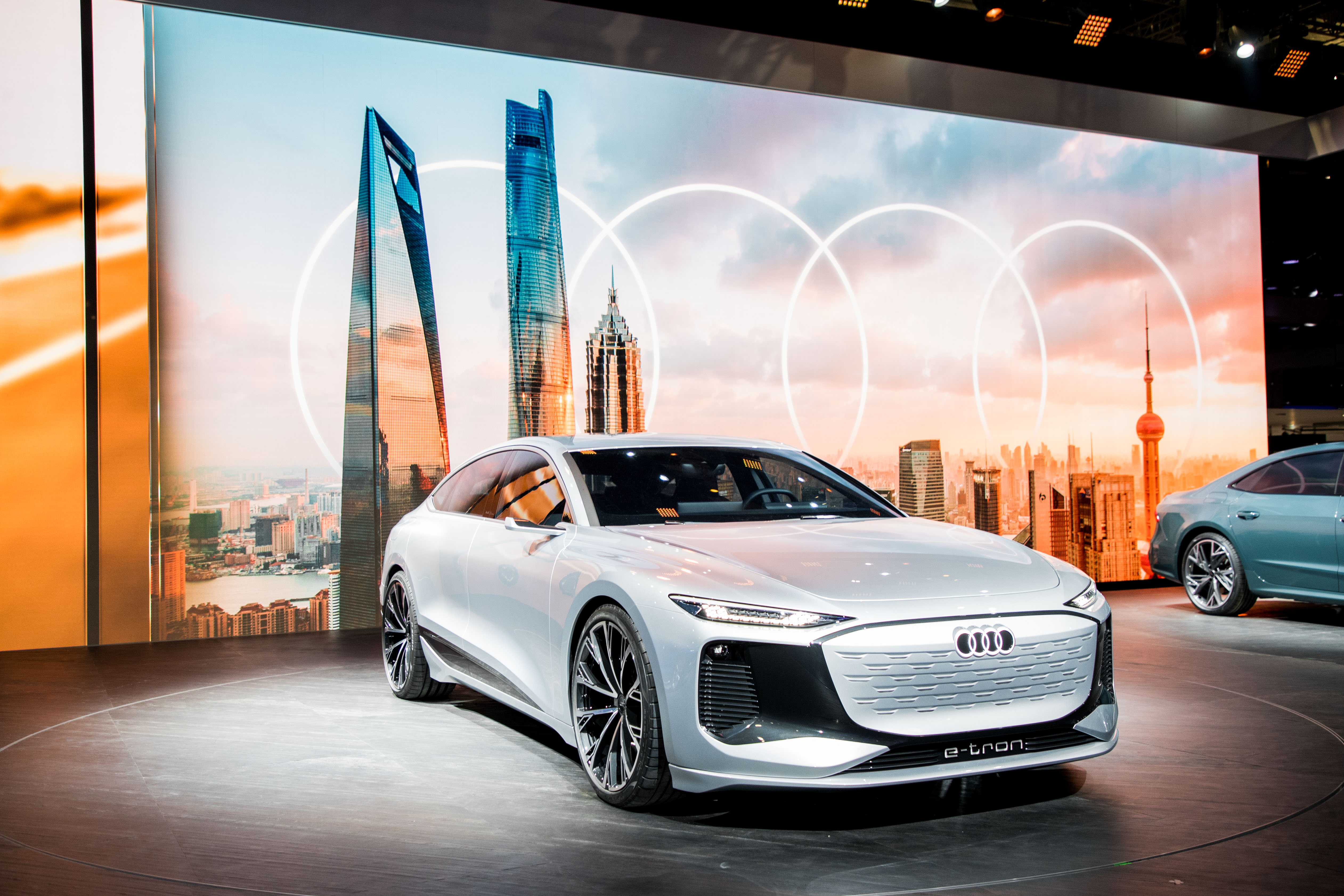
An Audi A6 e-tron on display. Image Credits: Wu Kai/VCG via Getty Images

The A6 etron concept is not the A6 with which you might be familiar. This all-electric vehicle is built off of Audi’s “Premium Platform Electric,” or PPE platform, which will be the underlying architecture for its C- and B-segment production cars beginning in late 2022.

The Audi A6 e-tron concept shares the same dimensions as the A6 and that’s about it. The A6 etron is designed as a sportback with a wide coupe roof arch and short overhangs. The large 22-inch wheels complete the look. The A6 e-tron concept is outfitted with two electric motors that can deliver a total output of 350 kW and a torque of 590 pound-feet. The vehicle has 800-volt charging architecture — the same as its Porsche Taycan cousin — with an estimated range of 434 miles based on the WLTP measurement.

BYD

Warren Buffet-backed BYD has competed for high sales with Tesla, with units sold increasing steadily on the “Han” series since its launch last year. 

BYD Han
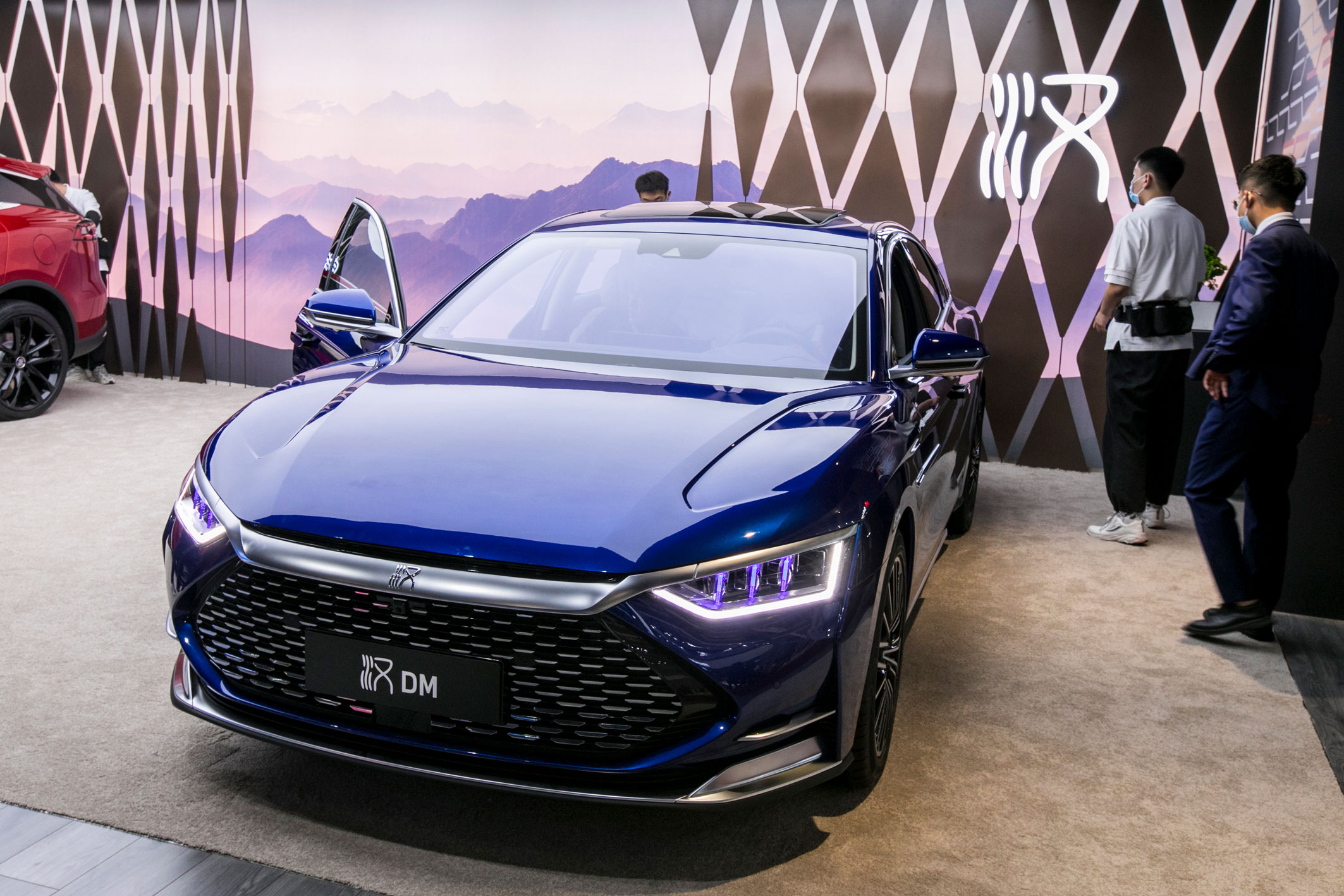
A BYD Han car is on display. Image Credits: VCG/VCG via Getty Images

BYD’s Han flagship series includes three electric vehicles and one hybrid vehicle. Named after China’s Han dynasty, the luxury electric sedan series launched sales last year. BYD’s long-range EV can go for about 375 miles, and the company claims its vehicle’s “blade” battery pack is safer than traditional battery packs.  

Geely Holdings Inc.

The Chinese automotive conglomerate took up a lot of the Shanghai Auto Show floor this year with several of its brands — including a brand new one — on display. Polestar, Volvo Cars, Lynk & Co, Geometry and the new Zeekr brand all brought EVs to the show.

Geometry Pro
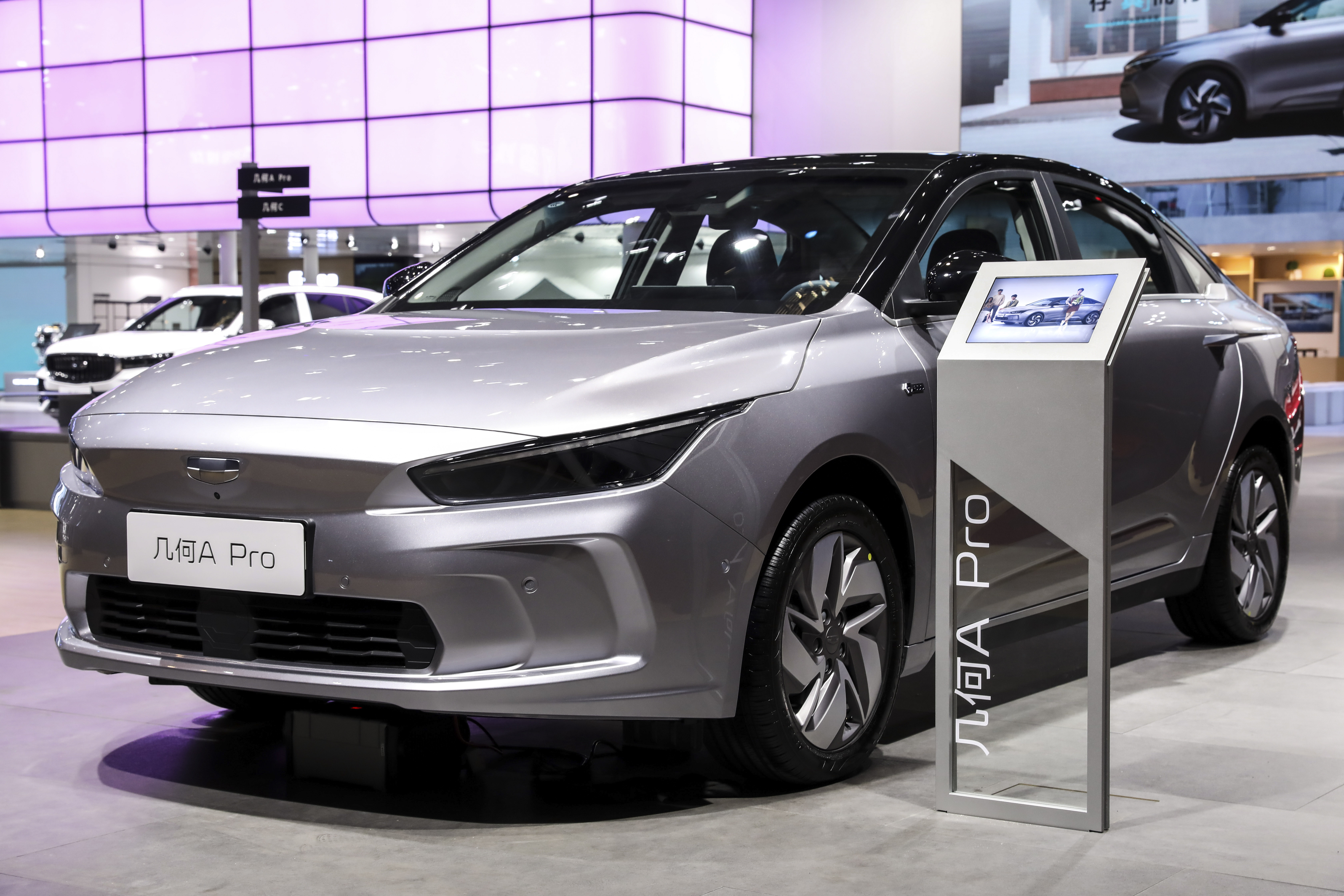
Geely Geometry ev

The 几何A-Pro revealed at the 2021 Shanghai Auto Show. Image Credits: Geometry/Geely Holdings

Geely’s mass market brand launched the new extended-range version of its Geometry A vehicle. The so-called Geometry A Pro comes with a 150kW battery and can travel 600 km (372 miles) on a single charge. The brand launched in 2019 and unveiled three models to date. The A and C models are on sale in the Chinese market. The brand has plans to export the Geometry C later this year to select global partners.

Lynk & Co. 05
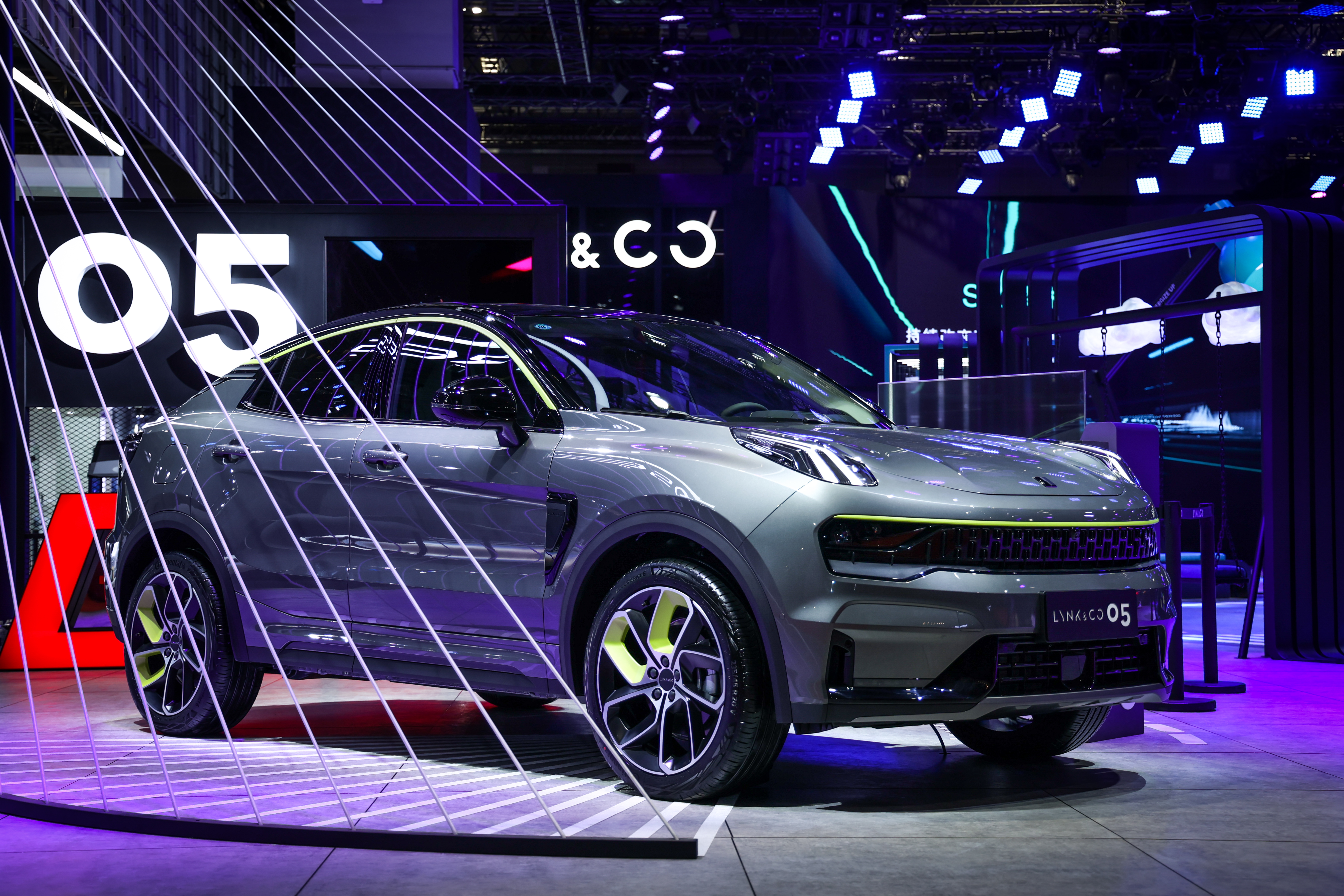
lynk-and-co-shanghai electric

Image Credits: Geely holdings/Lynk & Co.

The company unveiled their newest plug-in hybrid variant of the Lynk & Co. 05. The company also showcased the Scalable Product Architecture for the first time that will be used by a future Lynk & Co. products to be unveiled later this year with an electrified powertrain.

Polestar 1 Special Edition

polestar lineup shanghai auto show

The lineup of Polestar vehicles at the 2021 Shanghai Auto Show. Image Credits: Polestar/Geely Holdings

The EV performance brand of Volvo, which is owned by Geely, displayed the Polestar 1 hybrid electric and the all-electric Polestar 2. It was the 2021 Special Edition in matte gold that got our attention. Granted this is not an all-electric vehicle, just a hybrid, but this special version is worth noting.

This special edition has a lightweight body made from carbon fiber reinforced polymer, twin rear electric motors with genuine torque vectoring and high-performance components like Akebono brakes and adjustable Öhlins dampers. The vehicle’s powertrain produced 619 hp and 738 lb.-ft. of torque, and a purely electric driving range of 60 miles based on the WLTP standard. The vehicle also features a bespoke matte gold exterior paint job with matching calipers and black wheels

Volvo XC40 Recharge
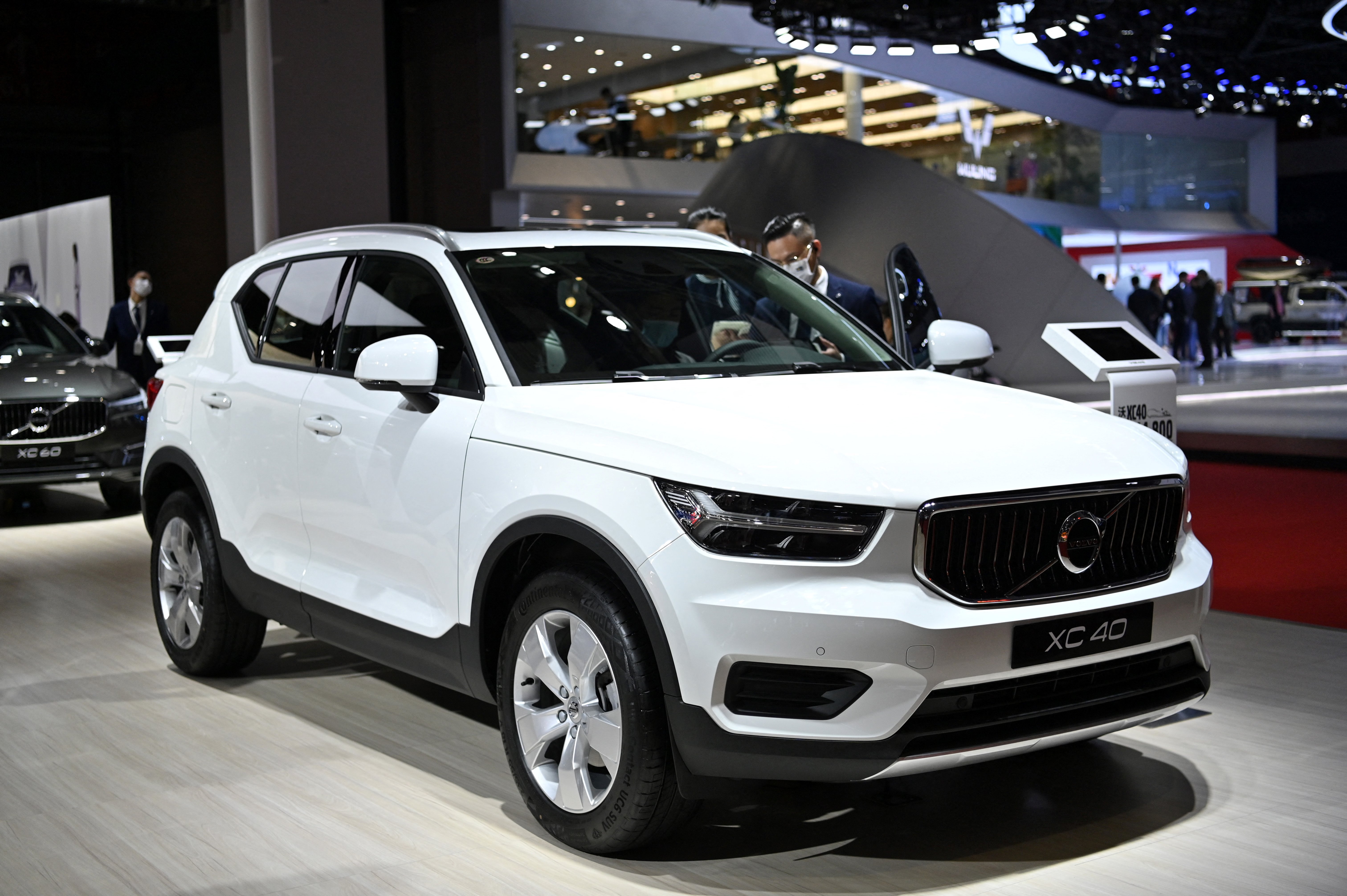
A Volvo XC40 car is seen during the Shanghai Auto Show on April 20, 2021. Image Credits: Hector RETAMAL / AFP via Getty

The Swedish brand, which plans to only sell pure battery-electric models beginning in 2030, brought its first all-electric vehicle to the show: the XC40 Recharge. The company’s next EV will be the C40, the company announced.

Zeekr 001
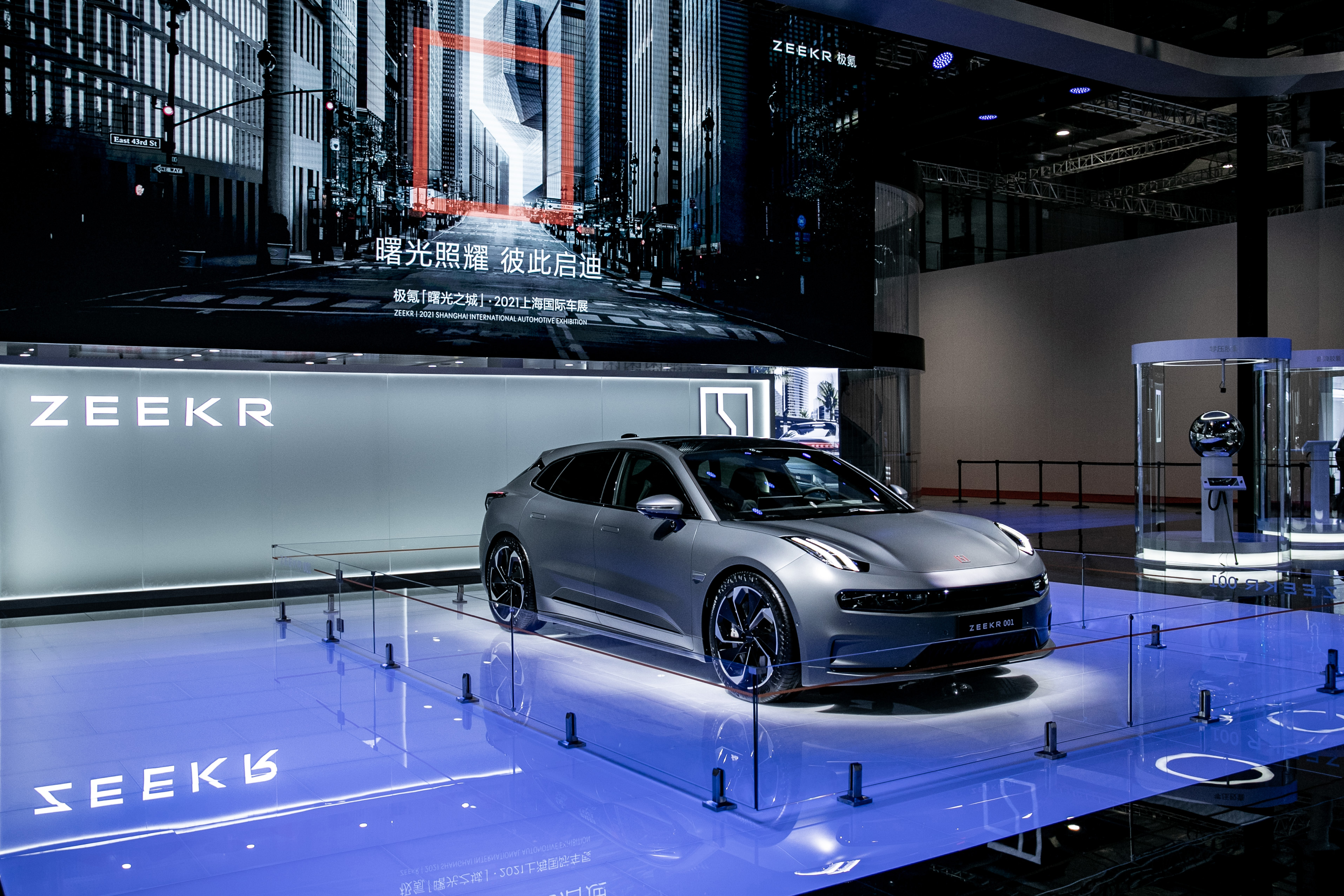
Zeekr-electric-shanghai auto

Zeekr revealed its first electric vehicle at the 2021 Shanghai Auto Show. Image Credits: Zeekr/Geely Holdings

And finally, Zeekr brought its flagship (and first) EV called the Zeekr 001. What is a Zeekr? It’s the combination of Z as in Generation Z and “geek,” and its aim is to put software at the forefront.

Zeekr said its cars will also be sold online and through experience centers across China, with plans also to eventually expand to Europe and North America. The Zeekr 001 comes with a dual motor, which sends power to all four wheels — delivering 566 lb-ft. of torque and allowing it to accelerate from 0 to 60mph in less than 4 seconds. The car has a claimed estimated range of more than 700 km (434 miles) on a single charge.

The Zeekr brand said it plans to bring five cars to market in the next five years, all of which will be based on Geely Holdings’ pure electric SEA architecture.

Mercedes

The German automaker showed off several vehicles at the Shanghai Auto Show, notably the EQB and EQS. Both of these all-electric vehicles are part of the company’s growing EQ brand.


EQB
Mercedes-Benz's new EQB Shanghai auto show2021

Mercedes-Benz’s new EQB. Image Credits: Mercedes-Benz

The German automaker revealed the compact mass-market all-electric SUV at the show. The vehicle, which looks a lot like the GLB, especially the interior, will launch in China this year. A global variant will be produced in Hungary for Europe followed, by the U.S. market launch in 2022.

While there are some obvious links to the internal combustion engine GLB, the EQB does have some differences in the exterior design, including the continuous light strip at front and rear that is consistent with other models in the electric EQ brand. The EQB also has light-alloy wheels in a bi- or tri-color design that come in up to 20 inches in size. Some even have rosé gold-colored or blue decorative trim. Mercedes has not yet revealed details on the powertrain, range or price.

EQS
Mercedes-EQS

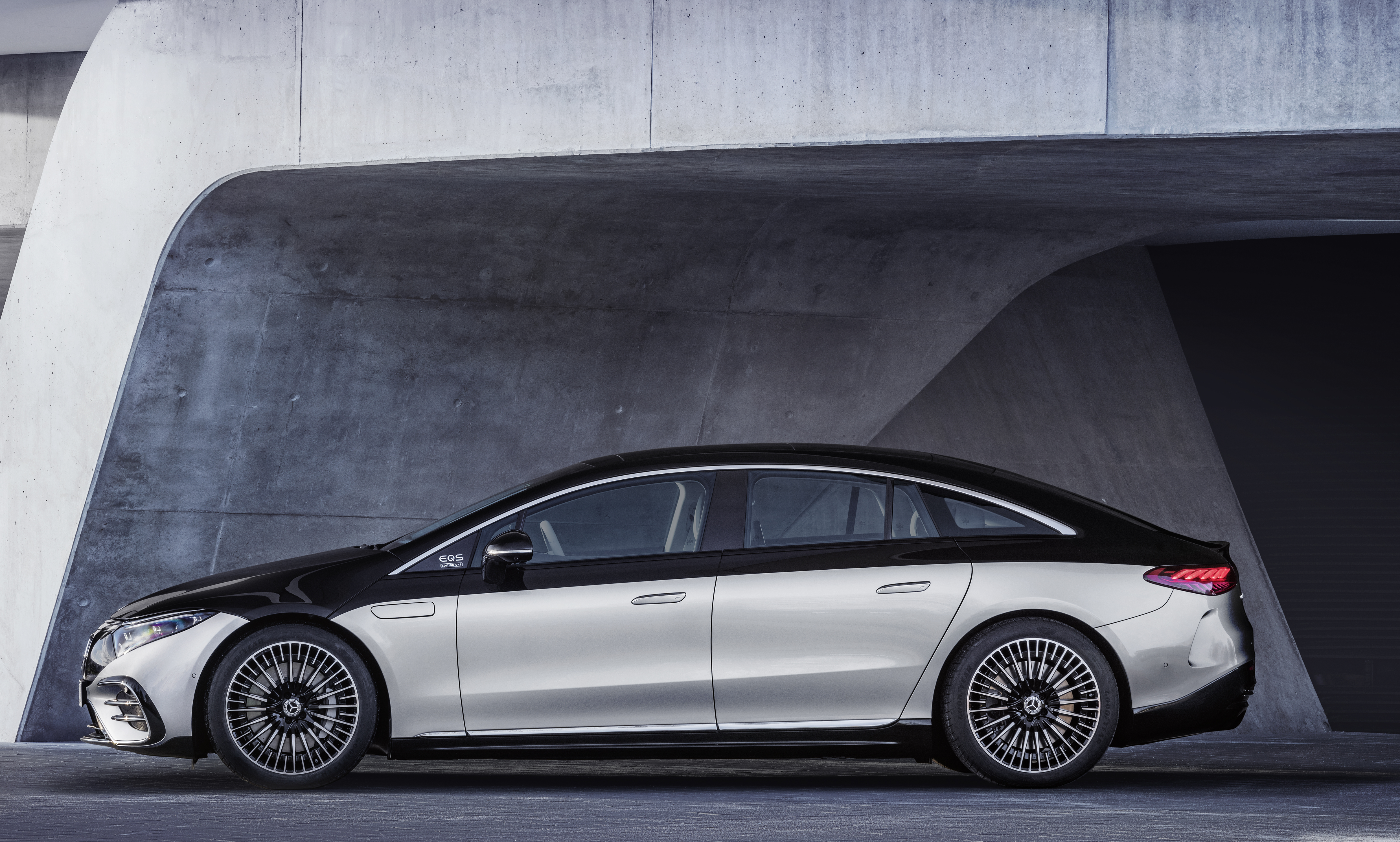
Mercedes EQS 580 4MATIC. Image Credits: Mercedes-Benz

Mercedes-Benz held its own world premiere of its EQ brand flagship ahead of the Shanghai Auto Show. The EQS is the first all-electric luxury sedan under the automaker’s new EQ brand. The first models being introduced to the U.S. market will be the EQS 450+ with 329 hp and the EQS 580 4MATIC with 516 hp. This will be an important vehicle for the Chinese market as well.

This all-electric counterpart to the S-Class is loaded with tech. For instance, there are 350 sensors in the vehicle that are used to record distances, speeds and acceleration, lighting conditions, precipitation and temperatures, the occupancy of seats as well as the driver’s blink of an eye or the passengers’ speech. TechCrunch also had a chance to take the EQS for a spin. Here’s what we thought.

NIO

Nio revealed the interior of its flagship sedan at the auto show, giving us more details on the ET7 which was initially revealed in January. It also announced it will deploy a total of 100 of its branded power swap stations as well as other infrastructure, including 500 charging stations and more than 10,000 destination chargers in eight provinces in China. 
Nio ET7 shanghai auto show

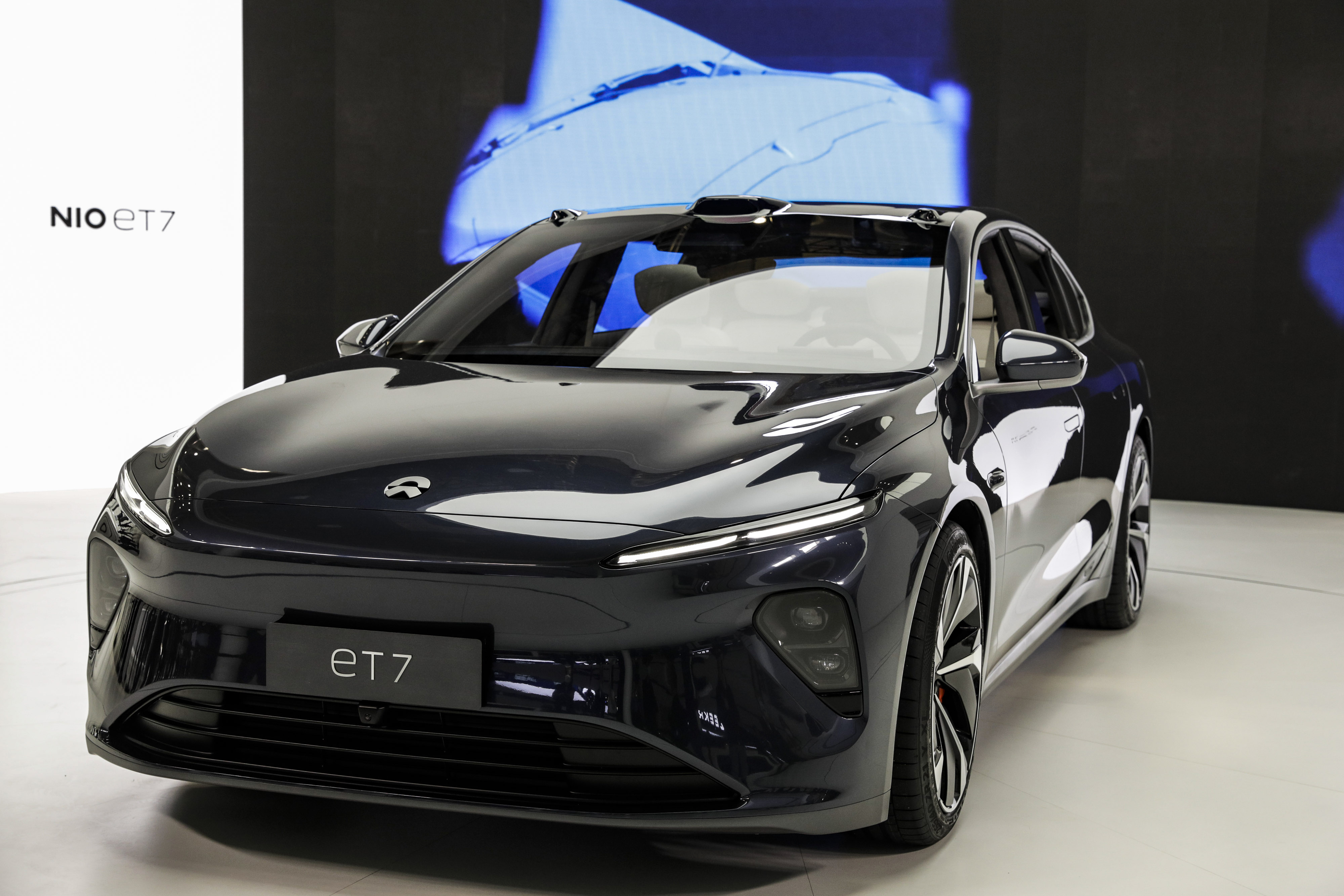
The Nio ET7 electric sedan at the 2021 Auto Shanghai on Monday, April 19, 2021. Image Credits: Qilai Shen/Bloomberg via Getty Images

Nio ET7

The ET7 is Nio’s electric flagship sedan. The company officially debuted the interior of the vehicle, which it described as a second living space. The interior comes in three earth-tone color schemes: Storm Gray, Sand Brown and Edelweiss White. The company dropped some hints about possible exterior colors, as well, such as Sunrise Beige, Luminous Orange and Arctic Green, in addition to the established Cloud White, Star Gray, Deep Black and Southern Star.

The ET7’s 150kWh battery gives the car a whopping range of 621 miles under China’s NEDC testing protocol. The NEDC testing is notorious for providing optimistic estimates and will likely be much less than that under Europe’s WLTP testing.

Nio also boasted about its so-called NIO Autonomous Driving technology, which it claims will  “gradually deliver the relaxing and safe point-to-point autonomous driving experience in scenarios like an expressway, urban, parking, and battery swap.” That phrasing suggests that this is aspirational and is still squarely under the driver assistance system category. Plus, China regulations require drivers to keep their hands on the wheel and be able to take control at any time.

Nio is expected to begin production of the ET7 in the coming months, with a launch scheduled for Q1 2022. 

SAIC-GM

SAIC-GM-Wuling Automobile Co., a joint venture between SAIC Motor Corp., General Motors and Liuzhou Wuling Motors Co. showed off their latest vehicle: the budget-friendly Hong Guang Mini EV that costs less than $5,000.

Hong Guang Mini EV
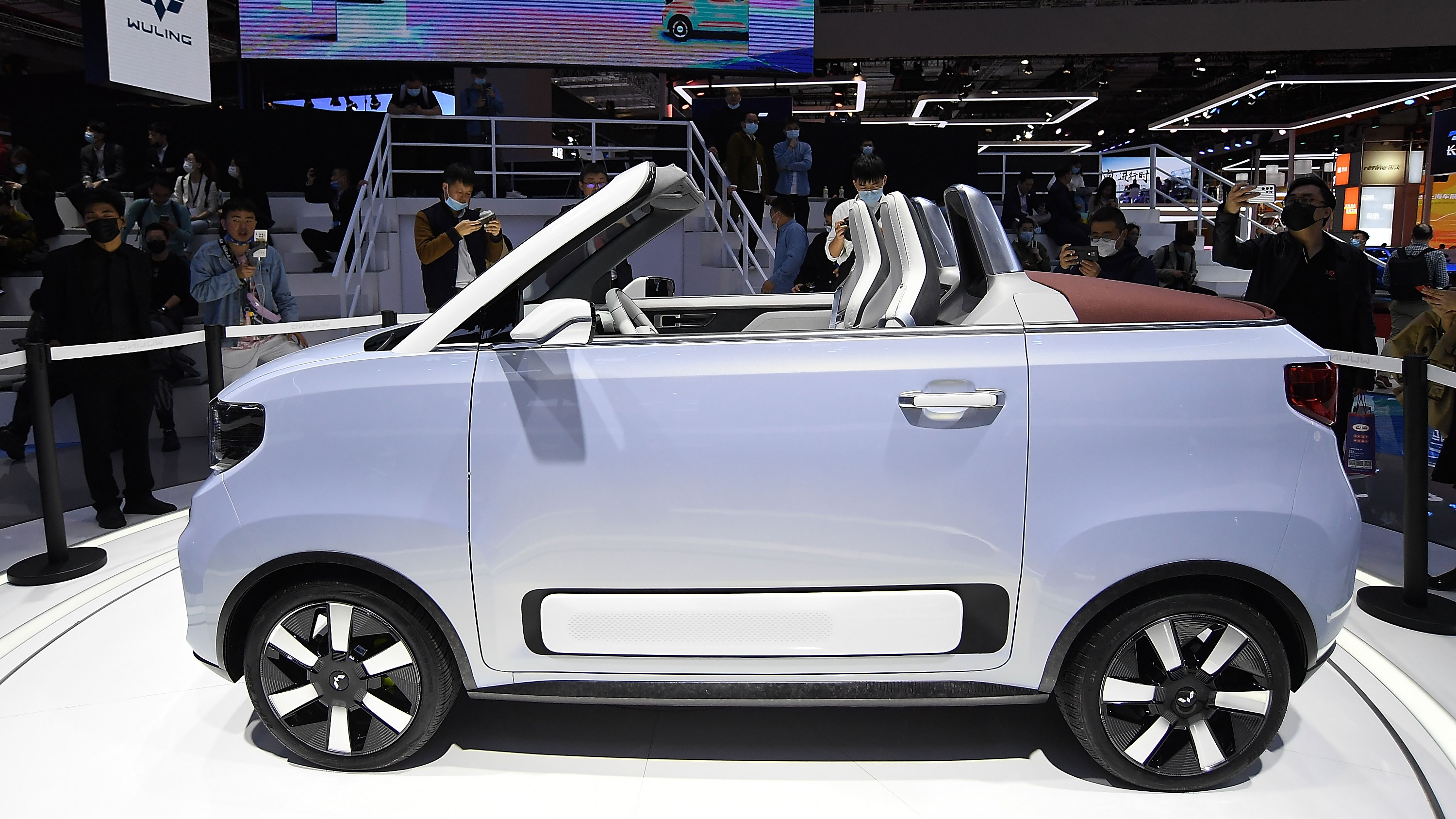
Wuling Hong Guang Mini electric vehicles, manufactured by SAIC-GM-Wuling Automobile Co. Image Credits: Zhe Ji/Getty Images

The Wuling Hong Guang Mini EV, which is also the main photo in this article, is one of the most popular EVs in China this year, with more than 57,000 units sold in February alone, and at $4,230, it’s not hard to see why. The featherweight EV is produced with max efficiency and few parts. A new car is made every minute at the Lizhou, Guangxi factory, and it only takes about four hours to make one from start to finish. The most basic models are truly made for that A to B utility. Both the interior and what’s under the hood make for a very simple, yet functional, vehicle. 

The smooth ride of this adorable mini won’t go faster than 62 miles per hour, and a cap of around 75 to 110 miles of range per charge makes it the perfect car for short trips around urban environments. Upgrading to the $5,600 model includes air conditioning and power windows, which really points to the near Spartan nature of the standard model, which comes with an HVAC ventilation system and a simple radio.

Toyota

The Japanese automakers said it will introduce 15 all-electric vehicles, including seven Toyota bZ branded models, globally by 2025. The new bZ brand debuted at the Shanghai Auto Show.

Toyota bZ46
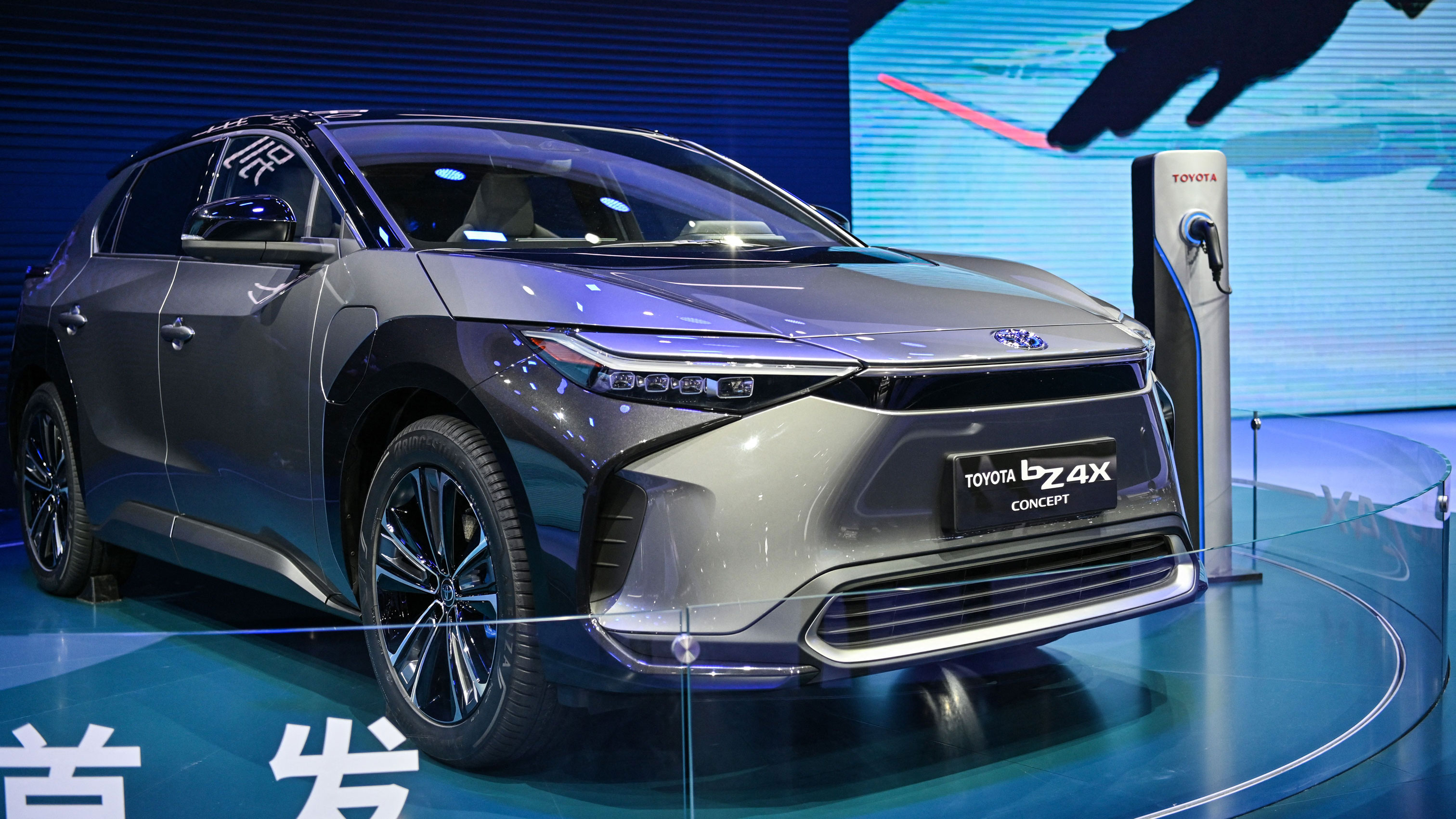
The Toyota bZ4X on display during the 19th Shanghai Auto Show on April 20, 2021. Image Credits: (Photo by Hector RETAMAL / AFP via Getty Images)

The Toyota bZ4X is technically just a concept, but its importance shouldn’t be disregarded. The concept, which was revealed at the Shanghai Auto Show, kicks off a new all-electric lineup for Toyota.

Toyota’s new bZ brand — which stands for beyond zero — will have a dedicated underlying platform that can be used with multiple variations in terms of size and design. The company said that since it is difficult to prepare such a wide range of choices by itself, it is jointly developing the series with partners who boast expertise in various fields. Toyota tapped Subaru to develop the bZ4X. BYD, Daihaitsu and Suzuki are other partners in the bZ line.

Toyota plans to produce the Toyota bZ4X in Japan and China said it hopes to begin worldwide sales of the model by the middle of 2022.

Volkswagen

The German automaker used the Shanghai Auto Show to reveal its third electric vehicle in its ID brand. And this one is designed specifically for the Chinese market.

VW ID 6
Volkswagen ID 6 world premiere

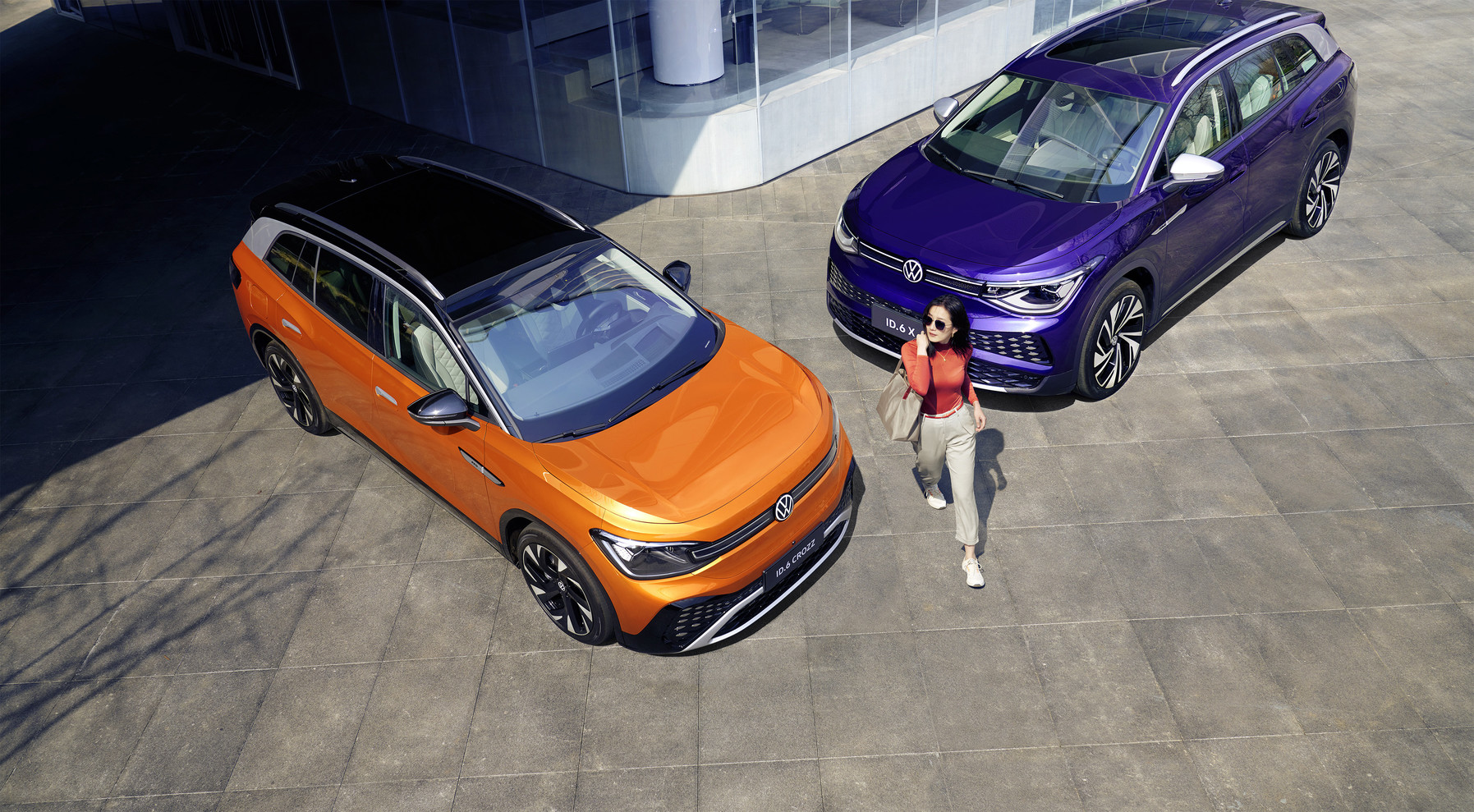
Volkswagen debuted the all-electric ID.6 CROZZ and ID.6 X at the 2021 Shanghai Auto Show. Image Credits: Volkswagen

The VW ID.6 will be available in two versions: The ID.6 CROZZ, which will be manufactured in the north of China and the ID.6 X in the southern part of the country. The ID.6 is VW’s most spacious ID branded model, with room for up to seven people. The vehicle, which is available in four configurations, has a range of up to 588 km (China NEDC).

Xpeng

Xpeng revealed its third vehicle at the Shanghai auto show, one that intends to use lidar in an effort to boost the capabilities of its advanced driver assistance system.

Xpeng P5
Xpeng P5 electric vehicle

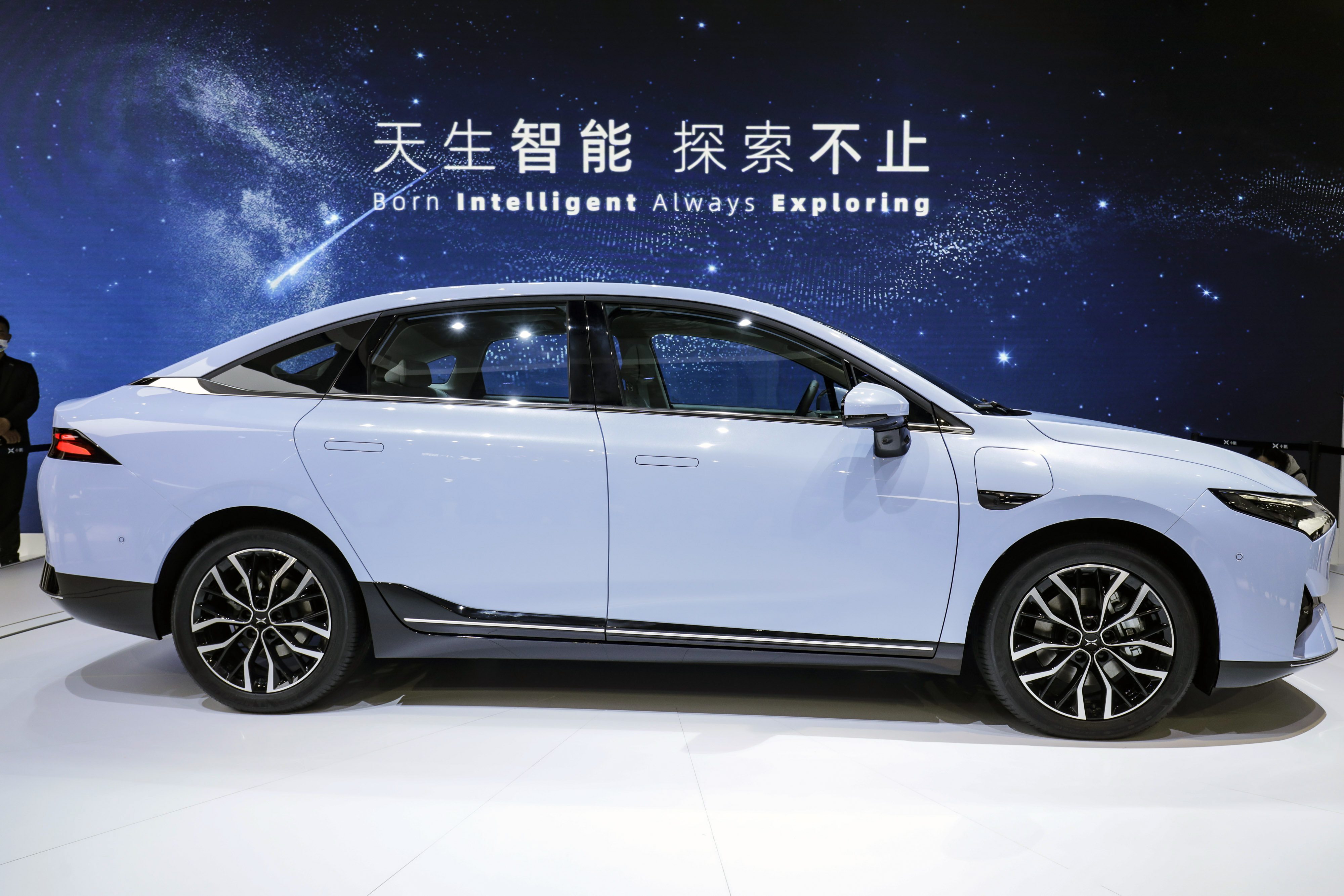
The XPeng Inc. P5 electric vehicle at the 2021Shanghai Auto Show. Image Credits: Qilai Shen/Bloomberg via Getty Images

The Xpeng P5 is the Chinese automaker’s third vehicle, but it’s among the first to be produced with a built-in lidar sensor. The company says the two sensors, which are built into both sides of the sedan’s front, can detect and identify pedestrians, other cars, cyclists, scooters and more, no matter the weather or darkness.

Xpeng’s chairman and CEO He Xiaopeng called the P5 is its most advanced and technically ambitious model yet.

The lidar sensors combined with software deliver an advanced driver assistance system that the automaker says pushes it toward full automation. While the sensor and software system is robust, the vehicle is not self driving. As TechCrunch’s Liao reported, Xpeng’s Navigation Guided Pilot system is benchmarked against Tesla’s Navigate On Autopilot and can automatically change lanes, enter or exit ramps, overtake other vehicles and maneuver another car’s sudden cut-in, a common sight in China’s complex road conditions. However, drivers’ hands must remain on the wheel. The carmaker’s ambition is to remove the driver, that is, reach Level 4 autonomy two to four years from now, but real-life implementation will hinge on regulations.

News: Apple event fails to save the company’s stock from broader market sell-off

Today’s Apple event, chock-full of the company’s products that will help decide whether the company meets, exceeds or undershoots Wall Street expectations for its future growth and performance, had little to no impact on its share price. By now this is the theme: Apple announces a slew of new products, services, software or peripherals, and

Today’s Apple event, chock-full of the company’s products that will help decide whether the company meets, exceeds or undershoots Wall Street expectations for its future growth and performance, had little to no impact on its share price.

By now this is the theme: Apple announces a slew of new products, services, software or peripherals, and its share price does nothing. It’s almost humorous; certainly Apple’s shares can move in the wake of an earnings release, but a new product digest? Not so much.

Or at least not as long as TechCrunch has been paying attention (here’s more evidence). It’s almost like Apple’s customers — and the press — care rabidly about what the company builds. And are very vocal about it. While investors are essentially at lunch the entire time.

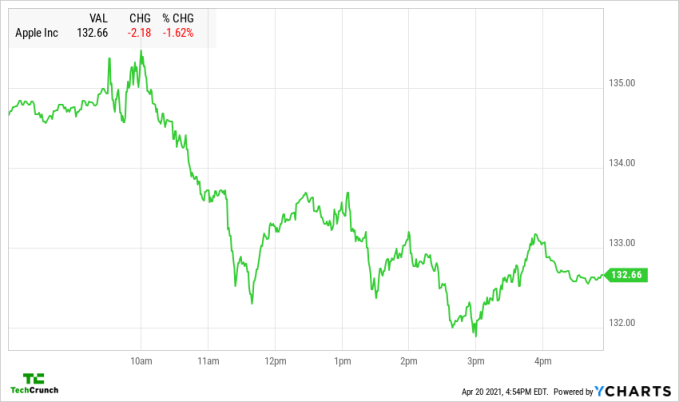
Today, for example, Apple shares closed the day off 1.28% and have since fallen a further 0.36%. Apple stock closed the day worth $133.11 per share and was worth $133.40 at the time its event kicked off. So, the event hardly prevented the company from losing more ground.

The broader Nasdaq index lost 0.92%, per Yahoo Finance.

Put another way, news that Apple is revamping its credit card, rebuilding its podcast app and will support paid subscriptions, that purple iPhones are coming, that AirTags are real, that there is finally a new Apple TV, that there are new iMacs coming that look hot as heck, that there are new iPads (including a new iPad Pro) on the way and more, was essentially a shrug from investors.

To avoid being cliché I won’t paste the are you not entertained gif here, but it’s warranted. In short, this is what Apple stock did today, as investors were too focused on numbers to look upstream from revenue at the products that will drive the numbers that they later parse and come to a firm conclusion.

Here’s the chart, via YCharts:

Image Credits: YCharts

News: UK’s IoT ‘security by design’ law will cover smartphones too

Smartphones will be included in the scope of a planned “security by design” U.K. law aimed at beefing up the security of consumer devices, the government said today. It made the announcement in its response to a consultation on legislative plans aimed at tackling some of the most lax security practices long-associated with the Internet

Smartphones will be included in the scope of a planned “security by design” U.K. law aimed at beefing up the security of consumer devices, the government said today.

It made the announcement in its response to a consultation on legislative plans aimed at tackling some of the most lax security practices long-associated with the Internet of Things (IoT).

The government introduced a security code of practice for IoT device manufacturers back in 2018 — but the forthcoming legislation is intended to build on that with a set of legally binding requirements.

A draft law was aired by ministers in 2019 — with the government focused on IoT devices, such as webcams and baby monitors, which have often been associated with the most egregious device security practices.

Its plan now is for virtually all smart devices to be covered by legally binding security requirements, with the government pointing to research from consumer group “Which?” that found that a third of people kept their last phone for four years, while some brands only offer security updates for just over two years.

The forthcoming legislation will require smartphone and device makers like Apple and Samsung to inform customers of the duration of time for which a device will receive software updates at the point of sale.

It will also ban manufacturers from using universal default passwords (such as “password” or “admin”), which are often preset in a device’s factory settings and easily guessable — making them meaningless in security terms.

California already passed legislation banning such passwords in 2018 with the law coming into force last year.

Under the incoming U.K. law, manufacturers will additionally be required to provide a public point of contact to make it simpler for anyone to report a vulnerability.

The government said it will introduce legislation as soon as parliamentary time allows.

Commenting in a statement, digital infrastructure minister Matt Warman added: “Our phones and smart devices can be a gold mine for hackers looking to steal data, yet a great number still run older software with holes in their security systems.

“We are changing the law to ensure shoppers know how long products are supported with vital security updates before they buy and are making devices harder to break into by banning easily guessable default passwords.

“The reforms, backed by tech associations around the world, will torpedo the efforts of online criminals and boost our mission to build back safer from the pandemic.”

A DCMS spokesman confirmed that laptops, PCs and tablets with no cellular connection will not be covered by the law, nor will secondhand products. Although he added that the intention is for the scope to be adaptive, to ensure the law can keep pace with new threats that may emerge around devices.

News: Netflix blames ‘lighter content slate’ for slowing subscriber growth

Netflix added 4 million net new subscribers in the first quarter of 2021, bringing its total subscriber base to 207.6 million, according to its latest earnings report. Any year-over-year comparison was inevitably going to make this latest quarter seem disappointing, since Netflix grew by an unprecedented rate (15.77 million net new subscribers) during the same

Netflix added 4 million net new subscribers in the first quarter of 2021, bringing its total subscriber base to 207.6 million, according to its latest earnings report.

Any year-over-year comparison was inevitably going to make this latest quarter seem disappointing, since Netflix grew by an unprecedented rate (15.77 million net new subscribers) during the same period last year, when the pandemic first trapped global audiences at home. But these new numbers also fall short of the 210 million subscribers that Netflix had been predicting.

While the streaming market has certainly become more competitive (with Disney+ recently passing 100 million subscribers), Netflix suggested that its lackluster growth had less to do with “competitive intensity” and more with the simple fact that it released fewer original shows and movies, thanks to pandemic-related production delays.

“We believe paid membership growth slowed due to the big COVID-19 pull forward in 2020 and a lighter content slate in the first half of this year, due to COVID-19 production delays,” the company said. “We continue to anticipate a strong second half with the return of new seasons of some of our biggest hits and an exciting film lineup. In the short term, there is some uncertainty from COVID-19; in the long term, the rise of streaming to replace linear TV around the world is the clear trend in entertainment.”

Netflix noted that retention was “in line with our expectations,” and that the main issue was new user acquisition. It also said that “in early Q1, with the benefit of ‘Bridgerton,’ ‘Lupin’ and ‘Cobra Kai,’ we were following a growth trajectory similar to recent years,” before growth dipped in March.

Pandemic-related delays will also affect the release schedule in Q2, so Netflix is only projecting 1 million net new subscribers. The release of high-profile titles should pick up again in the second half of the year, the company said, with production having resumed “in every major market, with the exception of Brazil and India.”

As for the company’s finances, revenue grew 24% year over year to $7.2 billion (in line with the forecast), with diluted earnings per share of $3.75. (Analysts had been predicting EPS of $2.97.) Netflix shares were down more than 11% in after-hours trading, as of 4:33 p.m. EDT.

News: BlaBlaCar raises $115 million to build all-in-one travel app

French startup BlaBlaCar has raised a new $115 million funding round (€97 million). While the company is better known for its long distance carpooling marketplace, BlaBlaCar has also added a bus marketplace with the acquisition of Ouibus and an online bus ticketing platform with the acquisition of Busfor. Existing investor VNV Global is leading the

French startup BlaBlaCar has raised a new $115 million funding round (€97 million). While the company is better known for its long distance carpooling marketplace, BlaBlaCar has also added a bus marketplace with the acquisition of Ouibus and an online bus ticketing platform with the acquisition of Busfor.

Existing investor VNV Global is leading the round. Two new investors are also participating — Otiva J/F AB and FMZ Ventures. Otiva J/F AB is a fund created by Avito founders Jonas Nordlander and Filip Engelbert. If you’re not familiar with Avito, they specialize in classified ads for the Russian market. Classified giant and global tech investor Naspers acquired Avito. As for FMZ Ventures, it’s a growth fund created by Michael Zeisser, who previously led investments for Alibaba and was a board member at Lyft and Tripadvisor.

It’s a convertible note, which means that the valuation will depend on the next financial event, such as another fundraising round or an initial public offering. But BlaBlaCar co-founder and CEO Nicolas Brusson consider it as a “pre-IPO convertible” round as BlaBlaCar still has a ton of cash on its bank account.

“We already had a lot of cash before this round and we still have more than €200 million in cash following this funding round,” Brusson told me.

Even if BlaBlaCar doesn’t go public right away (or doesn’t raise), there’s a clause with a time frame. After a while, those $115 million will convert into BlaBlaCar shares at a $2 billion valuation in case there’s no financial event.

BlaBlaCar’s strategy and goal with today’s funding round could be summed up with three pillars — carpooling, buses and aggregation.

Let’s start with carpooling, BlaBlaCar’s core business. The company started 15 years ago with a simple goal — matching empty car seats with passengers going in the same direction. While last year’s lockdown has impacted carpooling, it shouldn’t be compared with trains or flights.

“With our carpooling network, there’s no fixed costs,” Brusson said. So BlaBlaCar isn’t paying to put empty cars on the road as everything is community-powered. But, of course, as BlaBlaCar takes a cut from each transaction, revenue took a hit during last year’s lockdown.

Activity bounced back last summer and it’s been up and down ever since depending on current restrictions. “Car is and will be the universal connector that doesn’t rely on train stations or bus stops,” Brusson said.

The carpooling marketplace will always remain a strong revenue generator. In 2020 alone, BlaBlaCar had 50 million passengers across 22 markets overall. In other words, never bet against carpooling.

For the past few years, BlaBlaCar’s second pillar has been buses. In particular, buses represent a huge opportunity in emerging markets and Eastern Europe.

There are already a ton of buses on the road, you simply can’t buy tickets online. BlaBlaCar’s total addressable market in this category is huge and the company is mostly focused on moving offline supply to its online marketplace.

That’s why the company is also acquiring Octobus, a Ukrainian company working on an inventory management system for bus supply. “It consolidates our tech stack in the region,” Brusson said.

Finally, BlaBlaCar’s third pillar is all about creating loyal users that keep coming back to the platform. The company wants to build a multimodal app where you can find all shared travel — carpooling, buses and soon trains.

The startup will add train operators on its marketplace by the end of 2021 or early 2022. I asked Brusson whether he wanted to build an Omio competitor. Formerly known as GoEuro, Omio lets you book train tickets, bus tickets and flights on a single platform.

BlaBlaCar wants to follow a different strategy. It wants to focus first on a handful of countries so that it can sell everything a local would expect.

Eventually, you could imagine opening the BlaBlaCar app to find the best way to go from A to B. It could involve a train ticket followed by a carpooling ride to reach a tiny town. Or it could mix carpooling with bus rides. Thanks to BlaBlaCar’s reach, the French startup is uniquely positioned to connect two small cities through shared transportation.

News: Discord walked away from Microsoft talks, may pursue an IPO

A month after reports that Microsoft sought to buy the hot voice chat app Discord surfaced, those talks are off, a source familiar with the deal confirmed to TechCrunch. Discord is considering plans to stay independent, possibly charting a path to its own IPO in the not-too-distant future. The Wall Street Journal first reported news

A month after reports that Microsoft sought to buy the hot voice chat app Discord surfaced, those talks are off, a source familiar with the deal confirmed to TechCrunch.

Discord is considering plans to stay independent, possibly charting a path to its own IPO in the not-too-distant future. The Wall Street Journal first reported news that the deal was off.

The two companies were deep in acquisition talks that valued Discord at around $10 billion before Discord walked away. According to the WSJ, three companies were exploring the possible acquisition, though only Microsoft was named.

Discord’s valuation doubled in less than six months last year and its stock is only looking hotter in 2021. A well-loved voice chat app originally built for gamers, Discord was in the right place well ahead of the current voice chat trend that Clubhouse ignited. As companies from Facebook to Twitter scramble to build voice-based community tools, Discord rolled out its own support for curated audio events last month.

Discord’s decision to veer away from a sale makes sense for a company keen to keep its unique DNA rather than being rolled into an existing product at a bigger company. The choice could also keep the company distant from a protracted antitrust headache, as lawmakers mull legislation that could block big tech deals to prevent further consolidation in the industry.

News: Belarusian regime’s thugs shut down Imaguru, the country’s key startup hub

After visits by unnamed masked intruders and the cancellation of its lease, Imaguru — the country’s key startup hub, event and co-working space in Minsk — has effectively been shut down by the Lukashenko regime, which has led a brutal crackdown on its own people in recent months. But the company behind the space says

After visits by unnamed masked intruders and the cancellation of its lease, Imaguru — the country’s key startup hub, event and co-working space in Minsk — has effectively been shut down by the Lukashenko regime, which has led a brutal crackdown on its own people in recent months. But the company behind the space says it will defy the authorities and continue its activities online.

Since 2013, Imaguru had become known as being the birthplace of a large number of startups from Belarus, including MSQRD, acquired by Facebook in 2017 — as well as a landing pad for international investors visiting the country. Startups that have emerged from the space have attracted over $100 million in investments in recent years.

The “Imaguru Startup HUB” leased the space from “Horizon Holding” in 2013, when it took over a dilapidated building from a state-owned company. But on April 16, 2021, Horizon told Imaguru it was unilaterally terminating its lease and the startup space has been given until April 30 to vacate.

Imaguru says there has been no reason given for the lease termination, despite Horizon calling Imaguru a “flagship” leasehold for its property business.

To outside observers, it looks like Horizon has come under pressure because of Imaguru’s active support of the pro-democracy protests inside the country.

In early March, unidentified men wearing masks broke into the office, “blocked the exit, put young event attendees against the wall, and brought them to the police station” said the company.

In a statement, Imaguru said it is “not silent about lawlessness, repressions and persecution against civilians who defend their rights to an honest and fair choice … Not silent about the regime shutting down the business, investment and startup environment … Not silent about the massive relocation of startups from Belarus, about the catastrophe of this for the country and the role of the HTP in this process.”

Named after the phrase “I’m a guru,” and transcribed literately by Belarusian entrepreneurs, Imaguru held countless conferences, events, startup pitches and courses. It also organised Venture Day Minsk (which will still be run online on April 29).

Since 2013 Imaguru says it has helped over 300 Belarusian startups, including Splitmetrics, MSQRD, PingFin, DEIP and TrackDuck; created 250+ jobs; educated over 12,000 people; held over 3,500 events; organised study tours to the U.S., U.K., Finland, Spain and, most recently, launched the TechMinsk accelerator program.

In recent months, the startup hub came out in solidarity with the protests inside the country following last year’s tainted elections, recorded videos of solidarity with PandaDoc, who’s employees have been jailed, and supported the general strike on October 26, 2020.

The Global Entrepreneurship Week Belarus, which was organized by the Imaguru team, was opened by the Belarusian leader Sviatlana Tsikhanouskaya.

Imaguru was founded by Belarusian businesswoman Tania Marinich (Twitter, Linkedin, Telegram) whose husband died in jail after standing at elections in opposition to the Lukashenko regime.

The below is a statement by Marinich on the closure of the Imaguru space:

A startup hub in Minsk was a totally new idea in Belarus in 2013, but Marinich has championed the ecosystem ever since.

After the protest last year, Marinich joined the core team of the opposition party’s Coordination Council, leading the business group.

If you’d like to help Imaguru you can subscribe to their newsFacebook, LinkedinTwitterInstagram and Youtube.

You can buy Imaguru’s merchandise and order their services, which they will continue to provide online.

You can also attend Venture Day Minsk Online on April 29. You can register here


News: Who’s funding privacy tech?

New regulations, stricter cross-border data transfer rules and increasing calls for data sovereignty have helped the privacy startup space grow thanks to an uptick in investor support.

Privacy isn’t dead, as many would have you believe. New regulations, stricter cross-border data transfer rules and increasing calls for data sovereignty have helped the privacy startup space grow thanks to an uptick in investor support.

This is how we got here, and where investors are spending.

The rise of privacy tech

With strict privacy laws such as GDPR and CCPA already listing big-ticket penalties — and a growing number of countries following suit — businesses have little option but to comply. It’s not just bigger, established businesses offering privacy and compliance tech; brand-new startups are filling in the gaps in this emerging and growing space.

“For the last decade, privacy tech was trumpeted as one of the next ‘big things’ for investors, but never delivered. Startup business models were too academic, complex and did not appeal to VCs, or crucially, consumers were used to getting free web services,” Gilbert Hill, chief executive at Tapmydata, told Extra Crunch.

Some privacy companies — including privacy hardware companies — are chasing profits and less focused on hustling for outside investment.

Today, privacy is big business. Crunchbase lists 207 privacy startups (as of April 2021) that have together raised more than $3.5 billion over hundreds of individual rounds of funding. The number of privacy companies rockets if you take into account enterprise privacy players. Crunchbase currently has 809 listed under the wider “privacy” category.

The latest Privacy Tech Vendor Report 2021 names 356 companies exclusively dealing in enterprise privacy technology solutions, up from 304 companies a year earlier.

“Since 2017, the privacy landscape underwent a metamorphosis,” the report said. “The emergence of the California Consumer Privacy Act, Brazilian General Data Protection Law and other privacy laws around the world have forced organizations to adhere to a new array of compliance requirements, and in response, the demand for privacy tech grew exponentially.”

That also presents an opportunity for investors.

Increasing investments

Privacy tech was catching the attention of investors even before the recent wave of new privacy laws came into effect. The sector amassed nearly $10 billion in investment in 2019, according to Crunchbase, compared to just $1.7 billion in 2010. Investments remained active in 2020, despite the pandemic.

Case in point: In December, enterprise privacy and compliance firm OneTrust announced a $300 million Series C funding. The deal valued the 4-year-old privacy tech firm at $5.1 billion, making it one of the first modern privacy unicorns. Three months later, it extended its Series C funding, with SoftBank Vision Fund 2 and Franklin Templeton pumping in another $210 million.

News: Tile bashes Apple’s new AirTag as unfair competition

Now that Apple’s lost item finder AirTag has officially been introduced, competitor Tile is going on record ahead of its testimony in front of Congress tomorrow about how it perceives Apple’s latest product. The company says it will be asking Congress on Wednesday to take a closer look into Apple’s business practices, and specifically its

Now that Apple’s lost item finder AirTag has officially been introduced, competitor Tile is going on record ahead of its testimony in front of Congress tomorrow about how it perceives Apple’s latest product. The company says it will be asking Congress on Wednesday to take a closer look into Apple’s business practices, and specifically its entry in this lost item tracking category.

Tile has been a strong Apple critic since it learned that Apple would soon launch its own device to take on Tile’s leading lost item finder beacons. Tile had successfully carved out a market for its Bluetooth-powered keychain dongles that allow consumers to find the lost items Tile attaches to — like purses, luggage, keys, bikes, wallets and more. It also introduced the idea of a “finding network,” where everyone with the Tile app installed on their phone could help to locate someone else’s Tile, in the case that a lost item was out of Bluetooth range of its owner.

With AirTag, Apple is reproducing these capabilities, while also adding support for more precise ultra-wideband technology, integrating AirTag into its first-party “Find My” app, and leveraging its larger iPhone install base to help find missing items. This presents significant competition to Tile, which is not only expected to face off with Apple’s AirTag across Apple’s own devices, but also share a portion of its subscription revenues from in-app purchases with Apple thanks to App Store policies.

Ahead of AirTag’s launch, Apple moved to head off any sort of anti-competitive claims by opening up access to its “Find My” app to third parties. It even partnered with a Tile competitor, the Chipolo ONE Spot, to serve as proof that it’s giving other lost item finders that compete with AirTag equal footing on its iPhone platform. But Tile’s argument to date has been that it doesn’t want to give up the direct relationship it has with customers via its own iOS app to instead support Apple’s “Find My” users, and that Apple’s mere decision to enter this market with its own item-locating tracker will allow it to easily dominate because of its first-party advantage and ecosystem power.

Tile had previously testified before Congress about Apple’s alleged anti-competitive behavior back in 2020 and will now do so again on Wednesday alongside other Apple critics, including Match and Spotify.

The companies are arguing against Apple’s in-app commissions, the so-called “Apple tax,” which Apple recently reduced for smaller businesses. Many larger companies do not want to pay Apple at all — they want to process their own payments directly to retain all the revenue collected. They also want a more direct relationship with customers, not one where Apple is the middleman. And in some cases like Tile and Spotify, the companies don’t feel it’s fair that they’re paying money to Apple when Apple directly competes with their business through its own first-party apps.

In a statement released today following Apple’s event, Tile CEO CJ Prober again publicly criticized Apple’s move into a market Tile created, saying:

Our mission is to solve the everyday pain point of finding lost and misplaced things and we are flattered to see Apple, one of the most valuable companies in the world, enter and validate the category Tile pioneered.

The reason so many people turn to Tile to locate their lost or misplaced items is because of the differentiated value we offer our consumers. In addition to providing an industry leading set of features via our app that works with iOS and Android devices, our service is seamlessly integrated with all major voice assistants, including Alexa and Google. And with form factors for every use case and many different styles at affordable prices, there is a Tile for everyone.

Tile has also successfully partnered with top brands like HP, Intel, Skullcandy and fitbit to enable our finding technology in mass market consumer categories like laptops, earbuds and wearables. With over 30 partners, we look forward to extending the benefits of Tile to millions of customers and enabling an experience that helps you keep track of all your important belongings.

We welcome competition, as long as it is fair competition. Unfortunately, given Apple’s well-documented history of using its platform advantage to unfairly limit competition for its products, we’re skeptical. And given our prior history with Apple, we think it is entirely appropriate for Congress to take a closer look at Apple’s business practices specific to its entry into this category. We welcome the opportunity to discuss these issues further in front of Congress tomorrow.


News: Here’s everything Apple announced at its ‘Spring Loaded’ event today

It’s Apple event day! From tweaks to the Apple Card to all new iMacs and iPads, Apple crammed this one-hour event with news. Don’t have time to sit down and click through every last announcement? We’ve slimmed it down to just the key points for maximum skimmability. Enjoy! Apple Card Apple kicked things off with

It’s Apple event day!

From tweaks to the Apple Card to all new iMacs and iPads, Apple crammed this one-hour event with news. Don’t have time to sit down and click through every last announcement? We’ve slimmed it down to just the key points for maximum skimmability. Enjoy!

Apple Card

Apple Card

Image Credits: Apple

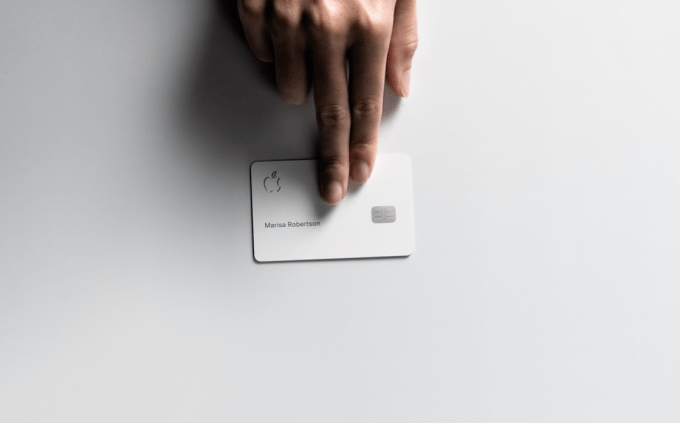
Apple kicked things off with a quick but key mention outlining a shift in how Apple Card works. “Apple Card Family” will allow you to share your card with anyone in your family over the age of 13, with customizable spending limits for each added user. You’ll also now be able to “co-own” an Apple card with another adult, with both owners building up their credit equally.

Apple Podcasts

apple podcasts 2021

Image Credits: Apple

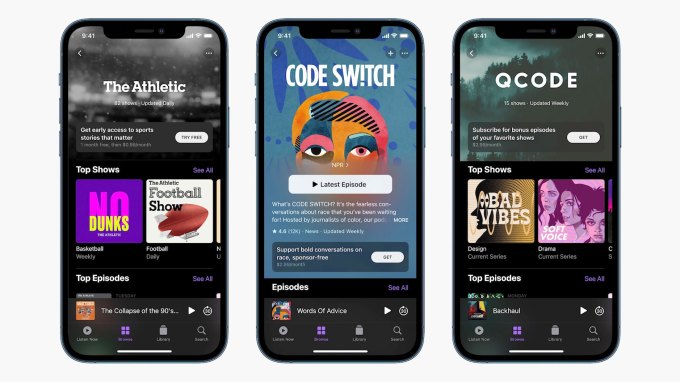
Apple will launch a redesigned Podcast app, including an option for paid subscriptions (monthly or annual) to individual podcasts.

Purple iPhones

purple iphone

Image Credits: Apple

No new iPhone this time (those come later in the year, generally), but the existing iPhone 12 and iPhone 12 mini are getting a new color option: purple. They used a song from Willy Wonka to announce it, because… well, purple.

AirTag

apple airtag $99 4 pack

Image Credits: Apple

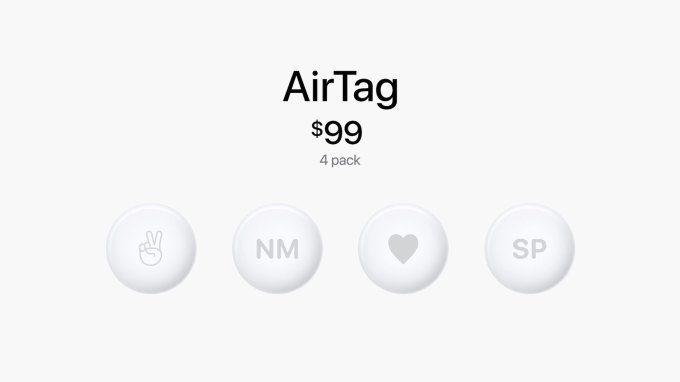
After literal years of rumors and leaks, Apple has at long last officially announced its accessory for tracking things like keys, wallets, and bags through the same “Find My” app you use to find your various Apple devices when you lose them in the couch.

Called “AirTag” (curiously, not ‘AirTags’), Apple says they’ll cost $29 each or $99 for a four pack, and launch on April 30th. They’ll have user-replaceable batteries but, oddly, no built-in attachment loop; if you want to attach it to something like a keyring, you’ll need to add a case. Which, of course, they’ll be making and selling.

Next-gen Apple TV 4K

Image Credits: Apple

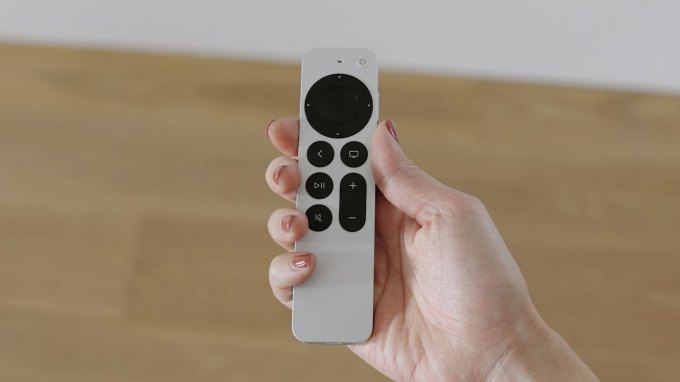
Apple announced a big refresh to the Apple TV 4K it first launched back in 2017. Here’s the breakdown:

  • Powered by Apple’s A12 Bionic chip
  • You can use an iPhone to calibrate the picture. Start the calibration, point your iPhone’s camera at your display, and Apple TV 4K will automatically optimize its own output accordingly.
  • They’ve redesigned the remote! They’ve moved away from the much lamented touchpad remote, building this new remote around a five-way click pad complete with iPod-esque scroll wheel. There’s a Siri button on the side, in case you feel like talking to your TV instead of pushing buttons. Word is (via WSJ’s Joanna Stern) they’ll also be selling this remote separately for $59 for use with the previous-gen Apple TV 4K and Apple TV HD.
  • $179 for 32GB model or $199 for 64GB.

New iMacs

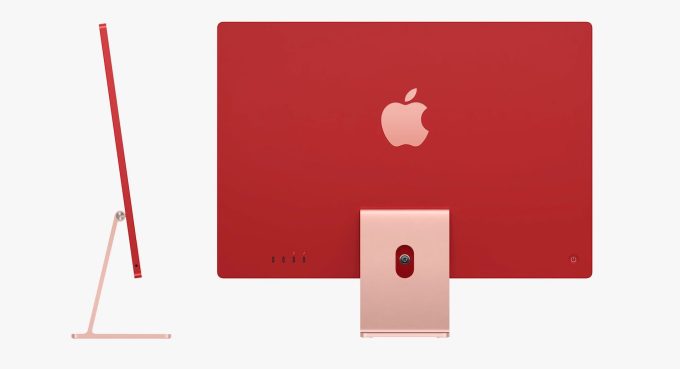
back and side views of red 2021 Apple iMacTime for the iMac to shift over to M1! Apple announced a new lineup of iMacs — and in a throwback to the iMacs of yesteryear, these new ones will come in an array of fancy colors. Here are the highlights:
  • Built around the absurdly zippy M1 chipset Apple first introduced into its laptops last year
  • 24-inch “4.5K” display
  • At last, a decent webcam! These new iMacs will ship with a 1080p FaceTime camera
  • Pre-orders start April 20th, shipping in late May
  • $1299 gets you an 8-core CPU/7-core GPU setup, while $1499 will bump it up to 8-core CPU/8-core GPU.
  • It’ll come in seven colors: green, yellow, pink, orange, blue, purple, and silver. Some colors will only be available in the more expensive model.
  • Both models come with a 256GB SSD, and two thunderbolt ports. The $1499 model adds two USB 3 ports
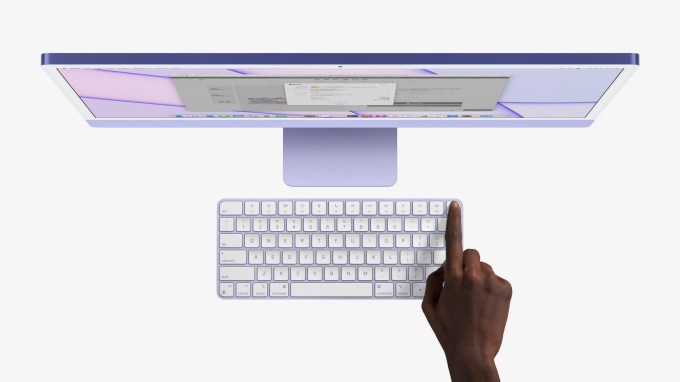
  • Apple will ship a new version of its Bluetooth Magic Keyboard, now complete with a Touch ID fingerprint sensor.

    Apple Touch ID on magic keyboard in front of 2021 iMac

    Image Credits: Apple

New iPad Pros

Apple 2021 iPad Pro overview

Image Credits: Apple

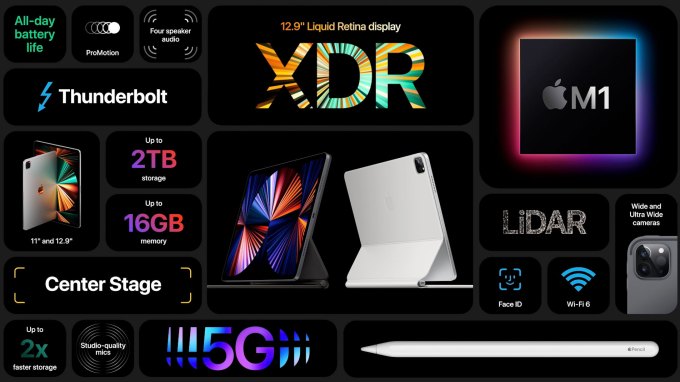
The iPad Pro is going M1, too! Apple says this shift brings a 50 percent performance improvement over the previous iPad Pro. Here’s whats new:

  • 8-core GPU/8-core CPU
  • The 11-inch model will start at $799, while the 12.9-inch model will start at $1,099.
  • Cellular models will now have 5G support
  • Thunderbolt and USB 4 support through the USB-C port
  • The 12.9-inch model will have “Liquid Retina XDR” display that Apple says packs 1000 nits of full-screen brightness, or 1600 nits of peak brightness.
  • A feature Apple calls “Center Stage” will automatically keep your face in the center of the frame during FaceTime calls, even as you move about the room.
  • Up to 2TB of built-in storage, and 16GB of RAM

WordPress Image Lightbox Plugin