Tag Archives: Blog

News: With $30M extension, BigID boosts Series D to $100M at $1.25B valuation

When we last heard from BigID at the end of 2020, the company was announcing a $70 million Series D at a $1 billion valuation. Today, it announced a $30 million extension on that deal valuing the company at $1.25 billion just 4 months later. This chunk of money comes from private equity firm Advent

When we last heard from BigID at the end of 2020, the company was announcing a $70 million Series D at a $1 billion valuation. Today, it announced a $30 million extension on that deal valuing the company at $1.25 billion just 4 months later.

This chunk of money comes from private equity firm Advent International, and brings the total raised to over $200 million across 4 rounds, according to the company. The late stage startup is attracting all of this capital by building a security and privacy platform. When I spoke to CEO Dimitri Sirota in September 2019 at the time of the $50 million Series C, he described the company’s direction this way:

“We’ve separated the product into some constituent parts. While it’s still sold as a broad-based [privacy and security] solution, it’s much more of a platform now in the sense that there’s a core set of capabilities that we heard over and over that customers want.”

Sirota says he has been putting the money to work, and as the economy improves he is seeing more traction for the product set. “Since December, we’ve added employees as we’ve seen broader economic recovery and increased demand. In tandem, we have been busy building a whole host of new products and offerings that we will announce over the coming weeks that will be transformational for BigID,” he said.

He also said that as with previous rounds, he didn’t go looking for the additional money, but decided to take advantage of the new funds at a higher valuation with a firm that he believes can add value overall. What’s more, the funds should allow the company to expand in ways it might have held off on.

“It was important to us that this wouldn’t be a distraction and that we could balance any funding without the need to over-capitalize, which is becoming a bigger issue in today’s environment. In the end, we took what we thought could bring forward some additional product modules and add a sales team focused on smaller commercial accounts,” Sirota said.

Ashwin Krishnan, a principal on Advent’s technology team in New York says that BigID was clearly aligned with two trends his firm has been following. That includes the explosion of data being collected and the increasing focus on managing and securing that data with the goal of ultimately using it to make better decisions.

“When we met with Dimitri and the BigID team, we immediately knew we had found a company with a powerful platform that solves the most challenging problem at the center of these trends and the data question,”Krishnan said.

Past investors in the company include Boldstart Ventures, Bessemer Venture Partners and Tiger Global. Strategic investors include Comcast Ventures, Salesforce Ventures and SAP.io.

News: Will Budweiser brew eggs and will Post cereal make meat?

Corporations are quickly waking up to the market potential of alternative proteins with the nation’s biggest consumer brands continuing to make investments and create partnerships with startup companies helping consumers transition to healthier and more environmentally sustainable diets. As Earth Week draws to a close (thankfully) new partnerships announced over the past week show the

Corporations are quickly waking up to the market potential of alternative proteins with the nation’s biggest consumer brands continuing to make investments and create partnerships with startup companies helping consumers transition to healthier and more environmentally sustainable diets.

As Earth Week draws to a close (thankfully) new partnerships announced over the past week show the potential for new technologies to transform old businesses.

Yesterday the New York-based ZX Ventures, the investment and innovation arm of AB InBev, said that it would be partnering with Clara Foods, a developer of protein production technologies including (but not limited to), brewing egg substitutes. That’s right, the makers of Budweiser are hatching a scheme to make other kinds of liquids that are less potable and more poachable.

In that case, the yolk would definitely be on you, future consumer.

“Since day one, Clara has been on a mission to accelerate the world’s transition to animal-free protein, starting with the egg. More than one trillion eggs are consumed globally every year and corporate commitments for cage-free aren’t enough,” said Arturo Elizondo, the chief executive and co-founder of Clara Foods. “We’re thrilled to be partnering with the world’s largest fermentation company to work together to enable a kinder, greener, and more delicious future. This partnership is a major step towards realizing our vision.”

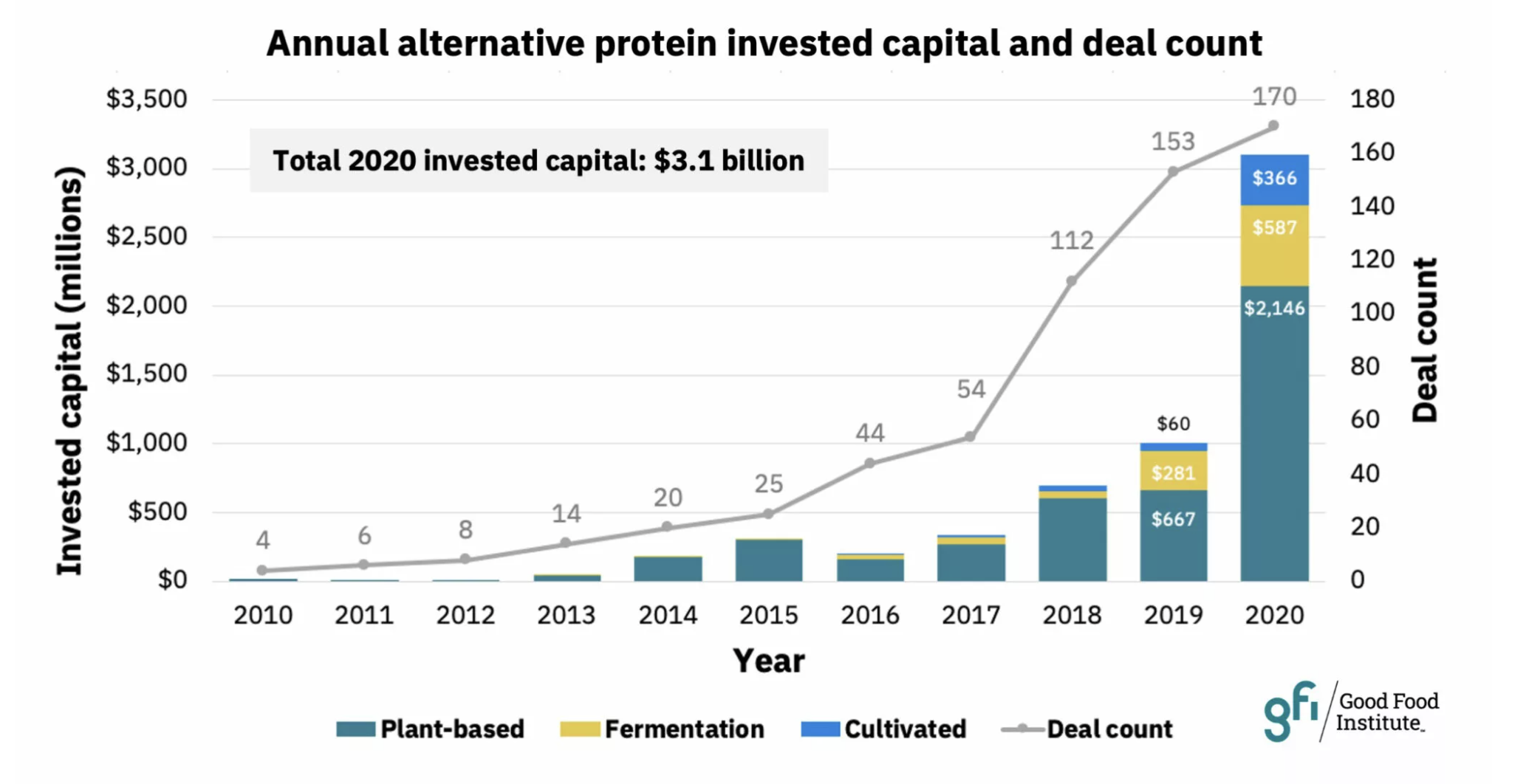
Graph showing the increasing size of investments into alternative proteins in 2020. From 2019 to 2020 investments in alternative proteins soared from just over $1 billion to $3 billion led by investments in plant protein products. Image Credit: Good Food Institute

There are market-driven reasons for the partnership. Demand for high quality proteins is expected to jump up to 98% by 2050, according to research cited by the two companies.

“Meeting the increased demand for food requires breakthrough solutions built on collaboration and innovation that spans several industry domains – both old and new. The ancient and natural process of fermentation can be further harnessed to help meet future demands in our global food system,” said Patrick O’Riordan, founder & CEO at BioBrew, ZX Ventures’ new business line trying to apply large-scale fermentation and downstream processing expertise beyond beer. “We look forward to exploring the development of highly-functional, animal-free egg proteins with Clara Foods in a scalable, sustainable and economically viable manner.”

Meanwhile, there’s a meeting of the minds happening in St. Louis where cereal giant Post is investing in Hungry Planet, a startup making meat a range of meat replacements.

Formed from the same Seventh Day Adventist focus on plant-based diet and health as a core of spirituality that launched the Kellogg’s cereal empire, Post has long been a rival to the corn flake king with its grape nuts cereal and other grain-based breakfast offerings.

Now the company has led a $25 million investment in Hungry Planet, which aims to provide meat-based replacements for crab cakes, lamb burgers, chicken, pork, and beef. Additional investors included the Singapore-based environmentally sustainable holding company, Trirec.

Alternative proteins are a big business. Last year, companies developing technologies and businesses to commercialize alternative sources of protein raised over $3 billion, according to the industry tracker, the Good Food Institute.

“Over the past year, the alternative protein industry has demonstrated not only resilience but acceleration, raising significantly more investment capital in 2020 than in prior years,” said GFI director of corporate engagement Caroline Bushnell, in a statement. “These capital infusions and the funding still to come will facilitate much-needed R&D and capacity building to enable these companies to scale and reach more consumers with delicious, affordable, and accessible alternative protein products.”

It’s all part of a push to provide more plant-based alternatives to animal proteins in a bid to halt planetary deforestation and reduce the greenhouse gas emissions associated with animal husbandry.

“Humanity needs solutions that match the scale and urgency of our problems,” said Elizondo. “

News: Tiger Global backs Indian crypto startup Coinswitch Kuber at over $500M valuation

Coinswitch Kuber, a startup that allows young users in India to invest in cryptocurrencies, said on Thursday it has raised $25 million in a new financing round as it looks to expand its reach in India, the world’s second largest internet market and also the place where the future of private cryptocurrencies remains uncertain for

Coinswitch Kuber, a startup that allows young users in India to invest in cryptocurrencies, said on Thursday it has raised $25 million in a new financing round as it looks to expand its reach in India, the world’s second largest internet market and also the place where the future of private cryptocurrencies remains uncertain for now.

Tiger Global financed the entire Series B funding round of Coinswitch Kuber and valued the three-year-old Indian startup at over $500 million. The announcement of Series B comes just three months after Coinswitch closed its $15 million Series A round from Ribbit Capital, Sequoia Capital India, and Kunal Shah. The Bangalore-based startup has raised $41.5 million to date.

TechCrunch reported earlier this month that the New York-headquartered technology hedge fund had led or was in advanced stages of talks to lead investments in many Indian startups including Coinswitch.

Coinswitch Kuber is one of the handful of startups operating in the cryptocurrency space today. The startup allows users to buy slivers of several popular cryptocurrencies. A user on Coinswitch, for instance, can buy small sachets of bitcoin and other currencies for as low as 100 Indian rupees ($1.3)-worth.

The startup said it has amassed over 4.5 million users, more than half of whom are aged 25 or younger. In the past 11 months, Coinswitch Kuber said it processed transactions over $5 billion.

But how the startup performs in the future is not entire in its hand.

While trading of private cryptocurrency such as bitcoin is currently legal in India, New Delhi is widely expected to introduce a law that bans all private cryptocurrency.

Ashish Singhal, co-founder and chief executive of Coinswitch Kuber, said he is optimistic that India will not ban private cryptocurrencies, but said the startup closed the financing round with Tiger Global before New Delhi’s indication to formulate a law.

“This investment round brings us at par with some of the most sought after cryptocurrency companies in the world and sets us up for the long run,” said Singhal.

In recent months, some startups in India have started to explore a contingency plan in case the nation does end up banning cryptocurrency trading in the country. Many startups are today building in India, but focusing on serving customers overseas.

“As they build India’s leading cryptocurrency platform, CoinSwitch is well positioned to capture the tremendous growing interest in crypto among retail investors. We are excited to partner with CoinSwitch as they innovate in this emerging asset class,” said Scott Shleifer, Partner at Tiger Global, in a statement.

News: SmartNews’ COVID-19 vaccine alert reaches 1M users in Japan a week after launching

SmartNews announced today that its tools to help Japanese users find nearby COVID-19 vaccine bookings have reached more than one million users just a week after launching. The news discovery unicorn decided to create Vaccine Alert and Map features for its Japanese app because many people there are frustrated by the speed of vaccine rollouts.

Screenshots of SmartNews' Vaccine Alert and Map features for its Japanese app

SmartNews’ Vaccine Alert and Map features for its Japanese app

SmartNews announced today that its tools to help Japanese users find nearby COVID-19 vaccine bookings have reached more than one million users just a week after launching. The news discovery unicorn decided to create Vaccine Alert and Map features for its Japanese app because many people there are frustrated by the speed of vaccine rollouts. In the United States, where vaccinations are going much faster, SmartNews just released a feature that lets people find appointments by zip code today.

The company has more than 20 million monthly active users combined in Japan and the United States.

According to a public opinion poll by Nippon TV, more than 70% of Japanese people are dissatisfied with its slow vaccine rollout. That sentiment was echoed in SmartNews’ own research, which surveyed 900 people aged 65 to 79 at the beginning of April, and found that more than 90% felt there was insufficient information available about when and where they could get vaccinated. Challenges included the lack of a central portal for vaccine booking information, meaning local government offices and healthcare providers were inundated with questions.

A screenshot of SmartNews' vaccine locater feature for the American version of its app

A screenshot of SmartNews’ vaccine finder feature for the American version of its app

To create its Vaccine Alert and Map, SmartNews aggregated information from 1,741 municipalities across Japan. The Vaccine Alert lets users know when they are eligible to get a shot based on their location, age, occupation and health conditions. The Vaccine Map combines data from about 37,000 facilities, so people can see where bookings are available near them or get notified when their healthcare providers begin taking reservations.

The features were released on April 12, the day vaccinations began for elderly people in Japan, and had more than one million users a week later. This is in part because SmartNews is one of the country’s most popular news aggregator apps and also because the new features were covered by TV Asahi, a major TV station.

A company representative told TechCrunch that many people who signed up for the vaccine features were already SmartNews users, but it has also seen new downloads as people share their vaccination appointments with friends and family.

News: Bux, a European Robinhood, raises $80M to expand its neo-broker platform

A new wave of apps have democratized the concept of investing, bringing the concept of trading stocks and currencies to a wider pool of users who can use these platforms to make incremental, or much larger, bets in the hopes of growing their money at a time when interest rates are low. In the latest

A new wave of apps have democratized the concept of investing, bringing the concept of trading stocks and currencies to a wider pool of users who can use these platforms to make incremental, or much larger, bets in the hopes of growing their money at a time when interest rates are low. In the latest development, Bux — a startup form Amsterdam that lets people invest in shares and exchange-traded funds (ETFs) without paying commissions (its pricing is based on flat €1 fees for certain services, no fees for others) — has picked up some investment of its own, a $80 million round that it.

Alongside this, the company is announcing a new CEO. Founder Nick Bortot is stepping away and Yorick Naeff, an early employee of the company who had been the COO, is taking over. Bortot will remain a shareholder and involved with the company, which will be using to expand its geographical footprint and expand its tech platform and services to users, said Naeff in an interview.

“Since we started, Bux has been trying to make investments affordable and intuitive, and that will still be the case,” he said. The average age of a Bux customer is 30, so while affordable and intuitive are definitely priorities to capture younger users, it also means that if Bux can earn their loyalty and show positive returns, they have the potential to keep them for a long time to come.

The funding is coming from an interesting group of investors. Jointly led by Prosus Ventures and Tencent (in which Prosus, the tech division of Naspers, is a major investor), it also included ABN Amro Ventures, Citius, Optiver, and Endeit Capital — all new investors — as well as previous backers HV Capital and Velocity Capital Fintech Ventures.

Naeff said in an interview that Bux isn’t disclosing its valuation with this round. But for some context, he confirmed that the startup has around 500,000 customers across the Netherlands, Germany, Austria, France and Belgium, using not just its main Bux Zero app, but also Bux Crypto and Bux X (a contracts for difference (CFDs) app).

Crypto remains a niche but extremely active part of the wider investment market and Naeff described Bux Crypo — formed out of Bux acquiring Blockport last year — as “very profitable.” The company had only raised about $35 million before this round, and it’s been around since 2014, so while he wouldn’t comment on wider profitability, you can draw some conclusions from that.

For some further valuation context, another big player in trading in Europe, eToro, in March announced it was going public by way of a SPAC valuing it at $10 billion. (Note: eToro is significantly bigger, adding 5 million users last year alone.)

Others in the wider competitive landscape include Robinhood out of the US, which had plans but appeared to have stalled in its entry into Europe; Trade Republic out of Germany, which raised $67 million a year ago from the likes of Accel and Founders Fund; and Revolut, which has been running a trading app for some time.

The opportunity that Bux is targeting is a very simple one: technology, and specifically innovations in banking and apps, have opened the door to making it significantly easier for the average consumer to engage in a new set of financial services.

At the same time, some of the more traditional ways of “growing” one’s capital, by way of buying and selling property or opening savings accounts, are not as strong these days as they were in the past, with the housing market being too expensive to enter for younger people, and interest rates very low, leading those consumers to considering other options open to them. Social media is also playing a major role here, opening up conversations around investing that have been traditionally run between professionals in the industry.

“We’re looking for industries that solve big societal needs and fintech continues to be one of them,” said Sandeep Bakshi, who heads up investments for Prosus in Europe, in an interview. “Interest rates being what they are, there are no opportunities for individuals to save and that represents a massive opportunity, and we’re happy to partner and be a part of the journey.”

Although there is a wave of so-called neo-brokers in the market today, Bux’s unique selling point, Naeff said, is the company’s tech stack.

In comparison to others providing trading apps, he said Bux is the first and only one of them to have built a full-stack system of its own.

“It’s not on top of existing broker, which makes it a nimble and modular,” he said. “This is especially critical because fintech is a game of scale, but every market is completely different when you consider tax, payment systems and the ID documents that one needs in order to fill KYC requirements.”

And that is before you consider that doing business in Europe means doing business in a number of different languages.

“Our system is here to scale across Europe,” he said. “The fact that we are live in five countries, and the only neo-broker doing that, shows that this modular system is working.”

Indeed, the scaling opportunity is one of the reasons why China’s tech giant Tencent, owner of WeChat and a vast gaming empire, has come on board.

“We are excited about backing BUX as they are the leading neo-broker in Europe and have been able to build a platform that is sustainable and scalable. BUX is the only neo-broker in Europe that offers zero commission investing without being dependent on kickbacks or payments for order flow. This ensures that its interests are fully aligned with its customers. We will support BUX in its journey of pursuing consistent growth for the years to come”, said Alex Leung, Assistant GM at Tencent, Strategic Development, in a statement.

News: Founders Factory Africa partners with Small Foundation to invest in 18 agritech startups

Johannesburg-based investment company Founders Factory Africa (FFA) today announced a partnership with Small Foundation that will see it select 18 agritech startups for an acceleration and incubation program. Small Foundation is a Dublin-based philanthropic organization that focuses on the rural and agriculture sector in sub-Saharan Africa. With this partnership, Small Foundation is making an undisclosed

Johannesburg-based investment company Founders Factory Africa (FFA) today announced a partnership with Small Foundation that will see it select 18 agritech startups for an acceleration and incubation program.

Small Foundation is a Dublin-based philanthropic organization that focuses on the rural and agriculture sector in sub-Saharan Africa. With this partnership, Small Foundation is making an undisclosed investment in FFA to build and scale agritech startups on the continent.

“The partnership stands to make a significant impact across the continent by supporting agritech startups who can innovate and improve the delivery of a range of services to smallholder farmers and micro, small and medium-sized enterprises in the agricultural sector,” an excerpt in a statement read.

According to the South African-based venture development and investment company founded by Roo Rogers and Alina Truhina, early-stage founders will need to apply to join the Founders Factory Africa Venture Scale or Venture Build portfolios. These startups will have access to funding between $100,000 to $250,000 and hands-on technical support.

This is a change from when the company launched in 2018. FFA is an extension of the Founders Factory organisation that has invested in more than 130 companies globally. In 2018, FFA launched its first vertical in fintech when it partnered with the continent’s largest bank, Standard Bank, to invest in fintech startups. Some of the startups include Bwala, LipaLater, MVXchange and OkHi.

The following year, it took on a second investor in South African healthcare company Netcare Group and, via the partnership, invested in health-tech startups like RxAll, Redbird and Wellahealth.

Last year when we reported this partnership, startups in FFA’s Venture Scale accelerator program received a £30,000 cash investment and £220,000 in support services. Those in the Venture Build program received £60,000 cash and £100,000 toward support.   

For this third partnership, Truhina says FFA will be investing a total of $300,000 in cash and hands-on support for companies in its Venture Scale program. However, startups in Venture Build will be receiving up to $250,000 in funding.

The Venture Scale program involves providing support for existing startups operating in seed to pre-Series A stages. On the other hand, the Venture Build program is for founders wanting to launch a startup in Africa, who may or may not have a concept or an idea

Currently, there are 23 companies across FFA’s Scale and Build portfolios. These startups, mainly from Ghana, Kenya, Nigeria and South Africa, have collectively raised more than $7 million during and after the program. Truhina says FFA plans to increase this number to nearly 90 startups in total by 2024.

“We will build, scale and invest in 88 startups with current FFA investors (Standard Bank, Netcare and Small Foundation) until 2024. We plan to continue to take on new investors and continue to work on the continent indefinitely,” she said.

Founders Factory Africa

While FFA is dedicating a fund for agritech startups, it has invested in other startups with agritech solutions for instance Nigeria’s Foodlocker. The company forecasts foodstuff demand through machine learning and helps buyers procure goods from smallholder farmers. But despite this proposition, FFA classifies the startup as a fintech investment.

“Foodlocker was a company we selected and invested in under our Fintech portfolio, as the startup has a financial component. With Small Foundation, we are setting up a new dedicated agritech sector,” said Truhina. Small Foundation joins Standard Bank and Netcare in the peculiarity of assistance offered to FFA portfolio startups. From sector expertise and footprint across the continent to access to clients, POCs and pilots, these investors are trying to fill in the gap in sectors ripe for exponential growth.

But though fintech has caught on well with both local and international investors, the same cannot be said for health tech and agritech. According to Briter Bridges, fintech accounted for 31% of the total $1.3 billion raised by African startups. Health-tech startups accounted for 9%, while agritech startups represented just 7%.

Small Foundation wants to improve this number in its own little way, and concurrently has a plan to “end extreme poverty in sub-Saharan Africa by 2030.” Conor Brosnan, the CEO and chair of the foundation, holds that tackling the sector’s biggest issues with the FFA will bring the company toward achieving this objective.

“This is a pivotal time to invest in the growing area of agritech in Africa, which has transformative potential for local livelihoods. We are excited to see FFA’s highly skilled teamwork with immensely talented African entrepreneurs to deliver scaled solutions to some of the biggest challenges faced by the sector,” he said.

In three years, Founders Factory Africa has managed to enlist the services and finances of three influential partners. Yet, it has 55 more startups to invest in before 2024, so we should expect an increased investment activity and more partnerships to fund startups in other sectors.

The firm also has fresh capital in the works for its portfolio companies as it advances, though. It’s in the process of raising a $35 million “Africa Seed Fund” which will exist alongside FFA and execute follow-on capital in some portfolio companies.

News: Satellite Vu’s $5M seed round will fuel the launch of its thermal imaging satellites

Earth imaging is an increasingly crowded space, but Satellite Vu is taking a different approach by focusing on infrared and heat emissions, which are crucial for industry and climate change monitoring. Fresh from TechCrunch’s Startup Battlefield, the company has raised a £3.6M ($5M) seed round and is on its way to launching its first satellite

Earth imaging is an increasingly crowded space, but Satellite Vu is taking a different approach by focusing on infrared and heat emissions, which are crucial for industry and climate change monitoring. Fresh from TechCrunch’s Startup Battlefield, the company has raised a £3.6M ($5M) seed round and is on its way to launching its first satellite in 2022.

The nuts and bolts of Satellite Vu’s tech and master plan are described in our original profile of the company, but the gist is this: while companies like Planet have made near-real-time views of the Earth’s surface into a thriving business, other niches are relatively unexplored — like thermal imaging.

The heat coming off a building, geological feature, or even a crowd of people is an enormously interesting data point. It can tell you whether an office building or warehouse is in use or empty, and whether it’s heated or cooled, and how efficient that process is. It can find warmer or cooler areas that suggest underground water, power lines, or other heat-affecting objects. It could even make a fair guess at how many people attended a concert, or perhaps an inauguration. And of course it works at night.

An aerial image side by side with a thermal image of the same area.

You could verify, for instance, which parts of a power plant are active, when.

Pollution and other emissions are also easily spotted and tracked, making infrared observation of the planet an important part of any plan to monitor industry in the context of climate change. That’s what attracted Satellite Vu’s first big piece of cash, a grant from the U.K. government for £1.4M, part of a £500M infrastructure fund.

CEO and founder Anthony Baker said that they began construction of their first satellite with that money, “so we knew we got our sums right,” he said, then began the process of closing additional capital.

Seraphim Capital, a space-focused VC firm whose most relevant venture is probably synthetic aperture satellite startup Iceye, matched the grant funds, and with subsequent grant the total money raised is in excess of the $5M target (the extra is set aside in a convertible note).

“What attracted us to Satellite Vu is several things. We published some research about this last year: there are more than 180 companies with plans to launch smallsat constellations,” said Seraphim managing partner James Bruegger. But very few, they noted, were looking at the infrared or thermal space. “That intrigued us, because we always thought infrared had a lot of potential. And we already knew Anthony and Satellite Vu from having put them through our space accelerator in 2019.”

They’re going to need every penny. Though the satellites themselves are looking to be remarkably cheap, as satellites go — $14-15M all told — and only seven will be needed to provide global coverage, that still adds up to over $100M over the next couple years.

Simulated image of a Satellite Vu imaging satellite.

Image Credits: Satellite Vu

Seraphim isn’t daunted, however: “As a specialist space investor, we understand the value of patience,” said Bruegger. Satellite Vu, he added, is a “poster child” for their approach, which is to shuttle early stage companies through their accelerator and then support them to an exit.

It helps that Baker has lined up about as much potential income from interested customers as they’ll need to finance the whole thing, soup to nuts. “Commercial traction has improved since we last spoke,” said Baker, which was just before he presented at TechCrunch’s Disrupt 2020 Startup Battlefield:

The company now has 26 letters of intent and other leads that amount to, in his estimation, about a hundred million dollars worth of business — if he can provide the services they’re asking for, of course. To that end the company has been flying its future orbital cameras on ordinary planes and modifying the output to resemble what they expect from the satellite network.

Companies interested in the latter can buy into the former for now, and the transition to the “real” product should be relatively painless. It also helps create a pipeline on Satellite Vu’s side, so there’s no need for a test satellite and service.

An aerial image side by side with a thermal image of the same area.

Another example of the simulated satellite imagery – same camera as will be in orbit, but degraded to resemble shots from that far up.

“We call it pseudo-satellite data — it’s almost a minimum viable product.We work with the companies about the formats and stuff they need,” Baker said. “The next stage is, we’re planning on taking a whole city, like Glasgow, and mapping the whole city in thermal. We think there will be many parties interested in that.”

With investment, tentative income, and potential customers lining up, Satellite Vu seems poised to make a splash, though its operations and launches are small compared with those of Planet, Starlink, and very soon Amazon’s Kuiper. After the first launch, tentatively scheduled for 2022, Baker said the company would only need two more to put the remaining six satellites in orbit, three at a time on a rideshare launch vehicle.

Before that, though, we can expect further fundraising, perhaps as soon as a few months from now — after all, however thrifty the company is, tens of millions in cash will still be needed to get off the ground.

News: Dutch startup Go Sharing raises $60M to expand beyond e-mopeds and into new markets

On-demand access to electric mopeds — the small, motorised scooters that you sit on, not kick — has been a small but persistent part of the multi-modal transportation mix on offer to people in cities these days. Today, a startup out of The Netherlands is announcing some funding with ambitions to make e-mopeds more mainstream,

On-demand access to electric mopeds — the small, motorised scooters that you sit on, not kick — has been a small but persistent part of the multi-modal transportation mix on offer to people in cities these days. Today, a startup out of The Netherlands is announcing some funding with ambitions to make e-mopeds more mainstream, and to expand into a wider set of vehicle options.

Go Sharing, which has a fleet of around 5,000 e-mopeds across in 30 cities in three countries — The Netherlands, Belgium and Austria — has picked up €50 million (around $60 million). The startup, based near Utrecht, plans to use the funding to expand its footprint for e-mopeds; add electric cars and e-bikes to its app; and continue building out the technology underpinning it all.

Go Sharing believes tech will be the answer to creating a profitable operation, using AI algorithms to optimize locations for e-mopeds, encouraging people to drop off in those locations with incentives like discounts, and keeping that network charged.

Germany, the UK and Turkey are next on Go Sharing’s list of countries, the company said.

The funding is being led by Opportunity Partners — a firm based out of Amsterdam that also backs online supermarket Crisp, with the startup’s founders — CEO Raymon Pouwels, Doeke Boersma, and Donny van den Oever — also participating. A previous round of about $12 million came from Rabo Corporate Investments, the VC arm of the banking giant.

In a world where we now have many choices for getting around cities — taxis, public transport, push and electric bikes, scooters, walking, carpools, car rentals or our own cars — e-mopeds occupy an interesting niche in the mix.

They can be faster than bikes and scooters — 25 km per hour is a typical speed limit in cities, 40 km per hour in less dense areas — more agile than cars, completely quiet compared to their very noisy fuel-based cousins, and of course much more eco-friendly. For those managing fleets, they less likely to break down and need replacing than some of the other alternatives like e-bikes and e-scooters.

But they also represent a higher barrier to entry for picking up customers: riders need a license to operate them as you would other moving vehicles, and in some (but not all) places they need to wear helmets; and the operators of fleets need to sort out how required insurance will work and need special permits as a vehicle provider in most places, and they can also face the same issue as other vehicles like bikes and kick scooters of being a public nuisance when parked.

That mix of challenges — and the fact that fleets can be expensive to operate and might even if all the boxes are ticked still not attract enough users — has meant that the e-moped market has been a patchy one, with some startups shutting down, some cancelling cities after low demand, or retreating over and then returning with better safety measures.

Yet with on-demand transport companies increasingly looking to provide “any” mode in their multi-modal plays to capture more consumers at more times, they remain a class of vehicle that the bigger players and newer entrants will continue to entertain. Lime earlier this year said it was adding e-mopeds to its fleet in certain cities. Uber teamed up with Cityscoot in Paris to integrate the e-moped’s fleet into its app. Cityscoot itself raised some funding last year and is active in several cities across Europe.

And while it can be work to get permits and other regulatory aspects in place to operate services, Pouwels said that Go Sharing was finding that many municipalities actually liked the idea of bringing in more e-mopeds as an eco-friendly alternative to more vehicles — the idea being to provide a transport option to people who are not interested in kick-scooters or bikes and might have driven their own cars, meaning they already have licenses.

The eco-friendly option is also motivating how the company is planning out other parts of its strategy:

“What we have heard from regulators is that they want to motivate people to walk or move in other ways, for example with bicycles,” Pouwels said in an interview. “What we’ve seen with kick scooters is that they ‘deactivate’ people. This is why we see bikes [not adding e-scooters] as the healthy way of moving forward.” The plan with adding electric cars, he said, is to address the needs of people to travel longer distances than shorter inner-city journeys.

Handling supply for its services is coming by way of GreenMo, a sister operation run by Boersma that has been procuring and running a rental service of e-mopeds that are used by drivers for delivery services, with some 10,000 bikes already used this way. GreenMo recently acquired Dutch startup e-bike and a took a majority stake in Belgian company zZoomer, to expand its fleet.

News: 9 investors, execs and founders discuss Zagreb’s startup potential

“With the COVID-19 pandemic, it’s easier to land remote jobs and stay in Zagreb, which will positively impact the Croatian startup ecosystem.”

Startups may not spring to mind when speaking about the beautiful country of Croatia. Indeed, the country is most popular as a tourist destination, and given that tourism accounted for about 20% of its GDP in 2018, to an extent, its pre-pandemic focus was mostly on growing its share of the international tourism market.

But Croatia’s entrepreneurs haven’t been quiet: Startups like Infobip and Rimac are significant local hero businesses now, and the region can boast of high-quality talent in the tech, automotive, manufacturing, and agtech spaces. With only two venture capital firms operating in the capital of Zagreb, the startup scene is still young, but the country’s relatively recent EU membership has given it access to a growing set of direct investment instruments.

The current tax framework on capital gains tax (zero if you hold the shares for more than two years) and a new ‘digital nomad’ visa are helping to attract investors and talent to the city, which is also close to some of the best beaches in the world.

Access to fresh, outside capital is always a catalyst for growth, so to get an inside look at Zagreb’s fast-growing startup ecosystem, we spoke with nine local founders, investors and C-level executives.

According to the respondents, Zagreb’s strongest tech areas include HR solutions, automotive, fintech, mobile gaming, IoT, insurtech, and AI. The city’s angel investor scene isn’t very strong yet, but that could be attributed to the ecosystem’s youth.


Use discount code ZAGREB2021 to save 25% off an annual or two-year Extra Crunch membership.
This offer is only available to readers in Europe and expires on May 30, 2021.


The city has an excellent work-life balance, and most of the talent wants to stay there. “Now, with the COVID-19 pandemic, it’s easier to land remote jobs and stay in Zagreb, which will positively impact our ecosystem,” one of the investors said.

However, with competition heating up, startups looking for larger, serious investment will probably have to look beyond the country’s borders while trying to retain their engineering talent. Luckily, an increasing number of international investors are looking at Zagreb for their deal flow pipeline.

Some top Croatian startups include: Agrivi, Amodo, Ascalia, Bellabeat, Cognism, Degordian, Dok-Ing, Infobip, Mindsmiths, OptimoRoute, Oradian, Photomath, Repsly, ReversingLabs, ScoreAlarm, Sportening and AdScanner.

We surveyed:


Lucija Ilicic, CEO, PlatePay

Which are the most interesting startups in your city?
Photomath, Sportening, and Mindsmiths.

What are the tech investors like? What is the investment scene like in your city? What’s their focus?
Mostly revenue-oriented.

With the shift to remote working during the COVID-19 pandemic, will people stay in your city, move out, or will others move in?
People would choose to live and move here during the pandemic. Some of them did, especially having in mind that Croatia now has the digital nomad visa.

Who are the key startup people in your city? (e.g. Investors, founders, lawyers, designers, etc)
Investors: Fil Rouge Capital, Feelsgood, Zicer, Bird Incubator; Founders: Ivan Klarić, Damir Sabol, Mislav Malenica, Mate Riimac

Where do you see your city’s tech scene in five years?
The Croatian startup ecosystem really grew during last year and has huge potential. I see it as a perfect place for digital nomads, home of a few new unicorns and a European center for AI solutions development.

Can you recommend any companies that should appear in our global Startup Battlefield competition?
Sportening, Mindsmiths, and of course, PlatePay.


Julien Coustaury, partner, Fil Rouge Capital

Which sectors is your tech ecosystem strong in? What are you most excited by? What is it weak in?
Strong in fintech, automotive, insurtech, and AI. We are excited that the whole ecosystem is growing strong with flagships such as Rimac, Optimoroute, Oradian, Infobeep, Agrivi, Tvbeat, Orqa, and Bellabeat, and our relevant funding partners with us and a new PE fund that have just been creating. There is money, talent and we have unicorns in Croatia. Very few weaknesses in Croatia at the moment, especially with the current tax framework on capital gains (zero if you hold the shares for more than two years) and the digital nomad visa. A giant leap for the region!

Which are the most interesting startups in your city?
Oradian, Lebesgue, Optimoroute, Gideon Brothers, Worcon, TVbeat, Orqa, Ascalia, Epoets Society, Hoss, Jade, Miret, My Valet, Sendbee, She’s Well, Spotsie, Taia, TDA, and Twire.

What are the tech investors like? What is the investment scene like in your city? What’s their focus?
The ecosystem still a bit small to talk about the vertical focus. [We have] two active funds: SC ventures and Fil Rouge Capital. FRC runs an accelerator program along the YC model. The angel scene is a bit disappointing at the moment with not a lot of investments. Funderbeam [is] pretty active here. The quality and quantity is amazing at the moment in Croatia, probably a factor of the ecosystem being rather young.

With the shift to remote working during the COVID-19 pandemic, will people stay in your city, move out, or will others move in?
The current fiscal climate makes it very attractive for people to relocate/stay in Zagreb, no doubt. One million people here; proximity to one of the best seas in the world — all the ingredients are here to make it the beacon of the up and coming startup world!

Who are the key startup people in your city? (e.g. Investors, founders, lawyers, designers, etc)
FRC is definitely the main player in Zagreb; SC ventures, Funderbeam, Novak Law for lawyers, Algebra University, ZICER, Hub 385, Step RI.

Where do you see your city’s tech scene in five years?
No doubt a key hub in Europe on par with Vienna.

Can you recommend any companies that should appear in our global Startup Battlefield competition?
Oradian, Lebesgue, Optimoroute, Gideon Brothers, Worcon, TVbeat, Orqa, Ascalia, Epoets Society, Hoss, Jade, Miret, My Balet, Sendbee, She’s well, Spotsie, Taia, TDA, and Twire.


Josip Orsolic, CEO, Lilcodelab

Which sectors is your tech ecosystem strong in? What are you most excited by? What is it weak in?
IT, automotive, manufacturing, farming (different SaaS and IoT solutions).

Which are the most interesting startups in your city?
Rimac Automobili, Microblink, Five, Nanobit, Agrivi.

What are the tech investors like? What is the investment scene like in your city? What’s their focus?
It’s a small circle of people and not a lot of diversity, although it is getting better. Many new young successful investors emerged in the last few years.

With the shift to remote working during the COVID-19 pandemic, will people stay in your city, move out, or will others move in?
They will stay, maybe go to the suburbs, but just looking at the rental prices for flats/apartments I don’t see any shift in people moving outside of the city.

Who are the key startup people in your city? (e.g. Investors, founders, lawyers, designers, etc)
Mate Rimac, Damir Sabol, Alan Sumina, Tomislav Car, Luka Abrus.

Where do you see your city’s tech scene in five years?
I believe the tech scene is going to grow more and more. Many companies from other countries are opening up engineering hubs in Zagreb. There is a lot of talent, people are drawn to tech jobs; it is heavily covered by the media. Each success is celebrated and covered by the media, so there is a feeling that tech companies are being pushed, even though there are other successful companies from other industries.

Can you recommend any companies that should appear in our global Startup Battlefield competition?
Agrivi, Parklio, Seek and Hit, Electrocoin, TestDome, Include.

Vedran Tolic, founder & CBO, Q agency

Which sectors is your tech ecosystem strong in? What are you most excited by? What is it weak in?
Strongest: Online betting, HR solutions, fintech, mobile gaming, IoT.
Weakest: Gaming for serious platforms; AI solutions are still in their infancy.

Which are the most interesting startups in your city?
PhotoMath, Agrivi, SofaScore, TalentLyft, Jenz, and Bellabeat.

What are the tech investors like? What is the investment scene like in your city? What’s their focus?
The scene is getting stronger, but for any serious investment, startups have to look beyond our borders.

With the shift to remote working during the COVID-19 pandemic, will people stay in your city, move out, or will others move in?
Zagreb has an excellent work-life balance, and most of the talent want to stay here. Now, with the COVID-19 pandemic, it’s easier to land remote jobs and stay in Zagreb, which will positively impact our ecosystem.

Who are the key startup people in your city? (e.g. Investors, founders, lawyers, designers, etc)
Founders: We have many charismatic founders who are raising awareness around startups and entrepreneurship in general. They are reaching large audiences and getting attention from government, the education system and the public.

Where do you see your city’s tech scene in five years?
Shifting from mostly agency work for foreign companies to a more product-oriented scene — especially in AI and ML. Products will revolve around customer and employee engagement, automation and prediction of processes which are today done by a large workforce.

Can you recommend any companies that should appear in our global Startup Battlefield competition?
Photomath, Agrivi, Bellabeat, Jenz


Bozidar Pavlovic, managing director, airt

Which sectors is your tech ecosystem strong in? What are you most excited by? What is it weak in?
AI, SaaS, electric cars manufacturing, and software development in general.

Which are the most interesting startups in your city?
Rimac Automobili, Nanobit, Infinum, Five, Agrivi, Aircash, Identyum, Airt, Mindsmiths, Electrocoin, Agency 04, Oradian, Microblink, Photomath, Agency Q, Revuto, Optimoroute, Amodo, Lemax, Ampnet, RobotiqAI, and Velebit AI.

What are the tech investors like? What is the investment scene like in your city? What’s their focus?
The scene is growing recently — Zagreb is capital of Croatia, thus attracting capital and people. A recent near-unicorn (Rimac, with heavy investment from Hyundai and Porsche) helped raise visibility for this vibrant ecosystem.

With the shift to remote working during the COVID-19 pandemic, will people stay in your city, move out, or will others move in?
Even before the pandemic, Zagreb was very attractive for tech experts worldwide due to its appealing price of accommodation, security, comfort of living and relatively high salaries. I am expecting to see the masses return after vaccination.

Who are the key startup people in your city? (e.g. Investors, founders, lawyers, designers, etc)
Davor Runje, Nikola Pavesic, Drazen Orescanin, Frane Sesnic, Tin Tezak, Ante Magzan, and Luka Sucic.

Where do you see your city’s tech scene in five years?
I see it blooming, mostly due to upcoming adoption of EUR as a local currency.

Can you recommend any companies that should appear in our global Startup Battlefield competition?
Amodo, Agrivi, Photomath, Identyum.


Matej Zelic, COO, Spotsie

What industry sectors is your tech ecosystem strong in? What are you most excited by? What is it weak in?
Oil and energy, Industry 4.0. Most excited to be a part of digital transformation in the old-fashioned industries.

Which are the most interesting startups in your city?
Rimac, Agrivi, Oradian, Miret, SofaScore.

What are the tech investors like? What is the investment scene like in your city? What’s their focus?
The startup ecosystem in Croatia is still in early stages of development. The investment scene (except a few business angels) started a  few years ago backed by EU with just two VCs (FRC and SVC) without a strategic plan and focus.

With the shift to remote working during the COVID-19 pandemic, will people stay in your city, move out, or will others move in?
People will stay here.

Who are the key startup people in your city? (e.g. Investors, founders, lawyers, designers, etc)
Fil Rouge Capital, South Central Ventures. Mate Rimac, Damir Sabol, Frane Sesnic

Where do you see your city’s tech scene in five years?
Because of micro-location, the digital nomad program, and IT talent pool, Zagreb is on the way to becoming the No. 1 tech location in CEE and Europe.

Can you recommend any companies that should appear in our global Startup Battlefield competition?
Gideon Brothers, Spotsie.


Miroslav Kovac, CEO, Coffee Cloud

Which sectors is your tech ecosystem strong in? What are you most excited by? What is it weak in?
IoT, software analytics, big data, coffee industry.

Which are the most interesting startups in your city?
Agrivi, Repsly.

What are the tech investors like? What is the investment scene like in your city? What’s their focus?
Very poor startup ecosystem.

With the shift to remote working during the COVID-19 pandemic, will people stay in your city, move out, or will others move in?
Most of the last year was in partial lockdown.

Who are the key startup people in your city? (e.g. Investors, founders, lawyers, designers, etc.)
Sasa Cvetojecic, Hrvoje Prpic, Fil Rouge Capital, Bird Incubator.

Where do you see your city’s tech scene in five years?
At the same place.


Vedran Blagus, investment manager, South Central Ventures

Which sectors is your tech ecosystem strong in? What are you most excited by? What is it weak in?
Industry is very agnostic. Most of them work in B2B or the enterprise space. They lack B2C knowledge, growth/expansion plan and investor relations.

Which are the most interesting startups in your city?
AdScanner, Agrivi, ReversingLabs, TalentLyft, Sportening, Codemap, Gideon Brothers.

What are the tech investors like? What is the investment scene like in your city? What’s their focus?
Two VCs operating – Fil Rouge Capital (Pre-Seed, Seed, Series A – industry agnostic; B2C and B2B) and South Central Ventures (Seed, Series A, B2B). In the past six to twelve months, C-level executives from corporates started investing in startups in early stages (up to EUR 200k), but keep their investments below the radar.

With the shift to remote working during the COVID-19 pandemic, will people stay in your city, move out, or will others move in?
I believe that it will stay the same as it is. Development/operations in Zagreb, expansion to other European cities by opening offices there.

Who are the key startup people in your city? (e.g. investors, founders, lawyers, designers, etc)
Founders – Matija Zulj, Marin Curkovic, Mate Rimac, Marin Saric, Alan Sumina, Matija Kopic.
Investors – Luka Sucic, Stevica Kuharski, Vedran Blagus.
Lawyers – Marijana Sarolic Robic.
Media – Ivan Brezak Brkan, Bernard Ivezic.

Where do you see your city’s tech scene in five years?
Founders who exited companies they’ve been building for the past 10 years will found new companies and/or invest in early stage startups. More international investors looking at Zagreb for pipeline/investments.


Daniel Stefanic, investor

Which are the most interesting startups in your city?
Infobip, Rimac seem to be hottest ones in Croatia.

Where do you see your city’s tech scene in five years?
There’s some incredibly smart people involved in STEM in Croatia – world class. They just need better pathways to commercialisation and access to capital.


News: Oath Care just raised $2 million to develop a social, health-focused app that groups expectant and new parents

Being an expectant mom can be frightening, as can mothering an infant or toddler. The answers don’t come automatically, and while there’s no shortage of books and websites (and advice from grandparents) about how to parent at every stage, finding satisfying information often proves a lot harder than imagined. There are online social groups that

Being an expectant mom can be frightening, as can mothering an infant or toddler. The answers don’t come automatically, and while there’s no shortage of books and websites (and advice from grandparents) about how to parent at every stage, finding satisfying information often proves a lot harder than imagined.

There are online social groups that deliver some of the social and emotional support that new parents need, no matter where they live. There are many dozens of mom communities on Facebook, for example. However, it’s because there’s room for improvement on this theme — big groups can feel isolating, bad information abounds —that Oath Care, a young, four-person San Francisco-based startup, just raised $2 million in seed funding from XYZ Ventures, General Catalyst, and Eros Resmini, former CMO of Discord and managing partner of the Mini Fund.

What is it building? Founder Camilla Hermann describes it as a subscription-based mobile app that’s focused on improving the lives of new mothers by combining parents with a whole lot in common with healthcare specialists and moderators who can guide them in group chats, as well as one-on-one video calls.

More specifically, she says, for $20 per month, Oath matches pregnant and postpartum moms in circles of up to 10  based on factors like stage of pregnancy, age of child, location, and career so they can ask questions of each other, with the help of a trained moderator (who is sometimes a mother with older children).

Oath also pushes curriculum that Oath’s team is developing in-house to members based on each group’s specific needs. Not last, every group is given collective access to medical specialists who can answer general questions as part of the members’ subscription and who are also available for consultations when individualized help is needed.

Hermann says the pricing of these 15-minute-long consultations is still being developed, but that the medical experts with whom it’s already working see the app as a form of lead generation.

It’s an interesting concept, one that could be taken in a host of directions, acknowledges Hermann who says she was inspired to cofound the company based on earlier work developing a contact tracing technology created to track outbreaks like Ebola in real time.

As she said yesterday during a Zoom call with TechCrunch and her cofounder, Michelle Stephens, a pediatric clinician and research scientist: “We’ve fundamentally misunderstand something really important about health in the West; we think that [changes] happen to one person at a time or one part of the body at a time, but it always happens in interconnected systems both inside and outside the body, which fundamentally means that it is always happening in community.”

For her part, Stephens — who was introduced to Hermann at a dinner years ago — says her motivation in cofounding Oath was born out of research into childhood stress, and that by “better equipping parents to be those positive consistent caregivers in their child’s life,” Oath aims to help enable stronger, more intimate child-parent bonds.

It might sound grand for a mobile app, but it also sounds like a smart starting point. Though the idea is to match mothers in similar situations at the outset to help bolster theirs and their children’s health, it’s easy to imagine the platform evolving in a way that brings together parents in numerous groups based on interests, from preschool applications to autism to same-sex parenting. It’s easy to see the platform helping to sell products that parents need. It’s easy to imagine the company amassing a lot of valuable information.

Indeed, says Hermann, the longer-term vision for Oath is to create rich datasets that it hopes can be used to improve health outcomes, including by identifying health issues earlier. Relatedly, it also hopes to build relationships with health systems and payers in order to increase access to its products.

For now, Oath is mostly just trying to keep up with demand. Hermann says the “small and scrappy” company found its first 50 users through Facebook ads, and that this base quickly tripled organically before Oath was forced to create a growing waitlist for what has been a closed beta until now. (Oath is “anticipating a full launch in late summer,” says Stephens.)

That’s not to say the company isn’t thinking at all about next steps.

While right now it is “laser focused on building out the most exceptional experience for this specific cohort of users in this specific period of time of their lives,” says Hermann, once it builds out many more communities of small trusted groups with “high engagement and high trust,” there is “a lot you can layer on top of that. It’s virtually limitless.”

WordPress Image Lightbox Plugin