
Tag Archives: Blog

News: Disney Imagineering’s Project Kiwi is a free walking robot that will make you believe in Groot

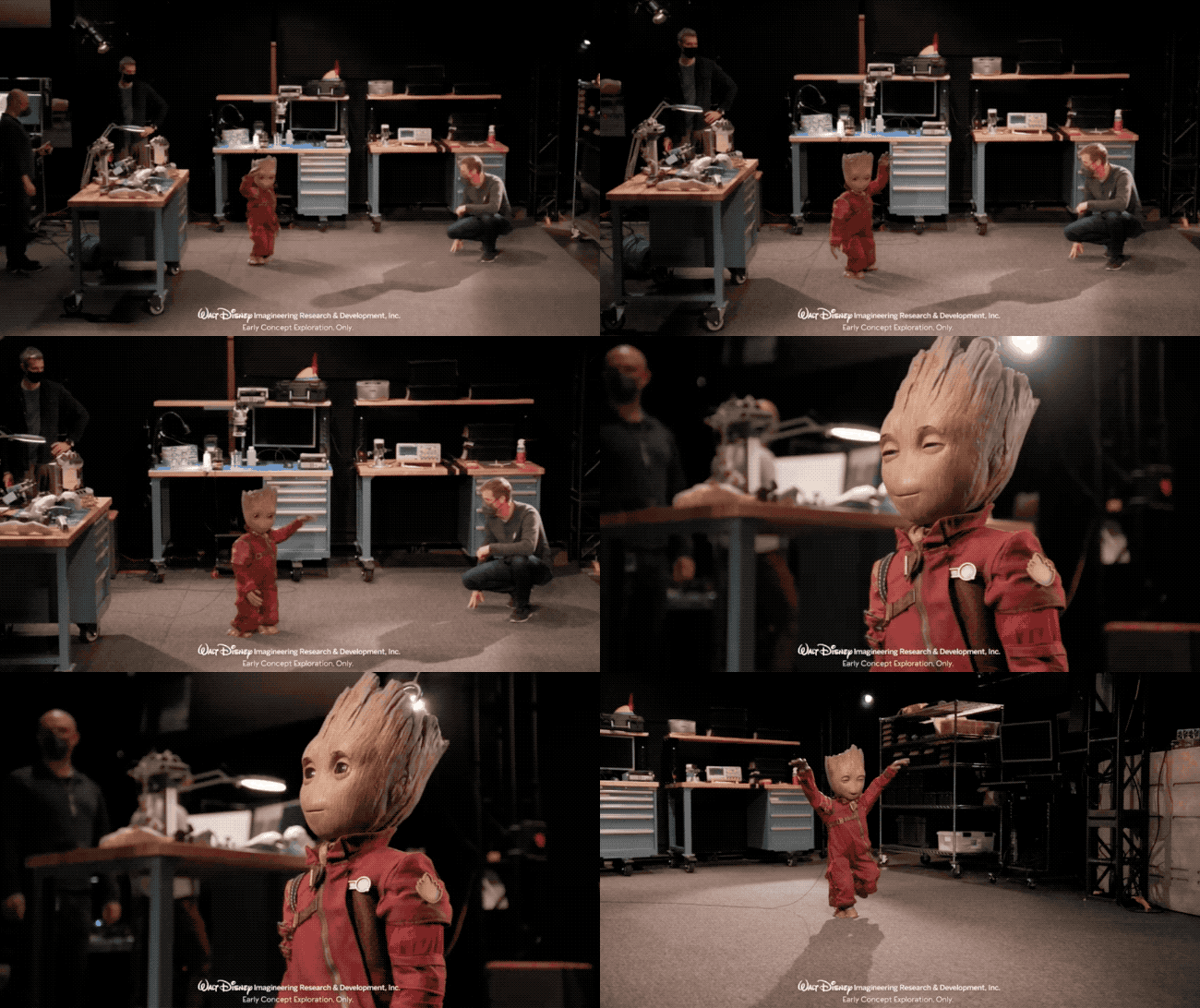
The black curtain pulls aside and a character straight out of the movies waves hello. This is not an uncommon occurrence when I’m around Imagineers, but this time is special. The character isn’t a costume, it’s a robot. And, unlike the m​any animatronic figures you’ve seen in the parks, it’s not stuck in one place.

The black curtain pulls aside and a character straight out of the movies waves hello. This is not an uncommon occurrence when I’m around Imagineers, but this time is special. The character isn’t a costume, it’s a robot. And, unlike the m​any animatronic figures you’ve seen in the parks, it’s not stuck in one place. No, this character is walking towards me, attached only by a thin cable used for programming. 

The gait is smooth, the arms swing in a lifelike manner and the feet plant realistically. The body sways exactly as you’d expect it to. There’s no other way to say it, it’s ambling. This is Project Kiwi, a small-scale, free-roaming robotic actor — the first of its kind for Disney and a real robotics milestone.

The holy grail of themed entertainment has been established for decades now: a fully mobile, bipedal character that matches the appearance, personality and scale of the original. Various non-mobile levels of this vision have been achieved at parks around the world, including the incredibly lifelike Na’Vi Shaman, The A1000 figure that powers characters like Star Wars: Galaxy’s Edge’s Hondo Ohnaka and the smoothly expressive Belle from Beauty and the Beast at Tokyo Disneyland. There have also been some cool mobile experiments like the self-piloting droid “Jake”. 

The pint sized character has accurately rendered textures on its face, hands and feet. It’s dressed in a distressed red flight suit that you may remember from the films. And its eyes are expressive as it looks at me and waves. This is the moment, the one that Disney Imagineers and park goers alike have been waiting decades to realize. This is a real, walk around character that is at the proper scale, kid scale. 

A couple of weeks ago at Walt Disney Imagineering in Southern California, I saw just how close they finally are to making that dream come true. A bipedal platform, developed completely in house over the past 3 years by WDI researchers and roboticists — dressed up to look like a roughly two and a half foot tall Groot.

Even though the version of Kiwi that I’m looking at is Groot-flavored, it’s important to stress that this is a platform first and foremost, which means that it could take this form when it gets to the parks, or another form entirely. It’s important while developing a character to have a target character that can tell you whether or not you’re hitting an established mark of believability. 

Kiwi is also is still very much a work in progress. I wouldn’t expect to see this in the wild soon, there is still a lot of work to be done on the way that Kiwi works and interacts with people and WDI does not have immediate plans to put it in the parks. 

But even at this stage it’s an incredible feat of engineering that genuinely radiates that elusive characteristic that Disney always searches for with its figures: presence.

How did we get here?

I was able to speak to the lead on Project Kiwi, R&D Imagineer Principal Scott LaValley as well as Advanced Development Studio Executive SVP Jon Snoddy about how the platform came together over the past few years. 

“Project KIWI started about three years ago to figure out how we can bring our smaller characters to life at their actual scale in authentic ways,” LaValley says. “It’s an exciting time for bipedal robotics and with an incredible team and our combination of technology, artistry, and magic, we are bringing characters to life that could not have happened anywhere but Disney.”

I’ve talked a bit about the unique Imagineering process in my previous pieces on how Disney builds reactive robotics, autonomous stuntbots and even entire lands. Imagineering works a lot like a startup in the way that it comes up with a problem to solve and then goes about pulling in other departments to help it get a solution. There is a remarkably ego-free nature to much of the way that WDI actually finds those solutions, too. They are as likely to find a key component off the shelf as they are to design, develop and patent it in house. 

The interconnected nature of Imagineering departments like ride design, show systems, special effects, animatronics department, Tech Studio R&D and Disney Research means that they share solutions across the stack as well.

The guiding thread to all of it, of course, is storytelling. This guiding force exists at all levels of the process, keeping the project moving in the right direction — towards a better way to tell stories and transport guests. 
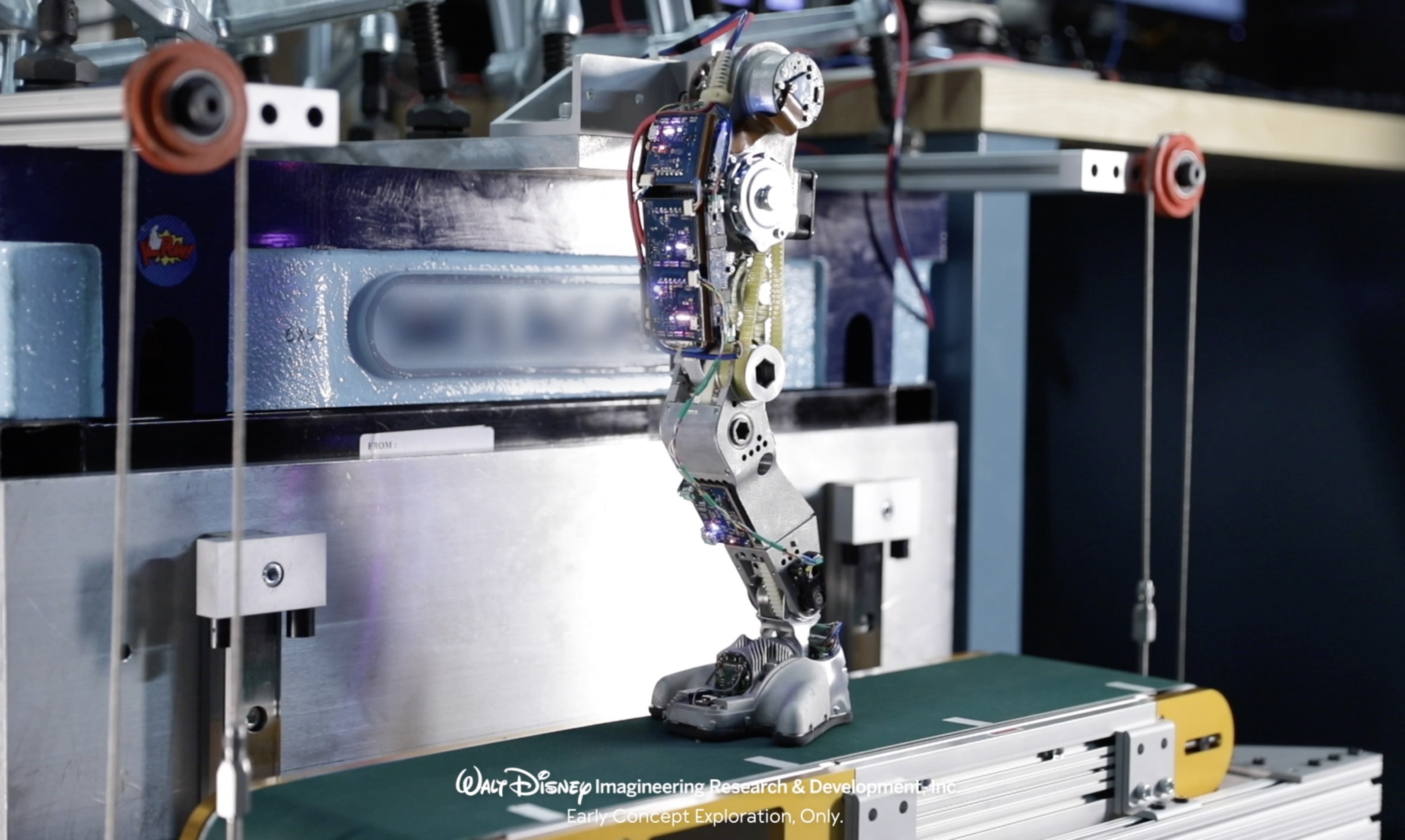
Image Credits: Walt Disney Imagineering R&D Inc.

With Kiwi, the end goal was clear, a character that could walk on its own and interact with park guests. Unfortunately, due to the scale and complexity of the figure and the requirements for interaction and walking, no ‘off the shelf’ platforms would do. The fact is that there are actually only a handful of truly viable bipedal robotics platforms anywhere in the world and the vast majority of them are being created for industrial applications, with a handful of ‘human-scale’ solutions that are designed as marketing set pieces rather than truly autonomous systems. 

So to hit that goal, Imagineering turned to R&D and LaValley’s team. LaValley had come to Disney from Boston Dynamics, where he worked on the first version of its biped robot Atlas. 

The project scope was that they needed a biped robot that was battery powered and could be programmed to handle autonomous interactions with park guests and striped gestures and emotes. The team would take the next 3 years to build what they needed — much of which was custom for reasons we’ll get into shortly. 
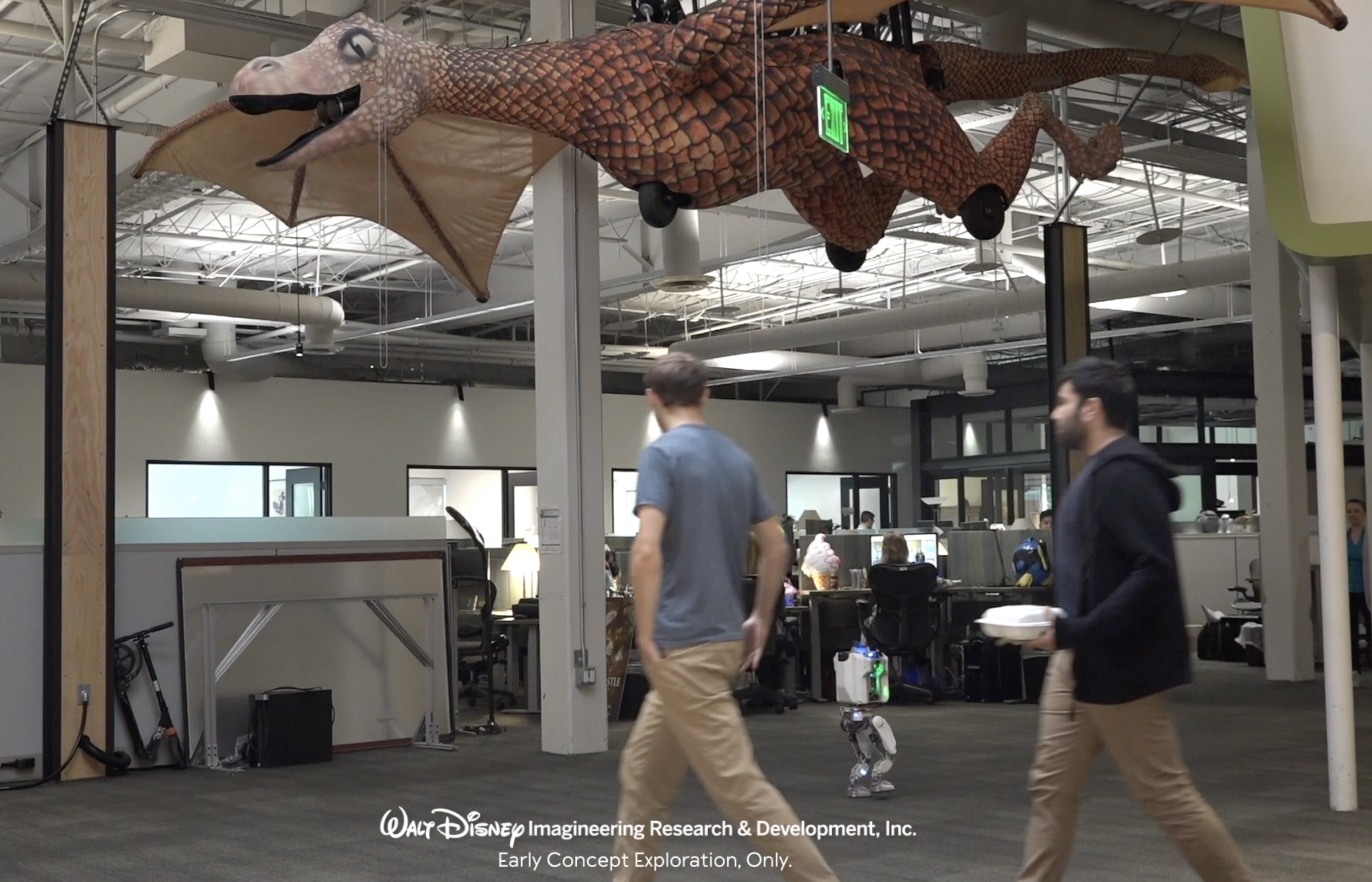
Image Credits: Walt Disney Imagineering R&D Inc.

It’s clear at a glance that Kiwi has no operator inside. The human brain is pretty good at instinctually understanding whether a space is just too small to have a person in it. In order to achieve the small size, the team had to first build a custom skeleton that had room for every motor and actuator Kiwi would need to achieve 50 degrees of freedom, all while keeping it humanoid in shape so that it could be ‘dressed up’ as any number of characters. 

First came the frame. Prototypes were built from custom printed polymer and then eventually custom metal parts using industrial printers. The armatures and segments that they needed to house the critical components were just too complex to mill or cast. The cleverly printed metal skeleton is hollow throughout, allowing a ‘marrow conduit’ for air which rushes through the body cooling the motors and actuators. In the current Kiwi prototype the air comes in through the collar area of the suit, flows throughout the body, propelled by fans embedded in the skeleton and exhausts near the bottom of the unit. Eventually it will use the clothing as a shroud to help air flow out near the feet.

Though there is some audible noise, even in this early state it is very low, allowing audio playing out of a speaker to enable conversation. 

As you can see in the exclusive progress video embedded above, the lower sections were built first. Early testing around the office shows the legs and torso sneaking, bouncing, shuffling and strutting through Imagineering. This is probably the only workplace in the world where the bottom half of a torso can tiptoe past your office while you’re eating lunch and it doesn’t even merit a pause between bites. 

An enormous amount of completely custom robotics work went into the Kiwi platform. In the demonstration I saw, young Groot had a safety tether and control cable for live programming but nothing on the rig itself needed support, it was free roaming with on board battery power that LaValley says hits around the 45 minute mark currently with more longevity hoped for in the final version. In fact, a next-generation skeleton is already under development that is lighter and more efficient.
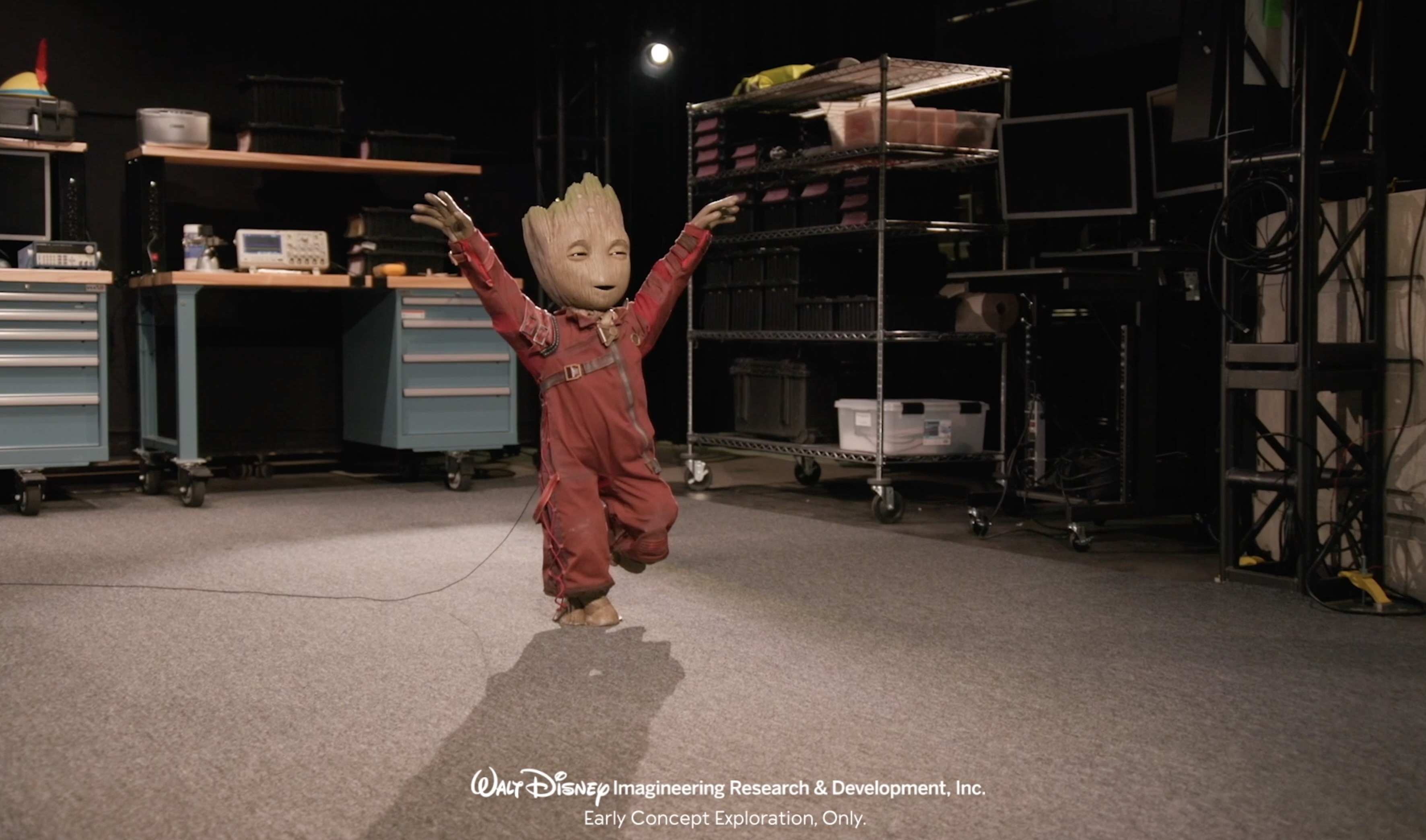
Image Credits: Walt Disney Imagineering R&D Inc. / Walt Disney Imagineering R&D Inc.

The legs use a system that offers a kinetic counter-balance, allowing the force of having to move and plant a foot to be off-set, making motions more power efficient and quicker. Think of a spring loaded heavy gate that makes it easier for you to swing open — but no springs, and a robotic limb instead of a gate.

The feet plant realistically for the very simple reason that they must actually support the figure. This gives it an additional layer of believability that just doesn’t happen with externally supported characters that “fake” a foot plant. LaValley demonstrated that the figure could easily stay afoot even if it was shoved gently or if a hand was rested on its shoulder. This kind of self-balancing is something that humans do unconsciously and continuously but it must be built and programmed in to an ambulatory robot. 

Many patentable inventions went into this creation. One of them is a clever system of gears that translates energy across joints, allowing them to share motors with one another even across a joint like a knee or wrist. This means fewer components and the ability to keep motor and actuator packages small and compact enough to fit underneath theming. 

In order to minimize the amount of wiring throughout Kiwi — since wires are always the biggest points of failure — the team created a set of origami-like circuit boards joined by integrated flex cabling. Think of your standard computer circuit board but sliced into segments and mounted to the exterior of the hollow ‘bones’. They wrap around the limbs and other body parts, binding the control systems and motors being controlled together into a local group that reduces the amount of harnessing that needs to be spread across joints and throughout the structure. 

No actuators — the components that decide how to move a limb — that exist had the capabilities that the team needed, so they built them from scratch. At one point, LaValley handed me a ring holding iteration after iteration of a dozen actuator elements. I was holding years worth of engineering, experimentation, failure and progress on a simple bit of wire twisted together at the end.

Up next for Project Kiwi is a new set of actuators that can dynamically apply torque plus added sensing capabilities for more stability and reaction to uneven ground or interactions. You can imagine that, as a free roaming character people will want to take pictures with it and I doubt kids would be able to resist running up for a hug. The skeleton must be able to sense and react quickly and smoothly to those sudden external inputs in order to stay upright and keep looking natural. 
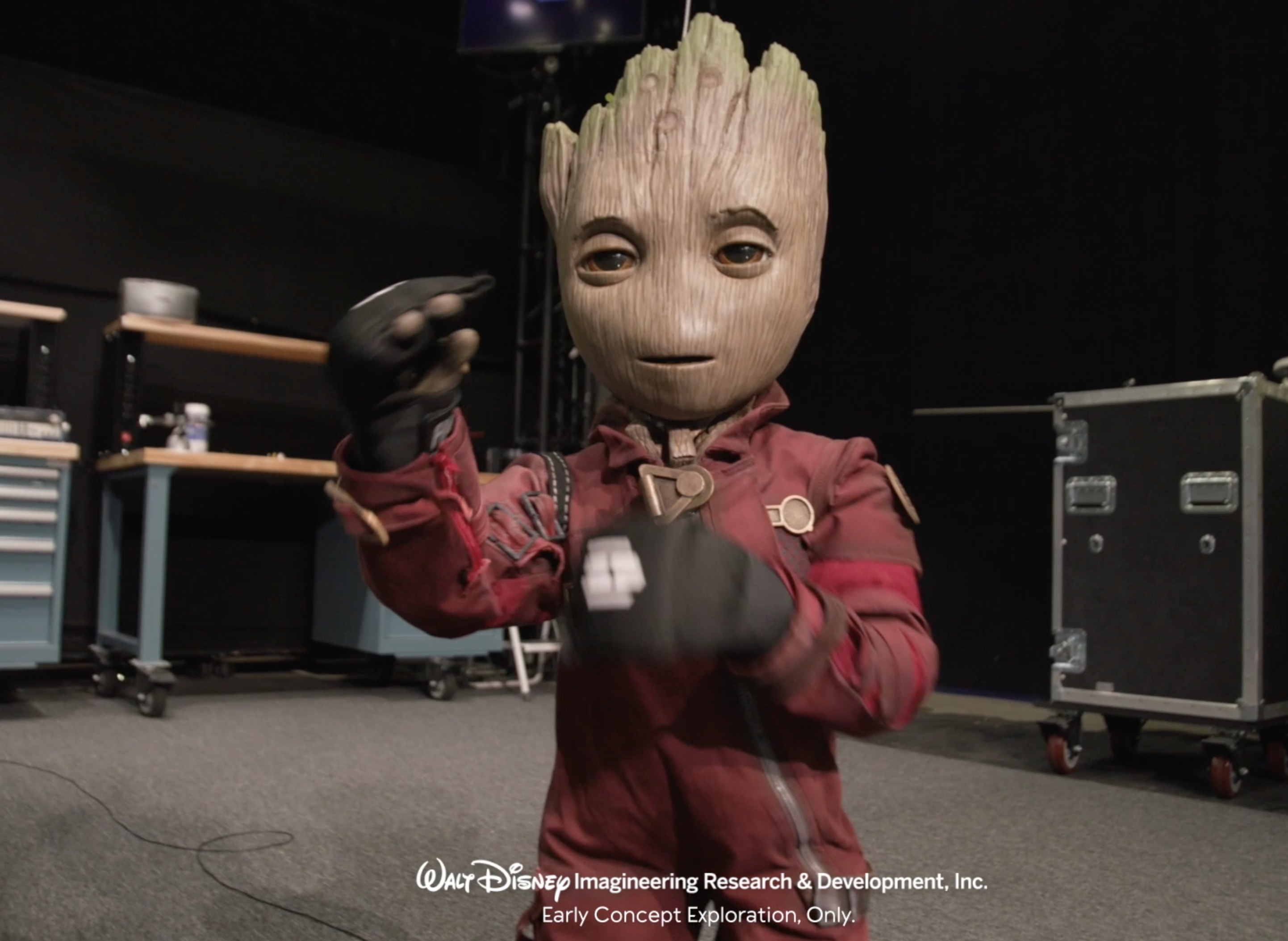
Image Credits: Walt Disney Imagineering R&D Inc. / Walt Disney Imagineering R&D Inc.

Moving from a pure IK system to a fully torque sensing system will allow for the platform to make on the fly adjustments that compensate for terrain or interaction with other performers or guests.

All of the work the team put into custom gearing, motors and actuation has paid off in spades with the ridiculously smooth and natural looking movements of Kiwi’s arms and legs. Quick waves, shrugs, dance moves and even boxing jabs all look like a real — if slightly gentle — creature is performing them. 

The team also demonstrated the custom built performance software that they designed which allows Kiwi to have different kinds of gaits with personality layered on top. The bottom layer is an IK-style gait system that keeps Kiwi upright and walking, but then layering the personalities on top adds character to the walk while still maintaining stability. Bouncy, jaunty walks, limps, sad or downhearted walks, all with the other motions of arms and head contributing to a constantly shifting center of mass and momentum. The paddling ducks feet under the water is that gait system that takes the external inputs and integrates it into the walk naturally.

The current prototype software has a series of set behaviors, with a timeline that allows them to program new behaviors and actions by toggles or adjusting curves that control movement. With a series of tweaks in the software the changes become evident immediately, with Groot’s “mood” becoming immediately evident in his walk. 

One moment he is bouncing along swinging his arms jauntily, clearly happy to be there. Then the next moment his arms are slumped, his head is hung and he is slowly plodding — clearly sad to be leaving the fun behind. It’s a remarkable bit of performance software. 

And even though the expressive eyes are already impressive — the team is not done. Up next on the agenda is a sensory package that allows Kiwi to more fully understand the world around it and to identify people and their faces. This becomes important because eye contact is such an emotive and powerful tool to use in transporting a participant. 

Even without the sensing software I can tell you that the experience of this 2.5ft Groot locking eyes with me, smiling and waving was just incredibly transportive. Multiple times throughout my interaction I completely forgot that it was a robot at all. 
As I mentioned at the top, the Project Kiwi platform still has a lot of work left to do before it makes any appearances in the parks. But it’s already well on the road to being viable for things like stage performances, photo ops and eventually free roaming deployment in the parks.

That is really the vision, Snoddy says that the goal is to move the characters we love from across Disney’s pantheon into the spaces of the guests, elevating the entirety of the park to a live transportive experience, rather than a single ride or dark room. And to do it at the proper scale to make them genuine and capable of making guests believe. With these kinds of platforms, the possibilities are there to make the entire parks themselves a living breathing home for the characters, rather than the tightly controlled environments of the rides themselves.

The arc of history in this Imagineering journeys is drawn in robots. From Great Moments with Mr Lincoln, to incredibly expressive characters like the Na’Vi Shaman anchored inside a dark ride, to characters that hold up in bright, well lit spaces. Project Kiwi is the next frontier, allowing them to step off of the pedestal and right into the world of the guest.

One of the most fascinating fields in robotics currently is HRI or human-robot interaction. This multidisciplinary effort to help humans and robots communicate better is often focused on safety and awareness in industrial settings. But I’ve long had that the most incredibly interesting work in this space is being done in Imagineering R&D. Over 100 million people pass through Disney’s parks per year, and the number of opportunities that they have to react to and interact with robotic characters grows yearly. And with projects like Kiwi on the horizon, this field is going to explode with new kinds of data and learnings. 

And, of course, we’ll get to meet some of our favorite characters looking and acting as real as we’ve ever seen them in our world. 

News: EU’s top data protection supervisor urges ban on facial recognition in public

The European Union’s lead data protection supervisor has called for remote biometric surveillance in public places to be banned outright under incoming AI legislation. The European Data Protection Supervisor’s (EDPS) intervention follows a proposal, put out by EU lawmakers on Wednesday, for a risk-based approach to regulating applications of artificial intelligence. The Commission’s legislative proposal

The European Union’s lead data protection supervisor has called for remote biometric surveillance in public places to be banned outright under incoming AI legislation.

The European Data Protection Supervisor’s (EDPS) intervention follows a proposal, put out by EU lawmakers on Wednesday, for a risk-based approach to regulating applications of artificial intelligence.

The Commission’s legislative proposal includes a partial ban on law enforcement’s use of remote biometric surveillance technologies (such as facial recognition) in public places. But the text includes wide-ranging exceptions, and digital and humans rights groups were quick to warn over loopholes they argue will lead to a drastic erosion of EU citizens’ fundamental rights. And last week a cross-party group of MEPs urged the Commission to screw its courage to the sticking place and outlaw the rights-hostile tech.

The EDPS, whose role includes issuing recommendations and guidance for the Commission, tends to agree. In a press release today Wojciech Wiewiórowski urged a rethink.

“The EDPS regrets to see that our earlier calls for a moratorium on the use of remote biometric identification systems — including facial recognition — in publicly accessible spaces have not been addressed by the Commission,” he wrote.

“The EDPS will continue to advocate for a stricter approach to automated recognition in public spaces of human features — such as of faces but also of gait, fingerprints, DNA, voice, keystrokes and other biometric or behavioural signals — whether these are used in a commercial or administrative context, or for law enforcement purposes.

“A stricter approach is necessary given that remote biometric identification, where AI may contribute to unprecedented developments, presents extremely high risks of deep and non-democratic intrusion into individuals’ private lives.”

Wiewiórowski had some warm words for the legislative proposal too, saying he welcomed the horizontal approach and the broad scope set out by the Commission. He also agreed there are merits to a risk-based approach to regulating applications of AI.

But the EDPB has made it clear that the red lines devised by EU lawmakers are a lot pinker in hue than he’d hoped for — adding a high profile voice to the critique that the Commission hasn’t lived up to its much trumpeted claim to have devised a framework that will ensure ‘trustworthy’ and ‘human-centric’ AI.

The coming debate over the final shape of the regulation is sure to include plenty of discussion over where exactly Europe’s AI red lines should be. A final version of the text isn’t expected to be agreed until next year at the earliest.

“The EDPS will undertake a meticulous and comprehensive analysis of the Commission’s proposal to support the EU co-legislators in strengthening the protection of individuals and society at large. In this context, the EDPS will focus in particular on setting precise boundaries for those tools and systems which may present risks for the fundamental rights to data protection and privacy,” Wiewiórowski added.


News: Semiconductor specialist Alphawave IP plans $4.5Bn London IPO and move to UK HQ

Alphawave IP is a global semiconductor IP company that focuses on the way semiconductors communicate — something which is going to be crucial as 5G data networks roll out and start to power everything from homes, industry and autonomous vehicles, for instance. It’s therefore interesting to note that the Toronto-born company is planning a London

Alphawave IP is a global semiconductor IP company that focuses on the way semiconductors communicate — something which is going to be crucial as 5G data networks roll out and start to power everything from homes, industry and autonomous vehicles, for instance.

It’s therefore interesting to note that the Toronto-born company is planning a London public listing, with a valuation of $4.5bn, and has raised $510m in backing from Blackrock and Janus Henderson. The company will also move its HQ to the UK as part of the listing.

The move is being welcomed by City-watchers concerned with UK tech stock listings, after the collapse of Deliveroo’s valuation post-IPO.

Chief executive Tony Pialis said: “We have chosen to come to the UK to grow our business because the UK has an incredible technology and semiconductor industry ecosystem around it. There is a deep pool of knowledge, experience, and talent here… We are specialists in connectivity. Our founding team have worked together for over 20 years and have a long history of both semiconductor innovation and in creating significant value for investors.”

The proposed listing comes in the context of another UK-based deep-tech company, the proposed sale of computer chip designer Arm Holdings to a US company, which has been delayed subject to an investigation about the implications for UK national security grounds.

News: SpaceX successfully launches astronauts with a re-used Dragon spacecraft for the first time

SpaceX has another successful human space launch to its credit, after a good takeoff and orbital delivery of its Crew Dragon spacecraft on Friday morning. The Dragon took off aboard a Falcon 9 rocket from Cape Canaveral in Florida at 5:49 AM EDT (2:49 AM EDT). On board were four astronauts, including NASA’s Megan McArthur

SpaceX has another successful human space launch to its credit, after a good takeoff and orbital delivery of its Crew Dragon spacecraft on Friday morning. The Dragon took off aboard a Falcon 9 rocket from Cape Canaveral in Florida at 5:49 AM EDT (2:49 AM EDT). On board were four astronauts, including NASA’s Megan McArthur and Shane Kimbrough, as well as JAXA’s Akihiko Hoshide and the ESA’s Thomas Pesquet.

This was Spacex’s second official astronaut delivery mission for NASA, after its Crew-1 operation last year. Unlike Crew-1, Crew-2 included use of two re-flown components in the spacecraft system, including the first stage booster, which was used during the Crew-1 launch, and the Dragon capsule, which was used for SpaceX’s first ever human spaceflight, the final demonstration mission of its spacecraft certification program for NASA, which flew Bob Behnken (side note: this mission’s pilot, McArthur, is Behnken’s wife) and Doug Hurley to the ISS. SpaceX has characterized the use of re-flown elements as arguably even safer than using new ones, with CEO Elon Musk noting that you wouldn’t want to be on the “first flight of an airplane when it comes out of the factory” during a conversation with XPRIZE’s Peter Diamandis on Thursday evening.

Now that the Crew Dragon is in its target transfer orbit, it’ll be making its way to rendezvous with the Space Station, which will take just under 24 hours. It’ll be docking with the station early tomorrow morning, attaching to a docking port that was just cleared earlier this month when SpaceX’s other Crew Dragon relocated to another port on the ISS earlier this month.

This launch also included a recovery attempt for the booster, with a landing at sea using SpaceX’s drone landing pad. That went as planned, meaning this booster which has already flown two different sets of human astronauts, could be used to fly yet another after refurbishment.

SpaceX’s Commercial Crew program with NASA continues to be the key success story in the agency’s move to partner with more private companies for its research and space exploration missions. NASA also recently tapped SpaceX to develop the human landing system for its Artemis program, which will return humans to the Moon for the first time since the Apollo program, and which will use SpaceX’s Starship spacecraft. For SpaceX’s human spaceflight program, the next big milestone will be its first flight of a mission made up entirely of paying private citizens, which is currently set to take place this fall.

News: The TechCrunch Germany Survey – Calling Hamburg, Munich, Cologne, Bielefeld, Frankfurt

TechCrunch is embarking on a major new project to survey European founders and investors in cities outside the larger European capitals. Over the next few weeks, we will ask entrepreneurs in these cities to talk about their ecosystems, in their own words. This is your chance to put Hamburg, Munich, Cologne, Bielefeld, Frankfurt on the

TechCrunch is embarking on a major new project to survey European founders and investors in cities outside the larger European capitals.

Over the next few weeks, we will ask entrepreneurs in these cities to talk about their ecosystems, in their own words.

This is your chance to put Hamburg, Munich, Cologne, Bielefeld, Frankfurt on the Techcrunch Map!

If you are a tech startup founder or investor in these cities please fill out the survey form here.

We are particularly interested in hearing from women founders and investors.

This is the follow-up to the huge survey of investors (see also below) we’ve done over the last six or more months, largely in capital cities.

These formed part of a broader series of surveys we’re doing regularly for ExtraCrunch, our subscription service that unpacks key issues for startups and investors.

In the first wave of surveys, the cities we wrote about were largely capitals. You can see them listed here.

This time, we will be surveying founders and investors in Europe’s other cities to capture how European hubs are growing, from the perspective of the people on the ground.

We’d like to know how your city’s startup scene is evolving, how the tech sector is being impacted by COVID-19, and generally how your city will evolve.

We leave submissions mostly unedited and are generally looking for at least one or two paragraphs in answers to the questions.

So if you are a tech startup founder or investor in one of these cities please fill out our survey form here.

Thank you for participating. If you have questions you can email mike@techcrunch.com and/or reply on Twitter to @mikebutcher.

News: Watch SpaceX launch its second crew of Space Station astronauts on a flight-proven Falcon 9 live

SpaceX is set to launch its second operational commercial crew mission to the International Space Station for NASA, with a liftoff time of 5:49 AM EDT (2:49 AM PDT) on Friday morning. The flight will carry four astronauts, including two from NASA, one from JAXA (the Japan Aerospace Exploration Agency) and one from the ESA

SpaceX is set to launch its second operational commercial crew mission to the International Space Station for NASA, with a liftoff time of 5:49 AM EDT (2:49 AM PDT) on Friday morning. The flight will carry four astronauts, including two from NASA, one from JAXA (the Japan Aerospace Exploration Agency) and one from the ESA (European Space Agency), to the station, where they will begin a regular tour of duty conducting science experiments, and maintaining and upgrading the orbital platform.

This is the second commercial crew mission for SpaceX, which officially qualified its Dragon spacecraft and Falcon 9 rocket for human flight last year. NASA then launched four astronauts using SpaceX’s human-certified launch system later that year in November, becoming the first private company to deliver people to the ISS, and the first American vehicle to do so since the retirement of the Space Shuttle in 2011. Since the end of that program, NASA has relied on buying rides aboard Russian Soyuz rockets to keep up its representation on the ISS.

There’s already a SpaceX Crew Dragon at the Space Station from that Crew-1 launch last year, and it was relocated to another port on the station earlier this month in preparation for the arrival of the one flying for Crew-2. The Crew-1 Dragon capsule is set to return back to Earth with astronauts on board once they’re relieved by this flight’s crew, likely later this month on April 28.

One major notable change for this launch is the use of a flight-proven Falcon 9 rocket booster. SpaceX has previously used new boosters fresh from the factory for its human launches, though it has a spotless track record when it comes to booster re-use for its cargo flights. It’s also the first re-use of a dragon spacecraft, and both components of this launch system actually previously supported human launches, with the first stage serving during Crew-1, and the Dragon capsule providing the ride for Demo-2, which flew astronauts Bob Behnken and Doug Hurley.

The astronauts on today’s flight are Shane Kimbrough and Megan McArthur from NASA, as well as Akihiko Hoshide from JAXA and Thomas Pesquet from the ESA. As mentioned, liftoff time is set for 5:49 AM EDT, but SpaceX will begin streaming live hours in advance at approximately 1:30 AM EDT on Friday (10:30 PM PDT on Thursday).

News: Citi Bike rival JOCO brings shared, docked e-bikes to NYC

Move over Citi Bike, there’s a new docked, shared bike service in town — only this one is all electric. Next week, JOCO will be the first shared operator in New York City to launch a network of e-bike stations on private property for public use. The service, powered by shared mobility platform Vulog, will

Move over Citi Bike, there’s a new docked, shared bike service in town — only this one is all electric. Next week, JOCO will be the first shared operator in New York City to launch a network of e-bike stations on private property for public use.

The service, powered by shared mobility platform Vulog, will start with 30 stations and 300 e-bikes located around Manhattan, expanding to 100 stations and 1,000 bikes by June. This is not the first new shared operator to hit the streets of New York this year. Last week, the city announced the winning companies of the e-scooter pilot in the Bronx. But while Bird, Lime and Veo are restricted to operating in a section of the Bronx, far from any Citi Bike territory, JOCO is under no such constraints.

The company’s bikes will initially be stationed at parking garages around the city, including at Icon Parking garages, the city’s largest parking operators, but the company says it hopes to expand to residential and commercial buildings in the near future. The company essentially pays landlords to provide this amenity, while absolving them from having to operate or maintain the e-bikes.

“What differentiates us from Citi Bike is, first of all, our bikes are 100% electric, 100% premium,” co-founder Jonathan “Johnny” Cohen from New York told TechCrunch. (The two co-founders are both named Johnathan Cohen — one is from New York, the other from London. JOCO…get it?). “You can reserve our bikes in advance, and as we’re on private property, there are hand sanitizer at our stations, the bikes aren’t getting rained on every night, they’re a bit cleaner and easier to access.”

A map of JOCO's launch e-bike dock locations

A map of JOCO’s 30 launch e-bike dock locations in NYC.

Citi Bike’s fleet is about 30% electric. To charge the e-bikes, the Lyft-owned company must manually take the drained vehicles from their stations to charge them, whereas JOCO’s vehicles are charged at the stations. Like Citi Bike, each e-bike can last for about 30 miles on a charge.

“That’s enough to get around Manhattan several times,” said London Jo (another moniker for differentiating between the two John/Jon Cohens). “We expect our vehicles to always be charged and ready to go for the customer. It defeats the purpose when you’re taking a bike that’s extremely sustainable, and then come along in a gas-burning vehicle to swap the battery. We’re looking to be a truly environmentally friendly company and provide a more consistent and reliable service.”

Founded in 2019 and funded privately by a group of former CEOs of Fortune 500 companies, and specifically investors with technology and real estate backgrounds, JOCO offers e-bikes at a price point that’s comparable, if not directly competitive, to Citi Bike. It’ll cost riders $1 to unlock the bike and .25 cents a minute, so a 10 minute ride will come out to $3.50. If you can find an electric Citi Bike, it’ll cost a rider $3.50 to unlock and .18 cents a minute, which comes out to about $5.30.

“That’s significantly cheaper in our opinion for a brand new, gorgeous, full electric premium bike,” said NY Jo.

Neither company charges unlock fees for members. JOCO’s monthly membership is $49 per month with unlimited use, and Citi Bike’s is $20 per month, with monthly members continuing to pay 18 cents per minute, and annual members paying 12 cents per minute. Under Citi Bike’s annual membership, if a rider is averaging out about five 10-minute rides per week, the monthly spend is comparable between the two companies.

“Citi Bike has been around since 2013 and has done a tremendous job at driving cycling adoption on the streets of NYC,” Monica Wejman, Vulog’s North America managing director, told TechCrunch. “And now you have JOCO entering this space, powered by Vulog, really there to complement Citi Bike and satisfy what we’re seeing as a significant increase in demand for access to e-bikes. We’re truly empowering mobility operators to launch mobility programs at scale.”

While JOCO will not be reliant on the NYC Department of Transportation to carve out street and sidewalk space for docking stations, the operator is still taking steps to ensure a good working relationship with the city.

London Jo says JOCO’s bikes are made with safety-critical features, like hidden cables to make them less susceptible to vandalism, puncture-proof airless tires and bike-tracking, provided by Vulog’s backend.

“In addition, by operating in private spaces, we’re eliminating that problem of sidewalk clutter for the city,” said the British Cohen. “And they don’t have to worry about what has to go to fit 50 new bikes on the street. We’re taking a big headache off them, and it’s allowing us to stay in control a little bit more and not have to depend on the city.”

News: Daily Crunch: First impressions of Apple’s AirTags

We test out Apple’s lost item finder, Google Fi gets a new unlimited plan and Facebook tests new video ad targeting features. This is your Daily Crunch for April 22, 2021. The big story: First impressions of Apple’s AirTags AirTags are Apple’s new Tile competitor designed to help owners locate lost objects. They use Bluetooth

We test out Apple’s lost item finder, Google Fi gets a new unlimited plan and Facebook tests new video ad targeting features. This is your Daily Crunch for April 22, 2021.

The big story: First impressions of Apple’s AirTags

AirTags are Apple’s new Tile competitor designed to help owners locate lost objects. They use Bluetooth technology to announce their presence to nearby devices with iOS 14.5 or above.

Matthew Panzarino tried them out and reported that it could take 30 seconds or more to locate an AirTag. But once located, Apple was able to provide directions that were “extremely accurate down to a few inches.”

Matthew also got his hands on the purple iPhone and was extremely excited.

The tech giants

Google Fi turns 6 and gets a new unlimited plan — The new “Simply Unlimited” plan starts at $60 per month for a single line.

Apple downplays complaints about App Store scams in antitrust hearing — Apple was questioned on its inability to rein in subscription scammers on its App Store during yesterday’s Senate antitrust hearing.

Facebook tests topic targeting for in-stream video ads — The company says there are now 2 billion people each month who watch videos that are eligible for in-stream ads.

Startups, funding and venture capital

Tiger Global backs Indian crypto startup at over $500M valuation — CoinSwitch Kuber allows young users in India to invest in cryptocurrencies.

Universal Hydrogen raises $20.5M Series A to help launch hydrogen aviation — Universal Hydrogen aims to develop hydrogen storage solutions and conversion kits for commercial aircraft.

MasterClass co-founder’s Outlier.org raises $30M for affordable, virtual college courses — Like MasterClass, Outlier offers beautifully shot online courses; unlike MasterClass, students can actually earn college credit.

Advice and analysis from Extra Crunch

How are VCs handling diligence in a world where deals open and close in days, not months? — For venture capitalists, the timeline for reaching conviction around a startup’s thesis and executing due diligence has become compressed.

Five emerging use cases for productivity infrastructure in 2021 — Cloud communications services, API platforms, low-code development tools, business process automation and AI software development kits grew exponentially in 2020.

Customer care as a service: Outsourcing can help your startup wow clients 24/7 — Your clients might not demand 24/7 customer service yet, but they’re certainly hoping for it.

(Extra Crunch is our membership program, which helps founders and startup teams get ahead. You can sign up here.)

Everything else

Look at this tiny new Polaroid camera can you believe it — The company says its latest camera, the Polaroid Go, is the world’s smallest analog instant camera.

To ensure inclusivity, the Biden administration must double down on AI development initiatives — EqualAI’s Miriam Vogel argues that left unchecked, seemingly neutral artificial intelligence tools can and will perpetuate inequalities.

Alexa von Tobel will join Disrupt 2021 as a Startup Battlefield judge — Battlefield applications are now open, so don’t hesitate to throw your hat in the ring!

The Daily Crunch is TechCrunch’s roundup of our biggest and most important stories. If you’d like to get this delivered to your inbox every day at around 3pm Pacific, you can subscribe here.

News: Deepfake tech takes on satellite maps

While the concept of “deepfakes,” or AI-generated synthetic imagery, has been decried primarily in connection with involuntary depictions of people, the technology is dangerous (and interesting) in other ways as well. For instance, researchers have shown that it can be used to manipulate satellite imagery to produce real-looking — but totally fake — overhead maps

While the concept of “deepfakes,” or AI-generated synthetic imagery, has been decried primarily in connection with involuntary depictions of people, the technology is dangerous (and interesting) in other ways as well. For instance, researchers have shown that it can be used to manipulate satellite imagery to produce real-looking — but totally fake — overhead maps of cities.

The study, led by Bo Zhao from the University of Washington, is not intended to alarm anyone but rather to show the risks and opportunities involved in applying this rather infamous technology to cartography. In fact their approach has as much in common with “style transfer” techniques — redrawing images in an impressionistic, crayon, and arbitrary other fashions — than with deepfakes as they are commonly understood.

The team trained a machine learning system on satellite images of three different cities: Seattle, nearby Tacoma, and Beijing. Each has its own distinctive look, just as a painter or medium does. For instance, Seattle tends to have larger overhanging greenery and narrower streets, while Beijing is more monochrome and — in the images used for the study — the taller buildings cast long, dark shadows. The system learned to associate details of a street map (like Google or Apple’s) with those of the satellite view.

The resulting machine learning agent, when given a street map, returns a realistic-looking faux satellite image of what that area would look like if it were in any of those cities. In the following image, the map corresponds to the top right satellite image of Tacoma, while the lower versions show how it might look in Seattle and Beijing.

Four images show a street map and a real satellite image of Tacoma, and two simulated satellite images of the same streets in Seattle and Beijing.

Image Credits: Zhao et al.

A close inspection will show that the fake maps aren’t as sharp as the real one, and there are probably some logical inconsistencies like streets that go nowhere and the like. But at a glance the Seattle and Beijing images are perfectly plausible.

One only has to think for a few minutes to conceive of uses for fake maps like this, both legitimate and otherwise. The researchers suggest that the technique could be used to simulate imagery of places for which no satellite imagery is available — like one of these cities in the days before such things were possible, or for a planned expansion or zoning change. The system doesn’t have to imitate another place altogether — it could be trained on a more densely populated part of the same city, or one with wider streets.

It could conceivably even be used, as this rather more whimsical project was, to make realistic-looking modern maps from ancient hand-drawn ones.

And should technology like this be bent to less constructive purposes, the paper also looks at ways to detect such simulated imagery using careful examination of colors and features.

The work challenges the general assumption of the “absolute reliability of satellite images or other geospatial data,” said Zhao in a UW news article, and certainly as with other media that kind thinking has to go by the wayside as new threats appear. You can read the full paper at the journal Cartography and Geographic Information Science.

News: To sell or not to sell: Lessons from a bootstrapped CEO

Regardless of a young company’s struggles or success, sooner or later the question of when, how or whether to sell the enterprise presents itself. It’s the biggest question a founder will face.

Glen Rabie
Contributor

Glen Rabie is co-founder and CEO of Yellowfin, a global analytics and BI software vendor.

The clock begins ticking on a startup the day the doors open. Regardless of a young company’s struggles or success, sooner or later the question of when, how or whether to sell the enterprise presents itself. It’s possibly the biggest question an entrepreneur will face.

For founders who self-funded (bootstrapped) their startup, a boardroom full of additional factors come into play. Some are the same as for investor-funded firms, but many are unique.

Put happiness at the center of the decision, and let your intuition — the instincts that made you the person you are today — be your guide.

After 18 years of bootstrapping a BI software firm into a business that now serves 28,000 companies and three million users in 75 countries, here’s what I’ve learned about myself, my company, about entrepreneurship and about when to grab for that brass ring.

Profitable or bust

Starting a software company 7,900 miles southwest of Silicon Valley requires some forethought and not a small amount of crazy. When we opened, it didn’t occur to us that one could have an idea and then go knock on someone’s door and ask for money.

Bootstrapping forced us to be a bit more creative about how we would go about building our company. In the early days, it was a distraction to growth, because we were doing other revenue-generating activities like consulting, development work, whatever we could find to keep ourselves afloat while we built Yellowfin. It meant we couldn’t be 100% focused on our idea.

However, it also meant we had to generate income from our new company from Day One — something funded companies don’t have to do. We never got into the mindset that it was okay to burn lots of cash and then cross our fingers and hope that it worked.

WordPress Image Lightbox Plugin