Tag Archives: Blog

News: Should you give an anchor investor a stake in your fund’s management company?

Raising capital for a new fund is always hard. But should you give preferential economics or other benefits to a seed anchor investor who makes a material commitment to the fund?

David Teten
Contributor

David Teten is founder of Versatile VC and writes periodically at teten.com and @dteten.

Raising capital for a new fund is always hard. But should you give preferential economics or other benefits to a seed anchor investor who makes a material commitment to the fund?

These “VCs for investment management companies” are also known as GP stake investors or fund platforms. According to DocSend, “About half the VC firms in our survey had an anchor LP for their fund, and the average percentage that an anchor LP took in a first-time fund was 25%. The prevalence of anchor LPs among both early-stage and more established firms in our data suggests that securing an anchor investor can be crucial for signaling a firm’s credibility to other potential LPs.”

However, data about whether those anchors received preferential terms are very hard to obtain.

“In the hedge fund world, fund platforms are common and therefore more transparent,” Ha Duong, the investment principal at Ocean Investment, a single-family office based in Berlin, told me. “In venture, I haven’t seen many fund platforms.”

A number of firms provide infrastructure for emerging VCs, including Capria, Draper Venture Network, Oper8r and Recast Capital, and may provide capital or assistance in raising capital.

However, this ecosystem is much more built out in the private equity and hedge fund spaces. Examples include Archean Capital Partners, Gatewood Capital Partners, Lafayette Square, Nesvold Capital Partners and Reservoir Capital Group. Certain family offices also make these investments on an ad-hoc basis. As do some VCs: LuneX.com notes it is a dedicated blockchain and cryptocurrency fund that partners with a Southeast Asia-based VC, Golden Gate Ventures.

A GP stake investor brings some significant advantages:

  • Meaningful upfront initial capital, usually greatly shortening the lengthy fundraising process. This can be particularly helpful for founders who do not come from a wealthy background and may not be able to forgo an income for an 18-month fundraising period.
  • Credibility. This is proportionate to the stake investor’s credibility. Everyone else will assume the GP stake investor did extensive due diligence.
  • Assistance in business development, marketing, risk management and governance.
  • Ability to access LPs who require meaningful assets under management (AUM) before they’ll consider you.
  • Back office, in some cases.

There can also be meaningful disadvantages to working with a GP stake investor:

News: India restricts American Express from adding new customers for violating data storage rules

India’s central bank has restricted American Express and Diners Club from adding new customers starting next month, it said Friday, citing violation of local data-storage rules. In a statement, the Reserve Bank of India said existing customers of either of the two card companies will not be impacted by the new order, which goes into

India’s central bank has restricted American Express and Diners Club from adding new customers starting next month, it said Friday, citing violation of local data-storage rules.

In a statement, the Reserve Bank of India said existing customers of either of the two card companies will not be impacted by the new order, which goes into effect May 1.

This is the first time India’s central bank has penalized any firm for noncompliance with local data-storage rules, which was unveiled in 2018. The rules require payments firms to store all Indian transaction data within servers in the country.

Visa, Mastercard and several other firms, as well as the U.S. government, have previously requested New Delhi to reconsider its rules, which is designed to allow the regulator “unfettered supervisory access.”

Visa, Mastercard and American Express had also lobbied to either significantly change the rules or completely discard it. But after none of those efforts worked, most firms began to comply.

In a statement Friday evening (local time), an Amex spokesperson said the company was “disappointed that the RBI has this course of action,” but said was working with the authority to resolve the concerns “as quickly as possible.”

With about 1.5 million customers, American Express has amassed the highest number of customers among foreign banks in India.

“We have been in regular dialogue with the Reserve Bank of India about data localization requirements and have demonstrated our progress towards complying with the regulation. […] This does not impact the services that we offer to our existing customers in India, and our customers can continue to use and accept our cards as normal.”

Diners Club, which is owned by Discover Financial Services and offers credit cards in India through a partnership with the nation’s largest private sector bank (HDFC), said in a statement that India remains an important market for the firm and it is working with the central bank to reach a resolution so that it can “continue to grow in the country.”

Last year, India’s central bank ordered HDFC Bank to not add new credit customers or launch digital businesses after the bank’s services were hit by a power outage.

Friday’s order comes as Citigroup, another key foreign bank in India, has announced plans to exit most of its Asian consumer business as it looks to boost its profitability. The consumer operations of the bank in 13 countries is up for sale.

News: Just one week left to save $100 on TC Early Stage 2021: Marketing and Fundraising

Don’t let procrastination slow your roll. Yeah, we’re looking at you, early-stage founders. At TechCrunch, we love to reward action with savings. Want to save a cool $100? Buy your Early Stage 2021: Marketing & Fundraising pass before April 30, at 11:59 p.m. (PT), and you’ll keep a cool $100 in your pocket. Take action,

Don’t let procrastination slow your roll. Yeah, we’re looking at you, early-stage founders. At TechCrunch, we love to reward action with savings. Want to save a cool $100? Buy your Early Stage 2021: Marketing & Fundraising pass before April 30, at 11:59 p.m. (PT), and you’ll keep a cool $100 in your pocket.

Take action, reap savings and get ready to join your community of early-inning startup founders for a two-day bootcamp (July 8-9) dedicated to helping you build a firm foundation for entrepreneurial success. We’re talking a day packed with highly interactive presentations, breakout sessions and plenty of time for Q&As with top-tier industry leaders and experts — plus a thrilling day-long pitch competition.

Part one of TC Early Stage 2021, which took place in April, featured folks like entrepreneur and VC Melissa Bradley, who delivered advice on nailing a virtual pitch meeting; Alexa von Tobel lead a discussion on finance for founders; and Fuel Capital’s Leah Solivan revealed 10 things not to do when you start a company.

Here’s just one example of the quality topics and guidance you can expect at TC Early Stage 2021 in July.

Plenty of founders struggle to find, or even define, product-market fit. And let’s face it, without the proper product-market fit, you basically have two chances of raising a unicorn: slim and fat. That’s why you won’t want to miss out on what Superhuman founder, CEO and product-market fit master Rahul Vohra has to say on the subject. Bring your questions and take advantage of his invaluable advice.

Pro Tip: We’re building our July agenda and announcing new speakers every week (like Mike Duboe and Sarah Kunst) — stay tuned!

Wondering whether attending TC Early Stage 2021: Marketing & Fundraising is worth your time and money? Here’s what two founders shared about their experience at last year’s event.

Early Stage 2020 provided a rich, bootcamp experience with premier founders, VCs and startup community experts. If you’re beginning to build a startup, it’s an efficient way to advance your knowledge across key startup topics. — Katia Paramonova, founder and CEO of Centrly.

Sequoia Capital’s session, Start with Your Customer, looked at the benefits of storytelling and creating customer personas. I took the idea to my team and we identified seven different user types for our product, and we’ve implemented storytelling to help onboard new customers. That one session alone has transformed my business. — Chloe Leaaetoa, founder, Socicraft.

TC Early Stage 2021: Marketing & Fundraising takes place on July 8-9, and you have just one week left to save $100 on the price of admission. Kick procrastination to the curb and keep more money in your wallet. Buy your TC Early Stage 2021 pass before April 30, at 11:59 p.m. (PT).

Is your company interested in sponsoring or exhibiting at Early Stage 2021 – Marketing & Fundraising? Contact our sponsorship sales team by filling out this form.

News: Norwest Venture Partners’ Lisa Wu to teach founders how to think like a VC at TC Early Stage

The best venture capitalists take moonshot risks based on due diligence, support portfolio companies through ups and downs and find focus through noise. When you look at the job description of the best founder, you’ll find nearly the exact same list of characteristics (except, of course, instead of a portfolio, the founder is supporting a

The best venture capitalists take moonshot risks based on due diligence, support portfolio companies through ups and downs and find focus through noise.

When you look at the job description of the best founder, you’ll find nearly the exact same list of characteristics (except, of course, instead of a portfolio, the founder is supporting a team of employees). The shared ethos is almost uncanny — and includes a slew of strategic synergies both sides of the table can exploit.

That’s why we’re excited to announce that Lisa Wu, a partner at Norwest, is joining us at TechCrunch Early Stage in July to talk tactics, and how founders can think like a VC in all facets of their business.

Wu focuses on seed to late-stage companies with a specific interest in consumer internet, digital commerce and next-generation marketplaces. Her portfolio includes Calm, Ritual, Plaid and the recently public Opendoor.

With the inside scoop on these iconic companies, Wu will use her experience to illustrate how the best founders can leverage the language of venture capital in the pitch and beyond. The goal is to give the audience a list of actionable insights to implement immediately — and lean heavily on anecdotes found in Wu’s impressive work in the industry.

Tickets for TC Early Stage: Marketing & Fundraising are available at the early-bird rate, which gives you an instant $100 savings if you book before next week!


News: Introvoke raises $2.7M to power online events that can be embedded anywhere

While there’s been plenty of attention and money lavished on virtual event platforms over the past year, Introvoke co-founder and CEO Oana Manolache predicted that we’re only at the beginning of a “third wave of digital transformation.” In her framing, the first wave came at the beginning of the pandemic, when everyone was using video

While there’s been plenty of attention and money lavished on virtual event platforms over the past year, Introvoke co-founder and CEO Oana Manolache predicted that we’re only at the beginning of a “third wave of digital transformation.”

In her framing, the first wave came at the beginning of the pandemic, when everyone was using video conferencing tools like Zoom for their virtual events. Next came conference platforms like Hopin (which has been raising money at a mind-boggling clip). But Manolache argued that even Hopin represents a “Band-Aid” that customers are hoping will tide them over until in-person events can resume — particularly when organizers have to point attendees to a third-party platform.

“One size does not fit all,” she said. “The Band-Aid solution that was only supposed to last for a couple months has had big benefits as companies grew their customer base and revenue targets. Now we’ve reached the third wave, as organizations want to bring solutions to their own universe and own their relationship with the audience.”

San Francisco-based Introvoke is a Techstars Accelerator graduate aiming to provide this third-wave solution. It’s announcing today that it has raised $2.7 million in funding led by Struck Capital, while Comcast, Social Leverage, Great Oaks, V1vc, Time CTO Bharat Krish and Resy co-founder Mike Montero also participated.

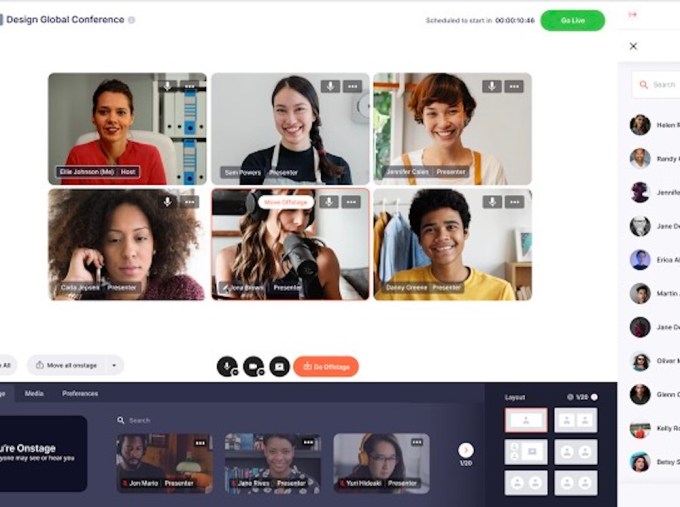
The startup offers components like virtual stages, chat rooms and networking hubs, all customizable and embeddable on a customer’s website. Manolache said Introvoke (the name comes from the idea of “thought-provoking introductions”) is designed for a hybrid future, which will take multiple forms: “Hybrid is going to mean virtual-only events, in-person only events and events that have in-person and virtual elements.”

Introvoke

Image Credits: Introvoke

Introvoke charges customers based on live event minutes, a model that it says is accessible to companies large and small. Its components can be embedded on websites built with WordPress, Squarespace, Wix, Splash and other platforms, but also on a customer’s internal intranet.

“We’ve been so impressed by the way customers are using the technology — conferences, career fairs, employee engagements,” Manolache said.

She added that as customers like Comcast, Wharton and Ritual Motion have used the platform in private preview mode, they’re beginning to break free of the in-person model. For example, Introvoke events can allow for attendees to chat with each other over weeks or months, not just a few days.

In a statement, Struck Capital founder and Managing Partner Adam B. Struck suggested that virtual events “will continue far beyond the COVID-19 pandemic.”

“Right now, virtual experiences, from conferences and concerts to company all-hands, are generally hosted on third party platforms, which creates a disjointed experience for the brand or organization hosting the event,” he continued. “Virtual enablement should be native to the website and platform of the enterprise itself, and it’s the role of technologists like the Introvoke team to make these experiences as seamless as any in-person event.”

News: Hyundai invests in teleoperations startup Ottopia as part of $9M round

After spending much of his career in mission-critical environments, including the Israeli Air Force, Israeli Intelligence and leading development of a cybersecurity product at Microsoft, Amit Rosenzweig turned his attention to autonomous vehicles. It was a technology that he soon recognized would need what every other mission-critical system requires: humans.  “I understood that there are

After spending much of his career in mission-critical environments, including the Israeli Air Force, Israeli Intelligence and leading development of a cybersecurity product at Microsoft, Amit Rosenzweig turned his attention to autonomous vehicles.

It was a technology that he soon recognized would need what every other mission-critical system requires: humans. 

“I understood that there are so many edge cases that will not be solved purely by AI and machine learning, and there must be some kind of human-in-the-loop intervention,” Rosenzweig said in a recent interview. “You don’t have any mission-critical system on the planet — not nuclear power plants, not airplanes — without human supervision. A human must be in the loop or present in some way for autonomous mobility to exist, even in 10 or probably 20 years from now.”

That “human in the loop” conclusion led Rosenzweig to found teleoperations startup Ottopia in 2018. (His brother, Oren Rosenzweig is also in the autonomous vehicle business via the lidar company he co-founded, Innoviz.) Ottopia’s first product is a universal teleoperation platform that allows a human operator to monitor and control any type of vehicle from thousands of miles away. Ottopia’s software is combined with off-the-shelf hardware components like monitors and cameras to create a teleoperations center. The company’s software also includes assistive features, which provide “path” instructions to the AV without having to remotely control the vehicle.

Since launching, the small 25-person company has racked up investors and partners such as BMW, fixed-route AV startup May Mobility and Bestmile. Ottopia said Friday that it has raised $9 million from Hyundai Motor Group as well as Maven and IN Venture, the Israel-focused venture capital arm of Sumitomo Corporation. Existing investors MizMaa and Israeli firm NextGear also participated.

Hyundai and IN Venture also gained board seats. Woongjun Jang, who heads up Hyundai’s autonomous driving center, and IN Venture managing partner Eyal Rosner, are now on Ottopia’s board.

Ottopia has raised a total of $12 million to date, and Rosenzweig has already set his sights on a larger round to help fund the company’s growth.

For now, Rosenzweig is focused on doubling his workforce to 50 people by the end of the year and opening an office in the United States. Rosenzweig said the company is also expanding into other applications of its teleoperations software, including defense, mining and logistics. However, most of Ottopia’s resources will continue to be dedicated to automotive, and specifically the deployment of autonomous cars, trucks and shuttles.

“The motivation is really simple — it’s simple but it’s hard to do — and that’s to make affordable autonomous transportation closer to reality,” Rosenzweig said. “The problem of course is that when an AV does not have any kind of backup or any kind of safety net in the form of teleoperations and it gets stuck, passengers are going to get anxious, ‘what’s going on, why, why is this not moving’.”

The other problem, Rosenzweig noted, is that AVs need to be combined with an efficient transit service. That’s where he sees his newest partner, on-demand shuttle and transit software company Via, coming in.

Under the partnership, which was also announced this week, Via will offer autonomous vehicle fleets that combine its fleet management software with Ottopia’s teleoperations platform. Via is not developing its own self-driving software system. In November 2020, Via announced it had partnered with May Mobility to launch an autonomous vehicle platform that integrates on-demand shared rides, public transportation and transit options for passengers with accessibility needs.

News: After going public, once-hot startups are riding a valuation roller coaster

This is why I only buy index funds. No one knows what anything (interesting) is worth.

To close out the week, a short meditation on value, or, more precisely, how assets are valued in today’s markets.

Do you recall the pre-direct-listing hype Coinbase enjoyed? After reporting its estimated first-quarter financial performance, interest in the domestic cryptocurrency trading giant ran red-hot.

When Coinbase set a $250 per-share direct listing reference price, it was broadly viewed as modest, if not downright low. Of course, a reference price is just that — a reference — so it wasn’t too big a deal. But it also wasn’t surprising that Coinbase shares traded as high as $429.54 on their first day, according to Yahoo Finance data.

Coinbase equity hasn’t topped $400 in any following day and is now under the $300 mark, with more declines set to arrive as trading commences. Its reference price looms, and suddenly a price that felt intensely conservative before Coinbase began to trade is starting to look nearly reasonable.


The Exchange explores startups, markets and money. 

Read it every morning on Extra Crunch or get The Exchange newsletter every Saturday.


There have been other notable declines in value among some recently public, more technologically differentiated companies. The Exchange has watched with something akin to polite confusion as the value of Root, a neo-insurance company, fell to a third of its public-market highs after going public, even though it beat growth expectations in its most recent quarterly report.

We could toss UiPath into our trend of wildly meandering value. The company’s initial IPO price range targeted a price as low as $43 per share. Today it’s worth $76.75 per share in pre-market trading.

No one knows what anything is worth, again. This is the feeling I get while watching the markets work to determine how to value assets as diverse as startups crossing the private-public divide to the value of Bitcoin, which was supposed to keep going up. Until it suddenly reversed gear.

Frankly, we’re still dealing with new-enough models — or big-enough guesses about the future baked into business models — that it’s hard to really value the most uncertain (and therefore most exciting) companies, let alone cryptocurrencies. Let’s discuss.

Value?

News: Since colleges are failing to prepare students for tech jobs, it’s time to bring back apprenticeships

In the explosion of edtech businesses with new approaches, we are in danger of overlooking an established model that can be adapted to solve these challenges. That model is apprenticeships.

Sophie Ruddock
Contributor

Sophie Ruddock is VP, GM North America at Multiverse, a tech startup focused on high-quality education and training through professional apprenticeships.

Ryan Craig
Contributor

Ryan Craig is managing director of Achieve Partners, an investment firm focused at the intersection of education and employment, and author of “A New U: Faster + Cheaper Alternatives to College.”

You can always tell a system is broken when you change the inputs and the outcomes don’t improve. Any software engineer will tell you that.

Using this metric, it’s clear the United States’ antiquated higher education system is truly broken. Overpriced and underperforming, the system is failing on two key fronts: addressing racial inequalities and closing our country’s growing tech skills gaps.

For all the changes made to the system to welcome people of color into the classroom, the outcomes in terms of wealth, equity distribution and representation are worse than ever.

On average, Black college graduates owe $25,000 more in student debt than their white peers. Worse still, four years after throwing their caps in the air, 48% of Black graduates owe an average of 12.5% more than they borrowed in the first place.

A labor market built on degree requirements has little hope of correcting course.

While colleges and universities do as good a job as they’ve ever done at preparing students with the cognitive and critical thinking skills they’ll need to be successful in the long run, the college system just isn’t providing the right training for jobs in 2021.

Looking past the college experience, the unemployment rate for Black Americans stands at nearly 10%, compared with 5.5% for white Americans, while the typical Black American family has eight times less wealth than a white family. This is coupled with the fact that Black people make up just 4.1% of Russell 3000 board members — compared to 13.4% of the population.

This isn’t just a matter of grave injustice. The racial wealth gap costs the U.S. economy $1 trillion to $1.5 trillion in GDP output each year. There is a financial and moral imperative to do something about it.

Then there’s the skills gaps: For all the belated changes made to academic programs and curricula, and while colleges and universities do as good a job as they’ve ever done at preparing students with the cognitive and critical thinking skills they’ll need to be successful in the long run, the college system just isn’t providing the right training for jobs in 2021. Ten years ago, 56% of CEOs were “extremely” or “somewhat” concerned by the lack of talent for digital roles. By 2019, this had jumped to 79%. This is why well over 50% of new and recent graduates are underemployed in their first jobs out of college (two-thirds of whom will be underemployed five years later, and half a decade later).

There must be a better way. A way that empowers young people to achieve in-demand skills while avoiding the decades-long burden of student loans. A way that doesn’t discriminate based on socioeconomic background while exposing talent-hungry employers to a new pool of qualified, driven individuals.

In the explosion of edtech businesses with new approaches, we are in danger of overlooking an established model that can be adapted to solve these challenges. That model is apprenticeships.

The apprenticeship movement

There’s a lingering perception in America that apprenticeships are the province of construction and building trades, or even medieval guilds like smithing and glass-blowing. Well, not anymore. While we’ve been focused on edtech, or despairing over the widening skills gap, apprenticeships have been rebooted. Modern, tech-driven apprenticeships are emerging as a faster, cheaper and more impactful alternative to higher education.

In Europe, tech companies — and nontech companies increasingly hiring entry-level workers with discrete tech skills — are already leveraging apprenticeships to provide a direct route into the labor market for diverse talent. From software engineers to data analysts, the apprentice of the 21st century is as likely to wield a keyboard as a wrench.

Fully employed from day one, apprentices earn a wage while they learn on a program that is entirely free to the individual. Their training is delivered alongside their role, with this applied learning approach ensuring relevant skills are tested and embedded right away.

Part of the challenge presented by the existing system is that college provides a single shot of learning at the start of a career, with a focus on knowledge rather than skills. Instead of time-consuming traditional education models, we should be encouraging companies to focus on training individuals for highly skilled jobs and adapting training as roles shift through a lifelong learning journey.

Against a college system churning out graduates armed with knowledge of limited applicability in the workplace, apprentices have real-work experience and transferable skill sets in the tech and digital spaces.

As we write this, tech apprenticeships represent less than 1% of American apprenticeships , while 78% of apprentices are white. But change is in the air. In recent weeks, the Biden administration has gone out of its way to highlight tech as a growth area for apprenticeships.

The president also announced his commitment to raising apprenticeship standards, starting with casting off industry-recognized apprenticeship programs lacking in quality and training rigor.

These aren’t just words, either. The apprenticeship reboot will be powered by a new National Apprenticeship Act . This proposed legislation commits $3 billion over the next five years to expanding registered apprenticeship programs across a range of industries. If it’s done right, tech will be front and center.

The benefit to businesses

All this is welcome good news for businesses desperate to close skills gaps. As roles evolve at an ever-faster pace, it’s becoming more and more difficult to know what a college degree actually says about an individual’s ability. Yes, they went to a “good” school. But when half of Americans say their degree is irrelevant to their current role, how does prestige translate to jobs, let alone ability to perform in the workplace?

Increasingly operating in the dark, tech businesses and nontech managers hiring for tech roles are competing with each other to poach experienced talent into senior roles. It’s continuing to fish in a very limited, homogeneous pool and an expensive short-term solution.

Professional apprenticeships allow business leaders to be more strategic and proactive in their hiring practices. They can mold apprentices to the roles they actually need to fill while focusing on their organization’s specific requirements. It beats relying on uniform, outdated education models.

Better still, by training apprentices from the start of their career, companies inspire loyalty and eliminate the tricky transition phase recent grads and external hires usually need. Once converted to full-time employees, apprentices tend to persist for twice as long as traditional direct hires.

While skills gaps are created by the future racing toward us, racial inequalities are rooted in our past. Professional apprenticeships help break down entrenched structural barriers to careers in industries like tech.

Most important, they look beyond the degree requirements that screen out 67% of Black and 79% of Hispanic Americans. Because apprenticeships are paid pathways to economic opportunity, they truly level the playing field and allow companies to make genuine advances toward racial equality — beyond a few neatly crafted Instagram posts. Meanwhile, by tapping into diverse talent pools early, businesses can develop individuals and build real, recognizable routes to the boardroom.

They would be right, too. A 2020 report by McKinsey found companies with the highest diversity earned 35% more than their industry average. Similarly, the share returns of the most diverse companies in the S&P 500 outperformed the least diverse by a staggering 240%.

The time for change is now. According to the National Center for Education Statistics, 41% of grads end up in roles that don’t require a degree. With COVID-19 hitting young workers particularly hard, this figure is set to rise unless we embrace new approaches, including professional apprenticeships. In creating a direct and meaningful career pathway for young adults, they can help businesses close skills gaps and hit their much-vaunted diversity targets.

There’s no single solution to these challenges. But the professional apprenticeship can be education’s biggest contribution.


 

News: No one is talking about remote work from space

Hello and welcome back to Equity, TechCrunch’s venture capital-focused podcast, where we unpack the numbers behind the headlines. First and foremost, Equity was nominated a Webby for “Best Technology Podcast”!!! Drop everything and go Vote for Equity! We’d appreciate. A lot. And even if we lose, well, we’ll keep doing our thing and making each other

Hello and welcome back to Equity, TechCrunch’s venture capital-focused podcast, where we unpack the numbers behind the headlines.

First and foremost, Equity was nominated a Webby for “Best Technology Podcast”!!! Drop everything and go Vote for Equity! We’d appreciate. A lot. And even if we lose, well, we’ll keep doing our thing and making each other laugh.

Natasha and Danny and Alex and Chris got together to chat through the week’s biggest news. And like every other week in recent memory, it was a busy one. But we did our best to hit some M&A news, some unicorn news, and some funding news from smaller startups.

Now, onto the show rundown, here’s what we discussed:

We’ll see you on Monday.

Equity drops every Monday at 7:00 a.m. PST, Wednesday, and Friday at 6:00 AM PST, so subscribe to us on Apple PodcastsOvercastSpotify and all the casts!

News: Score a Free 30-day Extra Crunch membership when you buy a pass to TC Sessions: Mobility 2021

Does the science, technology — and yes, art — of creating new ways to transport people and parcels get your EV motor running? Then join us on June 9 at TC Sessions: Mobility 2021. We’ll pack the day with interactive presentations and breakout sessions. Explore new tech, find emerging trends, discover what’s catching investor interest

Does the science, technology — and yes, art — of creating new ways to transport people and parcels get your EV motor running? Then join us on June 9 at TC Sessions: Mobility 2021.

We’ll pack the day with interactive presentations and breakout sessions. Explore new tech, find emerging trends, discover what’s catching investor interest — and learn about evolving regulatory issues that affect the way mobility startups engage with cities and towns around the globe.

Buy your pass and take advantage of this extra perk — one free month of access to Extra Crunch, our members-only program featuring exclusive daily articles for founders and startup teams. Can you say value add? Yes, yes you can.

Pro Tip 1: Did you already buy a pass? No worries — we’ll email existing pass holders details on how they can claim their free Extra Crunch membership. All new ticket purchasers will receive information via email immediately after they complete their purchase.

Pro Tip 2: Do you already subscribe to Extra Crunch? Simply email extracrunch@techcrunch.com, tell us you’re an existing Extra Crunch member who bought a ticket to TC Sessions: Mobility 2021, and we’ll happily extend your membership.

TechCrunch always delivers the top experts in their field, and this event is no exception. You’ll connect and engage with the mobility movers, shakers, influencers and makers. It’s an opportunity to expand your network, find funding, forge new partnerships and yes, scope out your competition, too.

Here’s a peek at just some of the super speakers who will grace TC Mobility 2021’s virtual stage.

Can mobility be accessible, equitable and profitable? We tapped three heavy hitters to tackle this hot topic: Tamika L. Butler, a community organizer, transportation consultant and lawyer, Remix Co-founder and CEO, Tiffany Chu and Frank Reig, Revel co-founder and CEO.

Joby Aviation founder, JoeBen Bevirt and Reid Hoffman, a LinkedIn co-founder and an investor who knows a thing or two about SPACs, will share their expertise on building a startup, keeping it secret while raising funds, the future of flight and, of course, SPACs.

What do people say about their Mobility experience? Rachael Wilcox, a creative producer at Volvo Cars — and a serial TC Sessions: Mobility attendee — told us why she makes it a point to attend every year.

“I go to TC Sessions: Mobility to find new and interesting companies, make new business connections and look for startups with investment potential. It’s an opportunity to expand my knowledge and inform my work.”

TC Sessions: Mobility 2021 takes place on June 9. Early bird savings remain in effect until May 5, at 11:59 pm (PT). Buy your pass now, save money and enjoy one month of free access to Extra Crunch. Yay!

Is your company interested in sponsoring or exhibiting at TC Sessions: Mobility 2021? Contact our sponsorship sales team by filling out this form.

WordPress Image Lightbox Plugin