Daily Archives: August 2, 2021

News: The Station: The script for Elon Musk’s Loop drivers, Redwood snags $700M and a chat with Kodiak Robotics’ co-founder

The Station is a weekly newsletter dedicated to all things transportation. Sign up here — just click The Station — to receive it every weekend in your inbox. Hello readers: Welcome to The Station, your central hub for all past, present and future means of moving people and packages from Point A to Point B. In

The Station is a weekly newsletter dedicated to all things transportation. Sign up here — just click The Station — to receive it every weekend in your inbox.

Hello readers: Welcome to The Station, your central hub for all past, present and future means of moving people and packages from Point A to Point B.

In case you missed it, our scoop machine Mark Harris was at it again. This time, he found some interesting and entertaining documents related to Elon Musk’s underground Loop system in Las Vegas received via a Freedom of Information Act. Among the treasure is a “ride script” that instructs drivers for the Loop system to bypass passengers’ questions about how long they have been driving for the company, declare ignorance about crashes, and shut down conversations about Musk himself.

The takeaway: the script shows just how serious The Boring Company, which built and operates the system, is about controlling the public image of the new system, its technology and especially Musk.

Importantly, the documents confirm that Autopilot, the advanced driver assistance system in the Tesla vehicles used in the Loop system, must be disabled.

As always, you can email me at kirsten.korosec@techcrunch.com to share thoughts, criticisms, offer up opinions or tips. You can also send a direct message to me at Twitter — @kirstenkorosec.

Micromobbin’

This is a step outside the norm of what I usually think of when I think of micromobility (you’ll see what I did there in a second), but this week I wrote about a new in-shoe navigation system that helps the visually impaired walk around town.

Ashirase, as both the system and the name of the company is called, involves attaching a three-dimensional vibration device, including a motion sensor, inside a pair of shoes. This bit of hardware is connected to a smartphone app that someone with low vision can use to enter their destination. Vibrations in the front part of the shoe give the cue to walk straight, and vibrations on the left and right cue the user to make a left or right turn. The aim is to free up the hands while walking to use a cane and allow the walker to put more of their full attention on audio signals in the environment, thus making their commutes a bit more intuitive and their lives more independent.

It’s a really interesting bit of tech because it uses a similar stack to what we’re seeing in autonomous driving and advanced driver assistance systems. Which makes sense because that’s the founder’s background. Wataru Chino worked in Honda’s EV motor control and automated driving systems departments since 2009. His startup is a product of Honda’s incubator, Ignition, that features original technology, ideas, and designs of Honda associates with the goal of solving social issues and going beyond the existing Honda business.

Accessibility: We love to see it

Cabify recently announced a new feature that makes its rideshare service more accessible to the elderly, people with partial visual impairment and people with cognitive disabilities. The feature provides voice notifications to alert the user when a driver is on their way or has just arrived, when the ride starts, when a stop has been reached, when a message has come into the app’s chat, etc.

The notification makes use of a text-to-speech functionality that Android and iOS phones have.

“Apple and Google operating systems allow us to pronounce sentences with the system’s voice but we have developed the text and established the situations where we inform and draw the user’s attention,” a Cabify spokesperson told me.

Lime’s push for world domination

And we’re back with the latest on Lime’s plans to take over the world, one electric scooter at a time. The micromobility goliath has announced an integration with the Moovit transit planning app. From Monday onwards, Moovit users in 117 cities across 20 countries will see Lime’s electric scooters, bikes and mopeds show up as an option for travel, either as the whole journey or as part of a multi-modal journey. This news follows a trend we’re seeing as cities start to see micromobility companies as less of a public nuisance and more of a public solution, particularly for first- and last-mile travel. Integrating with Moovit, an app that’s solely focused on public transportation, is a move that helps in the long run creating a broader transportation ecosystem.

New whips

Espin released its limited edition fixie style e-bike called the Aero. It’s just the thing for Seattle hipsters, particularly ones with a stick-and-poke bike tattoo. The bike frame is just as sleek as you’d expect from a single gear bike, all clean lines and comes in either a forest green or a smoke gray. The Aero can reach top speeds of 20 mph and can hit 30 miles on a single charge. Best of all, it doesn’t break the bank at $1,399.

Splach, which normally makes e-scooters and e-bikes, has come out with something it’s calling the Transformer. I truly don’t know how to categorize it but it looks like a lot of fun to ride. The company is calling the light-duty e-vehicle a “mini-moto Robust scooter specialized for rugged terrains.” It looks like a dirt bike has been sized way down and given a long neck so you can stand on it and still steer it. It also looks like it would indeed do well on rugged terrains, based on videos of people shredding down dirt paths. Splach used Indiegogo to fund the thing, and said it reached its goal within an hour.

Deal of the week

money the station

Get ready to hear a lot more about supply chain constraints around batteries with virtually every automaker shouting out pledges to shift their entire portfolio away from internal combustion engines and towards electric powertrains.

Cell producers need access to the raw materials like nickel that are needed to make batteries. Mining those materials is the most common means, but that isn’t sustainable (and I’m not just talking about the environmental toll). JB Straubel, who is best known as the former Tesla co-founder and longtime CTO, is tackling the supply chain issue through his startup Redwood Materials. The battery recycling company is aiming to create a circular supply chain. This closed-loop system, Straubel says, will be essential if the world’s battery cell producers hope to have the supply needed for consumer electronics and the coming wave of electric vehicles.

High-profile investors like Amazon, funds managed by T. Rowe and Bill Gates’ Breakthrough Ventures fund recognize the opportunity and have injected $700M in fresh capital into Redwood Materials. This is comically large compared to the startup’s last raise of $40 million. And sources tell me that this pushes Redwood Material’s valuation to $3.7 billion.

I interviewed Straubel about the raise and what struck me was how aggressively he wants to scale; he is treating this issue as if there is no time to lose — and he’s not wrong.

Other deals that got my attention this week …

Clarios, the maker of low-voltage vehicle batteries, postponed its IPO, citing market volatility, Bloomberg reported. the Milwaukee area-based company backed by Brookfield Asset Management had filed to raise $1.7 billion by offering 88.1 million shares at a price range of $17 to $21.

Fisker, the electric vehicle startup turned publicly traded company via a SPAC, has turned investor to support EV charging company Allego. Fisker said it is investing $10 million in private-investment-in-public equity (PIPE) funding for the merger of Allego and special purpose acquisition company Spartan Acquisition Corp III. The merger puts Allego at a pro forma equity value of $3.14 billion.

Flock, which went from providing drone insurance to commercial vehicle insurance, raised $17 million in a Series A funding led by Social Capital, the investment vehicle run by Chamath Palihapitiya, best known as a SPAC investor and chairman of Virgin Galactic. Flock’s existing investors Anthemis and Dig Ventures also participated. This round brings Flock’s total funding to $22 million. Justin Saslaw (Social Capital’s fintech partner) joins Flock’s board of directors, as does Ross Mason (founder of Dig Ventures and MuleSoft).

HappyFresh, the on-demand grocery app based in Indonesia, raised $65 million in a Series D round led by Naver Financial Corporation and Gafina B.V., with participation from STIC, LB and Mirae Asset Indonesia and Singapore. It also included returning investors Mirae-Asset Naver Asia Growth Fund and Z Venture Capital. The company’s previous round of funding was a $20 million Series C announced in April 2019.

Lordstown Motors got a lifeline from a hedge fund managed by investment firm Yorkville Advisors about five weeks after the automaker issued a warning that it might not have enough funds to bring its electric pickup truck to market. The hedge fund agreed to buy $400 million worth of shares over a three-year period, according to a regulatory filing.

Merqueo, the on-demand delivery service that operates in Latin America, raised $50 million in a Series C round of funding co-led by IDC Ventures, Digital Bridge and IDB Invest. MGM Innova Group, Celtic House Venture Partners, Palm Drive Capital and previous shareholders also participated. The financing brings the Bogota, Colombia-based startup’s total raised to $85 million since its 2017 inception.

Niron Magnetics, a company developing permanent magnets free of rare earths, raised $21.3 million in new financing from the Volvo Cars Tech Fund and Volta Energy Technologies, which joined existing investors Anzu Partners and the University of Minnesota. Niron will use the funding to build its pilot production facility in Minnesota.

Onto, the EV car subscription company raised $175 million in a combined equity and debt Series B round. The equity piece was led by Swedish VC Alfvén & Didrikson. British investment company Pollen Street Capital provided the senior-secured asset-backed debt facility. The company, which has raised a total of $245 million, says it plans to double its fleet size every three to six months and that any new vehicles will be used as collateral. Onto did not disclose how much of the round came from equity versus debt.

Zūm, a student transportation startup, was awarded a five-year $150 million contract to modernize San Francisco Unified School District transport service throughout the district. Zūm, which already operates its rideshare-meets-bus service in Oakland, much of Southern California, Seattle, Chicago and Dallas, will be responsible for handling day-to-day operations, transporting 3,500 students across 150 school campuses starting this fall semester.

A little bird

blinky cat bird green

I hear things. But I’m not selfish. Let me share!

You might have missed my article late Friday about Argo AI landing a permit in California that will allow the company to give people free rides in its self-driving vehicles on the state’s public roads.

Tl;dr: The California Public Utilities Commission issued Argo the so-called Drivered AV pilot permit, which is part of the state’s Autonomous Vehicle Passenger Service pilot. This puts Argo in a small and growing group of companies seeking to expand beyond traditional AV testing — a signal that the industry, or at least some companies, are preparing for commercial operations.

Regulatory hurdles remain and don’t expect Argo to be offering and charging for “driverless” rides anytime soon. But progress is being made and I would expect the company to secure the next permit — in a long line of them — later this year.

Argo has never officially indicated what city it is targeting for a robotaxi service in California. The company has been testing its autonomous vehicle technology in Ford vehicles around Palo Alto since 2019. Today, the company’s test fleet in California is about one dozen self-driving test vehicles. It also has autonomous test vehicles in Miami, Austin, Washington D.C., Pittsburgh and Detroit. (In July, Argo and Ford announced plans to launch at least 1,000 self-driving vehicles on Lyft’s ride-hailing network in a number of cities over the next five years, starting with Miami and Austin.)

I’m hearing from some sources familiar with Argo’s strategy for California that we should look south of the Bay Area. Way south.

The city that jumps to mind is San Diego. Some AV companies are already playing around the Irvine area and Los Angeles seems too unwieldy. Plus, Ford already has a footprint in San Diego. The automaker partnered way back in 2017 with AT&T, Nokia and Qualcomm Technologies to test Cellular vehicle-to-everything (CV2X) at the San Diego Regional Proving Ground with the support of the San Diego Association of Governments, Caltrans, the city of Chula Vista, and intelligent transportation solutions provider McCain. The upshot of these trials? To improve traffic efficiency, vehicle safety and “support a path towards autonomous vehicles.”

Policy corner

the-station-delivery

Hi everyone. Let’s dive into two key pieces of proposed legislation this week: the infrastructure bill and the tailpipe emissions standards.

After months of negotiations, U.S. senators have finally settled on a $550 billion infrastructure package that includes investments in roads, bridges, broadband and more. The bill would provide $7.5 billion to electrify buses and ferries, including school buses, and $7.5 billion to build out a national network of public EV charging stations. Subsequent statements on the bill from the White House say directly that the EV investments are intended to keep the U.S. competitive on the world stage: “U.S. market share of plug-in electric vehicle (EV) sales is only one-third the size of the Chinese EV market. The President believes that must change.”

The budget is just a fraction of the $2.25 trillion bill President Joe Biden originally introduced in March. That version of the bill earmarked billions more for transportation electrification, especially in rebates and incentives to get consumers buying more EVs. The bill is still with the Senate for final approval. Then it will head to the House before finally ending up on Biden’s desk.

The Environmental Protection Agency and the Department of Transportation have proposed rules that would beef up tailpipe emissions standards, which had been rolled back under President Donald Trump. The rules would be identical to the agreement the state of California reached with Ford, VW, Honda, BMW and Volvo in 2019, the AP reported. If approved, the rules would apply starting with model year 2023 vehicles.

The aim is to cut carbon emissions from transportation and encourage more people to buy hybrid and electric. But many environmental groups like the Sierra Club — plus some EV automakers — don’t think they go far enough.

“This draft proposal would drive us in the right direction after several years in reverse–but slowly getting back on track is not enough,” Chris Nevers, senior director of environmental policy at Rivian, told TechCrunch. EPA and NHTSA must maximize the stringency of the program beyond the voluntary deal and account for current and future developments in vehicle electrification.

One more thing that caught my eye this week…The Washington Post reported that Biden and a group of automakers are negotiating for the latter group to make a “formal pledge” to have at least 40% of all vehicles sold in 2030 to be electric. The article doesn’t specify which OEMs are part of the talks. However, it’s hard to imagine automakers signing onto anything — even a “voluntary pledge” — without some hefty federal spending to go along with it. We’ll have to see if the provisions in the infrastructure bill are enough.

— Aria Alamalhodaei

Notable reads and other tidbits

As per ushe, there was a ton of transportation news this week. Let’s dig in.

ADAS

Yep, ADAS gets its own section now in an effort to make it abundantly clear that advanced driver assistance systems are not self-driving cars. Never. Never ever.

New York Times’ Greg Bensinger weighs in on beta testing and Tesla in this opinion column.

Autonomous vehicles

Aurora co-founder and chief product officer Sterling Anderson put out a blog and a bunch of tweets to layout a blueprint for an autonomous ride-hailing business that will launch in late 2024 with partners Toyota and Uber. Aurora has spent the past year or so pushing its messaging on self-driving trucks, which the company says is its best and most viable first commercial product. Aurora never entirely ditched the robotaxi idea, but it was pretty quiet on the topic. Until now.

The blog comes about a week after competitor Argo AI and Ford announced a partnership with Lyft. While the timing might not be related, it does show that competition is heating up in both areas — robotaxis and self-driving trucks — with every AV company keen to show progress and deep partnerships.

TuSimple, the self-driving truck company that went public earlier this year, has partnered with Ryder as part of its plan to build out a freight network that will support its autonomous trucking operations. Ryder’s fleet maintenance facilities will act as terminals for TuSimple’s so-called AFN, or autonomous freight network.

Electric vehicles

Ford released Wednesday its second quarter earnings for 2021, which besides containing a surprise profit despite the ongoing chip shortage, revealed that its F-150 Lightning electric pickup has generated 120,000 preorders since its unveiling in May. Ford reported revenue of $26.8 billion, slightly below expectations, and net income of $561 million in the second quarter.

Lucid Group (formerly Lucid Motors) will be expanding its factory in Casa Grande, Arizona, by 2.7 million square feet, CEO Pete Rawlinson said just hours after the company officially went public with a $4.5 billion injection of capital. The company also said it has 11,000 paid reservations for its flagship luxury electric sedan, the Lucid Air.

Polestar said it plans to launch in nine more markets this year, doubling its global presence as it seeks to sell more of its electric sedans. The company, which is the electric performance vehicle brand under Volvo Car Group, also wants to double the number of retail stores to 100 locations and add more service centers by the end of the year. The Swedish automaker has more than 650 so-called “service points” in Polestar markets and wants to exceed 780 by the end of 2021.

REE Automotive has picked Austin for its U.S. headquarters. The company said the headquarters will help it address the growing U.S. market demand for mission-specific EVs from delivery and logistics companies, Mobility-as-a-Service and new technology players.

Tesla reported its second-quarter earnings and it was packed with news, including that the company generated $1.14 billion in net income, marking the first time the company’s quarterly profit (on a GAAP basis) has passed the three-comma threshold. And they hit that profitability metric without completely relying on the sale of zero-emissions credits to other automakers.

Tesla CEO Elon Musk weighed in on the company’s battery strategy and disclosed that the company is pushing the launch of its electric Semi truck program to 2022 due to supply chain challenges and the limited availability of battery cells. And everything is pointing to the Cybertruck also being delayed until next year.

And finally, Tesla’s latest quarterly earnings report showed growth in its energy storage and solar business. The company reported $801 million in revenue from its energy generation and storage business — which includes three main products: solar, its Powerwall storage device for homes and businesses, and its utility storage unit Megapack. More importantly, the cost of revenue for its solar and energy storage business was $781 million, meaning that for the first time the total cost of producing and distributing these energy storage products was lower than the revenue it generated. That’s good news.

eVTOLs and other flying things

Joby Aviation completed the longest test flight of an eVTOL to date: Its unnamed full-sized prototype aircraft concluded a trip of over 150 miles on a single charge. The test was completed at Joby’s Electric Flight Base in Big Sur, California, earlier this month. It’s the latest in a succession of secretive tests the company’s been conducting, all part of its goal to achieve certification with the Federal Aviation Administration and start commercial operations.

Lilium, the electric air taxi startup, has tapped German manufacturer Customcells to supply batteries for its flagship seven-seater Lilium Jet.

People stuff

AEye, a lidar company, has been adding to its executive team in the past few months. The most recent is the hiring of automotive veteran and former Valeo executive Bernd Reichert as senior vice president of ADAS. the company has also hired Velodyne’s former COO Rick Tewell, Bob Brown from Cepton and Hod Finkelstein as chief research and design officer from Sense Photonics.

Cruise is also on a bit of an executive and engineering hiring spree. The company sent me a list of recent folks who have joined including former Southwest Airlines employee Anthony Gregory as VP of market development, Phil Maher, the former Virgin Atlantic COO, as VP of central operations and Bhavini Soneji as VP of product engineering. Soneji was most recently VP of engineering at Headspace, and was at Microsoft and Snapchat before that.

Cruise also hired Vinoj Kumar, who oversaw Google’s cloud infrastructure and software systems, as VP of Infrastructure and Yuning Chai, former lead perception researcher at Waymo, as head of AI Research. In all, Cruise now employs more than 1,900 people.

Don Burnette, the co-founder and CEO of self-driving trucks company Kodiak Robotics, sat down with TechCrunch as part of our ongoing Q&A series with the founders of transportation startups. The interview covers a lot of ground, including Burnette’s views on the company’s strategy, current funding conditions in the industry and what he learned at Otto. the self-driving trucks startup he co-founded and that was acquired by Uber.

Trevor Milton, the fast-talking showman founder of Nikola and the electric truck startup’s former CEO and executive chairman, was charged with three counts of fraud. He is free on $100 million bail.

Milton “engaged in a fraudulent scheme to deceive retail investors” for his own personal benefit, according to the federal indictment unsealed by U.S. Attorney’s Office in Manhattan. Milton was charged with two counts of securities fraud and wire fraud by a federal grand jury.
 

News: E-scooter company Fenix acquires Palm for $5M, gains entry to Turkish market

Abu Dhabi-based micromobility company Fenix has acquired Palm, a shared e-scooter company in Turkey, for $5 million – the exact amount the company raised last November and this past February during its seed round. Despite having not even raised a Series A round yet, Fenix scrounged together the cash and equity needed to fund this

Abu Dhabi-based micromobility company Fenix has acquired Palm, a shared e-scooter company in Turkey, for $5 million – the exact amount the company raised last November and this past February during its seed round.

Despite having not even raised a Series A round yet, Fenix scrounged together the cash and equity needed to fund this buy and stretch into Turkey, calling on additional capital from existing investors Maniv Mobility and Emkan Capital. Fenix would not disclose the terms of the acquisition or how much it recently raised.

This acquisition marks Fenix’s expansion into its fifth Middle Eastern country and 13th city since its launch last November, making it the largest shared micromobility operator in the region, ahead of regional competitors KIWIride, Careem and Arnab Mobility.

“Palm has a meaningful presence in Istanbul, and the city will be a major focus for our company in the near term,” Jaideep Dhanoa, co-founder and CEO, told TechCrunch. “Beyond Istanbul, we see tremendous opportunity across Turkey. The country is home to 83 million people and there are 24 cities with a million or more people. Mersin, for example, is another coastal city Palm operates in today where we will continue to invest.”

Berhan Goskin and Alican İstanbullu, Palm’s founders, will continue to lead the company and Fenix’s expansion plans across Turkey. Existing Palm shareholders will also migrate over and support Fenix’s efforts to lead the market in Turkey, according to a statement from the company.

The Palm acquisition not only hands off Palm’s fleet of around 1,500 Ninebot e-scooters to Fenix, bringing the startup’s total vehicle size up to 10,000, but it also gives Fenix a built-in permit with Istanbul, a city of 15.5 million people.

“Recently the Turkey Ministry of Transport legalized shared e-scooters nationally in a very progressive and pro-competition manner,” said Dhanoa. “This regulatory clarity increased the attractiveness of the market for investment and was a significant motivator for the transaction. There are several local market requirements to qualify for a five-year license which is partially why we went in inorganically. With Palm we now have a five-year license for e-scooter sharing in Turkey and expect to receive permits in some of the highest potential  districts in the country.”

Istanbul’s first round of applications for capped e-scooter permits were due earlier this month, so the acquisition means Fenix didn’t need to apply for a new license. It will, however, have to comply with all local Turkey market requirements.

Fenix says it will begin deploying several thousands of its vehicles, laden with built-in hand sanitizers, in August, adding to Palm’s existing fleet, which will be rebranded to reflect new ownership. Fenix did not disclose who its manufacturing partner is for its vehicles, but told TechCrunch that it’s “not one of the usual suspects” and that the partnership is exclusive and involves a co-development of custom vehicles for their markets.

As part of its entry into Istanbul, Fenix also has plans to establish an R&D center on the ground for software and hardware in order to “develop breakthrough technologies for the Turkish market and to export to the Greater Middle East region,” according to a statement.

“Turkey has some of the top tech talent in the broader region, and now that we’ll also be operating there, we’re excited about leveraging that talent pool to help us craft solutions for the Turkey market, as well as apply them to the rest of our network,” IQ Sayed, co-founder and CTO, told TechCrunch. “This holds for all our offerings and all parts of our tech stack, but I’m especially looking forward to augmenting our payments tech, machine learning and IoT capabilities there.  We will also be looking into local manufacturing opportunities.”

News: Industrial cybersecurity startup Nozomi Networks secures $100M in pre-IPO funding

Nozomi Networks, an industry cybersecurity startup that aims to shield critical infrastructure from cyberattacks, has raised $100 million in pre-IPO funding.  The Series D funding round was led by Triangle Peak Partners, and also includes investment from a number of equipment, security, service provider and go-to-market companies including Honeywell Ventures, Keysight Technologies and Porsche Digital. 

Nozomi Networks, an industry cybersecurity startup that aims to shield critical infrastructure from cyberattacks, has raised $100 million in pre-IPO funding. 

The Series D funding round was led by Triangle Peak Partners, and also includes investment from a number of equipment, security, service provider and go-to-market companies including Honeywell Ventures, Keysight Technologies and Porsche Digital. 

This funding comes at a critical time for the company. Cyberattacks on industrial control systems (ICS) — the devices necessary for the continued running of power plants, water supplies, and other critical infrastructure — increased both in frequency and severity during the pandemic. Look no further than May and June, which saw ransomware attacks target the IT networks of Colonial Pipeline and meat manufacturing giant JBS, forcing the companies to shut down their industrial operations.

Nozomi Networks, which competes with Dragos and Claroty, claims its industrial cybersecurity solution, which works to secure ICS devices by detecting threats before they hit, aims to prevent such attacks from happening. It provides real-time visibility to help organizations manage cyber risk and improve resilience for industrial operations.

The technology currently supports more than a quarter of a million devices in sectors such as critical infrastructure, energy, manufacturing, mining, transportation, and utilities, with Nozomi Networks doubling its customer base in 2020 and seeing a 5,000% increase in the number of devices its solutions monitor. 

The company will use its latest investment, which comes less than two years after it secured $30 million in Series C funding, to scale product development efforts as well as its go-to-market approach globally. 

Specifically, Nozomi Networks said it plans to grow its sales, marketing, and partner enablement efforts, and upgrade its products to address new challenges in both the OT and IoT visibility and security markets. 

News: Kuda, the African challenger bank, raises $55M at a $500M valuation

Kuda Bank, the London-based, Nigerian-operating startup that is taking on incumbents in the country with a mobile-first, personalised and often cheaper set of banking services built on newer, API-based infrastructure, has been on a growth tear in the last several months, and to fuel its expansion, it has now raised another round of funding. TechCrunch

Kuda Bank, the London-based, Nigerian-operating startup that is taking on incumbents in the country with a mobile-first, personalised and often cheaper set of banking services built on newer, API-based infrastructure, has been on a growth tear in the last several months, and to fuel its expansion, it has now raised another round of funding.

TechCrunch has learned, and confirmed with Kuda, that the startup has closed, via its London entity, a Series B of $55 million — money that it plans to use to double down not just on new services for Nigeria, but to prepare its launch into more countries on the continent, and in the words of co-founder and CEO Babs Ogundeyi, to build a new take on banking services for “ever African on the planet.”

The funding was made at a valuation of $500 million, and it comes on the back of some impressive early growth for the startup.

“We’ve been doing a lot of resource deployment has been in our operational entity, in Nigeria. But now we are doubling down on expansion and the idea is to build a strong team for the expansion plans for Kuda,” Ogundeyi told TechCrunch in an interview. “We still see Nigeria as an important market and don’t want to be distracted so don’t want to disrupt those operations too much. It’s a strong market and competitive. It’s one that we feel we need to have a strong hold on. So this funding is to invest in expansion and have more experience in the company with relation to expansion.”

Kuda now has 1.4 million registered users, which is more than double the number it had in March when it had 650,000 registered users — a figure it revealed when announcing its Series A of $25 million led by Valar Ventures.

We understand that this latest Series B was a relatively quick inside round — that is, it’s coming from existing investors. Co-led by Valar Ventures and Target Global, it also includes SBI and a number of previous angels also participating. Kuda was not proactively raising money at the time the Series B was initiated and closed.

“We felt that Babs and Musty” — Musty Mustapha, the co-founder and CTO — “are ambitious on another level. For them, it was always about building a pan-African bank, not just a Nigerian leader,” said Ricardo Schäfer, the partner at Target who led the round for the firm. “The prospect of banking over 1 billion people from day one really stood out for me at the beginning.”

You might notice that it’s only been four months since Kuda last announced a round of funding. Equity rounds raised in quick succession, sometimes just months apart, seems to be the order of the day at the moment, fueled in part by a lot of money being pumped into venture at the moment, but also by the state of the market. When the company in question is showing all the right growth metrics and is working in a particularly buzzy area, many will strike when the iron is hot. (GoPuff, which last week confirmed a $1 billion raise just months after a previous round, is another example of that happening from a different corner of the world.)

Neobanks — fintechs building a new generation disruptive of banking services based around more modern interfaces and infrastructure based around the concept of API-driven embedded finance — have been one of these areas, growing at a rate of nearly 50% annually in terms of revenues and projected to be collectively a $723 billion market by 2028.

Within that, we’re seeing a number of strong players emerging across the globe built on this model — Nubank out of Brazil, Revolut and N26 in Europe, WeBank in China, Varo and Chime in the U.S. among them. In this regard, Africa may be the last great untapped region when it comes to banking, one reason why Kuda is being eyed up and is seeing strong adoption.

The writing has been on the wall for years. A report from McKinsey on banking in Africa in 2018 identified a surge of interest in financial services that were delivered digitally, and that growth would be driven by a rapidly evolving middle class of consumers, while at the same time an ongoing death of accessible financial services for the majority of the population with some 300 million people still unbanked on the continent. It’s these three basic factors on which Kuda has built its own service.

Kuda is not the only one building and raising and growing. Others raising money for new fintech plays include payments company Chipper Cash, Airtel Africa, online lender FairMoney and more.

However, Kuda is unique among the neobanks in that it is building its services with its own banking license in hand.

This means that it can be more flexible and fast-moving when it comes to creating new products or tweaking existing ones, and it gives the company another level of credibility in a region where those who were already banking with incumbents might be more wary of new players.

Indeed, Kuda’s initial business model was built around providing banking services to people who still also held accounts with incumbent banks: people would have their salaries paid into their old accounts, and then transferred out to be spent and used in other ways via their Kuda accounts. Ogundeyi said that this is gradually shifting and more people are now bringing both paying-in and paying-out to their Kuda accounts.

Ogundeyi would not say which countries would be Kuda’s next targets. But he did note that its most recently-launched product, Kuda’s first move into credit by way of an overdraft allowance, is a sign of the things to come.

“It’s a unique product, an overdraft that we pre-qualify the most active users for,” he said. In Q2 it qualified over 200,000 users and pushed out $20 million worth of credit. With a 30-day repayment, he said, so far default has been “minimal” because of the company’s approach.

“We use all the data we have for a customer and allocate the overdraft proportion based on the customer’s activities, aiming for it not to be a burden to repay,” he added.

Andrew McCormack, a general partner at Valar Ventures who co-founded the firm with Peter Thiel and James Fitzgerald, said that the still-nascent potential of the market, and how Kuda is approaching that, were behind its decision invest in the startup another time.

“Kuda is our first investment in Africa and our initial confidence in the team has been upheld by its rapid growth in the past four months,” he said. “With a youthful population eager to adopt digital financial services in the region, we believe that Kuda’s transformative effect on banking will scale across Africa and we’re proud to continue supporting them.”

News: Indian online insurer PolicyBazaar files for IPO, seeks to raise over $800 million

Indian online insurance aggregator PolicyBazaar has filed for an initial public offering in which it is seeking to raise $809 million, becoming the fourth startup in the past two months from the South Asian market to explore public markets. In papers submitted to the market regulator in India, PolicyBazaar said it is looking to raise

Indian online insurance aggregator PolicyBazaar has filed for an initial public offering in which it is seeking to raise $809 million, becoming the fourth startup in the past two months from the South Asian market to explore public markets.

In papers submitted to the market regulator in India, PolicyBazaar said it is looking to raise $504 million by issuing new shares while the rest will be driven by sale of shares by existing investors. Local media reports said the startup is looking to raise at a valuation of up to $6 billion.

The 12-year-old startup — backed by SoftBank, Falcon Edge Capital, Tiger Global, and InfoEdge — said it may consider raising about $100 million in a pre-IPO round.

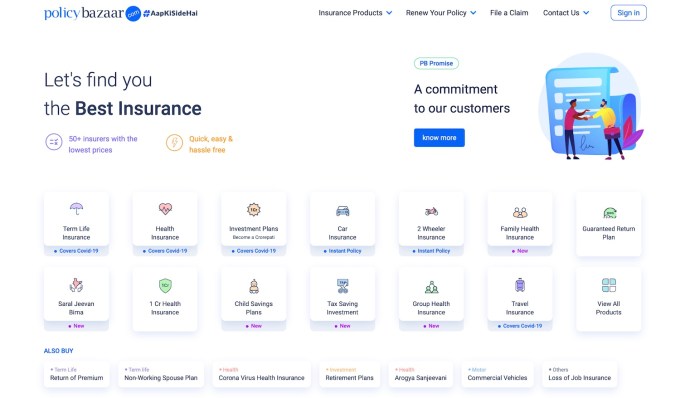
PolicyBazaar serves as an aggregator that allows users to compare and buy policies — across categories including life, health, travel, auto and property — from dozens of insurers on its website without having to go through conventional agents. It operates in India as well as the Middle East.

PolicyBazaar website

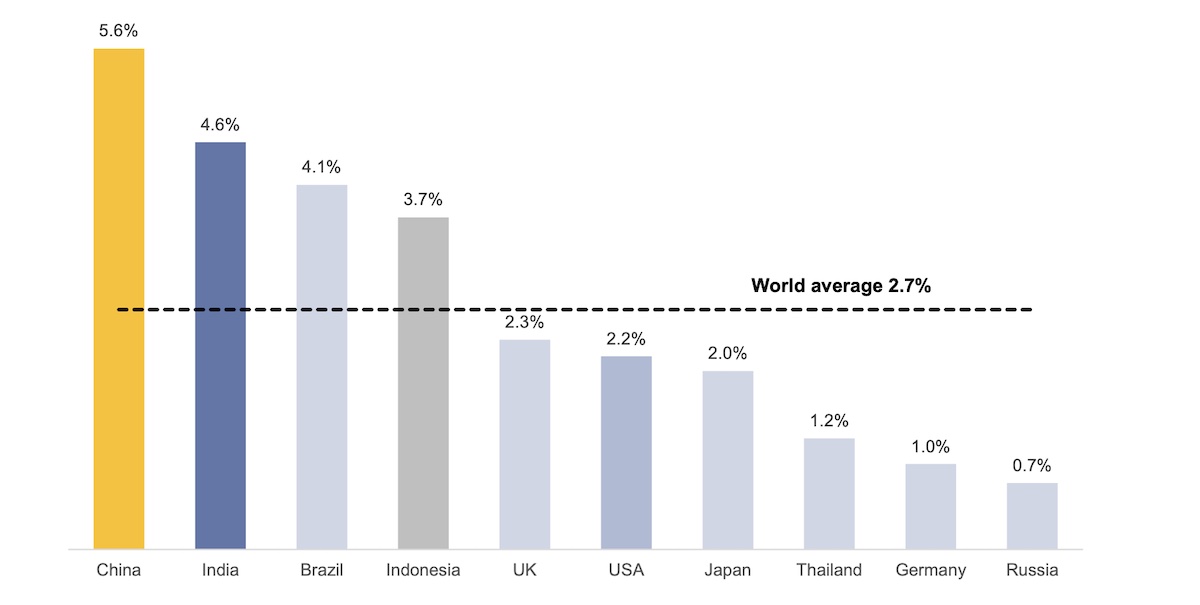
In India only a fraction of the nation’s 1.3 billion people currently have access to insurance and some analysts say that digital firms could prove crucial in bringing these services to the masses. According to rating agency ICRA, insurance products had reached less than 3% of the population as of 2017.

An average Indian makes about $2,100 in a year, according to World Bank. ICRA estimated that of those Indians who had purchased an insurance product, they were spending less than $50 on it in 2017.

In a report early this year, analysts at Bernstein estimated that PolicyBazaar commands 90% of share in the online insurance distribution market. The platform, which competes with Acko as well as Amazon in India, also sells loans, credit cards and mutual funds. The startup says it sells over a million policies a month.

“India has an under-penetrated insurance market. Within the under-penetrated landscape, digital distribution through web-aggregators like Policybazaar forms <1% of the industry. This offers a large headroom for growth,” Bernstein analysts wrote to clients.

Zomato, which had a stellar public debut last month, as well as fintech firms Paytm and MobiKwik have filed for their initial public offerings in recent weeks.

News: Indian edtech Unacademy valued at $3.44 billion in $440 million fundraise

Unacademy has raised $440 million in a new financing round as the Indian online learning startup looks to expand into multiple additional categories. Temasek led the Bangalore-based startup’s new financing round while Mirae Asset and existing investors including SoftBank Vision Fund 2, General Atlantic, Tiger Global as well as Zomato co-founder and chief executive Deepinder

Unacademy has raised $440 million in a new financing round as the Indian online learning startup looks to expand into multiple additional categories.

Temasek led the Bangalore-based startup’s new financing round while Mirae Asset and existing investors including SoftBank Vision Fund 2, General Atlantic, Tiger Global as well as Zomato co-founder and chief executive Deepinder Goyal and Oyo founder Ritesh Agarwal participated in it, the startup said without disclosing the name of the new round (which should be Series G).

The new round values the six-year-old startup at $3.44 billion, up from $2 billion in November last year. The investment brings Unacademy’s to-date raise to about $860 million.

The online learning platform, which began its journey on YouTube and still uses Google’s video platform to on-board educators, helps students prepare for competitive exams to get into college, as well as those who are pursuing graduate-level courses.

On its app, students watch live classes from educators and later engage in sessions to review topics in more detail. The startup has over 50,000 educators on its platform, many of whom are very popular on YouTube. These educators help Unacademy sell more subscriptions and in return get a commission, according to industry executives familiar with the business arrangement.

Unacademy has amassed over 6 million monthly active users (over 600,000 of whom pay for the service) in over 10,000 cities in India.

Gaurav Munjal, Unacademy co-founder and chief executive, said the startup will deploy the fresh capital to broaden its bets on new categories such as upskilling, jobs and hiring.

Relevel is “giving people a path to get their dream job irrespective of their educational background, while Graphy is “empowering creators to build their online businesses to sell digital goods including NFTs,” he said in a tweet.

In a recent conversation with TechCrunch, Munjal said he wants Unacademy to become the “Tencent of India.”

The startup competes with scores of firms including Byju’s, which is India’s most valuable startup (at $16.5 billion valuation), GGV-backed Vedantu, Tiger Global-backed Classplus, and Lightspeed Venture-backed Teachmint.

All these startups have reported growth in the past year as India — like most other countries — enforced lockdowns and closed schools to contain the spread of the coronavirus.

At stake is India’s online education market, which is estimated to grow to be worth about $20 billion by 2030 (up from about $1 billion last year), according to Bernstein.

As of last year, there were about 6 million students in India who were paying for an online learning app, a figure Bernstein analysts expect to reach about 70 million by the end of the decade.

Spendings on education in India is among the highest globally (Source: A report from analysts at Goldman Sachs to clients last year.)

Unacademy said last week it was creating a $40 million fund for educators on its platform. “On Day One (which is today) we already have more than 300 Educators eligible for the Grant which they will get immediately. Over the next few years we will give Grants of over $40M to our Educators,” said Munjal in a tweet.

The new investment comes at a time when Indian startups are raising record capital and a handful of mature firms are beginning to explore the public markets. Business-to-business commerce and financing startup Ofbusiness said over the weekend it had raised $160 million in a new financing round (led by SoftBank Vision Fund 2) at a valuation of $1.5 billion, becoming the 18th Indian startup to attain the unicorn status, up from 11 last year.

News: Square to buy ‘buy now, pay later’ giant Afterpay in $29B deal

In a blockbuster deal that rocks the fintech world, Square announced today that it is acquiring Australian buy now, pay later giant Afterpay in a $29 billion all-stock deal. The purchase price is based on the closing price of Square common stock on July 30, which was $247.26. The transaction is expected to close in

In a blockbuster deal that rocks the fintech world, Square announced today that it is acquiring Australian buy now, pay later giant Afterpay in a $29 billion all-stock deal.

The purchase price is based on the closing price of Square common stock on July 30, which was $247.26. The transaction is expected to close in the first quarter of 2022, contingent upon certain closing conditions. It values Afterpay at more than 30% premium to its latest closing price of A$96.66.

Square co-founder and CEO Jack Dorsey said in a statement that the two fintech behemoths “have a shared purpose.”

“We built our business to make the financial system more fair, accessible, and inclusive, and Afterpay has built a trusted brand aligned with those principles,” he said in the statement. “Together, we can better connect our Cash App and Seller ecosystems to deliver even more compelling products and services for merchants and consumers, putting the power back in their hands.”

The combination of the two companies would create a payments giant unlike any other. Over the past 18 months, the buy now, pay later space has essentially exploded, appealing especially to younger generations drawn to the idea of not using credit cards or paying interest and instead opting for the installment loans, which have become ubiquitous online and in retail stores.

As of June 30, Afterpay served more than 16 million consumers and nearly 100,000 merchants globally, including major retailers across industries such as fashion, homewares, beauty and sporting goods, among others.

The addition of Afterpay, the companies’ statement said, will “accelerate Square’s strategic priorities” for its Seller and Cash App ecosystems. Square plans to integrate Afterpay into its existing Seller and Cash App business units, so that even “the smallest of merchants” can offer buy now, pay later at checkout. The integration will also give Afterpay consumers the ability to manage their installment payments directly in Cash App. Cash App customers will be able to find merchants and buy now, pay later (BNPL) offers directly within the app.

Afterpay’s co-founders and co-CEOs Anthony Eisen and Nick Molnar will join Square upon closure of the deal and help lead Afterpay’s respective merchant and consumer businesses. Square said it will appoint one Afterpay director to its board.

Shareholders of Afterpay will get 0.375 shares of Square Class A stock for every share they own. This implies a price of about A$126.21 per share based on Square’s Friday close, according to the companies.

Will there be more consolidation in the space? That remains to be seen, and Twitter is all certainly abuzz about what deals could be next. Here in the U.S., rival Affirm (founded by PayPal co-founder Max Levchin) went public earlier this year. On July 30, shares closed at $56.32, significantly lower than its opening price and 52-week-high of $146.90. Meanwhile, European competitor Klarna — which is growing rapidly in the U.S. — in June raised another $639 million at a staggering post-money valuation of $45.6 billion.

No doubt the BNPL fight for the U.S. consumer is only heating up with this deal.

WordPress Image Lightbox Plugin