Daily Archives: May 7, 2021

News: To buy time for a failing startup, recreate the engineering process

The drastic approach I took to recovering our company is often referred to as a “full reset” — the old company is essentially annihilated and a new company is formed from the remaining pieces.

Jason Meller
Contributor

Jason Meller is the founder and CEO of Kolide, an endpoint security solution for teams that value productivity, transparency and employee happiness.

In non-aerobatic fixed-wing aviation, spins are an emergency. If you don’t have spin recovery training, you can easily make things worse, dramatically increasing your chances of crashing. Despite the life-and-death consequences, licensed amateur pilots in the United States are not required to train for this. Uncontrolled spins don’t happen often enough to warrant the training.

Startups can enter the equivalent of a spin as well. My startup, Kolide, entered a dangerous spin in early 2018, only a year after our Series A fundraise. We had little traction and we were quickly burning through our sizable cash reserves. We were spinning out of control, certain to hit the ground in no time.

Kolide had a lot going for it that enabled me to recover the company, but by far the most important was that we recognized we were in a spin very early, and we had enough cash remaining (and therefore sufficient time) to execute a recovery plan.

All spins start with a stall — a reduction in lift when either the aircraft is flying too slowly or the nose is pointed too high. In Kolide’s case, we were doing both.

First, we raised too much money too fast. In order to justify the post-money valuation that came with the raise, we set unattainable goals. To make matters worse, we lacked the confidence in our product and strategy, so we developed our solution with hesitancy, underspending in critical areas. As a result, we were flying too steep and too slow. We stalled.

If a stall isn’t corrected promptly, a spin can develop. Flat spins are one of the worst. Once the flat spin starts, there are a number of techniques experienced pilots should perform to recover the aircraft. Nearly all of these techniques require a critical resource, altitude — or, put another way, time.

Just like amateur pilots, startup CEOs don’t receive spin recovery training. When Kolide was spinning out of control, the vast majority of the advice I received was to cut our losses and sell the company or return the money to the investors.

At the time, I didn’t find any promising examples of companies with these same problems successfully recovering; I found only smoldering wreckage. By February 2019, my co-founders departed.

Despite this tell-tale sign of imminent demise, I was ultimately able to recover and put us on track for a great fundraise. Here’s how I recreated the engineering process.

Buying time

Kolide had a lot going for it that enabled me to recover the company, but by far the most important was that we recognized we were in a spin very early, and we had enough cash remaining (and therefore sufficient time) to execute a recovery plan. Even waiting just a few more months would have likely changed the outcome.

News: $99 passes to TC Disrupt 2021 disappear next week

TechCrunch Disrupt — it’s the must-attend conference for anyone and everyone connected to the global startup community. Don’t miss your chance to attend TC Disrupt 2021, on September 21-23, for less than $100. That’s a tidy little bottom-line booster, yes? Three opportunity-packed days can be yours at the super early-bird price — just $99 —

TechCrunch Disrupt — it’s the must-attend conference for anyone and everyone connected to the global startup community. Don’t miss your chance to attend TC Disrupt 2021, on September 21-23, for less than $100. That’s a tidy little bottom-line booster, yes?

Three opportunity-packed days can be yours at the super early-bird price — just $99 — but not for long. Prices increase next week. Purchase your pass to TC Disrupt 2021 before May 13, 11:59 pm (PST).

Come and listen to, learn from and engage with some of the leading voices in the startup world today. We’re talking dozens of in-depth, one-on-one interviews, moderated panel discussions and breakout sessions with folks like:

  • Tope Awotona, the founder and CEO of Calendly
  • Mercedes Bent, a partner at Lightspeed Venture Partners
  • Julia Collins, the founder and CEO of Planet FWD and Moonshot
  • Leslie Feinzaig, the founder and CEO of Female Founders Alliance

The all-virtual nature of Disrupt 2021 means that you can connect, network and collaborate with people across the globe — and in Silicon Valley. Still on the fence? Listen to what past attendees have told us about their Disrupt experiences:

“Tech startups go to Disrupt to show off their stuff. It’s the perfect place to scope out the competition, network with potential investors, get a feel for how other companies position themselves and to see what’s trending.” — Jessica McLean, director of marketing and communications, Infinite-Compute.

“I attend TechCrunch Disrupt every year because it’s different every time. It’s inspiring every single time. I’m never bored. Ever. I always learn something, whether it’s a new company, a new topic or a deeper exploration of a familiar technology. It’s great. I love stuff like that.” — Rachael Wilcox, creative producer, Volvo Cars.

“The virtual platform’s chat feature made it easy to connect with participants. People got creative using it to promote their business, like posting a LinkedIn profile or offering 15-minute time slots to review business pitches. I even saw a product-naming competition. You could find lots of opportunity rolling through the chat area.” — Ada Lau, manager of market development, Hong Kong Science and Technology Parks Corporation.

And there are still more opportunities to discover at Disrupt. Don’t miss the Startup Battlefield as roughly 25 stand-out startups vie for $100,000. If you want to vie, you must apply by May 13 at 11:59 pm (PT).

Startup Alley — our expo area and the heart of every Disrupt — is synonymous with opportunity. Discover all the new perks and bennies that come with exhibiting there, including a shot at participating in Startup Alley+.

TechCrunch Disrupt 2021 takes place on September 21-23, and you can grab all the opportunity for less than $100. Sound good? Great — just remember that prices go up next week. Buy your pass before May 13, 11:59 pm (PST).

Is your company interested in sponsoring or exhibiting at Disrupt 2021? Contact our sponsorship sales team by filling out this form.

News: If 12% is the new 30%, 4% is the new 12%

Hello and welcome back to Equity, TechCrunch’s venture capital-focused podcast, where we unpack the numbers behind the headlines. The whole team was aboard for this recording, with Grace and Chris behind the scenes, and Danny, Alex, and Natasha on the mics. We had to cut more than we included this week, which should give you a

Hello and welcome back to Equity, TechCrunch’s venture capital-focused podcast, where we unpack the numbers behind the headlines.

The whole team was aboard for this recording, with Grace and Chris behind the scenes, and Danny, Alex, and Natasha on the mics. We had to cut more than we included this week, which should give you a good idea of how busy the startup and VC worlds are of late.

Make sure that you are following the podcast on Twitter, where we post all sorts of memes and cuts and, perhaps, the occasional video here and there. That aside, here’s the rundown:

  • Investing legend David Swenson passed away.
  • Twitter is buying Scroll (neat, very cool) as part of its subscription push, but also killing Nuzzel in the process (bad, very uncool). Natasha and Danny fill us in on why Nuzzel will be missed. Alex has thoughts on why Twitter-Scroll is good.
  • Epic bought ArtStation and cut its marketplace take rate. This is the future, says Danny, who throws his own estimates in, too.
  • Sony and Discord are tying up after the Microsoft-Discord deal fell apart.
  • Edtech is doing the edtech thing in which it raises money and consolidates, as shown by Kahoot’s latest scoop.
  • A friend of the pod, Jomayra Herrera, is joining Reach Capital as its first ever outside-partner hire.
  • Uber is teaming up with Arrival for ride-hailing designed electric vehicles. We’re pretty bullish on the idea. Also Alex likes to say “microfactories.”
  • IVF startups are raising venture capital, and this time its Alife Health that we’re talking about. 
  • WorkBoard raised again. Alex once again made us talk about OKR-focused startups. He needs to get a life, and so does the rest of the Equity team which fought to do the transition into this segment.
  • To end, we spoke about Leda Health, a new startup focused on at-home rape kits for sexual assault survivors. It’s a controversial company, and we discuss critiques and opportunities,

And that’s our show! No private equity deal can slow the Equity team down, so we’ll see you Monday!

Equity drops every Monday at 7:00 a.m. PST, Wednesday, and Friday at 6:00 AM PST, so subscribe to us on Apple PodcastsOvercastSpotify and all the casts!

News: Tiger Global is betting that more schools are going to share future student earnings

Income-share agreements, or ISAs, are a way to bring flexibility to the often steep financial costs of higher education. The financial model allows a student to learn at zero upfront cost, and then pay any costs through a percentage of future income over time. While the model has caught fire from a variety of trade

Income-share agreements, or ISAs, are a way to bring flexibility to the often steep financial costs of higher education. The financial model allows a student to learn at zero upfront cost, and then pay any costs through a percentage of future income over time.

While the model has caught fire from a variety of trade schools and bootcamps, it’s a hard service to offer at scale. It required underwriting a risky group of people — and that costs money. Just last week, a leader in the ISA space Lambda School laid off 65 employees amid a broader restructuring.

It’s here that a startup like Blair, which graduated Y Combinator in 2019, could be of use. The startup today helps universities finance and offer income-share agreements, or ISAs, to students. The startup has two services: a capital arm (Blair Capital) for which it secured a $100 million debt facility, and a services arm (Blair Servicing) that helps manage the flow of money, which just got a new tranche of capital to expand

The company told TechCrunch that it has raised a $6.3 million round led by Tiger Global. Other investors include Rainfall and 468 Capital, along with angels such as Teachable’s Ankur Nagpal and Vouch’s Sam Hodges. The raise came on top of a $1.1 million pre-seed round, bringing Blair’s total capital raised to date at $7.4 million.

A big portion of the venture capital money will go toward doubling or tripling Blair’s San Francisco team, said CEO Mike Mahlkow. It is especially investing in engineering and product, as well as a few senior hires in finance, compliance and the service side.

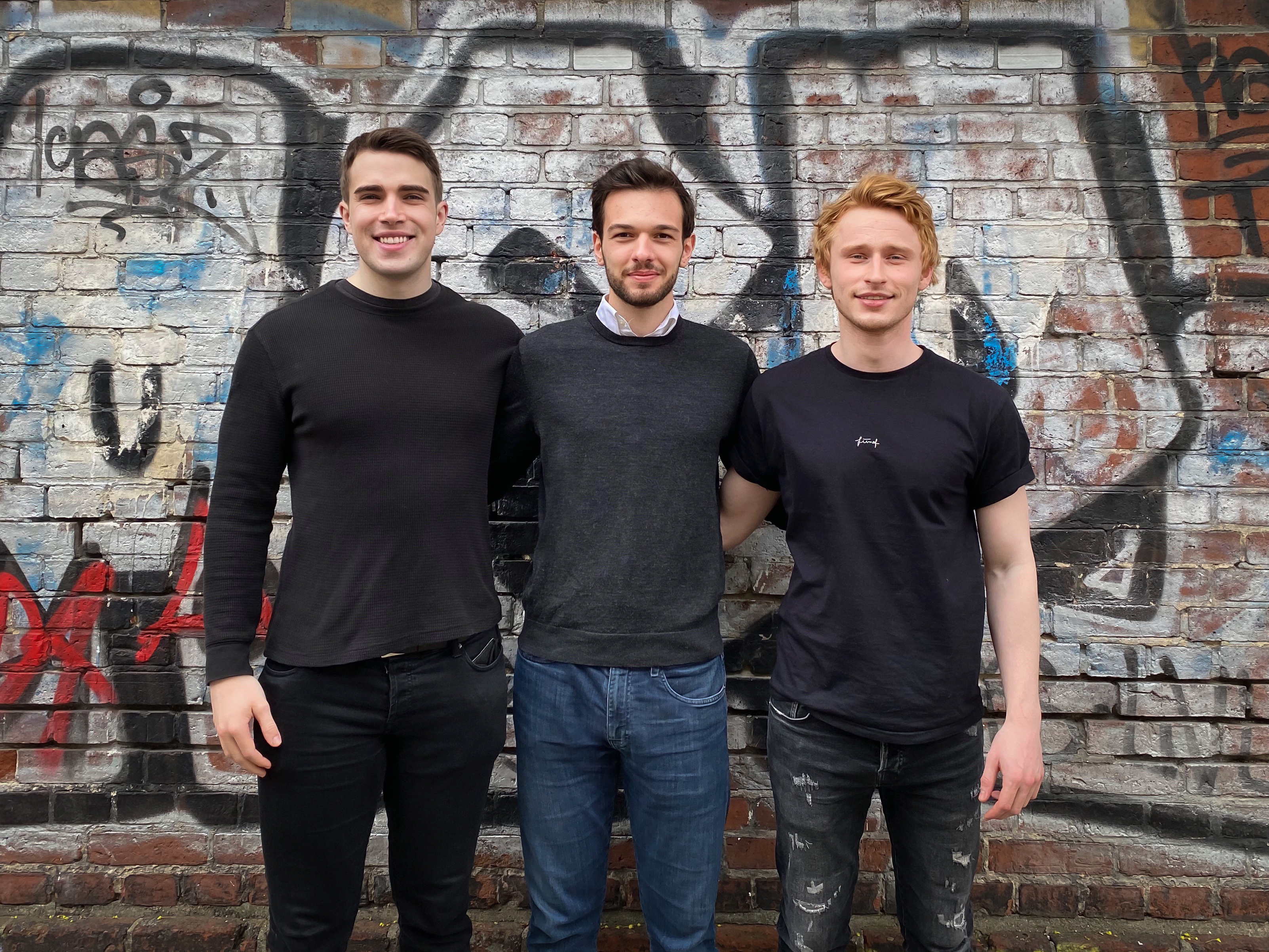
The Blair founding team.

Notably, Blair’s eight person team is fully male. The lack of gender diversity, even as an early-stage startup with a handful of employees, could hurt its competitive advantage, recruiting prospects, and and performance over time. About 25 percent of the employees are LGBT and 27.5% identify as non-white.

Blair started as a tool to underwrite students with loans that would pay for college, a sum that would eventually be repaid through an income-share agreement. It was similar to an Affirm for Education, where it could help students get access with low or nonexistent upfront costs.

“The model worked very well until March last year,” Mahlkow said. “And then the debt market was fairly dead, so we needed to shift our focus to a more software-like approach.” Now, Blair focuses on building ISA-based programs for schools, and underwrites loans based on certain programs at certain schools that have historical returns.

Most companies use its servicing piece — aka an operating system for offering ISAs — but a number of companies turn to Blair to help finance the costs of offering an ISA. Either colleges and bootcamps finance the ISA themselves and put it on the balance sheet, or they sell it to a company like Blair to get the money upfront and get repaid eventually.

Blair Servicing takes a percent of money from an ISA once a student is employed post-graduation, and Blair Capital takes a base fee plus a portion for the ISA as well.

While the company did not share exact numbers, it did say it has doubled its customers since February, tripling revenue during the same time period. Of course, a bet from the ever-ravenous Tiger Global is a statement. And, unlike his new investor, Mahlkow plans to keep growth sustainable and lean. Long-term, Blair is betting that outcome-based financing could get traction in more than just a savvy startup bootcamp but in how recruiting and placement works in various industries. The startup is in talks with a sports association and large companies that are working on upskilling and reskilling their workforces. Incentives are key in edtech, and Blair speaking that language as an early-stage startup is key as the sector moves more into the spotlight.

News: Twitch UX teardown: The Anchor Effect and de-risking decisions

How does Twitch make money? And more importantly, what subtle psychology does it use to encourage viewers to spend more? Let’s tear it down.

Peter Ramsey
Contributor

Peter Ramsey is CEO of Built For Mars, a UX consultancy that helps customers build better product experiences.

Twitch evidently has no issues getting people to spend time on its platform — even politicians can draw huge crowds by streaming themselves playing games. But monetizing video content is hard, and Twitch has missed revenue targets for the last few years.

So how does Twitch make money? And more importantly, what subtle psychology does it use within its iOS app to encourage viewers to spend more?

I’m a UX analyst and the founder of UX community Built for Mars — where I regularly tear down some of the best products in the world, showing you how they’re made, and, more importantly, how they could be improved.

I recently published my analysis of Twitch. But for Extra Crunch subscribers, I wanted to go a little deeper and bridge the gap between what Twitch does and how you can make meaningful changes to your product’s UX.

In general, you should encourage the user to make the hard decision (i.e., to commit to subscribing), after understanding all the benefits.

So here are three UX tips to discuss during your next team Zoom call.

The Anchor Effect

In short: The Anchor Effect is a heuristic bias whereby people will become attached (anchored) to an initial piece of information. For example, spending $1,000 on an iPhone may not seem like a bad deal if you saw an ad for the $1,500 one first — by comparison, it looks “cheap.”

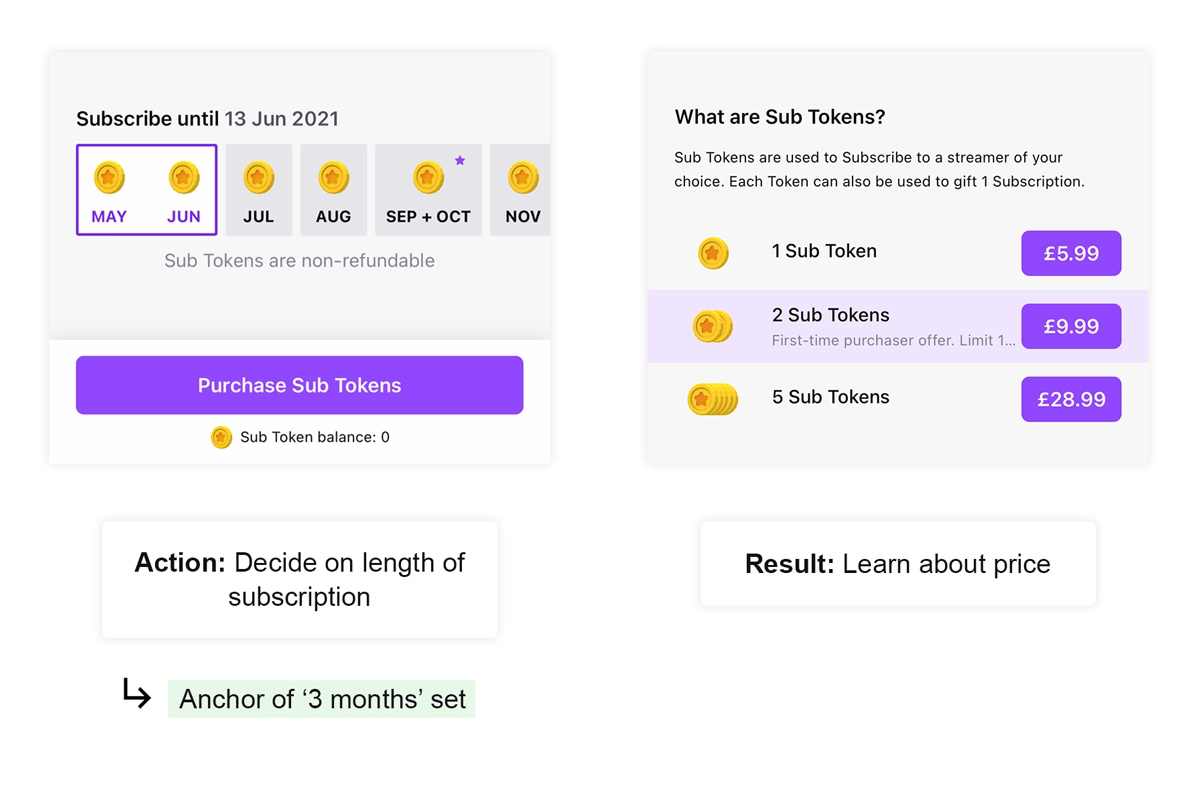
On Twitch, when a new user subscribes to a channel for the first time, they’re shown the benefits of subscribing, and then asked how long they want those benefits for before being shown a price.

Image Credits: Twitch

This type of bias is everywhere. For example, the order of your pricing tiers will affect conversions — which is likely why Mailchimp shows its pricing tiers in reverse order.

News: Startup employees should pay attention to Biden’s capital gains tax plans

The Biden Administration has reportedly proposed significant changes to the capital gains tax, aiming to target the wealthiest Americans to help fund his historic aid programs.

Vieje Piauwasdy
Contributor

Vieje Piauwasdy is the director of Equity Strategy at Secfi, an equity planning platform for startup executives and employees.

The Biden Administration has reportedly proposed significant changes to the capital gains tax, aiming to target the wealthiest Americans to help fund his historic aid programs.

If the current proposal goes into effect, it will have an impact on startup employees who aren’t (yet) wealthy. And it’s unlikely the Biden Administration has considered the consequences, because many of these employees aren’t yet in the highest tax bracket. But startup employees need to pay close attention to these changes when planning what to do with their stock options.

We don’t yet know what will end up in a passed bill, which may look very different from the originally proposed plan. This shouldn’t cause alarm for employees or cause them to avoid exercising options, but it is something they should be thinking about when planning their equity strategy.

When it comes to employee equity, the worst decision is always not having a plan of action.

As always, employees should work with their advisers to plan accordingly and get ahead of any changes.

How changes in capital gains tax impact startup stock options

Historically, long-term capital gains, or gains on assets held for over a year, have enjoyed preferential tax rates in comparison to short-term capital gains, which are assets held for less than a year. In Biden’s original proposal, he suggests raising the long-term capital gains rate to the highest ordinary income tax rate on income over $1 million.

If Biden’s changes are enacted, it means that there would no longer be preferential tax rates for those that make over $1 million on the sale of their shares post-IPO or as part of an acquisition. Many employees “go long” with their equity, selling them a year after exercising to benefit from long-term capital gains tax. Under this change, they may be limited to the amount of upside they can convert to preferential capital gains tax depending on their income levels and when they sell.

As with any tax legislation, the devil is in the details, many of which are still to be determined. These are the questions employees should be asking if the legislation moves forward:

  • Is the first $1 million in capital gains still taxed at preferential rates or do I factor in other sources of income to determine the $1 million threshold?
  • How can I plan around the sale of my shares to stay under the $1 million threshold?
  • Is there any impact on qualified small business stock (QSBS)?

Clarity on these questions and details of the plan will provide critical information for employees looking to exercise if Biden’s tax plan advances in Congress.

Capital gains tax rules have always been political

Many presidents have expressed interest in changing the capital gains laws in the past. President Obama, for example, wanted to raise the capital gains tax. President Trump campaigned on capital gains rules, suggesting the carried interest rules, which are possible because of capital gains tax rules, be eliminated.

The questions now are: Will Biden be successful in addressing capital gains tax rules? And will the Democrats risk backlash or potential downsides driven by increased capital gains tax? Many experts suggest that the final legislation, if passed, will result in a capital gains tax increase, but much less than Biden’s original proposal. Some are suggesting Congress will settle on no more than 30% as the highest capital gain rates for those who earn more than $1 million.

Only time will tell, but the suggested tax plan may create a significant, if unintended, burden to startup employees more than anyone else.

Planning around your equity

There’s still a lot of uncertainty around what new tax legislation may look like or if it will happen at all. At this point, startup employees may not necessarily need to act on these potential changes, but they should be taking it into account when planning what to do with their equity and, more specifically, when they are planning to exercise.

Either way, employees should still strongly consider exercising their stock options (it’s a key benefit of working at a startup, after all). Taxes are just one consideration. For example, many companies have exercise deadlines after employees leave a company.

Even if rates to capital gains taxes change, exercising early may still have its benefits, as many employees may still be able to create a plan to sell up to a certain number of shares at preferential rates every year.

While Biden’s proposed plan is focused on changing the federal tax rates, state income tax considerations remain. Startup employees have been moving away from high-tax states such as California and New York in favor of no-income tax states such as Texas and Florida. Those that are planning a move may have a big incentive to exercise their options to limit California and New York’s reach on the shares.

It’s important that employees understand the advantages and disadvantages of exercising today versus waiting until after an IPO. When it comes to employee equity, the worst decision is always not having a plan of action.

News: SpaceX might try to fly the first Starship prototype to successfully land a second time

SpaceX is fresh off a high for its Starship spacecraft development program, but according to CEO Elon Musk, it’s already looking ahead to potentially repeating its latest success with an unplanned early reusability experiment. Earlier this week, SpaceX flew the SN15 (i.e., 15th prototype) of its Starship from its development site near Brownsville, Texas, and

SpaceX is fresh off a high for its Starship spacecraft development program, but according to CEO Elon Musk, it’s already looking ahead to potentially repeating its latest success with an unplanned early reusability experiment. Earlier this week, SpaceX flew the SN15 (i.e., 15th prototype) of its Starship from its development site near Brownsville, Texas, and succeeded in landing it upright for the first time. Now, Musk says they could fly the same prototype a second time, a first for the Starship test and development effort.

The successful launch and landing on Wednesday included an ascent to around 30,000 feet, where the 150-foot tall spacecraft flipped onto its ‘belly’ and then descended back to Earth, returning vertical and firing its engines to slow its descent and touch down softly standing upright. This atmospheric testing is a key step meant to help prove out the technologies and systems that will later help Starship return to Earth after its orbital launches. The full Starship launch system is intended to be completely reusable, including this vehicle (which will eventually serve as the upper stage) and the Super Heavy booster that the company is also in the process of developing.

A second test flight of SN15 is an interesting possibility among the options for the prototype. SpaceX will obviously be conducting a number of other check-outs and gathering as much data as it can from the vehicle, in addition to whatever it collected from onboard sensors, but the options for the craft after that basically amounted to stress testing it to failure, or dismantling it and studying the pieces. A second flight attempt is an interesting additional option that could provide SpaceX with a lot of invaluable data about its planned re-use of the production version of Starship.

Whether or not SpaceX actually does re-fly SN15 is still up in the air, but if it does end up being technically possible, it seems like a great learning opportunity for SpaceX that could help fast-track the overall development program.


News: 5 investors discuss the future of RPA after UIPath’s IPO

We spoke to five investors to find out more about RPA. The general consensus? We’re just getting started.

Robotic process automation (RPA) has certainly been getting a lot of attention in the last year, with startups, acquisitions and IPOs all coming together in a flurry of market activity. It all seemed to culminate with UiPath’s IPO last month. The company that appeared to come out of nowhere in 2017 eventually had a final private valuation of $35 billion. It then had the audacity to match that at its IPO. A few weeks later, it still has a market cap of over $38 billion in spite of the stock price fluctuating at points.

Was this some kind of peak for the technology or a flash in the pan? Probably not. While it all seemed to come together in the last year with a big increase in attention to automation in general during the pandemic, it’s a market category that has been around for some time.

RPA allows companies to automate a group of highly mundane tasks and have a machine do the work instead of a human. Think of finding an invoice amount in an email, placing the figure in a spreadsheet and sending a Slack message to Accounts Payable. You could have humans do that, or you could do it more quickly and efficiently with a machine. We’re talking mind-numbing work that is well suited to automation.

In 2019, Gartner found RPA was the fastest-growing category in enterprise software. In spite of that, the market is still surprisingly small, with IDC estimates finding it will reach just $2 billion in 2021. That’s pretty tiny for the enterprise, but it shows that there’s plenty of room for this space to grow.

We spoke to five investors to find out more about RPA, and the general consensus was that we are just getting started. While we will continue to see the players at the top of the market — like UiPath, Automation Anywhere and Blue Prism — jockeying for position with the big enterprise vendors and startups, the size and scope of the market has a lot of potential and is likely to keep growing for some time to come.

To learn about all of this, we queried the following investors:

  • Mallun Yen, founder and partner, Operator Collective
  • Jai Das, partner and president, Sapphire Ventures
  • Soma Somasegar, managing director, Madrona Venture Group
  • Laela Sturdy, general partner, CapitalG
  • Ed Sim, founder and managing partner, Boldstart Ventures

We have seen a range of RPA startups emerge in recent years, with companies like UiPath, Blue Prism and Automation Anywhere leading the way. As the space matures, where do the biggest opportunities remain?

Mallun Yen: One of the fastest-growing categories of software, RPA has been growing at over 60% in recent years, versus 13% for enterprise software generally. But we’ve barely scratched the surface. The COVID-19 pandemic forced companies to shift how they run their business, how they hire and allocate staff.

Given that the workforce will remain at least partially permanently remote, companies recognize that this shift is also permanent, and so they need to make fundamental changes to how they run their businesses. It’s simply suboptimal to hire, train and deploy remote employees to run routine processes, which are prone to, among other things, human error and boredom.

Jai Das: All the companies that you have listed are focused on automating simple repetitive tasks that are performed by humans. These are mostly data entry and data validation jobs. Most of these tasks will be automated in the next couple of years. The new opportunity lies in automating business processes that involve multiple humans and machines within complicated workflow using AI/ML.

Sometimes this is also called process mining. There have been BPM companies in the past that have tried to automate these business processes, but they required a lot of services to implement and maintain these automated processes. AI/ML is providing a way for software to replace all these services.

Soma Somasegar: For all the progress that we have seen in RPA, I think it is still early days. The global demand for RPA market size in terms of revenue was more than $2 billion this past year and is expected to cross $20 billion in the coming decade, growing at a CAGR of more than 30% over the next seven to eight years, according to analysts such as Gartner.

That’s an astounding growth rate in the coming years and is a reflection of how early we are in the RPA journey and how much more is ahead of us. A recent study by Deloitte indicates that up to 50% of the tasks in businesses performed by employees are considered mundane, administrative and labor-intensive. That is just a recipe for a ton of process automation.

There are a lot of opportunities that I see here, including process discovery and mining; process analytics; application of AI to drive effective, more complex workflow automation; and using low code/no code as a way to enable a broader set of people to be able to automate tasks, processes and workflows, to name a few.

Laela Sturdy: We’re a long way from needing to think about the space maturing. In fact, RPA adoption is still in its early infancy when you consider its immense potential. Most companies are only now just beginning to explore the numerous use cases that exist across industries. The more enterprises dip their toes into RPA, the more use cases they envision.

I expect to see market leaders like UiPath continue to innovate rapidly while expanding the breadth and depth of their end-to-end automation platforms. As the technology continues to evolve, we should expect RPA to penetrate even more deeply into the enterprise and to automate increasingly more — and more critical — business processes.

Ed Sim: Most large-scale automation projects require a significant amount of professional services to deliver on the promises, and two areas where I still see opportunity include startups that can bring more intelligence and faster time to value. Examples include process discovery, which can help companies quickly and accurately understand how their business processes work and prioritize what to automate versus just rearchitecting an existing workflow.


News: GajiGesa, a fintech focused on Indonesian workers, adds strategic investors and launches new app for micro-SMEs

GajiGesa, a fintech startup that provides earned wage access (EWA) and other services for workers in Indonesia, has added strategic investors to help it launch new services and expand its user base. Its new backers include OCBC NISP Ventura, the venture capital arm of one of Indonesia’s largest banks, and the founders of grab-and-go coffee

GajiGesa, a fintech startup that provides earned wage access (EWA) and other services for workers in Indonesia, has added strategic investors to help it launch new services and expand its user base. Its new backers include OCBC NISP Ventura, the venture capital arm of one of Indonesia’s largest banks, and the founders of grab-and-go coffee chain Kopi Kenangan. GajiGesa also recently expanded beyond the enterprise space with a new employee management system for SMEs and micro-SMEs. Called GajiTim, the app is aimed at businesses with between five to 100 workers and has gained more than 50,000 active users since it was launched in mid-March.

The amount of GajiGesa’s latest funding was undisclosed. The startup, launched last year by husband-and-wife team Vidit Agrawal and Martyna Malinowska, announced a $2.5 million seed round led by Defy.vc and Quest Ventures in February. Over the last quarter, GajiGesa’s enterprise customer base has doubled to more than 60 companies, representing tens of thousands of workers.

GajiGesa is part of a new wave of startups focused on digitizing the 60 million small businesses in Indonesia. Others include digital bookkeeping apps like BukuWarung and BukuKas for very small businesses including neighborhood stores; Moka and Jurnal for larger companies; and CrediBook, which focuses on B2B businesses.

Before starting GajiGesa, Agrawal’s experience included serving as Uber’s first employee in Asia, while Malinowska was former product lead at Standard Chartered’s SC Ventures and alternative credit-scoring platform LenddoEFL. They created GajiGesa to give workers an alternative to payday and other high-interest lenders by allowing them to access their earned wages immediately, instead of waiting for semi-monthly or monthly paychecks. (Other companies that offer similar services around the world include Square, London-based Wagestream and Gusto). Based on a recent survey, GajiGesa said more than 75% of workers at companies that use its EWA feature have stopped using informal lenders for short-term needs.

The founders of Kopi Kenangan, the grab-and-go coffee chain backed by investors like Sequoia Capital India, Alpha JWC and Horizons Ventures, have become prolific angel investors in other startups, and their network will help GajiGesa onboard more employers, Agrawal told TechCrunch. Its strategic partnership with Bank OCBC NISP, meanwhile, will help it launch more services.

GajiGesa co-founders Vidit Agrawal and Martyna Malinowska

GajiGesa co-founders Vidit Agrawal and Martyna Malinowska

“One thing we are realizing is that a lot of employees who use the earned wage aspect of GajiGesa are expecting more kinds of products, either a loan product or an insurance product, and that’s where an opportunity arises to partner with a bank,” Agrawal told TechCrunch. About two-thirds of Indonesia’s population is “unbanked,” meaning they don’t have a bank account, so this also gives Bank OCBC NISP a chance to onboard new customers.

“Having a bank as a partner allows us to structure the right interest rate, the right size of products and create a larger impact,” said Malinowska.

GajiGesa does not charge interest rates or require collateral, since users are pre-approved by their employers. Instead, companies can decide to charge fees or offer GajiGesa as part of a benefits package. When a worker withdraws money, GajiGesa asks why they are using the Earned Wage Access feature, and presents that data to companies in an anonymized and aggregated format.

This allows employers to see what needs their work base has and potentially develop new benefits. For example, one of the top three reasons workers use EWA is to pay medical bills. “This is a strong signal to an employer that if you’re trying to retain employees, especially a blue collar employee, even a basic insurance product might be very attractive for the family,” said Agrawal.

GajiGesa also discovered that many workers, especially in Tier 2 to Tier 3 cities, use its EWA to fund family businesses instead of taking out loans for working capital.

“A lot of families in Indonesia often have one member working in a factory with fixed salaries, and they have micro-industries at home, for example making wafers or stickers to sell in their communities or online,” said Agrawal. “They were going to loan sharks previously or private lenders for very expensive rates so they can run their business, and now the family member who is working in a factory can withdraw capital to support the family business so they don’t need to go to loan sharks.”

GajiTim was launched because the startup saw many inbound inquiries from SMEs, like restaurants, small factories and general stores, that have a lot of part-time workers. These businesses often rely on paper systems, including punch time cards, to track working hours and calculate paychecks. But this often results in disputes, so having an app that counts working hours and earned wages in real-time gives workers more transparency and helps companies save time. GajiTim also has access to GajiGesa’s flagship EWA service and allows it to bring more clients onto the platform.

News: Juul inventor’s Myst lands funding as institutional investors turn to China’s e-cigs

Over the past several years, institutional investors had largely shied away from China’s e-cigarette makers, an industry that was teeming with shoddy workshops and lacked regulatory oversight. But investors’ attitude is changing as China sets in motion its strictest ever regulation on electronic cigarettes. Myst Labs, a Chinese e-cigarette maker co-founded in 2019 by Chenyue

Over the past several years, institutional investors had largely shied away from China’s e-cigarette makers, an industry that was teeming with shoddy workshops and lacked regulatory oversight. But investors’ attitude is changing as China sets in motion its strictest ever regulation on electronic cigarettes.

Myst Labs, a Chinese e-cigarette maker co-founded in 2019 by Chenyue Xing, a chemist who was part of the team at Juul that invented nicotine salts, a key ingredient in vaping, recently raised “tens of thousands of dollars” from a Series B funding round. The financing was led by its existing investor, IMO Ventures. Thomas Yao, CEO and another co-founder of Myst, is a founding partner of IMO Ventures.

In March, one of China’s top tech policy makers published a set of draft rules that would bring e-cigarettes under the same regulatory scope as traditional tobacco, which means vaping companies will need licenses for production, wholesale and retail operations in the world’s largest manufacturer and exporter of e-cigarettes.

These changes will deal a blow to small producers with poor quality control, leaving the industry with a handful of established and compliant players, Fang Wang, head of marketing at Myst, told TechCrunch.

For one, standardizing production is costly, Li said. From ceramic coils, batteries, to fragrance, every component and ingredient of a vape will need to meet stringent requirements. E-cigarette companies will also need to pay tobacco taxes, an important source of tax revenue for the Chinese government.

The other challenge is how to lower nicotine content. Many current products on the market have a relatively high nicotine concentration at 3-5%, so if China is in line with the European Union standard of 1.7%, many small brands will be forced out of business because they lack the know-how to produce low-nicotine vapes that still satisfy users’ crave, suggested Li.

“We’ve received a lot of investor interest in the past few months. Before that, professional, institutional investors often avoided e-cigarette companies, but they are showing more willingness now as regulations take shape,” Li added.

Myst declined to list its other investors but said they include high-profile individuals invovled in the e-bike sharing company Lime, Facebook and the bitcoin industry.

Most of Myst’s current sales are from China, where it has opened 600 stores and plans to reach a footprint of 1,000 stores in the next few quarters. Overseas, the startup has a retail footprint in Malaysia, Russia, Canada and the United Kingdom, where it’s selling in over 30 shopping malls and a few hospitals through its distribution partner, Ecigwizard.

The new funding will allow Myst to further expand its sales network and strengthen its research and development. The company prides itself on its product containing 1.7% nicotine, which it claims can deliver the effect of a 3% counterpart. At her lab, Xing is currently working on e-liquids with “natural tobacco contents” and without organic acids, additives that allow nicotine salts to vaporize and be absorbed.

Myst is still a relatively small player compared to China’s market dominator Relx, which went public in New York earlier this year and is applying for a license to sell in the U.S. But Yao is optimistic about Myst’s future. Vaping, he said, is one of the fastest-growing consumer categories in China. Myst’s recent sales are tripling every three months.

“In other consumer areas, you rarely see a top player commanding 60-70% of the market, so there is still a lot of room for the top 10 players to grow,” the CEO said.

WordPress Image Lightbox Plugin