Monthly Archives: March 2021

News: Uber spins out delivery robot startup as Serve Robotics

Postmates X, the robotics division of the on-demand delivery startup that Uber acquired last year for $2.65 billion, has officially spun out as an independent company called Serve Robotics. TechCrunch reported in January that a deal was being shopped to investors. Serve Robotics, a name taken from the autonomous sidewalk delivery bot that was developed and

Postmates X, the robotics division of the on-demand delivery startup that Uber acquired last year for $2.65 billion, has officially spun out as an independent company called Serve Robotics.

TechCrunch reported in January that a deal was being shopped to investors.

Serve Robotics, a name taken from the autonomous sidewalk delivery bot that was developed and piloted by Postmates X, has raised seed funding in a round led by venture capital firm Neo. Other investors included Uber as well as Lee Jacobs and Cyan Banister’s Long Journey Ventures, Western Technology Investment, Scott Banister, Farhad Mohit and Postmates co-founders Bastian Lehmann and Sean Plaice.

Serve Robotics didn’t share specifics of the funding except to confirm that the round, which will be a Series A, has not been completed yet. Funding a spin out can occur in phases, with the first tranche used for the initial launch and the rest of the round closing once IP has been transferred.

The new company will be run by Ali Kashani, who headed up Postmates X. Other co-founders include Dmitry Demeshchuk, the first engineer who joined the Serve team at Postmates and MJ Chun, who previously led product at Anki, has been heading up product strategy at Serve. The company is launching with 60 employees with headquarters in San Francisco and offices in Los Angeles and Vancouver, Canada.

Serve Robotics Uber Postmates

Image Credits: Serve Robotics

“While self-driving cars remove the driver, robotic delivery eliminates the car itself and makes deliveries sustainable and accessible to all,” said Kashani, co-founder and CEO of Serve Robotics. “Over the next two decades, new mobility robots will enter every aspect of our lives–first moving food, then everything else.”

Postmates’ exploration into sidewalk delivery bots began in earnest in 2017 after the company quietly acquired Kashani’s startup Lox Inc. As head of Postmates X, Kashani set out to answer the question: why move two-pound burritos with two-ton cars? Postmates revealed its first Serve autonomous delivery bot in December 2018. A second generation — with an identical design but different lidar sensors and few other upgrades — emerged in summer 2019 ahead of its planned commercial launch in Los Angeles.

The company’s mission to design, develop, and operate delivery robots specialized in navigating sidewalks will continue, albeit with an eye towards expansion. Serve will continue its delivery operations in Los Angeles. It plans to ramp up research and development in the San Francisco Bay area and expand its market reach through new partnerships.

The spin out is consistent with Uber’s aim to narrow the focus of its business on ride-hailing and delivery in a push towards profitability. This strategy began to take shape after Uber’s public market debut in May 2019 and accelerated last year as the COVID-19 pandemic put pressure on the ride-hailing company. Two years ago, Uber had enterprises across the transportation landscape, from ride-hailing and micromobility to logistics, public transit, food delivery and futuristic bets like autonomous vehicles and air taxis. CEO Dara Khosrowshahi has dismantled the everything-but-the-kitchen-sink approach as he pushes the company toward profitability.

In 2020, Uber offloaded shared scooter and bike unit Jump in a complex deal with Lime, sold a stake worth $500 million in its logistics spinoff Uber Freight and rid itself of its autonomous vehicle unit Uber ATG and its air taxi play Uber Elevate. Aurora acquired Uber ATG in a deal that had a similar structure to the Jump-Lime transaction. Aurora didn’t pay cash for Uber ATG. Instead, Uber handed over its equity in ATG and invested $400 million into Aurora, which gave it a 26% stake in the combined company. In a similarly crafted deal, Uber Elevate was sold to Joby Aviation in December.

News: Parabol raises $8M after reaching 100,000 users of its agile meeting software

This morning Parabol, a startup that provides retrospective meeting software to agile development teams, announced that it has closed an $8 million Series A. Microsoft’s venture capital arm, M12, led the deal. The investment also saw participation from Techstars, CRV, and Haystack. TechCrunch caught up with Parabol CEO Jordan Husney to talk about the round,

This morning Parabol, a startup that provides retrospective meeting software to agile development teams, announced that it has closed an $8 million Series A. Microsoft’s venture capital arm, M12, led the deal. The investment also saw participation from Techstars, CRV, and Haystack.

TechCrunch caught up with Parabol CEO Jordan Husney to talk about the round, and his company. We were curious how large the market that Parabol serves is, and if the company was overly-nicheing its service. While the startup is still young, the answer appears to be no – adding to our general sentiment that the software market is even larger than we perhaps thought.

Let’s explore how Parabol came to be, and how it came to pick its target market. Or more precisely, how its target market chose it.

Building horizontally, focusing vertically

After a stint in the consulting world, Husney was more than aware of the communications issues that distributed teams can endure. With multiple offices the norm among big companies, he told TechCrunch in an interview, communications between remote workers came down to an email thread, or a meeting. A self-described “recovering engineer,” Husney wondered if there was space in the business market for “structured communications,” or the type of asynchronous meetings that are popular in the code-writing world.

Borrowing from the ethos of agile development, a method of writing software that prioritizes collaboration and evolution over process and documentation, Husney built Parabol to bring agile work and communications methods to non-developer business teams. If agile principles were good at helping foster developer results through status meetings, why wouldn’t the same process translate to other work settings?

But the market had other ideas. Instead of hitting it big in the business world, owing to the friction resulting from needing what Husney described as a “behavior change” — something often lethal to rapid adoption of a new service, or product — agile teams themselves started using Parabol’s tech.

The startup followed the demand. And there’s quite a lot of it, as it turns out. Husney estimated that there are around 20 million agile developers in the world, the business from which has helped propel companies like Atlassian to enormous heights. It’s a big enough pool for the startup to swim in for a long time.

Returning to our earlier note about the depth of the software market, Parabol is a good reference point. It appears capable of building a real company on the back of supporting a subset of the software creation world’s peculiar meeting style; the market for software is simply gigantic.

Growth

After deciding to support agile software teams, growth came quickly to Parabol. In 2018 and 2019, the company saw growth of 20% to 40% each month, its CEO said. Calling his company a “rocket,” Husney gave partial credit to Parabol’s freemium go-to-market model, a common approach when selling to developers who eschew the traditional sales process.

By selling to the already-converted, Parabol found product-market fit. Husney himself had underestimated the demand from agile software developers for tools to support they work, because he thought that they’d already figured out their own needs, he told TechCrunch.

What Parabol has built is not a simple tool, however. Powering retrospective meetings and incident post-mortems, its software collects notes from workers on things that should be done, things that should no longer done, and things that should be kept up. The service then aggregates them automatically by topic, followed by users voting to decide on changes and takeaway actions. The result is an asynchronous way for developer teams to stay in sync.

The startup closed a Seed round in November of 2019, just in time to have cash on hand for the COVID-19 pandemic. The rapid switch to remote work quickly drove Parabol’s user growth from 600 per week in January of 2020, to 5,000 per week in March of the same year. The company has some public usage data available here, in case you want to check the spike yourself.

After raising its $4 million Seed, Husney decided to raise more capital after being told by others that it was a great time to do so. And after winding up with a few firms to choose between, wound up taking Microsoft’s money.

There’s a story there. Per Husney, Microsoft’s M12 was not on the top of its venture capital list; there is a somewhat good reason for that, as taking strategic capital over pure-venture capital is a choice and not the best one for every startup. But after Husney and company got to know the Microsoft partners, and each side underwent diligence, the fit became clear. According to the CEO, M12’s investing team called various Microsoft groups — Azure, GitHub, etc — to ask them about their views on Parabol. They raved. So Microsoft had strong internal signals concerning the deal, and Parabol learned that its potential investor was a heavy user of its product.

The deal worked out.

Why $8 million and not more? The startup’s growth plan isn’t super capital intensive according to Husney, and its market is pulling it instead of the other way around. The team is dilution-conscious as well, he explained. The founding team put the company together in 2015, and didn’t raise its seed round until 2019. It was ramen days back then, he explained; you’ll cling to your ownership, I suppose, when you have bought it that dearly.

Parabol runs lean on purpose. Husney said that his team was not following the Reid Hoffman blitzscaling ethos, instead focusing on hiring for individual leverage. In the CEO’s view, you don’t need to scale quickly to build collaboration products.

The $8 million raise could give Parabol infinite runway, the CEO said, but his company instead raised it for about a 24 month spend. At the end of that he expects the company to have around 30 workers, up from its current 10.

Parabol wants to quadruple its revenues this year, and triple them in 2022. And it wants to scale to 500,000 users from its current 100,000 this year, reaching one million by the end of next year. Let’s see how it performs against those goals.

News: Apple releases results from hearing health study

Was back in 2019, Apple launched Research. The app was the latest effort by a company looking to take a more serious approach to user health, built (naturally) around data collected from the iPhone and Apple Watch. The app debuted with four studies: heart health, women’s health, movement and hearing. Today, the company is issuing

Was back in 2019, Apple launched Research. The app was the latest effort by a company looking to take a more serious approach to user health, built (naturally) around data collected from the iPhone and Apple Watch. The app debuted with four studies: heart health, women’s health, movement and hearing.

Today, the company is issuing results from the latter, conducted alongside the University of Michigan School of Public Health, a day prior World Hearing Day. Hearing loss is an issue the company has looked to tackle, due in no small part to its large — and growing — involvement in the headphone category.

Headphones have, of course, become a common source of long term hearing loss as the technology has proliferated. The company has also built noise level readings into its mobile operating systems, to offer notifications of loud environments. That info is also built into the health app, showing off both headphone levels and environmental sound levels – the latter of which can be a subtler source of hearing loss.

According to the study of “thousands” of participants in the U.S., a quarter of those involved encounter more than the WHO’s recommended daily limit of environmental sound exposure. 50% of those in the survey work or worked in in a loud environment. The numbers remain reasonably high, even as many or most have transitioned to a work-from-home setting during the pandemic.

“Even during this pandemic, when many people are staying home, we’re still seeing 25%of our participants experiencing high environmental sound exposures,” University of Michigan Associate Profession Rick Neitzel says in a release tied to the news. “The results of this study can improve our understanding of potentially harmful exposures, and help identify ways that people can proactively protect their hearing.”

Ten-percent of those surveyed, meanwhile, exceed the recommended limit for weekly headphone exposure, while a quarter reported ringing in their ears a few times a week or more.


Early Stage is the premiere ‘how-to’ event for startup entrepreneurs and investors. You’ll hear firsthand how some of the most successful founders and VCs build their businesses, raise money and manage their portfolios. We’ll cover every aspect of company-building: Fundraising, recruiting, sales, legal, PR, marketing and brand building. Each session also has audience participation built-in — there’s ample time included in each for audience questions and discussion.

News: Vestiaire Collective raises $216 million for its second-hand fashion platform

Vestiaire Collective announced a new funding round. The company has raised $216 million, or €178 million — it has reached a valuation above $1 billion, making it a unicorn. French fashion and luxury group Kering is leading the round with Tiger Global Management. Kering now owns 5% of Vestiaire Collective. The startup operates an online marketplace

Vestiaire Collective announced a new funding round. The company has raised $216 million, or €178 million — it has reached a valuation above $1 billion, making it a unicorn. French fashion and luxury group Kering is leading the round with Tiger Global Management. Kering now owns 5% of Vestiaire Collective.

The startup operates an online marketplace where you can find pre-owned luxury and fashion items. And it’s a complicated industry as you don’t want to buy a damaged item or a cheap knockoff. The company controls and authenticate some items before they reach the buyer. If you opt for direct shipping, you can get reimbursed if there’s something wrong with what you ordered.

In addition to the two lead investors, many of the company’s existing shareholders are investing once again, such as Vestiaire Collective’s own CEO Max Bittner, Bpifrance’s Large Venture fund, Condé Nast, Eurazeo through Eurazeo Growth and Idinvest Venture, Fidelity International, Korelya Capital, Luxury Tech Fund and Vitruvian Partner.

As you may have noticed, it’s been a bit harder to travel and buy fashion items in store. Many fashion e-commerce companies have been thriving during the coronavirus outbreak, and Vestiaire Collective is one of them. Transaction volume doubled in 2020 compared to 2019. There are 140,000 new listings every week.

In addition to the current pandemic, many consumers are concerned about the impact of fashion on the environment. At the lower end of the spectrum, retailers and fast fashion brands encourage you to buy more and more stuff as trends change with each season. At the higher end of the spectrum, luxury brands don’t want to undermine the value of their goods by putting items on sale to clear room for a new collection.

That’s why Vestiaire Collective is particularly well positioned to find new customers who are looking for quality goods that are going to last for a while and that haven’t been specifically produced for them. Similarly, people can sell their stuff instead of throwing them away.

While Vestiaire Collective originally started in Europe, the company is now growing rapidly in the U.S. and Asia. “As of January 2021, local sellers in those regions had increased their items sold by more than 250% year-over-year,” Tiger Global partner Griffin Schroeder said in the release.

With today’s funding round, the company plans to further develop partnerships with brands through buy-back circular solutions. The company also wants to encourage more people to sell something every time they buy something. Vestiaire Collective aims to be carbon neutral by 2026 and get the B Corp certification. The startup will also hire 155 people in the technology team.

News: Looped raises $7.7M to expand its interactive live event platform

Live events in the age of Covid-19 have largely been moved into the virtual world: we buy tickets (or simply click on a link), go to a site or app, and watch the action unfold on a screen. Your seat or mine might be just as good as that of any other audience member, but

Live events in the age of Covid-19 have largely been moved into the virtual world: we buy tickets (or simply click on a link), go to a site or app, and watch the action unfold on a screen. Your seat or mine might be just as good as that of any other audience member, but these affairs also leave a lot to be desired. Today, a startup called Looped that’s trying to build a livestreaming event service that is more engaged and interactive is announcing some funding to see how it can fill that gap.

The startup, which powers music concerts, comedy and other entertainment, has closed funding of $7.7 million, money that Faisel Durrani, co-CEO of Looped, said in an interview will be used to continue building out the company’s technology stack. It has now raised $8.8 million in total.

The funding comes on the heels of a strong year for the company, which was founded in October 2019 and has since launch seen some 300,000 people buy virtual tickets to join events led by some 1,000 creators on its platform. Stars have included Billie Eilish, Shawn Mendes, BTS, Kevin Durant, Aaron Rodgers, Russell Wilson, Lamar Jackson, Baker Mayfield, Lin-Manuel Miranda, Usher, Sam Smith, Charlie Puth, Khalid, Dua Lipa, the original cast of Hamilton, and many more.

These creators use Looped to set up and broadcast performances (using Looped’s own tools or integrating with whatever production tools a creator prefers to use), sell tickets and merchandise, create “backstage pass” rooms, initiate conversations between a couple or many people, create “co-viewing” suites for groups to watch something together, and more.

As an example of what you can do on Looped, the Hamilton cast assembled for a charity event called Ham4Change, to raise money for 9 non-profits working on fighting racial injustice. The event, which saw the cast chatting and singing for their audience, raised over $1.1 million, selling 15,500+ livestream tickets and 1,000+ Virtual Meet & Greets with 35 cast members. (One of the screenshots of the event is the main illustration here.)

The funding is notable for a couple of reasons.

First, Looped is yet another example of the proliferation of streaming startups and virtual event services that are seeing attention in the market today. In addition to the very obvious and biggest players like Zoom (which is… zooming right now, and also moving into events), there are sizable startups like Hopin and Bizzabo, and smaller or newer tech player like Grip, Welcome, Hubilo, Touchcast, and many others slicing up different segments or aspects of running a virtual event.

Big tech platforms like Google’s YouTube already have a strong business in live streaming massive events, and other online media companies like Pinterest and Spotify are also testing the waters for its users’ appetites for virtual events.

“There are many people playing in this space, which is the good news because it’s the future,” said Durrani, himself a longtime entertainment and music industry executive. “Those that create the most innovation will be the ones that win. The question is: how do we build new products for further engagement?”

Second, the other reason why Looped’s funding is notable is because of who is doing the backing: a 100+ person syndicate of people who are strategic network partners for the startup as it looks to expand the list of creators who use it. 

The funding is led by Will Ventures, with participation from Rocketship VC, Alpaca VC, Forefront Venture Partners, HOF Capital, Toy Ventures, Intuition Capital, Predictive VC and Ketch Ventures. Alongside that tame list, it lists more than 90 strategic angel investors.

At the risk of getting something wrong or missing something out, I’m copying the whole list directly from the company. Angel investors include former Bunim/Murray Productions CEO and Emmy-winning Television Producer Gil Goldschein; President of Live Nation Urban & Maverick Management Partner Shawn Gee; Blueprint Group Co-CEOs & Maverick Management Partners Gee Roberson & Cortez “Tez” Bryant; Grammy-winning Singer and Songwriter Jill Scott; California Film Commissioner, Former U.S. Ambassador, and Emmy-nominated Television Producer Colleen Bell; Former Uber CFO and Former Microsoft & Google executive Brent Callinicos; RealNetworks Founder Rob Glaser; Arcot Systems & Acalvio Technologies Founder Ram Varadarajan; Consumer Media & Technology Pioneer and HelloTech Founder Richard Wolpert; Goodreads Founders Elizabeth Khuri Chandler & Otis Chandler; Prominent angel investor and podcast host James Beshara; Former Turner CCMO Lauren Hurvitz; Founder of Multi-Platinum band & record label Laurie Marvald; LA Lakers Partnerships Executive Erika Singal; Immortals Gaming Club Founder Noah Whinston; and Gen Z VC Patrick Finnegan.

“I have always been driven by innovation. The underlying technology combined with audience interactivity built by the team at Looped forms a truly impressive media platform,” said Gil Goldschein, Former CEO of Bunim/Murray Productions, in a statement. ““This type of intersection between media and technology is the way of the future.”

Others include Grammy-winning Musician and Entrepreneur Ahmir “Questlove” Thompson; Musician, Entrepreneur, and member of Grammy-winning group Backstreet Boys AJ McLean; Actor and Grammy-winning lead MC of hip-hop group The Roots Tariq “Black Thought” Trotter; and Super Bowl LV Champion, NFL All-Pro Defensive Tackle, and House of Spears Management Managing Partner Ndamukong Suh.

“Looped is an absolute game changer. It provides so many great opportunities for artists to connect with fans while they’re off the road, and to create new hybrid experiences while touring as well,” said AJ McLean in another statement. “This platform is going to be a staple in fan interaction for many years to come.”

That network of investors may sound a little noisy and highlight how party rounds can find companies without dedicated avocates or close advisors, but in this case Durrani said it’s done intentionally for the purposes of improving its network.

“The biggest hurdle right now is still one of adoption,” he said, with virtual events nowhere near the scale of activity as that of a typical performer on a tour. In fact, many artists have pulled away from performing almost entirely in the current climate: they too face “Zoom fatigue” and there is a hesitation too about flooding the market too much right now.

“This space is still fairly new, and we’re all going through a difficult time in this pandemic where we are having screen exhaustion. It means that many people are eager to get back to the old ways rather than embracing what will be the new world as we move forward.

“I am a believer that the virtual event business will be part of the portfolio as we move forward, but we’re still just on the cusp of it.” He added that a recent Goldman Sachs survey of consumers found that 74% said they would continue to consume content virtually even after the pandemic has passed. Encouraging numbers for Looped and many others, I’m guessing.

For the more usual suspect VC investors, they see in Looped a company that, by virtue of its specialization on entertainment events (similar to how Touchcast is specializing on corporate events) it has a strong play to make here.

“In a crowded virtual venue market, Looped clearly stands out from the pack. Their focus on product innovation sets them apart, and it’s enabled them to establish industry-leading talent, partners, and traction,” said Brian Reilly, Managing Partner at Will Ventures, in a statement. “Their products will change how creators engage with their fans by increasing access and facilitating authentic connections. We’re excited to support Looped in their mission to bring creators closer to their fans all over the world.”

It will definitely be worth watching, especially as huge tech companies like Apple, Spotify, Google continue to eye up the space and look for leaders among startups that can help them build out their own offerings and connections to artists and creators.

News: Oscar Health raises IPO price as Coupang releases bullish debut valuation

These companies will soon convert tens of billions of dollars of illiquid private shares into public currency. As such, their offerings may reveal investors’ sentiments regarding e-commerce and insurance companies backed by venture capital.

Investors appear excited to buy shares in impending public companies Oscar Health and Coupang. TechCrunch covered both extensively during their ramp toward the public markets, and more recently regarding their IPO march. And now, with a combined valuation well above $50 billion, both public offerings should make a splash.

And in good news for their respective investors, recent pricing points to an IPO market that remains enthusiastic about new listings, despite some recent chop among public technology equities.


The Exchange explores startups, markets and money. Read it every morning on Extra Crunch, or get The Exchange newsletter every Saturday.


The valuation news from Coupang and Oscar Health bodes well for other impending offerings, including a host of SPAC-led flotations and the coming direct-listing of cryptocurrency giant Coinbase.

This morning, let’s collect pricing news on both Coupang and Oscar Health, eat some modest crow in the case of the latter and prep ourselves for the next two unicorn public offerings.

These companies will soon convert tens of billions of dollars of illiquid private shares into public currency. As such, their offerings may reveal investors’ sentiments regarding e-commerce and insurance companies backed by venture capital.

Oscar Health and Coupang’s IPO pricing

As TechCrunch reported this morning, South Korean e-commerce player Coupang could be worth as much as $51 billion in its IPO if its first debut price range of $27 to $30 per share holds up; the price range matches earlier expectations for the company, which recorded revenues of $11.97 billion in 2020, up more than 90 percent from its year-ago results.

Oscar Health’s new IPO price range is even more interesting than Coupang’s first. The insurance startup’s first IPO pricing interval of $32 to $34 per share valued the company at a midpoint, full-diluted price of around $7.7 billion. Its range is now $36 to $38 per share, more than modestly higher than its prior target price range.

News: Spotify podcast listeners to top Apple’s for the first time in 2021, forecast claims

Investors have been waiting for Spotify’s multimillion-dollar bet on podcasting to pay off, in terms of increased paid subscriptions or improved revenues. But before that can occur, Spotify has to get more people listening to podcasts through its app. On that front, the streaming service has momentum. According to a new market forecast, Spotify’s U.S.

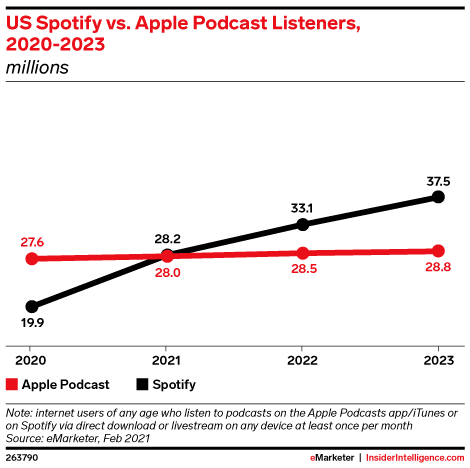
Investors have been waiting for Spotify’s multimillion-dollar bet on podcasting to pay off, in terms of increased paid subscriptions or improved revenues. But before that can occur, Spotify has to get more people listening to podcasts through its app. On that front, the streaming service has momentum. According to a new market forecast, Spotify’s U.S. podcast listenership will surpass Apple Podcasts for the first time this year when 28.2 million U.S. users will listen to podcasts on Spotify at least monthly, compared with 28.0 million via Apple Podcasts.

This shift will come on the heels of expected 41.3% in 2021, the analysts at eMarketer are predicting.

In the two years that follow, Spotify will widen the gap with Apple, reaching 33.1 million monthly U.S. podcast listeners by 2022, versus 28.5 million for Apple Podcasts. And by 2023, Spotify will see 37.5 monthly million listeners in the U.S., compared with Apple’s still flat 28.8 million.

Image Credits: eMarketer


The firm notes that Apple has been losing podcast listener share since it first began tracking the market back in 2018. At that point, Apple Podcasts had a 34% market share, which will fall to 23.8% this year.

Overall, there will be 117.8 million people in the U.S. who listen to podcasts on a monthly basis in 2021, a 10.1% year-over-year increase. Podcast listeners will also account for 53.9% of monthly digital audio listeners, surpassing 50% for the first time, eMarketer says. This growth is also likely to benefit Spotify at Apple’s expense.

Apple, unlike other streaming music services — including Spotify, Amazon, and Pandora, for example — has split off podcasts into their own app instead of offering an integrated experience with music and podcasts combined. That means it’s missing out from some of the crossover that occurs when someone is streaming music or thinking of doing so, but then decides to listen to podcasts instead and vice versa. In other apps, making the jump between music and other audio is easier — and there are even ways to listen to music and podcasts combined, as with Pandora Stories or Spotify’s Shows with Music and its other mixed-media playlists.

“By putting podcasts and music in one place, Spotify quickly became the convenient one-stop-shop for everything digital audio,” noted eMarketer forecasting analyst Peter Vahle. “Apple was the de facto destination for podcasts for a long time, but in recent years, it has not kept up with Spotify’s pace of investment and innovation in podcast content and technology. Spotify’s investments have empowered podcast creators and advertisers through its proprietary hosting, creation, and monetization tools,” he said.

Apple today still seems to be experimenting with podcasts. It recently began calling attention to quality podcasts, through increased editorial curation. It’s dabbled in releasing a few podcasts of its own, as with its recently launched “For All Mankind” companion podcast for its Apple TV+ series or its original podcasts focused on music. But Apple seems to have largely ignored the market momentum around the format, instead focusing on expansions to new areas — like streaming TV and movies or subscription-based fitness.

Spotify, which already has a set of originals and exclusives via acquisitions, is moving ahead to what’s next. Last week, for instance, it announced a number of upcoming products and features, including paid podcast subscriptions, WordPress integrations to turn blogs into podcasts, and tools to make its podcasts more interactive — the latter an attempt at challenging the growing interest in social audio apps like Clubhouse.

The company is also newly investing in the advertising business around podcasts with plans to launch an audio ad marketplace, the Spotify Audience Network.

Image Credits: eMarketer

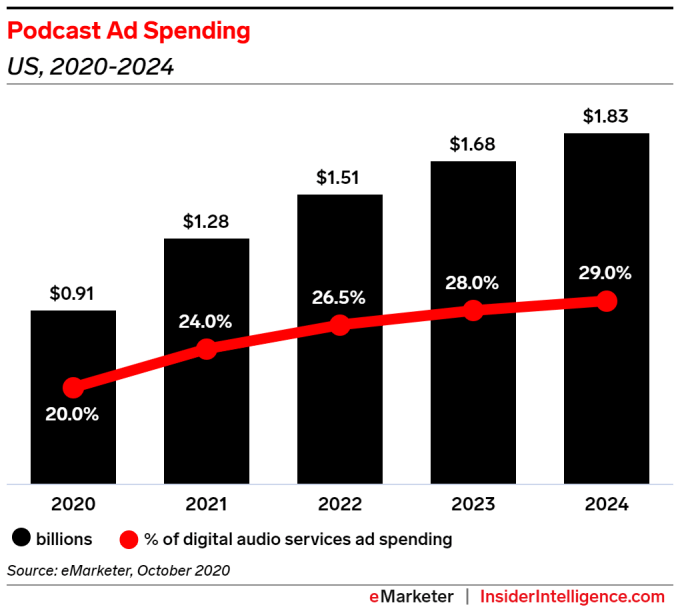
That could be a timely launch, eMarketer’s forecast indicates. The firm is predicting that podcast advertising will top $1 billion for the first time in 2021, reaching $1.28 billion — a 41% year-over-year increase. This figure will continue to grow in the years to come, with podcasts going from a 24% share of the total digital audio ad spend in 2021 to 29% by 2024.

To what extent Spotify can actually follow through on converting its podcast listenership to paid subscribers of some sort, or whether it can successfully monetize them through advertisements, remains to be seen, of course. After all, Spotify today is losing money, as The Wall St. Journal recently pointed out in covering its Q4 2020 earnings. That’s because it’s still prioritizing investments in subscriber growth and podcasting over turning a profit for the time being. And there are some early indications that its exclusive model could have issues — last year, for example, it lost its first big podcast star, Joe Budden, when it failed to reach a new agreement.

Meanwhile, Apple has been said to be exploring a podcast subscription service of its own, too — something it could bundle into a higher-value subscription that includes other services like cloud storage, streaming TV, games and more. And Amazon just made its own investment in podcast with the acquisition of podcast network Wondery. These factors could come into play over the next few years, potentially disrupting this forecast and Spotify’s future podcast listenership growth.


News: Offering a service that prioritizes the highest-paying gigs in the gig economy, Stoovo raises funding

Semih Korkmaz and Hantz Févry launched Stoovo in 2019 as a way to help gig workers make the best use of their time. Févry, who immigrated to the U.S. from Haiti, knew first hand the struggles that come with part time work from his days as a student at Stonybrook University. While there bouncing from

Semih Korkmaz and Hantz Févry launched Stoovo in 2019 as a way to help gig workers make the best use of their time.

Févry, who immigrated to the U.S. from Haiti, knew first hand the struggles that come with part time work from his days as a student at Stonybrook University. While there bouncing from job to job, Févry would feel the sting associated with hidden fees, unkept promises, and variability of part-time labor.

The time at Stonybrook was also when Févry got his first taste of entrepreneurship. In 2010 and 2011 Févry said the Dean of the University’s business school let the budding business owner cut back on his hours so he could start iTrade International, an import-export business selling earthquake detection equipment in Haiti.

That first taste of tech and business development eventually landed Févry a job at Google in Hong Kong and offered him the chance to travel around the world. After a stint in Europe, Févry moved back to the U.S. where he set to work building Stoovo.

The question on his mind was this: How can we leverage technology to help gig workers or people taking short term assignments?

Févry and his co-founder Korkmaz envisioned Stoovo as a way to level they playing field by providing gig workers with information about the highest paying jobs available on the gig platforms at any one time. “What the platforms are doing is they are  optimizing to make sure that they’re responding to demand,” Févry said. “What we do is use the same approach to predict what will be the demand, where will be the demand, what will be the competition, and what’s the payout.”

The company’s software advises gig workers on the optimum time for using each service based on their earning criteria and hours, Févry said.

“We tell you when to start working, where you need to start working, and when you need to go when you need to take your break,” he said. 

But the company’s service isn’t only about optimization. There’s also a banking component and a suite of products to ensure that gig workers are also getting the most out of their gigs financially. The company offers a checking account, a tax management service, and lending services as well through services like BellBizzer, a Seattle-based company which offers a short-term rental service for consumer goods.

Both Korkmaz and Févry spent time working as delivery drivers or freelancing to get a feel for the challenges gig workers faced, Févry said. During lunch breaks at Google, Févry would do food deliveries to seewhat he could do so that he could understand how to make the gig economy work better.

Ultimately, the best solution would be to pay gig workers a fair wage for the time they spend doing their work, but barring that, technologically developed band-aids to help heal technologically enabled wounds seem like the only option.

Gig companies like Uber have a history of using their algorithms to wring more money from drivers — sometimes unbeknownst to the workers.

Back in August, a developer named Armin Samii created an app called UberCheats that monitored the UberEats application for a software bug to inform drivers if they were underpaid by the company for the distance they’d traveled to make a delivery. Last week, the app was taken down, but only because of a copyright infringement claim from Uber.

UberCheats is now live! Download the Chrome extension to detect if UberEats has underpaid you.

Uber could block this at any time, so if you’re an UberEats driver/biker, please download it before it’s blocked by Uber and let me know if Uber cheated you!https://t.co/NsIuTbsSU1

— Armin Samii (@ArminSamii) August 18, 2020


Stoovo and UberCheats seem to come from the same place. The idea is to equip workers with tools that can work for workers instead of for big platforms.

It’s this vision that attracted investors like Derek Norton from Watertower Ventures to invest in the company. To date, Stoovo has raised $2.4 million from investors including Watertower, 500 Startups, Plug and Play Ventures, and TSEF, Févry said.

With the money the company hopes to build out more products that can enable things like low-cost money transfers. Ultimately, the company just wants to give these gig workers a chance, Févry said.

“The gig economy is rife with frustrations,” Févry said, and Stoovo is making a pitch to smooth over the obstacles. “We really understand your life. We are also immigrants,” he said. “We know that of that $200… we know you have to send $40 overseas… We are building a product with [gig workers], we are not building for them.”

News: Instacart raises $265M at a $39B valuation

On-demand grocery delivery platform Instacart has raises a $265 million funding ground from existing investors, including Andreessen Horowitz, Sequoia Capital, D1 Capital Partners and others. The new funding, which, like its past few rounds, isn’t assigned a Series alphabetical designation, pushes the company’s valuation to $39 billion – more than double its $17.7 billion valuation

On-demand grocery delivery platform Instacart has raises a $265 million funding ground from existing investors, including Andreessen Horowitz, Sequoia Capital, D1 Capital Partners and others. The new funding, which, like its past few rounds, isn’t assigned a Series alphabetical designation, pushes the company’s valuation to $39 billion – more than double its $17.7 billion valuation when it raised is last financing, a $200 million venture round in October 2020.

What’s behind the massive increase in the value investors are willing to ascribe to the business? Put simply, the pandemic. Last year, Instacart announced three separate raises, including a $225 round in June, followed by a $100 million round in July. The rapid sequence of venture capital injections were likely designed to fuel growth as demand for grocery delivery services surged while people attempted to quarantine or generally spend less time frequenting high-traffic social environments like grocery stores.

In a blog post announcing the news, Instacart doesn’t put specifics on the growth rates of usage over the course of 2020, but it does express its intent to grow headcount by 50% in 2021, and continue to scale and invest in its advertising, marketing and enterprise efforts specifically in a quote.

On the product side, Instacart broadened its offerings from groceries to also include same-day delivery of a wide range of products, including prescription medicine, electronics, home decor, sport and exercise equipment and more. It’s capitalizing on the phenomenon of increased consumer spending during the pandemic, which is a reverse from what many anticipated given the impact the ongoing crisis has had on employment.

Instacart Chief Financial Officer Nick Giovanni said in a quote that the company expects this to be “a new normal” for shopping habits, and the size and pace of the company’s recent funding, as well as its ballooning valuation, seem to suggest its investors also don’t think this is a trend that will revert post-pandemic.

News: Xage introduces Zero Trust remote access cloud solution for hard-to-secure environments

When a hacker broke into the computer systems of the Oldsmar Florida water supply last month, it sent up red flags across the operational tech world, whether that’s utilities or oil and gas pipelines. Xage, a security startup that has been building a solution to help protect these hard-to-secure operations, announced a Zero Trust remote

When a hacker broke into the computer systems of the Oldsmar Florida water supply last month, it sent up red flags across the operational tech world, whether that’s utilities or oil and gas pipelines. Xage, a security startup that has been building a solution to help protect these hard-to-secure operations, announced a Zero Trust remote access cloud solution today that could help prevent these kinds of attacks.

Duncan Greatwood, CEO at Xage, says flat out that if his company’s software was in place in Oldsmar, that hack wouldn’t have happened. Smaller operations like the one in Oldsmar tend to be one-person IT shops running older remote access software that’s vulnerable to hacking on a number of levels.

“It’s not difficult to compromise a virtual network computing (VNC) connection. It’s not difficult to compromise a stale account that’s been left on a jump box. What we started to do last year was deliver what we call a Zero Trust remote access solution to these kinds of customers,” Greatwood told me.

This involves controlling access device by device and person by person by determining who can do what based on them authenticating themselves and proving who they are. “It doesn’t rely on knowledge of a device password or a VPN zone password,” he explained.

The solution goes further with a secure traversal tunnel, which relies on a tamper proof certificate to prevent hackers from getting from the operations side of the house — whether that’s a utility grid, water supply or oil and gas pipeline — to the IT side where they could then begin to muck about with the operational technology.

Xage also uses a distributed ledger as a core part of its solution to help protect identity policies, logs and other key information across the platform. “Having a distributed ledger means that rather than an attacker having to compromise just a single node, it would have to compromise a majority of the nodes simultaneously, and that’s very difficult [if not impossible] to do,” he said.

What’s more, the ledgers operate independently across locations in a hierarchy with a global ledger that acts as the ultimate rules enforcer. That means even if a location goes offline, the rules will be enforced by the main system whenever it reconnects.

They introduced an on premise version of the Zero Trust remote access system last October, but with this kind of technology difficult to configure and maintain, some customers were looking for a managed solution like the one being introduced today. With the cloud solution, customers get a hosted solution accessible via a web browser with much faster deployment.

“What we’ve done with the cloud solution is made it really simple for people to adopt us by hosting the management software and the core Xage fabric nodes in this Xage cloud, and we’re really dramatically reducing that time to value for a remote access solution for OT,” Greatwood said.

You might be thinking that CISOs might not trust a cloud solution for these sensitive kinds of environments, and he admits that there is some caution in this market, even though they understand the benefits of moving to the cloud. To help ease these concerns, they can do a PoC in the cloud and there is a transfer tool to move back on prem easily if they are not comfortable with the cloud approach. So far he says that no early customers have chosen to do that, but the option is there.

Xage was founded in 2017 and has raised $16 million so far, according to Crunchbase data.

WordPress Image Lightbox Plugin