Monthly Archives: March 2021

News: Version 2 of Google’s Flutter toolkit adds support for desktop and web apps

At an online event, Google today announced Flutter 2, the newest version of its open-source UI toolkit for building portable apps. While Flutter started out with a focus on mobile when it first launched two years ago, it spread its wings in recent years and with version 2, Flutter now supports web and desktop apps

At an online event, Google today announced Flutter 2, the newest version of its open-source UI toolkit for building portable apps. While Flutter started out with a focus on mobile when it first launched two years ago, it spread its wings in recent years and with version 2, Flutter now supports web and desktop apps out of the box. With that, Flutter users can now use the same codebase to build apps for iOS, Android, Windows, MacOS, Linux and the web.

“The big thing that justifies the major version number shift is, of course, the availability of web and desktop support,” Flutter product lead Tim Sneath told me. “And that’s just a fairly profound pivot. It’s rare for products that you suddenly have all these additional endpoints.”

Image Credits: Google

He noted that because of Flutter’s open-source nature, web and desktop support had been “cooking in the open” for a while, so the addition of these endpoints isn’t a surprise. A lot of that work in getting these new platforms ready for the 2.0 release involved getting the performance up to par on these new platforms.

It’s worth noting, though, that Flutter desktop support is still behind an early-release flag in Flutter’s stable release channel and Google says developers should think of it as a “beta snapshot.” Web support, however, has transitioned from beta to stable and has become just another target for building apps with Flutter.

Image Credits: Google

On the web platform, specifically, Sneath noted that the team deliberately started out with a very standard, DOM-centric approach. But while that worked fine, it also meant performance was held back by that, especially for more advanced features. Over the course of the last year or so, the team started working on what it calls Canvas Kit. This WebAssembly-based project takes the same Skia graphics engine that powers Android and Chrome itself and makes it available to web apps.

“What that’s meant is that we can now essentially bypass the core HTML — sort of the document-centric parts of the web platform — and really use the app-centric parts of the web platform without leaving [behind] things like auto-complete of text or passwords and all the things that keep the web feeling very unique,” Sneath said.

Image Credits: Google

On the desktop, Google is announcing that Canonical is going all-in on Flutter and making it the default choice of all its future desktop and mobile apps.

Microsoft, too, is expanding its support for Flutter and working with Google on Windows support for Flutter. Given Microsoft’s interest in Android, that’s maybe no huge surprise, and indeed, Microsoft today is releasing contributions to the Flutter engine to help support foldable Android devices.

In total, Google notes, there are now over 15,000 packages for Flutter and Dart from companies like Amazon, Microsoft, Adobe, Huawei, Alibaba, eBay and Square.

As always, there are dozen of other smaller updates to Flutter in this update, too.

Looking ahead, Sneath noted that the Flutter team plans to spend more time on Flutter as a framework for embedded devices and other somewhat non-traditional platforms. He also noted that the team is interested in how Flutter can help power ambient computing experiences.

“As we think about the ambient computing worlds where there are these core premises behind the ambient computing aspects — things like: can it be searched easily? Can people make money off of the apps that they build and do it in a responsible way? We’re building support for those kinds of services. Better analytics, better ads frameworks, connectivity into things like Firebase and Google Cloud, so that people can not just take advantage of Flutter but the broader ecosystem services that Google provides,” Sneath explained.

News: Postscript raises $35M to give Shopify stores SMS superpowers

Postscript helps Shopify stores stay in touch with customers via SMS, with a focus on keeping everything opt-in, legally compliant, and spam free. The company raised $4.5M back at the end of 2019; this morning it’s announcing it has raised a $35M Series B. The company has grown pretty rapidly over the last year. When

Postscript helps Shopify stores stay in touch with customers via SMS, with a focus on keeping everything opt-in, legally compliant, and spam free. The company raised $4.5M back at the end of 2019; this morning it’s announcing it has raised a $35M Series B.

The company has grown pretty rapidly over the last year. When we last checked in with them in December of 2019, they had 14 employees and around 530 customers; today, they’re at 61 employees with over 3,500 customers.

Their vision for the product has grown a bit over the last year as well. Initially envisioned as more of a one-way broadcasting for Shopify stores to market to existing customers (“Look! We’ve got new shoes in stock!”), they’re now working on expanding into more two-way interactions, enabling customers to do things like re-orders, subscription management, and reviews through SMS.

As before, Postscript is compatible exclusively with Shopify stores. Behind the scenes they’ve been building out an API to allow deeper integrations into other Shopify plugins — but still, they’re all about Shopify merchants for now.

“We’re still focused exclusively there,” Postscript co-founder Alex Beller tells me. “We think it’s kind of our secret sauce, honestly, because we go so deep with the data and the ecosystem. There’s just a lot of tiny accumulating advantages there. It’s also the platform that’s growing the fastest in e-commerce, so it’s been a good place to be.”

While the company’s December 2019 funding was a seed round, co-founder Adam Turner tells me that between the size of the round and the revenue the company is seeing, they’ve skipped the A round and have structured this one as a Series B.

The round was led by Greylock, and backed by YC, 1984vc, Ali Capital, Elephant VC, and Larry Fitzgerald. As part of the deal, Greylock partners Sarah Guo and Mike Duboe will be joining Postscript’s board.

News: GSV Ventures doubles assets managed with new fund focused on global edtech

GSV Ventures, co-founded by Deborah Quazzo and Michael Cohn, has raised $180 million in its second fund, exclusively focused on backing edtech startups across the globe. The startup now manages $277 million in cumulative assets, inclusive of its debut fund that was closed in 2016. The new fund will let GSV invest in 13 core

GSV Ventures, co-founded by Deborah Quazzo and Michael Cohn, has raised $180 million in its second fund, exclusively focused on backing edtech startups across the globe. The startup now manages $277 million in cumulative assets, inclusive of its debut fund that was closed in 2016.

The new fund will let GSV invest in 13 core holdings, with an average check size of $15 million. The firm reserves up to $20 million per position for follow-on capital. It will invest in seed, Series A and late growth-stage opportunities.

While edtech was certainly spotlighted by the pandemic’s impact on the adoption of remote education, GSV Ventures is a case study in what happens when you invest in a category before it has generalist eyes on it. The first fund had three of its largest positions in Coursera, which is planning to go public this year; Course Hero, which was valued at $1.1 billion last year; and ClassDojo, which finally hit profitability after spending eight years focusing on customer growth instead of monetization.

The firm was also an early believer in Nearpod, which exited for $650 million in an all-cash deal in February 2021. Quazzo, who contributed her angel portfolio into the fund, says that this gives the firm 10 exits under its belt to date.

GSV Ventures began around the same time as other exclusively-edtech funds launched, such as Reach Capital, Learn Capital and Owl Ventures. These funds have all closed new capital in the wake of the coronavirus, with $165 million, $132 million and $585 million, respectively.

The biggest change between GSV Ventures’ debut fund and Fund II is the opportunity that Quazzo seeds internationally. Fund 1 only had one investment outside the United States, and Fund II already has holdings in Capetown, Croatia, Jordan, as well as, Quazzo confirms, six incoming investments split between Indonesia and India.

“There are very important businesses being built in these markets with missions to democratize and improve the delivery of learning at scale to all people,” Quazzo tells TechCrunch. To date, GSV Ventures’ portfolio has 37% female founders and 43% people of color.

While there was a four-year gap between Fund I and Fund II, GSV’s ability to back edtech startups with an ambitious trajectory hasn’t gone unnoticed. Its third fund, already mid-raise, will have its first close in the next few months.

News: From the ashes of nearly a billion dollars, Ample resurrects Better Place’s battery swapping business model

A little over thirteen years ago, Shai Agassi, a promising software executive who was in line to succeed the chief executive at SAP, then one of the world’s mightiest software companies, left the company he’d devoted the bulk of his professional career to and started a business called Better Place. That startup promised to revolutionize

A little over thirteen years ago, Shai Agassi, a promising software executive who was in line to succeed the chief executive at SAP, then one of the world’s mightiest software companies, left the company he’d devoted the bulk of his professional career to and started a business called Better Place.

That startup promised to revolutionize the nascent electric vehicle market and make range anxiety a thing of the past. The company’s pitch? A network of automated battery swapping stations that would replace spent batteries with freshly charged ones.

Agassi’s company would go on to raise nearly $1 billion (back when that was considered a large sum of money) from some of the world’s top venture capital and growth equity firms. By 2013 it would be bankrupt and one of the many casualties of the first wave of cleantech investing.

Now serial entrepreneurs John de Souza and Khaled Hassounah are reviving the battery swapping business model with a startup called Ample and an approach that they say solves some of the problems that Better Place could never address at a time when the adoption of electric vehicles is creating a far larger addressable market.

In 2013, there were 220,000 vehicles on roads, according to data from Statista, a number which has grown to 4.8 million by 2019.

Ample has actually raised approximately $70 million from investors including Shell Ventures, the Spanish energy company Repsol, and the venture capital arm of the $10 billion money manager, Moore Capital Management. That includes a $34 million investment first reported back in 2018, and a later round from investors including Japan’s energy and metals company, Eneos Holdings that closed recently.

“We had a lot of people that either said, I somehow was involved in that and was suffering from PTSD,” said de Souza, of the similarities between his business and Better Place. “The people who weren’t involved read up about it and then ran away.”

For Ample, the difference is in the modularization of the battery pack and how that changes the relationship with the automakers that would use the technology.

“The approach we’ve taken… is to modularize the battery and then we have an adapter plate that is the structural element of the battery that has the same shape of the battery, same bolt pattern and same software interface. Even though we provide the same battery system.. .it’s same as replacing the tire,” said Hassounah, Ample’s co-founder and chief executive. “Effectively we’re giving them the plate. We don’t modify the car whatsoever. You either put a fixed battery system or an Ample battery plate. We’re able to work with the OEMS where you can make the battery swappable for the use cases where this makes a lot of sense. Without really changing the same vehicle.”

Ample’s currently working with five different OEMs and has validated its approach to battery swapping with nine different car models. One of those OEMs also brings back memories of Better Place.

It’s clear that the company has a deal with Nissan for the Leaf thanks to the other partnership that Ample has announced with Uber. Ample’s founders declined to comment on any OEM relationships.

It’s clear that Ample is working with Nissan because Nissan is the company that inked a deal with Uber earlier this year on zero-emission mobility. And Uber is the first company to use Ample’s robotic charging stations at a few locations in the Bay Area, the company said. This work with Nissan echoes Better Place’s one partnership with Renault, another arm of the automaker, which proved to be the biggest deal for the older, doomed, battery swapping startup.

Ample says it only takes weeks to set up one of its charging pods at a facility and that the company’s charging drivers on energy delivered per mile. “We achieve economics that are 10% to 20% cheaper than gas. We are profitable on day one,” said Hassounah.

Uber is the first step. Ample is focused on fleets first and is in talks with multiple, undisclosed municipalities to get their cars added to the system. So far, Ample has done thousands of swaps, according to Hassounah with just Uber drivers alone.

The cars can also be charged at traditional charging facilities, Hassounah said, and the company’s billing system knows the split between the amount of energy it delivers versus another charging outlet, Hassounah said.

“So far, in the use cases that we have, for ride sharing it’s individual drivers who pay,” said de Souza. With the five fleets that Ample expects to deploy with later this year the company expects to have the fleet managers and owners pay for. charging.

Some of the inspiration for Ample came from Hassounah’s earlier experience working at One laptop per child, where he was forced to rethink assumptions about how the laptops would be used, the founder said.

“Initially i worked on the keyboard display and then quickly realized the challenge was in the field and developed a framework for creating infrastructure,” Hassounah said.

The problem was the initial design of the system did not take into account lack of access to power for laptops at children’s homes. So the initiative developed a charging unit for swapping batteries. Children would use their laptops over the course of the day and take them home, and when they needed a fresh charge, they would swap out the batteries.

“There are fleets that need this exact solution,” said de Souza. But there are advantages for individual car owners as well, he said. “The experience for the owner of a vehicle is after time the battery degrades. With ours as we put new batteries in the car can go further and further over time.” 

Right now, OEMs are sending cars without batteries and Ample is just installing their charging system, said Hassounah, but as the number of vehicles using the system rises above 1,000, the company expects to send their plates to manufacturers, who can then have Ample install their own packs.

Currently, Ample only supports level one and level two charging, but won’t offer fast charging options for the car makers it works with — likely because that option would cannibalize the company’s business and potentially obviate the need for its swapping technology.

At issue is the time it takes to charge a car. Fast chargers still take between 20 and 30 minutes to charge up, but advances in technologies should drive that figure down. Even if fast charging ultimately becomes a better option, Ample’s founders say they view their business as an additive step to faster electric vehicle adoption.

“When you’re moving 1 billion cars, you need everything… We have so many cars we need to put on the road,” Hassounah said. “We think we need all solutions to solve the problem. As you think of fleet applications you need a solution that can match gas in charge and not speed. Fast charging is not available in mass. The challenge will not be can the battery be charged in 5 minutes. The cost of building  charges that can deliver that amount of power is prohibitive.”

Looking beyond charging, Ample sees opportunities in the grid power market as well, the two founders said.

“Time shift is built into our economics… that’s another way we can help,” said de Souza. “We use that as grid storage… we can do demand charge and now that the federal mandate is there to feed into the grid we can help stabilize the grid by feeding back energy.. We don’t have a lot of stations to make a significant impact. As we scale up this year we will.”

Currently the company is operating at a storage capacity of tens of megawatts per hour, according to Hassounah.

“We can use the side storage to accelerate the development of swapping stations,” de Souza said. “You don’t have to invest an insane amount of money to put them in. We can finance the batteries in multiple ways as well as utilize other sources of financing.” 

Ample co-founders John de Souza and Khaled Hassounah. Image Credit: Ample

News: Cables could help soft robots transform into harder structures

The sub-category of soft robotics has transformed the way many think about the field. Oft-influenced by natural phenomenon, the technology offers a dramatically different approach than the sort of rigid structures we traditionally think of when we discuss robots. Soft designs offer a number of benefits, including compliance, which has already seen a number of

The sub-category of soft robotics has transformed the way many think about the field. Oft-influenced by natural phenomenon, the technology offers a dramatically different approach than the sort of rigid structures we traditionally think of when we discuss robots.

Soft designs offer a number of benefits, including compliance, which has already seen a number of real-world applications in manufacturing and fulfillment. But like their more rigid cousins, soft robots have their limitations. As such, designers generally choose between one or the other for a given job — or, best-case scenario, design swappable parts.

A team at MIT’s CSAIL lab is exploring a technology that could make choosing less of a trade-off. The project has been in the works since 2017, though it’s still in the somewhat early stages — still largely the realm of computer simulation, though the details have been outlined in a new paper.

“This is the first step in trying to see if we can get the best of both worlds,” CSAIL post-doc James Bern said in a release.

In the project (or the simulated version, at least), the robot is controlled by a series of cables. Pulling on them in the right combination turns the soft structure into a hard one. The team uses the analogy of a series of muscles controlling the human arm — if the right ones are flexed, you can effectively lock a position in place.

The team will present their findings at a conference next month. For the time being, they’re currently working on a prototype to showcase how it operates in a real-world setting. Combining the two fields could go a ways toward building safer collaborative robots for interacting with human workers.

News: EV rivals Tesla, Rivian unite to target direct sales legislation

Tesla, Rivian, Lordstown Motors and Lucid Motors — potential rivals in the burgeoning EV market — are working together to pass laws that would allow direct sales in at least eight states with another batch of proposed legislation likely being introduced this year. Passage of such legislation would clear the way for EV giants like

Tesla, Rivian, Lordstown Motors and Lucid Motors — potential rivals in the burgeoning EV market — are working together to pass laws that would allow direct sales in at least eight states with another batch of proposed legislation likely being introduced this year.

Passage of such legislation would clear the way for EV giants like Tesla, along with newcomers Lucid and Rivian, which have yet to bring a vehicle to market, to sell directly to consumers. However, Tesla’s cooperation could also cost the company its monopoly on direct sales in some states.

Tesla and a growing number of new EV companies have a different business model than legacy automakers like GM, Ford and Stellantis. Tesla sells vehicles through their own branded stores — similar to how Apple sells its products — and do not have franchised dealerships. The direct sales model has attracted the ire of auto dealers, who benefit from long-established rules in all 50 states that prevent manufacturers with existing franchisees from opening their own dealerships to compete with them. Tesla and other allies argue that because they don’t have franchise dealers, they should be allowed to sell directly to consumers.

“We support our other EV-only manufacturers and their desires to sell direct-to-consumers, to invest, to create jobs and to do that unfettered as we are allowed,” Thad Kurowski, senior policy manager at Tesla, said while testifying in the state of Washington during the House’s Consumer Protection and Business Committee. Washington is one of many states where such legislation is being considered. Tesla has six retail locations in the state.

Similar legislation is being considered in Connecticut, Nebraska, Georgia, New York, Wisconsin, Pennsylvania and Nevada. Some of these states ban all EV manufacturers from directly selling to customers; some only permit Tesla, at the exclusion of other companies, but cap the number of retail stores it can open.

It’s a rare moment of cooperation for EV manufacturers, companies that must contend not only with each other but with legacy automakers for market share. Relations between the companies have not always been so copacetic: Tesla last July filed a lawsuit against Rivian alleging theft of trade secrets and talent poaching. Rivian responded that two of the three claims in the case were nothing more than an attempt to smear its reputation.

Tesla is a veteran of battles with state legislatures over direct sales. At least a dozen states, including Arizona, Colorado and Utah have reversed bans that prevented Tesla from selling directly to consumers either through new legislation or via the courts.

Michigan, home to major automakers GM and Ford, has been a longtime battleground.

Former Gov. Rick Snyder signed a bill in 2014 that was initiated and backed by the Michigan Automobile Dealers Association, banning Tesla from selling directly to consumers in the state. Two years later, Tesla sued the state of Michigan when it denied Tesla a dealership license. The Michigan Legislature last December considered a bill that would have banned all direct sales except for Tesla, an arrangement that allowed the automaker to deliver cars to customers, so long as the vehicle sale and title transfer didn’t occur in the state. That special exception for Tesla was removed from the proposed legislation, a move that would have threatened what little progress it had in the state. At the end, though, the legislation died, leaving Tesla’s arrangement intact.

Lucid is leading the charge in some states where direct sales legislation is being considered, according to Daniel Witt, who worked at Tesla before joining the new EV entrant as a public policy lead. Witt emphasized the bills are the result of efforts from the coalition of EV companies, grassroots lobbying from EV owners and EV enthusiasts and consumer groups. The legislation has also found support from environmental and clean energy groups, which argue that consumer choice and ease of access are key to helping people transition away from internal combustion engine cars.

“Any situation where the door got closed behind Tesla was not a matter of trying to gain a market advantage so much as it was just a product of the negotiations in a given legislature,” Witt said. “By and large, whether it’s New York, or Washington or Connecticut, we’re all rowing in the same direction.”

In a statement to TechCrunch, the Washington State Auto Dealers Association said franchised dealers support the transition toward zero-emission vehicles and want to sell them at their locations. But it said the direct sale bill is a “battle of Main Street vs. Wall Street.”

“Electric vehicle manufacturers perpetuate [the] myth of the middleman when the reality is that they would bear the same costs if they built their own stores, but would ship their revenue to their billionaire investors out of state after the sale is made instead of reinvesting in the community,” the group said.

The organization pointed out that Rivian has garnered $500 million in funding from Ford.

“What would stop Ford from abandoning its dealer network, and shifting the profits dealers generate for the company out of Ford and into greater ownership of Rivian? Or GM from spinning off an EV subsidiary?” the group said in its statement.

EV manufacturers have a long legislative road ahead of them. Bills generally must clear legislative committees and receive majority votes from both the House and Senate before being sent to the governor’s desk to be signed into law.

News: Netflix launches ‘Fast Laughs,’ a TikTok-like feed of funny videos

Late last year, Netflix began experimenting with a new TikTok-like feed of funny videos inside its mobile app, which it called “Fast Laughs.” Today, the company announced the new feature is now rolling out on iOS, allowing users to watch, react, or share the short clips as well as add the show or movie to

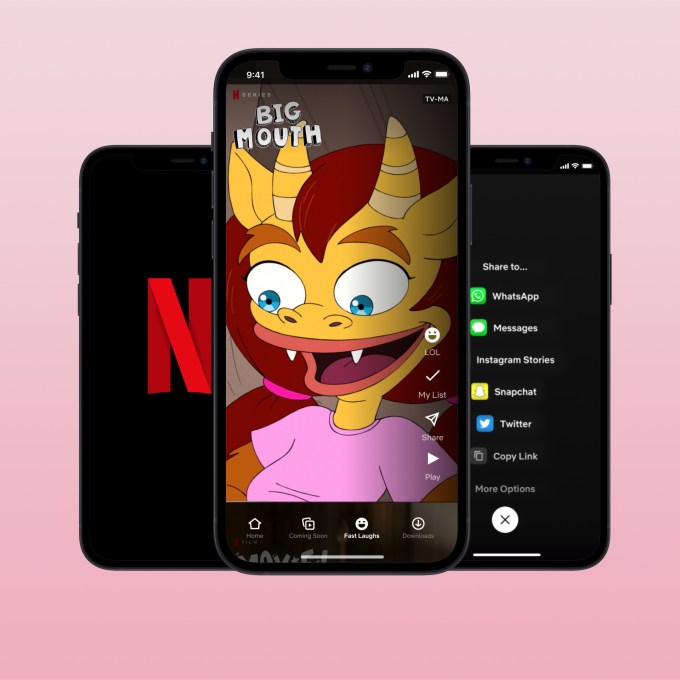
Late last year, Netflix began experimenting with a new TikTok-like feed of funny videos inside its mobile app, which it called “Fast Laughs.” Today, the company announced the new feature is now rolling out on iOS, allowing users to watch, react, or share the short clips as well as add the show or movie to your Netflix watchlist. You can also push a “Play” button to start watching the program immediately.

At launch, the feature will include short clips from Netflix’s comedy catalog, including films like “Murder Mystery,” series like “Big Mouth,” sitcoms like “The Crew,” as well as snippets from stand-up comedians like Kevin Hart and Ali Wong. Netflix confirmed to TechCrunch the feature will tap into its full catalog, not just its Original programs. However, the company couldn’t says how many total shows or movies would be featured in the new experience.

Image Credits: Netflix

The new feature been given prominent placement in the Netflix app, where it’s accessible from the bottom navigation menu on its own tab, next to “Coming Soon.” This is no small experiment, then — but rather an indication of how successful the early tests of the “Fast Laughs” feature must have been in terms of engaging users and connecting them to Netflix content.

This is not the first time Netflix has borrowed concepts from social media to help users discover new shows or movies to watch in its app. A few years ago, Netflix introduced its own short-form video “Stories” feature, called Previews, for example. But times have changed. Now users are drawn to short-form vertical video feeds, like those popularized by TikTok.

Image Credits: Netflix

“Fast Laughs” heavily borrows from the TikTok format, as its feed also features full-screen videos that you can swipe through vertically, and places the engagement buttons on the right side of the screen. These buttons let you react with an “LOL” (crying/laughing) emoji to the clip or share it via iMessage or social media apps, like WhatsApp, Instagram, Snapchat or Twitter. You can also start watch the show immediately or save it for later viewing by adding it to “My List.”

During tests, “Fast Laughs” clips ranged in length anywhere from 15 to 45 seconds. Today, Netflix says there’s no exact clip length for these video snippets.

Image Credits: Netflix

The company is positioning the feature as a discovery tool.

“We wanted to give members a fun, fast, and intuitive way to discover our catalog by letting these comedic moments across genres speak for themselves in a mobile-native, full screen experience,” said Product Designer Kim Ho, previously worked on product design at both Facebook, Instacart, and Coin. “We worked hard to cut to just what was necessary in an intentional and minimalist UI design, from the transparent tab bar to ways to react in the moment (‘LOL’) and plan their next laugh by adding to their list,” she added.

But though “Fast Laughs” is focused on finding new things to watch, the feature could, in fact, help Netflix compete with TikTok in terms of time spent on mobile devices, as it caters to the growing demand for shorter, more “snackable” video content.

Netflix says the feature is rolling out now to iOS and will begin testing on Android in the months to come.


News: After 200% ARR growth in 2020, CourseKey raises $9M to digitize trade schools

When the COVID-19 pandemic hit and forced educational institutions to go virtual, many were scrambling to develop online or blended curriculums. That struggle was particularly challenging for trade schools, many of which were not designed to teach online and were mostly paper-driven.  CourseKey, a San Diego-based trade school management SaaS startup, was in a unique

When the COVID-19 pandemic hit and forced educational institutions to go virtual, many were scrambling to develop online or blended curriculums.

That struggle was particularly challenging for trade schools, many of which were not designed to teach online and were mostly paper-driven. 

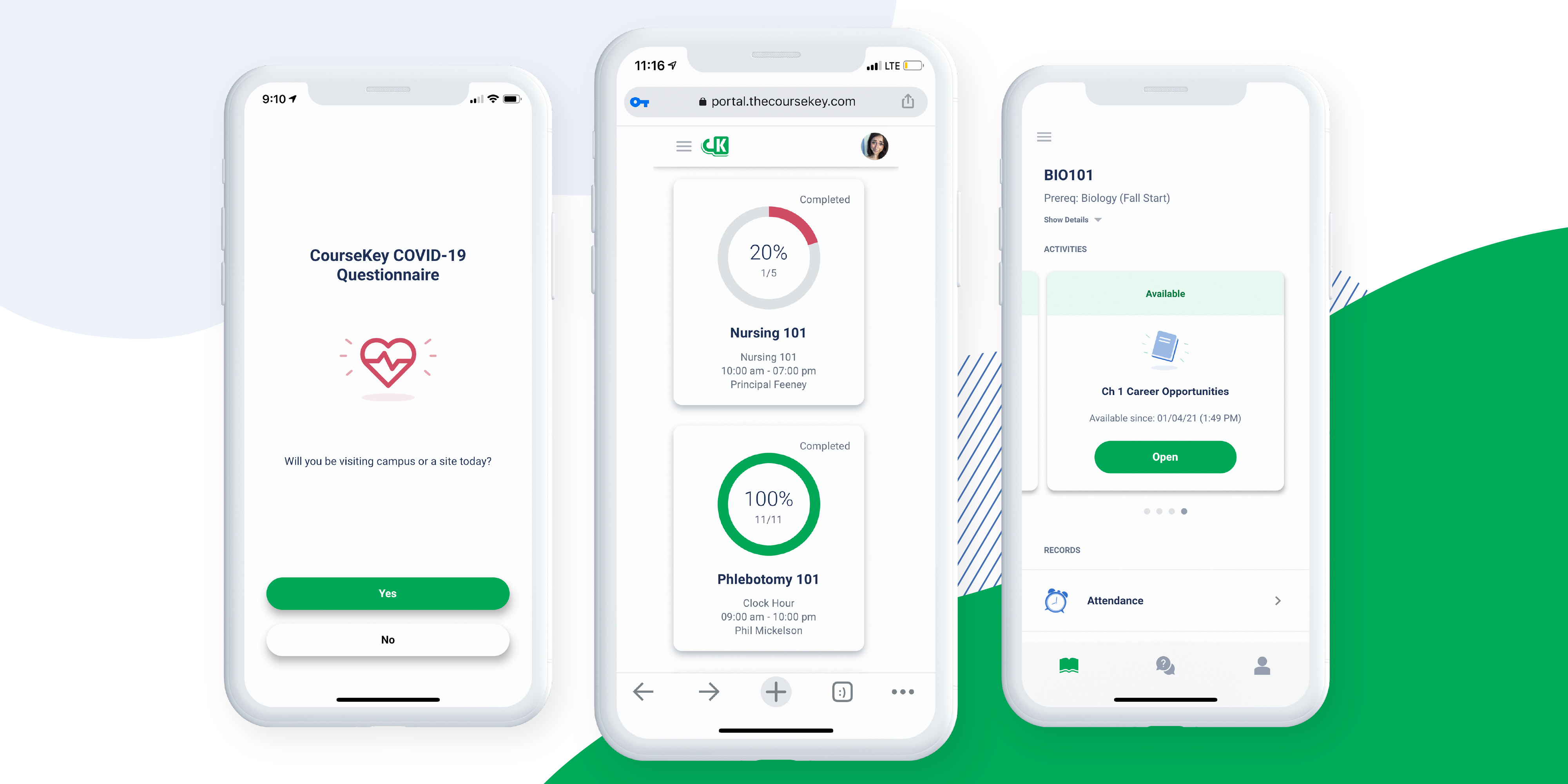
CourseKey, a San Diego-based trade school management SaaS startup, was in a unique position. Demand surged and its ARR grew by 200% in 2020. And now, the company has raised $9 million in a Series B led by SignalFire and with participation from existing backer Builders VC to help it continue its momentum. 

Founded in 2015 by Luke Sophinos and Fadee Kannah, CourseKey’s B2B platform is designed to work with organizations that teach some of our most essential workers — from automotive mechanics to electricians to plumbers to nurses, phlebotomists and dental assistants.

CourseKey founders Luke Sophinos (left) and Faddee Kannah (right)

CourseKey founders Luke Sophinos (left) and Fadee Kannah (right)

The goal is to help those organizations boost revenue by improving student retention and graduation rates, helping them maintain regulatory compliance and generally streamline processes. 

“Things really took off last year when the coronavirus hit,” Sophinos said. “So many schools had to adopt a digital arsenal. We saw a massive acceleration trend that was already going to happen. Every industry had been eaten. We just found a space that wasn’t yet.”

CourseKey currently works with over 200 career colleges, including the Paul Mitchell School and the Institute for Business & Technology, among others. Over 100,000 students use its software.

For Sophinos and Kannah, founding CourseKey was more than just a business opportunity. Kannah, who had fled Iraq as a refugee, saw family members going through trade schools that were lacking technology infrastructure and modern software tools. He architected the CourseKey platform. 

Sophinos, frustrated by his own college experience, applied for The Thiel Fellowship – a program that supports students in company building instead of university attending. However, he recognized that not everyone who doesn’t want to go to traditional college has that option.

“While looking at alternatives, our early team began recognizing a market that we felt no one was paying attention to. It was occupied by our friends and by our family members,” Sophinos said. “It was a space that, for some odd reason, was largely being left out of the education conversation.”

In 2017, CourseKey partnered with a large vocational education provider to build and launch what Sophinos describes as “the world’s first trade school management system.”

“We focused on automating daily classroom procedures like attendance and grading, enhancing the student experience through communication tools, helping to identify at-risk students, and simplifying compliance,” he said. “We also visualized data for retention purposes.”

CourseKey also does things like track skill attainment, run evaluations and exams and integrate third-party tools.

Image Credits: CourseKey

The startup’s goal with its new capital is to scale the platform to serve “every trade school in the country” with the mission of changing the narrative that four-year college is the “only option.” It also plans to add new features and capabilities, largely based on customer requests. CourseKey also plans to nearly double its current headcount of just over 50 employees to nearly 100 over the next two years.

“This is a massive market and massive business opportunity,” Sophinos said.

CourseKey has an impressive list of supporters beyond SignalFire and Builders. Steve Altman, former vice chairman and president of Qualcomm, led its $3.5 million seed round which also included participation from Larry Rosenberger, former FICO CEO. Dennis Yang, former CEO of edtech giant Udemy, and Altman now serve on its board.

SignalFire Managing Director Wayne Hu, who also took a seat on the startup’s board with the new round, said his firm recognized that vocational schools and their administrators, instructors, and students “suffer from a lack of purpose-built software.”

“Student Information Systems and Learning Management Systems are optimized for traditional K-12 schools and university workflow, but vocational schools are stuck relying on pen and paper or trying to shoe-horn in solutions that aren’t built for them,” Hu wrote in a blog post.

CourseKey, in SignalFire’s view, is reimagining a new education operating system built specifically for experiential, hands-on learning models, which continues to evolve with hybrid/distance learning.  

Hu also pointed out that since many of the jobs that vocational schools are preparing people for “have life or death consequences,” they are highly regulated.

“Not only does CourseKey improve trade school business KPIs, it serves as insurance against this existential risk,” he added.

News: First impressions of AppLovin’s IPO filing

Could a bet on AppLovin then, could be viewed as a wager not on its business income growth, but on the strength of consumer app demand?

AppLovin released its S-1 filing yesterday, bringing the Palo Alto-based mobile app-focused software company a step closer to joining the public markets.

The business results detailed in the document are generally impressive. While some companies going public in recent months have detailed pandemic-fueled growth to lean against or membership in a sector hotter than individual results, AppLovin’s filing tells the story of a rapidly growing company that has managed to scale adjusted profit as it has grown.

And now, with annual revenue north of $1 billion, AppLovin is also a very large company, meaning that its IPO will be widely watched.


The Exchange explores startups, markets and money. Read it every morning on Extra Crunch, or get The Exchange newsletter every Saturday.


So this morning we’re rifling through its IPO filing and yanking out what matters as we add one more name to our IPO lists.

The Exchange has a lengthy list of non-IPO topics that we’d like to get to. If everyone could stop going public for a few days, we’d love to write about something else! OK, let’s get into it!

Most of the news is good

As a short introduction, the company’s products are designed to help developers find users and monetize their apps. And AppLovin has its own in-house suite of mobile apps, what its S-1 calls a “globally diversified portfolio of over 200 free-to-play mobile games run by 12 studios.” Those apps have 32 million global daily actives, the document added.

It’s a pretty neat company to dig into if you’re into mobile apps at all. Regardless, what we care about today are its numbers. So let’s talk growth, revenue quality, profits, cash consumption and capital structure. Most of the news is good, even if there are some downsides to AppLovin’s capital structure.

Recall that KKR bought a chunk of AppLovin back in mid-2018 at a valuation of around $2 billion. That number appears comically low, given that the company posted $483.4 million in revenue that year, a figure that it roughly doubled in 2019 to $994.1 million. Growth slowed in percentage terms in 2020, when AppLovin saw total revenues of $1.45 billion, though the company managed similar growth in gross-dollar terms.

In percentage terms, AppLovin grew 106% from 2018 to 2019, and 46% from 2019 to 2020. How KKR got to buy into the company at 4x revenues when it was growing at 100% is not clear.

The company is growing well, but is AppLovin accreting revenue of high quality? Yes, but we need to scrape some grime off the numbers to understand them. Turning to the company’s yearly results, AppLovin’s cost of revenue rose steadily as a percentage of revenue from 2018 to 2020. Indeed, the numbers went from 11% in 2018 to 24% in 2019 and 38% in 2020. That’s an awful progression, and if we lacked more information we’d posit that the company’s overall revenue quality was sharply declining.

It’s not that bad. There’s about $1 million in share-based compensation inside the 2020 cost of revenue figure and $228.3 million of “amortization expense related to acquired intangibles.” If we yank out those from the cost-of-revenue line item, AppLovin’s gross margin for 2020 grows from 62% to 77.5%. That’s much better.

News: Microsoft launches ‘Group Transcribe,’ a transcription and translation app for in-person meetings

A new project from Microsoft’s in-house incubator, Microsoft Garage, introduces a different take on meeting transcriptions. While today there are a number of real-time transcription apps to use on your phone — like Otter.ai or Google’s Recorder app for Pixel devices, for example — Microsoft’s new Group Transcribe app reimagines meeting transcriptions as a more

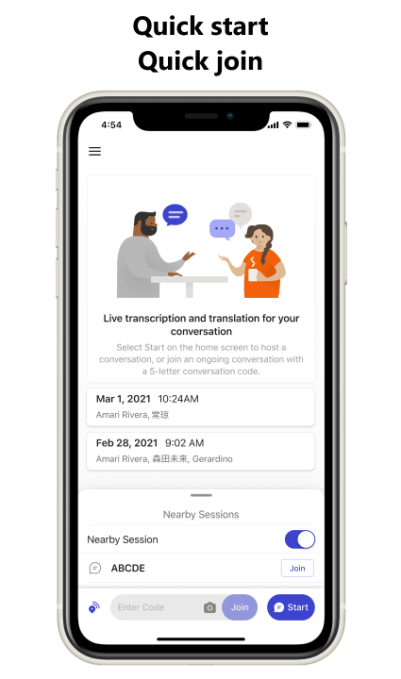
A new project from Microsoft’s in-house incubator, Microsoft Garage, introduces a different take on meeting transcriptions. While today there are a number of real-time transcription apps to use on your phone — like Otter.ai or Google’s Recorder app for Pixel devices, for example — Microsoft’s new Group Transcribe app reimagines meeting transcriptions as a more collaborative process, where everyone simultaneously records the meeting on their own device for higher accuracy. It also offers real-time translation for languages spoken in over 80 distinct locales.

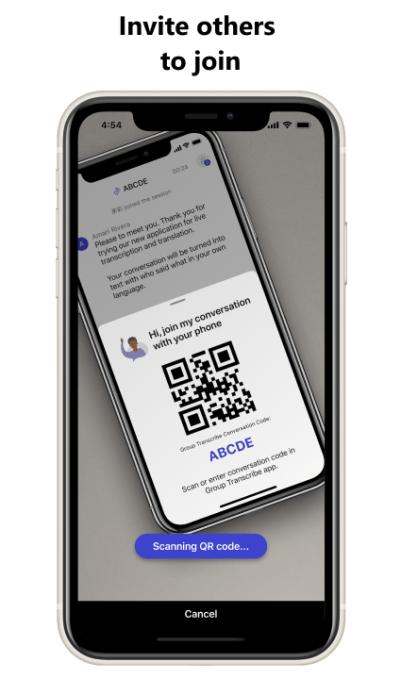
To use the app, one person would first initiate the meeting in their own device. They can then invite the other meeting attendees to join the session via Bluetooth, a scannable QR code or by sharing a link. After the other participants join the session and the meeting begins, each person will see the transcript appear in real-time on their own device.

Image Credits: Microsoft

The app, which is powered by A.I. speech and language technology, is able to transcribe with higher accuracy and speaker attribution based on the volume of the speaker captured by the microphone of each phone being used in the meeting.

By comparing the level of a person’s voice volume, the cloud service attempts to determine which device is closest to the speaker and the language preferences of that speaker. This means speakers are also accurately labeled in the app, which can be a challenge for other transcription apps where only one person is recording.

In addition, if meeting participants want to speak in their own language, the app can provide the translation to others’ devices in their own language.

Image Credits: Microsoft

Microsoft says the app is designed with accessibility in mind, as it makes it easier for people who are deaf, hard of hearing, and non-native speakers to more fully participate in meetings by following along through the live transcriptions and translations.

The project itself was built by Microsoft employees who collectively speak over a dozen different languages and dialects.

“This can be a fantastic tool for communication. What I would love to see is for this to break down barriers for people speaking across multiple languages,” said Franklin Munoz, Principal Development Lead, when introducing the project.

Like most cloud-based transcription services, the app should not be used for highly confidential meetings. However, Microsoft has built granular data and privacy controls that allow users to decide if or when they want to share their conversation data.

Image Credits: Microsoft

To work, the audio and text input data collected is sent to Microsoft’s online speech recognitions and translation technologies — though with a randomly generated identifier, not your real name.

While Microsoft doesn’t save the meeting transcripts and recordings itself after the fact — they’re saved on your device — the app does encourage participants to “contribute” their meetings recordings to Microsoft so it can improve the service.

This allows Microsoft to retain the audio and speech recognition-generated text transcriptions when all meeting participants agree to opt in for that session. By reviewing the data, Microsoft aims to improve its speech recognition and speaker attribution capabilities over time, it says. The user data will then be accessed under NDA by both Microsoft employees and contractors from other companies who work for Microsoft, but won’t include any of the speakers’ account credentials.

Reviewers will also only have access to randomized snippets of audio, not full recordings. And Microsoft says it “de-identifies” meeting recordings by removing long strings of numbers that could represent things like credit card numbers or phone numbers, for example. Users can delete their previously shared recordings at any time, but otherwise they’re retained for up to 2 years on encrypted servers, the company says.

Because there’s not a way for a business, at an admin level, to configure or block the “contribution” setting for all users, people should carefully weigh the advantages and risks of such a service. It’s also a Microsoft Garage project, meaning it’s meant to be more experimental and could be shuttered at any time.

Currently, the Group Transcribe app is available on iOS only.


WordPress Image Lightbox Plugin